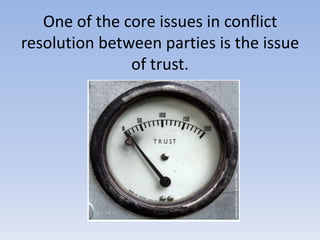

One of the core issues in conflict resolution between parties is the issue of trust.
Trust is a key resource in the conflict management process.
trust is having positive expectations about another's motives and intentions toward us where potential risk is involved.
RISKRisk is a key element of trust, in the sense that we have to take risks (small or large) to explore, test, and eventually build trust. Without actually relying on someone, without taking a small risk with them, we can never really know if we can trust them. The level of trust we have in the sit­uation or the people affects the size of the risk we'll take and how frequently we'll take those risks. Risk is integral to trust at all levels.
MOTIVEThe motives and intentions of other people are invisible to us, we can only infer or attrib­ute motives based on their behaviour; or, more accurately, how we interpret their behaviour. Our assignment of motives to other people is critical, because it also determines how we assign fault and blame. When con­flict arises, how we decide who caused it, and therefore who is at fault and who is to blame, will determine what hap­pens to our level of trust with the other party.
Attribution Theory and Self-Serving BiasWhen a negative event arises, when we are hurt or harmed, we begin by attributing the cause to someone or something. We do this in order to make sense of what has happened. And we have a strong tendency to attribute in a particular Way.
Attribution to SELFWhen we are involved with or cause a negative event, we have a strong tendency to attribute the cause to the situation, such orders from our boss that we had no choice about, market forces, or other circumstances that we see as beyond our control. In essence, we attribute the best of intentions to ourselves and blame outside circumstances for the problem, thus minimizing the fault or blame.
Attribution to OthersWhen others are involved with or cause a negative event, we have a strong tendency to ignore (or minimize) the situation­al factors and attribute the cause to the intrinsic nature or bad intentions of the other person. In other words, we lay fault and blame on the other individual personally; we attribute the cause to their innate bad character, their indifference, even their obvious bad intentions. We give ourselves the benefit of the doubt (big time), but do not give that to others.
Effect of Self-Serving Bias on Trust the negative events are attributed in a way that exaggerates the wrong, invents bad intentions, blames the other party to the point of feeling betrayed, and makes the conflict deeply personal. All of this happens because of the assumptions driven by the self-serving bias and not because of what is necessarily true.
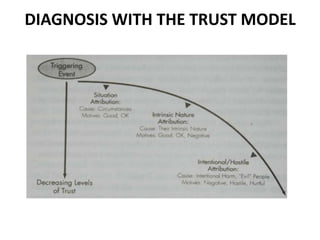
DIAGNOSIS WITH THE TRUST MODEL Trust Model says thatthere are fundamentally three types of attributions peo­ple can make in conflict situations:Situation Attribution Intrinsic Nature AttributionIntentional / Hostile Attribution
DIAGNOSIS WITH THE TRUST MODEL
Situation Attribution Some examples of a Situation attribution are:A boss fires three employees because the company is close to bankruptcy and he doesn't have any other option.A person kills an intruder or attacker purely in self-defence. A person rear-ends the car in front because of black ice on the road.A clerk makes a mistake because he was never trained properly on the computer system.
Intrinsic Nature attributionSome examples of an Intrinsic Nature attribution are:A manager who steps on people's toes because she is a worka­holic committed to meeting the team's goals and objectives; A child or a mentally incompetent person who starts a fire that injures someone;An employee who doesn't address a problem because he simply cannot deal with confrontation of any kind;Parents who push their children incessantly to go to university because they never had the chance themselves;A friend who betrays a trust because he or she is incapable of keeping a secret.
Intentional / Hostile AttributionSome examples of Intentional attribution are:An insurance claimant who is lying to collect on the insurance policy;Bosses who degrade employees in front of the team because they enjoy using their power, or to simply "teach them who is boss";A boss who fires an employee to make himself look good and get promoted;A person who deliberately breaks a contract because he or she found a cheaper price elsewhere;A friend who betrays a trust for personal gain.
How Attributions FormMotives and intentions cannot be seen, they can only be inferred from our interpretation of the other party's behaviour. Attributions, therefore, are fundamentally perceptions, not reality. Perceptions are influenced mostly by two factors: information and preconceptions.
How Attributions FormInformation, or data, can greatly influence the attributions madePreconceptions refer to the values, beliefs, past experiences, stereotypes, and assumptions that we all carry.
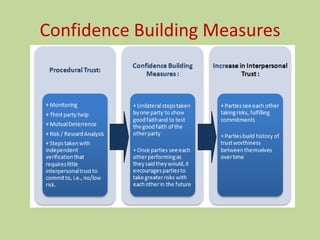
STRATEGIC DIRECTION FROM THE TRUST MODELThe Trust model identifies two brood types of trust that parties are always relying on: interpersonal trustproce­dural trust.
INTERPERSONAL TRUSTis a set of feelings that defines how comfort­able we are taking a given level of risk with a specific person. This has to do with our judgment of that person's character, integrity, values, and so on. It answers the question, "How much do I trust this individual?"
Procedural Trustis the trust we place in a structure or process we are involved in, as opposed to the individual. For example, parties often attempt mediation when they have very little trust in each other, and may have little experience with the mediator as well. In this case, they are placing their trust in the mediation process itself. It answers the question, "How much trust do 1 have in the process itself, regardless of the individual(s) involved?"
Confidence Building Measures
ASSESSING AND APPLYING THE TRUST MODEL
_NONVERBALS CONSULTINGCell: +91.9886.112211  +91.9886009796DictaScript Inc. #12/7, 3rd Floor, ShamRao Compound, Mission RoadBangalore 560027. INDIA. Tel:  +91.80.4113.1507 | Fax: +91.80.2663.6732hi@nonverbals.com | nonverbals@gmail.com | www.nonverbals.com

Dynamics Of Trust

  • 2.
    One of thecore issues in conflict resolution between parties is the issue of trust.
  • 3.
    Trust is akey resource in the conflict management process.
  • 4.
    trust is havingpositive expectations about another's motives and intentions toward us where potential risk is involved.
  • 5.
    RISKRisk is akey element of trust, in the sense that we have to take risks (small or large) to explore, test, and eventually build trust. Without actually relying on someone, without taking a small risk with them, we can never really know if we can trust them. The level of trust we have in the sit­uation or the people affects the size of the risk we'll take and how frequently we'll take those risks. Risk is integral to trust at all levels.
  • 6.
    MOTIVEThe motives andintentions of other people are invisible to us, we can only infer or attrib­ute motives based on their behaviour; or, more accurately, how we interpret their behaviour. Our assignment of motives to other people is critical, because it also determines how we assign fault and blame. When con­flict arises, how we decide who caused it, and therefore who is at fault and who is to blame, will determine what hap­pens to our level of trust with the other party.
  • 7.
    Attribution Theory andSelf-Serving BiasWhen a negative event arises, when we are hurt or harmed, we begin by attributing the cause to someone or something. We do this in order to make sense of what has happened. And we have a strong tendency to attribute in a particular Way.
  • 8.
    Attribution to SELFWhenwe are involved with or cause a negative event, we have a strong tendency to attribute the cause to the situation, such orders from our boss that we had no choice about, market forces, or other circumstances that we see as beyond our control. In essence, we attribute the best of intentions to ourselves and blame outside circumstances for the problem, thus minimizing the fault or blame.
  • 9.
    Attribution to OthersWhenothers are involved with or cause a negative event, we have a strong tendency to ignore (or minimize) the situation­al factors and attribute the cause to the intrinsic nature or bad intentions of the other person. In other words, we lay fault and blame on the other individual personally; we attribute the cause to their innate bad character, their indifference, even their obvious bad intentions. We give ourselves the benefit of the doubt (big time), but do not give that to others.
  • 10.
    Effect of Self-ServingBias on Trust the negative events are attributed in a way that exaggerates the wrong, invents bad intentions, blames the other party to the point of feeling betrayed, and makes the conflict deeply personal. All of this happens because of the assumptions driven by the self-serving bias and not because of what is necessarily true.
  • 11.
    DIAGNOSIS WITH THETRUST MODEL Trust Model says thatthere are fundamentally three types of attributions peo­ple can make in conflict situations:Situation Attribution Intrinsic Nature AttributionIntentional / Hostile Attribution
  • 12.
    DIAGNOSIS WITH THETRUST MODEL
  • 13.
    Situation Attribution Someexamples of a Situation attribution are:A boss fires three employees because the company is close to bankruptcy and he doesn't have any other option.A person kills an intruder or attacker purely in self-defence. A person rear-ends the car in front because of black ice on the road.A clerk makes a mistake because he was never trained properly on the computer system.
  • 14.
    Intrinsic Nature attributionSomeexamples of an Intrinsic Nature attribution are:A manager who steps on people's toes because she is a worka­holic committed to meeting the team's goals and objectives; A child or a mentally incompetent person who starts a fire that injures someone;An employee who doesn't address a problem because he simply cannot deal with confrontation of any kind;Parents who push their children incessantly to go to university because they never had the chance themselves;A friend who betrays a trust because he or she is incapable of keeping a secret.
  • 15.
    Intentional / HostileAttributionSome examples of Intentional attribution are:An insurance claimant who is lying to collect on the insurance policy;Bosses who degrade employees in front of the team because they enjoy using their power, or to simply "teach them who is boss";A boss who fires an employee to make himself look good and get promoted;A person who deliberately breaks a contract because he or she found a cheaper price elsewhere;A friend who betrays a trust for personal gain.
  • 16.
    How Attributions FormMotivesand intentions cannot be seen, they can only be inferred from our interpretation of the other party's behaviour. Attributions, therefore, are fundamentally perceptions, not reality. Perceptions are influenced mostly by two factors: information and preconceptions.
  • 17.
    How Attributions FormInformation,or data, can greatly influence the attributions madePreconceptions refer to the values, beliefs, past experiences, stereotypes, and assumptions that we all carry.
  • 18.
    STRATEGIC DIRECTION FROMTHE TRUST MODELThe Trust model identifies two brood types of trust that parties are always relying on: interpersonal trustproce­dural trust.
  • 19.
    INTERPERSONAL TRUSTis aset of feelings that defines how comfort­able we are taking a given level of risk with a specific person. This has to do with our judgment of that person's character, integrity, values, and so on. It answers the question, "How much do I trust this individual?"
  • 20.
    Procedural Trustis thetrust we place in a structure or process we are involved in, as opposed to the individual. For example, parties often attempt mediation when they have very little trust in each other, and may have little experience with the mediator as well. In this case, they are placing their trust in the mediation process itself. It answers the question, "How much trust do 1 have in the process itself, regardless of the individual(s) involved?"
  • 21.
  • 22.
    ASSESSING AND APPLYINGTHE TRUST MODEL
  • 24.
    _NONVERBALS CONSULTINGCell: +91.9886.112211 +91.9886009796DictaScript Inc. #12/7, 3rd Floor, ShamRao Compound, Mission RoadBangalore 560027. INDIA. Tel:  +91.80.4113.1507 | Fax: +91.80.2663.6732hi@nonverbals.com | nonverbals@gmail.com | www.nonverbals.com