The Family Roles of Addiction
How the problem of addiction can imbalance our family roles...
Question to ponder...
When a family member is an alcoholic (or
chemical addict), how do you think it affects
the family? How do you think it affects the
individuals in the family?
Let’s take a look at family roles...
Addiction throws off the “balance” of the
family roles. New roles will be formed to
relieve the pain, restore the balance, and
keep the family together!
The new roles will also take attention away
from the addict, unintentionally allowing
him or her to avoid facing the real problem
The “Star” of the show!
“The Star” -often times a parent

 The star is the addict. The role is called the “star” because
the addiction has such a large impact on the way the family
functions. The star is usually in denial, and is blinded by his/
her chemical addiction. Many times, the star struggles to fulfill
their family responsibilities. Who will help take over their
responsibilities for them?
“The Chief Enabler”
“The Chief Enabler”- usually a spouse

 Enablers knowingly or unknowingly do things that allow
the addict to progress in their addiction, and many times
help the addict hide from the consequences of their
behavior. Enablers may make excuses for the addict, deny
the problem, blame other circumstances, or even defend the
addict’s behavior.
Who will take over the responsibilities that the enabler is
supposed to fulfill?
“The Hero”
“The Hero”- usually an
older child
The hero tries to do as much as possible
to help the family out. They are usually
perfectionists or overachievers, and
many times are also in denial of the
family problem.
“the forgotten child”
“The Forgotten Child”- usually a younger child

 The forgotten child may spend time alone to escape the problem.
They can experience social difficulties (Imaginary friends, make
believe play), and may be very shy. They also may have a hard time
talking about their feelings or problems.
“The Scapegoat”
“The Scapegoat”- May be
any family member

 The scapegoat will unwillingly assume
the blame for the family, instead of the
addiction itself. The scapegoat may get
into trouble often, have a “rebel” or “I don’t
care” attitude, and takes attention away
from the drinker.
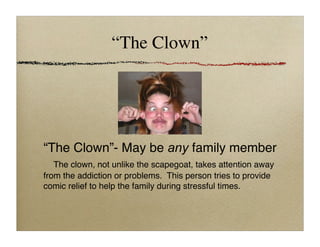
“The Clown”
“The Clown”- May be any family member

 The clown, not unlike the scapegoat, takes attention away
from the addiction or problems. This person tries to provide
comic relief to help the family during stressful times.

familyaddictionroles

  • 1.
    The Family Rolesof Addiction How the problem of addiction can imbalance our family roles...
  • 2.
    Question to ponder... Whena family member is an alcoholic (or chemical addict), how do you think it affects the family? How do you think it affects the individuals in the family?
  • 3.
    Let’s take alook at family roles... Addiction throws off the “balance” of the family roles. New roles will be formed to relieve the pain, restore the balance, and keep the family together! The new roles will also take attention away from the addict, unintentionally allowing him or her to avoid facing the real problem
  • 4.
    The “Star” ofthe show! “The Star” -often times a parent The star is the addict. The role is called the “star” because the addiction has such a large impact on the way the family functions. The star is usually in denial, and is blinded by his/ her chemical addiction. Many times, the star struggles to fulfill their family responsibilities. Who will help take over their responsibilities for them?
  • 5.
    “The Chief Enabler” “TheChief Enabler”- usually a spouse Enablers knowingly or unknowingly do things that allow the addict to progress in their addiction, and many times help the addict hide from the consequences of their behavior. Enablers may make excuses for the addict, deny the problem, blame other circumstances, or even defend the addict’s behavior. Who will take over the responsibilities that the enabler is supposed to fulfill?
  • 6.
    “The Hero” “The Hero”-usually an older child The hero tries to do as much as possible to help the family out. They are usually perfectionists or overachievers, and many times are also in denial of the family problem.
  • 7.
    “the forgotten child” “TheForgotten Child”- usually a younger child The forgotten child may spend time alone to escape the problem. They can experience social difficulties (Imaginary friends, make believe play), and may be very shy. They also may have a hard time talking about their feelings or problems.
  • 8.
    “The Scapegoat” “The Scapegoat”-May be any family member The scapegoat will unwillingly assume the blame for the family, instead of the addiction itself. The scapegoat may get into trouble often, have a “rebel” or “I don’t care” attitude, and takes attention away from the drinker.
  • 9.
    “The Clown” “The Clown”-May be any family member The clown, not unlike the scapegoat, takes attention away from the addiction or problems. This person tries to provide comic relief to help the family during stressful times.