© Dr. Dafda
Patterns and Pattern Classes in
Object Recognition for DIP
and its implementation in MATLAB
72
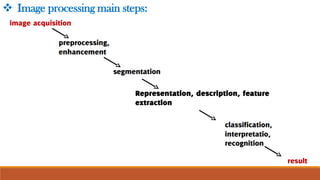
❖ Image processing main steps:
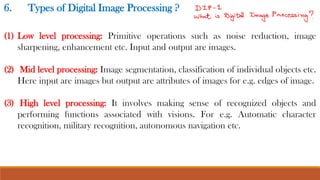
6. Types of Digital Image Processing ?
(1) Low level processing: Primitive operations such as noise reduction, image
sharpening, enhancement etc. Input and output are images.
(2) Mid level processing: Image segmentation, classification of individual objects etc.
Here input are images but output are attributes of images for e.g. edges of image.
(3) High level processing: It involves making sense of recognized objects and
performing functions associated with visions. For e.g. Automatic character
recognition, military recognition, autonomous navigation etc.
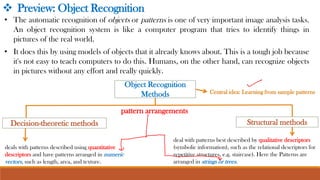
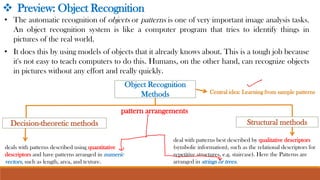
• The automatic recognition of objects or patterns is one of very important image analysis tasks.
An object recognition system is like a computer program that tries to identify things in
pictures of the real world.
• It does this by using models of objects that it already knows about. This is a tough job because
it's not easy to teach computers to do this. Humans, on the other hand, can recognize objects
in pictures without any effort and really quickly.
Object Recognition
Methods
Decision-theoretic methods
❖ Preview: Object Recognition
Structural methods
deals with patterns described using quantitative
descriptors and have patterns arranged in numeric
vectors, such as length, area, and texture.
deal with patterns best described by qualitative descriptors
(symbolic information), such as the relational descriptors for
repetitive structures, e.g. staircase). Here the Patterns are
arranged in strings or trees.
Central idea: Learning from sample patterns
pattern arrangements
• A pattern is an arrangement of descriptors (or features).
• A pattern class is a family of patterns that share some common properties. Pattern classes are
denoted w1, w2, . . . , wN where N is the number of classes.
• Pattern recognition by machine involves techniques for assigning patterns to their respective
classes automatically and with as little human intervention as possible.
• The object or pattern recognition task consists of two steps:
➢ feature selection (extraction)
➢ matching (classification)
There are three common pattern arrangements used in practice:
• Numeric pattern vectors (for quantitative descriptions)
𝑥1
𝑥 = 𝑥2
[ ⋮ ]
𝑥𝑛
• Strings and trees (for qualitative(structural) descriptions)
x = abababa….
❖ Patterns and Pattern Classes:
❖ Numeric Pattern vectors (Decision-theoretic methods):
• Fisher 1936, performed Recognition of three types of Iris flowers(Iris serosa,
versicolor and virginica by the lengths[x1] and widths[x2] of their petals.
• Here 3 pattern classes are w1, w2 and w3 corresponding to Iris setosa, versicolor
and virginica. Also there are variations between and within classes.
• Class separability depends strongly on the choice of descriptors.
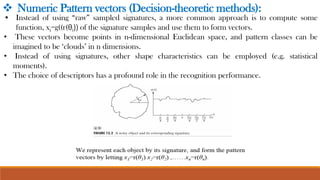
• Instead of using “raw” sampled signatures, a more common approach is to compute some
function, xi=g((r(θi)) of the signature samples and use them to form vectors.
• These vectors become points in n-dimensional Euclidean space, and pattern classes can be
imagined to be ‘clouds’ in n dimensions.
• Instead of using signatures, other shape characteristics can be employed (e.g. statistical
moments).
• The choice of descriptors has a profound role in the recognition performance.
❖ Numeric Pattern vectors (Decision-theoretic methods):
❖ String descriptors (Structural methods):
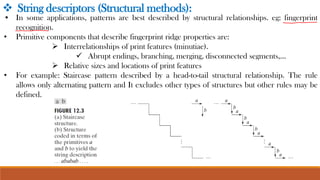
• In some applications, patterns are best described by structural relationships. eg: fingerprint
recognition.
• Primitive components that describe fingerprint ridge properties are:
➢ Interrelationships of print features (minutiae).
✓ Abrupt endings, branching, merging, disconnected segments,…
➢ Relative sizes and locations of print features
• For example: Staircase pattern described by a head-to-tail structural relationship. The rule
allows only alternating pattern and It excludes other types of structures but other rules may be
defined.
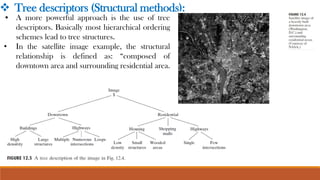
• A more powerful approach is the use of tree
descriptors. Basically most hierarchical ordering
schemes lead to tree structures.
• In the satellite image example, the structural
relationship is defined as: “composed of
downtown area and surrounding residential area.
❖ Tree descriptors (Structural methods):
Thank You
© Dr. Dafda
Recognition Based on Decision-Theoretic
Methods and Matching in Object Recognition
for DIP and its implementation in MATLAB
73
• The automatic recognition of objects or patterns is one of very important image analysis tasks.
An object recognition system is like a computer program that tries to identify things in
pictures of the real world.
• It does this by using models of objects that it already knows about. This is a tough job because
it's not easy to teach computers to do this. Humans, on the other hand, can recognize objects
in pictures without any effort and really quickly.
Object Recognition
Methods
Decision-theoretic methods
❖ Preview: Object Recognition
Structural methods
deals with patterns described using quantitative
descriptors and have patterns arranged in numeric
vectors, such as length, area, and texture.
deal with patterns best described by qualitative descriptors
(symbolic information), such as the relational descriptors for
repetitive structures, e.g. staircase). Here the Patterns are
arranged in strings or trees.
Central idea: Learning from sample patterns
pattern arrangements
• The basic concept in decision-theoretic methods is the idea of pattern matching
based on measures of distance between pattern vectors. Where it includes decision
(discriminant) functions and decision boundaries.
• Let x=[x1, x2,…, xn]T represent a pattern vector.
• For W pattern classes ω1, ω2,…, ωW, the basic problem is to find W decision
functions d1(x), d2(x),…, dW (x) with the property that if x belongs to class ωi:
di(x) > dj(x) for j = 1,2,..., W; j # i
• In other words, an unknown pattern x is said to belong to the ith pattern class if
upon substitution of x into all decision functions, di(x) yields the largest numerical
value. We want to classify x, which is a pattern. We are given a finite set of classes
of objects. We want to categorize the pattern x into one of the classes. To do so,
we apply x to all decision functions, and categorize x to the class of best fit.
❖ Decision-theoretic methods:
❖ Decision-theoretic methods (cont.):
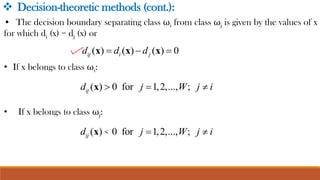
• The decision boundary separating class ωi from class ωj is given by the values of x
for which di (x) = dj (x) or
• If x belongs to class ωi:
• If x belongs to class ωj:
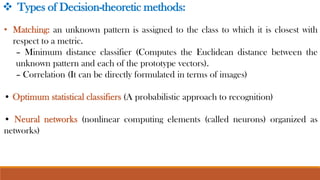
• Matching: an unknown pattern is assigned to the class to which it is closest with
respect to a metric.
– Minimum distance classifier (Computes the Euclidean distance between the
unknown pattern and each of the prototype vectors).
– Correlation (It can be directly formulated in terms of images)
• Optimum statistical classifiers (A probabilistic approach to recognition)
• Neural networks (nonlinear computing elements (called neurons) organized as
networks)
❖ Types of Decision-theoretic methods:
❖ Matching and Minimum distance classifier:
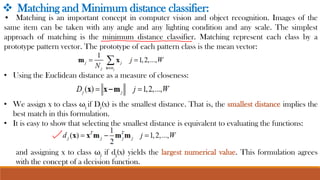
• Matching is an important concept in computer vision and object recognition. Images of the
same item can be taken with any angle and any lighting condition and any scale. The simplest
approach of matching is the minimum distance classifier. Matching represent each class by a
prototype pattern vector. The prototype of each pattern class is the mean vector:
• Using the Euclidean distance as a measure of closeness:
• We assign x to class ωj if Dj(x) is the smallest distance. That is, the smallest distance implies the
best match in this formulation.
• It is easy to show that selecting the smallest distance is equivalent to evaluating the functions:
and assigning x to class ωj if dj(x) yields the largest numerical value. This formulation agrees
with the concept of a decision function.
❖ Minimum distance classifier(cont.):
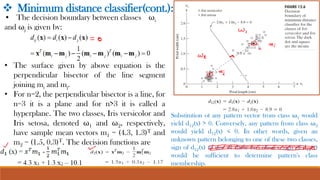
• The decision boundary between classes ωi
and ωj is given by:
• The surface given by above equation is the
perpendicular bisector of the line segment
joining mi and mj.
• For n=2, the perpendicular bisector is a line, for
n=3 it is a plane and for n>3 it is called a
hyperplane. The two classes, Iris versicolor and
Iris setosa, denoted ω1 and ω2, respectively,
have sample mean vectors m1 = (4.3, 1.3)T and
m2 = (1.5, 0.3)T. The decision functions are
Substitution of any pattern vector from class ω1 would
yield d12(x) > 0. Conversely, any pattern from class ω2
would yield d12(x) < 0. In other words, given an
unknown pattern belonging to one of these two classes,
sign of d12(x) to one of these two classes, sign of d12(x)
would be sufficient to determine pattern's class
membership.
• In practice, the classifier works well when the
distance between means is large compared to the
spread of each class. This occurs seldom unless the
system designer controls the nature of the input.
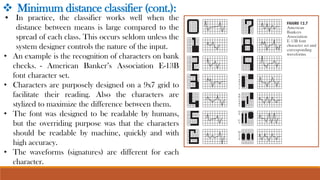
• An example is the recognition of characters on bank
checks. - American Banker’s Association E-13B
font character set.
• Characters are purposely designed on a 9x7 grid to
facilitate their reading. Also the characters are
stylized to maximize the difference between them.
• The font was designed to be readable by humans,
but the overriding purpose was that the characters
should be readable by machine, quickly and with
high accuracy.
• The waveforms (signatures) are different for each
character.
❖ Minimum distance classifier (cont.):
Thank You

Chap_10_Object_Recognition.pdf

  • 1.
    © Dr. Dafda Patternsand Pattern Classes in Object Recognition for DIP and its implementation in MATLAB 72
  • 2.
  • 3.
    6. Types ofDigital Image Processing ? (1) Low level processing: Primitive operations such as noise reduction, image sharpening, enhancement etc. Input and output are images. (2) Mid level processing: Image segmentation, classification of individual objects etc. Here input are images but output are attributes of images for e.g. edges of image. (3) High level processing: It involves making sense of recognized objects and performing functions associated with visions. For e.g. Automatic character recognition, military recognition, autonomous navigation etc.
  • 4.
    • The automaticrecognition of objects or patterns is one of very important image analysis tasks. An object recognition system is like a computer program that tries to identify things in pictures of the real world. • It does this by using models of objects that it already knows about. This is a tough job because it's not easy to teach computers to do this. Humans, on the other hand, can recognize objects in pictures without any effort and really quickly. Object Recognition Methods Decision-theoretic methods ❖ Preview: Object Recognition Structural methods deals with patterns described using quantitative descriptors and have patterns arranged in numeric vectors, such as length, area, and texture. deal with patterns best described by qualitative descriptors (symbolic information), such as the relational descriptors for repetitive structures, e.g. staircase). Here the Patterns are arranged in strings or trees. Central idea: Learning from sample patterns pattern arrangements
  • 5.
    • A patternis an arrangement of descriptors (or features). • A pattern class is a family of patterns that share some common properties. Pattern classes are denoted w1, w2, . . . , wN where N is the number of classes. • Pattern recognition by machine involves techniques for assigning patterns to their respective classes automatically and with as little human intervention as possible. • The object or pattern recognition task consists of two steps: ➢ feature selection (extraction) ➢ matching (classification) There are three common pattern arrangements used in practice: • Numeric pattern vectors (for quantitative descriptions) 𝑥1 𝑥 = 𝑥2 [ ⋮ ] 𝑥𝑛 • Strings and trees (for qualitative(structural) descriptions) x = abababa…. ❖ Patterns and Pattern Classes:
  • 6.
    ❖ Numeric Patternvectors (Decision-theoretic methods): • Fisher 1936, performed Recognition of three types of Iris flowers(Iris serosa, versicolor and virginica by the lengths[x1] and widths[x2] of their petals. • Here 3 pattern classes are w1, w2 and w3 corresponding to Iris setosa, versicolor and virginica. Also there are variations between and within classes. • Class separability depends strongly on the choice of descriptors.
  • 7.
    • Instead ofusing “raw” sampled signatures, a more common approach is to compute some function, xi=g((r(θi)) of the signature samples and use them to form vectors. • These vectors become points in n-dimensional Euclidean space, and pattern classes can be imagined to be ‘clouds’ in n dimensions. • Instead of using signatures, other shape characteristics can be employed (e.g. statistical moments). • The choice of descriptors has a profound role in the recognition performance. ❖ Numeric Pattern vectors (Decision-theoretic methods):
  • 8.
    ❖ String descriptors(Structural methods): • In some applications, patterns are best described by structural relationships. eg: fingerprint recognition. • Primitive components that describe fingerprint ridge properties are: ➢ Interrelationships of print features (minutiae). ✓ Abrupt endings, branching, merging, disconnected segments,… ➢ Relative sizes and locations of print features • For example: Staircase pattern described by a head-to-tail structural relationship. The rule allows only alternating pattern and It excludes other types of structures but other rules may be defined.
  • 9.
    • A morepowerful approach is the use of tree descriptors. Basically most hierarchical ordering schemes lead to tree structures. • In the satellite image example, the structural relationship is defined as: “composed of downtown area and surrounding residential area. ❖ Tree descriptors (Structural methods):
  • 10.
  • 11.
    © Dr. Dafda RecognitionBased on Decision-Theoretic Methods and Matching in Object Recognition for DIP and its implementation in MATLAB 73
  • 12.
    • The automaticrecognition of objects or patterns is one of very important image analysis tasks. An object recognition system is like a computer program that tries to identify things in pictures of the real world. • It does this by using models of objects that it already knows about. This is a tough job because it's not easy to teach computers to do this. Humans, on the other hand, can recognize objects in pictures without any effort and really quickly. Object Recognition Methods Decision-theoretic methods ❖ Preview: Object Recognition Structural methods deals with patterns described using quantitative descriptors and have patterns arranged in numeric vectors, such as length, area, and texture. deal with patterns best described by qualitative descriptors (symbolic information), such as the relational descriptors for repetitive structures, e.g. staircase). Here the Patterns are arranged in strings or trees. Central idea: Learning from sample patterns pattern arrangements
  • 13.
    • The basicconcept in decision-theoretic methods is the idea of pattern matching based on measures of distance between pattern vectors. Where it includes decision (discriminant) functions and decision boundaries. • Let x=[x1, x2,…, xn]T represent a pattern vector. • For W pattern classes ω1, ω2,…, ωW, the basic problem is to find W decision functions d1(x), d2(x),…, dW (x) with the property that if x belongs to class ωi: di(x) > dj(x) for j = 1,2,..., W; j # i • In other words, an unknown pattern x is said to belong to the ith pattern class if upon substitution of x into all decision functions, di(x) yields the largest numerical value. We want to classify x, which is a pattern. We are given a finite set of classes of objects. We want to categorize the pattern x into one of the classes. To do so, we apply x to all decision functions, and categorize x to the class of best fit. ❖ Decision-theoretic methods:
  • 14.
    ❖ Decision-theoretic methods(cont.): • The decision boundary separating class ωi from class ωj is given by the values of x for which di (x) = dj (x) or • If x belongs to class ωi: • If x belongs to class ωj:
  • 15.
    • Matching: anunknown pattern is assigned to the class to which it is closest with respect to a metric. – Minimum distance classifier (Computes the Euclidean distance between the unknown pattern and each of the prototype vectors). – Correlation (It can be directly formulated in terms of images) • Optimum statistical classifiers (A probabilistic approach to recognition) • Neural networks (nonlinear computing elements (called neurons) organized as networks) ❖ Types of Decision-theoretic methods:
  • 16.
    ❖ Matching andMinimum distance classifier: • Matching is an important concept in computer vision and object recognition. Images of the same item can be taken with any angle and any lighting condition and any scale. The simplest approach of matching is the minimum distance classifier. Matching represent each class by a prototype pattern vector. The prototype of each pattern class is the mean vector: • Using the Euclidean distance as a measure of closeness: • We assign x to class ωj if Dj(x) is the smallest distance. That is, the smallest distance implies the best match in this formulation. • It is easy to show that selecting the smallest distance is equivalent to evaluating the functions: and assigning x to class ωj if dj(x) yields the largest numerical value. This formulation agrees with the concept of a decision function.
  • 17.
    ❖ Minimum distanceclassifier(cont.): • The decision boundary between classes ωi and ωj is given by: • The surface given by above equation is the perpendicular bisector of the line segment joining mi and mj. • For n=2, the perpendicular bisector is a line, for n=3 it is a plane and for n>3 it is called a hyperplane. The two classes, Iris versicolor and Iris setosa, denoted ω1 and ω2, respectively, have sample mean vectors m1 = (4.3, 1.3)T and m2 = (1.5, 0.3)T. The decision functions are Substitution of any pattern vector from class ω1 would yield d12(x) > 0. Conversely, any pattern from class ω2 would yield d12(x) < 0. In other words, given an unknown pattern belonging to one of these two classes, sign of d12(x) to one of these two classes, sign of d12(x) would be sufficient to determine pattern's class membership.
  • 18.
    • In practice,the classifier works well when the distance between means is large compared to the spread of each class. This occurs seldom unless the system designer controls the nature of the input. • An example is the recognition of characters on bank checks. - American Banker’s Association E-13B font character set. • Characters are purposely designed on a 9x7 grid to facilitate their reading. Also the characters are stylized to maximize the difference between them. • The font was designed to be readable by humans, but the overriding purpose was that the characters should be readable by machine, quickly and with high accuracy. • The waveforms (signatures) are different for each character. ❖ Minimum distance classifier (cont.):
  • 19.