1
Chapter 2
Chapter 2
The
The
Process
Process
2
Software Engineering
 Defined by IEEE 610.12-1990 as:
Defined by IEEE 610.12-1990 as:
 (1) The application of a systematic, disciplined, quantifiable
(1) The application of a systematic, disciplined, quantifiable
approach to the development, operation, and maintenance
of software; that is, the application of engineering to software.
(2) The study of approaches in (1).
3
Software Engineering
A Layered
A Layered
Technology
Technology
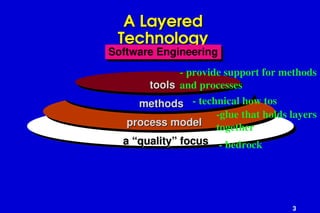
Software Engineering
a “quality” focus
a “quality” focus
process model
process model
methods
methods
tools
tools
- provide support for methods
and processes
- technical how tos
-glue that holds layers
together
- bedrock
4
Types of Software
Types of Software
Maintenance
Maintenance
 Corrective
Corrective
 Adaptive
Adaptive
 Perfective
Perfective
 Preventive
Preventive
5
A Common Process
A Common Process
Framework
Framework
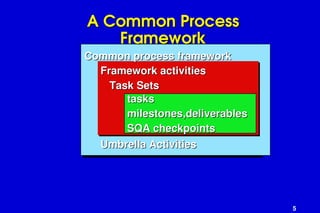
Common process framework
Framework activities
Task Sets
Task Sets
Umbrella Activities
Umbrella Activities
tasks
tasks
milestones,deliverables
SQA checkpoints
SQA checkpoints
6
Umbrella
Umbrella
Activities
Activities
 Software project management
Software project management
(tracking and control)
 Formal technical reviews
Formal technical reviews
 Software quality assurance
Software quality assurance
 Software configuration management
Software configuration management
 Document preparation and production
Document preparation and production
 Reusability management
Reusability management
 Measurement
Measurement
 Risk management
Risk management
7
The Process
The Process
Model:
Model:
Adaptability
Adaptability
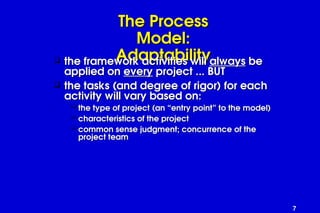
 the framework activities will
the framework activities will always
always be
be
applied on
applied on every
every project ... BUT
project ... BUT
 the tasks (and degree of rigor) for each
the tasks (and degree of rigor) for each
activity will vary based on:
 the type of project (an “entry point” to the model)
the type of project (an “entry point” to the model)
 characteristics of the project
characteristics of the project
 common sense judgment; concurrence of the
common sense judgment; concurrence of the
project team
project team
8
SEI CMM Levels
9
Process as Problem
Process as Problem
Solving
Solving
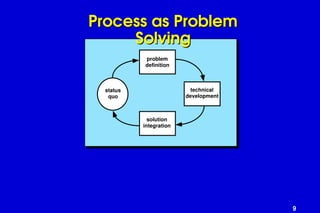
status
quo
problem
definition
technical
development
solution
integration
10
The Linear
The Linear
Model
Model
analysis design code test
System/information
engineering
11
System
Reqmts
Analysis
System
Architectural
Design
Software
Reqmts
Analysis
Software
Architectural
Design
Software
Detailed
Design
Software
Coding &
Testing
Software
Integration
Software
Qualification
Testing
System
Integration,
Qualification
& Release
Activities
Software
Item n
. . .
Software Item 1
Hardware
Items
Note: 1) Software Lifecycle Activities are bolded / shaded
2) This model is consistent with IEEE/EIA 12207.2 - 1997
Waterfall Model
12
Prototypin
Prototypin
g
g
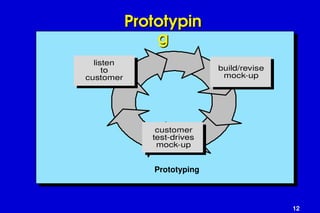
listen
to
customer
build/revise
mock-up
customer
test-drives
mock-up
Prototyping
13
RAD
RAD
business
modeling
data
modeling
process
modeling
application
generation
testing
&
turnover
business
modeling
data
modeling
process
modeling
application
generation
testing
&
turnover
business
modeling
data
modeling
process
modeling
application
generation
testing
&
turnover
team #1
team #2
team #3
60 - 90 days
14
The Incremental
The Incremental
Model
Model
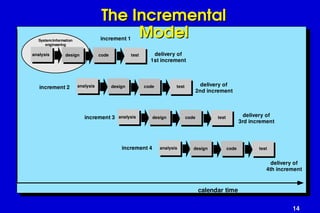
analysis design code test
System/information
engineering
analysis design code test
increment 2
increment 3
increment 4
increment 1
delivery of
1st increment
delivery of
2nd increment
delivery of
3rd increment
delivery of
4th increment
calendar time
15
16
An Evolutionary (Spiral)
Model
Model
Customer
Communication
Planning
Construction & Release
Customer
Evaluation
Engineering
Risk Analysis
17
18
Still Other Process
Still Other Process
Models
Models
 WINWIN spiral model - defines negotiating activities
WINWIN spiral model - defines negotiating activities
and adds anchor points to spiral model
 Concurrent process model
Concurrent process model—recognizes that different
—recognizes that different
part of the project will be at different places in the
process
process
 Component-based development model
Component-based development model—the process
—the process
to apply when reuse is a development objective
 Formal methods
Formal methods—the process to apply when a
—the process to apply when a
mathematical specification is to be developed
 Cleanroom software engineering
Cleanroom software engineering—emphasizes error
—emphasizes error
detection
detection before
before testing
testing

software requirement engineeringg.ppt