Chapter 5 Activity-Based Costing and Management
Learning  Objective 1
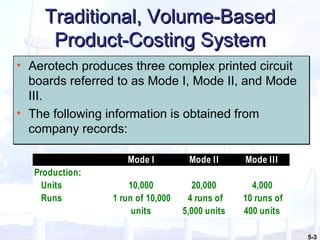
Traditional, Volume-Based Product-Costing System Aerotech produces three complex printed circuit boards referred to as Mode I, Mode II, and Mode III. The following information is obtained from company records:
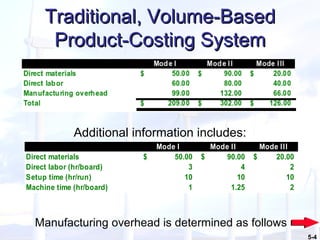
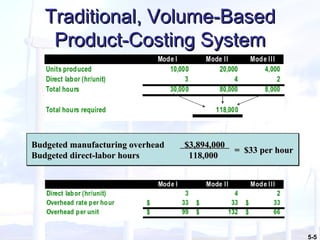
Traditional, Volume-Based Product-Costing System Additional information includes: Manufacturing overhead is determined as follows
Traditional, Volume-Based Product-Costing System Budgeted manufacturing overhead  $3,894,000  Budgeted direct-labor hours  118,000 =  $33 per hour
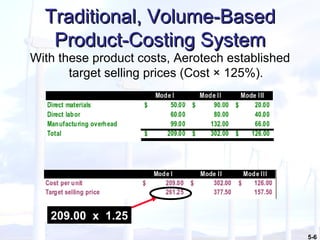
Traditional, Volume-Based Product-Costing System With these product costs, Aerotech established target selling prices (Cost × 125%). 209.00  x  1.25
Learning  Objective 2
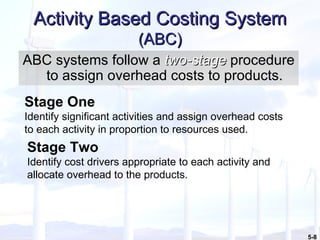
Activity Based Costing System  (ABC) ABC systems follow a  two-stage  procedure to assign overhead costs to products. Stage One Identify significant activities and assign overhead costs to each activity in proportion to resources used. Stage Two Identify cost drivers appropriate to each activity and allocate overhead to the products.
Learning  Objective 3
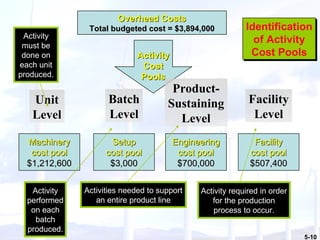
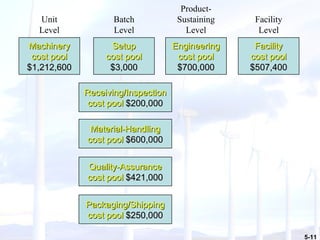
Overhead Costs Total budgeted cost = $3,894,000 Activity Cost Pools Machinery cost pool $1,212,600 Setup cost pool $3,000 Engineering cost pool $700,000 Facility cost pool $507,400 Unit Level Batch Level Product- Sustaining Level Facility Level Identification of Activity Cost Pools Activity must be done on each unit produced. Activity performed on each batch produced. Activities needed to support an entire product line Activity required in order for the production process to occur.
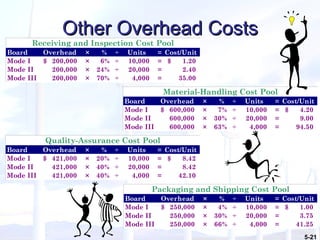
Receiving/Inspection cost pool  $200,000 Material-Handling cost pool  $600,000 Quality-Assurance cost pool  $421,000 Packaging/Shipping cost pool  $250,000 Machinery cost pool $1,212,600 Setup cost pool $3,000 Engineering cost pool $700,000 Facility cost pool $507,400 Unit Level Batch Level Product- Sustaining Level Facility Level
Learning  Objectives 3 & 4
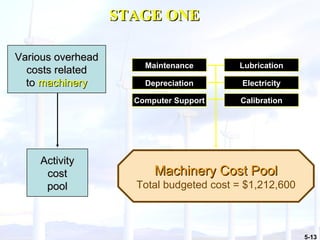
Machinery Cost Pool Total budgeted cost = $1,212,600 Activity cost pool STAGE ONE Various overhead costs related to  machinery Maintenance Depreciation Computer Support Lubrication Electricity Calibration
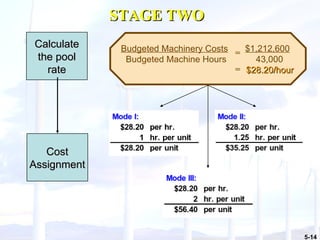
Calculate the pool rate Budgeted Machinery Costs   $1,212,600 Budgeted Machine Hours  43,000 $28.20/hour Cost Assignment STAGE TWO = =
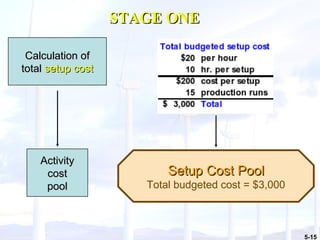
Calculation of total  setup cost Setup Cost Pool Total budgeted cost = $3,000 Activity cost pool STAGE ONE
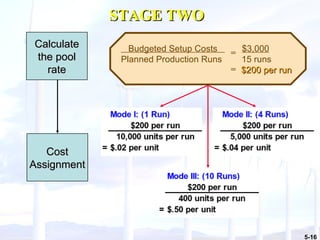
Calculate the pool rate Budgeted Setup Costs  $3,000 Planned Production Runs  15 runs $200 per run Cost Assignment STAGE TWO = =
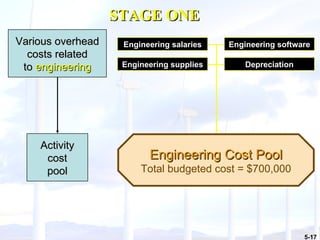
Various overhead costs related to  engineering Engineering salaries Engineering supplies Engineering software Depreciation Engineering Cost Pool Total budgeted cost = $700,000 Activity cost pool STAGE ONE
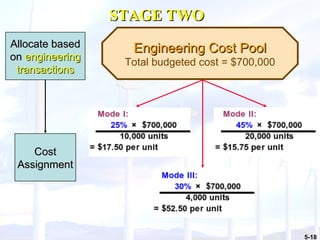
Allocate based on  engineering transactions Cost Assignment STAGE TWO Engineering Cost Pool Total budgeted cost = $700,000
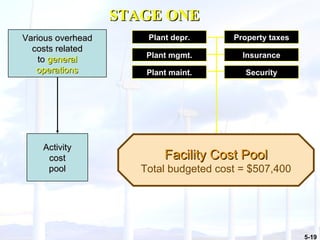
Various overhead costs related to  general operations Plant depr. Plant mgmt. Plant maint. Property taxes Insurance Security Facility Cost Pool Total budgeted cost = $507,400 Activity cost pool STAGE ONE
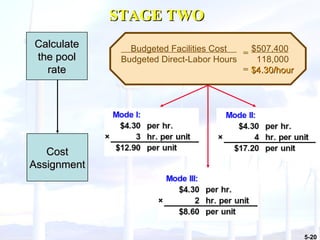
Budgeted Facilities Cost  $507,400 Budgeted Direct-Labor Hours  118,000 $4.30/hour Cost Assignment STAGE TWO = = Calculate the pool rate
Other Overhead Costs
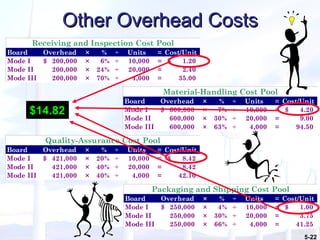
Other Overhead Costs $14.82
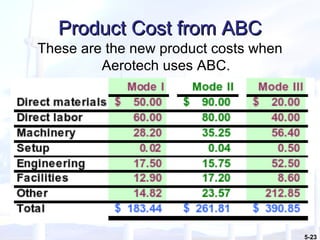
Product Cost from ABC These are the new product costs when Aerotech uses ABC.
Learning  Objective 5
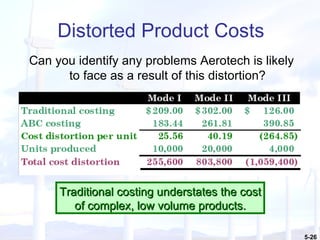
Distorted Product Costs Both original and ABC target selling prices are based on (Cost × 125%). [$209.00 × 1.25] [$183.44 ×  1.25] The selling price of Mode I and II are reduced and the selling price for Mode III is increased.
Can you identify any problems Aerotech is likely to face as a result of this distortion? Traditional costing understates the cost of complex, low volume products. Distorted Product Costs
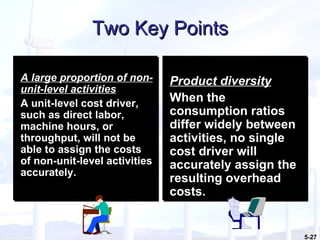
Two Key Points A large proportion of non-unit-level activities   A unit-level cost driver, such as direct labor, machine hours, or throughput, will not be able to assign the costs of non-unit-level activities accurately. Product diversity   When the consumption ratios differ widely between activities, no single cost driver will accurately assign the resulting overhead costs.
Learning  Objective 6
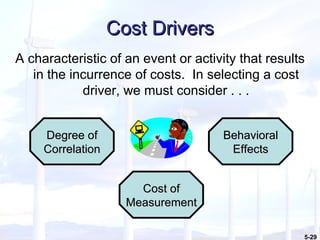
Cost Drivers A characteristic of an event or activity that results in the incurrence of costs.  In selecting a cost driver, we must consider . . . Degree of Correlation Cost of Measurement Behavioral Effects
Learning  Objective 7
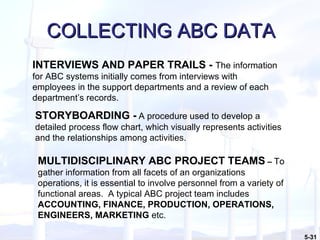
COLLECTING ABC DATA INTERVIEWS AND PAPER TRAILS -  The information for ABC systems initially comes from interviews with employees in the support departments and a review of each department’s records. STORYBOARDING -   A procedure used to develop a detailed process flow chart, which visually represents activities and the relationships among activities. MULTIDISCIPLINARY ABC PROJECT TEAMS  –   To gather information from all facets of an organizations operations, it is essential to involve personnel from a variety of functional areas.  A typical ABC project team includes  ACCOUNTING, FINANCE, PRODUCTION, OPERATIONS, ENGINEERS, MARKETING  etc.
Learning  Objective 8
Activity-Based Management The use of ABC costing  information to help management make decisions
Activity-Based Management Activity-based costing   establishes relationships between overhead costs and activities so that we can better allocate overhead costs. Activity-based management   focuses  on managing activities to reduce costs.
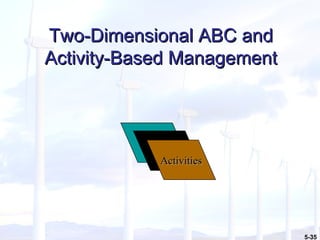
Two-Dimensional ABC and Activity-Based Management Activities
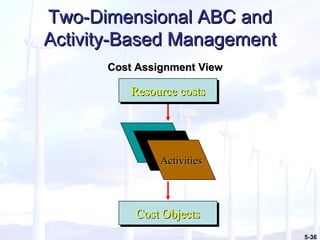
Two-Dimensional ABC and Activity-Based Management Cost Objects Activities Resource costs Cost Assignment View
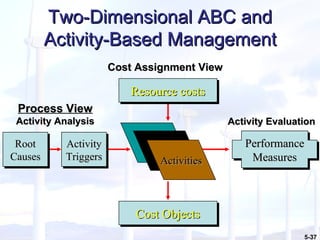
Two-Dimensional ABC and Activity-Based Management Activity Triggers Cost Objects Activities Root Causes Process View Activity Analysis Resource costs Cost Assignment View Performance Measures Activity Evaluation
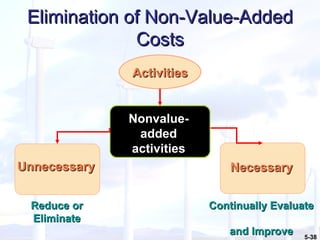
Elimination of Non-Value-Added Costs Nonvalue-added activities Necessary Unnecessary Activities Reduce or Eliminate Continually Evaluate  and Improve
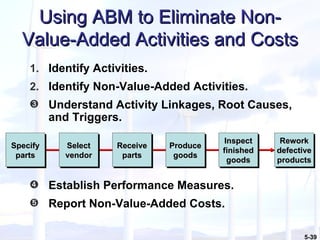
Using ABM to Eliminate Non-Value-Added Activities and Costs Identify Activities. Identify Non-Value-Added Activities. Understand Activity Linkages, Root Causes, and Triggers. Establish Performance Measures. Report Non-Value-Added Costs.   Specify parts Select vendor Receive parts Produce goods Inspect finished goods Rework defective products
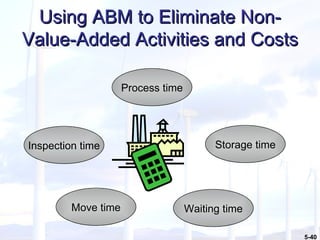
Using ABM to Eliminate Non-Value-Added Activities and Costs Inspection time Process time Storage time Move time Waiting time
Learning  Objective 9
Customer Profitability Analysis Customer profitability analysis uses activity-based costing to determine the activities, costs, and profit associated  with serving particular customers.
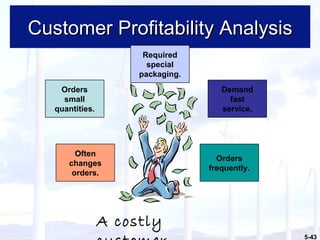
Customer Profitability Analysis Orders small quantities. Orders frequently. Often changes orders. Required special packaging. Demand fast service. A costly customer
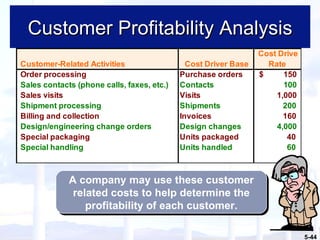
Customer Profitability Analysis A company may use these customer related costs to help determine the profitability of each customer.
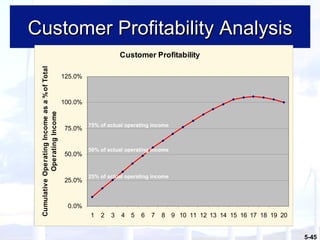
Customer Profitability Analysis 75% of actual operating income 50% of actual operating income 25% of actual operating income
Learning  Objective 10
Activity-Based Management in the Service Industry Activity  Analysis Customer Profitability Analysis
Learning  Objective 11
Just-in-Time Inventory and Production Management No materials are purchased and no products are manufactured until they are needed. The primary goal of a JIT production system is to reduce or eliminate inventories at every stage of production.
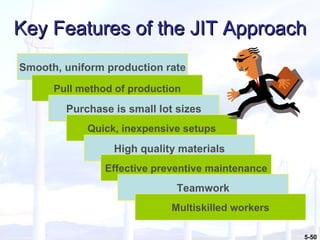
Key Features of the JIT Approach Smooth, uniform production rate Pull method of production Purchase is small lot sizes Quick, inexpensive setups High quality materials Effective preventive maintenance Teamwork Multiskilled workers
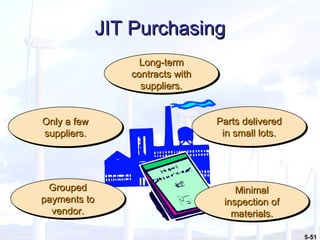
JIT Purchasing Long-term contracts with suppliers. Only a few suppliers. Parts delivered in small lots. Minimal inspection of materials. Grouped payments to vendor.
End of Chapter 5 This is my kind of cost pool!

Chap005 abc

  • 1.
    Chapter 5 Activity-BasedCosting and Management
  • 2.
  • 3.
    Traditional, Volume-Based Product-CostingSystem Aerotech produces three complex printed circuit boards referred to as Mode I, Mode II, and Mode III. The following information is obtained from company records:
  • 4.
    Traditional, Volume-Based Product-CostingSystem Additional information includes: Manufacturing overhead is determined as follows
  • 5.
    Traditional, Volume-Based Product-CostingSystem Budgeted manufacturing overhead $3,894,000 Budgeted direct-labor hours 118,000 = $33 per hour
  • 6.
    Traditional, Volume-Based Product-CostingSystem With these product costs, Aerotech established target selling prices (Cost × 125%). 209.00 x 1.25
  • 7.
  • 8.
    Activity Based CostingSystem (ABC) ABC systems follow a two-stage procedure to assign overhead costs to products. Stage One Identify significant activities and assign overhead costs to each activity in proportion to resources used. Stage Two Identify cost drivers appropriate to each activity and allocate overhead to the products.
  • 9.
  • 10.
    Overhead Costs Totalbudgeted cost = $3,894,000 Activity Cost Pools Machinery cost pool $1,212,600 Setup cost pool $3,000 Engineering cost pool $700,000 Facility cost pool $507,400 Unit Level Batch Level Product- Sustaining Level Facility Level Identification of Activity Cost Pools Activity must be done on each unit produced. Activity performed on each batch produced. Activities needed to support an entire product line Activity required in order for the production process to occur.
  • 11.
    Receiving/Inspection cost pool $200,000 Material-Handling cost pool $600,000 Quality-Assurance cost pool $421,000 Packaging/Shipping cost pool $250,000 Machinery cost pool $1,212,600 Setup cost pool $3,000 Engineering cost pool $700,000 Facility cost pool $507,400 Unit Level Batch Level Product- Sustaining Level Facility Level
  • 12.
  • 13.
    Machinery Cost PoolTotal budgeted cost = $1,212,600 Activity cost pool STAGE ONE Various overhead costs related to machinery Maintenance Depreciation Computer Support Lubrication Electricity Calibration
  • 14.
    Calculate the poolrate Budgeted Machinery Costs $1,212,600 Budgeted Machine Hours 43,000 $28.20/hour Cost Assignment STAGE TWO = =
  • 15.
    Calculation of total setup cost Setup Cost Pool Total budgeted cost = $3,000 Activity cost pool STAGE ONE
  • 16.
    Calculate the poolrate Budgeted Setup Costs $3,000 Planned Production Runs 15 runs $200 per run Cost Assignment STAGE TWO = =
  • 17.
    Various overhead costsrelated to engineering Engineering salaries Engineering supplies Engineering software Depreciation Engineering Cost Pool Total budgeted cost = $700,000 Activity cost pool STAGE ONE
  • 18.
    Allocate based on engineering transactions Cost Assignment STAGE TWO Engineering Cost Pool Total budgeted cost = $700,000
  • 19.
    Various overhead costsrelated to general operations Plant depr. Plant mgmt. Plant maint. Property taxes Insurance Security Facility Cost Pool Total budgeted cost = $507,400 Activity cost pool STAGE ONE
  • 20.
    Budgeted Facilities Cost $507,400 Budgeted Direct-Labor Hours 118,000 $4.30/hour Cost Assignment STAGE TWO = = Calculate the pool rate
  • 21.
  • 22.
  • 23.
    Product Cost fromABC These are the new product costs when Aerotech uses ABC.
  • 24.
  • 25.
    Distorted Product CostsBoth original and ABC target selling prices are based on (Cost × 125%). [$209.00 × 1.25] [$183.44 × 1.25] The selling price of Mode I and II are reduced and the selling price for Mode III is increased.
  • 26.
    Can you identifyany problems Aerotech is likely to face as a result of this distortion? Traditional costing understates the cost of complex, low volume products. Distorted Product Costs
  • 27.
    Two Key PointsA large proportion of non-unit-level activities A unit-level cost driver, such as direct labor, machine hours, or throughput, will not be able to assign the costs of non-unit-level activities accurately. Product diversity When the consumption ratios differ widely between activities, no single cost driver will accurately assign the resulting overhead costs.
  • 28.
  • 29.
    Cost Drivers Acharacteristic of an event or activity that results in the incurrence of costs. In selecting a cost driver, we must consider . . . Degree of Correlation Cost of Measurement Behavioral Effects
  • 30.
  • 31.
    COLLECTING ABC DATAINTERVIEWS AND PAPER TRAILS - The information for ABC systems initially comes from interviews with employees in the support departments and a review of each department’s records. STORYBOARDING - A procedure used to develop a detailed process flow chart, which visually represents activities and the relationships among activities. MULTIDISCIPLINARY ABC PROJECT TEAMS – To gather information from all facets of an organizations operations, it is essential to involve personnel from a variety of functional areas. A typical ABC project team includes ACCOUNTING, FINANCE, PRODUCTION, OPERATIONS, ENGINEERS, MARKETING etc.
  • 32.
  • 33.
    Activity-Based Management Theuse of ABC costing information to help management make decisions
  • 34.
    Activity-Based Management Activity-basedcosting establishes relationships between overhead costs and activities so that we can better allocate overhead costs. Activity-based management focuses on managing activities to reduce costs.
  • 35.
    Two-Dimensional ABC andActivity-Based Management Activities
  • 36.
    Two-Dimensional ABC andActivity-Based Management Cost Objects Activities Resource costs Cost Assignment View
  • 37.
    Two-Dimensional ABC andActivity-Based Management Activity Triggers Cost Objects Activities Root Causes Process View Activity Analysis Resource costs Cost Assignment View Performance Measures Activity Evaluation
  • 38.
    Elimination of Non-Value-AddedCosts Nonvalue-added activities Necessary Unnecessary Activities Reduce or Eliminate Continually Evaluate and Improve
  • 39.
    Using ABM toEliminate Non-Value-Added Activities and Costs Identify Activities. Identify Non-Value-Added Activities. Understand Activity Linkages, Root Causes, and Triggers. Establish Performance Measures. Report Non-Value-Added Costs. Specify parts Select vendor Receive parts Produce goods Inspect finished goods Rework defective products
  • 40.
    Using ABM toEliminate Non-Value-Added Activities and Costs Inspection time Process time Storage time Move time Waiting time
  • 41.
  • 42.
    Customer Profitability AnalysisCustomer profitability analysis uses activity-based costing to determine the activities, costs, and profit associated with serving particular customers.
  • 43.
    Customer Profitability AnalysisOrders small quantities. Orders frequently. Often changes orders. Required special packaging. Demand fast service. A costly customer
  • 44.
    Customer Profitability AnalysisA company may use these customer related costs to help determine the profitability of each customer.
  • 45.
    Customer Profitability Analysis75% of actual operating income 50% of actual operating income 25% of actual operating income
  • 46.
  • 47.
    Activity-Based Management inthe Service Industry Activity Analysis Customer Profitability Analysis
  • 48.
  • 49.
    Just-in-Time Inventory andProduction Management No materials are purchased and no products are manufactured until they are needed. The primary goal of a JIT production system is to reduce or eliminate inventories at every stage of production.
  • 50.
    Key Features ofthe JIT Approach Smooth, uniform production rate Pull method of production Purchase is small lot sizes Quick, inexpensive setups High quality materials Effective preventive maintenance Teamwork Multiskilled workers
  • 51.
    JIT Purchasing Long-termcontracts with suppliers. Only a few suppliers. Parts delivered in small lots. Minimal inspection of materials. Grouped payments to vendor.
  • 52.
    End of Chapter5 This is my kind of cost pool!