The McGraw-Hill Companies, Inc. 2006McGraw-Hill/Irwin
TOPIC 4a
ACTIVITY BASED COSTING
SYSTEM
The McGraw-Hill Companies, Inc. 2006McGraw-Hill/Irwin
4-2
Traditional Costing Systems
Traditional cost systems were created when
manufacturing processes were labor intensive.
Traditional cost systems were created when
manufacturing processes were labor intensive.
A single company-wide overhead rate,
based on direct labor hours, may be
used to allocate overhead to products
in these labor intensive processes.
A single company-wide overhead rate,
based on direct labor hours, may be
used to allocate overhead to products
in these labor intensive processes.
The McGraw-Hill Companies, Inc. 2006McGraw-Hill/Irwin
4-3
Overhead is allocated to jobs using direct
labor hours. If overhead is $120, how much
overhead is allocated to each job?
Overhead is allocated to jobs using direct
labor hours. If overhead is $120, how much
overhead is allocated to each job?
Traditional Costing Systems
Job 1 Job 2
Labor Hours 2 6
The McGraw-Hill Companies, Inc. 2006McGraw-Hill/Irwin
4-4
Job 1 Job 2
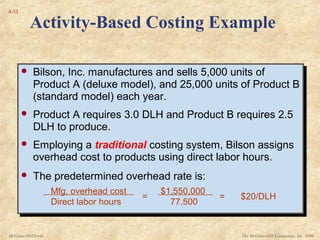
Labor Hours 2 6
Overhead
Allocation
30$ 90$
Overhead Rate = $120 ÷ 8 direct labor hours
Overhead Rate = $15 per direct labor hour
Job 1 = 2 hours × $15 per hour = $30
Job 2 = 6 hours × $15 per hour = $90
Traditional Costing Systems
The McGraw-Hill Companies, Inc. 2006McGraw-Hill/Irwin
4-5
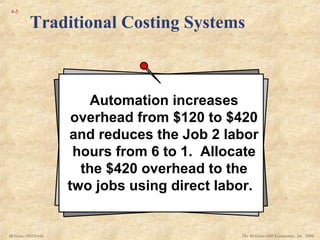
Automation increases
overhead from $120 to $420
and reduces the Job 2 labor
hours from 6 to 1. Allocate
the $420 overhead to the
two jobs using direct labor.
Traditional Costing Systems
The McGraw-Hill Companies, Inc. 2006McGraw-Hill/Irwin
4-6
Job 1 Job 2
Labor Hours 2 1
Overhead
Allocation
280$ 140$
Overhead Rate = $420 ÷ 3 direct labor hours
Overhead Rate = $140 per direct labor hour
Job 1 = 2 hours × $140 per hour = $280
Job 2 = 1 hour × $140 per hour = $140
Traditional Costing Systems
The McGraw-Hill Companies, Inc. 2006McGraw-Hill/Irwin
4-7
Is this reasonable?
Automation benefited Job 2, but Job 1 is
allocated more overhead. Clearly, we need
another cost driver to allocate overhead.
Job 1 Job 2
Labor Hours 2 1
Overhead
Allocation
280$ 140$
Traditional Costing Systems
The McGraw-Hill Companies, Inc. 2006McGraw-Hill/Irwin
4-8
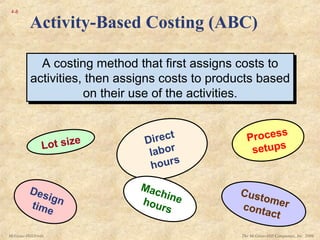
Direct
labor
hours
Machinehours
Process
setups
Designtime
Lot size
Customercontact
Activity-Based Costing (ABC)
A costing method that first assigns costs to
activities, then assigns costs to products based
on their use of the activities.
A costing method that first assigns costs to
activities, then assigns costs to products based
on their use of the activities.
The McGraw-Hill Companies, Inc. 2006McGraw-Hill/Irwin
4-9
Products
Require
Activities
Activities
Consume
Resources
People
Manage
Activities
Activity-Based Costing (ABC)
A costing method that first assigns costs to
activities, then assigns costs to products based
on their use of the activities.
A costing method that first assigns costs to
activities, then assigns costs to products based
on their use of the activities.
The McGraw-Hill Companies, Inc. 2006McGraw-Hill/Irwin
4-10
ABC is used primarily
for decision making, not
for inventory valuation
for external reporting.
ABC is used primarily
for decision making, not
for inventory valuation
for external reporting.
Activity-Based Costing (ABC)
Both manufacturing
and nonmanufacturing
costs may be
assigned to
products.
Both manufacturing
and nonmanufacturing
costs may be
assigned to
products.
Allocation bases often
differ from
traditional costing
systems.
Allocation bases often
differ from
traditional costing
systems.
A
B C
ABC is a good
supplement
to our traditional
cost system.
ABC is a good
supplement
to our traditional
cost system.
The McGraw-Hill Companies, Inc. 2006McGraw-Hill/Irwin
4-11
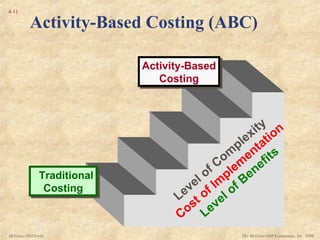
Level of Com
plexity
Cost of Im
plem
entation
Level of Benefits
Traditional
Costing
Traditional
Costing
Activity-Based
Costing
Activity-Based
Costing
Activity-Based Costing (ABC)
The McGraw-Hill Companies, Inc. 2006McGraw-Hill/Irwin
4-12
Resource CostsResource Costs
Cost Pools:Cost Pools:
Plants orPlants or
DepartmentsDepartments
Cost ObjectsCost Objects
Traditional Costing
Resource CostsResource Costs
Cost Pools:Cost Pools:
Activities orActivities or
Activity CentersActivity Centers
Cost ObjectsCost Objects
Activity-Based Costing
Directly traced
or allocated
Directly traced
or allocated
Predetermined
overhead
rate
Cost driver
rates for
each activity
Activity-Based Costing (ABC)
The McGraw-Hill Companies, Inc. 2006McGraw-Hill/Irwin
4-13
An Activity CostActivity Cost
PoolPool is a
“container” in
which costs are
accumulated
that relate to a
single activity in
the ABC system.
$
$
$ $
$
$
Costs
Activity-Based Costing (ABC)
The McGraw-Hill Companies, Inc. 2006McGraw-Hill/Irwin
4-14
 Identify and classify the activities
related to the company’s
products or services.
 Estimate the cost of each activity
identified in .
 Calculate a cost-driver rate for
each activity.
 Assign activity costs to products
using the cost-driver rate.
 Identify and classify the activities
related to the company’s
products or services.
 Estimate the cost of each activity
identified in .
 Calculate a cost-driver rate for
each activity.
 Assign activity costs to products
using the cost-driver rate.
Four Steps in the ABC Process
The McGraw-Hill Companies, Inc. 2006McGraw-Hill/Irwin
4-15
 Identify and Classify Activities
UNIT-LEVEL ACTIVITES
Resources acquired and activities performed for individual units.
CUSTOMER-LEVEL ACTIVITES
Resources acquired and activities performed to serve specific customers.
BATCH-LEVEL ACTIVITES
Resources acquired and activities performed for a group or batch of similar
products or services.
PRODUCT-LEVEL ACTIVITES
Resources acquired and activities performed to produce and sell a
specific product or service.
FACILITY-LEVEL ACTIVITIES
Resources acquired and activities performed to provide general capacity to
produce goods or services.
The McGraw-Hill Companies, Inc. 2006McGraw-Hill/Irwin
16
Directly traceable
to the decision to
produce the level
of output
Cost Hierarchy
Includes direct material, direct labor, utilities to
run equipment, other overhead directly related to
the production process.
Includes direct material, direct labor, utilities to
run equipment, other overhead directly related to
the production process.
Costs that are incurred for every unit of product
manufactured or service produced.
Costs that are incurred for every unit of product
manufactured or service produced.
Unit-level
Costs
Unit-level
Costs
All unit level costs are variable, but not
all variable costs are unit level costs.
All unit level costs are variable, but not
all variable costs are unit level costs.
The McGraw-Hill Companies, Inc. 2006McGraw-Hill/Irwin
17
Batch-level
Costs
Batch-level
Costs
Costs that are incurred for batch of product
manufactured or service produced.
Costs that are incurred for batch of product
manufactured or service produced.
Includes setup costs, material-handling costs
related to delivering raw material to the
production line, etc.
Includes setup costs, material-handling costs
related to delivering raw material to the
production line, etc.
Cost Hierarchy
The McGraw-Hill Companies, Inc. 2006McGraw-Hill/Irwin
18
Product-level
Costs
Product-level
Costs
Costs that are incurred for each line of product
or service.
Costs that are incurred for each line of product
or service.
Includes design costs for product lines and
marketing costs for each product line.
Includes design costs for product lines and
marketing costs for each product line.
Cost Hierarchy
The McGraw-Hill Companies, Inc. 2006McGraw-Hill/Irwin
19
Customer-
level Costs
Customer-
level Costs
Costs that are incurred for specific customers.Costs that are incurred for specific customers.
Includes licensing costs for customer-specific
logos and customization costs.
Includes licensing costs for customer-specific
logos and customization costs.
Cost Hierarchy
The McGraw-Hill Companies, Inc. 2006McGraw-Hill/Irwin
20
Facility-level
Costs
Facility-level
Costs
Costs that are incurred to maintain the
organization’s overall facility and infrastructure.
Costs that are incurred to maintain the
organization’s overall facility and infrastructure.
Includes production manager’s salary, plant
depreciation, and insurance on the facility and
equipment.
Includes production manager’s salary, plant
depreciation, and insurance on the facility and
equipment.
Cost Hierarchy
The McGraw-Hill Companies, Inc. 2006McGraw-Hill/Irwin
4-21
INTERVIEW ORINTERVIEW OR
PARTICIPATIVEPARTICIPATIVE
APPROACHAPPROACH
ABC teams include or
interview operating
employees.
INTERVIEW ORINTERVIEW OR
PARTICIPATIVEPARTICIPATIVE
APPROACHAPPROACH
ABC teams include or
interview operating
employees.
RECYCLINGRECYCLING
APPROACHAPPROACH
Reuses documentation
of processes used for
other purposes.
RECYCLINGRECYCLING
APPROACHAPPROACH
Reuses documentation
of processes used for
other purposes.
TOP DOWN APPROACHTOP DOWN APPROACH
ABC teams of middle-
management or above
develop the activity
dictionary.
TOP DOWN APPROACHTOP DOWN APPROACH
ABC teams of middle-
management or above
develop the activity
dictionary.
 Identify and Classify Activities
The McGraw-Hill Companies, Inc. 2006McGraw-Hill/Irwin
4-22
The ABC teams should gather data on the costs of all
the activities identified in Step 1.
The ABC teams should gather data on the costs of all
the activities identified in Step 1.
 Estimate the Cost of Activities
Examine
accounting
records for
recorded cost
information.
Examine
accounting
records for
recorded cost
information.
Ask employees
to indicate how
much time
they work on
various
activities.
Ask employees
to indicate how
much time
they work on
various
activities.
The McGraw-Hill Companies, Inc. 2006McGraw-Hill/Irwin
4-23
MAY Company has 4 employees in its Quality Control
Department. Salaries and costs for the department total
$360,000 per year. MAY produces 500,000 units of
product a year. What is the cost-driver rate per unit?
$360,000 ÷ 500,000 units = $.72 per unit
MAY Company has 4 employees in its Quality Control
Department. Salaries and costs for the department total
$360,000 per year. MAY produces 500,000 units of
product a year. What is the cost-driver rate per unit?
$360,000 ÷ 500,000 units = $.72 per unit
Two pieces of
information are
required to compute
the cost-driver rate:
•Activity Cost
•Activity Volume
Two pieces of
information are
required to compute
the cost-driver rate:
•Activity Cost
•Activity Volume
 Calculate Cost-Driver Rates for
Activities
The McGraw-Hill Companies, Inc. 2006McGraw-Hill/Irwin
4-24
MAY has a customer service center
where customers can call to ask
questions. Customers pay a fixed fee for
each call they make to the service center.
It costs MAY $1,260,000 a year to operate
the center. The center receives 120,000
calls per year. The center handles
1,000,000 minutes of calls.
What is the appropriate cost driver; total
minutes for all calls or number of calls?
What is the cost-driver rate?
MAY has a customer service center
where customers can call to ask
questions. Customers pay a fixed fee for
each call they make to the service center.
It costs MAY $1,260,000 a year to operate
the center. The center receives 120,000
calls per year. The center handles
1,000,000 minutes of calls.
What is the appropriate cost driver; total
minutes for all calls or number of calls?
What is the cost-driver rate?
 Calculate Cost-Driver Rates for
Activities
The McGraw-Hill Companies, Inc. 2006McGraw-Hill/Irwin
4-25
Since customers are charged “per call”, the
proper activity in this case is the number of
calls handled by the center.
The cost-driver rate would be:
$1,260,000 ÷ 120,000 calls = $10.50 per call
Since customers are charged “per call”, the
proper activity in this case is the number of
calls handled by the center.
The cost-driver rate would be:
$1,260,000 ÷ 120,000 calls = $10.50 per call
 Calculate Cost-Driver Rates for
Activities
The McGraw-Hill Companies, Inc. 2006McGraw-Hill/Irwin
4-26
 Calculate Cost-Driver Rates for
Activities
Appropriate
cost-driver
base
Based on resource’s
practical capacity to
support activities
Cause and effect
relationship between
activity and costs
Measurable
Predict or explain
an activity’s use
of resources
The McGraw-Hill Companies, Inc. 2006McGraw-Hill/Irwin
4-27
Practical Capacity Note
When estimating the
cost of an activity,
only the costs
associated with the
product should be
used (practical
capacity). The cost
of “unused capacity”
should not be
applied to products.
When estimating the
cost of an activity,
only the costs
associated with the
product should be
used (practical
capacity). The cost
of “unused capacity”
should not be
applied to products.
EXAMPLE
Suppose we rent a 1,000
square foot warehouse for
$1,000 per month. Only 800
sq. ft. are used to store
Product A. The rest of the
warehouse is “unused”.
How much rent cost should be
allocated to Product A?
EXAMPLE
Suppose we rent a 1,000
square foot warehouse for
$1,000 per month. Only 800
sq. ft. are used to store
Product A. The rest of the
warehouse is “unused”.
How much rent cost should be
allocated to Product A?
The McGraw-Hill Companies, Inc. 2006McGraw-Hill/Irwin
4-28
20%, or $200 should20%, or $200 should
be assigned tobe assigned to
“unused capacity”“unused capacity”
80%, or $80080%, or $800
should be assignedshould be assigned
to Product Ato Product A
Practical Capacity Note
The McGraw-Hill Companies, Inc. 2006McGraw-Hill/Irwin
4-29
 Assign Activity Costs to Products
1. Identify all
the activities
related to a
given product
or service.
1. Identify all
the activities
related to a
given product
or service.
2. Determine
how many
units of each
activity are
used per unit
of product.
2. Determine
how many
units of each
activity are
used per unit
of product.
3. Assign costs
to products
using the cost-
driver rates for
each activity.
3. Assign costs
to products
using the cost-
driver rates for
each activity.
The McGraw-Hill Companies, Inc. 2006McGraw-Hill/Irwin
4-30
Example: Yazz, Inc. produces 130,000 units of Product A
and 400,000 units for Product B. Using the following
cost information, how much overhead should be
allocated to Product A?
Example: Yazz, Inc. produces 130,000 units of Product A
and 400,000 units for Product B. Using the following
cost information, how much overhead should be
allocated to Product A?
 Assign Activity Costs to Products
The McGraw-Hill Companies, Inc. 2006McGraw-Hill/Irwin
4-31
 Assign Activity Costs to Products
The McGraw-Hill Companies, Inc. 2006McGraw-Hill/Irwin
4-32
Let’s look at an
example from the
Bilson Company.
Activity-Based Costing Example
The McGraw-Hill Companies, Inc. 2006McGraw-Hill/Irwin
4-33
 Bilson, Inc. manufactures and sells 5,000 units of
Product A (deluxe model), and 25,000 units of Product B
(standard model) each year.
 Product A requires 3.0 DLH and Product B requires 2.5
DLH to produce.
 Employing a traditional costing system, Bilson assigns
overhead cost to products using direct labor hours.
 The predetermined overhead rate is:
 Bilson, Inc. manufactures and sells 5,000 units of
Product A (deluxe model), and 25,000 units of Product B
(standard model) each year.
 Product A requires 3.0 DLH and Product B requires 2.5
DLH to produce.
 Employing a traditional costing system, Bilson assigns
overhead cost to products using direct labor hours.
 The predetermined overhead rate is:
Mfg. overhead cost
Direct labor hours
=
$1,550,000
77,500
= $20/DLH
Activity-Based Costing Example
The McGraw-Hill Companies, Inc. 2006McGraw-Hill/Irwin
4-34
Bilson’s unit product costs using
traditional costing are:
Product A Product B
Direct material 40.00$ 29.00$
Direct labor 30.00 25.00
Manufacturing overhead
3.0 DLH × $20/DLH 60.00
2.5 DLH × $20/DLH 50.00
Total unit product cost 130.00$ 104.00$
Bilson marks its products up by 50 percent and allocates
its $500,000 customer service costs based on revenue.
Activity-Based Costing Example
The McGraw-Hill Companies, Inc. 2006McGraw-Hill/Irwin
4-35
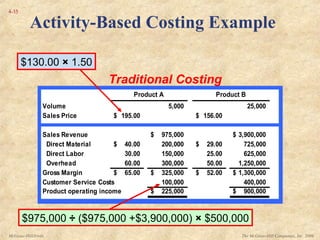
Volume 5,000 25,000
Sales Price 195.00$ 156.00$
Sales Revenue 975,000$ 3,900,000$
Direct Material 40.00$ 200,000 29.00$ 725,000
Direct Labor 30.00 150,000 25.00 625,000
Overhead 60.00 300,000 50.00 1,250,000
Gross Margin 65.00$ 325,000$ 52.00$ 1,300,000$
Customer Service Costs 100,000 400,000
Product operating income 225,000$ 900,000$
Product A Product B
$975,000 ÷ ($975,000 +$3,900,000) × $500,000
Traditional Costing
$130.00 × 1.50
Activity-Based Costing Example
The McGraw-Hill Companies, Inc. 2006McGraw-Hill/Irwin
4-36
Sales of Product A have increased steadily since introduction,
but company income has declined. Management at Bilson is
unhappy with the traditional costing system and they have
decided to try activity-based costing.
Sales of Product A have increased steadily since introduction,
but company income has declined. Management at Bilson is
unhappy with the traditional costing system and they have
decided to try activity-based costing.
In addition, management has
observed that the cost of direct
labor is relatively stable.
Since labor does not behave
like a unit-level cost, labor will
be combined with overhead and
the total conversion cost
will be assigned using ABC.
In addition, management has
observed that the cost of direct
labor is relatively stable.
Since labor does not behave
like a unit-level cost, labor will
be combined with overhead and
the total conversion cost
will be assigned using ABC.
Activity-Based Costing Example
The McGraw-Hill Companies, Inc. 2006McGraw-Hill/Irwin
4-37
The total conversion cost is:
Traditional overhead $1,550,000
Labor (77,500 hours @ $10) 775,000
Total $2,325,000
The total conversion cost is:
Traditional overhead $1,550,000
Labor (77,500 hours @ $10) 775,000
Total $2,325,000
In addition, management has
observed that the cost of direct
labor is relatively stable.
Since labor does not behave
like a unit-level cost, labor will
be combined with overhead and
the total conversion cost
will be assigned using ABC.
In addition, management has
observed that the cost of direct
labor is relatively stable.
Since labor does not behave
like a unit-level cost, labor will
be combined with overhead and
the total conversion cost
will be assigned using ABC.
Activity-Based Costing Example
The McGraw-Hill Companies, Inc. 2006McGraw-Hill/Irwin
4-38
Activity Cost
Machine setups 800,000$
Quality inspections 450,000
Production orders 225,000
Machine-hours worked 650,000
Material receipts 200,000
Total 2,325,000$
Management has identified the following five activities
and costs in the production of its two products:
Total conversion cost
Activity-Based Costing Example
The McGraw-Hill Companies, Inc. 2006McGraw-Hill/Irwin
4-39
The following transaction data has been
complied by management of Bilson:
Activity Total Product A Product B
Machine setups 5,000 3,000 2,000
Quality inspections 9,000 6,000 3,000
Production orders 600 200 400
Machine-hours worked 50,000 15,000 35,000
Material receipts 800 150 650
Activity-Based Costing Example
The McGraw-Hill Companies, Inc. 2006McGraw-Hill/Irwin
4-40
These data can be used to develop predetermined
cost-driver rates for each of the five activities:
Activity Costs
Total
Transactions
Rate per
Transaction
Machine setups 800,000$ 5,000 160.00$ per setup
Quality inspections 450,000 9,000 50.00 per inspection
Production orders 225,000 600 375.00 per order
Machine-hours worked 650,000 50,000 13.00 per hour
Material receipts 200,000 800 250.00 per receipt
Total 2,325,000$
$ 800,000 ÷ 5,000 Machine setups = $160.00 per setup
Activity-Based Costing Example
The McGraw-Hill Companies, Inc. 2006McGraw-Hill/Irwin
4-41
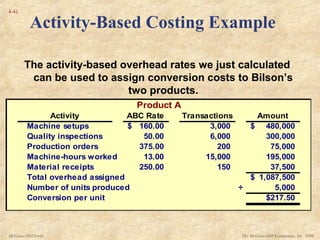
Product A
Activity ABC Rate Transactions Amount
Machine setups 160.00$ 3,000 480,000$
Quality inspections 50.00 6,000 300,000
Production orders 375.00 200 75,000
Machine-hours worked 13.00 15,000 195,000
Material receipts 250.00 150 37,500
Total overhead assigned 1,087,500$
Number of units produced ÷ 5,000
Conversion per unit $217.50
The activity-based overhead rates we just calculated
can be used to assign conversion costs to Bilson’s
two products.
Activity-Based Costing Example
The McGraw-Hill Companies, Inc. 2006McGraw-Hill/Irwin
4-42
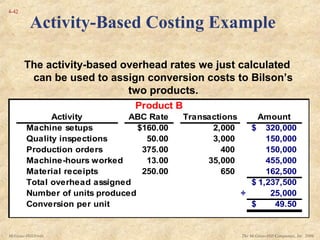
The activity-based overhead rates we just calculated
can be used to assign conversion costs to Bilson’s
two products.
Product B
Activity ABC Rate Transactions Amount
Machine setups $160.00 2,000 320,000$
Quality inspections 50.00 3,000 150,000
Production orders 375.00 400 150,000
Machine-hours worked 13.00 35,000 455,000
Material receipts 250.00 650 162,500
Total overhead assigned 1,237,500$
Number of units produced ÷ 25,000
Conversion per unit 49.50$
Activity-Based Costing Example
The McGraw-Hill Companies, Inc. 2006McGraw-Hill/Irwin
4-43
The activity-based overhead rates we just calculated
can be used to assign conversion costs to Bilson’s
two products.
Product B
Activity ABC Rate Transactions Amount
Machine setups $160.00 2,000 320,000$
Quality inspections 50.00 3,000 150,000
Production orders 375.00 400 150,000
Machine-hours worked 13.00 35,000 455,000
Material receipts 250.00 650 162,500
Total overhead assigned 1,237,500$
Number of units produced ÷ 25,000
Overhead per unit 49.50$
Total conversion assigned to Product A 1,087,500$
Total conversion assigned to Product B 1,237,500
Total overhead 2,325,000$
Activity-Based Costing Example
The McGraw-Hill Companies, Inc. 2006McGraw-Hill/Irwin
4-44
Let’s compute the product cost for A and B
using our ABC overhead rates:
Activity Based Costing Product A Product B
Direct materials 40.00$ 29.00$
Conversion 217.50 49.50
Total unit product cost 257.50$ 78.50$
These amounts did not
change as a result of
using ABC.
Activity-Based Costing Example
The McGraw-Hill Companies, Inc. 2006McGraw-Hill/Irwin
4-45
Now compare the unit product costs using the
traditional costing system and our ABC system.
Costing Method Product A Product B
Activity-based costing 257.50$ 78.50$
Traditional costing 130.00 104.00
Remember, we used one overhead
rate based on direct labor hours.
Activity-Based Costing Example
The McGraw-Hill Companies, Inc. 2006McGraw-Hill/Irwin
4-46
Now compare the unit product costs using the
traditional costing system and our ABC system.
Costing Method Product A Product B
Activity-based costing 257.50$ 78.50$
Traditional costing 130.00 104.00
Adopting activity-based costing usually results
in a shift of batch-level and product-level
overhead costs from high-volume standard
products to low-volume, more complex products.
Activity-Based Costing Example
The McGraw-Hill Companies, Inc. 2006McGraw-Hill/Irwin
4-47
Can you see how different allocationCan you see how different allocation
methods might lead to makingmethods might lead to making
different management decisions?different management decisions?
Costing Method Product A Product B
Activity-based costing 257.50$ 78.50$
Traditional costing 130.00 104.00
Now compare the unit product costs using the
traditional costing system and our ABC system.
Activity-Based Costing Example
The McGraw-Hill Companies, Inc. 2006McGraw-Hill/Irwin
4-48
Based on these results Bilson also decides to use ABC to assign
its $500,000 customer service costs. The applicable activity is
number of customer consultations. Customers buying Product A,
the deluxe model, require more consultations than those buying
Product B, the standard model.
Product A Product B Total
Sales Volume 5,000 25,000
Consultations per
Unit Sold 10 3
Total Consultations 50,000 75,000 125,000
Cost per Consultation 4.00$ 4.00$
Cost per Product 200,000$ 300,000$ 500,000
Cost per consultation = $500,000 ÷ 125,000 consultations = $4.00
Activity-Based Costing Example
The McGraw-Hill Companies, Inc. 2006McGraw-Hill/Irwin
4-49
Volume 5,000 25,000
Sales Price 195.00$ 156.00$
Sales Revenue 975,000$ 3,900,000$
Direct Material 40.00$ 200,000 29.00$ 725,000
Conversion 217.50 1,087,500 49.50 1,237,500
Gross Margin (62.50)$ (312,500)$ 77.50$ 1,937,500$
Customer Service Costs 200,000 300,000
Product operating income (512,500)$ 1,637,500$
Product A Product B
ABC Costing
No change in sales price
Let’s compare product income using traditional and ABC costing.Let’s compare product income using traditional and ABC costing.
Activity-Based Costing Example
The McGraw-Hill Companies, Inc. 2006McGraw-Hill/Irwin
4-50
ABC
Costing
Traditional
Costing
Volume 5,000 25,000
Sales Price 195.00$ 156.00$
Sales Revenue 975,000$ 3,900,000$
Direct Material 40.00$ 200,000 29.00$ 725,000
Conversion 217.50 1,087,500 49.50 1,237,500
Gross Margin (62.50)$ (312,500)$ 77.50$ 1,937,500$
Customer Service Costs 200,000 300,000
Product operating income (512,500)$ 1,637,500$
Product A Product B
Volume 5,000 25,000
Sales Price 195.00$ 156.00$
Sales Revenue 975,000$ 3,900,000$
Direct Material 40.00$ 200,000 29.00$ 725,000
Direct Labor 30.00 150,000 25.00 625,000
Overhead 60.00 300,000 50.00 1,250,000
Gross Margin 65.00$ 325,000$ 52.00$ 1,300,000$
Customer Service Costs 100,000 400,000
Product operating income 225,000$ 900,000$
Product A Product B
The McGraw-Hill Companies, Inc. 2006McGraw-Hill/Irwin
4-51
Should Bilson
increase the price
of Product A?
Should Bilson
reduce the price
of Product B?
Should Bilson
drop Product A?
Activity-Based Costing Example
The McGraw-Hill Companies, Inc. 2006McGraw-Hill/Irwin
4-52
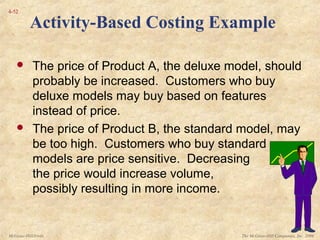
 The price of Product A, the deluxe model, should
probably be increased. Customers who buy
deluxe models may buy based on features
instead of price.
 The price of Product B, the standard model, may
be too high. Customers who buy standard
models are price sensitive. Decreasing
the price would increase volume,
possibly resulting in more income.
Activity-Based Costing Example
The McGraw-Hill Companies, Inc. 2006McGraw-Hill/Irwin
4-53
 More accurate and informative
product costs lead to better
decisions.
 More accurate measurements of the
activities driving costs.
 Provides managers with easier
access to relevant costs.
 More accurate and informative
product costs lead to better
decisions.
 More accurate measurements of the
activities driving costs.
 Provides managers with easier
access to relevant costs.
An ABC system is very expensive
to develop and implement; it is
also very time-consuming.
An ABC system is very expensive
to develop and implement; it is
also very time-consuming.
ABC– Benefits and Limitations
The McGraw-Hill Companies, Inc. 2006McGraw-Hill/Irwin
4-54
When Should a Company Use ABC?
 Indirect costs are significant in proportion to direct costs.
 Goods are complex, requiring many inputs and processes.
 Complex, low-volume products are profitable while
standard, high-volume products are not.
 Different departments believe costs are assigned
inaccurately.
 The company loses bids it thought were low, and wins bids
it thought were high.
 Operations have changed significantly, but the costing
system has not changed.
 Introduction of new models result in higher sales, apparent
profits per unit, but an overall income decline.
 Indirect costs are significant in proportion to direct costs.
 Goods are complex, requiring many inputs and processes.
 Complex, low-volume products are profitable while
standard, high-volume products are not.
 Different departments believe costs are assigned
inaccurately.
 The company loses bids it thought were low, and wins bids
it thought were high.
 Operations have changed significantly, but the costing
system has not changed.
 Introduction of new models result in higher sales, apparent
profits per unit, but an overall income decline.
The McGraw-Hill Companies, Inc. 2006McGraw-Hill/Irwin
4-55
End of Chapter 4

Topic 7a activity based costing sem 2 1516

  • 1.
    The McGraw-Hill Companies,Inc. 2006McGraw-Hill/Irwin TOPIC 4a ACTIVITY BASED COSTING SYSTEM
  • 2.
    The McGraw-Hill Companies,Inc. 2006McGraw-Hill/Irwin 4-2 Traditional Costing Systems Traditional cost systems were created when manufacturing processes were labor intensive. Traditional cost systems were created when manufacturing processes were labor intensive. A single company-wide overhead rate, based on direct labor hours, may be used to allocate overhead to products in these labor intensive processes. A single company-wide overhead rate, based on direct labor hours, may be used to allocate overhead to products in these labor intensive processes.
  • 3.
    The McGraw-Hill Companies,Inc. 2006McGraw-Hill/Irwin 4-3 Overhead is allocated to jobs using direct labor hours. If overhead is $120, how much overhead is allocated to each job? Overhead is allocated to jobs using direct labor hours. If overhead is $120, how much overhead is allocated to each job? Traditional Costing Systems Job 1 Job 2 Labor Hours 2 6
  • 4.
    The McGraw-Hill Companies,Inc. 2006McGraw-Hill/Irwin 4-4 Job 1 Job 2 Labor Hours 2 6 Overhead Allocation 30$ 90$ Overhead Rate = $120 ÷ 8 direct labor hours Overhead Rate = $15 per direct labor hour Job 1 = 2 hours × $15 per hour = $30 Job 2 = 6 hours × $15 per hour = $90 Traditional Costing Systems
  • 5.
    The McGraw-Hill Companies,Inc. 2006McGraw-Hill/Irwin 4-5 Automation increases overhead from $120 to $420 and reduces the Job 2 labor hours from 6 to 1. Allocate the $420 overhead to the two jobs using direct labor. Traditional Costing Systems
  • 6.
    The McGraw-Hill Companies,Inc. 2006McGraw-Hill/Irwin 4-6 Job 1 Job 2 Labor Hours 2 1 Overhead Allocation 280$ 140$ Overhead Rate = $420 ÷ 3 direct labor hours Overhead Rate = $140 per direct labor hour Job 1 = 2 hours × $140 per hour = $280 Job 2 = 1 hour × $140 per hour = $140 Traditional Costing Systems
  • 7.
    The McGraw-Hill Companies,Inc. 2006McGraw-Hill/Irwin 4-7 Is this reasonable? Automation benefited Job 2, but Job 1 is allocated more overhead. Clearly, we need another cost driver to allocate overhead. Job 1 Job 2 Labor Hours 2 1 Overhead Allocation 280$ 140$ Traditional Costing Systems
  • 8.
    The McGraw-Hill Companies,Inc. 2006McGraw-Hill/Irwin 4-8 Direct labor hours Machinehours Process setups Designtime Lot size Customercontact Activity-Based Costing (ABC) A costing method that first assigns costs to activities, then assigns costs to products based on their use of the activities. A costing method that first assigns costs to activities, then assigns costs to products based on their use of the activities.
  • 9.
    The McGraw-Hill Companies,Inc. 2006McGraw-Hill/Irwin 4-9 Products Require Activities Activities Consume Resources People Manage Activities Activity-Based Costing (ABC) A costing method that first assigns costs to activities, then assigns costs to products based on their use of the activities. A costing method that first assigns costs to activities, then assigns costs to products based on their use of the activities.
  • 10.
    The McGraw-Hill Companies,Inc. 2006McGraw-Hill/Irwin 4-10 ABC is used primarily for decision making, not for inventory valuation for external reporting. ABC is used primarily for decision making, not for inventory valuation for external reporting. Activity-Based Costing (ABC) Both manufacturing and nonmanufacturing costs may be assigned to products. Both manufacturing and nonmanufacturing costs may be assigned to products. Allocation bases often differ from traditional costing systems. Allocation bases often differ from traditional costing systems. A B C ABC is a good supplement to our traditional cost system. ABC is a good supplement to our traditional cost system.
  • 11.
    The McGraw-Hill Companies,Inc. 2006McGraw-Hill/Irwin 4-11 Level of Com plexity Cost of Im plem entation Level of Benefits Traditional Costing Traditional Costing Activity-Based Costing Activity-Based Costing Activity-Based Costing (ABC)
  • 12.
    The McGraw-Hill Companies,Inc. 2006McGraw-Hill/Irwin 4-12 Resource CostsResource Costs Cost Pools:Cost Pools: Plants orPlants or DepartmentsDepartments Cost ObjectsCost Objects Traditional Costing Resource CostsResource Costs Cost Pools:Cost Pools: Activities orActivities or Activity CentersActivity Centers Cost ObjectsCost Objects Activity-Based Costing Directly traced or allocated Directly traced or allocated Predetermined overhead rate Cost driver rates for each activity Activity-Based Costing (ABC)
  • 13.
    The McGraw-Hill Companies,Inc. 2006McGraw-Hill/Irwin 4-13 An Activity CostActivity Cost PoolPool is a “container” in which costs are accumulated that relate to a single activity in the ABC system. $ $ $ $ $ $ Costs Activity-Based Costing (ABC)
  • 14.
    The McGraw-Hill Companies,Inc. 2006McGraw-Hill/Irwin 4-14  Identify and classify the activities related to the company’s products or services.  Estimate the cost of each activity identified in .  Calculate a cost-driver rate for each activity.  Assign activity costs to products using the cost-driver rate.  Identify and classify the activities related to the company’s products or services.  Estimate the cost of each activity identified in .  Calculate a cost-driver rate for each activity.  Assign activity costs to products using the cost-driver rate. Four Steps in the ABC Process
  • 15.
    The McGraw-Hill Companies,Inc. 2006McGraw-Hill/Irwin 4-15  Identify and Classify Activities UNIT-LEVEL ACTIVITES Resources acquired and activities performed for individual units. CUSTOMER-LEVEL ACTIVITES Resources acquired and activities performed to serve specific customers. BATCH-LEVEL ACTIVITES Resources acquired and activities performed for a group or batch of similar products or services. PRODUCT-LEVEL ACTIVITES Resources acquired and activities performed to produce and sell a specific product or service. FACILITY-LEVEL ACTIVITIES Resources acquired and activities performed to provide general capacity to produce goods or services.
  • 16.
    The McGraw-Hill Companies,Inc. 2006McGraw-Hill/Irwin 16 Directly traceable to the decision to produce the level of output Cost Hierarchy Includes direct material, direct labor, utilities to run equipment, other overhead directly related to the production process. Includes direct material, direct labor, utilities to run equipment, other overhead directly related to the production process. Costs that are incurred for every unit of product manufactured or service produced. Costs that are incurred for every unit of product manufactured or service produced. Unit-level Costs Unit-level Costs All unit level costs are variable, but not all variable costs are unit level costs. All unit level costs are variable, but not all variable costs are unit level costs.
  • 17.
    The McGraw-Hill Companies,Inc. 2006McGraw-Hill/Irwin 17 Batch-level Costs Batch-level Costs Costs that are incurred for batch of product manufactured or service produced. Costs that are incurred for batch of product manufactured or service produced. Includes setup costs, material-handling costs related to delivering raw material to the production line, etc. Includes setup costs, material-handling costs related to delivering raw material to the production line, etc. Cost Hierarchy
  • 18.
    The McGraw-Hill Companies,Inc. 2006McGraw-Hill/Irwin 18 Product-level Costs Product-level Costs Costs that are incurred for each line of product or service. Costs that are incurred for each line of product or service. Includes design costs for product lines and marketing costs for each product line. Includes design costs for product lines and marketing costs for each product line. Cost Hierarchy
  • 19.
    The McGraw-Hill Companies,Inc. 2006McGraw-Hill/Irwin 19 Customer- level Costs Customer- level Costs Costs that are incurred for specific customers.Costs that are incurred for specific customers. Includes licensing costs for customer-specific logos and customization costs. Includes licensing costs for customer-specific logos and customization costs. Cost Hierarchy
  • 20.
    The McGraw-Hill Companies,Inc. 2006McGraw-Hill/Irwin 20 Facility-level Costs Facility-level Costs Costs that are incurred to maintain the organization’s overall facility and infrastructure. Costs that are incurred to maintain the organization’s overall facility and infrastructure. Includes production manager’s salary, plant depreciation, and insurance on the facility and equipment. Includes production manager’s salary, plant depreciation, and insurance on the facility and equipment. Cost Hierarchy
  • 21.
    The McGraw-Hill Companies,Inc. 2006McGraw-Hill/Irwin 4-21 INTERVIEW ORINTERVIEW OR PARTICIPATIVEPARTICIPATIVE APPROACHAPPROACH ABC teams include or interview operating employees. INTERVIEW ORINTERVIEW OR PARTICIPATIVEPARTICIPATIVE APPROACHAPPROACH ABC teams include or interview operating employees. RECYCLINGRECYCLING APPROACHAPPROACH Reuses documentation of processes used for other purposes. RECYCLINGRECYCLING APPROACHAPPROACH Reuses documentation of processes used for other purposes. TOP DOWN APPROACHTOP DOWN APPROACH ABC teams of middle- management or above develop the activity dictionary. TOP DOWN APPROACHTOP DOWN APPROACH ABC teams of middle- management or above develop the activity dictionary.  Identify and Classify Activities
  • 22.
    The McGraw-Hill Companies,Inc. 2006McGraw-Hill/Irwin 4-22 The ABC teams should gather data on the costs of all the activities identified in Step 1. The ABC teams should gather data on the costs of all the activities identified in Step 1.  Estimate the Cost of Activities Examine accounting records for recorded cost information. Examine accounting records for recorded cost information. Ask employees to indicate how much time they work on various activities. Ask employees to indicate how much time they work on various activities.
  • 23.
    The McGraw-Hill Companies,Inc. 2006McGraw-Hill/Irwin 4-23 MAY Company has 4 employees in its Quality Control Department. Salaries and costs for the department total $360,000 per year. MAY produces 500,000 units of product a year. What is the cost-driver rate per unit? $360,000 ÷ 500,000 units = $.72 per unit MAY Company has 4 employees in its Quality Control Department. Salaries and costs for the department total $360,000 per year. MAY produces 500,000 units of product a year. What is the cost-driver rate per unit? $360,000 ÷ 500,000 units = $.72 per unit Two pieces of information are required to compute the cost-driver rate: •Activity Cost •Activity Volume Two pieces of information are required to compute the cost-driver rate: •Activity Cost •Activity Volume  Calculate Cost-Driver Rates for Activities
  • 24.
    The McGraw-Hill Companies,Inc. 2006McGraw-Hill/Irwin 4-24 MAY has a customer service center where customers can call to ask questions. Customers pay a fixed fee for each call they make to the service center. It costs MAY $1,260,000 a year to operate the center. The center receives 120,000 calls per year. The center handles 1,000,000 minutes of calls. What is the appropriate cost driver; total minutes for all calls or number of calls? What is the cost-driver rate? MAY has a customer service center where customers can call to ask questions. Customers pay a fixed fee for each call they make to the service center. It costs MAY $1,260,000 a year to operate the center. The center receives 120,000 calls per year. The center handles 1,000,000 minutes of calls. What is the appropriate cost driver; total minutes for all calls or number of calls? What is the cost-driver rate?  Calculate Cost-Driver Rates for Activities
  • 25.
    The McGraw-Hill Companies,Inc. 2006McGraw-Hill/Irwin 4-25 Since customers are charged “per call”, the proper activity in this case is the number of calls handled by the center. The cost-driver rate would be: $1,260,000 ÷ 120,000 calls = $10.50 per call Since customers are charged “per call”, the proper activity in this case is the number of calls handled by the center. The cost-driver rate would be: $1,260,000 ÷ 120,000 calls = $10.50 per call  Calculate Cost-Driver Rates for Activities
  • 26.
    The McGraw-Hill Companies,Inc. 2006McGraw-Hill/Irwin 4-26  Calculate Cost-Driver Rates for Activities Appropriate cost-driver base Based on resource’s practical capacity to support activities Cause and effect relationship between activity and costs Measurable Predict or explain an activity’s use of resources
  • 27.
    The McGraw-Hill Companies,Inc. 2006McGraw-Hill/Irwin 4-27 Practical Capacity Note When estimating the cost of an activity, only the costs associated with the product should be used (practical capacity). The cost of “unused capacity” should not be applied to products. When estimating the cost of an activity, only the costs associated with the product should be used (practical capacity). The cost of “unused capacity” should not be applied to products. EXAMPLE Suppose we rent a 1,000 square foot warehouse for $1,000 per month. Only 800 sq. ft. are used to store Product A. The rest of the warehouse is “unused”. How much rent cost should be allocated to Product A? EXAMPLE Suppose we rent a 1,000 square foot warehouse for $1,000 per month. Only 800 sq. ft. are used to store Product A. The rest of the warehouse is “unused”. How much rent cost should be allocated to Product A?
  • 28.
    The McGraw-Hill Companies,Inc. 2006McGraw-Hill/Irwin 4-28 20%, or $200 should20%, or $200 should be assigned tobe assigned to “unused capacity”“unused capacity” 80%, or $80080%, or $800 should be assignedshould be assigned to Product Ato Product A Practical Capacity Note
  • 29.
    The McGraw-Hill Companies,Inc. 2006McGraw-Hill/Irwin 4-29  Assign Activity Costs to Products 1. Identify all the activities related to a given product or service. 1. Identify all the activities related to a given product or service. 2. Determine how many units of each activity are used per unit of product. 2. Determine how many units of each activity are used per unit of product. 3. Assign costs to products using the cost- driver rates for each activity. 3. Assign costs to products using the cost- driver rates for each activity.
  • 30.
    The McGraw-Hill Companies,Inc. 2006McGraw-Hill/Irwin 4-30 Example: Yazz, Inc. produces 130,000 units of Product A and 400,000 units for Product B. Using the following cost information, how much overhead should be allocated to Product A? Example: Yazz, Inc. produces 130,000 units of Product A and 400,000 units for Product B. Using the following cost information, how much overhead should be allocated to Product A?  Assign Activity Costs to Products
  • 31.
    The McGraw-Hill Companies,Inc. 2006McGraw-Hill/Irwin 4-31  Assign Activity Costs to Products
  • 32.
    The McGraw-Hill Companies,Inc. 2006McGraw-Hill/Irwin 4-32 Let’s look at an example from the Bilson Company. Activity-Based Costing Example
  • 33.
    The McGraw-Hill Companies,Inc. 2006McGraw-Hill/Irwin 4-33  Bilson, Inc. manufactures and sells 5,000 units of Product A (deluxe model), and 25,000 units of Product B (standard model) each year.  Product A requires 3.0 DLH and Product B requires 2.5 DLH to produce.  Employing a traditional costing system, Bilson assigns overhead cost to products using direct labor hours.  The predetermined overhead rate is:  Bilson, Inc. manufactures and sells 5,000 units of Product A (deluxe model), and 25,000 units of Product B (standard model) each year.  Product A requires 3.0 DLH and Product B requires 2.5 DLH to produce.  Employing a traditional costing system, Bilson assigns overhead cost to products using direct labor hours.  The predetermined overhead rate is: Mfg. overhead cost Direct labor hours = $1,550,000 77,500 = $20/DLH Activity-Based Costing Example
  • 34.
    The McGraw-Hill Companies,Inc. 2006McGraw-Hill/Irwin 4-34 Bilson’s unit product costs using traditional costing are: Product A Product B Direct material 40.00$ 29.00$ Direct labor 30.00 25.00 Manufacturing overhead 3.0 DLH × $20/DLH 60.00 2.5 DLH × $20/DLH 50.00 Total unit product cost 130.00$ 104.00$ Bilson marks its products up by 50 percent and allocates its $500,000 customer service costs based on revenue. Activity-Based Costing Example
  • 35.
    The McGraw-Hill Companies,Inc. 2006McGraw-Hill/Irwin 4-35 Volume 5,000 25,000 Sales Price 195.00$ 156.00$ Sales Revenue 975,000$ 3,900,000$ Direct Material 40.00$ 200,000 29.00$ 725,000 Direct Labor 30.00 150,000 25.00 625,000 Overhead 60.00 300,000 50.00 1,250,000 Gross Margin 65.00$ 325,000$ 52.00$ 1,300,000$ Customer Service Costs 100,000 400,000 Product operating income 225,000$ 900,000$ Product A Product B $975,000 ÷ ($975,000 +$3,900,000) × $500,000 Traditional Costing $130.00 × 1.50 Activity-Based Costing Example
  • 36.
    The McGraw-Hill Companies,Inc. 2006McGraw-Hill/Irwin 4-36 Sales of Product A have increased steadily since introduction, but company income has declined. Management at Bilson is unhappy with the traditional costing system and they have decided to try activity-based costing. Sales of Product A have increased steadily since introduction, but company income has declined. Management at Bilson is unhappy with the traditional costing system and they have decided to try activity-based costing. In addition, management has observed that the cost of direct labor is relatively stable. Since labor does not behave like a unit-level cost, labor will be combined with overhead and the total conversion cost will be assigned using ABC. In addition, management has observed that the cost of direct labor is relatively stable. Since labor does not behave like a unit-level cost, labor will be combined with overhead and the total conversion cost will be assigned using ABC. Activity-Based Costing Example
  • 37.
    The McGraw-Hill Companies,Inc. 2006McGraw-Hill/Irwin 4-37 The total conversion cost is: Traditional overhead $1,550,000 Labor (77,500 hours @ $10) 775,000 Total $2,325,000 The total conversion cost is: Traditional overhead $1,550,000 Labor (77,500 hours @ $10) 775,000 Total $2,325,000 In addition, management has observed that the cost of direct labor is relatively stable. Since labor does not behave like a unit-level cost, labor will be combined with overhead and the total conversion cost will be assigned using ABC. In addition, management has observed that the cost of direct labor is relatively stable. Since labor does not behave like a unit-level cost, labor will be combined with overhead and the total conversion cost will be assigned using ABC. Activity-Based Costing Example
  • 38.
    The McGraw-Hill Companies,Inc. 2006McGraw-Hill/Irwin 4-38 Activity Cost Machine setups 800,000$ Quality inspections 450,000 Production orders 225,000 Machine-hours worked 650,000 Material receipts 200,000 Total 2,325,000$ Management has identified the following five activities and costs in the production of its two products: Total conversion cost Activity-Based Costing Example
  • 39.
    The McGraw-Hill Companies,Inc. 2006McGraw-Hill/Irwin 4-39 The following transaction data has been complied by management of Bilson: Activity Total Product A Product B Machine setups 5,000 3,000 2,000 Quality inspections 9,000 6,000 3,000 Production orders 600 200 400 Machine-hours worked 50,000 15,000 35,000 Material receipts 800 150 650 Activity-Based Costing Example
  • 40.
    The McGraw-Hill Companies,Inc. 2006McGraw-Hill/Irwin 4-40 These data can be used to develop predetermined cost-driver rates for each of the five activities: Activity Costs Total Transactions Rate per Transaction Machine setups 800,000$ 5,000 160.00$ per setup Quality inspections 450,000 9,000 50.00 per inspection Production orders 225,000 600 375.00 per order Machine-hours worked 650,000 50,000 13.00 per hour Material receipts 200,000 800 250.00 per receipt Total 2,325,000$ $ 800,000 ÷ 5,000 Machine setups = $160.00 per setup Activity-Based Costing Example
  • 41.
    The McGraw-Hill Companies,Inc. 2006McGraw-Hill/Irwin 4-41 Product A Activity ABC Rate Transactions Amount Machine setups 160.00$ 3,000 480,000$ Quality inspections 50.00 6,000 300,000 Production orders 375.00 200 75,000 Machine-hours worked 13.00 15,000 195,000 Material receipts 250.00 150 37,500 Total overhead assigned 1,087,500$ Number of units produced ÷ 5,000 Conversion per unit $217.50 The activity-based overhead rates we just calculated can be used to assign conversion costs to Bilson’s two products. Activity-Based Costing Example
  • 42.
    The McGraw-Hill Companies,Inc. 2006McGraw-Hill/Irwin 4-42 The activity-based overhead rates we just calculated can be used to assign conversion costs to Bilson’s two products. Product B Activity ABC Rate Transactions Amount Machine setups $160.00 2,000 320,000$ Quality inspections 50.00 3,000 150,000 Production orders 375.00 400 150,000 Machine-hours worked 13.00 35,000 455,000 Material receipts 250.00 650 162,500 Total overhead assigned 1,237,500$ Number of units produced ÷ 25,000 Conversion per unit 49.50$ Activity-Based Costing Example
  • 43.
    The McGraw-Hill Companies,Inc. 2006McGraw-Hill/Irwin 4-43 The activity-based overhead rates we just calculated can be used to assign conversion costs to Bilson’s two products. Product B Activity ABC Rate Transactions Amount Machine setups $160.00 2,000 320,000$ Quality inspections 50.00 3,000 150,000 Production orders 375.00 400 150,000 Machine-hours worked 13.00 35,000 455,000 Material receipts 250.00 650 162,500 Total overhead assigned 1,237,500$ Number of units produced ÷ 25,000 Overhead per unit 49.50$ Total conversion assigned to Product A 1,087,500$ Total conversion assigned to Product B 1,237,500 Total overhead 2,325,000$ Activity-Based Costing Example
  • 44.
    The McGraw-Hill Companies,Inc. 2006McGraw-Hill/Irwin 4-44 Let’s compute the product cost for A and B using our ABC overhead rates: Activity Based Costing Product A Product B Direct materials 40.00$ 29.00$ Conversion 217.50 49.50 Total unit product cost 257.50$ 78.50$ These amounts did not change as a result of using ABC. Activity-Based Costing Example
  • 45.
    The McGraw-Hill Companies,Inc. 2006McGraw-Hill/Irwin 4-45 Now compare the unit product costs using the traditional costing system and our ABC system. Costing Method Product A Product B Activity-based costing 257.50$ 78.50$ Traditional costing 130.00 104.00 Remember, we used one overhead rate based on direct labor hours. Activity-Based Costing Example
  • 46.
    The McGraw-Hill Companies,Inc. 2006McGraw-Hill/Irwin 4-46 Now compare the unit product costs using the traditional costing system and our ABC system. Costing Method Product A Product B Activity-based costing 257.50$ 78.50$ Traditional costing 130.00 104.00 Adopting activity-based costing usually results in a shift of batch-level and product-level overhead costs from high-volume standard products to low-volume, more complex products. Activity-Based Costing Example
  • 47.
    The McGraw-Hill Companies,Inc. 2006McGraw-Hill/Irwin 4-47 Can you see how different allocationCan you see how different allocation methods might lead to makingmethods might lead to making different management decisions?different management decisions? Costing Method Product A Product B Activity-based costing 257.50$ 78.50$ Traditional costing 130.00 104.00 Now compare the unit product costs using the traditional costing system and our ABC system. Activity-Based Costing Example
  • 48.
    The McGraw-Hill Companies,Inc. 2006McGraw-Hill/Irwin 4-48 Based on these results Bilson also decides to use ABC to assign its $500,000 customer service costs. The applicable activity is number of customer consultations. Customers buying Product A, the deluxe model, require more consultations than those buying Product B, the standard model. Product A Product B Total Sales Volume 5,000 25,000 Consultations per Unit Sold 10 3 Total Consultations 50,000 75,000 125,000 Cost per Consultation 4.00$ 4.00$ Cost per Product 200,000$ 300,000$ 500,000 Cost per consultation = $500,000 ÷ 125,000 consultations = $4.00 Activity-Based Costing Example
  • 49.
    The McGraw-Hill Companies,Inc. 2006McGraw-Hill/Irwin 4-49 Volume 5,000 25,000 Sales Price 195.00$ 156.00$ Sales Revenue 975,000$ 3,900,000$ Direct Material 40.00$ 200,000 29.00$ 725,000 Conversion 217.50 1,087,500 49.50 1,237,500 Gross Margin (62.50)$ (312,500)$ 77.50$ 1,937,500$ Customer Service Costs 200,000 300,000 Product operating income (512,500)$ 1,637,500$ Product A Product B ABC Costing No change in sales price Let’s compare product income using traditional and ABC costing.Let’s compare product income using traditional and ABC costing. Activity-Based Costing Example
  • 50.
    The McGraw-Hill Companies,Inc. 2006McGraw-Hill/Irwin 4-50 ABC Costing Traditional Costing Volume 5,000 25,000 Sales Price 195.00$ 156.00$ Sales Revenue 975,000$ 3,900,000$ Direct Material 40.00$ 200,000 29.00$ 725,000 Conversion 217.50 1,087,500 49.50 1,237,500 Gross Margin (62.50)$ (312,500)$ 77.50$ 1,937,500$ Customer Service Costs 200,000 300,000 Product operating income (512,500)$ 1,637,500$ Product A Product B Volume 5,000 25,000 Sales Price 195.00$ 156.00$ Sales Revenue 975,000$ 3,900,000$ Direct Material 40.00$ 200,000 29.00$ 725,000 Direct Labor 30.00 150,000 25.00 625,000 Overhead 60.00 300,000 50.00 1,250,000 Gross Margin 65.00$ 325,000$ 52.00$ 1,300,000$ Customer Service Costs 100,000 400,000 Product operating income 225,000$ 900,000$ Product A Product B
  • 51.
    The McGraw-Hill Companies,Inc. 2006McGraw-Hill/Irwin 4-51 Should Bilson increase the price of Product A? Should Bilson reduce the price of Product B? Should Bilson drop Product A? Activity-Based Costing Example
  • 52.
    The McGraw-Hill Companies,Inc. 2006McGraw-Hill/Irwin 4-52  The price of Product A, the deluxe model, should probably be increased. Customers who buy deluxe models may buy based on features instead of price.  The price of Product B, the standard model, may be too high. Customers who buy standard models are price sensitive. Decreasing the price would increase volume, possibly resulting in more income. Activity-Based Costing Example
  • 53.
    The McGraw-Hill Companies,Inc. 2006McGraw-Hill/Irwin 4-53  More accurate and informative product costs lead to better decisions.  More accurate measurements of the activities driving costs.  Provides managers with easier access to relevant costs.  More accurate and informative product costs lead to better decisions.  More accurate measurements of the activities driving costs.  Provides managers with easier access to relevant costs. An ABC system is very expensive to develop and implement; it is also very time-consuming. An ABC system is very expensive to develop and implement; it is also very time-consuming. ABC– Benefits and Limitations
  • 54.
    The McGraw-Hill Companies,Inc. 2006McGraw-Hill/Irwin 4-54 When Should a Company Use ABC?  Indirect costs are significant in proportion to direct costs.  Goods are complex, requiring many inputs and processes.  Complex, low-volume products are profitable while standard, high-volume products are not.  Different departments believe costs are assigned inaccurately.  The company loses bids it thought were low, and wins bids it thought were high.  Operations have changed significantly, but the costing system has not changed.  Introduction of new models result in higher sales, apparent profits per unit, but an overall income decline.  Indirect costs are significant in proportion to direct costs.  Goods are complex, requiring many inputs and processes.  Complex, low-volume products are profitable while standard, high-volume products are not.  Different departments believe costs are assigned inaccurately.  The company loses bids it thought were low, and wins bids it thought were high.  Operations have changed significantly, but the costing system has not changed.  Introduction of new models result in higher sales, apparent profits per unit, but an overall income decline.
  • 55.
    The McGraw-Hill Companies,Inc. 2006McGraw-Hill/Irwin 4-55 End of Chapter 4

Editor's Notes

  • #3 As we saw in the last chapter, a number of companies use a single plant-wide overhead rate. Because its relatively easy to deal with, many companies tend to use direct labor as the overhead allocation base. However, there are a growing number of accountants who believe that direct labor is not a good basis for allocating overhead costs and, in fact, is not even highly correlated with the allocation of overhead costs. Many companies are looking for a new allocation scheme.
  • #4 Using the traditional concept of a predetermined overhead rate based on direct labor hours, let’s assign the one hundred twenty dollars of overhead to these two jobs.
  • #5 There are eight total labor hours for the two jobs. Dividing eight hours into the one hundred twenty dollars of overhead results in an overhead rate of fifteen dollars per direct labor hour. Multiplying the the overhead rate times the hours for each job gives us an overhead allocation of thirty dollars for Job One and ninety dollars for Job Two.
  • #6 Automation increases overhead from one hundred twenty dollars to four hundred twenty dollars and reduces the Job Two labor hours from six to one. Allocate the four hundred twenty dollars of overhead to the two jobs using direct labor hours.
  • #7 There are now three total labor hours for the two jobs. Dividing three hours into the four hundred twenty dollars of overhead results in an overhead rate of one hundred forty dollars per direct labor hour. Multiplying the the overhead rate times the hours for each job gives us an overhead allocation of two hundred eighty dollars for Job One and one hundred forty dollars for Job Two.
  • #8 Is this reasonable? Automation benefited Job Two, but more overhead is now allocated to Job One than before. Clearly, we need another method to allocate overhead.
  • #9 With an activity-based costing system, a company uses a number of allocation bases for assigning costs to products. Each allocation base used should represent a major activity that the company believes causes overhead costs to be incurred.
  • #10 At the beginning of the design of an activity-based costing system, we must first identify the activities that consume overhead resources. We then assign factory overhead costs to those activities. Our ultimate objective is to develop a better method of assigning manufacturing overhead costs to jobs and products. The central idea is that products require activities in the manufacturing process, and that these activities consume overhead resources.
  • #11 It’s important to note that in an activity-based costing system, both manufacturing and non-manufacturing costs may be assigned to a product, whereas in the traditional system, only manufacturing costs are assigned to products. Because non-manufacturing costs may also be assigned to products, activity based costing tends to be a supplement to traditional costing for many companies. It these companies, activity-based costing is used for management decisions and to enhance the understanding of relationships between activities and costs.
  • #12 Although the benefits of activity based costing are greater than traditional costing, so is the level of complexity and the cost of implementation.
  • #13 Traditional costing accumulates overhead costs in departmental or plant cost pools and then applies the costs to products using plantwide or departmental predetermined overhead rates. Activity-based costing accumulates overhead costs in activity cost pools within departments or plants and then applies the costs to products using activity rates for each activity cost pool.
  • #14 It’s helpful to think of an activity cost pool as a container into which costs that relate to a single activity measure in an activity-based-costing system accumulate.
  • #15 There are four basic steps in the implementation of an activity-based costing system:  Identify and classify the activities related to the company’s products or services.  Estimate the cost of each activity identified in step one.  Calculate a cost-driver rate (activity rate) for each activity.  Assign activity costs to products using the cost-driver rate.
  • #16 The first step is identifying and defining activities and activity cost pools. An activity cost pool is any part of the production process for which management would like to have separate reporting. Normally we refer to these as unit-level activities, batch-level activities, product-level activities, customer-level activities, and facility-level activities. Unit-level activities are performed each time a unit is produced. For example, providing power to run processing equipment would be a unit-level activity. All unit level costs are variable, but not all variable costs are unit level costs. Batch-level activities are performed each time a batch is handled or processed, regardless of how many units are in the batch. For example, setting up equipment and shipping customer orders are batch-level activities. Product-level activities relate to specific products and must be carried out regardless of how many batches are run or units produced and sold. For example, designing or advertising a product would be product-level activities Customer-level activities relate to specific customers and are not tied to any specific product. For example, sales calls and catalog mailings would be customer-level activities. Facility-level activities are carried out regardless of which customers are served, which products are produced, how many batches are run, or how many units are made. For example, heating a factory and cleaning executive offices are facility-level activities.
  • #17 Unit-level activities are performed each time a unit is produced. For example, providing power to run processing equipment would be a unit-level activity. All unit level costs are variable, but not all variable costs are unit level costs.
  • #18 Batch-level activities are performed each time a batch is handled or processed, regardless of how many units are in the batch. For example, setting up equipment and shipping customer orders are batch-level activities.
  • #19 Product-level activities relate to specific products and must be carried out regardless of how many batches are run or how many units are produced and sold. For example, designing and advertising a product would be product-level activities.
  • #20 Customer-level activities relate to specific customers and may not be related to any specific product. For example, sales calls and catalog mailings would be customer-level activities.
  • #21 Facility-level activities are carried out regardless of which customers are served, which products are produced, how many batches are run, or how many units are made. For example, heating a factory and cleaning executive offices are facility-level activities.
  • #22 Three approaches are used individually or in combination to identify activities:  The top-down approach where management appoints a cross-functional team to develop the list of activities relevant to the company’s products.  The interview approach where employees are interviewed to determine the activities involved to produce the companies products.  The recycling approach where existing information about activities and processes is used.
  • #23 Typically a cross-functional ABC team is appointed, and that team employs one or both of the other approaches. Particularly helpful are employee interviews. These interviews can not only identify activities, but the amount of time and costs associated with the activities. Accounting records also contain cost information that can be reclassified according to the activities identified.
  • #24 Part I The cost-driver rate (activity rate) is computed by dividing the costs for an activity by the activity volume. Part II MAY Company has four employees in its Quality Control Department. Salaries and costs for the department total three hundred sixty thousand dollars per year. MAY produces five hundred thousand units of product a year. Part III We find the rate of seventy-two cents per unit by dividing three hundred sixty thousand dollars by five hundred thousand units.
  • #25 On your screen is another example of the cost-driver rate computation. Read through the information and first decide on the appropriate cost driver. Should it be total minutes for all calls or number of calls? After you select the cost driver, compute the cost driver rate before advancing to the next slide.
  • #26 Since customers are charged a fixed fee for each call regardless of the number of minutes for the call, the proper cost-driver activity in this case is the number of calls handled by the center. The cost-driver rate is one million two hundred sixty thousand dollars divided by one hundred twenty thousand calls, or ten dollars and fifty cents per call..
  • #27 The cost driver chosen should drive the cost being assigned, meaning there should be a cause and effect relationship between the cost driver activity and the cost. In addition to the desired causal relationship between activities and costs, we should consider ease of measurement, and the activities ability to predict or explain the use of resources.
  • #28 Resources are usually supplied and available in greater numbers than are actually used. To accurately and reliably determine the cost of products and services, we need to distinguish between the cost of resources used and the cost of resources supplied (capacity costs). The cost of unused capacity should not be assigned to products. For example, suppose we rent a one thousand square foot warehouse for one thousand dollars per month. Only eight hundred square feet are used to store Product A. The rest of the warehouse is “unused”. How much rent cost should be allocated to Product A?
  • #29 Eight hundred square feet is eighty percent of one thousand square feet, so we should assign eighty percent of the one thousand dollars rent to Product A. The remaining twenty percent, two hundred dollars, should be assigned to unused capacity.
  • #30 Once we have the cost driver rates, we are ready to assign costs to products using the following three steps:  Identify all the activities related to a given product or service. Not all products require the same activities, we will select only the activities related to the product from our activity list.  Determine the amount of of each activity used for each unit of product.  Assign costs to products by multiplying the cost driver for each activity selected in in step one times the amount of each activity determined in step two. Let’s look at an example to illustrate the assignment of costs.
  • #31 On your screen are six activities and cost driver rates for each of the six activities, In the right column of the spreadsheet is the amount of each activity used by Product A. Using the cost driver rates and the activity amounts, assign costs for each activity to product A.
  • #32 We assign costs to products by multiplying the cost driver for each activity times the amount of each activity. Next we total the costs assigned for each activity.
  • #33 Let’s take a look at an overhead costing example for Bilson Company. We will start with traditional overhead assignment and then move to activity-based costing. By doing both traditional overhead assignment and activity-based costing, we will be able to compare the two methods for Bilson Company.
  • #34 Bilson Company makes a product with two models: A, the deluxe model, and B, the standard model. Currently, Bilson Company uses the traditional method of assigning overhead to the products with a plant-wide rate based on direct labor hours. The predetermined overhead rate, based on estimated overhead of one million five hundred fifty thousand dollars and estimated activity of seventy-seven thousand five hundred direct labor hours is twenty dollars per direct labor hour.
  • #35 Adding the three product costs, direct material, direct labor and factory overhead for the two models results a one hundred thirty dollars unit cost for A, the deluxe model and a one hundred four dollars unit cost for B the standard model. Note that we assign the overhead to the products by multiplying the predetermined overhead rate of twenty dollars per direct labor hour times the direct labor hours required for each unit. Bilson marks its products up by fifty percent and allocates its five hundred thousand dollars of customer service costs based on revenue.
  • #36 Here we see product line income statements prepared using traditional costing. The sales price for each product is determined by adding a fifty percent markup to the product cost. For example Product A’s sales price is one hundred ninety-five dollars when we add a fifty percent markup to its one hundred thirty dollars unit cost. You should verify the sales price for Product B. The unit sales price and the unit costs for each product are presented in the left column of the income statements. You should verify the unit costs from the previous screen and then multiply the unit costs times the sales volume for each product to verify the total costs in the right column of each statement. The allocation computation for customer costs is shown for Product A. Before preceding to the next screen you should do the same computation to verify the four hundred thousand dollars allocated to Product B. Notice that with traditional costing, Product B’s income is four times that of Product A.
  • #37 Management is concerned and puzzled because sales of Product A have increased steadily since introduction, but company income has declined. They are unhappy with the traditional costing system and have decided to try activity-based costing. In addition, management has observed that the cost of direct labor is relatively stable. Since labor does not behave like a unit-level cost, labor will be combined with overhead and the total conversion cost will be assigned using activity-based costing.
  • #38 Here we see the combination of labor and overhead to get conversion cost. Note that the total overhead has not changed and the total labor hours have not changed.
  • #39 The activity-based cost team at Bilson has completed several steps in the activity-based costing procedure. First, they identified five activities that consume overhead resources. These activities are machine setups, quality inspections, production orders, machine-hours worked, and material receipts. Second, they determined the costs for each activity. Notice that the costs for each activity total two million three hundred twenty-five thousand dollars, which is the conversion cost total from the previous screen. The total amount of conversion costs does not differ with activity-based costing, it is just assigned to products differently. Now we are ready to compute an activity rate for each activity center.
  • #40 Third, the team identified cost drivers associated with each activity, number of setups for machine setups, number of inspections for quality inspections, number of orders for production orders, machine hours for machine-hours worked, and number of receipts for material receipts. And last, the team determined the number of units of activity for each model. For example the five thousand deluxe models (Product A) are expected to require three thousand machine setups. Now we are ready to compute an activity rate for each activity center.
  • #41 To compute the activity rates for each activity, we divide the conversion costs assigned to the activity by the total units of activity. For example for machine setups we divide eight hundred thousand dollars by five thousand setups to get a rate of one hundred sixty dollars per setup. You should verify the other four rates before advancing to the next slide.
  • #42 We are now ready to apply the conversion costs for each activity to the two products. We will apply the overhead by multiplying the activity rates for each activity times the number of units of activity for each product in that activity center. Work through the assignment of conversion costs Product A to verify the amounts on your screen. Once we have assigned the conversion costs from each of the five activity centers to Product A, we can total the the amount and divide by the five thousand units of Product A to obtain a conversion rate of two hundred seventeen dollars and fifty cents per unit for Product A.
  • #43 Now we can do the same thing for Product B. Work through the assignment of conversion costs Product B to verify the amounts on your screen. Once we have assigned the conversion costs from each of the five activity centers to Product B, we can total the the amount and divide by the twenty-five thousand units of Product B to obtain a conversion rate of forty-nine dollars and fifty cents per unit Product B.
  • #44 Notice that the total amount of conversion costs assigned to the two products using activity-based costing is two million three hundred twenty-five thousand dollars, the same total that we saw with traditional costing. The total amount of conversion costs does not differ with activity-based costing, it is just assigned to products differently.
  • #45 Adding the conversion costs assigned using activity-based costing to the direct materials cost for each product results in unit costs for each product.
  • #46 Now we can compare the traditional costing approach with the activity-based costing approach. Notice that the Deluxe model (Product A) unit cost increases while the Standard model (Product B) unit cost decreases when we use activity-based costing. This is a common result when activity based costing is adopted. Low volume, specialty, high-featured, deluxe models are typically undercosted using traditional costing because traditional costing tends to assign overhead based on a volume measure without considering the model’s complexity.
  • #47 Adopting activity-based costing usually results in a shift of batch-level and product-level overhead costs from high-volume standard products to low-volume, more complex products. This result is not uncommon when activity-based costing is adopted. Many companies have found that low-volume, specialized products have greater overhead costs than previously realized.
  • #48 The dramatic difference in unit costs can result in very different outcomes. For example, recall that Bilson used a fifty percent markup on unit costs to establish unit prices. Using that same markup percentage applied to the unit costs obtained from activity-based costing would result in Product A’s price being much higher, while Product B’ price would be lower.
  • #49 Based on the different unit costs resulting from the using activity-based costing, Bilson also decides to use activity-based costing to assign Its $500,000 customer service costs. The applicable activity is number of customer consultations. Customers buying Product A, the deluxe model, require more consultations than those buying Product B, the standard model. Now we are ready to prepare product line income statements.
  • #50 If we use the results of activity based costing to prepare product line income statements without changing the unit sales prices, we see that Product A has an operating loss. Remember that activity-based costing shifted conversion costs from the Standard model (B) to the Deluxe model (A).
  • #51 Here we see a comparison of product line income statements using activity based costing and traditional costing. Now, we can see why overall income is declining even as sales of Product A are increasing. With traditional costing, Bilson thought Product A was profitable, but activity-based costing reveals that it is unprofitable.
  • #52 Management at Bilson faces some tough choices. Recall that sales of Product A are rising, and at the same time, income is falling. What would you advise Bilson to do?
  • #53 The price of Product A, the deluxe model, should probably be increased. Customers who buy deluxe models may buy based on features instead of price. Increasing the price of a product that is not very price sensitive will probably not decrease the sales volume. The price of Product B, the standard model, may be too high. Customers who buy standard models are price sensitive. Decreasing the price would increase volume, possibly resulting in more income.
  • #54 Activity-based costing results in more accurate, useful, and informative unit costs. The analysis of activities and costs involved in activity-based costing provides management with better understanding of the relationships between costs and activities. These benefits are significant, but we must be aware that activity-based costing systems can be very expensive and time-consuming to develop, implement, and maintain.
  • #55 The following observations from a company’s operations might indicate the need to investigate the adoption of activity-based costing: Indirect costs are significant in proportion to direct costs. Goods are complex, requiring many inputs and processes. Complex, low-volume products are profitable while standard, high-volume products are not. Different departments believe costs are assigned inaccurately. The company loses bids it thought were low, and wins bids it thought were high. Operations have changed significantly, but the costing system has not changed. Introduction of new models result in higher sales, apparent profits per unit, but an overall income decline.
  • #56 Activity-based costing can result in very different unit costs and product line profitability as we saw with Bilson company. The benefits of activity-based costing are obvious from this example, but we must always compare the costs of implementing and maintaining a more complex costing system with those benefits.