1
Designed by: Salah Anwar Skaik
Copyright © 2012 - S.A.S
2
8CHAPTER
Activity-Based Costing
A Tool to Aid Decision Making
Copyright © 2012 - S.A.S, M.H.. & M.S.
3
Topics In Chapter: (Objectives)
 Understand activity-based costing and
how it differs from a traditional costing
system.
 Assign costs to cost pools using a first-
stage allocation.
Part A: Salah A. Skaik
4
Topics In Chapter: (Objectives)
 Compute activity rates for cost pools.
 Assign costs to an object using a
second-stage allocation.
 Use activity-based costing to compute
products and customer margins.
Part B: Mazen Hammoda
5
Topics In Chapter: (Objectives)
 Prepare an action analysis report
using activity-based costing data and
interpret the report. (Appendix 8A).
Use activity-based costing techniques
to compute unit product costs for
external reports. (Appendix 8B).
Part C: Mohammed Shaat
6
Introduction
Activity-based costing (ABC) is a costing
method that is designed to provide managers
with cost information for strategic and other
decisions that potentially affect capacity and
therefore “fixed” as well as variable costs.
7
Introduction
Activity-based costing is ordinarily used
As a supplement to, rather than as a
replacement for, a company’s usual
costing system.
8
Introduction
Most organizations that use activity-
based costing have two costing systems
9
Introduction
1) The official costing system that is
used for preparing external
financial reports.
2) The activity-based costing system
that is used for internal decision
making and for managing activities.
10
Overview
Activity-based costing differs from
traditional cost accounting in three
Ways:
11
Overview
In activity-based costing:
1) Nonmanufacturing as well as manufacturing
costs may be assigned to products, but only on
a cause-and-effect basis.
12
Overview
In activity-based costing:
2) Some manufacturing costs may be
excluded from product costs.
13
Overview
In activity-based costing:
3) Numerous overhead cost pools are used,
each of which is allocated to products and
other cost objects using its own unique
Measure of activity.
14
How Costs Are Treated under
Activity-Based Costing
Nonmanufacturing Costs and Activity-Based Costing
In traditional cost accounting, only manufacturing
costs are assigned to products. Selling and
administrative expenses are treated as period
expenses and are not assigned to products. However,
many of these nonmanufacturing costs are also part
of the costs of producing, selling, distributing, and
servicing specific products.
15
How Costs Are Treated under
Activity-Based Costing
Nonmanufacturing Costs and Activity-Based Costing
For example, commissions paid to salespersons,
shipping costs, and warranty repair costs can be
easily traced to individual products.
16
How Costs Are Treated under
Activity-Based Costing
Nonmanufacturing Costs and Activity-Based Costing
In this chapter, we will use the term overhead to
refer to nonmanufacturing costs as well as to indirect
manufacturing costs
17
How Costs Are Treated under
Activity-Based Costing
Nonmanufacturing Costs and Activity-Based Costing
In activity-based costing, products are assigned all of
the overhead costs—nonmanufacturing as well as
manufacturing—that they can reasonably be
supposed to have caused.
18
How Costs Are Treated under
Activity-Based Costing
Manufacturing Costs and Activity-Based Costing
In traditional cost accounting systems, all
manufacturing costs are assigned to products— even
manufacturing costs that are not caused by the
products.
19
How Costs Are Treated under
Activity-Based Costing
Manufacturing Costs and Activity-Based Costing
Manufacturing overhead includes costs such as the
factory security guard’s wages, the plant controller’s
salary, and the cost of supplies used by the plant
manager’s secretary. These types of costs are assigned to
products in a traditional absorption costing system even
though they are totally unaffected by which products are
made during a period.
20
How Costs Are Treated under
Activity-Based Costing
Manufacturing Costs and Activity-Based Costing
In contrast, activity-based costing systems do not
arbitrarily assign these types of costs, which are
called organization-sustaining costs, to products.
Activity-based costing treats these types of costs as
period expenses rather than product costs.
21
Cost Pools, Allocation Bases, and Activity-Based Costing
In activity-based costing, an activity is any event that
causes the consumption of overhead resources.
22
How Costs Are Treated under
Activity-Based Costing
Cost Pools, Allocation Bases, and Activity-Based Costing
In activity-based costing, An activity cost pool is a
“bucket” in which costs are accumulated that relate
to a single activity measure in the ABC system.
23
How Costs Are Treated under
Activity-Based Costing
Cost Pools, Allocation Bases, and Activity-Based Costing
In activity-based costing, An activity measure is an
allocation base in an activity-based costing system.
The term cost driver is also used to refer to an activity
measure because the activity measure should “drive”
the cost being allocated.
24
How Costs Are Treated under
Activity-Based Costing
Cost Pools, Allocation Bases, and Activity-Based Costing
The two most common types of activity measures are
transaction drivers and duration drivers.
25
How Costs Are Treated under
Activity-Based Costing
Cost Pools, Allocation Bases, and Activity-Based Costing
Transaction drivers are simple counts of the number
of times an activity occurs such as the number of bills
sent out to customers.
26
How Costs Are Treated under
Activity-Based Costing
Cost Pools, Allocation Bases, and Activity-Based Costing
Duration drivers measure the amount of time
required to perform an activity such as the time spent
preparing individual bills for customers.
27
How Costs Are Treated under
Activity-Based Costing
Cost Pools, Allocation Bases, and Activity-Based Costing
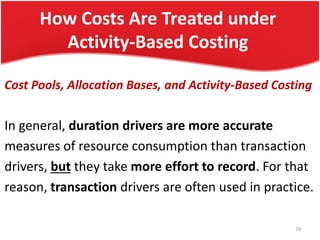
In general, duration drivers are more accurate
measures of resource consumption than transaction
drivers, but they take more effort to record. For that
reason, transaction drivers are often used in practice.
28
How Costs Are Treated under
Activity-Based Costing
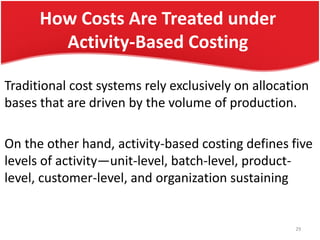
Traditional cost systems rely exclusively on allocation
bases that are driven by the volume of production.
On the other hand, activity-based costing defines five
levels of activity—unit-level, batch-level, product-
level, customer-level, and organization sustaining
29
How Costs Are Treated under
Activity-Based Costing
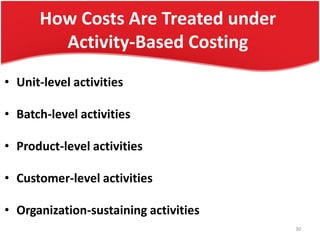
• Unit-level activities
• Batch-level activities
• Product-level activities
• Customer-level activities
• Organization-sustaining activities
30
Designing an Activity-Based
Costing (ABC) System
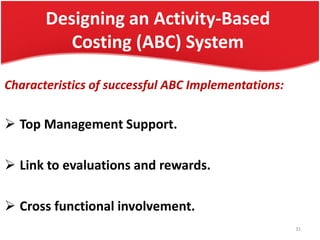
Characteristics of successful ABC Implementations:
 Top Management Support.
 Link to evaluations and rewards.
 Cross functional involvement.
31
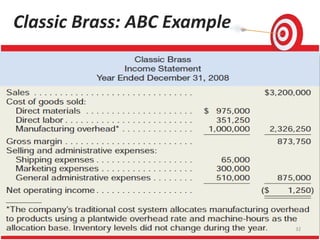
Classic Brass: ABC Example
32
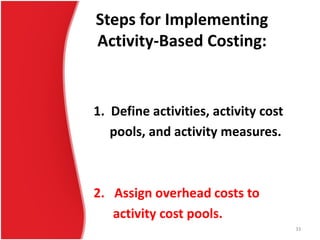
Steps for Implementing
Activity-Based Costing:
1. Define activities, activity cost
pools, and activity measures.
2. Assign overhead costs to
activity cost pools.
33
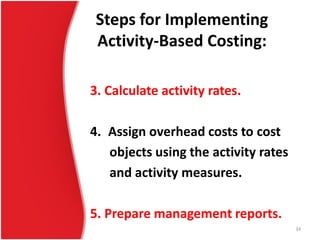
Steps for Implementing
Activity-Based Costing:
3. Calculate activity rates.
4. Assign overhead costs to cost
objects using the activity rates
and activity measures.
5. Prepare management reports.
34
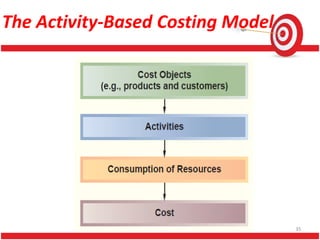
The Activity-Based Costing Model
35
Step 1:
Define Activities,
Activity Cost Pools,
and Activity Measures
36
Cont. Step 1
37
Cont. Step 1
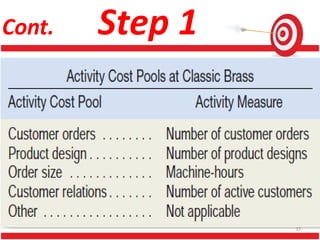
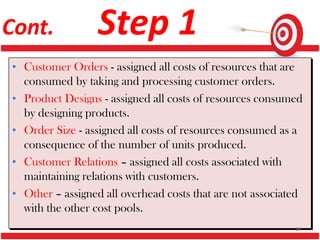
• Customer Orders - assigned all costs of resources that are
consumed by taking and processing customer orders.
• Product Designs - assigned all costs of resources consumed
by designing products.
• Order Size - assigned all costs of resources consumed as a
consequence of the number of units produced.
• Customer Relations – assigned all costs associated with
maintaining relations with customers.
• Other – assigned all overhead costs that are not associated
with the other cost pools.
38
Step 2:
Assign Overhead Costs
TO ==>
Activity Cost Pools
39
Cont. Step 2
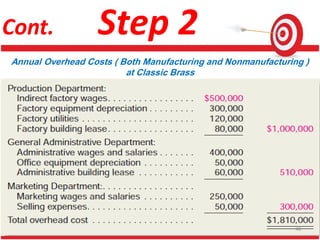
Annual Overhead Costs ( Both Manufacturing and Nonmanufacturing )
at Classic Brass
40
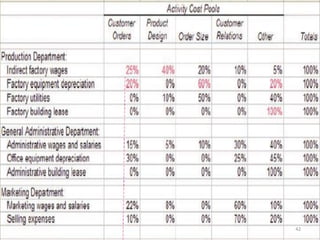
Cont. Step 2
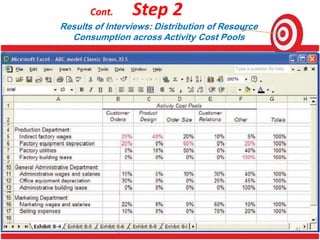
Results of Interviews: Distribution of Resource
Consumption across Activity Cost Pools
41
42
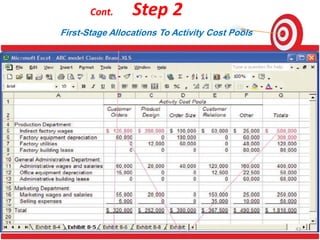
Cont. Step 2
First-Stage Allocations To Activity Cost Pools
43
Cont. Step 2
First-Stage Allocations To Activity Cost Pools
44
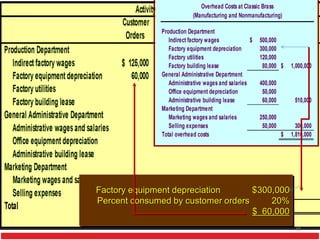
Factory equipment depreciation $300,000
Percent consumed by customer orders 20%
$ 60,000
45
THE ENDOF PART 1
46

Activity based costing salah skaik

  • 1.
  • 2.
    Designed by: SalahAnwar Skaik Copyright © 2012 - S.A.S 2
  • 3.
    8CHAPTER Activity-Based Costing A Toolto Aid Decision Making Copyright © 2012 - S.A.S, M.H.. & M.S. 3
  • 4.
    Topics In Chapter:(Objectives)  Understand activity-based costing and how it differs from a traditional costing system.  Assign costs to cost pools using a first- stage allocation. Part A: Salah A. Skaik 4
  • 5.
    Topics In Chapter:(Objectives)  Compute activity rates for cost pools.  Assign costs to an object using a second-stage allocation.  Use activity-based costing to compute products and customer margins. Part B: Mazen Hammoda 5
  • 6.
    Topics In Chapter:(Objectives)  Prepare an action analysis report using activity-based costing data and interpret the report. (Appendix 8A). Use activity-based costing techniques to compute unit product costs for external reports. (Appendix 8B). Part C: Mohammed Shaat 6
  • 7.
    Introduction Activity-based costing (ABC)is a costing method that is designed to provide managers with cost information for strategic and other decisions that potentially affect capacity and therefore “fixed” as well as variable costs. 7
  • 8.
    Introduction Activity-based costing isordinarily used As a supplement to, rather than as a replacement for, a company’s usual costing system. 8
  • 9.
    Introduction Most organizations thatuse activity- based costing have two costing systems 9
  • 10.
    Introduction 1) The officialcosting system that is used for preparing external financial reports. 2) The activity-based costing system that is used for internal decision making and for managing activities. 10
  • 11.
    Overview Activity-based costing differsfrom traditional cost accounting in three Ways: 11
  • 12.
    Overview In activity-based costing: 1)Nonmanufacturing as well as manufacturing costs may be assigned to products, but only on a cause-and-effect basis. 12
  • 13.
    Overview In activity-based costing: 2)Some manufacturing costs may be excluded from product costs. 13
  • 14.
    Overview In activity-based costing: 3)Numerous overhead cost pools are used, each of which is allocated to products and other cost objects using its own unique Measure of activity. 14
  • 15.
    How Costs AreTreated under Activity-Based Costing Nonmanufacturing Costs and Activity-Based Costing In traditional cost accounting, only manufacturing costs are assigned to products. Selling and administrative expenses are treated as period expenses and are not assigned to products. However, many of these nonmanufacturing costs are also part of the costs of producing, selling, distributing, and servicing specific products. 15
  • 16.
    How Costs AreTreated under Activity-Based Costing Nonmanufacturing Costs and Activity-Based Costing For example, commissions paid to salespersons, shipping costs, and warranty repair costs can be easily traced to individual products. 16
  • 17.
    How Costs AreTreated under Activity-Based Costing Nonmanufacturing Costs and Activity-Based Costing In this chapter, we will use the term overhead to refer to nonmanufacturing costs as well as to indirect manufacturing costs 17
  • 18.
    How Costs AreTreated under Activity-Based Costing Nonmanufacturing Costs and Activity-Based Costing In activity-based costing, products are assigned all of the overhead costs—nonmanufacturing as well as manufacturing—that they can reasonably be supposed to have caused. 18
  • 19.
    How Costs AreTreated under Activity-Based Costing Manufacturing Costs and Activity-Based Costing In traditional cost accounting systems, all manufacturing costs are assigned to products— even manufacturing costs that are not caused by the products. 19
  • 20.
    How Costs AreTreated under Activity-Based Costing Manufacturing Costs and Activity-Based Costing Manufacturing overhead includes costs such as the factory security guard’s wages, the plant controller’s salary, and the cost of supplies used by the plant manager’s secretary. These types of costs are assigned to products in a traditional absorption costing system even though they are totally unaffected by which products are made during a period. 20
  • 21.
    How Costs AreTreated under Activity-Based Costing Manufacturing Costs and Activity-Based Costing In contrast, activity-based costing systems do not arbitrarily assign these types of costs, which are called organization-sustaining costs, to products. Activity-based costing treats these types of costs as period expenses rather than product costs. 21
  • 22.
    Cost Pools, AllocationBases, and Activity-Based Costing In activity-based costing, an activity is any event that causes the consumption of overhead resources. 22
  • 23.
    How Costs AreTreated under Activity-Based Costing Cost Pools, Allocation Bases, and Activity-Based Costing In activity-based costing, An activity cost pool is a “bucket” in which costs are accumulated that relate to a single activity measure in the ABC system. 23
  • 24.
    How Costs AreTreated under Activity-Based Costing Cost Pools, Allocation Bases, and Activity-Based Costing In activity-based costing, An activity measure is an allocation base in an activity-based costing system. The term cost driver is also used to refer to an activity measure because the activity measure should “drive” the cost being allocated. 24
  • 25.
    How Costs AreTreated under Activity-Based Costing Cost Pools, Allocation Bases, and Activity-Based Costing The two most common types of activity measures are transaction drivers and duration drivers. 25
  • 26.
    How Costs AreTreated under Activity-Based Costing Cost Pools, Allocation Bases, and Activity-Based Costing Transaction drivers are simple counts of the number of times an activity occurs such as the number of bills sent out to customers. 26
  • 27.
    How Costs AreTreated under Activity-Based Costing Cost Pools, Allocation Bases, and Activity-Based Costing Duration drivers measure the amount of time required to perform an activity such as the time spent preparing individual bills for customers. 27
  • 28.
    How Costs AreTreated under Activity-Based Costing Cost Pools, Allocation Bases, and Activity-Based Costing In general, duration drivers are more accurate measures of resource consumption than transaction drivers, but they take more effort to record. For that reason, transaction drivers are often used in practice. 28
  • 29.
    How Costs AreTreated under Activity-Based Costing Traditional cost systems rely exclusively on allocation bases that are driven by the volume of production. On the other hand, activity-based costing defines five levels of activity—unit-level, batch-level, product- level, customer-level, and organization sustaining 29
  • 30.
    How Costs AreTreated under Activity-Based Costing • Unit-level activities • Batch-level activities • Product-level activities • Customer-level activities • Organization-sustaining activities 30
  • 31.
    Designing an Activity-Based Costing(ABC) System Characteristics of successful ABC Implementations:  Top Management Support.  Link to evaluations and rewards.  Cross functional involvement. 31
  • 32.
  • 33.
    Steps for Implementing Activity-BasedCosting: 1. Define activities, activity cost pools, and activity measures. 2. Assign overhead costs to activity cost pools. 33
  • 34.
    Steps for Implementing Activity-BasedCosting: 3. Calculate activity rates. 4. Assign overhead costs to cost objects using the activity rates and activity measures. 5. Prepare management reports. 34
  • 35.
  • 36.
    Step 1: Define Activities, ActivityCost Pools, and Activity Measures 36
  • 37.
  • 38.
    Cont. Step 1 •Customer Orders - assigned all costs of resources that are consumed by taking and processing customer orders. • Product Designs - assigned all costs of resources consumed by designing products. • Order Size - assigned all costs of resources consumed as a consequence of the number of units produced. • Customer Relations – assigned all costs associated with maintaining relations with customers. • Other – assigned all overhead costs that are not associated with the other cost pools. 38
  • 39.
    Step 2: Assign OverheadCosts TO ==> Activity Cost Pools 39
  • 40.
    Cont. Step 2 AnnualOverhead Costs ( Both Manufacturing and Nonmanufacturing ) at Classic Brass 40
  • 41.
    Cont. Step 2 Resultsof Interviews: Distribution of Resource Consumption across Activity Cost Pools 41
  • 42.
  • 43.
    Cont. Step 2 First-StageAllocations To Activity Cost Pools 43
  • 44.
    Cont. Step 2 First-StageAllocations To Activity Cost Pools 44
  • 45.
    Factory equipment depreciation$300,000 Percent consumed by customer orders 20% $ 60,000 45
  • 46.