Activity-Based Costing and
Activity-Based Management
Learning Objective 1
Explain undercosting
and overcosting of
products and services.
Undercosting and
Overcosting Example
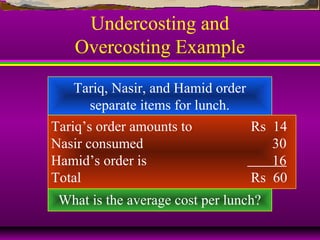
Tariq, Nasir, and Hamid order
separate items for lunch.
Tariq’s order amounts to Rs 14
Nasir consumed 30
Hamid’s order is 16
Total Rs 60
What is the average cost per lunch?
Undercosting and
Overcosting Example
Rs 60 ÷ 3 = Rs 20
Tariq and Hamid
are overcosted.
Nasir is
undercosted.
Learning Objective 2
Present three guidelines for
refining a costing system.
Existing Single Indirect-
Cost Pool System Example
Super Corporation manufactures a normal lens
(NL) and a complex lens (CL).
Super currently uses a single indirect-cost rate
job costing system.
Cost objects: 80,000 (NL) and 20,000 (CL).
Existing Single Indirect-
Cost Pool System Example
Normal Lenses (NL)
Direct materials Rs 1,520,000
Direct mfg. labor 800,000
Total direct costs Rs 2,320,000
Direct cost per unit: Rs 2,320,000 ÷ 80,000 = Rs29
Existing Single Indirect-
Cost Pool System Example
Complex Lenses (CL)
Direct materials Rs 920,000
Direct mfg. labor 260,000
Total direct costs Rs1,180,000
Direct cost per unit: Rs 1,180,000 ÷ 20,000 = Rs 59
Existing Single Indirect-
Cost Pool System Example
All Indirect Costs
Rs 2,900,000
All Indirect Costs
Rs 2,900,000
50,000 Direct
Manufacturing
Labor-Hours
50,000 Direct
Manufacturing
Labor-Hours
INDIRECT-COST
POLL
INDIRECT
COST-ALLOCATION
BASE
Rs 58 per Direct
Manufacturing
Labor-Hour
Existing Single Indirect-
Cost Pool System Example
Indirect Costs
Direct Costs
Indirect Costs
Direct Costs
COST OBJECT:
NL AND CL
LENSES
DIRECT
COSTS
Direct
Materials
Direct
Materials
Direct
Manufacturing
Labor
Direct
Manufacturing
Labor
Existing Single Indirect-
Cost Pool System Example
Super uses 36,000 direct manufacturing
labor-hours to make NL and 14,000 direct
manufacturing labor-hours to make CL.
How much indirect costs are allocated
to each product?
Existing Single Indirect-
Cost Pool System Example
NL: 36,000 × Rs 58 = Rs 2,088,000
CL: 14,000 × Rs 58 = Rs 812,000
What is the total cost of normal lenses?
Direct costs Rs 2,320,000 +
Allocated costs Rs 2,088,000 = Rs 4,408,000
What is the cost per unit?
Rs 4,408,000 ÷ 80,000 = Rs 55.10
Existing Single Indirect-
Cost Pool System Example
What is the total cost of complex lenses?
Direct costs Rs 1,180,000 + Allocated
costs Rs 812,000 = Rs 1,992,000
What is the cost per unit?
Rs 1,992,000 ÷ 20,000 = Rs 99.60
Existing Single Indirect-
Cost Pool System Example
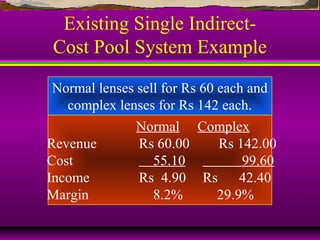
Normal lenses sell for Rs 60 each and
complex lenses for Rs 142 each.
Normal Complex
Revenue Rs 60.00 Rs 142.00
Cost 55.10 99.60
Income Rs 4.90 Rs 42.40
Margin 8.2% 29.9%
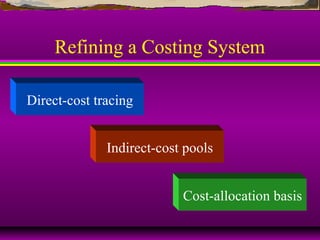
Refining a Costing System
Direct-cost tracing
Indirect-cost pools
Cost-allocation basis
Refining a Costing System
1. Design of Products and Process
The Design Department designs the molds
and defines processes needed (details of
the manufacturing operations).
Refining a Costing System
2. Manufacturing Operations
Lenses are molded, finished,
cleaned, and inspected.
3. Shipping and Distribution
Finished lenses are packed and
sent to the various customers.
Learning Objective 3
Distinguish between the
traditional and the
activity-based costing
approaches to designing
a costing system.
Activity-Based Costing System
Fundamental
Cost Objects
Activities
Costs of Activities
Assignment to Other
Cost Objects
Cost of:
• Product
• Service
• Customer
Activity-Based Costing System
A cross-functional team at Super
Corporation identified key activities:
Design products and processes.
Set up molding machine.
Operate machines to manufacture lenses.
Maintain and clean the molds.
Activity-Based Costing System
Set up batches of finished lenses for shipment.
Distribute lenses to customers.
Administer and manage all processes.
Activity-Based Costing System
No. of
Setup
Hours
Lenses
NL
Lenses
CL
Lenses
Other
Cost
Allocation
Base
Product
Cost
Objects
No. of
Shipments
Parts-
Square
feet
SetupDesign Shipping
Activity
Indirect Cost
Pool
Activity-Based Costing System
NL CL
Quantity produced 80,000 20,000
No. produced/batch 250 50
Number of batches 320 400
Setup time per batch 2 hours 5 hours
Total setup-hours 640 2,000
Total setup costs are Rs 409,200.
Activity-Based Costing System
What is the setup cost per setup-hour?
Rs 409,200 ÷ 2,640 hours = Rs 155
What is the setup cost per
direct manufacturing labor-hour?
Rs 409,200 ÷ 50,000 = Rs 8.184
Activity-Based Costing System
Allocation using direct labor-hours:
NL: Rs 8.184 × 36,000 = Rs 294,624
CL: Rs8.184 × 14,000 = Rs114,576
Total Rs409,200
Allocation using setup-hours:
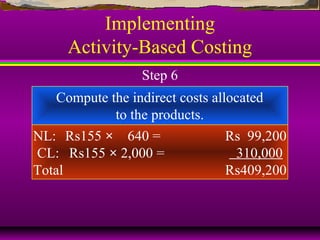
NL: Rs155 × 640 = Rs 99,200
CL: Rs155 × 2,000 = Rs310,000
Total Rs409,200
Learning Objective 4
Describe a four-part
cost hierarchy.
Cost Hierarchies
A cost hierarchy is a categorization
of costs into different cost pools.
Cost drivers bases (cost-allocation bases)
Degrees of difficulty in determining
cause-and-effect relationships
Cost Hierarchies
ABC systems commonly use a
four-part cost hierarchy to
identify cost-allocation bases:
1. Output unit-level costs
2. Batch-level costs
3. Product-sustaining costs
4. Facility-sustaining costs
Output Unit-Level Costs
These are resources sacrificed
on activities performed on each
individual unit of product or service.
Energy
Machine depreciation
Repairs
Batch-Level Costs
These are resources sacrificed on
activities that are related to a group
of units of product(s) or service(s)
rather than to each individual unit
of product or service.
Setup-hours
Procurement costs
Product-Sustaining Costs
These are often called service-sustaining
costs and are resources sacrificed on
activities undertaken to support
individual products or services.
Design costs
Engineering costs
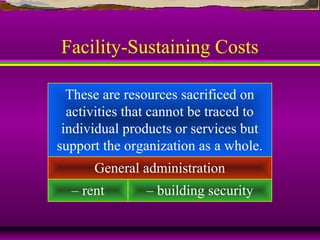
Facility-Sustaining Costs
These are resources sacrificed on
activities that cannot be traced to
individual products or services but
support the organization as a whole.
General administration
– rent – building security
Learning Objective 5
Cost products or services using
activity-based costing.
Implementing
Activity-Based Costing
Identify cost objects.
NL
CL
Identify the direct costs
of the products.
Direct material
Direct labor
Mold cleaning and
maintenance
Step 1 Step 2
Implementing
Activity-Based Costing
Cleaning and maintenance costs of
Rs360,000 are direct batch-level costs.
Why?
Because these costs consist of workers’
wages for cleaning molds after each
batch of lenses is run.
Implementing
Activity-Based Costing
Normal Lenses (NL)
Cost Hierarchy
Description Category
Direct materials Unit-level
Rs1,520,000
Direct mfg. labor Unit-level 800,000
Cleaning and maint. Batch-level 160,000
Total direct costs
Rs2,480,000
Implementing
Activity-Based Costing
Complex Lenses (CL)
Cost Hierarchy
Description Category
Direct materials Unit-level Rs
920,000
Direct mfg. labor Unit-level 260,000
Cleaning and maint. Batch-level 200,000
Total direct costs
Rs1,380,000
Implementing
Activity-Based Costing
Select the cost-allocation bases to use for
allocating indirect costs to the products.
(1) (2) (3)
Activity Cost Hierarchy Total Costs
Design Product-sustaining Rs450,000
Setups Batch-level Rs409,200
Operations Unit-level Rs637,500
Step 3
Implementing
Activity-Based Costing
Identify the indirect costs associated
with each cost-allocation base.
Overhead costs incurred are assigned
to activities, to the extent possible, on
the basis of a cause-and-effect relationship.
Step 4
Implementing
Activity-Based Costing
Compute the rate per unit.
(1) (5)
NL CL Total
Setup-hours: 640 2,000 2,640
Step 5
Rs409,200 ÷ 2,640 = Rs155
Implementing
Activity-Based Costing
Compute the indirect costs allocated
to the products.
NL: Rs155 × 640 = Rs 99,200
CL: Rs155 × 2,000 = 310,000
Total Rs409,200
Step 6
Implementing
Activity-Based Costing
Compute the costs of the products.
NL and CL would show three
direct cost categories.
Step 7
1. Direct materials
2. Direct manufacturing labor
3. Cleaning and maintenance
Implementing
Activity-Based Costing
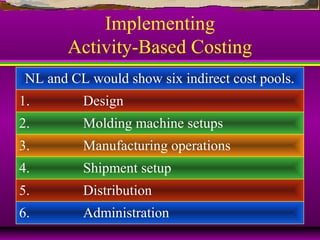
NL and CL would show six indirect cost pools.
1. Design
2. Molding machine setups
3. Manufacturing operations
4. Shipment setup
5. Distribution
6. Administration
Learning Objective 6
Use activity-based
costing systems for
activity-based management.
Activity-Based Management
ABM describes management decisions that use
activity-based costing information to satisfy
customers and improve profits.
Product pricing and mix decisions
Cost reduction and process improvement decisions
Design decisions
Product Pricing and
Mix Decisions
ABC gives management insight into the cost
structures for making and selling diverse products.
It provides more accurate product cost
information and more detailed information
on costs of activities and the drivers of those costs.
Cost Reduction and Process
Improvement Decisions
Manufacturing and distribution personnel use
ABC systems to focus on cost-reduction efforts.
Managers set cost-reduction targets in terms of
reducing the cost per unit of the cost-allocation base.
Design Decisions
Management can identify and evaluate new designs
to improve performance by evaluating how product
and process designs affect activities and costs.
Companies can work with their customers to
evaluate the costs and prices of alternative designs.
Learning Objective 7
Compare activity-based costing
systems and department-
costing systems.
ABC and Department
Indirect-Cost Rates
Many companies have evolved their
costing system from using a single
cost pool to using separate indirect-cost
rates for each department:
Design
Manufacturing
Distribution
ABC and Department
Indirect-Cost Rates
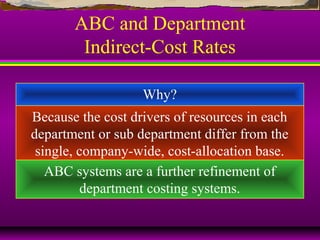
Why?
Because the cost drivers of resources in each
department or sub department differ from the
single, company-wide, cost-allocation base.
ABC systems are a further refinement of
department costing systems.
Learning Objective 8
Evaluate the costs and benefits
of implementing activity-based
costing systems.
Benefits of ABC Systems
Significant amounts of indirect costs are
allocated using only one or two cost pools.
All or most costs are identified
as output unit-level costs.
Products make diverse demands on
resources because of differences in
volume, process steps, batch size,
or complexity.
Benefits of ABC Systems
Products that a company is well-suited to
make and sell show small profits while
products for which a company is less
suited show large profits.
Complex products appear to be very
profitable and simple products
appear to be losing money.
Benefits of ABC Systems
Operations staff have significant
disagreements with the accounting
staff about the costs of manufacturing
and marketing products and services.
Limitations of ABC Systems
The main limitations of ABC are the
measurements necessary to
implement the system.
ABC systems require management
to estimate costs of activity pools
and to identify and measure cost
drivers for these pools.
Limitations of ABC Systems
Activity-cost rates also need to be
updated regularly.
Very detailed ABC systems are costly
to operate and difficult to understand.
ABC In Service and
Merchandising Companies
The general approach to ABC in the
service and merchandising areas is very
similar to the approach in manufacturing.
Costs are divided into homogeneous cost
pools and classified as output unit-level,
batch-level, product- or service-sustaining,
and facility-sustaining costs.
ABC In Service and
Merchandising Companies
The cost pools correspond to key activities.
Costs are allocated to products or customers
using activity drivers or cost-allocation
bases that have a cause-and-effect
relationship with the cost in the cost pool.
ATTENTION
STUDENTS
JOIN KHALID
AZIZ FOR
ACCOUNTING OF
ICMAP 1,2,3..CA..
B,C & D
PIPFA,MBA,BBA

abc COSTING

  • 1.
  • 2.
    Learning Objective 1 Explainundercosting and overcosting of products and services.
  • 3.
    Undercosting and Overcosting Example Tariq,Nasir, and Hamid order separate items for lunch. Tariq’s order amounts to Rs 14 Nasir consumed 30 Hamid’s order is 16 Total Rs 60 What is the average cost per lunch?
  • 4.
    Undercosting and Overcosting Example Rs60 ÷ 3 = Rs 20 Tariq and Hamid are overcosted. Nasir is undercosted.
  • 5.
    Learning Objective 2 Presentthree guidelines for refining a costing system.
  • 6.
    Existing Single Indirect- CostPool System Example Super Corporation manufactures a normal lens (NL) and a complex lens (CL). Super currently uses a single indirect-cost rate job costing system. Cost objects: 80,000 (NL) and 20,000 (CL).
  • 7.
    Existing Single Indirect- CostPool System Example Normal Lenses (NL) Direct materials Rs 1,520,000 Direct mfg. labor 800,000 Total direct costs Rs 2,320,000 Direct cost per unit: Rs 2,320,000 ÷ 80,000 = Rs29
  • 8.
    Existing Single Indirect- CostPool System Example Complex Lenses (CL) Direct materials Rs 920,000 Direct mfg. labor 260,000 Total direct costs Rs1,180,000 Direct cost per unit: Rs 1,180,000 ÷ 20,000 = Rs 59
  • 9.
    Existing Single Indirect- CostPool System Example All Indirect Costs Rs 2,900,000 All Indirect Costs Rs 2,900,000 50,000 Direct Manufacturing Labor-Hours 50,000 Direct Manufacturing Labor-Hours INDIRECT-COST POLL INDIRECT COST-ALLOCATION BASE Rs 58 per Direct Manufacturing Labor-Hour
  • 10.
    Existing Single Indirect- CostPool System Example Indirect Costs Direct Costs Indirect Costs Direct Costs COST OBJECT: NL AND CL LENSES DIRECT COSTS Direct Materials Direct Materials Direct Manufacturing Labor Direct Manufacturing Labor
  • 11.
    Existing Single Indirect- CostPool System Example Super uses 36,000 direct manufacturing labor-hours to make NL and 14,000 direct manufacturing labor-hours to make CL. How much indirect costs are allocated to each product?
  • 12.
    Existing Single Indirect- CostPool System Example NL: 36,000 × Rs 58 = Rs 2,088,000 CL: 14,000 × Rs 58 = Rs 812,000 What is the total cost of normal lenses? Direct costs Rs 2,320,000 + Allocated costs Rs 2,088,000 = Rs 4,408,000 What is the cost per unit? Rs 4,408,000 ÷ 80,000 = Rs 55.10
  • 13.
    Existing Single Indirect- CostPool System Example What is the total cost of complex lenses? Direct costs Rs 1,180,000 + Allocated costs Rs 812,000 = Rs 1,992,000 What is the cost per unit? Rs 1,992,000 ÷ 20,000 = Rs 99.60
  • 14.
    Existing Single Indirect- CostPool System Example Normal lenses sell for Rs 60 each and complex lenses for Rs 142 each. Normal Complex Revenue Rs 60.00 Rs 142.00 Cost 55.10 99.60 Income Rs 4.90 Rs 42.40 Margin 8.2% 29.9%
  • 15.
    Refining a CostingSystem Direct-cost tracing Indirect-cost pools Cost-allocation basis
  • 16.
    Refining a CostingSystem 1. Design of Products and Process The Design Department designs the molds and defines processes needed (details of the manufacturing operations).
  • 17.
    Refining a CostingSystem 2. Manufacturing Operations Lenses are molded, finished, cleaned, and inspected. 3. Shipping and Distribution Finished lenses are packed and sent to the various customers.
  • 18.
    Learning Objective 3 Distinguishbetween the traditional and the activity-based costing approaches to designing a costing system.
  • 19.
    Activity-Based Costing System Fundamental CostObjects Activities Costs of Activities Assignment to Other Cost Objects Cost of: • Product • Service • Customer
  • 20.
    Activity-Based Costing System Across-functional team at Super Corporation identified key activities: Design products and processes. Set up molding machine. Operate machines to manufacture lenses. Maintain and clean the molds.
  • 21.
    Activity-Based Costing System Setup batches of finished lenses for shipment. Distribute lenses to customers. Administer and manage all processes.
  • 22.
    Activity-Based Costing System No.of Setup Hours Lenses NL Lenses CL Lenses Other Cost Allocation Base Product Cost Objects No. of Shipments Parts- Square feet SetupDesign Shipping Activity Indirect Cost Pool
  • 23.
    Activity-Based Costing System NLCL Quantity produced 80,000 20,000 No. produced/batch 250 50 Number of batches 320 400 Setup time per batch 2 hours 5 hours Total setup-hours 640 2,000 Total setup costs are Rs 409,200.
  • 24.
    Activity-Based Costing System Whatis the setup cost per setup-hour? Rs 409,200 ÷ 2,640 hours = Rs 155 What is the setup cost per direct manufacturing labor-hour? Rs 409,200 ÷ 50,000 = Rs 8.184
  • 25.
    Activity-Based Costing System Allocationusing direct labor-hours: NL: Rs 8.184 × 36,000 = Rs 294,624 CL: Rs8.184 × 14,000 = Rs114,576 Total Rs409,200 Allocation using setup-hours: NL: Rs155 × 640 = Rs 99,200 CL: Rs155 × 2,000 = Rs310,000 Total Rs409,200
  • 26.
    Learning Objective 4 Describea four-part cost hierarchy.
  • 27.
    Cost Hierarchies A costhierarchy is a categorization of costs into different cost pools. Cost drivers bases (cost-allocation bases) Degrees of difficulty in determining cause-and-effect relationships
  • 28.
    Cost Hierarchies ABC systemscommonly use a four-part cost hierarchy to identify cost-allocation bases: 1. Output unit-level costs 2. Batch-level costs 3. Product-sustaining costs 4. Facility-sustaining costs
  • 29.
    Output Unit-Level Costs Theseare resources sacrificed on activities performed on each individual unit of product or service. Energy Machine depreciation Repairs
  • 30.
    Batch-Level Costs These areresources sacrificed on activities that are related to a group of units of product(s) or service(s) rather than to each individual unit of product or service. Setup-hours Procurement costs
  • 31.
    Product-Sustaining Costs These areoften called service-sustaining costs and are resources sacrificed on activities undertaken to support individual products or services. Design costs Engineering costs
  • 32.
    Facility-Sustaining Costs These areresources sacrificed on activities that cannot be traced to individual products or services but support the organization as a whole. General administration – rent – building security
  • 33.
    Learning Objective 5 Costproducts or services using activity-based costing.
  • 34.
    Implementing Activity-Based Costing Identify costobjects. NL CL Identify the direct costs of the products. Direct material Direct labor Mold cleaning and maintenance Step 1 Step 2
  • 35.
    Implementing Activity-Based Costing Cleaning andmaintenance costs of Rs360,000 are direct batch-level costs. Why? Because these costs consist of workers’ wages for cleaning molds after each batch of lenses is run.
  • 36.
    Implementing Activity-Based Costing Normal Lenses(NL) Cost Hierarchy Description Category Direct materials Unit-level Rs1,520,000 Direct mfg. labor Unit-level 800,000 Cleaning and maint. Batch-level 160,000 Total direct costs Rs2,480,000
  • 37.
    Implementing Activity-Based Costing Complex Lenses(CL) Cost Hierarchy Description Category Direct materials Unit-level Rs 920,000 Direct mfg. labor Unit-level 260,000 Cleaning and maint. Batch-level 200,000 Total direct costs Rs1,380,000
  • 38.
    Implementing Activity-Based Costing Select thecost-allocation bases to use for allocating indirect costs to the products. (1) (2) (3) Activity Cost Hierarchy Total Costs Design Product-sustaining Rs450,000 Setups Batch-level Rs409,200 Operations Unit-level Rs637,500 Step 3
  • 39.
    Implementing Activity-Based Costing Identify theindirect costs associated with each cost-allocation base. Overhead costs incurred are assigned to activities, to the extent possible, on the basis of a cause-and-effect relationship. Step 4
  • 40.
    Implementing Activity-Based Costing Compute therate per unit. (1) (5) NL CL Total Setup-hours: 640 2,000 2,640 Step 5 Rs409,200 ÷ 2,640 = Rs155
  • 41.
    Implementing Activity-Based Costing Compute theindirect costs allocated to the products. NL: Rs155 × 640 = Rs 99,200 CL: Rs155 × 2,000 = 310,000 Total Rs409,200 Step 6
  • 42.
    Implementing Activity-Based Costing Compute thecosts of the products. NL and CL would show three direct cost categories. Step 7 1. Direct materials 2. Direct manufacturing labor 3. Cleaning and maintenance
  • 43.
    Implementing Activity-Based Costing NL andCL would show six indirect cost pools. 1. Design 2. Molding machine setups 3. Manufacturing operations 4. Shipment setup 5. Distribution 6. Administration
  • 44.
    Learning Objective 6 Useactivity-based costing systems for activity-based management.
  • 45.
    Activity-Based Management ABM describesmanagement decisions that use activity-based costing information to satisfy customers and improve profits. Product pricing and mix decisions Cost reduction and process improvement decisions Design decisions
  • 46.
    Product Pricing and MixDecisions ABC gives management insight into the cost structures for making and selling diverse products. It provides more accurate product cost information and more detailed information on costs of activities and the drivers of those costs.
  • 47.
    Cost Reduction andProcess Improvement Decisions Manufacturing and distribution personnel use ABC systems to focus on cost-reduction efforts. Managers set cost-reduction targets in terms of reducing the cost per unit of the cost-allocation base.
  • 48.
    Design Decisions Management canidentify and evaluate new designs to improve performance by evaluating how product and process designs affect activities and costs. Companies can work with their customers to evaluate the costs and prices of alternative designs.
  • 49.
    Learning Objective 7 Compareactivity-based costing systems and department- costing systems.
  • 50.
    ABC and Department Indirect-CostRates Many companies have evolved their costing system from using a single cost pool to using separate indirect-cost rates for each department: Design Manufacturing Distribution
  • 51.
    ABC and Department Indirect-CostRates Why? Because the cost drivers of resources in each department or sub department differ from the single, company-wide, cost-allocation base. ABC systems are a further refinement of department costing systems.
  • 52.
    Learning Objective 8 Evaluatethe costs and benefits of implementing activity-based costing systems.
  • 53.
    Benefits of ABCSystems Significant amounts of indirect costs are allocated using only one or two cost pools. All or most costs are identified as output unit-level costs. Products make diverse demands on resources because of differences in volume, process steps, batch size, or complexity.
  • 54.
    Benefits of ABCSystems Products that a company is well-suited to make and sell show small profits while products for which a company is less suited show large profits. Complex products appear to be very profitable and simple products appear to be losing money.
  • 55.
    Benefits of ABCSystems Operations staff have significant disagreements with the accounting staff about the costs of manufacturing and marketing products and services.
  • 56.
    Limitations of ABCSystems The main limitations of ABC are the measurements necessary to implement the system. ABC systems require management to estimate costs of activity pools and to identify and measure cost drivers for these pools.
  • 57.
    Limitations of ABCSystems Activity-cost rates also need to be updated regularly. Very detailed ABC systems are costly to operate and difficult to understand.
  • 58.
    ABC In Serviceand Merchandising Companies The general approach to ABC in the service and merchandising areas is very similar to the approach in manufacturing. Costs are divided into homogeneous cost pools and classified as output unit-level, batch-level, product- or service-sustaining, and facility-sustaining costs.
  • 59.
    ABC In Serviceand Merchandising Companies The cost pools correspond to key activities. Costs are allocated to products or customers using activity drivers or cost-allocation bases that have a cause-and-effect relationship with the cost in the cost pool.
  • 60.
    ATTENTION STUDENTS JOIN KHALID AZIZ FOR ACCOUNTINGOF ICMAP 1,2,3..CA.. B,C & D PIPFA,MBA,BBA

Editor's Notes

  • #35 <number>
  • #37 <number>
  • #38 <number>