BBA 3rd
(Course Overview & Introduction)
   Best way of consultation is through e-mail;
    (humna.asif19@gmail.com)            OR
    Skype (humna.asif)
   Course would be based on lecture discussions,
    mainly comprising of Case Studies
   A branch of Philosophy
   Set of Moral principles that govern a
    person's or group's behavior
   The moral correctness of specified conduct
   Refers to a bunch of Norms
   Judgments from society
   Moral Values
     “beliefs or ideals of a person or social group, which are
            judged in the light of reason and humanity”

   Norms
     “explicit or implicit rules specifying what behaviors are
                 acceptable within a society or group”
   Judgments
              “the ability to make a decision, or form
                  an opinion wisely; with good sense”
   Right Vs. Good
   Wrong Vs. Bad
   Unethical Vs. Illegal
   comprises principles and standards that guide behavior
    in the world of business
   acceptable or unacceptable behavior within or outside
    the organization
   is determined by key stakeholders
   what is right and wrong, good and bad, and harmful or
    beneficial regarding decisions and actions in & around
    organizational activities
 The discipline of applying ethical principles to solve
 complex moral dilemmas
 An area that requires reasoning and judgment based
 on individuals’ principles and beliefs in making
 choices that balance self-interest against social
 claims and responsibilities
   is the obligation a business assumes toward
    society
   is designed to maximize the positive influence
    & minimize the negative
   includes economic, legal, ethical, and
    philanthropic dimensions
   Social responsibility represents the duties of an
    individual or organization to be accountable for its
    decisions

   Social responsibility is best described as a subset
    of ethics
   To develop students’ critical thinking skills by:
     Stimulating moral investigation

     Analyzing key concepts

     Dealing with ambiguity and disagreement
   Prepare students for issues they will face in business
    careers
   Stimulate students’ sense of social responsibility
   Laws are not sufficient to cover “gray areas ”
   To anticipate laws and the market in order to;
     Prevent fraud or other organizational wrongdoing

     Long-term market rewards through positive

      reputation
   To increase employee morale and productivity
   Because business is part of the social system in which
    we all must live
   Obey laws
   Adopt codes of ethics that focus on stakeholder
    interest over shareholder interest
   Participate in socially responsible initiatives
       (Examples…)
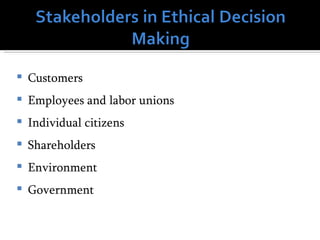
   Customers
   Employees and labor unions
   Individual citizens
   Shareholders
   Environment
   Government
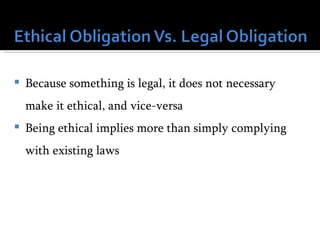
   Because something is legal, it does not necessary
    make it ethical, and vice-versa
   Being ethical implies more than simply complying
    with existing laws
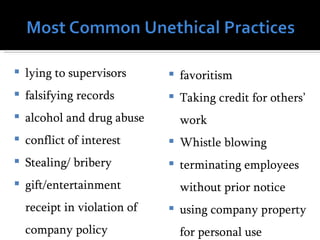
   lying to supervisors         favoritism
   falsifying records           Taking credit for others’
   alcohol and drug abuse        work
   conflict of interest         Whistle blowing
   Stealing/ bribery            terminating employees
   gift/entertainment            without prior notice
    receipt in violation of      using company property
    company policy                for personal use
   Two general categories of reasoning used to solve
    ethical dilemmas -- deontology and utilitarianism
   Arguments and decisions can be made by using either
    or a combination of both
   Value-based
   Using personal or individual beliefs of right and wrong
    to solve an ethical dilemma
   Follows the logic that people ought to do what they
    believe is right, and refrain from doing what they
    believe is wrong
   Does not take consequences or long-term outcomes
    into account
   Outcome-based
   Using the potential outcome of an action to solve
    and ethical dilemma
   Follows the logic that people ought to base their
    decisions on the action that will result in the greatest
    good for the greatest number
   Does not take personal beliefs or values into account
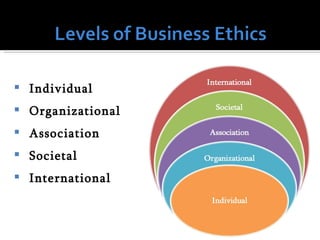
   Individual
   Organizational
   Association
   Societal
   International
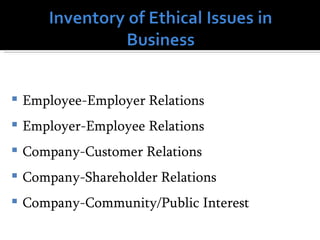
   Employee-Employer Relations
   Employer-Employee Relations
   Company-Customer Relations
   Company-Shareholder Relations
   Company-Community/Public Interest
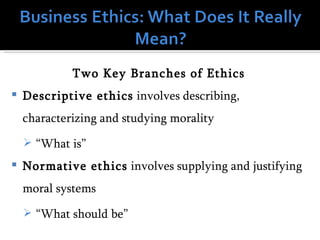
Two Key Branches of Ethics
   Descriptive ethics involves describing,
    characterizing and studying morality
     “What is”
   Normative ethics involves supplying and justifying
    moral systems
     “What should be”
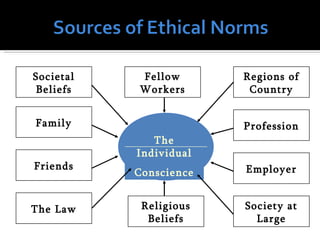
Societal   Fellow       Regions of
Beliefs    Workers       Country


Family                  Profession
              The
           Individual
Friends                 Employer
           Conscience


The Law     Religious   Society at
             Beliefs      Large
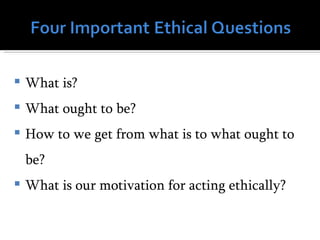
   What is?
   What ought to be?
   How to we get from what is to what ought to
    be?
   What is our motivation for acting ethically?
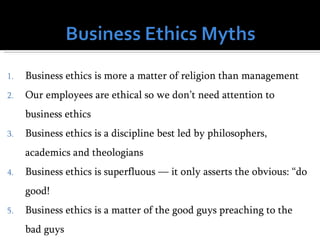
1.   Business ethics is more a matter of religion than management
2.   Our employees are ethical so we don’t need attention to
     business ethics
3.   Business ethics is a discipline best led by philosophers,
     academics and theologians
4.   Business ethics is superfluous — it only asserts the obvious: “do
     good!
5.   Business ethics is a matter of the good guys preaching to the
     bad guys
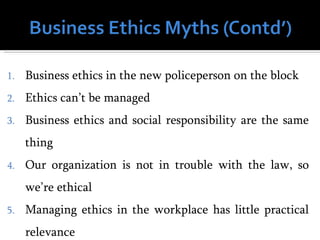
1.   Business ethics in the new policeperson on the block
2.   Ethics can’t be managed
3.   Business ethics and social responsibility are the same
     thing
4.   Our organization is not in trouble with the law, so
     we’re ethical
5.   Managing ethics in the workplace has little practical
     relevance
“There are always those who think they know
  what is your responsibility, better than you
                      do”

                      -- Ralph Waldo Emerson
Business Ethics Lecture 2 & 3

Business Ethics Lecture 2 & 3

  • 1.
    BBA 3rd (Course Overview& Introduction)
  • 2.
    Best way of consultation is through e-mail; (humna.asif19@gmail.com) OR Skype (humna.asif)  Course would be based on lecture discussions, mainly comprising of Case Studies
  • 4.
    A branch of Philosophy  Set of Moral principles that govern a person's or group's behavior  The moral correctness of specified conduct  Refers to a bunch of Norms  Judgments from society
  • 5.
    Moral Values “beliefs or ideals of a person or social group, which are judged in the light of reason and humanity”  Norms “explicit or implicit rules specifying what behaviors are acceptable within a society or group”  Judgments “the ability to make a decision, or form an opinion wisely; with good sense”  Right Vs. Good  Wrong Vs. Bad  Unethical Vs. Illegal
  • 6.
    comprises principles and standards that guide behavior in the world of business  acceptable or unacceptable behavior within or outside the organization  is determined by key stakeholders  what is right and wrong, good and bad, and harmful or beneficial regarding decisions and actions in & around organizational activities
  • 7.
     The disciplineof applying ethical principles to solve complex moral dilemmas  An area that requires reasoning and judgment based on individuals’ principles and beliefs in making choices that balance self-interest against social claims and responsibilities
  • 8.
    is the obligation a business assumes toward society  is designed to maximize the positive influence & minimize the negative  includes economic, legal, ethical, and philanthropic dimensions
  • 9.
    Social responsibility represents the duties of an individual or organization to be accountable for its decisions  Social responsibility is best described as a subset of ethics
  • 10.
    To develop students’ critical thinking skills by:  Stimulating moral investigation  Analyzing key concepts  Dealing with ambiguity and disagreement  Prepare students for issues they will face in business careers  Stimulate students’ sense of social responsibility
  • 11.
    Laws are not sufficient to cover “gray areas ”  To anticipate laws and the market in order to;  Prevent fraud or other organizational wrongdoing  Long-term market rewards through positive reputation  To increase employee morale and productivity  Because business is part of the social system in which we all must live
  • 12.
    Obey laws  Adopt codes of ethics that focus on stakeholder interest over shareholder interest  Participate in socially responsible initiatives  (Examples…)
  • 13.
    Customers  Employees and labor unions  Individual citizens  Shareholders  Environment  Government
  • 14.
    Because something is legal, it does not necessary make it ethical, and vice-versa  Being ethical implies more than simply complying with existing laws
  • 15.
    lying to supervisors  favoritism  falsifying records  Taking credit for others’  alcohol and drug abuse work  conflict of interest  Whistle blowing  Stealing/ bribery  terminating employees  gift/entertainment without prior notice receipt in violation of  using company property company policy for personal use
  • 17.
    Two general categories of reasoning used to solve ethical dilemmas -- deontology and utilitarianism  Arguments and decisions can be made by using either or a combination of both
  • 18.
    Value-based  Using personal or individual beliefs of right and wrong to solve an ethical dilemma  Follows the logic that people ought to do what they believe is right, and refrain from doing what they believe is wrong  Does not take consequences or long-term outcomes into account
  • 19.
    Outcome-based  Using the potential outcome of an action to solve and ethical dilemma  Follows the logic that people ought to base their decisions on the action that will result in the greatest good for the greatest number  Does not take personal beliefs or values into account
  • 20.
    Individual  Organizational  Association  Societal  International
  • 21.
    Employee-Employer Relations  Employer-Employee Relations  Company-Customer Relations  Company-Shareholder Relations  Company-Community/Public Interest
  • 22.
    Two Key Branchesof Ethics  Descriptive ethics involves describing, characterizing and studying morality  “What is”  Normative ethics involves supplying and justifying moral systems  “What should be”
  • 23.
    Societal Fellow Regions of Beliefs Workers Country Family Profession The Individual Friends Employer Conscience The Law Religious Society at Beliefs Large
  • 24.
    What is?  What ought to be?  How to we get from what is to what ought to be?  What is our motivation for acting ethically?
  • 26.
    1. Business ethics is more a matter of religion than management 2. Our employees are ethical so we don’t need attention to business ethics 3. Business ethics is a discipline best led by philosophers, academics and theologians 4. Business ethics is superfluous — it only asserts the obvious: “do good! 5. Business ethics is a matter of the good guys preaching to the bad guys
  • 27.
    1. Business ethics in the new policeperson on the block 2. Ethics can’t be managed 3. Business ethics and social responsibility are the same thing 4. Our organization is not in trouble with the law, so we’re ethical 5. Managing ethics in the workplace has little practical relevance
  • 28.
    “There are alwaysthose who think they know what is your responsibility, better than you do” -- Ralph Waldo Emerson