3-1
Ch.3 Managing Ethics & Diversity
1. Read Chapter & Review Slide Deck
2. Complete assigned task on end-of-chapter activity (argue case
in class using appropriate chapter concepts)
3. Engage class in ethical reasoning activities regarding business
ethics situations (no advanced preparation)
4. Complete Starbucks Case on Corporate Social Responsibility,
Sustainability & Social Audits (Teams)
5. Complete in-class activity “Joseph and the Company Party”
(Kingston-Case, no advanced preparation
6. Watch S.A.S. Video Case (10 mins) & comment based on key
concepts from chapter.
Learning Outcomes
 Be able to illustrate how ethics help managers
determine the right way to behave when dealing
with different stakeholder groups
 Understand & be able to explain convincingly why
managers should behave ethically and strive to
create ethical organizational cultures
 Appreciate the increasing diversity of the
workforce and of the organization environment
Learning Outcomes
Be able to grasp the central role that managers
play in the effective management of diversity and
business ethics
Understand why the effective management of
diversity is both an ethical and a business
imperative
Understand and explain the significance of
corporate social responsibility, sustainability and
social and environmental audits to today’s
businesses.
The Nature of Ethics
Ethics: Inner-guiding moral principles, values, and
beliefs that people use to analyze or interpret a
situation and then decide what is the “right” or
appropriate way to behave
Ethical dilemma: Quandary people find
themselves in when they have to decide if they
should act in a way that might help another person
or group even though doing so might go against
their own self-interest
Stakeholders and Ethics
Stakeholders: People and groups that supply a
company with its productive resources and so have
a claim on and stake in the company
Stakeholders can directly benefit or be harmed by
an organizations actions, the ethics of a company
and its managers are important to them
3-6
What Is Ethics?
•Ethics - accepted principles of right or wrong or
good and bad that govern
•the conduct of a person
•the members of a profession
•the actions of an organization
•Business ethics - accepted principles of right or
wrong governing the conduct of business people
•Ethical strategy - a strategy, or course of action,
that does not violate these accepted principles
3-7
What are Ethical Dilemmas?
•Ethical dilemmas - situations in which none of the
available alternatives seems ethically acceptable
•real-world decisions are complex, difficult to frame, and
involve consequences that are difficult to quantify
the right course of action is not always clear
May be little or no agreement on accepted ethical standards
or principles
May be agreement on issue but little agreement on what to do
May be situations where none of the alternative courses of
action are fully ethical acceptable
Need a moral compass but what should that look like?
3-8
Use and Abuse of Business Power
Business Power
The ability or capacity to produce
an effect or to bring influence to bear on a situation or people.
Iron Law of Responsibility
In the long run, those who do not use
power in a manner society considers responsible will tend to
lose it.
3-9
Questions?
1. How much moral divergence is acceptable?
2. What role does company play if practices tolerated? How far should
company go re: discovery? Is failure to do anything tacit support?
3. Who is responsible? What is the obligation to use business power and
how should it be used in the business society relationship?
4. What can be done to change the situation positively?
5. Are there policies in place to deal with problems before they emerge
or once they have emerged?
Note: Power is itself morally neutral: How power is used is what matters.
It can be used in a positive way to increase social welfare and
sustainability or it can be used in a manner that is ethically & morally
suspect.
3-10
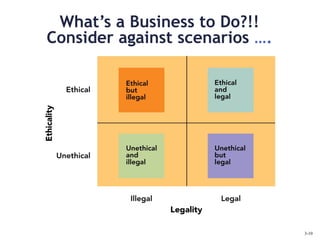
What’s a Business to Do?!!
Consider against scenarios ….
3-11
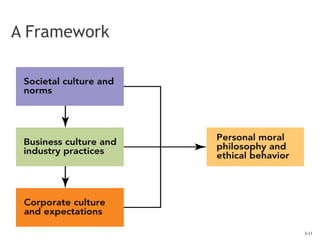
A Framework
3-12
Elements of the Social Contract
Laws or Regulations:
“Rules of the Game”
Shared Understandings
of Each Other
Society or
Societal
Stakeholder
Groups
Business
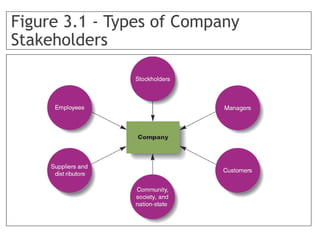
Figure 3.1 - Types of Company
Stakeholders
Stockholders
•Want to ensure that managers are behaving
ethically and not risking investors’ capital by
engaging in actions that could hurt the company’s
reputation
•Want to maximize their return on investment
Managers
•Responsible for using a company’s financial,
capital and human resources to increase its
performance
•Have the right to expect a good return or reward
by investing their human capital to improve a
company’s performance
•Difficult decisions challenge managers to uphold
ethical values
Employees
•Companies can act ethically toward employees by
creating an occupational structure that fairly and
equitably rewards employees for their contributions
Suppliers and Distributors
•Suppliers expect to be paid fairly and promptly for
their inputs
•Distributors expect to receive quality products at
agreed-upon prices
Customers
•Most critical stakeholder group
•Company must work to increase efficiency and
effectiveness in order to create loyal customers
and attract new ones
Community, Society, and Nation
•Community - Physical locations like towns or cities
or to social milieus like ethnic neighborhoods in
which companies are located
•Provides a company with the physical and social
infrastructure that allows it to operate
•A company affects the prosperity of a community,
society and a nation
Figure 3.2 - Four Ethical Rules
Practical Decision Model
Does my decision fall within the accepted values
or standards that typically apply in business today?
Am I willing to see the decision communicated to
all people and groups affected by it—for example,
by having it reported in newspapers or on
television?
Would the people with whom I have a significant
personal relationship, such as family members,
friends, or even managers in other organizations,
approve of the decision?
See ‘Ethical Reasoning Guidelines’ doc (Canvas)
Why Should Managers Behave
Ethically?
•The relentless pursuit of self-interest can lead to a
collective disaster if individuals start to profit from
being unethical, encouraging other people to act in
the same way
Figure 3.3 - Some Effects of
Ethical and Unethical Behavior
Why Should Managers behave Ethically?
Trust: Willingness of one person or group to have
faith or confidence in the goodwill of another
person, even though this puts them at risk
Reputation: Esteem or high repute that
individuals or organizations gain when they behave
ethically
Figure 3.4 - Sources of an
Organization’s Code of Ethics
Ethical Organizational Cultures
Managers can ensure that important ethical values
and norms are key features of an organization’s
culture
Managers become ethical role models whose
behavior is scrutinized by their subordinates
Ethical Organizational Cultures
Ethics ombudsman: Ethics officer who monitors
an organization’s practices and procedures to be
sure they are ethical
3-28
Corporate Social Responsibility (CSR)
Social responsibility- idea that organizations are
part of a larger society & are accountable to that
society for their actions
Like ethics, agreement on nature & scope of social
responsibility is difficult, given diversity of values
and interests
Increasingly firms are becoming very mindful of
these conditions and challenges and are responding
by committing organizational and other resources
to CSR
3-29
Three Concepts of Social Responsibility
3-30
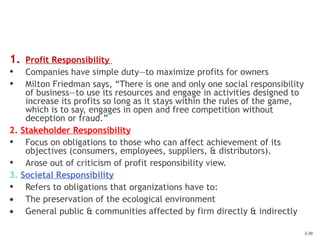
1. Profit Responsibility
• Companies have simple duty—to maximize profits for owners
• Milton Friedman says, “There is one and only one social responsibility
of business—to use its resources and engage in activities designed to
increase its profits so long as it stays within the rules of the game,
which is to say, engages in open and free competition without
deception or fraud.”
2. Stakeholder Responsibility
• Focus on obligations to those who can affect achievement of its
objectives (consumers, employees, suppliers, & distributors).
• Arose out of criticism of profit responsibility view.
3. Societal Responsibility
• Refers to obligations that organizations have to:
• The preservation of the ecological environment
• General public & communities affected by firm directly & indirectly
3-31
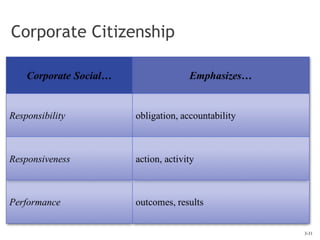
Corporate Citizenship
3-32
The Pyramid of Corporate Social
Responsibility (CSR)
• Philanthropic Responsibilities
Be a good corporate citizen.
• Ethical Responsibilities
Be ethical.
• Legal Responsibilities
Obey the law.
• Economic Responsibilities
Be profitable.
• Philanthropic Responsibilities
Be a good corporate citizen.
• Ethical Responsibilities
Be ethical.
• Legal Responsibilities
Obey the law.
• Economic Responsibilities
Be profitable.
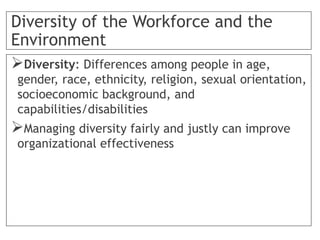
Diversity of the Workforce and the
Environment
Diversity: Differences among people in age,
gender, race, ethnicity, religion, sexual orientation,
socioeconomic background, and
capabilities/disabilities
Managing diversity fairly and justly can improve
organizational effectiveness
3-34
Arguments Against CSR
• The classical economic view that business’ only
goal is the maximize profits for owners.
• Business is not equipped to handle social activities.
• It dilutes the primary purpose of business.
• Businesses have too much power already .
• It limits the ability to compete in a global
marketplace.
3-35
Arguments For CSR
• It addresses social issues brought on by business, and
allows business to be part of the solution.
• Enlightened self-interest: businesses must take actions to
ensure long-term viability.
• Wards off future government intervention.
• It addresses issues by using business resources and
expertise.
• It addresses issues by being proactive.
• The public supports CSR.
3-36
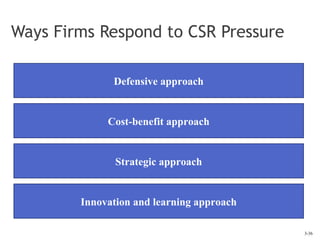
Ways Firms Respond to CSR Pressure
Cost-benefit approach
Strategic approach
Innovation and learning approach
Defensive approach
3-37
Corporate Social Responsiveness
•An action-oriented variant of CSR.
Responsibility
•Implies a state or condition of having assumed an
obligation.
Responsiveness
•Connotes a dynamic, action-oriented condition.
3-38
“Triple Bottom Line” Perspective of
Sustainable Business
Key Spheres of Sustainability
1.Economic
2.Social
3.Environmental
Corporate sustainability is the goal.
Diversity Concerns
•The ethical imperative for equal opportunity
•The continuing work towards accepting diversity
•Glass ceiling: Metaphor alluding to the invisible
barriers that prevent minorities and women from
being promoted to top corporate positions
Figure 3.5 - Sources of Diversity in the
Workplace
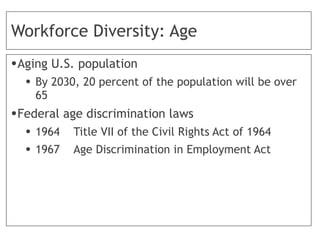
Workforce Diversity: Age
•Aging U.S. population
• By 2030, 20 percent of the population will be over
65
•Federal age discrimination laws
• 1964 Title VII of the Civil Rights Act of 1964
• 1967 Age Discrimination in Employment Act
Workforce Diversity: Gender
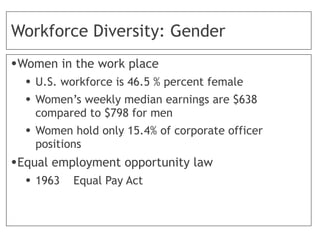
•Women in the work place
• U.S. workforce is 46.5 % percent female
• Women’s weekly median earnings are $638
compared to $798 for men
• Women hold only 15.4% of corporate officer
positions
•Equal employment opportunity law
• 1963 Equal Pay Act
Workforce Diversity: Race and Ethnicity
•Racial and ethnic diversity of the U.S. population is
increasing at an exponential rate
•Emphasizes the importance of effectively managing
diversity
Workforce Diversity: Religion
•Accommodation for religious beliefs
• Scheduling of critical meetings
• Providing flexible time off for holy days
• Posting holy days for different religions on the
company calendar
•Even small accommodations for religious diversity
often enhances employee loyalty
•See Joseph and the Company Party -- Case
Workforce Diversity: Capabilities and
Disabilities
•Americans with Disabilities Act (ADA) of 1990
prohibits discrimination against persons with
disabilities
•Accommodation towards disability
• Providing reasonable accommodations for
individuals with disabilities
• Promoting a nondiscriminatory workplace
environment
• Educating the organization about disabilities and
AIDS
Workforce Diversity: Socioeconomic
Background
•A combination of social class and income-related
factors
•Requires managers to be sensitive and responsive to
the needs and concerns of those less privileged
•Concerns
• Widening diversity in income levels
• Single mothers and the “working poor”
• Child and elder care for working parents
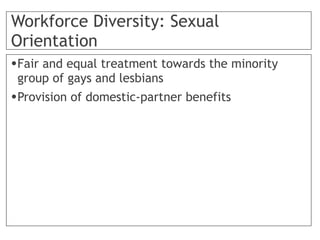
Workforce Diversity: Sexual
Orientation
•Fair and equal treatment towards the minority
group of gays and lesbians
•Provision of domestic-partner benefits
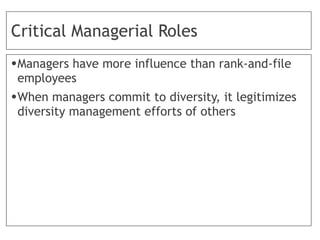
Critical Managerial Roles
•Managers have more influence than rank-and-file
employees
•When managers commit to diversity, it legitimizes
diversity management efforts of others
Effectively Managing Diversity Makes
Good Business Sense
•Diverse organizational members can be a source of
competitive advantage when managed efficiently
•Variety of points of view and approaches to
problems and opportunities that diverse employees
provide can improve managerial decision making
Forms of Sexual Harassment
•Quid pro quo: Asking or forcing an employee to
perform sexual favors in exchange for some reward
or to avoid negative consequences
•Hostile work environment: Telling lewd jokes,
displaying pornography, making sexually oriented
remarks about someone’s personal appearance, and
other sex-related actions that make the work
environment unpleasant
Steps to Eradicate Sexual Harassment
•Develop and clearly communicate a sexual
harassment policy endorsed by top management
•Use a fair complaint to investigate charges
of sexual harassment
•When it has been determined that sexual
harassment has taken place, take corrective action
as soon as possible
•Provide sexual harassment education and training
to all organizational members, including managers

Chapter 3 ethics and diversity ppt

  • 1.
    3-1 Ch.3 Managing Ethics& Diversity 1. Read Chapter & Review Slide Deck 2. Complete assigned task on end-of-chapter activity (argue case in class using appropriate chapter concepts) 3. Engage class in ethical reasoning activities regarding business ethics situations (no advanced preparation) 4. Complete Starbucks Case on Corporate Social Responsibility, Sustainability & Social Audits (Teams) 5. Complete in-class activity “Joseph and the Company Party” (Kingston-Case, no advanced preparation 6. Watch S.A.S. Video Case (10 mins) & comment based on key concepts from chapter.
  • 2.
    Learning Outcomes  Beable to illustrate how ethics help managers determine the right way to behave when dealing with different stakeholder groups  Understand & be able to explain convincingly why managers should behave ethically and strive to create ethical organizational cultures  Appreciate the increasing diversity of the workforce and of the organization environment
  • 3.
    Learning Outcomes Be ableto grasp the central role that managers play in the effective management of diversity and business ethics Understand why the effective management of diversity is both an ethical and a business imperative Understand and explain the significance of corporate social responsibility, sustainability and social and environmental audits to today’s businesses.
  • 4.
    The Nature ofEthics Ethics: Inner-guiding moral principles, values, and beliefs that people use to analyze or interpret a situation and then decide what is the “right” or appropriate way to behave Ethical dilemma: Quandary people find themselves in when they have to decide if they should act in a way that might help another person or group even though doing so might go against their own self-interest
  • 5.
    Stakeholders and Ethics Stakeholders:People and groups that supply a company with its productive resources and so have a claim on and stake in the company Stakeholders can directly benefit or be harmed by an organizations actions, the ethics of a company and its managers are important to them
  • 6.
    3-6 What Is Ethics? •Ethics- accepted principles of right or wrong or good and bad that govern •the conduct of a person •the members of a profession •the actions of an organization •Business ethics - accepted principles of right or wrong governing the conduct of business people •Ethical strategy - a strategy, or course of action, that does not violate these accepted principles
  • 7.
    3-7 What are EthicalDilemmas? •Ethical dilemmas - situations in which none of the available alternatives seems ethically acceptable •real-world decisions are complex, difficult to frame, and involve consequences that are difficult to quantify the right course of action is not always clear May be little or no agreement on accepted ethical standards or principles May be agreement on issue but little agreement on what to do May be situations where none of the alternative courses of action are fully ethical acceptable Need a moral compass but what should that look like?
  • 8.
    3-8 Use and Abuseof Business Power Business Power The ability or capacity to produce an effect or to bring influence to bear on a situation or people. Iron Law of Responsibility In the long run, those who do not use power in a manner society considers responsible will tend to lose it.
  • 9.
    3-9 Questions? 1. How muchmoral divergence is acceptable? 2. What role does company play if practices tolerated? How far should company go re: discovery? Is failure to do anything tacit support? 3. Who is responsible? What is the obligation to use business power and how should it be used in the business society relationship? 4. What can be done to change the situation positively? 5. Are there policies in place to deal with problems before they emerge or once they have emerged? Note: Power is itself morally neutral: How power is used is what matters. It can be used in a positive way to increase social welfare and sustainability or it can be used in a manner that is ethically & morally suspect.
  • 10.
    3-10 What’s a Businessto Do?!! Consider against scenarios ….
  • 11.
  • 12.
    3-12 Elements of theSocial Contract Laws or Regulations: “Rules of the Game” Shared Understandings of Each Other Society or Societal Stakeholder Groups Business
  • 13.
    Figure 3.1 -Types of Company Stakeholders
  • 14.
    Stockholders •Want to ensurethat managers are behaving ethically and not risking investors’ capital by engaging in actions that could hurt the company’s reputation •Want to maximize their return on investment
  • 15.
    Managers •Responsible for usinga company’s financial, capital and human resources to increase its performance •Have the right to expect a good return or reward by investing their human capital to improve a company’s performance •Difficult decisions challenge managers to uphold ethical values
  • 16.
    Employees •Companies can actethically toward employees by creating an occupational structure that fairly and equitably rewards employees for their contributions
  • 17.
    Suppliers and Distributors •Suppliersexpect to be paid fairly and promptly for their inputs •Distributors expect to receive quality products at agreed-upon prices
  • 18.
    Customers •Most critical stakeholdergroup •Company must work to increase efficiency and effectiveness in order to create loyal customers and attract new ones
  • 19.
    Community, Society, andNation •Community - Physical locations like towns or cities or to social milieus like ethnic neighborhoods in which companies are located •Provides a company with the physical and social infrastructure that allows it to operate •A company affects the prosperity of a community, society and a nation
  • 20.
    Figure 3.2 -Four Ethical Rules
  • 21.
    Practical Decision Model Doesmy decision fall within the accepted values or standards that typically apply in business today? Am I willing to see the decision communicated to all people and groups affected by it—for example, by having it reported in newspapers or on television? Would the people with whom I have a significant personal relationship, such as family members, friends, or even managers in other organizations, approve of the decision? See ‘Ethical Reasoning Guidelines’ doc (Canvas)
  • 22.
    Why Should ManagersBehave Ethically? •The relentless pursuit of self-interest can lead to a collective disaster if individuals start to profit from being unethical, encouraging other people to act in the same way
  • 23.
    Figure 3.3 -Some Effects of Ethical and Unethical Behavior
  • 24.
    Why Should Managersbehave Ethically? Trust: Willingness of one person or group to have faith or confidence in the goodwill of another person, even though this puts them at risk Reputation: Esteem or high repute that individuals or organizations gain when they behave ethically
  • 25.
    Figure 3.4 -Sources of an Organization’s Code of Ethics
  • 26.
    Ethical Organizational Cultures Managerscan ensure that important ethical values and norms are key features of an organization’s culture Managers become ethical role models whose behavior is scrutinized by their subordinates
  • 27.
    Ethical Organizational Cultures Ethicsombudsman: Ethics officer who monitors an organization’s practices and procedures to be sure they are ethical
  • 28.
    3-28 Corporate Social Responsibility(CSR) Social responsibility- idea that organizations are part of a larger society & are accountable to that society for their actions Like ethics, agreement on nature & scope of social responsibility is difficult, given diversity of values and interests Increasingly firms are becoming very mindful of these conditions and challenges and are responding by committing organizational and other resources to CSR
  • 29.
    3-29 Three Concepts ofSocial Responsibility
  • 30.
    3-30 1. Profit Responsibility •Companies have simple duty—to maximize profits for owners • Milton Friedman says, “There is one and only one social responsibility of business—to use its resources and engage in activities designed to increase its profits so long as it stays within the rules of the game, which is to say, engages in open and free competition without deception or fraud.” 2. Stakeholder Responsibility • Focus on obligations to those who can affect achievement of its objectives (consumers, employees, suppliers, & distributors). • Arose out of criticism of profit responsibility view. 3. Societal Responsibility • Refers to obligations that organizations have to: • The preservation of the ecological environment • General public & communities affected by firm directly & indirectly
  • 31.
  • 32.
    3-32 The Pyramid ofCorporate Social Responsibility (CSR) • Philanthropic Responsibilities Be a good corporate citizen. • Ethical Responsibilities Be ethical. • Legal Responsibilities Obey the law. • Economic Responsibilities Be profitable. • Philanthropic Responsibilities Be a good corporate citizen. • Ethical Responsibilities Be ethical. • Legal Responsibilities Obey the law. • Economic Responsibilities Be profitable.
  • 33.
    Diversity of theWorkforce and the Environment Diversity: Differences among people in age, gender, race, ethnicity, religion, sexual orientation, socioeconomic background, and capabilities/disabilities Managing diversity fairly and justly can improve organizational effectiveness
  • 34.
    3-34 Arguments Against CSR •The classical economic view that business’ only goal is the maximize profits for owners. • Business is not equipped to handle social activities. • It dilutes the primary purpose of business. • Businesses have too much power already . • It limits the ability to compete in a global marketplace.
  • 35.
    3-35 Arguments For CSR •It addresses social issues brought on by business, and allows business to be part of the solution. • Enlightened self-interest: businesses must take actions to ensure long-term viability. • Wards off future government intervention. • It addresses issues by using business resources and expertise. • It addresses issues by being proactive. • The public supports CSR.
  • 36.
    3-36 Ways Firms Respondto CSR Pressure Cost-benefit approach Strategic approach Innovation and learning approach Defensive approach
  • 37.
    3-37 Corporate Social Responsiveness CorporateSocial Responsiveness •An action-oriented variant of CSR. Responsibility •Implies a state or condition of having assumed an obligation. Responsiveness •Connotes a dynamic, action-oriented condition.
  • 38.
    3-38 “Triple Bottom Line”Perspective of Sustainable Business Key Spheres of Sustainability 1.Economic 2.Social 3.Environmental Corporate sustainability is the goal.
  • 39.
    Diversity Concerns •The ethicalimperative for equal opportunity •The continuing work towards accepting diversity •Glass ceiling: Metaphor alluding to the invisible barriers that prevent minorities and women from being promoted to top corporate positions
  • 40.
    Figure 3.5 -Sources of Diversity in the Workplace
  • 41.
    Workforce Diversity: Age •AgingU.S. population • By 2030, 20 percent of the population will be over 65 •Federal age discrimination laws • 1964 Title VII of the Civil Rights Act of 1964 • 1967 Age Discrimination in Employment Act
  • 42.
    Workforce Diversity: Gender •Womenin the work place • U.S. workforce is 46.5 % percent female • Women’s weekly median earnings are $638 compared to $798 for men • Women hold only 15.4% of corporate officer positions •Equal employment opportunity law • 1963 Equal Pay Act
  • 43.
    Workforce Diversity: Raceand Ethnicity •Racial and ethnic diversity of the U.S. population is increasing at an exponential rate •Emphasizes the importance of effectively managing diversity
  • 44.
    Workforce Diversity: Religion •Accommodationfor religious beliefs • Scheduling of critical meetings • Providing flexible time off for holy days • Posting holy days for different religions on the company calendar •Even small accommodations for religious diversity often enhances employee loyalty •See Joseph and the Company Party -- Case
  • 45.
    Workforce Diversity: Capabilitiesand Disabilities •Americans with Disabilities Act (ADA) of 1990 prohibits discrimination against persons with disabilities •Accommodation towards disability • Providing reasonable accommodations for individuals with disabilities • Promoting a nondiscriminatory workplace environment • Educating the organization about disabilities and AIDS
  • 46.
    Workforce Diversity: Socioeconomic Background •Acombination of social class and income-related factors •Requires managers to be sensitive and responsive to the needs and concerns of those less privileged •Concerns • Widening diversity in income levels • Single mothers and the “working poor” • Child and elder care for working parents
  • 47.
    Workforce Diversity: Sexual Orientation •Fairand equal treatment towards the minority group of gays and lesbians •Provision of domestic-partner benefits
  • 48.
    Critical Managerial Roles •Managershave more influence than rank-and-file employees •When managers commit to diversity, it legitimizes diversity management efforts of others
  • 49.
    Effectively Managing DiversityMakes Good Business Sense •Diverse organizational members can be a source of competitive advantage when managed efficiently •Variety of points of view and approaches to problems and opportunities that diverse employees provide can improve managerial decision making
  • 50.
    Forms of SexualHarassment •Quid pro quo: Asking or forcing an employee to perform sexual favors in exchange for some reward or to avoid negative consequences •Hostile work environment: Telling lewd jokes, displaying pornography, making sexually oriented remarks about someone’s personal appearance, and other sex-related actions that make the work environment unpleasant
  • 51.
    Steps to EradicateSexual Harassment •Develop and clearly communicate a sexual harassment policy endorsed by top management •Use a fair complaint to investigate charges of sexual harassment •When it has been determined that sexual harassment has taken place, take corrective action as soon as possible •Provide sexual harassment education and training to all organizational members, including managers