THE PRINCIPLES OF MULTICRITERIAL REASONING  OF THE DEVELOPMENT PRIORITIES Buracas & Zvirblis [email_address] PROF. HAB. DR.  ALGIS  ŽVIRBLIS
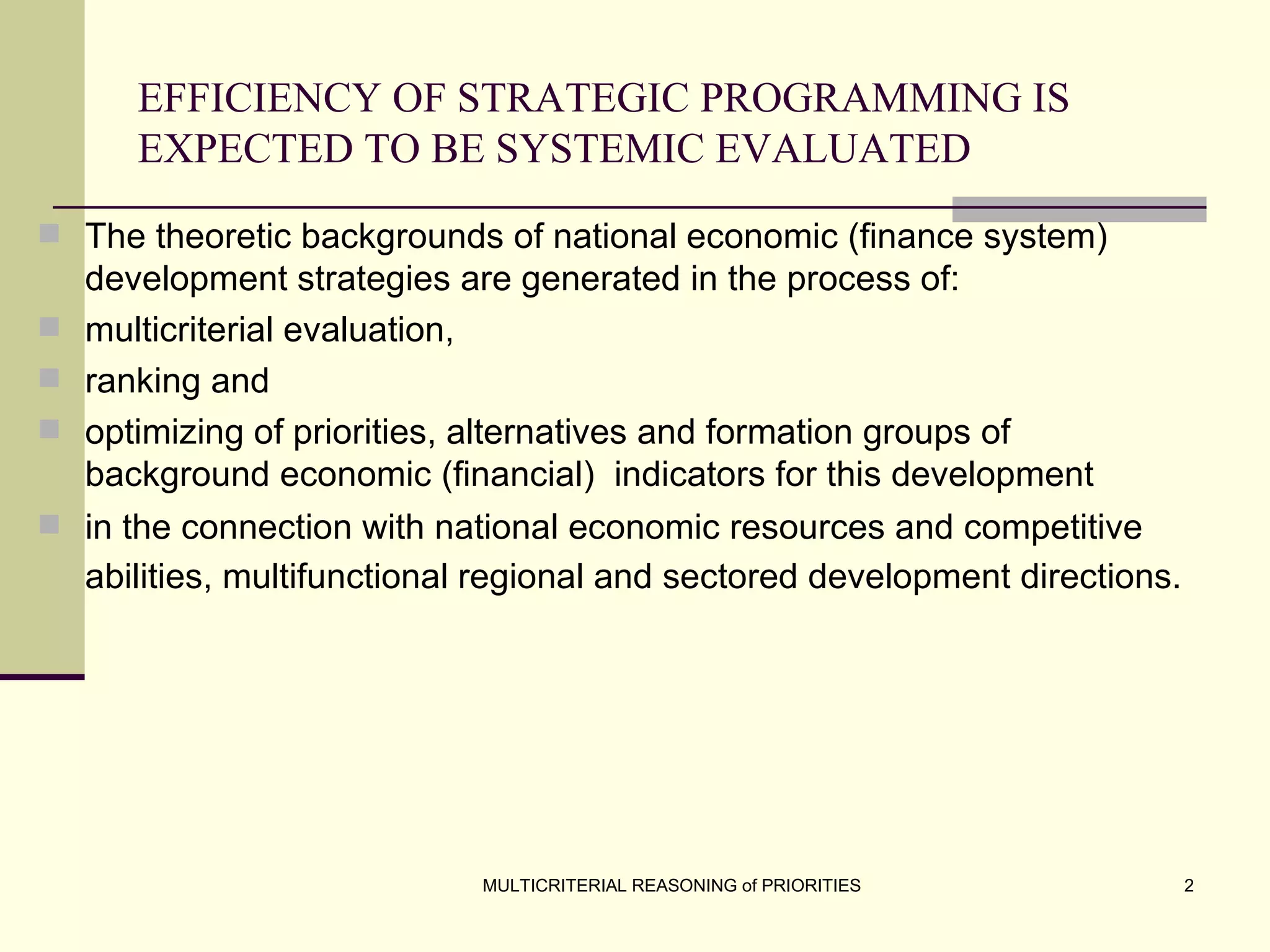
EFFICIENCY OF STRATEGIC PROGRAMMING IS EXPECTED TO BE SYSTEMIC EVALUATED The theoretic backgrounds of national economic (finance system) development strategies are generated in the process of:  multicriterial evaluation,  ranking and  optimizing of priorities, alternatives and formation groups of background economic (financial)  indicators for this development  in the connection with national economic resources and competitive abilities, multifunctional regional and sectored development directions.
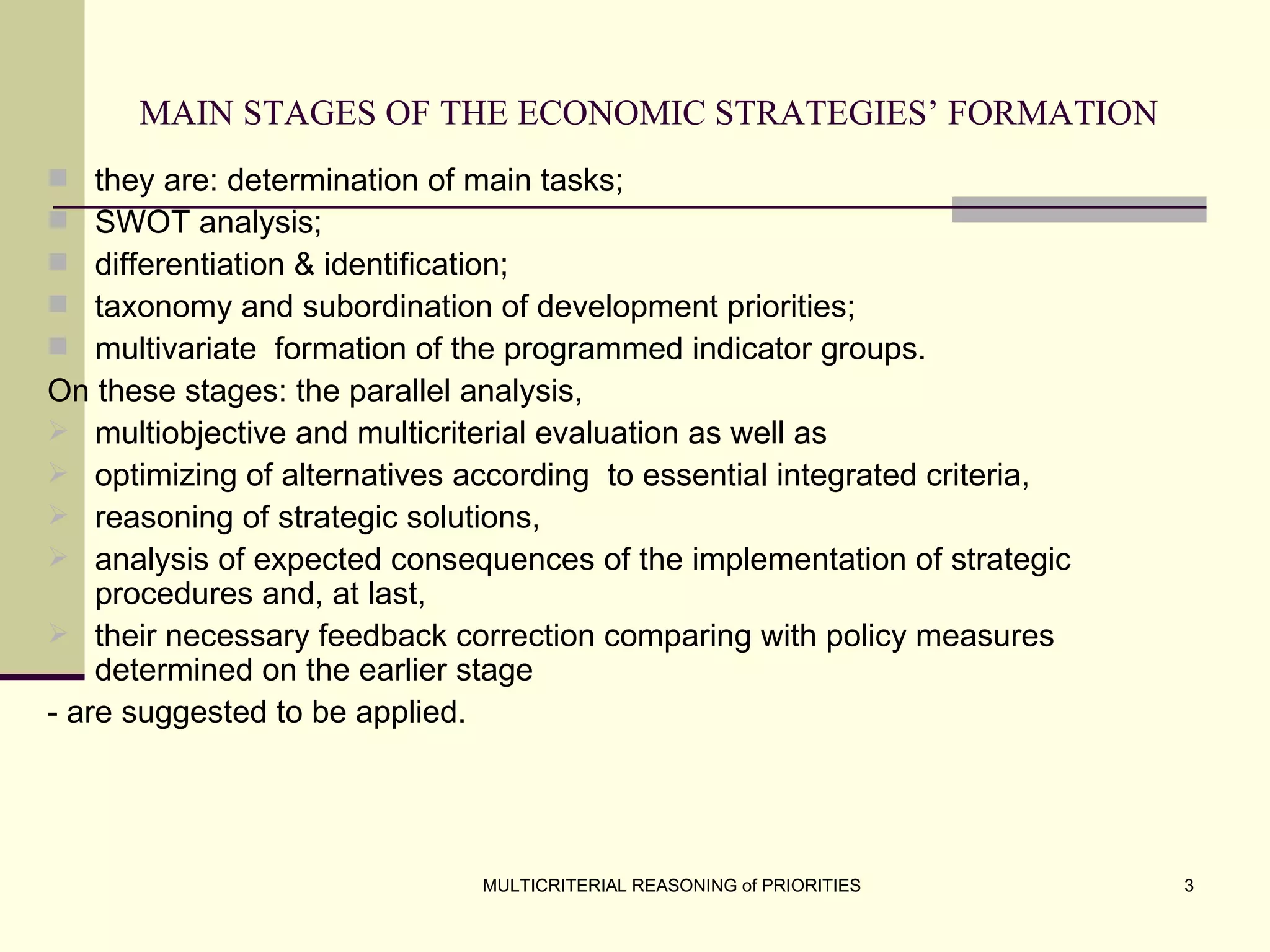
MAIN STAGES OF THE ECONOMIC STRATEGIES’ FORMATION   they are: determination of main tasks;  SWOT analysis;  differentiation & identification;  taxonomy and subordination of development priorities;  multivariate  formation of the programmed indicator groups.  On these stages: the parallel analysis,  multiobjective and multicriterial evaluation as well as  optimizing of alternatives according  to essential integrated criteria,  reasoning of strategic solutions,  analysis of expected consequences of the implementation of strategic procedures and, at last,  their necessary feedback correction comparing with policy measures determined on the earlier stage  - are suggested to be applied.
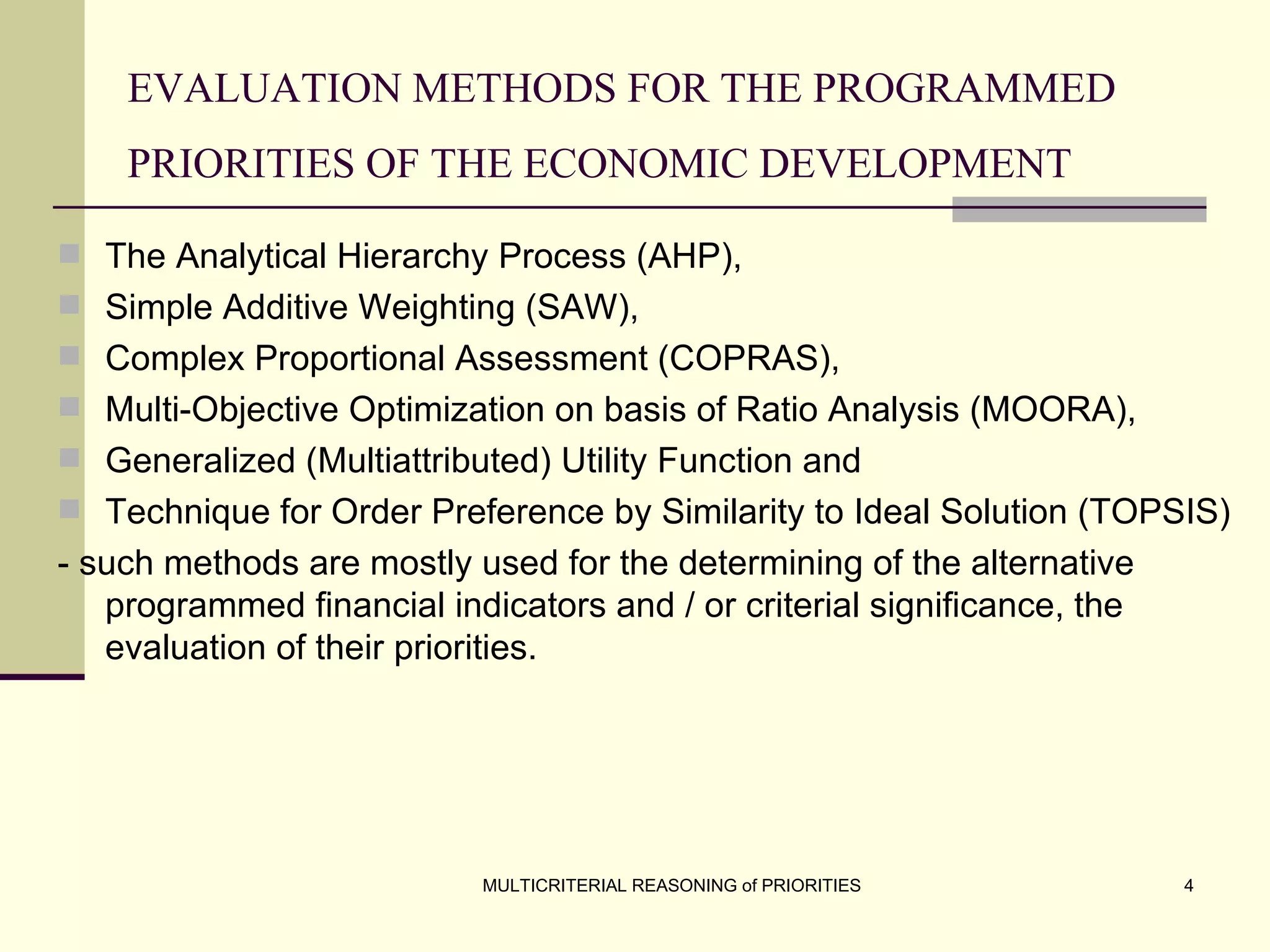
EVALUATION METHODS FOR THE PROGRAMMED PRIORITIES OF THE ECONOMIC DEVELOPMENT   The Analytical Hierarchy Process (AHP),  Simple Additive Weighting (SAW),  Complex Proportional Assessment (COPRAS), Multi-Objective Optimization on basis of Ratio Analysis (MOORA), Generalized (Multiattributed) Utility Function and Technique for Order Preference by Similarity to Ideal Solution (TOPSIS)  - such methods are mostly used for the determining of the alternative programmed financial indicators and / or criterial significance, the evaluation of their priorities.
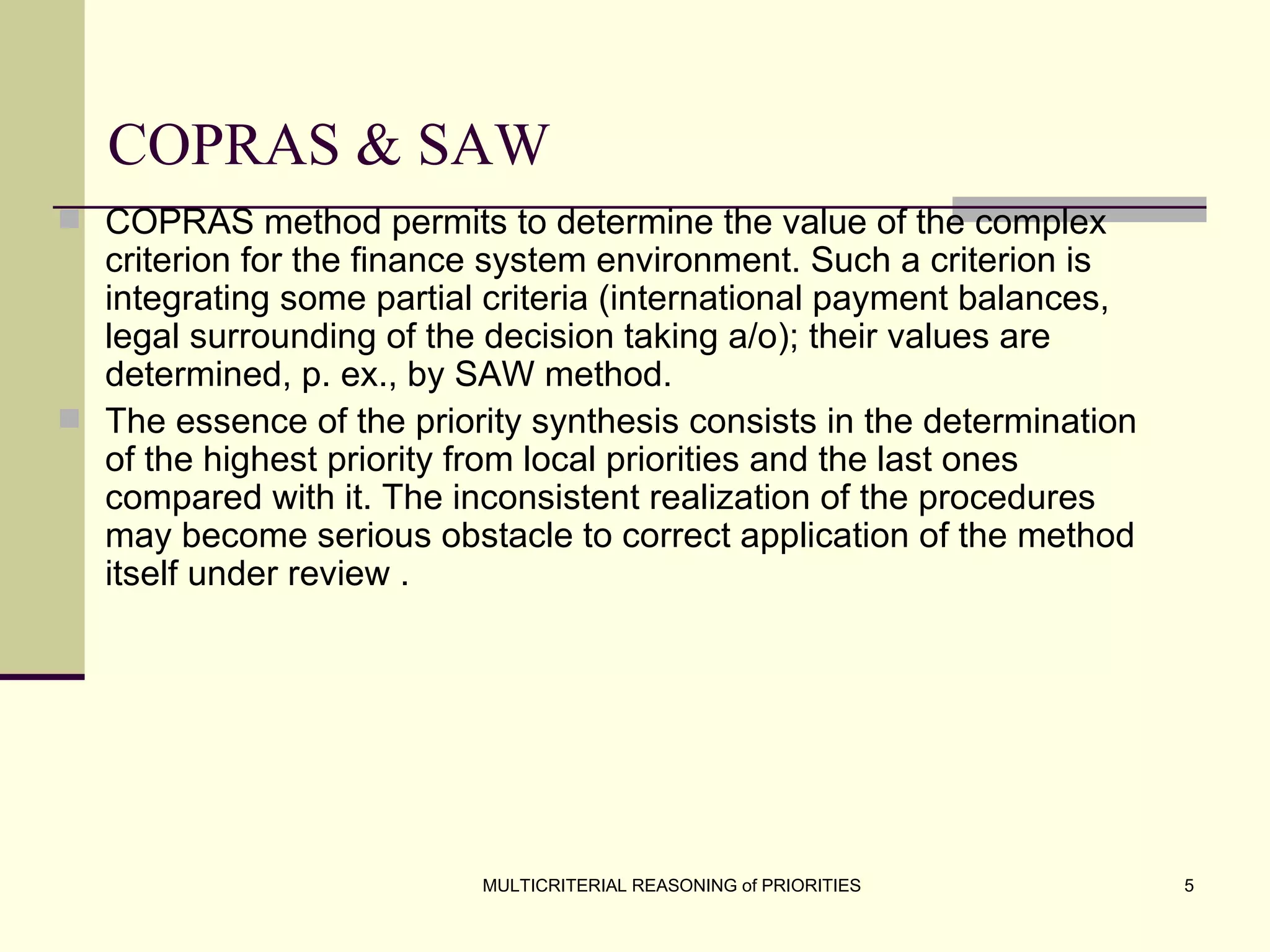
COPRAS & SAW COPRAS method permits to determine the value of the complex criterion for the finance system environment. Such a criterion is integrating some partial criteria (international payment balances, legal surrounding of the decision taking a/o); their values are determined, p. ex., by SAW   method.  The essence of the priority synthesis consists in the determination of the highest priority from local priorities and the last ones compared with it. The inconsistent realization of the procedures may become serious obstacle to correct application of the method itself under review   .
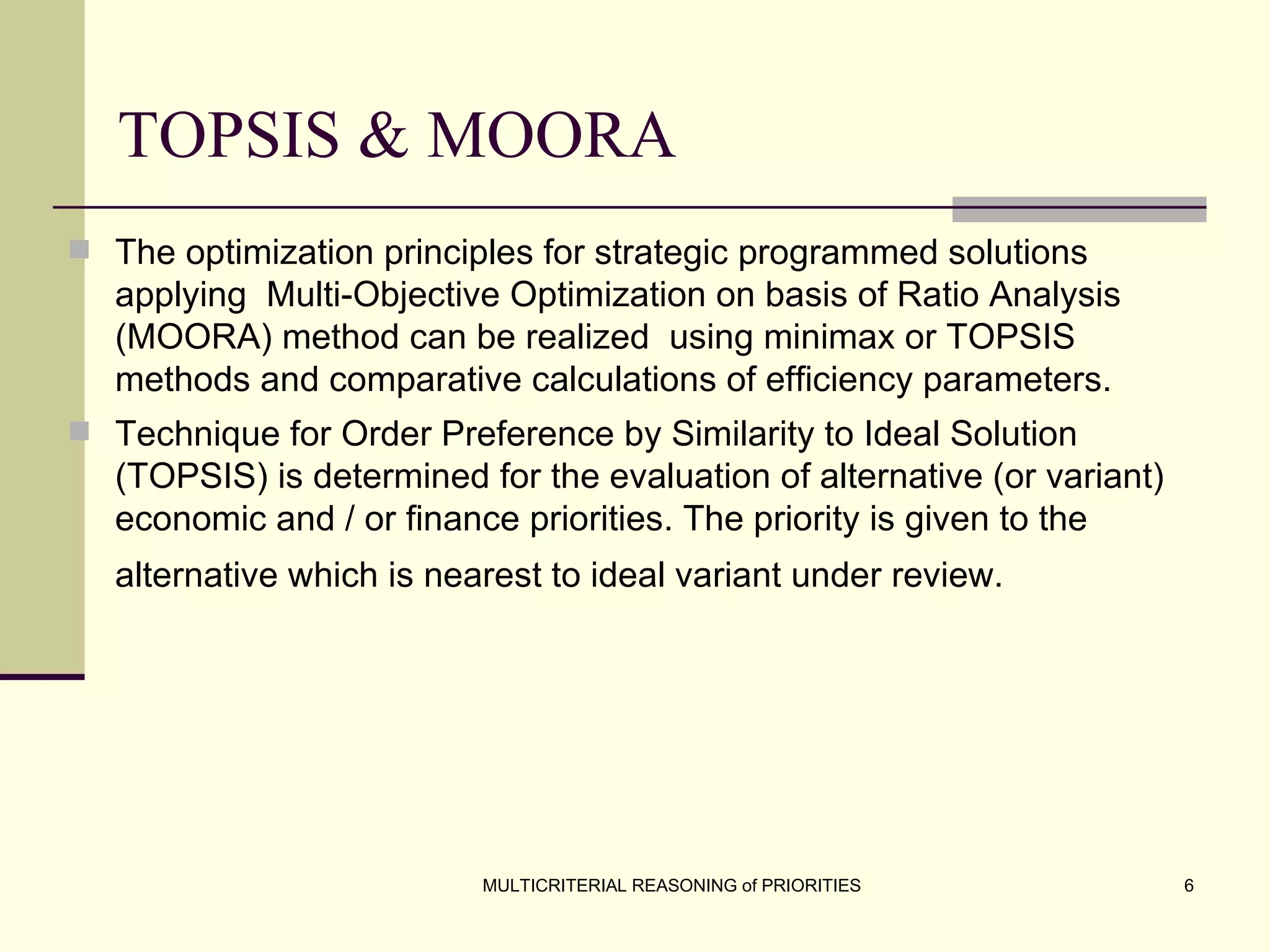
TOPSIS & MOORA The optimization principles for strategic programmed solutions applying  Multi-Objective Optimization on basis of Ratio Analysis (MOORA) method can be realized  using minimax or TOPSIS methods and comparative calculations of efficiency parameters .   Technique for Order Preference by Similarity to Ideal Solution (TOPSIS) is determined for the evaluation of alternative (or variant) economic and / or finance priorities. The priority is given to the alternative which is nearest to ideal variant under review.
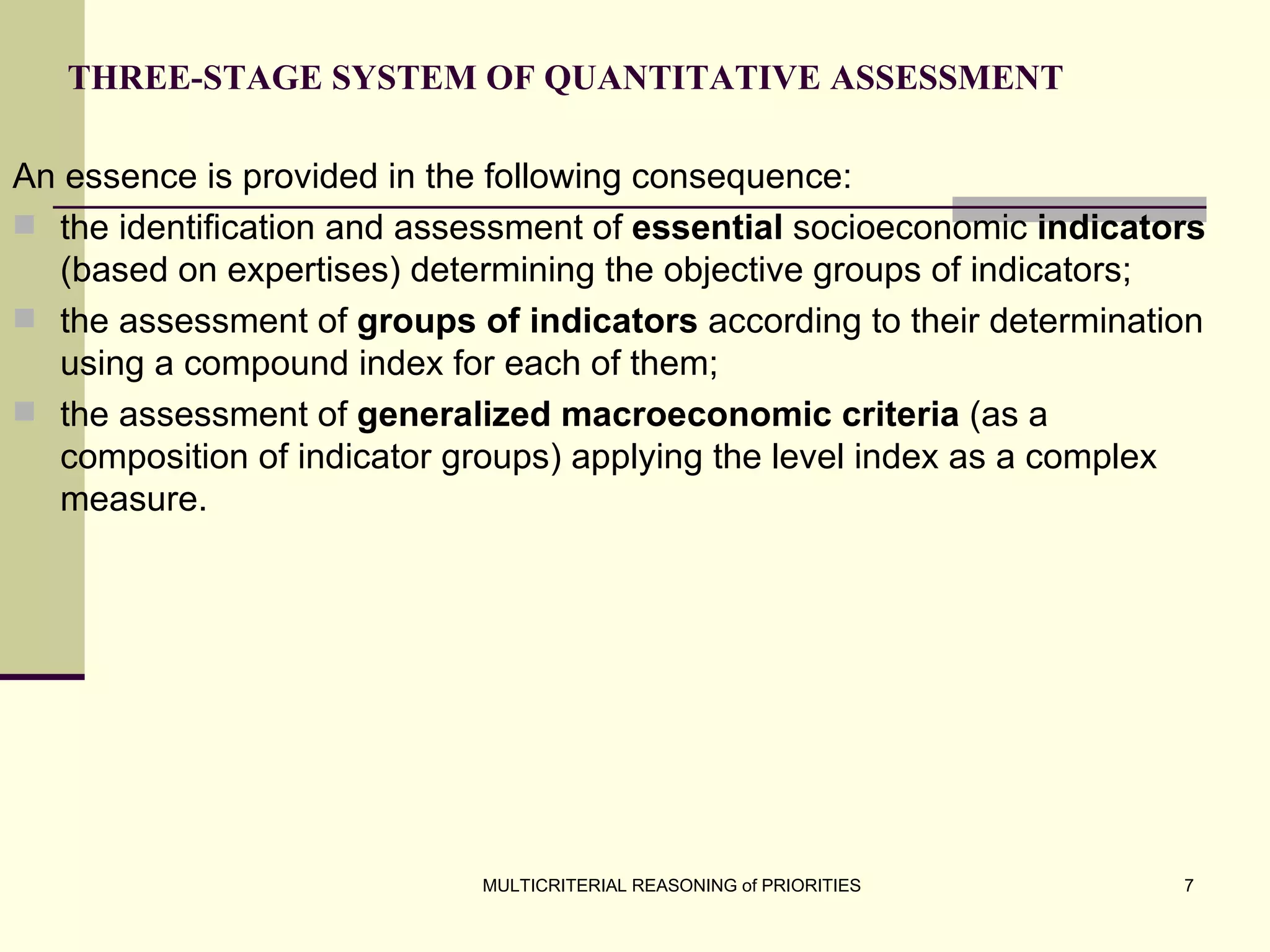
T HREE-STAGE SYSTEM   OF QUANTITATIVE ASSESSMENT An essence is provided in the following consequence: the identification and assessment of  essential  socioeconomic  indicators  (based on expertises) determining the objective groups of indicators; the assessment of  groups of indicators  according to their determination using a compound index for each of them; the assessment of  generalized macroeconomic criteria  (as a composition of indicator groups) applying the level index as a complex measure.
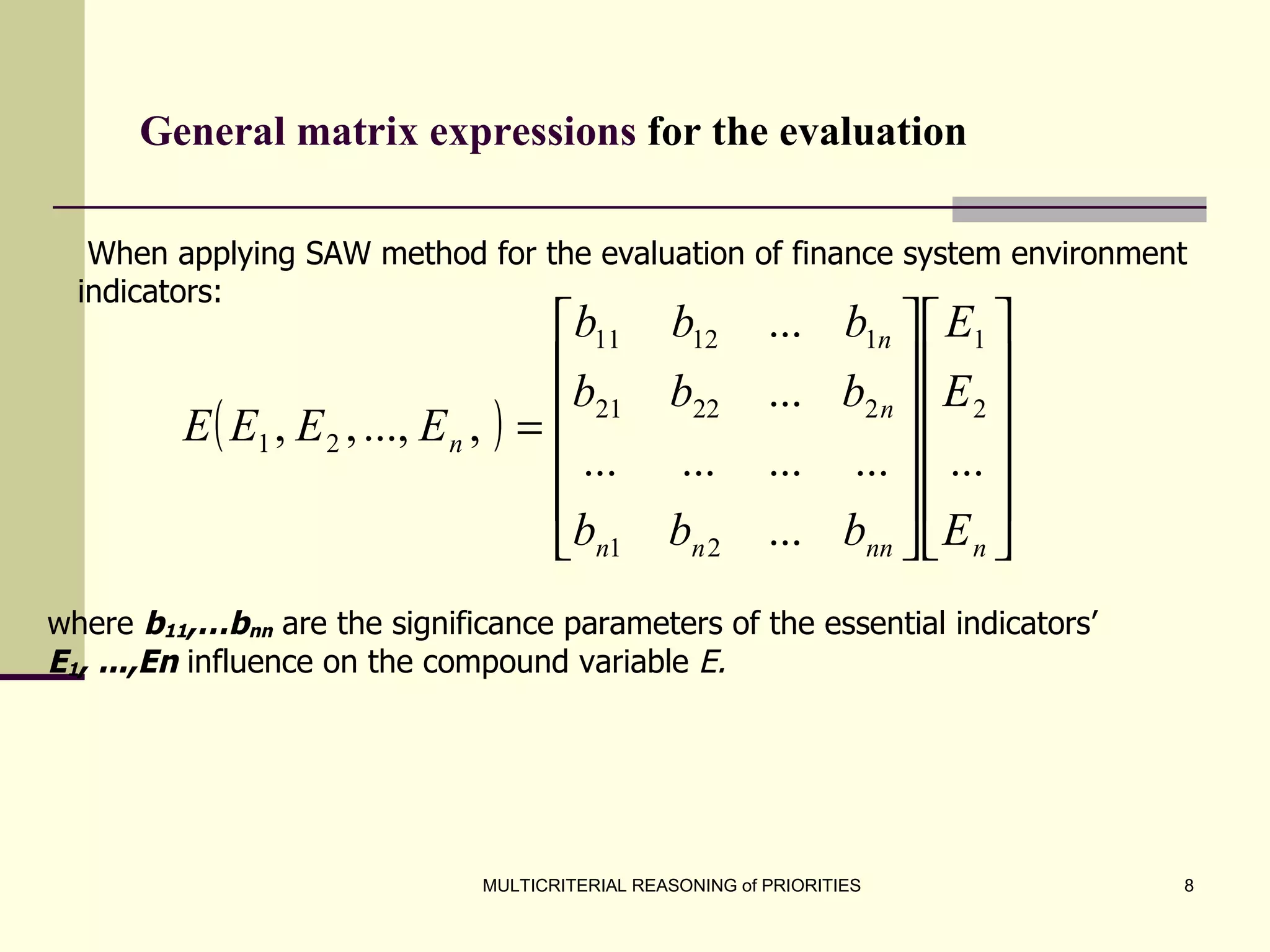
G eneral matrix expressions  for the evaluation   When applying SAW method for the evaluation of finance system environment indicators: where  b 11 ,…b nn  are the significance parameters of the essential indicators’  E 1 , ...,En  influence on the compound variable  E.
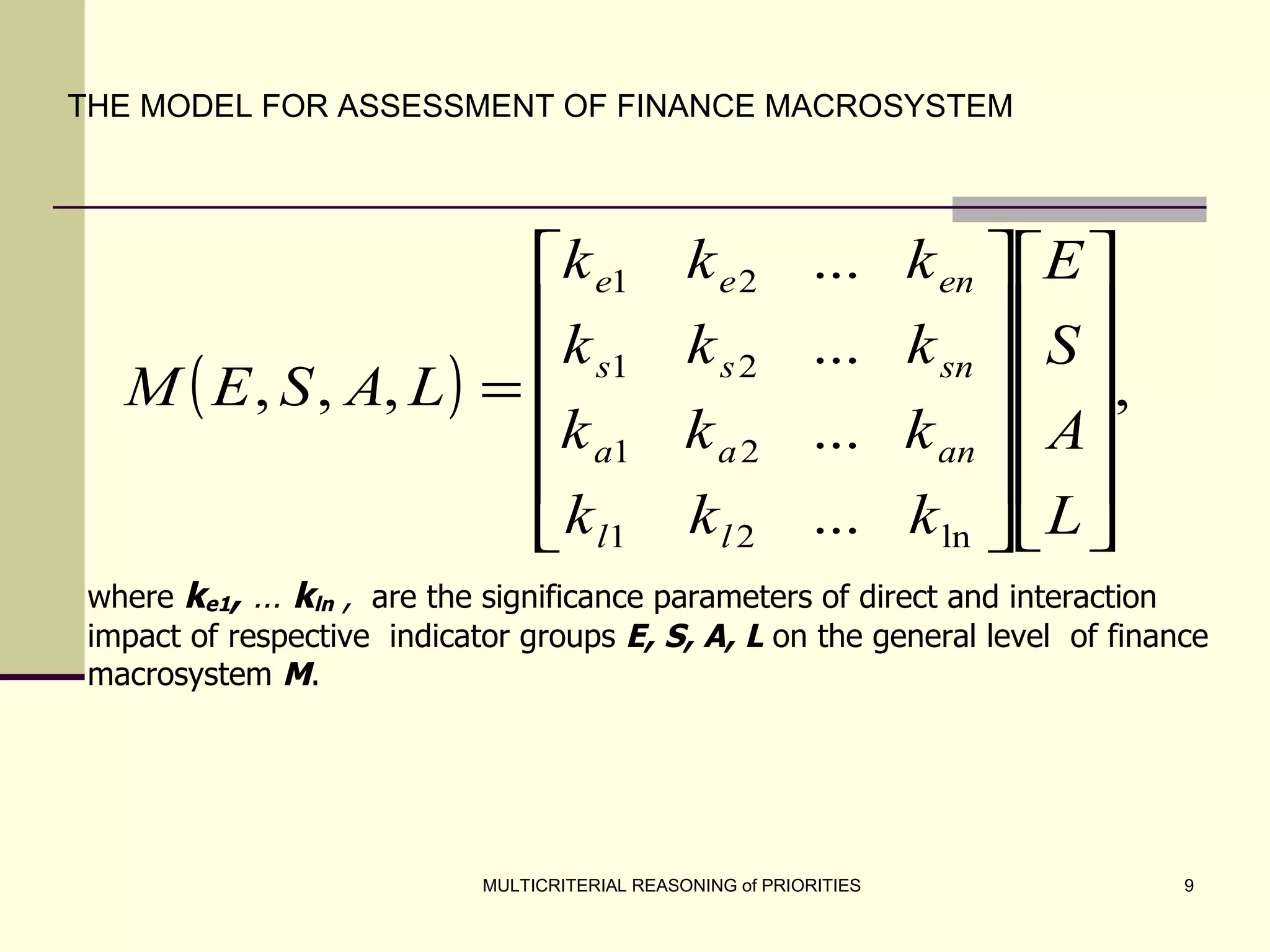
where  k e1 ,  …  k ln   ,   are the significance parameters of direct and interaction impact of respective  indicator groups  E, S, A, L  on the general level  of finance macrosystem  M . THE MODEL FOR ASSESSMENT OF FINANCE MACROSYSTEM
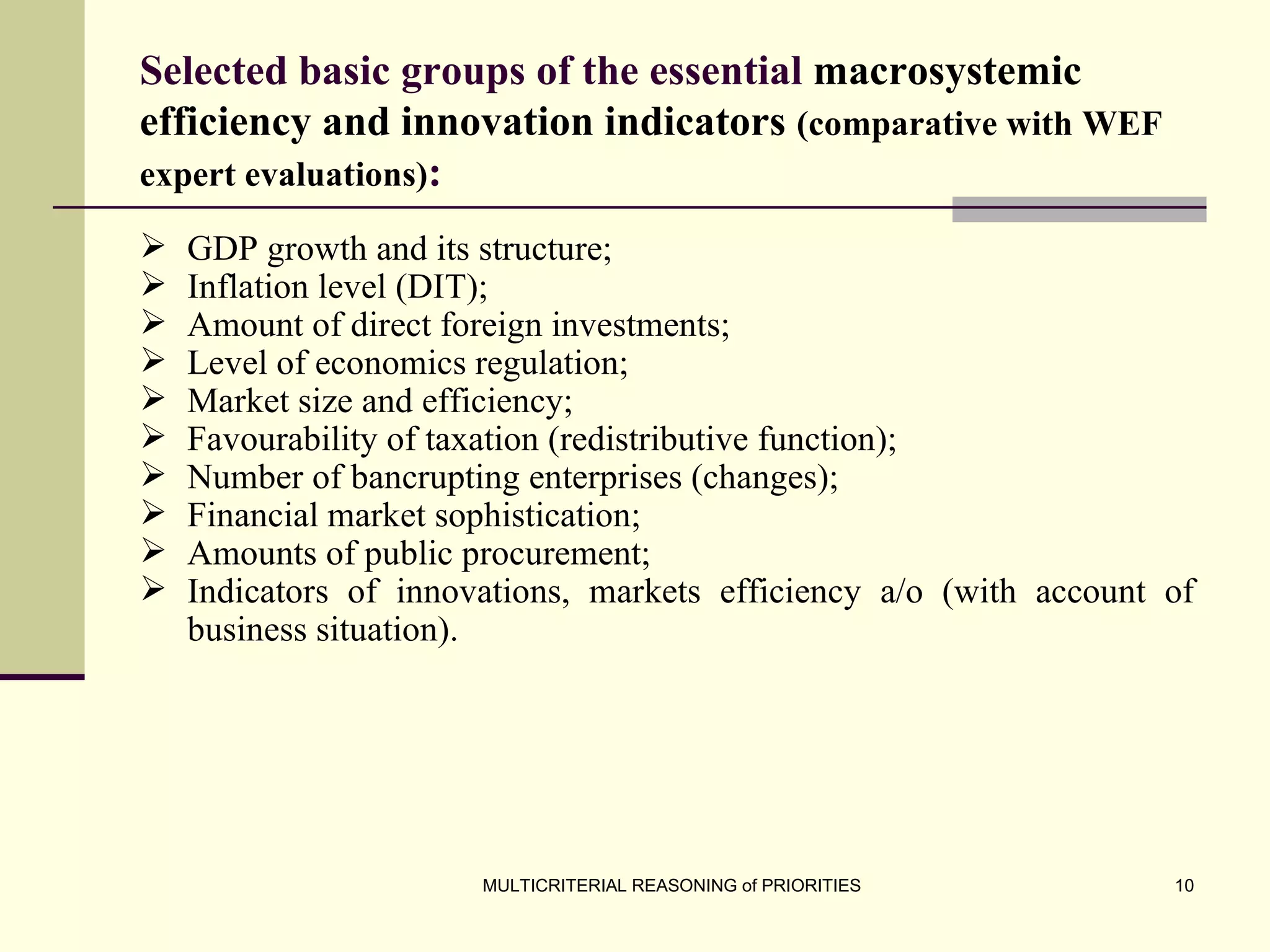
Selected basic groups of the essential  macrosystemic   efficiency and innovation  indicators   (comparative with WEF expert evaluations) : GDP growth  and its structure; Inflation level  (DIT);   Amount of direct foreign investments; Level of economics regulation; Market size and efficiency;  Favourability of taxation (redistributive function);  Number of bancrupting enterprises (changes);  Financial market sophistication; Amounts of public procurement; Indicators of innovations, markets efficiency a/o (with account of business situation).
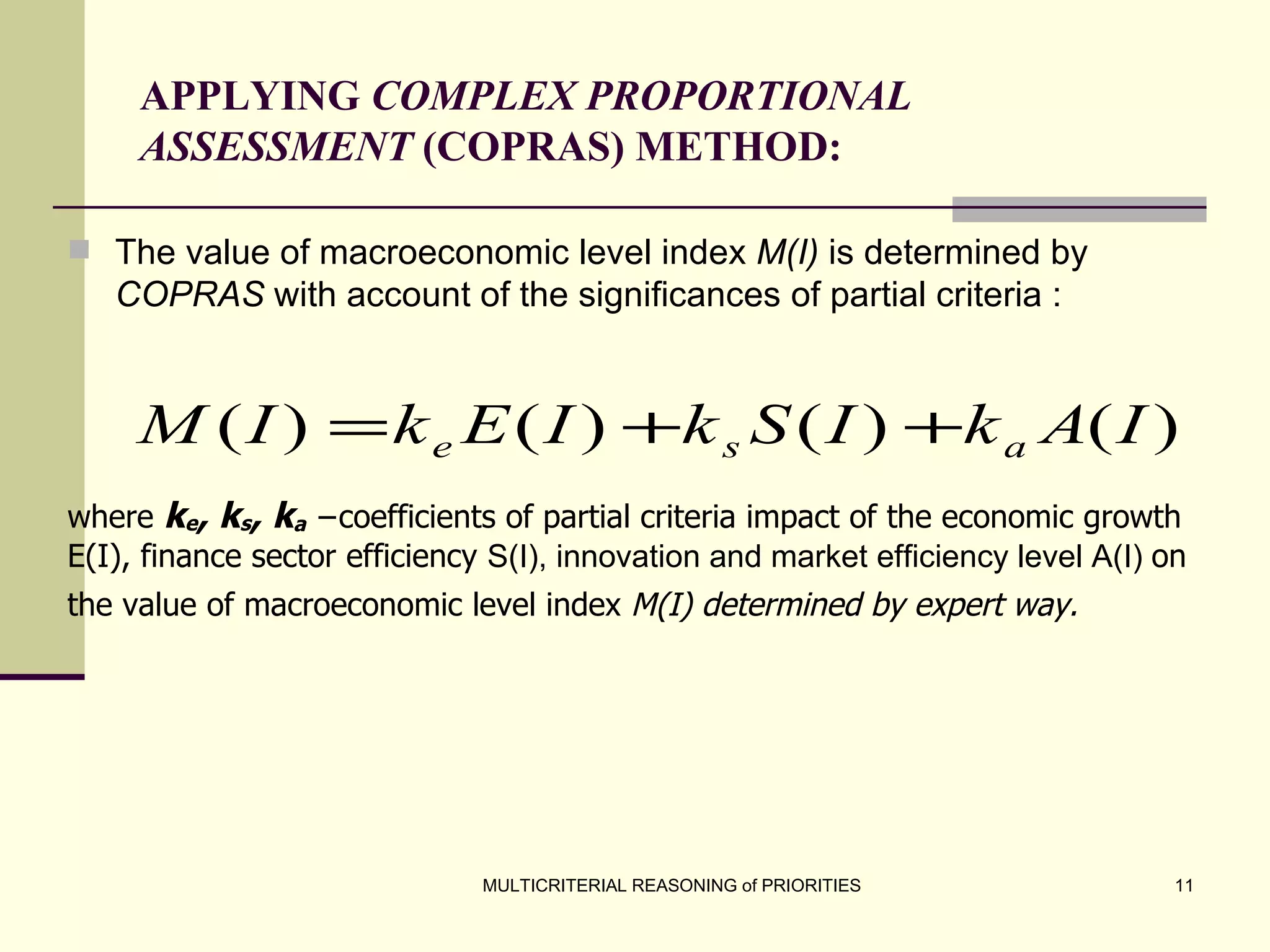
APPLYING  COMPLEX PROPORTIONAL ASSESSMENT  (COPRAS) METHOD: The value of macroeconomic level index  M(I)  is determined by  COPRAS  with account of the significances of partial criteria :   where  k e , k s , k a  −coefficients of partial criteria impact of the  economic growth  E(I),  finance sector efficiency  S(I),  innovation and market efficiency level  A(I)  on the value of macroeconomic  level  index  M(I) determined by expert way.
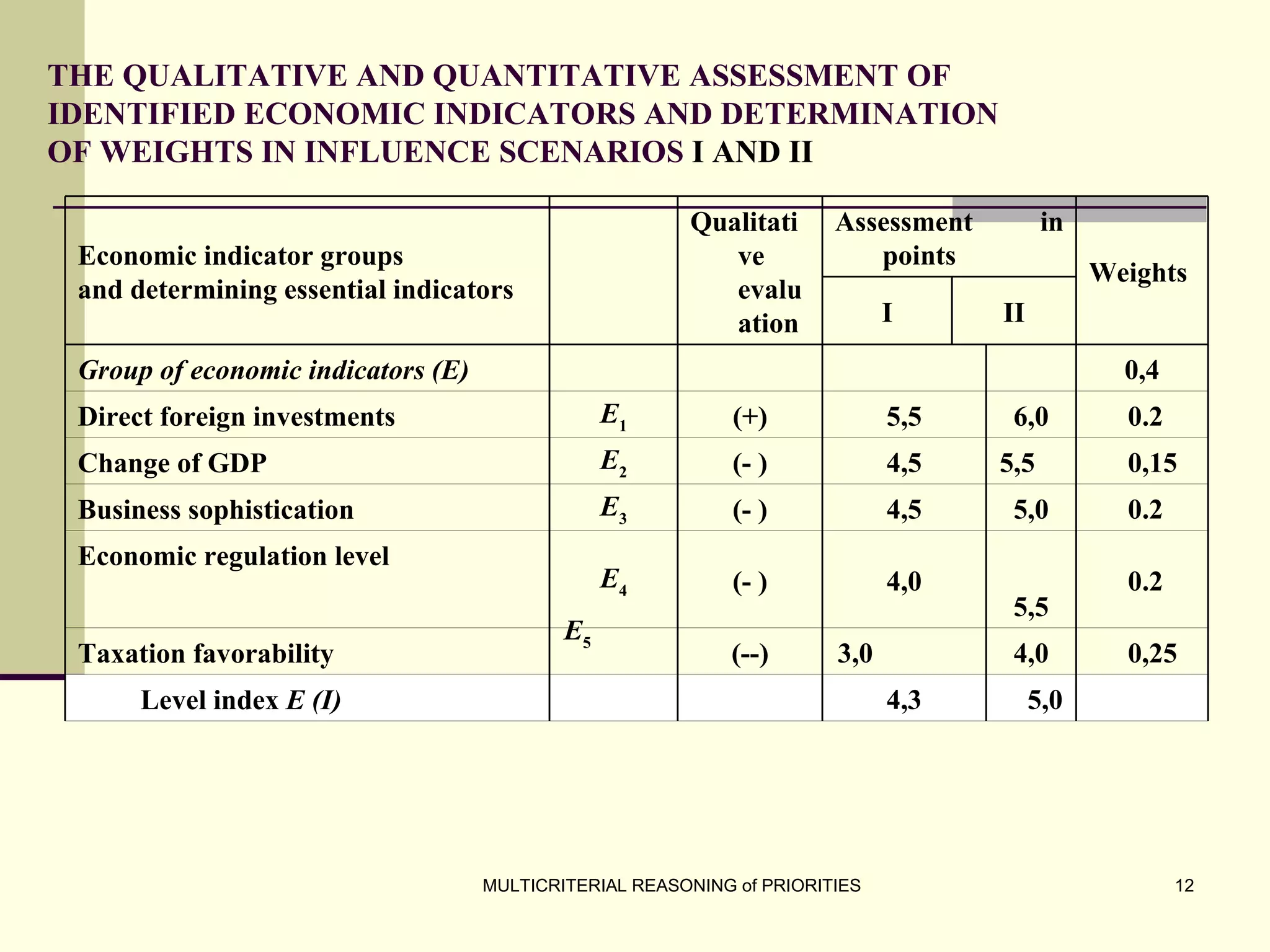
THE QUALITATIVE AND QUANTITATIVE ASSESSMENT OF  IDENTIFIED ECONOMIC INDICATORS AND DETERMINATION  OF WEIGHTS IN   INFLUENCE SCENARIOS   I AND II 5,0 4,3 Level index  E (I) 0,25 4,0 3,0  (--) E 5  Taxation   favorability    0.2 5,5 4,0 (- ) E 4 Economic regulation level    0.2 5,0 4,5 (- ) E 3 Business sophistication  0,15 5,5  4,5 (- ) E 2 Change of GDP   0.2 6,0 5,5 (+) E 1 Direct foreign investments  0,4 Group of economic indicators (E) II I Weights Assessment in points Qualitative evaluation Economic indicator groups  and determining essential indicators
SUMMARY The multicriterial evaluation and optimization principles based on it permit to formulate the  more effective  strategic development programs, to determine their  priorities  and essential indicators when modeling programmed alternatives.  There is possibilities to implement the  multicriterial reasoning  under review into management and administration systems when forming the algorithms of this process. The principles under review may form the basis for the  computerized strategic planning  and development  programs .

Multicriterial Priorities

  • 1.
    THE PRINCIPLES OFMULTICRITERIAL REASONING OF THE DEVELOPMENT PRIORITIES Buracas & Zvirblis [email_address] PROF. HAB. DR. ALGIS ŽVIRBLIS
  • 2.
    EFFICIENCY OF STRATEGICPROGRAMMING IS EXPECTED TO BE SYSTEMIC EVALUATED The theoretic backgrounds of national economic (finance system) development strategies are generated in the process of: multicriterial evaluation, ranking and optimizing of priorities, alternatives and formation groups of background economic (financial) indicators for this development in the connection with national economic resources and competitive abilities, multifunctional regional and sectored development directions.
  • 3.
    MAIN STAGES OFTHE ECONOMIC STRATEGIES’ FORMATION they are: determination of main tasks; SWOT analysis; differentiation & identification; taxonomy and subordination of development priorities; multivariate formation of the programmed indicator groups. On these stages: the parallel analysis, multiobjective and multicriterial evaluation as well as optimizing of alternatives according to essential integrated criteria, reasoning of strategic solutions, analysis of expected consequences of the implementation of strategic procedures and, at last, their necessary feedback correction comparing with policy measures determined on the earlier stage - are suggested to be applied.
  • 4.
    EVALUATION METHODS FORTHE PROGRAMMED PRIORITIES OF THE ECONOMIC DEVELOPMENT The Analytical Hierarchy Process (AHP), Simple Additive Weighting (SAW), Complex Proportional Assessment (COPRAS), Multi-Objective Optimization on basis of Ratio Analysis (MOORA), Generalized (Multiattributed) Utility Function and Technique for Order Preference by Similarity to Ideal Solution (TOPSIS) - such methods are mostly used for the determining of the alternative programmed financial indicators and / or criterial significance, the evaluation of their priorities.
  • 5.
    COPRAS & SAWCOPRAS method permits to determine the value of the complex criterion for the finance system environment. Such a criterion is integrating some partial criteria (international payment balances, legal surrounding of the decision taking a/o); their values are determined, p. ex., by SAW method. The essence of the priority synthesis consists in the determination of the highest priority from local priorities and the last ones compared with it. The inconsistent realization of the procedures may become serious obstacle to correct application of the method itself under review .
  • 6.
    TOPSIS & MOORAThe optimization principles for strategic programmed solutions applying Multi-Objective Optimization on basis of Ratio Analysis (MOORA) method can be realized using minimax or TOPSIS methods and comparative calculations of efficiency parameters . Technique for Order Preference by Similarity to Ideal Solution (TOPSIS) is determined for the evaluation of alternative (or variant) economic and / or finance priorities. The priority is given to the alternative which is nearest to ideal variant under review.
  • 7.
    T HREE-STAGE SYSTEM OF QUANTITATIVE ASSESSMENT An essence is provided in the following consequence: the identification and assessment of essential socioeconomic indicators (based on expertises) determining the objective groups of indicators; the assessment of groups of indicators according to their determination using a compound index for each of them; the assessment of generalized macroeconomic criteria (as a composition of indicator groups) applying the level index as a complex measure.
  • 8.
    G eneral matrixexpressions for the evaluation When applying SAW method for the evaluation of finance system environment indicators: where b 11 ,…b nn are the significance parameters of the essential indicators’ E 1 , ...,En influence on the compound variable E.
  • 9.
    where ke1 , … k ln , are the significance parameters of direct and interaction impact of respective indicator groups E, S, A, L on the general level of finance macrosystem M . THE MODEL FOR ASSESSMENT OF FINANCE MACROSYSTEM
  • 10.
    Selected basic groupsof the essential macrosystemic efficiency and innovation indicators (comparative with WEF expert evaluations) : GDP growth and its structure; Inflation level (DIT); Amount of direct foreign investments; Level of economics regulation; Market size and efficiency; Favourability of taxation (redistributive function); Number of bancrupting enterprises (changes); Financial market sophistication; Amounts of public procurement; Indicators of innovations, markets efficiency a/o (with account of business situation).
  • 11.
    APPLYING COMPLEXPROPORTIONAL ASSESSMENT (COPRAS) METHOD: The value of macroeconomic level index M(I) is determined by COPRAS with account of the significances of partial criteria : where k e , k s , k a −coefficients of partial criteria impact of the economic growth E(I), finance sector efficiency S(I), innovation and market efficiency level A(I) on the value of macroeconomic level index M(I) determined by expert way.
  • 12.
    THE QUALITATIVE ANDQUANTITATIVE ASSESSMENT OF IDENTIFIED ECONOMIC INDICATORS AND DETERMINATION OF WEIGHTS IN INFLUENCE SCENARIOS I AND II 5,0 4,3 Level index E (I) 0,25 4,0 3,0 (--) E 5 Taxation favorability   0.2 5,5 4,0 (- ) E 4 Economic regulation level   0.2 5,0 4,5 (- ) E 3 Business sophistication 0,15 5,5 4,5 (- ) E 2 Change of GDP   0.2 6,0 5,5 (+) E 1 Direct foreign investments 0,4 Group of economic indicators (E) II I Weights Assessment in points Qualitative evaluation Economic indicator groups and determining essential indicators
  • 13.
    SUMMARY The multicriterialevaluation and optimization principles based on it permit to formulate the more effective strategic development programs, to determine their priorities and essential indicators when modeling programmed alternatives. There is possibilities to implement the multicriterial reasoning under review into management and administration systems when forming the algorithms of this process. The principles under review may form the basis for the computerized strategic planning and development programs .