Objectives
After studyingthis unit you should be able to :
– Define planning and why it is termed the primary
function of management.
– Explain the different classifications and types of
plans.
– Explain the importance and the steps involved in
planning.
– Explain why people fail in planning and the limits to
planning.
– Discuss the tools used in planning.
2
3.
3
3
Introduction
A Plan:
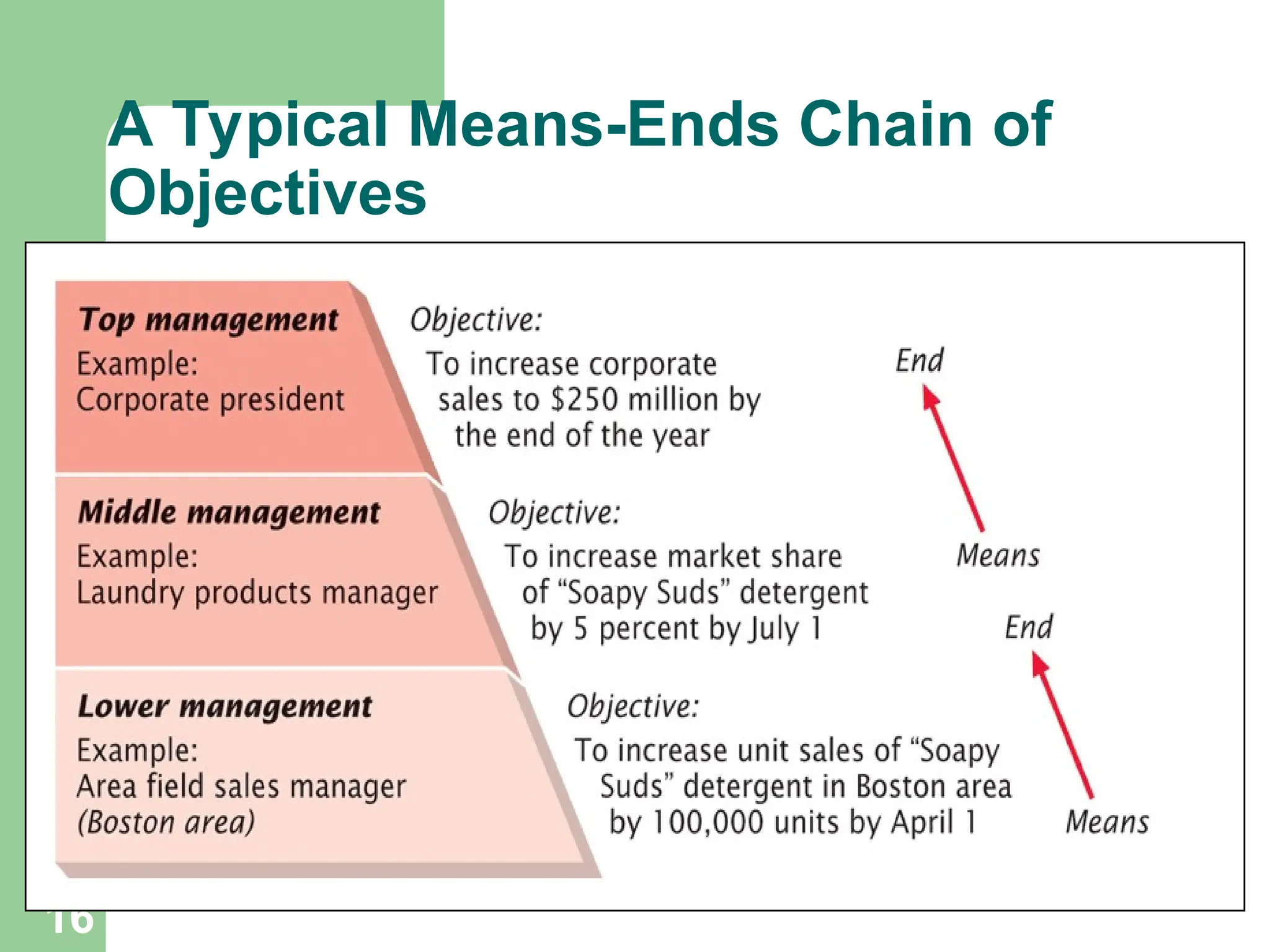
–is a specific documented intention consisting of an objective (end)
and an action statement (means)
Planning:
– Is an intellectual process;
– it requires the conscious determination of courses of action, and
– the basing of decisions on purpose, knowledge and considered
estimates. (Koontz, O’Donnell & Weihrich, 1980)
– is a task of:
– setting objectives,
– specifying how to achieve them,
– implementing the plan. and
– evaluating the results. (Boddy, 2005).
4.
Planning
Allows forcoping with uncertainty
– by formulating courses of action to achieve specified
results
Three Types of Uncertainty
1. State uncertainty: Occurs when the environment, or
a portion of the environment, is considered unstable
2. Effect uncertainty: Occurs when impacts of
environmental change are unpredictable
3. Response uncertainty: Arises when the
consequences of decisions are unpredictable
4
5.
5
5
Planning cont’d.
Itis deciding in advance:
– what to do,
– how to do it,
– when to do it, and
– who is to do it.
In this sense planning is essentially decision making,
and
– It is the responsibility of management
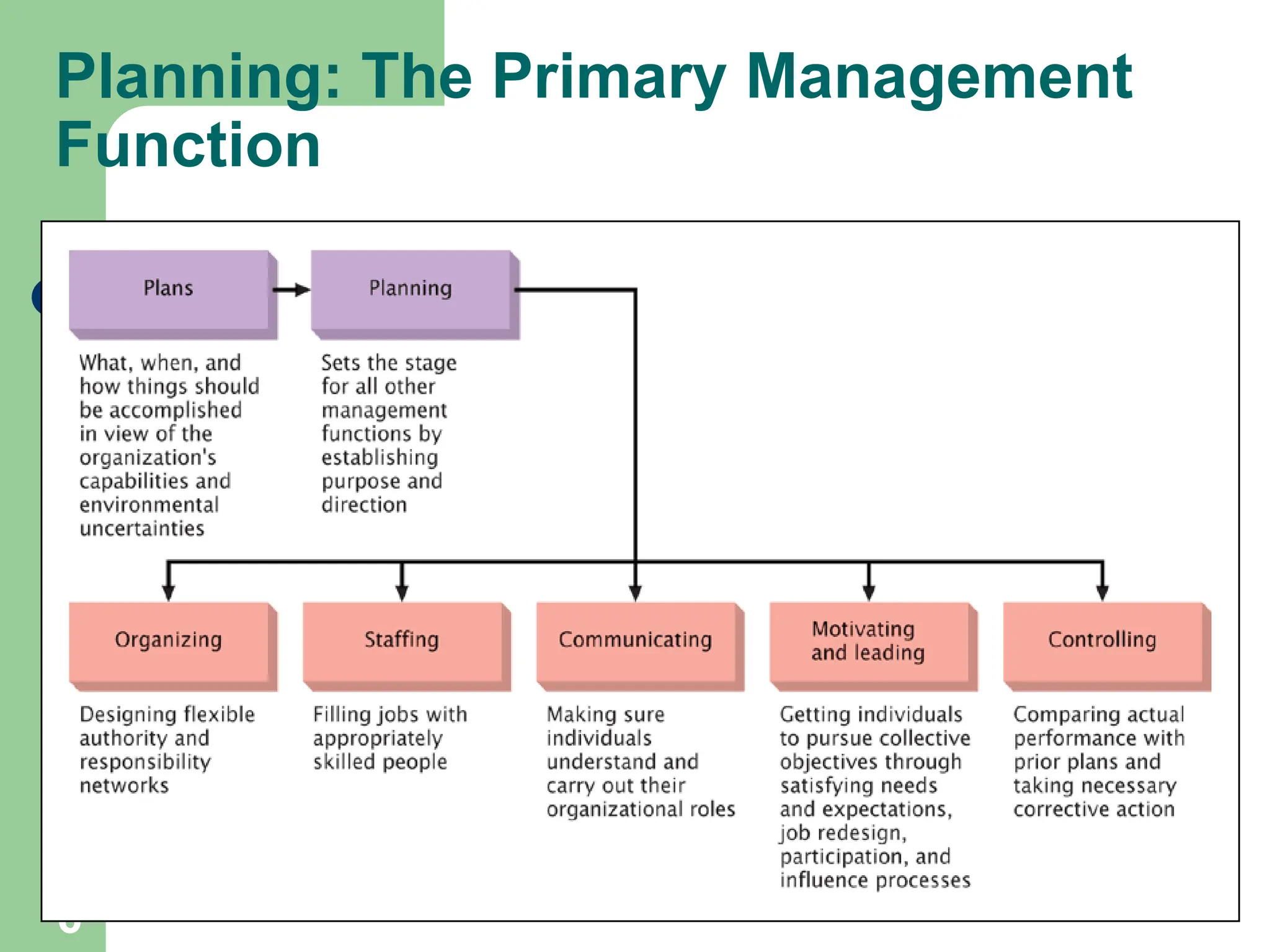
Because it affects all downstream mgmt functions,
– it has been called the primary management function.
7
7
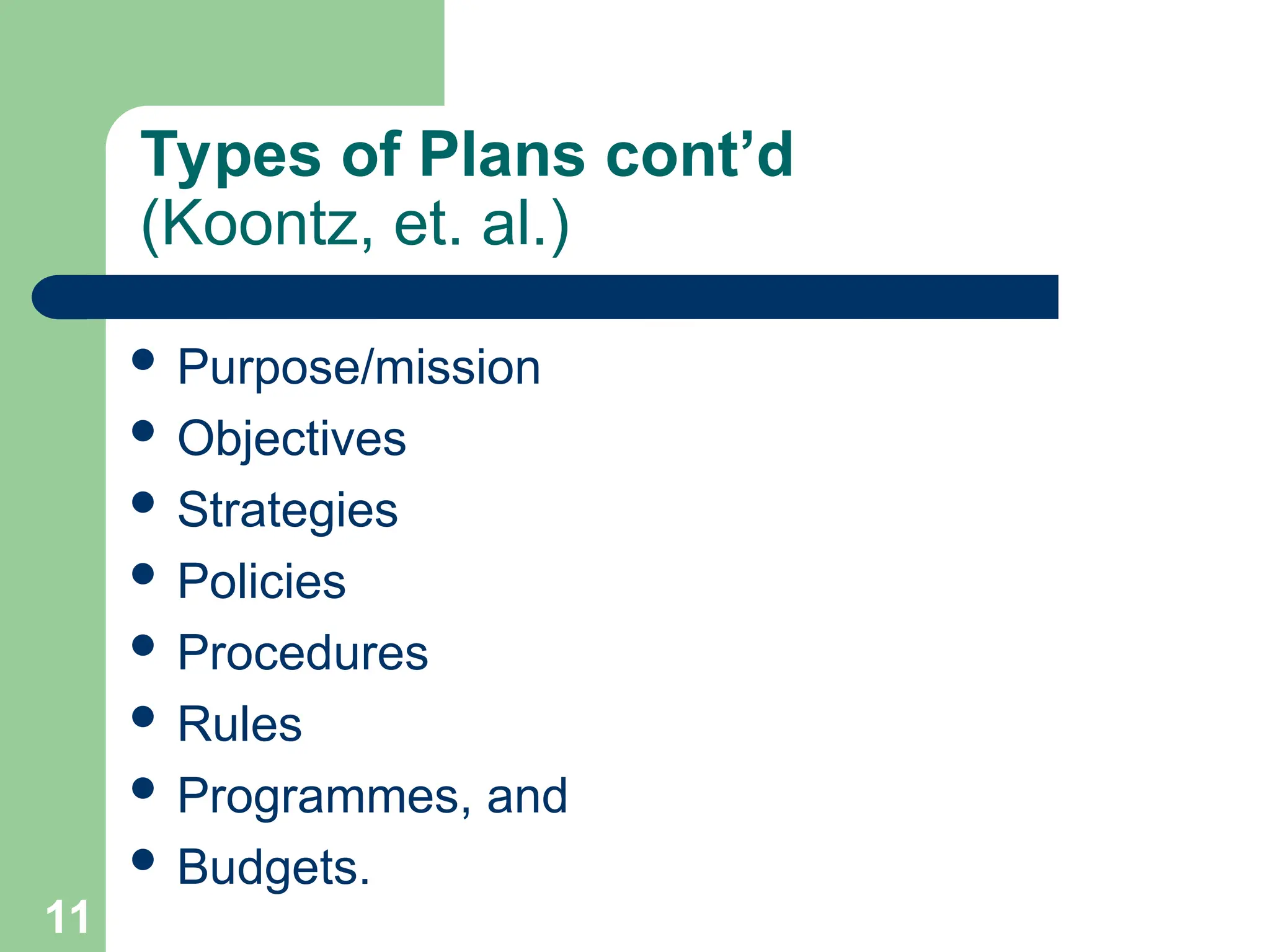
Classification of Plans
Standing plans
– Those that are repeatedly used ie. policies,
procedures and rules
Single use plans
– Those designed for the attainment of specific
objectives within a relatively short time span, ie a
programme and budgets
8.
8
8
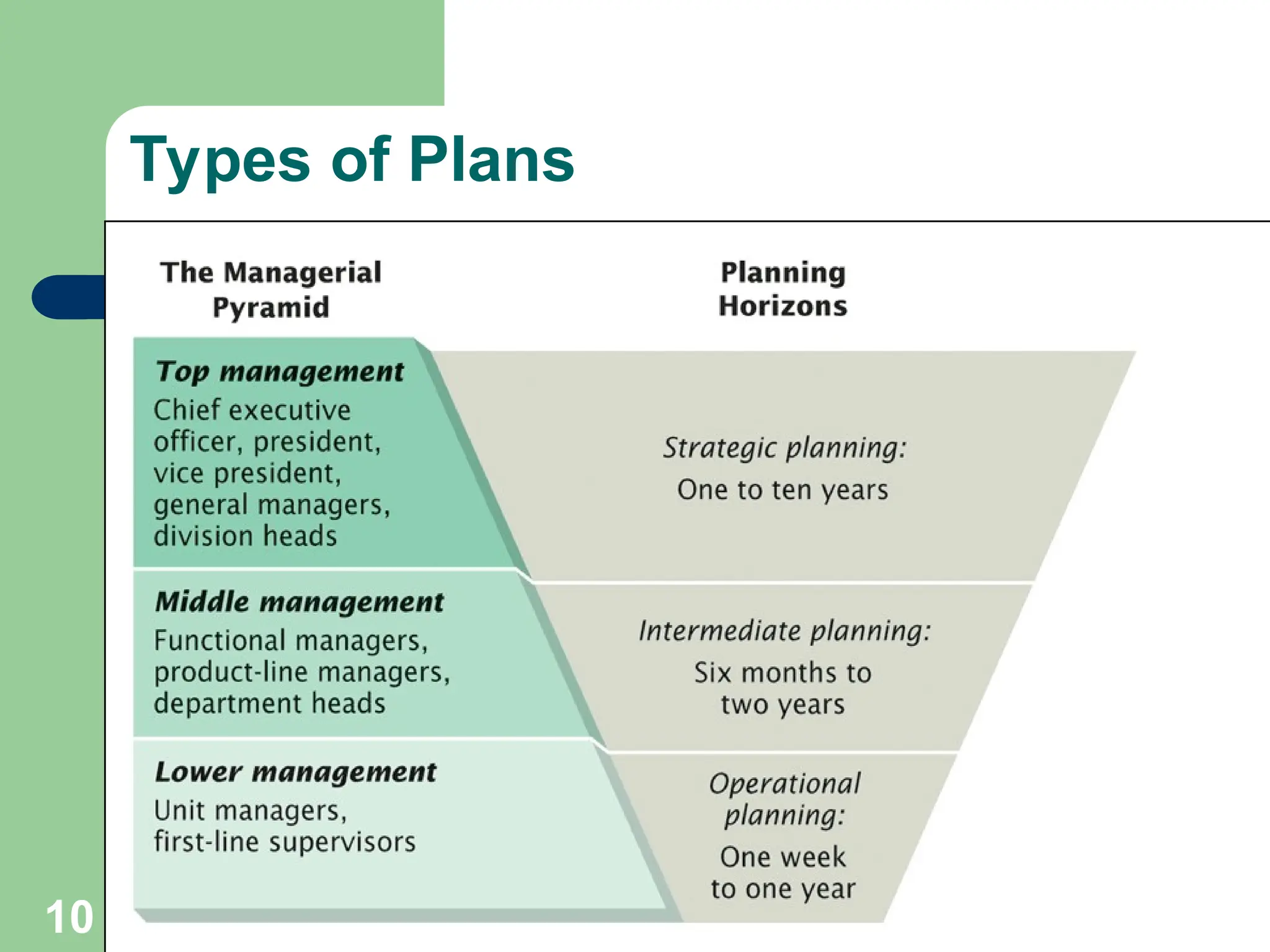
Types of Plans
Strategic plans
– Set out the overall direction for the business, are
broad in scope and cover all major activities.
– Chandler (1962) defined them as:
determining the the basic long-term goals and
objectives of an enterprise and
the adoption of courses of action and the allocation of
resources necessary for carrying out these goals.
Tactical/Divisional plans
– for each major unit of the business
– focus on how to compete
9.
9
9
Types of Planscont’d
Operational plans
– First line managers tool for planning daily, weekly,
and monthly activities
Business plans
– set out the markets the business intends to serve,
how it will do so and what finance they require
(Blackwell,2004)
12
12
Purpose or mission
A broad definition of an organizations
operations and scope, aiming to distinguish it
from similar organizations (Boddy,2005).
13.
13
13
Objectives
Represent thedesired ends and can be used
as yardsticks for measurement of performance,
– to indicate to what extent an organization’s mission
is being carried out.
Eg.
– An airlines mission is the provision of cheap air
freight facilities,
– its objectives could include:
Cutting costs so that its able to offer profitable low
freight charges.
14.
14
14
Objectives cont’d
Objectivesare fundamental to the control of
organizational activity, and
are vital for the formulation of policies,
programmes and rules.
Objectives should be SMART expressed in
quantitative, measurable, and concrete terms.
Ie.
o What specific result is to be achieved?
o When is the result to be achieved?
o How is the result to be measured?
o Who will be responsible for achieving the result?
15.
15
15
The Importance ofObjectives
(Kreitner 2007, p. 161)
Target:
– Sets specific goals to achieve
Measuring stick:
– Gauges how much was achieved
Commitment:
– Encourages pursuit of the objective
Motivation:
– Provides a challenge for achievement
17
17
Strategies
Are coursesof action to be taken in light of the adverse
environmental forces so as to achieve company
objectives.
18.
18
18
Policies
These arestatements that reflect the basic
objectives and provide guidelines for selecting
actions to achieve objectives.
19.
19
19
Procedures
Series ofrelated sequential steps to deal with a
structured problem.
Narrower and more specific than policies
Often utilized when high degrees of accuracy in
performance are required if policies are to be
executed effectively.
– Eg. if an airline has a policy of servicing incoming
aircraft within a reasonable time of landing, that
– calls for the drawing up of appropriate procedures
20.
20
20
Rules
Simplest typeof operational plans
They state specific action for particular situations
– no discretion.
Differ :
– from procedures in that they are not related to time
sequences, and
– from policy which is essentially guides decision-making
21.
21
21
Programmes
Single useplans comprising relatively wide
related activities and requiring complex
coordination
Involve, objectives, policies, procedures and
budgets and fixed period.
22.
22
22
Budgets
Statements inquantified terms of:
– future expenditures and revenue
– reflecting resources allocated to specified activities
within a stated period of time (usually 1 yr).
They mirror basic organizational plans &
– are used as guides to and controls of, standards of
performance.
They act as signals for corrective action to be
taken
23.
23
23
Importance of Planning
1.To offset uncertainty and change
2. To focus attention on objectives
3. To gain economical cooperation
4. To facilitate control
24.
24
24
The Planning ProcessInvolves :
Assessing
– The Planning Period
– The Environment of Plans
Environmental Forecasting
– Economic Forecasting
– Technological Forecasting
– Social Forecasting, and
– Political Forecasting
25.
25
25
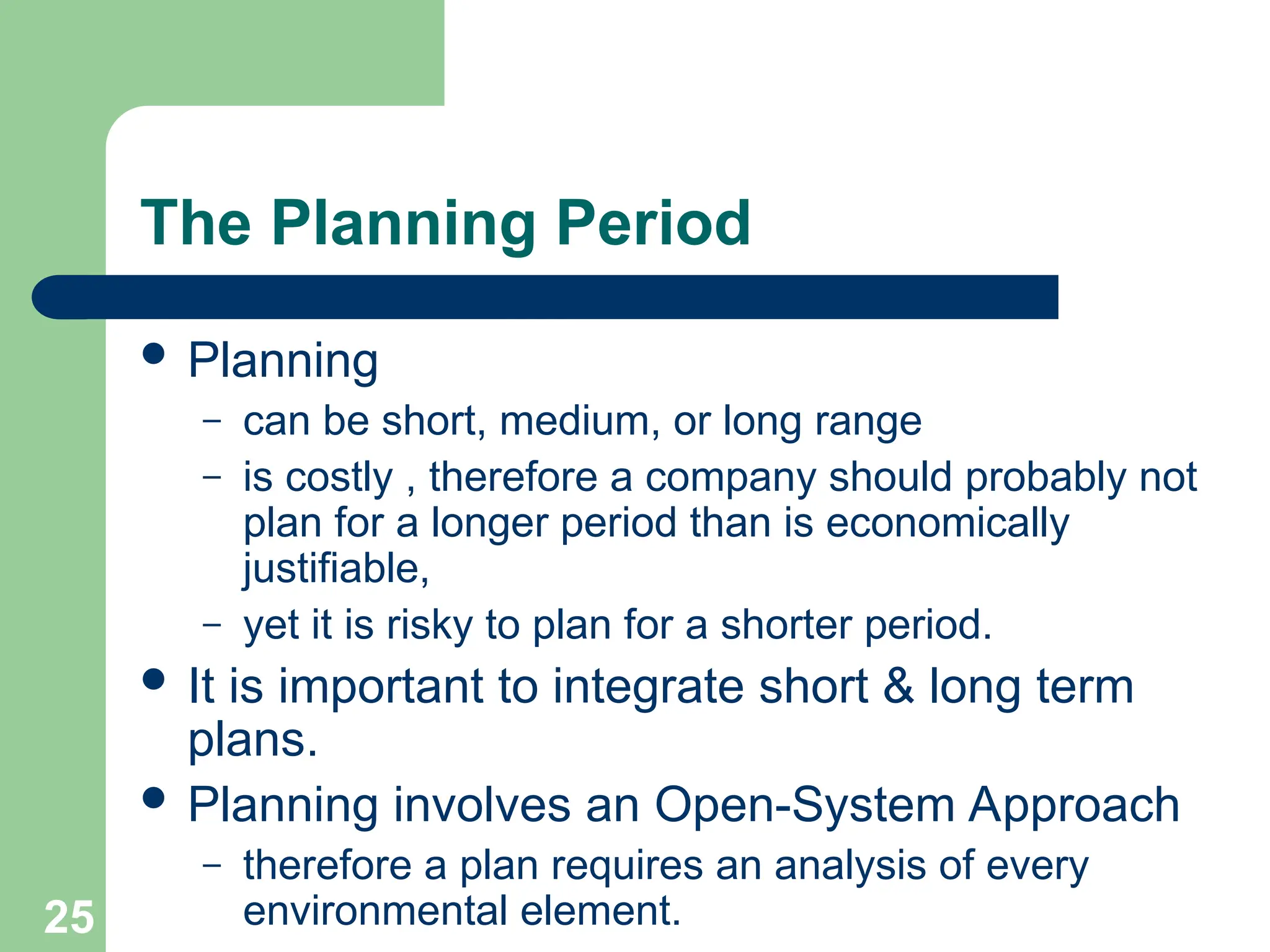
The Planning Period
Planning
– can be short, medium, or long range
– is costly , therefore a company should probably not
plan for a longer period than is economically
justifiable,
– yet it is risky to plan for a shorter period.
It is important to integrate short & long term
plans.
Planning involves an Open-System Approach
– therefore a plan requires an analysis of every
environmental element.
26.
26
26
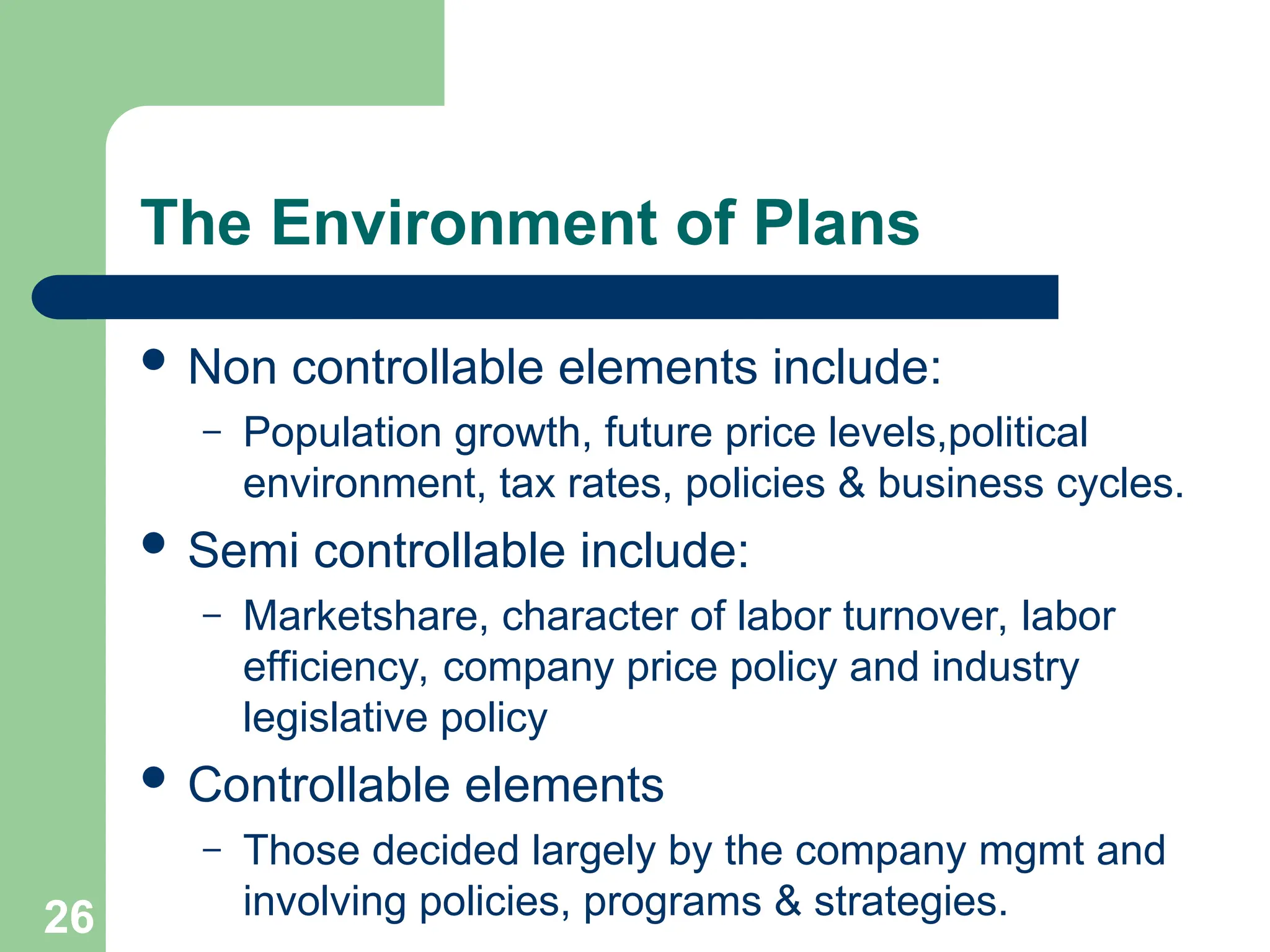
The Environment ofPlans
Non controllable elements include:
– Population growth, future price levels,political
environment, tax rates, policies & business cycles.
Semi controllable include:
– Marketshare, character of labor turnover, labor
efficiency, company price policy and industry
legislative policy
Controllable elements
– Those decided largely by the company mgmt and
involving policies, programs & strategies.
27.
27
27
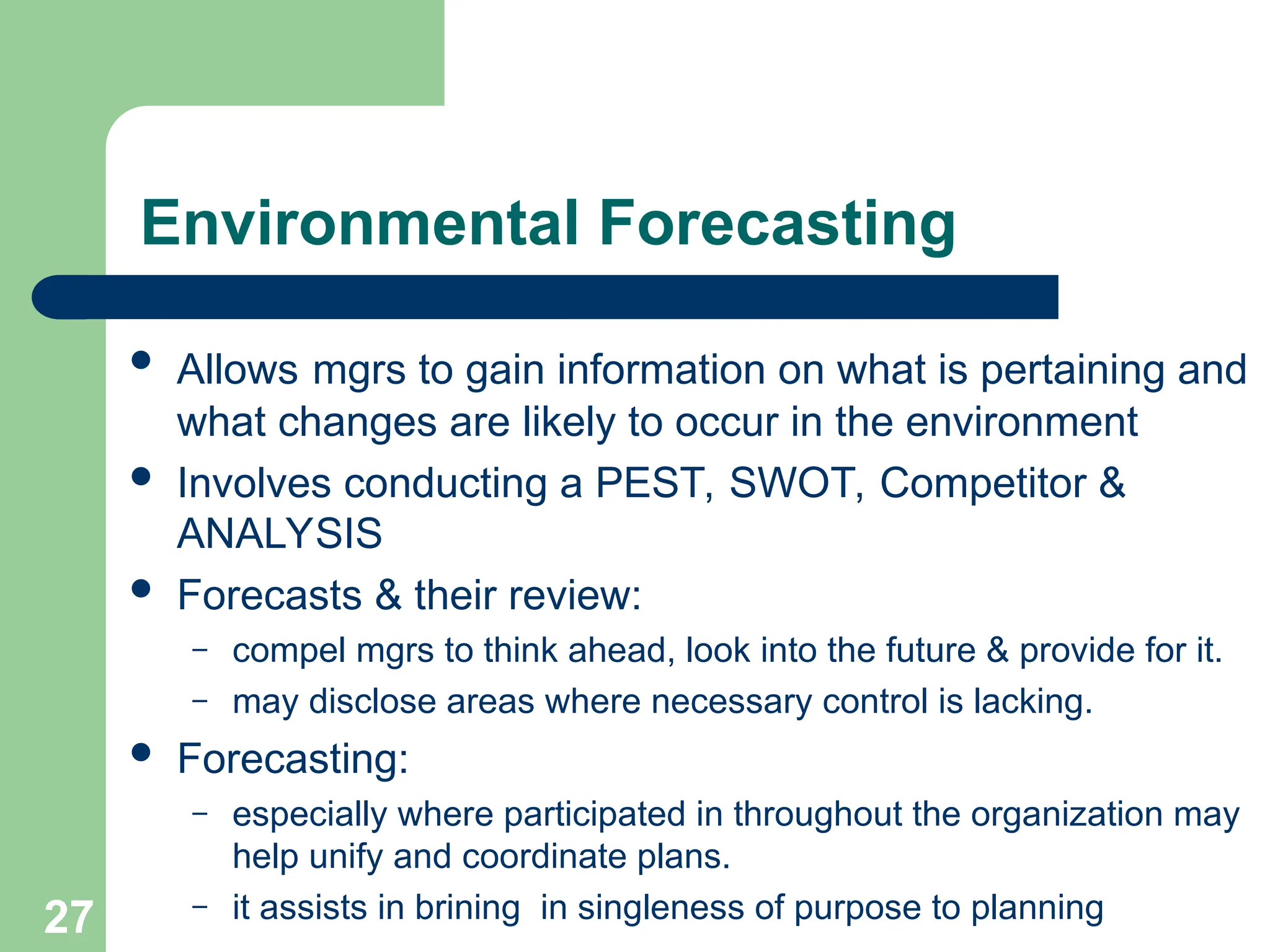
Environmental Forecasting
Allowsmgrs to gain information on what is pertaining and
what changes are likely to occur in the environment
Involves conducting a PEST, SWOT, Competitor &
ANALYSIS
Forecasts & their review:
– compel mgrs to think ahead, look into the future & provide for it.
– may disclose areas where necessary control is lacking.
Forecasting:
– especially where participated in throughout the organization may
help unify and coordinate plans.
– it assists in brining in singleness of purpose to planning
28.
28
28
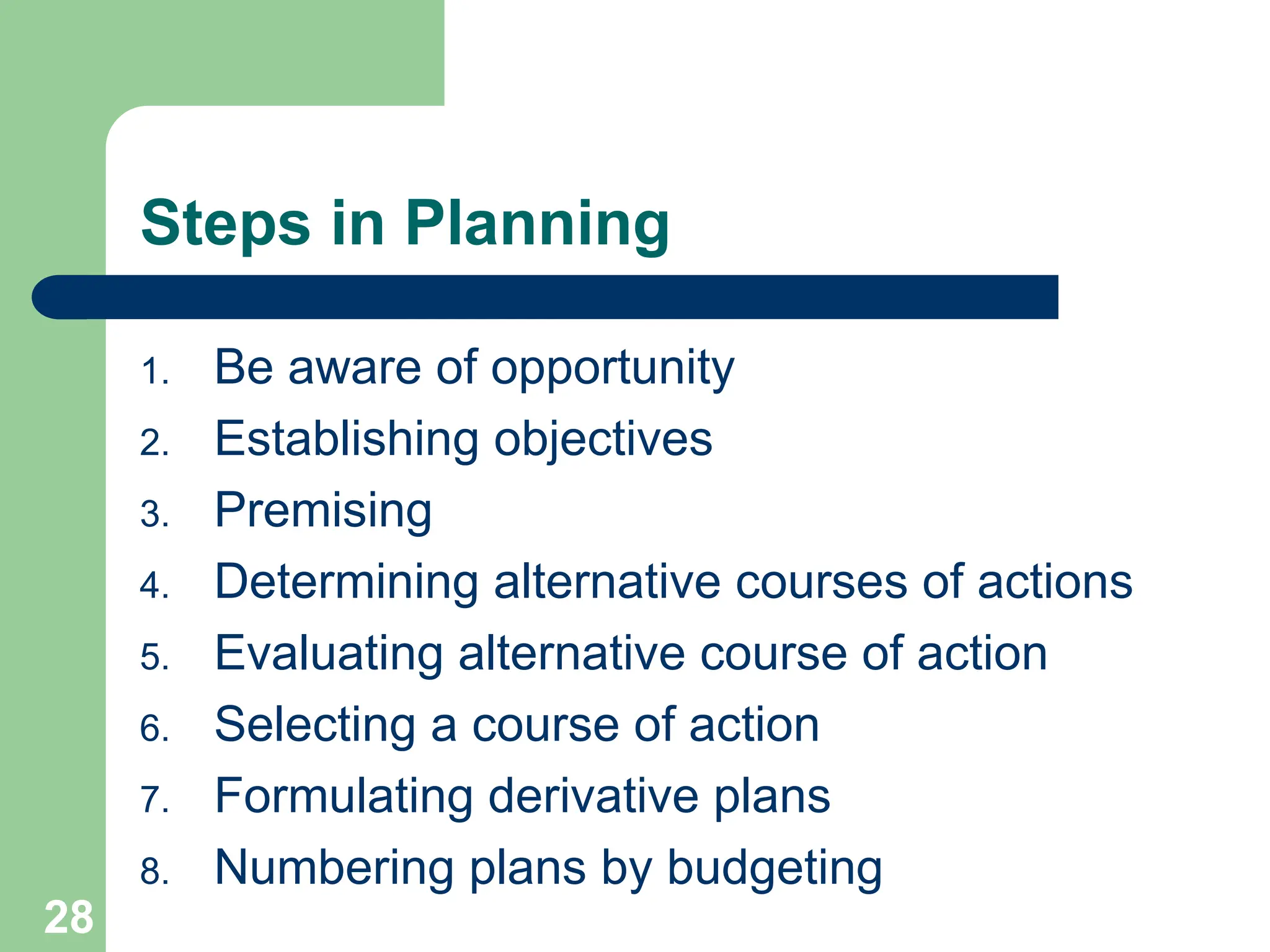
Steps in Planning
1.Be aware of opportunity
2. Establishing objectives
3. Premising
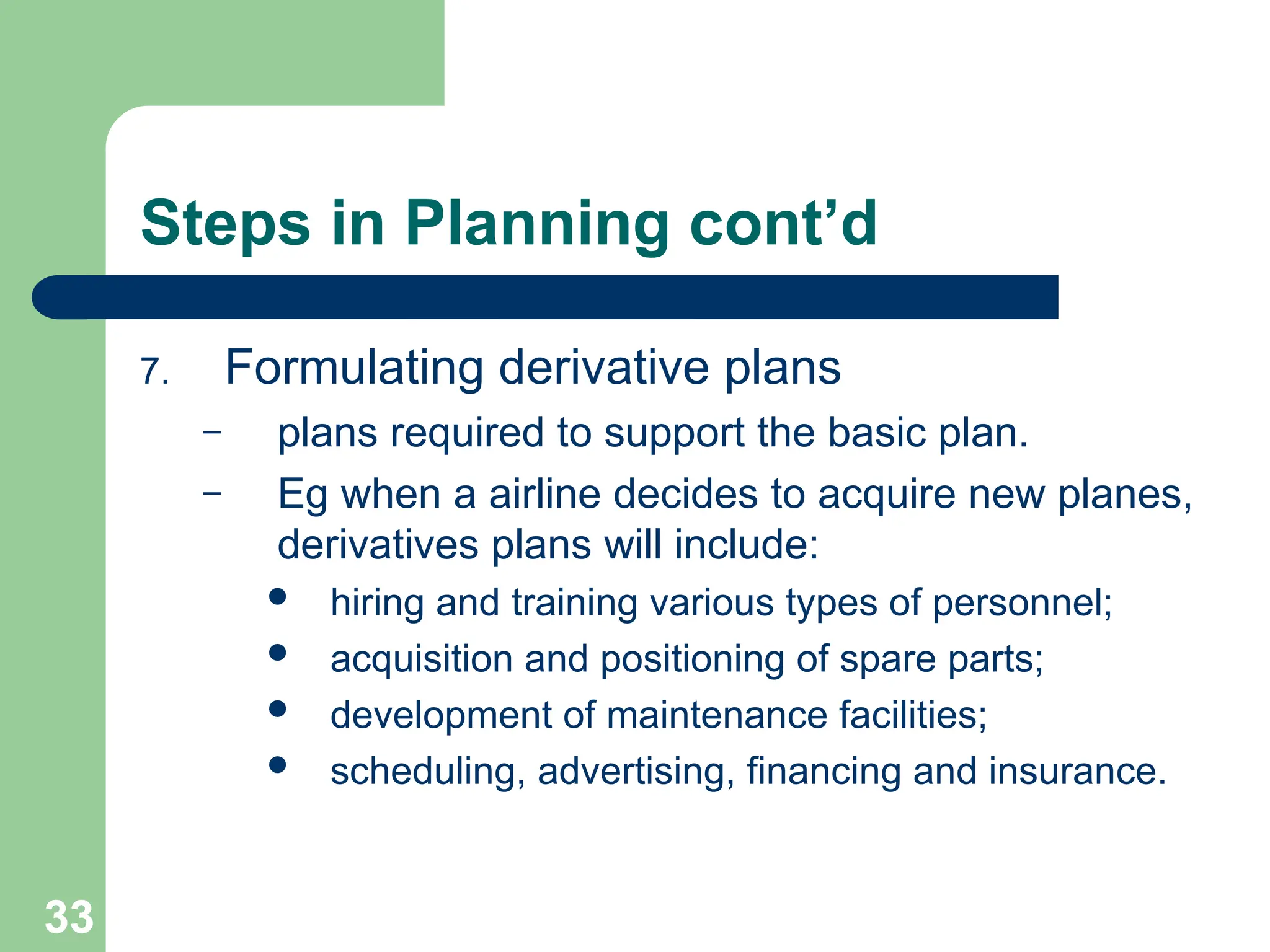
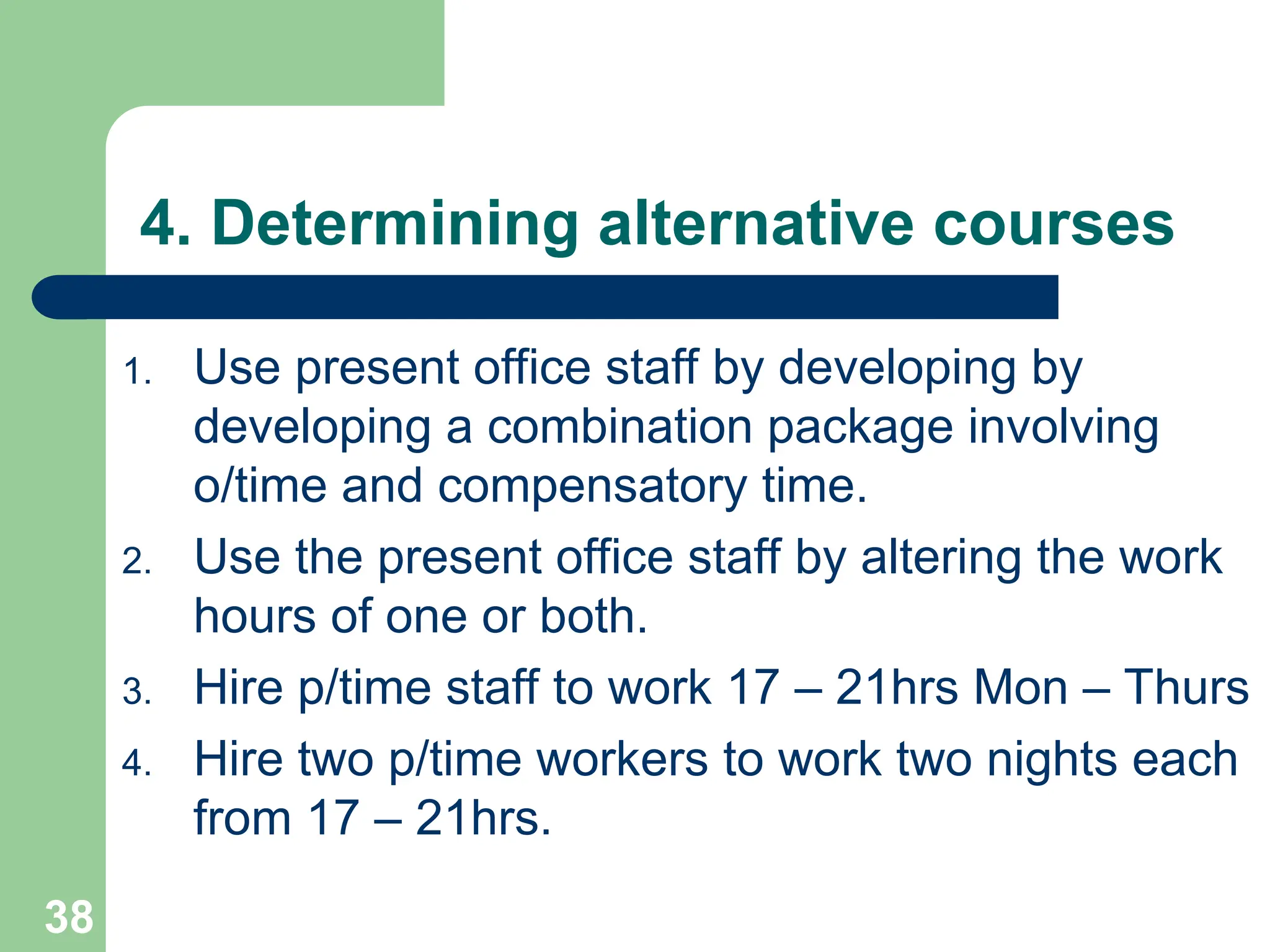
4. Determining alternative courses of actions
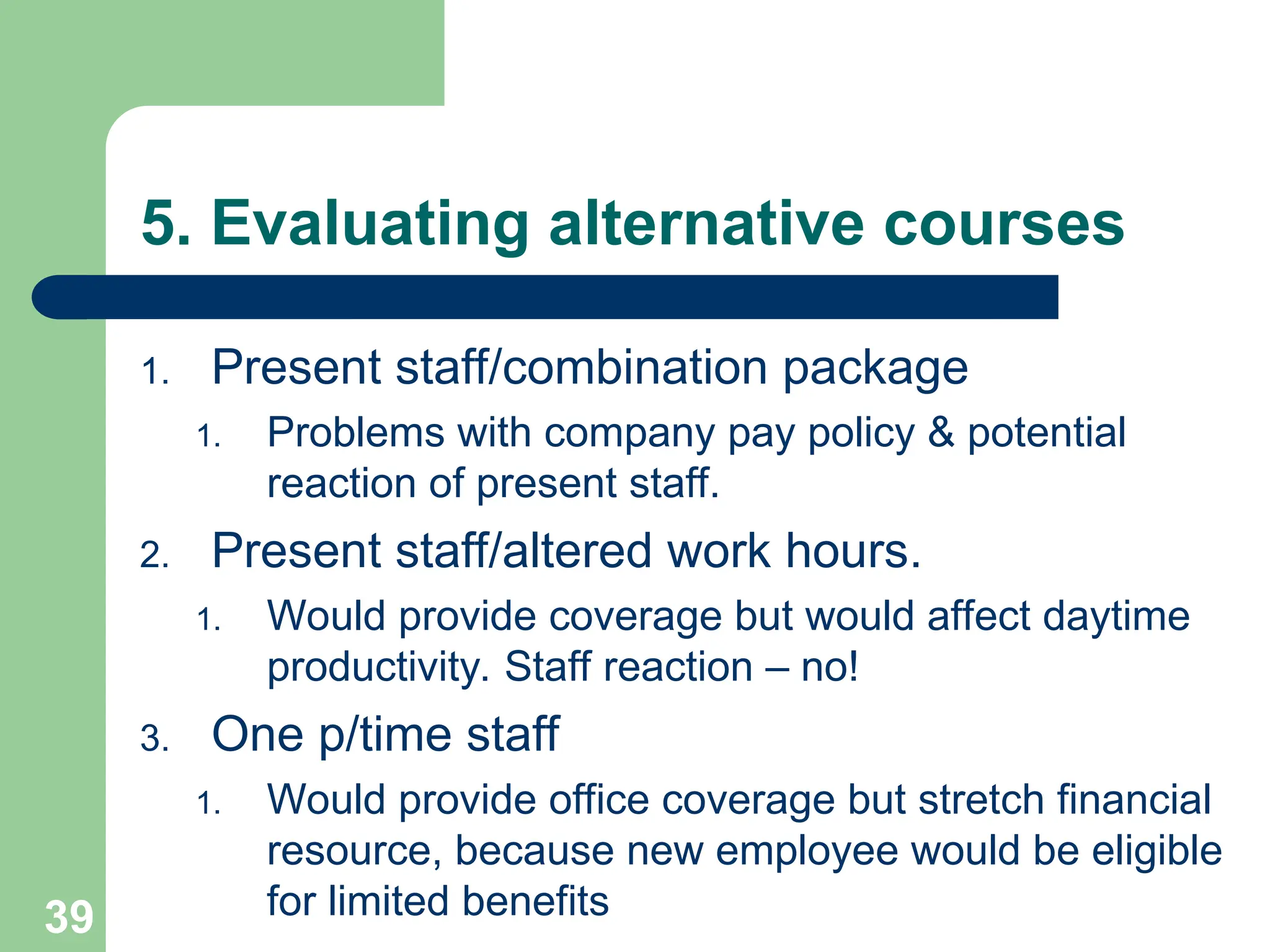
5. Evaluating alternative course of action
6. Selecting a course of action
7. Formulating derivative plans
8. Numbering plans by budgeting
29.
29
29
Steps in Planningcont’d
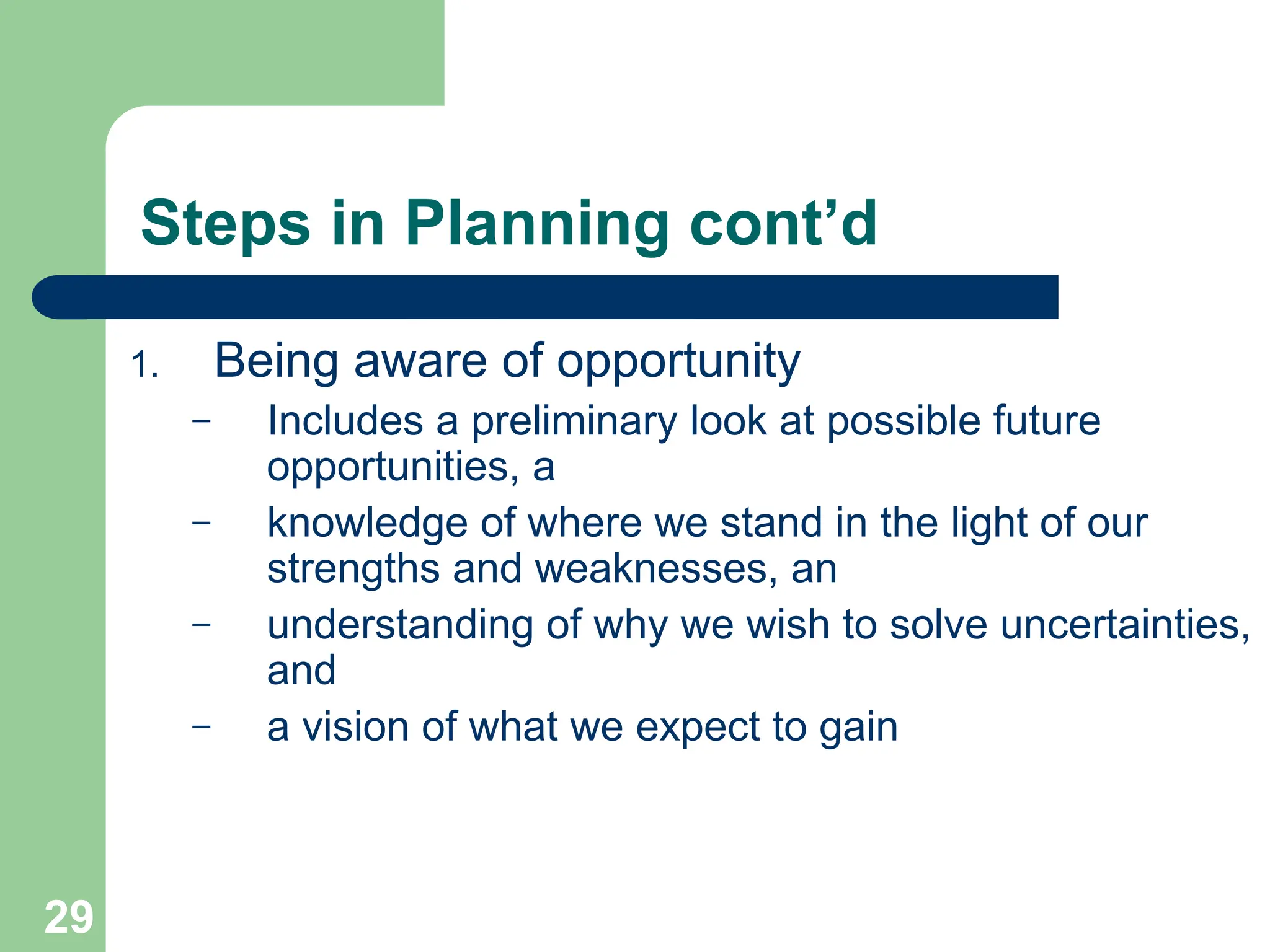
1. Being aware of opportunity
– Includes a preliminary look at possible future
opportunities, a
– knowledge of where we stand in the light of our
strengths and weaknesses, an
– understanding of why we wish to solve uncertainties,
and
– a vision of what we expect to gain
30.
30
30
Steps in Planningcont’d
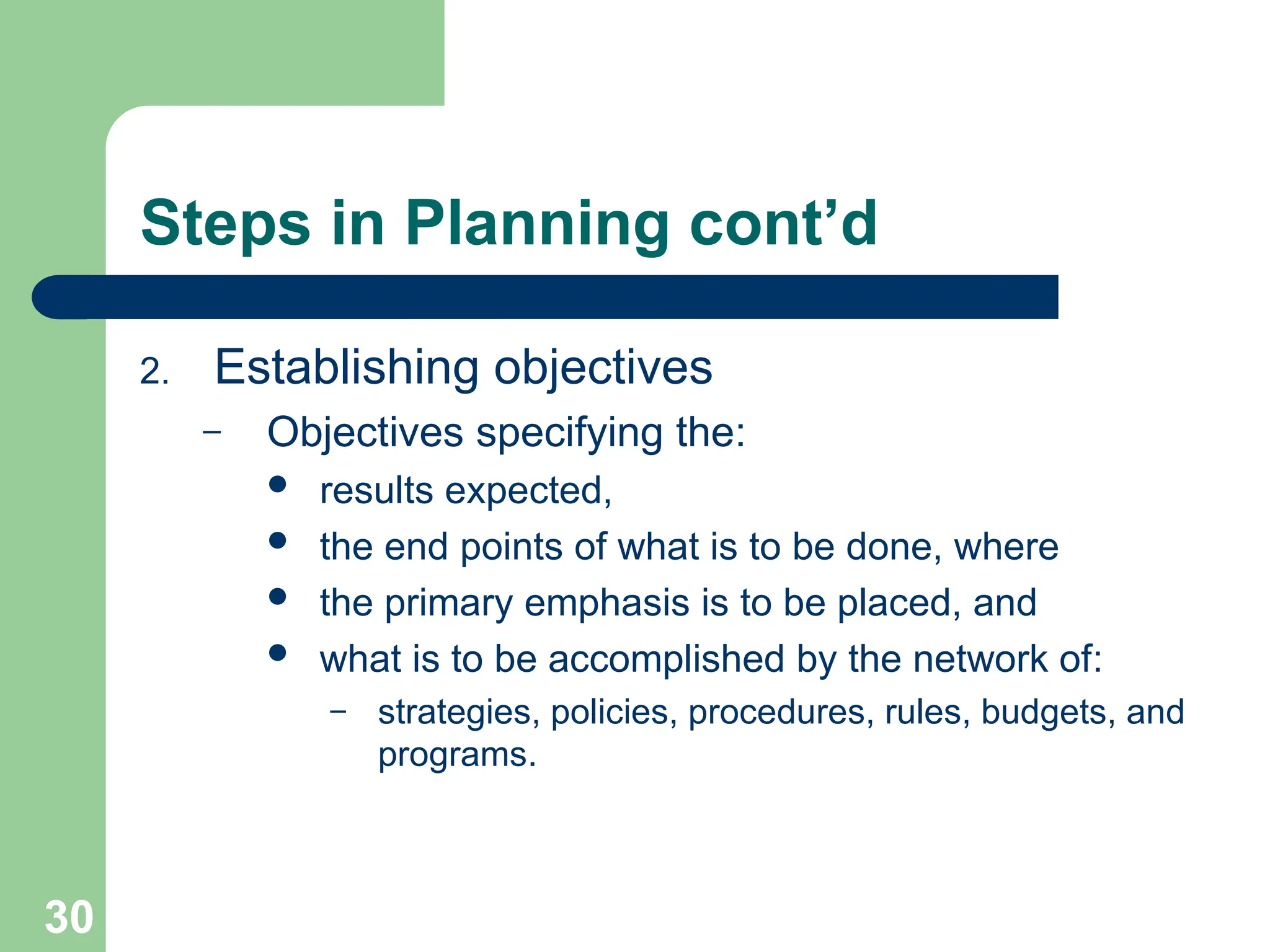
2. Establishing objectives
– Objectives specifying the:
results expected,
the end points of what is to be done, where
the primary emphasis is to be placed, and
what is to be accomplished by the network of:
– strategies, policies, procedures, rules, budgets, and
programs.
31.
31
31
Steps in Planningcont’d
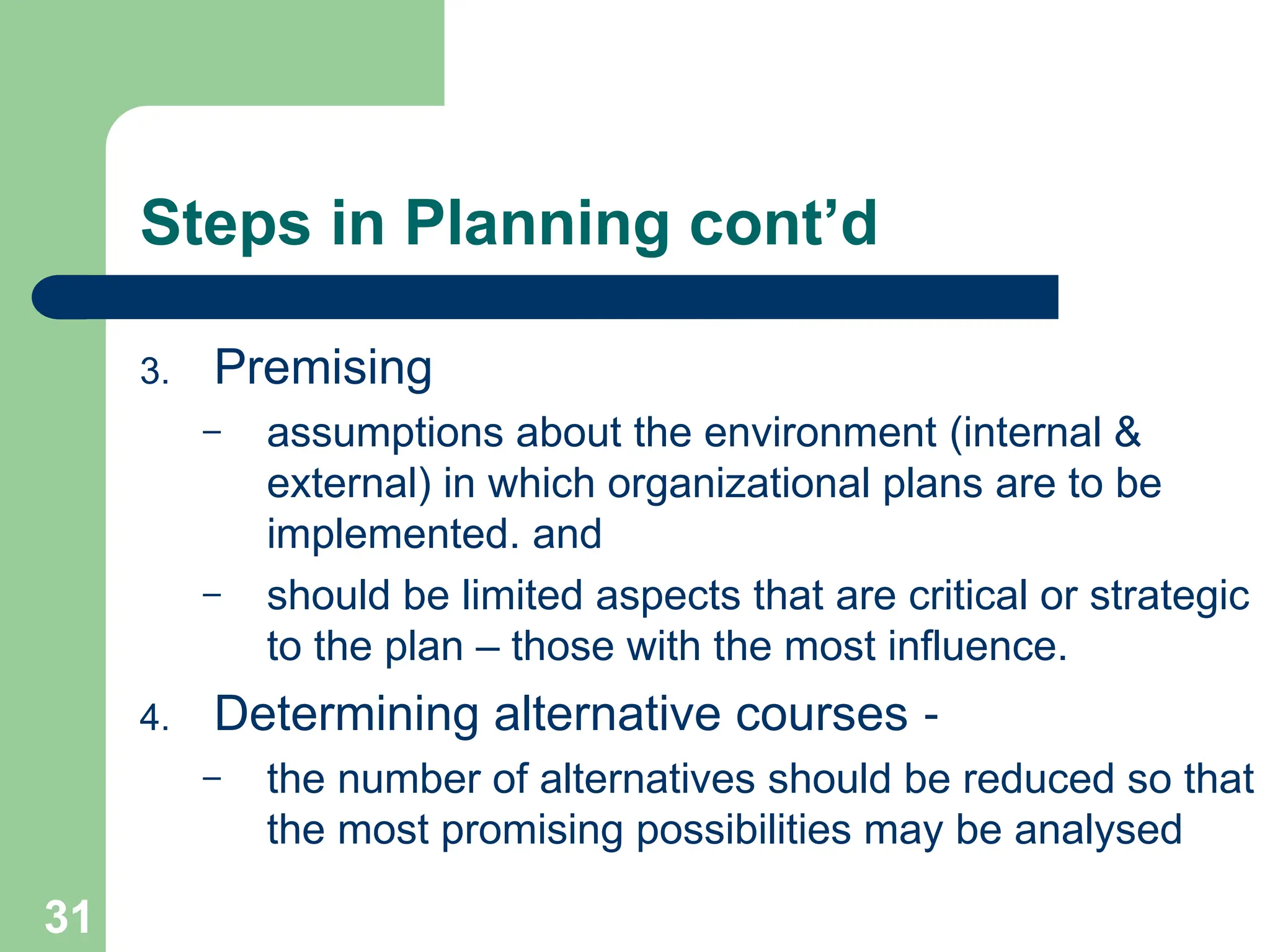
3. Premising
– assumptions about the environment (internal &
external) in which organizational plans are to be
implemented. and
– should be limited aspects that are critical or strategic
to the plan – those with the most influence.
4. Determining alternative courses ‑
– the number of alternatives should be reduced so that
the most promising possibilities may be analysed
32.
32
32
Steps in Planningcont’d
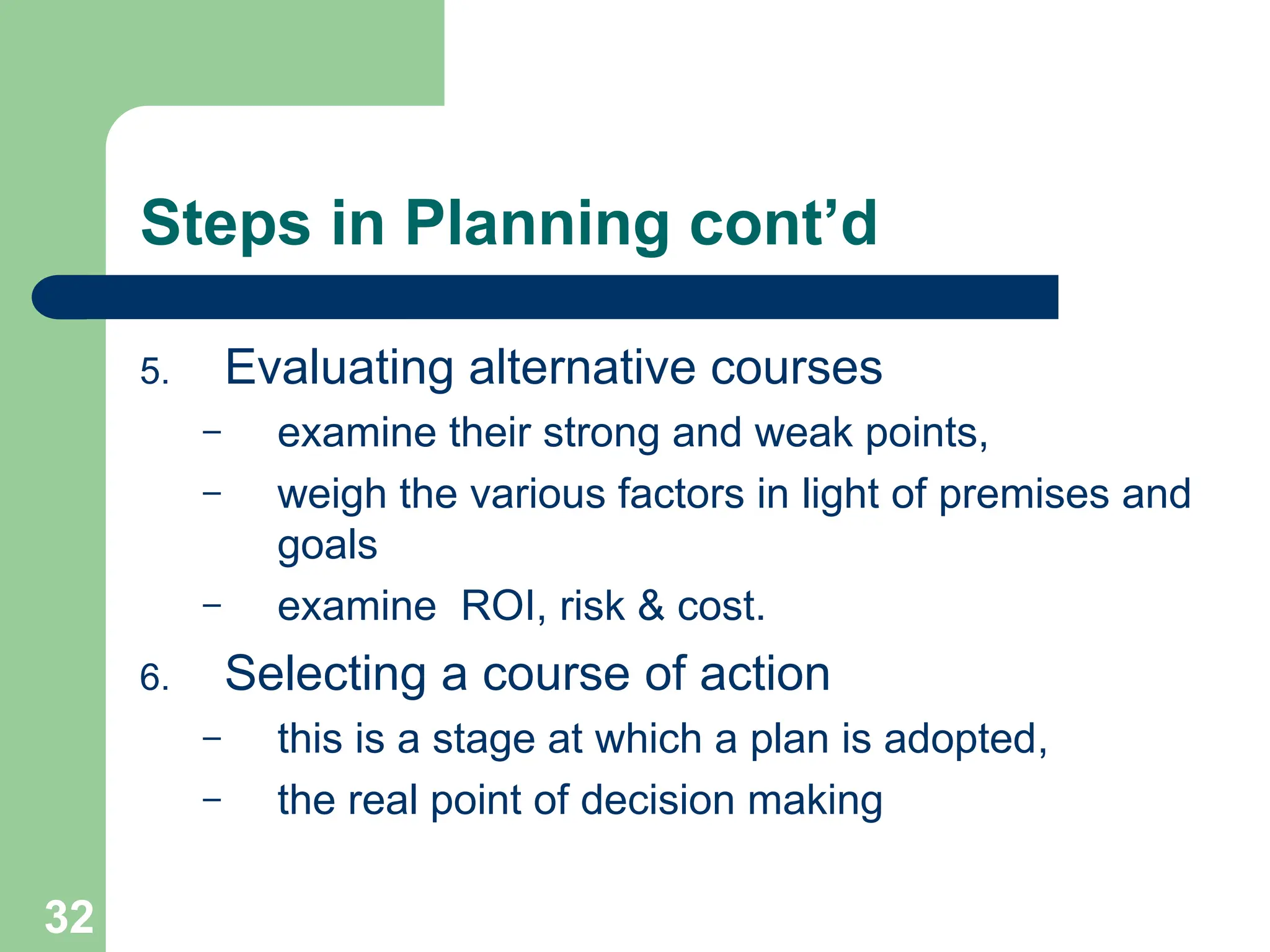
5. Evaluating alternative courses
– examine their strong and weak points,
– weigh the various factors in light of premises and
goals
– examine ROI, risk & cost.
6. Selecting a course of action
– this is a stage at which a plan is adopted,
– the real point of decision making
33.
33
33
Steps in Planningcont’d
7. Formulating derivative plans
– plans required to support the basic plan.
– Eg when a airline decides to acquire new planes,
derivatives plans will include:
hiring and training various types of personnel;
acquisition and positioning of spare parts;
development of maintenance facilities;
scheduling, advertising, financing and insurance.
34.
34
34
Steps in Planningcont’d
8. Numbering plans by budgeting
– Convert plans to budgets.
– The overall budgets of an organization represent
the sum total of income and expenses.
o Each department or program of a business can
have its own budgets.
– If done well, budgets become important standards
against which planning progress can be measured
35.
Planning; an example(Plunkett et al)
Basic planning process by a first level manager
1. Being aware of an opportunity
– Increasing marketshare
2. Set Objective
– To ensure that the office is staffed from 8hrs to
21hrs, Mon – Thurs. Target date January 1 2016.
35
36.
3.Premising
Present staffingsituation
– Office is staffed by two f/time hourly employees.
08hrs to 16.30 and 08hrs to 17hrs
Financial resources
– Operating budget has sufficient funds to support
additional staff at a range of K6 – K8 p/hr, but
benefits are restricted.
36
37.
Premising cont’d
Laboursupply
– The potential number of p/time applicants is
uncertain based on the rate of pay available.
Company policy
– Severe limits are placed on the use of overtime &
compensatory time.
– a p/time employee becomes eligible for a limited
benefits package when they work 19hrs per week
37
38.
4. Determining alternativecourses
1. Use present office staff by developing by
developing a combination package involving
o/time and compensatory time.
2. Use the present office staff by altering the work
hours of one or both.
3. Hire p/time staff to work 17 – 21hrs Mon – Thurs
4. Hire two p/time workers to work two nights each
from 17 – 21hrs.
38
39.
5. Evaluating alternativecourses
1. Present staff/combination package
1. Problems with company pay policy & potential
reaction of present staff.
2. Present staff/altered work hours.
1. Would provide coverage but would affect daytime
productivity. Staff reaction – no!
3. One p/time staff
1. Would provide office coverage but stretch financial
resource, because new employee would be eligible
for limited benefits
39
40.
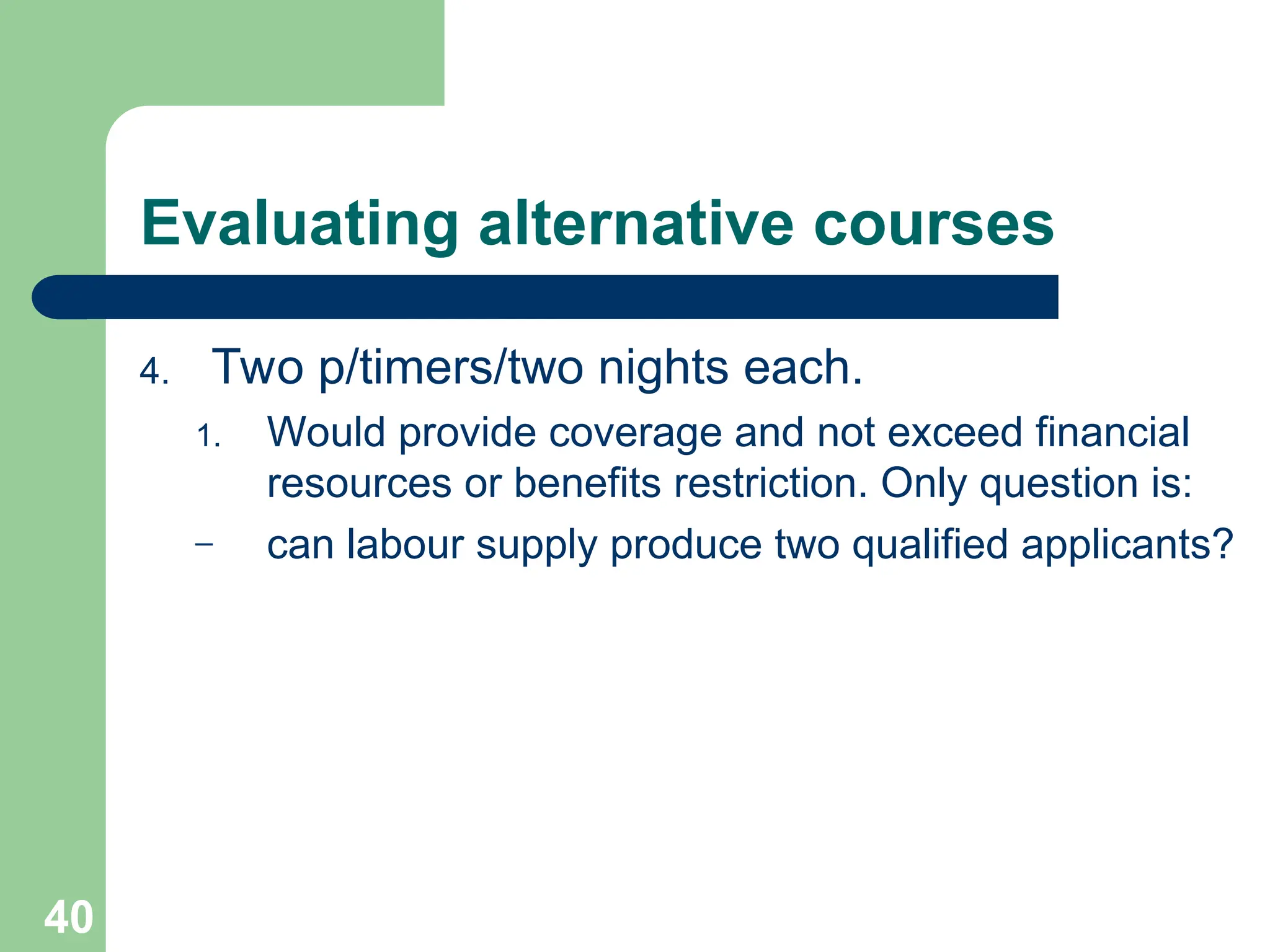
Evaluating alternative courses
4.Two p/timers/two nights each.
1. Would provide coverage and not exceed financial
resources or benefits restriction. Only question is:
‒ can labour supply produce two qualified applicants?
40
41.
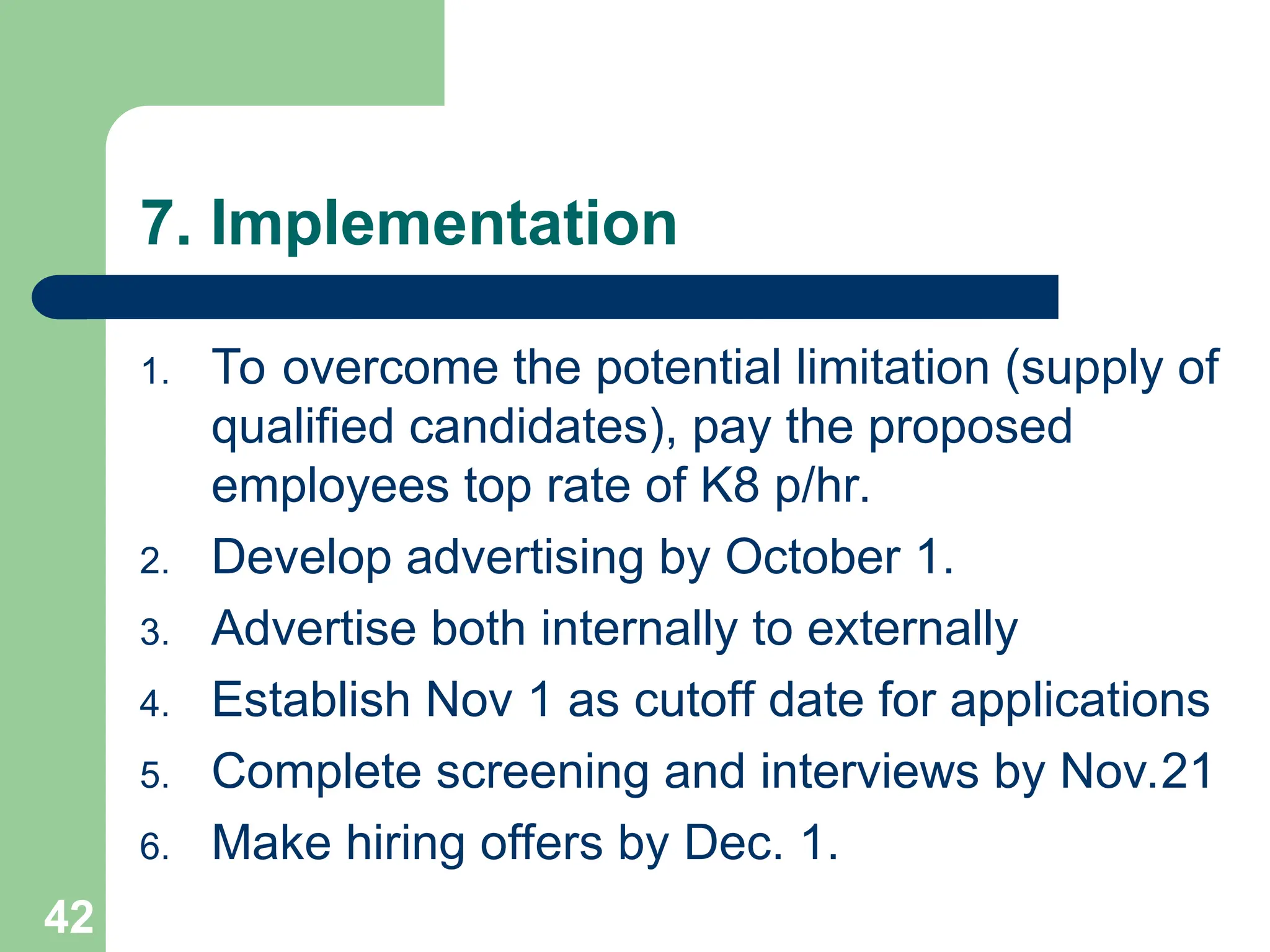
6. Selecting acourse of action
The alternative with the fewest questions and
most promise is alternative 1. the only problem
lies in attracting candidates.
41
42.
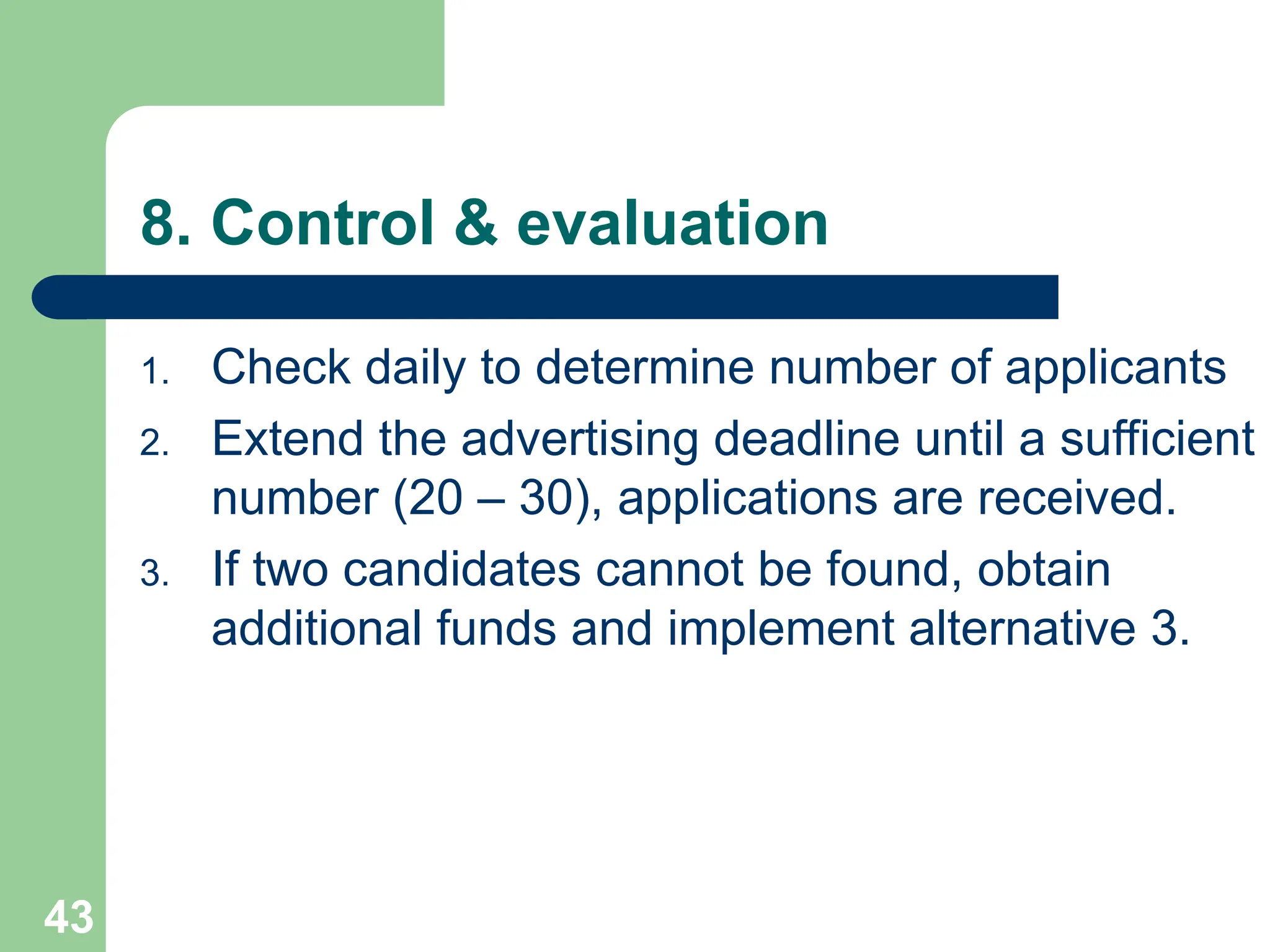
7. Implementation
1. Toovercome the potential limitation (supply of
qualified candidates), pay the proposed
employees top rate of K8 p/hr.
2. Develop advertising by October 1.
3. Advertise both internally to externally
4. Establish Nov 1 as cutoff date for applications
5. Complete screening and interviews by Nov.21
6. Make hiring offers by Dec. 1.
42
43.
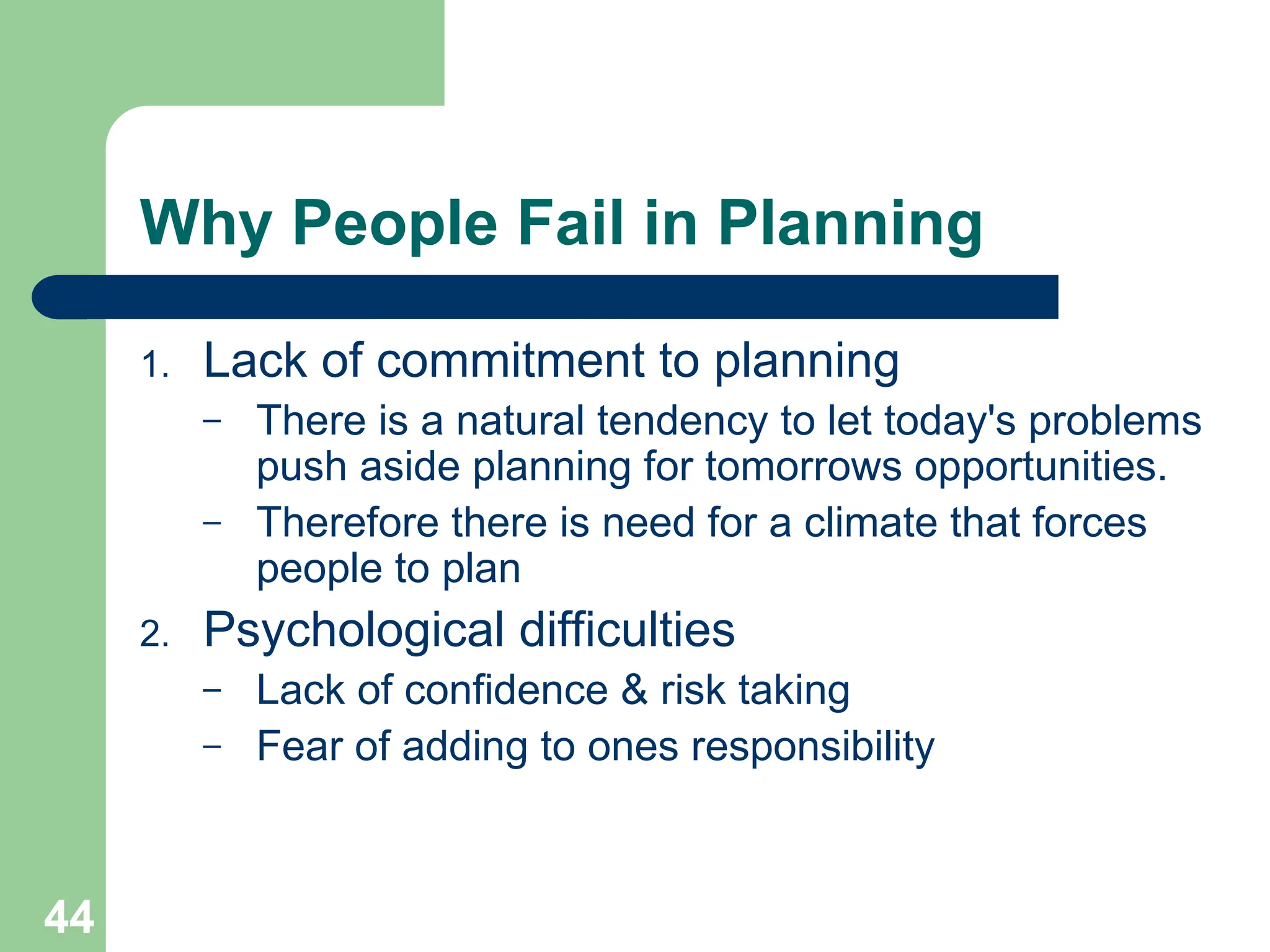
8. Control &evaluation
1. Check daily to determine number of applicants
2. Extend the advertising deadline until a sufficient
number (20 – 30), applications are received.
3. If two candidates cannot be found, obtain
additional funds and implement alternative 3.
43
44.
44
44
Why People Failin Planning
1. Lack of commitment to planning
– There is a natural tendency to let today's problems
push aside planning for tomorrows opportunities.
– Therefore there is need for a climate that forces
people to plan
2. Psychological difficulties
– Lack of confidence & risk taking
– Fear of adding to ones responsibility
45.
45
45
Why People Failin Planning
3. Lack of meaningful objectives
– Goals must be clear, attainable, actionable and
verifiable (smart)
– Goals must be defined in light of our strengths &
weaknesses and the relevant environmental factor.
4. Tendency to underestimate the importance of
planning premises
– Plans must be made in the light of uniform and
generally understood planning premises.
46.
46
46
Why People Failin Planning cont’d
5. Failure to see scope of plans
– Some mgrs concentrate solely on either major or
minor plans neglecting other types of plans:
– Eg. Missions/purposes, objectives/goals, strategies,
policies, rules, procedures and programs.
6. Failure to see planning as a rational process
– Planning requires clear goals, knowledge of
alternatives and a desire to come up with best
possible solution
47.
47
47
Why People Failin Planning cont’d
7. Excessive reliance on experience
– What happened in the past is not likely to suit a
future situation
8. Failure to use the principle of the limiting
factor
– it requires that mgrs search out those factors in a
problem situation which make the most difference
in the solution and then deal primarily with them.
48.
48
48
Why People Failin Planning cont’d
9. Lack of top management support
– Planning is not likely to be very effective if there is no
support from top mgmt.
10. Lack of clear delegation
– It is very difficult for people to plan if they do not know
what their job is, and
– if they do not have clear authority to make decisions.
11. Lack of adequate control techniques & info.
– It can hardly be very effective if those responsible do
not know how well they are working.
49.
49
49
Why People Failin Planning cont’d
12. Lack of an appropriate planning climate within
the organization as a whole
– procedural inflexibilities inhibit effective planning, &
– too much pressure on line mgrs leaves them with no
time to prepare effective plans
13. Technical problems
– a mgr lacking technical skills will be deficient in
solving some of the technical problems which
accompany planning
50.
50
50
Why People Failin Planning cont’d
14. Resistance to changes
– without proper levels of participation, & careful
planning for implementation,
– plans & objectives will be resisted by some
employees.
– limiting resistance to change requires patient
selling of ideas, careful dissemination of
information and aggressive leadership
51.
51
51
Limits to Planning
1.Cost
2. Complexity of the planning process
3. Problem of rapid change
4. Political climate
5. Labour organization
6. Technological change
7. Current crises
8. Policy and procedural inflexibility
9. Capital investment
52.
52
52
1. Cost
Costeffective planning requires a lot of time
and energy.
The more:
– committed to planning an organization is, the more
time and energy it devotes to it, and the more
– detailed the planning, the more expensive it will
be.
The longer the planning period the more
costly the plans will be.
53.
53
53
2. Complexity ofthe planning
process
Shifting patterns of market demand make
prediction highly uncertain
Forecasting & planning techniques require a
fair degree of mathematical knowledge by
mgrs, so
– lack of training in quantitative approaches to
planning, creates difficulties.
54.
54
54
3. Problem ofrapid change
In a complex & rapidly changing industry,
planning is very difficult, because new
problems become more complicated.
55.
55
55
4. Political climate
–Government regulation must be taken into
account
5 Labor organization
– existence of strong unions especially those
organized on a national basis tend to restrict
freedom in planning.
6. Technological change
– The rate & nature of change presents external
limitations on planning
56.
56
56
7. Current crises
–Focusing on and constantly dealing with current
crises resulting from uncontrollable environment.
8. Policy & procedural inflexibility
– Progressive planning requires an environment of
change.
9. Capital investment
– The ability to switch courses of future action
becomes limited and
– the investment itself becomes a planning
premises.
57.
57
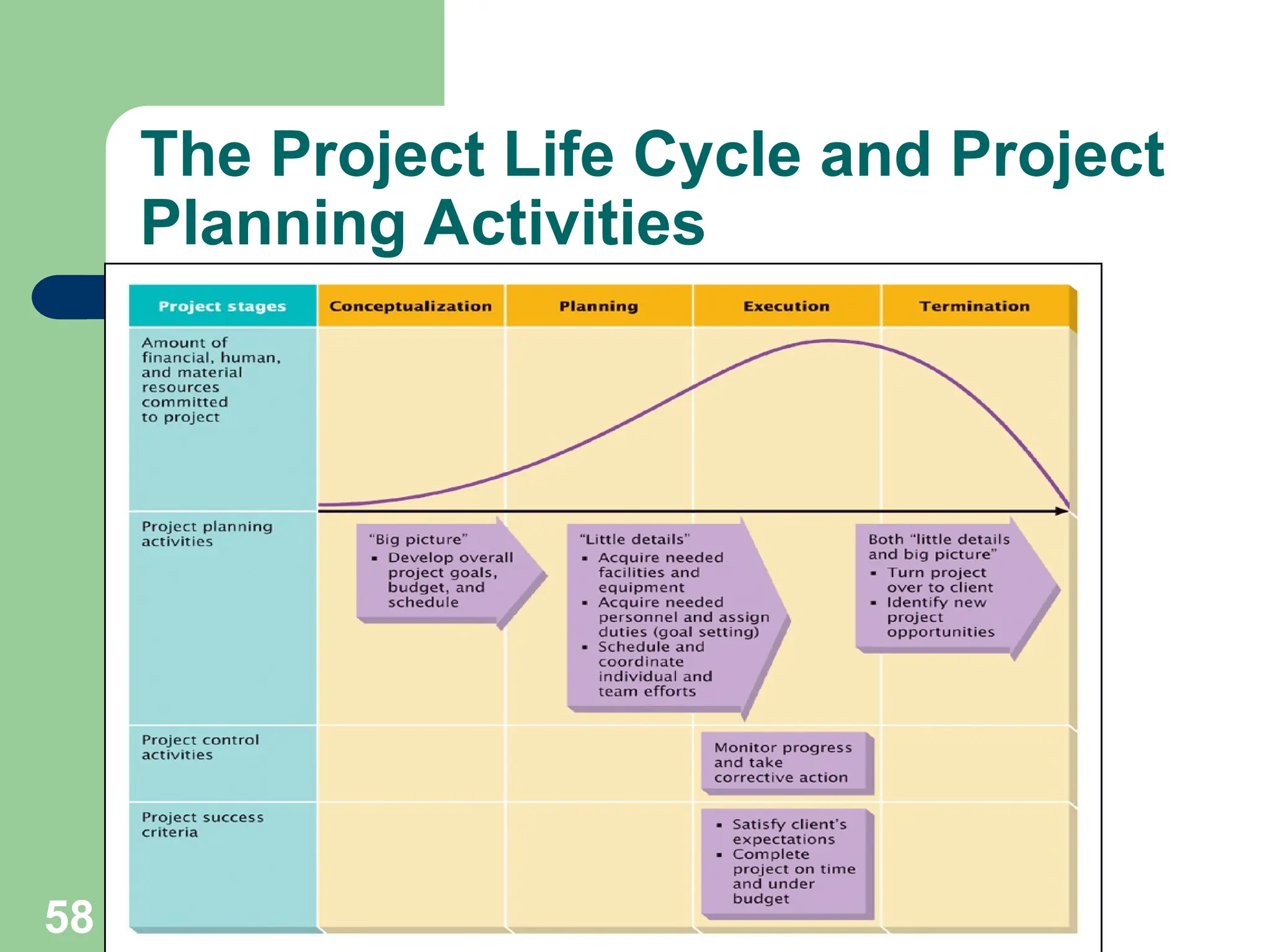
Project Planning andManagement
Project
– A temporary endeavor to achieve a particular aim
The Project Life Cycle
– Conceptualization: Setting project goals and objectives
– Planning: Organizing facilities and equipment, personnel and
task assignments, and scheduling
– Execution: Beginning actual work on the project
– Termination: Turning the project over to the end user and
phasing out project resources
59
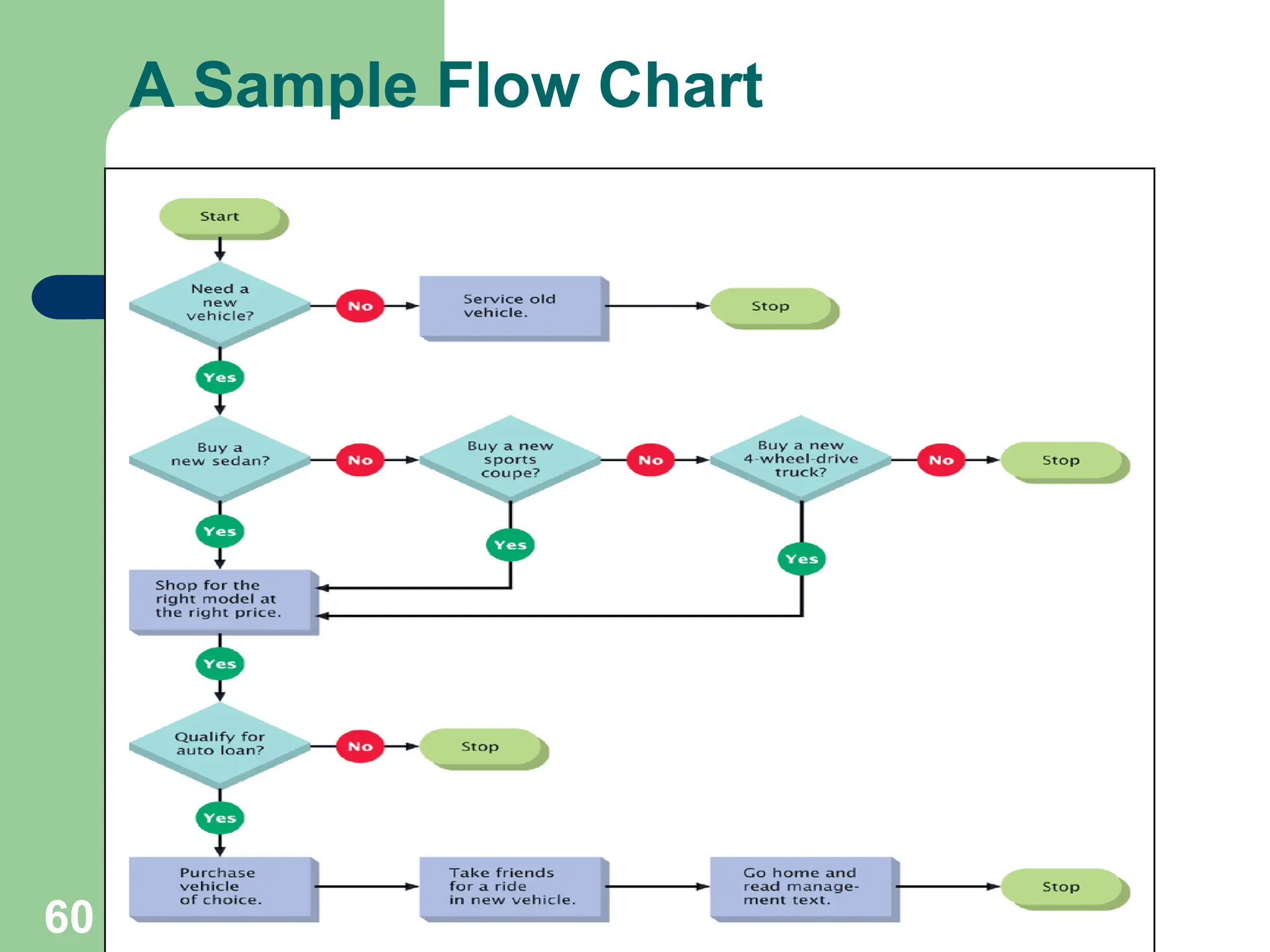
Graphic Planning, Schedulingand
Control Tools
Flow Charts
– Arrange events in the order of their actual or desired
occurrence (flow)
– Eliminate wasted steps and activities (work
simplification)
– Are useful for identifying task components and in
TQM
– Potential problems:
They do not indicate the time dimension of tasks.
They are not practical for complex operations where
several activities occur at once.
61
Graphic Planning, Schedulingand
Control Tools (cont’d)
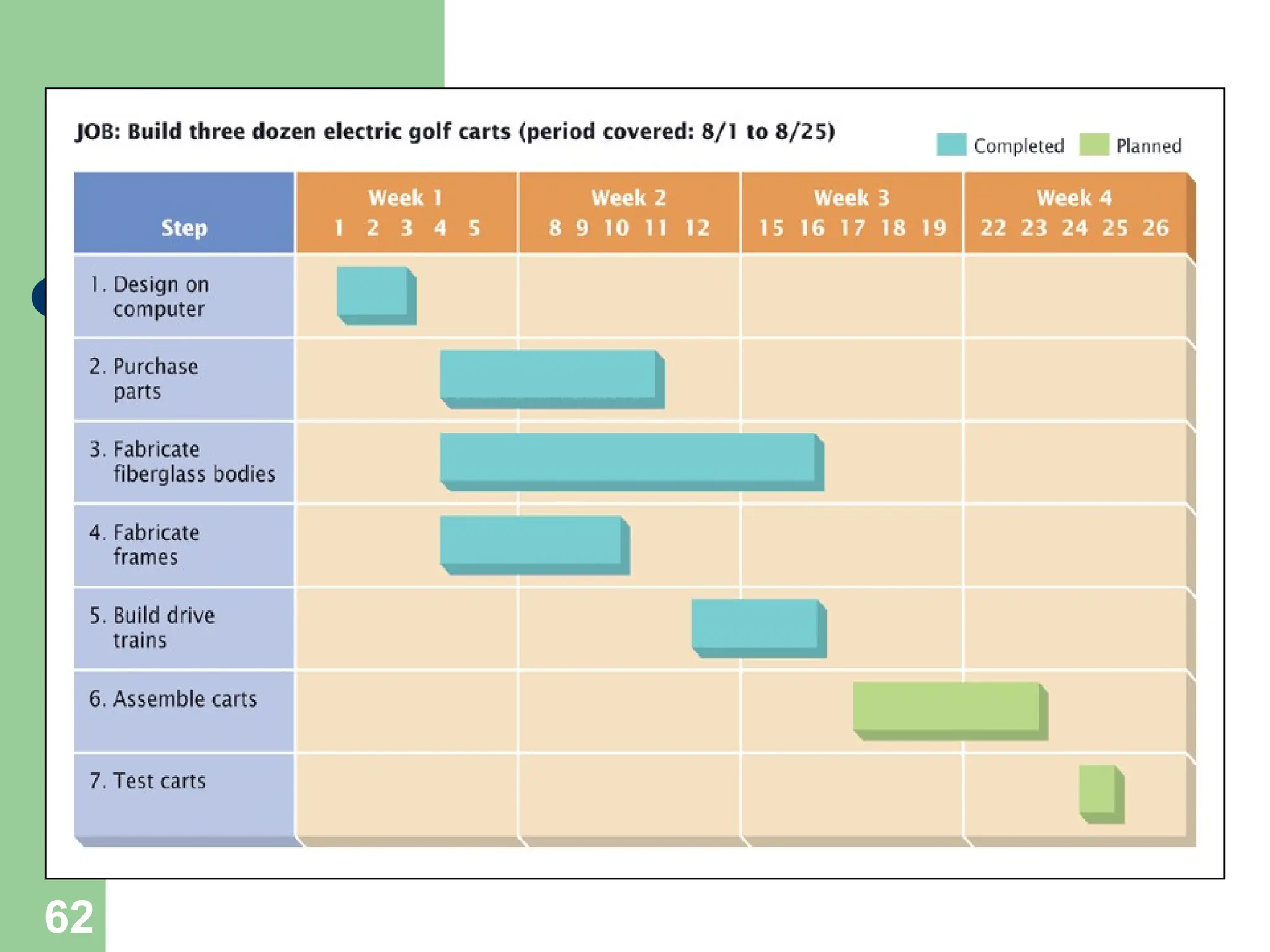
Gantt Charts
– A graphic scheduling technique historically
used in production operations
Useful for scheduling large projects where time
for each activity can be specified and progress
assessed
Potential problem: Overly complex endeavors
are too cumbersome for Gantt charts.
63
Graphic Planning, Schedulingand
Control Tools (cont’d)
Program Evaluation and Review Technique
(PERT) Networks
– Developed in 1958 for use in the development of
the U.S. Navy’s Polaris submarine-launched
missile project
– Graphic sequencing and scheduling tool for large,
complex, and non-routine projects
64.
64
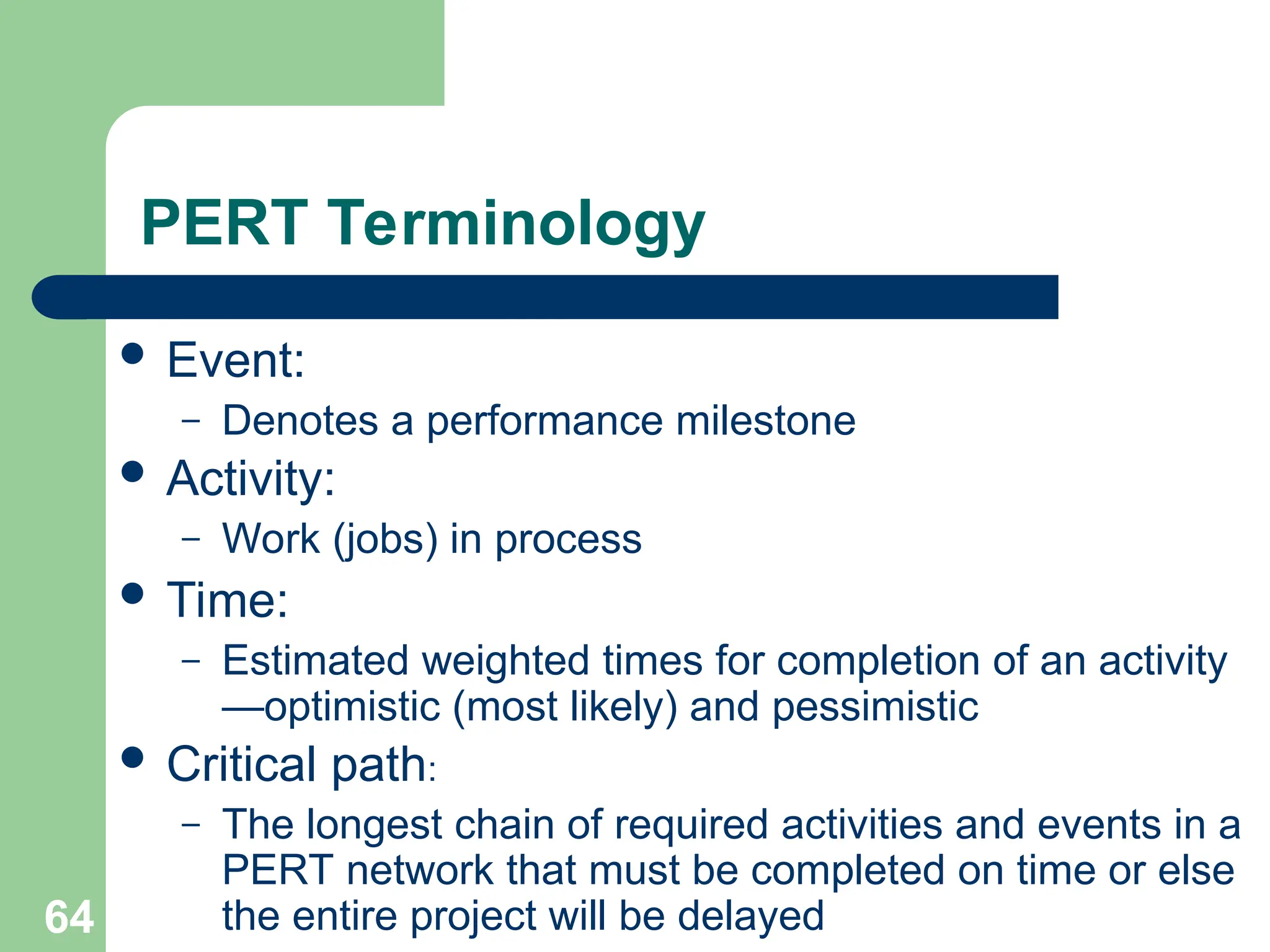
PERT Terminology
Event:
–Denotes a performance milestone
Activity:
– Work (jobs) in process
Time:
– Estimated weighted times for completion of an activity
—optimistic (most likely) and pessimistic
Critical path:
– The longest chain of required activities and events in a
PERT network that must be completed on time or else
the entire project will be delayed
65.
65
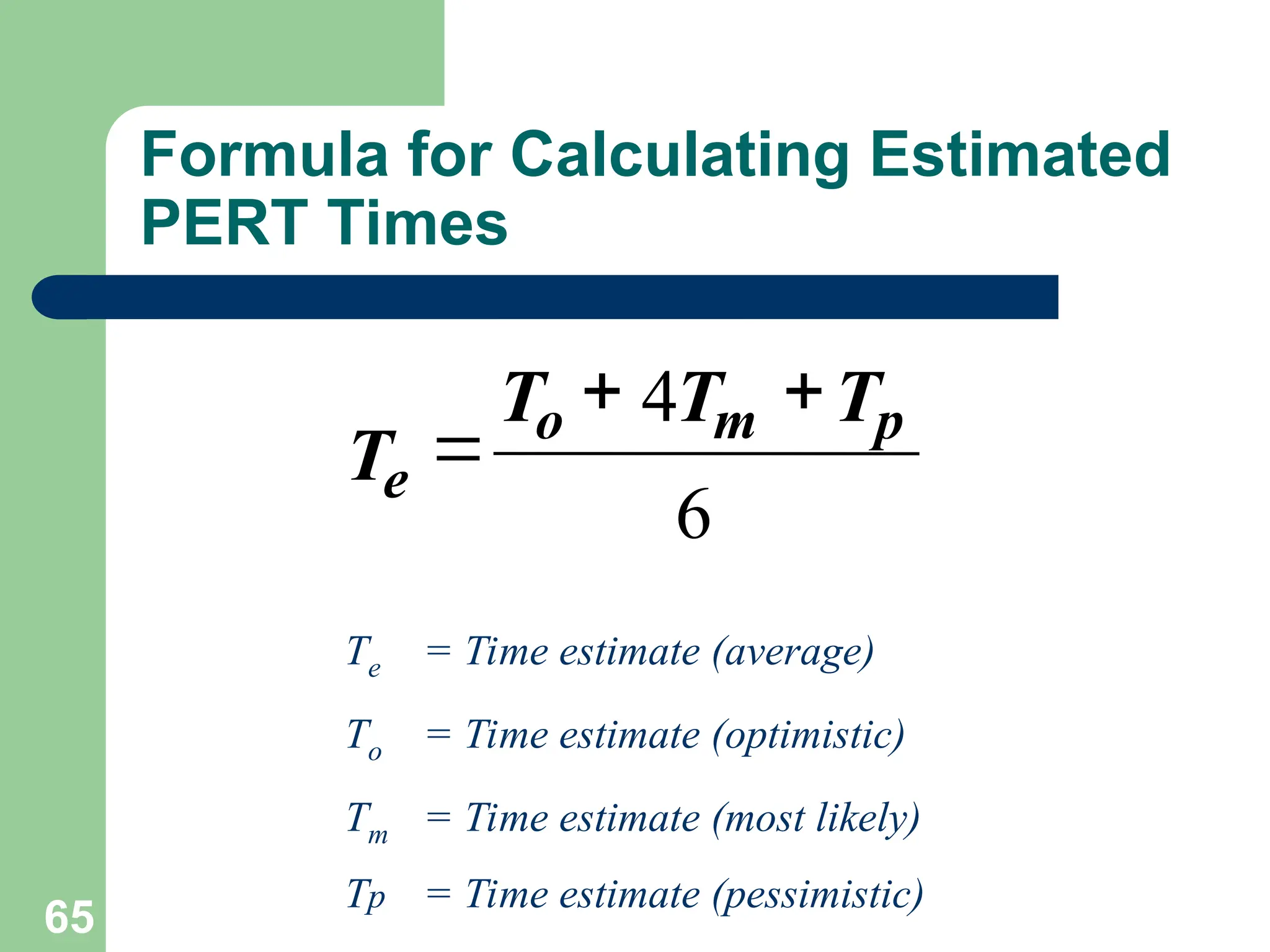
Formula for CalculatingEstimated
PERT Times
Te = Time estimate (average)
To = Time estimate (optimistic)
Tm = Time estimate (most likely)
Tp = Time estimate (pessimistic)
6
4 p
m
o
e
T
T
T
T
66.
66
Getting to Classon Time
Estimates for the amount of time that it takes Joe to get
to class:
– Optimistic: 11 minutes
(The alarm clock wakes him.)
– Mostly likely: 15 minutes
(Joe hits the snooze button once.)
– Pessimistic: 25 minutes
(Joe unplugs the clock.)
What is Joe’s estimated (average) time to get to class?
– 16 minutes
67.
67
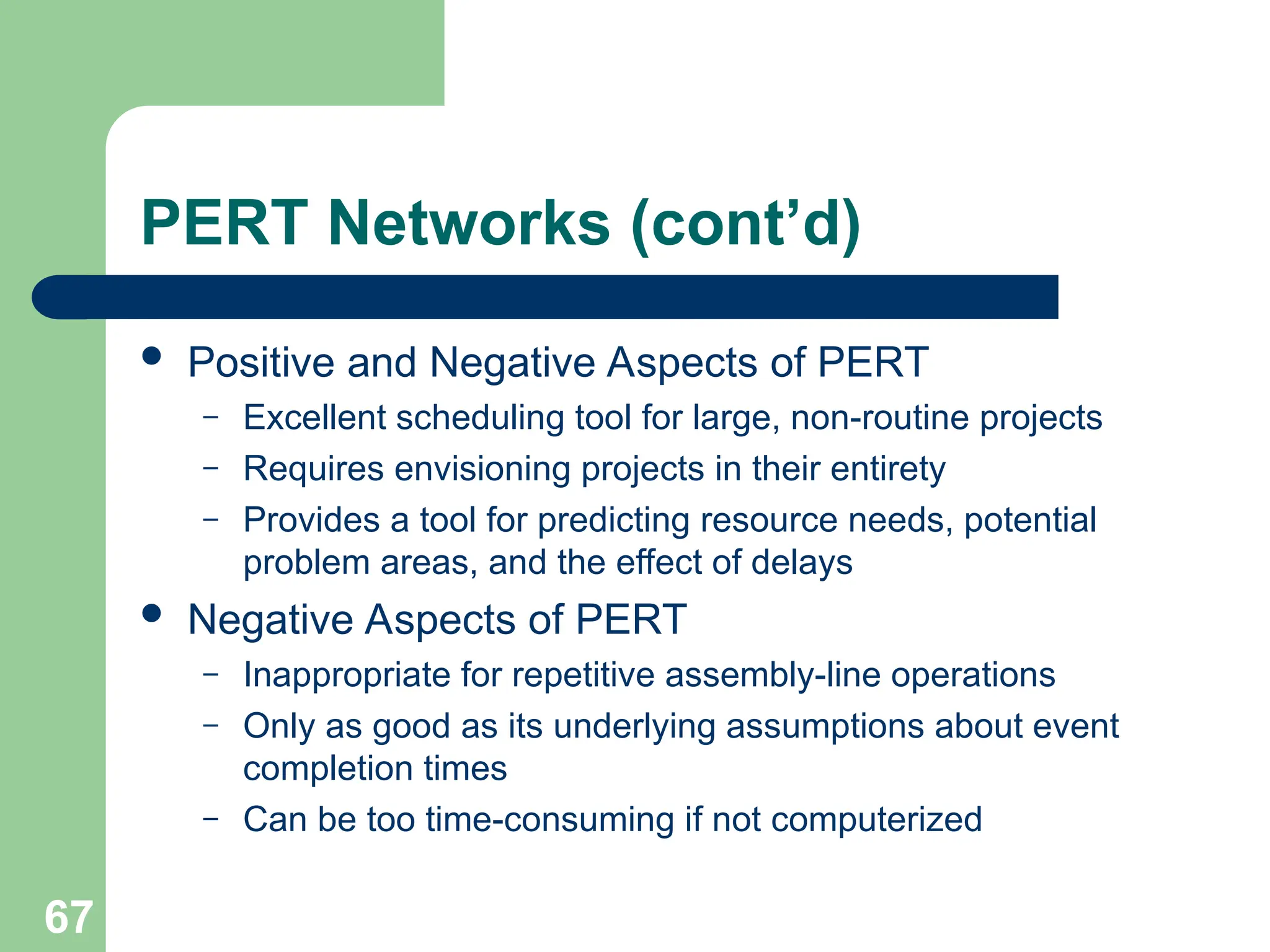
PERT Networks (cont’d)
Positive and Negative Aspects of PERT
– Excellent scheduling tool for large, non-routine projects
– Requires envisioning projects in their entirety
– Provides a tool for predicting resource needs, potential
problem areas, and the effect of delays
Negative Aspects of PERT
– Inappropriate for repetitive assembly-line operations
– Only as good as its underlying assumptions about event
completion times
– Can be too time-consuming if not computerized
69
Break-Even Analysis
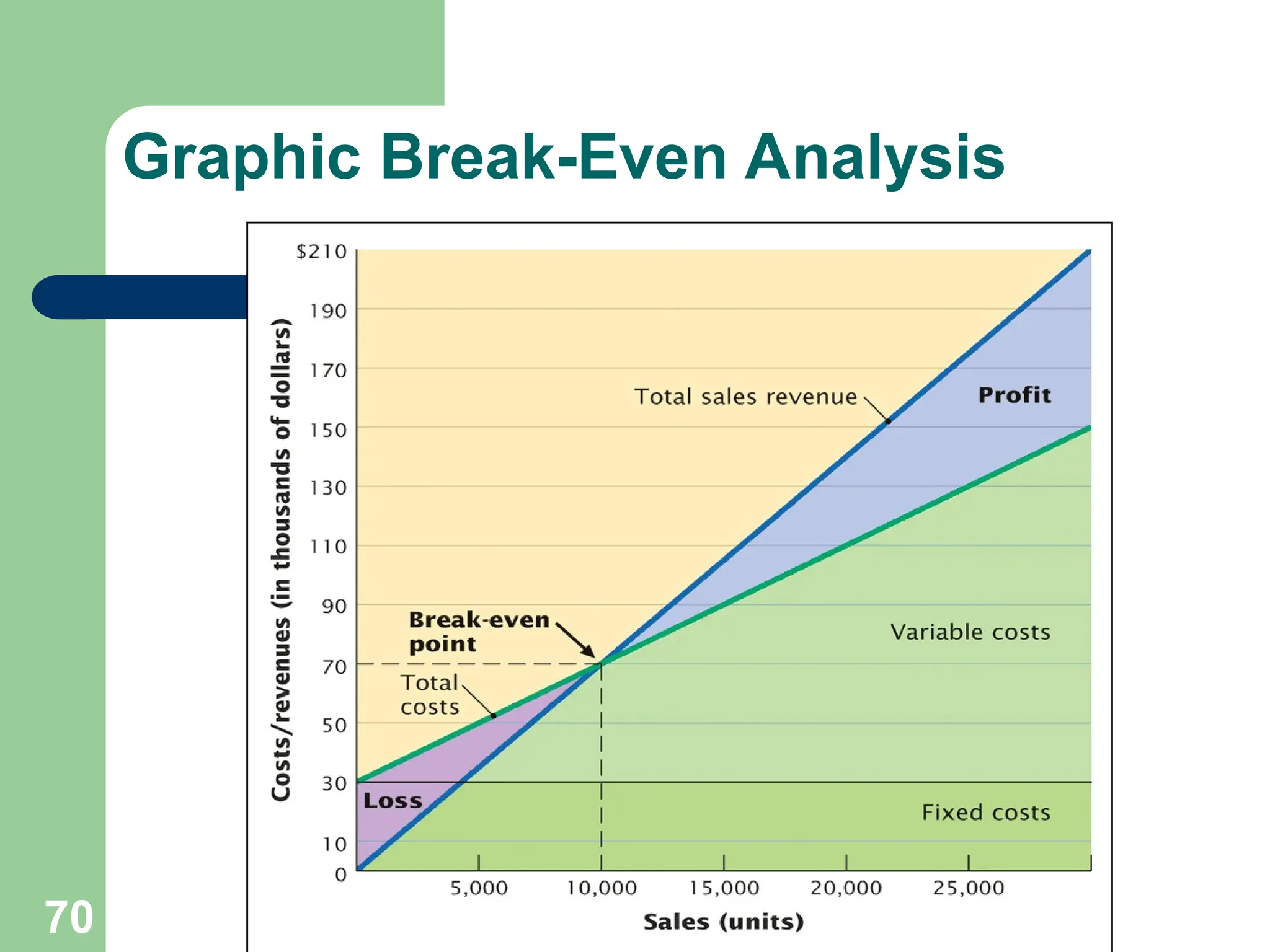
Break-EvenPoint
– The level of sales at which there is no loss or profit
– The point at which the total of fixed and variable costs
equal total sales revenues
Fixed Versus Variable Costs
– Fixed costs:
Costs that must be paid regardless of output or sales
– Variable costs
Costs that vary directly with production and sales
71
Break-Even Analysis
Strengths
–Planners are forced to interrelate cost, volume, and
profit in a realistic way.
– Planners are able to ask what-if questions concerning
the impact of price, costs, and profit objective changes.
Limitations
– A neat separation of fixed and variable costs is difficult
to achieve.
– Complex factors in supply and demand interfere with
the linear projections (point estimates) of the analysis.