Department of English Language and
Literature
Major: English Language and Literature
Discourse Analysis
Sessions 9 The cooperative principles
Dr. Badriya Al Mamari
Academic year 2021/2022
•In conversation analysis, the cooperative
principle is the assumption that participants in a
conversation normally attempt to be
informative, truthful, relevant, and clear.
•This idea was introduced by philosopher H.
Paul Grice in his 1975 article "Logic and
Conversation
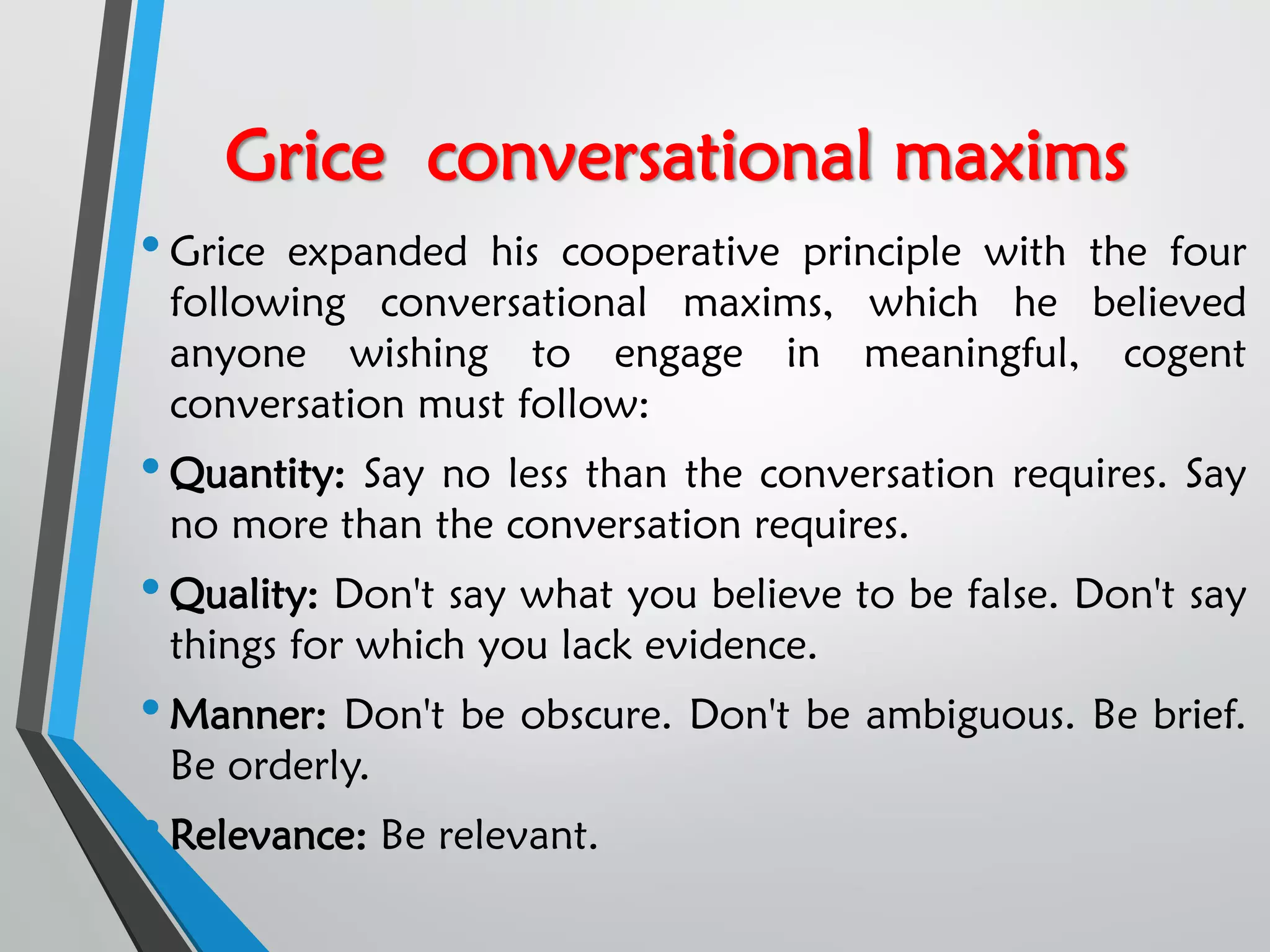
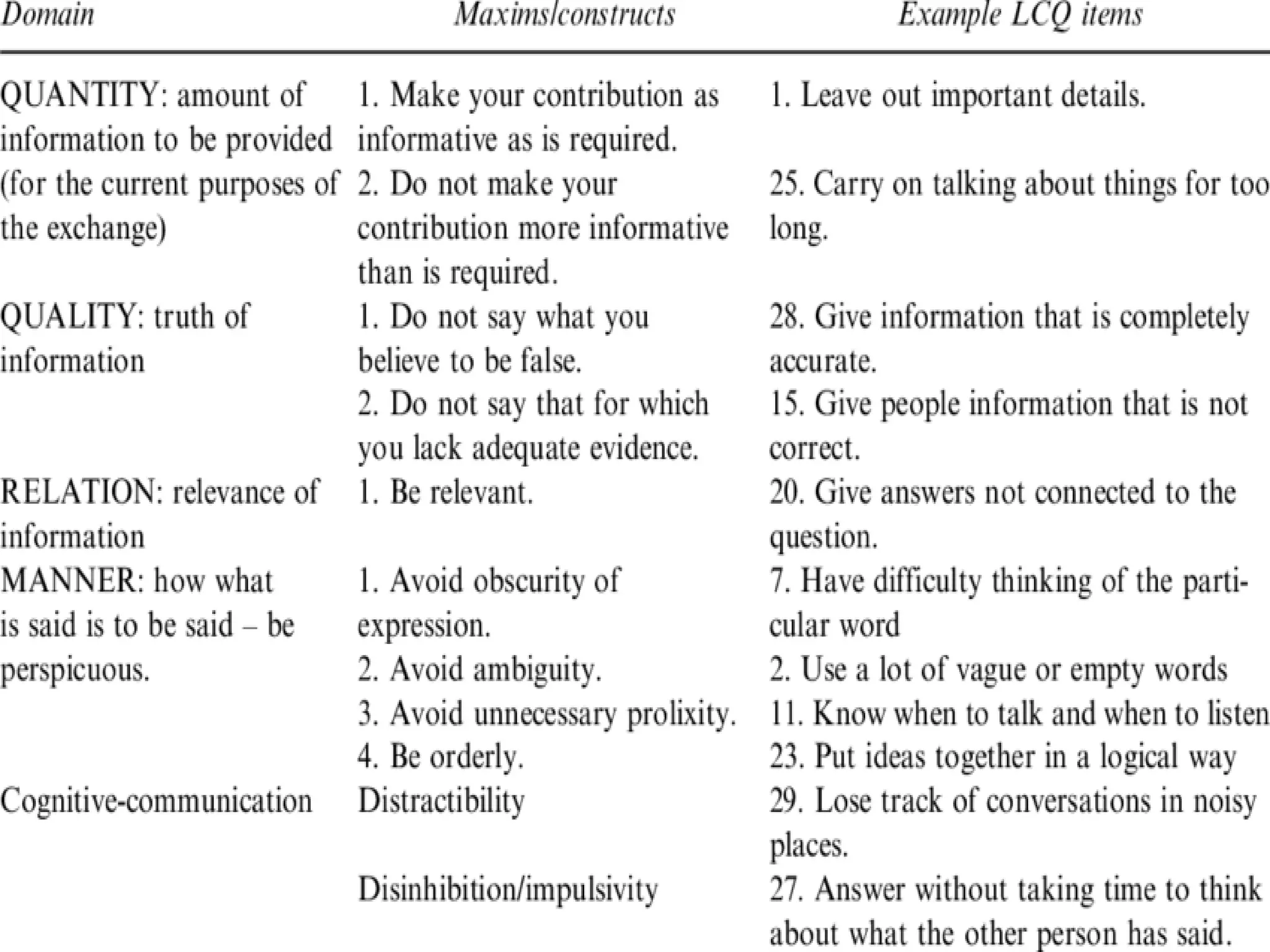
Grice conversational maxims
•Grice expanded his cooperative principle with the four
following conversational maxims, which he believed
anyone wishing to engage in meaningful, cogent
conversation must follow:
•Quantity: Say no less than the conversation requires. Say
no more than the conversation requires.
•Quality: Don't say what you believe to be false. Don't say
things for which you lack evidence.
•Manner: Don't be obscure. Don't be ambiguous. Be brief.
Be orderly.
•Relevance: Be relevant.
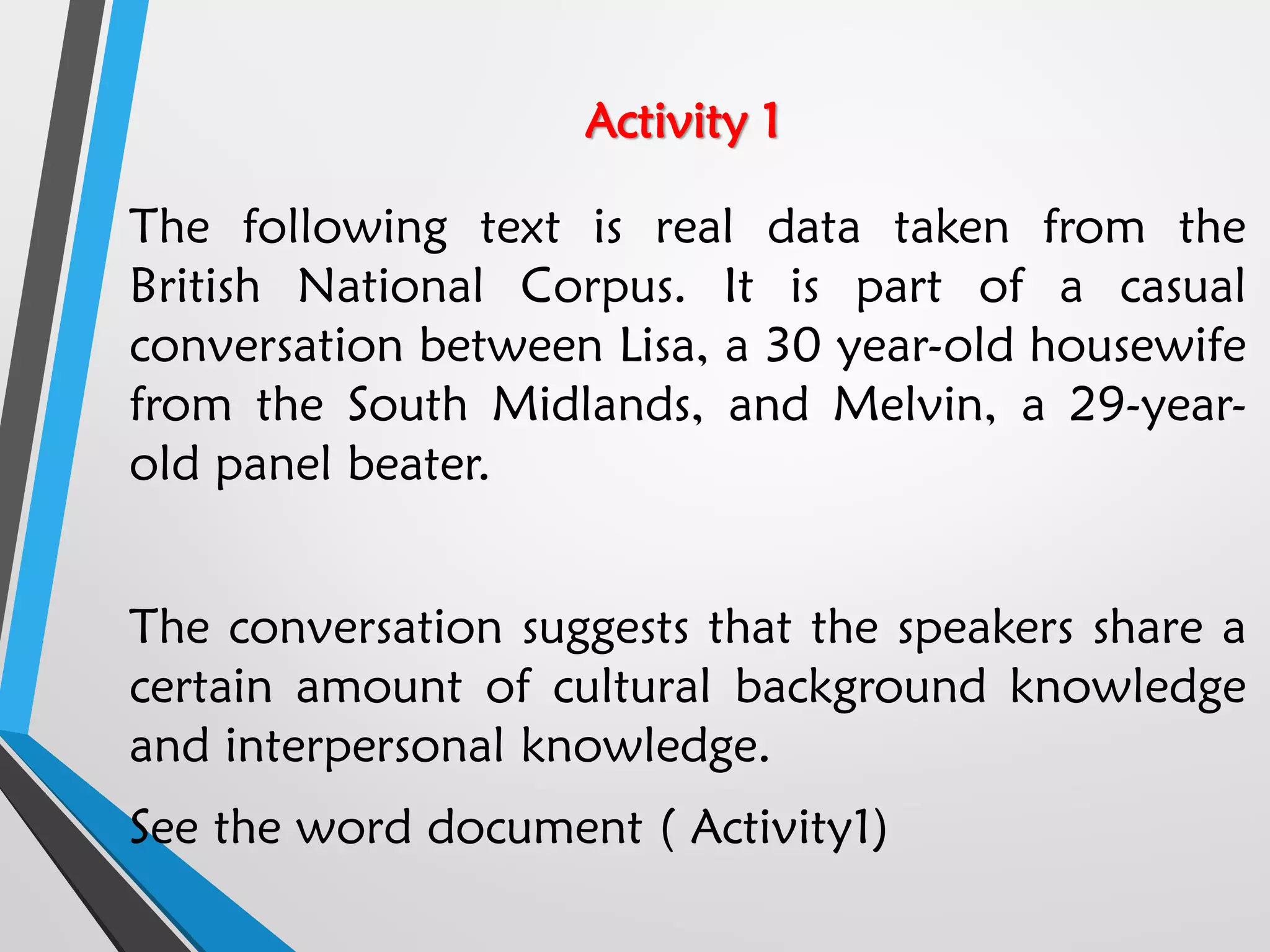
Activity 1
The following text is real data taken from the
British National Corpus. It is part of a casual
conversation between Lisa, a 30 year-old housewife
from the South Midlands, and Melvin, a 29-year-
old panel beater.
The conversation suggests that the speakers share a
certain amount of cultural background knowledge
and interpersonal knowledge.
See the word document ( Activity1)
• Because Melvin and Louise seem to share such a
lot of cultural background knowledge and
interpersonal knowledge, we can assume that
they know each other and each other’s worlds
fairly well, and because of their shared
knowledge, they can flout the maxims freely, in
the certainty that they will each be able to infer
the other’s implied meaning.
Flouting the maxim of quantity
Lisa says that Melvin’s mother and father arrived at
Louise’s house or flat at quarter past eight, she
adds, ‘She was in bed.
She normally goes to bed about half past seven.
They said that’s the earliest they could get there’
(lines 4–5), which implies that it was not actually
‘the earliest they could get there’, and she feels that
this was inconsiderate of them as they knew that
she had to go to bed early and they wittingly
disturbed her sleep.
• Melvin flouts the maxim of quantity when he
says minimally, ‘They should have gone as
soon as they got out of work’ (line 18).
Flouting the maxim of relation
• They said that’s the earliest they could get
there. I said that’s a load of rubbish I said, cos
they have fish and chips on a Friday night’
(lines 6–7).
• Fish and chips does not seem immediately
relevant to their getting there early, yet
Melvin infers it.
Flouting of the maxim of quality
• This starts with a metaphor that is so well
established that it has become a fixed expression
and is no longer anything to do with pains or
arses.
• She’s a right pain in the arse sometimes, me mum.
That’s why they don’t go anywhere’ (lines 13–15).
• The second part is a hyperbole; it is an
exaggeration which his very next utterance
would seem to contradict if we did not know
that he was flouting the maxim of quality: ‘that’s
why they don’t come out and visit his brother
very often’ (lines 15–16).
• A violation of the cooperative maxims is much
harder to detect. It could be that Louise does
not in reality go to bed at 7.30 normally, but
that she goes at 9.30, and that Lisa is therefore
lying, violating the maxim of quality.
• One would have to know the speakers and
their context very well to know if they were
trying to deceive each other and intentionally
generate a misleading implicature.
Relevance theory
• Relevance theory holds true for this little
passage:
• Lisa and Melvin communicate successfully,
interpreting the connections between utterances
as meaningful, making inferences drawing on
their own background knowledge of Louise, the
parents, birthdays, fish and chips, and so on and
selecting the relevant features of context.
Conversational implicatures
• According to Grice, utterance interpretation is not
a matter of decoding messages, but rather
involves
(1) taking the meaning of the sentences together
with contextual information,
(2) using inference rules
(3) working out what the speaker means on the
basis of the assumption that the utterance
conforms to the maxims. The main advantage of
this approach from Grice’s point of view is that it
provides a pragmatic explanation for a wide range
of phenomena, especially for Conversational
implicautres
Conversational implicatures
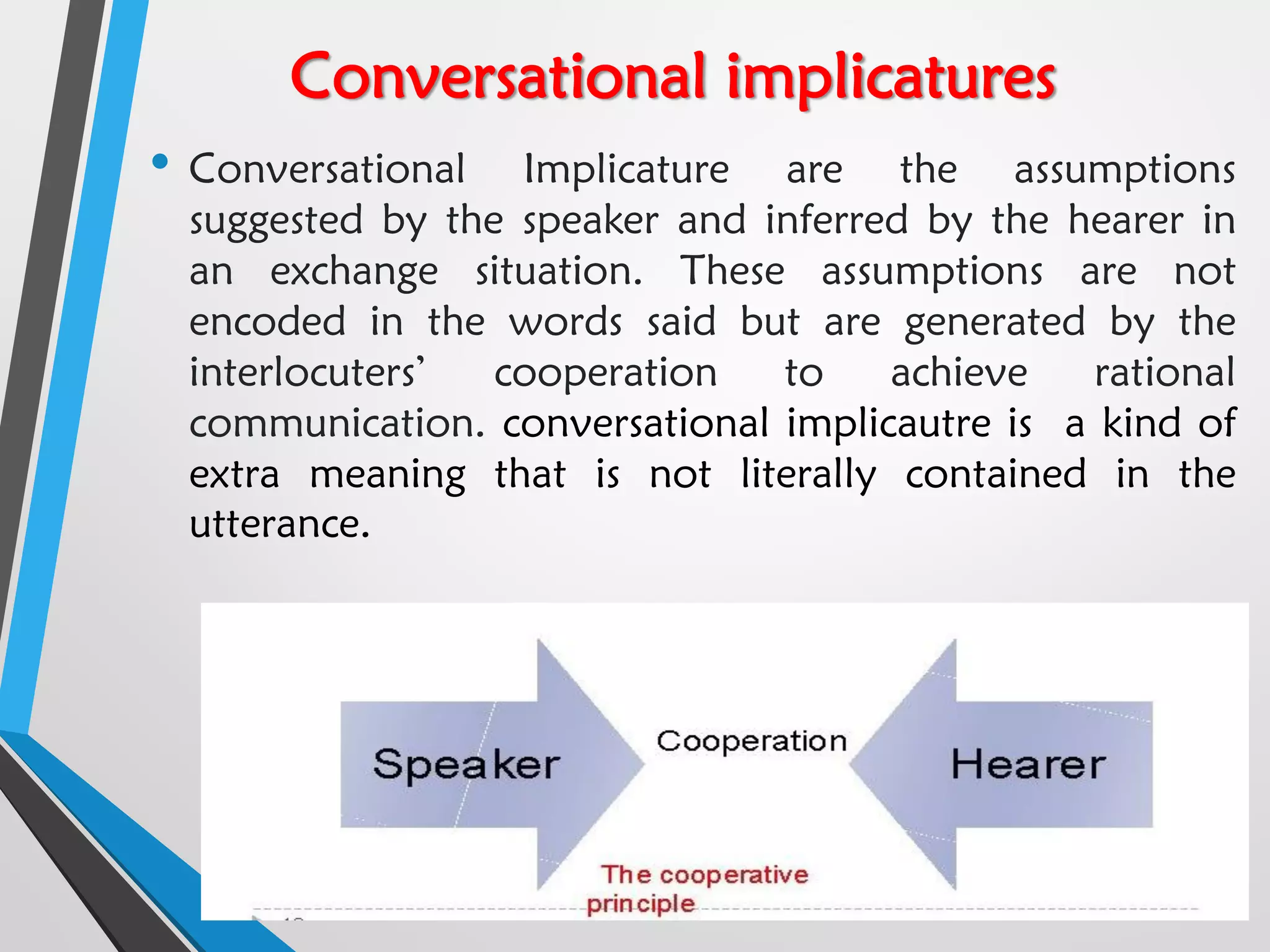
• Conversational Implicature are the assumptions
suggested by the speaker and inferred by the hearer in
an exchange situation. These assumptions are not
encoded in the words said but are generated by the
interlocuters’ cooperation to achieve rational
communication. conversational implicautre is a kind of
extra meaning that is not literally contained in the
utterance.
Conversational implicatures
• According to Grice, conversational implicatures
can arise from either strictly and directly
observing or deliberately and openly flouting
the maxims, that is, speakers can produce
implicatures in two ways: observance and non-
observance of the maxims.
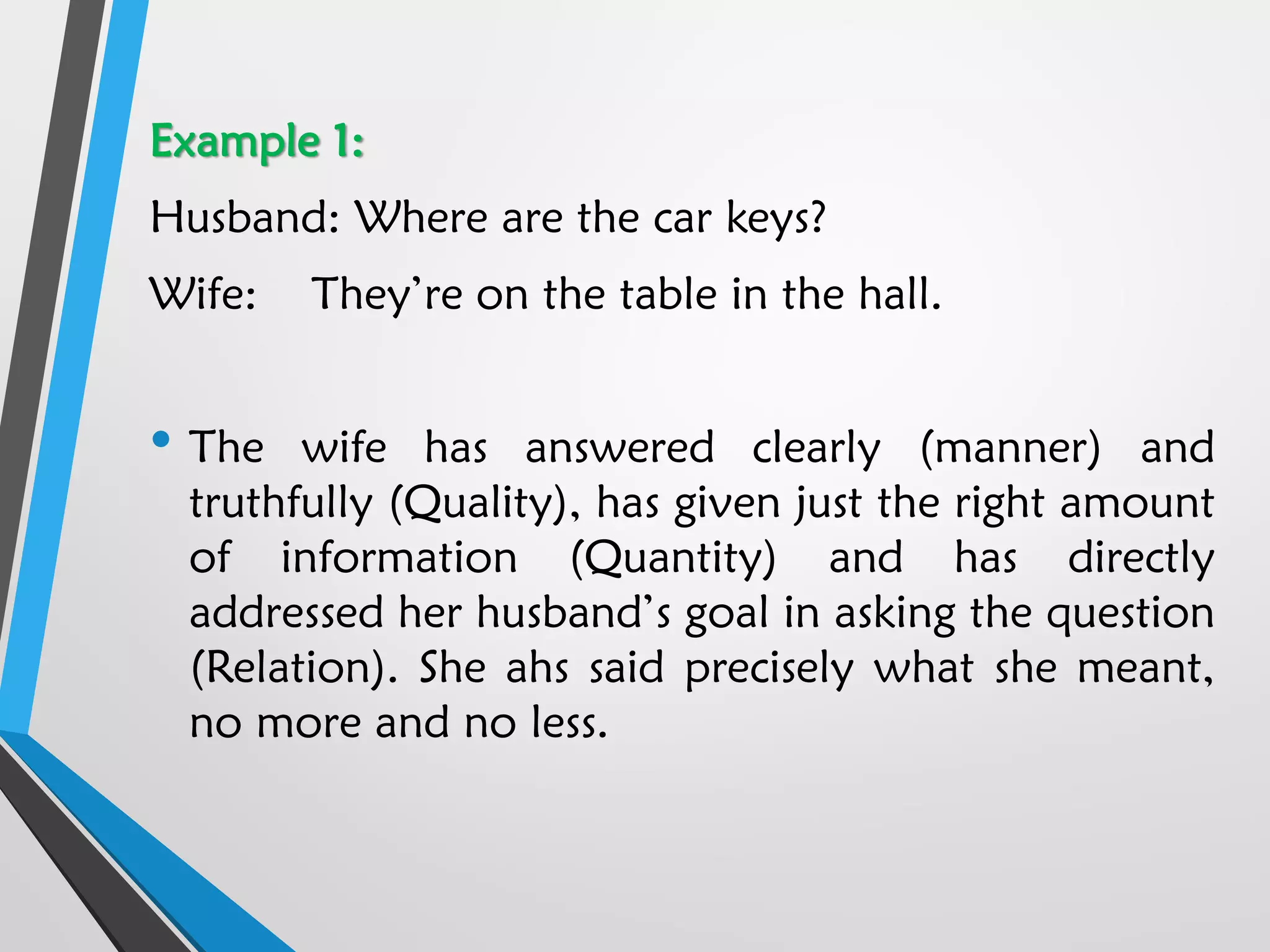
Example 1:
Husband: Where are the car keys?
Wife: They’re on the table in the hall.
• The wife has answered clearly (manner) and
truthfully (Quality), has given just the right amount
of information (Quantity) and has directly
addressed her husband’s goal in asking the question
(Relation). She ahs said precisely what she meant,
no more and no less.
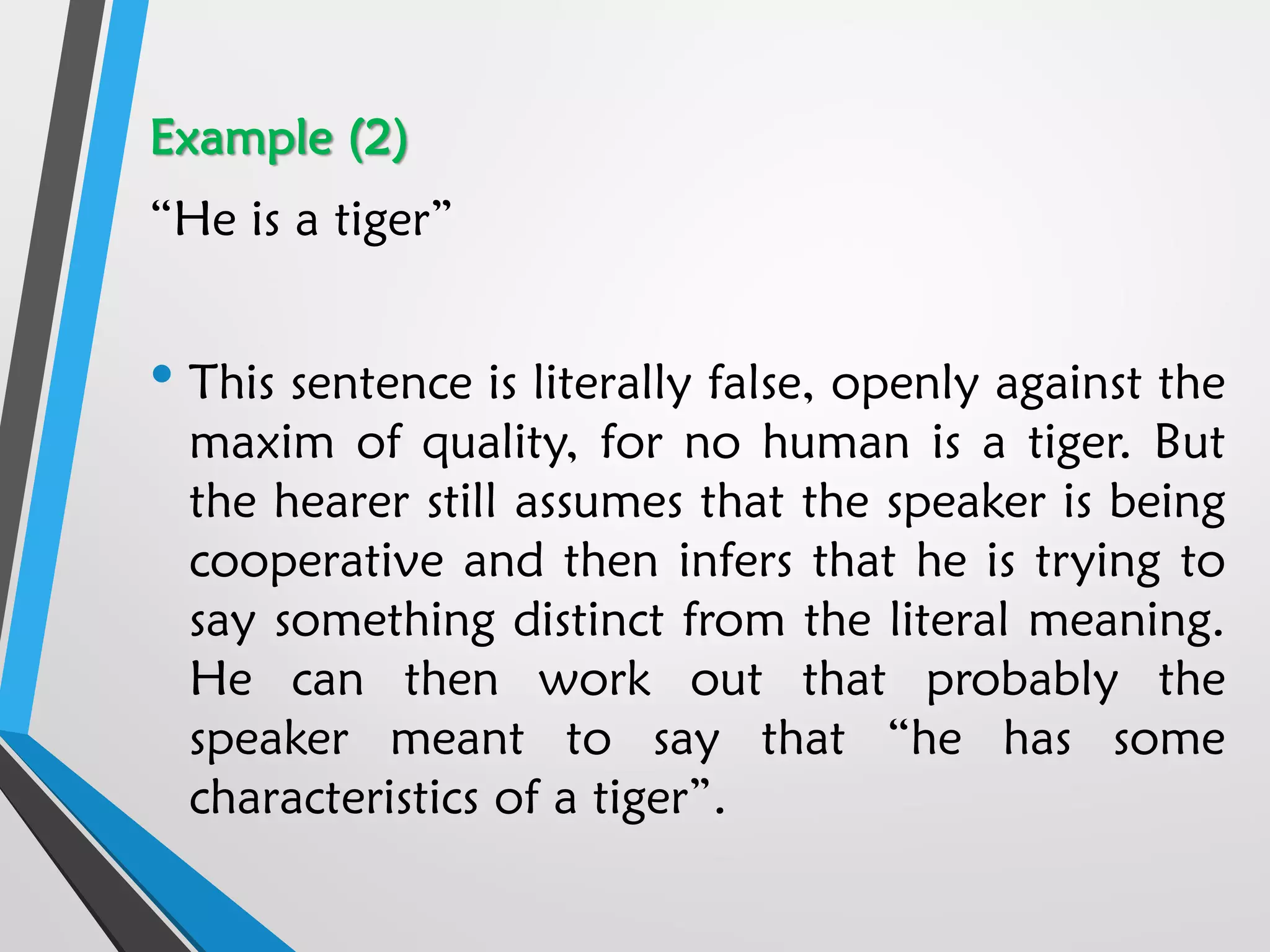
Example (2)
“He is a tiger”
• This sentence is literally false, openly against the
maxim of quality, for no human is a tiger. But
the hearer still assumes that the speaker is being
cooperative and then infers that he is trying to
say something distinct from the literal meaning.
He can then work out that probably the
speaker meant to say that “he has some
characteristics of a tiger”.
Example 3:
“Tom has wooden ears”
• is obviously false most natural contexts and the
speaker in uttering it flouts the first maxim of
quality.
The flouting of cooperative principles
• It is important to note that it is speakers who
communicate meaning via implicatures and it is
listeners who recognize those communicated
meanings via inference. The inferences selected are
those which will preserve the assumption of
cooperation. But in fact, the speakers often flout
the cooperative principles and are still thought to
be cooperative. What they convey is the
conversational implicatures.
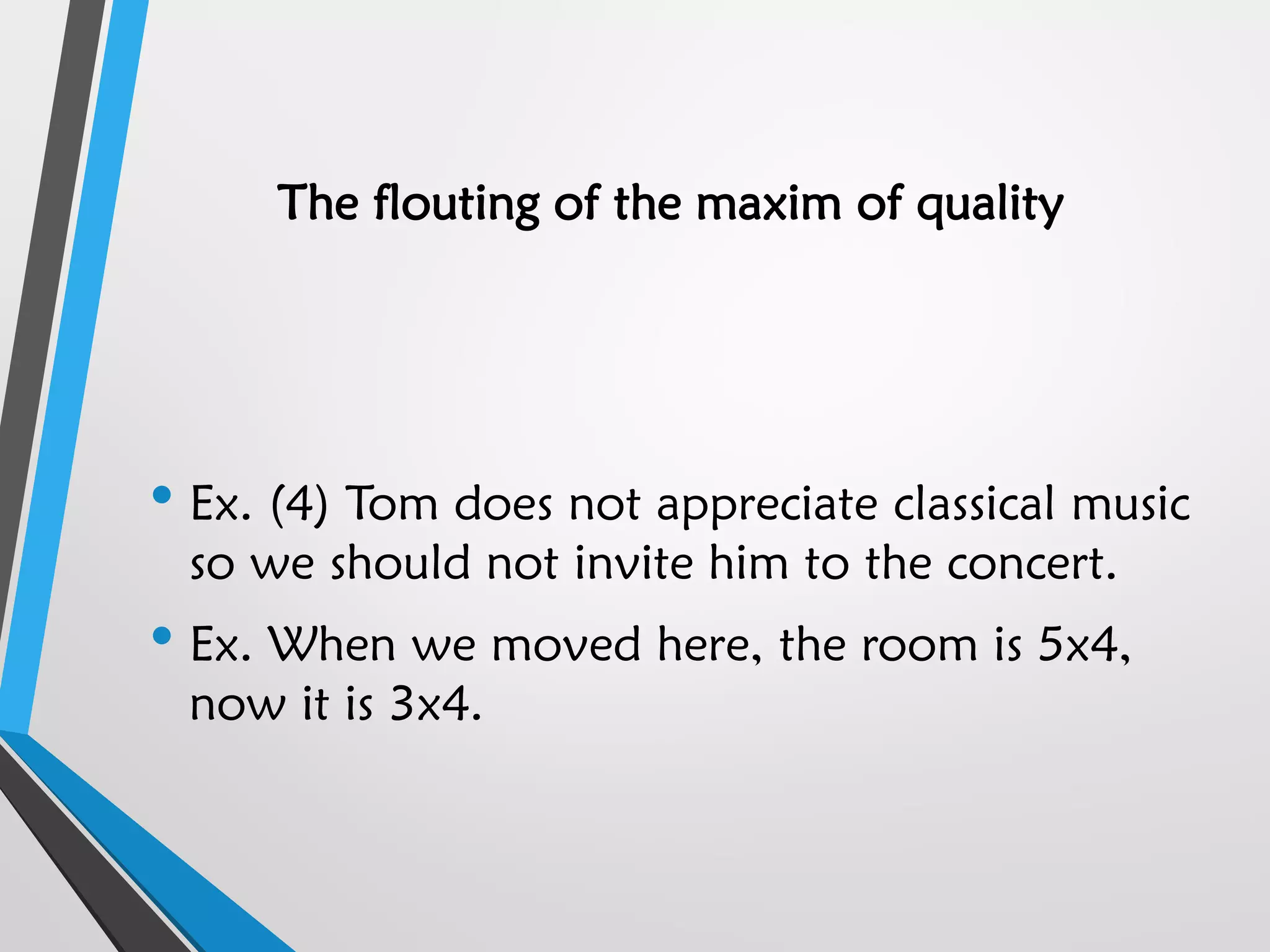
The flouting of the maxim of quality
• Ex. (4) Tom does not appreciate classical music
so we should not invite him to the concert.
• Ex. When we moved here, the room is 5x4,
now it is 3x4.
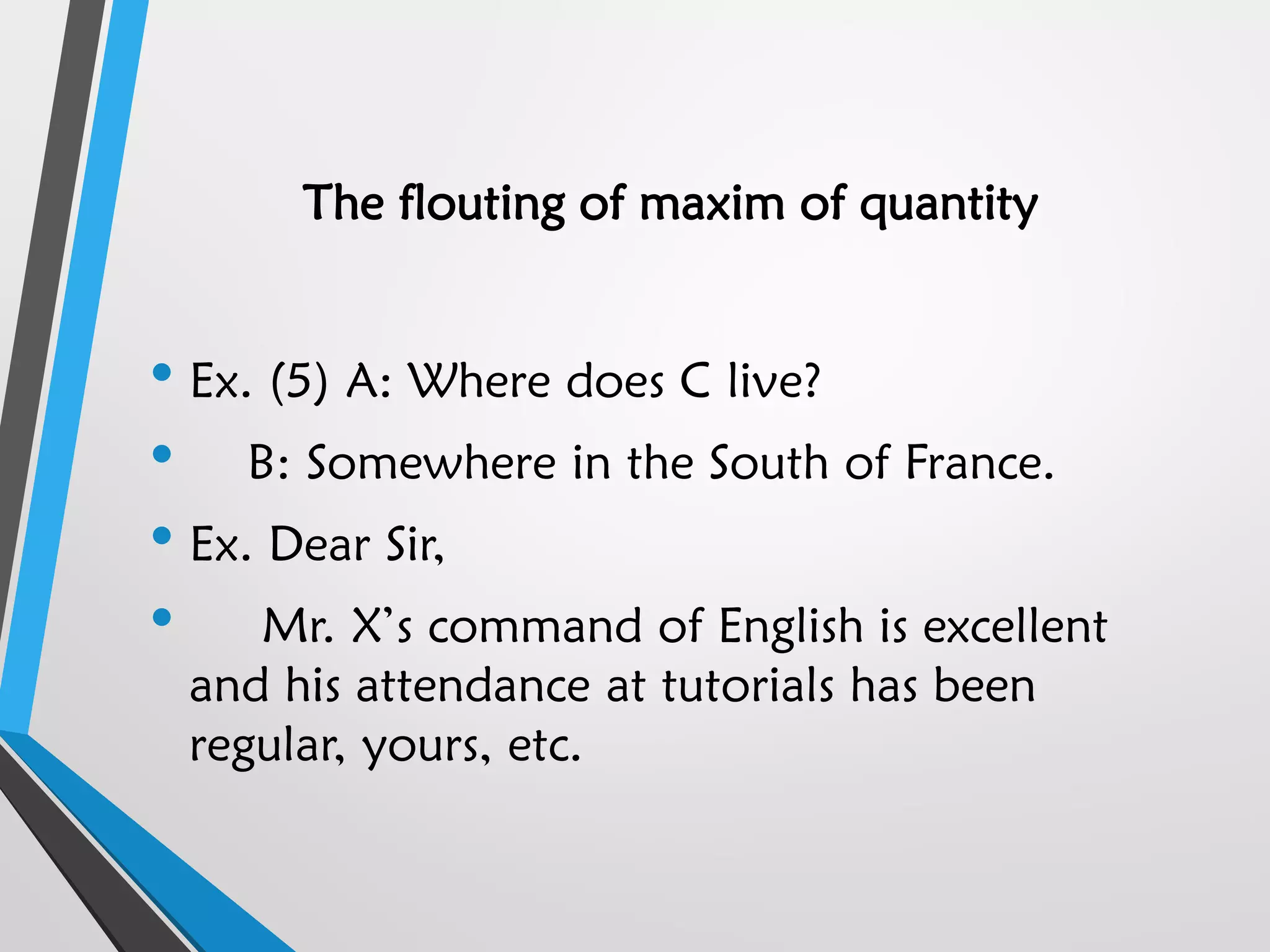
The flouting of maxim of quantity
• Ex. (5) A: Where does C live?
• B: Somewhere in the South of France.
• Ex. Dear Sir,
• Mr. X’s command of English is excellent
and his attendance at tutorials has been
regular, yours, etc.
The flouting of the maxim of relation:
• Ex. (6) A: I’m out of petrol.
• B: There is a garage round the corner.
• Ex. A. Where’s Bill?
• B. There’s a yellow VW outside Sue’s house.
• Ex. A. What time is it?
• B. The mail has already come.
• Ex. A. The hostess is an awful bore, don’t you think?
• B. The roses are lovely, aren’t they?
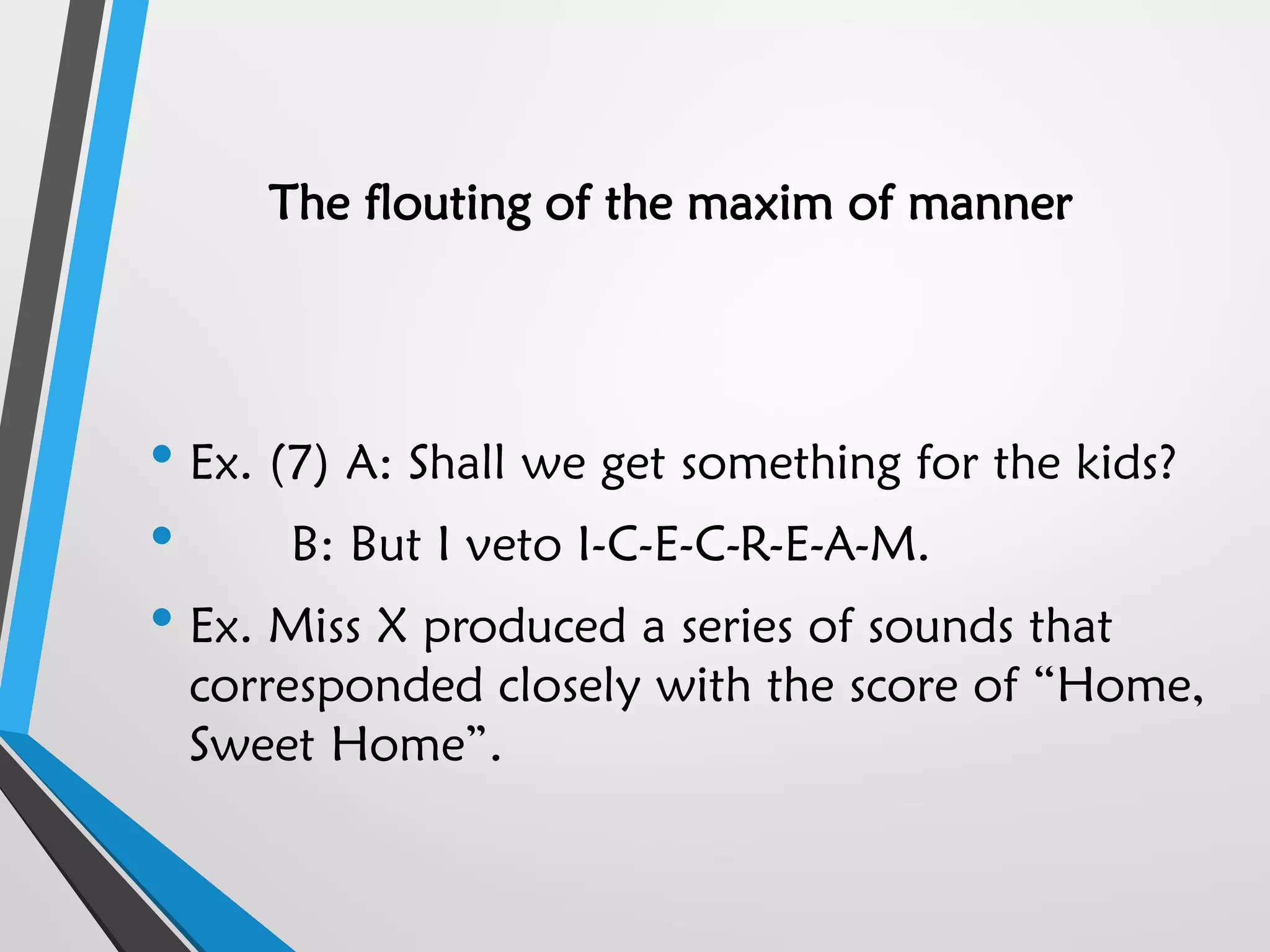
The flouting of the maxim of manner
• Ex. (7) A: Shall we get something for the kids?
• B: But I veto I-C-E-C-R-E-A-M.
• Ex. Miss X produced a series of sounds that
corresponded closely with the score of “Home,
Sweet Home”.
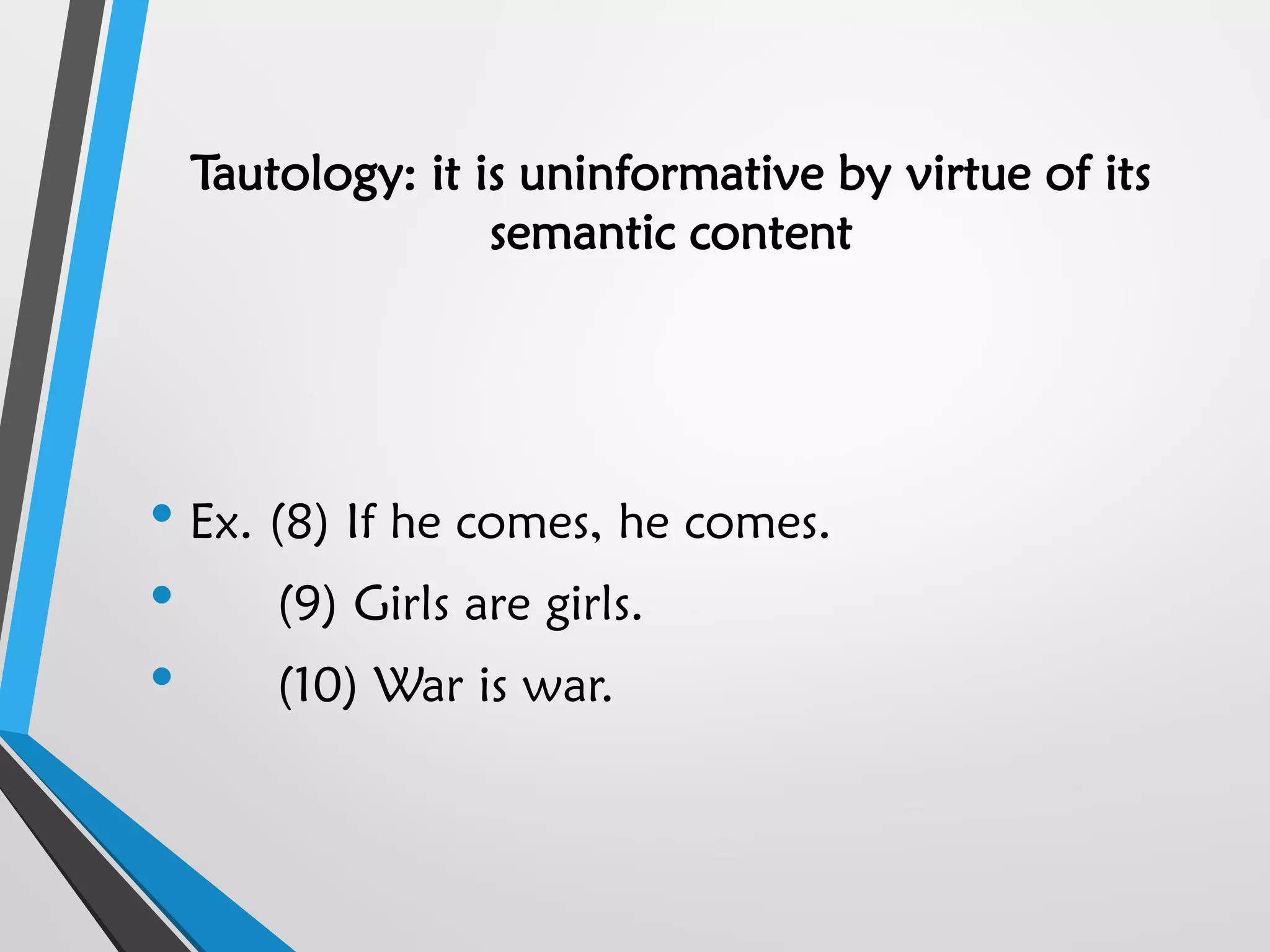
Tautology: it is uninformative by virtue of its
semantic content
• Ex. (8) If he comes, he comes.
• (9) Girls are girls.
• (10) War is war.
References:
• Grice, H. Paul. "Logic and Conversation." Syntax and
Semantics, 1975. Reprinted in "Studies in theWay of
Words." Harvard University Press, 1989
• Cutting, J. (2005). Pragmatics and discourse: A
resource book for students. Routledge.

Discourse analysis session 9_30_11_2021_cooperative principles.pdf

  • 1.
    Department of EnglishLanguage and Literature Major: English Language and Literature Discourse Analysis Sessions 9 The cooperative principles Dr. Badriya Al Mamari Academic year 2021/2022
  • 2.
    •In conversation analysis,the cooperative principle is the assumption that participants in a conversation normally attempt to be informative, truthful, relevant, and clear. •This idea was introduced by philosopher H. Paul Grice in his 1975 article "Logic and Conversation
  • 3.
    Grice conversational maxims •Griceexpanded his cooperative principle with the four following conversational maxims, which he believed anyone wishing to engage in meaningful, cogent conversation must follow: •Quantity: Say no less than the conversation requires. Say no more than the conversation requires. •Quality: Don't say what you believe to be false. Don't say things for which you lack evidence. •Manner: Don't be obscure. Don't be ambiguous. Be brief. Be orderly. •Relevance: Be relevant.
  • 5.
    Activity 1 The followingtext is real data taken from the British National Corpus. It is part of a casual conversation between Lisa, a 30 year-old housewife from the South Midlands, and Melvin, a 29-year- old panel beater. The conversation suggests that the speakers share a certain amount of cultural background knowledge and interpersonal knowledge. See the word document ( Activity1)
  • 6.
    • Because Melvinand Louise seem to share such a lot of cultural background knowledge and interpersonal knowledge, we can assume that they know each other and each other’s worlds fairly well, and because of their shared knowledge, they can flout the maxims freely, in the certainty that they will each be able to infer the other’s implied meaning.
  • 7.
    Flouting the maximof quantity Lisa says that Melvin’s mother and father arrived at Louise’s house or flat at quarter past eight, she adds, ‘She was in bed. She normally goes to bed about half past seven. They said that’s the earliest they could get there’ (lines 4–5), which implies that it was not actually ‘the earliest they could get there’, and she feels that this was inconsiderate of them as they knew that she had to go to bed early and they wittingly disturbed her sleep.
  • 8.
    • Melvin floutsthe maxim of quantity when he says minimally, ‘They should have gone as soon as they got out of work’ (line 18).
  • 9.
    Flouting the maximof relation • They said that’s the earliest they could get there. I said that’s a load of rubbish I said, cos they have fish and chips on a Friday night’ (lines 6–7). • Fish and chips does not seem immediately relevant to their getting there early, yet Melvin infers it.
  • 10.
    Flouting of themaxim of quality • This starts with a metaphor that is so well established that it has become a fixed expression and is no longer anything to do with pains or arses. • She’s a right pain in the arse sometimes, me mum. That’s why they don’t go anywhere’ (lines 13–15).
  • 11.
    • The secondpart is a hyperbole; it is an exaggeration which his very next utterance would seem to contradict if we did not know that he was flouting the maxim of quality: ‘that’s why they don’t come out and visit his brother very often’ (lines 15–16).
  • 12.
    • A violationof the cooperative maxims is much harder to detect. It could be that Louise does not in reality go to bed at 7.30 normally, but that she goes at 9.30, and that Lisa is therefore lying, violating the maxim of quality. • One would have to know the speakers and their context very well to know if they were trying to deceive each other and intentionally generate a misleading implicature.
  • 13.
    Relevance theory • Relevancetheory holds true for this little passage: • Lisa and Melvin communicate successfully, interpreting the connections between utterances as meaningful, making inferences drawing on their own background knowledge of Louise, the parents, birthdays, fish and chips, and so on and selecting the relevant features of context.
  • 14.
    Conversational implicatures • Accordingto Grice, utterance interpretation is not a matter of decoding messages, but rather involves (1) taking the meaning of the sentences together with contextual information, (2) using inference rules (3) working out what the speaker means on the basis of the assumption that the utterance conforms to the maxims. The main advantage of this approach from Grice’s point of view is that it provides a pragmatic explanation for a wide range of phenomena, especially for Conversational implicautres
  • 15.
    Conversational implicatures • ConversationalImplicature are the assumptions suggested by the speaker and inferred by the hearer in an exchange situation. These assumptions are not encoded in the words said but are generated by the interlocuters’ cooperation to achieve rational communication. conversational implicautre is a kind of extra meaning that is not literally contained in the utterance.
  • 16.
  • 17.
    • According toGrice, conversational implicatures can arise from either strictly and directly observing or deliberately and openly flouting the maxims, that is, speakers can produce implicatures in two ways: observance and non- observance of the maxims.
  • 18.
    Example 1: Husband: Whereare the car keys? Wife: They’re on the table in the hall. • The wife has answered clearly (manner) and truthfully (Quality), has given just the right amount of information (Quantity) and has directly addressed her husband’s goal in asking the question (Relation). She ahs said precisely what she meant, no more and no less.
  • 19.
    Example (2) “He isa tiger” • This sentence is literally false, openly against the maxim of quality, for no human is a tiger. But the hearer still assumes that the speaker is being cooperative and then infers that he is trying to say something distinct from the literal meaning. He can then work out that probably the speaker meant to say that “he has some characteristics of a tiger”.
  • 20.
    Example 3: “Tom haswooden ears” • is obviously false most natural contexts and the speaker in uttering it flouts the first maxim of quality.
  • 21.
    The flouting ofcooperative principles • It is important to note that it is speakers who communicate meaning via implicatures and it is listeners who recognize those communicated meanings via inference. The inferences selected are those which will preserve the assumption of cooperation. But in fact, the speakers often flout the cooperative principles and are still thought to be cooperative. What they convey is the conversational implicatures.
  • 22.
    The flouting ofthe maxim of quality • Ex. (4) Tom does not appreciate classical music so we should not invite him to the concert. • Ex. When we moved here, the room is 5x4, now it is 3x4.
  • 23.
    The flouting ofmaxim of quantity • Ex. (5) A: Where does C live? • B: Somewhere in the South of France. • Ex. Dear Sir, • Mr. X’s command of English is excellent and his attendance at tutorials has been regular, yours, etc.
  • 24.
    The flouting ofthe maxim of relation: • Ex. (6) A: I’m out of petrol. • B: There is a garage round the corner. • Ex. A. Where’s Bill? • B. There’s a yellow VW outside Sue’s house. • Ex. A. What time is it? • B. The mail has already come. • Ex. A. The hostess is an awful bore, don’t you think? • B. The roses are lovely, aren’t they?
  • 25.
    The flouting ofthe maxim of manner • Ex. (7) A: Shall we get something for the kids? • B: But I veto I-C-E-C-R-E-A-M. • Ex. Miss X produced a series of sounds that corresponded closely with the score of “Home, Sweet Home”.
  • 26.
    Tautology: it isuninformative by virtue of its semantic content • Ex. (8) If he comes, he comes. • (9) Girls are girls. • (10) War is war.
  • 27.
    References: • Grice, H.Paul. "Logic and Conversation." Syntax and Semantics, 1975. Reprinted in "Studies in theWay of Words." Harvard University Press, 1989 • Cutting, J. (2005). Pragmatics and discourse: A resource book for students. Routledge.