Objectives Identify adverbs and the words they modify.   Differentiate between the use of adjectives and adverbs. Recognize the importance of the placement of adverbs. Form the comparative and superlative degrees of regular and irregular adverbs.   PP 13-1a continued
Objectives PP 13-1b continued Recognize and correct double negatives and other incorrect uses of negative words.  Use special adverbs correctly.
Adverb  PP 13-2 An adverb answers these questions:   How?  In what manner?   patiently, boldly, slowly, softly, enthusiastically   When?   recently, later, finally, daily, again, formerly   Where?   outside, here, down, forward, up, away   To what extent?  To what degree?   extremely, very, too, rarely, completely, frequently
Adverbs—Modify Verbs  PP 13-3 Place the adverb before or after the verb that is modified. When businesses  knowingly  deceive customers, they are violating ethical standards. Do not  illegally  copy paper or electronic documents.
Adverbs—Modify Adjectives  PP 13-4 Place the adverb immediately before the adjective.   The courtesy of greeting others within your own firm is  universally   acceptable  in the United States. In some countries, greetings are  very   expressive  and elaborate. Downsizing is becoming an  increasingly   popular  way for businesses to lower expenses.
Adverbs—Modify Other Adverbs  PP 13-5 Place the adverb immediately before the adverb being modified.   We  very   precisely  judged the commute time to our new client’s office. Ruby did  extremely   well  on the ethics section of her real estate exam.
Descriptive Adjectives  Before Nouns  PP 13-6 Add  ly  to an adjective root to form the majority of adverbs. cautious cautiously extreme extremely perfect perfectly skillful skillfully   Adjective Adverb
Noun Base Used to Form  Adjectives Ending in  ly   PP 13-7 Use root words to identify words ending in  ly  as adjectives or adverbs.   brother brotherly neighbor neighborly earth earthly world worldly love lovely Noun Adjective
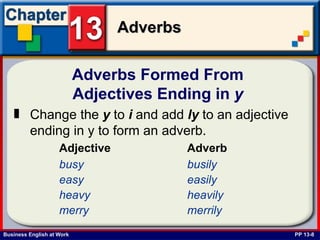
Adverbs Formed From  Adjectives Ending in  y   PP 13-8 Change the  y  to  i  and add  ly  to an adjective ending in y to form an adverb.   busy busily easy easily heavy heavily merry merrily   Adjective Adverb
Adverbs Formed From Adjectives Ending in  ible  or  able   PP 13-9 Drop the final  e  on adjectives that end in  able  or  ible  before adding the  y  to form the adverb. forcible forcibly terrible terribly possible possibly   Adjective Adverb
Adverbs Formed From Adjectives Ending in  ic   PP 13-10 Add  ally  to adjectives ending in  ic  to form the adverb. chronic chronically logic logically magic magically scenic scenically Adjective Adverb
Adverbs—Modify Adjectives  PP 13-11 The following list includes some adverbs that do not end in  ly . again more sometimes almost much soon always near then down now there far nowhere too fast often twice hard once up
Do Not Hyphenate Adverbs  Ending in  ly   PP 13-12 Examples   a  carelessly  written memo a  richly  deserved award an  internationally  recognized sign a  highly  successful business
Verbs—Action Versus Linking  PP 13-13 Use an adverb to modify action verbs.   Tucker  intentionally  withheld confidential information. The employee  thoughtlessly   made an inappropriate comment to Julie.   Use an adjective, not an adverb, after a linking verb to describe the subject. The manager felt  bad  about the dependence on temporary workers. Karen seems  distraught  over the missing computer disk.
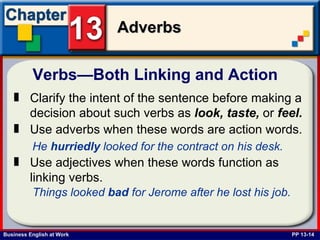
Verbs—Both Linking and Action  PP 13-14 Clarify the intent of the sentence before making a decision about such verbs as  look,   taste,  or  feel. Use adverbs when these words are action words.   He  hurriedly  looked for the contract on his desk.   Use adjectives when these words function as linking verbs.   Things looked  bad  for Jerome after he lost his job.
Adjectives and Adverbs  With the Same Form  PP 13-15 Some adverbs and adjectives that have the same form include  fast, first, last, early,  and  right. Use an adjective to modify a noun or pronoun.   Turn left at the  first  stop sign.   Use an adverb to modify verbs, adjectives, and other adverbs.   Return Andrew’s phone call  first.
One-Syllable Adverbs  PP 13-16 Add  er  to the positive form for its comparative degree. Add  est  to the positive form for its superlative degree. fast faster fastest late later latest soon sooner soonest   Positive Comparative Superlative
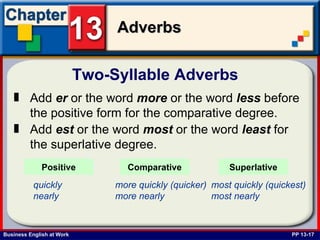
Two-Syllable Adverbs  PP 13-17 Add  er  or the word  more   or the word  less  before the positive form for the comparative degree. Add  est  or the word  most   or the word  least  for the superlative degree. quickly more quickly (quicker) most quickly (quickest) nearly more nearly most nearly   Positive Comparative Superlative
Three-Syllable Adverbs  PP 13-18 Add the word  more  or the word  less  before the positive form to form its comparative degree. Add the word  most   or the word  least  before the positive form to form its superlative degree. efficiently more efficiently most efficiently dangerously more dangerously most dangerously Reliably more reliably most reliably   Positive Comparative Superlative
Irregular Adverbs  PP 13-19 Use irregular comparisons for some adverbs. well better best badly worse worst Positive Comparative Superlative
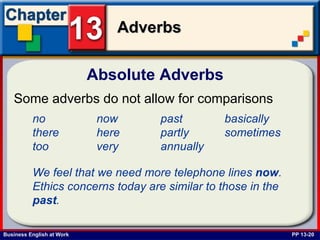
Absolute Adverbs  PP 13-20 Some adverbs do not allow for comparisons   no now past basically there here partly sometimes too very annually   We feel that we need more telephone lines  now . Ethics concerns today are similar to those in the  past .
Cautions for Using  Not  and  Never   PP 13-21 Use  not  in a negative statement. Place  not  between the helping verb and the main verb in a sentence.   Some employees do  not  treat all customers with respect.   Use  never  as a stronger word than  not  to mean  “at no time.” Being rude to a customer is  never  acceptable.   Refrain from using  never  if  not  will suffice.
Cautions for Using Contractions  PP 13-22 Use an apostrophe to take the place of the missing letter or letters in such words as aren’t doesn’t can’t isn’t wouldn’t hasn’t don’t   He  doesn’t  anticipate rewriting the code of ethics for several years. She  hasn’t  missed a day of work this year.
Double Negatives  PP 13-23a Double negatives are two negative words used in a sentence.  This combination gives the clause a positive meaning rather than the intended negative meaning.   I have  not  seen  no  evidence of employee theft.   Incorrect I  have   seen  no evidence of employee theft. I  have   not   seen   any  evidence of employee theft.   Correct
Double Negatives  PP 13-23b continued I  couldn’t   hardly  believe that the computer was missing.   Incorrect I  could   hardly  believe that the computer was missing. I  could   not  believe that the computer was missing. Correct I  can’t  go  nowhere  until I help these customers.   Incorrect I  can  go  nowhere  until I help these customers. I  cannot  go  anywhere  until I help these customers.   Correct
Placement of  Only   PP 13-24 Place the adverb  only  immediately before the word or group of words it modifies. Only  long-time employees can take vacations during June. Long-time employees can take vacations  only  during June.
Adverb Clauses  PP 13-25a Use subordinating conjunctions such as  after, although, before, because, if, unless, when,  and  while  to introduce dependent adverb clauses. Place the adverb clause as closely as possible to the words modified.
Adverb Clauses  PP 13-25b Use commas after introductory adverb clauses that precede independent clauses. continued Although he broke no laws,  his actions were still unethical.   Do not use commas to set aside adverb clauses that follow independent clauses. Plan to arrive 10 minutes  before the meeting begins. We will start the meeting  after serving refreshments.
Farther/Further (Adverbs)  PP 13-26 Use  farther  to refer to physical distance.   We traveled  farther  from the airport than we anticipated to find our hotel.   Use  further  to mean additional or additionally. He explained  further  the reasons for adjusting our work schedules.
Good/Well   PP 13-27 Use  good  as an adjective.   Making ethical choices is often more than being a  good  person.   Use  well  as an adverb.   The new code of ethics has worked very  well  during the past year.   Use  well  as an adjective in reference to the state of someone’s health.   Although Anna was not  well , she stayed at work long enough to complete writing the payroll checks.
Most/Almost   PP 13-28 Use  almost  as an adverb to mean “ nearly .” Use  almost  if the word  nearly  can be substituted satisfactorily.   Almost  all of us use our yearly vacation time.   Use  most  as a limiting adjective to modify a noun.  Most  new supervisors have trouble with ethical situations.   Use  most  as the superlative degree in a comparison.  The speaker answered the question  most  effectively.
Real/Really   PP 13-29a Use  real  as a descriptive adjective to mean “genuine.” Do not use  real  to modify another adjective. We never knew the  real  reason for losing the Manila contract.
Real/Really   PP 13-29b Use  really  as an adverb to mean “genuinely.” Substitute  very  for the word  really  to determine if  really  is the correct word. Cynthia is  really  supportive of our efforts to improve customer satisfaction.   continued
Sometime/Sometimes/Some Time   PP 13-30a Use  sometime  as an adverb to mean “ at some unscheduled time ” or “ in the future .” Sometime  next week we are meeting to revise our customer service policy.   Use  sometimes  as an adverb to mean “ on some occasions .” We  sometimes  waive late payment charges.
Sometime/Sometimes/ Some Time   PP 13-30b Use  some time  as a phrase in which the adjective  some  modifies the noun  time .  Some time  designates an “ amount of time.” The revision of the ethics policy will take  some   time .   continued
Sure/Surely   PP 13-31 Use  sure  as an adjective.   They thought a lock on the supply cabinet was the  sure  solution for reducing theft. Use  surely  as an adverb to mean “without a doubt.” Ellen  surely  makes an excellent impression on customers.
End of

Adverbs

  • 1.
  • 2.
    Objectives Identify adverbsand the words they modify. Differentiate between the use of adjectives and adverbs. Recognize the importance of the placement of adverbs. Form the comparative and superlative degrees of regular and irregular adverbs. PP 13-1a continued
  • 3.
    Objectives PP 13-1bcontinued Recognize and correct double negatives and other incorrect uses of negative words. Use special adverbs correctly.
  • 4.
    Adverb PP13-2 An adverb answers these questions: How? In what manner? patiently, boldly, slowly, softly, enthusiastically When? recently, later, finally, daily, again, formerly Where? outside, here, down, forward, up, away To what extent? To what degree? extremely, very, too, rarely, completely, frequently
  • 5.
    Adverbs—Modify Verbs PP 13-3 Place the adverb before or after the verb that is modified. When businesses knowingly deceive customers, they are violating ethical standards. Do not illegally copy paper or electronic documents.
  • 6.
    Adverbs—Modify Adjectives PP 13-4 Place the adverb immediately before the adjective. The courtesy of greeting others within your own firm is universally acceptable in the United States. In some countries, greetings are very expressive and elaborate. Downsizing is becoming an increasingly popular way for businesses to lower expenses.
  • 7.
    Adverbs—Modify Other Adverbs PP 13-5 Place the adverb immediately before the adverb being modified. We very precisely judged the commute time to our new client’s office. Ruby did extremely well on the ethics section of her real estate exam.
  • 8.
    Descriptive Adjectives Before Nouns PP 13-6 Add ly to an adjective root to form the majority of adverbs. cautious cautiously extreme extremely perfect perfectly skillful skillfully Adjective Adverb
  • 9.
    Noun Base Usedto Form Adjectives Ending in ly PP 13-7 Use root words to identify words ending in ly as adjectives or adverbs. brother brotherly neighbor neighborly earth earthly world worldly love lovely Noun Adjective
  • 10.
    Adverbs Formed From Adjectives Ending in y PP 13-8 Change the y to i and add ly to an adjective ending in y to form an adverb. busy busily easy easily heavy heavily merry merrily Adjective Adverb
  • 11.
    Adverbs Formed FromAdjectives Ending in ible or able PP 13-9 Drop the final e on adjectives that end in able or ible before adding the y to form the adverb. forcible forcibly terrible terribly possible possibly Adjective Adverb
  • 12.
    Adverbs Formed FromAdjectives Ending in ic PP 13-10 Add ally to adjectives ending in ic to form the adverb. chronic chronically logic logically magic magically scenic scenically Adjective Adverb
  • 13.
    Adverbs—Modify Adjectives PP 13-11 The following list includes some adverbs that do not end in ly . again more sometimes almost much soon always near then down now there far nowhere too fast often twice hard once up
  • 14.
    Do Not HyphenateAdverbs Ending in ly PP 13-12 Examples a carelessly written memo a richly deserved award an internationally recognized sign a highly successful business
  • 15.
    Verbs—Action Versus Linking PP 13-13 Use an adverb to modify action verbs. Tucker intentionally withheld confidential information. The employee thoughtlessly made an inappropriate comment to Julie. Use an adjective, not an adverb, after a linking verb to describe the subject. The manager felt bad about the dependence on temporary workers. Karen seems distraught over the missing computer disk.
  • 16.
    Verbs—Both Linking andAction PP 13-14 Clarify the intent of the sentence before making a decision about such verbs as look, taste, or feel. Use adverbs when these words are action words. He hurriedly looked for the contract on his desk. Use adjectives when these words function as linking verbs. Things looked bad for Jerome after he lost his job.
  • 17.
    Adjectives and Adverbs With the Same Form PP 13-15 Some adverbs and adjectives that have the same form include fast, first, last, early, and right. Use an adjective to modify a noun or pronoun. Turn left at the first stop sign. Use an adverb to modify verbs, adjectives, and other adverbs. Return Andrew’s phone call first.
  • 18.
    One-Syllable Adverbs PP 13-16 Add er to the positive form for its comparative degree. Add est to the positive form for its superlative degree. fast faster fastest late later latest soon sooner soonest Positive Comparative Superlative
  • 19.
    Two-Syllable Adverbs PP 13-17 Add er or the word more or the word less before the positive form for the comparative degree. Add est or the word most or the word least for the superlative degree. quickly more quickly (quicker) most quickly (quickest) nearly more nearly most nearly Positive Comparative Superlative
  • 20.
    Three-Syllable Adverbs PP 13-18 Add the word more or the word less before the positive form to form its comparative degree. Add the word most or the word least before the positive form to form its superlative degree. efficiently more efficiently most efficiently dangerously more dangerously most dangerously Reliably more reliably most reliably Positive Comparative Superlative
  • 21.
    Irregular Adverbs PP 13-19 Use irregular comparisons for some adverbs. well better best badly worse worst Positive Comparative Superlative
  • 22.
    Absolute Adverbs PP 13-20 Some adverbs do not allow for comparisons no now past basically there here partly sometimes too very annually We feel that we need more telephone lines now . Ethics concerns today are similar to those in the past .
  • 23.
    Cautions for Using Not and Never PP 13-21 Use not in a negative statement. Place not between the helping verb and the main verb in a sentence. Some employees do not treat all customers with respect. Use never as a stronger word than not to mean “at no time.” Being rude to a customer is never acceptable. Refrain from using never if not will suffice.
  • 24.
    Cautions for UsingContractions PP 13-22 Use an apostrophe to take the place of the missing letter or letters in such words as aren’t doesn’t can’t isn’t wouldn’t hasn’t don’t He doesn’t anticipate rewriting the code of ethics for several years. She hasn’t missed a day of work this year.
  • 25.
    Double Negatives PP 13-23a Double negatives are two negative words used in a sentence. This combination gives the clause a positive meaning rather than the intended negative meaning. I have not seen no evidence of employee theft. Incorrect I have seen no evidence of employee theft. I have not seen any evidence of employee theft. Correct
  • 26.
    Double Negatives PP 13-23b continued I couldn’t hardly believe that the computer was missing. Incorrect I could hardly believe that the computer was missing. I could not believe that the computer was missing. Correct I can’t go nowhere until I help these customers. Incorrect I can go nowhere until I help these customers. I cannot go anywhere until I help these customers. Correct
  • 27.
    Placement of Only PP 13-24 Place the adverb only immediately before the word or group of words it modifies. Only long-time employees can take vacations during June. Long-time employees can take vacations only during June.
  • 28.
    Adverb Clauses PP 13-25a Use subordinating conjunctions such as after, although, before, because, if, unless, when, and while to introduce dependent adverb clauses. Place the adverb clause as closely as possible to the words modified.
  • 29.
    Adverb Clauses PP 13-25b Use commas after introductory adverb clauses that precede independent clauses. continued Although he broke no laws, his actions were still unethical. Do not use commas to set aside adverb clauses that follow independent clauses. Plan to arrive 10 minutes before the meeting begins. We will start the meeting after serving refreshments.
  • 30.
    Farther/Further (Adverbs) PP 13-26 Use farther to refer to physical distance. We traveled farther from the airport than we anticipated to find our hotel. Use further to mean additional or additionally. He explained further the reasons for adjusting our work schedules.
  • 31.
    Good/Well PP 13-27 Use good as an adjective. Making ethical choices is often more than being a good person. Use well as an adverb. The new code of ethics has worked very well during the past year. Use well as an adjective in reference to the state of someone’s health. Although Anna was not well , she stayed at work long enough to complete writing the payroll checks.
  • 32.
    Most/Almost PP 13-28 Use almost as an adverb to mean “ nearly .” Use almost if the word nearly can be substituted satisfactorily. Almost all of us use our yearly vacation time. Use most as a limiting adjective to modify a noun. Most new supervisors have trouble with ethical situations. Use most as the superlative degree in a comparison. The speaker answered the question most effectively.
  • 33.
    Real/Really PP 13-29a Use real as a descriptive adjective to mean “genuine.” Do not use real to modify another adjective. We never knew the real reason for losing the Manila contract.
  • 34.
    Real/Really PP 13-29b Use really as an adverb to mean “genuinely.” Substitute very for the word really to determine if really is the correct word. Cynthia is really supportive of our efforts to improve customer satisfaction. continued
  • 35.
    Sometime/Sometimes/Some Time PP 13-30a Use sometime as an adverb to mean “ at some unscheduled time ” or “ in the future .” Sometime next week we are meeting to revise our customer service policy. Use sometimes as an adverb to mean “ on some occasions .” We sometimes waive late payment charges.
  • 36.
    Sometime/Sometimes/ Some Time PP 13-30b Use some time as a phrase in which the adjective some modifies the noun time . Some time designates an “ amount of time.” The revision of the ethics policy will take some time . continued
  • 37.
    Sure/Surely PP 13-31 Use sure as an adjective. They thought a lock on the supply cabinet was the sure solution for reducing theft. Use surely as an adverb to mean “without a doubt.” Ellen surely makes an excellent impression on customers.
  • 38.