Chapter II
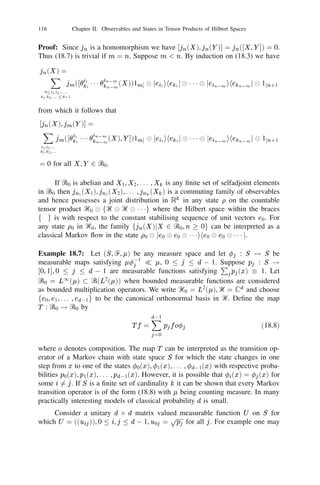
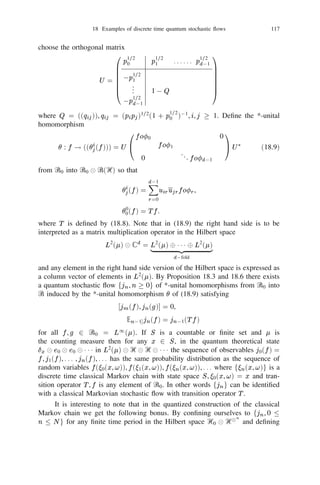
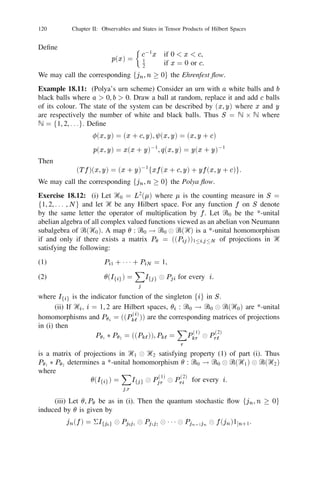
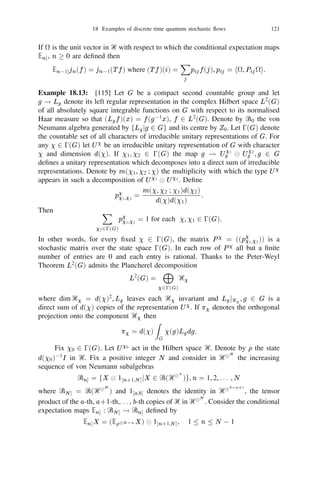
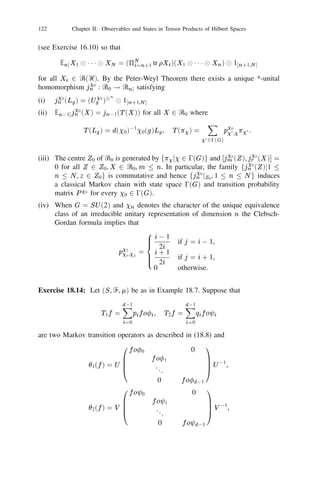
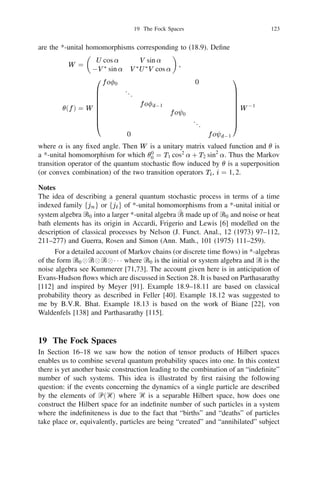
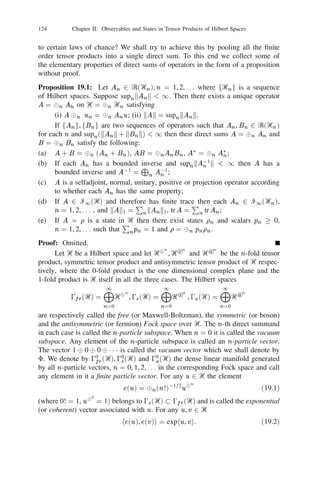
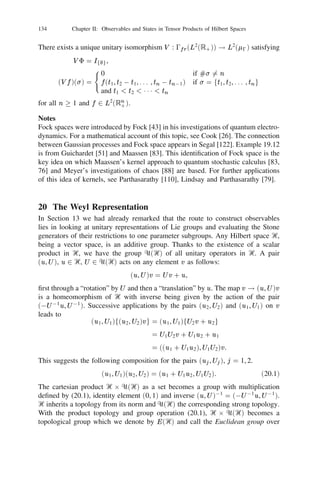
Observables and States in Tensor
Products of Hilbert Spaces


15 Positive definite kernels and tensor
   products of Hilbert spaces
Suppose (
i , Ᏺi ), 1  i  n are sample spaces describing the elementary out-
comes and events concerning n different statistical systems in classical proba-
bility. To integrate them into a unified picture under the umbrella of a single
sample space one takes their cartesian product (
, Ᏺ) where 
 = 
1 2 1 1 1 2 
n ,
Ᏺ = Ᏺ1 2 1 1 1 2 Ᏺn , the smallest  -algebra containing all rectangles of the form
F1 2 F2 21 1 12 Fn , Fj 2 Ᏺj for each j . Now we wish to search for an analogue of
this description in quantum probability when we have n systems where the events
concerning the j -th system are described by the set P (Ᏼj ) of all projections in
a Hilbert space Ᏼj , j = 1, 2, . . . , n. Such an attempt leads us to consider tensor
products of Hilbert spaces. We shall present a somewhat statistically oriented ap-
proach to the definition of tensor products which is at the same time coordinate
free in character. To this end we introduce the notion of a positive definite kernel.

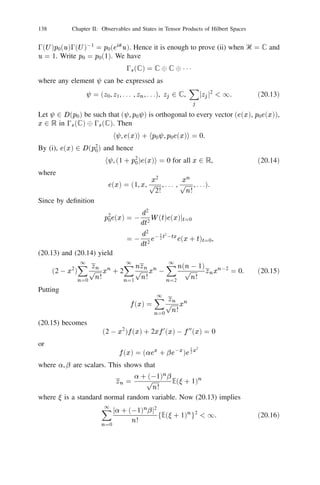
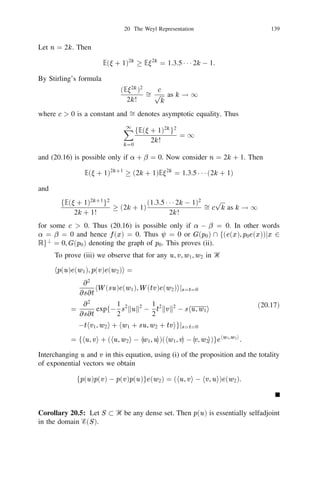
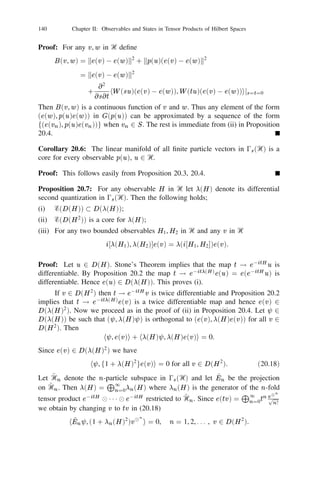
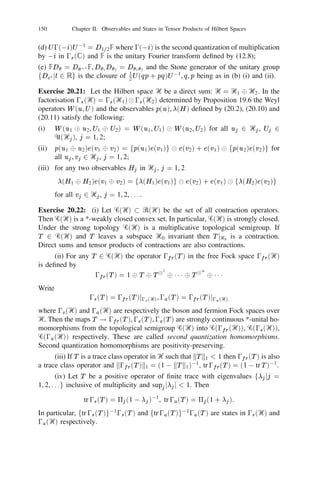
                                   X
       Let ᐄ be any set and let K : ᐄ 2 ᐄ ! ‫ ރ‬be a map satisfying the following:
                                          i j K (xi , xj )   0
                                    i,j

for all i 2 ‫ ,ރ‬xi 2 ᐄ, i = 1, 2, . . . , n. Such a map K is called a positive definite
kernel or simply a kernel on ᐄ. We denote by K(ᐄ) the set of all such kernels on
ᐄ.
      If ᐄ = f1, 2, . . . , ng, a kernel on ᐄ is just a positive (semi) definite matrix.
If Ᏼ is a Hilbert space the scalar product K (x, y ) = hx, y i is a kernel on Ᏼ. If G
is a group and g ! Ug is a homomorphism from G into the unitary group ᐁ(Ᏼ)
of a Hilbert space Ᏼ then K (g , h) = hu, Ug01 h ui is a kernel on G for every u in
Ᏼ. If  is a state in Ᏼ then K (X , Y ) = tr X 3 Y is a kernel on Ꮾ(Ᏼ).
Proposition 15.1: Let ((aij )), ((bij )), 1  i, j                 n   be two positive definite
matrices. Then ((aij bij )) is positive definite.
Proof: Let A = ((aij )). Choose any matrix C of order n such that CC 3 = A. Let
1 , . . . , n ,
1 , . . . ,
n be any 2n independent and identically distributed standard
Gaussian (normal) random variables. Write 
j = 20 2 (j + i
j ),  = C
 where 
                                                             1


denotes the column vector with j -th entry 
j . Then  is a complex valued Gaussian
random vector satisfying ‫ = 3 ޅ ,0 = ޅ‬CC 3 = A.
        Using the procedure described above select a pair of independent complex
Gaussian random vectors  ,  such that ‫ޅ‬j = ‫ޅ‬j = 0, ‫ ޅ‬i j = aij , ‫ ޅ‬i j = bij


K.R. Parthasarathy, An Introduction to Quantum Stochastic Calculus,                          91
DOI 10.1007/978-3-0348-0566-7_2, © Springer Basel 1992
92                     Chapter II: Observables and States in Tensor Products of Hilbert Spaces


for 1  i, j  n. Let j = j j . Then ‫ޅ‬j = 0, ‫ ޅ‬i j = aij bij . Thus ((aij bij ))
is the covariance matrix of the complex random vector  and hence positive
definite.

Corollary 15.2: The space                            K   (ᐄ) of all kernels on ᐄ is closed under pointwise
multiplication.

Proof: This follows immediately from Proposition 15.1 and the fact that K is
a kernel on ᐄ if and only if for any finite set fx1 , x2 , . . . , xn g  ᐄ the matrix
((aij )) where aij = K (xi , xj ) is positive definite.
Corollary 15.3: Let ᐄi , 1  i  n be sets and let Ki                                     2 K (ᐄ ) for each i. Define
                                                                                                i
ᐄ = ᐄ1 2 1 1 1 2 ᐄn and
           ( ) = 5 =1 K (x , y ), x = (x1 , . . . , x ), y = (y1 , . . . , y )
              K x, y
                                    n
                                    i            i   i       i                        n                  n

where x , y 2 ᐄ . Then K 2 K (ᐄ).
              i        i        i


Proof: Let x( ) = (x1 , x2 , . . . , x ) 2 ᐄ, 1  r  m. Putting a =
                            r
                                             r           r               nr
                                                                                                              i
                                                                                                              rs
K (x , x ) we observe that
     i   ir       is

                          K (x , x ) = 5 =1 a .
                               ( )   ( )                     r           s       n   i
                                                                                 i   rs

Since ((a )), 1  r, s  m is positive definite for each fixed i the required result
                  i
                  rs
follows from Proposition 15.1.

Proposition 15.4: Let ᐄ be any set and let K 2 K (ᐄ). Then there exists a
(not necessarily separable) Hilbert space Ᏼ and a map  : ᐄ ! Ᏼ satisfying the
following: (i) the set f(x), x 2 ᐄg is total in Ᏼ; (ii) K (x, y ) = h(x), (y )i for
all x, y in ᐄ.
       If Ᏼ0 is another Hilbert space and 0 : ᐄ ! Ᏼ0 is another map satisfy-
ing (i) and (ii) with Ᏼ,  replaced by Ᏼ0 , 0 respectively then there is a unitary
isomorphism U : Ᏼ ! Ᏼ0 such that U (x) = 0 (x) for all x in ᐄ.

Proof: For any finite set F = fx1 , x2 , . . . , xn g  ᐄ it follows from the argument
in the proof of Proposition 15.1 that there exists a complex Gaussian random
vector (1 , 2 , . . . , n ) such that
         F    F            F


                              = K (x , x ), ‫  1 ,0 = ޅ‬i, j  n.
                                  F F
                                ‫ޅ‬i j                   i       j
                                                                             F
                                                                             i

If G = fx1 , x2 , . . . , x , x +1 g  F then the marginal distribution of (1 , . . . ,  )
                                    n        n
                                                                                                         G         G
                                                                                                                   n
derived from that of (1 , . . . ,  ,  +1 ) is the same as the distribution of (1 ,
                                         G                   G
                                                             n
                                                                     G                                             F

. . . ,  ). Hence by Kolmogorov’s Consistency Theorem there exists a Gaussian
                                                                     n
         F
         n
family f , x 2 ᐄg of complex valued random variables on a probability space
                  x
(
, Ᏺ, P ) such that
                        ‫ =  ޅ ,0 = ޅ‬K (x, y ) for all x, y 2 ᐄ.
                                    x                    x y

If Ᏼ is the closed linear span of f , x 2 ᐄg in L2 (P ) and (x) =  then the
                                                                     x                                    x
first part of the proposition holds.
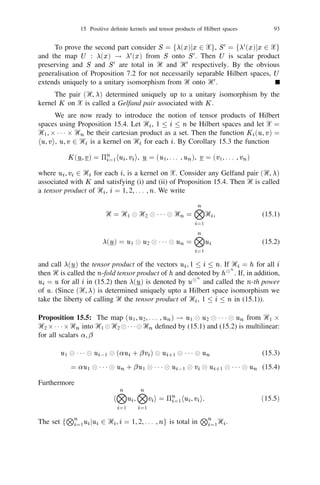
15 Positive definite kernels and tensor products of Hilbert spaces                                93


      To prove the second part consider S = f(x)jx 2 ᐄg, S 0 = f0 (x)jx 2 ᐄg
and the map U : (x) ! 0 (x) from S onto S 0 . Then U is scalar product
preserving and S and S 0 are total in Ᏼ and Ᏼ0 respectively. By the obvious
generalisation of Proposition 7.2 for not necessarily separable Hilbert spaces, U
extends uniquely to a unitary isomorphism from Ᏼ onto Ᏼ0 .
     The pair (Ᏼ, ) determined uniquely up to a unitary isomorphism by the
kernel K on ᐄ is called a Gelfand pair associated with K .
       We are now ready to introduce the notion of tensor products of Hilbert
spaces using Proposition 15.4. Let Ᏼi , 1  i  n be Hilbert spaces and let ᐄ =
Ᏼ1 , 2 1 1 1 2 Ᏼn be their cartesian product as a set. Then the function Ki (u, v ) =
hu, v i, u, v 2 Ᏼi is a kernel on Ᏼi for each i. By Corollary 15.3 the function

            K (u, v ) = 5n=1 hui , vi i, u = (u1 , . . . , un ), v = (v1 , . . . , vn )
                         i


where ui , vi 2 Ᏼi for each i, is a kernel on ᐄ. Consider any Gelfand pair (Ᏼ, )
associated with K and satisfying (i) and (ii) of Proposition 15.4. Then Ᏼ is called
a tensor product of Ᏼi , i = 1, 2, . . . , n. We write


                            Ᏼ = Ᏼ1 
 Ᏼ2 
 1 1 1 
 Ᏼn
                                                                          O    =
                                                                                       n

                                                                                               Ᏼi ,            (15.1)

                                                                          O
                                                                          =        i       1
                                                                                       n

                           (u) = u1 
 u2 
 1 1 1 
                    u = u
                                                                           n                    i              (15.2)
                                                                                   i   =1
and call (u) the tensor product of the vectors ui , 1  i  n. If Ᏼi = h for all i
then Ᏼ is called the n-fold tensor product of h and denoted by h
 . If, in addition,
                                                                   n

ui = u for all i in (15.2) then (u) is denoted by u
 and called the n-th power
                                                       n

of u. (Since (Ᏼ, ) is determined uniquely upto a Hilbert space isomorphism we
take the liberty of calling Ᏼ the tensor product of Ᏼi , 1  i  n in (15.1)).

Proposition 15.5: The map (u1 , u2 , . . . , un ) ! u1 
 u2 
 1 1 1 
 un from Ᏼ1 2
Ᏼ2 2 1 1 1 2 Ᏼn into Ᏼ1 
 Ᏼ2 
 1 1 1 
 Ᏼn defined by (15.1) and (15.2) is multilinear:
for all scalars ,
u1 
 1 1 1 
 ui01 
 (ui +
vi ) 
 ui+1 
 1 1 1 
 un                                                    (15.3)
             = u1 
 1 1 1 
 u +
u1 
 1 1 1 
 u 01 
 v
                                       n                               i               i   
 ui+1 
 1 1 1 
 un (15.4)

Furthermore

                               h
                                 Ou Ov n

                                               ,
                                                       n

                                                               i = 5n 1 hui , vi i.
                                                                    i=                                        (15.5)
            N= u u                                                                     N=
                                           i               i
                                   =1
                                   i               =1
                                                   i


                           2 Ᏼi , i = 1, 2, . . . , ng is total in
              n                                                                                 n
The set f     i   1 ij i                                                                        i   1 Ᏼi .
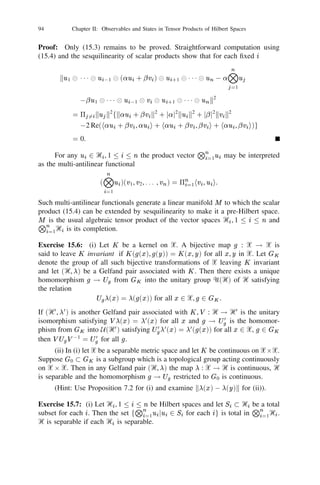
94         Chapter II: Observables and States in Tensor Products of Hilbert Spaces


Proof: Only (15.3) remains to be proved. Straightforward computation using


                                                                                        O
(15.4) and the sesquilinearity of scalar products show that for each fixed i
                                                                                            n

       ku1 
 1 1 1 
 ui01 
 (ui +
vi ) 
 ui+1 
 1 1 1 
 un 0                                  uj
                                                                                        j   =1
                0
u1 
 1 1 1 
 ui01 
 vi 
 ui+1 
 1 1 1 
 un k2
            = 5j 6=i kuj k
                         fkui +
vi k2 + jj2 kui k2 + j
j2 kvi k2
                              2

                02 Re(hui +
vi , ui i + hui +
vi ,
vi i + hui ,
vi i)g


                                                                         N=
            =   0.
                                                                            n
      For any ui 2 Ᏼi , 1  i  n the product vector                        i   1 ui   may be interpreted

                       O
as the multi-antilinear functional
                              n

                      (           ui )(v1 , v2 , . . .   , vn ) = 5n 1 hvi , ui i.
                                                                   i=
                          =1
                          i

Such multi-antilinear functionals generate a linear manifold M to which the scalar

N
product (15.4) can be extended by sesquilinearity to make it a pre-Hilbert space.
M is the usual algebraic tensor product of the vector spaces Ᏼi , 1  i  n and
   n
   i=1
       Ᏼi is its completion.

Exercise 15.6: (i) Let K be a kernel on ᐄ. A bijective map g : ᐄ ! ᐄ is
said to leave K invariant if K (g (x), g (y )) = K (x, y ) for all x, y in ᐄ. Let GK
denote the group of all such bijective transformations of ᐄ leaving K invariant
and let (Ᏼ, ) be a Gelfand pair associated with K . Then there exists a unique
homomorphism g ! Ug from GK into the unitary group ᐁ(Ᏼ) of Ᏼ satisfying
the relation
                   Ug (x) = (g (x)) for all x 2 ᐄ, g 2 GK .

If (Ᏼ0 , 0 ) is another Gelfand pair associated with K , V : Ᏼ ! Ᏼ0 is the unitary
isomorphism satisfying V (x) = 0 (x) for all x and g ! Ug is the homomor-
                                                                 0


phism from GK into U (Ᏼ0 ) satisfying Ug 0 (x) = 0 (g (x)) for all x 2 ᐄ, g 2 GK
                                           0


then V Ug V 01 = Ug for all g .
                      0


      (ii) In (i) let ᐄ be a separable metric space and let K be continuous on ᐄ 2 ᐄ.
Suppose G0  GK is a subgroup which is a topological group acting continuously
on ᐄ 2 ᐄ. Then in any Gelfand pair (Ᏼ, ) the map  : ᐄ ! Ᏼ is continuous, Ᏼ
is separable and the homomorphism g ! Ug restricted to G0 is continuous.
     (Hint: Use Proposition 7.2 for (i) and examine k(x) 0 (y )k for (ii)).

                                    n       N
Exercise 15.7: (i) Let Ᏼi , 1  i  n be Hilbert spaces and let Si  Ᏼi be a total
                                                                          n
subset for each i. Then the set f i=1 ui jui 2 Si for each ig is total in i=1 Ᏼi .
                                                                                                      N
Ᏼ is separable if each Ᏼi is separable.
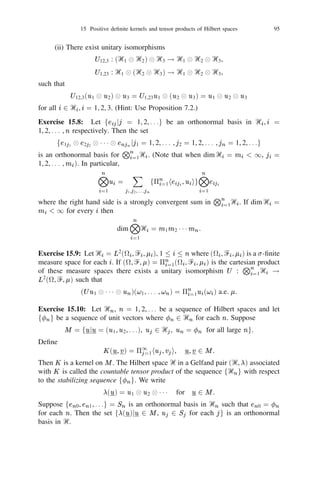
15 Positive definite kernels and tensor products of Hilbert spaces                                           95


       (ii) There exist unitary isomorphisms
                        U12,3 : (Ᏼ1 
 Ᏼ2 ) 
 Ᏼ3 ! Ᏼ1 
 Ᏼ2 
 Ᏼ3 ,
                        U1,23 : Ᏼ1 
 (Ᏼ2 
 Ᏼ3 ) ! Ᏼ1 
 Ᏼ2 
 Ᏼ3 ,
such that
               U12,3 (u1 
 u2 ) 
 u3 = U1,23 u1 
 (u2 
 u3 ) = u1 
 u2 
 u3
for all i 2 Ᏼi , i = 1, 2, 3. (Hint: Use Proposition 7.2.)
Exercise 15.8: Let feij jj = 1, 2, . . .g be an orthonormal basis in Ᏼi , i =
1, 2, . . . , n respectively. Then the set
         fe1j 
 e2j 
 1 1 1 
 enjn jj1 = 1, 2, . . . , j2 = 1, 2, . . . , jn = 1, 2, . . .g
            1       2
                                      N
is an orthonormal basis for i=1 Ᏼi . (Note that when dim Ᏼi = mi  1, ji =
                                    n

1, 2, . . . , mi ). In particular,
                        Ou   n

                                 i   =
                                             X             f    n
                                                               5i=1   he   iji   , u ig
                                                                                   i
                                                                                        Oe n

                                                                                               iji
                         =1
                         i               j1 ,j2 ,... ,jn

where the right hand side is a strongly convergent sum in
                                                                                       i=1
                                                                                               N     n
                                                                                                           Ᏼi . If dim Ᏼi   =
mi  1 for every i then
                                                                                                     i=1


                                     dim
                                           OᏴn

                                                      i    =    m1 m2 1 1 1 mn .
                                            i=1


Exercise 15.9: Let Ᏼi = L2 (
i , Ᏺi , i ), 1  i  n where (
i , Ᏺi , i ) is a  -finite
measure space for each i. If (
, Ᏺ, ) = 5n 1 (
i , Ᏺi , i ) is the cartesian product
                                              i=
of these measure spaces there exists a unitary isomorphism U :
                                                                              n
                                                                              i=1
                                                                                  Ᏼi !
                                                                                                               N
L (
, Ᏺ, ) such that
  2

                (Uu1 
 1 1 1 
 un )(!1 , . . . , !n ) = 5n 1 ui (!i ) a.e. .
                                                         i                         =


Exercise 15.10: Let Ᏼn ,             n = 1, 2, . . . be a sequence of Hilbert spaces and let
f g be a sequence of unit vectors where  2 Ᏼ for each n. Suppose
   n                                                                   n           n

        M = fuju = (u1 , u2 , . . .), u 2 Ᏼ , u =  for all large ng.
                                                          j        j         n         n


                          K (u, v) = 51 1 huj , vj i, u, v 2 M .
Define
                                      j             =


Then K is a kernel on M . The Hilbert space Ᏼ in a Gelfand pair (Ᏼ, ) associated
with K is called the countable tensor product of the sequence fᏴn g with respect
to the stabilizing sequence fn g. We write
                          (u) = u1 
 u2 
 1 1 1 for u 2 M .
Suppose fen0 , en1 , . . .g = Sn is an orthonormal basis in Ᏼn such that en0 = n
for each n. Then the set f(u)ju 2 M , uj 2 Sj for each j g is an orthonormal
basis in Ᏼ.
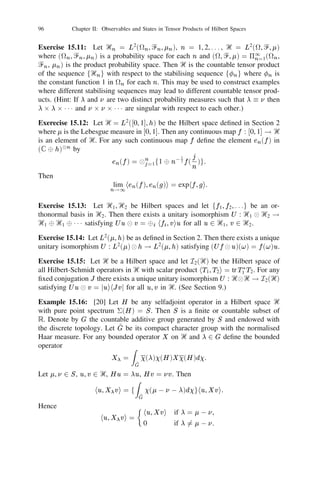
96          Chapter II: Observables and States in Tensor Products of Hilbert Spaces


Exercise 15.11: Let Ᏼn = L2 (
n , Ᏺn , n ), n = 1, 2, . . . , Ᏼ = L2 (
, Ᏺ, )
where (
n , Ᏺn , n ) is a probability space for each n and (
, Ᏺ, ) = 51 1 (
n ,
                                                                          n=
Ᏺn , n ) is the product probability space. Then Ᏼ is the countable tensor product
of the sequence fᏴn g with respect to the stabilising sequence fn g where n is
the constant function 1 in 
n for each n. This may be used to construct examples
where different stabilising sequences may lead to different countable tensor prod-
ucts. (Hint: If  and  are two distinct probability measures such that    then
 2  2 1 1 1 and  2  2 1 1 1 are singular with respect to each other.)
Exerecise 15.12: Let Ᏼ = L2 ([0, 1], h) be the Hilbert space defined in Section 2
where  is the Lebesgue measure in [0, 1]. Then any continuous map f : [0, 1] ! Ᏼ
is an element of Ᏼ. For any such continuous map f define the element en (f ) in
(‫ 8 ރ‬h)
n by
                        en (f ) = 
n=1 f1 8 n0 21 f ( j )g.
                                    j
                                                              n
Then
                            lim hen (f ), en (g )i = exphf , g i.
                           n !1
Exercise 15.13: Let Ᏼ1 , Ᏼ2 be Hilbert spaces and let ff1 , f2 , . . .g be an or-
thonormal basis in Ᏼ2 . Then there exists a unitary isomorphism U : Ᏼ1 
 Ᏼ2 !
Ᏼ1 8 Ᏼ1 8 1 1 1 satisfying Uu 
 v = 8i hfi , v iu for all u 2 Ᏼ1 , v 2 Ᏼ2 .

Exercise 15.14: Let L2 (, h) be as defined in Section 2. Then there exists a unique
unitary isomorphism U : L2 () 
 h ! L2 (, h) satisfying (Uf 
 u)(! ) = f (! )u.

Exercise 15.15: Let Ᏼ be a Hilbert space and let I2 (Ᏼ) be the Hilbert space of
                                                                        3
all Hilbert-Schmidt operators in Ᏼ with scalar product hT1 , T2 i = tr T1 T2 . For any
fixed conjugation J there exists a unique unitary isomorphism U : Ᏼ 
 Ᏼ ! I2 (Ᏼ)
satisfying Uu 
 v = juihJv j for all u, v in Ᏼ. (See Section 9.)

Example 15.16: [20] Let H be any selfadjoint operator in a Hilbert space Ᏼ
with pure point spectrum 6(H ) = S . Then S is a finite or countable subset of
‫ .ޒ‬Denote by G the countable additive group generated by S and endowed with
                           ~
the discrete topology. Let G be its compact character group with the normalised
Haar measure. For any bounded operator X on Ᏼ and  2 G define the bounded
operator                      Z
                            X =          ()(H )X(H )d.
                                      ~
                                      G

Let ,  2 S , u, v 2 Ᏼ,   Hu = u, Hv = v. Then
                                      Z
                     hu, X v i = f        ( 0  0 )dghu, Xvi.
                                       ~
                                       G
Hence                                  hu, Xvi            =  0 ,
                       hu, X v i =
                                                     if
                                           0         if    6=  0  .
16 Operators in tensor products of Hilbert spaces                     97


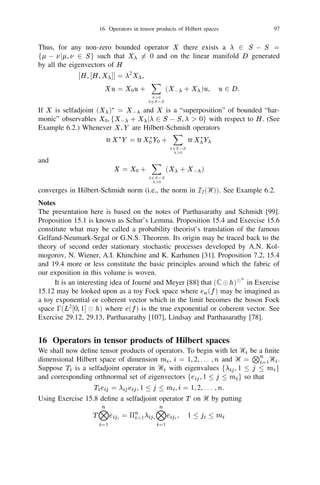
Thus, for any non-zero bounded operator           X
                                        there exists a 2                         S0S =
   S                       X
f 0 j , 2 g such that  6= 0 and on the linear manifold                          D generated
by all the eigenvectors of H
             [H , [H , X ]] = 2 X ,
                       Xu = X0u +
                                         X (X0 + X )u             ,   u 2 D.
                                          0
                                         2S0S
IfX                 X         X
     is selfadjoint (  )3 = 0 and     X
                                     is a “superposition” of bounded “har-
                    X X X  S S 
monic” observables 0 , f 0 +  j 2 0 ,         0g with respect to . (See           H
                         XY
                      tr X 3 Y = tr X0 Y0 +
                                     3
                                                  X
Example 6.2.) Whenever , are Hilbert-Schmidt operators
                                            tr X Y
                                                3
                                                 2S0S

                                          X (X + X
                                                  0
and
                          X = X0 +                       0    )
                                         2S0S
                                          0
converges in Hilbert-Schmidt norm (i.e., the norm in        I2 (Ᏼ)). See Example 6.2.
Notes
The presentation here is based on the notes of Parthasarathy and Schmidt [99].
Proposition 15.1 is known as Schur’s Lemma. Proposition 15.4 and Exercise 15.6
constitute what may be called a probability theorist’s translation of the famous
Gelfand-Neumark-Segal or G.N.S. Theorem. Its origin may be traced back to the
theory of second order stationary stochastic processes developed by A.N. Kol-
mogorov, N. Wiener, A.I. Khinchine and K. Karhunen [31]. Proposition 7.2, 15.4
and 19.4 more or less constitute the basic principles around which the fabric of
our exposition in this volume is woven.
                                        e
                                                                     n
                                                                           h
      It is an interesting idea of Journ´ and Meyer [88] that (‫ 
) 8 ރ‬in Exercise
                                                             e f
15.12 may be looked upon as a toy Fock space where n ( ) may be imagined as
a toy exponential or coherent vector which in the limit becomes the boson Fock
        L          h           ef
space 0( 2 [0, 1] 
 ) where ( ) is the true exponential or coherent vector. See
Exercise 29.12, 29.13, Parthasarathy [107], Lindsay and Parthasarathy [78].


16 Operators in tensor products of Hilbert spaces

                                                                n      N
We shall now define tensor products of operators. To begin with let Ᏼi be a finite
                                             m i
dimensional Hilbert space of dimension i , = 1, 2, . . . , and Ᏼ = i=1 Ᏼi .
                                                                         n
        T                                                             j m
Suppose i is a selfadjoint operator in Ᏼi with eigenvalues f ij , 1   i g
                                                    e            j m
and corresponding orthnormal set of eigenvectors f ij , 1   i g so that
                  Tieij = ij eij , 1  j  mi, i = 1, 2, . . . , n.
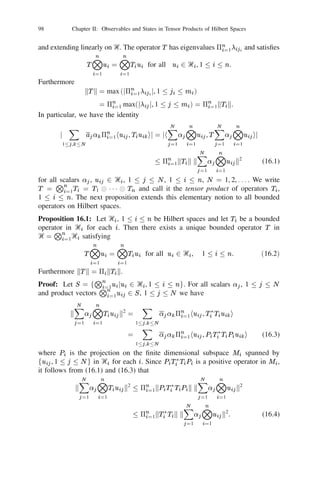
Using Exercise 15.8 define a selfadjoint operator T on Ᏼ by putting
                   On                    On
                 T eiji = 5n=1iji eiji , 1  ji  mi
                                i
                    i=1                    i=1
98               Chapter II: Observables and States in Tensor Products of Hilbert Spaces


                           T
                               O =O
and extending linearly on Ᏼ. The operator T has eigenvalues 5n 1 iji and satisfies
                                       n

                                               ui
                                                             i=
                                                                 n

                                                                     Ti ui for all ui 2 Ᏼi , 1  i  n.
                                   =1
                                   i                         =1
                                                             i

Furthermore
                          kT k = max (j5n=1 ij j, 1  ji  mi )
                                        i                                   i


                               = 5i=1 max(jij j, 1  j  mi ) = 5n=1 kTi k.
                                  n
                                                                  i


                 X                                                                  XO XO
In particular, we have the identity
                                                                                     N                n                        N                 n

         j                 aj k 5 =1 huij , Ti uikn
                                                   i                        ij = jh          j               uij , T                  j                uij ij
              
             1 j ,k N                                                               =
                                                                                    j =
                                                                               5= k kk
                                                                                    n
                                                                                    i
                                                                                        XO k
                                                                                        1
                                                                                         =
                                                                                         1 =
                                                                                             Ti
                                                                                                  i       1
                                                                                                               N

                                                                                                                       j
                                                                                                                            j      1
                                                                                                                                   n
                                                                                                                                             i


                                                                                                                                           uij   2
                                                                                                                                                     1


                                                                                                                                                                  (16.1)
                                                                                                                  =1            =1
         N=
                                                                                                              j                i

                    2 Ᏼi , 1  j  N , 1  i  n, N = 1, 2, . . . . We write
for all scalars j , uij
T    =   1 Ti = T1 
 1 1 1 
 Tn and call it the tensor product of operators Ti ,
             n
             i
1  i  n. The next proposition extends this elementary notion to all bounded
operators on Hilbert spaces.
Proposition 16.1: Let Ᏼi , 1  i  n be Hilbert spaces and let Ti be a bounded
         N
operator in Ᏼi for each i. Then there exists a unique bounded operator T in
Ᏼ = i=1 Ᏼi satisfying
                       O =O
        n

                                   n                         n

                          T          2     ui                        Ti ui for all ui         Ᏼi ,                1  i  n.                                      (16.2)
                        =    =

                     = fN = j 2
                               i       1                 i       1
Furthermore T      k k=5k k                            Ti .
                          N = 2   g
                                               i

Proof: Let S
                                           n
                                           i       1 i u ui Ᏼi , 1 i n . For all scalars j , 1  j  N
                                                       1 uij S , 1 j N we have
                                                   n


                   X O k = X 5= h
and product vectors                                i

                  N                    n

                 k        j                   Ti uij                             j k      n
                                                                                                          uij , Ti3 Ti uik i
                                  X 5= h
                                                                 2
                                                                                             i    1
                  j=  1  =        
                                   i       1                           1 j ,k N

                               =                                                  j k      n
                                                                                             i    1       uij , Pi Ti3 Ti Pi uik i                                (16.3)
                                                                         
                                                                       1 j ,k N
where Pi is the projection on the finite dimensional subspace Mi spanned by
fuij , 1  j  N g in Ᏼi for each i. Since Pi Ti3 Ti Pi is a positive operator in Mi ,

                  k
                      XO
it follows from (16.1) and (16.3) that
                      N

                               j
                                           n

                                                   Ti uij k2  5n=1 kPi Ti3 Ti Pi k k
                                                                i
                                                                                           XO                     N

                                                                                                                          j
                                                                                                                                   n

                                                                                                                                           uij k2
                      j   =1           i   =1
                                                                       5n=1 kTi3 Ti
                                                                         i              kk
                                                                                          XO k
                                                                                           = =
                                                                                                  N

                                                                                                          j
                                                                                                              j       1
                                                                                                                      n
                                                                                                                               i


                                                                                                                           uij 2 .
                                                                                                                                       1


                                                                                                                                                                  (16.4)
                                                                                              j   =1              i=1
16 Operators in tensor products of Hilbert spaces                                  99


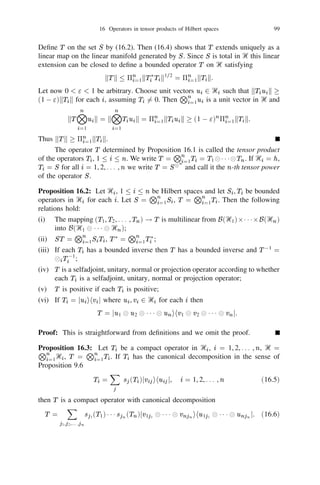
Define T on the set S by (16.2). Then (16.4) shows that T extends uniquely as a
linear map on the linear manifold generated by S . Since S is total in Ᏼ this linear
extension can be closed to define a bounded operator T on Ᏼ satisfying
                       kT k  5n kT 3 T k1=2 = 5n kT k.=1
                                                       i       i        i           =1
                                                                                    i       i


(1 0 )kT k for each i, assuming T 6= 0. Then N =1 u
Let now 0    1 be arbitrary. Choose unit vectors ui 2 Ᏼi such that kTi ui k 
                                                 n
         i                        i                  i is a unit vector in Ᏼ and

                    Ou k = k OT u k = 5
                                                 i
                        n                     n

              kT                                                        =1 kTi ui k  (1 0 )       5 =1 k T k .
                                                                    n                           n     n
                                i                  i   i            i                                 i            i
            =1      i   i=1

Thus kT k  5i=1 kTi k.
             n


      The operator T determined by Proposition 16.1 is called the tensor productN
of the operators Ti , 1  i  n. We write T = i=1 Ti = T1 
1 1 1
 Tn . If Ᏼi = h,
                                                    n

Ti = S for all i = 1, 2, . . . , n we write T = S 
 and call it the n-th tensor power
                                                   n

of the operator S .

                                                               N
Proposition 16.2: Let Ᏼi , 1  i  n be Hilbert spaces and let Si , Ti be bounded
operators in Ᏼi for each i. Let S = i=1 Si , T = i=1 Ti . Then the following
                                           n               n                            N
relations hold:
(i) The mapping (T1 , T2 , . . . , Tn ) ! T is multilinear from B (Ᏼ1 ) 21 1 12B (Ᏼn )
      into B (Ᏼ1 
 1 1 1 
 Ᏼn );
                  N
(ii) ST = i=1 Si Ti , T 3 = i=1 Ti3 ;
                n                   n              N
(iii) If each Ti has a bounded inverse then T has a bounded inverse and T 01 =
      
i Ti01 ;
(iv) T is a selfadjoint, unitary, normal or projection operator according to whether
      each Ti is a selfadjoint, unitary, normal or projection operator;
(v) T is positive if each Ti is positive;
(vi) If Ti      = ju ihv j where u , v 2 Ᏼ for each i then
                            i       i              i       i        i

                        T = ju1 
 u2 
 1 1 1 
 u ihv1 
 v2 
 1 1 1 
 v      n                             n   j.

Proof: This is straightforward from definitions and we omit the proof.

N n
  i=1
                 n          N
Proposition 16.3: Let Ti be a compact operator in Ᏼi , i = 1, 2, . . . , n, Ᏼ =
      Ᏼi , T =      T . If Ti has the canonical decomposition in the sense of
                 i=1 i
Proposition 9.6
                                Ti =
                                            X s (T )jv
                                                   j       i   ij   ihuij j,    i = 1, 2, . . . , n                    (16.5)
                                             j

then T is a compact operator with canonical decomposition
  T   =
              X             sj1 (T1 ) 1 1 1 sjn (Tn )jv1j1 
 1 1 1 
 vnjn ihu1j1 
 1 1 1 
 unjn j.                     (16.6)
          j1 ,j2 ,... ,jn
100               Chapter II: Observables and States in Tensor Products of Hilbert Spaces


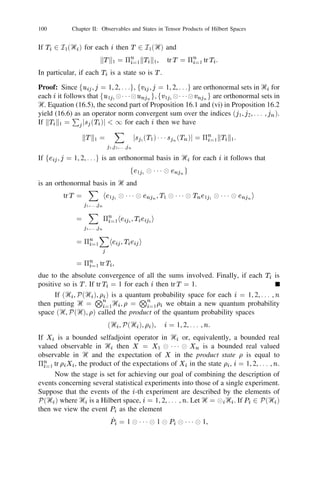
If Ti   2 I1 (Ᏼi ) for each i then T 2 I1 (Ᏼ) and
                         kT k1 = 5n=1 kTi k1 , tr T
                                   i                                                = 5i=1 tr Ti .
                                                                                        n


In particular, if each Ti is a state so is T .

Proof: Since fuij , j = 1, 2, . . .g, fvij , j = 1, 2, . . .g are orthonormal sets in Ᏼi for
each i it follows that fu1j1 
1 1 1
 unjn g, fv1j1 
1 1 1
 vnjn g are orthonormal sets in
Ᏼ. Equation (16.5), the second part of Proposition 16.1 and (vi) in Proposition 16.2
                  P
yield (16.6) as an operator norm convergent sum over the indices (j1 , j2 , . . . , jn ).

                                             X
If kTi k1 = j jsj (Ti )j  1 for each i then we have

                       kT k 1 =                              jsj (T1 ) 1 1 1 sjn (Tn )j = 5n 1 kTi k1 .
                                                                 1                         i      =

                                         j1 ,j2 ,... ,jn

If feij , j   =   1, 2, . . .g is an orthonormal basis in Ᏼi for each i it follows that
                                                         fe1j 
 1 1 1 
 enjn g
                         X he 
 1 1 1 
 e T 
 1 1 1 
 T e
                                                                  1

is an orthonormal basis in Ᏼ and
           tr T    =                                                  njn   ,                         
 1 1 1 
 enjn i
                         X he T e i
                                          1j1                                   1           n   1j1
                       j1 ,... ,jn

                                         n
                   =                 5i=1                    ,

                          Xhe T e i
                                                       iji       i iji
                       j1 ,... ,jn

                          n
                   = 5i=1                     ij   ,    i ij
                                     j


                   = 5i=1 tr Ti ,
                          n


due to the absolute convergence of all the sums involved. Finally, if each Ti is
positive so is T . If tr Ti = 1 for each i then tr T = 1.

then putting Ᏼ =
                         n
                         i=1
                              N         n
                                        i=1 i
                                                                 N
      If (Ᏼi , P (Ᏼi ), i ) is a quantum probability space for each i = 1, 2, . . . , n
                             Ᏼi ,  =       we obtain a new quantum probability
space (Ᏼ, P (Ᏼ), ) called the product of the quantum probability spaces
                                         (Ᏼi ,     P (Ᏼi ), i ), i = 1, 2, . . . , n.
If Xi is a bounded selfadjoint operator in Ᏼi or, equivalently, a bounded real
valued observable in Ᏼi then X = X1 
 1 1 1 
 Xn is a bounded real valued
observable in Ᏼ and the expectation of X in the product state  is equal to
5n 1 tr i Xi , the product of the expectations of Xi in the state i , i = 1, 2, . . . , n.
  i=

     Now the stage is set for achieving our goal of combining the description of
events concerning several statistical experiments into those of a single experiment.
Suppose that the events of the i-th experiment are described by the elements of
P (Ᏼi ) where Ᏼi is a Hilbert space, i = 1, 2, . . . , n. Let Ᏼ = 
i Ᏼi . If Pi 2 P (Ᏼi )
then we view the event Pi as the element
                                          Pi = 1 
 1 1 1 
 1 
 Pi 
 1 1 1 
 1,
                                          ^
16 Operators in tensor products of Hilbert spaces                                       101


(called the ampliation of Pi in Ᏼ) in ᏼ(Ᏼ) and interpret P = i=1 Pi = 5n 1 Pi 2i=
                                                                                  ^
                                                                                              N n

ᏼ(Ᏼ) (see Proposition 16.2) as the event signifying the simultaneous occurrence
of Pi in the i-th experiment for i = 1, 2, . . . , n. These are the quantum probabilis-
tic equivalents of measurable rectangles in products of sample spaces. The next
proposition indicates how ᏼ(Ᏼ) is “generated” by P (Ᏼi ), i = 1, 2, . . . , n.
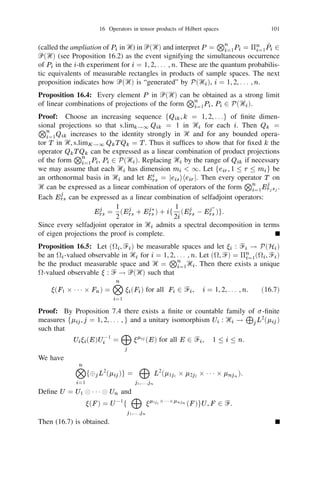
Proposition 16.4: Every element P in ᏼ(Ᏼ) can be obtained as a strong limit
of linear combinations of projections of the form i=1 Pi , Pi 2 P (Ᏼi ).
                                                  n                                  N
Proof: Choose an increasing sequence fQik , k = 1, 2, . . .g of finite dimen-
N
sional projections so that s.limk!1 Qik = 1 in Ᏼi for each i. Then Qk =
   n
      Q increases to the identity strongly in Ᏼ and for any bounded opera-
   i=1 ik
tor T in Ᏼ, s.limK !1 Qk T Qk = T . Thus it suffices to show that for fixed k the
            N
operator Qk T Qk can be expressed as a linear combination of product projections
of the form i=1 Pi , Pi 2 P (Ᏼi ). Replacing Ᏼi by the range of Qik if necessary
                n

we may assume that each Ᏼi has dimension mi  1. Let feir , 1  r  mi g be
an orthonormal basis in Ᏼi and let Ers = jeis iheir j. Then every operator T on
                                      i

Ᏼ can be expressed as a linear combination of operators of the form i=1 Erj sj .
                                                                       n    j                         N
Each Ers can be expressed as a linear combination of selfadjoint operators:
        j


                                     j3
                           1 j                1 j          3
                   Ers = (Ers + Ers ) + if (Ers 0 Ers )g.
                     j                                   j
                           2                 2i
Since every selfadjoint operator in Ᏼi admits a spectral decomposition in terms
of eigen projections the proof is complete.
Proposition 16.5: Let (
i , Ᏺi ) be measurable spaces and let i : Ᏺi ! P (Hi )
                                                n
                                                                         i=
be the product measurable space and Ᏼ = i=1 Ᏼi . Then there exists a unique
                                                                            N
be an 
i -valued observable in Ᏼi for i = 1, 2, . . . , n. Let (
, Ᏺ) = 5n 1 (
i , Ᏺi )


-valued observable  : Ᏺ ! ᏼ(Ᏼ) such that


     (F1 2 1 1 1 2 Fn ) =
                                  O  n

                                               Fi ) for all Fi 2 Ᏺi , i = 1, 2, . . . , n.
                                              i(                                                              (16.7)
                                  =1
                                  i


Proof: By Proposition 7.4 there exists a finite or countable family of  -finite
measures fij , j = 1, 2, . . . , g and a unitary isomorphism Ui : Ᏼi ! j L2 (ij )
                                                                                                          L
such that
            Ui i (E )Ui01 =
                                          M        ij
                                                          E ) for all E 2 Ᏺi ,
                                                          (                                  1  i  n.
                                          j


             Of8 L                                   ML
We have
                 n

                     j
                          2
                              ij )g =
                              (
                                                                     2
                                                                           2 2j 2 1 1 1 2 njn ).
                                                                         ( 1j 1          2
           =1i                                     j1 ,... ,jn

Define U = U1 
 1 1 1 
 Un and
               (F ) = U 01 f
                                              M              1j1   21112    njn
                                                                                     F gU , F 2 Ᏺ.
                                                                                     ( )
                                          j1 ,... ,jn

Then (16.7) is obtained.
102          Chapter II: Observables and States in Tensor Products of Hilbert Spaces


     The unique observable  satisfying (16.7) in Proposition 16.5 is called the
tensor product of the observables i , i = 1, 2, . . . , n. We write  = 1 
 1 1 1 
 n .
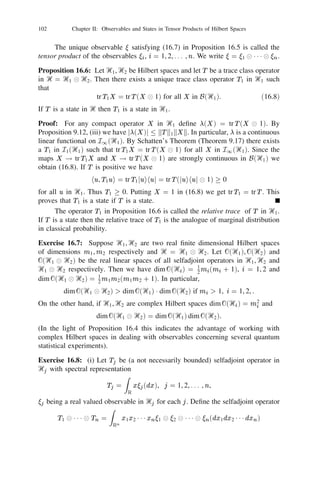
Proposition 16.6: Let Ᏼ1 , Ᏼ2 be Hilbert spaces and let T be a trace class operator
in Ᏼ = Ᏼ1 
 Ᏼ2 . Then there exists a unique trace class operator T1 in Ᏼ1 such
that
                  tr T1 X = tr T (X 
 1) for all X in B(Ᏼ1 ).                (16.8)
If T is a state in Ᏼ then T1 is a state in Ᏼ1 .
Proof: For any compact operator X in Ᏼ1 define (X ) = tr T (X 
 1). By
Proposition 9.12, (iii) we have j(X )j  kT k1 kX k. In particular,  is a continuous
linear functional on I1 (Ᏼ1 ). By Schatten’s Theorem (Theorem 9.17) there exists
a T1 in I1 (Ᏼ1 ) such that tr T1 X = tr T (X 
 1) for all X in I1 (Ᏼ1 ). Since the
maps X ! tr T1 X and X ! tr T (X 
 1) are strongly continuous in B(Ᏼ1 ) we
obtain (16.8). If T is positive we have
                   hu, T1 ui = tr T1 juihuj = tr T (juihuj 
 1)  0
for all u in Ᏼ1 . Thus T1  0. Putting X = 1 in (16.8) we get tr T1 = tr T . This
proves that T1 is a state if T is a state.
      The operator T1 in Proposition 16.6 is called the relative trace of T in Ᏼ1 .
If T is a state then the relative trace of T1 is the analogue of marginal distribution
in classical probability.
Exercise 16.7: Suppose Ᏼ1 , Ᏼ2 are two real finite dimensional Hilbert spaces
of dimensions m1 , m2 respectively and Ᏼ = Ᏼ1 
 Ᏼ2 . Let ᏻ(Ᏼ1 ), ᏻ(Ᏼ2 ) and
ᏻ(Ᏼ1 
 Ᏼ2 ) be the real linear spaces of all selfadjoint operators in Ᏼ1 , Ᏼ2 and
Ᏼ1 
 Ᏼ2 respectively. Then we have dim ᏻ(Ᏼi ) = 2 mi (mi + 1), i = 1, 2 and
                                                     1

dim ᏻ(Ᏼ1 
 Ᏼ2 ) = 2 m1 m2 (m1 m2 + 1). In particular,
                   1


         dim ᏻ(Ᏼ1 
 Ᏼ2 )  dim ᏻ(Ᏼ1 ) 1 dim ᏻ(Ᏼ2 ) if mi  1, i = 1, 2, .
On the other hand, if Ᏼ1 , Ᏼ2 are complex Hilbert spaces dim ᏻ(Ᏼi ) = mi and
                                                                       2

                      dim ᏻ(Ᏼ1 
 Ᏼ2 ) = dim ᏻ(Ᏼ1 ) dim ᏻ(Ᏼ2 ).
(In the light of Proposition 16.4 this indicates the advantage of working with
complex Hilbert spaces in dealing with observables concerning several quantum
statistical experiments).
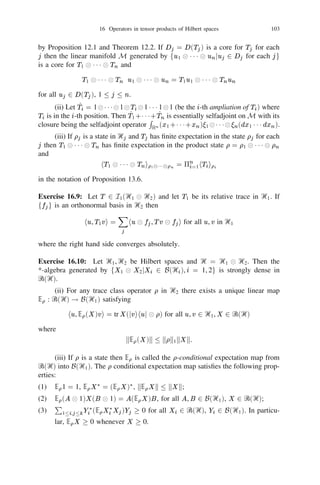
Exercise 16.8: (i) Let Tj be (a not necessarily bounded) selfadjoint operator in
Ᏼj with spectral representation
                                    Z
                           Tj   =          ( )
                                        xj dx , j    = 1, 2, . . . , n,
                                    ‫ޒ‬
j being a real valued observable in Ᏼj for each j . Define the selfadjoint operator
                            Z
       T1   
 111 
 T =
                      n           x1 x2   111x
                                             n 1   
 2 
 1 1 1 
  (dx1 dx2 1 1 1 dx )
                                                                     n                 n
                             ‫ޒ‬n
16 Operators in tensor products of Hilbert spaces                     103


                                              D = D(T ) is a core for T for each
j
                T 
111
 T
  then the linear manifold    M
by Proposition 12.1 and Theorem 12.2. If
                               generated by     fu 
111
 unjuj 2 Dj for each jg
                                                        j
                                                            1
                                                                      j             j


is a core for 1           n and

                 T 
111
 Tn u 
111
 un = T u 
111
 Tn un
                  1                1                            1 1

for all uj 2 D(Tj ), 1  j  n.
       (ii) Let Ti = 1 
111
 1 
 Ti 
 1 111 1 
 1 (be the i-th ampliation of Ti ) where
                ^
Ti is in the i-th position. Then T + 111 + Tn is essentially selfadjoint on M with its
                                 ^         ^
                                            (x + 111 + x ) 
111
  (dx 111 dx ).
                                   1       R
closure being the selfadjoint operator         ‫ޒ‬n   1   n 1           n    1      n
                                      T                                            
j then 1T   
111
 T   n has finite expectation in the product state = 1            
111
 
      (iii) If j is a state in Ᏼj and j has finite expectation in the state j for each
                                                                                    n

                      hT 
111
 T i                                    hT i
and
                                     n 1 
111
n = 5i=1 i i
                                                      n
                           1

in the notation of Proposition 13.6.

Exercise                      1
            orthonormal basis in
                                 
 then
ffj g is an16.9: Let T 2 I (Ᏼ Ᏼ Ᏼ ) and let T be its relative trace in Ᏼ . If
                                   1
                                       2
                                           2                    1                       1


                hu, T vi = j hu 
 fj , Tv 
 fj i for all u, v in Ᏼ
                      1
                              X
                                                                               1


where the right hand side converges absolutely.

Exercise 16.10: Let Ᏼ1 , Ᏼ2 be Hilbert spaces and Ᏼ = Ᏼ1 Ᏼ2 . Then the
*-algebra generated by
Ꮾ(Ᏼ).
                         1fX 
 X jX 2 B
                               2  i                              i
                                         (Ᏼi ), = 1, 2 is strongly dense in  g 

                                                in Ᏼ2 there exists a unique linear map
‫ : ޅ‬Ꮾ(Ᏼ)    !B
      (ii) For any trace class operator
                 (Ᏼ1 ) satisfying
            hu, ‫(ޅ‬X )vi = tr X (jvihuj
 ) for all u, v 2 Ᏼ , X 2 Ꮾ(Ᏼ)   1


                               k‫(ޅ‬X )k  kk kX k.
where
                                                        1


             B           
                                                        
      (iii) If is a state then ‫ ޅ‬is called the -conditional expectation map from
Ꮾ(Ᏼ) into (Ᏼ1 ). The conditional expectation map satisfies the following prop-
erties:
(1)   ‫ޅ ,1 = 1 ޅ‬  X 3 = (‫ ޅ‬X )3, k‫ޅ‬X k  kX k;
(2)   ‫( ޅ‬A 
 X B 
 1) = A(‫ ޅ‬X )B, for all A, B 2 B(Ᏼ1), X 2 Ꮾ(Ᏼ);
              1) (
         1i,j k Yi (‫ ޅ‬Xi Xj )Yj  0 for all Xi 2 Ꮾ(Ᏼ), Yi 2 B (Ᏼ1 ). In particu-
      P             3     3
      lar, ‫ ޅ‬X  0 whenever X  0.
(3)
104                 Chapter II: Observables and States in Tensor Products of Hilbert Spaces


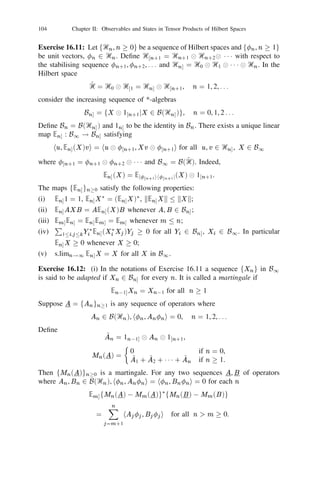
Exercise 16.11: Let fᏴn , n  0g be a sequence of Hilbert spaces and fn , n  1g
be unit vectors, n 2 Ᏼn . Define Ᏼ[n+1 = Ᏼn+1 
 Ᏼn+2 
 1 1 1 with respect to
the stabilising sequence n+1 , n+2 , . . . and Ᏼn] = Ᏼ0 
 Ᏼ1 
 1 1 1 
 Ᏼn . In the
Hilbert space
                           ~
                           Ᏼ = Ᏼ0 
 Ᏼ[1                 = Ᏼn        ]   
 Ᏼ[n+1 ,        n = 1, 2, . . .
consider the increasing sequence of *-algebras
                   = fX 
 1 n 1 jX 2 B(Ᏼn )g, n = 0, 1, 2 . . .
                        Bn]                        [   +                           ]


Define Bn = B (Ᏼn ) and 1n to be the identity in Bn . There exists a unique linear
                              ]                ]

map ‫ޅ‬n : B1 ! Bn satisfying
          ]                       ]


    hu, ‫ޅ‬n (X )v i = hu 
  n 1 , Xv 
  n 1 i for all u, v 2 Ᏼn , X 2 B1
                   ]                           [   +                       [   +                           ]


              [   +                        +
                                                  ~
where  n 1 = n 1 
 n 2 
 1 1 1 and B1 = B (Ᏼ). Indeed,
                            +


                      ‫ޅ‬n (X ) = ‫  ޅ‬n  n (X ) 
 1 n 1 .
                                       ]                   j   [   +1 ih   [   +1 j         [   +


The     maps f‫ޅ‬n] gn0 satisfy the following properties:
(i)     ‫ޅ‬n] 1 = 1, ‫ޅ‬n] X 3 = (‫ޅ‬n] X )3 , k‫ޅ‬n] X k  kX k;
(ii)    ‫ޅ‬n] AXB = A‫ޅ‬n] (X )B whenever A, B 2 Bn] ;
        ‫ޅ‬m] ‫ޅ‬n] = ‫ޅ‬n] ‫ޅ‬m] = ‫ޅ‬m] whenever m  n;
(iii)
(iv)
        P 1i,j k Yi ‫ޅ‬n] (Xi Xj )Yj  0 for all Yi 2 Bn] ,
                     3      3
                                                                                                Xi 2 B . In particular
                                                                                                           1

        ‫ޅ‬n] X  0 whenever X  0;
(v)     s.limn!1 ‫ޅ‬n] X = X for all X in B1 .

Exercise 16.12: (i) In the notations of Exercise 16.11 a sequence fXn g in B1
is said to be adapted if Xn 2 Bn] for every n. It is called a martingale if
                                       ‫ޅ‬n01] Xn              = Xn       01     for all   n1
Suppose           A = fAn gn 1 is any sequence of operators where


                        An 2 B(Ᏼn ), hn , An n i = 0, n = 1, 2, . . .

                                      ~
Define
                                      An = 1n                  
 An 
 1[n+1 ,
                                               
                                                       01]


                            Mn (A) = A + A + 1 1 1 + A if n = 0,
                                     0
                                      ~1 ~2          ~n if n  1.
Then fMn (A)gn0 is a martingale. For any two sequences A, B of operators
where An , Bn 2 B (Ᏼn ), hn , An n i = hn , Bn n i = 0 for each n
                          ‫ޅ‬m] fMn (A) 0 Mm (A)g3 fMn (B ) 0 Mm (B )g
                                 Xn
                            =         hAj j , Bj j i for all n  m  0.
                               j =m+1
17 Symmetric and antisymmetric tensor products            105


       (ii) For any sequence     E = (E1 , E2 , . . .) of operators such that
                                 En 2 Bn01 , n = 1, 2, . . .
                                              ]


define                         0
               In (A, E ) =      Pn EnfMn(A) 0 Mn0 (A)g
                                    1                        1
                                                                      if
                                                                      if
                                                                           n = 0,
                                                                           n  1.
Then   fIn (A, E )gn0 is a martingale. Furthermore
                   ‫ޅ‬n01] In (A, E )3 In (B , F ) = In01 (A, E )3 In01 (B , F )
                                                                     3
                                                  + hAn n , Bn n iEn Fn
for all   n  1.
Exercise 16.13: For any selfadjoint operator X in the Hilbert space Ᏼ define
the operator S (X ) in ‫ 
 2ރ‬Ᏼ by S (X ) = (1 
 1) exp[i2 
 X ] where j ,
1  j  3 are the Pauli spin matrices. Then S (X ) = S (X )01 = S (X )3 and
2 [S (X ) + S (0X )] = 1 
 cos X . Thus S (X ) and S (0X ) are spin observables
1

with two-point spectrum f01, 1g but their average can have arbitrary spectrum in
the interval [01, 1]. (See also Exercise 4.4, 13.11.)

Notes
The role of tensor products of Hilbert spaces and operators in the construction of
observables concerning multiple quantum systems is explained in Mackey [84].
For a discussion of conditional expectation in non-commutative probability theory,
see Accardi and Cecchini [4]. Exercise 16.13 arose from discussions with B.V. R.
Bhat.


17 Symmetric and antisymmetric tensor products
There is a special feature of quantum mechanics which necessitates the introduction
of symmetric and antisymmetric tensor products of Hilbert spaces. Suppose that
a physical system consists of n identical particles which are indistinguishable
from one another. A transition may occur in the system resulting in merely the
interchange of particles regarding some physical characteristic (like position for
example) and it may not be possible to detect such a change by any observable
means. Suppose the statistical features of the dynamics of each particle in isolation
are described by states in some Hilbert space Ᏼ. According to the procedure
                                                                       N
outlined in Section 15, 16 the events concerning all the n particles are described
by the elements of ᏼ(Ᏼ
 ). If Pi 2 ᏼ(Ᏼ), 1  i  n then i=1 Pi signifies the
                            n                                        n

event that Pi occurs for each i. If the particles i and j (i  j ) are interchanged and
a change cannot be detected then we should not distinguish between the events
P1 
1 1 1
Pn and P1 
1 1 1
Pi01 
Pj 
Pi+1 
1 1 1
Pj01 
Pi 
Pj+1 
1 1 1
Pn , where
in the second product the positions of Pi and Pj are interchanged. This suggests
that the Hilbert space Ᏼ
 is too large and therefore admits too many projections
                            n
106         Chapter II: Observables and States in Tensor Products of Hilbert Spaces


and does not qualify for the description of events concerning n identical particles.
In order to take into account this curtailment in the degrees of freedom, the desired
reduction of the Hilbert space may be achieved by restriction to a suitable subspace
of Ᏼ
 which is “invariant under permutations”. We shall make this statement
       n

more precise in the sequel.
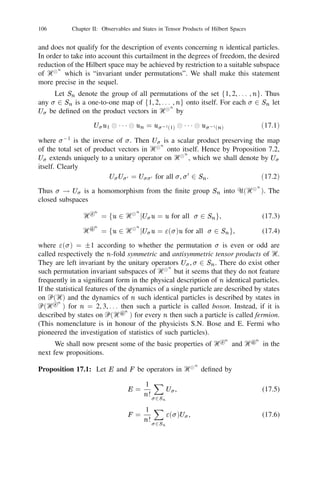
    Let Sn denote the group of all permutations of the set f1, 2, . . . , ng. Thus
any 2 Sn is a one-to-one map of f1, 2, . . .n, ng onto itself. For each  2 Sn let
U be defined on the product vectors in Ᏼ
 by
                    U u1 
 1 1 1 
 un = u01 (1) 
 1 1 1 
 u01 (n)                      17.1)
                                                                                          (


where  01 is the inverse of  . Then U is a scalar product preserving the map
of the total set of product vectors in Ᏼ
 onto itself. Hence by Proposition 7.2,
                                         n

U extends uniquely to a unitary operator on Ᏼ
 , which we shall denote by U
                                                   n

itself. Clearly
                         U U0 = U0 for all  ,  0 2 Sn .             (17.2)


Thus  ! U is a homomorphism from the finite group Sn into ᐁ(Ᏼ
 ). The
                                                                                      n

closed subspaces

                Ᏼ
           fu 2 Ᏼ
 jU u = u for all
                 s   n                n
                         =                                            2 Sn g,            (17.3)

                Ᏼ
           fu 2 Ᏼ
 jU u = ( )u for all
                 a   n                n
                         =                                                2 Sn g,        (17.4)
where ( ) = 61 according to whether the permutation  is even or odd are
called respectively the n-fold symmetric and antisymmetric tensor products of Ᏼ.
They are left invariant by the unitary operators U ,  2 Sn . There do exist other
such permutation invariant subspaces of Ᏼ
 but it seems that they do not feature
                                                n

frequently in a significant form in the physical description of n identical particles.
If the statistical features of the dynamics of a single particle are described by states
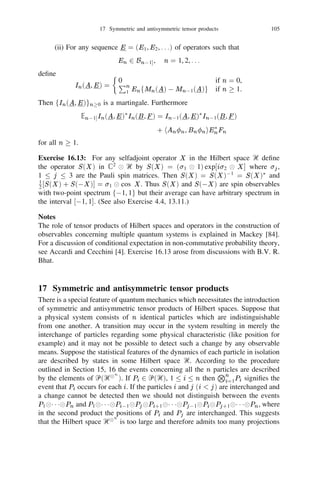
on ᏼ(Ᏼ) and the dynamics of n such identical particles is described by states in
ᏼ(Ᏼ
 ) for n = 2, 3, . . . then such a particle is called boson. Instead, if it is
      sn
described by states on ᏼ(Ᏼ 
 ) for every n then such a particle is called fermion.
                                an
(This nomenclature is in honour of the physicists S.N. Bose and E. Fermi who
pioneered the investigation of statistics of such particles).
      We shall now present some of the basic properties of Ᏼ
 and Ᏼ 
 in the
                                                            s       a            n    n

next few propositions.

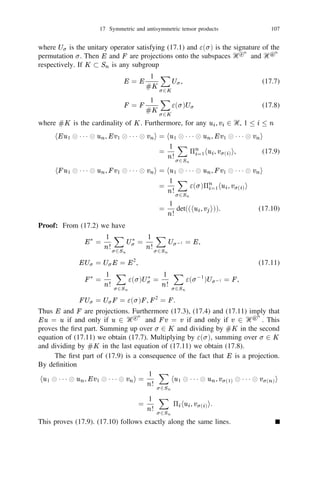
                             E and F be operators in Ᏼ
 defined by
                                                       n

                                              XU
Proposition 17.1: Let

                                          1
                                  E=                   ,                                 (17.5)
                                          n! 2S

                                  F   =
                                          1   X  U
                                                   n

                                                       (    )   ,                        (17.6)
                                          n! 2Sn
17 Symmetric and antisymmetric tensor products                                  107


where U is the unitary operator satisfying (17.1) and ( ) is the signature of the
permutation  . Then E and F are projections onto the subspaces Ᏼ
 and Ᏼ 
                                                                      sn         an
respectively. If K  Sn is any subgroup

                                E = E #1
                                                XU      ,                                        (17.7)
                                       K
                                F   =   F #1
                                                X  U
                                                2
                                                 K

                                                       ( )                                       (17.8)
                                           K     2
                                                 K
where  K is the cardinality of K . Furthermore, for any ui , vi 2 Ᏼ, 1  i  n
        #


                                                =
                                                     1  X
     hEu1 
 1 1 1 
 un , Ev1 
 1 1 1 
 vn i = hu1 
 1 1 1 
 un , Ev1 
 1 1 1 
 vn i
                                                                  n
                                                                 5i=1   hui , v(i) i,            (17.9)
                                                     n! 2S  n

                                                        X
     hF u1 
 1 1 1 
 un , F v1 
 1 1 1 
 vn i = hu1 
 1 1 1 
 un , F v1 
 1 1 1 
 vn i
                                                n! 2Sn ()5i=1 hui , v(i) i
                                                 1              n
                                              =


                                                   det((hui , vj i)).
                                                 1
                                              =                                     (17.10)
                                                n!
Proof: From (17.2) we have

                E 3 = n!
                      1    X U3 X U  =
                                            1
                                                       01 =     E,
                            2
                            Sn
                                            n! 2Sn


                F 3 = n!
                      1     X   U3
               EU = U E = E 2 ,
                                                 1     X    01 01
                                                                                                 (17.11)


                            2
                            Sn
                                    ( )  =
                                                 n! 2Sn ( )U                =   F,

              F U = U F = ()F , F 2 = F .
Thus E and F are projections. Furthermore (17.3), (17.4) and (17.11) imply that
Eu = u if and only if u 2 Ᏼ
n and F v = v if and only if v 2 Ᏼ
n . This
                                s                                      a
proves the first part. Summing up over  2 K and dividing by #K in the second
equation of (17.11) we obtain (17.7). Multiplying by ( ), summing over  2 K
and dividing by #K in the last equation of (17.11) we obtain (17.8).
     The first part of (17.9) is a consequence of the fact that E is a projection.
By definition
hu1 
 1 1 1 
 un , Ev1 
 1 1 1 
 vn i = n!
                                        1       X hu 
 1 1 1 
 u
                                                        1                  n , v (1)   
 1 1 1 
 v(n) i
                                                2
                                     1
                                        =
                                                X hu v i
                                                 Sn


                                     n! 2Sn 5i i , (i) .
This proves (17.9). (17.10) follows exactly along the same lines.
108              Chapter II: Observables and States in Tensor Products of Hilbert Spaces

                                                                   P
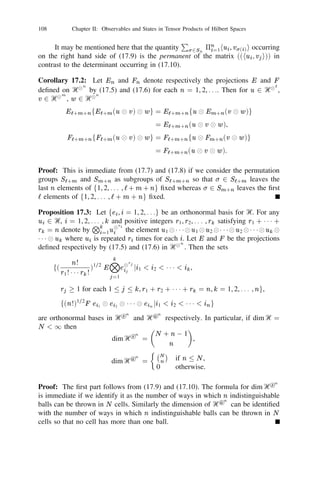
      It may be mentioned here that the quantity 2Sn 5n 1 hui , v(i) i occurring
                                                        i=
on the right hand side of (17.9) is the permanent of the matrix ((hui , vj i)) in
contrast to the determinant occurring in (17.10).

Corollary 17.2: Let En and Fn denote respectively the projections E and F
               n
defined on Ᏼ
 by (17.5) and (17.6) for each n = 1, 2, . . .. Then for u 2 Ᏼ
 ,
                                                                           `


v2Ᏼ   
 m , w 2 Ᏼ 
n
               E`+m+n fE`+m (u 
 v ) 
 wg = E`+m+n fu 
 Em+n (v 
 w)g
                                           = E`+m+n (u 
 v 
 w),
                F`+m+n fF`+m (u 
 v ) 
 wg = F`+m+n fu 
 Fm+n (v 
 w)g
                                           = F`+m+n (u 
 v 
 w).
Proof: This is immediate from (17.7) and (17.8) if we consider the permutation
groups S`+m and Sm+n as subgroups of S`+m+n so that  2 S`+m leaves the
last n elements of f1, 2, . . . , ` + m + ng fixed whereas  2 Sm+n leaves the first
` elements of f1, 2, . . . , ` + m + ng fixed.
Proposition 17.3: Let fei , i = 1, 2, . . .g be an orthonormal basis for Ᏼ. For any
                       k  N
ui 2 Ᏼ, i = 1, 2, . . . , k and positive integers r1 , r2 , . . . , rk satisfying r1 + 1 1 1 +
rk = n denote by i=1 u
 i the element u1 
 1 1 1 
 u1 
 u2 
 1 1 1 
 u2 
 1 1 1 
 uk 

                             i
                               r


1 1 1 
 uk where ui is repeated ri times for each i. Let E and F be the projections
defined respectively by (17.5) and (17.6) in Ᏼ
 . Then the sets
                                                    n


          ( r ! 1n!1 r ! )1=2 E
                                  Oe

                                  k
                                          rj
      f
                 1
                                         ij ji1     i2  1 1 1  ik ,
            1         k           j =1
           rj      1 for each 1  j          k, r1 + r2 + 1 1 1 + rk = n, k = 1, 2, . . . , ng,
           f   (n!)1=2 F ei1
                               
 ei2 
 1 1 1 
 ein ji1        i2  1 1 1  in g
are orthonormal bases in Ᏼ
 and Ᏼ 
 respectively. In particular, if dim Ᏼ
                           s      a      n               n
                                                                                                    =
N  1 then
                                  N +n01
                                                                   
                        dim Ᏼ
 =
                             sn              ,
                                                        0N 1 n if n N ,
                                  dim Ᏼ 
                                        a          =
                                               n
                                                             n         
                                                         0       otherwise.

Proof: The first part follows from (17.9) and (17.10). The formula for dim Ᏼ
  s                     n


is immediate if we identify it as the number of ways in which n indistinguishable
balls can be thrown in N cells. Similarly the dimension of Ᏼ 
 can be identified
                                                             an
with the number of ways in which n indistinguishable balls can be thrown in N
cells so that no cell has more than one ball.
17 Symmetric and antisymmetric tensor products                              109


      Using Proposition 17.3 it is possible to compare the different probability
distributions that arise in the “statistics of occupancy”. More precisely, let  be a
                                         P 1 ih jf j ih j
state in Ᏼ with dim Ᏼ = N  . Let ej , j = 1, 2, . . . , N be an orthonormal
                                           j
basis of Ᏼ such that  = j pj ej ej . Let ej ej signify the event “particle
                                                                                          g
occupies cell number j ”. Now consider n distinguishable particles whose statis-
tics are described by the quantum probability space (Ᏼ
 , ᏼ(Ᏼ
 ), 
 ). The
                                                                     n        n     n

           j 
111
 ih 
111
 j
projection ej1          ejn ej1             ejn signifies the event “particle i occupies
cell ji for each i = 1, 2, . . . , n”. Let r = (r1 , . . . , rN ) where rj is the number of


                E =
                    X je111
 111 
 e n ihe 
 111 
 e n j
particles in cell j so that r1 +
                        0
                        r
                                        + rN = n. Define
                                                j1              j       j1            j         (17.12)
where the summation on the right hand side is over all (j1 , . . . , jn ) such that the
               fj           g
cardinality of i ji = j is rj for j = 1, 2, . . . , N . Er is a projection whose range
                                                         0

has dimension r1 !111!rN ! and it signifies the event that cell j has rj particles for
                   n

each j . Then
                              n 0
                         tr 
 Er =
                                          n!
                                                          111
                                                 pr2 pr2 pN .
                                      r1 ! rN ! 1 1
                                                             rN
                                                                              111
                                                                               (17.13)
In this case we say that the particles obey the Maxwell-Boltzmann statistics and
                                                                                n
the probability that there are rj particles in cell j for each j in the state 
 is
given by (17.13).
       Suppose that the n particles under consideration are n identical bosons.
                               n                    n                        n
Then the Hilbert space Ᏼ
 is replaced by Ᏼ
 and correspondingly 
 by its
                                                  s

restricton to Ᏼ
n . To make this restriction a state we put
                s

                  n
              
 = 
 Ᏼ
n .
                           n
                                     j
                                                                    X
                s
                                 s
                            s
                              n        n
                   c = tr 
 = tr 
 E =                    s   s   sN
                                                           p11 p22 pN                     111
                                             s1 +111+sN =n

                            n
and observe that c01 
 is a state, E being defined by (17.5). The quantum
                          s

probability space (Ᏼ  
n , ᏼ(Ᏼ
n ), c01 
n ) describes the statistics of n identical
                      s            s       s


bosons. Denote by Er
                      (b) the projection on the one dimensional subspace generated

                        O

by the vector

                                                     = (r1 , . . . , r ), r1 + 111 + r = n.
                         N
                                         rj
              er   =E            e            , r                   N                      N
                        j   =1
Then the probability of finding rj particles in cell j for each j = 1, 2, . . . , N is

                             s
                               n (b)
                     tr c01 
 Er =
                                               pr1 pN
                                                 1
                                                       rN
                                                          P
                                                      ps1 pN
                                          s1 +111sN =n 1
                                                            sN
                                                                        111    (17.14)
                                                                                111
In this case we say that the particles obey the Bose-Einstein statistics.
                                                        n                    n
      When the particles are n identical fermions Ᏼ
 is replaced by Ᏼ 
 which
                                                                           a

                                               
is non-trivial if and only if n N , i.e., the number of particles does not exceed
110          Chapter II: Observables and States in Tensor Products of Hilbert Spaces


the number of cells. The state 
 is replaced by its restriction to Ᏼ 
 . Once
                                                 n                    a                                                n


                           = tr 
n Ᏼ
n =
                                   j a
                                                             X
again to make this restriction a state we have to divide it by

                      c0                                                                  pi1 pi2 1 1 1 pin .
                                                  1   i1 i2 111in N
Then the quantum probability space describing the statistics of n identical fermions
      an      an     01 a n
is (Ᏼ 
 , ᏼ(Ᏼ 
 ), c0  
 ) where

                                             
          = 
n Ᏼ
n
                                              a  n
                                                                a j


      (f )
If Er denotes the one dimensional projection on the subspace generated by the
vector
                                  = F ei ei
                                   fr                1
                                                         
  ein
                                                             2
                                                                 
 111 


where r = (r1 , . . . , rN ), rij = 1, j = 1, 2, . . . , n and the remaining ri are 0 and
F is defined by (17.6) then the probability that cell ij is occupied by one particle
for each j = 1, 2, . . . , n and the remaining cells are unoccupied is given by

             tr c0
                     01 
n E (f ) =
                         a
                               r        P j j 111ji Nppij pj
                                                pi p         1    2
                                                                       111        n
                                                                                                  111   pjn
                                                                                                              .        (17.15)
                                             1    1      2            n               1       2


In this case we say that the particles obey the Fermi-Dirac statistics.
     For a comparison of the three distributions (17.13)–(17.15) consider the case
of two cells and n particles. Let the state  of a single particle be given by

                                       e1   = 2 e1 ,
                                               1
                                                                 e2      = 2 e2
                                                                            1


where fe1 , e2 g is an orthonormal basis in Ᏼ. According to Maxwell-Boltzmann

                                                                 n 0n
statistics the number of particles in cell 1 has a binomial distribution given by

                     Pr (cell 1 has k particles) =                            2           ,       0k             n
                                                                      k
whereas Bose-Einstein statistics yield

                      Pr (cell 1 has k particles) =
                                                                          1
                                                                                              0k                 n.
                                                                      n+1
                                                                                  ,                      


According to the first distribution the probability that all the particles occupy
a particular cell is 20n whereas the second distribution assigns the enhanced
             1
probability n+1 to the same event.
      In the case of fermions it is impossible to have more than two of them when
there are only two cells available and if a cell is occupied by one particle the
second one has to be occupied by the other. Bosons tend to crowd more than
particles obeying Maxwell-Boltzmann statistics and fermions tend to avoid each
other.
18 Examples of discrete time quantum stochastic flows                 111


Exercise 17.4: Let  be an irreducible unitary representation of Sn and let
( ) = tr  ( ) be its character. Suppose (1) = d denotes the dimension of the
representation  . Define
                                E = 
                                       d     X( )U
                                       n! 2S
                                                n
where U is the unitary operator satisfying (17.1). Then E is a projection for
each , E U = U E for all  2 Sn , E1 E2 = 0 if 1 6= 2 and  E = 1.
                                                                               P
(Hint: Use Schur orthogonality relations).

Example 17.5: [74] (i) The volume of the region
       1 = f(x1 , x2 , . . . , xN 01 )jxj  0 for all j , 0  x1 + 1 1 1 + xN 01  1g

in ‫ޒ‬ N 01 is [(N 0 1)!]01 .
      (ii) Let r1 , . . . , rN be non-negative integers such that r1 + 1 1 1 + rN = n.
Then
     Z         n!         r         rN
                                                                                  
                                                                        N + n 0 1 01
                         p11 1 1 1 pN (N 0 1)!dp1 dp2 1 1 1 dpN 01 =
       1 r1 ! 1 1 1 rN !                                                    n
where pN = (1 0 p1 0 p2 0 1 1 1 0 pN 01 ).
      This identity has the following interpretation. Suppose all the probability
distributions (p1 , p2 , . . . , pN ) for the occupancy of the cells (1, 2, . . . , N ) by a
particle are equally likely and for any chosen prior distribution (p1 , p2 , . . . , pN ) the
particle obeys Maxwell-Boltzmann statistics. Then one obtains the Bose-Einstein
distribution (17.4) with pj = N , j = 1, 2, . . . , N .
                                       1


Notes
Regarding the role of symmetric and antisymmetric tensor products of Hilbert
spaces in the statistics of indistinguishable particles, see Dirac [29]. For an inter-
esting historical account of indistinguishable particles and Bose-Einstein statistics,
see Bach [11]. Example 17.5 linking Bose-Einstein and Maxwell-Boltzmann statis-
tics in the context of Bayesian inference is from Kunte [74].


18 Examples of discrete time quantum stochastic flows
Using the notion of a countable tensor product of a sequence of Hilbert spaces
with respect to a stabilising sequence of unit vectors and properties of conditional
expectation (see Exercise 16.10, 16.11) we shall now outline an elementary pro-
cedure of constructing a “quantum stochastic flow” in discrete time which is an
analogue of a classical Markov chain induced by a transition probability matrix.
       For a Hilbert space Ᏼ any subalgebra Ꮾ  Ꮾ(Ᏼ) which is closed under the
involution * and weak topology is called a W 3 algebra or a von Neumann algebra.
If Ᏼi , i = 1, 2 are Hilbert spaces, Ꮾi  Ꮾ(Ᏼi ), i = 1, 2 are von Neumann algebras
denote by Ꮾ1 
 Ꮾ2 the smallest von Neumann algebra containing fX1 
 X2 jXi 2
112           Chapter II: Observables and States in Tensor Products of Hilbert Spaces


Ꮾi , i = 1, 2g in Ꮾ(Ᏼ1 
 Ᏼ2 ). If  is a trace class operator in Ᏼ2 , following
Exercise 16.10, define the operator ‫( ޅ‬Z ), Z 2 Ꮾ(Ᏼ1 
 Ᏼ2 ) by the relation
                          hu, ‫( ޅ‬Z )v i = tr Z jv ihuj 
 ,                 u, v   2 Ᏼ1                (18.1)
in Ᏼ1 .

Proposition 18.1: ‫( ޅ‬Z ) 2 Ꮾ1 if                    Z   2 Ꮾ1 
 Ꮾ2 .

Proof: If Z = X1 
 X2 then (18.1) implies that ‫( ޅ‬Z ) = (tr X2 )X1 . Thus the
proposition holds for any finite linear combination of product operators in Ꮾ1 
 Ꮾ2 .
Suppose that  = 6pj jej ihej j is a state where pj  0, 6pj = 1 and fej g is an
orthonormal set and w.limn!1 Zn = Z in Ꮾ(Ᏼ1 
 Ᏼ2 ). Then by (18.1)

                    lim hu, ‫( ޅ‬Zn )v i = lim
                                                                  X
                    n!1                             !1 p hu 
 e , Z v 
 e i
                                                     n
                                                                  j
                                                                       j       j        n         j


                                                 = 6p hu 
 e , Zv 
 e i
                                                          j            j            j

                                                 = hu, ‫( ޅ‬Z )vi for all u, v 2 Ᏼ1 .
                                                              

In other words ‫ ޅ‬is weakly continuous if  is a state. Since ‫ ޅ‬is linear in 
the same property follows for any trace class operator. Now the required result is
immediate from the definition of Ꮾ1 
 Ꮾ2 .
      Let Ᏼ0 , Ᏼ be Hilbert spaces where dim Ᏼ = d  1. Let fe0 , e1 , . . . , ed01 g
be a fixed orthonormal basis in Ᏼ and let Ꮾ0  Ꮾ(Ᏼ0 ) be a von Neumann algebra
with identity. Putting Ᏼn = Ᏼ, n = e0 for all n  1 in Exercise 16.11 construct
the Hilbert spaces Ᏼn] , Ᏼ[n+1 for each n  0. Define the von Neumann algebras

                    Ꮾn]   = fX 
 1 1 jX 2 Ꮾ0 
 Ꮾ(Ᏼ
n )g,
                                         [n+                                                n    0,
                        Ꮾ = Ꮾ0 
 Ꮾ(Ᏼ 1 ).        [


Property (v) in Exercise 16.11 implies that Ꮾ is the smallest von Neumann algebra
containing all the Ꮾn , n  0. fᏮn] g is increasing in n. By Proposition 18.1 the
[n+1 -conditional expectation ‫ޅ‬n] of Exercise 16.11 maps Ꮾ onto Ꮾn] .

      Any algebra with identity and an involution * is called a *-unital algebra.
If Ꮾ1 , Ꮾ2 are *-unital algebras and  : Ꮾ1 ! Ꮾ2 is a mapping preserving * and
identity then  is called a *-unital map.

Proposition 18.2: Let  : Ꮾ0 ! Ꮾ0 
 Ꮾ(Ᏼ) be a *-unital homomorphism. Define
the linear maps j : Ꮾ0 ! Ꮾ0 by
                 i


                i
               j X ( ) = ‫ޅ‬j ih j ((X )),
                               ej   ei                        0  i,   j    d 0 1,         X    2 Ꮾ0   (18.2)
Then the following holds:
         (1) =  ,  (X 3 ) =  (X )3 ;  j

                  P 010 (X ) (Y ) for all X , Y
          i         i    i
(i)    j           j    j               i

        (X Y ) =
                          d
(ii)      i
          j               k=
                               i
                               k
                                             k
                                             j                             2 Ꮾ0 .
18 Examples of discrete time quantum stochastic flows                                                               113


Proof: From (18.1) and (18.2) we have
                                  hu, j (X )v i = hu 
 ei ,  (X )v 
 ej i.
                                            i


If X   =   1 the right hand side of this equation is hu, v ij . Furthermore
                                                             i


                             3                                                3
            hu, j (X )v i = hu 
 ei ,  (X )v 
 ej i = hv 
 ej ,  (X )u 
 ei i
                    i


                                                                                                          3
                                  = hv , i (X )ui = hu, i (X )                                              v i.
                                                       j                                     j


This proves (i). To prove (ii) choose an orthonormal basis fun g in Ᏼo and observe
that

           hu, j (XY )v i = hu 
 ei ,  (X ) (Y )v 
 ej i
                i


                                       Xu e Xu e u
                                                       3
                                  = h (X )u 
 ei ,  (Y )v 
 ej i

                                  =                h       
          ,       (    )         
         k ih          
 ek ,  (Y )v 
 ej i

                                       Xu Xu u  Y v
                                                                  i                      r                      r
                                       r ,k

                                                               i                                     k
                                  =                h       ,   k(         )       r ih       ,       j(       ) i

                                       X X u Y v
                                                                                         r
                                       k,r

                                                       i              3            k
                                  =                h   k(         )           ,    j(        ) i


                                  =h   u
                                         X X  Y v
                                           k


                                               ,               i
                                                               k(         )
                                                                                  k
                                                                                  j(     ) i.
                                                       k


Proposition 18.3: Let , Ᏼ0 , Ᏼ1 , Ꮾ0 be as in Proposition 18.2. Define the maps
jn : Ꮾ0 ! Ꮾn , n = 0, 1, 2, . . . inductively by
                        ]


            jn (X ) =
                                  X
            j0 (X ) = X 
 1 1 , j1 (X ) = (X ) 
 1 2 ,
                                       [


                                                 jn01 (k (X ))1n01
                                                        i
                                                                                             ]
                                                                                                 [


 jei ihek j 
 1[n+1 .
                                                                                                                                             (18.3)

                                  0
                              0 i,j d 1

Then jn is a *-unital homomorphism for every n. Furthermore
                        ‫ޅ‬n01] jn (X ) = jn01 (0 (X )) for all n  1, X
                                               0
                                                                                                                           2   Ꮾ0 ,
where ‫ޅ‬n01] is the [n -conditional expectation map of Exercise 16.11.

Proof: We prove by induction. For n = 0, 1 it is immediate. Let n  2. Then by

                                       Xj 0  0
(i) in Proposition 18.2 and the induction hypothesis we have

                            jn (1) =                                i
                                                               1 ( j )1n 1] 
 j i ih j j 
       e e                  1[n+1

                                            Xe e
                                                       n
                                           i,j


                                  =     0
                                       1n          1] 
                   j   i ih i j       
 1[n+1 =                1
                                                                 i
114           Chapter II: Observables and States in Tensor Products of Hilbert Spaces


and
                 jn (X )3 =
                                      X     jn01 (i (X 3 ))1n01]
                                                        j
                                                                       
 je ihe j 
 1
                                                                               j        i          [n+1

                                      i,j


                               = jn (X ).
                                                 3


                           X 0
By (ii) in Proposition 18.2 and induction hypothesis we have

      jn (X )jn (Y ) =             jn 1 (j (X ))jn01 (` (Y ))1n01]
                                          i             k
                                                                                        
  je ihe j 
 1
                                                                                             k


                           X 0X
                                                                                             j         i       `    [n+1

                           i,j ,k,`


                      =           jn 1               k (X )` (Y ))1n01]
                                                      i      k
                                                                            
 je ihe j 
 1
                           X0
                                                                                    i        `               [n+1

                            i,`              k


                      =           jn 1 (` (XY ))1n01]
                                         i
                                                                  
 je ihe j 
 1
                                                                       i       `            [n+1   .
                            i,`


This proves the first part. By the definition of ‫ޅ‬n] in Exercise 16.11 and the fact
that he0 , jei ihej je0 i = 0 j , the second part follows from (18.3).
                             i 0


Corollary 18.4: Let fjn , n  0g be the *-unital homomorphisms of Proposition
18.3. Write T = 0 . Then for 0  n0  n1  1 1 1  nk  1, Xi 2 Ꮾ0 , 1  i  k
                 0


         ‫ޅ‬n0 ] jn1 (X1 )jn2 (X2 ) 1 1 1 jnk (Xk ) =
              jn0 (T n1 0n0 (X1 T n2 0n1 (X2                1 1 1 (X 01 T k 0                                        (18.4)
                                                                   k
                                                                           n         0
                                                                                   nk 1
                                                                                            (X ))          1 1 1)

Proof: By Exercise 16.11 ‫ޅ‬n0 ] = ‫ޅ‬n0 ] ‫ޅ‬nk01 ] . Since jn1 (X1 ) 1 1 1 jnk01 (Xk01 ) is
an element of Ꮾnk01] it follows from the same exercise that

                    ‫ޅ‬n0 ] jn1 (X1 ) 1 1 1 jnk (Xk )
                                                                                                                     (18.5)
                       =   ‫ޅ‬n0] jn1 (X1 ) 1 1 1 jnk01 (Xk01 )‫ޅ‬nk01 ] (jnk (Xk )).

Since ‫ޅ‬nk01 ]   =   ‫ޅ‬nk01] ‫ޅ‬nk01 +1] 1 1 1 ‫ޅ‬nk 01] it follows from Proposition 18.3 that

                            ‫ޅ‬nk01 ] jnk (Xk ) = jnk01 (T nk 0nk01 (X )).

Substituting this in (18.5), using the fact that jnk01 is a homomorphism and re-
peating this argument successively we arrive at (18.4).

Proposition 18.5: The map T = 0 from Ꮾ0 into itself satisfies the following:
                                     0

P
(i) T is a *-unital linear map on Ꮾ(Ᏼ0 ); (ii) for any Xi , Yi 2 Ꮾ0 , 1  i  k,
              3    3
   1i,j k Yi T (Xi Xj )Yj  0 for every k . In particular, T (X )  0 whenever
X  0.
18 Examples of discrete time quantum stochastic flows                                           115


Proof: Since  is a *-unital homomorphism from Ꮾ0 into Ꮾ0 
 Ꮾ(Ᏼ) and
T (X ) = ‫ޅ‬je0 ihe0 j ((X )), (i) is immediate from Exercise 16.10. Using the same

 X
exercise once again we have
        Yi3 T (Xi Xj ))Yj =
                3
                                   X      Yi3 ‫ޅ‬je0 ihe0 j ((Xi )3 (Xj ))Yj
  i,j

                               =
                                    i,j

                                   ‫ޅ‬je0 ihe0 j (f
                                                    X      (Xi )Yi        
 1g f 3
                                                                                      X     (Xj )Yj           
 1g)  0.
                                                      i                                j

Putting k    =   1, Y1   =   1, X1      =   X in this relation we get the last part.
      We may now compare the situation in Proposition 18.3, Corollary 18.4 and
Proposition 18.5 with the one that is obtained in the theory of classical Markov
chains. Consider a Markov chain with state space S = f1, 2, . . . , N g and transition
probability matrix P = ((pij )), 1  i, j  N . Denote by B1 the *-unital
commutative algebra of all bounded complex valued measurable functions on the
space S 1 = S0 2 S1 21 1 12 Sn 21 1 1 where Sn = S for every n. Let Bn]  B1 be
the *-subalgebra of all functions which depend only on the first n + 1 coordinates.
Denote by ‫ޅ‬n] the conditional expectation map determined by
             (‫ޅ‬n] g )(i0 , i1 , . . .   , in ) = ‫(ޅ‬g jX0       = i0 , X1 = i1 , . . .           , Xn   = in )

where X0 , X1 , . . . is the Markov chain starting in the state X0 = i0 with stationary
transition probability matrix P . For any function f on S define
                  jn (f )(i) = f (in ) where i = (i0 , i1 , . . . , in , . . .)                 2S     1
                                                                                                           .
Then jn is a *-unital homomorphism from B0 into Bn] and the Markov property
implies that
          ‫ޅ‬n0] jn1 (f1 )jn2 (f2 ) 1 1 1 jnk (fk ) =
                                                                                                                     (18.6)
                 jn0 (T n1 0n0 (f1 (T n2 0n1 f2 (          1 1 1 (fk   01   T nk 0nk01 (fk ))     1 1 1)
where
                             (T f )(i) =
                                              XN
                                                     pij f (j ),       f    2 B0 = B0 ,     ]

                                              j =1

n0  n1       111                                     2
                 nk and f1 , . . . , fk B0 . T is a *-unital positive linear map on
B0 . Then (18.4) is the non-commutative or quantum probabilistic analogue of the
classical Markov property (18.6) expressed in the language of *-unital commuta-
                                                                        f
tive algebras. For this reason we call the family jn , n 0 of homomorphisms in         g
Proposition 18.3 a quantum stochastic flow induced by the *-unital homomorphism
 : Ꮾ0   !        

           Ꮾ0 Ꮾ(Ᏼ).

Proposition 18.6: Suppose that the von Neumann algebra Ꮾ0 in Proposition 18.3
is abelian. Then for any X , Y 2 Ꮾ0 , m, n  0
                                            [jm (X ), jn (Y )] =             0.                                      (18.7)
116                 Chapter II: Observables and States in Tensor Products of Hilbert Spaces


Proof: Since jn is a homomorphism we have [jn (X ), jn (Y )] = jn ([X , Y ]) = 0.
Thus (18.7) is trivial if m = n. Suppose m  n. By induction on (18.3) we have

jn (X )
       X      =


               j
                      i
                   m k
                     ([
                          1
                          1
                            111
                                    in0m
                                    k
                                   n0m (X ))1   m
                                                 ]              i       k
                                                         
 je 1 ihe 1 j 
 1 1 1 
 je   in0m ekn0m
                                                                                          ih        j 
   1[n+1
    
  0 i1 ,i2 ,... ,
              0
k1 ,k2 ,... , d 1

from which it follows that

 X m m ki
 n
[j (X )


          j
              ,j
               ([
                    (Y )] =

                     1
                     1
                       111
                              i
                              n0m (X ), Y ])1
                              kn0m               m   ]          i       k
                                                         
 je 1 ihe 1 j 
 1 1 1 
 je   in0m ekn0m
                                                                                          ih        j 
   1[n+1
i1 ,i2 ,...
k1 ,k2 ,...

=     0 for all X , Y        2    Ꮾ0 .

      If Ꮾ0 is abelian and X1 , X2 , . . . , Xk is any finite set of selfadjoint elements
in Ꮾ0 then jn1 (X1 ), jn2 (X2 ), . . . , jnk (Xk ) is a commuting family of observables
and hence possesses a joint distribution in ‫ޒ‬k in any state  on the countable
tensor product Ᏼ0 
 fᏴ 
 Ᏼ 
 1 1 1g where the Hilbert space within the braces
f g is with respect to the constant stabilising sequence of unit vectors e0 . For

any state 0 in Ᏼ0 , the family fjn (X )jX 2 Ꮾ0 , n  0g can be interpreted as a
classical Markov flow in the state 0 
 je0 
 e0 
 1 1 1ihe0 
 e0 
 1 1 1 j.

Example 18.7: Let (S , Ᏺ, ) be any measure space and let j : S ! S be
measurable maps satisfying 01  , 0  j  d 0 1. Suppose pj : S !
                                      j                                                  P
[0, 1], 0  j  d 0 1 are measurable functions satisfying
                                                                    j pj (x)  1. Let
             1 ()  Ꮾ(L2 ()) when bounded measurable functions are considered
Ꮾ0 = L
as bounded multiplication operators. We write Ᏼ0 = L2 (), Ᏼ = ‫ރ‬d and choose
fe0 , e1 , . . . , ed01 g to be the canonical orthonormal basis in Ᏼ. Define the map

T : Ꮾ0 ! Ꮾ0 by
                                                           X p f o
                                                           d0   1
                                            Tf       =              j       j                             18.8)
                                                                                                          (

                                                           j   =0


where o denotes composition. The map T can be interpreted as the transition op-
erator of a Markov chain with state space S for which the state changes in one
step from x to one of the states 0 (x), 1 (x), . . . , d01 (x) with respective proba-
bilities p0 (x), p1 (x), . . . , pd01 (x). However, it is possible that i (x) = j (x) for
some i 6= j . If S is a finite set of cardinality k it can be shown that every Markov
transition operator is of the form (18.8) with  being counting measure. In many
practically interesting models of classical probability d is small.
     Consider a unitary d 2 d matrix valued measurable function U on S for
which U = ((uij )), 0  i, j  d 0 1, u0j = pj for all j . For example one may
                                           p
18 Examples of discrete time quantum stochastic flows                   117


choose the orthogonal matrix
                           0 p1=2           p1=2
                                             1                      1
                                                                       1
                                                       . . . . . . pd=21
                                                                      0
                           B 0 1=2
                           B                                             C
                                                                         C
                       U = B 0p.1
                           B
                           B
                                                                       C
                                                                       C
                                                                       C
                           @ ..             10Q                        A
                            0p 0      1=2
                                      d 1

where   Q = ((qij )), qij = (pi pj )1=2 (1 + p0=2 )01 , i, j 
                                              1
                                                                          1. Define the *-unital
homomorphism
                               0 fo0                                        0
                                                                                 1
        : f ! ((j (f ))) = U @
                  i                           fo1                               A U3    (18.9)
                                                          ..
                                        0                      . fod01
from Ꮾ0 into Ꮾ0 
 Ꮾ(Ᏼ) so that
                                            X
                                            d01
                                 (f ) =
                                  i
                                  j               uir ujr for ,
                                            r=0

                                0 (f ) = T f .
                                 0


where T is defined by (18.8). Note that in (18.9) the right hand side is to be
interpreted as a matrix multiplication operator in the Hilbert space
                          L2 () 
 ‫ރ‬d = | 2 () 8 1{z1 8 L2 (}
                                        L           1         )
                                                       d0fold
and any element in the right hand side version of the Hilbert space is expressed as
a column vector of elements in L2 (). By Proposition 18.3 and 18.6 there exists
a quantum stochastic flow fjn , n  0g of *-unital homomorphisms from Ꮾ0 into
Ꮾ induced by the *-unital homomorphism  of (18.9) satisfying
                                       [jm (f ), jn (g)] = 0,
                                        ] ‫ޅ‬n01 jn (f ) = jn01 (T f )
for all f , g 2 Ꮾ0 = L1 (). If S is a countable or finite set and  is
the counting measure then for any x 2 S , in the quantum theoretical state
x 
 e0 
 e0 
 1 1 1 in L2 () 
 Ᏼ 
 Ᏼ 
 1 1 1 the sequence of observables j0 (f ) =
f , j1 (f ), . . . , jn (f ), . . . has the same probability distribution as the sequence of
random variables f (0 (x, ! )), f (1 (x, ! )), f (n (x, ! )), . . . where fn (x, ! )g is a
discrete time classical Markov chain with state space S , 0 (x, ! ) = x and tran-
sition operator T , f is any element of Ꮾ0 . In other words fjn g can be identified
with a classical Markovian stochastic flow with transition operator T .
     It is interesting to note that in the quantized construction of the classical
Markov chain we get the following bonus. By confining ourselves to fjn , 0 
n  N g for any finite time period in the Hilbert space Ᏼ0 
 Ᏼ
n and defining
118          Chapter II: Observables and States in Tensor Products of Hilbert Spaces


the conditional expectations ‫ޅ‬n] with respect to an arbitrary unit vector                                      , in Ᏼ
replacing e0 , we get a Markov flow with the property
‫ޅ‬n0 ] jn1 (f1 ) 1 1 1 jnk (fk ) = jn0 (T n1 0n0 (f1 T n2 0n1 (f2 1 1 1 (fk01 T
                                                                                               nk 0nk01 (f
                                                                                                             k )) 1 1 1)
for all 0  n0    n1  1 1 1  nk  N                           T
                                         XeU
                                                    where              is the Markov transition operator
                                         0
                                         d     1
                               T f=                jh   j,   (1)      ij
                                                                          2
                                                                              foj .
                                         j =0
T describes the chain where the state changes from x to one of the states
0 (x), 1 (x), . . . , d01 (x) with respective probabilities jhej , U (x) ij2 , j = 0, 1,
. . . , d 0 1. Thus a quantum probabilistic description enables us to describe a whole
class of Markov chains with transition operators T , 2 Ᏼ, k k = 1 within the
                                                                   N
framework of a single Hilbert space Ᏼ0                       
   Ᏼ
 if we confine ourselves to the
finite time period [0, N ].

Example 18.8: We examine Example 18.7 when d = 2. Denote the maps 0 and
1 on S by  and respectively. Write p0 = p, p1 = q so that p + q = 1. Then
the *-unital homomorphism  in (18.9) assumes the simple form
                                                                                                     
                  i
       (f ) = ((j (f ))) =           pfo + qfo                      p
                                                                              pq (fo 0 fo)                   (18.10)
                                   p
                                       pq (fo 0 fo)                          qfo + pfo
when                                                                  
                                       U=              pp        p
                                                                   q          .
                                                    0
                                                      p
                                                        q        p
                                                                  p
Define

                     an = 1n01     ]   
 j   e0 ihe1 j 
 1 n     [   +1   ,

                     ay = 1n01
                      n            ]   
 j   e1 ihe0 j 
 1 n     [   +1   ,       n = 1, 2, . . . ,
so that
                  an ay = 1n01
                      n            ]   
 j   e0 ihe0 j 
 1 n     [   +1   ,

                  ay an = 1n01
                   n               ]   
 j   e1 ihe1 j 
 1 n     [   +1   ,

and an ay + an an = 1 for all
         n
             y                         n  1. Then the flow fjn , n  0g induced by  in
(18.3) assumes the form
        jn (f ) = jn01 (T f ) + jn01 (Lf )(an + ay ) + jn01 (Kf )ay an
                                                 n                n                                           (18.11)

for all f 2 L   1 (), n  1 where
            T f = pfo + qfo ,
                                                                                                              (18.12)
            Lf = pq (fo 0 fo), Kf = (p 0 q )ffo 0 fog
                   p
18 Examples of discrete time quantum stochastic flows              119


If An = 0 for n = 0 and a1 +       + an for n 1 and 3n = 0 for n = 0 and
                                    111                       

ay a1 + + ay an for n 1 we may express (18.11) in the form
  1     111     n          


jn (f ) = jn01 (Tf )+jn01 (Lf )(An An01 +Ay Ay 01 )+jn01 (Kf )(3n 3n01 )
                                        0   n    n            0                 0

                                                                        (18.13)
where An , Ay and 3n , n 0 are three martingales with respect to the conditional
             n             

expectations ‫ޅ‬n] (see Exercise 16.12). In Chapter III we shall treat continuous
time analogues of flows satisfying (18.13) where difference equations will become
differential equations.
Example 18.9: (Hypergeometric model) Consider an urn with a white balls and
b black balls. Draw a ball at random successively without replacement. The state
of the Markov chain at any time is denoted (x, y ) where x is the number of white
balls and y is the number of black balls. Then
                       S = (x, y) 0 x a, 0 y b
                               f        j                          g

is the state space. Define maps , on S by
                               8 (x 1, y) if x  0
                                           0

                     (x, y) = : (0, y 1) if x = 0, y  0,
                                                0

                                 (0, 0)   if x = 0, y = 0,
                               8 (x, y 1) if y  0,
                                               0

                      (x, y) = : (x 1, 0) if y = 0, x  0,
                                            0

                                 (0, 0)   if x = y = 0.
Define                                            x      if   x  0,
                             p(x, y) =           x+y
                                                 1
                                                         if   x = 0.
                                                 2
Then
                 8 x                    y
                  x + y f (x 1, y) + x + y f (x, y 1)
                                                        x  0, y  0,
                                  0                               0       if
   (Tf )(x, y) =  f (x 1, 0)
                         0                            if x  0, y = 0,
                  f (0, y 1)
                 :           0                        if x = 0, y  0,
                     f (0, 0)                         if x = 0, y = 0.
We may call f  jn , n 0 defined by the *-unital homomorphism  in (18.10)–
                       g

(18.12) the hypergeometric flow.
Example 18.10: (Ehrenfest’s model) There are two urns with a and b balls so
that a + b = c. One of the c balls is chosen at random and shifted from its urn to
the other. The state of the system is the number of balls in the first urn. Then
                                   S=   f   0, 1, 2, . . . , cg.
Define the maps ,     on   S by 
                            (x) = x 1          0        if x  0,
                                                         if x = 0,
                                  nx + 1
                                   1
                                                         if x  c,
                             (x) = c 1          0        if x = c.
120        Chapter II: Observables and States in Tensor Products of Hilbert Spaces


Define                                  01
                                       c x                 if 0  x  c,
                           p(x) =         1
                                          2                if x = 0 or c.
We may call the corresponding fjn , n  0g the Ehrenfest flow.
Example 18.11: (Polya’s urn scheme) Consider an urn with a white balls and b
black balls where a  0, b  0. Draw a ball at random, replace it and add c balls
of its colour. The state of the system can be described by (x, y ) where x and y
are respectively the number of white and black balls. Thus S = ‫ ގ 2 ގ‬where
‫ = ގ‬f1, 2, . . .g. Define
                   (x, y ) = (x + c, y ),                (x, y ) = (x, y + c)

                   p(x, y ) = x(x + y )01 , q (x, y ) = y (x + y )01
Then
             (T f )(x, y ) = (x + y )
                                          01 fxf (x + c, y ) + yf (x, y + c)g.
We may call the corresponding fjn , n  0g the Polya flow.
Exercise 18.12: (i) Let Ᏼ0 = L2 () where  is the counting measure in S =
f1, 2, . . . , N g and let Ᏼ be any Hilbert space. For any function f on S denote
by the same letter the operator of multiplication by f . Let Ꮾ0 be the *-unital
abelian algebra of all complex valued functions viewed as an abelian von Neumann
subalgebra of Ꮾ(Ᏼ0 ). A map  : Ꮾ0 ! Ꮾ0 
 Ꮾ(Ᏼ) is a *-unital homomorphism
if and only if there exists a matrix P = ((Pij ))1i,j N of projections in Ᏼ
satisfying the following:
(1)

(2)                     (Ifig ) =
                                      Xfg
                        Pi1 + 1 1 1 + PiN
                                              I   j
                                                      =   1,

                                                      
 Pji for every i.
                                      j

where Ifig is the indicator function of the singleton fig in S .
       (ii) If Ᏼi , i = 1, 2 are Hilbert spaces, i : Ꮾ0 ! Ꮾ0 
 Ꮾ(Ᏼ0 ) are *-unital
                                    (i)


                                                               X
homomorphisms and Pi = ((Pk` )) are the corresponding matrices of projections
in (i) then
                       P1 3 P2 = ((Pk` )), Pk` =     Pkr) 
 Pr` )
                                                        (1     (2

                                                                 r
is a matrix of projections in Ᏼ1 
 Ᏼ2 satisfying property (1) of part (i). Thus

                               X
P1 3 P2 determines a *-unital homomorphism  : Ꮾ0 ! Ꮾ0 
 Ꮾ(Ᏼ1 ) 
 Ꮾ(Ᏼ2 )
where
                 (Ifig ) =     Ifj g 
 Pjr ) 
 Pri ) for every i.
                                         (1      (2

                               j ,r

     (iii) Let , P be as in (i). Then the quantum stochastic flow fjn , n  0g
induced by  is given by
         jn (f ) = 6Ifj0 g 
 Pj0 j1 
 Pj1 j2 
 1 1 1 
 Pjn01 jn 
 f (jn )1[n+1 .
18 Examples of discrete time quantum stochastic flows                                   121


If 
 is the unit vector in Ᏼ with respect to which the conditional expectation maps
‫ޅ‬n] , n  0 are defined then
     ‫ޅ‬n01] jn (f ) = jn01 (T f ) where (T f )(i) =
                                                                            Xp f (j) p
                                                                                 ij   ,   ij   = h
, Pij 
i.
                                                                            j


Example 18.13: [115] Let G be a compact second countable group and let
g ! Lg denote its left regular representation in the complex Hilbert space L2 (G)
of all absolutely square integrable functions on G with respect to its normalised
Haar measure so that (Lg f )(x) = f (g 01 x), f 2 L2 (G). Denote by Ꮾ0 the von
Neumann algebra generated by fLg jg 2 Gg and its centre by Z0 . Let 0(G) denote
the countable set of all characters of irreducible unitary representations of G. For
any  2 0(G) let U  be an irreducible unitary representation of G with character
 and dimension d(). If 1 , 2 2 0(G) the map g ! Ug 1 
 Ug 2 , g 2 G
                                                                         

defines a unitary representation which decomposes into a direct sum of irreducible
representations. Denote by m(1 , 2 ; ) the multiplicity with which the type U 
appears in such a decomposition of U 1 
 U 2 . Define
                                     m(, 2 ; 1 )d(2 )
                           p1 ,2 =
                            
                                                          .
                                                          d()d(1 )
Then                          Xp      
                                      1 ,2       = 1 for each , 1 2 0(G).
                         2   20(G)
In other words, for every fixed  2 0(G), the matrix P  = ((p1 ,2 )) is a
                                                                  

stochastic matrix over the state space 0(G). In each row of P all but a finite


                                                               M
number of entries are 0 and each entry is rational. Thanks to the Peter-Weyl
Theorem L2 (G) admits the Plancherel decomposition
                                              L2 (G) =                  Ᏼ
                                                              20(G)
where dim Ᏼ = d()2 , Lg leaves each Ᏼ invariant and Lg jᏴ , g 2 G is a
direct sum of d() copies of the representation U  . If  denotes the orthogonal
projection onto the component Ᏼ then

                                       = d()
                                                          Z (g)L dg        g    .
                                                               G

       Fix   0   2 0(G). Let U          0
                                              act in the Hilbert space Ᏼ. Denote by
                                                            N
                                                                                                         the state
d(0 )01 I in Ᏼ. Fix a positive integer N and consider in Ᏼ
 the increasing
sequence of von Neumann subalgebras
                   = fX 
 1 n 1,N jX 2 Ꮾ(Ᏼ
n )g, n = 1, 2, . . . , N
                  Ꮾn]                 [   +        ]

                        N                                            b0a+
where ᏮN = Ꮾ(Ᏼ
 ) and 1 a,b denotes the identity in Ᏼ

                                                                                                    1
             ]                                 [    ]                      , the tensor
                                                            N
product of the a-th, a + 1-th,. . . , b-th copies of Ᏼ in Ᏼ
 . Consider the conditional
expectation maps ‫ޅ‬n] : ᏮN ]           ! Ꮾn          ]   defined by
                   ‫ޅ‬n] X   = (‫
ޅ‬N 0n X ) 
 1 n            [   +1,N ]   ,       1nN      01
122              Chapter II: Observables and States in Tensor Products of Hilbert Spaces


(see Exercise 16.10) so that

        ‫ޅ‬n]   X1 
 1 1 1 
 XN = (5N n
                                  i                   =       +1
                                                                   tr   Xi)(X1 
 1 1 1 
 Xn) 
 1 n                       [   +1,   N   ]


        X
for all i 2 Ꮾ(Ᏼ). By the Peter-Weyl Theorem there exists a unique *-unital
                      j
homomorphism n 0 : Ꮾ0 ! Ꮾn] satisfying
(i)    jn (Lg ) = (Ug )
n 
 1 n 1,N
        0                     0
                                              [   +           ]

             
       ‫ޅ‬n01 jn (X ) = jn01 (T (X )) for all X 2 Ꮾ0 where
                                                                                                        X p 
                   0
(ii)         ]


                 T (Lg ) = d(0)01 0(g)Lg , T ( ) =                                                               0
                                                                                                                     0,        0   .
                                                                                                2 G0   0(   )


                  Z                           G                   
                                                                j Z j X
(iii) The centre 0 of Ꮾ0 is generated by f  j 2 0( )g and [ m0 ( ), r 0 ( )] =
      0 for all  Z Z X              m n
                  2 0 , 2 Ꮾ0 ,  . In particular, the family f n    0 ( )j1 
                                                                      j Z
       n Nz Z                                        j          n N
         , 2 0 g is commutative and hence f n 0 jZ0 , 1   g induces
                                                      G
      a classical Markov chain with state space 0( ) and transition probability
              P              
      matrix 0 for every 0 2 0( ).   G
(iv)   When G = SU (2) and n denotes the character of the unique equivalence
       class of an irreducible unitary representation of dimension n the Clebsch-
       Gordan formula implies that
                                                         8i01
                                                         
                                                          2                        j = i 0 1,
                                                       =  i +i 1
                                                                                 if
                                         
                                        pi2 ,j
                                                         : 2i                    if j = i + 1,
                                                                   0             otherwise.


Exercise 18.14: Let                (S , Ᏺ, ) be as in Example 18.7. Suppose that
                                         X
                                         d0       1                                   X
                                                                                      d0  1
                               T1f =                  pifoi, T2f =                           qi fo      i
                                          i=0                                         i
                                                                                      =0


are two Markov transition operators as described in (18.8) and
                                  0 fo                                                   0
                                                                                                    1
                                  B     fo                                                         C U0 ,
                                                          0

                        (f ) = U B
                           1      @      ..
                                                                        .
                                                                             1
                                                                                                    C
                                                                                                    A        1


                                                                       0          fod01
                                  0 fo                                                    0
                                                                                                    1
                                  B                                fo                               CV 0 ,
                                                          0

                        (f ) = V B
                           2      @                                 ..
                                                                         .
                                                                             1
                                                                                                    C
                                                                                                    A            1


                                                                        0         fo          d01
19 The Fock Spaces                                    123


are the *-unital homomorphisms corresponding to (18.9). Define
              
                            V  
           W = 0U cos  V 3U 3sincos  ,
                V 3 sin         V
                0 fo     0                                    0
                                                                                    1
                  B
                  B
                              ..
                                   .                                                C
                                                                                    C
                  B                      fod0                                      C
        (f ) = W B
                  B
                  B
                                                 1
                                                     fo
                                                                                    C W 01
                                                                                    C
                                                                                    C
                  B
                  @
                                                          0
                                                               ..                   C
                                                                                    A
                                                                    .
                              0                                         fo    d01
       
where is any fixed angle. Then            W
                                      is a unitary matrix valued function and is             
                                              T               T
a *-unital homomorphism for which 0 = 1 cos2 + 2 sin2 . Thus the Markov
                                      0
                                                                              
                                                                              
transition operator of the quantum stochastic flow induced by is a superposition
(or convex combination) of the two transition operators i , = 1, 2.     T i
Notes
The idea of describing a general quantum stochastic process in terms of a time
                 j       j
indexed family f n g or f t g of *-unital homomorphisms from a *-unital initial or
                                                 ~
system algebra Ꮾ0 into a larger *-unital algebra Ꮾ made up of Ꮾ0 and noise or heat
bath elements has its origin in Accardi, Frigerio and Lewis [6] modelled on the
description of classical processes by Nelson (J. Funct. Anal., 12 (1973) 97–112,
211–277) and Guerra, Rosen and Simon (Ann. Math., 101 (1975) 111–259).
      For a detailed account of Markov chains (or discrete time flows) in *-algebras
of the form Ꮾ0 
 Ꮾ 
 Ꮾ 
1 1 1 where Ꮾ0 is the initial or system algebra and Ꮾ is the
noise algebra see Kummerer [71,73]. The account given here is in anticipation of
Evans-Hudson flows which are discussed in Section 28. It is based on Parthasarathy
[112] and inspired by Meyer [91]. Example 18.9–18.11 are based on classical
probability theory as described in Feller [40]. Example 18.12 was suggested to
me by B.V.R. Bhat. Example 18.13 is based on the work of Biane [22], von
Waldenfels [138] and Parthasarathy [115].


19 The Fock Spaces
In Section 16–18 we saw how the notion of tensor products of Hilbert spaces
enables us to combine several quantum probability spaces into one. In this context
there is yet another basic construction leading to the combination of an “indefinite”
number of such systems. This idea is illustrated by first raising the following
question: if the events concerning the dynamics of a single particle are described
by the elements of ᏼ(Ᏼ) where Ᏼ is a separable Hilbert space, how does one
construct the Hilbert space for an indefinite number of such particles in a system
where the indefiniteness is due to the fact that “births” and “deaths” of particles
take place or, equivalently, particles are being “created” and “annihilated” subject
124         Chapter II: Observables and States in Tensor Products of Hilbert Spaces


to certain laws of chance? We shall try to achieve this by pooling all the finite
order tensor products into a single direct sum. To this end we collect some of
the elementary properties of direct sums of operators in the form of a proposition
without proof.
Proposition 19.1: Let An 2 Ꮾ(Ᏼn ), n = 1, 2, . . . where fᏴn g is a sequence
of Hilbert spaces. Suppose supn kAn k  1. Then there exists a unique operator
A = 8n An on Ᏼ = 8n Ᏼn satisfying
      (i) A 8n un = 8n An u; (ii) kAk = supn kAn k.
      If fAn g, fBn g are two sequences of operators such that An , Bn 2 Ꮾ(Ᏼn )
for each n and supn (kAn k + kBn k)  1 then their direct sums A = 8n An and
B = 8n Bn satisfy the following:
(a) A + B = 8n (An + Bn ), AB = 8n An Bn , A3 = 8n A3 ;        n

      bounded inverse and A01 = n A01 ;
                                        L
(b) If each An has a bounded inverse and supn kA01 k  1 then A has a
                                          n
                                                        n

(c) A is a selfadjoint, normal, unitary, positive or projection operator according
      to whether each An has the same property;
                                      P                     P
(d) If A 2 Ᏽ1 (Ᏼ) and therefore has finite trace then each An 2 Ᏽ1 (Ᏼn ),
      n = 1, 2, . . . , and kAk1 = n kAn k1 , tr A = n tr An ;
                                P
(e) If A =  is a state in Ᏼ then there exist states n and scalars pn  0,
      n = 1, 2, . . . such that n pn = 1 and  = 8n pn n .
Proof: Omitted.
      Let Ᏼ be a Hilbert space and let Ᏼ
 , Ᏼ
 and Ᏼ 
 be the n-fold tensor
                                             n    sn        an

product, symmetric tensor product and antisymmetric tensor product of Ᏼ respec-
tively, where the 0-fold product is the one dimensional complex plane and the
1-fold product is Ᏼ itself in all the three cases. The Hilbert spaces

           0fr (Ᏼ) =
                        MᏴ
 ,
                        1        n
                                     0s (Ᏼ) =
                                                MᏴ
 ,
                                                1
                                                       sn
                                                            0a (Ᏼ) =
                                                                        MᏴ 
                                                                        1
                                                                               an

                          =
                        n 0                      =
                                                n 0                      =
                                                                        n 0
are respectively called the free (or Maxwell-Boltzman), the symmetric (or boson)
and the antisymmetric (or fermion) Fock space over Ᏼ. The n-th direct summand
in each case is called the n-particle subspace. When n = 0 it is called the vacuum
subspace. Any element of the n-particle subspace is called an n-particle vector.
The vector 1 8 0 8 0 8 1 1 1 is called the vacuum vector which we shall denote by
8. We denote by 0fr (Ᏼ), 0s (Ᏼ) and 0a (Ᏼ) the dense linear manifold generated
                     0        0              0

by all n-particle vectors, n = 0, 1, 2, . . . in the corresponding Fock space and call
any element in it a finite particle vector. For any u 2 Ᏼ the element
                                 e(u) = 8n (n!)01=2 u
n                               (19.1)

(where 0! = 1, u
 = 1) belongs to 0s (Ᏼ)  0fr (Ᏼ) and is called the exponential
                    0


(or coherent) vector associated with u. For any u, v 2 Ᏼ
                                he(u), e(v )i = exphu, vi.                            (19.2)
19 The Fock Spaces                              125


The projections E and     F   from   0fr (Ᏼ) onto the subspaces 0s (Ᏼ) and 0a (Ᏼ) can
be expressed as
                                 E = 8n En , F = 8n Fn                            (19.3)
where En and Fn are the projections from Ᏼ onto Ᏼ 
n         
n
                                                             s
                                                           and Ᏼ       
n
                                                                       a
                                                                      respectively
described by Proposition 17.1. If dim Ᏼ = N  1 then the direct sum in 0a (Ᏼ)
terminates at the N -th stage and by the second part of Proposition 17.3

                                    0 ( )=
                                         Ᏼ
                                           XN  =
                                             N
                                                          2N .
                              dim    a
                                             n=0
                                                 n
Let Urs : Ᏼ

               r
                   
 Ᏼ
s ! Ᏼ
r+s be the unique unitary isomorphism satisfying the
relations
     Urs (u1 
 1 1 1 
 ur ) 
 (v1 
 1 1 1 
 vs ) = u1 
 1 1 1 
 ur 
 v1 
 1 1 1 
 vs
for all ui , vj 2 Ᏼ, 1  i  r, 1  j  s. Such an isomorphism is well-
defined in view of Proposition 7.2 and 15.5. We use this isomorphism to identify
                       r+s
Ᏼ
 
 Ᏼ
 with Ᏼ
 . In each of the Fock spaces let Pn denote the projection
    r       s

on the n-particle subspace for every n. If ᏼ(Ᏼ) is interpreted as the collection
of events concerning the dynamics of a single particle then ᏼ(0fr (Ᏼ)) can be
interpreted as the collection of events concerning an indefinite number of identical
but distinguishable particles obeying Maxwell-Boltzmann statistics (see (17.13)).
Similarly ᏼ(0s (Ᏼ)) and ᏼ(0a (Ᏼ)) may be considered as the collection of events
concerning an indefinite number of identical bosons and fermions respectively.
(See (17.14), (17.15) and the succeeding remarks.) In such a case the projection
Pn signifies the event that the number of particles in the system is n.
Proposition 19.2: Define multiplications (u, v ) ! u 
 v , uv , u ^ v respectively
in the finite particle Fock spaces 0fr (Ᏼ), 00 (Ᏼ), 00 (Ᏼ) by
                                   0
                                            s       a
                          X
          u 
 v = 8n             Pr u 
 Ps v, uv = Eu 
 v, u ^ v = Fu 
 v
                         r+s=n
where 1 
 u = u 
 1 = u and E , F are defined by (19.3). Then the following
properties hold: (i) 00 (Ᏼ) is an associative algebra; (ii) 00 (Ᏼ) is a commutative
                      fr                                     s
and associative algebra; (iii) 00 (Ᏼ) is an associative algebra in which
                                a
                   u ^ v = (01)mn v ^ u for all u 2 Ᏼ
m , v 2 Ᏼ
n .
                                                     a         a


Proof: The associativity of the three multiplications is immediate from Exercise
15.7 and Corollary 17.2. (ii) is immediate from definitions. The last part follows
from the fact that the permutation from (1, 2, . . . , m +n) to (m +1, m + 2, . . . , m +
n, 1, 2, . . . , m) can be achieved by mn successive elementary permutations which
are transpositions.
       If we say that the degree or rank of any n-particle vector is equal to n then
the product of two vectors of degrees m and n leads to a vector of degree m + n in
126           Chapter II: Observables and States in Tensor Products of Hilbert Spaces


all the three algebras 00 (Ᏼ), 00 (Ᏼ) and 00 (Ᏼ). These are examples of “graded
                        fr      s          a
algebras”. 0fr (Ᏼ) is the tensor algebra over Ᏼ whereas 00 (Ᏼ) and 0a (Ᏼ) are
              0                                                       0

the symmetric and exterior algebras over Ᏼ. When dim Ᏼ =
                                                            s
                                                                the products of             1
m                n
   -particle and -particle vectors generate only a dense linear manifold in the
               m n
subspace of + -particle vectors. In this sense the definitions here are different
from the corresponding notions in the algebraic appoach to tensor products over
a vector space.
      If 0+ (Ᏼ) and 00 (Ᏼ) denote the subspaces spanned by vectors of even
          fr           fr
and odd degrees respectively then any element of 0+ (Ᏼ) is called even and any
                                  uv2                    u^v v^u
                                                     fr
element of 00 (Ᏼ) is called odd. If ,       0a (Ᏼ) then
                                             0
                                                              =                 u
                u ^ v 0v ^ u                            u^v
                                                                       if either
    v                                 uv
             fr
or is even and         =
                          u^v
                                 if both , are odd.         is odd if one of them
is odd and the other is even.        is even if both are odd or both are even. In
                      Z
other words 00 (Ᏼ) is a 2 -graded algebra under the multiplication .
              a                                                     ^
Proposition 19.3: Suppose fej , j = 1, 2, . . . , g is an orthonormal basis in Ᏼ.
Then the three sets
        f8, e 
 111 
 e n ji = 1, 2, . . . ; j = 1, 2, . . . , n ; n = 1, 2, . . . , g,
             i1                      i        j
             n!                        1=2
        f8, r ! 111 r ! e e 111 e jr + 111 + r = n,
                                 k
                                                  r1 r2
                                                  i1 i2
                                                               rk
                                                               ik   1               k

          1  i  i  111  i , k, n = 1, 2, . . .g,
                  1

                  1          2                      k

        f8, (n!) e ^ e ^ 111 ^ e j1  i  i  111  i , n = 1, 2, . . .g
                      1=2
                            i1           i2               in            1   2           n

are respectively orthonormal bases in the Fock spaces 0fr (Ᏼ), 0s (Ᏼ) and 0a (Ᏼ),
the multiplications being defined according to Proposition 19.2.

Proof: This is immediate from Exercise 15.8 and Proposition 17.3.

Proposition 19.4: The set (                       fe u)ju 2 Ᏼg of all exponential vectors is linearly
independent and total in 0s (Ᏼ).

        fu j  j  ng
Proof: Let j 1                                    fujhu u i 6 hu u ig
                             be a finite subset of Ᏼ. Since     , j = , k ,
j6 k                                       v
   = are open and dense in Ᏼ there exists a in Ᏼ such that the scalars
 hv u i  j  n
P= , j , 1
 j                                       jn
                        are distinct. Suppose j , 1        are scalars such that
  eu                          z
   j j ( j ) = 0. Then for any scalar
                            X             X
               0 = he(zv ),   j e(uj )i = j ezj .
                                                          j                     j

                                    j
Hence j = 0 for all . This proves linear independence. To prove the second
part consider an orthonormal basis i in Ᏼ. If = 1 i1 + fe g     u z e 111 z e z
                                                          + k ikn, j being
                                r r
scalars then the coefficient of 1 1 2 2 rk
                                          , 1+      z z 111 z r 111 r n u
                                                 + k = , in 
 belongs
                                         S
                                       k
to Ᏼ
 . Suppose that is the closed subspace spanned by all the exponential
      sn
19 The Fock Spaces                                            127


vectors. Then the vacuum vector e(0) 2 S . By (19.1)

          u

              n+1
                    = (n + 1!)
                              1=2
                                    lim 0(n+1) fe(u) 0
                                                                 M n
                                                                       (r !)
                                                                               0 21 r u
r g.
                                    !0
                                                                 r=0

Hence it follows by induction that u

                                                   n
                                                       2   S for all n and u in Ᏼ. Thus
S = 0s (Ᏼ).

Corollary 19.5: Let S be a dense set in Ᏼ. Then the linear manifold Ᏹ(S )
generated by S = fe(u)ju 2 S g is dense in 0s (Ᏼ). If T : S ! 0s (Ᏼ) is any map
               ~                                          ~
                                      ^ on 0s (Ᏼ) with domain Ᏹ(S ) satisfying
there exists a unique linear operator T
                            T e(u) = T e(u) for all u 2 S .
                            ^


Proof: For any u, v    2Ᏼ
                    ke(u) 0 e(v )k2 = ekuk             kvk2 0 2 Re ehu,vi .
                                               2
                                                   +e

Since the scalar product is continuous in its arguments this shows that the map
u ! e(u) from Ᏼ into 0s (Ᏼ) is continuous and, in particular, fe(u)ju 2 S g =
fe(u)ju 2 Ᏼg. The second part follows from the linear independence of the set
of all exponential vectors.
     The next two propositions indicate how the correspondences Ᏼ ! 0s (Ᏼ)
and Ᏼ ! 0a (Ᏼ) share a functorial property in the “category of Hilbert spaces”.

Proposition 19.6: Let Ᏼ1 , Ᏼ2 be Hilbert spaces and Ᏼ = Ᏼ1 8 Ᏼ2 . Then there
exists a unique unitary isomorphism U : 0s (Ᏼ) ! 0s (Ᏼ1 ) 
 0s (Ᏼ2 ) satisfying
the relation
                U e(u 8 v ) = e(u) 
 e(v ) for all u 2 Ᏼ1 , v              2 Ᏼ2 .               (19.4)


Proof: We may assume without loss of generality that Ᏼ1 , Ᏼ2 are mutually orthog-
onal subspaces of Ᏼ. By Proposition 19.4 the sets fe(u)ju 2 Ᏼg, fe(u)ju 2 Ᏼi g,
i = 1, 2 are respectively total in 0s (Ᏼ), 0s (Ᏼi ), i = 1, 2. By Proposition 15.6 the
set fe(u) 
 e(v )ju 2 Ᏼ1 , v 2 Ᏼ2 g is total in 0s (Ᏼ1 ) 
 0s (Ᏼ2 ). By (19.2), for
ui , vi in Ᏼi
             he(u1 + u2 ), e(v1 + v2 )i = exphu1 + u2 , v1 + v2 i
                                          =    ehu1 ,v1 i ehu2 ,v2 i
                                      he(u1 ), e(v1 )ihe(u2 ), e(v2 )i.
                                           =

In other words the map U defined by (19.4) on the set fe(u + v )ju 2 Ᏼ1 , v 2 Ᏼ2 g
is scalar product preserving. Hence by Proposition 7.2 U extends uniquely to the
required unitary isomorphism.
128            Chapter II: Observables and States in Tensor Products of Hilbert Spaces


Proposition 19.7: Let Ᏼ1 , Ᏼ2 be Hilbert spaces and let Ᏼ = Ᏼ1 8 Ᏼ2 . Then
there exists a unique unitary isomorphism U : 0a (Ᏼ1 8 Ᏼ2 ) ! 0a (Ᏼ1 ) 
 0a (Ᏼ2 )
satisfying the relations:
          U [(m + n)!]1=2 u1 ^ 1 1 1 ^ um ^ v1 ^ 1 1 1 ^ vn
                                                                                (19.5)
              = f(m!)1=2 u1 ^ 1 1 1 ^ um g 
 f(n!)1=2 v1 ^ 1 1 1 ^ vn g
for all ui 2 Ᏼ1 , vj 2 Ᏼ2 , 1  i  m, 1  j  n, m = 1, 2, . . . , n = 1, 2, . . . and
U 8 = 81 
 82 , 8, 81 , 82 being the vacuum vectors in 0a (Ᏼ), 0a (Ᏼ1 ), 0a (Ᏼ2 )
respectively.

Proof: Once again, as in the proof of Proposition 19.6, we assume without loss
of generality that Ᏼ1 , Ᏼ2 are orthogonal subspaces of Ᏼ. Let
      S = f8, [(m + n)!]1=2 u1 ^ 1 1 1 ^ um ^ v1 ^ 1 1 1 ^ vn jui 2 Ᏼ1 , vj 2 Ᏼ2 , g
             1  i  m, 1  j  n, m = 1, 2, . . . ; n = 1, 2, . . .g,
     S1 = f81 , (m!)1=2 u1 ^ 1 1 1 ^ um , ui 2 Ᏼ1 , 1  i  m, m = 1, 2, . . .g,
     S2 = f82 , (n!)1=2 v1 ^ 1 1 1 ^ vn , vi 2 Ᏼ1 , 1  i  n, n = 1, 2, . . .g.
By Proposition 19.3, S , S1 , S2 are total in 0a (Ᏼ), 0a (Ᏼ1 ), 0a (Ᏼ2 ) respectively.
Furthermore, the set fu 
 v ju 2 S1 , v 2 S2 g is total in 0a (Ᏼ1 ) 
 0a (Ᏼ2 ). Thus
it suffices to show that the map U defined by (19.5) is scalar product preserving.
Let ui , uk 2 Ᏼ1 , 1  i  m, 1  k  m , vj , v` 2 Ᏼ2 , 1  j  n, 1  `  n .
           0                                                         0        0                                       0


We now consider three different cases:

Case 1: m + n 6= m0 + n0 .
       Define u1 ^1 1 1^ um = 81 , v1 ^1 1 1^ vn = 82 , u1 ^1 1 1^ um ^ v1 ^1 1 1^ vn = 8
when m = n = 0. Then we see that since u1 ^ 1 1 1 ^ um ^ v1 ^ 1 1 1 ^ vn and
u01 ^ 1 1 1 ^ u0m0 ^ v1 ^ 1 1 1 ^ v1 ^ 1 1 1 ^ vn0 are m + n and m0 + n0 -particle vectors,
                      0            0            0


they are orthogonal. Furthermore, either m 6= m0 or n 6= n0 and hence
      hu1 ^ 1 1 1 ^ um , u1 ^ 1 1 1 ^ um ihv1 ^ 1 1 1 ^ vn , v1 ^ 1 1 1 ^ vn i = 0.
                             0               0
                                                 0
                                                                                          0               0
                                                                                                              0   (19.6)
Case 2: m + n = m0 + n0 , m 6= m0 .
      Without loss of generality let m                        m , n  n . Then (19.6) holds. On the
                                                                         0                0


other hand, writing
                  (u1 , . . . , um , v1 , . . . , vn ) = (w1 , . . . , wm+n ),
                (u1 , . . . , um , v1 , . . . , vn ) = (w1 , . . . , wm+n )
                         0           0
                                         0
                                             0                   0
                                                                     0
                                                                                  0                   0


we observe that the matrix ((hwi , wj i)), 1  i, j  m + n has the partitioned
                                                     0


form                     0A                  Bm2(m 0m)
                                                                                        1
                         @ m02m
                                                                                          0
                                                                             C m 0m 2 n A
                                                             0

                                                         0                    (       0       )       0

                                 0                       0                        Dn 2n   0       0
19 The Fock Spaces                                                  129


and hence has rank  + 0 m n  m + n. Thus its determinant vanishes. By (17.10)
and the definition of ^ we have
       hu1 ^ 1 1 1 ^ um ^ v1 ^ 1 1 1 ^ vn , u1 ^ 1 1 1 ^ um ^ v1 ^ 1 1 1 ^ vn i = 0.
                                                      0                0
                                                                            0
                                                                                    0        0
                                                                                                 0


Case 3:   m m n n
            = 0, = 0.
            w   w                       0
                                              w  0
                                                                  w
     Define ( 1 , . . . , m+n ) and ( 1 , . . . , m+n ) as in case 2 and observe that
            w w
the matrix ((h i , j i)) has the partitioned form
                    0

                                                                      
                                      Am2m                        0
                                        0        Bn2n
where A = ((hui , uk
                   0 i)), B = ((hvj , v 0 i)). By (17.10)
                                         `
 hu1 ^ 1 1 1 ^ um ^ v1 ^ 1 1 1 ^ vn , u0 ^ 1 1 1 ^ u0 ^ v0 ^ 1 1 1 ^ v0 i
                                          1                        m        1            n
      = m + n! det((hwi , wj0 i)) = m + n! det A det B
             1                                    1


      = m +nn! hu1 ^ 1 1 1 ^ um 
 v1 ^ 1 1 1 ^ vn , u01 ^ 1 1 1 ^ u0m 
 v1 ^ 1 1 1 ^ vn i.
        m! !                                                             0            0


      It is interesting to note that the correspondence
                         X
           Uu 
 v = 8n         Pr u 
 Psv, u 2 0fr (Ᏼ1), v 2 0fr (Ᏼ2)
                        r+s=n
can be extended by linearity and closure to an isometry from 0fr (Ᏼ1 ) 
 0fr (Ᏼ2 )
into 0fr (Ᏼ1 8 Ᏼ2 ) but not a unitary isomorphism. Thus the functorial property
established for the boson and fermion Fock spaces fails for the free Fock space.
      The next few examples illustrate the connections between Fock spaces and
probability theory.
                         
Example 19.8: Let be the standard normal (or Gaussian) distribution on the
                                                  L 
real line. Consider the Hilbert spaces 2 ( ) and the boson Fock space 0s (‫=()ރ‬
                                      n
0fr (‫ .))ރ‬Since ‫
ރ‬n = ‫ ރ‬for all we have
                           0s (‫. 2` = 1 1 1 8 ރ 8 ރ = )ރ‬
For any z 2 ‫ ރ‬the associated exponential vector e(z ) is the sequence
                    e(z) = (1, z, (2!)0 z2, . . . , (n!)0 zn, . . .).
                                                  1
                                                  2
                                                                                1
                                                                                2


In L2 () consider the generating function of the Hermite polynomials
                                                       1
                                                      X zn
                               ezx0 z =
                                      1   2
                                                             Hn(x),                                  (19.7)
                                                      n=0 n!
                                      2


H                    n
  n being the -th degree Hermite polynomial. There exists a unique unitary
                 U            L 
isomorphism : 0s (‫ ) ( 2 ! )ރ‬satisfying
                         [Ue(z )](x) = ezx0 z             1
                                                          2
                                                              2
                                                                  for all       z 2 ‫.ރ‬               (19.8)
130          Chapter II: Observables and States in Tensor Products of Hilbert Spaces


Indeed, the set of functions fexp zxjz 2 ‫ރ‬g is total in L2 () and
                  Z
                      ez 1 x0 2 z1 1 ez2 x0 2 z2 d(x) = ez 1 z2 = he(z1 ), e(z2 )i.
                                
                             1   2              1   2


                  ‫ޒ‬
By Proposition 19.4 and 7.2 the correspondence (19.8) extends uniquely to a
unitary isomorphism. Under this unitary isomorphism we have
                                        U (1, 0, 0, . . .) = 1,

                          U (0, 0, . . . , 0, 1, 0, . . .) = (n!)0 2 Hn (x)
                                                                                   1


where, on the left hand side, 1 appears in the n-th position and n varies from 0 to
1. In particular the sequence f(n!)0 2 Hn (x), n = 0, 1, 2, . . .g is an orthonormal
                                       1


basis in L2 ().
      In this example we may replace ‫ ރ‬by ‫ރ‬k and the distribution  by its k-fold
cartesian product 
 and replace (19.8) by
                     k


                             [U e(z )](x) =             exp(z 1 x 0
                                                                           1   X   k
                                                                                       zj )
                                                                                        2
                                                                                                     (19.9)

                      P
                                                                           2
                                                                               j =1

                                     Then U is a unitary isomorphism between L2 (

                                                                                                         k
where z 1 x       =     j zj xj .                                                                            )
                            is the countably infinite cardinal and correspondingly 

                                                                                     k
and   0s (‫ރ‬k ).When k
is the countable cartesian product of standard normal distributions we obtain a
unitary correspondence between the L2 -space of an independent and identically
distributed sequence of standard Gaussian random variables and the boson Fock
space 0s (`2 ), `2 denoting the Hilbert space of absolutely square summable se-
quences. This leads us to the connection between Brownian motion and the boson
Fock space.
Example 19.9: Let fw(t)jt  0g be the standard Brownian motion stochastic
process described by the Wiener probability measure P on the space of continuous
functions in [0, 1). Then w (0) = 0 and for any 0  t1  t2  1 1 1  tk 
1, w(t1 ), w(t2 ) 0 w(t1 ), . . . , w(tk ) 0 w(tk01 ) are independent Gaussian random

R
variables with mean 0 and ‫(ޅ‬w(t) 0 w(s))2 = t 0 s. For any complex valued
function f in L2 (‫ ) +ޒ‬where ‫ )1 ,0[ = +ޒ‬is equipped with Lebesgue measure, let
  1 fdw denote the stochastic integral (in the sense of Wiener) of f with respect to
 0
the path w of the Brownian motion. Then the argument outlined in Example 19.1

                                                    Z                          Z
shows that there exists a unique unitary isomorphism U : 0s (L2 (‫ ! )) +ޒ‬L2 (P )
satisfying
                                             1          1 1
                  [U e(f )](w ) = exp(         fdw 0          f (t)2 dt).      (19.10)
                                           0            2 0
For any t  0, let ft] = f I[0,t] which agrees with f in the interval [0, t] and
vanishes in the interval (t, 1). Then

           [U e(ft] )](w ) =     exp(
                                        Z   t
                                                f dw 0
                                                       1
                                                             Z       t
                                                                         f (s)2 ds),          t0   (19.11)
                                        0              2         0
19 The Fock Spaces                                                 131


where the right hand side as a stochastic process is the well-known exponential
martingale of classical stochastic calculus.
      A multidimensional analogue of this example can be constructed as follows.
Suppose fw(t) = (w1 (t), w2 (t), . . . , wn (t))jt  0g is the n-dimensional standard
Brownian motion process whose probability measure in the space of continuous
sample paths with values in ‫ޒ‬n is P 
 . Let fej j1  j  ng be the canonical
                                           n
                              n
basis of column vectors in ‫ . ރ‬Then there exists a unique unitary isomorphism
U : 0s (L2 (‫ރ 
 ) +ޒ‬n ) ! L2 (P 
n ) satisfying
       X     n
     Ue f (] )
     [   (         t
                       j
                           
 ej )](w) = exp
                                                   X n
                                                         f
                                                             Z   t
                                                                     f (j) (s)dwj (s) 0 1
                                                                                            Z   t
                                                                                                    f (j) (s)2 dsg
                                                                                       2
            =j 1                         j =1                0                              0


for all f (j ) in L2 (‫ ,) +ޒ‬j = 1, 2, . . . , n.

Example 19.10: Let  be the Poisson distribution with mean value  in the space
Z+  of non-negative integers. In L2 () consider the generating function of the
Charlier-Poisson polynomials defined by
                                p z    1
                               z )x = X z n  (, x), x 2 Z .
                           e0          (1 +   p
                                           n! n              +          (19.12)
                                      n=0

Then there exists a unique unitary isomorphism U : 0s (‫ ! )ރ‬L2 () satisfying

                 [Ue(z )](x) = e
                                 0p z (1 + p )x for all z 2 ‫.ރ‬
                                             z                          (19.13)
                                              
Under this isomorphism
                          U (1, 0, 0, . . .) = 1,
              U (0, 0, . . . , 0, 1, 0, . . .) = (n!)0 n (, x), n = 1, 2, . . .
                                                                      1
                                                                      2


where 1 appears in the n-th position and n = 0, 1, 2, . . . , and in particular,
f(n!)0 n (, x)jn = 0, 1, 2, . . .g is an orthonormal basis in L2 ().
         1
         2


Example 19.11: Let fN (t)jt  0g be the Poisson process with stationary inde-
pendent increments, right continuous trajectories and intensity parameter  and let
its distribution be described by the probability measure P . Then

           P fN (t) 0 N (s) = j g = e0(t0s) [(t j ! s)] , j = 0, 1, 2, . . .
                                                           0 j

and the conditional distribution of the jump points 0  1  2  1 1 1  n  t,
given the fact that the process has n jumps in [0, t], is uniform in the simplex
fsj0  s1  1 1 1  sn  tg. This enables us to construct a natural unitary
isomorphism U between 0s (L2 (‫ )) +ޒ‬and L2 (P ) by putting for every t  0
                                R
   [Ue(ft] )](N ) = e
                        0p f (s)ds 5   t
                                                          [N (s+) 0 N (s0)]
                                                                            f (s)g (19.14)
                                               0st f1 +        p
                                                                   
                                        0
132               Chapter II: Observables and States in Tensor Products of Hilbert Spaces


(where    N (00) = 0) for all f in L2(‫ ) +ޒ‬and f                                                t]   is defined as in (19.11). Indeed,

        hUe(f ), Ue(g )i =
                  t]                     t]
             p R              1
                                 e0 (t!) 2
                              X
          e0
                               t                                                   n
                                  [f (s)+g (s)]ds                    t
                           0
                                       n                n=0
                           Z
              n!t0     n                     fps ) )(1 + gps ) )ds 1 1 1 ds
                                              (            (  n
                                                          5j =1 (1 +
                                                                                          j                  j

                  0      111 n     s1          s t       1                                                       n


                  p Z                         t      Z
                                                              f (s)        g(s)                      t
          = expf0        [f (s) + g (s)]ds 0 t +      (1 + p )(1 + p )dsg
                Z
                       0                               0                    
                           t
          = exp   f (s)g(s)ds = he(f ), e(g )i.                       t]             t]
                       0

      L P
In 2 ( ) the totality of the set of random variables occurring on the right hand
                                     f                      L
side of (19.14) as varies in 2 (‫ ) +ޒ‬and in ‫ +ޒ‬is an exercise for the reader.             t
                                                        S 
Example 19.12: [51] Let ( , Ᏺ, ) be a non-atomic, -finite and separable mea-                        
                                                          S
sure space. For any finite set  denote by # its cardinality. Let 0( ) be the                                                  S
                                                         S
space of all finite subsets of and 0n ( ) = f j  , # = g, 00 ( ) = f;g           S               S  n                       S
                                                          S
where ; is the empty subset of . (Thus the empty subset of is a point in 0( )!).                     S                               S
For any symmetric measurable function on n define the function n on 0( )          f             S                           f             S
by
                           8
                            ( 1 , . . . , n ) if # = ,   fs                   s                  n
                                    f () = :
                                     n                                                         = fs1 , . . . , s g,
                                                                                                                 n

                                                          0                                   otherwise.
                                                   
Let Ᏺ0 be the smallest -algebra which makes all such functions n measurable                                            f
      n
for = 1, 2, . . . . Define the measure 0 on Ᏺ0 as follows. Let 1n  n denote                                                   S
           s                        s               s s               s
the subset f = ( 1 , . . . , n )j i 6= j for 6= g. The non-atomicity of implies      i j                                       
that 
 ( n n1n ) = 0. For any 2 Ᏺ0 put
        S                                                        E
       n

                                         1
                                         X1 Z
  (E ) = I (;) +
    0                  E
                                                  n!          I j E   0   n (S ) ( fs1 , . . . , s g)(ds1 ) 1 1 1 (ds
                                                                                                         n                 n)  . (19.15)
                                        n=1             1 n

Then                      
         is a -finite measure whose only atom is ; with mass at ; being unity.
      S                                                                                                         S     
              0

(0( ), Ᏺ0 ,  0 ) is called the symmetric measure space over ( , Ᏺ,   ) in the sense
of A. Guichardet [51]. We write      =                            d d 
                                            ( ) when integration is with respect to

                                          0

 0.


          For any function                        f on S let
                                                                  
                                                   () =              1                        if    = ;,
                                                                             2 f (s)
                                                    f                                                                              (19.16)
                                                                       5s                      otherwise.
19 The Fock Spaces                                                         133


Then f g      = fg and f = f . If f is integrable with respect to  then (19.15)
                                    X Z
implies
       Z                             1
                   f ( )d = 1   + n                      5n=1 f (sj )(ds1 )              (dsn )
                                            1

                                    Z fd
                                                             j                         111
           0(S )                             !         Sn
                                      n=1                                                                     (19.17)
                             = exp                 .
                                       S
Now consider the Hilbert space L2 (0 ). It is an exercise for the reader to show

                                 Z   ()d = Z 
that ff jf 2 L2 ()g is total in L2 (). Equation (19.17) implies that

                   f , g i =
                                                                                             Z fg d
               h                    f g                             fg ( )d = exp                     .
                                                                                              S
This at once enables us to see the unitary isomorphism U : 0s (L2 ()) ! L2 (0 )
satisfying the relations
                            [Ue(f )]() = f () for all f in L2 ().
Exercise 19.13: Let Ᏼ = ‫ރ‬n or `2 according to whether n is the finite or countably
infinite cardinal. Suppose fj jj = 1, 2, . . .g is an n-length sequence of independent
and identically distributed Bernoulli random variables assuming the values 61 with
equal probability. Choose and fix an orthonormal basis fe1 , e2 , . . .g in Ᏼ. Then
there exists a unique unitary isomorphism U : 0a (Ᏼ) ! L2 (P ) satisfying
           U 8 = 1,
           U (k!)1=2 ej1 ^ ej2 ^ 1 1 1 ^ ejk           =  j j 1   2
                                                                        111   jk , j1  j2  1 1 1  jk ,
k  1 + dim Ᏼ where 8 is the vacuum vector and P is the probability measure
of the sequence fj g. (Hint: Use Proposition 19.3.)

Exercise 19.14: Let  be any (not necessarily non-atomic!)  -finite measure
in ‫ .)1 ,0[ = +ޒ‬Define the measurable space (0(‫ ,) +ޒ‬Ᏺ0 ) and the symmetric
measure 0 on Ᏺ0 as in Example 19.12. Then there exists a unique unitary
isomorphism V : 0a (L2 ()) ! L2 (0 ) satisfying


                                           (
                                  V 8 = If;g ,
                                               0                                           if # 6= n,
   (V f1   ^   f2 ^ 1 1 1 ^ fn )( ) =         (n!)0        1
                                                            2   det((fi (tj )))            if  = ft1 , . . . , tn g
                                               and t1  t2  1 1 1  tn
for all n  1 and f1 , f2 , . . . , fn in L2 (). (Hint: See Proposition 19.2 and (17.10).)


                                                                        ML (
Exercise 19.15: [116] In Exercise 19.14 let  be Lebesgue measure. Then
                                                                        1
                                 0fr (L2 (‫ރ = )) +ޒ‬                 8
                                                                               2
                                                                                   ‫ޒ‬n ).
                                                                                    +
                                                                        n=1
134           Chapter II: Observables and States in Tensor Products of Hilbert Spaces


There exists a unique unitary isomorphism V : 0fr (L2 (‫)) +ޒ‬                             ! L (0) satisfying
                                                                                             2


                V 8 = If;g ,
                       (0                                                        6
                                                                         if # = n
       (V f )( ) = f (t1 , t2         0 t ,... ,t 0 t 0 )                           f
                                                                         if  = t1 , t2 , . . . , tn     g
                                        t  111  t
                                               1       n       n 1
                          and t1              2            n

for all n    1 and f 2 L (    2
                                   ‫ޒ‬n  + ).
Notes
Fock spaces were introduced by Fock [43] in his investigations of quantum electro-
dynamics. For a mathematical account of this topic, see Cook [26]. The connection
between Gaussian processes and Fock space appears in Segal [122]. Example 19.12
is from Guichardet [51] and Maassen [83]. This identification of Fock space is the
key idea on which Maassen’s kernel approach to quantum stochastic calculus [83,
76] and Meyer’s investigations of chaos [88] are based. For further applications
of this idea of kernels, see Parthasarathy [110], Lindsay and Parthasarathy [79].


20 The Weyl Representation
In Section 13 we had already remarked that the route to construct observables
lies in looking at unitary representations of Lie groups and evaluating the Stone
generators of their restrictions to one parameter subgroups. Any Hilbert space Ᏼ,
being a vector space, is an additive group. Thanks to the existence of a scalar
product in Ᏼ, we have the group ᐁ(Ᏼ) of all unitary operators in Ᏼ. A pair
            2         2
(u, U ), u Ᏼ, U ᐁ(Ᏼ) acts on any element v as follows:
                                              (u, U )v = Uv + u,
first through a “rotation” by U and then a “translation” by u. The map v      (u, U )v                !
is a homeomorphism of Ᏼ with inverse being given by the action of the pair
 0
( U 01 u, U 01 ). Successive applications by the pairs (u2 , U2 ) and (u1 , U1 ) on v
leads to
                                   f               g
                   (u1 , U1 ) (u2 , U2 )v = (u1 , U1 ) U2 v + u2     f               g
                                           = U1 U2 v + U1 u2 + u1
                                           = ((u1 + U1 u2 ), U1 U2 )v .
This suggests the following composition for the pairs (uj , Uj ), j = 1, 2.
                      (u1 , U1 )(u2 , U2 ) = (u1 + U1 u2 , U1 U2 ).         (20.1)
                                   2
The cartesian product Ᏼ ᐁ(Ᏼ) as a set becomes a group with multiplication
defined by (20.1), identity element (0, 1) and inverse (u, U )01 = ( U 01 u, U 01 ).              0
Ᏼ inherits a topology from its norm and ᐁ(Ᏼ) the corresponding strong topology.
With the product topology and group operation (20.1), Ᏼ ᐁ(Ᏼ) becomes a                   2
topological group which we denote by E (Ᏼ) and call the Euclidean group over
20 The Weyl Representation                        135


Ᏼ. The separability of Ᏼ implies that E (Ᏼ) is, indeed, a complete and separable
metric group. If d = dim Ᏼ        1then E (Ᏼ) is a connected Lie group of dimension
n(n + 2). In any case E (Ᏼ) has a rich supply of one parameter subgroups. Since
(u, U )(v , 1)(u, U )01 = (Uv , 1), Ᏼ is a normal subgroup of E (Ᏼ) if we identify
                   2
any element u Ᏼ as (u, 1) in E (Ᏼ). The quotient group E (Ᏼ)=Ᏼ is isomorphic
to ᐁ(Ᏼ). Any element U in ᐁ(Ᏼ) can be identified with (0, U ) in E (Ᏼ).
      We shall now construct a certain canonical (projective) unitary representation
of E (Ᏼ) in the boson Fock space 0s (Ᏼ) over Ᏼ and reap a rich harvest of
observables which constitute the building blocks of quantum stochastic calculus.
                    f      j 2         2 g
      Let S = e(v )  ‫ ,ރ‬v Ᏼ . By Proposition 19.4 S is total in 0s (Ᏼ).
Consider, for any fixed (u, U )         2
                                       E (Ᏼ), the action induced on S by the map
        !
e(v) e(Uv + u). This is not inner product preserving. Indeed, for any v1 , v2 in
Ᏼ
 he Uv
    (       1+   u), e(Uv2 + u)i = he(v1 ), e(v2 )i expfkuk2 + hUv1 , ui + hu, Uv2 ig.
This shows that the correspondence

                  e(v) ! fexp(0 2 kuk2 0 hu, Uvi)ge(Uv + u)
                                   1

yields an isometry of S onto itself. Hence by Proposition 7.2 there exists a unique
unitary opeator W (u, U ) in 0s (Ᏼ) satisfying

  W (u, U )e(v) = fexp(0 2 kuk2 0 hu, Uvi)ge(Uv + u) for all v in Ᏼ. (20.2)
                            1

W (u, U ) is called the Weyl operator associated with the pair (u, U ) in E (Ᏼ).
Proposition 20.1: The correspondence (u, U ) ! W (u, U ) from E (Ᏼ) into
ᐁ(0s (Ᏼ)) is strongly continuous. Furthermore
        W (u1 , U1 )W (u2 , U2 ) = e0i Imhu ,U u i W ((u1 , U1 )(u2 , U2 ))
                                             1   1   2

                                                                                 (20.3)
                                   for all (uj , Uj ) in E (Ᏼ), j = 1, 2.

Proof: Since the scalar product in Ᏼ is continuous in its arguments and the map
u ! e(u) is also continuous (see the proof of Corollary 19.5) it follows from
(20.2) that (u, U ) ! W (u, U )e(v ) is a continuous map from E (Ᏼ) into 0s (Ᏼ)
for every fixed v . The totality of exponential vectors and the unitarity of Weyl
operators imply the first part. The second part of the proposition is immediate from
(20.2) on successive applications of W (u2 , U2 ) and W (u1 , U1 ) on an exponential
vector.
      Proposition 20.1 shows that the correspondence (u, U )               !
                                                                       W (u, U ) is a
homomorphism from E (Ᏼ) into ᐁ(0s (Ᏼ)) modulo a phase-factor of modulus
unity. Such a correspondence is called a projective unitary representation [135].
As a special case of (20.3) we obtain the following relations by putting
                          W (u) = W (u, 1),      0(      U ) = W (0, U )         (20.4)
136          Chapter II: Observables and States in Tensor Products of Hilbert Spaces


for u in Ᏼ and U in ᐁ(Ᏼ):
                     W (u)W (v ) = e0i Imhu,vi W (u + v ),                                  (20.5)
                     W (u)W (v ) = W (v )W (u)fexp 02i Imhu, v ig,                          (20.6)
                       0(U )0(V ) = 0(UV ),                                                 (20.7)
               0(U )W (u)0(U )    = W (Uu),
                               01
                                                                                            (20.8)
                    W (su)W (tu) = W (s + tu), s, t 2 ‫.ޒ‬                                    (20.9)
It is fruitful to compare (20.6) with the Weyl commutation relations in (13.7) of
Example 13.3. Equation (20.9) shows that every element u in Ᏼ yields a one
parameter unitary group fW (tu)jt 2 ‫ޒ‬g and hence an observable p(u) through
its Stone generator so that
                        W (tu) = e0it p(u) , t 2 ‫ ,ޒ‬u 2 Ᏼ.                    (20.10)
If S is any completely real subspace of Ᏼ then hu, v i is real for all u, v in S and
the family fp(u)ju 2 S g is commutative (or non-interfering) in the sense that all
their spectral projections commute with each other.
      The operator 0(U ) defined by (20.4) is called the second quantization of U .
Equation (20.7) shows that for every one parameter unitary group Ut = e0itH in
Ᏼ there corresponds a one parameter unitary group f0(Ut )jt 2 ‫ޒ‬g in 0s (Ᏼ). We
denote its Stone generator by (H ) so that
                               0(e               e0it(H ) , t 2 ‫.ޒ‬
                                     0itH
                                            )=                                             (20.11)
The observable (H ) is called the differential second quantization of H .
      Through (20.10) and (20.11) we thus obtain the families fp(u)ju 2 Ᏼg,
f(H )jH an observable in Ᏼg of observables in 0s (Ᏼ). The quantum stochastic
calculus that we develop in the sequel depends very much on the basic properties
of these observables. We shall now investigate the commutation relations obeyed
by them.
Proposition 20.2: For an arbitrary finite set fv1 , v2 , . . . , vn g  Ᏼ the map z !
e(z1 v1 + 1 1 1 + zn vn ) from ‫ރ‬n into 0s (Ᏼ) is analytic.
                  P   1              n
                             z jn kvn!  1 it follows that the map z ! e(zv ) =
                                    k

P                         j
Proof:    Since                   p
                      n=0
                
n
   1
   n=0
        z n v n! is analytic so that the proposition holds for n = 1. When n 
              p

1 choose an orthonormal basis fu1 , u2 , . . . , um g for the subspace spanned by
fv1 , v2 , . . . , vn g and note that 6i zi vi = 6j Lj (z )uj where Lj (z ) = 6i zi huj , vi i
                                                                     L
is linear in z for each j . Denote by Ᏼj the one dimensional subspace ‫ރ‬uj for

                                                                    N
1  j  m and put Ᏼm+1 = fu1 , . . . , um g? . Since Ᏼ = j =1 Ᏼj we can, by
                                                                      m+1

                                                                             m+1
Proposition 19.6, identify        0s (Ᏼ)    with the tensor product                  Ᏼj ) so that
                                                                                  0s (

                              Xz v             Oe L z u g 
 e 0
                                                                             j =1
                                                 m

                         e(        i i)   =  f       (   j(   )   j)   ( )
                              i               j =1

and the required analyticity follows from the case n = 1.
20 The Weyl Representation                                             137


Proposition 20.3: For any u1 , u2 , . . . , um , v1 , v2 , . . . , vn , v in Ᏼ the map (s, t)                     !
W (s1 u1 )   111                                               111
             W (sm um )e(t1 v1 + t2 v2 + + tn vn + v ) from ‫ޒ‬m+n into 0s (Ᏼ)
is analytic.


                   111 W smum e Xtj vj                                           Xsiui Xtj vj
Proof: By (20.2) and (20.5) we have
                                            n                                    m     n
      W (s1 u1 )          (         ) (                    +   v ) = (s, t)e(              +          +     v)
                                           j=1                                   i=1            j=1
where (s, t) is the exponential of a second degree polynomial in the variables
                   
si , tj , 1 i m, 1 j n. The required result is immediate from Proposition
20.2.
     For any set S  Ᏼ recall (from Corollary 19.5) that Ᏹ S denotes the linear
manifold generated by fe u ju 2 S g. When S Ᏼ and there is no confusion we
                                                                                        (   )

                                   (   )                                 =

write Ᏹ = Ᏹ(Ᏼ).

Proposition 20.4: For each u in Ᏼ let p(u) be the observable defined by (20.10).
Then the following holds:
(i)     Ᏹ   D p u ( (   1)        111
                     p(u2 ) p(un )) for all n and u1 , u2 , . . . , un                          2 Ᏼ;
(ii) Ᏹ is a core for p(u) for any u in Ᏼ;
                                   f
(iii) [p(u), p(v )]e(w ) = 2i Im u, v e(w).   h ig                                                      (20.12)

Proof: (i) is immediate from Proposition 20.3 by putting t1 = t2 =                      = 0,           111
applying Stone’s Theorem (Theorem 13.1) and differentiating successively with
respect to sm , sm01 , . . . , s1 at the origin. To prove (ii) first observe that for any real
 6
s = 0, p(su) = sp(u) and hence we may assume without loss of generality that
kk
 u = 1. Let Ᏼ0 = ‫ރ‬u, Ᏼ1 = Ᏼ? . By Proposition 19.6 0s (Ᏼ) = 0s (Ᏼ0 )                                               

0s (Ᏼ1 ) and for any v         2
                               Ᏼ
                                           0


                                             h i 
 e v 0 hu, viu ,
                              e(v ) = e( u, v u)                     (              )


                    W (tu)e(v ) = e0 t 0thu,vi e(v + tu)
                                                1 2
                                                2


                                       =   fW   0(             h i g 
 e v 0 hu, viu
                                                      tu)e( u, v u)             (               )


where W0 indicates Weyl operator in                         s
                                                           0 (  Ᏼ0 ). The totality of exponential vectors
implies that
                                           W (tu) = W0 (tu)              
 1,
1 denoting the identity operator in                    s
                                                      0 (  Ᏼ1 ). Thus
                                                  
1
                                                p(u) = p0 (u)
where p0 (u)       is the Stone generator of fW tu jt 2 ‫ޒ‬g in
                                         0( )           0s (Ᏼ0 ). In other words

it suffices to prove (ii) when dim Ᏼ = 1 or Ᏼ = ‫ .ރ‬Let U denote multipliction by
ei in ‫ .ރ‬Then 0(U )W0 (u)0(U )01 = W0 (ei u) and 0(U )e(v ) = e(ei v ). Thus
138          Chapter II: Observables and States in Tensor Products of Hilbert Spaces


0(U )p0 (u)0(U )01 = p0 (ei u). Hence it is enough to prove (ii) when Ᏼ = ‫ ރ‬and
u = 1. Write p0 = p0 (1). We have
                              0s (‫1 1 1 8 ރ 8 ރ = )ރ‬
where any element            can be expressed as
                     = (z0 , z1 , . . . , zn , . . .), zj 2 ‫,ރ‬
                                                                   Xjz j  1 j
                                                                                 2
                                                                                             .        (20.13)
                                                                    j

Let    2 D(p0 ) be such that ( , p0 ) is orthogonal to every vector (e(x), p0 e(x)),
x 2 ‫ ޒ‬in 0s (‫0 8 )ރ‬s (‫ .)ރ‬Then
                          h , e(x)i + hp0 , p0 e(x)i = 0.
By (i), e(x) 2 D(p0 ) and hence
                    2

                       h , (1 + p0 )e(x)i = 0 for all x 2 ‫,ޒ‬
                                  2
                                                                            (20.14)
where
                                             x2          xn
                               e(x) = (1, x, p , . . . , p , . . .).
                                              2!          n!
Since by definition
                                         d2
                             p0 e(x) = 0 dt2 W (t)e(x)jt=0
                              2


                                      =0
                                           d2 e0 t 0tx e(x + t) ,
                                                   1 2
                                                               t=0
                                           dt2
                                                   2


                  X pz                X p x 0 X n(p0 ) z x 0 =
(20.13) and (20.14) yield
                  1                   1 nz    1 n
      (2 0 x2 )
                                                                         1
                         n
                             xn + 2        n   n                                     n   2
                                                                                                 0.   (20.15)
                  n=0
                      n!              n=1
                                          n!         n   =2        n!            n


Putting
                                       f (x) =
                                               X pz
                                               1         n
                                                              xn
                                               n=0
                                                   n!

                             (2 0 x2 )f (x) + 2xf 0 (x) 0 f 00 (x) = 0
(20.15) becomes


                                   f (x) = (ex +
e0x )e
or
                                                                   1 2
                                                                   2x


where ,
are scalars. This shows that

                                 z n =  +p01)
‫)1 + (ޅ‬n
                                          ( n
                                           n!
         is a standard normal random variable. Now (20.13) implies
                             X
where
                        1 j + (01)n
j2
                                 n!
                                         f‫)1 + (ޅ‬n g2  1.                                           (20.16)
                       n=0
20 The Weyl Representation                          139


Let   n = 2k. Then
                        ‫2)1 + (ޅ‬k     ‫2ޅ‬k = 1.3.5 1 1 1 2k 0 1.
By Stirling’s formula
                              (‫2ޅ‬k )2  p
                                       = c        as k   !1
                                 2k!          k
        c  0 is a constant and  denotes asymptotic equality. Thus
                                =
                                X f ( + ) g = 1
where
                                1      ‫ޅ‬     1 2k   2

                                           2k!
                                k=0

and (20.16) is possible only if    +
= 0. Now consider n = 2k + 1. Then
                 ‫2)1 + (ޅ‬k+1    (2k + 1)‫2ޅ‬k = 1.3.5 1 1 1 (2k + 1)
and
       f‫2)1 + (ޅ‬k+1 g2  (2k + 1) (1.3.5 1 1 1 2k 0 1)2  cpk as k ! 1
                                                         =
           2k + 1!                          2k!
for some c  0. Thus (20.16) is possible only if  0
= 0. In other words
 =
= 0 and hence f (x) = 0. Thus = 0 or G(p0 )  f(e(x), p0 e(x))jx 2
‫ޒ‬g? = 0, G(p0 ) denoting the graph of p0 . This proves (ii).
       To prove (iii) we observe that for any u, v , w1 , w2 in Ᏼ

       hp(u)e(w1 ), p(v)e(w2 )i =
               @2
              @s@t
                    hW (su)e(w1 ), W (tv)e(w2 )ijs=t=0
               @2
            = @s@t expf0 2 s2 kuk2 0 2 t2 kvk2 0 shu, w1 i
                            1            1                                      (20.17)
              0thv1 , w2 i + hw1 + su, w2 + tvigjs=t=0
            = fhu, vi + (hu, w2 i 0 hw1 , ui)(hw1 , vi 0hv, w2i)gehw1 ,w2 i .
Interchanging u and v in this equation, using (i) of the proposition and the totality
of exponential vectors we obtain

              fp(u)p(v) 0 p(v)p(u)ge(w2 ) = (hu, vi 0 hv, ui)e(w2 ).


Corollary 20.5: Let S      Ᏼ be any dense set. Then p(u) is essentially selfadjoint
in the domain Ᏹ(S ).
140         Chapter II: Observables and States in Tensor Products of Hilbert Spaces


Proof: For any v , w in Ᏼ define
       B (v , w ) = ke(v ) 0 e(w)k2 + kp(u)(e(v ) 0 e(w )k2
               =   ke(v ) 0 e(w)k2
                        @2
                   +        hW (su)(e(v ) 0 e(w)), W (tu)(e(v ) 0 e(w))ijs=t=0
                       @s@t
Then B (v , w) is a continuous function of v and w. Thus any element of the form
(e(w ), p(u)e(w ))  in G(p(u)) can be approximated by a sequence of the form
f(e(vn ), p(u)e(vn ))g when vn 2 S . The rest is immediate from (ii) in Proposition
20.4.

Corollary 20.6: The linear manifold of all finite particle vectors in                  0s (Ᏼ)    is a
core for every observable p(u), u 2 Ᏼ.

Proof: This follows easily from Proposition 20.3, 20.4.

Proposition 20.7: For any observable H in Ᏼ let (H ) denote its differential
second quantization in 0s (Ᏼ). Then the following holds;
(i)    Ᏹ(D(H ))  D((H ));
(ii)   Ᏹ(D(H 2 )) is a core for (H );
(iii) For any two bounded observables H1 , H2 in Ᏼ and any v in Ᏼ
                          i[(H1 ), (H2 )]e(v ) = (i[H1 , H2 ])e(v ).

Proof: Let u 2 D(H ). Stone’s Theorem implies that the map t ! e0itH u is
differentiable. By Proposition 20.2 the map t ! e0it(H ) e(u) = e(e0itH u) is
differentiable. Hence e(u) 2 D((H )). This proves (i).
     If v 2 D(H 2 ) then t ! e0itH v is twice differentiable and Proposition 20.2
implies that t ! e0it(H ) e(v ) is a twice differentiable map and hence e(v ) 2
D((H )2 ). Now we proceed as in the proof of (ii) in Proposition 20.4. Let 2
D((H )) be such that ( , (H ) ) is orthogonal to (e(v ), (H )e(v )) for all v 2
D(H 2 ). Then
                      h , e(v )i + h(H ) , (H )e(v )i = 0.
Since e(v ) 2 D((H )2 ) we have
                     h , f1 + (H )2 ge(v )i = 0 for all v 2 D(H 2 ).                    (20.18)

    ~
                          L                             ~
Let Ᏼn denote the n-particle subspace in 0s (Ᏼ) and let En be the projection
                       1 n (H ) where n (H ) is the generator of the n-fold
   ~
on Ᏼn . Then (H ) = n=0
tensor product e0itH 
 1 1 1 
 e0itH restricted to Ᏼn . Since e(tv ) =
                                                   ~
                                                                                 L1   n=0 t
                                                                                              n v

                                                                                                pnn!
we obtain by changing v to tv in (20.18)
            hEn , (1 + n (H )2 )v 
 i = 0,
                                       n
             ~                                     n = 1, 2, . . . , v 2 D(H 2 ).
20 The Weyl Representation                           141


A polarisation argument yields

                    h ~nE    , f1 + n (H )2 gEn v1 
 1 1 1 
 vn i = 0
                                                                                   (20.19)
                               for all vj   2   D(H 2 ),       1j          n.
where En denotes the symmetrization projection. Since the linear manifold gen-
erated by fEn v1 
 1 1 1 
 vn jvj 2 D(H 2 ), 1  j  ng is a core for 1 + n (H )2 ,
(20.19) implies

                E
               h ~n     , f1 + n (H )2 g i = 0 for all      2   D(n (H )2 ).
Since 1 + n (H )2 has a bounded inverse (thanks to the spectral theorem) its range
is Ᏼn . Thus En = 0 for all n. In other words
   ~          ~

                G((H ))  f(e(v), (H )e(v))jv 2 D(H 2 )g? = 0.
This proves (ii).
     To prove (iii) we first observe by using (i)

                    h
                                           d
                      e(u), (H )e(v)i = i dt he(u), e(e0itH v)ijt=0
                                           d
                                       = i exphu, e0itH v ijt=0                    (20.20)
                                           dt
                                       = hu, Hv iehu,vi

for any observable H in Ᏼ and v 2 D(H ). If H1 , H2 are bounded observables
the map (s, t) ! e0isH1 e0itH2 v is analytic for every v 2 Ᏼ and, in particular, by
Proposition 20.2 the map (s, t) ! e(e0isH1 e0itH2 v ) is differentiable and

                                     @2
               (H1 )(H2 )e(v) = 0 @s@t e(e0isH e0itH v)js=t=0 .
                                                           1         2


Thus for any u, v   2   Ᏼ,

                                     0@ 2
          he(u), (H1 )(H2 )e(v)i = @s@t expheisH u, e0itH vijs=t=0
                                                               1             2


          = fhu, H1 H2 v i + hu, H1 v ihu, H2 v ig exphu, v i.

Now the totality of exponential vectors and (20.20) imply (iii).

Proposition 20.8: Let        H be an observable in Ᏼ and u, v 2 D(H 2 ). Then
                            i[p(u), (H )]e(v) = 0p(iHu)e(v).
142        Chapter II: Observables and States in Tensor Products of Hilbert Spaces


Proof: Let u, v , w   2 D(H 2 ), Ut = e0itH . Then the Ᏼ-valued functions
                 0(Ut )W (su)e(w ) =         e0 2 s kuk 0shu,wi e(Ut (su + w)),
                                                1 2       2
                                                                                       (20.21)

               W (su)0(Ut01 )e(w) = e0                k k 0shUt u,wi
                                                                       e(Ut01 w + su), (20.22)
                                                1 2  2
                                                2s u


                             01
        0(Ut )W (su)0(Ut          )e(w ) =   W (sUt u)e(w)
                                             e0 2 s kuk 0shUt u,wi e(w + sUt w)
                                                1 2       2
                                        =                                              (20.23)
are twice differentiable in (s, t). Hence by Stone’s Theorem and (20.23) we have
                    @2
                        he(v ), 0(Ut )W (su)0(Ut01 )e(w)ijs=t=0
                   @t@s                                                                (20.24)
                     = fhv , 0iHui 0 h0iHu, w ige
                                                     hv ,wi
                                                            .
On the other hand the left hand side of the above equation can be written as
    @2
        h0(Ut01 )e(v ), W (su)0(Ut01 )e(w)ijs=t=0
  @s@t
        @                                                                              (20.25)
     =     fhi(H )e(v ), W (su)e(w)i + he(v ), W (su)i(H )e(w)igjs=0
        @s
     = he(v ), fp(u)(H ) 0 (H )p(u)ge(w )i.

Furthermore, for any u, v , w in Ᏼ
                         d
  he(v ), p(u)e(w)i = i he(v ), W (tu)e(w)ijt=0
                         dt
                         d          1
                            expf0 t2 kuk2 0 thu, wi + hv , w + tuigjt=0
                                                                                       (20.26)
                     =i
                         dt         2
                     = i(hv , ui 0 hu, w i) exphv , w i.

Equating the right hand side expressions in (20.24) and (20.25) and using (20.26)
we obtain

                        i[p(u), (H )]e(w) = 0p(iHu)e(w).

Proposition 20.9: Let T be any bounded operator in 0s (Ᏼ) such that T W (u) =
W (u)T for all u in Ᏼ. Then T is a scalar multiple of the identity.
Proof: Without loss of generality we assume that Ᏼ = `2 . The same proof will
go through when dim Ᏼ  1. Consider the unitary isomorphism U : 0s (Ᏼ) !
L2 (P ) discussed in Example 19.8 where P is the probability measure of an in-
dependent and identically distributed sequence of standard Guassian random vari-
ables  = (1 , 2 , . . .). Then

                         [Ue(z )]( ) =   exp
                                                Xz 0 (   j j
                                                                1 2
                                                                 z ).
                                                                2 j
                                                 j
20 The Weyl Representation                              143


                                  X
Elementary computation shows that the Weyl operators obey the following rela-
tions thanks to the totality of exponential vectors in 0s (Ᏼ) and the set
                           fexp       aj j ja 2 `2 g in L2 (P ) :
                                  j
for any square summable real sequence a
                                               0i
                                                    P
                fUW (0ia)U 01 f g( ) = e
                                                            aj j
                                                                    f ( )
                                                                P
                                                        j                          (20.27)
                      1                  0 1 kak 0 21 j aj j f ( + a)
              fU W (0 a)U 01 f g( ) = e 4
                                                        2
                                                                        (20.28)
                      2
for all f 2 L2 (P ). Let U T U 01 = S . Then S commutes with U W (0ia)U 01
and U W (0 2 a)U 01 for all real square summable sequences a. Equation (20.27)
            1

implies that S commutes with the operator of multiplication of ( ) for every
bounded random variable ( ). In particular, for any indicator random variable
IE we have
                              SIE = SIE 1 = IE S 1.
If S 1 = then we conclude that (Sf )( ) = ( )f ( ) for every f in L2 (P ). Now
using the commutativity of S with the operators defined by (20.28) we conclude
that
                    ( + a)f ( + a) = ( )f ( + a) a.e. 
for each real square summable sequence a and f in L2 (P ). Thus
                                      ( + a) = ( ) a.e. 
for each a of the form (a1 , a2 , . . . , an , 0, 0, . . .), aj 2 ‫ .ޒ‬This means that ( ) is
independent of 1 , 2 , . . . , n for each n. An application of Kolmogorov’s 0-1 law
shows that is a constant.
      Suppose fT j 2 J g is a family of bounded operators in a Hilbert space
Ᏼ, which is closed under the adjoint operation *. Such a family is said to be
irreducible if for any bounded operator S the identity ST = T S for all  2 J
implies that S is a scalar multiple of the identity. For such an irreducible family
the only closed subspaces invariant under all the T are either f0g or Ᏼ. Indeed,
if P is an orthogonal projection on such an invariant subspace then P T = T P
for all . In this sense the family of Weyl operators fW (u)ju 2 Ᏼg is irreducible
in 0s (Ᏼ) according to Proposition 20.9. We now summarise our conclusions in
the form of a theorem.
Theorem 20.10: Let Ᏼ be any complex separable Hilbert space and let 0s (Ᏼ) be
the boson Fock space over Ᏼ. Let W (u, U ), (u, U ) 2 E (Ᏼ) be the Weyl operator
defined by (20.2). The mapping (u, U ) ! W (u, U ) is a strongly continuous,
irreducible and unitary projective representation of the group E (Ᏼ). For any u in
Ᏼ and any observable H on Ᏼ there exist observables p(u) and (H ) satisfying
                           W (tu) = W (tu, 1) = e0itp(u)
                        0(e0itH ) = W (0, e0itH ) = e0it(H )
144        Chapter II: Observables and States in Tensor Products of Hilbert Spaces


for all t in ‫ .ޒ‬The observables p(u) and (H ) obey the following commutation
relations:
(i) [p(u), p(v )]e(w ) = 2i Imhu, v ie(w ) for all u, v , w in Ᏼ;
(ii) i[p(u), (H )]e(v ) = 0p(iH u)e(v ) for all u, v 2 D(H 2 );
(iii) for any two bounded observables H1 , H2 in Ᏼ and v 2 Ᏼ
                        i[(H1 ), (H2 )]e(v ) = (i[H1 , H2 ])e(v ).


Proof: This is contained in Proposition 20.4, 20.7–20.9.
      We shall now introduce a family of operators in terms of which computations
involving the Weyl operators or, equivalently, the operators p(u) and (H ) become
considerably simplified. We write
                            1                    y       1
   q (u) = 0p(iu), a(u) = (q (u) + ip(u)), a (u) = (q (u) 0 ip(u))          (20.29)
                            2                            2
for any u in Ᏼ. For any bounded operator H in Ᏼ we write
                 1         3          1           3    y            3
      (H ) = ( (H + H )) + i(        (H 0 H )),  (H ) = (H ).          (20.30)
                 2                   2i
Proposition 20.11: Let T be any operator of the form T = T1 T2 1 1 1 Tn where
Ti = p(ui ) or (Hi ) for some ui 2 Ᏼ or some bounded observable Hi in Ᏼ. Then
the linear manifold Ᏹ generated by all the exponential vectors in 0s (Ᏼ) satisfies
the relation Ᏹ  D(T ).
Proof: The proof is analogous to those of (i) and (iii) in Proposition 20.4, 20.7
and we leave it to the reader.
Proposition 20.12: Let a(u), ay (u), (H ), y (H ) be defined as in (20.29), (20.30)
for u 2 Ᏼ, H 2 Ꮾ(Ᏼ). For any operator of the form T = T1 T2 1 1 1 Tn where each
                                     y
Tj is one of the operators a(uj ), a (uj ), (Hj ), uj 2 Ᏼ, Hj 2 Ꮾ(Ᏼ), 1  j  n,
n = 1, 2, . . . , the relation Ᏹ  D (T ) holds. Furthermore, for any , 1 , 2 2 Ᏹ
the following relations hold:
(i) a(u)e(v ) = hu, v ie(v );
(ii) hay (u) 1 , 2 i = h 1 , a(u) 2 i;
(iii) hy (H ) 1 , 2 i = h 1 , (H ) 2 i;
(iv) The restrictions of a(u) and ay (u) to Ᏹ are respectively antilinear and linear
      in the variable u. The restriction of (H ) to Ᏹ is linear in the variable H ;
                                                    y               y
                             [a(u), a(v )]    = [a (u), a (v )]                     =   0,
                                     y
                            [a(u), a (v )]    = hu, v i         ,
                         [(H1 ), (H2 )]     = ([H1 , H2 )])                  ,
                                                            3
                            [a(u), (H )]     = a(H u)                  ,
                             y                          y
                           [a (u), (H )]     = 0a (H u)                    .
20 The Weyl Representation                              145


Proof: From (20.29) and (20.26) we have
                 he(w ), a(u)e(v )i = hu, v ihe(w ), e(v )i       for all w in Ᏼ.
Since exponential vectors are total in 0s (Ᏼ) we obtain (i). For the remaining parts
we may assume without loss of generality that , 1 , 2 are exponential vectors.
Since Ᏹ  D(p(u)) for any u in Ᏼ and p(u) is selfadjoint we have
                     y                       1
                  ha (u)e(w ), e(v )i = h (0p(iu) 0 ip(u))e(w ), e(v )i
                                             2
                                                        1
                                        = he(w ),         (0p(iu) + ip(u))e(v )i
                                                        2
                                        = he(w ), a(u)e(v )i.

This proves (ii). When H = H 3 , y (H ) = (H ) and (iii) is trivial. Now (iii) is
immediate from (20.30). The antilinearity of a(u) in the variable u follows from
(i). The linearity of ay (u) in u follows from (i) and (ii). When H is selfadjoint
                                                           d
                         he(u), (H )e(v )i = ihe(u),         e(e0itH v )jt=0 i
                                                           dt
                                                     d
                                            =    i      exphu, e0itH v i
                                                     dt
                                            = hu, Hv i exphu, v i.

Thus the linearity of (H ) in H follows from (20.30). This proves (iv). (v) follows
from Theorem 20.10 and definitions (20.29), (20.30).

Proposition 20.13: The operators ay (u), u 2 Ᏼ and (H ), H                   2   Ꮾ(Ᏼ) obey the
following relations:
(i)     he(v ), (H )e(w )i = hv , Hw iehv ,wi ;
(ii)    hay (u1 )e(v ), ay (u2 )e(w )i = fhu1 , w ihv , u2 i + hu1 , u2 igehv ,wi ;
(iii)   hay (u)e(v ), (H )e(w )i = fhu, w ihv , Hw i + hu, Hw igehv ,wi ;
(iv)    h(H1 )e(v ), (H2 )e(w )i = fhH1 v , w ihv , H2 w i + hH1 v , H2 w igehv ,wi .

Proof: (i) already occurs in the proof of Proposition 20.12. (ii) follows from
(i), (ii) and the second commutation relation in (v) of Proposition 20.12. (iii)
follows from the fourth commutation relation of (v) and (i) in Proposition 20.12
and property (i) of the present proposition. (iv) results from
                                      @2
            h(H1 )e(v ), (H2 )e(w )i =   exphe0isH1 v , e0itH2 wijs=t=0
                                     @s@t
when H1 , H2 are selfadjoint and the general case from (20.30).
    We now make a notational remark in the context of Dirac’s bra and ket
symbols. Write
                  a(u) = a(huj), ay (u) = ay (jui).
146           Chapter II: Observables and States in Tensor Products of Hilbert Spaces


Then we have the suggestive relations:
                                       a(huj)e(v ) = hu, v ie(v ),
                                            y
                             [a(huj), a (jv i)] = hu, v i,

                              [a(huj), (H )] =            a(hujH ) = a(hH 3 uj),
                                           y
                             [(H ), a (jui)] =            ay (H jui) = ay (jHui)
in the domain Ᏹ. The remaining relations in Proposition 20.12 and 20.13 also
acquire a natural significance especially in the context of the quantum stochastic
calculus that will be developed later.
Proposition 20.14: The operators a(u), ay (u), u 2 Ᏼ and (H ), H 2 Ꮾ(Ᏼ)
satisfy the following relations:
                     d
(i) ay (u)e(v ) = dt e(v + tu)jt=0 ;
(ii) the linear manifold of all finite particle vectors is contained in the domains
      of a(u), ay (u) and (H ). Furthermore

                                                       n        p              n01
                       a(u)e(0) = 0, a(u)v 
                     nhu, v iv 

                                                          X
                                                           =                         if n  1           (20.31)
                                                           n
                                   n                                 r          
n0r
                       ay (u)v 
       = ( n + 1)
                                                     02
                                                                v
       
u
v
                                                      1
                                                                                       ,                (20.32)
                                                          r=0


                       (H )v 

                                  n
                                       =
                                           X
                                           n01
                                                 v r 
 Hv 
 v n0r01 .                                   (20.33)
                                           r=0

Proof: (i) follows from the two relations
                   y                                                                   hv ,wi
              ha (u)e(v ), e(w )i = he(v ), a(u)e(w )i = hu, w ie                               ,
                  d                         d
              h      e(v + tu)jt=0 , e(w)i = ehv+tu,wi jt=0 = hu, wiehv,wi
                  dt                        dt
and the totality of exponential vectors. The first part of (ii) is an easy conse-
quence of Stone’s Theorem and Proposition 20.2. By (i) in Proposition 20.12
a(u)e(tv ) = thu, v ie(tv ) for all t 2 ‫ .ރ‬Identifying coefficients of tn on both
sides of this equation we obtain (20.31). Expanding e(sv + tu) as n=0 (sv+tu!) ,
                                                                         p
                                                                                            L       1      
n
                                                                           n

e(e0itH v )   =
                                                 L
differentiating at t = 0 and using (i) we obtain (20.32). When H is selfadjoint
                                         0itH 
n
               e0it(H ) e(v ) = 1 0 (e pnv!) . Change v to sv and identify
                                    n=
the coefficients of sn t0 . Then we get (20.33). When H is not selfadjoint (20.33)
follows from (20.30).
Proposition 20.15: In the domain Ᏹ the Weyl operator W (u, U ) admits the
factorisation:                           y              01
                  W (u, U ) = e0 2 kuk ea (u) 0(U )e0a(U u)
                                 1    2
                                                                  (20.34)
for all u 2 Ᏼ, U         2   ᐁ(Ᏼ).
20 The Weyl Representation                               147


Proof: By (i) in Proposition 20.12 we have
                        01              01
                   e0a(U u) e(v ) = e0hU u,vi e(v ) = e0hu,Uvi e(v ).
By (20.2) and (20.4)
                                 0a(U   01 u)
                        0(U )e                  e(v ) = e0hu,Uvi e(U v ).
By (i) in Proposition 20.14 and (20.2) we get
                     y              01
                   ea (u) 0(U )e0a(U u) e(v ) = e0hu,Uvi e(U v + u)

                                                          e 2 kuk W (u, U )e(v ).
                                                           1    2
                                                      =

      Proposition 20.14 shows that a((u)e(0) = 0 and a(u) transforms an n-
particle vector into an (n 0 1)-particle vector whereas ay (u) sends an n-particle
vector into an (n + 1)-particle vector. (H ) leaves the n-particle subspace invari-
ant. In view of these properties we call a(u) the annihilation operator associated
with u and ay (u) the creation operator associated with u. (H ) is called the con-
servation operator associated with H . The quantum stochastic calculus that we
shall develop in the sequel will depend heavily on the properties of these operators
described in Proposition 20.12–20.15.

Exercise 20.16: (i) Let G be a connected Lie group with Lie algebra Ᏻ. Suppose
g ! Ug is a unitary representation of G in Ᏼ. For any X 2 Ᏻ let  (X ) denote
the Stone generator of fUexp tX jt 2 ‫ޒ‬g. Let
   D   =    fv 2 Ᏼjthe map g ! Ug v from G into Ᏼ is infinitely differentiableg.
Then
                   i[( (X )), ( (Y ))]e(v ) = 0( ([X , Y ]))e(v )
for all v  2 D, X , Y 2 Ᏻ.
       (ii) Let  : Ᏻ ! Ᏼ be a linear map satisfying
            (X )(Y ) 0  (Y )(X ) = i([X , Y ]) for all X , Y 2 Ᏻ.                (20.35)

Define
                     8(X ) =   ay ((X )) 0 a((X )) 0 i( (X )).
Then
                   [8(X ), 8(Y )] = 8([X , Y ])        0 2i Imh(X ), (Y )i
in the domain Ᏹ(D).
      (iii) If u 2 D then (X )     =       (X )u satisfies (20.35). If       9(X ) = 8(X )   0
ihu,  (X )ui then
                    [9(X ), 9(Y )] = 9([X , Y ])          for all X , Y   2 Ᏻ.
148         Chapter II: Observables and States in Tensor Products of Hilbert Spaces


Exercise 20.17: Let h =
                                     L1= h   k 1 k be a direct sum of Hilbert spaces fhk g and let
      D = fuju 2 h, u = 8k uk , uk = 0 for all but a finite number of k sg.                           0


                              L
Suppose T is an operator on h with domain D such that T jhk is bounded for
every k and T (hk )  j nk hj where nk ! 1 as k ! 1. Then T is closable.
In particular, a(u) and ay (u) restricted to the domain of finite particle vectors are
closable and ay (u)  a(u)3 .

Exercise 20.18: (a) Let fej jj = 1, 2, . . . , g be an orthonormal basis in Ᏼ. Define
on the domain 00 (Ᏼ) of all finite particle vectors the operators aj and aj as the
                  s
                                                                                y


restrictions of a(ej ) and ay (ej ) respectively for each j = 1, 2, . . . . Let

                       = 2 (aj + a+ ), pj = 0i2 (aj 0 aj ).
                         qj          0
                                         1
                                         2
                                          j
                                                                        0
                                                                            1
                                                                            2
                                                                                         y


Then qj , pj are essentially selfadjoint in 0s (Ᏼ). Furthermore
                                                 0


                      [aj , ak ] = [aj , ak ] = 0, [aj , ak ] = jk ,
                                                    y   y                  y


                       [qj , qk ] = [pj , pk ] = 0, [qj , pk ] = ijk .
(b) When Ᏼ = ‫ ,ރ‬e
 = 8, e
 = fj , j = 1, 2, . . . then f8, f1 , f2 , . . .g is an
                              0                     j
                    1           1
orthonormal basis for 0s (‫ .)ރ‬If a1 = a, ay = ay then the matrices of a and ay
                                          1
are respectively
                   00 1 p 0 00                                          ...        ...       ...1
                   B0 0 2 p 0
                   B 0 0 0 03 0                                         ...        ...       ...C
                 a=B
                   B... ... ... ... ...                                 ...        ...       ...C,
                                                                                                 C
                   B
                   @0 0 0 0 0                                           ...        p.
                                                                                   ..        ...CC
                                                                        ...          n       ...A
                            ... ... ... ... ...                         ...        ...       ...
                          0 0 0 0 0 ...                                 ...        ...       ...1
                          B 1 p 0 0 ...
                          B 0 02 0 0 . . .                              ...        ...       ...C
                          B                                             ...        ...       ...CC
                        = B 0 0 3 0 ...                                                      ...C
                                    p
                a         B
                          B... ... ... ... ...                          ...        ...           C
                                                                                             ...C
                    y


                          B
                          @ 0 0 0 ... ... n                             p.
                                                                        ..         ...           C
                                                                                   ...       ...A
                            ... ... ... ... ... ...                                ...       ...
where fj is considered as a column vector with 1 in the j -th position and 0
elsewhere and f0 = 8. This may be expressed in Dirac’s notation as
                              Xp
                              1
                                                                    Xp
                                                                    1

                        a=               j jfj 1 ihfj j, a
                                                0
                                                            y
                                                                =               j jfj ihfj 1 j.
                                                                                          0

                              j =1                                  j =1

      The operator ay a = N is called the number operator because the j -th par-
ticle vector with 1 in the j -th position and 0 elsewhere is an eigenvector for the
20 The Weyl Representation                                                          149


eigenvalue j , f0 denoting
                                                                      Pj =
                                        8. If L denotes the coisometry 1 1 fj01                                j       ihfj j   we can
express
                                                               + 1L, ay = L3
                                              p                                           p
                                    a   =          N      +1                                  N
on the domain of finite particle vectors. In the pure state 8 the observable 2 (L+L3 )
                                                                            1

has standard Wigner distribution whereas the closure of a + a   3 has standard normal
distribution. (See Exercise 4.5, 6.3.)
Exercise 20.19: Let H be a selfadjoint operator in Ᏼ with a complete orthonormal
eigenbasis fej jj = 1, 2, . . .g satisfying Hej = j ej for each j . Then its differential
second quantization (H ) in 0s (Ᏼ) has the orthonormal eigenbasis
                                  1=2
   f
           (r1 +   111   + rk )!              r
                                          e11 e22
                                                       r
                                                           111
                                                                       r
                                                                    ekk jrj          0, j    = 1, 2, . . . , k, k = 1, 2, . . .  g
             r1 ! 1 1 1 rk !
                                                                                                                          (20.36)
(expressed in the notation of Proposition 19.3) with corresponding eigenvalues
fr1 1 + 1 1 1 + rk k g. In the linear manifold generated by the set (20.36) (H )
                                    P
coincides with the (formal) sum j j aj aj where aj , ay are as in Exercise 20.18.
                                          y
                                                          j

Exercise 20.20: (a) There exists a unique unitary isomorphism U :                                                          0s (‫)ރ‬     !

L2 (‫ )ޒ‬satisfying

                         (z ) (x) = (2)0                                       x2                2
                  fU e        g
                                            4
                                                   + z2 ) for all z ‫;ރ‬
                                                           1
                                                           4   exp 0(                0   zx                        2


(b) Let D ,   0 denote the unitary dilation operator L2 (‫ )ޒ‬defined by
                       (D f )(x) = 1=2 f (x), f L2 (‫)ޒ‬                                     2

and let V = D U . Then the image under V of the domain of all finite particle
vectors in 0s (‫ )ރ‬is the linear manifold
           ᏹ = P (x)e0  x P a polynomial in the real variable x .
                                          1   2    2
                          f               4            j                                                               g


If q = 20 (a + ay ), p = 20 i(a ay ) where a, ay are as in Exercise 20.18 (b)
              1                                    1
              2                      0             2               0

then for any f in ᏹ the following holds:
(i) (V qV01 f )(x) = 20 2 xf (x);
                          1


(ii) (V pV01 f )(x) = 020 2 i01 f 0 (x);
                                              1


(iii) for  = 2c
              p


                         y     1 01
               fcVp (a a +
                     2c
                               2
                                 )Vp2c f g(x) = 0 2 f 00 (x) + 2 c2 x2 f (x).
                                                  1            1

(c) The functions
                     ( ) = (2)0 (j !)0                                         2cx)e0 2 x ,
                                                                            p
                   j x
                                          1
                                          4
                                                               1
                                                               2   Hj   (                 1   2
                                                                                                  j   = 0, 1, 2, . . . ,
where fHj g is the sequence of Hermitian polynomials as defined by (19.7) satisfy
             1 00      1 2 2                1
           0    j (x) + c x j (x) = c(j + ) j (x),      j = 0, 1, 2, . . .
             2         2                    2
(Hint: Use the properties of the number operator ay a defined in Exercise
20.18 (b).)
150              Chapter II: Observables and States in Tensor Products of Hilbert Spaces


(d) U 0(0i)U 01 = D1=2 ‫ ކ‬where 0(0i) is the second quantization of multiplication
by 0i in 0s (‫ )ރ‬and ‫ ކ‬is the unitary Fourier transform defined by (12.8);
(e) ‫ކ‬D        = D01 ‫ ,ކ‬D1 D2 = D1 2 and the Stone generator of the unitary group
fDe jt 2 ‫ޒ‬g is the closure of 2 U (qp + pq)U 01 , q, p being as in (b) (i) and (ii).
        t
                                1


Exercise 20.21: Let the Hilbert space Ᏼ be a direct sum: Ᏼ = Ᏼ1 8 Ᏼ2 . In the
factorisation 0s (Ᏼ) = 0s (Ᏼ1 ) 
 0s (Ᏼ2 ) determined by Proposition 19.6 the Weyl
operators W (u, U ) and the observables p(u), (H ) defined by (20.2), (20.10) and
(20.11) satisfy the following:
(i)         W (u1 8 u2 , U1 8 U2 ) = W (u1 , U1 ) 
 W (u2 , U2 ) for all uj 2 Ᏼj , Uj 2
            ᐁ(Ᏼj ), j = 1, 2;
(ii)        p(u1 8 u2 )e(v1 8 v2 ) = fp(u1 )e(v1 )g 
 e(v2 ) + e(v1 ) 
 fp(u2 )e(v2 )g for
            all uj , vj 2 Ᏼj , j = 1, 2;
(iii)       for any two observables Hj in Ᏼj , j = 1, 2
             (H1 8 H2 )e(v1 8 v2 ) = f(H1 )e(v1 )g 
 e(v2 ) + e(v1 ) 
 f(H2 )e(v2 )g
            for all vj 2 Ᏼj , j = 1, 2, . . . .

Exercise 20.22: (i) Let Ꮿ(Ᏼ)  Ꮾ(Ᏼ) be the set of all contraction operators.
Then Ꮿ(Ᏼ) is a *-weakly closed convex set. In particular, Ꮿ(Ᏼ) is strongly closed.
Under the strong topology Ꮿ(Ᏼ) is a multiplicative topological semigroup. If
T 2 Ꮿ(Ᏼ) and T leaves a subspace Ᏼ0 invariant then T jᏴ0 is a contraction.
Direct sums and tensor products of contractions are also contractions.
      (ii) For any       T 2 Ꮿ(Ᏼ) the operator 0fr (T ) in the free Fock space 0fr (Ᏼ)
is defined by
                          0fr (T ) = 1 8 T 8 T 
          8 1 1 1 8 T 
n 8 1 1 1
                                                      2


Write
                0s (T ) = 0fr (T )j0s (Ᏼ) , 0a (T ) = 0fr (T )j0a (Ᏼ)
where 0s (Ᏼ) and 0a (Ᏼ) are respectively the boson and fermion Fock spaces over
Ᏼ. Then the maps T ! 0fr (T ), 0s (T ), 0a (T ) are strongly continuous *-unital ho-
momorphisms from the topological semigroup Ꮿ(Ᏼ) into Ꮿ(0fr (Ᏼ)), Ꮿ(0s (Ᏼ)),
Ꮿ(0a (Ᏼ)) respectively. These are called second quantization homomorphisms.
Second quantization homomorphisms are positivity-preserving.
      (iii) If T is a trace class operator in Ᏼ such that kT k1  1 then 0fr (T ) is also
a trace class operator and k0fr (T )k1 = (1 0 kT k1 )01 , tr 0fr (T ) = (1 0 tr T )01 .
        (iv) Let T be a positive operator of finite trace with eigenvalues                  fj jj =
1, 2, . . .g inclusive of multiplicity and supj jj j  1. Then

                      tr 0s (T ) = 5j (1 0 j )01 , tr 0a (T ) = 5j (1 + j ).
In particular, ftr 0s (T )g01 0s (T ) and ftr 0a (T )g01 0a (T ) are states in 0s (Ᏼ) and
0a (Ᏼ) respectively.
20 The Weyl Representation                                                 151


      (v) Let dim Ᏼ                     1
                              and let  be any positive operator in Ᏼ such
         kk
that   1. Then for any observable X in Ᏼ, det(1 eitX )01 (1 ) and                 0                        0
det(1 + eitX )(1 + )01 are characteristic functions of probability distributions.
      (Hint: Use Proposition 19.3 for computing traces.)

                                         S , Ᏺ, ) and 0 be as in Example 19.12. Write d for
                                         (
                                     2L       (0 2 0 21112 0 ), where the product is n-fold,
Exercise 20.23: [83] Let
0 (d). Then for any f                     2

the following holds:
     Z
            f (1 , 2 , . . . ,  )d1 111 d
                                     n                  n   =
                                                                Z                X            f (1 , . . . ,  )dn
     0(S )n                                                       0(S ) 1 [2 [111[n =
          [
                                                                    !                                          2
where    signifies disjoint union. (This is known as the sum-integral formula.)
Under the unitary isomorphism U : 0s (L2 ())     L2 (0 ) for any f U (Ᏹ),
u 2 L2 ()
                             Uay (u)U 01 f )() =
                                                            X u s f  ns
                                                            Z u s f  [ fsg d s
                            (                                       ( ) (         )
                                                            2
                                                            s 


                                (Ua(u)U f )( ) =
                                       01                           ( ) (             )      ( )
                                                             S

and for any real valued Ᏺ measurable function
                  U 0(e )U 01 f )() = f () exp
                  (
                           i
                                                                 i
                                                                   X  s   on
                                                                          ( )
                                                                                 S
                                                                                 for all f    2L    2
                                                                                                        0 )
                                                                                                        (
                                                                    2
                                                                    s 

where     e  i
                  denotes the unitary operator of multiplication by                       e  i
                                                                                                   in   L2 ().
                                                       2
Exercise 20.24: [136] For any u Ᏼ there exists a unique bounded operator
`(u) in the free Fock space 0f r (Ᏼ) satisfying the relations:
  `(u)8 = 0, `(u)v1 
 111 
 v = 1 2            n       hu, v iv 
 111 
 v
                                                  for all n  1, v 2 Ᏼ            n                            j

(where v2 
 111 
 v = 8 when n = 1). The adjoint `3 (u) of `(u) satisfies the
                                 n
relations:
   `3 (u)8 = u, `3 (u)v1 
 111 
 v = u 
 v1 
 111 
 v for all n  1, v 2 Ᏼ.
                                                   n                              n                            j

If T is a bounded operator in Ᏼ then there exists a unique bounded operator 0 (T )
in   0f r (Ᏼ)         satisfying
0 (T )8 = 0, 0 (T )v1 
111
 v = (Tv1 ) 
 v2 
111
 v for all n  1, v
                                               n                                      n                            j   2 Ᏼ.
The operators `(u), `3 (u) and 0 (T ) satisfy the following:
(i) `(u)`3 (v ) = hu, v i;
(ii) k`(u)k = k`3 (u)k = kuk;
(iii) `(u) is antilinear in u whereas `3 (u) is linear in u;
(iv) `(u)0 (T ) = `(T 3 u), 0 (T )`3 (u) = `3 (Tu);
(v) 0 (T )3 = 0 (T 3 ), k0 (T )k = kT k;
152          Chapter II: Observables and States in Tensor Products of Hilbert Spaces


(vi) 0 is a *-(non-unital) homomorphism from Ꮾ(Ᏼ) into Ꮾ(0fr (Ᏼ));
(vii) If `(u) = 0 for all u 2 Ᏼ then is a scalar multiple of the vacuum vector
        8. If B 2 Ꮾ(Ᏼ) and B commutes with `(u) for all u then B 8 = b8 for
        some scalar b. If, in addition, B commutes with `3 (u) for all u then B = b.
        In other words the family f`(u), `3 (u)ju 2 Ᏼg is irreducible.
(It is instructive to compare the properties of `(u), `3 (u) and 0 (T ) in 0fr (Ᏼ) with
the properties of a(u), ay (u) and (T ) in 0s (Ᏼ). The operators `(u) and `3 (u) are
respectively called the free annihilation and creation operators associated with u.
0 (T ) is called the free conservation operator associated with T . It is appropriate
to call (T ) the boson conservation operator associated with T ).
Exercise 20.25: [116] Consider the unitary isomorphism V : 0fr (L2 (‫! )) +ޒ‬
L2 (0 ) where  is Lebesgue measure in ‫ +ޒ‬and 0 and V are as in Exercise
19.15. For any  2 0(‫ ,) +ޒ‬s 2 ‫ +ޒ‬define  + s = ft + sjt 2  g if  6= ; and
= ; if  = ;;  0 s = ft 0 sjt 2  g if  6= ; and if every element in  exceeds
s. Denote by min  the smallest element in  . Then
                         R1
(i) (V `(u)V 01 f )( ) = 0 u(s)f (( + s) [ fsg)ds;
(ii)   (V `3 (u)V 01 f )( ) =   u(min  ) f ( nfmin  g 0 min  ) if  6= ; and = 0 if
        = ;;
(iii) For any bounded measurable function  on ‫+ޒ‬
                        (V 0 ()V
                                     01
                                          f ( ) = (min  )f ( ) if  6= ;,
                                                =   0 if    =   ;,
       where, on the left hand side,  denotes the operator of multiplication by .
       (Compare (i), (ii) and (iii) with the properties of a(u), ay (u) and () in
       Exercise 20.23 after noting that 0(ei ) = ei() ).
Notes
For an extensive discussion of second quantization, CCR and CAR, see Cook
[26], Garding and Wightman [45], [46], Segal [120], [121], Berezin [19], Bratteli
and Robinson [23]. Exercise 20.23 is from Maassen [83]. Exercise 20.24 [136] is
the starting point of a free Fock space stochastic calculus developed by Speicher
[126,127]. Exercise 20.25 is from Parthasarathy and Sinha [116].


21 Weyl Representation and infinitely divisible distributions
Using the Weyl operators defined by (20.2) we constructed the observables
fp(u)j u 2 Ᏼg, f(H )jH an observable in Ᏼg in 0s (Ᏼ) through (20.10) and
(20.11). We shall now analyse their probability distributions in every pure state of
the form
                                  0 1 kv k2
                          (v ) = e 2        e(v ), v 2 Ᏼ.                    (21.1)

Any state of the form (21.1) is called a coherent state (associated with v ). Such
an analysis together with the factorisability property indicated in Exercise 20.21
21 Weyl Representation and infinitely divisible distributions        153


shows how one can realise every infinitely divisible probability distribution as the
distribution of an observable in 0s (Ᏼ) in the vacuum state. It may be recalled
that a probability distribution  on the real line (or ‫ޒ‬n ) is called infinitely divis-
ible if for every positive integer k there exists a probability distribution k such
that  = 3k , the k-fold convolution of k . The investigation of such distribu-
             k
tions in the present context leads us to the construction of stochastic processes
with independent increments as linear combinations of creation, conservation and
annihilation operators in 0s (Ᏼ).

Proposition 21.1: Let         S  Ᏼ be a completely real subspace such that Ᏼ =
S + iS = fu + iv ju 2 S , v 2 S g. Then the following holds:
(i) fp(u)ju 2 S g and fq (u) = 0p(iu)ju 2 S g are two commuting families of
      observables with Ᏹ as a common core in 0s (Ᏼ);
(ii) [q (u), p(v )] = 2ihu, v i for all u, v 2 S , 2 Ᏹ;
(iii) For any v 2 Ᏼ, u1 , . . . , un 2 S the joint distribution of p(u1 ), . . . , p(un )
      in the coherent state (v ) is Gaussian with mean vector 02(Imhv , u1 i,
      Imhv , u2 i, . . . , Imhv , un i) and covariance matrix ((hui , uj i)), 1  i, j  n.
      In the same state the joint distribution of q (u1 ), . . . , q (un ) is Gaussian with
      mean vector 2(Rehu, u1 i, . . . , Rehv , un i) and the same covariance matrix.

Proof: For any u, v      2 S , Imhu, vi = 0 and (20.3) and (20.4) imply
                    W (u)W (v ) = W (u + v ) = W (v )W (u),
                  W (iu)W (iv ) = W (i(u + v )) = W (iv )W (iu).
Now (20.10) implies that fp(u)ju 2 S g and fq (u)ju 2 S g are commuting families
of observables. That Ᏹ is a core for each p(u) and q (u) is just (ii) in Proposition
20.4. This proves (i). Now (iii) in Proposition 20.4 implies that for u, v 2 S
               [q (u), p(v )] = 0[p(iu), p(v )]
                              = 02i Imhiu, v i = 2ihu, v i , 2 Ᏹ.
This proves (ii).
     For any u, v  2 Ᏼ we have from (21.1), (20.2) and (20.4)
         h (v), W (u) (v)i = exp(0kvk2 0 2 kuk2 0 hu, vi + hv, u + vi)
                                          1


                                 = exp(2i Imhv , ui 0            kuk2 ).
                                                               1
                                                               2
Thus for any
     h
                uj 2 S , tj 2 ‫  1 ,ޒ‬j  n and v
         (v ), e0it1 p(u1 ) 1 1 1 e0itn p(un ) (v )i = h (v ), W (
                                                                      Xt u ) (v)i
                                                              2 Ᏼ we have
                                                                          j j


         = expf2i
                    Xt   j   Imhv , uj i 0
                                             1   Xt t hu u ig
                                                       i j   i,   j
                                                                      j
                                                                                    (21.2)
                                             2
                     j                           i,j
154            Chapter II: Observables and States in Tensor Products of Hilbert Spaces


and
         v e0it q(u ) 1 1 1 e0itn q(un ) (v )i = h (v ), W (0
      h ( ),       1   1
                                                                                Xit u   j)   v
                                                                                             ( )i

                       Xt                           Xt t u u
                                                                                    j
                                                                                j
                                                                                                    (21.3)
                                                1
        =    expf02i        j   Rehv , uj i 0             i jh   i   ,   j ig
                                                                            .
                                                2
                        j                           i,j

Equations (21.2) and (21.3) express the characteristic functions of the joint distri-
butions of p(u1 ), . . . , p(un ) and q (u1 ), . . . , q (un ) respectively in the pure state
 (v ).
     In Proposition 21.1, S is a real Hilbert space and we have p(u +
v ) =
p(u) +
p(v ) , q(u +
v ) = q(u) +

An introduction to quantum stochastic calculus

  • 1.
    Chapter II Observables andStates in Tensor Products of Hilbert Spaces 15 Positive definite kernels and tensor products of Hilbert spaces Suppose ( i , Ᏺi ), 1 i n are sample spaces describing the elementary out- comes and events concerning n different statistical systems in classical proba- bility. To integrate them into a unified picture under the umbrella of a single sample space one takes their cartesian product ( , Ᏺ) where = 1 2 1 1 1 2 n , Ᏺ = Ᏺ1 2 1 1 1 2 Ᏺn , the smallest -algebra containing all rectangles of the form F1 2 F2 21 1 12 Fn , Fj 2 Ᏺj for each j . Now we wish to search for an analogue of this description in quantum probability when we have n systems where the events concerning the j -th system are described by the set P (Ᏼj ) of all projections in a Hilbert space Ᏼj , j = 1, 2, . . . , n. Such an attempt leads us to consider tensor products of Hilbert spaces. We shall present a somewhat statistically oriented ap- proach to the definition of tensor products which is at the same time coordinate free in character. To this end we introduce the notion of a positive definite kernel. X Let ᐄ be any set and let K : ᐄ 2 ᐄ ! ‫ ރ‬be a map satisfying the following: i j K (xi , xj ) 0 i,j for all i 2 ‫ ,ރ‬xi 2 ᐄ, i = 1, 2, . . . , n. Such a map K is called a positive definite kernel or simply a kernel on ᐄ. We denote by K(ᐄ) the set of all such kernels on ᐄ. If ᐄ = f1, 2, . . . , ng, a kernel on ᐄ is just a positive (semi) definite matrix. If Ᏼ is a Hilbert space the scalar product K (x, y ) = hx, y i is a kernel on Ᏼ. If G is a group and g ! Ug is a homomorphism from G into the unitary group ᐁ(Ᏼ) of a Hilbert space Ᏼ then K (g , h) = hu, Ug01 h ui is a kernel on G for every u in Ᏼ. If is a state in Ᏼ then K (X , Y ) = tr X 3 Y is a kernel on Ꮾ(Ᏼ). Proposition 15.1: Let ((aij )), ((bij )), 1 i, j n be two positive definite matrices. Then ((aij bij )) is positive definite. Proof: Let A = ((aij )). Choose any matrix C of order n such that CC 3 = A. Let 1 , . . . , n ,
  • 2.
    1 , .. . ,
  • 3.
    n be any2n independent and identically distributed standard Gaussian (normal) random variables. Write j = 20 2 (j + i
  • 4.
    j ), = C where 1 denotes the column vector with j -th entry j . Then is a complex valued Gaussian random vector satisfying ‫ = 3 ޅ ,0 = ޅ‬CC 3 = A. Using the procedure described above select a pair of independent complex Gaussian random vectors , such that ‫ޅ‬j = ‫ޅ‬j = 0, ‫ ޅ‬i j = aij , ‫ ޅ‬i j = bij K.R. Parthasarathy, An Introduction to Quantum Stochastic Calculus, 91 DOI 10.1007/978-3-0348-0566-7_2, © Springer Basel 1992
  • 5.
    92 Chapter II: Observables and States in Tensor Products of Hilbert Spaces for 1 i, j n. Let j = j j . Then ‫ޅ‬j = 0, ‫ ޅ‬i j = aij bij . Thus ((aij bij )) is the covariance matrix of the complex random vector and hence positive definite. Corollary 15.2: The space K (ᐄ) of all kernels on ᐄ is closed under pointwise multiplication. Proof: This follows immediately from Proposition 15.1 and the fact that K is a kernel on ᐄ if and only if for any finite set fx1 , x2 , . . . , xn g ᐄ the matrix ((aij )) where aij = K (xi , xj ) is positive definite. Corollary 15.3: Let ᐄi , 1 i n be sets and let Ki 2 K (ᐄ ) for each i. Define i ᐄ = ᐄ1 2 1 1 1 2 ᐄn and ( ) = 5 =1 K (x , y ), x = (x1 , . . . , x ), y = (y1 , . . . , y ) K x, y n i i i i n n where x , y 2 ᐄ . Then K 2 K (ᐄ). i i i Proof: Let x( ) = (x1 , x2 , . . . , x ) 2 ᐄ, 1 r m. Putting a = r r r nr i rs K (x , x ) we observe that i ir is K (x , x ) = 5 =1 a . ( ) ( ) r s n i i rs Since ((a )), 1 r, s m is positive definite for each fixed i the required result i rs follows from Proposition 15.1. Proposition 15.4: Let ᐄ be any set and let K 2 K (ᐄ). Then there exists a (not necessarily separable) Hilbert space Ᏼ and a map : ᐄ ! Ᏼ satisfying the following: (i) the set f(x), x 2 ᐄg is total in Ᏼ; (ii) K (x, y ) = h(x), (y )i for all x, y in ᐄ. If Ᏼ0 is another Hilbert space and 0 : ᐄ ! Ᏼ0 is another map satisfy- ing (i) and (ii) with Ᏼ, replaced by Ᏼ0 , 0 respectively then there is a unitary isomorphism U : Ᏼ ! Ᏼ0 such that U (x) = 0 (x) for all x in ᐄ. Proof: For any finite set F = fx1 , x2 , . . . , xn g ᐄ it follows from the argument in the proof of Proposition 15.1 that there exists a complex Gaussian random vector (1 , 2 , . . . , n ) such that F F F = K (x , x ), ‫ 1 ,0 = ޅ‬i, j n. F F ‫ޅ‬i j i j F i If G = fx1 , x2 , . . . , x , x +1 g F then the marginal distribution of (1 , . . . , ) n n G G n derived from that of (1 , . . . , , +1 ) is the same as the distribution of (1 , G G n G F . . . , ). Hence by Kolmogorov’s Consistency Theorem there exists a Gaussian n F n family f , x 2 ᐄg of complex valued random variables on a probability space x ( , Ᏺ, P ) such that ‫ = ޅ ,0 = ޅ‬K (x, y ) for all x, y 2 ᐄ. x x y If Ᏼ is the closed linear span of f , x 2 ᐄg in L2 (P ) and (x) = then the x x first part of the proposition holds.
  • 6.
    15 Positive definitekernels and tensor products of Hilbert spaces 93 To prove the second part consider S = f(x)jx 2 ᐄg, S 0 = f0 (x)jx 2 ᐄg and the map U : (x) ! 0 (x) from S onto S 0 . Then U is scalar product preserving and S and S 0 are total in Ᏼ and Ᏼ0 respectively. By the obvious generalisation of Proposition 7.2 for not necessarily separable Hilbert spaces, U extends uniquely to a unitary isomorphism from Ᏼ onto Ᏼ0 . The pair (Ᏼ, ) determined uniquely up to a unitary isomorphism by the kernel K on ᐄ is called a Gelfand pair associated with K . We are now ready to introduce the notion of tensor products of Hilbert spaces using Proposition 15.4. Let Ᏼi , 1 i n be Hilbert spaces and let ᐄ = Ᏼ1 , 2 1 1 1 2 Ᏼn be their cartesian product as a set. Then the function Ki (u, v ) = hu, v i, u, v 2 Ᏼi is a kernel on Ᏼi for each i. By Corollary 15.3 the function K (u, v ) = 5n=1 hui , vi i, u = (u1 , . . . , un ), v = (v1 , . . . , vn ) i where ui , vi 2 Ᏼi for each i, is a kernel on ᐄ. Consider any Gelfand pair (Ᏼ, ) associated with K and satisfying (i) and (ii) of Proposition 15.4. Then Ᏼ is called a tensor product of Ᏼi , i = 1, 2, . . . , n. We write Ᏼ = Ᏼ1 Ᏼ2 1 1 1 Ᏼn O = n Ᏼi , (15.1) O = i 1 n (u) = u1 u2 1 1 1 u = u n i (15.2) i =1 and call (u) the tensor product of the vectors ui , 1 i n. If Ᏼi = h for all i then Ᏼ is called the n-fold tensor product of h and denoted by h . If, in addition, n ui = u for all i in (15.2) then (u) is denoted by u and called the n-th power n of u. (Since (Ᏼ, ) is determined uniquely upto a Hilbert space isomorphism we take the liberty of calling Ᏼ the tensor product of Ᏼi , 1 i n in (15.1)). Proposition 15.5: The map (u1 , u2 , . . . , un ) ! u1 u2 1 1 1 un from Ᏼ1 2 Ᏼ2 2 1 1 1 2 Ᏼn into Ᏼ1 Ᏼ2 1 1 1 Ᏼn defined by (15.1) and (15.2) is multilinear: for all scalars ,
  • 7.
    u1 11 1 ui01 (ui +
  • 8.
    vi ) ui+1 1 1 1 un (15.3) = u1 1 1 1 u +
  • 9.
    u1 11 1 u 01 v n i i ui+1 1 1 1 un (15.4) Furthermore h Ou Ov n , n i = 5n 1 hui , vi i. i= (15.5) N= u u N= i i =1 i =1 i 2 Ᏼi , i = 1, 2, . . . , ng is total in n n The set f i 1 ij i i 1 Ᏼi .
  • 10.
    94 Chapter II: Observables and States in Tensor Products of Hilbert Spaces Proof: Only (15.3) remains to be proved. Straightforward computation using O (15.4) and the sesquilinearity of scalar products show that for each fixed i n ku1 1 1 1 ui01 (ui +
  • 11.
    vi ) ui+1 1 1 1 un 0 uj j =1 0
  • 12.
    u1 11 1 ui01 vi ui+1 1 1 1 un k2 = 5j 6=i kuj k fkui +
  • 13.
    vi k2 +jj2 kui k2 + j
  • 14.
    j2 kvi k2 2 02 Re(hui +
  • 15.
    vi , uii + hui +
  • 16.
  • 17.
    vi i +hui ,
  • 18.
    vi i)g N= = 0. n For any ui 2 Ᏼi , 1 i n the product vector i 1 ui may be interpreted O as the multi-antilinear functional n ( ui )(v1 , v2 , . . . , vn ) = 5n 1 hvi , ui i. i= =1 i Such multi-antilinear functionals generate a linear manifold M to which the scalar N product (15.4) can be extended by sesquilinearity to make it a pre-Hilbert space. M is the usual algebraic tensor product of the vector spaces Ᏼi , 1 i n and n i=1 Ᏼi is its completion. Exercise 15.6: (i) Let K be a kernel on ᐄ. A bijective map g : ᐄ ! ᐄ is said to leave K invariant if K (g (x), g (y )) = K (x, y ) for all x, y in ᐄ. Let GK denote the group of all such bijective transformations of ᐄ leaving K invariant and let (Ᏼ, ) be a Gelfand pair associated with K . Then there exists a unique homomorphism g ! Ug from GK into the unitary group ᐁ(Ᏼ) of Ᏼ satisfying the relation Ug (x) = (g (x)) for all x 2 ᐄ, g 2 GK . If (Ᏼ0 , 0 ) is another Gelfand pair associated with K , V : Ᏼ ! Ᏼ0 is the unitary isomorphism satisfying V (x) = 0 (x) for all x and g ! Ug is the homomor- 0 phism from GK into U (Ᏼ0 ) satisfying Ug 0 (x) = 0 (g (x)) for all x 2 ᐄ, g 2 GK 0 then V Ug V 01 = Ug for all g . 0 (ii) In (i) let ᐄ be a separable metric space and let K be continuous on ᐄ 2 ᐄ. Suppose G0 GK is a subgroup which is a topological group acting continuously on ᐄ 2 ᐄ. Then in any Gelfand pair (Ᏼ, ) the map : ᐄ ! Ᏼ is continuous, Ᏼ is separable and the homomorphism g ! Ug restricted to G0 is continuous. (Hint: Use Proposition 7.2 for (i) and examine k(x) 0 (y )k for (ii)). n N Exercise 15.7: (i) Let Ᏼi , 1 i n be Hilbert spaces and let Si Ᏼi be a total n subset for each i. Then the set f i=1 ui jui 2 Si for each ig is total in i=1 Ᏼi . N Ᏼ is separable if each Ᏼi is separable.
  • 19.
    15 Positive definitekernels and tensor products of Hilbert spaces 95 (ii) There exist unitary isomorphisms U12,3 : (Ᏼ1 Ᏼ2 ) Ᏼ3 ! Ᏼ1 Ᏼ2 Ᏼ3 , U1,23 : Ᏼ1 (Ᏼ2 Ᏼ3 ) ! Ᏼ1 Ᏼ2 Ᏼ3 , such that U12,3 (u1 u2 ) u3 = U1,23 u1 (u2 u3 ) = u1 u2 u3 for all i 2 Ᏼi , i = 1, 2, 3. (Hint: Use Proposition 7.2.) Exercise 15.8: Let feij jj = 1, 2, . . .g be an orthonormal basis in Ᏼi , i = 1, 2, . . . , n respectively. Then the set fe1j e2j 1 1 1 enjn jj1 = 1, 2, . . . , j2 = 1, 2, . . . , jn = 1, 2, . . .g 1 2 N is an orthonormal basis for i=1 Ᏼi . (Note that when dim Ᏼi = mi 1, ji = n 1, 2, . . . , mi ). In particular, Ou n i = X f n 5i=1 he iji , u ig i Oe n iji =1 i j1 ,j2 ,... ,jn where the right hand side is a strongly convergent sum in i=1 N n Ᏼi . If dim Ᏼi = mi 1 for every i then i=1 dim OᏴn i = m1 m2 1 1 1 mn . i=1 Exercise 15.9: Let Ᏼi = L2 ( i , Ᏺi , i ), 1 i n where ( i , Ᏺi , i ) is a -finite measure space for each i. If ( , Ᏺ, ) = 5n 1 ( i , Ᏺi , i ) is the cartesian product i= of these measure spaces there exists a unitary isomorphism U : n i=1 Ᏼi ! N L ( , Ᏺ, ) such that 2 (Uu1 1 1 1 un )(!1 , . . . , !n ) = 5n 1 ui (!i ) a.e. . i = Exercise 15.10: Let Ᏼn , n = 1, 2, . . . be a sequence of Hilbert spaces and let f g be a sequence of unit vectors where 2 Ᏼ for each n. Suppose n n n M = fuju = (u1 , u2 , . . .), u 2 Ᏼ , u = for all large ng. j j n n K (u, v) = 51 1 huj , vj i, u, v 2 M . Define j = Then K is a kernel on M . The Hilbert space Ᏼ in a Gelfand pair (Ᏼ, ) associated with K is called the countable tensor product of the sequence fᏴn g with respect to the stabilizing sequence fn g. We write (u) = u1 u2 1 1 1 for u 2 M . Suppose fen0 , en1 , . . .g = Sn is an orthonormal basis in Ᏼn such that en0 = n for each n. Then the set f(u)ju 2 M , uj 2 Sj for each j g is an orthonormal basis in Ᏼ.
  • 20.
    96 Chapter II: Observables and States in Tensor Products of Hilbert Spaces Exercise 15.11: Let Ᏼn = L2 ( n , Ᏺn , n ), n = 1, 2, . . . , Ᏼ = L2 ( , Ᏺ, ) where ( n , Ᏺn , n ) is a probability space for each n and ( , Ᏺ, ) = 51 1 ( n , n= Ᏺn , n ) is the product probability space. Then Ᏼ is the countable tensor product of the sequence fᏴn g with respect to the stabilising sequence fn g where n is the constant function 1 in n for each n. This may be used to construct examples where different stabilising sequences may lead to different countable tensor prod- ucts. (Hint: If and are two distinct probability measures such that then 2 2 1 1 1 and 2 2 1 1 1 are singular with respect to each other.) Exerecise 15.12: Let Ᏼ = L2 ([0, 1], h) be the Hilbert space defined in Section 2 where is the Lebesgue measure in [0, 1]. Then any continuous map f : [0, 1] ! Ᏼ is an element of Ᏼ. For any such continuous map f define the element en (f ) in (‫ 8 ރ‬h) n by en (f ) = n=1 f1 8 n0 21 f ( j )g. j n Then lim hen (f ), en (g )i = exphf , g i. n !1 Exercise 15.13: Let Ᏼ1 , Ᏼ2 be Hilbert spaces and let ff1 , f2 , . . .g be an or- thonormal basis in Ᏼ2 . Then there exists a unitary isomorphism U : Ᏼ1 Ᏼ2 ! Ᏼ1 8 Ᏼ1 8 1 1 1 satisfying Uu v = 8i hfi , v iu for all u 2 Ᏼ1 , v 2 Ᏼ2 . Exercise 15.14: Let L2 (, h) be as defined in Section 2. Then there exists a unique unitary isomorphism U : L2 () h ! L2 (, h) satisfying (Uf u)(! ) = f (! )u. Exercise 15.15: Let Ᏼ be a Hilbert space and let I2 (Ᏼ) be the Hilbert space of 3 all Hilbert-Schmidt operators in Ᏼ with scalar product hT1 , T2 i = tr T1 T2 . For any fixed conjugation J there exists a unique unitary isomorphism U : Ᏼ Ᏼ ! I2 (Ᏼ) satisfying Uu v = juihJv j for all u, v in Ᏼ. (See Section 9.) Example 15.16: [20] Let H be any selfadjoint operator in a Hilbert space Ᏼ with pure point spectrum 6(H ) = S . Then S is a finite or countable subset of ‫ .ޒ‬Denote by G the countable additive group generated by S and endowed with ~ the discrete topology. Let G be its compact character group with the normalised Haar measure. For any bounded operator X on Ᏼ and 2 G define the bounded operator Z X = ()(H )X(H )d. ~ G Let , 2 S , u, v 2 Ᏼ, Hu = u, Hv = v. Then Z hu, X v i = f ( 0 0 )dghu, Xvi. ~ G Hence hu, Xvi = 0 , hu, X v i = if 0 if 6= 0 .
  • 21.
    16 Operators intensor products of Hilbert spaces 97 Thus, for any non-zero bounded operator X there exists a 2 S0S = S X f 0 j , 2 g such that 6= 0 and on the linear manifold D generated by all the eigenvectors of H [H , [H , X ]] = 2 X , Xu = X0u + X (X0 + X )u , u 2 D. 0 2S0S IfX X X is selfadjoint ( )3 = 0 and X is a “superposition” of bounded “har- X X X S S monic” observables 0 , f 0 + j 2 0 , 0g with respect to . (See H XY tr X 3 Y = tr X0 Y0 + 3 X Example 6.2.) Whenever , are Hilbert-Schmidt operators tr X Y 3 2S0S X (X + X 0 and X = X0 + 0 ) 2S0S 0 converges in Hilbert-Schmidt norm (i.e., the norm in I2 (Ᏼ)). See Example 6.2. Notes The presentation here is based on the notes of Parthasarathy and Schmidt [99]. Proposition 15.1 is known as Schur’s Lemma. Proposition 15.4 and Exercise 15.6 constitute what may be called a probability theorist’s translation of the famous Gelfand-Neumark-Segal or G.N.S. Theorem. Its origin may be traced back to the theory of second order stationary stochastic processes developed by A.N. Kol- mogorov, N. Wiener, A.I. Khinchine and K. Karhunen [31]. Proposition 7.2, 15.4 and 19.4 more or less constitute the basic principles around which the fabric of our exposition in this volume is woven. e n h It is an interesting idea of Journ´ and Meyer [88] that (‫ ) 8 ރ‬in Exercise e f 15.12 may be looked upon as a toy Fock space where n ( ) may be imagined as a toy exponential or coherent vector which in the limit becomes the boson Fock L h ef space 0( 2 [0, 1] ) where ( ) is the true exponential or coherent vector. See Exercise 29.12, 29.13, Parthasarathy [107], Lindsay and Parthasarathy [78]. 16 Operators in tensor products of Hilbert spaces n N We shall now define tensor products of operators. To begin with let Ᏼi be a finite m i dimensional Hilbert space of dimension i , = 1, 2, . . . , and Ᏼ = i=1 Ᏼi . n T j m Suppose i is a selfadjoint operator in Ᏼi with eigenvalues f ij , 1 i g e j m and corresponding orthnormal set of eigenvectors f ij , 1 i g so that Tieij = ij eij , 1 j mi, i = 1, 2, . . . , n. Using Exercise 15.8 define a selfadjoint operator T on Ᏼ by putting On On T eiji = 5n=1iji eiji , 1 ji mi i i=1 i=1
  • 22.
    98 Chapter II: Observables and States in Tensor Products of Hilbert Spaces T O =O and extending linearly on Ᏼ. The operator T has eigenvalues 5n 1 iji and satisfies n ui i= n Ti ui for all ui 2 Ᏼi , 1 i n. =1 i =1 i Furthermore kT k = max (j5n=1 ij j, 1 ji mi ) i i = 5i=1 max(jij j, 1 j mi ) = 5n=1 kTi k. n i X XO XO In particular, we have the identity N n N n j aj k 5 =1 huij , Ti uikn i ij = jh j uij , T j uij ij 1 j ,k N = j = 5= k kk n i XO k 1 = 1 = Ti i 1 N j j 1 n i uij 2 1 (16.1) =1 =1 N= j i 2 Ᏼi , 1 j N , 1 i n, N = 1, 2, . . . . We write for all scalars j , uij T = 1 Ti = T1 1 1 1 Tn and call it the tensor product of operators Ti , n i 1 i n. The next proposition extends this elementary notion to all bounded operators on Hilbert spaces. Proposition 16.1: Let Ᏼi , 1 i n be Hilbert spaces and let Ti be a bounded N operator in Ᏼi for each i. Then there exists a unique bounded operator T in Ᏼ = i=1 Ᏼi satisfying O =O n n n T 2 ui Ti ui for all ui Ᏼi , 1 i n. (16.2) = = = fN = j 2 i 1 i 1 Furthermore T k k=5k k Ti . N = 2 g i Proof: Let S n i 1 i u ui Ᏼi , 1 i n . For all scalars j , 1 j N 1 uij S , 1 j N we have n X O k = X 5= h and product vectors i N n k j Ti uij j k n uij , Ti3 Ti uik i X 5= h 2 i 1 j= 1 = i 1 1 j ,k N = j k n i 1 uij , Pi Ti3 Ti Pi uik i (16.3) 1 j ,k N where Pi is the projection on the finite dimensional subspace Mi spanned by fuij , 1 j N g in Ᏼi for each i. Since Pi Ti3 Ti Pi is a positive operator in Mi , k XO it follows from (16.1) and (16.3) that N j n Ti uij k2 5n=1 kPi Ti3 Ti Pi k k i XO N j n uij k2 j =1 i =1 5n=1 kTi3 Ti i kk XO k = = N j j 1 n i uij 2 . 1 (16.4) j =1 i=1
  • 23.
    16 Operators intensor products of Hilbert spaces 99 Define T on the set S by (16.2). Then (16.4) shows that T extends uniquely as a linear map on the linear manifold generated by S . Since S is total in Ᏼ this linear extension can be closed to define a bounded operator T on Ᏼ satisfying kT k 5n kT 3 T k1=2 = 5n kT k.=1 i i i =1 i i (1 0 )kT k for each i, assuming T 6= 0. Then N =1 u Let now 0 1 be arbitrary. Choose unit vectors ui 2 Ᏼi such that kTi ui k n i i i is a unit vector in Ᏼ and Ou k = k OT u k = 5 i n n kT =1 kTi ui k (1 0 ) 5 =1 k T k . n n n i i i i i i =1 i i=1 Thus kT k 5i=1 kTi k. n The operator T determined by Proposition 16.1 is called the tensor productN of the operators Ti , 1 i n. We write T = i=1 Ti = T1 1 1 1 Tn . If Ᏼi = h, n Ti = S for all i = 1, 2, . . . , n we write T = S and call it the n-th tensor power n of the operator S . N Proposition 16.2: Let Ᏼi , 1 i n be Hilbert spaces and let Si , Ti be bounded operators in Ᏼi for each i. Let S = i=1 Si , T = i=1 Ti . Then the following n n N relations hold: (i) The mapping (T1 , T2 , . . . , Tn ) ! T is multilinear from B (Ᏼ1 ) 21 1 12B (Ᏼn ) into B (Ᏼ1 1 1 1 Ᏼn ); N (ii) ST = i=1 Si Ti , T 3 = i=1 Ti3 ; n n N (iii) If each Ti has a bounded inverse then T has a bounded inverse and T 01 = i Ti01 ; (iv) T is a selfadjoint, unitary, normal or projection operator according to whether each Ti is a selfadjoint, unitary, normal or projection operator; (v) T is positive if each Ti is positive; (vi) If Ti = ju ihv j where u , v 2 Ᏼ for each i then i i i i i T = ju1 u2 1 1 1 u ihv1 v2 1 1 1 v n n j. Proof: This is straightforward from definitions and we omit the proof. N n i=1 n N Proposition 16.3: Let Ti be a compact operator in Ᏼi , i = 1, 2, . . . , n, Ᏼ = Ᏼi , T = T . If Ti has the canonical decomposition in the sense of i=1 i Proposition 9.6 Ti = X s (T )jv j i ij ihuij j, i = 1, 2, . . . , n (16.5) j then T is a compact operator with canonical decomposition T = X sj1 (T1 ) 1 1 1 sjn (Tn )jv1j1 1 1 1 vnjn ihu1j1 1 1 1 unjn j. (16.6) j1 ,j2 ,... ,jn
  • 24.
    100 Chapter II: Observables and States in Tensor Products of Hilbert Spaces If Ti 2 I1 (Ᏼi ) for each i then T 2 I1 (Ᏼ) and kT k1 = 5n=1 kTi k1 , tr T i = 5i=1 tr Ti . n In particular, if each Ti is a state so is T . Proof: Since fuij , j = 1, 2, . . .g, fvij , j = 1, 2, . . .g are orthonormal sets in Ᏼi for each i it follows that fu1j1 1 1 1 unjn g, fv1j1 1 1 1 vnjn g are orthonormal sets in Ᏼ. Equation (16.5), the second part of Proposition 16.1 and (vi) in Proposition 16.2 P yield (16.6) as an operator norm convergent sum over the indices (j1 , j2 , . . . , jn ). X If kTi k1 = j jsj (Ti )j 1 for each i then we have kT k 1 = jsj (T1 ) 1 1 1 sjn (Tn )j = 5n 1 kTi k1 . 1 i = j1 ,j2 ,... ,jn If feij , j = 1, 2, . . .g is an orthonormal basis in Ᏼi for each i it follows that fe1j 1 1 1 enjn g X he 1 1 1 e T 1 1 1 T e 1 is an orthonormal basis in Ᏼ and tr T = njn , 1 1 1 enjn i X he T e i 1j1 1 n 1j1 j1 ,... ,jn n = 5i=1 , Xhe T e i iji i iji j1 ,... ,jn n = 5i=1 ij , i ij j = 5i=1 tr Ti , n due to the absolute convergence of all the sums involved. Finally, if each Ti is positive so is T . If tr Ti = 1 for each i then tr T = 1. then putting Ᏼ = n i=1 N n i=1 i N If (Ᏼi , P (Ᏼi ), i ) is a quantum probability space for each i = 1, 2, . . . , n Ᏼi , = we obtain a new quantum probability space (Ᏼ, P (Ᏼ), ) called the product of the quantum probability spaces (Ᏼi , P (Ᏼi ), i ), i = 1, 2, . . . , n. If Xi is a bounded selfadjoint operator in Ᏼi or, equivalently, a bounded real valued observable in Ᏼi then X = X1 1 1 1 Xn is a bounded real valued observable in Ᏼ and the expectation of X in the product state is equal to 5n 1 tr i Xi , the product of the expectations of Xi in the state i , i = 1, 2, . . . , n. i= Now the stage is set for achieving our goal of combining the description of events concerning several statistical experiments into those of a single experiment. Suppose that the events of the i-th experiment are described by the elements of P (Ᏼi ) where Ᏼi is a Hilbert space, i = 1, 2, . . . , n. Let Ᏼ = i Ᏼi . If Pi 2 P (Ᏼi ) then we view the event Pi as the element Pi = 1 1 1 1 1 Pi 1 1 1 1, ^
  • 25.
    16 Operators intensor products of Hilbert spaces 101 (called the ampliation of Pi in Ᏼ) in ᏼ(Ᏼ) and interpret P = i=1 Pi = 5n 1 Pi 2i= ^ N n ᏼ(Ᏼ) (see Proposition 16.2) as the event signifying the simultaneous occurrence of Pi in the i-th experiment for i = 1, 2, . . . , n. These are the quantum probabilis- tic equivalents of measurable rectangles in products of sample spaces. The next proposition indicates how ᏼ(Ᏼ) is “generated” by P (Ᏼi ), i = 1, 2, . . . , n. Proposition 16.4: Every element P in ᏼ(Ᏼ) can be obtained as a strong limit of linear combinations of projections of the form i=1 Pi , Pi 2 P (Ᏼi ). n N Proof: Choose an increasing sequence fQik , k = 1, 2, . . .g of finite dimen- N sional projections so that s.limk!1 Qik = 1 in Ᏼi for each i. Then Qk = n Q increases to the identity strongly in Ᏼ and for any bounded opera- i=1 ik tor T in Ᏼ, s.limK !1 Qk T Qk = T . Thus it suffices to show that for fixed k the N operator Qk T Qk can be expressed as a linear combination of product projections of the form i=1 Pi , Pi 2 P (Ᏼi ). Replacing Ᏼi by the range of Qik if necessary n we may assume that each Ᏼi has dimension mi 1. Let feir , 1 r mi g be an orthonormal basis in Ᏼi and let Ers = jeis iheir j. Then every operator T on i Ᏼ can be expressed as a linear combination of operators of the form i=1 Erj sj . n j N Each Ers can be expressed as a linear combination of selfadjoint operators: j j3 1 j 1 j 3 Ers = (Ers + Ers ) + if (Ers 0 Ers )g. j j 2 2i Since every selfadjoint operator in Ᏼi admits a spectral decomposition in terms of eigen projections the proof is complete. Proposition 16.5: Let ( i , Ᏺi ) be measurable spaces and let i : Ᏺi ! P (Hi ) n i= be the product measurable space and Ᏼ = i=1 Ᏼi . Then there exists a unique N be an i -valued observable in Ᏼi for i = 1, 2, . . . , n. Let ( , Ᏺ) = 5n 1 ( i , Ᏺi ) -valued observable : Ᏺ ! ᏼ(Ᏼ) such that (F1 2 1 1 1 2 Fn ) = O n Fi ) for all Fi 2 Ᏺi , i = 1, 2, . . . , n. i( (16.7) =1 i Proof: By Proposition 7.4 there exists a finite or countable family of -finite measures fij , j = 1, 2, . . . , g and a unitary isomorphism Ui : Ᏼi ! j L2 (ij ) L such that Ui i (E )Ui01 = M ij E ) for all E 2 Ᏺi , ( 1 i n. j Of8 L ML We have n j 2 ij )g = ( 2 2 2j 2 1 1 1 2 njn ). ( 1j 1 2 =1i j1 ,... ,jn Define U = U1 1 1 1 Un and (F ) = U 01 f M 1j1 21112 njn F gU , F 2 Ᏺ. ( ) j1 ,... ,jn Then (16.7) is obtained.
  • 26.
    102 Chapter II: Observables and States in Tensor Products of Hilbert Spaces The unique observable satisfying (16.7) in Proposition 16.5 is called the tensor product of the observables i , i = 1, 2, . . . , n. We write = 1 1 1 1 n . Proposition 16.6: Let Ᏼ1 , Ᏼ2 be Hilbert spaces and let T be a trace class operator in Ᏼ = Ᏼ1 Ᏼ2 . Then there exists a unique trace class operator T1 in Ᏼ1 such that tr T1 X = tr T (X 1) for all X in B(Ᏼ1 ). (16.8) If T is a state in Ᏼ then T1 is a state in Ᏼ1 . Proof: For any compact operator X in Ᏼ1 define (X ) = tr T (X 1). By Proposition 9.12, (iii) we have j(X )j kT k1 kX k. In particular, is a continuous linear functional on I1 (Ᏼ1 ). By Schatten’s Theorem (Theorem 9.17) there exists a T1 in I1 (Ᏼ1 ) such that tr T1 X = tr T (X 1) for all X in I1 (Ᏼ1 ). Since the maps X ! tr T1 X and X ! tr T (X 1) are strongly continuous in B(Ᏼ1 ) we obtain (16.8). If T is positive we have hu, T1 ui = tr T1 juihuj = tr T (juihuj 1) 0 for all u in Ᏼ1 . Thus T1 0. Putting X = 1 in (16.8) we get tr T1 = tr T . This proves that T1 is a state if T is a state. The operator T1 in Proposition 16.6 is called the relative trace of T in Ᏼ1 . If T is a state then the relative trace of T1 is the analogue of marginal distribution in classical probability. Exercise 16.7: Suppose Ᏼ1 , Ᏼ2 are two real finite dimensional Hilbert spaces of dimensions m1 , m2 respectively and Ᏼ = Ᏼ1 Ᏼ2 . Let ᏻ(Ᏼ1 ), ᏻ(Ᏼ2 ) and ᏻ(Ᏼ1 Ᏼ2 ) be the real linear spaces of all selfadjoint operators in Ᏼ1 , Ᏼ2 and Ᏼ1 Ᏼ2 respectively. Then we have dim ᏻ(Ᏼi ) = 2 mi (mi + 1), i = 1, 2 and 1 dim ᏻ(Ᏼ1 Ᏼ2 ) = 2 m1 m2 (m1 m2 + 1). In particular, 1 dim ᏻ(Ᏼ1 Ᏼ2 ) dim ᏻ(Ᏼ1 ) 1 dim ᏻ(Ᏼ2 ) if mi 1, i = 1, 2, . On the other hand, if Ᏼ1 , Ᏼ2 are complex Hilbert spaces dim ᏻ(Ᏼi ) = mi and 2 dim ᏻ(Ᏼ1 Ᏼ2 ) = dim ᏻ(Ᏼ1 ) dim ᏻ(Ᏼ2 ). (In the light of Proposition 16.4 this indicates the advantage of working with complex Hilbert spaces in dealing with observables concerning several quantum statistical experiments). Exercise 16.8: (i) Let Tj be (a not necessarily bounded) selfadjoint operator in Ᏼj with spectral representation Z Tj = ( ) xj dx , j = 1, 2, . . . , n, ‫ޒ‬ j being a real valued observable in Ᏼj for each j . Define the selfadjoint operator Z T1 111 T = n x1 x2 111x n 1 2 1 1 1 (dx1 dx2 1 1 1 dx ) n n ‫ޒ‬n
  • 27.
    16 Operators intensor products of Hilbert spaces 103 D = D(T ) is a core for T for each j T 111 T then the linear manifold M by Proposition 12.1 and Theorem 12.2. If generated by fu 111 unjuj 2 Dj for each jg j 1 j j is a core for 1 n and T 111 Tn u 111 un = T u 111 Tn un 1 1 1 1 for all uj 2 D(Tj ), 1 j n. (ii) Let Ti = 1 111 1 Ti 1 111 1 1 (be the i-th ampliation of Ti ) where ^ Ti is in the i-th position. Then T + 111 + Tn is essentially selfadjoint on M with its ^ ^ (x + 111 + x ) 111 (dx 111 dx ). 1 R closure being the selfadjoint operator ‫ޒ‬n 1 n 1 n 1 n T j then 1T 111 T n has finite expectation in the product state = 1 111 (iii) If j is a state in Ᏼj and j has finite expectation in the state j for each n hT 111 T i hT i and n 1 111 n = 5i=1 i i n 1 in the notation of Proposition 13.6. Exercise 1 orthonormal basis in then ffj g is an16.9: Let T 2 I (Ᏼ Ᏼ Ᏼ ) and let T be its relative trace in Ᏼ . If 1 2 2 1 1 hu, T vi = j hu fj , Tv fj i for all u, v in Ᏼ 1 X 1 where the right hand side converges absolutely. Exercise 16.10: Let Ᏼ1 , Ᏼ2 be Hilbert spaces and Ᏼ = Ᏼ1 Ᏼ2 . Then the *-algebra generated by Ꮾ(Ᏼ). 1fX X jX 2 B 2 i i (Ᏼi ), = 1, 2 is strongly dense in g in Ᏼ2 there exists a unique linear map ‫ : ޅ‬Ꮾ(Ᏼ) !B (ii) For any trace class operator (Ᏼ1 ) satisfying hu, ‫(ޅ‬X )vi = tr X (jvihuj ) for all u, v 2 Ᏼ , X 2 Ꮾ(Ᏼ) 1 k‫(ޅ‬X )k kk kX k. where 1 B (iii) If is a state then ‫ ޅ‬is called the -conditional expectation map from Ꮾ(Ᏼ) into (Ᏼ1 ). The conditional expectation map satisfies the following prop- erties: (1) ‫ޅ ,1 = 1 ޅ‬ X 3 = (‫ ޅ‬X )3, k‫ޅ‬X k kX k; (2) ‫( ޅ‬A X B 1) = A(‫ ޅ‬X )B, for all A, B 2 B(Ᏼ1), X 2 Ꮾ(Ᏼ); 1) ( 1i,j k Yi (‫ ޅ‬Xi Xj )Yj 0 for all Xi 2 Ꮾ(Ᏼ), Yi 2 B (Ᏼ1 ). In particu- P 3 3 lar, ‫ ޅ‬X 0 whenever X 0. (3)
  • 28.
    104 Chapter II: Observables and States in Tensor Products of Hilbert Spaces Exercise 16.11: Let fᏴn , n 0g be a sequence of Hilbert spaces and fn , n 1g be unit vectors, n 2 Ᏼn . Define Ᏼ[n+1 = Ᏼn+1 Ᏼn+2 1 1 1 with respect to the stabilising sequence n+1 , n+2 , . . . and Ᏼn] = Ᏼ0 Ᏼ1 1 1 1 Ᏼn . In the Hilbert space ~ Ᏼ = Ᏼ0 Ᏼ[1 = Ᏼn ] Ᏼ[n+1 , n = 1, 2, . . . consider the increasing sequence of *-algebras = fX 1 n 1 jX 2 B(Ᏼn )g, n = 0, 1, 2 . . . Bn] [ + ] Define Bn = B (Ᏼn ) and 1n to be the identity in Bn . There exists a unique linear ] ] map ‫ޅ‬n : B1 ! Bn satisfying ] ] hu, ‫ޅ‬n (X )v i = hu n 1 , Xv n 1 i for all u, v 2 Ᏼn , X 2 B1 ] [ + [ + ] [ + + ~ where n 1 = n 1 n 2 1 1 1 and B1 = B (Ᏼ). Indeed, + ‫ޅ‬n (X ) = ‫ ޅ‬n n (X ) 1 n 1 . ] j [ +1 ih [ +1 j [ + The maps f‫ޅ‬n] gn0 satisfy the following properties: (i) ‫ޅ‬n] 1 = 1, ‫ޅ‬n] X 3 = (‫ޅ‬n] X )3 , k‫ޅ‬n] X k kX k; (ii) ‫ޅ‬n] AXB = A‫ޅ‬n] (X )B whenever A, B 2 Bn] ; ‫ޅ‬m] ‫ޅ‬n] = ‫ޅ‬n] ‫ޅ‬m] = ‫ޅ‬m] whenever m n; (iii) (iv) P 1i,j k Yi ‫ޅ‬n] (Xi Xj )Yj 0 for all Yi 2 Bn] , 3 3 Xi 2 B . In particular 1 ‫ޅ‬n] X 0 whenever X 0; (v) s.limn!1 ‫ޅ‬n] X = X for all X in B1 . Exercise 16.12: (i) In the notations of Exercise 16.11 a sequence fXn g in B1 is said to be adapted if Xn 2 Bn] for every n. It is called a martingale if ‫ޅ‬n01] Xn = Xn 01 for all n1 Suppose A = fAn gn 1 is any sequence of operators where An 2 B(Ᏼn ), hn , An n i = 0, n = 1, 2, . . . ~ Define An = 1n An 1[n+1 , 01] Mn (A) = A + A + 1 1 1 + A if n = 0, 0 ~1 ~2 ~n if n 1. Then fMn (A)gn0 is a martingale. For any two sequences A, B of operators where An , Bn 2 B (Ᏼn ), hn , An n i = hn , Bn n i = 0 for each n ‫ޅ‬m] fMn (A) 0 Mm (A)g3 fMn (B ) 0 Mm (B )g Xn = hAj j , Bj j i for all n m 0. j =m+1
  • 29.
    17 Symmetric andantisymmetric tensor products 105 (ii) For any sequence E = (E1 , E2 , . . .) of operators such that En 2 Bn01 , n = 1, 2, . . . ] define 0 In (A, E ) = Pn EnfMn(A) 0 Mn0 (A)g 1 1 if if n = 0, n 1. Then fIn (A, E )gn0 is a martingale. Furthermore ‫ޅ‬n01] In (A, E )3 In (B , F ) = In01 (A, E )3 In01 (B , F ) 3 + hAn n , Bn n iEn Fn for all n 1. Exercise 16.13: For any selfadjoint operator X in the Hilbert space Ᏼ define the operator S (X ) in ‫ 2ރ‬Ᏼ by S (X ) = (1 1) exp[i2 X ] where j , 1 j 3 are the Pauli spin matrices. Then S (X ) = S (X )01 = S (X )3 and 2 [S (X ) + S (0X )] = 1 cos X . Thus S (X ) and S (0X ) are spin observables 1 with two-point spectrum f01, 1g but their average can have arbitrary spectrum in the interval [01, 1]. (See also Exercise 4.4, 13.11.) Notes The role of tensor products of Hilbert spaces and operators in the construction of observables concerning multiple quantum systems is explained in Mackey [84]. For a discussion of conditional expectation in non-commutative probability theory, see Accardi and Cecchini [4]. Exercise 16.13 arose from discussions with B.V. R. Bhat. 17 Symmetric and antisymmetric tensor products There is a special feature of quantum mechanics which necessitates the introduction of symmetric and antisymmetric tensor products of Hilbert spaces. Suppose that a physical system consists of n identical particles which are indistinguishable from one another. A transition may occur in the system resulting in merely the interchange of particles regarding some physical characteristic (like position for example) and it may not be possible to detect such a change by any observable means. Suppose the statistical features of the dynamics of each particle in isolation are described by states in some Hilbert space Ᏼ. According to the procedure N outlined in Section 15, 16 the events concerning all the n particles are described by the elements of ᏼ(Ᏼ ). If Pi 2 ᏼ(Ᏼ), 1 i n then i=1 Pi signifies the n n event that Pi occurs for each i. If the particles i and j (i j ) are interchanged and a change cannot be detected then we should not distinguish between the events P1 1 1 1 Pn and P1 1 1 1 Pi01 Pj Pi+1 1 1 1 Pj01 Pi Pj+1 1 1 1 Pn , where in the second product the positions of Pi and Pj are interchanged. This suggests that the Hilbert space Ᏼ is too large and therefore admits too many projections n
  • 30.
    106 Chapter II: Observables and States in Tensor Products of Hilbert Spaces and does not qualify for the description of events concerning n identical particles. In order to take into account this curtailment in the degrees of freedom, the desired reduction of the Hilbert space may be achieved by restriction to a suitable subspace of Ᏼ which is “invariant under permutations”. We shall make this statement n more precise in the sequel. Let Sn denote the group of all permutations of the set f1, 2, . . . , ng. Thus any 2 Sn is a one-to-one map of f1, 2, . . .n, ng onto itself. For each 2 Sn let U be defined on the product vectors in Ᏼ by U u1 1 1 1 un = u01 (1) 1 1 1 u01 (n) 17.1) ( where 01 is the inverse of . Then U is a scalar product preserving the map of the total set of product vectors in Ᏼ onto itself. Hence by Proposition 7.2, n U extends uniquely to a unitary operator on Ᏼ , which we shall denote by U n itself. Clearly U U0 = U0 for all , 0 2 Sn . (17.2) Thus ! U is a homomorphism from the finite group Sn into ᐁ(Ᏼ ). The n closed subspaces Ᏼ fu 2 Ᏼ jU u = u for all s n n = 2 Sn g, (17.3) Ᏼ fu 2 Ᏼ jU u = ( )u for all a n n = 2 Sn g, (17.4) where ( ) = 61 according to whether the permutation is even or odd are called respectively the n-fold symmetric and antisymmetric tensor products of Ᏼ. They are left invariant by the unitary operators U , 2 Sn . There do exist other such permutation invariant subspaces of Ᏼ but it seems that they do not feature n frequently in a significant form in the physical description of n identical particles. If the statistical features of the dynamics of a single particle are described by states on ᏼ(Ᏼ) and the dynamics of n such identical particles is described by states in ᏼ(Ᏼ ) for n = 2, 3, . . . then such a particle is called boson. Instead, if it is sn described by states on ᏼ(Ᏼ ) for every n then such a particle is called fermion. an (This nomenclature is in honour of the physicists S.N. Bose and E. Fermi who pioneered the investigation of statistics of such particles). We shall now present some of the basic properties of Ᏼ and Ᏼ in the s a n n next few propositions. E and F be operators in Ᏼ defined by n XU Proposition 17.1: Let 1 E= , (17.5) n! 2S F = 1 X U n ( ) , (17.6) n! 2Sn
  • 31.
    17 Symmetric andantisymmetric tensor products 107 where U is the unitary operator satisfying (17.1) and ( ) is the signature of the permutation . Then E and F are projections onto the subspaces Ᏼ and Ᏼ sn an respectively. If K Sn is any subgroup E = E #1 XU , (17.7) K F = F #1 X U 2 K ( ) (17.8) K 2 K where K is the cardinality of K . Furthermore, for any ui , vi 2 Ᏼ, 1 i n # = 1 X hEu1 1 1 1 un , Ev1 1 1 1 vn i = hu1 1 1 1 un , Ev1 1 1 1 vn i n 5i=1 hui , v(i) i, (17.9) n! 2S n X hF u1 1 1 1 un , F v1 1 1 1 vn i = hu1 1 1 1 un , F v1 1 1 1 vn i n! 2Sn ()5i=1 hui , v(i) i 1 n = det((hui , vj i)). 1 = (17.10) n! Proof: From (17.2) we have E 3 = n! 1 X U3 X U = 1 01 = E, 2 Sn n! 2Sn F 3 = n! 1 X U3 EU = U E = E 2 , 1 X 01 01 (17.11) 2 Sn ( ) = n! 2Sn ( )U = F, F U = U F = ()F , F 2 = F . Thus E and F are projections. Furthermore (17.3), (17.4) and (17.11) imply that Eu = u if and only if u 2 Ᏼ n and F v = v if and only if v 2 Ᏼ n . This s a proves the first part. Summing up over 2 K and dividing by #K in the second equation of (17.11) we obtain (17.7). Multiplying by ( ), summing over 2 K and dividing by #K in the last equation of (17.11) we obtain (17.8). The first part of (17.9) is a consequence of the fact that E is a projection. By definition hu1 1 1 1 un , Ev1 1 1 1 vn i = n! 1 X hu 1 1 1 u 1 n , v (1) 1 1 1 v(n) i 2 1 = X hu v i Sn n! 2Sn 5i i , (i) . This proves (17.9). (17.10) follows exactly along the same lines.
  • 32.
    108 Chapter II: Observables and States in Tensor Products of Hilbert Spaces P It may be mentioned here that the quantity 2Sn 5n 1 hui , v(i) i occurring i= on the right hand side of (17.9) is the permanent of the matrix ((hui , vj i)) in contrast to the determinant occurring in (17.10). Corollary 17.2: Let En and Fn denote respectively the projections E and F n defined on Ᏼ by (17.5) and (17.6) for each n = 1, 2, . . .. Then for u 2 Ᏼ , ` v2Ᏼ m , w 2 Ᏼ n E`+m+n fE`+m (u v ) wg = E`+m+n fu Em+n (v w)g = E`+m+n (u v w), F`+m+n fF`+m (u v ) wg = F`+m+n fu Fm+n (v w)g = F`+m+n (u v w). Proof: This is immediate from (17.7) and (17.8) if we consider the permutation groups S`+m and Sm+n as subgroups of S`+m+n so that 2 S`+m leaves the last n elements of f1, 2, . . . , ` + m + ng fixed whereas 2 Sm+n leaves the first ` elements of f1, 2, . . . , ` + m + ng fixed. Proposition 17.3: Let fei , i = 1, 2, . . .g be an orthonormal basis for Ᏼ. For any k N ui 2 Ᏼ, i = 1, 2, . . . , k and positive integers r1 , r2 , . . . , rk satisfying r1 + 1 1 1 + rk = n denote by i=1 u i the element u1 1 1 1 u1 u2 1 1 1 u2 1 1 1 uk i r 1 1 1 uk where ui is repeated ri times for each i. Let E and F be the projections defined respectively by (17.5) and (17.6) in Ᏼ . Then the sets n ( r ! 1n!1 r ! )1=2 E Oe k rj f 1 ij ji1 i2 1 1 1 ik , 1 k j =1 rj 1 for each 1 j k, r1 + r2 + 1 1 1 + rk = n, k = 1, 2, . . . , ng, f (n!)1=2 F ei1 ei2 1 1 1 ein ji1 i2 1 1 1 in g are orthonormal bases in Ᏼ and Ᏼ respectively. In particular, if dim Ᏼ s a n n = N 1 then N +n01 dim Ᏼ = sn , 0N 1 n if n N , dim Ᏼ a = n n 0 otherwise. Proof: The first part follows from (17.9) and (17.10). The formula for dim Ᏼ s n is immediate if we identify it as the number of ways in which n indistinguishable balls can be thrown in N cells. Similarly the dimension of Ᏼ can be identified an with the number of ways in which n indistinguishable balls can be thrown in N cells so that no cell has more than one ball.
  • 33.
    17 Symmetric andantisymmetric tensor products 109 Using Proposition 17.3 it is possible to compare the different probability distributions that arise in the “statistics of occupancy”. More precisely, let be a P 1 ih jf j ih j state in Ᏼ with dim Ᏼ = N . Let ej , j = 1, 2, . . . , N be an orthonormal j basis of Ᏼ such that = j pj ej ej . Let ej ej signify the event “particle g occupies cell number j ”. Now consider n distinguishable particles whose statis- tics are described by the quantum probability space (Ᏼ , ᏼ(Ᏼ ), ). The n n n j 111 ih 111 j projection ej1 ejn ej1 ejn signifies the event “particle i occupies cell ji for each i = 1, 2, . . . , n”. Let r = (r1 , . . . , rN ) where rj is the number of E = X je111 111 e n ihe 111 e n j particles in cell j so that r1 + 0 r + rN = n. Define j1 j j1 j (17.12) where the summation on the right hand side is over all (j1 , . . . , jn ) such that the fj g cardinality of i ji = j is rj for j = 1, 2, . . . , N . Er is a projection whose range 0 has dimension r1 !111!rN ! and it signifies the event that cell j has rj particles for n each j . Then n 0 tr Er = n! 111 pr2 pr2 pN . r1 ! rN ! 1 1 rN 111 (17.13) In this case we say that the particles obey the Maxwell-Boltzmann statistics and n the probability that there are rj particles in cell j for each j in the state is given by (17.13). Suppose that the n particles under consideration are n identical bosons. n n n Then the Hilbert space Ᏼ is replaced by Ᏼ and correspondingly by its s restricton to Ᏼ n . To make this restriction a state we put s n = Ᏼ n . n j X s s s n n c = tr = tr E = s s sN p11 p22 pN 111 s1 +111+sN =n n and observe that c01 is a state, E being defined by (17.5). The quantum s probability space (Ᏼ n , ᏼ(Ᏼ n ), c01 n ) describes the statistics of n identical s s s bosons. Denote by Er (b) the projection on the one dimensional subspace generated O by the vector = (r1 , . . . , r ), r1 + 111 + r = n. N rj er =E e , r N N j =1 Then the probability of finding rj particles in cell j for each j = 1, 2, . . . , N is s n (b) tr c01 Er = pr1 pN 1 rN P ps1 pN s1 +111sN =n 1 sN 111 (17.14) 111 In this case we say that the particles obey the Bose-Einstein statistics. n n When the particles are n identical fermions Ᏼ is replaced by Ᏼ which a is non-trivial if and only if n N , i.e., the number of particles does not exceed
  • 34.
    110 Chapter II: Observables and States in Tensor Products of Hilbert Spaces the number of cells. The state is replaced by its restriction to Ᏼ . Once n a n = tr n Ᏼ n = j a X again to make this restriction a state we have to divide it by c0 pi1 pi2 1 1 1 pin . 1 i1 i2 111in N Then the quantum probability space describing the statistics of n identical fermions an an 01 a n is (Ᏼ , ᏼ(Ᏼ ), c0 ) where = n Ᏼ n a n a j (f ) If Er denotes the one dimensional projection on the subspace generated by the vector = F ei ei fr 1 ein 2 111 where r = (r1 , . . . , rN ), rij = 1, j = 1, 2, . . . , n and the remaining ri are 0 and F is defined by (17.6) then the probability that cell ij is occupied by one particle for each j = 1, 2, . . . , n and the remaining cells are unoccupied is given by tr c0 01 n E (f ) = a r P j j 111ji Nppij pj pi p 1 2 111 n 111 pjn . (17.15) 1 1 2 n 1 2 In this case we say that the particles obey the Fermi-Dirac statistics. For a comparison of the three distributions (17.13)–(17.15) consider the case of two cells and n particles. Let the state of a single particle be given by e1 = 2 e1 , 1 e2 = 2 e2 1 where fe1 , e2 g is an orthonormal basis in Ᏼ. According to Maxwell-Boltzmann n 0n statistics the number of particles in cell 1 has a binomial distribution given by Pr (cell 1 has k particles) = 2 , 0k n k whereas Bose-Einstein statistics yield Pr (cell 1 has k particles) = 1 0k n. n+1 , According to the first distribution the probability that all the particles occupy a particular cell is 20n whereas the second distribution assigns the enhanced 1 probability n+1 to the same event. In the case of fermions it is impossible to have more than two of them when there are only two cells available and if a cell is occupied by one particle the second one has to be occupied by the other. Bosons tend to crowd more than particles obeying Maxwell-Boltzmann statistics and fermions tend to avoid each other.
  • 35.
    18 Examples ofdiscrete time quantum stochastic flows 111 Exercise 17.4: Let be an irreducible unitary representation of Sn and let ( ) = tr ( ) be its character. Suppose (1) = d denotes the dimension of the representation . Define E = d X( )U n! 2S n where U is the unitary operator satisfying (17.1). Then E is a projection for each , E U = U E for all 2 Sn , E1 E2 = 0 if 1 6= 2 and E = 1. P (Hint: Use Schur orthogonality relations). Example 17.5: [74] (i) The volume of the region 1 = f(x1 , x2 , . . . , xN 01 )jxj 0 for all j , 0 x1 + 1 1 1 + xN 01 1g in ‫ޒ‬ N 01 is [(N 0 1)!]01 . (ii) Let r1 , . . . , rN be non-negative integers such that r1 + 1 1 1 + rN = n. Then Z n! r rN N + n 0 1 01 p11 1 1 1 pN (N 0 1)!dp1 dp2 1 1 1 dpN 01 = 1 r1 ! 1 1 1 rN ! n where pN = (1 0 p1 0 p2 0 1 1 1 0 pN 01 ). This identity has the following interpretation. Suppose all the probability distributions (p1 , p2 , . . . , pN ) for the occupancy of the cells (1, 2, . . . , N ) by a particle are equally likely and for any chosen prior distribution (p1 , p2 , . . . , pN ) the particle obeys Maxwell-Boltzmann statistics. Then one obtains the Bose-Einstein distribution (17.4) with pj = N , j = 1, 2, . . . , N . 1 Notes Regarding the role of symmetric and antisymmetric tensor products of Hilbert spaces in the statistics of indistinguishable particles, see Dirac [29]. For an inter- esting historical account of indistinguishable particles and Bose-Einstein statistics, see Bach [11]. Example 17.5 linking Bose-Einstein and Maxwell-Boltzmann statis- tics in the context of Bayesian inference is from Kunte [74]. 18 Examples of discrete time quantum stochastic flows Using the notion of a countable tensor product of a sequence of Hilbert spaces with respect to a stabilising sequence of unit vectors and properties of conditional expectation (see Exercise 16.10, 16.11) we shall now outline an elementary pro- cedure of constructing a “quantum stochastic flow” in discrete time which is an analogue of a classical Markov chain induced by a transition probability matrix. For a Hilbert space Ᏼ any subalgebra Ꮾ Ꮾ(Ᏼ) which is closed under the involution * and weak topology is called a W 3 algebra or a von Neumann algebra. If Ᏼi , i = 1, 2 are Hilbert spaces, Ꮾi Ꮾ(Ᏼi ), i = 1, 2 are von Neumann algebras denote by Ꮾ1 Ꮾ2 the smallest von Neumann algebra containing fX1 X2 jXi 2
  • 36.
    112 Chapter II: Observables and States in Tensor Products of Hilbert Spaces Ꮾi , i = 1, 2g in Ꮾ(Ᏼ1 Ᏼ2 ). If is a trace class operator in Ᏼ2 , following Exercise 16.10, define the operator ‫( ޅ‬Z ), Z 2 Ꮾ(Ᏼ1 Ᏼ2 ) by the relation hu, ‫( ޅ‬Z )v i = tr Z jv ihuj , u, v 2 Ᏼ1 (18.1) in Ᏼ1 . Proposition 18.1: ‫( ޅ‬Z ) 2 Ꮾ1 if Z 2 Ꮾ1 Ꮾ2 . Proof: If Z = X1 X2 then (18.1) implies that ‫( ޅ‬Z ) = (tr X2 )X1 . Thus the proposition holds for any finite linear combination of product operators in Ꮾ1 Ꮾ2 . Suppose that = 6pj jej ihej j is a state where pj 0, 6pj = 1 and fej g is an orthonormal set and w.limn!1 Zn = Z in Ꮾ(Ᏼ1 Ᏼ2 ). Then by (18.1) lim hu, ‫( ޅ‬Zn )v i = lim X n!1 !1 p hu e , Z v e i n j j j n j = 6p hu e , Zv e i j j j = hu, ‫( ޅ‬Z )vi for all u, v 2 Ᏼ1 . In other words ‫ ޅ‬is weakly continuous if is a state. Since ‫ ޅ‬is linear in the same property follows for any trace class operator. Now the required result is immediate from the definition of Ꮾ1 Ꮾ2 . Let Ᏼ0 , Ᏼ be Hilbert spaces where dim Ᏼ = d 1. Let fe0 , e1 , . . . , ed01 g be a fixed orthonormal basis in Ᏼ and let Ꮾ0 Ꮾ(Ᏼ0 ) be a von Neumann algebra with identity. Putting Ᏼn = Ᏼ, n = e0 for all n 1 in Exercise 16.11 construct the Hilbert spaces Ᏼn] , Ᏼ[n+1 for each n 0. Define the von Neumann algebras Ꮾn] = fX 1 1 jX 2 Ꮾ0 Ꮾ(Ᏼ n )g, [n+ n 0, Ꮾ = Ꮾ0 Ꮾ(Ᏼ 1 ). [ Property (v) in Exercise 16.11 implies that Ꮾ is the smallest von Neumann algebra containing all the Ꮾn , n 0. fᏮn] g is increasing in n. By Proposition 18.1 the [n+1 -conditional expectation ‫ޅ‬n] of Exercise 16.11 maps Ꮾ onto Ꮾn] . Any algebra with identity and an involution * is called a *-unital algebra. If Ꮾ1 , Ꮾ2 are *-unital algebras and : Ꮾ1 ! Ꮾ2 is a mapping preserving * and identity then is called a *-unital map. Proposition 18.2: Let : Ꮾ0 ! Ꮾ0 Ꮾ(Ᏼ) be a *-unital homomorphism. Define the linear maps j : Ꮾ0 ! Ꮾ0 by i i j X ( ) = ‫ޅ‬j ih j ((X )), ej ei 0 i, j d 0 1, X 2 Ꮾ0 (18.2) Then the following holds: (1) = , (X 3 ) = (X )3 ; j P 010 (X ) (Y ) for all X , Y i i i (i) j j j i (X Y ) = d (ii) i j k= i k k j 2 Ꮾ0 .
  • 37.
    18 Examples ofdiscrete time quantum stochastic flows 113 Proof: From (18.1) and (18.2) we have hu, j (X )v i = hu ei , (X )v ej i. i If X = 1 the right hand side of this equation is hu, v ij . Furthermore i 3 3 hu, j (X )v i = hu ei , (X )v ej i = hv ej , (X )u ei i i 3 = hv , i (X )ui = hu, i (X ) v i. j j This proves (i). To prove (ii) choose an orthonormal basis fun g in Ᏼo and observe that hu, j (XY )v i = hu ei , (X ) (Y )v ej i i Xu e Xu e u 3 = h (X )u ei , (Y )v ej i = h , ( ) k ih ek , (Y )v ej i Xu Xu u Y v i r r r ,k i k = h , k( ) r ih , j( ) i X X u Y v r k,r i 3 k = h k( ) , j( ) i =h u X X Y v k , i k( ) k j( ) i. k Proposition 18.3: Let , Ᏼ0 , Ᏼ1 , Ꮾ0 be as in Proposition 18.2. Define the maps jn : Ꮾ0 ! Ꮾn , n = 0, 1, 2, . . . inductively by ] jn (X ) = X j0 (X ) = X 1 1 , j1 (X ) = (X ) 1 2 , [ jn01 (k (X ))1n01 i ] [ jei ihek j 1[n+1 . (18.3) 0 0 i,j d 1 Then jn is a *-unital homomorphism for every n. Furthermore ‫ޅ‬n01] jn (X ) = jn01 (0 (X )) for all n 1, X 0 2 Ꮾ0 , where ‫ޅ‬n01] is the [n -conditional expectation map of Exercise 16.11. Proof: We prove by induction. For n = 0, 1 it is immediate. Let n 2. Then by Xj 0 0 (i) in Proposition 18.2 and the induction hypothesis we have jn (1) = i 1 ( j )1n 1] j i ih j j e e 1[n+1 Xe e n i,j = 0 1n 1] j i ih i j 1[n+1 = 1 i
  • 38.
    114 Chapter II: Observables and States in Tensor Products of Hilbert Spaces and jn (X )3 = X jn01 (i (X 3 ))1n01] j je ihe j 1 j i [n+1 i,j = jn (X ). 3 X 0 By (ii) in Proposition 18.2 and induction hypothesis we have jn (X )jn (Y ) = jn 1 (j (X ))jn01 (` (Y ))1n01] i k je ihe j 1 k X 0X j i ` [n+1 i,j ,k,` = jn 1 k (X )` (Y ))1n01] i k je ihe j 1 X0 i ` [n+1 i,` k = jn 1 (` (XY ))1n01] i je ihe j 1 i ` [n+1 . i,` This proves the first part. By the definition of ‫ޅ‬n] in Exercise 16.11 and the fact that he0 , jei ihej je0 i = 0 j , the second part follows from (18.3). i 0 Corollary 18.4: Let fjn , n 0g be the *-unital homomorphisms of Proposition 18.3. Write T = 0 . Then for 0 n0 n1 1 1 1 nk 1, Xi 2 Ꮾ0 , 1 i k 0 ‫ޅ‬n0 ] jn1 (X1 )jn2 (X2 ) 1 1 1 jnk (Xk ) = jn0 (T n1 0n0 (X1 T n2 0n1 (X2 1 1 1 (X 01 T k 0 (18.4) k n 0 nk 1 (X )) 1 1 1) Proof: By Exercise 16.11 ‫ޅ‬n0 ] = ‫ޅ‬n0 ] ‫ޅ‬nk01 ] . Since jn1 (X1 ) 1 1 1 jnk01 (Xk01 ) is an element of Ꮾnk01] it follows from the same exercise that ‫ޅ‬n0 ] jn1 (X1 ) 1 1 1 jnk (Xk ) (18.5) = ‫ޅ‬n0] jn1 (X1 ) 1 1 1 jnk01 (Xk01 )‫ޅ‬nk01 ] (jnk (Xk )). Since ‫ޅ‬nk01 ] = ‫ޅ‬nk01] ‫ޅ‬nk01 +1] 1 1 1 ‫ޅ‬nk 01] it follows from Proposition 18.3 that ‫ޅ‬nk01 ] jnk (Xk ) = jnk01 (T nk 0nk01 (X )). Substituting this in (18.5), using the fact that jnk01 is a homomorphism and re- peating this argument successively we arrive at (18.4). Proposition 18.5: The map T = 0 from Ꮾ0 into itself satisfies the following: 0 P (i) T is a *-unital linear map on Ꮾ(Ᏼ0 ); (ii) for any Xi , Yi 2 Ꮾ0 , 1 i k, 3 3 1i,j k Yi T (Xi Xj )Yj 0 for every k . In particular, T (X ) 0 whenever X 0.
  • 39.
    18 Examples ofdiscrete time quantum stochastic flows 115 Proof: Since is a *-unital homomorphism from Ꮾ0 into Ꮾ0 Ꮾ(Ᏼ) and T (X ) = ‫ޅ‬je0 ihe0 j ((X )), (i) is immediate from Exercise 16.10. Using the same X exercise once again we have Yi3 T (Xi Xj ))Yj = 3 X Yi3 ‫ޅ‬je0 ihe0 j ((Xi )3 (Xj ))Yj i,j = i,j ‫ޅ‬je0 ihe0 j (f X (Xi )Yi 1g f 3 X (Xj )Yj 1g) 0. i j Putting k = 1, Y1 = 1, X1 = X in this relation we get the last part. We may now compare the situation in Proposition 18.3, Corollary 18.4 and Proposition 18.5 with the one that is obtained in the theory of classical Markov chains. Consider a Markov chain with state space S = f1, 2, . . . , N g and transition probability matrix P = ((pij )), 1 i, j N . Denote by B1 the *-unital commutative algebra of all bounded complex valued measurable functions on the space S 1 = S0 2 S1 21 1 12 Sn 21 1 1 where Sn = S for every n. Let Bn] B1 be the *-subalgebra of all functions which depend only on the first n + 1 coordinates. Denote by ‫ޅ‬n] the conditional expectation map determined by (‫ޅ‬n] g )(i0 , i1 , . . . , in ) = ‫(ޅ‬g jX0 = i0 , X1 = i1 , . . . , Xn = in ) where X0 , X1 , . . . is the Markov chain starting in the state X0 = i0 with stationary transition probability matrix P . For any function f on S define jn (f )(i) = f (in ) where i = (i0 , i1 , . . . , in , . . .) 2S 1 . Then jn is a *-unital homomorphism from B0 into Bn] and the Markov property implies that ‫ޅ‬n0] jn1 (f1 )jn2 (f2 ) 1 1 1 jnk (fk ) = (18.6) jn0 (T n1 0n0 (f1 (T n2 0n1 f2 ( 1 1 1 (fk 01 T nk 0nk01 (fk )) 1 1 1) where (T f )(i) = XN pij f (j ), f 2 B0 = B0 , ] j =1 n0 n1 111 2 nk and f1 , . . . , fk B0 . T is a *-unital positive linear map on B0 . Then (18.4) is the non-commutative or quantum probabilistic analogue of the classical Markov property (18.6) expressed in the language of *-unital commuta- f tive algebras. For this reason we call the family jn , n 0 of homomorphisms in g Proposition 18.3 a quantum stochastic flow induced by the *-unital homomorphism : Ꮾ0 ! Ꮾ0 Ꮾ(Ᏼ). Proposition 18.6: Suppose that the von Neumann algebra Ꮾ0 in Proposition 18.3 is abelian. Then for any X , Y 2 Ꮾ0 , m, n 0 [jm (X ), jn (Y )] = 0. (18.7)
  • 40.
    116 Chapter II: Observables and States in Tensor Products of Hilbert Spaces Proof: Since jn is a homomorphism we have [jn (X ), jn (Y )] = jn ([X , Y ]) = 0. Thus (18.7) is trivial if m = n. Suppose m n. By induction on (18.3) we have jn (X ) X = j i m k ([ 1 1 111 in0m k n0m (X ))1 m ] i k je 1 ihe 1 j 1 1 1 je in0m ekn0m ih j 1[n+1 0 i1 ,i2 ,... , 0 k1 ,k2 ,... , d 1 from which it follows that X m m ki n [j (X ) j ,j ([ (Y )] = 1 1 111 i n0m (X ), Y ])1 kn0m m ] i k je 1 ihe 1 j 1 1 1 je in0m ekn0m ih j 1[n+1 i1 ,i2 ,... k1 ,k2 ,... = 0 for all X , Y 2 Ꮾ0 . If Ꮾ0 is abelian and X1 , X2 , . . . , Xk is any finite set of selfadjoint elements in Ꮾ0 then jn1 (X1 ), jn2 (X2 ), . . . , jnk (Xk ) is a commuting family of observables and hence possesses a joint distribution in ‫ޒ‬k in any state on the countable tensor product Ᏼ0 fᏴ Ᏼ 1 1 1g where the Hilbert space within the braces f g is with respect to the constant stabilising sequence of unit vectors e0 . For any state 0 in Ᏼ0 , the family fjn (X )jX 2 Ꮾ0 , n 0g can be interpreted as a classical Markov flow in the state 0 je0 e0 1 1 1ihe0 e0 1 1 1 j. Example 18.7: Let (S , Ᏺ, ) be any measure space and let j : S ! S be measurable maps satisfying 01 , 0 j d 0 1. Suppose pj : S ! j P [0, 1], 0 j d 0 1 are measurable functions satisfying j pj (x) 1. Let 1 () Ꮾ(L2 ()) when bounded measurable functions are considered Ꮾ0 = L as bounded multiplication operators. We write Ᏼ0 = L2 (), Ᏼ = ‫ރ‬d and choose fe0 , e1 , . . . , ed01 g to be the canonical orthonormal basis in Ᏼ. Define the map T : Ꮾ0 ! Ꮾ0 by X p f o d0 1 Tf = j j 18.8) ( j =0 where o denotes composition. The map T can be interpreted as the transition op- erator of a Markov chain with state space S for which the state changes in one step from x to one of the states 0 (x), 1 (x), . . . , d01 (x) with respective proba- bilities p0 (x), p1 (x), . . . , pd01 (x). However, it is possible that i (x) = j (x) for some i 6= j . If S is a finite set of cardinality k it can be shown that every Markov transition operator is of the form (18.8) with being counting measure. In many practically interesting models of classical probability d is small. Consider a unitary d 2 d matrix valued measurable function U on S for which U = ((uij )), 0 i, j d 0 1, u0j = pj for all j . For example one may p
  • 41.
    18 Examples ofdiscrete time quantum stochastic flows 117 choose the orthogonal matrix 0 p1=2 p1=2 1 1 1 . . . . . . pd=21 0 B 0 1=2 B C C U = B 0p.1 B B C C C @ .. 10Q A 0p 0 1=2 d 1 where Q = ((qij )), qij = (pi pj )1=2 (1 + p0=2 )01 , i, j 1 1. Define the *-unital homomorphism 0 fo0 0 1 : f ! ((j (f ))) = U @ i fo1 A U3 (18.9) .. 0 . fod01 from Ꮾ0 into Ꮾ0 Ꮾ(Ᏼ) so that X d01 (f ) = i j uir ujr for , r=0 0 (f ) = T f . 0 where T is defined by (18.8). Note that in (18.9) the right hand side is to be interpreted as a matrix multiplication operator in the Hilbert space L2 () ‫ރ‬d = | 2 () 8 1{z1 8 L2 (} L 1 ) d0fold and any element in the right hand side version of the Hilbert space is expressed as a column vector of elements in L2 (). By Proposition 18.3 and 18.6 there exists a quantum stochastic flow fjn , n 0g of *-unital homomorphisms from Ꮾ0 into Ꮾ induced by the *-unital homomorphism of (18.9) satisfying [jm (f ), jn (g)] = 0, ] ‫ޅ‬n01 jn (f ) = jn01 (T f ) for all f , g 2 Ꮾ0 = L1 (). If S is a countable or finite set and is the counting measure then for any x 2 S , in the quantum theoretical state x e0 e0 1 1 1 in L2 () Ᏼ Ᏼ 1 1 1 the sequence of observables j0 (f ) = f , j1 (f ), . . . , jn (f ), . . . has the same probability distribution as the sequence of random variables f (0 (x, ! )), f (1 (x, ! )), f (n (x, ! )), . . . where fn (x, ! )g is a discrete time classical Markov chain with state space S , 0 (x, ! ) = x and tran- sition operator T , f is any element of Ꮾ0 . In other words fjn g can be identified with a classical Markovian stochastic flow with transition operator T . It is interesting to note that in the quantized construction of the classical Markov chain we get the following bonus. By confining ourselves to fjn , 0 n N g for any finite time period in the Hilbert space Ᏼ0 Ᏼ n and defining
  • 42.
    118 Chapter II: Observables and States in Tensor Products of Hilbert Spaces the conditional expectations ‫ޅ‬n] with respect to an arbitrary unit vector , in Ᏼ replacing e0 , we get a Markov flow with the property ‫ޅ‬n0 ] jn1 (f1 ) 1 1 1 jnk (fk ) = jn0 (T n1 0n0 (f1 T n2 0n1 (f2 1 1 1 (fk01 T nk 0nk01 (f k )) 1 1 1) for all 0 n0 n1 1 1 1 nk N T XeU where is the Markov transition operator 0 d 1 T f= jh j, (1) ij 2 foj . j =0 T describes the chain where the state changes from x to one of the states 0 (x), 1 (x), . . . , d01 (x) with respective probabilities jhej , U (x) ij2 , j = 0, 1, . . . , d 0 1. Thus a quantum probabilistic description enables us to describe a whole class of Markov chains with transition operators T , 2 Ᏼ, k k = 1 within the N framework of a single Hilbert space Ᏼ0 Ᏼ if we confine ourselves to the finite time period [0, N ]. Example 18.8: We examine Example 18.7 when d = 2. Denote the maps 0 and 1 on S by and respectively. Write p0 = p, p1 = q so that p + q = 1. Then the *-unital homomorphism in (18.9) assumes the simple form i (f ) = ((j (f ))) = pfo + qfo p pq (fo 0 fo) (18.10) p pq (fo 0 fo) qfo + pfo when U= pp p q . 0 p q p p Define an = 1n01 ] j e0 ihe1 j 1 n [ +1 , ay = 1n01 n ] j e1 ihe0 j 1 n [ +1 , n = 1, 2, . . . , so that an ay = 1n01 n ] j e0 ihe0 j 1 n [ +1 , ay an = 1n01 n ] j e1 ihe1 j 1 n [ +1 , and an ay + an an = 1 for all n y n 1. Then the flow fjn , n 0g induced by in (18.3) assumes the form jn (f ) = jn01 (T f ) + jn01 (Lf )(an + ay ) + jn01 (Kf )ay an n n (18.11) for all f 2 L 1 (), n 1 where T f = pfo + qfo , (18.12) Lf = pq (fo 0 fo), Kf = (p 0 q )ffo 0 fog p
  • 43.
    18 Examples ofdiscrete time quantum stochastic flows 119 If An = 0 for n = 0 and a1 + + an for n 1 and 3n = 0 for n = 0 and 111 ay a1 + + ay an for n 1 we may express (18.11) in the form 1 111 n jn (f ) = jn01 (Tf )+jn01 (Lf )(An An01 +Ay Ay 01 )+jn01 (Kf )(3n 3n01 ) 0 n n 0 0 (18.13) where An , Ay and 3n , n 0 are three martingales with respect to the conditional n expectations ‫ޅ‬n] (see Exercise 16.12). In Chapter III we shall treat continuous time analogues of flows satisfying (18.13) where difference equations will become differential equations. Example 18.9: (Hypergeometric model) Consider an urn with a white balls and b black balls. Draw a ball at random successively without replacement. The state of the Markov chain at any time is denoted (x, y ) where x is the number of white balls and y is the number of black balls. Then S = (x, y) 0 x a, 0 y b f j g is the state space. Define maps , on S by 8 (x 1, y) if x 0 0 (x, y) = : (0, y 1) if x = 0, y 0, 0 (0, 0) if x = 0, y = 0, 8 (x, y 1) if y 0, 0 (x, y) = : (x 1, 0) if y = 0, x 0, 0 (0, 0) if x = y = 0. Define x if x 0, p(x, y) = x+y 1 if x = 0. 2 Then 8 x y x + y f (x 1, y) + x + y f (x, y 1) x 0, y 0, 0 0 if (Tf )(x, y) = f (x 1, 0) 0 if x 0, y = 0, f (0, y 1) : 0 if x = 0, y 0, f (0, 0) if x = 0, y = 0. We may call f jn , n 0 defined by the *-unital homomorphism in (18.10)– g (18.12) the hypergeometric flow. Example 18.10: (Ehrenfest’s model) There are two urns with a and b balls so that a + b = c. One of the c balls is chosen at random and shifted from its urn to the other. The state of the system is the number of balls in the first urn. Then S= f 0, 1, 2, . . . , cg. Define the maps , on S by (x) = x 1 0 if x 0, if x = 0, nx + 1 1 if x c, (x) = c 1 0 if x = c.
  • 44.
    120 Chapter II: Observables and States in Tensor Products of Hilbert Spaces Define 01 c x if 0 x c, p(x) = 1 2 if x = 0 or c. We may call the corresponding fjn , n 0g the Ehrenfest flow. Example 18.11: (Polya’s urn scheme) Consider an urn with a white balls and b black balls where a 0, b 0. Draw a ball at random, replace it and add c balls of its colour. The state of the system can be described by (x, y ) where x and y are respectively the number of white and black balls. Thus S = ‫ ގ 2 ގ‬where ‫ = ގ‬f1, 2, . . .g. Define (x, y ) = (x + c, y ), (x, y ) = (x, y + c) p(x, y ) = x(x + y )01 , q (x, y ) = y (x + y )01 Then (T f )(x, y ) = (x + y ) 01 fxf (x + c, y ) + yf (x, y + c)g. We may call the corresponding fjn , n 0g the Polya flow. Exercise 18.12: (i) Let Ᏼ0 = L2 () where is the counting measure in S = f1, 2, . . . , N g and let Ᏼ be any Hilbert space. For any function f on S denote by the same letter the operator of multiplication by f . Let Ꮾ0 be the *-unital abelian algebra of all complex valued functions viewed as an abelian von Neumann subalgebra of Ꮾ(Ᏼ0 ). A map : Ꮾ0 ! Ꮾ0 Ꮾ(Ᏼ) is a *-unital homomorphism if and only if there exists a matrix P = ((Pij ))1i,j N of projections in Ᏼ satisfying the following: (1) (2) (Ifig ) = Xfg Pi1 + 1 1 1 + PiN I j = 1, Pji for every i. j where Ifig is the indicator function of the singleton fig in S . (ii) If Ᏼi , i = 1, 2 are Hilbert spaces, i : Ꮾ0 ! Ꮾ0 Ꮾ(Ᏼ0 ) are *-unital (i) X homomorphisms and Pi = ((Pk` )) are the corresponding matrices of projections in (i) then P1 3 P2 = ((Pk` )), Pk` = Pkr) Pr` ) (1 (2 r is a matrix of projections in Ᏼ1 Ᏼ2 satisfying property (1) of part (i). Thus X P1 3 P2 determines a *-unital homomorphism : Ꮾ0 ! Ꮾ0 Ꮾ(Ᏼ1 ) Ꮾ(Ᏼ2 ) where (Ifig ) = Ifj g Pjr ) Pri ) for every i. (1 (2 j ,r (iii) Let , P be as in (i). Then the quantum stochastic flow fjn , n 0g induced by is given by jn (f ) = 6Ifj0 g Pj0 j1 Pj1 j2 1 1 1 Pjn01 jn f (jn )1[n+1 .
  • 45.
    18 Examples ofdiscrete time quantum stochastic flows 121 If is the unit vector in Ᏼ with respect to which the conditional expectation maps ‫ޅ‬n] , n 0 are defined then ‫ޅ‬n01] jn (f ) = jn01 (T f ) where (T f )(i) = Xp f (j) p ij , ij = h , Pij i. j Example 18.13: [115] Let G be a compact second countable group and let g ! Lg denote its left regular representation in the complex Hilbert space L2 (G) of all absolutely square integrable functions on G with respect to its normalised Haar measure so that (Lg f )(x) = f (g 01 x), f 2 L2 (G). Denote by Ꮾ0 the von Neumann algebra generated by fLg jg 2 Gg and its centre by Z0 . Let 0(G) denote the countable set of all characters of irreducible unitary representations of G. For any 2 0(G) let U be an irreducible unitary representation of G with character and dimension d(). If 1 , 2 2 0(G) the map g ! Ug 1 Ug 2 , g 2 G defines a unitary representation which decomposes into a direct sum of irreducible representations. Denote by m(1 , 2 ; ) the multiplicity with which the type U appears in such a decomposition of U 1 U 2 . Define m(, 2 ; 1 )d(2 ) p1 ,2 = . d()d(1 ) Then Xp 1 ,2 = 1 for each , 1 2 0(G). 2 20(G) In other words, for every fixed 2 0(G), the matrix P = ((p1 ,2 )) is a stochastic matrix over the state space 0(G). In each row of P all but a finite M number of entries are 0 and each entry is rational. Thanks to the Peter-Weyl Theorem L2 (G) admits the Plancherel decomposition L2 (G) = Ᏼ 20(G) where dim Ᏼ = d()2 , Lg leaves each Ᏼ invariant and Lg jᏴ , g 2 G is a direct sum of d() copies of the representation U . If denotes the orthogonal projection onto the component Ᏼ then = d() Z (g)L dg g . G Fix 0 2 0(G). Let U 0 act in the Hilbert space Ᏼ. Denote by N the state d(0 )01 I in Ᏼ. Fix a positive integer N and consider in Ᏼ the increasing sequence of von Neumann subalgebras = fX 1 n 1,N jX 2 Ꮾ(Ᏼ n )g, n = 1, 2, . . . , N Ꮾn] [ + ] N b0a+ where ᏮN = Ꮾ(Ᏼ ) and 1 a,b denotes the identity in Ᏼ 1 ] [ ] , the tensor N product of the a-th, a + 1-th,. . . , b-th copies of Ᏼ in Ᏼ . Consider the conditional expectation maps ‫ޅ‬n] : ᏮN ] ! Ꮾn ] defined by ‫ޅ‬n] X = (‫ ޅ‬N 0n X ) 1 n [ +1,N ] , 1nN 01
  • 46.
    122 Chapter II: Observables and States in Tensor Products of Hilbert Spaces (see Exercise 16.10) so that ‫ޅ‬n] X1 1 1 1 XN = (5N n i = +1 tr Xi)(X1 1 1 1 Xn) 1 n [ +1, N ] X for all i 2 Ꮾ(Ᏼ). By the Peter-Weyl Theorem there exists a unique *-unital j homomorphism n 0 : Ꮾ0 ! Ꮾn] satisfying (i) jn (Lg ) = (Ug ) n 1 n 1,N 0 0 [ + ] ‫ޅ‬n01 jn (X ) = jn01 (T (X )) for all X 2 Ꮾ0 where X p 0 (ii) ] T (Lg ) = d(0)01 0(g)Lg , T ( ) = 0 0, 0 . 2 G0 0( ) Z G j Z j X (iii) The centre 0 of Ꮾ0 is generated by f j 2 0( )g and [ m0 ( ), r 0 ( )] = 0 for all Z Z X m n 2 0 , 2 Ꮾ0 , . In particular, the family f n 0 ( )j1 j Z n Nz Z j n N , 2 0 g is commutative and hence f n 0 jZ0 , 1 g induces G a classical Markov chain with state space 0( ) and transition probability P matrix 0 for every 0 2 0( ). G (iv) When G = SU (2) and n denotes the character of the unique equivalence class of an irreducible unitary representation of dimension n the Clebsch- Gordan formula implies that 8i01 2 j = i 0 1, = i +i 1 if pi2 ,j : 2i if j = i + 1, 0 otherwise. Exercise 18.14: Let (S , Ᏺ, ) be as in Example 18.7. Suppose that X d0 1 X d0 1 T1f = pifoi, T2f = qi fo i i=0 i =0 are two Markov transition operators as described in (18.8) and 0 fo 0 1 B fo C U0 , 0 (f ) = U B 1 @ .. . 1 C A 1 0 fod01 0 fo 0 1 B fo CV 0 , 0 (f ) = V B 2 @ .. . 1 C A 1 0 fo d01
  • 47.
    19 The FockSpaces 123 are the *-unital homomorphisms corresponding to (18.9). Define V W = 0U cos V 3U 3sincos , V 3 sin V 0 fo 0 0 1 B B .. . C C B fod0 C (f ) = W B B B 1 fo C W 01 C C B @ 0 .. C A . 0 fo d01 where is any fixed angle. Then W is a unitary matrix valued function and is T T a *-unital homomorphism for which 0 = 1 cos2 + 2 sin2 . Thus the Markov 0 transition operator of the quantum stochastic flow induced by is a superposition (or convex combination) of the two transition operators i , = 1, 2. T i Notes The idea of describing a general quantum stochastic process in terms of a time j j indexed family f n g or f t g of *-unital homomorphisms from a *-unital initial or ~ system algebra Ꮾ0 into a larger *-unital algebra Ꮾ made up of Ꮾ0 and noise or heat bath elements has its origin in Accardi, Frigerio and Lewis [6] modelled on the description of classical processes by Nelson (J. Funct. Anal., 12 (1973) 97–112, 211–277) and Guerra, Rosen and Simon (Ann. Math., 101 (1975) 111–259). For a detailed account of Markov chains (or discrete time flows) in *-algebras of the form Ꮾ0 Ꮾ Ꮾ 1 1 1 where Ꮾ0 is the initial or system algebra and Ꮾ is the noise algebra see Kummerer [71,73]. The account given here is in anticipation of Evans-Hudson flows which are discussed in Section 28. It is based on Parthasarathy [112] and inspired by Meyer [91]. Example 18.9–18.11 are based on classical probability theory as described in Feller [40]. Example 18.12 was suggested to me by B.V.R. Bhat. Example 18.13 is based on the work of Biane [22], von Waldenfels [138] and Parthasarathy [115]. 19 The Fock Spaces In Section 16–18 we saw how the notion of tensor products of Hilbert spaces enables us to combine several quantum probability spaces into one. In this context there is yet another basic construction leading to the combination of an “indefinite” number of such systems. This idea is illustrated by first raising the following question: if the events concerning the dynamics of a single particle are described by the elements of ᏼ(Ᏼ) where Ᏼ is a separable Hilbert space, how does one construct the Hilbert space for an indefinite number of such particles in a system where the indefiniteness is due to the fact that “births” and “deaths” of particles take place or, equivalently, particles are being “created” and “annihilated” subject
  • 48.
    124 Chapter II: Observables and States in Tensor Products of Hilbert Spaces to certain laws of chance? We shall try to achieve this by pooling all the finite order tensor products into a single direct sum. To this end we collect some of the elementary properties of direct sums of operators in the form of a proposition without proof. Proposition 19.1: Let An 2 Ꮾ(Ᏼn ), n = 1, 2, . . . where fᏴn g is a sequence of Hilbert spaces. Suppose supn kAn k 1. Then there exists a unique operator A = 8n An on Ᏼ = 8n Ᏼn satisfying (i) A 8n un = 8n An u; (ii) kAk = supn kAn k. If fAn g, fBn g are two sequences of operators such that An , Bn 2 Ꮾ(Ᏼn ) for each n and supn (kAn k + kBn k) 1 then their direct sums A = 8n An and B = 8n Bn satisfy the following: (a) A + B = 8n (An + Bn ), AB = 8n An Bn , A3 = 8n A3 ; n bounded inverse and A01 = n A01 ; L (b) If each An has a bounded inverse and supn kA01 k 1 then A has a n n (c) A is a selfadjoint, normal, unitary, positive or projection operator according to whether each An has the same property; P P (d) If A 2 Ᏽ1 (Ᏼ) and therefore has finite trace then each An 2 Ᏽ1 (Ᏼn ), n = 1, 2, . . . , and kAk1 = n kAn k1 , tr A = n tr An ; P (e) If A = is a state in Ᏼ then there exist states n and scalars pn 0, n = 1, 2, . . . such that n pn = 1 and = 8n pn n . Proof: Omitted. Let Ᏼ be a Hilbert space and let Ᏼ , Ᏼ and Ᏼ be the n-fold tensor n sn an product, symmetric tensor product and antisymmetric tensor product of Ᏼ respec- tively, where the 0-fold product is the one dimensional complex plane and the 1-fold product is Ᏼ itself in all the three cases. The Hilbert spaces 0fr (Ᏼ) = MᏴ , 1 n 0s (Ᏼ) = MᏴ , 1 sn 0a (Ᏼ) = MᏴ 1 an = n 0 = n 0 = n 0 are respectively called the free (or Maxwell-Boltzman), the symmetric (or boson) and the antisymmetric (or fermion) Fock space over Ᏼ. The n-th direct summand in each case is called the n-particle subspace. When n = 0 it is called the vacuum subspace. Any element of the n-particle subspace is called an n-particle vector. The vector 1 8 0 8 0 8 1 1 1 is called the vacuum vector which we shall denote by 8. We denote by 0fr (Ᏼ), 0s (Ᏼ) and 0a (Ᏼ) the dense linear manifold generated 0 0 0 by all n-particle vectors, n = 0, 1, 2, . . . in the corresponding Fock space and call any element in it a finite particle vector. For any u 2 Ᏼ the element e(u) = 8n (n!)01=2 u n (19.1) (where 0! = 1, u = 1) belongs to 0s (Ᏼ) 0fr (Ᏼ) and is called the exponential 0 (or coherent) vector associated with u. For any u, v 2 Ᏼ he(u), e(v )i = exphu, vi. (19.2)
  • 49.
    19 The FockSpaces 125 The projections E and F from 0fr (Ᏼ) onto the subspaces 0s (Ᏼ) and 0a (Ᏼ) can be expressed as E = 8n En , F = 8n Fn (19.3) where En and Fn are the projections from Ᏼ onto Ᏼ n n s and Ᏼ n a respectively described by Proposition 17.1. If dim Ᏼ = N 1 then the direct sum in 0a (Ᏼ) terminates at the N -th stage and by the second part of Proposition 17.3 0 ( )= Ᏼ XN = N 2N . dim a n=0 n Let Urs : Ᏼ r Ᏼ s ! Ᏼ r+s be the unique unitary isomorphism satisfying the relations Urs (u1 1 1 1 ur ) (v1 1 1 1 vs ) = u1 1 1 1 ur v1 1 1 1 vs for all ui , vj 2 Ᏼ, 1 i r, 1 j s. Such an isomorphism is well- defined in view of Proposition 7.2 and 15.5. We use this isomorphism to identify r+s Ᏼ Ᏼ with Ᏼ . In each of the Fock spaces let Pn denote the projection r s on the n-particle subspace for every n. If ᏼ(Ᏼ) is interpreted as the collection of events concerning the dynamics of a single particle then ᏼ(0fr (Ᏼ)) can be interpreted as the collection of events concerning an indefinite number of identical but distinguishable particles obeying Maxwell-Boltzmann statistics (see (17.13)). Similarly ᏼ(0s (Ᏼ)) and ᏼ(0a (Ᏼ)) may be considered as the collection of events concerning an indefinite number of identical bosons and fermions respectively. (See (17.14), (17.15) and the succeeding remarks.) In such a case the projection Pn signifies the event that the number of particles in the system is n. Proposition 19.2: Define multiplications (u, v ) ! u v , uv , u ^ v respectively in the finite particle Fock spaces 0fr (Ᏼ), 00 (Ᏼ), 00 (Ᏼ) by 0 s a X u v = 8n Pr u Ps v, uv = Eu v, u ^ v = Fu v r+s=n where 1 u = u 1 = u and E , F are defined by (19.3). Then the following properties hold: (i) 00 (Ᏼ) is an associative algebra; (ii) 00 (Ᏼ) is a commutative fr s and associative algebra; (iii) 00 (Ᏼ) is an associative algebra in which a u ^ v = (01)mn v ^ u for all u 2 Ᏼ m , v 2 Ᏼ n . a a Proof: The associativity of the three multiplications is immediate from Exercise 15.7 and Corollary 17.2. (ii) is immediate from definitions. The last part follows from the fact that the permutation from (1, 2, . . . , m +n) to (m +1, m + 2, . . . , m + n, 1, 2, . . . , m) can be achieved by mn successive elementary permutations which are transpositions. If we say that the degree or rank of any n-particle vector is equal to n then the product of two vectors of degrees m and n leads to a vector of degree m + n in
  • 50.
    126 Chapter II: Observables and States in Tensor Products of Hilbert Spaces all the three algebras 00 (Ᏼ), 00 (Ᏼ) and 00 (Ᏼ). These are examples of “graded fr s a algebras”. 0fr (Ᏼ) is the tensor algebra over Ᏼ whereas 00 (Ᏼ) and 0a (Ᏼ) are 0 0 the symmetric and exterior algebras over Ᏼ. When dim Ᏼ = s the products of 1 m n -particle and -particle vectors generate only a dense linear manifold in the m n subspace of + -particle vectors. In this sense the definitions here are different from the corresponding notions in the algebraic appoach to tensor products over a vector space. If 0+ (Ᏼ) and 00 (Ᏼ) denote the subspaces spanned by vectors of even fr fr and odd degrees respectively then any element of 0+ (Ᏼ) is called even and any uv2 u^v v^u fr element of 00 (Ᏼ) is called odd. If , 0a (Ᏼ) then 0 = u u ^ v 0v ^ u u^v if either v uv fr or is even and = u^v if both , are odd. is odd if one of them is odd and the other is even. is even if both are odd or both are even. In Z other words 00 (Ᏼ) is a 2 -graded algebra under the multiplication . a ^ Proposition 19.3: Suppose fej , j = 1, 2, . . . , g is an orthonormal basis in Ᏼ. Then the three sets f8, e 111 e n ji = 1, 2, . . . ; j = 1, 2, . . . , n ; n = 1, 2, . . . , g, i1 i j n! 1=2 f8, r ! 111 r ! e e 111 e jr + 111 + r = n, k r1 r2 i1 i2 rk ik 1 k 1 i i 111 i , k, n = 1, 2, . . .g, 1 1 2 k f8, (n!) e ^ e ^ 111 ^ e j1 i i 111 i , n = 1, 2, . . .g 1=2 i1 i2 in 1 2 n are respectively orthonormal bases in the Fock spaces 0fr (Ᏼ), 0s (Ᏼ) and 0a (Ᏼ), the multiplications being defined according to Proposition 19.2. Proof: This is immediate from Exercise 15.8 and Proposition 17.3. Proposition 19.4: The set ( fe u)ju 2 Ᏼg of all exponential vectors is linearly independent and total in 0s (Ᏼ). fu j j ng Proof: Let j 1 fujhu u i 6 hu u ig be a finite subset of Ᏼ. Since , j = , k , j6 k v = are open and dense in Ᏼ there exists a in Ᏼ such that the scalars hv u i j n P= , j , 1 j jn are distinct. Suppose j , 1 are scalars such that eu z j j ( j ) = 0. Then for any scalar X X 0 = he(zv ), j e(uj )i = j ezj . j j j Hence j = 0 for all . This proves linear independence. To prove the second part consider an orthonormal basis i in Ᏼ. If = 1 i1 + fe g u z e 111 z e z + k ikn, j being r r scalars then the coefficient of 1 1 2 2 rk , 1+ z z 111 z r 111 r n u + k = , in belongs S k to Ᏼ . Suppose that is the closed subspace spanned by all the exponential sn
  • 51.
    19 The FockSpaces 127 vectors. Then the vacuum vector e(0) 2 S . By (19.1) u n+1 = (n + 1!) 1=2 lim 0(n+1) fe(u) 0 M n (r !) 0 21 r u r g. !0 r=0 Hence it follows by induction that u n 2 S for all n and u in Ᏼ. Thus S = 0s (Ᏼ). Corollary 19.5: Let S be a dense set in Ᏼ. Then the linear manifold Ᏹ(S ) generated by S = fe(u)ju 2 S g is dense in 0s (Ᏼ). If T : S ! 0s (Ᏼ) is any map ~ ~ ^ on 0s (Ᏼ) with domain Ᏹ(S ) satisfying there exists a unique linear operator T T e(u) = T e(u) for all u 2 S . ^ Proof: For any u, v 2Ᏼ ke(u) 0 e(v )k2 = ekuk kvk2 0 2 Re ehu,vi . 2 +e Since the scalar product is continuous in its arguments this shows that the map u ! e(u) from Ᏼ into 0s (Ᏼ) is continuous and, in particular, fe(u)ju 2 S g = fe(u)ju 2 Ᏼg. The second part follows from the linear independence of the set of all exponential vectors. The next two propositions indicate how the correspondences Ᏼ ! 0s (Ᏼ) and Ᏼ ! 0a (Ᏼ) share a functorial property in the “category of Hilbert spaces”. Proposition 19.6: Let Ᏼ1 , Ᏼ2 be Hilbert spaces and Ᏼ = Ᏼ1 8 Ᏼ2 . Then there exists a unique unitary isomorphism U : 0s (Ᏼ) ! 0s (Ᏼ1 ) 0s (Ᏼ2 ) satisfying the relation U e(u 8 v ) = e(u) e(v ) for all u 2 Ᏼ1 , v 2 Ᏼ2 . (19.4) Proof: We may assume without loss of generality that Ᏼ1 , Ᏼ2 are mutually orthog- onal subspaces of Ᏼ. By Proposition 19.4 the sets fe(u)ju 2 Ᏼg, fe(u)ju 2 Ᏼi g, i = 1, 2 are respectively total in 0s (Ᏼ), 0s (Ᏼi ), i = 1, 2. By Proposition 15.6 the set fe(u) e(v )ju 2 Ᏼ1 , v 2 Ᏼ2 g is total in 0s (Ᏼ1 ) 0s (Ᏼ2 ). By (19.2), for ui , vi in Ᏼi he(u1 + u2 ), e(v1 + v2 )i = exphu1 + u2 , v1 + v2 i = ehu1 ,v1 i ehu2 ,v2 i he(u1 ), e(v1 )ihe(u2 ), e(v2 )i. = In other words the map U defined by (19.4) on the set fe(u + v )ju 2 Ᏼ1 , v 2 Ᏼ2 g is scalar product preserving. Hence by Proposition 7.2 U extends uniquely to the required unitary isomorphism.
  • 52.
    128 Chapter II: Observables and States in Tensor Products of Hilbert Spaces Proposition 19.7: Let Ᏼ1 , Ᏼ2 be Hilbert spaces and let Ᏼ = Ᏼ1 8 Ᏼ2 . Then there exists a unique unitary isomorphism U : 0a (Ᏼ1 8 Ᏼ2 ) ! 0a (Ᏼ1 ) 0a (Ᏼ2 ) satisfying the relations: U [(m + n)!]1=2 u1 ^ 1 1 1 ^ um ^ v1 ^ 1 1 1 ^ vn (19.5) = f(m!)1=2 u1 ^ 1 1 1 ^ um g f(n!)1=2 v1 ^ 1 1 1 ^ vn g for all ui 2 Ᏼ1 , vj 2 Ᏼ2 , 1 i m, 1 j n, m = 1, 2, . . . , n = 1, 2, . . . and U 8 = 81 82 , 8, 81 , 82 being the vacuum vectors in 0a (Ᏼ), 0a (Ᏼ1 ), 0a (Ᏼ2 ) respectively. Proof: Once again, as in the proof of Proposition 19.6, we assume without loss of generality that Ᏼ1 , Ᏼ2 are orthogonal subspaces of Ᏼ. Let S = f8, [(m + n)!]1=2 u1 ^ 1 1 1 ^ um ^ v1 ^ 1 1 1 ^ vn jui 2 Ᏼ1 , vj 2 Ᏼ2 , g 1 i m, 1 j n, m = 1, 2, . . . ; n = 1, 2, . . .g, S1 = f81 , (m!)1=2 u1 ^ 1 1 1 ^ um , ui 2 Ᏼ1 , 1 i m, m = 1, 2, . . .g, S2 = f82 , (n!)1=2 v1 ^ 1 1 1 ^ vn , vi 2 Ᏼ1 , 1 i n, n = 1, 2, . . .g. By Proposition 19.3, S , S1 , S2 are total in 0a (Ᏼ), 0a (Ᏼ1 ), 0a (Ᏼ2 ) respectively. Furthermore, the set fu v ju 2 S1 , v 2 S2 g is total in 0a (Ᏼ1 ) 0a (Ᏼ2 ). Thus it suffices to show that the map U defined by (19.5) is scalar product preserving. Let ui , uk 2 Ᏼ1 , 1 i m, 1 k m , vj , v` 2 Ᏼ2 , 1 j n, 1 ` n . 0 0 0 0 We now consider three different cases: Case 1: m + n 6= m0 + n0 . Define u1 ^1 1 1^ um = 81 , v1 ^1 1 1^ vn = 82 , u1 ^1 1 1^ um ^ v1 ^1 1 1^ vn = 8 when m = n = 0. Then we see that since u1 ^ 1 1 1 ^ um ^ v1 ^ 1 1 1 ^ vn and u01 ^ 1 1 1 ^ u0m0 ^ v1 ^ 1 1 1 ^ v1 ^ 1 1 1 ^ vn0 are m + n and m0 + n0 -particle vectors, 0 0 0 they are orthogonal. Furthermore, either m 6= m0 or n 6= n0 and hence hu1 ^ 1 1 1 ^ um , u1 ^ 1 1 1 ^ um ihv1 ^ 1 1 1 ^ vn , v1 ^ 1 1 1 ^ vn i = 0. 0 0 0 0 0 0 (19.6) Case 2: m + n = m0 + n0 , m 6= m0 . Without loss of generality let m m , n n . Then (19.6) holds. On the 0 0 other hand, writing (u1 , . . . , um , v1 , . . . , vn ) = (w1 , . . . , wm+n ), (u1 , . . . , um , v1 , . . . , vn ) = (w1 , . . . , wm+n ) 0 0 0 0 0 0 0 0 we observe that the matrix ((hwi , wj i)), 1 i, j m + n has the partitioned 0 form 0A Bm2(m 0m) 1 @ m02m 0 C m 0m 2 n A 0 0 ( 0 ) 0 0 0 Dn 2n 0 0
  • 53.
    19 The FockSpaces 129 and hence has rank + 0 m n m + n. Thus its determinant vanishes. By (17.10) and the definition of ^ we have hu1 ^ 1 1 1 ^ um ^ v1 ^ 1 1 1 ^ vn , u1 ^ 1 1 1 ^ um ^ v1 ^ 1 1 1 ^ vn i = 0. 0 0 0 0 0 0 Case 3: m m n n = 0, = 0. w w 0 w 0 w Define ( 1 , . . . , m+n ) and ( 1 , . . . , m+n ) as in case 2 and observe that w w the matrix ((h i , j i)) has the partitioned form 0 Am2m 0 0 Bn2n where A = ((hui , uk 0 i)), B = ((hvj , v 0 i)). By (17.10) ` hu1 ^ 1 1 1 ^ um ^ v1 ^ 1 1 1 ^ vn , u0 ^ 1 1 1 ^ u0 ^ v0 ^ 1 1 1 ^ v0 i 1 m 1 n = m + n! det((hwi , wj0 i)) = m + n! det A det B 1 1 = m +nn! hu1 ^ 1 1 1 ^ um v1 ^ 1 1 1 ^ vn , u01 ^ 1 1 1 ^ u0m v1 ^ 1 1 1 ^ vn i. m! ! 0 0 It is interesting to note that the correspondence X Uu v = 8n Pr u Psv, u 2 0fr (Ᏼ1), v 2 0fr (Ᏼ2) r+s=n can be extended by linearity and closure to an isometry from 0fr (Ᏼ1 ) 0fr (Ᏼ2 ) into 0fr (Ᏼ1 8 Ᏼ2 ) but not a unitary isomorphism. Thus the functorial property established for the boson and fermion Fock spaces fails for the free Fock space. The next few examples illustrate the connections between Fock spaces and probability theory. Example 19.8: Let be the standard normal (or Gaussian) distribution on the L real line. Consider the Hilbert spaces 2 ( ) and the boson Fock space 0s (‫=()ރ‬ n 0fr (‫ .))ރ‬Since ‫ ރ‬n = ‫ ރ‬for all we have 0s (‫. 2` = 1 1 1 8 ރ 8 ރ = )ރ‬ For any z 2 ‫ ރ‬the associated exponential vector e(z ) is the sequence e(z) = (1, z, (2!)0 z2, . . . , (n!)0 zn, . . .). 1 2 1 2 In L2 () consider the generating function of the Hermite polynomials 1 X zn ezx0 z = 1 2 Hn(x), (19.7) n=0 n! 2 H n n being the -th degree Hermite polynomial. There exists a unique unitary U L isomorphism : 0s (‫ ) ( 2 ! )ރ‬satisfying [Ue(z )](x) = ezx0 z 1 2 2 for all z 2 ‫.ރ‬ (19.8)
  • 54.
    130 Chapter II: Observables and States in Tensor Products of Hilbert Spaces Indeed, the set of functions fexp zxjz 2 ‫ރ‬g is total in L2 () and Z ez 1 x0 2 z1 1 ez2 x0 2 z2 d(x) = ez 1 z2 = he(z1 ), e(z2 )i. 1 2 1 2 ‫ޒ‬ By Proposition 19.4 and 7.2 the correspondence (19.8) extends uniquely to a unitary isomorphism. Under this unitary isomorphism we have U (1, 0, 0, . . .) = 1, U (0, 0, . . . , 0, 1, 0, . . .) = (n!)0 2 Hn (x) 1 where, on the left hand side, 1 appears in the n-th position and n varies from 0 to 1. In particular the sequence f(n!)0 2 Hn (x), n = 0, 1, 2, . . .g is an orthonormal 1 basis in L2 (). In this example we may replace ‫ ރ‬by ‫ރ‬k and the distribution by its k-fold cartesian product and replace (19.8) by k [U e(z )](x) = exp(z 1 x 0 1 X k zj ) 2 (19.9) P 2 j =1 Then U is a unitary isomorphism between L2 ( k where z 1 x = j zj xj . ) is the countably infinite cardinal and correspondingly k and 0s (‫ރ‬k ).When k is the countable cartesian product of standard normal distributions we obtain a unitary correspondence between the L2 -space of an independent and identically distributed sequence of standard Gaussian random variables and the boson Fock space 0s (`2 ), `2 denoting the Hilbert space of absolutely square summable se- quences. This leads us to the connection between Brownian motion and the boson Fock space. Example 19.9: Let fw(t)jt 0g be the standard Brownian motion stochastic process described by the Wiener probability measure P on the space of continuous functions in [0, 1). Then w (0) = 0 and for any 0 t1 t2 1 1 1 tk 1, w(t1 ), w(t2 ) 0 w(t1 ), . . . , w(tk ) 0 w(tk01 ) are independent Gaussian random R variables with mean 0 and ‫(ޅ‬w(t) 0 w(s))2 = t 0 s. For any complex valued function f in L2 (‫ ) +ޒ‬where ‫ )1 ,0[ = +ޒ‬is equipped with Lebesgue measure, let 1 fdw denote the stochastic integral (in the sense of Wiener) of f with respect to 0 the path w of the Brownian motion. Then the argument outlined in Example 19.1 Z Z shows that there exists a unique unitary isomorphism U : 0s (L2 (‫ ! )) +ޒ‬L2 (P ) satisfying 1 1 1 [U e(f )](w ) = exp( fdw 0 f (t)2 dt). (19.10) 0 2 0 For any t 0, let ft] = f I[0,t] which agrees with f in the interval [0, t] and vanishes in the interval (t, 1). Then [U e(ft] )](w ) = exp( Z t f dw 0 1 Z t f (s)2 ds), t0 (19.11) 0 2 0
  • 55.
    19 The FockSpaces 131 where the right hand side as a stochastic process is the well-known exponential martingale of classical stochastic calculus. A multidimensional analogue of this example can be constructed as follows. Suppose fw(t) = (w1 (t), w2 (t), . . . , wn (t))jt 0g is the n-dimensional standard Brownian motion process whose probability measure in the space of continuous sample paths with values in ‫ޒ‬n is P . Let fej j1 j ng be the canonical n n basis of column vectors in ‫ . ރ‬Then there exists a unique unitary isomorphism U : 0s (L2 (‫ރ ) +ޒ‬n ) ! L2 (P n ) satisfying X n Ue f (] ) [ ( t j ej )](w) = exp X n f Z t f (j) (s)dwj (s) 0 1 Z t f (j) (s)2 dsg 2 =j 1 j =1 0 0 for all f (j ) in L2 (‫ ,) +ޒ‬j = 1, 2, . . . , n. Example 19.10: Let be the Poisson distribution with mean value in the space Z+ of non-negative integers. In L2 () consider the generating function of the Charlier-Poisson polynomials defined by p z 1 z )x = X z n (, x), x 2 Z . e0 (1 + p n! n + (19.12) n=0 Then there exists a unique unitary isomorphism U : 0s (‫ ! )ރ‬L2 () satisfying [Ue(z )](x) = e 0p z (1 + p )x for all z 2 ‫.ރ‬ z (19.13) Under this isomorphism U (1, 0, 0, . . .) = 1, U (0, 0, . . . , 0, 1, 0, . . .) = (n!)0 n (, x), n = 1, 2, . . . 1 2 where 1 appears in the n-th position and n = 0, 1, 2, . . . , and in particular, f(n!)0 n (, x)jn = 0, 1, 2, . . .g is an orthonormal basis in L2 (). 1 2 Example 19.11: Let fN (t)jt 0g be the Poisson process with stationary inde- pendent increments, right continuous trajectories and intensity parameter and let its distribution be described by the probability measure P . Then P fN (t) 0 N (s) = j g = e0(t0s) [(t j ! s)] , j = 0, 1, 2, . . . 0 j and the conditional distribution of the jump points 0 1 2 1 1 1 n t, given the fact that the process has n jumps in [0, t], is uniform in the simplex fsj0 s1 1 1 1 sn tg. This enables us to construct a natural unitary isomorphism U between 0s (L2 (‫ )) +ޒ‬and L2 (P ) by putting for every t 0 R [Ue(ft] )](N ) = e 0p f (s)ds 5 t [N (s+) 0 N (s0)] f (s)g (19.14) 0st f1 + p 0
  • 56.
    132 Chapter II: Observables and States in Tensor Products of Hilbert Spaces (where N (00) = 0) for all f in L2(‫ ) +ޒ‬and f t] is defined as in (19.11). Indeed, hUe(f ), Ue(g )i = t] t] p R 1 e0 (t!) 2 X e0 t n [f (s)+g (s)]ds t 0 n n=0 Z n!t0 n fps ) )(1 + gps ) )ds 1 1 1 ds ( ( n 5j =1 (1 + j j 0 111 n s1 s t 1 n p Z t Z f (s) g(s) t = expf0 [f (s) + g (s)]ds 0 t + (1 + p )(1 + p )dsg Z 0 0 t = exp f (s)g(s)ds = he(f ), e(g )i. t] t] 0 L P In 2 ( ) the totality of the set of random variables occurring on the right hand f L side of (19.14) as varies in 2 (‫ ) +ޒ‬and in ‫ +ޒ‬is an exercise for the reader. t S Example 19.12: [51] Let ( , Ᏺ, ) be a non-atomic, -finite and separable mea- S sure space. For any finite set denote by # its cardinality. Let 0( ) be the S S space of all finite subsets of and 0n ( ) = f j , # = g, 00 ( ) = f;g S S n S S where ; is the empty subset of . (Thus the empty subset of is a point in 0( )!). S S For any symmetric measurable function on n define the function n on 0( ) f S f S by 8 ( 1 , . . . , n ) if # = , fs s n f () = : n = fs1 , . . . , s g, n 0 otherwise. Let Ᏺ0 be the smallest -algebra which makes all such functions n measurable f n for = 1, 2, . . . . Define the measure 0 on Ᏺ0 as follows. Let 1n n denote S s s s s s the subset f = ( 1 , . . . , n )j i 6= j for 6= g. The non-atomicity of implies i j that ( n n1n ) = 0. For any 2 Ᏺ0 put S E n 1 X1 Z (E ) = I (;) + 0 E n! I j E 0 n (S ) ( fs1 , . . . , s g)(ds1 ) 1 1 1 (ds n n) . (19.15) n=1 1 n Then is a -finite measure whose only atom is ; with mass at ; being unity. S S 0 (0( ), Ᏺ0 , 0 ) is called the symmetric measure space over ( , Ᏺ, ) in the sense of A. Guichardet [51]. We write = d d ( ) when integration is with respect to 0 0. For any function f on S let () = 1 if = ;, 2 f (s) f (19.16) 5s otherwise.
  • 57.
    19 The FockSpaces 133 Then f g = fg and f = f . If f is integrable with respect to then (19.15) X Z implies Z 1 f ( )d = 1 + n 5n=1 f (sj )(ds1 ) (dsn ) 1 Z fd j 111 0(S ) ! Sn n=1 (19.17) = exp . S Now consider the Hilbert space L2 (0 ). It is an exercise for the reader to show Z ()d = Z that ff jf 2 L2 ()g is total in L2 (). Equation (19.17) implies that f , g i = Z fg d h f g fg ( )d = exp . S This at once enables us to see the unitary isomorphism U : 0s (L2 ()) ! L2 (0 ) satisfying the relations [Ue(f )]() = f () for all f in L2 (). Exercise 19.13: Let Ᏼ = ‫ރ‬n or `2 according to whether n is the finite or countably infinite cardinal. Suppose fj jj = 1, 2, . . .g is an n-length sequence of independent and identically distributed Bernoulli random variables assuming the values 61 with equal probability. Choose and fix an orthonormal basis fe1 , e2 , . . .g in Ᏼ. Then there exists a unique unitary isomorphism U : 0a (Ᏼ) ! L2 (P ) satisfying U 8 = 1, U (k!)1=2 ej1 ^ ej2 ^ 1 1 1 ^ ejk = j j 1 2 111 jk , j1 j2 1 1 1 jk , k 1 + dim Ᏼ where 8 is the vacuum vector and P is the probability measure of the sequence fj g. (Hint: Use Proposition 19.3.) Exercise 19.14: Let be any (not necessarily non-atomic!) -finite measure in ‫ .)1 ,0[ = +ޒ‬Define the measurable space (0(‫ ,) +ޒ‬Ᏺ0 ) and the symmetric measure 0 on Ᏺ0 as in Example 19.12. Then there exists a unique unitary isomorphism V : 0a (L2 ()) ! L2 (0 ) satisfying ( V 8 = If;g , 0 if # 6= n, (V f1 ^ f2 ^ 1 1 1 ^ fn )( ) = (n!)0 1 2 det((fi (tj ))) if = ft1 , . . . , tn g and t1 t2 1 1 1 tn for all n 1 and f1 , f2 , . . . , fn in L2 (). (Hint: See Proposition 19.2 and (17.10).) ML ( Exercise 19.15: [116] In Exercise 19.14 let be Lebesgue measure. Then 1 0fr (L2 (‫ރ = )) +ޒ‬ 8 2 ‫ޒ‬n ). + n=1
  • 58.
    134 Chapter II: Observables and States in Tensor Products of Hilbert Spaces There exists a unique unitary isomorphism V : 0fr (L2 (‫)) +ޒ‬ ! L (0) satisfying 2 V 8 = If;g , (0 6 if # = n (V f )( ) = f (t1 , t2 0 t ,... ,t 0 t 0 ) f if = t1 , t2 , . . . , tn g t 111 t 1 n n 1 and t1 2 n for all n 1 and f 2 L ( 2 ‫ޒ‬n + ). Notes Fock spaces were introduced by Fock [43] in his investigations of quantum electro- dynamics. For a mathematical account of this topic, see Cook [26]. The connection between Gaussian processes and Fock space appears in Segal [122]. Example 19.12 is from Guichardet [51] and Maassen [83]. This identification of Fock space is the key idea on which Maassen’s kernel approach to quantum stochastic calculus [83, 76] and Meyer’s investigations of chaos [88] are based. For further applications of this idea of kernels, see Parthasarathy [110], Lindsay and Parthasarathy [79]. 20 The Weyl Representation In Section 13 we had already remarked that the route to construct observables lies in looking at unitary representations of Lie groups and evaluating the Stone generators of their restrictions to one parameter subgroups. Any Hilbert space Ᏼ, being a vector space, is an additive group. Thanks to the existence of a scalar product in Ᏼ, we have the group ᐁ(Ᏼ) of all unitary operators in Ᏼ. A pair 2 2 (u, U ), u Ᏼ, U ᐁ(Ᏼ) acts on any element v as follows: (u, U )v = Uv + u, first through a “rotation” by U and then a “translation” by u. The map v (u, U )v ! is a homeomorphism of Ᏼ with inverse being given by the action of the pair 0 ( U 01 u, U 01 ). Successive applications by the pairs (u2 , U2 ) and (u1 , U1 ) on v leads to f g (u1 , U1 ) (u2 , U2 )v = (u1 , U1 ) U2 v + u2 f g = U1 U2 v + U1 u2 + u1 = ((u1 + U1 u2 ), U1 U2 )v . This suggests the following composition for the pairs (uj , Uj ), j = 1, 2. (u1 , U1 )(u2 , U2 ) = (u1 + U1 u2 , U1 U2 ). (20.1) 2 The cartesian product Ᏼ ᐁ(Ᏼ) as a set becomes a group with multiplication defined by (20.1), identity element (0, 1) and inverse (u, U )01 = ( U 01 u, U 01 ). 0 Ᏼ inherits a topology from its norm and ᐁ(Ᏼ) the corresponding strong topology. With the product topology and group operation (20.1), Ᏼ ᐁ(Ᏼ) becomes a 2 topological group which we denote by E (Ᏼ) and call the Euclidean group over
  • 59.
    20 The WeylRepresentation 135 Ᏼ. The separability of Ᏼ implies that E (Ᏼ) is, indeed, a complete and separable metric group. If d = dim Ᏼ 1then E (Ᏼ) is a connected Lie group of dimension n(n + 2). In any case E (Ᏼ) has a rich supply of one parameter subgroups. Since (u, U )(v , 1)(u, U )01 = (Uv , 1), Ᏼ is a normal subgroup of E (Ᏼ) if we identify 2 any element u Ᏼ as (u, 1) in E (Ᏼ). The quotient group E (Ᏼ)=Ᏼ is isomorphic to ᐁ(Ᏼ). Any element U in ᐁ(Ᏼ) can be identified with (0, U ) in E (Ᏼ). We shall now construct a certain canonical (projective) unitary representation of E (Ᏼ) in the boson Fock space 0s (Ᏼ) over Ᏼ and reap a rich harvest of observables which constitute the building blocks of quantum stochastic calculus. f j 2 2 g Let S = e(v ) ‫ ,ރ‬v Ᏼ . By Proposition 19.4 S is total in 0s (Ᏼ). Consider, for any fixed (u, U ) 2 E (Ᏼ), the action induced on S by the map ! e(v) e(Uv + u). This is not inner product preserving. Indeed, for any v1 , v2 in Ᏼ he Uv ( 1+ u), e(Uv2 + u)i = he(v1 ), e(v2 )i expfkuk2 + hUv1 , ui + hu, Uv2 ig. This shows that the correspondence e(v) ! fexp(0 2 kuk2 0 hu, Uvi)ge(Uv + u) 1 yields an isometry of S onto itself. Hence by Proposition 7.2 there exists a unique unitary opeator W (u, U ) in 0s (Ᏼ) satisfying W (u, U )e(v) = fexp(0 2 kuk2 0 hu, Uvi)ge(Uv + u) for all v in Ᏼ. (20.2) 1 W (u, U ) is called the Weyl operator associated with the pair (u, U ) in E (Ᏼ). Proposition 20.1: The correspondence (u, U ) ! W (u, U ) from E (Ᏼ) into ᐁ(0s (Ᏼ)) is strongly continuous. Furthermore W (u1 , U1 )W (u2 , U2 ) = e0i Imhu ,U u i W ((u1 , U1 )(u2 , U2 )) 1 1 2 (20.3) for all (uj , Uj ) in E (Ᏼ), j = 1, 2. Proof: Since the scalar product in Ᏼ is continuous in its arguments and the map u ! e(u) is also continuous (see the proof of Corollary 19.5) it follows from (20.2) that (u, U ) ! W (u, U )e(v ) is a continuous map from E (Ᏼ) into 0s (Ᏼ) for every fixed v . The totality of exponential vectors and the unitarity of Weyl operators imply the first part. The second part of the proposition is immediate from (20.2) on successive applications of W (u2 , U2 ) and W (u1 , U1 ) on an exponential vector. Proposition 20.1 shows that the correspondence (u, U ) ! W (u, U ) is a homomorphism from E (Ᏼ) into ᐁ(0s (Ᏼ)) modulo a phase-factor of modulus unity. Such a correspondence is called a projective unitary representation [135]. As a special case of (20.3) we obtain the following relations by putting W (u) = W (u, 1), 0( U ) = W (0, U ) (20.4)
  • 60.
    136 Chapter II: Observables and States in Tensor Products of Hilbert Spaces for u in Ᏼ and U in ᐁ(Ᏼ): W (u)W (v ) = e0i Imhu,vi W (u + v ), (20.5) W (u)W (v ) = W (v )W (u)fexp 02i Imhu, v ig, (20.6) 0(U )0(V ) = 0(UV ), (20.7) 0(U )W (u)0(U ) = W (Uu), 01 (20.8) W (su)W (tu) = W (s + tu), s, t 2 ‫.ޒ‬ (20.9) It is fruitful to compare (20.6) with the Weyl commutation relations in (13.7) of Example 13.3. Equation (20.9) shows that every element u in Ᏼ yields a one parameter unitary group fW (tu)jt 2 ‫ޒ‬g and hence an observable p(u) through its Stone generator so that W (tu) = e0it p(u) , t 2 ‫ ,ޒ‬u 2 Ᏼ. (20.10) If S is any completely real subspace of Ᏼ then hu, v i is real for all u, v in S and the family fp(u)ju 2 S g is commutative (or non-interfering) in the sense that all their spectral projections commute with each other. The operator 0(U ) defined by (20.4) is called the second quantization of U . Equation (20.7) shows that for every one parameter unitary group Ut = e0itH in Ᏼ there corresponds a one parameter unitary group f0(Ut )jt 2 ‫ޒ‬g in 0s (Ᏼ). We denote its Stone generator by (H ) so that 0(e e0it(H ) , t 2 ‫.ޒ‬ 0itH )= (20.11) The observable (H ) is called the differential second quantization of H . Through (20.10) and (20.11) we thus obtain the families fp(u)ju 2 Ᏼg, f(H )jH an observable in Ᏼg of observables in 0s (Ᏼ). The quantum stochastic calculus that we develop in the sequel depends very much on the basic properties of these observables. We shall now investigate the commutation relations obeyed by them. Proposition 20.2: For an arbitrary finite set fv1 , v2 , . . . , vn g Ᏼ the map z ! e(z1 v1 + 1 1 1 + zn vn ) from ‫ރ‬n into 0s (Ᏼ) is analytic. P 1 n z jn kvn! 1 it follows that the map z ! e(zv ) = k P j Proof: Since p n=0 n 1 n=0 z n v n! is analytic so that the proposition holds for n = 1. When n p 1 choose an orthonormal basis fu1 , u2 , . . . , um g for the subspace spanned by fv1 , v2 , . . . , vn g and note that 6i zi vi = 6j Lj (z )uj where Lj (z ) = 6i zi huj , vi i L is linear in z for each j . Denote by Ᏼj the one dimensional subspace ‫ރ‬uj for N 1 j m and put Ᏼm+1 = fu1 , . . . , um g? . Since Ᏼ = j =1 Ᏼj we can, by m+1 m+1 Proposition 19.6, identify 0s (Ᏼ) with the tensor product Ᏼj ) so that 0s ( Xz v Oe L z u g e 0 j =1 m e( i i) = f ( j( ) j) ( ) i j =1 and the required analyticity follows from the case n = 1.
  • 61.
    20 The WeylRepresentation 137 Proposition 20.3: For any u1 , u2 , . . . , um , v1 , v2 , . . . , vn , v in Ᏼ the map (s, t) ! W (s1 u1 ) 111 111 W (sm um )e(t1 v1 + t2 v2 + + tn vn + v ) from ‫ޒ‬m+n into 0s (Ᏼ) is analytic. 111 W smum e Xtj vj Xsiui Xtj vj Proof: By (20.2) and (20.5) we have n m n W (s1 u1 ) ( ) ( + v ) = (s, t)e( + + v) j=1 i=1 j=1 where (s, t) is the exponential of a second degree polynomial in the variables si , tj , 1 i m, 1 j n. The required result is immediate from Proposition 20.2. For any set S Ᏼ recall (from Corollary 19.5) that Ᏹ S denotes the linear manifold generated by fe u ju 2 S g. When S Ᏼ and there is no confusion we ( ) ( ) = write Ᏹ = Ᏹ(Ᏼ). Proposition 20.4: For each u in Ᏼ let p(u) be the observable defined by (20.10). Then the following holds: (i) Ᏹ D p u ( ( 1) 111 p(u2 ) p(un )) for all n and u1 , u2 , . . . , un 2 Ᏼ; (ii) Ᏹ is a core for p(u) for any u in Ᏼ; f (iii) [p(u), p(v )]e(w ) = 2i Im u, v e(w). h ig (20.12) Proof: (i) is immediate from Proposition 20.3 by putting t1 = t2 = = 0, 111 applying Stone’s Theorem (Theorem 13.1) and differentiating successively with respect to sm , sm01 , . . . , s1 at the origin. To prove (ii) first observe that for any real 6 s = 0, p(su) = sp(u) and hence we may assume without loss of generality that kk u = 1. Let Ᏼ0 = ‫ރ‬u, Ᏼ1 = Ᏼ? . By Proposition 19.6 0s (Ᏼ) = 0s (Ᏼ0 ) 0s (Ᏼ1 ) and for any v 2 Ᏼ 0 h i e v 0 hu, viu , e(v ) = e( u, v u) ( ) W (tu)e(v ) = e0 t 0thu,vi e(v + tu) 1 2 2 = fW 0( h i g e v 0 hu, viu tu)e( u, v u) ( ) where W0 indicates Weyl operator in s 0 ( Ᏼ0 ). The totality of exponential vectors implies that W (tu) = W0 (tu) 1, 1 denoting the identity operator in s 0 ( Ᏼ1 ). Thus 1 p(u) = p0 (u) where p0 (u) is the Stone generator of fW tu jt 2 ‫ޒ‬g in 0( ) 0s (Ᏼ0 ). In other words it suffices to prove (ii) when dim Ᏼ = 1 or Ᏼ = ‫ .ރ‬Let U denote multipliction by ei in ‫ .ރ‬Then 0(U )W0 (u)0(U )01 = W0 (ei u) and 0(U )e(v ) = e(ei v ). Thus
  • 62.
    138 Chapter II: Observables and States in Tensor Products of Hilbert Spaces 0(U )p0 (u)0(U )01 = p0 (ei u). Hence it is enough to prove (ii) when Ᏼ = ‫ ރ‬and u = 1. Write p0 = p0 (1). We have 0s (‫1 1 1 8 ރ 8 ރ = )ރ‬ where any element can be expressed as = (z0 , z1 , . . . , zn , . . .), zj 2 ‫,ރ‬ Xjz j 1 j 2 . (20.13) j Let 2 D(p0 ) be such that ( , p0 ) is orthogonal to every vector (e(x), p0 e(x)), x 2 ‫ ޒ‬in 0s (‫0 8 )ރ‬s (‫ .)ރ‬Then h , e(x)i + hp0 , p0 e(x)i = 0. By (i), e(x) 2 D(p0 ) and hence 2 h , (1 + p0 )e(x)i = 0 for all x 2 ‫,ޒ‬ 2 (20.14) where x2 xn e(x) = (1, x, p , . . . , p , . . .). 2! n! Since by definition d2 p0 e(x) = 0 dt2 W (t)e(x)jt=0 2 =0 d2 e0 t 0tx e(x + t) , 1 2 t=0 dt2 2 X pz X p x 0 X n(p0 ) z x 0 = (20.13) and (20.14) yield 1 1 nz 1 n (2 0 x2 ) 1 n xn + 2 n n n 2 0. (20.15) n=0 n! n=1 n! n =2 n! n Putting f (x) = X pz 1 n xn n=0 n! (2 0 x2 )f (x) + 2xf 0 (x) 0 f 00 (x) = 0 (20.15) becomes f (x) = (ex +
  • 63.
    e0x )e or 1 2 2x where ,
  • 64.
    are scalars. Thisshows that z n = +p01)
  • 65.
    ‫)1 + (ޅ‬n ( n n! is a standard normal random variable. Now (20.13) implies X where 1 j + (01)n
  • 66.
    j2 n! f‫)1 + (ޅ‬n g2 1. (20.16) n=0
  • 67.
    20 The WeylRepresentation 139 Let n = 2k. Then ‫2)1 + (ޅ‬k ‫2ޅ‬k = 1.3.5 1 1 1 2k 0 1. By Stirling’s formula (‫2ޅ‬k )2 p = c as k !1 2k! k c 0 is a constant and denotes asymptotic equality. Thus = X f ( + ) g = 1 where 1 ‫ޅ‬ 1 2k 2 2k! k=0 and (20.16) is possible only if +
  • 68.
    = 0. Nowconsider n = 2k + 1. Then ‫2)1 + (ޅ‬k+1 (2k + 1)‫2ޅ‬k = 1.3.5 1 1 1 (2k + 1) and f‫2)1 + (ޅ‬k+1 g2 (2k + 1) (1.3.5 1 1 1 2k 0 1)2 cpk as k ! 1 = 2k + 1! 2k! for some c 0. Thus (20.16) is possible only if 0
  • 69.
    = 0. Inother words =
  • 70.
    = 0 andhence f (x) = 0. Thus = 0 or G(p0 ) f(e(x), p0 e(x))jx 2 ‫ޒ‬g? = 0, G(p0 ) denoting the graph of p0 . This proves (ii). To prove (iii) we observe that for any u, v , w1 , w2 in Ᏼ hp(u)e(w1 ), p(v)e(w2 )i = @2 @s@t hW (su)e(w1 ), W (tv)e(w2 )ijs=t=0 @2 = @s@t expf0 2 s2 kuk2 0 2 t2 kvk2 0 shu, w1 i 1 1 (20.17) 0thv1 , w2 i + hw1 + su, w2 + tvigjs=t=0 = fhu, vi + (hu, w2 i 0 hw1 , ui)(hw1 , vi 0hv, w2i)gehw1 ,w2 i . Interchanging u and v in this equation, using (i) of the proposition and the totality of exponential vectors we obtain fp(u)p(v) 0 p(v)p(u)ge(w2 ) = (hu, vi 0 hv, ui)e(w2 ). Corollary 20.5: Let S Ᏼ be any dense set. Then p(u) is essentially selfadjoint in the domain Ᏹ(S ).
  • 71.
    140 Chapter II: Observables and States in Tensor Products of Hilbert Spaces Proof: For any v , w in Ᏼ define B (v , w ) = ke(v ) 0 e(w)k2 + kp(u)(e(v ) 0 e(w )k2 = ke(v ) 0 e(w)k2 @2 + hW (su)(e(v ) 0 e(w)), W (tu)(e(v ) 0 e(w))ijs=t=0 @s@t Then B (v , w) is a continuous function of v and w. Thus any element of the form (e(w ), p(u)e(w )) in G(p(u)) can be approximated by a sequence of the form f(e(vn ), p(u)e(vn ))g when vn 2 S . The rest is immediate from (ii) in Proposition 20.4. Corollary 20.6: The linear manifold of all finite particle vectors in 0s (Ᏼ) is a core for every observable p(u), u 2 Ᏼ. Proof: This follows easily from Proposition 20.3, 20.4. Proposition 20.7: For any observable H in Ᏼ let (H ) denote its differential second quantization in 0s (Ᏼ). Then the following holds; (i) Ᏹ(D(H )) D((H )); (ii) Ᏹ(D(H 2 )) is a core for (H ); (iii) For any two bounded observables H1 , H2 in Ᏼ and any v in Ᏼ i[(H1 ), (H2 )]e(v ) = (i[H1 , H2 ])e(v ). Proof: Let u 2 D(H ). Stone’s Theorem implies that the map t ! e0itH u is differentiable. By Proposition 20.2 the map t ! e0it(H ) e(u) = e(e0itH u) is differentiable. Hence e(u) 2 D((H )). This proves (i). If v 2 D(H 2 ) then t ! e0itH v is twice differentiable and Proposition 20.2 implies that t ! e0it(H ) e(v ) is a twice differentiable map and hence e(v ) 2 D((H )2 ). Now we proceed as in the proof of (ii) in Proposition 20.4. Let 2 D((H )) be such that ( , (H ) ) is orthogonal to (e(v ), (H )e(v )) for all v 2 D(H 2 ). Then h , e(v )i + h(H ) , (H )e(v )i = 0. Since e(v ) 2 D((H )2 ) we have h , f1 + (H )2 ge(v )i = 0 for all v 2 D(H 2 ). (20.18) ~ L ~ Let Ᏼn denote the n-particle subspace in 0s (Ᏼ) and let En be the projection 1 n (H ) where n (H ) is the generator of the n-fold ~ on Ᏼn . Then (H ) = n=0 tensor product e0itH 1 1 1 e0itH restricted to Ᏼn . Since e(tv ) = ~ L1 n=0 t n v pnn! we obtain by changing v to tv in (20.18) hEn , (1 + n (H )2 )v i = 0, n ~ n = 1, 2, . . . , v 2 D(H 2 ).
  • 72.
    20 The WeylRepresentation 141 A polarisation argument yields h ~nE , f1 + n (H )2 gEn v1 1 1 1 vn i = 0 (20.19) for all vj 2 D(H 2 ), 1j n. where En denotes the symmetrization projection. Since the linear manifold gen- erated by fEn v1 1 1 1 vn jvj 2 D(H 2 ), 1 j ng is a core for 1 + n (H )2 , (20.19) implies E h ~n , f1 + n (H )2 g i = 0 for all 2 D(n (H )2 ). Since 1 + n (H )2 has a bounded inverse (thanks to the spectral theorem) its range is Ᏼn . Thus En = 0 for all n. In other words ~ ~ G((H )) f(e(v), (H )e(v))jv 2 D(H 2 )g? = 0. This proves (ii). To prove (iii) we first observe by using (i) h d e(u), (H )e(v)i = i dt he(u), e(e0itH v)ijt=0 d = i exphu, e0itH v ijt=0 (20.20) dt = hu, Hv iehu,vi for any observable H in Ᏼ and v 2 D(H ). If H1 , H2 are bounded observables the map (s, t) ! e0isH1 e0itH2 v is analytic for every v 2 Ᏼ and, in particular, by Proposition 20.2 the map (s, t) ! e(e0isH1 e0itH2 v ) is differentiable and @2 (H1 )(H2 )e(v) = 0 @s@t e(e0isH e0itH v)js=t=0 . 1 2 Thus for any u, v 2 Ᏼ, 0@ 2 he(u), (H1 )(H2 )e(v)i = @s@t expheisH u, e0itH vijs=t=0 1 2 = fhu, H1 H2 v i + hu, H1 v ihu, H2 v ig exphu, v i. Now the totality of exponential vectors and (20.20) imply (iii). Proposition 20.8: Let H be an observable in Ᏼ and u, v 2 D(H 2 ). Then i[p(u), (H )]e(v) = 0p(iHu)e(v).
  • 73.
    142 Chapter II: Observables and States in Tensor Products of Hilbert Spaces Proof: Let u, v , w 2 D(H 2 ), Ut = e0itH . Then the Ᏼ-valued functions 0(Ut )W (su)e(w ) = e0 2 s kuk 0shu,wi e(Ut (su + w)), 1 2 2 (20.21) W (su)0(Ut01 )e(w) = e0 k k 0shUt u,wi e(Ut01 w + su), (20.22) 1 2 2 2s u 01 0(Ut )W (su)0(Ut )e(w ) = W (sUt u)e(w) e0 2 s kuk 0shUt u,wi e(w + sUt w) 1 2 2 = (20.23) are twice differentiable in (s, t). Hence by Stone’s Theorem and (20.23) we have @2 he(v ), 0(Ut )W (su)0(Ut01 )e(w)ijs=t=0 @t@s (20.24) = fhv , 0iHui 0 h0iHu, w ige hv ,wi . On the other hand the left hand side of the above equation can be written as @2 h0(Ut01 )e(v ), W (su)0(Ut01 )e(w)ijs=t=0 @s@t @ (20.25) = fhi(H )e(v ), W (su)e(w)i + he(v ), W (su)i(H )e(w)igjs=0 @s = he(v ), fp(u)(H ) 0 (H )p(u)ge(w )i. Furthermore, for any u, v , w in Ᏼ d he(v ), p(u)e(w)i = i he(v ), W (tu)e(w)ijt=0 dt d 1 expf0 t2 kuk2 0 thu, wi + hv , w + tuigjt=0 (20.26) =i dt 2 = i(hv , ui 0 hu, w i) exphv , w i. Equating the right hand side expressions in (20.24) and (20.25) and using (20.26) we obtain i[p(u), (H )]e(w) = 0p(iHu)e(w). Proposition 20.9: Let T be any bounded operator in 0s (Ᏼ) such that T W (u) = W (u)T for all u in Ᏼ. Then T is a scalar multiple of the identity. Proof: Without loss of generality we assume that Ᏼ = `2 . The same proof will go through when dim Ᏼ 1. Consider the unitary isomorphism U : 0s (Ᏼ) ! L2 (P ) discussed in Example 19.8 where P is the probability measure of an in- dependent and identically distributed sequence of standard Guassian random vari- ables = (1 , 2 , . . .). Then [Ue(z )]( ) = exp Xz 0 ( j j 1 2 z ). 2 j j
  • 74.
    20 The WeylRepresentation 143 X Elementary computation shows that the Weyl operators obey the following rela- tions thanks to the totality of exponential vectors in 0s (Ᏼ) and the set fexp aj j ja 2 `2 g in L2 (P ) : j for any square summable real sequence a 0i P fUW (0ia)U 01 f g( ) = e aj j f ( ) P j (20.27) 1 0 1 kak 0 21 j aj j f ( + a) fU W (0 a)U 01 f g( ) = e 4 2 (20.28) 2 for all f 2 L2 (P ). Let U T U 01 = S . Then S commutes with U W (0ia)U 01 and U W (0 2 a)U 01 for all real square summable sequences a. Equation (20.27) 1 implies that S commutes with the operator of multiplication of ( ) for every bounded random variable ( ). In particular, for any indicator random variable IE we have SIE = SIE 1 = IE S 1. If S 1 = then we conclude that (Sf )( ) = ( )f ( ) for every f in L2 (P ). Now using the commutativity of S with the operators defined by (20.28) we conclude that ( + a)f ( + a) = ( )f ( + a) a.e. for each real square summable sequence a and f in L2 (P ). Thus ( + a) = ( ) a.e. for each a of the form (a1 , a2 , . . . , an , 0, 0, . . .), aj 2 ‫ .ޒ‬This means that ( ) is independent of 1 , 2 , . . . , n for each n. An application of Kolmogorov’s 0-1 law shows that is a constant. Suppose fT j 2 J g is a family of bounded operators in a Hilbert space Ᏼ, which is closed under the adjoint operation *. Such a family is said to be irreducible if for any bounded operator S the identity ST = T S for all 2 J implies that S is a scalar multiple of the identity. For such an irreducible family the only closed subspaces invariant under all the T are either f0g or Ᏼ. Indeed, if P is an orthogonal projection on such an invariant subspace then P T = T P for all . In this sense the family of Weyl operators fW (u)ju 2 Ᏼg is irreducible in 0s (Ᏼ) according to Proposition 20.9. We now summarise our conclusions in the form of a theorem. Theorem 20.10: Let Ᏼ be any complex separable Hilbert space and let 0s (Ᏼ) be the boson Fock space over Ᏼ. Let W (u, U ), (u, U ) 2 E (Ᏼ) be the Weyl operator defined by (20.2). The mapping (u, U ) ! W (u, U ) is a strongly continuous, irreducible and unitary projective representation of the group E (Ᏼ). For any u in Ᏼ and any observable H on Ᏼ there exist observables p(u) and (H ) satisfying W (tu) = W (tu, 1) = e0itp(u) 0(e0itH ) = W (0, e0itH ) = e0it(H )
  • 75.
    144 Chapter II: Observables and States in Tensor Products of Hilbert Spaces for all t in ‫ .ޒ‬The observables p(u) and (H ) obey the following commutation relations: (i) [p(u), p(v )]e(w ) = 2i Imhu, v ie(w ) for all u, v , w in Ᏼ; (ii) i[p(u), (H )]e(v ) = 0p(iH u)e(v ) for all u, v 2 D(H 2 ); (iii) for any two bounded observables H1 , H2 in Ᏼ and v 2 Ᏼ i[(H1 ), (H2 )]e(v ) = (i[H1 , H2 ])e(v ). Proof: This is contained in Proposition 20.4, 20.7–20.9. We shall now introduce a family of operators in terms of which computations involving the Weyl operators or, equivalently, the operators p(u) and (H ) become considerably simplified. We write 1 y 1 q (u) = 0p(iu), a(u) = (q (u) + ip(u)), a (u) = (q (u) 0 ip(u)) (20.29) 2 2 for any u in Ᏼ. For any bounded operator H in Ᏼ we write 1 3 1 3 y 3 (H ) = ( (H + H )) + i( (H 0 H )), (H ) = (H ). (20.30) 2 2i Proposition 20.11: Let T be any operator of the form T = T1 T2 1 1 1 Tn where Ti = p(ui ) or (Hi ) for some ui 2 Ᏼ or some bounded observable Hi in Ᏼ. Then the linear manifold Ᏹ generated by all the exponential vectors in 0s (Ᏼ) satisfies the relation Ᏹ D(T ). Proof: The proof is analogous to those of (i) and (iii) in Proposition 20.4, 20.7 and we leave it to the reader. Proposition 20.12: Let a(u), ay (u), (H ), y (H ) be defined as in (20.29), (20.30) for u 2 Ᏼ, H 2 Ꮾ(Ᏼ). For any operator of the form T = T1 T2 1 1 1 Tn where each y Tj is one of the operators a(uj ), a (uj ), (Hj ), uj 2 Ᏼ, Hj 2 Ꮾ(Ᏼ), 1 j n, n = 1, 2, . . . , the relation Ᏹ D (T ) holds. Furthermore, for any , 1 , 2 2 Ᏹ the following relations hold: (i) a(u)e(v ) = hu, v ie(v ); (ii) hay (u) 1 , 2 i = h 1 , a(u) 2 i; (iii) hy (H ) 1 , 2 i = h 1 , (H ) 2 i; (iv) The restrictions of a(u) and ay (u) to Ᏹ are respectively antilinear and linear in the variable u. The restriction of (H ) to Ᏹ is linear in the variable H ; y y [a(u), a(v )] = [a (u), a (v )] = 0, y [a(u), a (v )] = hu, v i , [(H1 ), (H2 )] = ([H1 , H2 )]) , 3 [a(u), (H )] = a(H u) , y y [a (u), (H )] = 0a (H u) .
  • 76.
    20 The WeylRepresentation 145 Proof: From (20.29) and (20.26) we have he(w ), a(u)e(v )i = hu, v ihe(w ), e(v )i for all w in Ᏼ. Since exponential vectors are total in 0s (Ᏼ) we obtain (i). For the remaining parts we may assume without loss of generality that , 1 , 2 are exponential vectors. Since Ᏹ D(p(u)) for any u in Ᏼ and p(u) is selfadjoint we have y 1 ha (u)e(w ), e(v )i = h (0p(iu) 0 ip(u))e(w ), e(v )i 2 1 = he(w ), (0p(iu) + ip(u))e(v )i 2 = he(w ), a(u)e(v )i. This proves (ii). When H = H 3 , y (H ) = (H ) and (iii) is trivial. Now (iii) is immediate from (20.30). The antilinearity of a(u) in the variable u follows from (i). The linearity of ay (u) in u follows from (i) and (ii). When H is selfadjoint d he(u), (H )e(v )i = ihe(u), e(e0itH v )jt=0 i dt d = i exphu, e0itH v i dt = hu, Hv i exphu, v i. Thus the linearity of (H ) in H follows from (20.30). This proves (iv). (v) follows from Theorem 20.10 and definitions (20.29), (20.30). Proposition 20.13: The operators ay (u), u 2 Ᏼ and (H ), H 2 Ꮾ(Ᏼ) obey the following relations: (i) he(v ), (H )e(w )i = hv , Hw iehv ,wi ; (ii) hay (u1 )e(v ), ay (u2 )e(w )i = fhu1 , w ihv , u2 i + hu1 , u2 igehv ,wi ; (iii) hay (u)e(v ), (H )e(w )i = fhu, w ihv , Hw i + hu, Hw igehv ,wi ; (iv) h(H1 )e(v ), (H2 )e(w )i = fhH1 v , w ihv , H2 w i + hH1 v , H2 w igehv ,wi . Proof: (i) already occurs in the proof of Proposition 20.12. (ii) follows from (i), (ii) and the second commutation relation in (v) of Proposition 20.12. (iii) follows from the fourth commutation relation of (v) and (i) in Proposition 20.12 and property (i) of the present proposition. (iv) results from @2 h(H1 )e(v ), (H2 )e(w )i = exphe0isH1 v , e0itH2 wijs=t=0 @s@t when H1 , H2 are selfadjoint and the general case from (20.30). We now make a notational remark in the context of Dirac’s bra and ket symbols. Write a(u) = a(huj), ay (u) = ay (jui).
  • 77.
    146 Chapter II: Observables and States in Tensor Products of Hilbert Spaces Then we have the suggestive relations: a(huj)e(v ) = hu, v ie(v ), y [a(huj), a (jv i)] = hu, v i, [a(huj), (H )] = a(hujH ) = a(hH 3 uj), y [(H ), a (jui)] = ay (H jui) = ay (jHui) in the domain Ᏹ. The remaining relations in Proposition 20.12 and 20.13 also acquire a natural significance especially in the context of the quantum stochastic calculus that will be developed later. Proposition 20.14: The operators a(u), ay (u), u 2 Ᏼ and (H ), H 2 Ꮾ(Ᏼ) satisfy the following relations: d (i) ay (u)e(v ) = dt e(v + tu)jt=0 ; (ii) the linear manifold of all finite particle vectors is contained in the domains of a(u), ay (u) and (H ). Furthermore n p n01 a(u)e(0) = 0, a(u)v nhu, v iv X = if n 1 (20.31) n n r n0r ay (u)v = ( n + 1) 02 v u v 1 , (20.32) r=0 (H )v n = X n01 v r Hv v n0r01 . (20.33) r=0 Proof: (i) follows from the two relations y hv ,wi ha (u)e(v ), e(w )i = he(v ), a(u)e(w )i = hu, w ie , d d h e(v + tu)jt=0 , e(w)i = ehv+tu,wi jt=0 = hu, wiehv,wi dt dt and the totality of exponential vectors. The first part of (ii) is an easy conse- quence of Stone’s Theorem and Proposition 20.2. By (i) in Proposition 20.12 a(u)e(tv ) = thu, v ie(tv ) for all t 2 ‫ .ރ‬Identifying coefficients of tn on both sides of this equation we obtain (20.31). Expanding e(sv + tu) as n=0 (sv+tu!) , p L 1 n n e(e0itH v ) = L differentiating at t = 0 and using (i) we obtain (20.32). When H is selfadjoint 0itH n e0it(H ) e(v ) = 1 0 (e pnv!) . Change v to sv and identify n= the coefficients of sn t0 . Then we get (20.33). When H is not selfadjoint (20.33) follows from (20.30). Proposition 20.15: In the domain Ᏹ the Weyl operator W (u, U ) admits the factorisation: y 01 W (u, U ) = e0 2 kuk ea (u) 0(U )e0a(U u) 1 2 (20.34) for all u 2 Ᏼ, U 2 ᐁ(Ᏼ).
  • 78.
    20 The WeylRepresentation 147 Proof: By (i) in Proposition 20.12 we have 01 01 e0a(U u) e(v ) = e0hU u,vi e(v ) = e0hu,Uvi e(v ). By (20.2) and (20.4) 0a(U 01 u) 0(U )e e(v ) = e0hu,Uvi e(U v ). By (i) in Proposition 20.14 and (20.2) we get y 01 ea (u) 0(U )e0a(U u) e(v ) = e0hu,Uvi e(U v + u) e 2 kuk W (u, U )e(v ). 1 2 = Proposition 20.14 shows that a((u)e(0) = 0 and a(u) transforms an n- particle vector into an (n 0 1)-particle vector whereas ay (u) sends an n-particle vector into an (n + 1)-particle vector. (H ) leaves the n-particle subspace invari- ant. In view of these properties we call a(u) the annihilation operator associated with u and ay (u) the creation operator associated with u. (H ) is called the con- servation operator associated with H . The quantum stochastic calculus that we shall develop in the sequel will depend heavily on the properties of these operators described in Proposition 20.12–20.15. Exercise 20.16: (i) Let G be a connected Lie group with Lie algebra Ᏻ. Suppose g ! Ug is a unitary representation of G in Ᏼ. For any X 2 Ᏻ let (X ) denote the Stone generator of fUexp tX jt 2 ‫ޒ‬g. Let D = fv 2 Ᏼjthe map g ! Ug v from G into Ᏼ is infinitely differentiableg. Then i[( (X )), ( (Y ))]e(v ) = 0( ([X , Y ]))e(v ) for all v 2 D, X , Y 2 Ᏻ. (ii) Let : Ᏻ ! Ᏼ be a linear map satisfying (X )(Y ) 0 (Y )(X ) = i([X , Y ]) for all X , Y 2 Ᏻ. (20.35) Define 8(X ) = ay ((X )) 0 a((X )) 0 i( (X )). Then [8(X ), 8(Y )] = 8([X , Y ]) 0 2i Imh(X ), (Y )i in the domain Ᏹ(D). (iii) If u 2 D then (X ) = (X )u satisfies (20.35). If 9(X ) = 8(X ) 0 ihu, (X )ui then [9(X ), 9(Y )] = 9([X , Y ]) for all X , Y 2 Ᏻ.
  • 79.
    148 Chapter II: Observables and States in Tensor Products of Hilbert Spaces Exercise 20.17: Let h = L1= h k 1 k be a direct sum of Hilbert spaces fhk g and let D = fuju 2 h, u = 8k uk , uk = 0 for all but a finite number of k sg. 0 L Suppose T is an operator on h with domain D such that T jhk is bounded for every k and T (hk ) j nk hj where nk ! 1 as k ! 1. Then T is closable. In particular, a(u) and ay (u) restricted to the domain of finite particle vectors are closable and ay (u) a(u)3 . Exercise 20.18: (a) Let fej jj = 1, 2, . . . , g be an orthonormal basis in Ᏼ. Define on the domain 00 (Ᏼ) of all finite particle vectors the operators aj and aj as the s y restrictions of a(ej ) and ay (ej ) respectively for each j = 1, 2, . . . . Let = 2 (aj + a+ ), pj = 0i2 (aj 0 aj ). qj 0 1 2 j 0 1 2 y Then qj , pj are essentially selfadjoint in 0s (Ᏼ). Furthermore 0 [aj , ak ] = [aj , ak ] = 0, [aj , ak ] = jk , y y y [qj , qk ] = [pj , pk ] = 0, [qj , pk ] = ijk . (b) When Ᏼ = ‫ ,ރ‬e = 8, e = fj , j = 1, 2, . . . then f8, f1 , f2 , . . .g is an 0 j 1 1 orthonormal basis for 0s (‫ .)ރ‬If a1 = a, ay = ay then the matrices of a and ay 1 are respectively 00 1 p 0 00 ... ... ...1 B0 0 2 p 0 B 0 0 0 03 0 ... ... ...C a=B B... ... ... ... ... ... ... ...C, C B @0 0 0 0 0 ... p. .. ...CC ... n ...A ... ... ... ... ... ... ... ... 0 0 0 0 0 ... ... ... ...1 B 1 p 0 0 ... B 0 02 0 0 . . . ... ... ...C B ... ... ...CC = B 0 0 3 0 ... ...C p a B B... ... ... ... ... ... ... C ...C y B @ 0 0 0 ... ... n p. .. ... C ... ...A ... ... ... ... ... ... ... ... where fj is considered as a column vector with 1 in the j -th position and 0 elsewhere and f0 = 8. This may be expressed in Dirac’s notation as Xp 1 Xp 1 a= j jfj 1 ihfj j, a 0 y = j jfj ihfj 1 j. 0 j =1 j =1 The operator ay a = N is called the number operator because the j -th par- ticle vector with 1 in the j -th position and 0 elsewhere is an eigenvector for the
  • 80.
    20 The WeylRepresentation 149 eigenvalue j , f0 denoting Pj = 8. If L denotes the coisometry 1 1 fj01 j ihfj j we can express + 1L, ay = L3 p p a = N +1 N on the domain of finite particle vectors. In the pure state 8 the observable 2 (L+L3 ) 1 has standard Wigner distribution whereas the closure of a + a 3 has standard normal distribution. (See Exercise 4.5, 6.3.) Exercise 20.19: Let H be a selfadjoint operator in Ᏼ with a complete orthonormal eigenbasis fej jj = 1, 2, . . .g satisfying Hej = j ej for each j . Then its differential second quantization (H ) in 0s (Ᏼ) has the orthonormal eigenbasis 1=2 f (r1 + 111 + rk )! r e11 e22 r 111 r ekk jrj 0, j = 1, 2, . . . , k, k = 1, 2, . . . g r1 ! 1 1 1 rk ! (20.36) (expressed in the notation of Proposition 19.3) with corresponding eigenvalues fr1 1 + 1 1 1 + rk k g. In the linear manifold generated by the set (20.36) (H ) P coincides with the (formal) sum j j aj aj where aj , ay are as in Exercise 20.18. y j Exercise 20.20: (a) There exists a unique unitary isomorphism U : 0s (‫)ރ‬ ! L2 (‫ )ޒ‬satisfying (z ) (x) = (2)0 x2 2 fU e g 4 + z2 ) for all z ‫;ރ‬ 1 4 exp 0( 0 zx 2 (b) Let D , 0 denote the unitary dilation operator L2 (‫ )ޒ‬defined by (D f )(x) = 1=2 f (x), f L2 (‫)ޒ‬ 2 and let V = D U . Then the image under V of the domain of all finite particle vectors in 0s (‫ )ރ‬is the linear manifold ᏹ = P (x)e0 x P a polynomial in the real variable x . 1 2 2 f 4 j g If q = 20 (a + ay ), p = 20 i(a ay ) where a, ay are as in Exercise 20.18 (b) 1 1 2 0 2 0 then for any f in ᏹ the following holds: (i) (V qV01 f )(x) = 20 2 xf (x); 1 (ii) (V pV01 f )(x) = 020 2 i01 f 0 (x); 1 (iii) for = 2c p y 1 01 fcVp (a a + 2c 2 )Vp2c f g(x) = 0 2 f 00 (x) + 2 c2 x2 f (x). 1 1 (c) The functions ( ) = (2)0 (j !)0 2cx)e0 2 x , p j x 1 4 1 2 Hj ( 1 2 j = 0, 1, 2, . . . , where fHj g is the sequence of Hermitian polynomials as defined by (19.7) satisfy 1 00 1 2 2 1 0 j (x) + c x j (x) = c(j + ) j (x), j = 0, 1, 2, . . . 2 2 2 (Hint: Use the properties of the number operator ay a defined in Exercise 20.18 (b).)
  • 81.
    150 Chapter II: Observables and States in Tensor Products of Hilbert Spaces (d) U 0(0i)U 01 = D1=2 ‫ ކ‬where 0(0i) is the second quantization of multiplication by 0i in 0s (‫ )ރ‬and ‫ ކ‬is the unitary Fourier transform defined by (12.8); (e) ‫ކ‬D = D01 ‫ ,ކ‬D1 D2 = D1 2 and the Stone generator of the unitary group fDe jt 2 ‫ޒ‬g is the closure of 2 U (qp + pq)U 01 , q, p being as in (b) (i) and (ii). t 1 Exercise 20.21: Let the Hilbert space Ᏼ be a direct sum: Ᏼ = Ᏼ1 8 Ᏼ2 . In the factorisation 0s (Ᏼ) = 0s (Ᏼ1 ) 0s (Ᏼ2 ) determined by Proposition 19.6 the Weyl operators W (u, U ) and the observables p(u), (H ) defined by (20.2), (20.10) and (20.11) satisfy the following: (i) W (u1 8 u2 , U1 8 U2 ) = W (u1 , U1 ) W (u2 , U2 ) for all uj 2 Ᏼj , Uj 2 ᐁ(Ᏼj ), j = 1, 2; (ii) p(u1 8 u2 )e(v1 8 v2 ) = fp(u1 )e(v1 )g e(v2 ) + e(v1 ) fp(u2 )e(v2 )g for all uj , vj 2 Ᏼj , j = 1, 2; (iii) for any two observables Hj in Ᏼj , j = 1, 2 (H1 8 H2 )e(v1 8 v2 ) = f(H1 )e(v1 )g e(v2 ) + e(v1 ) f(H2 )e(v2 )g for all vj 2 Ᏼj , j = 1, 2, . . . . Exercise 20.22: (i) Let Ꮿ(Ᏼ) Ꮾ(Ᏼ) be the set of all contraction operators. Then Ꮿ(Ᏼ) is a *-weakly closed convex set. In particular, Ꮿ(Ᏼ) is strongly closed. Under the strong topology Ꮿ(Ᏼ) is a multiplicative topological semigroup. If T 2 Ꮿ(Ᏼ) and T leaves a subspace Ᏼ0 invariant then T jᏴ0 is a contraction. Direct sums and tensor products of contractions are also contractions. (ii) For any T 2 Ꮿ(Ᏼ) the operator 0fr (T ) in the free Fock space 0fr (Ᏼ) is defined by 0fr (T ) = 1 8 T 8 T 8 1 1 1 8 T n 8 1 1 1 2 Write 0s (T ) = 0fr (T )j0s (Ᏼ) , 0a (T ) = 0fr (T )j0a (Ᏼ) where 0s (Ᏼ) and 0a (Ᏼ) are respectively the boson and fermion Fock spaces over Ᏼ. Then the maps T ! 0fr (T ), 0s (T ), 0a (T ) are strongly continuous *-unital ho- momorphisms from the topological semigroup Ꮿ(Ᏼ) into Ꮿ(0fr (Ᏼ)), Ꮿ(0s (Ᏼ)), Ꮿ(0a (Ᏼ)) respectively. These are called second quantization homomorphisms. Second quantization homomorphisms are positivity-preserving. (iii) If T is a trace class operator in Ᏼ such that kT k1 1 then 0fr (T ) is also a trace class operator and k0fr (T )k1 = (1 0 kT k1 )01 , tr 0fr (T ) = (1 0 tr T )01 . (iv) Let T be a positive operator of finite trace with eigenvalues fj jj = 1, 2, . . .g inclusive of multiplicity and supj jj j 1. Then tr 0s (T ) = 5j (1 0 j )01 , tr 0a (T ) = 5j (1 + j ). In particular, ftr 0s (T )g01 0s (T ) and ftr 0a (T )g01 0a (T ) are states in 0s (Ᏼ) and 0a (Ᏼ) respectively.
  • 82.
    20 The WeylRepresentation 151 (v) Let dim Ᏼ 1 and let be any positive operator in Ᏼ such kk that 1. Then for any observable X in Ᏼ, det(1 eitX )01 (1 ) and 0 0 det(1 + eitX )(1 + )01 are characteristic functions of probability distributions. (Hint: Use Proposition 19.3 for computing traces.) S , Ᏺ, ) and 0 be as in Example 19.12. Write d for ( 2L (0 2 0 21112 0 ), where the product is n-fold, Exercise 20.23: [83] Let 0 (d). Then for any f 2 the following holds: Z f (1 , 2 , . . . , )d1 111 d n n = Z X f (1 , . . . , )dn 0(S )n 0(S ) 1 [2 [111[n = [ ! 2 where signifies disjoint union. (This is known as the sum-integral formula.) Under the unitary isomorphism U : 0s (L2 ()) L2 (0 ) for any f U (Ᏹ), u 2 L2 () Uay (u)U 01 f )() = X u s f ns Z u s f [ fsg d s ( ( ) ( ) 2 s (Ua(u)U f )( ) = 01 ( ) ( ) ( ) S and for any real valued Ᏺ measurable function U 0(e )U 01 f )() = f () exp ( i i X s on ( ) S for all f 2L 2 0 ) ( 2 s where e i denotes the unitary operator of multiplication by e i in L2 (). 2 Exercise 20.24: [136] For any u Ᏼ there exists a unique bounded operator `(u) in the free Fock space 0f r (Ᏼ) satisfying the relations: `(u)8 = 0, `(u)v1 111 v = 1 2 n hu, v iv 111 v for all n 1, v 2 Ᏼ n j (where v2 111 v = 8 when n = 1). The adjoint `3 (u) of `(u) satisfies the n relations: `3 (u)8 = u, `3 (u)v1 111 v = u v1 111 v for all n 1, v 2 Ᏼ. n n j If T is a bounded operator in Ᏼ then there exists a unique bounded operator 0 (T ) in 0f r (Ᏼ) satisfying 0 (T )8 = 0, 0 (T )v1 111 v = (Tv1 ) v2 111 v for all n 1, v n n j 2 Ᏼ. The operators `(u), `3 (u) and 0 (T ) satisfy the following: (i) `(u)`3 (v ) = hu, v i; (ii) k`(u)k = k`3 (u)k = kuk; (iii) `(u) is antilinear in u whereas `3 (u) is linear in u; (iv) `(u)0 (T ) = `(T 3 u), 0 (T )`3 (u) = `3 (Tu); (v) 0 (T )3 = 0 (T 3 ), k0 (T )k = kT k;
  • 83.
    152 Chapter II: Observables and States in Tensor Products of Hilbert Spaces (vi) 0 is a *-(non-unital) homomorphism from Ꮾ(Ᏼ) into Ꮾ(0fr (Ᏼ)); (vii) If `(u) = 0 for all u 2 Ᏼ then is a scalar multiple of the vacuum vector 8. If B 2 Ꮾ(Ᏼ) and B commutes with `(u) for all u then B 8 = b8 for some scalar b. If, in addition, B commutes with `3 (u) for all u then B = b. In other words the family f`(u), `3 (u)ju 2 Ᏼg is irreducible. (It is instructive to compare the properties of `(u), `3 (u) and 0 (T ) in 0fr (Ᏼ) with the properties of a(u), ay (u) and (T ) in 0s (Ᏼ). The operators `(u) and `3 (u) are respectively called the free annihilation and creation operators associated with u. 0 (T ) is called the free conservation operator associated with T . It is appropriate to call (T ) the boson conservation operator associated with T ). Exercise 20.25: [116] Consider the unitary isomorphism V : 0fr (L2 (‫! )) +ޒ‬ L2 (0 ) where is Lebesgue measure in ‫ +ޒ‬and 0 and V are as in Exercise 19.15. For any 2 0(‫ ,) +ޒ‬s 2 ‫ +ޒ‬define + s = ft + sjt 2 g if 6= ; and = ; if = ;; 0 s = ft 0 sjt 2 g if 6= ; and if every element in exceeds s. Denote by min the smallest element in . Then R1 (i) (V `(u)V 01 f )( ) = 0 u(s)f (( + s) [ fsg)ds; (ii) (V `3 (u)V 01 f )( ) = u(min ) f ( nfmin g 0 min ) if 6= ; and = 0 if = ;; (iii) For any bounded measurable function on ‫+ޒ‬ (V 0 ()V 01 f ( ) = (min )f ( ) if 6= ;, = 0 if = ;, where, on the left hand side, denotes the operator of multiplication by . (Compare (i), (ii) and (iii) with the properties of a(u), ay (u) and () in Exercise 20.23 after noting that 0(ei ) = ei() ). Notes For an extensive discussion of second quantization, CCR and CAR, see Cook [26], Garding and Wightman [45], [46], Segal [120], [121], Berezin [19], Bratteli and Robinson [23]. Exercise 20.23 is from Maassen [83]. Exercise 20.24 [136] is the starting point of a free Fock space stochastic calculus developed by Speicher [126,127]. Exercise 20.25 is from Parthasarathy and Sinha [116]. 21 Weyl Representation and infinitely divisible distributions Using the Weyl operators defined by (20.2) we constructed the observables fp(u)j u 2 Ᏼg, f(H )jH an observable in Ᏼg in 0s (Ᏼ) through (20.10) and (20.11). We shall now analyse their probability distributions in every pure state of the form 0 1 kv k2 (v ) = e 2 e(v ), v 2 Ᏼ. (21.1) Any state of the form (21.1) is called a coherent state (associated with v ). Such an analysis together with the factorisability property indicated in Exercise 20.21
  • 84.
    21 Weyl Representationand infinitely divisible distributions 153 shows how one can realise every infinitely divisible probability distribution as the distribution of an observable in 0s (Ᏼ) in the vacuum state. It may be recalled that a probability distribution on the real line (or ‫ޒ‬n ) is called infinitely divis- ible if for every positive integer k there exists a probability distribution k such that = 3k , the k-fold convolution of k . The investigation of such distribu- k tions in the present context leads us to the construction of stochastic processes with independent increments as linear combinations of creation, conservation and annihilation operators in 0s (Ᏼ). Proposition 21.1: Let S Ᏼ be a completely real subspace such that Ᏼ = S + iS = fu + iv ju 2 S , v 2 S g. Then the following holds: (i) fp(u)ju 2 S g and fq (u) = 0p(iu)ju 2 S g are two commuting families of observables with Ᏹ as a common core in 0s (Ᏼ); (ii) [q (u), p(v )] = 2ihu, v i for all u, v 2 S , 2 Ᏹ; (iii) For any v 2 Ᏼ, u1 , . . . , un 2 S the joint distribution of p(u1 ), . . . , p(un ) in the coherent state (v ) is Gaussian with mean vector 02(Imhv , u1 i, Imhv , u2 i, . . . , Imhv , un i) and covariance matrix ((hui , uj i)), 1 i, j n. In the same state the joint distribution of q (u1 ), . . . , q (un ) is Gaussian with mean vector 2(Rehu, u1 i, . . . , Rehv , un i) and the same covariance matrix. Proof: For any u, v 2 S , Imhu, vi = 0 and (20.3) and (20.4) imply W (u)W (v ) = W (u + v ) = W (v )W (u), W (iu)W (iv ) = W (i(u + v )) = W (iv )W (iu). Now (20.10) implies that fp(u)ju 2 S g and fq (u)ju 2 S g are commuting families of observables. That Ᏹ is a core for each p(u) and q (u) is just (ii) in Proposition 20.4. This proves (i). Now (iii) in Proposition 20.4 implies that for u, v 2 S [q (u), p(v )] = 0[p(iu), p(v )] = 02i Imhiu, v i = 2ihu, v i , 2 Ᏹ. This proves (ii). For any u, v 2 Ᏼ we have from (21.1), (20.2) and (20.4) h (v), W (u) (v)i = exp(0kvk2 0 2 kuk2 0 hu, vi + hv, u + vi) 1 = exp(2i Imhv , ui 0 kuk2 ). 1 2 Thus for any h uj 2 S , tj 2 ‫ 1 ,ޒ‬j n and v (v ), e0it1 p(u1 ) 1 1 1 e0itn p(un ) (v )i = h (v ), W ( Xt u ) (v)i 2 Ᏼ we have j j = expf2i Xt j Imhv , uj i 0 1 Xt t hu u ig i j i, j j (21.2) 2 j i,j
  • 85.
    154 Chapter II: Observables and States in Tensor Products of Hilbert Spaces and v e0it q(u ) 1 1 1 e0itn q(un ) (v )i = h (v ), W (0 h ( ), 1 1 Xit u j) v ( )i Xt Xt t u u j j (21.3) 1 = expf02i j Rehv , uj i 0 i jh i , j ig . 2 j i,j Equations (21.2) and (21.3) express the characteristic functions of the joint distri- butions of p(u1 ), . . . , p(un ) and q (u1 ), . . . , q (un ) respectively in the pure state (v ). In Proposition 21.1, S is a real Hilbert space and we have p(u +
  • 86.
  • 87.
    p(v ) ,q(u +
  • 88.
    v ) =q(u) +