Change Management for Project Managers
A Journey Planner
1
Overview
• Arguably the two greatest ideologies of the 20th century were
– Management
– Globalization
• Management enabled us to run businesses in multiple locations and geographies
• Globalization changed the way we interact, purchase and think about supply
chains
• Technology comes into play and is largely successful because of the role it plays as
a change agent
• These are the catalysts to “Projects” and the change they create
1
2
Overview (Cont.)
• Project managers are often the greatest catalysts for change
• Yet they are split or conflicted as to their responsibility
• Change activities must go hand-in-hand with delivery
elements
– Run them in parallel
• Not all projects are right for a full change management
program
2
3
3
“It is good to have an end
to journey toward; but it is
the journey that matters, in
the end.”
Ernest	Hemingway
4
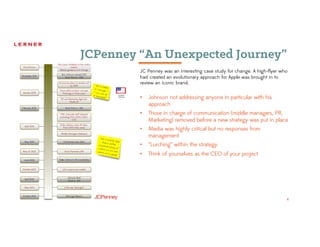
JCPenney “An Unexpected Journey”
4
• Johnson not addressing anyone in particular with his
approach
• Those in charge of communication (middle managers, PR,
Marketing) removed before a new strategy was put in place
• Media was highly critical but no responses from
management
• “Lurching” within the strategy
• Think of yourselves as the CEO of your project
JC Penney was an interesting case study for change. A high-flyer who
had created an evolutionary approach for Apple was brought in to
review an iconic brand.
5
A Journey, not a Destination
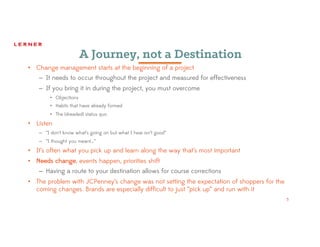
• Change management starts at the beginning of a project
– It needs to occur throughout the project and measured for effectiveness
– If you bring it in during the project, you must overcome
• Objections
• Habits that have already formed
• The (dreaded) status quo
• Listen
– “I don’t know what’s going on but what I hear isn’t good”
– “I thought you meant…”
• It’s often what you pick up and learn along the way that’s most important
• Needs change, events happen, priorities shift
– Having a route to your destination allows for course corrections
• The problem with JCPenney’s change was not setting the expectation of shoppers for the
coming changes. Brands are especially difficult to just “pick up” and run with it
5
6
Growth vs. Transformation
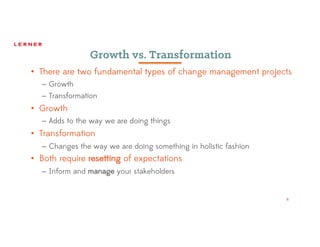
• There are two fundamental types of change management projects
– Growth
– Transformation
• Growth
– Adds to the way we are doing things
• Transformation
– Changes the way we are doing something in holistic fashion
• Both require resetting of expectations
– Inform and manage your stakeholders
6
7
Change via Constructive Disruption
• Start with the root cause of the change
• Technology projects are especially disruptive in nature.
– They break the status quo in order to enable advances
• A method and planned set of communications must be laid
out to enable success
8
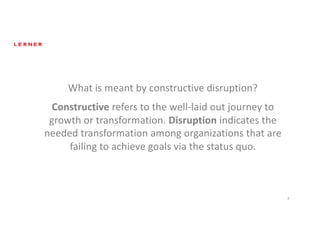
What	is	meant	by	constructive	disruption?	
Constructive refers	to	the	well-laid	out	journey	to	
growth	or	transformation.	Disruption indicates	the	
needed	transformation	among	organizations	that	are	
failing	to	achieve	goals	via	the	status	quo.
9
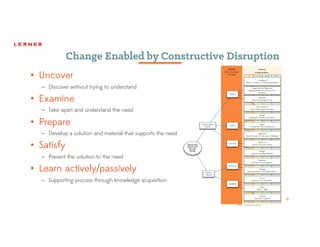
Change Enabled by Constructive Disruption
• Uncover
– Discover without trying to understand
• Examine
– Take apart and understand the need
• Prepare
– Develop a solution and material that supports the need
• Satisfy
– Present the solution to the need
• Learn actively/passively
– Supporting process through knowledge acquisition
9
10
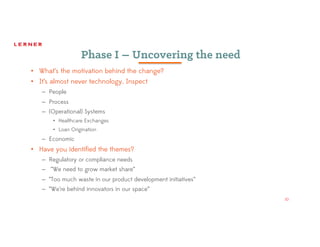
Phase I – Uncovering the need
• What’s the motivation behind the change?
• It’s almost never technology. Inspect
– People
– Process
– (Operational) Systems
• Healthcare Exchanges
• Loan Origination
– Economic
• Have you identified the themes?
– Regulatory or compliance needs
– “We need to grow market share”
– “Too much waste in our product development initiatives”
– “We’re behind innovators in our space”
10
11
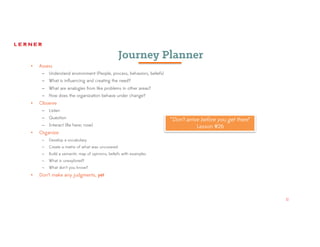
Journey Planner
• Assess
– Understand environment (People, process, behaviors, beliefs)
– What is influencing and creating the need?
– What are analogies from like problems in other areas?
– How does the organization behave under change?
• Observe
– Listen
– Question
– Interact (Be here; now)
• Organize
– Develop a vocabulary
– Create a matrix of what was uncovered
– Build a semantic map of opinions, beliefs with examples
– What is unexplored?
– What don’t you know?
• Don’t make any judgments, yet
11
“Don’t arrive before you get there”
Lesson #26
12
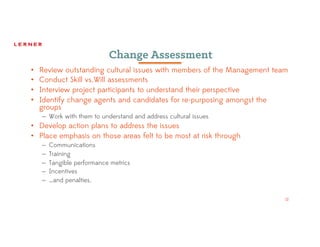
Change Assessment
• Review outstanding cultural issues with members of the Management team
• Conduct Skill vs.Will assessments
• Interview project participants to understand their perspective
• Identify change agents and candidates for re-purposing amongst the
groups
– Work with them to understand and address cultural issues
• Develop action plans to address the issues
• Place emphasis on those areas felt to be most at risk through
– Communications
– Training
– Tangible performance metrics
– Incentives
– …and penalties.
13
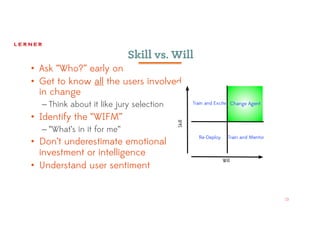
Skill vs. Will
• Ask “Who?” early on
• Get to know all the users involved
in change
– Think about it like jury selection
• Identify the “WIFM”
– “What’s in it for me”
• Don’t underestimate emotional
investment or intelligence
• Understand user sentiment
14
Help Users: “Where do I fit in?”
• Change is the New Normal
• People want to know how they remain relevant
– Penney’s employees didn’t know where they fit in the new order
• Customers were confused
• Inadequate communication and communication mechanisms to the new
customers
• Help the users with “Where do I fit in?”
– Audience engagement – Empower, guide and reward
– Training
– Role redefinition
– Timing
15
Deploy Your Change Agents
• Deploy Change Agents to work on
– Socializing awareness and promoting change
– Encouraging behaviors that support new systems
– Gaining a breakthrough in knowledge
– Altering the current mode of thinking
16
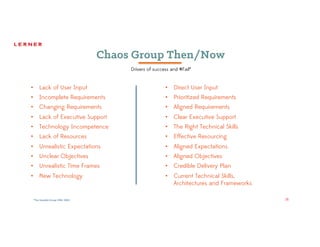
Chaos Group Then/Now
• Lack of User Input
• Incomplete Requirements
• Changing Requirements
• Lack of Executive Support
• Technology Incompetence
• Lack of Resources
• Unrealistic Expectations
• Unclear Objectives
• Unrealistic Time Frames
• New Technology
• Direct User Input
• Prioritized Requirements
• Aligned Requirements
• Clear Executive Support
• The Right Technical Skills
• Effective Resourcing
• Aligned Expectations
• Aligned Objectives
• Credible Delivery Plan
• Current Technical Skills,
Architectures and Frameworks
*The	Standish	Group	1994,	2004
Drivers of success and #Fail*
17
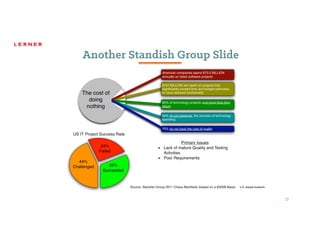
Another Standish Group Slide
17
U.S.-based	research
18
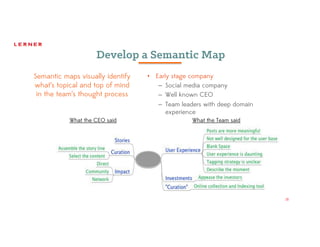
Develop a Semantic Map
What the CEO said What the Team said
• Early stage company
– Social media company
– Well known CEO
– Team leaders with deep domain
experience
Semantic maps visually identify
what’s topical and top of mind
in the team’s thought process
19
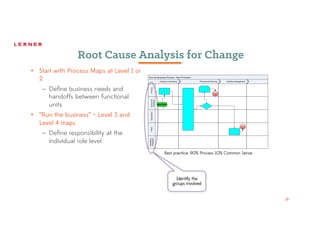
Root Cause Analysis for Change
• Start with Process Maps at Level 1 or
2
– Define business needs and
handoffs between functional
units
• “Run the business” – Level 3 and
Level 4 maps
– Define responsibility at the
individual role level
Best practice: 90% Process 10% Common Sense
Identify the
groups involved
20
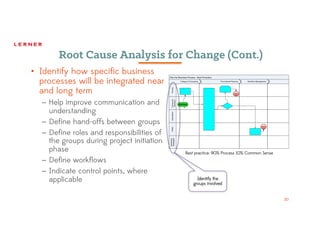
Root Cause Analysis for Change (Cont.)
• Identify how specific business
processes will be integrated near
and long term
– Help improve communication and
understanding
– Define hand-offs between groups
– Define roles and responsibilities of
the groups during project initiation
phase
– Define workflows
– Indicate control points, where
applicable
Best practice: 90% Process 10% Common Sense
Identify the
groups involved
21
Phase II – Examine
• Analyze
– Take apart and categorize
– Discover elements (reduce simplest form)
• Methods
• Properties
• Attributes
– Discover relationships in simplest form
• Isolate and address issues
• Re-organize
– Refine vocabulary and system of classification
(taxonomy)
– Refine relationship map (semantic map)
• Exercise parts of the need
– Examine for consistency in statements, processes
and elements (are they in simplest form possible)
in context of problem statement
– Example consistency in context of larger scope
– Examine outcomes
– Observe and record
• Research
– Find related or useful data, information and
beliefs
– Find related and undiscovered parts of the need
– Combine with data/elements previously
discovered
22
“Influence Only” Change
• Have specific examples to discuss
• Make it about the numbers
• Demonstrate sensitivity
• Work backwards from dates and milestones
• Behavior change is a lot like marketing
– It requires reinforcement
– Frequent messaging
22
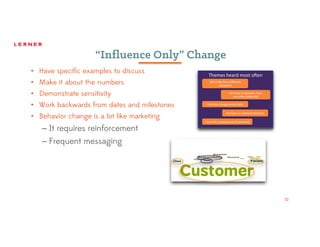
Themes&heard&most&o,en&
We’re&like&three&different&
companies&
We&have&no&direc7on&from&
execu7ve&leadership&
Priori7es&change&almost&daily&
We&have&no&technical&direc7on&
I&love&this&company&and&its&poten7al&
23
Mapping The Change Journey
• Develop a set of internal themes for communicating the reasons and measurements
for change
• All communications should be based and revolve around these central themes
• Identify three to five core measurements by which everything is driven. Sample:
– Reduction of defects: Reduce/remove business impact of defects in Production
– Overall productivity improvements in SDLC = Improvements in Development + QA
– Improved responsiveness to business needs
– Measurably better use of IT resources
– Process improvements
• Identify different stakeholder and ‘at-risk’ groups and develop tailored messages
• Utilize multi-modal communications (presentations, meetings, memos, website, FAQs)
24
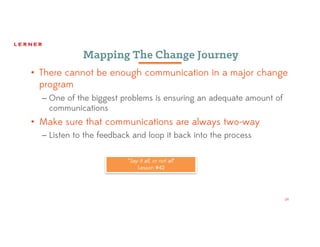
Mapping The Change Journey
• There cannot be enough communication in a major change
program
– One of the biggest problems is ensuring an adequate amount of
communications
• Make sure that communications are always two-way
– Listen to the feedback and loop it back into the process
“Say it all, or not all”
Lesson #42
25
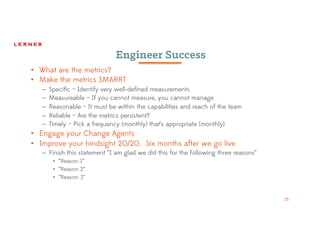
Engineer Success
• What are the metrics?
• Make the metrics SMARRT
– Specific – Identify very well-defined measurements
– Measureable – If you cannot measure, you cannot manage
– Reasonable – It must be within the capabilities and reach of the team
– Reliable – Are the metrics persistent?
– Timely – Pick a frequency (monthly) that’s appropriate (monthly)
• Engage your Change Agents
• Improve your hindsight 20/20. Six months after we go live
– Finish this statement “I am glad we did this for the following three reasons”
• “Reason 1”
• “Reason 2”
• “Reason 3”
26
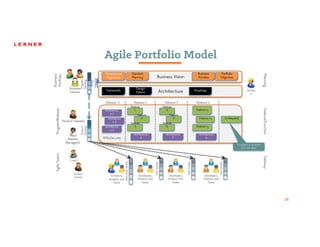
Business
Owners
Product Owner(s)
Release
Manager(s)
Business
Portfolio
Program/Release
Business Vision
Compliance/
Regulatory
Demand
Planning
Architecture
Business
Priorities
Portfolio
Objective
Framework
Design
Pattern
Roadmap
Feature
1
Feature
2
Feature
3
Architectur
e 1
Architectur
e 2
Architectur
e 3
Architecture
4
Feature
4
Feature
5
Feature
6
Architecture
5
Feature n1
Feature n2
Feature n3
Architecture
n1
As Required
Release 1 Release 2 Release nRelease 0
Emergency Release
(on standby)
1
Product
Backlog
Business
Value
1
Program
Backlog
Architects,
Analysts and
Tester
Developers,
Analysts and
Tester
1
UserStories
Developers,
Analysts and
Tester
1
UserStories
Developers,
Analysts and
Tester
1
UserStories
1
TechnicalStories
Product
Owner
Coach
AgileTeams
PlanningFeature/FunctionDelivery
Archite
ct
NFRs/Security
Agile Portfolio Model
26
27
Other Components of Change
• Tie the change initiative to the tangible
– “Greater Good” isn’t enough
– People want to see you/us succeed
• Don’t problem solve alone
– Fix the process not the steps
28
Engaging Others in the Journey
• Take the time to do your journey planning first and
completely.
– While there may be detours in the road, a well thought-out plan
helps you to journey’s end.
• Create a set of themes for external communications. Drive
all your plans from there.
Keeping change alive and on track is more difficult than simply stating the goal. It may seem
counterintuitive but change is not self-sustaining. A necessary plan is equal parts roadmap, process,
technology and systems with well-developed communication themes is necessary. It needs to be
nurtured with active support and management guidance.
If that weren’t the case, incumbents would always be re-elected.
29
Engaging Others in the Journey (Cont.)
• From those themes, identify five key metrics to judge success. If
you cannot do that you will never know how close you are to
journey’s end
• Today’s employees use many modes of communication!
– Mirror them with websites, brown bag lunches
– FAQs
– Internal Instant Message(s)-of-the-day
• Identify different stakeholder and ‘at-risk’ groups and develop
tailored messages.
– All stakeholders must have “a seat at the table.” Ensure you know who
they are.
30
Lessons Learned from Change Management
• The journey is more important than the destination
• Bad decisions can be reversed, slow decisions sow doubt
• Know how your corporate culture thrives during change
• Be firm but not aggressive
– When push comes to shove, management must be willing to step in and
do what’s necessary
• Be sensitive to middle management, they have it coming from
both sides
• Mean what you say, say what you mean
• Say it all or not at all
30
31
Lawrence I Lerner, President
LERNER Consulting
http://www.lawrenceilerner.com
lawrence@lawrenceilerner.com
+1.630.248.0663
@RevInnovator
Contact Us!

Change Management: A Journey Planner

  • 1.
    Change Management forProject Managers A Journey Planner
  • 2.
    1 Overview • Arguably thetwo greatest ideologies of the 20th century were – Management – Globalization • Management enabled us to run businesses in multiple locations and geographies • Globalization changed the way we interact, purchase and think about supply chains • Technology comes into play and is largely successful because of the role it plays as a change agent • These are the catalysts to “Projects” and the change they create 1
  • 3.
    2 Overview (Cont.) • Projectmanagers are often the greatest catalysts for change • Yet they are split or conflicted as to their responsibility • Change activities must go hand-in-hand with delivery elements – Run them in parallel • Not all projects are right for a full change management program 2
  • 4.
    3 3 “It is goodto have an end to journey toward; but it is the journey that matters, in the end.” Ernest Hemingway
  • 5.
    4 JCPenney “An UnexpectedJourney” 4 • Johnson not addressing anyone in particular with his approach • Those in charge of communication (middle managers, PR, Marketing) removed before a new strategy was put in place • Media was highly critical but no responses from management • “Lurching” within the strategy • Think of yourselves as the CEO of your project JC Penney was an interesting case study for change. A high-flyer who had created an evolutionary approach for Apple was brought in to review an iconic brand.
  • 6.
    5 A Journey, nota Destination • Change management starts at the beginning of a project – It needs to occur throughout the project and measured for effectiveness – If you bring it in during the project, you must overcome • Objections • Habits that have already formed • The (dreaded) status quo • Listen – “I don’t know what’s going on but what I hear isn’t good” – “I thought you meant…” • It’s often what you pick up and learn along the way that’s most important • Needs change, events happen, priorities shift – Having a route to your destination allows for course corrections • The problem with JCPenney’s change was not setting the expectation of shoppers for the coming changes. Brands are especially difficult to just “pick up” and run with it 5
  • 7.
    6 Growth vs. Transformation •There are two fundamental types of change management projects – Growth – Transformation • Growth – Adds to the way we are doing things • Transformation – Changes the way we are doing something in holistic fashion • Both require resetting of expectations – Inform and manage your stakeholders 6
  • 8.
    7 Change via ConstructiveDisruption • Start with the root cause of the change • Technology projects are especially disruptive in nature. – They break the status quo in order to enable advances • A method and planned set of communications must be laid out to enable success
  • 9.
  • 10.
    9 Change Enabled byConstructive Disruption • Uncover – Discover without trying to understand • Examine – Take apart and understand the need • Prepare – Develop a solution and material that supports the need • Satisfy – Present the solution to the need • Learn actively/passively – Supporting process through knowledge acquisition 9
  • 11.
    10 Phase I –Uncovering the need • What’s the motivation behind the change? • It’s almost never technology. Inspect – People – Process – (Operational) Systems • Healthcare Exchanges • Loan Origination – Economic • Have you identified the themes? – Regulatory or compliance needs – “We need to grow market share” – “Too much waste in our product development initiatives” – “We’re behind innovators in our space” 10
  • 12.
    11 Journey Planner • Assess –Understand environment (People, process, behaviors, beliefs) – What is influencing and creating the need? – What are analogies from like problems in other areas? – How does the organization behave under change? • Observe – Listen – Question – Interact (Be here; now) • Organize – Develop a vocabulary – Create a matrix of what was uncovered – Build a semantic map of opinions, beliefs with examples – What is unexplored? – What don’t you know? • Don’t make any judgments, yet 11 “Don’t arrive before you get there” Lesson #26
  • 13.
    12 Change Assessment • Reviewoutstanding cultural issues with members of the Management team • Conduct Skill vs.Will assessments • Interview project participants to understand their perspective • Identify change agents and candidates for re-purposing amongst the groups – Work with them to understand and address cultural issues • Develop action plans to address the issues • Place emphasis on those areas felt to be most at risk through – Communications – Training – Tangible performance metrics – Incentives – …and penalties.
  • 14.
    13 Skill vs. Will •Ask “Who?” early on • Get to know all the users involved in change – Think about it like jury selection • Identify the “WIFM” – “What’s in it for me” • Don’t underestimate emotional investment or intelligence • Understand user sentiment
  • 15.
    14 Help Users: “Wheredo I fit in?” • Change is the New Normal • People want to know how they remain relevant – Penney’s employees didn’t know where they fit in the new order • Customers were confused • Inadequate communication and communication mechanisms to the new customers • Help the users with “Where do I fit in?” – Audience engagement – Empower, guide and reward – Training – Role redefinition – Timing
  • 16.
    15 Deploy Your ChangeAgents • Deploy Change Agents to work on – Socializing awareness and promoting change – Encouraging behaviors that support new systems – Gaining a breakthrough in knowledge – Altering the current mode of thinking
  • 17.
    16 Chaos Group Then/Now •Lack of User Input • Incomplete Requirements • Changing Requirements • Lack of Executive Support • Technology Incompetence • Lack of Resources • Unrealistic Expectations • Unclear Objectives • Unrealistic Time Frames • New Technology • Direct User Input • Prioritized Requirements • Aligned Requirements • Clear Executive Support • The Right Technical Skills • Effective Resourcing • Aligned Expectations • Aligned Objectives • Credible Delivery Plan • Current Technical Skills, Architectures and Frameworks *The Standish Group 1994, 2004 Drivers of success and #Fail*
  • 18.
    17 Another Standish GroupSlide 17 U.S.-based research
  • 19.
    18 Develop a SemanticMap What the CEO said What the Team said • Early stage company – Social media company – Well known CEO – Team leaders with deep domain experience Semantic maps visually identify what’s topical and top of mind in the team’s thought process
  • 20.
    19 Root Cause Analysisfor Change • Start with Process Maps at Level 1 or 2 – Define business needs and handoffs between functional units • “Run the business” – Level 3 and Level 4 maps – Define responsibility at the individual role level Best practice: 90% Process 10% Common Sense Identify the groups involved
  • 21.
    20 Root Cause Analysisfor Change (Cont.) • Identify how specific business processes will be integrated near and long term – Help improve communication and understanding – Define hand-offs between groups – Define roles and responsibilities of the groups during project initiation phase – Define workflows – Indicate control points, where applicable Best practice: 90% Process 10% Common Sense Identify the groups involved
  • 22.
    21 Phase II –Examine • Analyze – Take apart and categorize – Discover elements (reduce simplest form) • Methods • Properties • Attributes – Discover relationships in simplest form • Isolate and address issues • Re-organize – Refine vocabulary and system of classification (taxonomy) – Refine relationship map (semantic map) • Exercise parts of the need – Examine for consistency in statements, processes and elements (are they in simplest form possible) in context of problem statement – Example consistency in context of larger scope – Examine outcomes – Observe and record • Research – Find related or useful data, information and beliefs – Find related and undiscovered parts of the need – Combine with data/elements previously discovered
  • 23.
    22 “Influence Only” Change •Have specific examples to discuss • Make it about the numbers • Demonstrate sensitivity • Work backwards from dates and milestones • Behavior change is a lot like marketing – It requires reinforcement – Frequent messaging 22 Themes&heard&most&o,en& We’re&like&three&different& companies& We&have&no&direc7on&from& execu7ve&leadership& Priori7es&change&almost&daily& We&have&no&technical&direc7on& I&love&this&company&and&its&poten7al&
  • 24.
    23 Mapping The ChangeJourney • Develop a set of internal themes for communicating the reasons and measurements for change • All communications should be based and revolve around these central themes • Identify three to five core measurements by which everything is driven. Sample: – Reduction of defects: Reduce/remove business impact of defects in Production – Overall productivity improvements in SDLC = Improvements in Development + QA – Improved responsiveness to business needs – Measurably better use of IT resources – Process improvements • Identify different stakeholder and ‘at-risk’ groups and develop tailored messages • Utilize multi-modal communications (presentations, meetings, memos, website, FAQs)
  • 25.
    24 Mapping The ChangeJourney • There cannot be enough communication in a major change program – One of the biggest problems is ensuring an adequate amount of communications • Make sure that communications are always two-way – Listen to the feedback and loop it back into the process “Say it all, or not all” Lesson #42
  • 26.
    25 Engineer Success • Whatare the metrics? • Make the metrics SMARRT – Specific – Identify very well-defined measurements – Measureable – If you cannot measure, you cannot manage – Reasonable – It must be within the capabilities and reach of the team – Reliable – Are the metrics persistent? – Timely – Pick a frequency (monthly) that’s appropriate (monthly) • Engage your Change Agents • Improve your hindsight 20/20. Six months after we go live – Finish this statement “I am glad we did this for the following three reasons” • “Reason 1” • “Reason 2” • “Reason 3”
  • 27.
    26 Business Owners Product Owner(s) Release Manager(s) Business Portfolio Program/Release Business Vision Compliance/ Regulatory Demand Planning Architecture Business Priorities Portfolio Objective Framework Design Pattern Roadmap Feature 1 Feature 2 Feature 3 Architectur e1 Architectur e 2 Architectur e 3 Architecture 4 Feature 4 Feature 5 Feature 6 Architecture 5 Feature n1 Feature n2 Feature n3 Architecture n1 As Required Release 1 Release 2 Release nRelease 0 Emergency Release (on standby) 1 Product Backlog Business Value 1 Program Backlog Architects, Analysts and Tester Developers, Analysts and Tester 1 UserStories Developers, Analysts and Tester 1 UserStories Developers, Analysts and Tester 1 UserStories 1 TechnicalStories Product Owner Coach AgileTeams PlanningFeature/FunctionDelivery Archite ct NFRs/Security Agile Portfolio Model 26
  • 28.
    27 Other Components ofChange • Tie the change initiative to the tangible – “Greater Good” isn’t enough – People want to see you/us succeed • Don’t problem solve alone – Fix the process not the steps
  • 29.
    28 Engaging Others inthe Journey • Take the time to do your journey planning first and completely. – While there may be detours in the road, a well thought-out plan helps you to journey’s end. • Create a set of themes for external communications. Drive all your plans from there. Keeping change alive and on track is more difficult than simply stating the goal. It may seem counterintuitive but change is not self-sustaining. A necessary plan is equal parts roadmap, process, technology and systems with well-developed communication themes is necessary. It needs to be nurtured with active support and management guidance. If that weren’t the case, incumbents would always be re-elected.
  • 30.
    29 Engaging Others inthe Journey (Cont.) • From those themes, identify five key metrics to judge success. If you cannot do that you will never know how close you are to journey’s end • Today’s employees use many modes of communication! – Mirror them with websites, brown bag lunches – FAQs – Internal Instant Message(s)-of-the-day • Identify different stakeholder and ‘at-risk’ groups and develop tailored messages. – All stakeholders must have “a seat at the table.” Ensure you know who they are.
  • 31.
    30 Lessons Learned fromChange Management • The journey is more important than the destination • Bad decisions can be reversed, slow decisions sow doubt • Know how your corporate culture thrives during change • Be firm but not aggressive – When push comes to shove, management must be willing to step in and do what’s necessary • Be sensitive to middle management, they have it coming from both sides • Mean what you say, say what you mean • Say it all or not at all 30
  • 32.
    31 Lawrence I Lerner,President LERNER Consulting http://www.lawrenceilerner.com lawrence@lawrenceilerner.com +1.630.248.0663 @RevInnovator Contact Us!