
University of Wisconsin-Madison
Evening MBA
Strategic Leadership MHR 765
Session Eleven
Paul Gibbons, BS, MA, MSc
Future Considerations LLC
Gibbons Associates LLP
June 21, 2010
My background
• UW graduate
• 10 years as investment banker or derivatives expert on Wall

Street
• 8 years at PwC as change ‘guru’ (innovation/ change/
leadership/ learning organizations/ transformation)
• 9 years founding and running my own change management
consulting firm

• www.futureconsiderations.com
• www.paulgibbons.net
• Paul@paulgibbons.net

© 2010 Paul Gibbons
Today’s agenda
• Introduction to Change Management
• Concept overview
• Break
• Tools and practice
• Questions/ discussion

18:15 - 18:30
18:30 – 19:30
19:30 – 19:45
19:45 – 20:00
20:00 – 20:30

© 2010 Paul Gibbons
Introduction to Change Management
Change Challenges
• 70% of mergers fail to deliver expected
•
•
•
•
•

shareholder value*
60 – 80% of re-engineering efforts fail*
Reports in drawers
Strategies on shelves
Shhhh…. Don’t mention Project Phoenix…
Hundred million dollar overruns

To be taken with a grain of salt! However, the US M&A market ALONE
was about $1.7 trillion in 2007 so even if out by a factor of 2…
© 2010 Paul Gibbons
Change Management
• Vast academic subject
• Two year Masters program
• Five year PhD program
• Substantial even for practitioners
• PwC: 5 – day, 2 – day, 4 – day and 4 – day for basics
• Why so hard?

© 2010 Paul Gibbons
Thought exercise
• Think about a personal change (diet, lifestyle,

relationship status, employment status)
• Human psychological frailty

• Think about a change to a small system (family,

community)
• Social system resistance

• Think about a change to a business (say a merger)
• Social and technical system resistance

• Think about a change to an ecosystem (multiple

businesses, state and federal government, diverse
communities, mixed ideologies…)
• All of the above plus political and ideological

© 2010 Paul Gibbons
Definitions
• Change management is a structured approach to transitioning

individuals, teams, and organizations from a current state to a
desired future state. ...
• Activities involved in (1) defining and instilling new values,

attitudes, norms, and behaviors within an organization that
support new ways of doing work and overcome resistance to
change; (2) building consensus among customers and
stakeholders on specific changes designed to better meet
their ...
• WARNING…. some people mean this…
 The change management process in systems engineering is the process of

requesting, determining attainability, planning, implementing, and evaluating
of changes to a system. ...

© 2010 Paul Gibbons
Key concepts
• Resilience
• Resistance
• Stakeholder
• Involvement
• Complexity

© 2010 Paul Gibbons
Resilience
Resilience: definition
• Resilience in psychology is the positive

capacity of people to cope with stress
and catastrophe. It also includes the
ability to bounce back to homeostasis
after a disruption. ...

© 2010 Paul Gibbons
Why resilience is important
• Whether you are CEO, VP, middle manager, new hire,

or administrator, how you respond emotionally to
change will determine (at the very least) your level of
enjoyment/ happiness/ satisfaction and your
performance…
• BUT, as senior change leader, the effect of your

mood, disposition, orientation (how you are handling
stress) will be multiplied many many times over
Why?

© 2010 Paul Gibbons
Developing resilience #1
• ‘Inside job’
 Don’t sweat the small stuff
 Grant me the serenity to accept the things… courage to change the

things…wisdom to know the difference
• ‘Western’… Change is:
 Personally difficult, conflict ridden, stressful
 Elizabeth Kubler-Ross on grieving/ loss
 Inventory of ‘stressors’ (divorce, death, birth, becoming rich,

becoming poor)
• ‘Eastern’… life is all change
 ‘You can never step in the same river twice’ (Heraclitus)
 All is flux, cycles, ebbs and flows
 Permanence is an illusion
 Attachment to status quo is what makes life difficult

© 2010 Paul Gibbons
Developing resilience #2
• Support
 Things that enhance personal well-being
 Aristotle’s ‘friendship of virtue’ – friends don’t ‘co-sign your BS’
(they challenge, tell you the truth)
• Question:
 What sort of support mechanisms do you have?
 What do you need to remember to do?

© 2010 Paul Gibbons
Resistance
Structure of resistance
 Individual






Rational/ analytical
Social (friendships, communities, solidarity)
Political (alliances, coalitions, power, control)
Ideological (ethics, worldview, religion)
Emotional (loss, anxiety, resentment)

 Group
 Culture (norms, values, unwritten rules)
 Authority structures/ leader attitudes/ behaviour
 Group dynamics (group think, in-group, Abilene…)

 Systemic
 “Hard” aspects of system that determine behaviour (reward,

structure, processes, systems, etc)

© 2010 Paul Gibbons
Symptoms of resistance
• Distancing
 Missing meetings/ un-returned calls
 Missing deadlines, breaking agreements
 Denial, “checking out” – emotional distancing
 Absenteeism/ turnover

• Dissent
 Overt disagreement – disputation, argumentation
 Covert disagreement – gossip, slander, rumour, dishonesty
 Organised resistance – strikes, union intervention

• Delay
 Intentional slowdown (like filibuster)
 Prevarication (endless discussion & planning)
 Procrastination

• Destruction
 Sabotage

© 2010 Paul Gibbons
Dealing with resistance
• Complicated, not one size fits all
• Appreciate perspective: Shopfloor doesn’t care about an extra .5%

ROI!
• It rarely works to steamroller over people and groups unless you

have a very big stick
• Engage, engage, engage

• If it isn’t rational, then more facts and analysis won’t help
• Most change is under communicated by a factor of ten (Kotter)
• High-touch communication essential for people/ groups with

power (not posters, emails…)
• Keep your friends close, but your enemies closer (Lao Tzu, Vito
Corleone, Machiavelli or Tony Soprano)

© 2010 Paul Gibbons
Stakeholder
Stakeholder
• Someone who will benefit from, be harmed by, or take

an interest in…
 When change fails, it is often the case that a powerful

stakeholder or stakeholder group has been neglected, or
alienated

• The stakeholder map is the simplest and most

underused change tool…
• Once mapped, then…
 How much power do they have?
 How much do they benefit (harmed)?
 How do they feel now? How do we need them to feel? By

when?
 What influence strategies need to be used?
© 2010 Paul Gibbons
The commitment curve
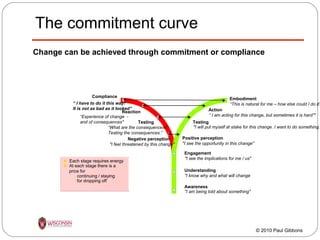
Change can be achieved through commitment or compliance

Compliance
“ I have to do it this way!
It is not as bad as it looked”
Reaction
“Experience of change and of consequences"
Testing
“What are the consequences?
Testing the consequences.”
Negative perception
"I feel threatened by this change"

 Each stage requires energy
 At each stage there is a
price for
–continuing / staying
–for dropping off

Embodiment
“This is natural for me – how else could I do it?
Action
“ I am acting for this change, but sometimes it is hard”"

Testing
"I will put myself at stake for this change. I want to do something."
Positive perception
"I see the opportunity in this change"
Engagement
"I see the implications for me / us"
Understanding
"I know why and what will change
Awareness
"I am being told about something"

© 2010 Paul Gibbons
Involvement
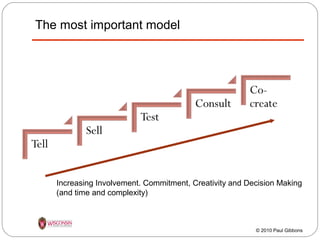
The most important model

Increasing Involvement. Commitment, Creativity and Decision Making
(and time and complexity)

© 2010 Paul Gibbons
Complexity
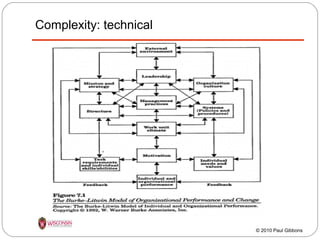
Complexity: technical

© 2010 Paul Gibbons
Complexity: dynamic
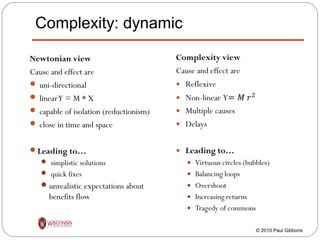
Newtonian view
Cause and effect are
 uni-directional
 linear Y = M * X
 capable of isolation (reductionism)
 close in time and space
Leading to…
 simplistic solutions
 quick fixes

 unrealistic expectations about

benefits flow

© 2010 Paul Gibbons
Complexity: social complexity
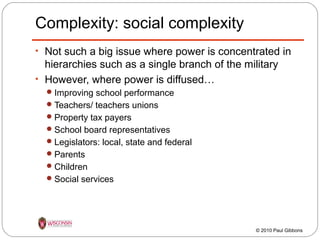
• Not such a big issue where power is concentrated in

hierarchies such as a single branch of the military
• However, where power is diffused…
 Improving school performance
 Teachers/ teachers unions
 Property tax payers
 School board representatives
 Legislators: local, state and federal
 Parents
 Children
 Social services

© 2010 Paul Gibbons
Complexity: take-away
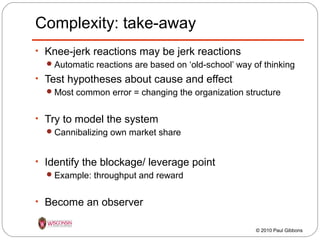
• Knee-jerk reactions may be jerk reactions
 Automatic reactions are based on ‘old-school’ way of thinking
• Test hypotheses about cause and effect
 Most common error = changing the organization structure
• Try to model the system
 Cannibalizing own market share
• Identify the blockage/ leverage point
 Example: throughput and reward
• Become an observer
© 2010 Paul Gibbons
Practice
Practice
• Identify key stakeholders
• Prioritize 3-5
• Analyze (power, benefits, risks)
• Resistance: why might they?
• How do they see the situation?
• Do I need commitment or compliance? How much?

What can I afford? What happens if I’m wrong
(risks)?
• Involvement
• To gain commitment, which approach is appropriate?

© 2010 Paul Gibbons
Discussion
• Identify key themes and learning with neighbor
• Come up with two questions..

© 2010 Paul Gibbons
Further questions?
• Paul Gibbons
 Leading and managing change
 Leadership development
 Innovation
 Culture change
 Coaching
• paul@paulgibbons.net
• +1 608 512 5916

© 2010 Paul Gibbons

Introduction to Change Management for MBAs

  • 1.
    University of Wisconsin-Madison EveningMBA Strategic Leadership MHR 765 Session Eleven Paul Gibbons, BS, MA, MSc Future Considerations LLC Gibbons Associates LLP June 21, 2010
  • 2.
    My background • UWgraduate • 10 years as investment banker or derivatives expert on Wall Street • 8 years at PwC as change ‘guru’ (innovation/ change/ leadership/ learning organizations/ transformation) • 9 years founding and running my own change management consulting firm • www.futureconsiderations.com • www.paulgibbons.net • Paul@paulgibbons.net © 2010 Paul Gibbons
  • 3.
    Today’s agenda • Introductionto Change Management • Concept overview • Break • Tools and practice • Questions/ discussion 18:15 - 18:30 18:30 – 19:30 19:30 – 19:45 19:45 – 20:00 20:00 – 20:30 © 2010 Paul Gibbons
  • 4.
  • 5.
    Change Challenges • 70%of mergers fail to deliver expected • • • • • shareholder value* 60 – 80% of re-engineering efforts fail* Reports in drawers Strategies on shelves Shhhh…. Don’t mention Project Phoenix… Hundred million dollar overruns To be taken with a grain of salt! However, the US M&A market ALONE was about $1.7 trillion in 2007 so even if out by a factor of 2… © 2010 Paul Gibbons
  • 6.
    Change Management • Vastacademic subject • Two year Masters program • Five year PhD program • Substantial even for practitioners • PwC: 5 – day, 2 – day, 4 – day and 4 – day for basics • Why so hard? © 2010 Paul Gibbons
  • 7.
    Thought exercise • Thinkabout a personal change (diet, lifestyle, relationship status, employment status) • Human psychological frailty • Think about a change to a small system (family, community) • Social system resistance • Think about a change to a business (say a merger) • Social and technical system resistance • Think about a change to an ecosystem (multiple businesses, state and federal government, diverse communities, mixed ideologies…) • All of the above plus political and ideological © 2010 Paul Gibbons
  • 8.
    Definitions • Change managementis a structured approach to transitioning individuals, teams, and organizations from a current state to a desired future state. ... • Activities involved in (1) defining and instilling new values, attitudes, norms, and behaviors within an organization that support new ways of doing work and overcome resistance to change; (2) building consensus among customers and stakeholders on specific changes designed to better meet their ... • WARNING…. some people mean this…  The change management process in systems engineering is the process of requesting, determining attainability, planning, implementing, and evaluating of changes to a system. ... © 2010 Paul Gibbons
  • 9.
    Key concepts • Resilience •Resistance • Stakeholder • Involvement • Complexity © 2010 Paul Gibbons
  • 10.
  • 11.
    Resilience: definition • Resiliencein psychology is the positive capacity of people to cope with stress and catastrophe. It also includes the ability to bounce back to homeostasis after a disruption. ... © 2010 Paul Gibbons
  • 12.
    Why resilience isimportant • Whether you are CEO, VP, middle manager, new hire, or administrator, how you respond emotionally to change will determine (at the very least) your level of enjoyment/ happiness/ satisfaction and your performance… • BUT, as senior change leader, the effect of your mood, disposition, orientation (how you are handling stress) will be multiplied many many times over Why? © 2010 Paul Gibbons
  • 13.
    Developing resilience #1 •‘Inside job’  Don’t sweat the small stuff  Grant me the serenity to accept the things… courage to change the things…wisdom to know the difference • ‘Western’… Change is:  Personally difficult, conflict ridden, stressful  Elizabeth Kubler-Ross on grieving/ loss  Inventory of ‘stressors’ (divorce, death, birth, becoming rich, becoming poor) • ‘Eastern’… life is all change  ‘You can never step in the same river twice’ (Heraclitus)  All is flux, cycles, ebbs and flows  Permanence is an illusion  Attachment to status quo is what makes life difficult © 2010 Paul Gibbons
  • 14.
    Developing resilience #2 •Support  Things that enhance personal well-being  Aristotle’s ‘friendship of virtue’ – friends don’t ‘co-sign your BS’ (they challenge, tell you the truth) • Question:  What sort of support mechanisms do you have?  What do you need to remember to do? © 2010 Paul Gibbons
  • 15.
  • 16.
    Structure of resistance Individual      Rational/ analytical Social (friendships, communities, solidarity) Political (alliances, coalitions, power, control) Ideological (ethics, worldview, religion) Emotional (loss, anxiety, resentment)  Group  Culture (norms, values, unwritten rules)  Authority structures/ leader attitudes/ behaviour  Group dynamics (group think, in-group, Abilene…)  Systemic  “Hard” aspects of system that determine behaviour (reward, structure, processes, systems, etc) © 2010 Paul Gibbons
  • 17.
    Symptoms of resistance •Distancing  Missing meetings/ un-returned calls  Missing deadlines, breaking agreements  Denial, “checking out” – emotional distancing  Absenteeism/ turnover • Dissent  Overt disagreement – disputation, argumentation  Covert disagreement – gossip, slander, rumour, dishonesty  Organised resistance – strikes, union intervention • Delay  Intentional slowdown (like filibuster)  Prevarication (endless discussion & planning)  Procrastination • Destruction  Sabotage © 2010 Paul Gibbons
  • 18.
    Dealing with resistance •Complicated, not one size fits all • Appreciate perspective: Shopfloor doesn’t care about an extra .5% ROI! • It rarely works to steamroller over people and groups unless you have a very big stick • Engage, engage, engage • If it isn’t rational, then more facts and analysis won’t help • Most change is under communicated by a factor of ten (Kotter) • High-touch communication essential for people/ groups with power (not posters, emails…) • Keep your friends close, but your enemies closer (Lao Tzu, Vito Corleone, Machiavelli or Tony Soprano) © 2010 Paul Gibbons
  • 19.
  • 20.
    Stakeholder • Someone whowill benefit from, be harmed by, or take an interest in…  When change fails, it is often the case that a powerful stakeholder or stakeholder group has been neglected, or alienated • The stakeholder map is the simplest and most underused change tool… • Once mapped, then…  How much power do they have?  How much do they benefit (harmed)?  How do they feel now? How do we need them to feel? By when?  What influence strategies need to be used? © 2010 Paul Gibbons
  • 21.
    The commitment curve Changecan be achieved through commitment or compliance Compliance “ I have to do it this way! It is not as bad as it looked” Reaction “Experience of change and of consequences" Testing “What are the consequences? Testing the consequences.” Negative perception "I feel threatened by this change"  Each stage requires energy  At each stage there is a price for –continuing / staying –for dropping off Embodiment “This is natural for me – how else could I do it? Action “ I am acting for this change, but sometimes it is hard”" Testing "I will put myself at stake for this change. I want to do something." Positive perception "I see the opportunity in this change" Engagement "I see the implications for me / us" Understanding "I know why and what will change Awareness "I am being told about something" © 2010 Paul Gibbons
  • 22.
  • 23.
    The most importantmodel Increasing Involvement. Commitment, Creativity and Decision Making (and time and complexity) © 2010 Paul Gibbons
  • 24.
  • 25.
  • 26.
    Complexity: dynamic Newtonian view Causeand effect are  uni-directional  linear Y = M * X  capable of isolation (reductionism)  close in time and space Leading to…  simplistic solutions  quick fixes  unrealistic expectations about benefits flow © 2010 Paul Gibbons
  • 27.
    Complexity: social complexity •Not such a big issue where power is concentrated in hierarchies such as a single branch of the military • However, where power is diffused…  Improving school performance  Teachers/ teachers unions  Property tax payers  School board representatives  Legislators: local, state and federal  Parents  Children  Social services © 2010 Paul Gibbons
  • 28.
    Complexity: take-away • Knee-jerkreactions may be jerk reactions  Automatic reactions are based on ‘old-school’ way of thinking • Test hypotheses about cause and effect  Most common error = changing the organization structure • Try to model the system  Cannibalizing own market share • Identify the blockage/ leverage point  Example: throughput and reward • Become an observer © 2010 Paul Gibbons
  • 29.
  • 30.
    Practice • Identify keystakeholders • Prioritize 3-5 • Analyze (power, benefits, risks) • Resistance: why might they? • How do they see the situation? • Do I need commitment or compliance? How much? What can I afford? What happens if I’m wrong (risks)? • Involvement • To gain commitment, which approach is appropriate? © 2010 Paul Gibbons
  • 31.
    Discussion • Identify keythemes and learning with neighbor • Come up with two questions.. © 2010 Paul Gibbons
  • 32.
    Further questions? • PaulGibbons  Leading and managing change  Leadership development  Innovation  Culture change  Coaching • paul@paulgibbons.net • +1 608 512 5916 © 2010 Paul Gibbons