Change Management The Cornerstone for Effective CRM Deployment
When you say C hange,  they say: “ This is a waste of time.”  “ Why change if it was working just fine before?”  “ If it ain't broke, don't fix it.”  “ They never tell us what’s going on!”  “ How soon will this happen?”  “ How will this impact me?”  “ Will I receive new training?” “ What’s in it for me.”  “ I doubt they are really serious about this.”  Natural reaction to change: R esist Awareness  of need to change: critical ingredient and must come   first
‘ Service-change’ and CRM projects are all about culture, ownership, control and resistance, direction, management, vision, communications, structure, process and  people… people… people. Resource:  A Practical Guide to CRM Background, Business Case & Case Studies  Our Ref e2e/reviews/BR131101   Prepared by Richard Parkinson Barclay Rae e2e Customer Services Ltd
1. Why change management is crucial to the success of your CRM project. 2. How to successfully use change management while focusing on the behaviors and attitudes to create champions of change. 3. Identification of the key components of change management  4. Components of an effective change plan: time lines, resources required,  communication processes, documentation, and acceptance criteria.
Before Embarking on Change Align the change with the company’s strategy Understand what you’re likely to achieve  Ensure executives committed to achieving change Verify there are sufficient resources Assess need for external help, find outside resources “ Change management is crucial to the success of any change effort.”
Key Components for Success Formalizing the process  Defining the change program  Establishing a formal management structure Communicating to the appropriate stakeholders Involving people frequently to create champions of change  “ Don’t build it in a box alone”
Project Team Executive Sponsors Management Team Project Manager / Project Assistant Change Manager USERS!! Outside clients Key stakeholders Partners / vendors Database administrators IT!!  (Technicians, engineers, system administrators, etc.) Help Desk and Call Center Users Auditing / quality control manager “ Not in handout”
Business  Dimension of Change Elements of the business dimension of Change:   Business need or opportunity is identified  Project is defined (scope and objectives) Proper management team is put in place  Risks, costs and business impacts are addressed
Business  Dimension of Change Elements of the business dimension of change:   Business solution is designed (new processes, systems, and organizational structure)  New processes and systems are developed  Solution is implemented into the organization
People   Dimension of Change   Effective management of the people dimension of change requires managing five key phases:  Awareness  of the need for change  Desire  to make the change happen  Knowledge  about how to change  Ability  to implement new skills and behaviors  Reinforcement  to retain the change once it has been made  Research shows that problems with this dimension of change is the most commonly cited reason for project failures.  In a study with 248 companies, effective change management with employees was listed as one of the top-three overall success factors for the project.  Helping managers be effective sponsors of change was considered the most critical success factor overall.  “ ADKAR”
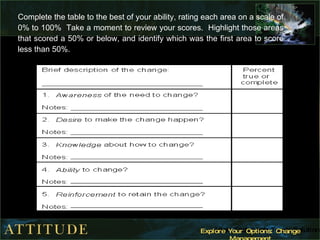
Now it's your turn Apply it to a personal situation that you are personally close to. 1. Identify a change you are having difficulty making in another person (friend, family member or work associate), that is not working regardless of your continued efforts.  2. Briefly describe the personal change you are trying to implement:  3. Answer and assign a score for the following questions.  Awareness.  List the reasons you believe the change is necessary. Review these reasons and rate the degree to which the person you are trying to change is aware of the reasons or need to change (0% - 100%).  Desire.  List the factors or consequences (good and bad) for this person that create a desire to change. Consider these motivating factors, including the person’s conviction in these factors and the associated consequences. Rate his/her desire to change (0% - 100%).  Knowledge . List the skills and knowledge needed to support the change, including if the person has a clear picture of what the change looks like. Rate this person’s knowledge or level of training in these areas (0% - 100%).   Ability . Considering the skills and knowledge identified in the previous question, evaluate the person’s ability to perform these skills or act on this knowledge. To what percent do you rate this person’s ability to implement the new skills, knowledge and behaviors to support the change (0% - 100%)?  Reinforcement . List the reinforcements that will help to retain the change. Are incentives in place to reinforce the change and make it stick? To what percent do you rate the reinforcements as helping support the change (0% - 100%)?
Complete the table to the best of your ability, rating each area on a scale of 0% to 100%  Take a moment to review your scores.  Highlight those areas that scored a 50% or below, and identify which was the first area to score less than 50%.
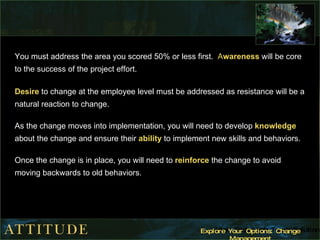
You must address the area you scored 50% or less first.  A wareness   will be core to the success of the project effort. Desire  to change at the employee level must be addressed as resistance will be a natural reaction to change.  As the change moves into implementation, you will need to develop  knowledge  about the change and ensure their  ability  to implement new skills and behaviors. Once the change is in place, you will need to  reinforce  the change to avoid moving backwards to old behaviors.
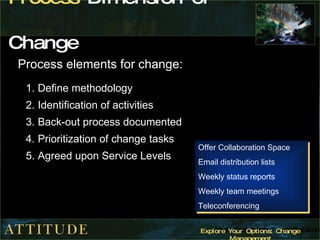
Process  Dimension of Change   Process elements for change:  Define methodology Identification of activities Back-out process documented Prioritization of change tasks Agreed upon Service Levels Offer Collaboration Space Email distribution lists Weekly status reports Weekly team meetings Teleconferencing
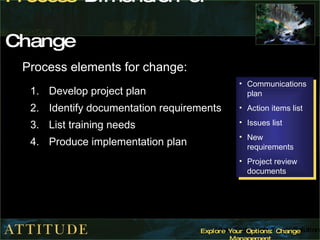
Process  Dimension of Change   Process elements for change:  Develop project plan Identify documentation requirements  List training needs Produce implementation plan Communications plan Action items list Issues list New requirements Project review documents
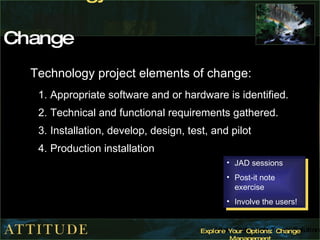
Technology  Dimension of Change Technology project elements of change: Appropriate software and or hardware is identified.  Technical and functional requirements gathered.  Installation, develop, design, test, and pilot  Production installation JAD sessions Post-it note exercise Involve the users!
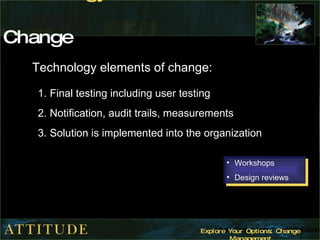
Technology  Dimension of Change Technology elements of change: Final testing including user testing Notification, audit trails, measurements Solution is implemented into the organization  Workshops Design reviews
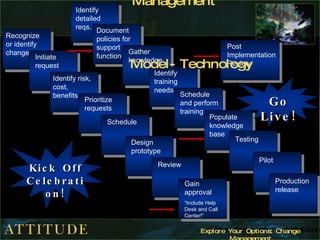
Change Management  Model- Technology Recognize or identify change Initiate request Identify risk, cost, benefits Prioritize requests Schedule Design prototype  Review Gain approval “ Include Help Desk and Call Center!” Identify detailed reqs. Document policies for support function Gather knowledge Identify training needs Schedule and perform training Populate knowledge base Testing Pilot Production release Post Implementation Review Kick Off Celebration! Go Live!
Roadmap to Change
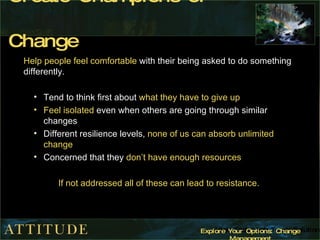
Create Champions of Change Help people feel comfortable  with their being asked to do something differently. Tend to think first about  what they have to give up Feel isolated  even when others are going through similar changes Different resilience levels,  none of us can absorb unlimited change Concerned that they  don’t have enough resources If not addressed all of these can lead to resistance.
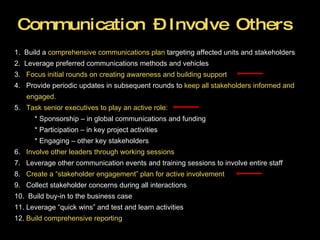
Communication – Involve Others 1.   Build a  comprehensive communications plan  targeting affected units and stakeholders 2.  Leverage preferred communications methods and vehicles 3.  Focus initial rounds on creating awareness and building support 4.  Provide periodic updates in subsequent rounds to  keep all stakeholders informed and engaged. 5.  Task senior executives to play an active role: * Sponsorship – in global communications and funding * Participation – in key project activities * Engaging – other key stakeholders 6.  Involve other leaders through working sessions  7.  Leverage other communication events and training sessions to involve entire staff 8.  Create a “stakeholder engagement” plan for active involvement  9.  Collect stakeholder concerns during all interactions 10.  Build buy-in to the business case 11. Leverage “quick wins” and test and learn activities 12.  Build comprehensive reporting
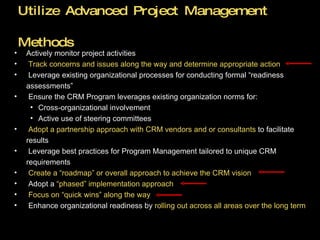
Utilize Advanced Project Management Methods Actively monitor project activities  Track concerns and issues along the way and determine appropriate action Leverage existing organizational processes for conducting formal “readiness  assessments” Ensure the CRM Program leverages existing organization norms for: Cross-organizational involvement  Active use of steering committees Adopt a partnership approach with CRM vendors and or consultants  to facilitate results Leverage best practices for Program Management tailored to unique CRM requirements Create a “roadmap” or overall approach to achieve the CRM vision Adopt a  “phased” implementation approach Focus on “quick wins” along the way Enhance organizational readiness by  rolling out across all areas over the long term
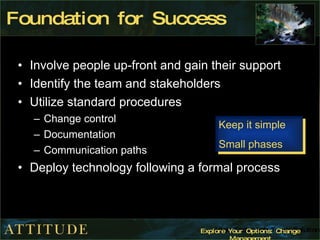
Foundation for Success Involve people up-front and gain their support Identify the team and stakeholders Utilize standard procedures Change control Documentation Communication paths Deploy technology following a formal process Keep it simple Small phases
“ If you're not riding the wave of change... you'll find yourself beneath it."
HTHTS’ Newsletter “ eSharings ”   Exclusive Help Desk and Call Center professional’s newsletter, ad exempt * , loaded with resources & tips. Just email solutions@hthts.com or visit www.hthts.com * If there is an event we think you should know about, we do include those.
Industry Newsletters Help Desk Northwest Just email memberships@hdnw.org Northwest Call Center Professionals Just email nwccp@hthts.com
Ivy Meadors High Tech High Touch Solutions, Inc. Business Consultant, Speaker, Writer  [email_address] www.hthts.com (425) 398-9292
CRM Guides www.ismguide.com
www.crm-toolkit.com/ www.crm-toolkit.com/SamplePlans.html www.projectconnections.com/knowhow/template_list/newformat/samples/CommunicationsPlan.doc www.iodinc.com/tools.php3 www.pfdf.org/leaderbooks/l2l/spring2000/bridges.html www.ncrel.org/sdrs/areas/issues/educatrs/leadrshp/le5spark.htm www.crmproject.com/document.asp?d_id=2198 www.projectconnections.com www.crm-toolkit.com “ Not in handout”

Change Management 2004

  • 1.
    Change Management TheCornerstone for Effective CRM Deployment
  • 2.
    When you sayC hange, they say: “ This is a waste of time.” “ Why change if it was working just fine before?” “ If it ain't broke, don't fix it.” “ They never tell us what’s going on!” “ How soon will this happen?” “ How will this impact me?” “ Will I receive new training?” “ What’s in it for me.” “ I doubt they are really serious about this.” Natural reaction to change: R esist Awareness of need to change: critical ingredient and must come first
  • 3.
    ‘ Service-change’ andCRM projects are all about culture, ownership, control and resistance, direction, management, vision, communications, structure, process and people… people… people. Resource: A Practical Guide to CRM Background, Business Case & Case Studies Our Ref e2e/reviews/BR131101   Prepared by Richard Parkinson Barclay Rae e2e Customer Services Ltd
  • 4.
    1. Why changemanagement is crucial to the success of your CRM project. 2. How to successfully use change management while focusing on the behaviors and attitudes to create champions of change. 3. Identification of the key components of change management 4. Components of an effective change plan: time lines, resources required, communication processes, documentation, and acceptance criteria.
  • 5.
    Before Embarking onChange Align the change with the company’s strategy Understand what you’re likely to achieve Ensure executives committed to achieving change Verify there are sufficient resources Assess need for external help, find outside resources “ Change management is crucial to the success of any change effort.”
  • 6.
    Key Components forSuccess Formalizing the process Defining the change program Establishing a formal management structure Communicating to the appropriate stakeholders Involving people frequently to create champions of change “ Don’t build it in a box alone”
  • 7.
    Project Team ExecutiveSponsors Management Team Project Manager / Project Assistant Change Manager USERS!! Outside clients Key stakeholders Partners / vendors Database administrators IT!! (Technicians, engineers, system administrators, etc.) Help Desk and Call Center Users Auditing / quality control manager “ Not in handout”
  • 8.
    Business Dimensionof Change Elements of the business dimension of Change: Business need or opportunity is identified Project is defined (scope and objectives) Proper management team is put in place Risks, costs and business impacts are addressed
  • 9.
    Business Dimensionof Change Elements of the business dimension of change: Business solution is designed (new processes, systems, and organizational structure) New processes and systems are developed Solution is implemented into the organization
  • 10.
    People Dimension of Change Effective management of the people dimension of change requires managing five key phases: Awareness of the need for change Desire to make the change happen Knowledge about how to change Ability to implement new skills and behaviors Reinforcement to retain the change once it has been made Research shows that problems with this dimension of change is the most commonly cited reason for project failures. In a study with 248 companies, effective change management with employees was listed as one of the top-three overall success factors for the project. Helping managers be effective sponsors of change was considered the most critical success factor overall. “ ADKAR”
  • 11.
    Now it's yourturn Apply it to a personal situation that you are personally close to. 1. Identify a change you are having difficulty making in another person (friend, family member or work associate), that is not working regardless of your continued efforts. 2. Briefly describe the personal change you are trying to implement: 3. Answer and assign a score for the following questions. Awareness. List the reasons you believe the change is necessary. Review these reasons and rate the degree to which the person you are trying to change is aware of the reasons or need to change (0% - 100%). Desire. List the factors or consequences (good and bad) for this person that create a desire to change. Consider these motivating factors, including the person’s conviction in these factors and the associated consequences. Rate his/her desire to change (0% - 100%). Knowledge . List the skills and knowledge needed to support the change, including if the person has a clear picture of what the change looks like. Rate this person’s knowledge or level of training in these areas (0% - 100%). Ability . Considering the skills and knowledge identified in the previous question, evaluate the person’s ability to perform these skills or act on this knowledge. To what percent do you rate this person’s ability to implement the new skills, knowledge and behaviors to support the change (0% - 100%)? Reinforcement . List the reinforcements that will help to retain the change. Are incentives in place to reinforce the change and make it stick? To what percent do you rate the reinforcements as helping support the change (0% - 100%)?
  • 12.
    Complete the tableto the best of your ability, rating each area on a scale of 0% to 100% Take a moment to review your scores. Highlight those areas that scored a 50% or below, and identify which was the first area to score less than 50%.
  • 13.
    You must addressthe area you scored 50% or less first. A wareness will be core to the success of the project effort. Desire to change at the employee level must be addressed as resistance will be a natural reaction to change. As the change moves into implementation, you will need to develop knowledge about the change and ensure their ability to implement new skills and behaviors. Once the change is in place, you will need to reinforce the change to avoid moving backwards to old behaviors.
  • 14.
    Process Dimensionof Change Process elements for change: Define methodology Identification of activities Back-out process documented Prioritization of change tasks Agreed upon Service Levels Offer Collaboration Space Email distribution lists Weekly status reports Weekly team meetings Teleconferencing
  • 15.
    Process Dimensionof Change Process elements for change: Develop project plan Identify documentation requirements List training needs Produce implementation plan Communications plan Action items list Issues list New requirements Project review documents
  • 16.
    Technology Dimensionof Change Technology project elements of change: Appropriate software and or hardware is identified. Technical and functional requirements gathered. Installation, develop, design, test, and pilot Production installation JAD sessions Post-it note exercise Involve the users!
  • 17.
    Technology Dimensionof Change Technology elements of change: Final testing including user testing Notification, audit trails, measurements Solution is implemented into the organization Workshops Design reviews
  • 18.
    Change Management Model- Technology Recognize or identify change Initiate request Identify risk, cost, benefits Prioritize requests Schedule Design prototype Review Gain approval “ Include Help Desk and Call Center!” Identify detailed reqs. Document policies for support function Gather knowledge Identify training needs Schedule and perform training Populate knowledge base Testing Pilot Production release Post Implementation Review Kick Off Celebration! Go Live!
  • 19.
  • 20.
    Create Champions ofChange Help people feel comfortable with their being asked to do something differently. Tend to think first about what they have to give up Feel isolated even when others are going through similar changes Different resilience levels, none of us can absorb unlimited change Concerned that they don’t have enough resources If not addressed all of these can lead to resistance.
  • 21.
    Communication – InvolveOthers 1. Build a comprehensive communications plan targeting affected units and stakeholders 2. Leverage preferred communications methods and vehicles 3. Focus initial rounds on creating awareness and building support 4. Provide periodic updates in subsequent rounds to keep all stakeholders informed and engaged. 5. Task senior executives to play an active role: * Sponsorship – in global communications and funding * Participation – in key project activities * Engaging – other key stakeholders 6. Involve other leaders through working sessions 7. Leverage other communication events and training sessions to involve entire staff 8. Create a “stakeholder engagement” plan for active involvement 9. Collect stakeholder concerns during all interactions 10. Build buy-in to the business case 11. Leverage “quick wins” and test and learn activities 12. Build comprehensive reporting
  • 22.
    Utilize Advanced ProjectManagement Methods Actively monitor project activities Track concerns and issues along the way and determine appropriate action Leverage existing organizational processes for conducting formal “readiness assessments” Ensure the CRM Program leverages existing organization norms for: Cross-organizational involvement Active use of steering committees Adopt a partnership approach with CRM vendors and or consultants to facilitate results Leverage best practices for Program Management tailored to unique CRM requirements Create a “roadmap” or overall approach to achieve the CRM vision Adopt a “phased” implementation approach Focus on “quick wins” along the way Enhance organizational readiness by rolling out across all areas over the long term
  • 23.
    Foundation for SuccessInvolve people up-front and gain their support Identify the team and stakeholders Utilize standard procedures Change control Documentation Communication paths Deploy technology following a formal process Keep it simple Small phases
  • 24.
    “ If you'renot riding the wave of change... you'll find yourself beneath it."
  • 25.
    HTHTS’ Newsletter “eSharings ” Exclusive Help Desk and Call Center professional’s newsletter, ad exempt * , loaded with resources & tips. Just email solutions@hthts.com or visit www.hthts.com * If there is an event we think you should know about, we do include those.
  • 26.
    Industry Newsletters HelpDesk Northwest Just email memberships@hdnw.org Northwest Call Center Professionals Just email nwccp@hthts.com
  • 27.
    Ivy Meadors HighTech High Touch Solutions, Inc. Business Consultant, Speaker, Writer [email_address] www.hthts.com (425) 398-9292
  • 28.
  • 29.
    www.crm-toolkit.com/ www.crm-toolkit.com/SamplePlans.html www.projectconnections.com/knowhow/template_list/newformat/samples/CommunicationsPlan.docwww.iodinc.com/tools.php3 www.pfdf.org/leaderbooks/l2l/spring2000/bridges.html www.ncrel.org/sdrs/areas/issues/educatrs/leadrshp/le5spark.htm www.crmproject.com/document.asp?d_id=2198 www.projectconnections.com www.crm-toolkit.com “ Not in handout”