MANAGING CHANGE PROJECTS:
How to upgrade your organization processes &
infrastructure
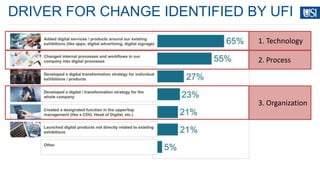
DRIVER FOR CHANGE IDENTIFIED BY UFI
1. Technology
2. Process
3. Organization
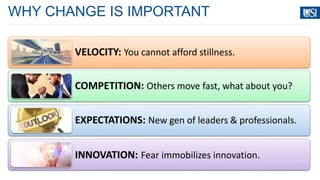
WHY CHANGE IS IMPORTANT
VELOCITY: You cannot afford stillness.
COMPETITION: Others move fast, what about you?
EXPECTATIONS: New gen of leaders & professionals.
INNOVATION: Fear immobilizes innovation.
“
„
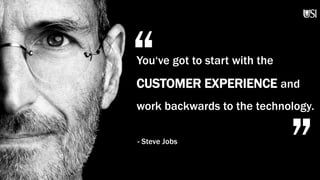
You‘ve got to start with the
CUSTOMER EXPERIENCE and
work backwards to the technology.
- Steve Jobs
“ „
Our ultimate goal is not
digitalization, it is value realisation.
- Andrew Roswell-Jones, Gartner
HOW TO CHANGE A COMPLEX ENVIRONMENT?
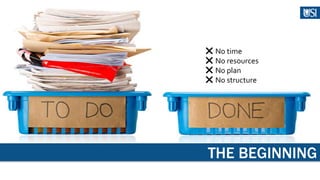
THE BEGINNING
❌ No time
❌ No resources
❌ No plan
❌ No structure
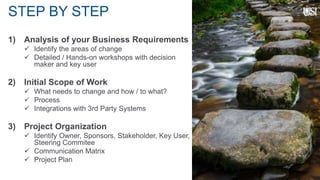
STEP BY STEP
1) Analysis of your Business Requirements
 Identify the areas of change
 Detailed / Hands-on workshops with decision
maker and key user
2) Initial Scope of Work
 What needs to change and how / to what?
 Process
 Integrations with 3rd Party Systems
3) Project Organization
 Identify Owner, Sponsors, Stakeholder, Key User,
Steering Commitee
 Communication Matrix
 Project Plan
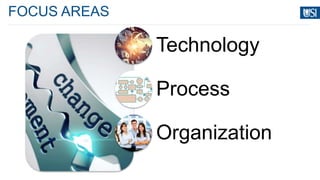
FOCUS AREAS
Technology
Process
Organization
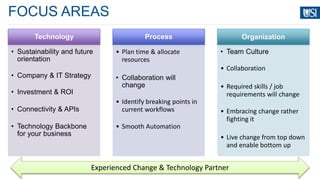
FOCUS AREAS
Technology
• Sustainability and future
orientation
• Company & IT Strategy
• Investment & ROI
• Connectivity & APIs
• Technology Backbone
for your business
Process
• Plan time & allocate
resources
• Collaboration will
change
• Identify breaking points in
current workflows
• Smooth Automation
Organization
• Team Culture
• Collaboration
• Required skills / job
requirements will change
• Embracing change rather
fighting it
• Live change from top down
and enable bottom up
Experienced Change & Technology Partner
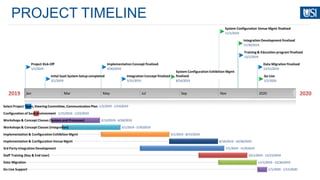
STRUCTURE & PLANNING
2019 2020Jan Mar May Jul Sep Nov 2020
Project Kick-Off
1/1/2019
Inital SaaS System Setup completed
2/1/2019
Implementation Concept finalized
4/30/2019
Integration Concept finalized
5/31/2019
System Configuration Exhibition Mgmt
finalized
8/16/2019
System Configuration Venue Mgmt finalized
11/1/2019
Integration Development finalized
11/30/2019
Training & Education program finalized
12/1/2019
Data Migration finalized
12/31/2019
Go Live
1/1/2020
1/2/2019 - 1/10/2019Select Project Team, Steering Committee, Communication Plan
1/15/2019 - 1/22/2019Configuration of SaaS Environment
2/12/2019 - 4/28/2019Workshops & Concept Classes (System and Processes)
3/1/2019 - 5/30/2019Workshops & Concept Classes (Integration)
5/1/2019 - 8/15/2019Implementation & Configuration Exhibition Mgmt
8/16/2019 - 10/30/2019Implementation & Configuration Venue Mgmt
7/1/2019 - 11/9/20193rd Party Integration Development
10/1/2019 - 12/15/2019Staff Training (Key & End User)
11/1/2019 - 12/30/2019Data Migration
1/1/2020 - 1/15/2020Go Live Support
PROJECT TIMELINE
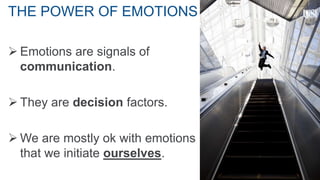
THE POWER OF EMOTIONS
 Emotions are signals of
communication.
 They are decision factors.
 We are mostly ok with emotions
that we initiate ourselves.
THE POWER OF EMOTIONS
BUT:
When changes come into our lives, they
provoke emotions that we have not
initiated ourselves.
They shake us!
LET’S TALK ABOUT….
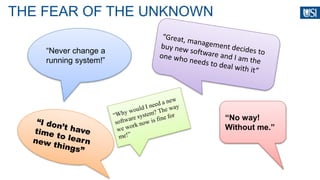
THE FEAR OF THE UNKNOWN
“No way!
Without me.”
“Never change a
running system!”
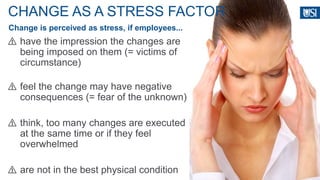
CHANGE AS A STRESS FACTOR
⚠ have the impression the changes are
being imposed on them (= victims of
circumstance)
⚠ feel the change may have negative
consequences (= fear of the unknown)
⚠ think, too many changes are executed
at the same time or if they feel
overwhelmed
⚠ are not in the best physical condition
Change is perceived as stress, if employees...
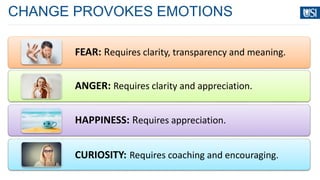
CHANGE PROVOKES EMOTIONS
FEAR: Requires clarity, transparency and meaning.
ANGER: Requires clarity and appreciation.
HAPPINESS: Requires appreciation.
CURIOSITY: Requires coaching and encouraging.
“
„
Most people decide based on their
gut feeling and search for ‘real’
facts to justify it.
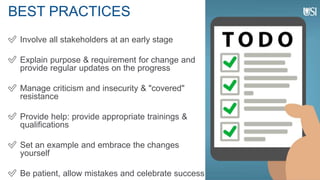
BEST PRACTICES
✅ Involve all stakeholders at an early stage
✅ Explain purpose & requirement for change and
provide regular updates on the progress
✅ Manage criticism and insecurity & "covered"
resistance
✅ Provide help: provide appropriate trainings &
qualifications
✅ Set an example and embrace the changes
yourself
✅ Be patient, allow mistakes and celebrate success
“
„
If your enterprise, your agency, was
looking to fill your job today, would
they hire you?
- Andrew Roswell-Jones, Gartner
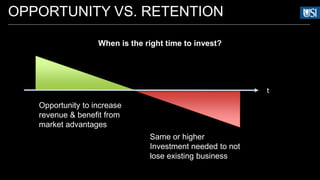
OPPORTUNITY VS. RETENTION
t
Opportunity to increase
revenue & benefit from
market advantages
Same or higher
Investment needed to not
lose existing business
When is the right time to invest?
 Embrace the Change – Don‘t fight it
 Be customer & employee centric
 Generate additional value
 Technology – Process –
Organization
 Partner with experienced Change
Leaders
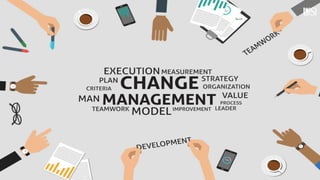
CHANGE MANAGEMENT
THANK YOUTHANK YOU

Managing Change Projects

  • 1.
    MANAGING CHANGE PROJECTS: Howto upgrade your organization processes & infrastructure
  • 3.
    DRIVER FOR CHANGEIDENTIFIED BY UFI 1. Technology 2. Process 3. Organization
  • 4.
    WHY CHANGE ISIMPORTANT VELOCITY: You cannot afford stillness. COMPETITION: Others move fast, what about you? EXPECTATIONS: New gen of leaders & professionals. INNOVATION: Fear immobilizes innovation.
  • 5.
    “ „ You‘ve got tostart with the CUSTOMER EXPERIENCE and work backwards to the technology. - Steve Jobs
  • 6.
    “ „ Our ultimategoal is not digitalization, it is value realisation. - Andrew Roswell-Jones, Gartner
  • 8.
    HOW TO CHANGEA COMPLEX ENVIRONMENT?
  • 9.
    THE BEGINNING ❌ Notime ❌ No resources ❌ No plan ❌ No structure
  • 10.
    STEP BY STEP 1)Analysis of your Business Requirements  Identify the areas of change  Detailed / Hands-on workshops with decision maker and key user 2) Initial Scope of Work  What needs to change and how / to what?  Process  Integrations with 3rd Party Systems 3) Project Organization  Identify Owner, Sponsors, Stakeholder, Key User, Steering Commitee  Communication Matrix  Project Plan
  • 11.
  • 12.
    FOCUS AREAS Technology • Sustainabilityand future orientation • Company & IT Strategy • Investment & ROI • Connectivity & APIs • Technology Backbone for your business Process • Plan time & allocate resources • Collaboration will change • Identify breaking points in current workflows • Smooth Automation Organization • Team Culture • Collaboration • Required skills / job requirements will change • Embracing change rather fighting it • Live change from top down and enable bottom up Experienced Change & Technology Partner
  • 13.
  • 14.
    2019 2020Jan MarMay Jul Sep Nov 2020 Project Kick-Off 1/1/2019 Inital SaaS System Setup completed 2/1/2019 Implementation Concept finalized 4/30/2019 Integration Concept finalized 5/31/2019 System Configuration Exhibition Mgmt finalized 8/16/2019 System Configuration Venue Mgmt finalized 11/1/2019 Integration Development finalized 11/30/2019 Training & Education program finalized 12/1/2019 Data Migration finalized 12/31/2019 Go Live 1/1/2020 1/2/2019 - 1/10/2019Select Project Team, Steering Committee, Communication Plan 1/15/2019 - 1/22/2019Configuration of SaaS Environment 2/12/2019 - 4/28/2019Workshops & Concept Classes (System and Processes) 3/1/2019 - 5/30/2019Workshops & Concept Classes (Integration) 5/1/2019 - 8/15/2019Implementation & Configuration Exhibition Mgmt 8/16/2019 - 10/30/2019Implementation & Configuration Venue Mgmt 7/1/2019 - 11/9/20193rd Party Integration Development 10/1/2019 - 12/15/2019Staff Training (Key & End User) 11/1/2019 - 12/30/2019Data Migration 1/1/2020 - 1/15/2020Go Live Support PROJECT TIMELINE
  • 15.
    THE POWER OFEMOTIONS
  • 16.
    THE POWER OFEMOTIONS  Emotions are signals of communication.  They are decision factors.  We are mostly ok with emotions that we initiate ourselves.
  • 17.
    THE POWER OFEMOTIONS BUT: When changes come into our lives, they provoke emotions that we have not initiated ourselves. They shake us!
  • 18.
  • 19.
    THE FEAR OFTHE UNKNOWN “No way! Without me.” “Never change a running system!”
  • 20.
    CHANGE AS ASTRESS FACTOR ⚠ have the impression the changes are being imposed on them (= victims of circumstance) ⚠ feel the change may have negative consequences (= fear of the unknown) ⚠ think, too many changes are executed at the same time or if they feel overwhelmed ⚠ are not in the best physical condition Change is perceived as stress, if employees...
  • 21.
    CHANGE PROVOKES EMOTIONS FEAR:Requires clarity, transparency and meaning. ANGER: Requires clarity and appreciation. HAPPINESS: Requires appreciation. CURIOSITY: Requires coaching and encouraging.
  • 22.
    “ „ Most people decidebased on their gut feeling and search for ‘real’ facts to justify it.
  • 23.
    BEST PRACTICES ✅ Involveall stakeholders at an early stage ✅ Explain purpose & requirement for change and provide regular updates on the progress ✅ Manage criticism and insecurity & "covered" resistance ✅ Provide help: provide appropriate trainings & qualifications ✅ Set an example and embrace the changes yourself ✅ Be patient, allow mistakes and celebrate success
  • 24.
    “ „ If your enterprise,your agency, was looking to fill your job today, would they hire you? - Andrew Roswell-Jones, Gartner
  • 25.
    OPPORTUNITY VS. RETENTION t Opportunityto increase revenue & benefit from market advantages Same or higher Investment needed to not lose existing business When is the right time to invest?
  • 26.
     Embrace theChange – Don‘t fight it  Be customer & employee centric  Generate additional value  Technology – Process – Organization  Partner with experienced Change Leaders CHANGE MANAGEMENT
  • 27.

Editor's Notes

  • #2 Implementing change in organizations: how to upgrade your organization processes and infrastructure
  • #5 Velocity: Digitalization is coming on a fast pace (also because it is hyping) If you are not moving fast – your competition does! You will have to meet the expectations of your employees and your customers Be creative and push for innovation – don‘t be afraid – failing is not as harmful as doing nothing! Kodak is probably the most famous example of such arrogance (not to listen and invest): An employee developed the first digital camera in 1975, but the company did not want to endanger the existing business. A known unfortunate decision because Kodak was never able to catch up with the market changes.
  • #6 Many companies think they do digitalization and are looking just at processes to improve or add fancy tools.. This is not a digital transformation!! In Gen Y, you‘d call this EPIC FAIL
  • #7 “Digital business clearly has the power to transform organisations,” the report states. As this transformation evolves, success requires a move from digital experimentation and pilots to the digital scaling of proven practices. “If we don't respond to what is happening in the environment, we are in danger of becoming frog soup,” says Rowsell-Jones. This is a reference to the oft-used metaphor about frogs that will not jump out of the pan if the water is tepid, and thus, be boiled to death. „this is the peace I‘m missing in most discussions about digitalization. It is NOT about fancy tools. https://www.cio.co.nz/article/629628/fire-yourself-cio-come-back-business-executive
  • #8 If there is ONE Question, I‘ve always been asked is – how do you manage such a change?
  • #12 Let‘s assume we have indentified the areas of change, Setup a Business and a IT Strategy, Focus areas will be along the lines that I mentioned earlier.
  • #13 Comments like ‘we don’t do that here’ or ‘that is not the way we work’ stop businesses from scaling as digital businesses. Hype Companies Fund rainsing 10m / that‘s nothing? Growth pain start ups vs mature companies Mobile app companies – issues apple store Brief – email – yammer Involve all stakeholders at an early stage Clearly explain the background, purpose and requirement for change Inform employees in a timely manner about the steps required and provide regular updates on the progress Respond to opposition, criticism and insecurity, paying particular attention to "covert" resistance Help employees to obtain the appropriate qualifications and prepare them for the changes Set an example and embrace the changes yourself Give employees time to get onboard, be patient, allow mistakes and celebrate success
  • #16 It‘s all about emotions!
  • #17 People decide based on their gut feeling and search for arguments to justify it. Intrinsische vs. Extrinsische Motivation
  • #20 In principle, change is perceived as particularly stressful by employees if: They have the impression that the changes are being imposed on them by external forces as they feel that they have no choice and are the victims of circumstance They feel at a disadvantage because of the change or that it may have negative consequences They believe they cannot bear the change or feel overwhelmed Too many changes are executed at the same time They are not in the best physical condition
  • #22  As a leader, you need to address emotions with the right actions
  • #23 This is not just about the basic decision – this is also how you manage your employees!
  • #25 VP and research director at Gartner,  https://www.cio.co.nz/article/629628/fire-yourself-cio-come-back-business-executive “Digital business clearly has the power to transform organisations,” the report states. As this transformation evolves, success requires a move from digital experimentation and pilots to the digital scaling of proven practices.  Good news – you are not alone in this situation and you don‘t have to manage it on your own. You need an experienced partner for it. “If we don't respond to what is happening in the environment, we are in danger of becoming frog soup,” says Rowsell-Jones.