
Presented to: The FAASTeam CFI Workshops
By: The FAASTeam
Date: July 2011
Federal Aviation
AdministrationFAASTeamFAASTeam
CFI Workshop #4CFI Workshop #4
Module 4, Core Topic 8
Special Use and Restricted
Airspace
2Federal Aviation
Administration
FAASTeam CFI Workshop #4
July 2011
THE FAA SAFETY TEAM - FAASTeam
“Space, the Final Frontier”
William Shatner
Or ………………..
4Federal Aviation
Administration
FAASTeam CFI Workshop #4
July 2011
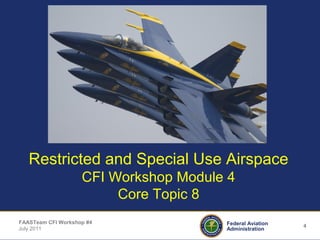
Restricted and Special Use Airspace
CFI Workshop Module 4
Core Topic 8
5Federal Aviation
Administration
FAASTeam CFI Workshop #4
July 2011
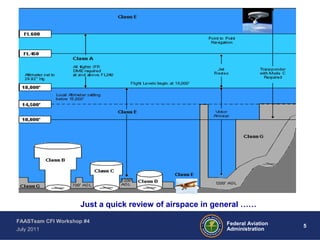
Just a quick review of airspace in general ……
6Federal Aviation
Administration
FAASTeam CFI Workshop #4
July 2011
7Federal Aviation
Administration
FAASTeam CFI Workshop #4
July 2011
A temporary flight restriction (TFR) is a regulatory action that
temporarily restricts certain aircraft from operating within a
defined area in order to protect persons or property in the air
or on the ground.
–TFRs are issued in a NOTAM.
–The most current information is obtained from a FSS.
–There are several types of TFRs defined in the regulations.
–TFRs are “temporary”, check NOTAMs before every flight.
–TFRs are not depicted on any navigational charts.
–Size, shape, altitudes, and other details vary.
– Always ask the FSS Briefer about TFRs on your route flight.
– Ask each new ATC contact for TFR information while enroute.
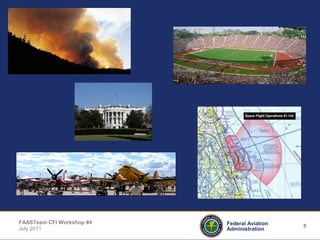
Some examples of TFRs are ………………………………
8Federal Aviation
Administration
FAASTeam CFI Workshop #4
July 2011
9Federal Aviation
Administration
FAASTeam CFI Workshop #4
July 2011
Flight Service and DUATS
Because TFRs and other restrictions often arise on
very short notice, there is no substitute for a thorough
preflight briefing from an approved source, such
as Flight Service (1-800-WX-BRIEF or 1-800-992-7433)
or DUAT/DUATS.
NOTAMs are part of the standard briefing, but it is a
good idea to ask specifically if there are any FDC
NOTAMs relevant to your route of flight. Don't forget to
ask for published NOTAMs, which may also be
relevant.
Share the following tips with your students …….
10Federal Aviation
Administration
FAASTeam CFI Workshop #4
July 2011
• If you learn about the existence of a TFR in a telephone
briefing from an AFSS specialist, review the text and print
a copy to carry along on your flight.
• The FAA's TFR website (http://tfr.faa.gov/tfr2/list.html)
provides multiple options for finding a specific TFR.
• In addition to reviewing the text, this website offers the
option of a graphical depiction of the affected area.
• There is a similar FAA graphical website for information
on special use airspace. Go to
http://sua.faa.gov/sua/Welcome.do for this tool.
11Federal Aviation
Administration
FAASTeam CFI Workshop #4
July 2011
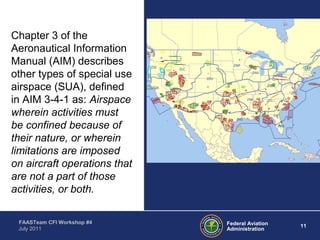
Chapter 3 of the
Aeronautical Information
Manual (AIM) describes
other types of special use
airspace (SUA), defined
in AIM 3-4-1 as: Airspace
wherein activities must
be confined because of
their nature, or wherein
limitations are imposed
on aircraft operations that
are not a part of those
activities, or both.
12Federal Aviation
Administration
FAASTeam CFI Workshop #4
July 2011
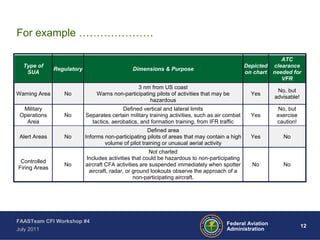
Type of
SUA
Regulatory Dimensions & Purpose
Depicted
on chart
ATC
clearance
needed for
VFR
Warning Area No
3 nm from US coast
Warns non-participating pilots of activities that may be
hazardous
Yes
No, but
advisable!
Military
Operations
Area
No
Defined vertical and lateral limits
Separates certain military training activities, such as air combat
tactics, aerobatics, and formation training, from IFR traffic
Yes
No, but
exercise
caution!
Alert Areas No
Defined area
Informs non-participating pilots of areas that may contain a high
volume of pilot training or unusual aerial activity
Yes No
Controlled
Firing Areas
No
Not charted
Includes activities that could be hazardous to non-participating
aircraft CFA activities are suspended immediately when spotter
aircraft, radar, or ground lookouts observe the approach of a
non-participating aircraft.
No No
For example …………………
13Federal Aviation
Administration
FAASTeam CFI Workshop #4
July 2011
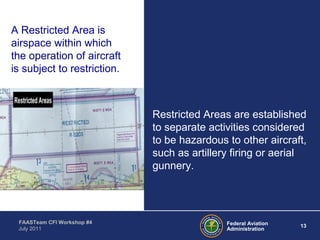
Restricted Areas are established
to separate activities considered
to be hazardous to other aircraft,
such as artillery firing or aerial
gunnery.
A Restricted Area is
airspace within which
the operation of aircraft
is subject to restriction.
14Federal Aviation
Administration
FAASTeam CFI Workshop #4
July 2011
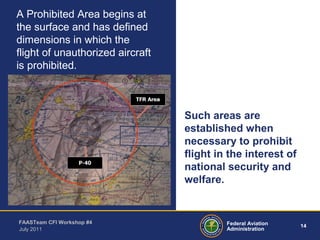
Such areas are
established when
necessary to prohibit
flight in the interest of
national security and
welfare.
A Prohibited Area begins at
the surface and has defined
dimensions in which the
flight of unauthorized aircraft
is prohibited.
15Federal Aviation
Administration
FAASTeam CFI Workshop #4
July 2011
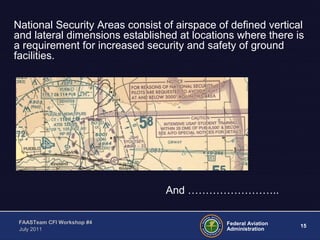
National Security Areas consist of airspace of defined vertical
and lateral dimensions established at locations where there is
a requirement for increased security and safety of ground
facilities.
And ……………………..
16Federal Aviation
Administration
FAASTeam CFI Workshop #4
July 2011
– Pilots are requested to voluntarily avoid flying through
the depicted NSA.
– When it is necessary to provide a greater level of
security and safety, flight in NSAs may be temporarily
prohibited by regulation under the provisions of 14 CFR
Section 99.7.
– Regulatory prohibitions will be issued by System
Operations, System Operations Airspace and AIM Office,
Airspace and Rules, and disseminated via NOTAM.
– Inquiries about NSAs Inquiries should be directed to
Airspace and Rules.
17Federal Aviation
Administration
FAASTeam CFI Workshop #4
July 2011
Emergency Air Traffic Rules
When authorities determine there is (or will be) an
emergency condition affecting the FAA's ability to
operate the air traffic control system with the
necessary level of safety and efficiency, the
Administrator may issue an air traffic rule with
immediate effect – that is, a rule that does not go
through the normal rule making processes.
The NOTAM system is used to disseminate
information on the precise impact, terms, and
conditions of the emergency air traffic rule, so it is
imperative to check FDC NOTAMs before every
flight.
18Federal Aviation
Administration
FAASTeam CFI Workshop #4
July 2011
A Special Federal Aviation Regulation (SFAR)
pertaining to airspace is typically a temporary rule to
address a temporary situation.
– It is generally not used to replace or enforce regulations that
are to remain in effect for many years.
– An SFAR has an expiration date, usually no more than 3 years
from its effective date.
– SFARs are listed at the beginning of the most relevant Code of
Federal Regulations (CFR), and may be cross-referenced to
other regulations.
– SFARS can prohibit, restrict, or have additional requirements to
operate in the airspace the SFAR applies to.
19Federal Aviation
Administration
FAASTeam CFI Workshop #4
July 2011
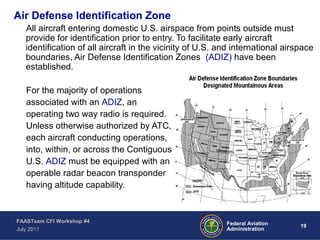
Air Defense Identification Zone
All aircraft entering domestic U.S. airspace from points outside must
provide for identification prior to entry. To facilitate early aircraft
identification of all aircraft in the vicinity of U.S. and international airspace
boundaries, Air Defense Identification Zones (ADIZ) have been
established.
For the majority of operations
associated with an ADIZ, an
operating two way radio is required.
Unless otherwise authorized by ATC,
each aircraft conducting operations,
into, within, or across the Contiguous
U.S. ADIZ must be equipped with an
operable radar beacon transponder
having altitude capability.
20Federal Aviation
Administration
FAASTeam CFI Workshop #4
July 2011
21Federal Aviation
Administration
FAASTeam CFI Workshop #4
July 2011
22Federal Aviation
Administration
FAASTeam CFI Workshop #4
July 2011
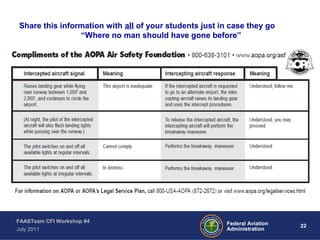
Share this information with all of your students just in case they go
“Where no man should have gone before”
23Federal Aviation
Administration
FAASTeam CFI Workshop #4
July 2011
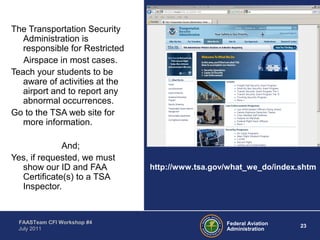
The Transportation Security
Administration is
responsible for Restricted
Airspace in most cases.
Teach your students to be
aware of activities at the
airport and to report any
abnormal occurrences.
Go to the TSA web site for
more information.
And;
Yes, if requested, we must
show our ID and FAA
Certificate(s) to a TSA
Inspector.
http://www.tsa.gov/what_we_do/index.shtm
24Federal Aviation
Administration
FAASTeam CFI Workshop #4
July 2011
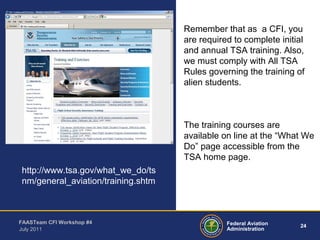
Remember that as a CFI, you
are required to complete initial
and annual TSA training. Also,
we must comply with All TSA
Rules governing the training of
alien students.
The training courses are
available on line at the “What We
Do” page accessible from the
TSA home page.
http://www.tsa.gov/what_we_do/ts
nm/general_aviation/training.shtm
25Federal Aviation
Administration
FAASTeam CFI Workshop #4
July 2011
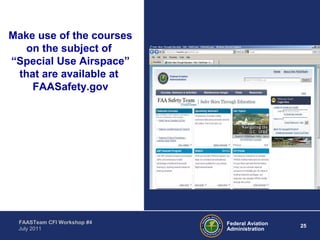
Make use of the courses
on the subject of
“Special Use Airspace”
that are available at
FAASafety.gov
26Federal Aviation
Administration
FAASTeam CFI Workshop #4
July 2011
27Federal Aviation
Administration
FAASTeam CFI Workshop #4
July 2011
28Federal Aviation
Administration
FAASTeam CFI Workshop #4
July 2011
29Federal Aviation
Administration
FAASTeam CFI Workshop #4
July 2011
QUIZ
30Federal Aviation
Administration
FAASTeam CFI Workshop #4
July 2011
1. What are National Security areas?
2. How does a pilot obtain information about
Special Use Airspace and TFRs?
a. Aeronautical Charts
b. Airport Directory
c. NOTAM
d. Local Flight School
31Federal Aviation
Administration
FAASTeam CFI Workshop #4
July 2011
3. An intercepting aircraft that rocks it wings from
ahead and above you means…
a. You have been intercepted. Follow me.
b. Land at this Aerodrome.
c. Are you in Distress?
d. Understand. You may proceed.
4. True or False; When plotting TFRs on a chart;
each time the compass is set to the appropriate
radius; it is important to remember the scales
used on each sectional chart are not precise.
32Federal Aviation
Administration
FAASTeam CFI Workshop #4
July 2011
5. I am a mechanic, pilot, and I own and operate
my own aircraft. Do I have to produce my
certificate(s) upon the request of an inspector
from TSA?
33Federal Aviation
Administration
FAASTeam CFI Workshop #4
July 2011
NOW THE
ANSWERS
34Federal Aviation
Administration
FAASTeam CFI Workshop #4
July 2011
1. What are National Security Areas?
Airspace of defined vertical and lateral dimensions at
locations where there is a requirement for increased
security and safety of ground facilities. – AIM 3-5-7
2. How does a pilot obtain information regarding Special
Use Airspace or TFRs?
a. Aeronautical Charts
b. Airport/Facility Directory
c. NOTAM
d. Local Flight School
c. NOTAM – AIM
35Federal Aviation
Administration
FAASTeam CFI Workshop #4
July 2011
3. An intercepting aircraft that rocks it wings from ahead
and above you means…
a. You have been intercepted. Follow me.
b. Land at this Aerodrome.
c. Are you in Distress?
d. Understand, You may proceed.
a. Follow Me – AIM
4. True or False; When plotting TFRs on a chart; each
time the compass is set to the appropriate radius; it is
important to remember the scales used on each
sectional chart are not precise.
True, scales on a sectional chart are not precise. –
AOPA TFR article of Nov. /Dec. 2006
36Federal Aviation
Administration
FAASTeam CFI Workshop #4
July 2011
5. I am a mechanic, pilot, and I own and operate my own
aircraft. Do I have to produce my certificate(s) upon the
request of an Inspector from TSA?
Yes, each individual who holds an airman certificate,
medical certificate, authorization, or license issued by
the FAA must present it for inspection upon a request
from TSA. – Transportation Security Regulation, part
1500, subsection 1540.115
37Federal Aviation
Administration
FAASTeam CFI Workshop #4
July 2011
This Completes
CFI Workshop Module 4
Be sure to have your attendance record validated!

CFI Workshop - Module 4 Special Use and Restricted Airspace

  • 1.
    Presented to: TheFAASTeam CFI Workshops By: The FAASTeam Date: July 2011 Federal Aviation AdministrationFAASTeamFAASTeam CFI Workshop #4CFI Workshop #4 Module 4, Core Topic 8 Special Use and Restricted Airspace
  • 2.
    2Federal Aviation Administration FAASTeam CFIWorkshop #4 July 2011 THE FAA SAFETY TEAM - FAASTeam
  • 3.
    “Space, the FinalFrontier” William Shatner Or ………………..
  • 4.
    4Federal Aviation Administration FAASTeam CFIWorkshop #4 July 2011 Restricted and Special Use Airspace CFI Workshop Module 4 Core Topic 8
  • 5.
    5Federal Aviation Administration FAASTeam CFIWorkshop #4 July 2011 Just a quick review of airspace in general ……
  • 6.
  • 7.
    7Federal Aviation Administration FAASTeam CFIWorkshop #4 July 2011 A temporary flight restriction (TFR) is a regulatory action that temporarily restricts certain aircraft from operating within a defined area in order to protect persons or property in the air or on the ground. –TFRs are issued in a NOTAM. –The most current information is obtained from a FSS. –There are several types of TFRs defined in the regulations. –TFRs are “temporary”, check NOTAMs before every flight. –TFRs are not depicted on any navigational charts. –Size, shape, altitudes, and other details vary. – Always ask the FSS Briefer about TFRs on your route flight. – Ask each new ATC contact for TFR information while enroute. Some examples of TFRs are ………………………………
  • 8.
  • 9.
    9Federal Aviation Administration FAASTeam CFIWorkshop #4 July 2011 Flight Service and DUATS Because TFRs and other restrictions often arise on very short notice, there is no substitute for a thorough preflight briefing from an approved source, such as Flight Service (1-800-WX-BRIEF or 1-800-992-7433) or DUAT/DUATS. NOTAMs are part of the standard briefing, but it is a good idea to ask specifically if there are any FDC NOTAMs relevant to your route of flight. Don't forget to ask for published NOTAMs, which may also be relevant. Share the following tips with your students …….
  • 10.
    10Federal Aviation Administration FAASTeam CFIWorkshop #4 July 2011 • If you learn about the existence of a TFR in a telephone briefing from an AFSS specialist, review the text and print a copy to carry along on your flight. • The FAA's TFR website (http://tfr.faa.gov/tfr2/list.html) provides multiple options for finding a specific TFR. • In addition to reviewing the text, this website offers the option of a graphical depiction of the affected area. • There is a similar FAA graphical website for information on special use airspace. Go to http://sua.faa.gov/sua/Welcome.do for this tool.
  • 11.
    11Federal Aviation Administration FAASTeam CFIWorkshop #4 July 2011 Chapter 3 of the Aeronautical Information Manual (AIM) describes other types of special use airspace (SUA), defined in AIM 3-4-1 as: Airspace wherein activities must be confined because of their nature, or wherein limitations are imposed on aircraft operations that are not a part of those activities, or both.
  • 12.
    12Federal Aviation Administration FAASTeam CFIWorkshop #4 July 2011 Type of SUA Regulatory Dimensions & Purpose Depicted on chart ATC clearance needed for VFR Warning Area No 3 nm from US coast Warns non-participating pilots of activities that may be hazardous Yes No, but advisable! Military Operations Area No Defined vertical and lateral limits Separates certain military training activities, such as air combat tactics, aerobatics, and formation training, from IFR traffic Yes No, but exercise caution! Alert Areas No Defined area Informs non-participating pilots of areas that may contain a high volume of pilot training or unusual aerial activity Yes No Controlled Firing Areas No Not charted Includes activities that could be hazardous to non-participating aircraft CFA activities are suspended immediately when spotter aircraft, radar, or ground lookouts observe the approach of a non-participating aircraft. No No For example …………………
  • 13.
    13Federal Aviation Administration FAASTeam CFIWorkshop #4 July 2011 Restricted Areas are established to separate activities considered to be hazardous to other aircraft, such as artillery firing or aerial gunnery. A Restricted Area is airspace within which the operation of aircraft is subject to restriction.
  • 14.
    14Federal Aviation Administration FAASTeam CFIWorkshop #4 July 2011 Such areas are established when necessary to prohibit flight in the interest of national security and welfare. A Prohibited Area begins at the surface and has defined dimensions in which the flight of unauthorized aircraft is prohibited.
  • 15.
    15Federal Aviation Administration FAASTeam CFIWorkshop #4 July 2011 National Security Areas consist of airspace of defined vertical and lateral dimensions established at locations where there is a requirement for increased security and safety of ground facilities. And ……………………..
  • 16.
    16Federal Aviation Administration FAASTeam CFIWorkshop #4 July 2011 – Pilots are requested to voluntarily avoid flying through the depicted NSA. – When it is necessary to provide a greater level of security and safety, flight in NSAs may be temporarily prohibited by regulation under the provisions of 14 CFR Section 99.7. – Regulatory prohibitions will be issued by System Operations, System Operations Airspace and AIM Office, Airspace and Rules, and disseminated via NOTAM. – Inquiries about NSAs Inquiries should be directed to Airspace and Rules.
  • 17.
    17Federal Aviation Administration FAASTeam CFIWorkshop #4 July 2011 Emergency Air Traffic Rules When authorities determine there is (or will be) an emergency condition affecting the FAA's ability to operate the air traffic control system with the necessary level of safety and efficiency, the Administrator may issue an air traffic rule with immediate effect – that is, a rule that does not go through the normal rule making processes. The NOTAM system is used to disseminate information on the precise impact, terms, and conditions of the emergency air traffic rule, so it is imperative to check FDC NOTAMs before every flight.
  • 18.
    18Federal Aviation Administration FAASTeam CFIWorkshop #4 July 2011 A Special Federal Aviation Regulation (SFAR) pertaining to airspace is typically a temporary rule to address a temporary situation. – It is generally not used to replace or enforce regulations that are to remain in effect for many years. – An SFAR has an expiration date, usually no more than 3 years from its effective date. – SFARs are listed at the beginning of the most relevant Code of Federal Regulations (CFR), and may be cross-referenced to other regulations. – SFARS can prohibit, restrict, or have additional requirements to operate in the airspace the SFAR applies to.
  • 19.
    19Federal Aviation Administration FAASTeam CFIWorkshop #4 July 2011 Air Defense Identification Zone All aircraft entering domestic U.S. airspace from points outside must provide for identification prior to entry. To facilitate early aircraft identification of all aircraft in the vicinity of U.S. and international airspace boundaries, Air Defense Identification Zones (ADIZ) have been established. For the majority of operations associated with an ADIZ, an operating two way radio is required. Unless otherwise authorized by ATC, each aircraft conducting operations, into, within, or across the Contiguous U.S. ADIZ must be equipped with an operable radar beacon transponder having altitude capability.
  • 20.
  • 21.
  • 22.
    22Federal Aviation Administration FAASTeam CFIWorkshop #4 July 2011 Share this information with all of your students just in case they go “Where no man should have gone before”
  • 23.
    23Federal Aviation Administration FAASTeam CFIWorkshop #4 July 2011 The Transportation Security Administration is responsible for Restricted Airspace in most cases. Teach your students to be aware of activities at the airport and to report any abnormal occurrences. Go to the TSA web site for more information. And; Yes, if requested, we must show our ID and FAA Certificate(s) to a TSA Inspector. http://www.tsa.gov/what_we_do/index.shtm
  • 24.
    24Federal Aviation Administration FAASTeam CFIWorkshop #4 July 2011 Remember that as a CFI, you are required to complete initial and annual TSA training. Also, we must comply with All TSA Rules governing the training of alien students. The training courses are available on line at the “What We Do” page accessible from the TSA home page. http://www.tsa.gov/what_we_do/ts nm/general_aviation/training.shtm
  • 25.
    25Federal Aviation Administration FAASTeam CFIWorkshop #4 July 2011 Make use of the courses on the subject of “Special Use Airspace” that are available at FAASafety.gov
  • 26.
  • 27.
  • 28.
  • 29.
  • 30.
    30Federal Aviation Administration FAASTeam CFIWorkshop #4 July 2011 1. What are National Security areas? 2. How does a pilot obtain information about Special Use Airspace and TFRs? a. Aeronautical Charts b. Airport Directory c. NOTAM d. Local Flight School
  • 31.
    31Federal Aviation Administration FAASTeam CFIWorkshop #4 July 2011 3. An intercepting aircraft that rocks it wings from ahead and above you means… a. You have been intercepted. Follow me. b. Land at this Aerodrome. c. Are you in Distress? d. Understand. You may proceed. 4. True or False; When plotting TFRs on a chart; each time the compass is set to the appropriate radius; it is important to remember the scales used on each sectional chart are not precise.
  • 32.
    32Federal Aviation Administration FAASTeam CFIWorkshop #4 July 2011 5. I am a mechanic, pilot, and I own and operate my own aircraft. Do I have to produce my certificate(s) upon the request of an inspector from TSA?
  • 33.
    33Federal Aviation Administration FAASTeam CFIWorkshop #4 July 2011 NOW THE ANSWERS
  • 34.
    34Federal Aviation Administration FAASTeam CFIWorkshop #4 July 2011 1. What are National Security Areas? Airspace of defined vertical and lateral dimensions at locations where there is a requirement for increased security and safety of ground facilities. – AIM 3-5-7 2. How does a pilot obtain information regarding Special Use Airspace or TFRs? a. Aeronautical Charts b. Airport/Facility Directory c. NOTAM d. Local Flight School c. NOTAM – AIM
  • 35.
    35Federal Aviation Administration FAASTeam CFIWorkshop #4 July 2011 3. An intercepting aircraft that rocks it wings from ahead and above you means… a. You have been intercepted. Follow me. b. Land at this Aerodrome. c. Are you in Distress? d. Understand, You may proceed. a. Follow Me – AIM 4. True or False; When plotting TFRs on a chart; each time the compass is set to the appropriate radius; it is important to remember the scales used on each sectional chart are not precise. True, scales on a sectional chart are not precise. – AOPA TFR article of Nov. /Dec. 2006
  • 36.
    36Federal Aviation Administration FAASTeam CFIWorkshop #4 July 2011 5. I am a mechanic, pilot, and I own and operate my own aircraft. Do I have to produce my certificate(s) upon the request of an Inspector from TSA? Yes, each individual who holds an airman certificate, medical certificate, authorization, or license issued by the FAA must present it for inspection upon a request from TSA. – Transportation Security Regulation, part 1500, subsection 1540.115
  • 37.
    37Federal Aviation Administration FAASTeam CFIWorkshop #4 July 2011 This Completes CFI Workshop Module 4 Be sure to have your attendance record validated!

Editor's Notes

  • #2 FAASTeam CFI Workshop 4. Module 4, Core Topics 7 and 8 Original, V-1. Jim Leavitt CFI WS NPL, (518) 785-5660, ex 214 james.w.leavitt@faa.gov
  • #3 The FAASTeam – be a part of the personal safety system in your local community. Speak briefly about the FAASTeam mission and the CFI Special Emphasis Initiative while this slide animates, then move right along.
  • #4 Get folks settled down and focused on the topic and the hopefully obvious reason CFIs need to ensure that their students have a good understanding of the National Airspace and the importance of being able to identify Restricted/Special Use Airspace.
  • #5 Briefly check for questions or comments and move on.
  • #6 Quick review of the National Airspace system including normal limits and restrictions; VFR/VMC, IFR/IMC, etc.
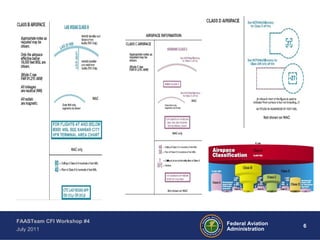
  • #7 Busy slide but again, review the use of specific airspace as related to airports, navigational aids and systems, airways, and terrain.
  • #8 The next slide gives some examples of why we might see the creation of a TFR.
  • #9 You might anticipate that these events could result in a TFR along your route of flight: National disaster, major sports event, Presidential/Government Official movement, airshow, NASA launch/recovery.
  • #10 Talk about any sources of TFR information the attendees use or can think of, share the information.
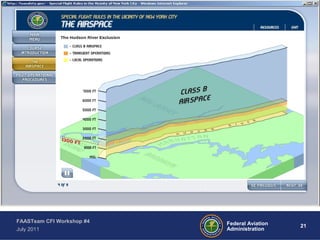
  • #11 Now mention some if the potential consequences of intentionally or unintentionally flying into a TFR without authorization. Also remind the attendees that they must also educate their students of the existence of Special Flight Rule Areas (SFRA) such as the New York Corridor, and the Washington, DC SFRA. Mention potential GPS navigation pitfalls when very near a TFR or any restricted airspace border.
  • #12 If you have internet access the links may work for you. Mention the value of the AIM for students when researching airspace topics
  • #13 Run through these briefly, ask the attendees for their experiences in any of the listed types of SUA. Point out that although these areas are not regulatory safety may very well be a factor when operating in or near them.
  • #14 Not the same as SUA, these areas may be off limits altogether at regularly designated times and during unannounced times as well.
  • #15 Prohibited Areas are off limits at all times with very few if any exceptions to general aviation operations. They are normally vigorously guarded by the military.
  • #16 Certain military installations or activities, accidents, meetings of Government officials ……….
  • #17 Run through these briefly and if there are no comments move on.
  • #18 Self explanatory, mention again the importance of checking NOTAMS.
  • #19 These are published along with the other Federal Aviation Regulations and are of a comparatively short duration.
  • #20 Self explanatory, run through the slide, ask attendees for any experiences with ADIZ operations.
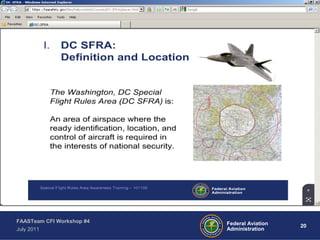
  • #21 Even if your attendees do not operate in the Washington, DC area or even close; remind them that their students may not always do their flying at, let’s say Grinder’s Switch Municipal, and someday they might very well benefit from a discussion now about SFRA operatons.
  • #22 Same story here, might be a good home work assignment for early cross country students of a recommendation for Flight Review clients. The training is easily available at no cost on the FAASTeam web site, FAASafety.Gov
  • #23 This information is available on line, Page 2 of AOPA ASF intercept procedures card and at FAA.Gov. A copy of this in your flight bad might not be a bad idea, especially if you find an F-16 at your 10 o’clock and don’t really know what he/she wants you to do!
  • #24 We all need to remember that we are obligated to follow the TSA Rules including those specific to flight training. Ask your attendees if they know where the Transportation Security Regulations can be found? Title 49 CFR, Chapter 12, Parts 1500-1699 from Jeppesen or on the internet.
  • #25 Encourage the attendees to go to the TSA web site and complete the training.
  • #26 This is a good chance to quickly check to see who is registered at FAASafety.Gov. Mention the value of the web site and Wings during the next couple of slides as you direct them to the courses specific to Restricted and Special Use Airspace. Instructors can make good use of the training courses provided as home work assignments for students on these and other topics.
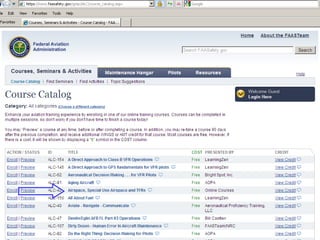
  • #27 Briefly explain the web navigation to get to this and the next page where they can find courses on airspace.
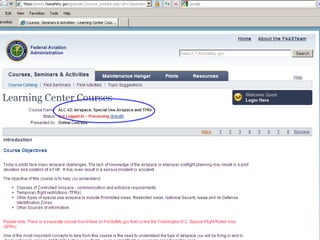
  • #28 Selected course with stated objectives. Log in is required to take the course because otherwise there would be no way for the system to save the individual’s completion record.
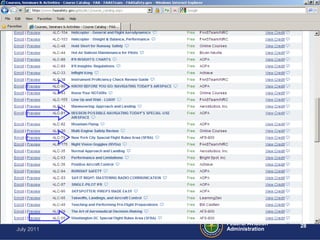
  • #29 Remind the attendees that these courses may provide them and/or their students with Wings credit as well as completion certificates for the required New York and DC SFRA training.
  • #30 Brief time for Q&A, then on to a Quiz.
  • #34 Move right into the answers and allow brief discussion when necessary.
  • #38 The record of attendance should be a matter of record when you close out the Workshop in SPANS however, if anyone want you to sign their attendance sheet it is ok to do so if you wish.