Online Classroom or Community in the Making? Engaged Participant or Knowledgeable Professor?  http://tanbob.wiki.zoho.com/CNIE.html  Tannis Morgan BCIT Stephen Carey University of British Columbia
Background How to get at the ‘why’s’ of teaching presence? Tsang (2004) and ‘interactive decisions’
Research questions 1.  How do instructors negotiate their teaching presence in online contexts? What are the constraints and affordances that influence this negotiation?
Methodology Adopted Activity Theory as framework therefore certain methodological implications Multi-case study with cross case analysis (Stake, 2006) as methodology
Cases Six “Cases of” instructor teaching presence Unit of analysis:  courses they were teaching Range of teaching contexts:  “Canada”, South America, Eastern Europe
Data 2-3 interviews with instructor Forum transcripts Course documents Interviews with program directors Interview with co-instructor *student course evaluations *student questionnaire
Triangulation Multiple sources of data Minimum 2 sources of evidence for each claim  Member checking Peer debriefing
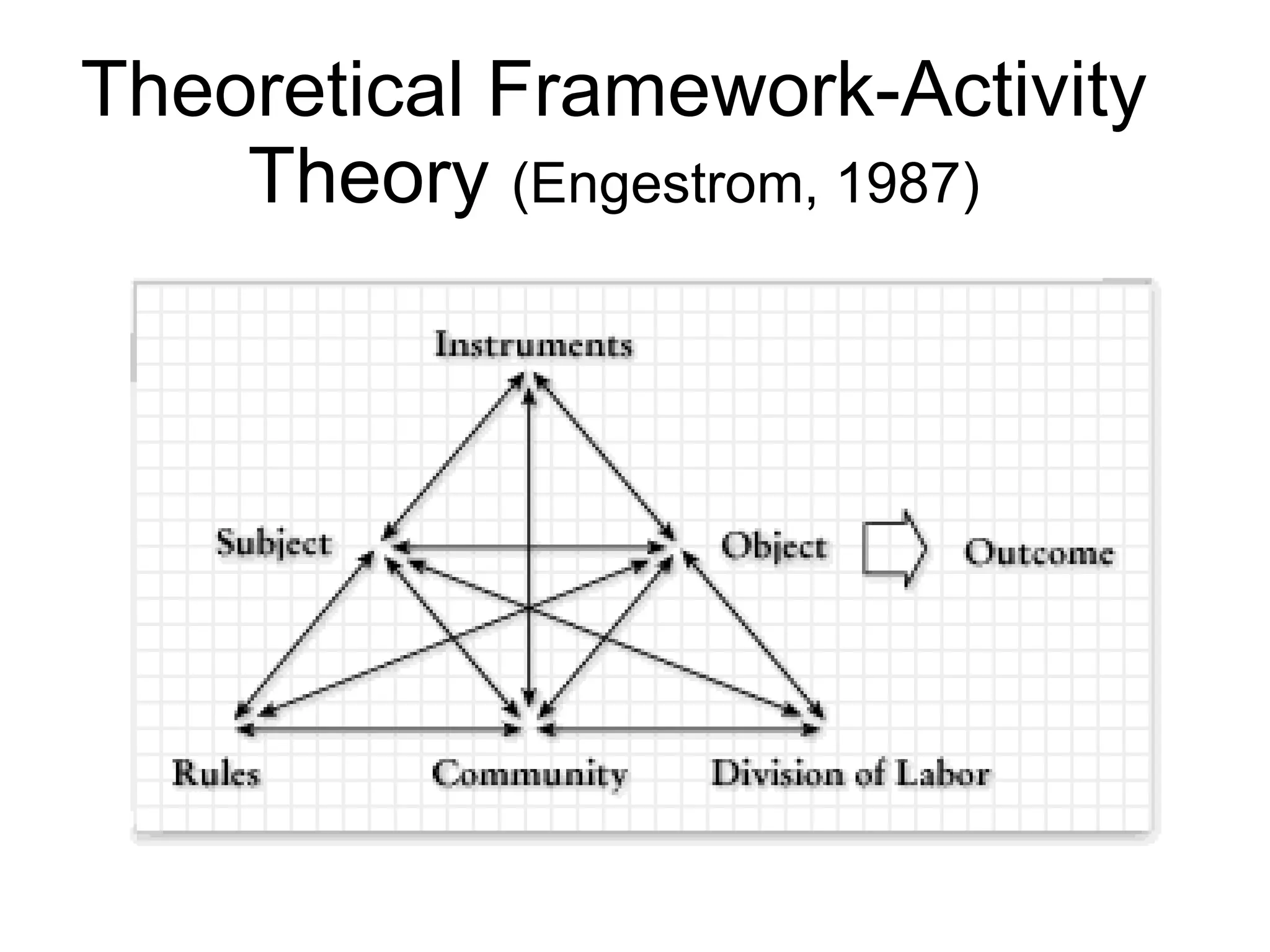
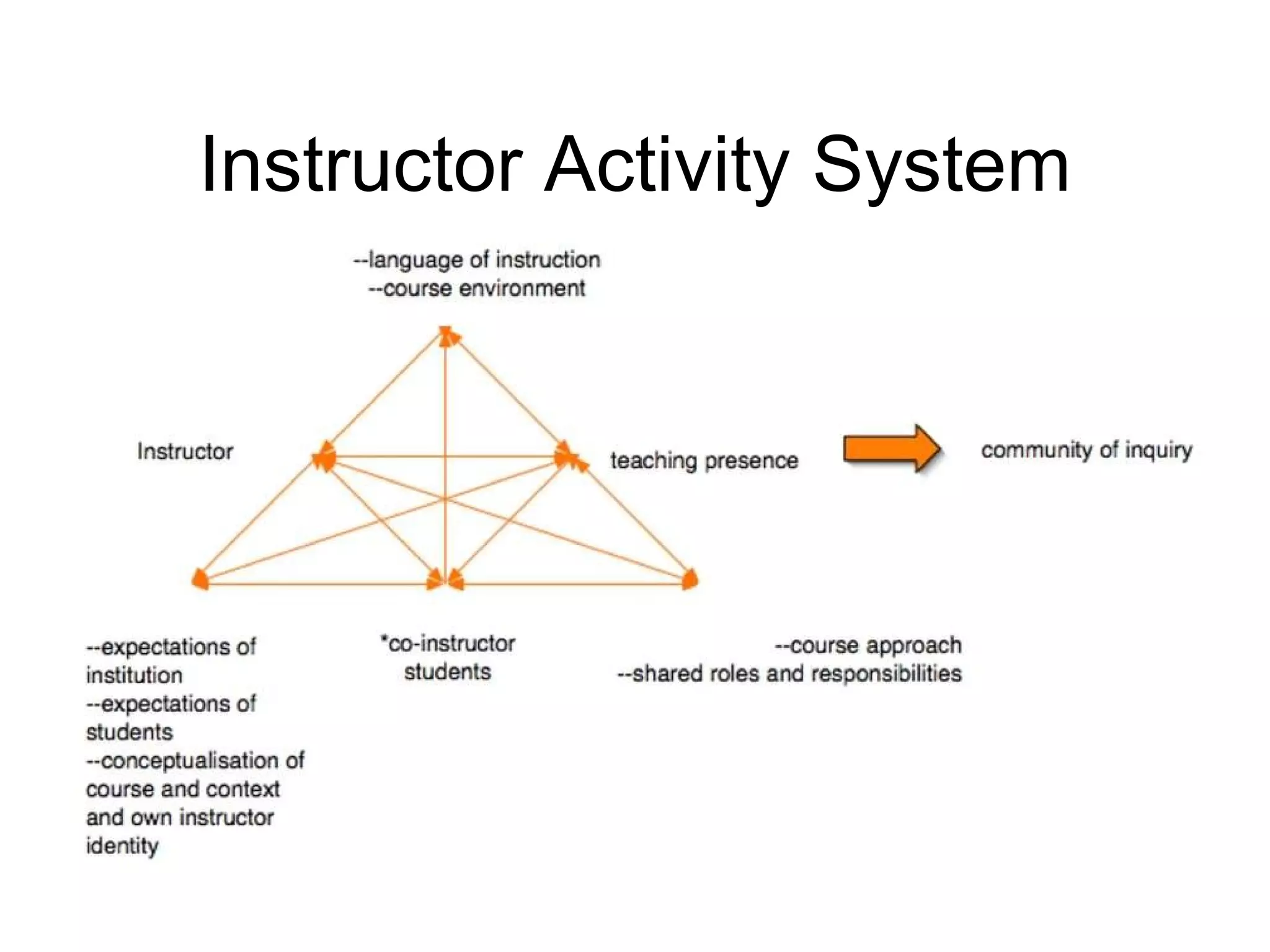
Theoretical Framework-Activity Theory  (Engestrom, 1987)
Instructor Activity System
Rationale “ By taking account of the  interactions  between people involved in the activity,  structures  within which the activity takes place,  conventions  on which it is based and  artefacts  used (here, teaching tools and methods), I was able to ground my study in the broad context and capture practice as socially situated, rather than simply evidenced in actions or performance.” (Fanghanel, 2004, p. 579)
Teaching Beliefs Kane, Sandretto and Heath (2002) “ Research into teachers’ beliefs, conceptions, attitudes, orientations, (personal) practical theories, and implicit or subjective theories about teaching is grounded in the understanding that these concepts drive teachers’ practices.” (p. 204) Relationship between beliefs and actual practices
Finding Conceptualization and teaching presence How do you view yourself as an online instructor? How do you conceptualize the interaction spaces?
Data Analysis Questions How did instructors conceptualize the online interaction spaces? How did this conceptualization influence their teaching presence? Were they able to realize their conceptualizations?
Conceptualization of interaction and teaching presence How instructor viewed purpose and goals of the interaction spaces Tannis--develop community Linda--activity space William--online graduate seminar and individualized teaching Daniel--student-centred online classroom Joanne--community in the making John--teacher-directed online classroom
Daniel--student centred online classroom Avoid being authoritarian Participate as a peer “  if the discussion was really flying along I would participate almost as a peer. Just really throwing my two cents. Actually I had to be very careful about this especially early in the classes because  I started to feel like a real discussion killer . I would see this rolling, rollicking discussion with arguments and stuff flying back and forth and  I would take a position as if I was a member of the student cohort and it would often stop discussion dead in its tracks , especially early on.”
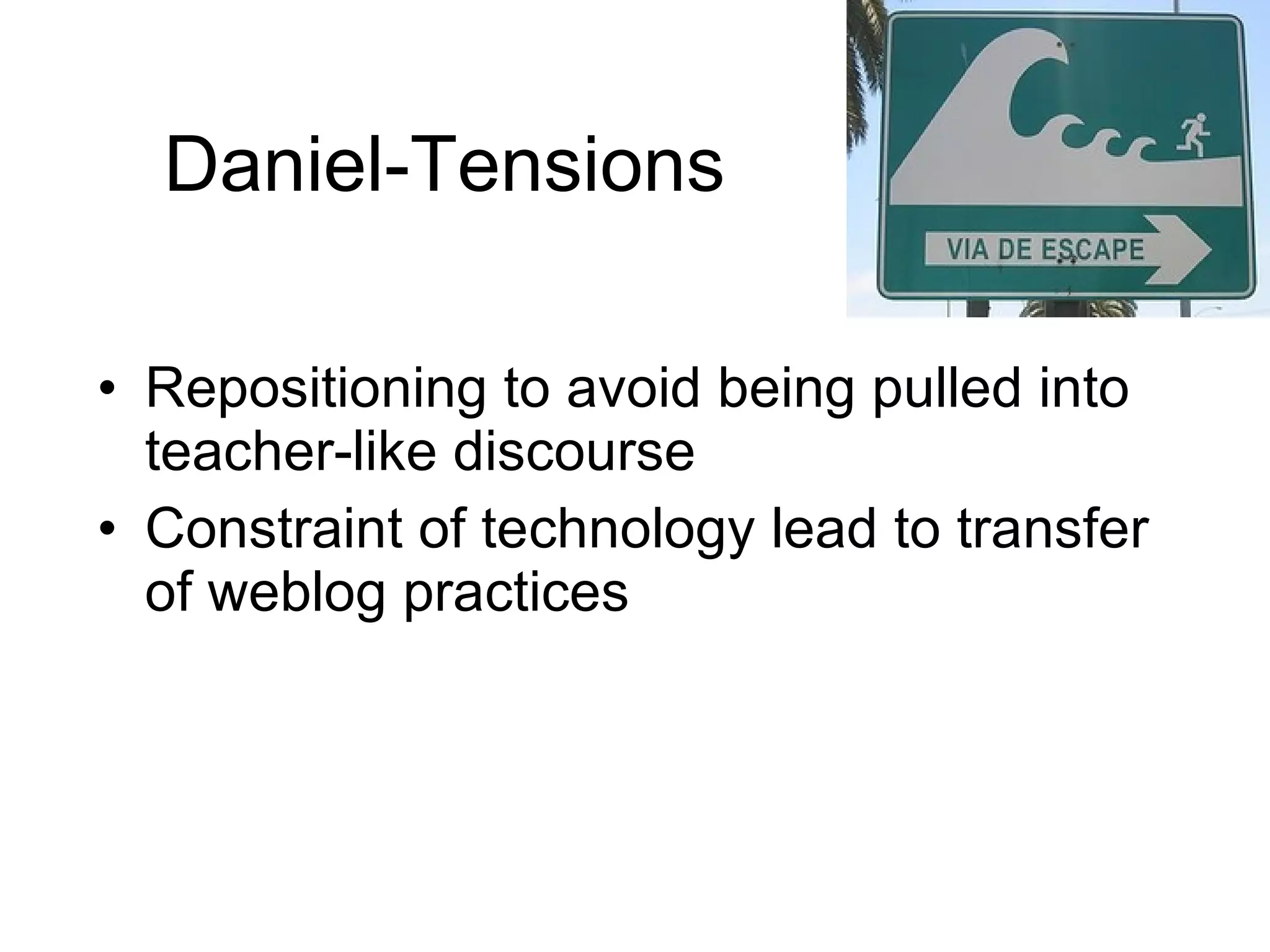
Daniel-Tensions Repositioning to avoid being pulled into teacher-like discourse Constraint of technology lead to transfer of weblog practices
“…  the role that was probably easiest to fill and the one that I had the most fun  was not unlike how I work when I use my weblog , just finding interesting, relevant kind of thing and then throwing them into the pot to get people talking. That was stuff that I do on my weblog all the time and had a lot of fun doing that in the forums and that was the probably the most satisfying good discussions.”
John Online classroom class leader--be directive in helping students through course requirements and content
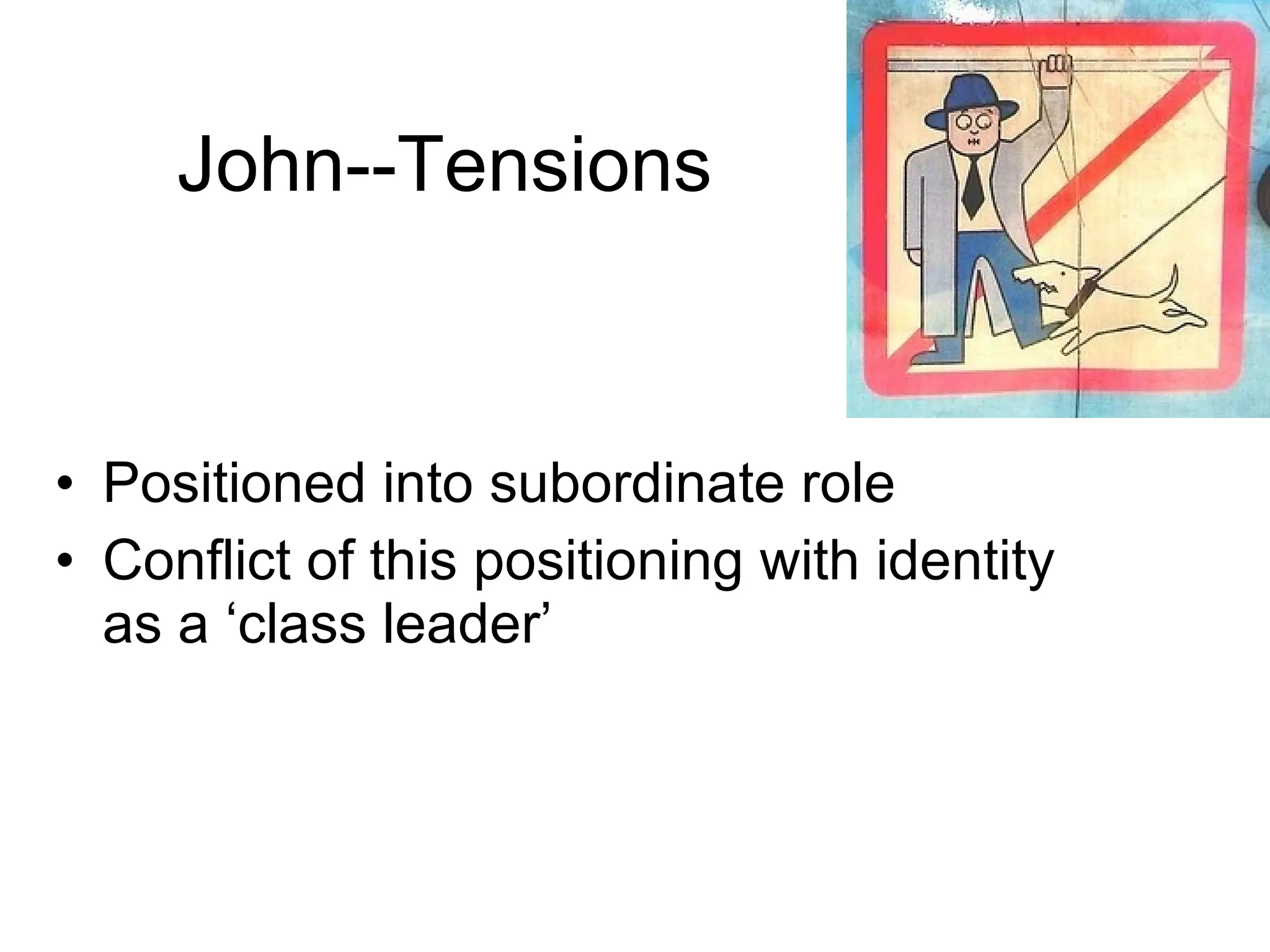
John--Tensions Positioned into subordinate role Conflict of this positioning with identity as a ‘class leader’
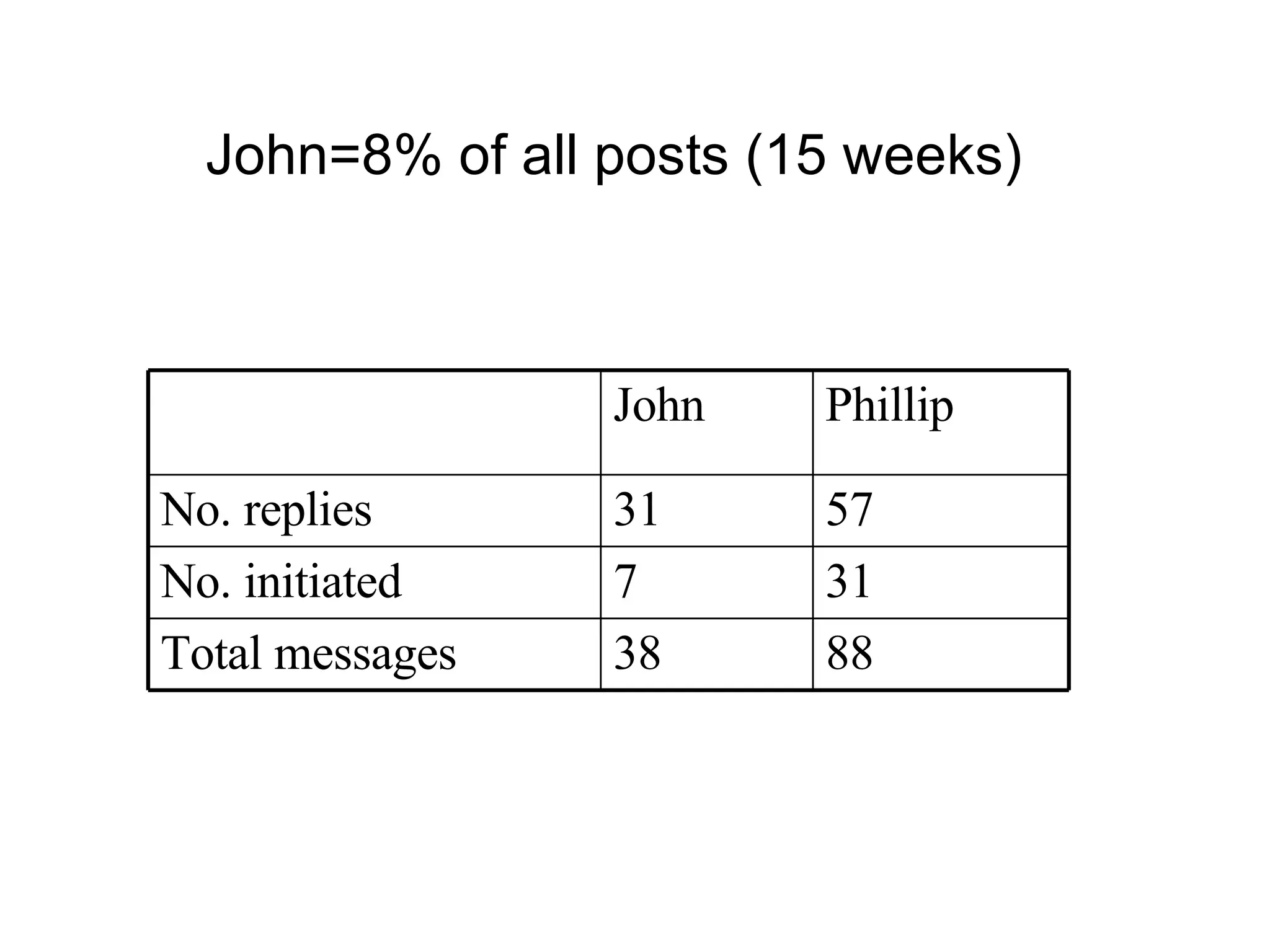
John=8% of all posts (15 weeks) 88 38 Total messages 31 7 No. initiated 57 31 No. replies Phillip John
Instructor 1 and 2 “ I felt a responsibility and I looked for my [opportunities] and tried to make contributions either big or little just to have a voice because whether they viewed me as secondary or not I thought it was my responsibility to post and make contributions where I could.”
Tannis Online community Importance of social activity
Tannis--Tensions (MU) Language--not enough to sustain community building Technology--couldn’t follow messages, no threads Forced to adopt teacher-centred interaction
William Conceptualization--online graduate seminar Realizing constructivism through highly individualized teaching (constraint--extremely time consuming) Influenced by beliefs about teaching and learning
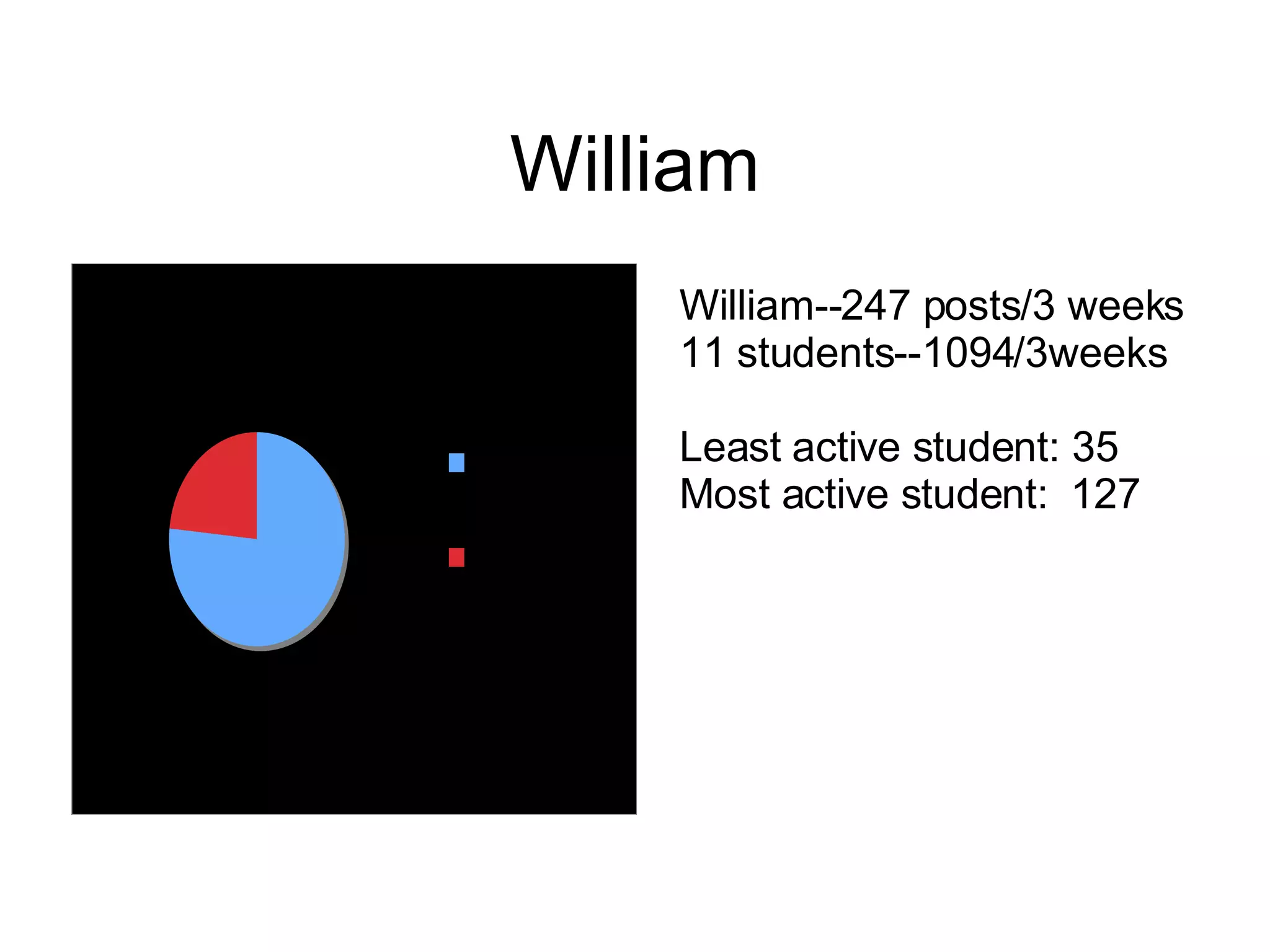
William William--247 posts/3 weeks 11 students--1094/3weeks Least active student: 35 Most active student:  127
William--Course design Syllabus, schedule of readings, 2 class texts Discussion forum--1 topic only Key element--development of a language-culture autobiography
William--Tensions Repositioning to avoid being perceived as authoritarian Time needed
So what? *Flexibility in design--new interpretations of constructivist teaching and course design *Ability to adapt teaching approach Meeting needs of the evolving community
Implications Conceptualizations in constant change Identity of students and instructors changes
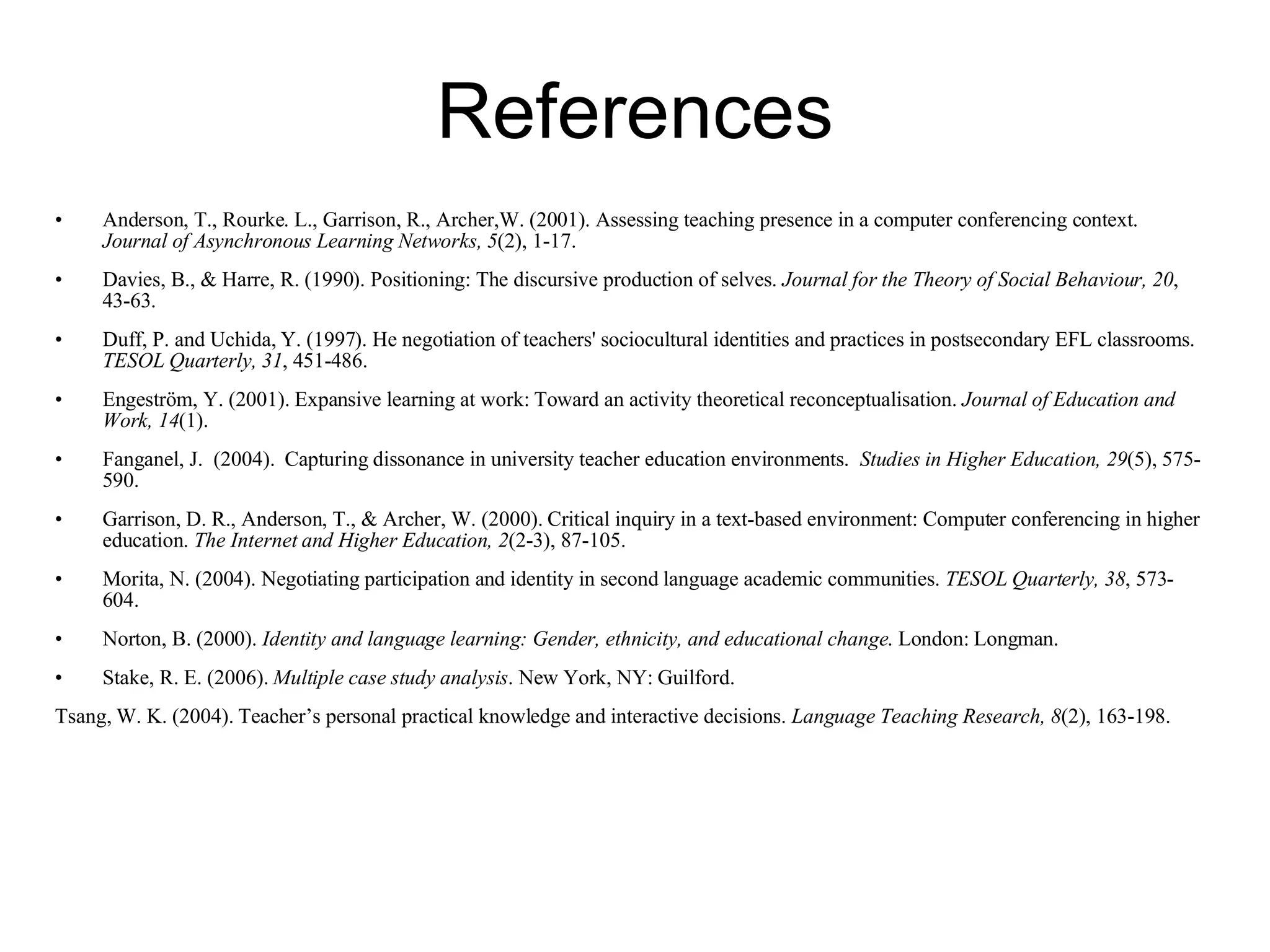
References Anderson, T., Rourke. L., Garrison, R., Archer,W. (2001). Assessing teaching presence in a computer conferencing context.  Journal of Asynchronous Learning Networks, 5 (2), 1-17.  Davies, B., & Harre, R. (1990). Positioning: The discursive production of selves.  Journal for the Theory of Social Behaviour, 20 , 43-63.  Duff, P. and Uchida, Y. (1997). He negotiation of teachers' sociocultural identities and practices in postsecondary EFL classrooms.  TESOL Quarterly, 31 , 451-486.  Engeström, Y. (2001). Expansive learning at work: Toward an activity theoretical reconceptualisation.  Journal of Education and Work, 14 (1).  Fanganel, J.  (2004).  Capturing dissonance in university teacher education environments.  Studies in Higher Education, 29 (5), 575-590. Garrison, D. R., Anderson, T., & Archer, W. (2000). Critical inquiry in a text-based environment: Computer conferencing in higher education.  The Internet and Higher Education, 2 (2-3), 87-105.  Morita, N. (2004). Negotiating participation and identity in second language academic communities.  TESOL Quarterly, 38 , 573-604.  Norton, B. (2000).  Identity and language learning: Gender, ethnicity, and educational change . London: Longman.  Stake, R. E. (2006).  Multiple case study analysis . New York, NY: Guilford.  Tsang, W. K. (2004). Teacher’s personal practical knowledge and interactive decisions.  Language Teaching Research, 8 (2), 163-198.
Photo credits Rustman http://flickr.com/photos/russmorris/ Jeff Bauche http://flickr.com/photos/jeff-bauche/ Queropere http://www.flickr.com/photos/pquero/756112579/  Florian b. http://www.flickr.com/photos/florian_b/44227093/  Banditz  http://flickr.com/photos/banditz/

CNIE: Online Classroom or Community in the Making? Engaged Participant or Knowlegable Professor? Instructor Conceptualizations and Presence in Online Discussion Forums

  • 1.
    Online Classroom orCommunity in the Making? Engaged Participant or Knowledgeable Professor? http://tanbob.wiki.zoho.com/CNIE.html Tannis Morgan BCIT Stephen Carey University of British Columbia
  • 2.
    Background How toget at the ‘why’s’ of teaching presence? Tsang (2004) and ‘interactive decisions’
  • 3.
    Research questions 1. How do instructors negotiate their teaching presence in online contexts? What are the constraints and affordances that influence this negotiation?
  • 4.
    Methodology Adopted ActivityTheory as framework therefore certain methodological implications Multi-case study with cross case analysis (Stake, 2006) as methodology
  • 5.
    Cases Six “Casesof” instructor teaching presence Unit of analysis: courses they were teaching Range of teaching contexts: “Canada”, South America, Eastern Europe
  • 6.
    Data 2-3 interviewswith instructor Forum transcripts Course documents Interviews with program directors Interview with co-instructor *student course evaluations *student questionnaire
  • 7.
    Triangulation Multiple sourcesof data Minimum 2 sources of evidence for each claim Member checking Peer debriefing
  • 8.
  • 9.
  • 10.
    Rationale “ Bytaking account of the interactions between people involved in the activity, structures within which the activity takes place, conventions on which it is based and artefacts used (here, teaching tools and methods), I was able to ground my study in the broad context and capture practice as socially situated, rather than simply evidenced in actions or performance.” (Fanghanel, 2004, p. 579)
  • 11.
    Teaching Beliefs Kane,Sandretto and Heath (2002) “ Research into teachers’ beliefs, conceptions, attitudes, orientations, (personal) practical theories, and implicit or subjective theories about teaching is grounded in the understanding that these concepts drive teachers’ practices.” (p. 204) Relationship between beliefs and actual practices
  • 12.
    Finding Conceptualization andteaching presence How do you view yourself as an online instructor? How do you conceptualize the interaction spaces?
  • 13.
    Data Analysis QuestionsHow did instructors conceptualize the online interaction spaces? How did this conceptualization influence their teaching presence? Were they able to realize their conceptualizations?
  • 14.
    Conceptualization of interactionand teaching presence How instructor viewed purpose and goals of the interaction spaces Tannis--develop community Linda--activity space William--online graduate seminar and individualized teaching Daniel--student-centred online classroom Joanne--community in the making John--teacher-directed online classroom
  • 15.
    Daniel--student centred onlineclassroom Avoid being authoritarian Participate as a peer “ if the discussion was really flying along I would participate almost as a peer. Just really throwing my two cents. Actually I had to be very careful about this especially early in the classes because I started to feel like a real discussion killer . I would see this rolling, rollicking discussion with arguments and stuff flying back and forth and I would take a position as if I was a member of the student cohort and it would often stop discussion dead in its tracks , especially early on.”
  • 16.
    Daniel-Tensions Repositioning toavoid being pulled into teacher-like discourse Constraint of technology lead to transfer of weblog practices
  • 17.
    “… therole that was probably easiest to fill and the one that I had the most fun was not unlike how I work when I use my weblog , just finding interesting, relevant kind of thing and then throwing them into the pot to get people talking. That was stuff that I do on my weblog all the time and had a lot of fun doing that in the forums and that was the probably the most satisfying good discussions.”
  • 18.
    John Online classroomclass leader--be directive in helping students through course requirements and content
  • 19.
    John--Tensions Positioned intosubordinate role Conflict of this positioning with identity as a ‘class leader’
  • 20.
    John=8% of allposts (15 weeks) 88 38 Total messages 31 7 No. initiated 57 31 No. replies Phillip John
  • 21.
    Instructor 1 and2 “ I felt a responsibility and I looked for my [opportunities] and tried to make contributions either big or little just to have a voice because whether they viewed me as secondary or not I thought it was my responsibility to post and make contributions where I could.”
  • 22.
    Tannis Online communityImportance of social activity
  • 23.
    Tannis--Tensions (MU) Language--notenough to sustain community building Technology--couldn’t follow messages, no threads Forced to adopt teacher-centred interaction
  • 24.
    William Conceptualization--online graduateseminar Realizing constructivism through highly individualized teaching (constraint--extremely time consuming) Influenced by beliefs about teaching and learning
  • 25.
    William William--247 posts/3weeks 11 students--1094/3weeks Least active student: 35 Most active student: 127
  • 26.
    William--Course design Syllabus,schedule of readings, 2 class texts Discussion forum--1 topic only Key element--development of a language-culture autobiography
  • 27.
    William--Tensions Repositioning toavoid being perceived as authoritarian Time needed
  • 28.
    So what? *Flexibilityin design--new interpretations of constructivist teaching and course design *Ability to adapt teaching approach Meeting needs of the evolving community
  • 29.
    Implications Conceptualizations inconstant change Identity of students and instructors changes
  • 30.
    References Anderson, T.,Rourke. L., Garrison, R., Archer,W. (2001). Assessing teaching presence in a computer conferencing context. Journal of Asynchronous Learning Networks, 5 (2), 1-17. Davies, B., & Harre, R. (1990). Positioning: The discursive production of selves. Journal for the Theory of Social Behaviour, 20 , 43-63. Duff, P. and Uchida, Y. (1997). He negotiation of teachers' sociocultural identities and practices in postsecondary EFL classrooms. TESOL Quarterly, 31 , 451-486. Engeström, Y. (2001). Expansive learning at work: Toward an activity theoretical reconceptualisation. Journal of Education and Work, 14 (1). Fanganel, J. (2004). Capturing dissonance in university teacher education environments. Studies in Higher Education, 29 (5), 575-590. Garrison, D. R., Anderson, T., & Archer, W. (2000). Critical inquiry in a text-based environment: Computer conferencing in higher education. The Internet and Higher Education, 2 (2-3), 87-105. Morita, N. (2004). Negotiating participation and identity in second language academic communities. TESOL Quarterly, 38 , 573-604. Norton, B. (2000). Identity and language learning: Gender, ethnicity, and educational change . London: Longman. Stake, R. E. (2006). Multiple case study analysis . New York, NY: Guilford. Tsang, W. K. (2004). Teacher’s personal practical knowledge and interactive decisions. Language Teaching Research, 8 (2), 163-198.
  • 31.
    Photo credits Rustmanhttp://flickr.com/photos/russmorris/ Jeff Bauche http://flickr.com/photos/jeff-bauche/ Queropere http://www.flickr.com/photos/pquero/756112579/ Florian b. http://www.flickr.com/photos/florian_b/44227093/ Banditz http://flickr.com/photos/banditz/