



May 22-25, 2017 | San Francisco
May 22-25, 2017
San Francisco
A Flexible Framework for
Complex Neural Networks
@ OpenPOWER Developer Congress, May 24th, 2017
Nobuyuki Ota
Preferred Networks, Inc.
May 22-25, 2017
San Francisco
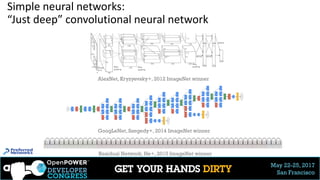
Simple neural networks:
“Just deep” convolutional neural network
3
AlexNet, Kryzyevsky+, 2012 ImageNet winner
GoogLeNet, Szegedy+, 2014 ImageNet winner
Residual Network, He+, 2015 ImageNet winner
May 22-25, 2017
San Francisco
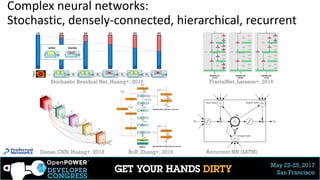
Complex neural networks:
Stochastic, densely-connected, hierarchical, recurrent
4
Stochastic Residual Net, Huang+, 2016 FractalNet, Larsson+, 2016
Recurrent NN (LSTM)RoR, Zhang+, 2016Dense CNN, Huang+, 2016
May 22-25, 2017
San Francisco
▶ Chainer is one of the NVIDIA-supported DL frameworks
▶ Chainer uses a unique scheme named Define-by-Run
http://chainer.org/
5
Chainer fits very well to complex neural networks
May 22-25, 2017
San Francisco
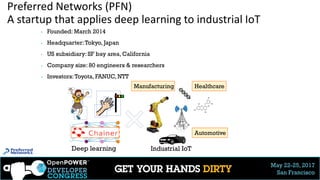
Preferred Networks (PFN)
A startup that applies deep learning to industrial IoT
▶ Founded: March 2014
▶ Headquarter:Tokyo, Japan
▶ US subsidiary: SF bay area, California
▶ Company size: 80 engineers & researchers
▶ Investors:Toyota, FANUC, NTT
Deep learning Industrial IoT
Manufacturing
Automotive
Healthcare
May 22-25, 2017
San Francisco
What we do with Chainer:
Partnering with world-leading companies
▶ Applying deep learning to industrial problems with real-world data
▶ Specific requirements, modification to algorithms, many trial-and-errors
▶ Completely different from making general-purpose recognition systems
▶ A proof: PFN won the 2nd prize @ Amazon Picking Challenge 2016
May 22-25, 2017
San Francisco
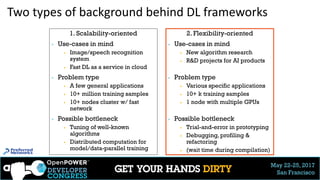
Two types of background behind DL frameworks
1. Scalability-oriented
▶ Use-cases in mind
▶ Image/speech recognition
system
▶ Fast DL as a service in cloud
▶ Problem type
▶ A few general applications
▶ 10+ million training samples
▶ 10+ nodes cluster w/ fast
network
▶ Possible bottleneck
▶ Tuning of well-known
algorithms
▶ Distributed computation for
model/data-parallel training
2. Flexibility-oriented
▶ Use-cases in mind
▶ New algorithm research
▶ R&D projects for AI products
▶ Problem type
▶ Various specific applications
▶ 10+ k training samples
▶ 1 node with multiple GPUs
▶ Possible bottleneck
▶ Trial-and-error in prototyping
▶ Debugging, profiling &
refactoring
▶ (wait time during compilation)
May 22-25, 2017
San Francisco
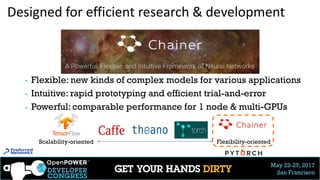
Designed for efficient research & development
▶ Flexible: new kinds of complex models for various applications
▶ Intuitive: rapid prototyping and efficient trial-and-error
▶ Powerful: comparable performance for 1 node & multi-GPUs
9
Scalability-oriented Flexibility-oriented
May 22-25, 2017
San Francisco
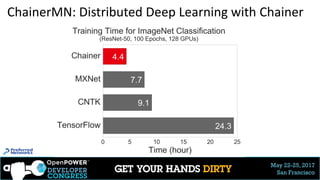
ChainerMN: Distributed Deep Learning with Chainer
10
May 22-25, 2017
San Francisco
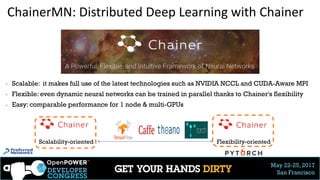
ChainerMN: Distributed Deep Learning with Chainer
▶ Scalable: it makes full use of the latest technologies such as NVIDIA NCCL and CUDA-Aware MPI
▶ Flexible: even dynamic neural networks can be trained in parallel thanks to Chainer's flexibility
▶ Easy: comparable performance for 1 node & multi-GPUs
11
Scalability-oriented Flexibility-oriented
May 22-25, 2017
San Francisco
Agenda
▶ Deep learning framework basics
▶ Basics of Chainer
▶ Chainer features
12
May 22-25, 2017
San Francisco
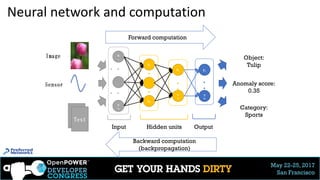
Neural network and computation
x
1
x
N
・
・
h1
hH
・・・・
k
M
k1
y
M
y1
Forward computation
Backward computation
(backpropagation)
・・
・・
Input Hidden units Output
Text
Image
Sensor
Object:
Tulip
Anomaly score:
0.35
Category:
Sports・
・
・・・・
13
May 22-25, 2017
San Francisco
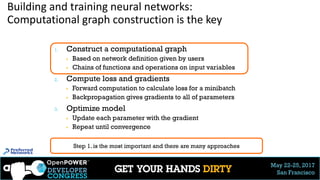
Building and training neural networks:
Computational graph construction is the key
1. Construct a computational graph
▶ Based on network definition given by users
▶ Chains of functions and operations on input variables
2. Compute loss and gradients
▶ Forward computation to calculate loss for a minibatch
▶ Backpropagation gives gradients to all of parameters
3. Optimize model
▶ Update each parameter with the gradient
▶ Repeat until convergence
Step 1. is the most important and there are many approaches
14
May 22-25, 2017
San Francisco
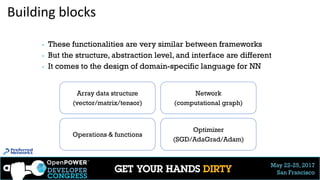
Building blocks
▶ These functionalities are very similar between frameworks
▶ But the structure, abstraction level, and interface are different
▶ It comes to the design of domain-specific language for NN
Array data structure
(vector/matrix/tensor)
Operations & functions
Network
(computational graph)
Optimizer
(SGD/AdaGrad/Adam)
15
May 22-25, 2017
San Francisco
3 types of domain-specific language:
Network definition to computational graph construction
16
▶ Text DSL
▶ Ex. Caffe (prototxt)
▶ Ex. CNTK (NDL)
# Symbolic definition
A = Variable(‘A’)
B = Variable(‘B’)
C = B * A
D = C + Constant(1)
# Compile
f = compile(D)
d = f(A=np.ones(10),
B=np.ones(10) * 2)
# Imperative declaration
a = np.ones(10)
b = np.ones(10) * 2
c = b * a
d = c + 1
%% Definition in text
f: {
“A”: “Variable”,
“B”: “Variable”,
“C”: [“B”, “*”, “A”],
“ret”: [“C”, “+”, 1]
}
# Compile
f = compile(“f.txt”)
d = f(A=np.ones(10),
B=np.ones(10) * 2)
▶ Symbolic program
▶ Operations on
symbols
▶ Ex.Theano
▶ Ex.TensorFlow
▶ Imperative program
▶ Direct computations
on raw data arrays
▶ Ex.Torch.nn
▶ Ex. Chainer
▶ Ex. MXNet
May 22-25, 2017
San Francisco
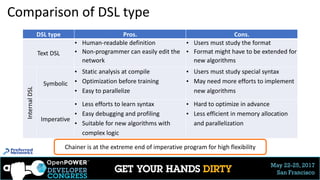
Comparison of DSL type
DSL type Pros. Cons.
Text DSL
• Human-readable definition
• Non-programmer can easily edit the
network
• Users must study the format
• Format might have to be extended for
new algorithms
InternalDSL
Symbolic
• Static analysis at compile
• Optimization before training
• Easy to parallelize
• Users must study special syntax
• May need more efforts to implement
new algorithms
Imperative
• Less efforts to learn syntax
• Easy debugging and profiling
• Suitable for new algorithms with
complex logic
• Hard to optimize in advance
• Less efficient in memory allocation
and parallelization
Chainer is at the extreme end of imperative program for high flexibility
17
May 22-25, 2017
San Francisco
Agenda
▶ Deep learning framework basics
▶ Basics of Chainer
▶ Chainer features
18
May 22-25, 2017
San Francisco
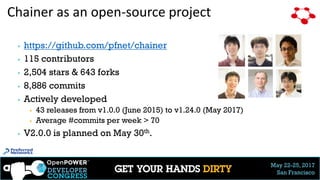
Chainer as an open-source project
▶ https://github.com/pfnet/chainer
▶ 115 contributors
▶ 2,504 stars & 643 forks
▶ 8,886 commits
▶ Actively developed
▶ 43 releases from v1.0.0 (June 2015) to v1.24.0 (May 2017)
▶ Average #commits per week > 70
▶ V2.0.0 is planned on May 30th.
19
May 22-25, 2017
San Francisco
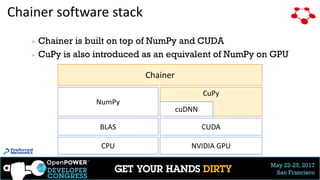
CuPy
Chainer software stack
CPU NVIDIA GPU
CUDA
cuDNN
BLAS
NumPy
Chainer
▶ Chainer is built on top of NumPy and CUDA
▶ CuPy is also introduced as an equivalent of NumPy on GPU
20
May 22-25, 2017
San Francisco
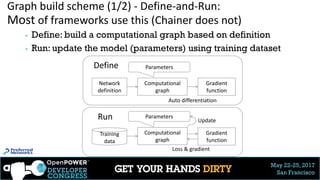
Graph build scheme (1/2) - Define-and-Run:
Most of frameworks use this (Chainer does not)
21
Run
Define
▶ Define: build a computational graph based on definition
▶ Run: update the model (parameters) using training dataset
Network
definition
Computational
graph
Gradient
function
Parameters
Computational
graph
Gradient
function
Parameters
Training
data
Update
Loss & gradient
Auto differentiation
21
May 22-25, 2017
San Francisco
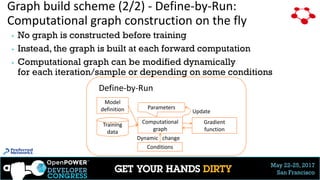
Define-by-Run
Graph build scheme (2/2) - Define-by-Run:
Computational graph construction on the fly
▶ No graph is constructed before training
▶ Instead, the graph is built at each forward computation
▶ Computational graph can be modified dynamically
for each iteration/sample or depending on some conditions
Model
definition
Computational
graph
Gradient
function
Parameters
Training
data
Update
Dynamic change
Conditions
May 22-25, 2017
San Francisco
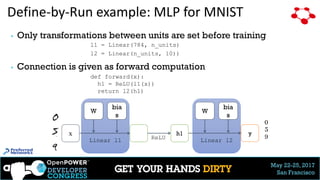
Define-by-Run example: MLP for MNIST
▶ Only transformations between units are set before training
▶ Connection is given as forward computation
l1 = Linear(784, n_units)
l2 = Linear(n_units, 10))
Linear l2Linear l1
x yh1
W
bia
s
0
5
9
W
bia
s
ReLU
def forward(x):
h1 = ReLU(l1(x))
return l2(h1)
23
May 22-25, 2017
San Francisco
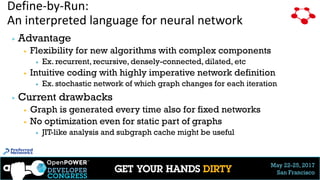
Define-by-Run:
An interpreted language for neural network
▶ Advantage
▶ Flexibility for new algorithms with complex components
▶ Ex. recurrent, recursive, densely-connected, dilated, etc
▶ Intuitive coding with highly imperative network definition
▶ Ex. stochastic network of which graph changes for each iteration
▶ Current drawbacks
▶ Graph is generated every time also for fixed networks
▶ No optimization even for static part of graphs
▶ JIT-like analysis and subgraph cache might be useful
May 22-25, 2017
San Francisco
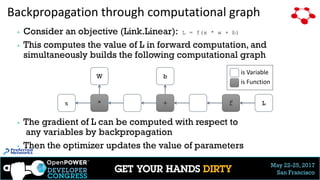
Backpropagation through computational graph
▶ Consider an objective (Link.Linear): L = f(x * w + b)
▶ This computes the value of L in forward computation, and
simultaneously builds the following computational graph
▶ The gradient of L can be computed with respect to
any variables by backpropagation
▶ Then the optimizer updates the value of parameters
*x
W
+
b
f L
is Variable
is Function
25
May 22-25, 2017
San Francisco
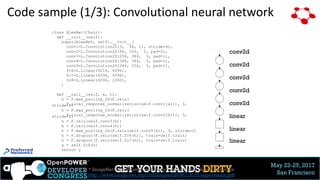
Code sample (1/3): Convolutional neural network
class AlexNet(Chain):
def __init__(self):
super(AlexNet, self).__init__(
conv1=L.Convolution2D(3, 96, 11, stride=4),
conv2=L.Convolution2D(96, 256, 5, pad=2),
conv3=L.Convolution2D(256, 384, 3, pad=1),
conv4=L.Convolution2D(384, 384, 3, pad=1),
conv5=L.Convolution2D(384, 256, 3, pad=1),
fc6=L.Linear(9216, 4096),
fc7=L.Linear(4096, 4096),
fc8=L.Linear(4096, 1000),
)
def __call__(self, x, t):
h = F.max_pooling_2d(F.relu(
F.local_response_normalization(self.conv1(x))), 3,stride=2)
h = F.max_pooling_2d(F.relu(
F.local_response_normalization(self.conv2(h))), 3,stride=2)
h = F.relu(self.conv3(h))
h = F.relu(self.conv4(h))
h = F.max_pooling_2d(F.relu(self.conv5(h)), 3, stride=2)
h = F.dropout(F.relu(self.fc6(h)), train=self.train)
h = F.dropout(F.relu(self.fc7(h)), train=self.train)
y = self.fc8(h)
return y
* ImageNet Classification with Deep Convolutional Neural Networks
http://www.image-net.org/challenges/LSVRC/2012/supervision.pdf
conv2d
conv2d
conv2d
conv2d
conv2d
linear
linear
26
linear
May 22-25, 2017
San Francisco
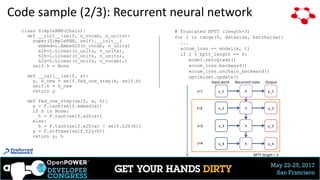
Code sample (2/3): Recurrent neural network
class SimpleRNN(Chain):
def __init__(self, n_vocab, n_units):
super(SimpleRNN, self).__init__(
embed=L.EmbedID(n_vocab, n_units)
x2h=L.Linear(n_units, n_units),
h2h=L.Linear(n_units, n_units),
h2y=L.Linear(n_units, n_vocab),)
self.h = None
def __call__(self, x):
y, h_new = self.fwd_one_step(x, self.h)
self.h = h_new
return y
def fwd_one_step(self, x, h):
x = F.tanh(self.embed(x))
if h is None:
h = F.tanh(self.x2h(x))
else:
h = F.tanh(self.x2h(x) + self.h2h(h))
y = F.softmax(self.h2y(h))
return y, h
x_1 h y_1
x_2 h y_2
x_3 h y_3
t=1
t=2
t=3
x_4 h y_4t=4
BPTT length = 3
Input word OutputRecurrent state
# Truncated BPTT (length=3)
for i in range(0, datasize, batchsize):
...
accum_loss += model(x, t)
if i % bptt_length == 0:
model.zerograds()
accum_loss.backward()
accum_loss.unchain_backward()
optimizer.update()
27
May 22-25, 2017
San Francisco
Code sample (3/3): Stochastic Residual Network
28
▶ A variant of Residual Net that skips connections stochastically
▶ Outperformed the original Residual Net (ImageNet 2015 winner, MSR)
▶ Stochastic skip:
Taken from http://arxiv.org/abs/1603.09382v2
G. Huang et al.
# Mock code in Chainer
class StochasticResNet(Chain):
def __init__(self, prob, size, …):
super(StochasticResNet, size, …).__init__(
## Define f[i] as same for Residual Net )
self.p = prob # Survival probabilities
def __call__(self, h):
for i in range(self.size):
b = numpy.random.binomial(1, self.p[i])
c = self.f[i](h) + h if b == 1 else h
h = F.relu(c)
return h
w/ survival probability:
May 22-25, 2017
San Francisco
Agenda
▶ Deep learning framework basics
▶ Basics of Chainer
▶ Chainer features
29
May 22-25, 2017
San Francisco
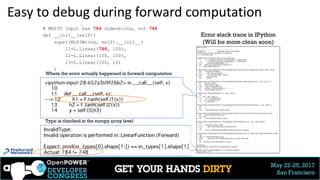
Easy to debug during forward computation
# MNIST input has 784 dimensions, not 748
def __init__(self):
super(MLP3Wrong, self).__init__(
l1=L.Linear(748, 100),
l2=L.Linear(100, 100),
l3=L.Linear(100, 10)
)
Error stack trace in IPython
(Will be more clean soon)
Where the error actually happened in forward computation
Type is checked at the numpy array level
May 22-25, 2017
San Francisco
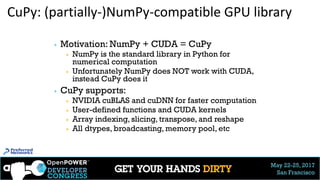
CuPy: (partially-)NumPy-compatible GPU library
▶ Motivation: NumPy + CUDA = CuPy
▶ NumPy is the standard library in Python for
numerical computation
▶ Unfortunately NumPy does NOT work with CUDA,
instead CuPy does it
▶ CuPy supports:
▶ NVIDIA cuBLAS and cuDNN for faster computation
▶ User-defined functions and CUDA kernels
▶ Array indexing, slicing, transpose, and reshape
▶ All dtypes, broadcasting, memory pool, etc
31
May 22-25, 2017
San Francisco
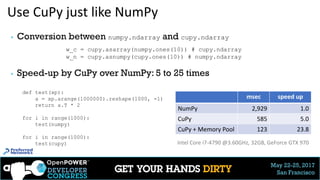
Use CuPy just like NumPy
▶ Conversion between numpy.ndarray and cupy.ndarray
▶ Speed-up by CuPy over NumPy: 5 to 25 times
32
msec speed up
NumPy 2,929 1.0
CuPy 585 5.0
CuPy + Memory Pool 123 23.8
Intel Core i7-4790 @3.60GHz, 32GB, GeForce GTX 970
def test(xp):
a = xp.arange(1000000).reshape(1000, -1)
return a.T * 2
for i in range(1000):
test(numpy)
for i in range(1000):
test(cupy)
w_c = cupy.asarray(numpy.ones(10)) # cupy.ndarray
w_n = cupy.asnumpy(cupy.ones(10)) # numpy.ndarray
May 22-25, 2017
San Francisco
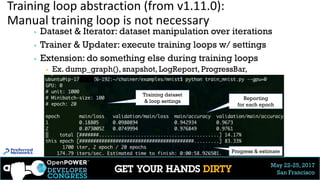
Training loop abstraction (from v1.11.0):
Manual training loop is not necessary
▶ Dataset & Iterator: dataset manipulation over iterations
▶ Trainer & Updater: execute training loops w/ settings
▶ Extension: do something else during training loops
▶ Ex. dump_graph(), snapshot, LogReport, ProgressBar,
33Progress & estimate
Reporting
for each epoch
Training dataset
& loop settings
May 22-25, 2017
San Francisco
Summary
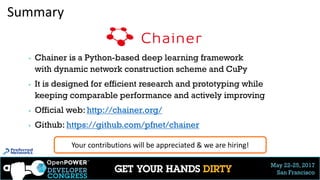
▶ Chainer is a Python-based deep learning framework
with dynamic network construction scheme and CuPy
▶ It is designed for efficient research and prototyping while
keeping comparable performance and actively improving
▶ Official web: http://chainer.org/
▶ Github: https://github.com/pfnet/chainer
Your contributions will be appreciated & we are hiring!
34

Chainer OpenPOWER developer congress HandsON 20170522_ota

  • 1.
    May 22-25, 2017| San Francisco
  • 2.
    May 22-25, 2017 SanFrancisco A Flexible Framework for Complex Neural Networks @ OpenPOWER Developer Congress, May 24th, 2017 Nobuyuki Ota Preferred Networks, Inc.
  • 3.
    May 22-25, 2017 SanFrancisco Simple neural networks: “Just deep” convolutional neural network 3 AlexNet, Kryzyevsky+, 2012 ImageNet winner GoogLeNet, Szegedy+, 2014 ImageNet winner Residual Network, He+, 2015 ImageNet winner
  • 4.
    May 22-25, 2017 SanFrancisco Complex neural networks: Stochastic, densely-connected, hierarchical, recurrent 4 Stochastic Residual Net, Huang+, 2016 FractalNet, Larsson+, 2016 Recurrent NN (LSTM)RoR, Zhang+, 2016Dense CNN, Huang+, 2016
  • 5.
    May 22-25, 2017 SanFrancisco ▶ Chainer is one of the NVIDIA-supported DL frameworks ▶ Chainer uses a unique scheme named Define-by-Run http://chainer.org/ 5 Chainer fits very well to complex neural networks
  • 6.
    May 22-25, 2017 SanFrancisco Preferred Networks (PFN) A startup that applies deep learning to industrial IoT ▶ Founded: March 2014 ▶ Headquarter:Tokyo, Japan ▶ US subsidiary: SF bay area, California ▶ Company size: 80 engineers & researchers ▶ Investors:Toyota, FANUC, NTT Deep learning Industrial IoT Manufacturing Automotive Healthcare
  • 7.
    May 22-25, 2017 SanFrancisco What we do with Chainer: Partnering with world-leading companies ▶ Applying deep learning to industrial problems with real-world data ▶ Specific requirements, modification to algorithms, many trial-and-errors ▶ Completely different from making general-purpose recognition systems ▶ A proof: PFN won the 2nd prize @ Amazon Picking Challenge 2016
  • 8.
    May 22-25, 2017 SanFrancisco Two types of background behind DL frameworks 1. Scalability-oriented ▶ Use-cases in mind ▶ Image/speech recognition system ▶ Fast DL as a service in cloud ▶ Problem type ▶ A few general applications ▶ 10+ million training samples ▶ 10+ nodes cluster w/ fast network ▶ Possible bottleneck ▶ Tuning of well-known algorithms ▶ Distributed computation for model/data-parallel training 2. Flexibility-oriented ▶ Use-cases in mind ▶ New algorithm research ▶ R&D projects for AI products ▶ Problem type ▶ Various specific applications ▶ 10+ k training samples ▶ 1 node with multiple GPUs ▶ Possible bottleneck ▶ Trial-and-error in prototyping ▶ Debugging, profiling & refactoring ▶ (wait time during compilation)
  • 9.
    May 22-25, 2017 SanFrancisco Designed for efficient research & development ▶ Flexible: new kinds of complex models for various applications ▶ Intuitive: rapid prototyping and efficient trial-and-error ▶ Powerful: comparable performance for 1 node & multi-GPUs 9 Scalability-oriented Flexibility-oriented
  • 10.
    May 22-25, 2017 SanFrancisco ChainerMN: Distributed Deep Learning with Chainer 10
  • 11.
    May 22-25, 2017 SanFrancisco ChainerMN: Distributed Deep Learning with Chainer ▶ Scalable: it makes full use of the latest technologies such as NVIDIA NCCL and CUDA-Aware MPI ▶ Flexible: even dynamic neural networks can be trained in parallel thanks to Chainer's flexibility ▶ Easy: comparable performance for 1 node & multi-GPUs 11 Scalability-oriented Flexibility-oriented
  • 12.
    May 22-25, 2017 SanFrancisco Agenda ▶ Deep learning framework basics ▶ Basics of Chainer ▶ Chainer features 12
  • 13.
    May 22-25, 2017 SanFrancisco Neural network and computation x 1 x N ・ ・ h1 hH ・・・・ k M k1 y M y1 Forward computation Backward computation (backpropagation) ・・ ・・ Input Hidden units Output Text Image Sensor Object: Tulip Anomaly score: 0.35 Category: Sports・ ・ ・・・・ 13
  • 14.
    May 22-25, 2017 SanFrancisco Building and training neural networks: Computational graph construction is the key 1. Construct a computational graph ▶ Based on network definition given by users ▶ Chains of functions and operations on input variables 2. Compute loss and gradients ▶ Forward computation to calculate loss for a minibatch ▶ Backpropagation gives gradients to all of parameters 3. Optimize model ▶ Update each parameter with the gradient ▶ Repeat until convergence Step 1. is the most important and there are many approaches 14
  • 15.
    May 22-25, 2017 SanFrancisco Building blocks ▶ These functionalities are very similar between frameworks ▶ But the structure, abstraction level, and interface are different ▶ It comes to the design of domain-specific language for NN Array data structure (vector/matrix/tensor) Operations & functions Network (computational graph) Optimizer (SGD/AdaGrad/Adam) 15
  • 16.
    May 22-25, 2017 SanFrancisco 3 types of domain-specific language: Network definition to computational graph construction 16 ▶ Text DSL ▶ Ex. Caffe (prototxt) ▶ Ex. CNTK (NDL) # Symbolic definition A = Variable(‘A’) B = Variable(‘B’) C = B * A D = C + Constant(1) # Compile f = compile(D) d = f(A=np.ones(10), B=np.ones(10) * 2) # Imperative declaration a = np.ones(10) b = np.ones(10) * 2 c = b * a d = c + 1 %% Definition in text f: { “A”: “Variable”, “B”: “Variable”, “C”: [“B”, “*”, “A”], “ret”: [“C”, “+”, 1] } # Compile f = compile(“f.txt”) d = f(A=np.ones(10), B=np.ones(10) * 2) ▶ Symbolic program ▶ Operations on symbols ▶ Ex.Theano ▶ Ex.TensorFlow ▶ Imperative program ▶ Direct computations on raw data arrays ▶ Ex.Torch.nn ▶ Ex. Chainer ▶ Ex. MXNet
  • 17.
    May 22-25, 2017 SanFrancisco Comparison of DSL type DSL type Pros. Cons. Text DSL • Human-readable definition • Non-programmer can easily edit the network • Users must study the format • Format might have to be extended for new algorithms InternalDSL Symbolic • Static analysis at compile • Optimization before training • Easy to parallelize • Users must study special syntax • May need more efforts to implement new algorithms Imperative • Less efforts to learn syntax • Easy debugging and profiling • Suitable for new algorithms with complex logic • Hard to optimize in advance • Less efficient in memory allocation and parallelization Chainer is at the extreme end of imperative program for high flexibility 17
  • 18.
    May 22-25, 2017 SanFrancisco Agenda ▶ Deep learning framework basics ▶ Basics of Chainer ▶ Chainer features 18
  • 19.
    May 22-25, 2017 SanFrancisco Chainer as an open-source project ▶ https://github.com/pfnet/chainer ▶ 115 contributors ▶ 2,504 stars & 643 forks ▶ 8,886 commits ▶ Actively developed ▶ 43 releases from v1.0.0 (June 2015) to v1.24.0 (May 2017) ▶ Average #commits per week > 70 ▶ V2.0.0 is planned on May 30th. 19
  • 20.
    May 22-25, 2017 SanFrancisco CuPy Chainer software stack CPU NVIDIA GPU CUDA cuDNN BLAS NumPy Chainer ▶ Chainer is built on top of NumPy and CUDA ▶ CuPy is also introduced as an equivalent of NumPy on GPU 20
  • 21.
    May 22-25, 2017 SanFrancisco Graph build scheme (1/2) - Define-and-Run: Most of frameworks use this (Chainer does not) 21 Run Define ▶ Define: build a computational graph based on definition ▶ Run: update the model (parameters) using training dataset Network definition Computational graph Gradient function Parameters Computational graph Gradient function Parameters Training data Update Loss & gradient Auto differentiation 21
  • 22.
    May 22-25, 2017 SanFrancisco Define-by-Run Graph build scheme (2/2) - Define-by-Run: Computational graph construction on the fly ▶ No graph is constructed before training ▶ Instead, the graph is built at each forward computation ▶ Computational graph can be modified dynamically for each iteration/sample or depending on some conditions Model definition Computational graph Gradient function Parameters Training data Update Dynamic change Conditions
  • 23.
    May 22-25, 2017 SanFrancisco Define-by-Run example: MLP for MNIST ▶ Only transformations between units are set before training ▶ Connection is given as forward computation l1 = Linear(784, n_units) l2 = Linear(n_units, 10)) Linear l2Linear l1 x yh1 W bia s 0 5 9 W bia s ReLU def forward(x): h1 = ReLU(l1(x)) return l2(h1) 23
  • 24.
    May 22-25, 2017 SanFrancisco Define-by-Run: An interpreted language for neural network ▶ Advantage ▶ Flexibility for new algorithms with complex components ▶ Ex. recurrent, recursive, densely-connected, dilated, etc ▶ Intuitive coding with highly imperative network definition ▶ Ex. stochastic network of which graph changes for each iteration ▶ Current drawbacks ▶ Graph is generated every time also for fixed networks ▶ No optimization even for static part of graphs ▶ JIT-like analysis and subgraph cache might be useful
  • 25.
    May 22-25, 2017 SanFrancisco Backpropagation through computational graph ▶ Consider an objective (Link.Linear): L = f(x * w + b) ▶ This computes the value of L in forward computation, and simultaneously builds the following computational graph ▶ The gradient of L can be computed with respect to any variables by backpropagation ▶ Then the optimizer updates the value of parameters *x W + b f L is Variable is Function 25
  • 26.
    May 22-25, 2017 SanFrancisco Code sample (1/3): Convolutional neural network class AlexNet(Chain): def __init__(self): super(AlexNet, self).__init__( conv1=L.Convolution2D(3, 96, 11, stride=4), conv2=L.Convolution2D(96, 256, 5, pad=2), conv3=L.Convolution2D(256, 384, 3, pad=1), conv4=L.Convolution2D(384, 384, 3, pad=1), conv5=L.Convolution2D(384, 256, 3, pad=1), fc6=L.Linear(9216, 4096), fc7=L.Linear(4096, 4096), fc8=L.Linear(4096, 1000), ) def __call__(self, x, t): h = F.max_pooling_2d(F.relu( F.local_response_normalization(self.conv1(x))), 3,stride=2) h = F.max_pooling_2d(F.relu( F.local_response_normalization(self.conv2(h))), 3,stride=2) h = F.relu(self.conv3(h)) h = F.relu(self.conv4(h)) h = F.max_pooling_2d(F.relu(self.conv5(h)), 3, stride=2) h = F.dropout(F.relu(self.fc6(h)), train=self.train) h = F.dropout(F.relu(self.fc7(h)), train=self.train) y = self.fc8(h) return y * ImageNet Classification with Deep Convolutional Neural Networks http://www.image-net.org/challenges/LSVRC/2012/supervision.pdf conv2d conv2d conv2d conv2d conv2d linear linear 26 linear
  • 27.
    May 22-25, 2017 SanFrancisco Code sample (2/3): Recurrent neural network class SimpleRNN(Chain): def __init__(self, n_vocab, n_units): super(SimpleRNN, self).__init__( embed=L.EmbedID(n_vocab, n_units) x2h=L.Linear(n_units, n_units), h2h=L.Linear(n_units, n_units), h2y=L.Linear(n_units, n_vocab),) self.h = None def __call__(self, x): y, h_new = self.fwd_one_step(x, self.h) self.h = h_new return y def fwd_one_step(self, x, h): x = F.tanh(self.embed(x)) if h is None: h = F.tanh(self.x2h(x)) else: h = F.tanh(self.x2h(x) + self.h2h(h)) y = F.softmax(self.h2y(h)) return y, h x_1 h y_1 x_2 h y_2 x_3 h y_3 t=1 t=2 t=3 x_4 h y_4t=4 BPTT length = 3 Input word OutputRecurrent state # Truncated BPTT (length=3) for i in range(0, datasize, batchsize): ... accum_loss += model(x, t) if i % bptt_length == 0: model.zerograds() accum_loss.backward() accum_loss.unchain_backward() optimizer.update() 27
  • 28.
    May 22-25, 2017 SanFrancisco Code sample (3/3): Stochastic Residual Network 28 ▶ A variant of Residual Net that skips connections stochastically ▶ Outperformed the original Residual Net (ImageNet 2015 winner, MSR) ▶ Stochastic skip: Taken from http://arxiv.org/abs/1603.09382v2 G. Huang et al. # Mock code in Chainer class StochasticResNet(Chain): def __init__(self, prob, size, …): super(StochasticResNet, size, …).__init__( ## Define f[i] as same for Residual Net ) self.p = prob # Survival probabilities def __call__(self, h): for i in range(self.size): b = numpy.random.binomial(1, self.p[i]) c = self.f[i](h) + h if b == 1 else h h = F.relu(c) return h w/ survival probability:
  • 29.
    May 22-25, 2017 SanFrancisco Agenda ▶ Deep learning framework basics ▶ Basics of Chainer ▶ Chainer features 29
  • 30.
    May 22-25, 2017 SanFrancisco Easy to debug during forward computation # MNIST input has 784 dimensions, not 748 def __init__(self): super(MLP3Wrong, self).__init__( l1=L.Linear(748, 100), l2=L.Linear(100, 100), l3=L.Linear(100, 10) ) Error stack trace in IPython (Will be more clean soon) Where the error actually happened in forward computation Type is checked at the numpy array level
  • 31.
    May 22-25, 2017 SanFrancisco CuPy: (partially-)NumPy-compatible GPU library ▶ Motivation: NumPy + CUDA = CuPy ▶ NumPy is the standard library in Python for numerical computation ▶ Unfortunately NumPy does NOT work with CUDA, instead CuPy does it ▶ CuPy supports: ▶ NVIDIA cuBLAS and cuDNN for faster computation ▶ User-defined functions and CUDA kernels ▶ Array indexing, slicing, transpose, and reshape ▶ All dtypes, broadcasting, memory pool, etc 31
  • 32.
    May 22-25, 2017 SanFrancisco Use CuPy just like NumPy ▶ Conversion between numpy.ndarray and cupy.ndarray ▶ Speed-up by CuPy over NumPy: 5 to 25 times 32 msec speed up NumPy 2,929 1.0 CuPy 585 5.0 CuPy + Memory Pool 123 23.8 Intel Core i7-4790 @3.60GHz, 32GB, GeForce GTX 970 def test(xp): a = xp.arange(1000000).reshape(1000, -1) return a.T * 2 for i in range(1000): test(numpy) for i in range(1000): test(cupy) w_c = cupy.asarray(numpy.ones(10)) # cupy.ndarray w_n = cupy.asnumpy(cupy.ones(10)) # numpy.ndarray
  • 33.
    May 22-25, 2017 SanFrancisco Training loop abstraction (from v1.11.0): Manual training loop is not necessary ▶ Dataset & Iterator: dataset manipulation over iterations ▶ Trainer & Updater: execute training loops w/ settings ▶ Extension: do something else during training loops ▶ Ex. dump_graph(), snapshot, LogReport, ProgressBar, 33Progress & estimate Reporting for each epoch Training dataset & loop settings
  • 34.
    May 22-25, 2017 SanFrancisco Summary ▶ Chainer is a Python-based deep learning framework with dynamic network construction scheme and CuPy ▶ It is designed for efficient research and prototyping while keeping comparable performance and actively improving ▶ Official web: http://chainer.org/ ▶ Github: https://github.com/pfnet/chainer Your contributions will be appreciated & we are hiring! 34