Deep Learning Implementations
and Frameworks
(Very short version of PAKDD 2016 tutorial)
Kenta Oono oono@preferred.jp
Preferred Networks Inc.
25th Jun. 2016
Tokyo Webmining @FreakOut
1/31
Overview
•1st session (8:30 ‒ 10:00)
•Introduction (AK)
•Basics of neural networks (AK)
•Common design of neural network
implementations (KO)
•2nd session (10:30 ‒ 12:30)
•Differences of deep learning frameworks (ST)
•Coding examples of frameworks (KO & ST)
•Conclusion (ST)
2/31
Full contents
• Session1
• Basics of neural Networks
• http://www.slideshare.net/atsu-kan/pakdd2016-tutorial-dlif-introduction-
and-basics-63030841
• Common design of neural networks implementation
• http://www.slideshare.net/KentaOono/common-design-of-deep-learning-
frameworks
• Session2
• Differences of deep learning frameworks
• http://www.slideshare.net/beam2d/differences-of-deep-learning-
frameworks
• Coding examples of frameworks
• will be available soon.
3/31
Basics of Neural Networks
Atsunori Kanemura
AIST, Japan
4/31
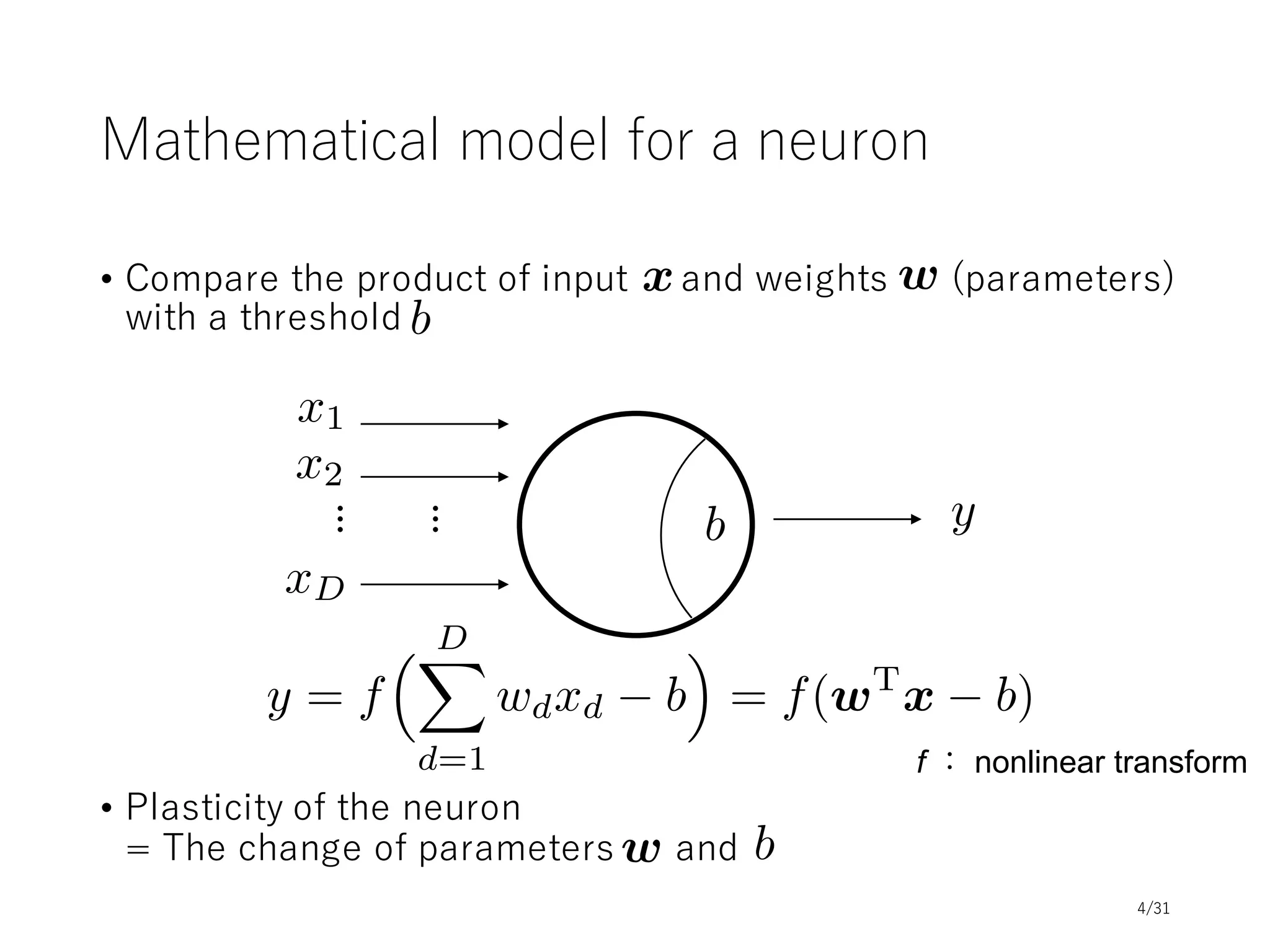
Mathematical model for a neuron
• Compare the product of input and weights (parameters)
with a threshold
• Plasticity of the neuron
= The change of parameters and
…
…
f : nonlinear transform
b
x w
b
x1
x2
y
w
xD
y = f
⇣ DX
d=1
wdxd b
⌘
= f(wT
x b)
b
5/31
Parameter update
• Gradient Descent (GD)
• Stochastic Gradient Descent (SGD)
• Take several samples (say, 128) from the dataset (mini-batch),
estimate the gradient.
• Theoretically motivated as the Robbins-Monro algorithm
• SGD to general gradient-based algorithms
• Adam, AdaGrad, etc.
• Use momentum and other techniques
w w rrwJ(w) = w
NX
n=1
h(xn
h(xn, w
¯
)
def
= (f(wT
xn) yn)f(wT
xn)(1 f(w
6/31
Gradient descent
• The gradient of the loss for 1-layer model is
• The update rule
(r is a
constant
learning
rate)
rwJ(w) =
1
2
NX
n=1
rw(f(wT
xn) y⇤
n)2
=
NX
n=1
(f(wT
xn) y⇤
n)rwf(wT
xn)
=
NX
n=1
(f(wT
xn) y⇤
n)f(wT
xn)(1 f(wT
xn))xn
w w rrwJ(w) = w
NX
n=1
h(xn, w)xn
h(xn, w)
def
= (f(wT
xn) y⇤
n)f(wT
xn)(1 f(wT
xn))
7/31
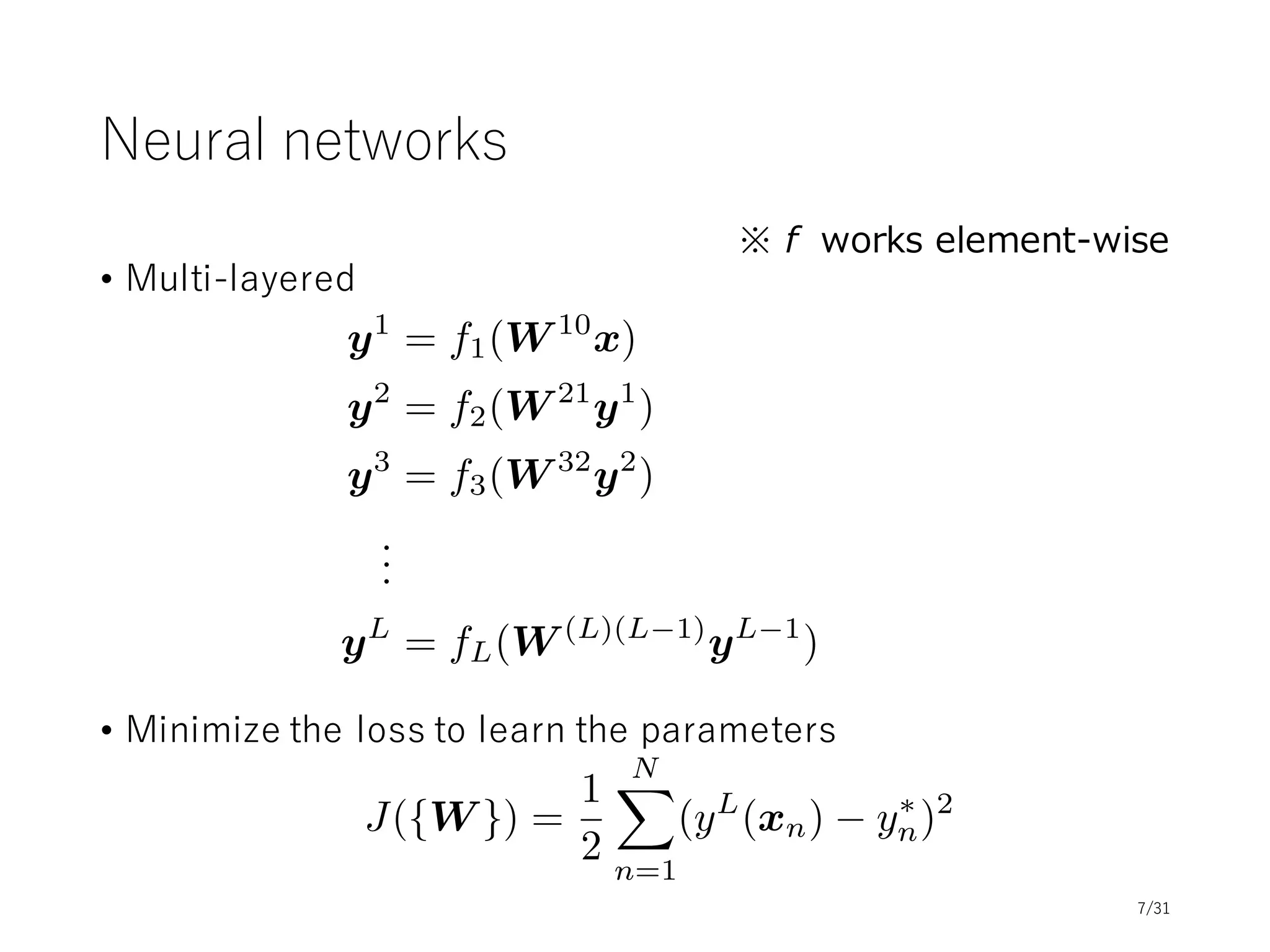
Neural networks
• Multi-layered
• Minimize the loss to learn the parameters
※ f works element-wise
y1
= f1(W 10
x)
y2
= f2(W 21
y1
)
y3
= f3(W 32
y2
)
...
yL
= fL(W (L)(L 1)
yL 1
)
J({W }) =
1
2
NX
n=1
(yL
(xn) y⇤
n)2
8/31
Backprop
• Use the chain rule to derive the gradient
• E.g. 2-layer case
• Calculate gradient recursively from top to bottom layers
• Cf. Gradient vanishing, ReLU
y1
n = f(W 10
xn), y2
n = f(w21
· y1
n)
@J
@W10
kl
=
X
n,i
@J
@y1
ni
@y1
ni
@W10
kl
J(W 10
, w21
) =
1
2
X
n
(y2
n y⇤
n)2
9/31
Common Design of
Deep Learning Frameworks
Kenta Oono <oono@preferred.jp>
Preferred Networks Inc.
10/31
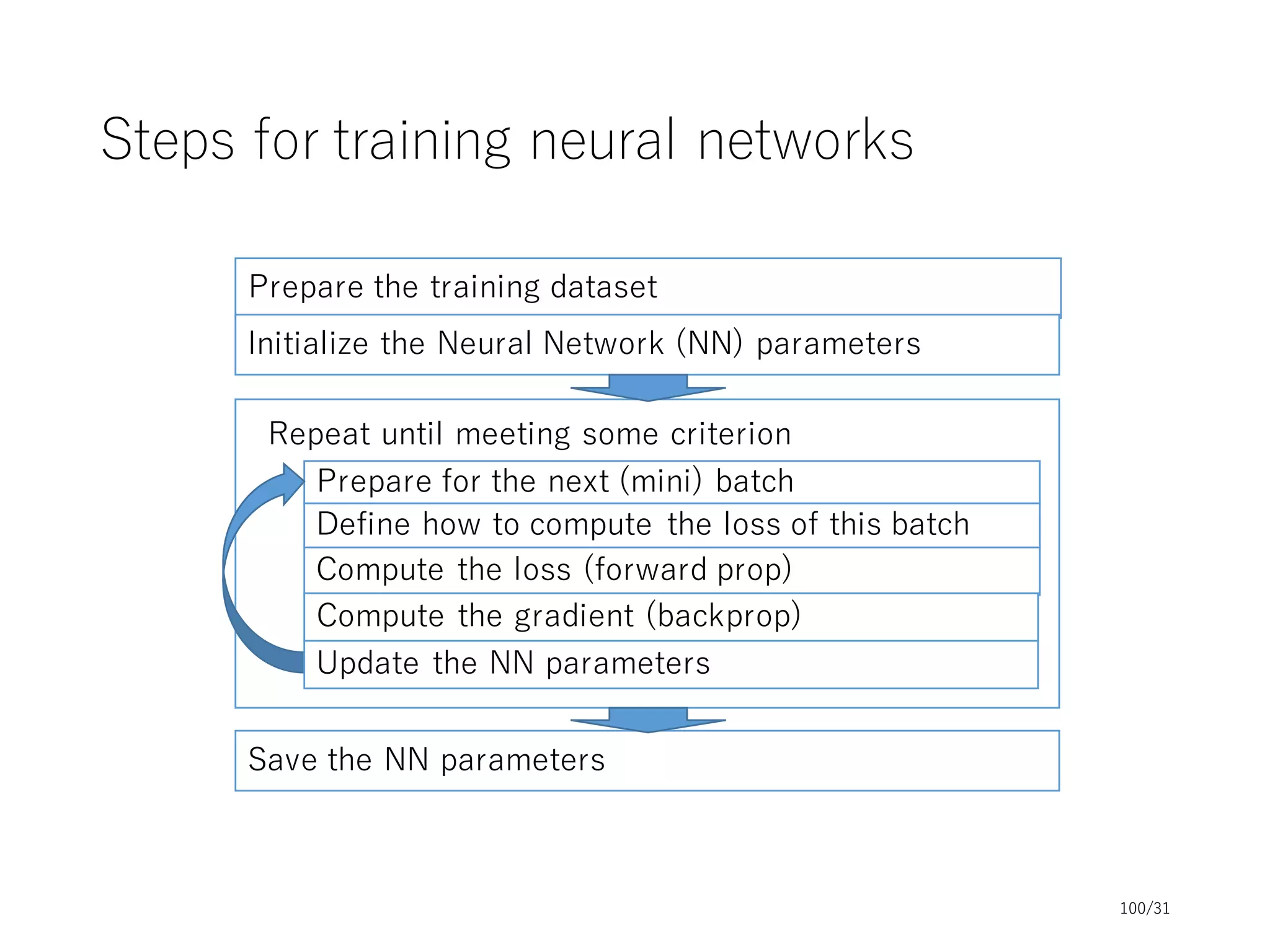
Steps for training neural networks
Prepare the training dataset
Repeat until meeting some criterion
Prepare for the next (mini) batch
Compute the loss (forward prop)
Initialize the Neural Network (NN) parameters
Save the NN parameters
Define how to compute the loss of this batch
Compute the gradient (backprop)
Update the NN parameters
11/31
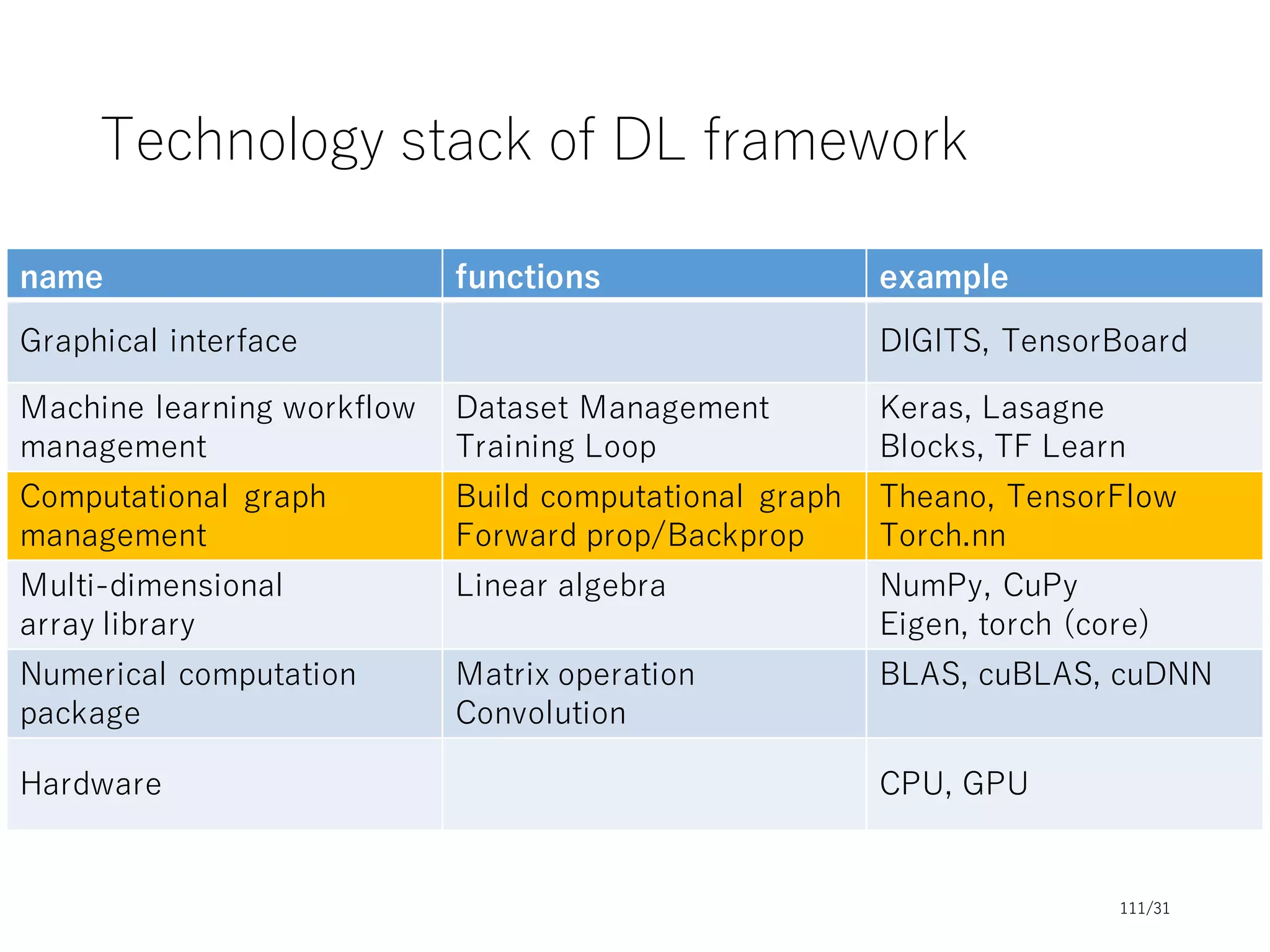
Technology stack of DL framework
name functions example
Graphical interface DIGITS, TensorBoard
Machine learning workflow
management
Dataset Management
Training Loop
Keras, Lasagne
Blocks, TF Learn
Computational graph
management
Build computational graph
Forward prop/Backprop
Theano, TensorFlow
Torch.nn
Multi-dimensional
array library
Linear algebra NumPy, CuPy
Eigen, torch (core)
Numerical computation
package
Matrix operation
Convolution
BLAS, cuBLAS, cuDNN
Hardware CPU, GPU
12/31
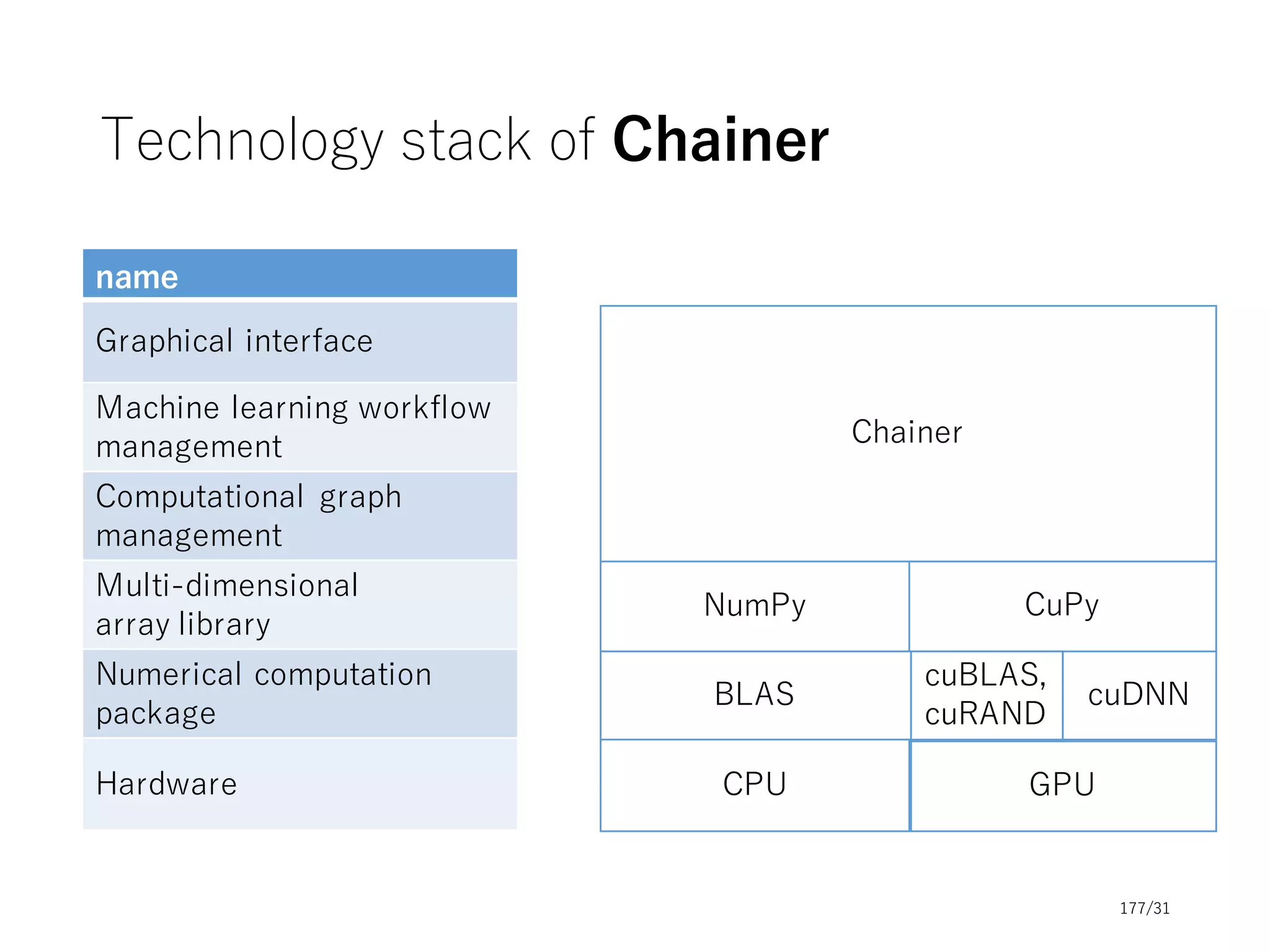
Technology stack of Chainer
cuDNN
Chainer
NumPy CuPy
BLAS
cuBLAS,
cuRAND
CPU GPU
name
Graphical interface
Machine learning workflow
management
Computational graph
management
Multi-dimensional
array library
Numerical computation
package
Hardware
13/31
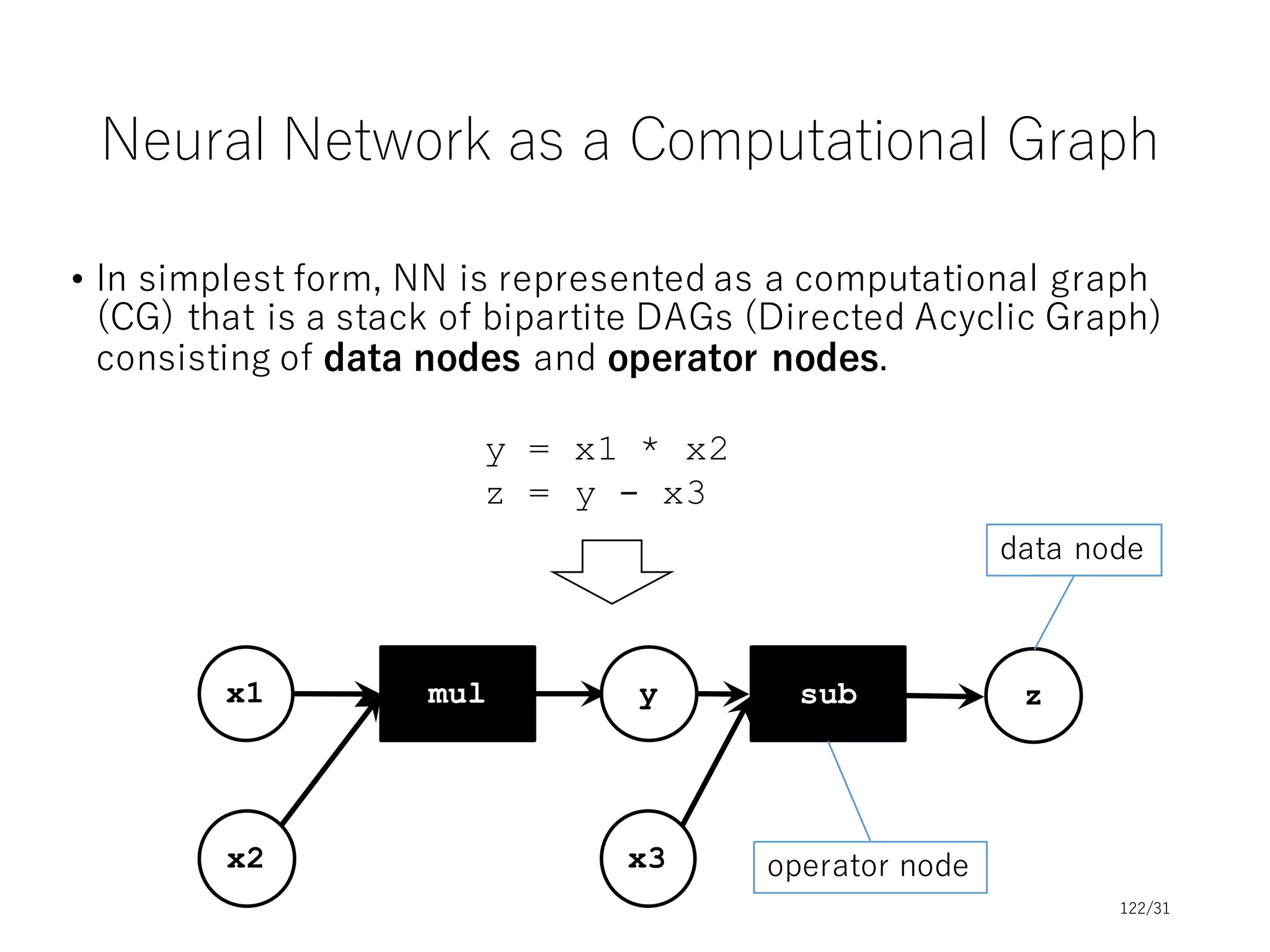
Neural Network as a Computational Graph
• In simplest form, NN is represented as a computational graph
(CG) that is a stack of bipartite DAGs (Directed Acyclic Graph)
consisting of data nodes and operator nodes.
y = x1 * x2
z = y - x3
x1 mul suby
x3
z
x2
data node
operator node
14/31
Example: Multi-layer Perceptron (MLP)
x Affine
W1 b1
h1 ReLU a1
Affine
W2 b2
h2 ReLU a2
Soft
max
y
Cross
Entropy
Lo
ss
t
It is choice of
implementation if CG
includes weights and
biases.
15/31
Automatic Differentiation
• Computes gradient of some specified data nodes (e.g. loss)
with respect to each data node.
• Each operator node must have backward operation to
calculate gradients w.r.t. its inputs from gradients w.r.t. its
outputs (realization of chain rule).
• e.g. Function class of Chainer has backward method.
• e.g. Each layer classes of Caffe has Backward_cpu and
Backward_gpu methods
• e.g. Autograd has a thin wrapper that adds gradient methods as a
closure to most of NumPy methods.
16/31
Backprop through CG
∇y z∇x1 z ∇z z = 1
y = x1 * x2
z = y - x3
x1 mul suby
x3
z
x2
17/31
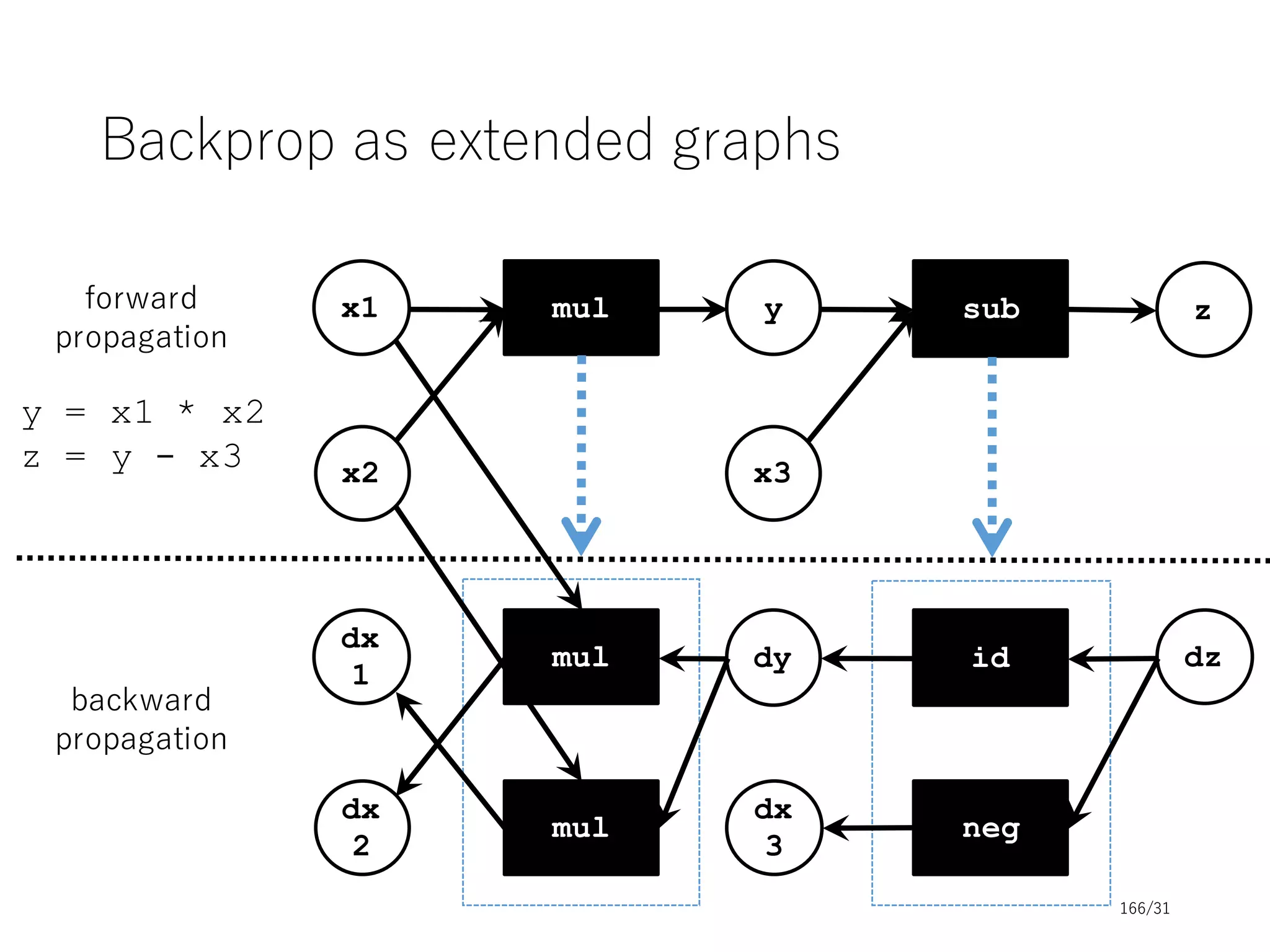
Backprop as extended graphs
x1 mul suby
x3
z
x2
dzid
neg
mul
mul
dy
dx
3
dx
1
dx
2
forward
propagation
backward
propagation
y = x1 * x2
z = y - x3
18/31
Differences of
Deep Learning Frameworks
Seiya Tokui
Preferred Networks, Inc.
19/31
Training of Neural Networks
Prepare the training dataset
Repeat until meeting some criterion
Prepare for the next (mini) batch
Compute the loss (forward prop)
Initialize the NN parameters
Save the NN parameters
Define how to compute the loss of this batch
Compute the gradient (backprop)
Update the NN parameters
automated
20/31
Framework Design Choices
• The most crucial part of NN frameworks is
• How to define the parameters
• How to define the loss function of the parameters
(= how to write computational graphs)
• These also influence on APIs for forward prop, backprop, and
parameter updates (i.e., numerical optimization)
• And all of these are determined by how to implement
computational graphs
• Other parts are also important, but are mostly common to
implementations of other types of machine learning methods
21/31
Framework Comparison: Basic information*
Viewpoint Torch.nn** Theano*** Caffe
autograd
(NumPy,
Torch)
Chainer MXNet
Tensor-
Flow
GitHub
stars
4,719 3,457 9,590
N: 654
T: 554
1,295 3,316 20,981
Started
from
2002 2008 2013 2015 2015 2015 2015
Open
issues/PRs
97/26 525/105 407/204
N: 9/0
T: 3/1
95/25 271/18 330/33
Main
developers
Facebook,
Twitter,
Google, etc.
Université
de Montréal
BVLC
(U.C. Berkeley)
N: HIPS
(Harvard Univ.)
T: Twitter
Preferred
Networks
DMLC Google
Core
languages
C/Lua C/Python C++ Python/Lua Python C++ C++/Python
Supported
languages
Lua Python
C++/Python
MATLAB
Python/Lua Python
C++/Python
R/Julia/Go
etc.
C++/Python
* Data was taken on Apr. 12, 2016
** Includes statistics of Torch7
*** There are many frameworks on top of Theano, though we omit them due to the space constraints
22/31
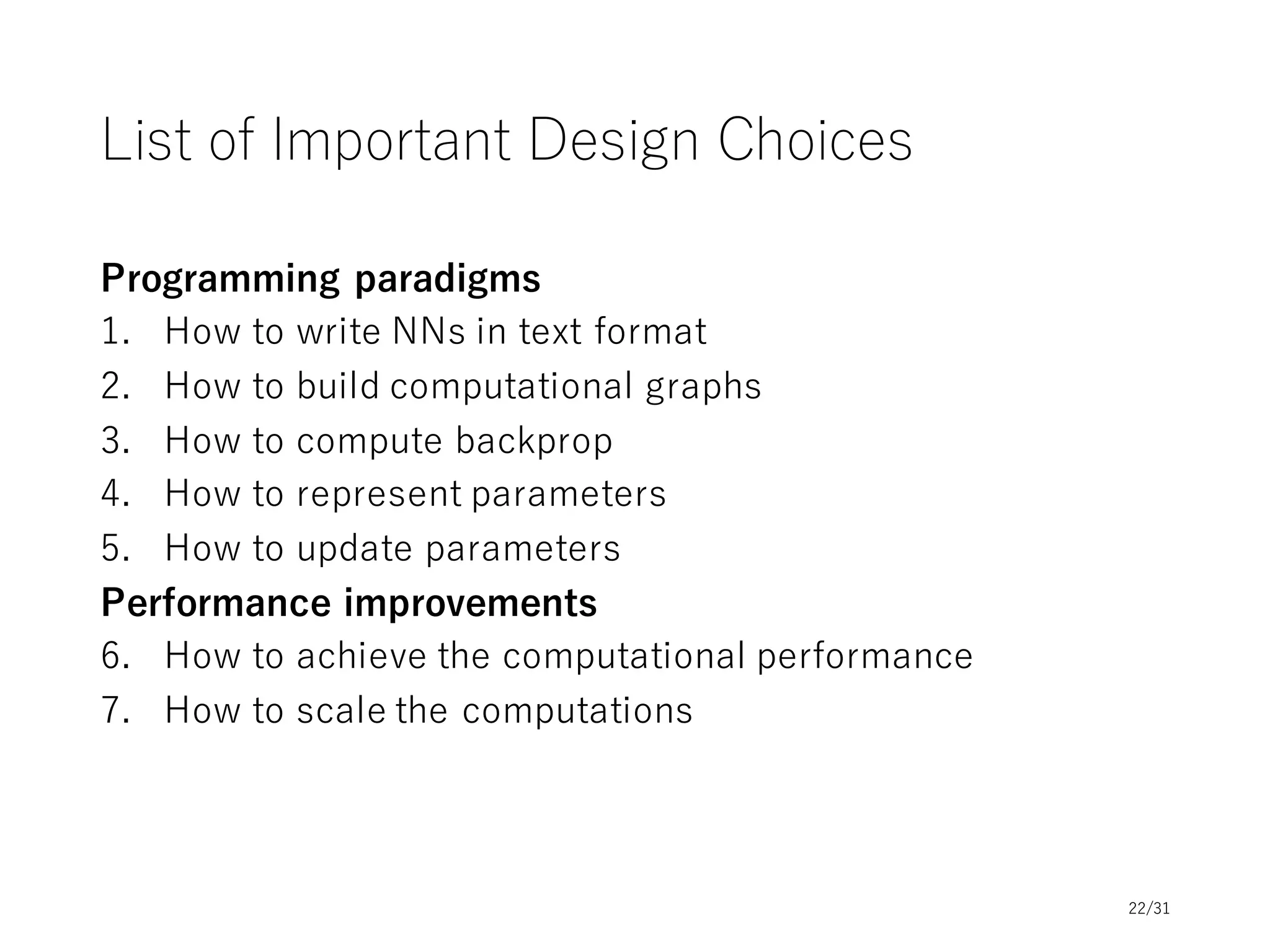
List of Important Design Choices
Programming paradigms
1. How to write NNs in text format
2. How to build computational graphs
3. How to compute backprop
4. How to represent parameters
5. How to update parameters
Performance improvements
6. How to achieve the computational performance
7. How to scale the computations
23/31
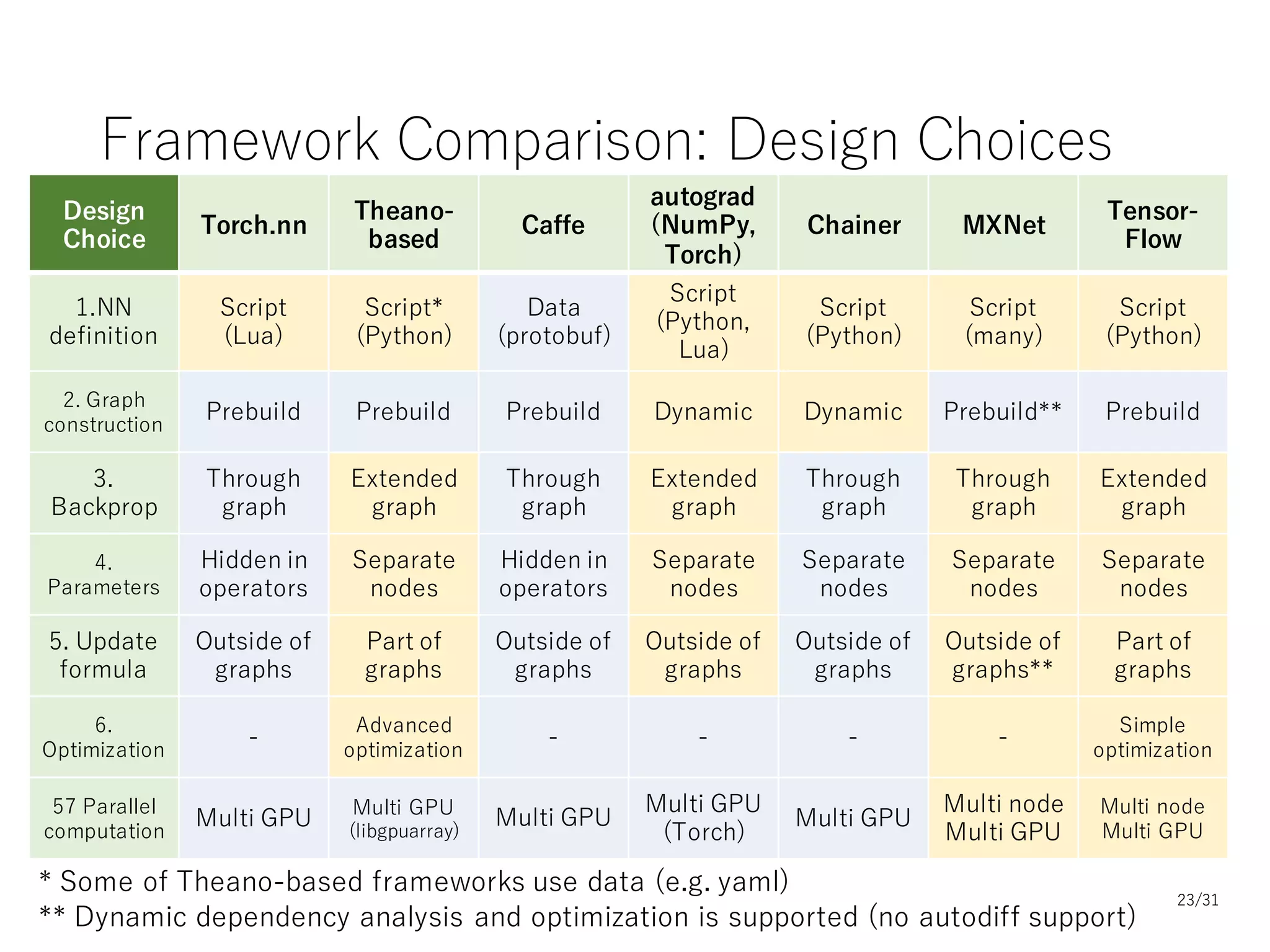
Framework Comparison: Design Choices
Design
Choice
Torch.nn
Theano-
based
Caffe
autograd
(NumPy,
Torch)
Chainer MXNet
Tensor-
Flow
1.NN
definition
Script
(Lua)
Script*
(Python)
Data
(protobuf)
Script
(Python,
Lua)
Script
(Python)
Script
(many)
Script
(Python)
2. Graph
construction
Prebuild Prebuild Prebuild Dynamic Dynamic Prebuild** Prebuild
3.
Backprop
Through
graph
Extended
graph
Through
graph
Extended
graph
Through
graph
Through
graph
Extended
graph
4.
Parameters
Hidden in
operators
Separate
nodes
Hidden in
operators
Separate
nodes
Separate
nodes
Separate
nodes
Separate
nodes
5. Update
formula
Outside of
graphs
Part of
graphs
Outside of
graphs
Outside of
graphs
Outside of
graphs
Outside of
graphs**
Part of
graphs
6.
Optimization
-
Advanced
optimization
- - - -
Simple
optimization
57 Parallel
computation
Multi GPU Multi GPU
(libgpuarray)
Multi GPU
Multi GPU
(Torch)
Multi GPU
Multi node
Multi GPU
Multi node
Multi GPU
* Some of Theano-based frameworks use data (e.g. yaml)
** Dynamic dependency analysis and optimization is supported (no autodiff support)24/31
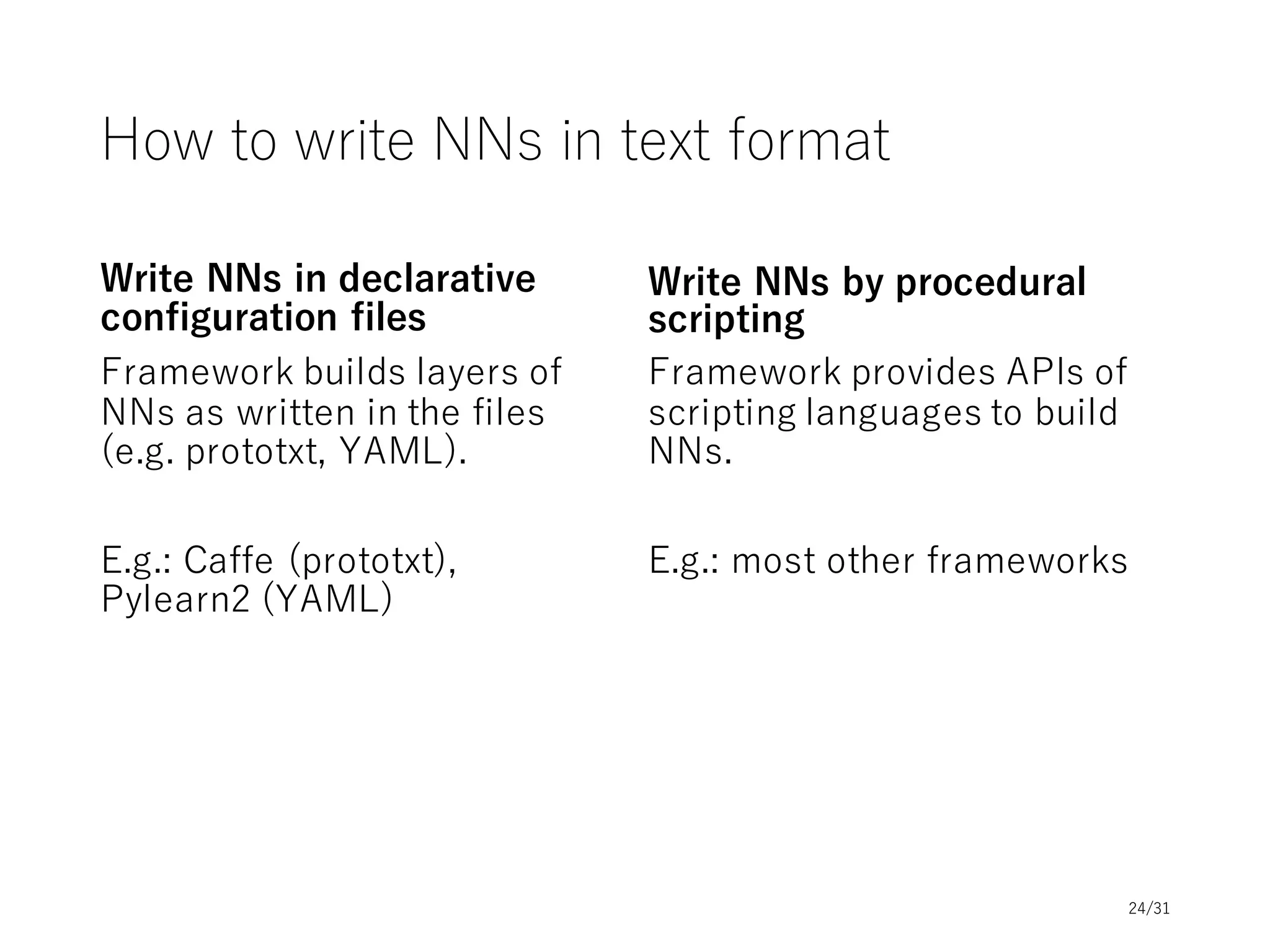
How to write NNs in text format
Write NNs in declarative
configuration files
Framework builds layers of
NNs as written in the files
(e.g. prototxt, YAML).
E.g.: Caffe (prototxt),
Pylearn2 (YAML)
Write NNs by procedural
scripting
Framework provides APIs of
scripting languages to build
NNs.
E.g.: most other frameworks
25/31
2. How to build computational graphs
Prepare the training dataset
Repeat until meeting some criterion
Prepare for the next (mini) batch
Compute the loss (forward prop)
Initialize the NN parameters
Save the NN parameters
Compute the gradient (backprop)
Update the NN parameters
Define how to compute the loss
Prepare the training dataset
Repeat until meeting some criterion
Prepare for the next (mini) batch
Compute the loss (forward prop)
Initialize the NN parameters
Save the NN parameters
Define how to compute the loss
Compute the gradient (backprop)
Update the NN parameters
Build once, run several times Build one at every iteration
26/31
3. How to compute backprop
Backprop through graphs
Framework only builds
graphs of forward prop, and
do backprop by backtracking
the graphs.
E.g.: Torch.nn, Caffe, MXNet,
Chainer
Backprop as extended graphs
Framework builds graphs for
backprop as well as those for
forward prop.
E.g.: Theano, TensorFlow
a mul suby
c
z
b
a mul suby
c
z
b
dzid
neg
mul
mul
dy
dc
da
db
∇y z∇x1 z ∇z z = 1
27/31
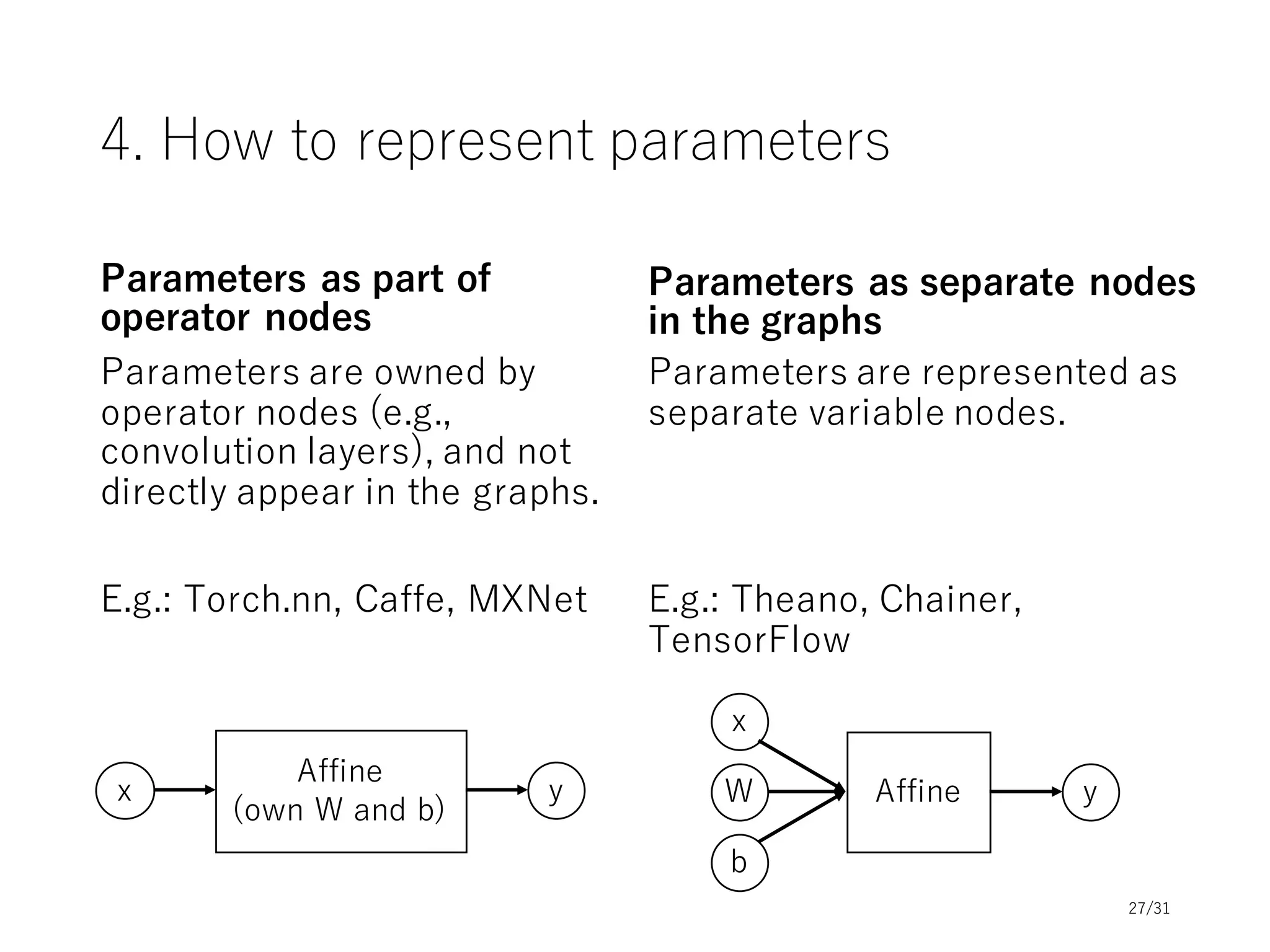
4. How to represent parameters
Parameters as part of
operator nodes
Parameters are owned by
operator nodes (e.g.,
convolution layers), and not
directly appear in the graphs.
E.g.: Torch.nn, Caffe, MXNet
Parameters as separate nodes
in the graphs
Parameters are represented as
separate variable nodes.
E.g.: Theano, Chainer,
TensorFlow
x
Affine
(own W and b)
y
x
Affine yW
b
28/31
5. How to update parameters
Update parameters by own
routines outside of the
graphs
Update formulae are
implemented directly using
the backend array libraries.
E.g.: Torch.nn, Caffe, MXNet,
Chainer
Represent update formulae as
a part of the graphs
Update formulae are built as a
part of computational graphs.
E.g.: Theano, TensorFlow
29/31
6. How to achieve the computational
performance
Transform the graphs to
optimize the computations
There are many ways to
optimize the computations.
Theano supports variout
optimizations.
TensorFlow does simple
ones.
Provide easy ways to write
custom operator nodes
Users can write their own
operator nodes optimized to
their purposes.
Torch, MXNet, and Chainer
provide ways to write one code
that runs both on CPU and GPU.
Chainer also provides ways to
write custom CUDA kernels
without manual compilation
steps.
30/31
7. How to scale the computations
Multi-GPU parallelizations
Nowadays, most popular
frameworks start supporting
multi-GPU computations.
Multi-GPU (one machine) is
enough for most use cases
today.
Distributed computations (i.e.,
multi-node parallelizations)
Some frameworks also support
distributed computations to
further scale the learning.
MXNet uses a simple
distributed key-value store.
TensorFlow uses gRPC. It will
also support easy-to-use cloud
environments.
CNTK uses simple MPI.
31/31
Conclusion
• We introduced the basics of NNs, typical designs of their
implementations, and pros/cons of various design choices.
• Deep learning is an emerging field with increasing speed of
development, so quick try-and-error is crutial for the
research/development in this field
• In that mean, using frameworks as highly reusable parts of
NNs is important
• There are growing number of frameworks in this world,
though most of them have different aspects, so it is also
important to choose one appropriate for your purpose
32/31

Tokyo Webmining Talk1

  • 1.
    Deep Learning Implementations andFrameworks (Very short version of PAKDD 2016 tutorial) Kenta Oono oono@preferred.jp Preferred Networks Inc. 25th Jun. 2016 Tokyo Webmining @FreakOut 1/31
  • 2.
    Overview •1st session (8:30‒ 10:00) •Introduction (AK) •Basics of neural networks (AK) •Common design of neural network implementations (KO) •2nd session (10:30 ‒ 12:30) •Differences of deep learning frameworks (ST) •Coding examples of frameworks (KO & ST) •Conclusion (ST) 2/31
  • 3.
    Full contents • Session1 •Basics of neural Networks • http://www.slideshare.net/atsu-kan/pakdd2016-tutorial-dlif-introduction- and-basics-63030841 • Common design of neural networks implementation • http://www.slideshare.net/KentaOono/common-design-of-deep-learning- frameworks • Session2 • Differences of deep learning frameworks • http://www.slideshare.net/beam2d/differences-of-deep-learning- frameworks • Coding examples of frameworks • will be available soon. 3/31
  • 4.
    Basics of NeuralNetworks Atsunori Kanemura AIST, Japan 4/31
  • 5.
    Mathematical model fora neuron • Compare the product of input and weights (parameters) with a threshold • Plasticity of the neuron = The change of parameters and … … f : nonlinear transform b x w b x1 x2 y w xD y = f ⇣ DX d=1 wdxd b ⌘ = f(wT x b) b 5/31
  • 6.
    Parameter update • GradientDescent (GD) • Stochastic Gradient Descent (SGD) • Take several samples (say, 128) from the dataset (mini-batch), estimate the gradient. • Theoretically motivated as the Robbins-Monro algorithm • SGD to general gradient-based algorithms • Adam, AdaGrad, etc. • Use momentum and other techniques w w rrwJ(w) = w NX n=1 h(xn h(xn, w ¯ ) def = (f(wT xn) yn)f(wT xn)(1 f(w 6/31
  • 7.
    Gradient descent • Thegradient of the loss for 1-layer model is • The update rule (r is a constant learning rate) rwJ(w) = 1 2 NX n=1 rw(f(wT xn) y⇤ n)2 = NX n=1 (f(wT xn) y⇤ n)rwf(wT xn) = NX n=1 (f(wT xn) y⇤ n)f(wT xn)(1 f(wT xn))xn w w rrwJ(w) = w NX n=1 h(xn, w)xn h(xn, w) def = (f(wT xn) y⇤ n)f(wT xn)(1 f(wT xn)) 7/31
  • 8.
    Neural networks • Multi-layered •Minimize the loss to learn the parameters ※ f works element-wise y1 = f1(W 10 x) y2 = f2(W 21 y1 ) y3 = f3(W 32 y2 ) ... yL = fL(W (L)(L 1) yL 1 ) J({W }) = 1 2 NX n=1 (yL (xn) y⇤ n)2 8/31
  • 9.
    Backprop • Use thechain rule to derive the gradient • E.g. 2-layer case • Calculate gradient recursively from top to bottom layers • Cf. Gradient vanishing, ReLU y1 n = f(W 10 xn), y2 n = f(w21 · y1 n) @J @W10 kl = X n,i @J @y1 ni @y1 ni @W10 kl J(W 10 , w21 ) = 1 2 X n (y2 n y⇤ n)2 9/31
  • 10.
    Common Design of DeepLearning Frameworks Kenta Oono <oono@preferred.jp> Preferred Networks Inc. 10/31
  • 11.
    Steps for trainingneural networks Prepare the training dataset Repeat until meeting some criterion Prepare for the next (mini) batch Compute the loss (forward prop) Initialize the Neural Network (NN) parameters Save the NN parameters Define how to compute the loss of this batch Compute the gradient (backprop) Update the NN parameters 11/31
  • 12.
    Technology stack ofDL framework name functions example Graphical interface DIGITS, TensorBoard Machine learning workflow management Dataset Management Training Loop Keras, Lasagne Blocks, TF Learn Computational graph management Build computational graph Forward prop/Backprop Theano, TensorFlow Torch.nn Multi-dimensional array library Linear algebra NumPy, CuPy Eigen, torch (core) Numerical computation package Matrix operation Convolution BLAS, cuBLAS, cuDNN Hardware CPU, GPU 12/31
  • 13.
    Technology stack ofChainer cuDNN Chainer NumPy CuPy BLAS cuBLAS, cuRAND CPU GPU name Graphical interface Machine learning workflow management Computational graph management Multi-dimensional array library Numerical computation package Hardware 13/31
  • 14.
    Neural Network asa Computational Graph • In simplest form, NN is represented as a computational graph (CG) that is a stack of bipartite DAGs (Directed Acyclic Graph) consisting of data nodes and operator nodes. y = x1 * x2 z = y - x3 x1 mul suby x3 z x2 data node operator node 14/31
  • 15.
    Example: Multi-layer Perceptron(MLP) x Affine W1 b1 h1 ReLU a1 Affine W2 b2 h2 ReLU a2 Soft max y Cross Entropy Lo ss t It is choice of implementation if CG includes weights and biases. 15/31
  • 16.
    Automatic Differentiation • Computesgradient of some specified data nodes (e.g. loss) with respect to each data node. • Each operator node must have backward operation to calculate gradients w.r.t. its inputs from gradients w.r.t. its outputs (realization of chain rule). • e.g. Function class of Chainer has backward method. • e.g. Each layer classes of Caffe has Backward_cpu and Backward_gpu methods • e.g. Autograd has a thin wrapper that adds gradient methods as a closure to most of NumPy methods. 16/31
  • 17.
    Backprop through CG ∇yz∇x1 z ∇z z = 1 y = x1 * x2 z = y - x3 x1 mul suby x3 z x2 17/31
  • 18.
    Backprop as extendedgraphs x1 mul suby x3 z x2 dzid neg mul mul dy dx 3 dx 1 dx 2 forward propagation backward propagation y = x1 * x2 z = y - x3 18/31
  • 19.
    Differences of Deep LearningFrameworks Seiya Tokui Preferred Networks, Inc. 19/31
  • 20.
    Training of NeuralNetworks Prepare the training dataset Repeat until meeting some criterion Prepare for the next (mini) batch Compute the loss (forward prop) Initialize the NN parameters Save the NN parameters Define how to compute the loss of this batch Compute the gradient (backprop) Update the NN parameters automated 20/31
  • 21.
    Framework Design Choices •The most crucial part of NN frameworks is • How to define the parameters • How to define the loss function of the parameters (= how to write computational graphs) • These also influence on APIs for forward prop, backprop, and parameter updates (i.e., numerical optimization) • And all of these are determined by how to implement computational graphs • Other parts are also important, but are mostly common to implementations of other types of machine learning methods 21/31
  • 22.
    Framework Comparison: Basicinformation* Viewpoint Torch.nn** Theano*** Caffe autograd (NumPy, Torch) Chainer MXNet Tensor- Flow GitHub stars 4,719 3,457 9,590 N: 654 T: 554 1,295 3,316 20,981 Started from 2002 2008 2013 2015 2015 2015 2015 Open issues/PRs 97/26 525/105 407/204 N: 9/0 T: 3/1 95/25 271/18 330/33 Main developers Facebook, Twitter, Google, etc. Université de Montréal BVLC (U.C. Berkeley) N: HIPS (Harvard Univ.) T: Twitter Preferred Networks DMLC Google Core languages C/Lua C/Python C++ Python/Lua Python C++ C++/Python Supported languages Lua Python C++/Python MATLAB Python/Lua Python C++/Python R/Julia/Go etc. C++/Python * Data was taken on Apr. 12, 2016 ** Includes statistics of Torch7 *** There are many frameworks on top of Theano, though we omit them due to the space constraints 22/31
  • 23.
    List of ImportantDesign Choices Programming paradigms 1. How to write NNs in text format 2. How to build computational graphs 3. How to compute backprop 4. How to represent parameters 5. How to update parameters Performance improvements 6. How to achieve the computational performance 7. How to scale the computations 23/31
  • 24.
    Framework Comparison: DesignChoices Design Choice Torch.nn Theano- based Caffe autograd (NumPy, Torch) Chainer MXNet Tensor- Flow 1.NN definition Script (Lua) Script* (Python) Data (protobuf) Script (Python, Lua) Script (Python) Script (many) Script (Python) 2. Graph construction Prebuild Prebuild Prebuild Dynamic Dynamic Prebuild** Prebuild 3. Backprop Through graph Extended graph Through graph Extended graph Through graph Through graph Extended graph 4. Parameters Hidden in operators Separate nodes Hidden in operators Separate nodes Separate nodes Separate nodes Separate nodes 5. Update formula Outside of graphs Part of graphs Outside of graphs Outside of graphs Outside of graphs Outside of graphs** Part of graphs 6. Optimization - Advanced optimization - - - - Simple optimization 57 Parallel computation Multi GPU Multi GPU (libgpuarray) Multi GPU Multi GPU (Torch) Multi GPU Multi node Multi GPU Multi node Multi GPU * Some of Theano-based frameworks use data (e.g. yaml) ** Dynamic dependency analysis and optimization is supported (no autodiff support)24/31
  • 25.
    How to writeNNs in text format Write NNs in declarative configuration files Framework builds layers of NNs as written in the files (e.g. prototxt, YAML). E.g.: Caffe (prototxt), Pylearn2 (YAML) Write NNs by procedural scripting Framework provides APIs of scripting languages to build NNs. E.g.: most other frameworks 25/31
  • 26.
    2. How tobuild computational graphs Prepare the training dataset Repeat until meeting some criterion Prepare for the next (mini) batch Compute the loss (forward prop) Initialize the NN parameters Save the NN parameters Compute the gradient (backprop) Update the NN parameters Define how to compute the loss Prepare the training dataset Repeat until meeting some criterion Prepare for the next (mini) batch Compute the loss (forward prop) Initialize the NN parameters Save the NN parameters Define how to compute the loss Compute the gradient (backprop) Update the NN parameters Build once, run several times Build one at every iteration 26/31
  • 27.
    3. How tocompute backprop Backprop through graphs Framework only builds graphs of forward prop, and do backprop by backtracking the graphs. E.g.: Torch.nn, Caffe, MXNet, Chainer Backprop as extended graphs Framework builds graphs for backprop as well as those for forward prop. E.g.: Theano, TensorFlow a mul suby c z b a mul suby c z b dzid neg mul mul dy dc da db ∇y z∇x1 z ∇z z = 1 27/31
  • 28.
    4. How torepresent parameters Parameters as part of operator nodes Parameters are owned by operator nodes (e.g., convolution layers), and not directly appear in the graphs. E.g.: Torch.nn, Caffe, MXNet Parameters as separate nodes in the graphs Parameters are represented as separate variable nodes. E.g.: Theano, Chainer, TensorFlow x Affine (own W and b) y x Affine yW b 28/31
  • 29.
    5. How toupdate parameters Update parameters by own routines outside of the graphs Update formulae are implemented directly using the backend array libraries. E.g.: Torch.nn, Caffe, MXNet, Chainer Represent update formulae as a part of the graphs Update formulae are built as a part of computational graphs. E.g.: Theano, TensorFlow 29/31
  • 30.
    6. How toachieve the computational performance Transform the graphs to optimize the computations There are many ways to optimize the computations. Theano supports variout optimizations. TensorFlow does simple ones. Provide easy ways to write custom operator nodes Users can write their own operator nodes optimized to their purposes. Torch, MXNet, and Chainer provide ways to write one code that runs both on CPU and GPU. Chainer also provides ways to write custom CUDA kernels without manual compilation steps. 30/31
  • 31.
    7. How toscale the computations Multi-GPU parallelizations Nowadays, most popular frameworks start supporting multi-GPU computations. Multi-GPU (one machine) is enough for most use cases today. Distributed computations (i.e., multi-node parallelizations) Some frameworks also support distributed computations to further scale the learning. MXNet uses a simple distributed key-value store. TensorFlow uses gRPC. It will also support easy-to-use cloud environments. CNTK uses simple MPI. 31/31
  • 32.
    Conclusion • We introducedthe basics of NNs, typical designs of their implementations, and pros/cons of various design choices. • Deep learning is an emerging field with increasing speed of development, so quick try-and-error is crutial for the research/development in this field • In that mean, using frameworks as highly reusable parts of NNs is important • There are growing number of frameworks in this world, though most of them have different aspects, so it is also important to choose one appropriate for your purpose 32/31