TensorFlow and Clipper
(Lecture 24, cs262a)
Ali Ghodsi and Ion Stoica,
UC Berkeley
April 18, 2018
Today’s lecture
Abadi et al., “TensorFlow: A System for Large-Scale Machine
Learning”, OSDI 2016
(https://www.usenix.org/system/files/conference/osdi16/osdi16-abadi.pdf)
Crankshaw et al., “Clipper: A Low-Latency Online Prediction
Serving System”, NSDI 2017
(https://www.usenix.org/conference/nsdi17/technical-
sessions/presentation/crankshaw)
A short history of Neural Networks
1957: Perceptron (Frank Rosenblatt): one layer network neural
network
1959: first neural network to solve a real world problem, i.e.,
eliminates echoes on phone lines (Widrow & Hoff)
1988: Backpropagation (Rumelhart, Hinton, Williams): learning
a multi-layered network
A short history of NNs
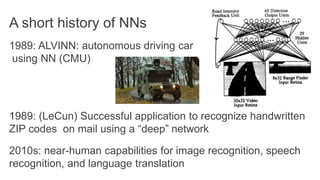
1989: ALVINN: autonomous driving car
using NN (CMU)
1989: (LeCun) Successful application to recognize handwritten
ZIP codes on mail using a “deep” network
2010s: near-human capabilities for image recognition, speech
recognition, and language translation
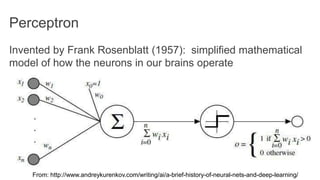
Perceptron
Invented by Frank Rosenblatt (1957): simplified mathematical
model of how the neurons in our brains operate
From: http://www.andreykurenkov.com/writing/ai/a-brief-history-of-neural-nets-and-deep-learning/
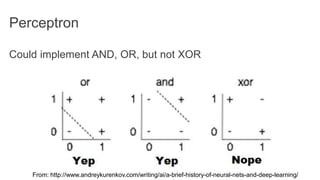
Perceptron
Could implement AND, OR, but not XOR
From: http://www.andreykurenkov.com/writing/ai/a-brief-history-of-neural-nets-and-deep-learning/
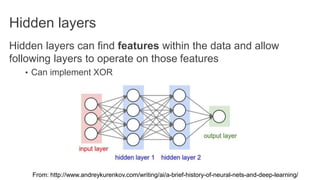
Hidden layers
Hidden layers can find features within the data and allow
following layers to operate on those features
• Can implement XOR
From: http://www.andreykurenkov.com/writing/ai/a-brief-history-of-neural-nets-and-deep-learning/
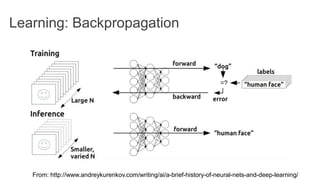
Learning: Backpropagation
From: http://www.andreykurenkov.com/writing/ai/a-brief-history-of-neural-nets-and-deep-learning/
Context (circa 2015)
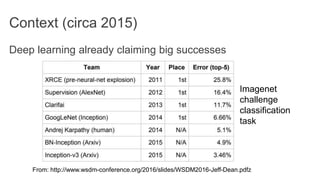
Deep learning already claiming big successes
From: http://www.wsdm-conference.org/2016/slides/WSDM2016-Jeff-Dean.pdfz
Imagenet
challenge
classification
task
Context (circa 2015)
Deep learning already claiming big successes
Number of developers/researchers exploding
A “zoo” of tools and libraries, some of questionable quality…
What is TensorFlow?
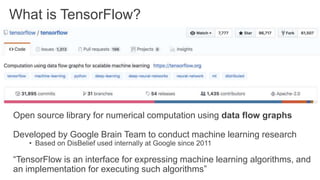
Open source library for numerical computation using data flow graphs
Developed by Google Brain Team to conduct machine learning research
• Based on DisBelief used internally at Google since 2011
“TensorFlow is an interface for expressing machine learning algorithms, and
an implementation for executing such algorithms”
What is TensorFlow
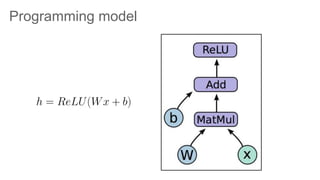
Key idea: express a numeric computation as a graph
Graph nodes are operations with any number of inputs and
outputs
Graph edges are tensors which flow between nodes
Programming model
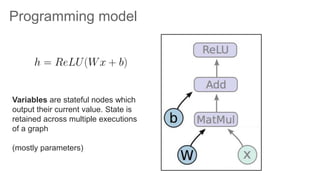
Variables are stateful nodes which
output their current value. State is
retained across multiple executions
of a graph
(mostly parameters)
Programming model
Programming model
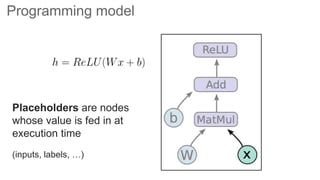
Placeholders are nodes
whose value is fed in at
execution time
(inputs, labels, …)
Programming model
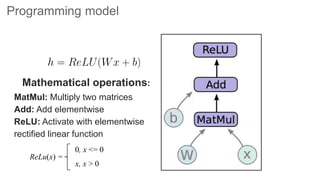
Mathematical operations:
MatMul: Multiply two matrices
Add: Add elementwise
ReLU: Activate with elementwise
rectified linear function
ReLu(x) =
0, x <= 0
x, x > 0
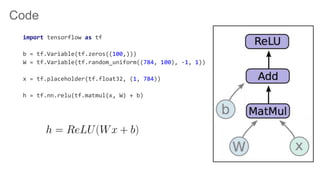
Code
import tensorflow as tf
b = tf.Variable(tf.zeros((100,)))
W = tf.Variable(tf.random_uniform((784, 100), -1, 1))
x = tf.placeholder(tf.float32, (1, 784))
h = tf.nn.relu(tf.matmul(x, W) + b)
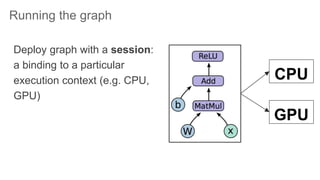
Running the graph
Deploy graph with a session:
a binding to a particular
execution context (e.g. CPU,
GPU)
CPU
GPU
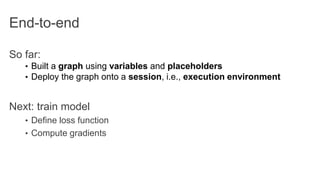
End-to-end
So far:
• Built a graph using variables and placeholders
• Deploy the graph onto a session, i.e., execution environment
Next: train model
• Define loss function
• Compute gradients
Defining loss
Use placeholder for labels
Build loss node using labels and prediction
prediction = tf.nn.softmax(...) #Output of neural network
label = tf.placeholder(tf.float32, [100, 10])
cross_entropy = -tf.reduce_sum(label * tf.log(prediction), axis=1)
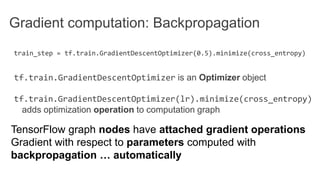
Gradient computation: Backpropagation
train_step = tf.train.GradientDescentOptimizer(0.5).minimize(cross_entropy)
tf.train.GradientDescentOptimizer is an Optimizer object
tf.train.GradientDescentOptimizer(lr).minimize(cross_entropy)
adds optimization operation to computation graph
TensorFlow graph nodes have attached gradient operations
Gradient with respect to parameters computed with
backpropagation … automatically
Design Principles
Dataflow graphs of primitive operators
Deferred execution (two phases)
1. Define program i.e., symbolic dataflow graph w/ placeholders
2. Executes optimized version of program on set of available devices
Common abstraction for heterogeneous accelerators
1. Issue a kernel for execution
2. Allocate memory for inputs and outputs
3. Transfer buffers to and from host memory
Dynamic Flow Control
Problem: support ML algos that contain conditional and
iterative control flow, e.g.
• Recurrent Neural Networks (RNNs)
• Long-Short Term Memory (LSTM)
Solution: Add conditional (if statement) and iterative (while
loop) programming constructs
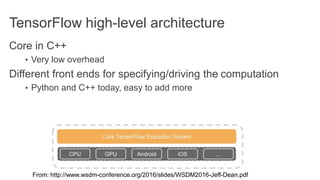
TensorFlow high-level architecture
Core in C++
• Very low overhead
Different front ends for specifying/driving the computation
• Python and C++ today, easy to add more
From: http://www.wsdm-conference.org/2016/slides/WSDM2016-Jeff-Dean.pdf
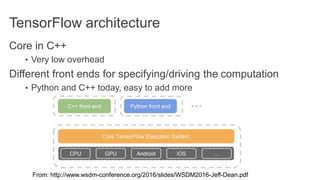
TensorFlow architecture
Core in C++
• Very low overhead
Different front ends for specifying/driving the computation
• Python and C++ today, easy to add more
From: http://www.wsdm-conference.org/2016/slides/WSDM2016-Jeff-Dean.pdf
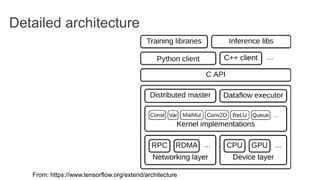
Detailed architecture
From: https://www.tensorflow.org/extend/architecture
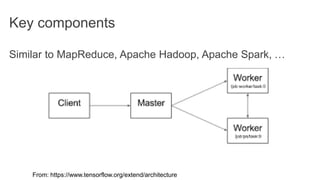
Key components
Similar to MapReduce, Apache Hadoop, Apache Spark, …
From: https://www.tensorflow.org/extend/architecture
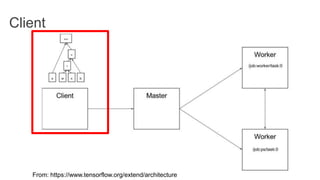
Client
From: https://www.tensorflow.org/extend/architecture
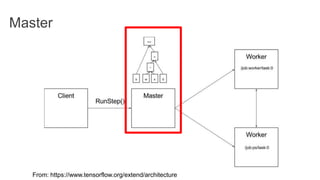
Master
From: https://www.tensorflow.org/extend/architecture
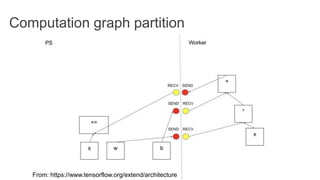
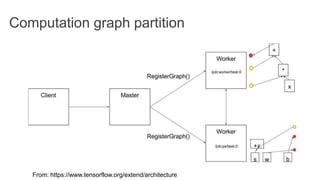
Computation graph partition
From: https://www.tensorflow.org/extend/architecture
Computation graph partition
From: https://www.tensorflow.org/extend/architecture
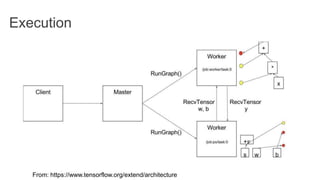
Execution
From: https://www.tensorflow.org/extend/architecture
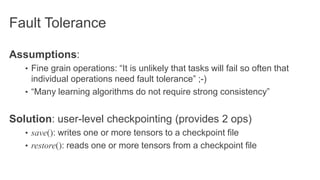
Fault Tolerance
Assumptions:
• Fine grain operations: “It is unlikely that tasks will fail so often that
individual operations need fault tolerance” ;-)
• “Many learning algorithms do not require strong consistency”
Solution: user-level checkpointing (provides 2 ops)
• save(): writes one or more tensors to a checkpoint file
• restore(): reads one or more tensors from a checkpoint file
Discussion
Eager vs. deferred (lazy) execution
Transparent vs. user-level fault tolerance
Easy of use
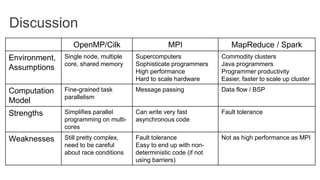
Discussion
OpenMP/Cilk MPI MapReduce / Spark
Environment,
Assumptions
Single node, multiple
core, shared memory
Supercomputers
Sophisticate programmers
High performance
Hard to scale hardware
Commodity clusters
Java programmers
Programmer productivity
Easier, faster to scale up cluster
Computation
Model
Fine-grained task
parallelism
Message passing Data flow / BSP
Strengths Simplifies parallel
programming on multi-
cores
Can write very fast
asynchronous code
Fault tolerance
Weaknesses Still pretty complex,
need to be careful
about race conditions
Fault tolerance
Easy to end up with non-
deterministic code (if not
using barriers)
Not as high performance as MPI

24-TensorFlow-Clipper.pptxnjjjjnjjjjjjmm

  • 1.
    TensorFlow and Clipper (Lecture24, cs262a) Ali Ghodsi and Ion Stoica, UC Berkeley April 18, 2018
  • 2.
    Today’s lecture Abadi etal., “TensorFlow: A System for Large-Scale Machine Learning”, OSDI 2016 (https://www.usenix.org/system/files/conference/osdi16/osdi16-abadi.pdf) Crankshaw et al., “Clipper: A Low-Latency Online Prediction Serving System”, NSDI 2017 (https://www.usenix.org/conference/nsdi17/technical- sessions/presentation/crankshaw)
  • 3.
    A short historyof Neural Networks 1957: Perceptron (Frank Rosenblatt): one layer network neural network 1959: first neural network to solve a real world problem, i.e., eliminates echoes on phone lines (Widrow & Hoff) 1988: Backpropagation (Rumelhart, Hinton, Williams): learning a multi-layered network
  • 4.
    A short historyof NNs 1989: ALVINN: autonomous driving car using NN (CMU) 1989: (LeCun) Successful application to recognize handwritten ZIP codes on mail using a “deep” network 2010s: near-human capabilities for image recognition, speech recognition, and language translation
  • 5.
    Perceptron Invented by FrankRosenblatt (1957): simplified mathematical model of how the neurons in our brains operate From: http://www.andreykurenkov.com/writing/ai/a-brief-history-of-neural-nets-and-deep-learning/
  • 6.
    Perceptron Could implement AND,OR, but not XOR From: http://www.andreykurenkov.com/writing/ai/a-brief-history-of-neural-nets-and-deep-learning/
  • 7.
    Hidden layers Hidden layerscan find features within the data and allow following layers to operate on those features • Can implement XOR From: http://www.andreykurenkov.com/writing/ai/a-brief-history-of-neural-nets-and-deep-learning/
  • 8.
  • 9.
    Context (circa 2015) Deeplearning already claiming big successes From: http://www.wsdm-conference.org/2016/slides/WSDM2016-Jeff-Dean.pdfz Imagenet challenge classification task
  • 10.
    Context (circa 2015) Deeplearning already claiming big successes Number of developers/researchers exploding A “zoo” of tools and libraries, some of questionable quality…
  • 11.
    What is TensorFlow? Opensource library for numerical computation using data flow graphs Developed by Google Brain Team to conduct machine learning research • Based on DisBelief used internally at Google since 2011 “TensorFlow is an interface for expressing machine learning algorithms, and an implementation for executing such algorithms”
  • 12.
    What is TensorFlow Keyidea: express a numeric computation as a graph Graph nodes are operations with any number of inputs and outputs Graph edges are tensors which flow between nodes
  • 13.
  • 14.
    Variables are statefulnodes which output their current value. State is retained across multiple executions of a graph (mostly parameters) Programming model
  • 15.
    Programming model Placeholders arenodes whose value is fed in at execution time (inputs, labels, …)
  • 16.
    Programming model Mathematical operations: MatMul:Multiply two matrices Add: Add elementwise ReLU: Activate with elementwise rectified linear function ReLu(x) = 0, x <= 0 x, x > 0
  • 17.
    Code import tensorflow astf b = tf.Variable(tf.zeros((100,))) W = tf.Variable(tf.random_uniform((784, 100), -1, 1)) x = tf.placeholder(tf.float32, (1, 784)) h = tf.nn.relu(tf.matmul(x, W) + b)
  • 18.
    Running the graph Deploygraph with a session: a binding to a particular execution context (e.g. CPU, GPU) CPU GPU
  • 19.
    End-to-end So far: • Builta graph using variables and placeholders • Deploy the graph onto a session, i.e., execution environment Next: train model • Define loss function • Compute gradients
  • 20.
    Defining loss Use placeholderfor labels Build loss node using labels and prediction prediction = tf.nn.softmax(...) #Output of neural network label = tf.placeholder(tf.float32, [100, 10]) cross_entropy = -tf.reduce_sum(label * tf.log(prediction), axis=1)
  • 21.
    Gradient computation: Backpropagation train_step= tf.train.GradientDescentOptimizer(0.5).minimize(cross_entropy) tf.train.GradientDescentOptimizer is an Optimizer object tf.train.GradientDescentOptimizer(lr).minimize(cross_entropy) adds optimization operation to computation graph TensorFlow graph nodes have attached gradient operations Gradient with respect to parameters computed with backpropagation … automatically
  • 22.
    Design Principles Dataflow graphsof primitive operators Deferred execution (two phases) 1. Define program i.e., symbolic dataflow graph w/ placeholders 2. Executes optimized version of program on set of available devices Common abstraction for heterogeneous accelerators 1. Issue a kernel for execution 2. Allocate memory for inputs and outputs 3. Transfer buffers to and from host memory
  • 23.
    Dynamic Flow Control Problem:support ML algos that contain conditional and iterative control flow, e.g. • Recurrent Neural Networks (RNNs) • Long-Short Term Memory (LSTM) Solution: Add conditional (if statement) and iterative (while loop) programming constructs
  • 24.
    TensorFlow high-level architecture Corein C++ • Very low overhead Different front ends for specifying/driving the computation • Python and C++ today, easy to add more From: http://www.wsdm-conference.org/2016/slides/WSDM2016-Jeff-Dean.pdf
  • 25.
    TensorFlow architecture Core inC++ • Very low overhead Different front ends for specifying/driving the computation • Python and C++ today, easy to add more From: http://www.wsdm-conference.org/2016/slides/WSDM2016-Jeff-Dean.pdf
  • 26.
  • 27.
    Key components Similar toMapReduce, Apache Hadoop, Apache Spark, … From: https://www.tensorflow.org/extend/architecture
  • 28.
  • 29.
  • 30.
    Computation graph partition From:https://www.tensorflow.org/extend/architecture
  • 31.
    Computation graph partition From:https://www.tensorflow.org/extend/architecture
  • 32.
  • 33.
    Fault Tolerance Assumptions: • Finegrain operations: “It is unlikely that tasks will fail so often that individual operations need fault tolerance” ;-) • “Many learning algorithms do not require strong consistency” Solution: user-level checkpointing (provides 2 ops) • save(): writes one or more tensors to a checkpoint file • restore(): reads one or more tensors from a checkpoint file
  • 34.
    Discussion Eager vs. deferred(lazy) execution Transparent vs. user-level fault tolerance Easy of use
  • 35.
    Discussion OpenMP/Cilk MPI MapReduce/ Spark Environment, Assumptions Single node, multiple core, shared memory Supercomputers Sophisticate programmers High performance Hard to scale hardware Commodity clusters Java programmers Programmer productivity Easier, faster to scale up cluster Computation Model Fine-grained task parallelism Message passing Data flow / BSP Strengths Simplifies parallel programming on multi- cores Can write very fast asynchronous code Fault tolerance Weaknesses Still pretty complex, need to be careful about race conditions Fault tolerance Easy to end up with non- deterministic code (if not using barriers) Not as high performance as MPI

Editor's Notes

  • #2 3-D graph Checklist What we want to enable What we have today How we’ll get there
  • #14 Neural network with one hidden layer The function we are computing is on the left. Relu is an activation function that takes the max of 0 and your input, applies a nonlinearity to your network. The graph on the right is how this function would look like in a tensorflow graph. Let us break down the nodes in the graph into three types
  • #15 We have two variables in this graph, the bias and W matrix. What we mean by saying that variables are stateful is that they retain their current value over multiple executions, and it’s easy to restore saved values to variables. Variables have a number of other useful features. They can be saved to disk during and after training, and gradient updates will by default apply over all the variables in your graph Variables are still operations (nodes = operations!). When you run a variable you get the value of its state. The variables in your graph are going to be your parameters
  • #16 The second important node type is placeholders. If you have inputs into your network that depend on some external data, you want to be able to build your graph without depending on any real values yet, as those are passed in at run time. Placeholders, unlike variables that have initial assignment, expect as arguments a data type and a shape of a tensor. Inputs, labels
  • #17 The other nodes are mathematical operations that you are familiar with. Matmul, addition, and relu are all operations in your graph that combine your inputs and parameters to produce new nodes.