Chapter Eight
Slutsky Equation
Effects of a Price Change
What happens when a commodity’s
price decreases?
– Substitution effect: the commodity
is relatively cheaper, so
consumers substitute it for now
relatively more expensive other
commodities.
Effects of a Price Change
– Income effect: the consumer’s
budget of $y can purchase more
than before, as if the consumer’s
income rose, with consequent
income effects on quantities
demanded.
Effects of a Price Change
x2
y
p2

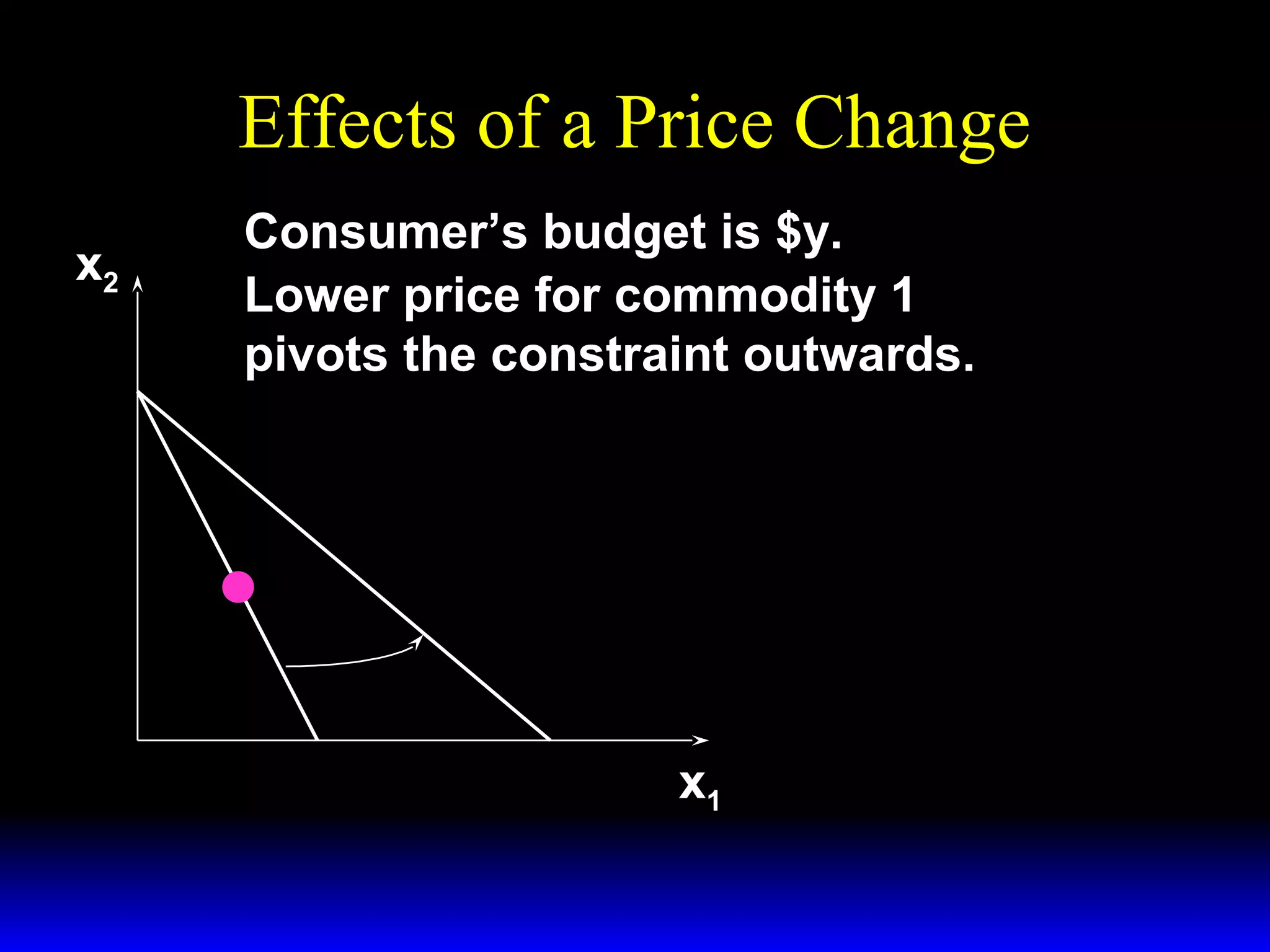
Consumer’s budget is $y.
Original choice

x1
Effects of a Price Change
x2
y
p2

Consumer’s budget is $y.
Lower price for commodity 1
pivots the constraint outwards.

x1
Effects of a Price Change
x2
y
p2
y'
p2

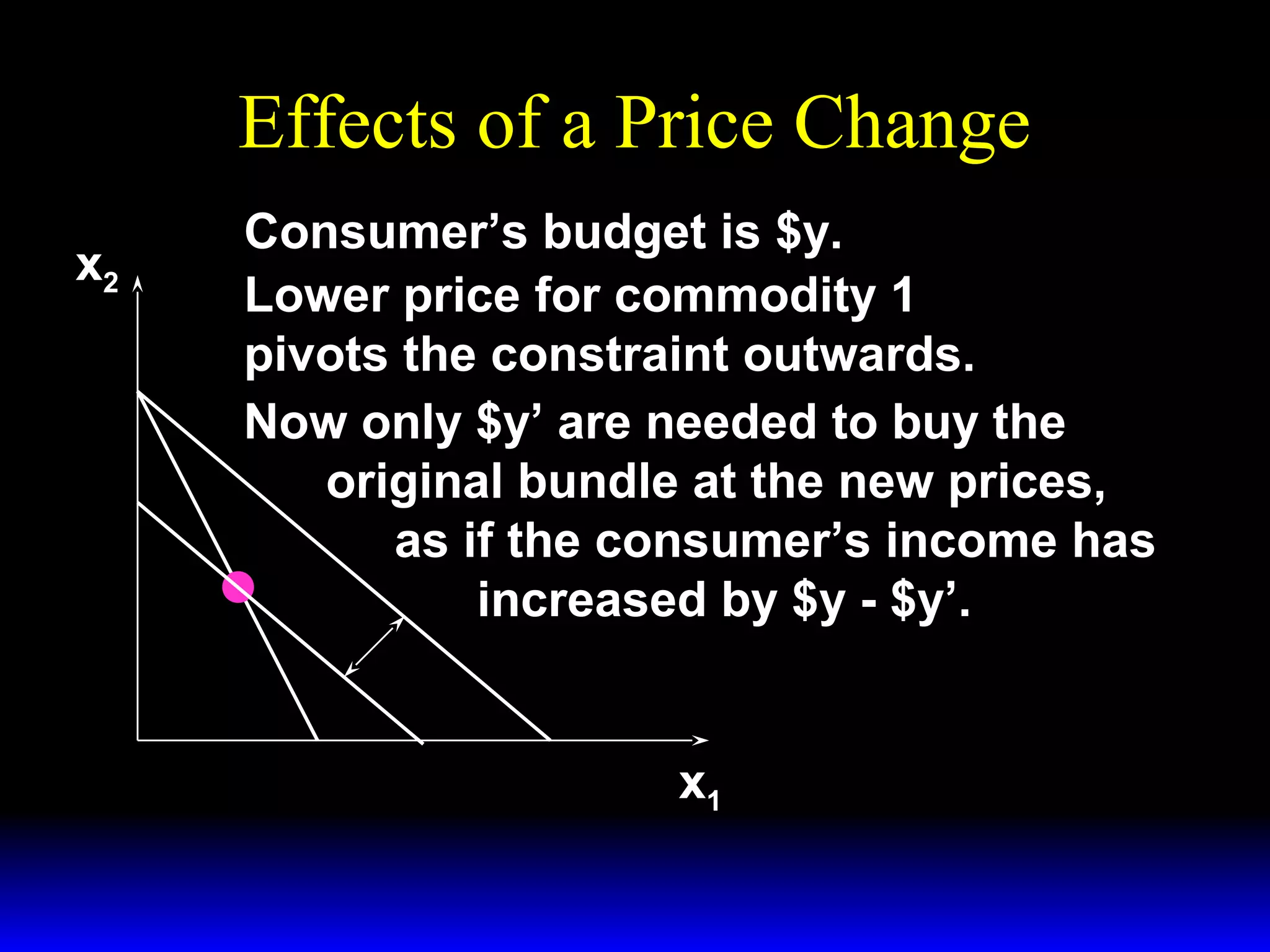
Consumer’s budget is $y.
Lower price for commodity 1
pivots the constraint outwards.
Now only $y’ are needed to buy the
original bundle at the new prices,
as if the consumer’s income has
increased by $y - $y’.

x1
Effects of a Price Change
Changes to quantities demanded due
to this ‘extra’ income are the income
effect of the price change.
Effects of a Price Change
Slutsky discovered that changes to
demand from a price change are
always the sum of a pure
substitution effect and an income
effect.
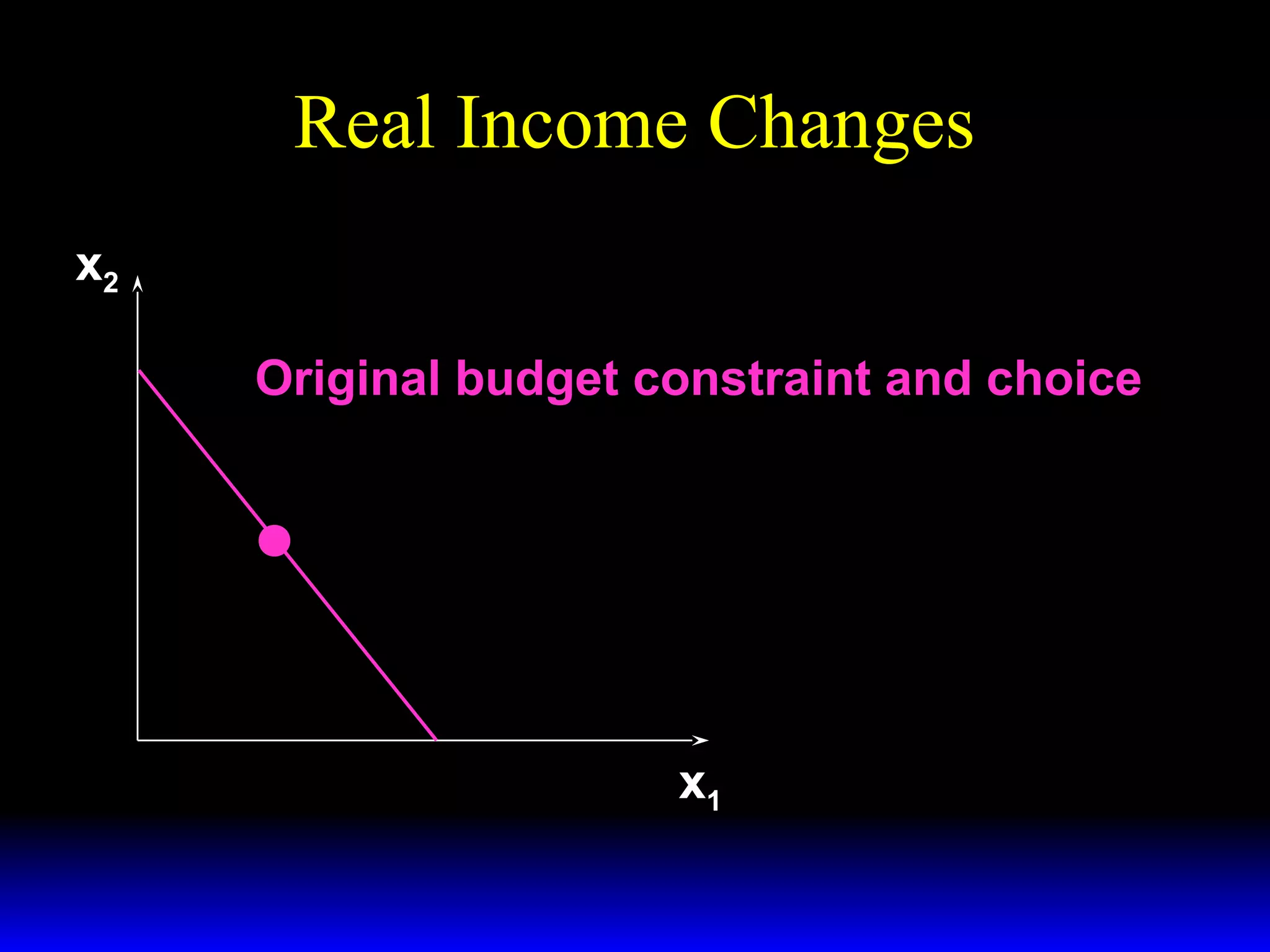
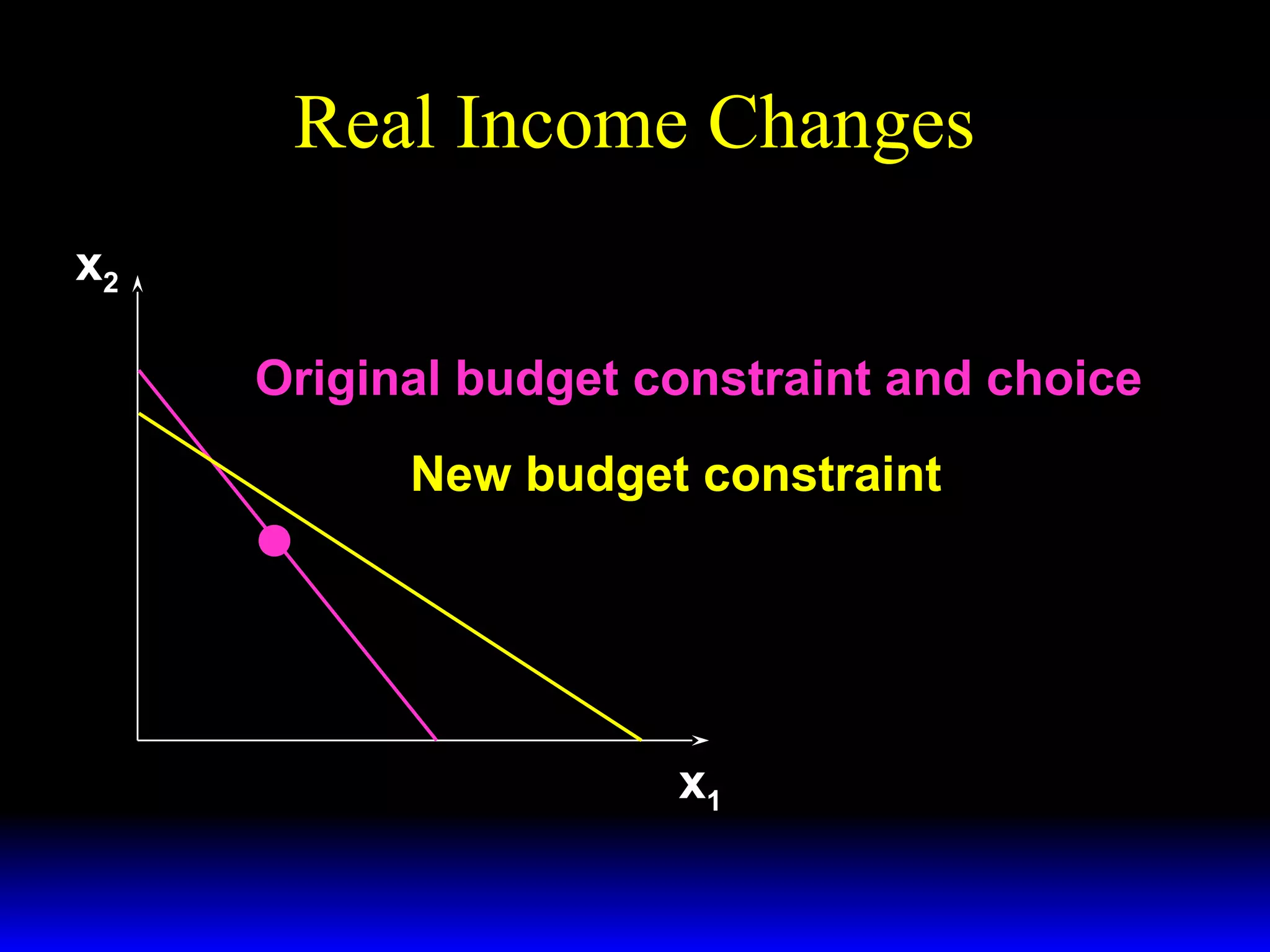
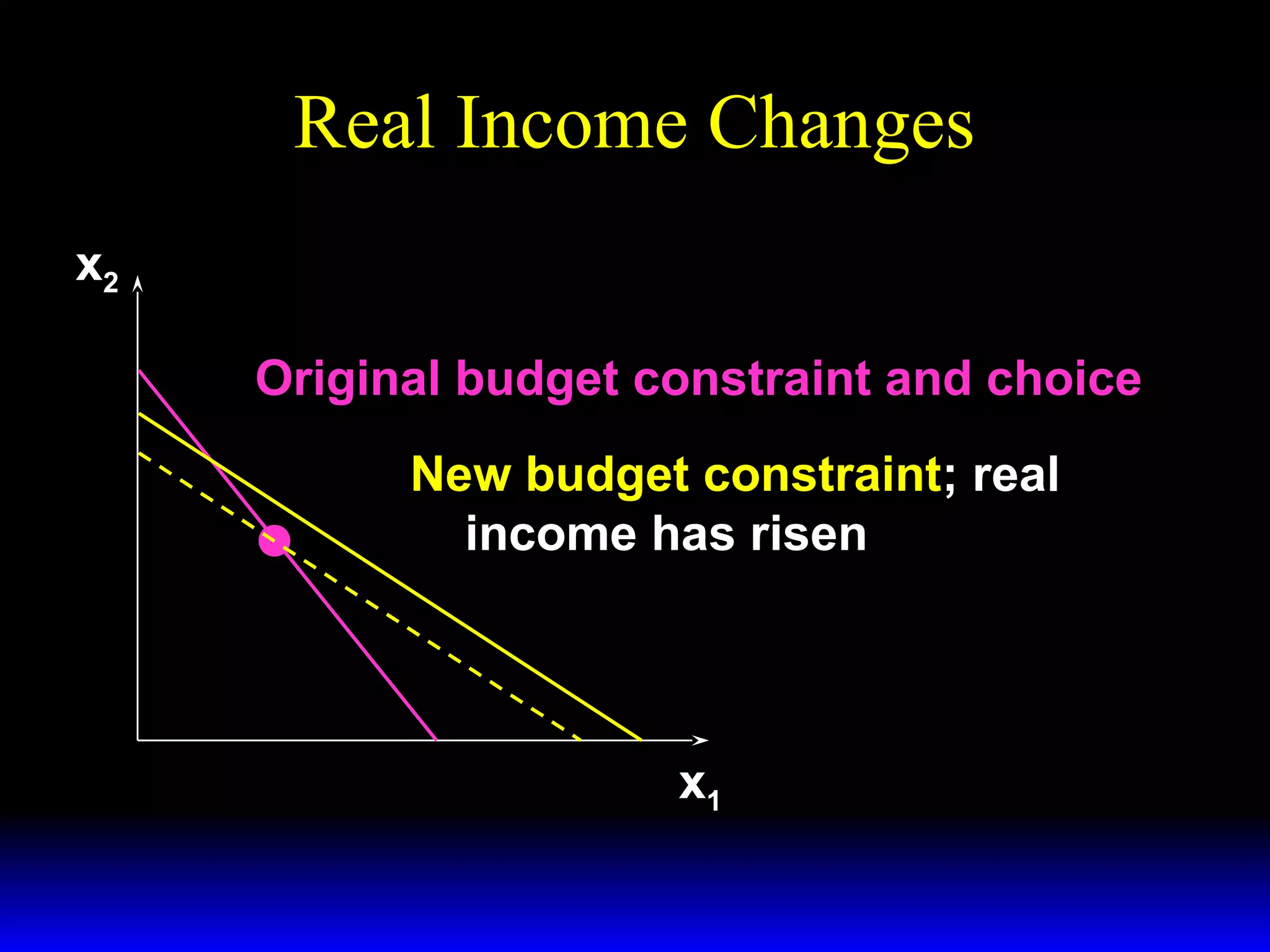
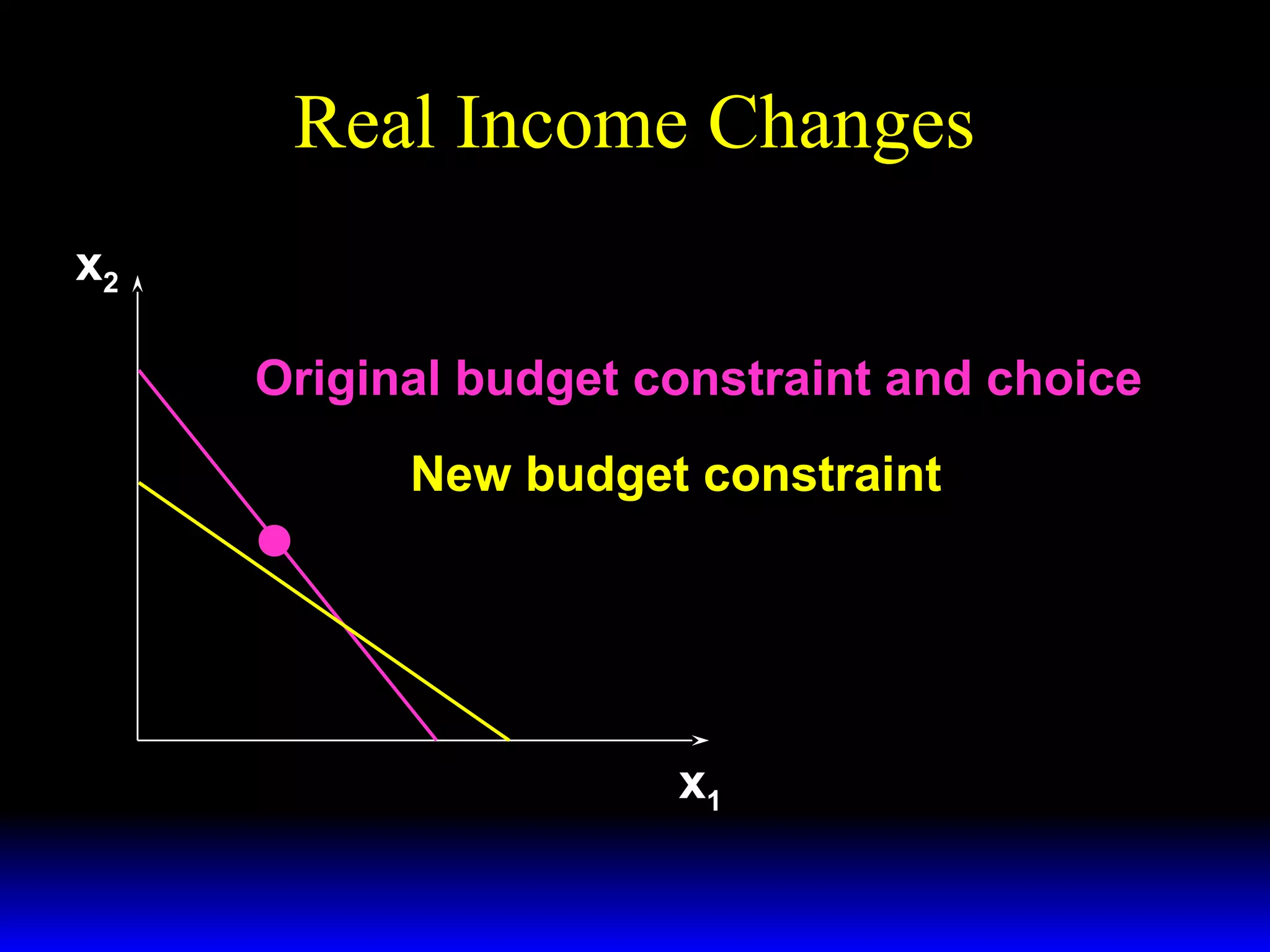
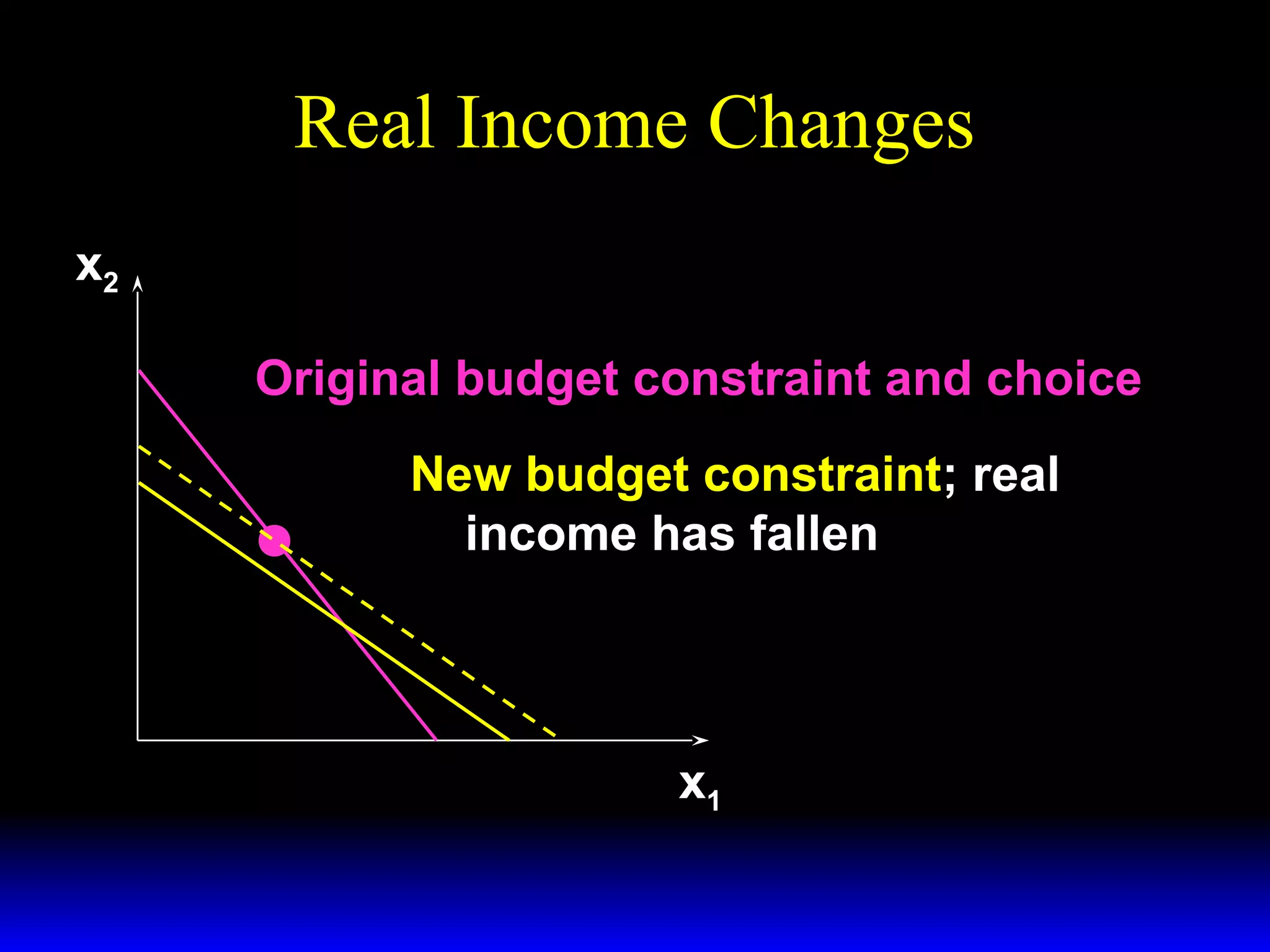
Real Income Changes
Slutsky asserted that if, at the new
prices,
– less income is needed to buy the
original bundle then “real income”
is increased
– more income is needed to buy the
original bundle then “real income”
is decreased
Real Income Changes
x2
Original budget constraint and choice

x1
Real Income Changes
x2
Original budget constraint and choice
New budget constraint

x1
Real Income Changes
x2
Original budget constraint and choice
New budget constraint; real
income has risen

x1
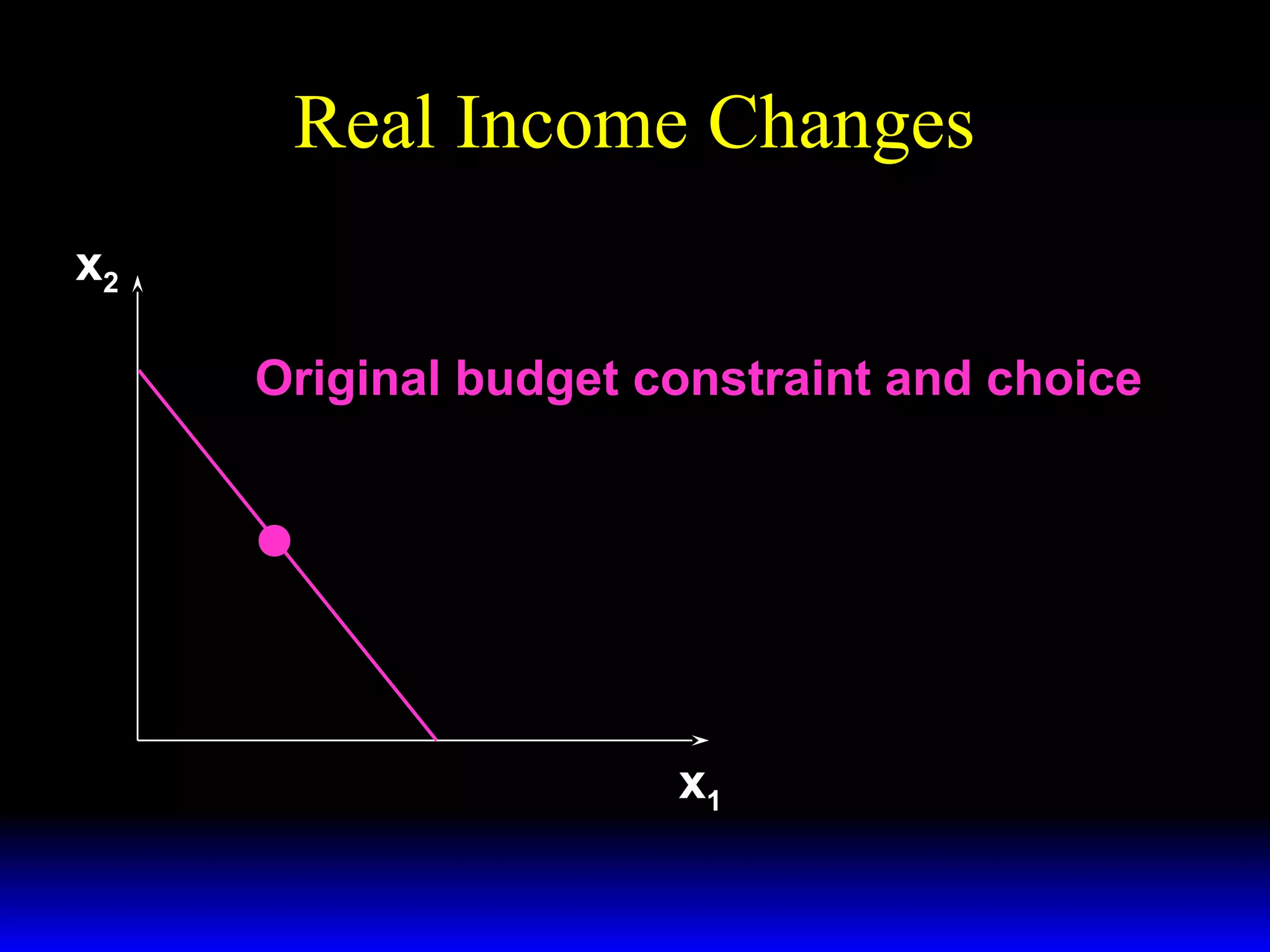
Real Income Changes
x2
Original budget constraint and choice

x1
Real Income Changes
x2
Original budget constraint and choice
New budget constraint

x1
Real Income Changes
x2
Original budget constraint and choice
New budget constraint; real
income has fallen

x1
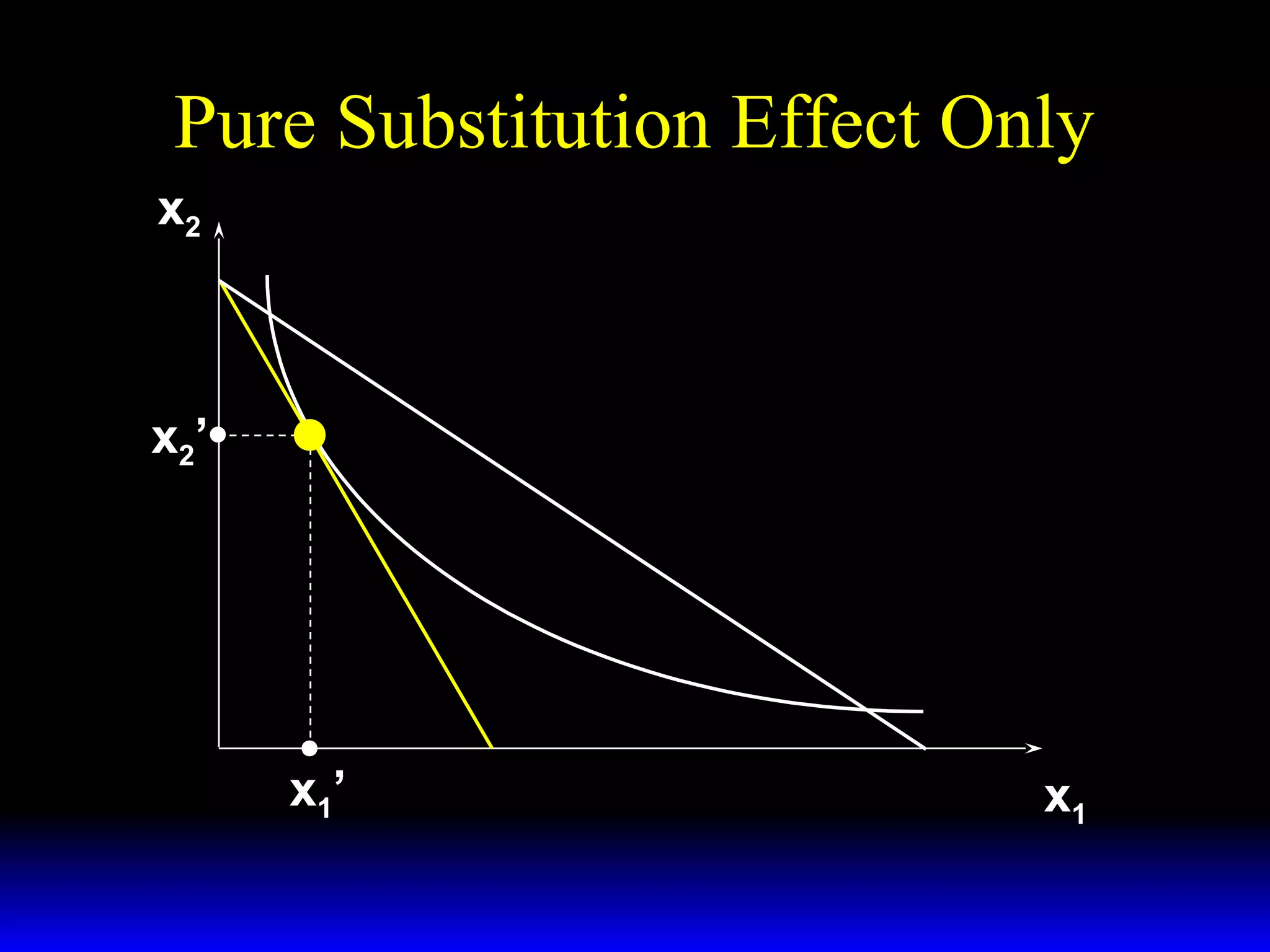
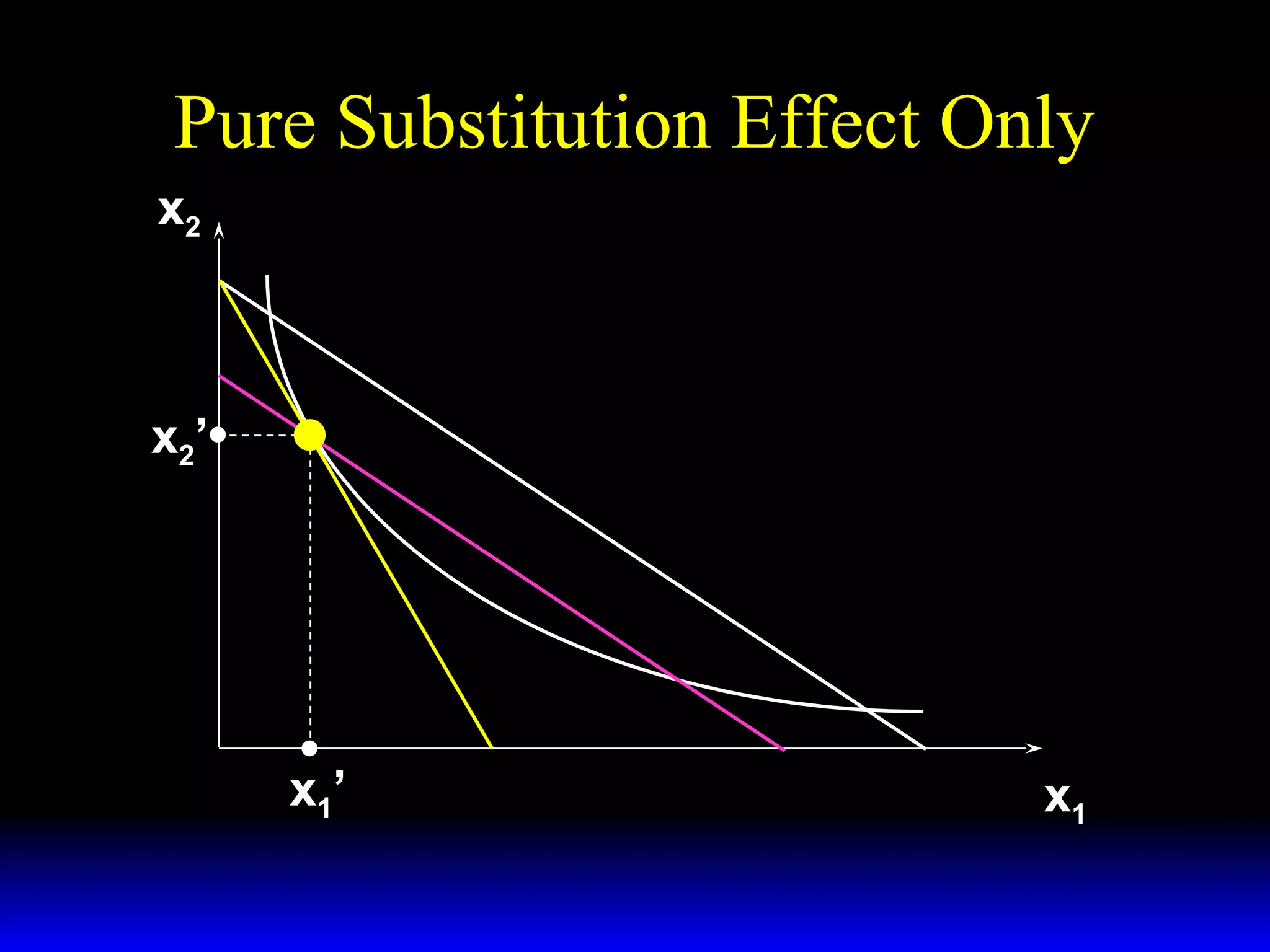
Pure Substitution Effect
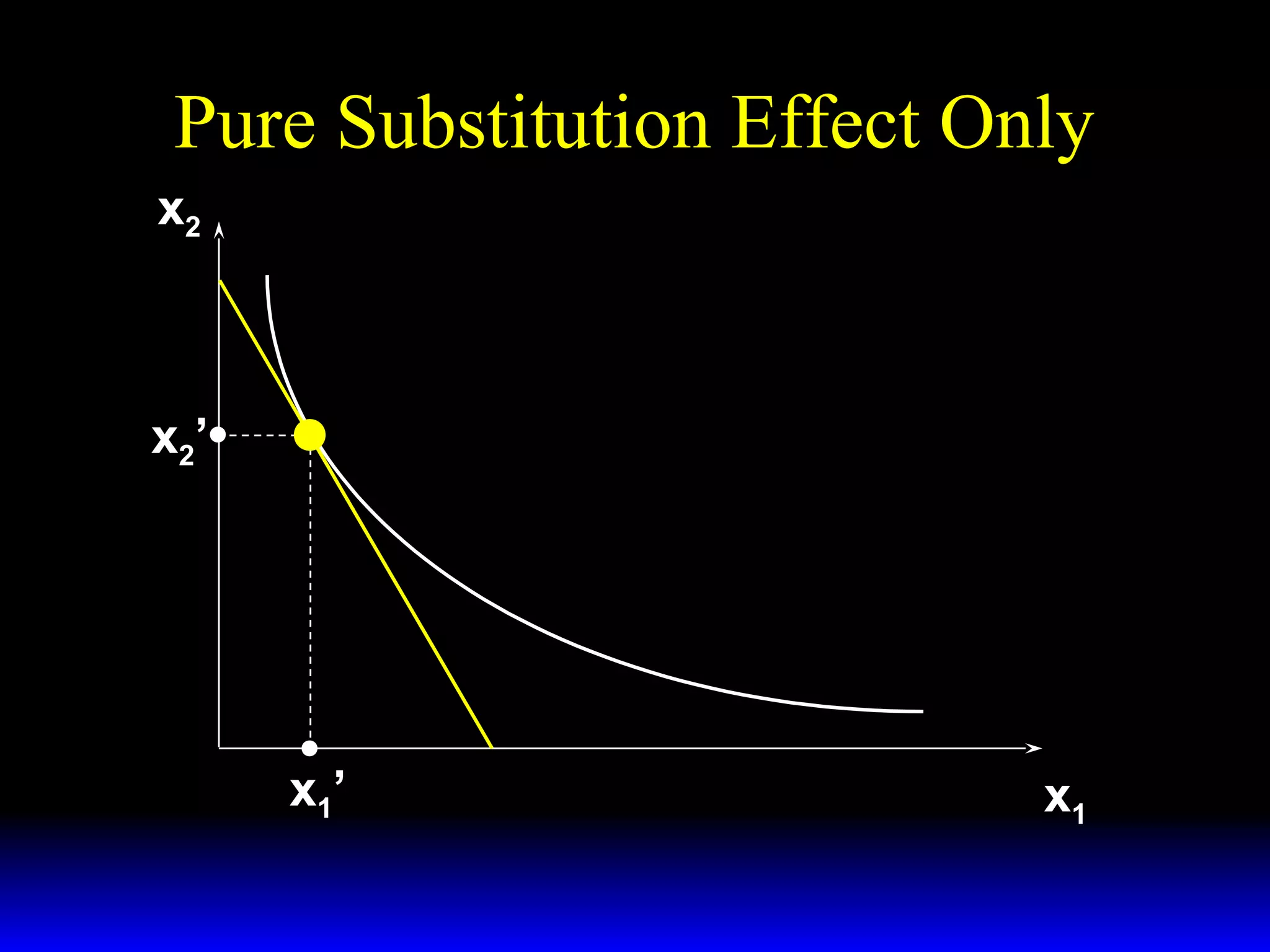
Slutsky isolated the change in
demand due only to the change in
relative prices by asking “What is the
change in demand when the
consumer’s income is adjusted so
that, at the new prices, she can only
just buy the original bundle?”
Pure Substitution Effect Only
x2

x2 ’

x1’

x1
Pure Substitution Effect Only
x2

x2 ’

x1’

x1
Pure Substitution Effect Only
x2

x2 ’

x1’

x1
Pure Substitution Effect Only
x2

x2 ’
x2’’

x1’

x1’’

x1
Pure Substitution Effect Only
x2

x2 ’
x2’’

x1’

x1’’

x1
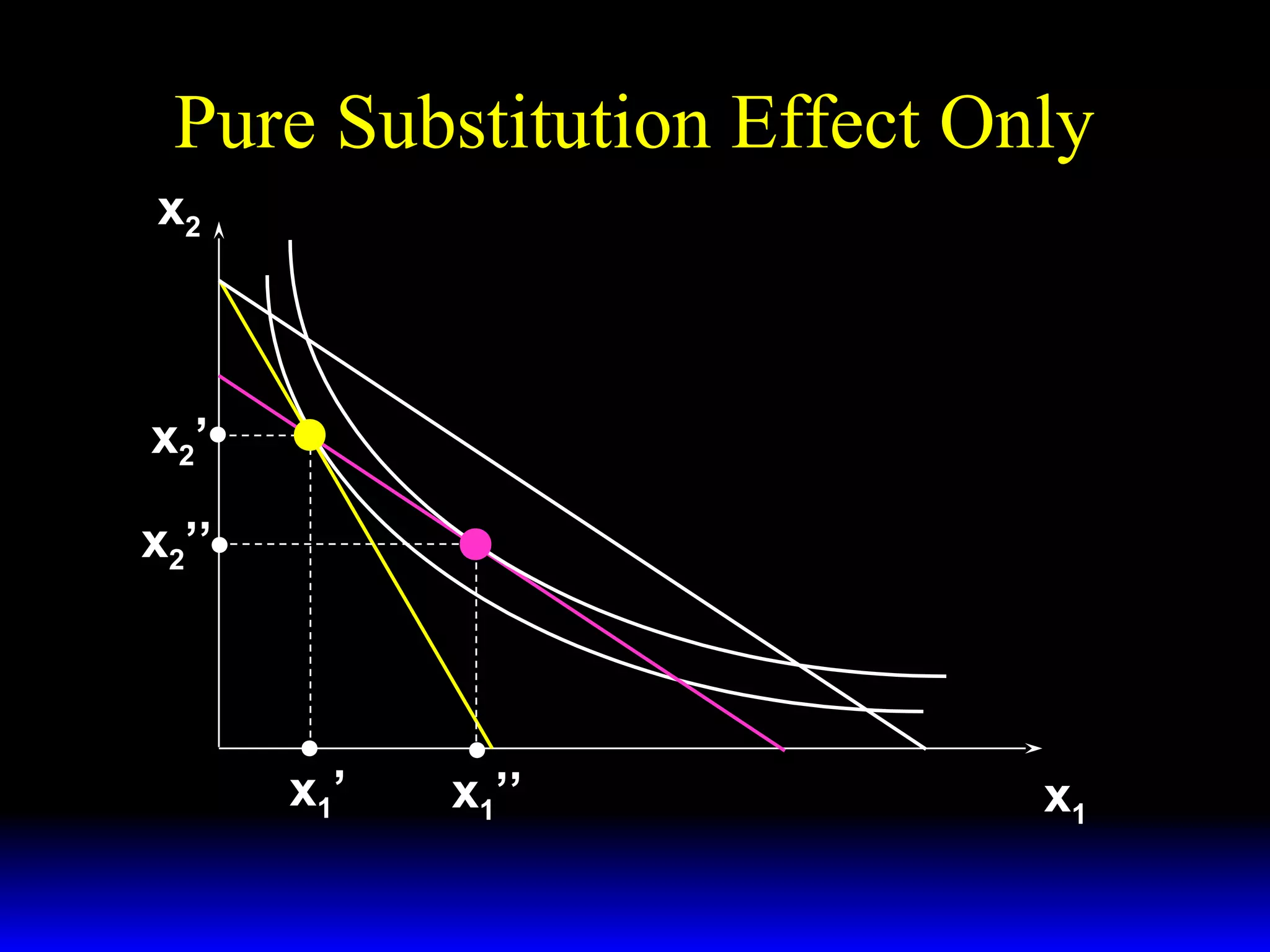
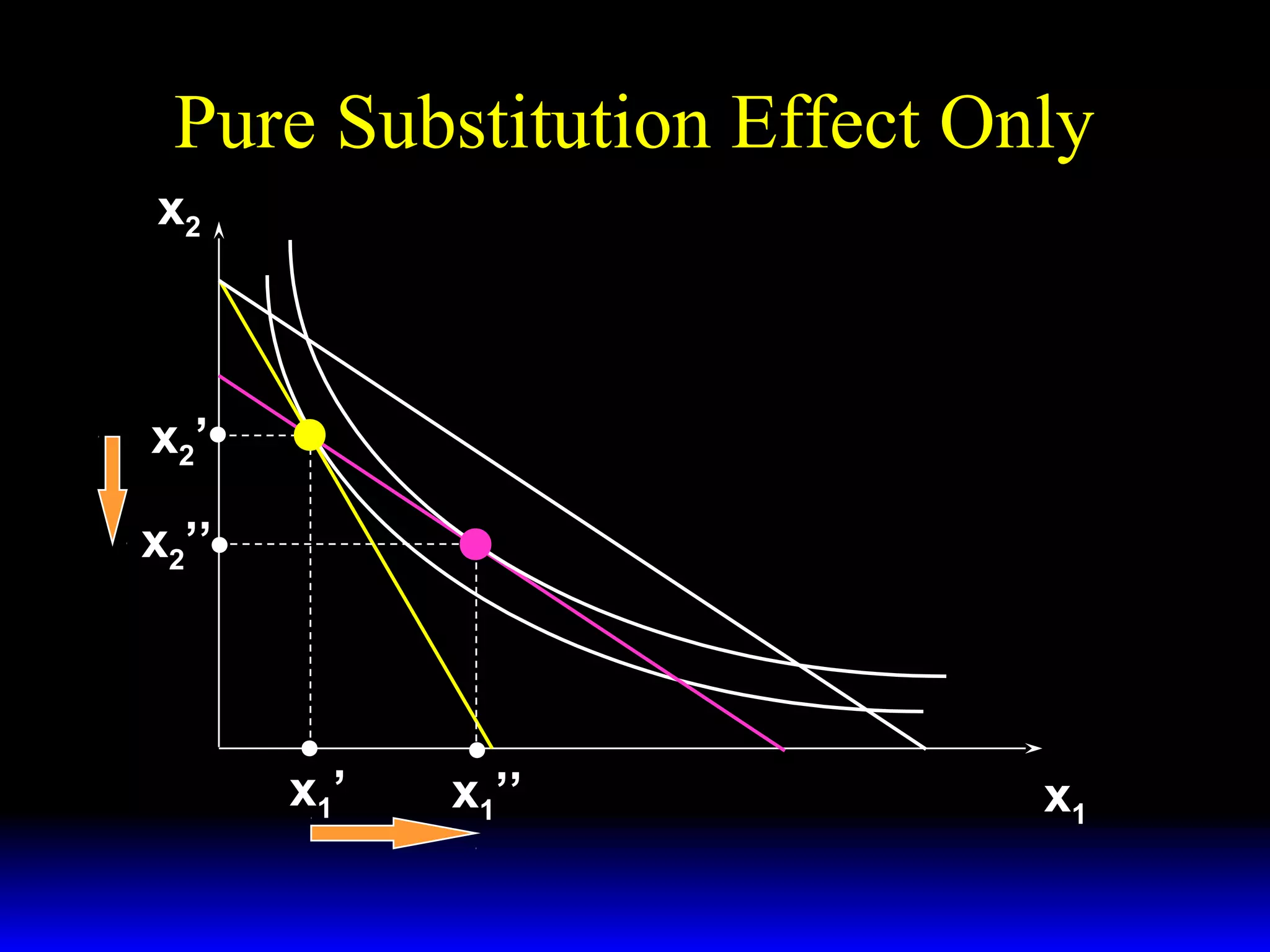
Pure Substitution Effect Only
x2

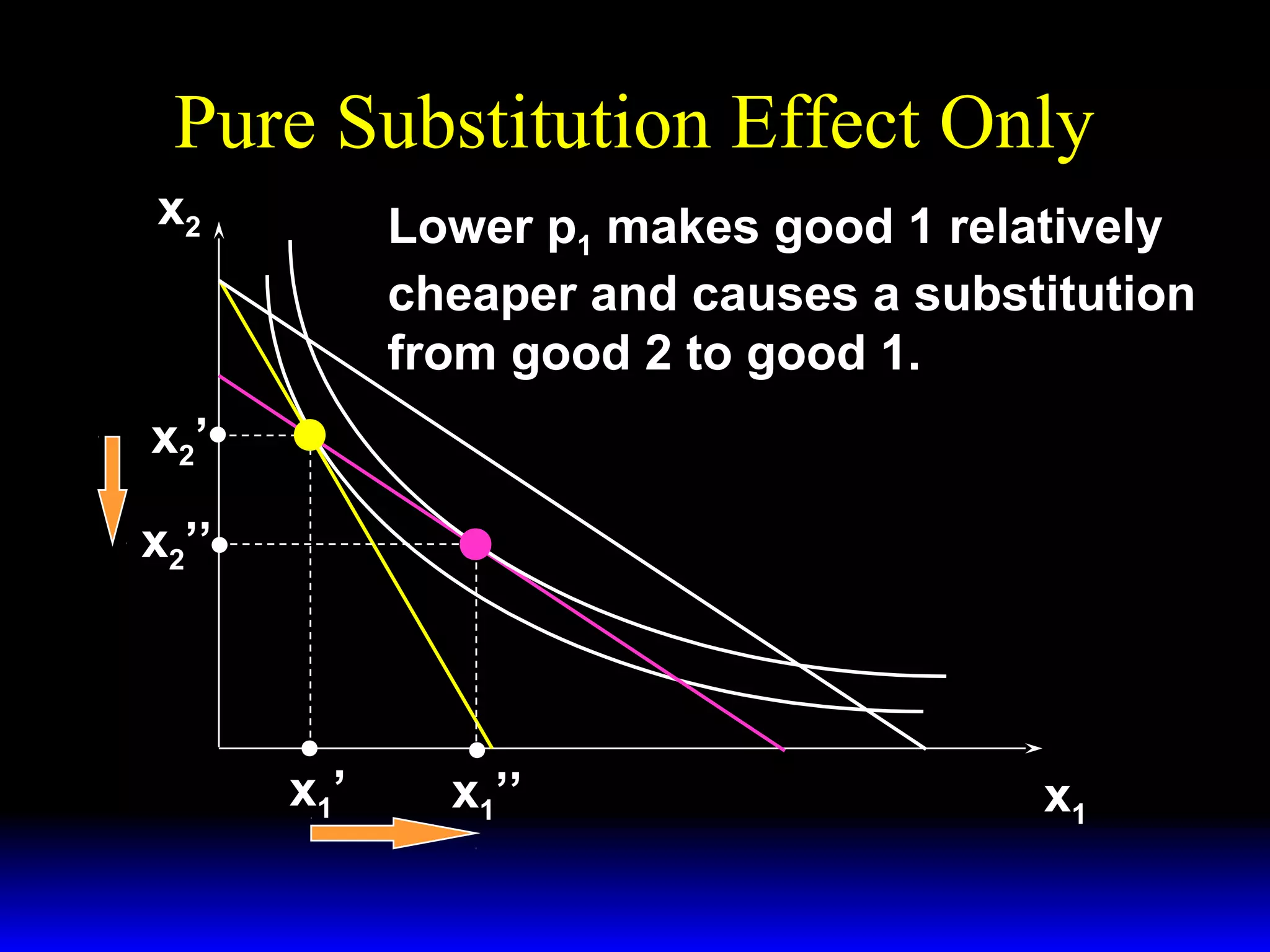
Lower p1 makes good 1 relatively
cheaper and causes a substitution
from good 2 to good 1.

x2 ’
x2’’

x1’

x1’’

x1
Pure Substitution Effect Only
x2

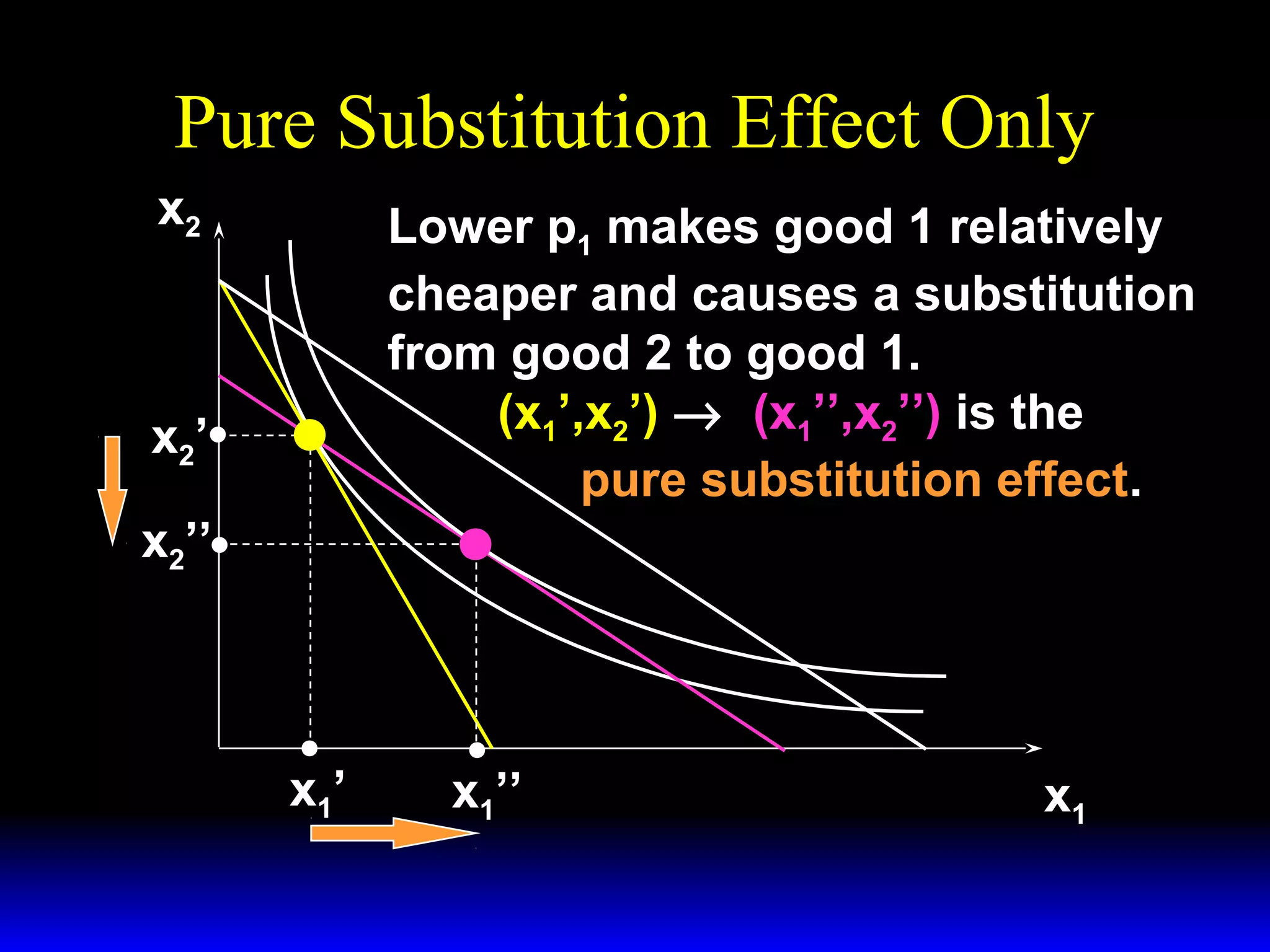
Lower p1 makes good 1 relatively
cheaper and causes a substitution
from good 2 to good 1.
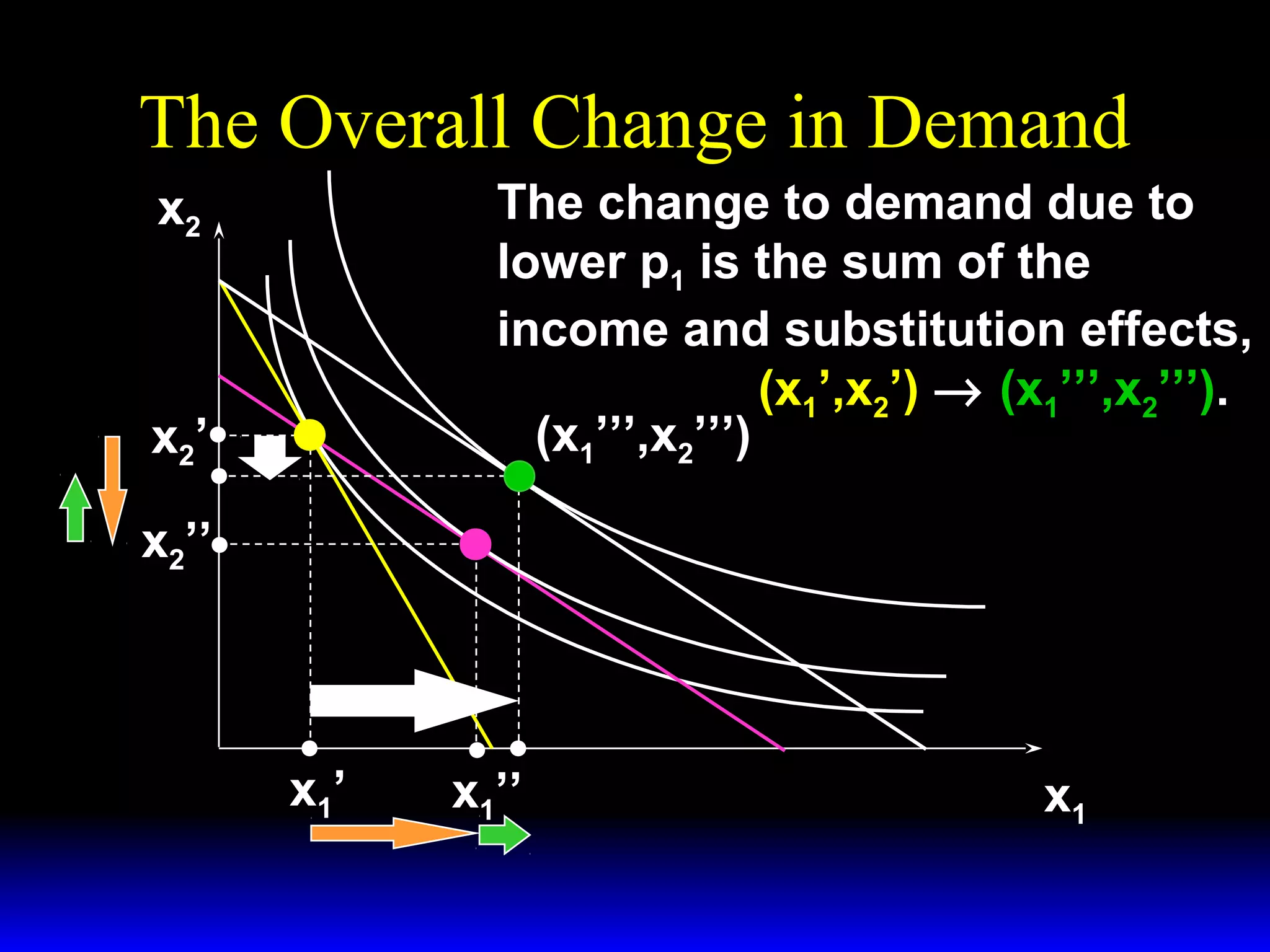
(x1’,x2’) → (x1’’,x2’’) is the
pure substitution effect.

x2 ’
x2’’

x1’

x1’’

x1
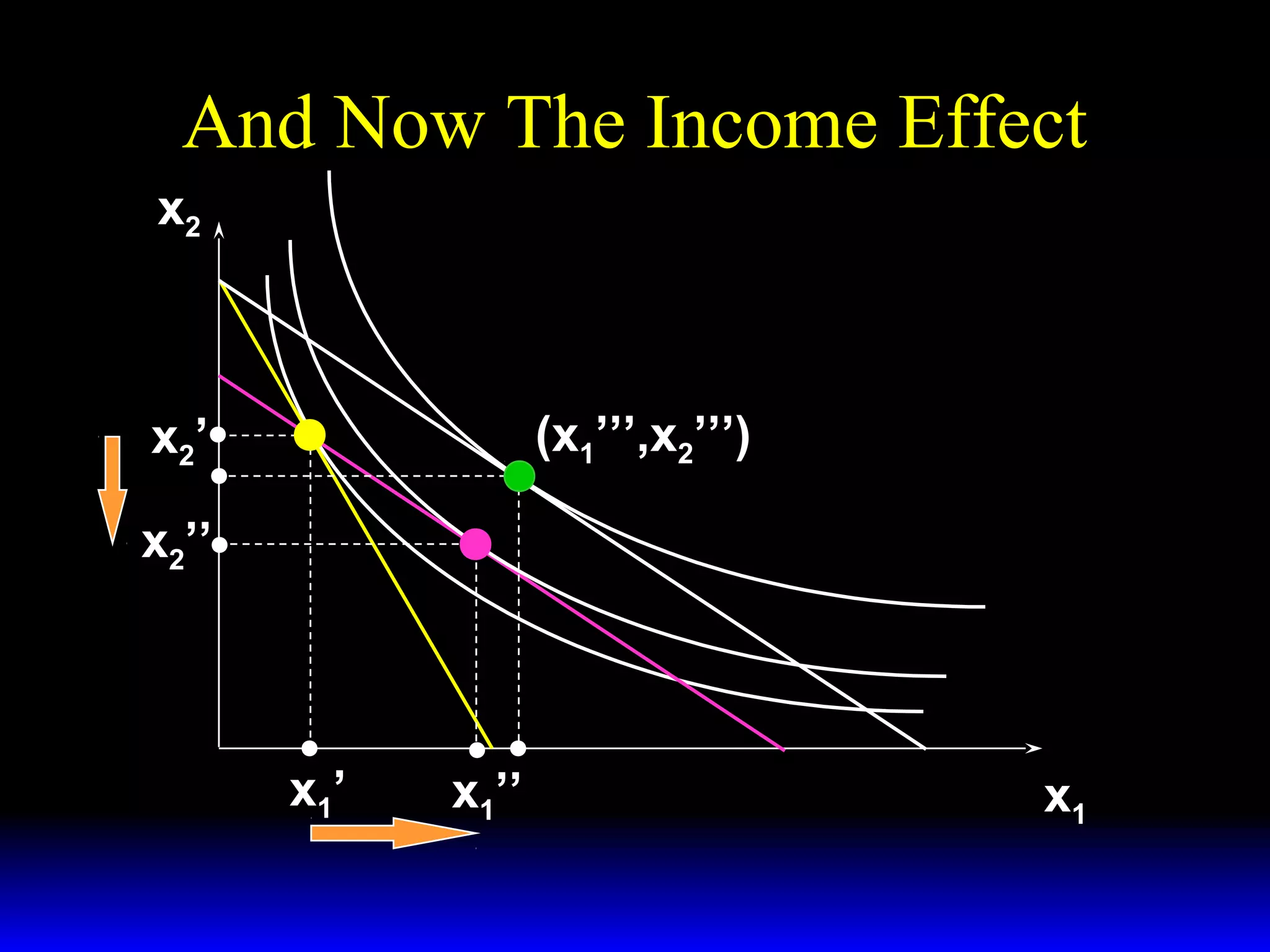
And Now The Income Effect
x2

(x1’’’,x2’’’)

x2 ’
x2’’

x1’

x1’’

x1
And Now The Income Effect
x2

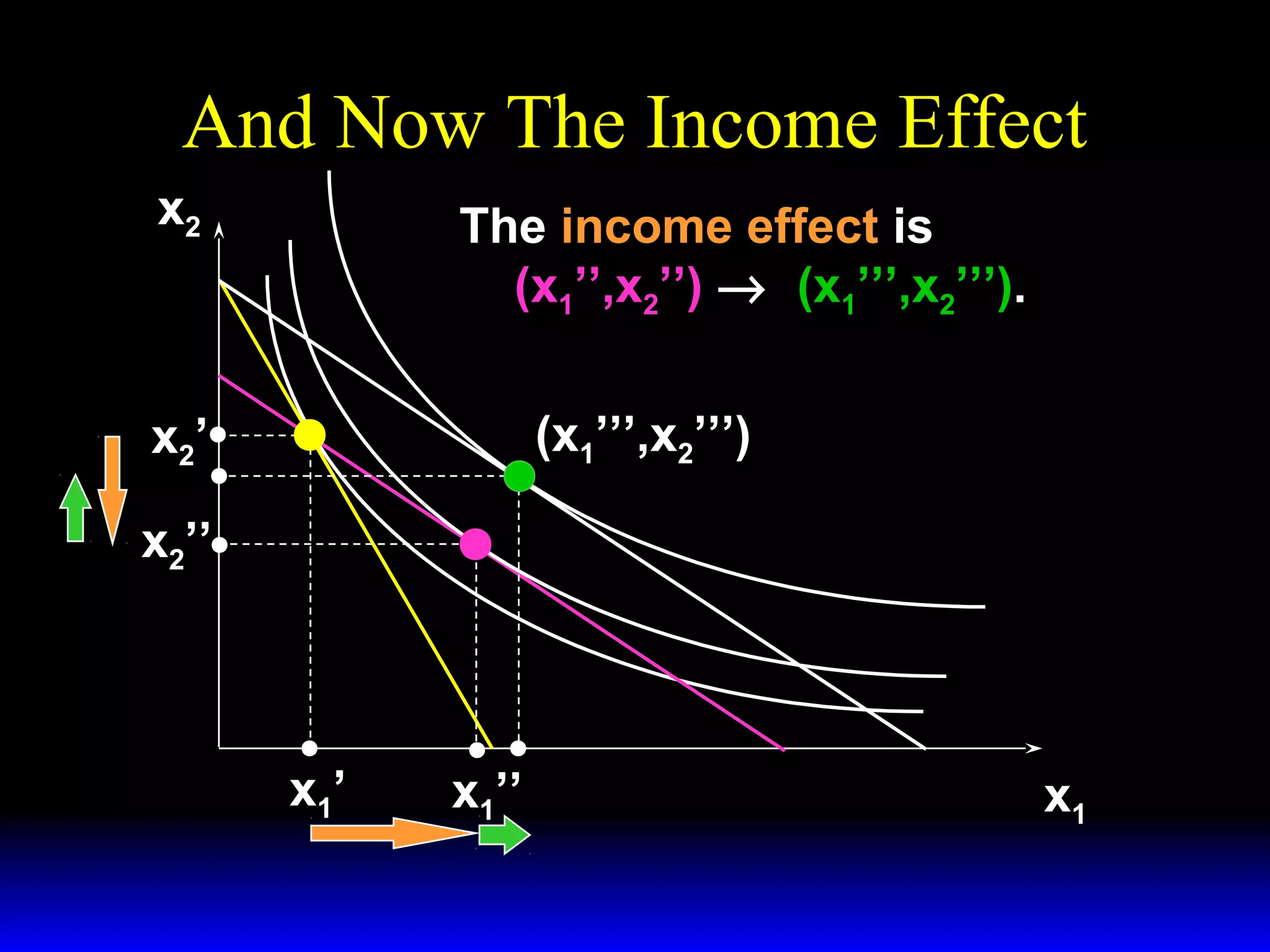
The income effect is
(x1’’,x2’’) → (x1’’’,x2’’’).
(x1’’’,x2’’’)

x2 ’
x2’’

x1’

x1’’

x1
The Overall Change in Demand
The change to demand due to
lower p1 is the sum of the
income and substitution effects,
(x1’,x2’) → (x1’’’,x2’’’).
(x1’’’,x2’’’)

x2

x2 ’
x2’’

x1’

x1’’

x1
Slutsky’s Effects for Normal Goods
Most goods are normal (i.e. demand
increases with income).
The substitution and income effects
reinforce each other when a normal
good’s own price changes.
Slutsky’s Effects for Normal Goods
x2

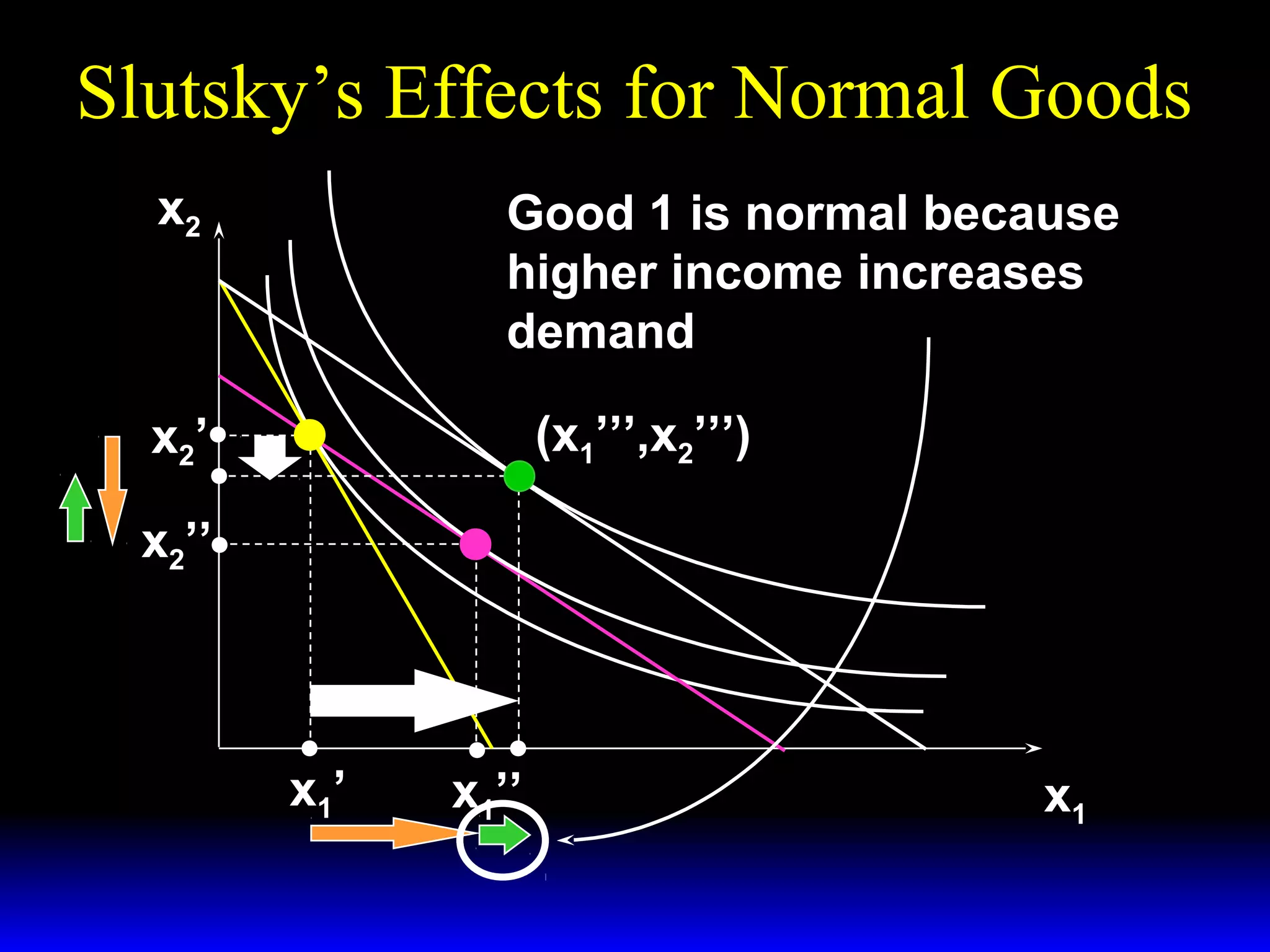
Good 1 is normal because
higher income increases
demand
(x1’’’,x2’’’)

x2 ’
x2’’

x1’

x1’’

x1
Slutsky’s Effects for Normal Goods
x2

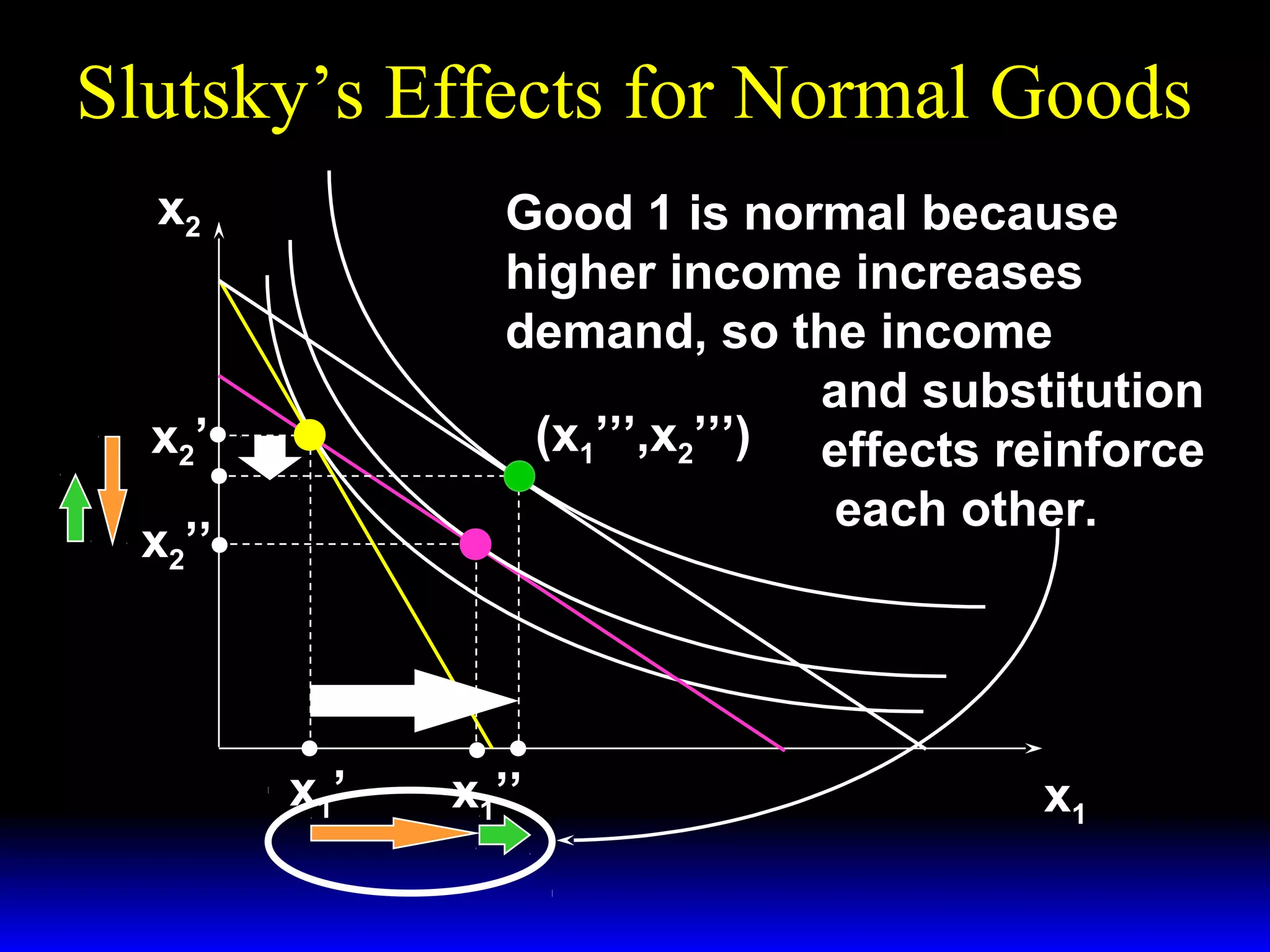
Good 1 is normal because
higher income increases
demand, so the income
and substitution
(x1’’’,x2’’’) effects reinforce
each other.

x2 ’
x2’’

x1’

x1’’

x1
Slutsky’s Effects for Normal Goods
Since both the substitution and
income effects increase demand
when own-price falls, a normal
good’s ordinary demand curve
slopes down.
The Law of Downward-Sloping
Demand therefore always applies to
normal goods.
Slutsky’s Effects for Income-Inferior
Goods
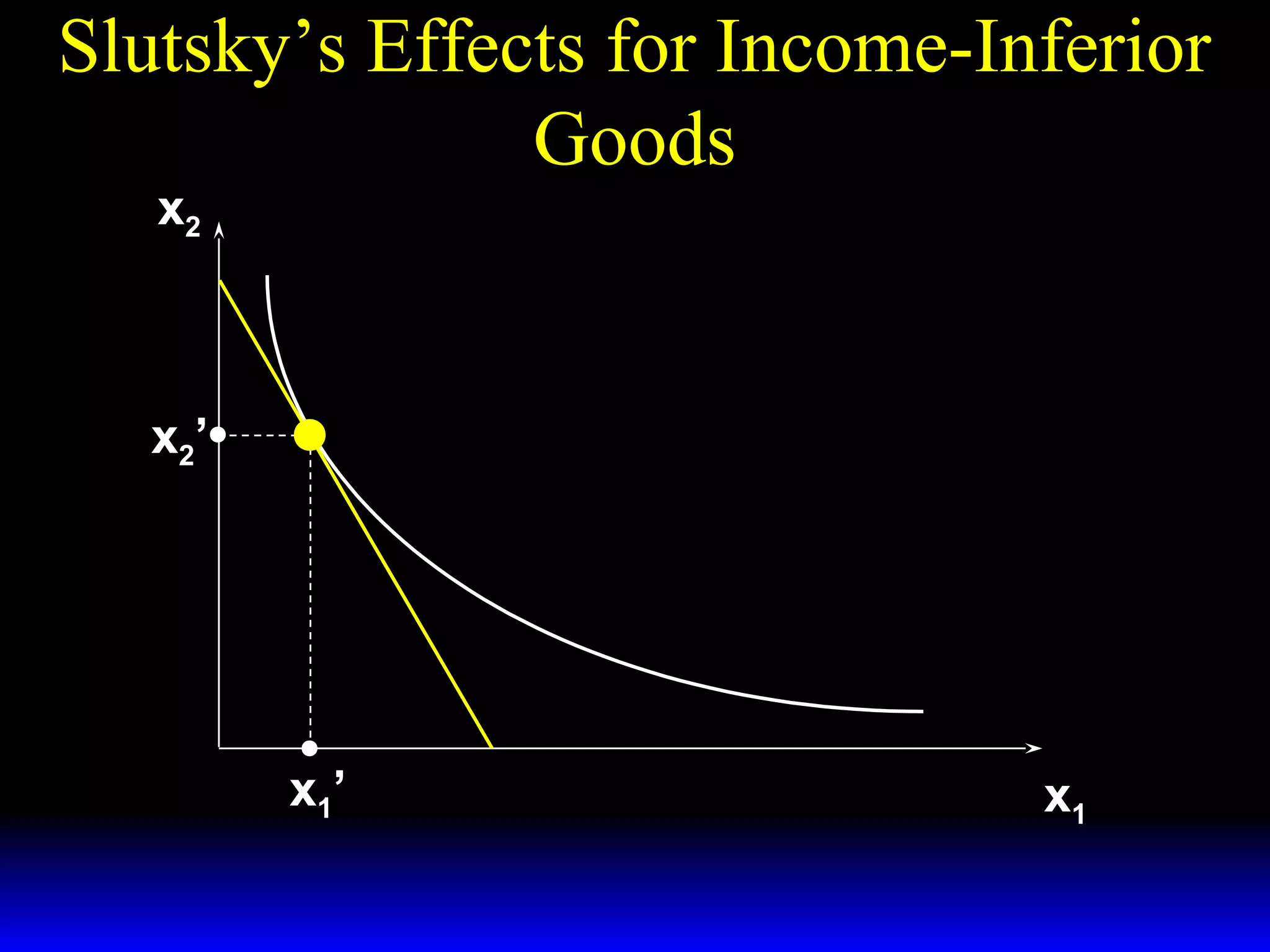
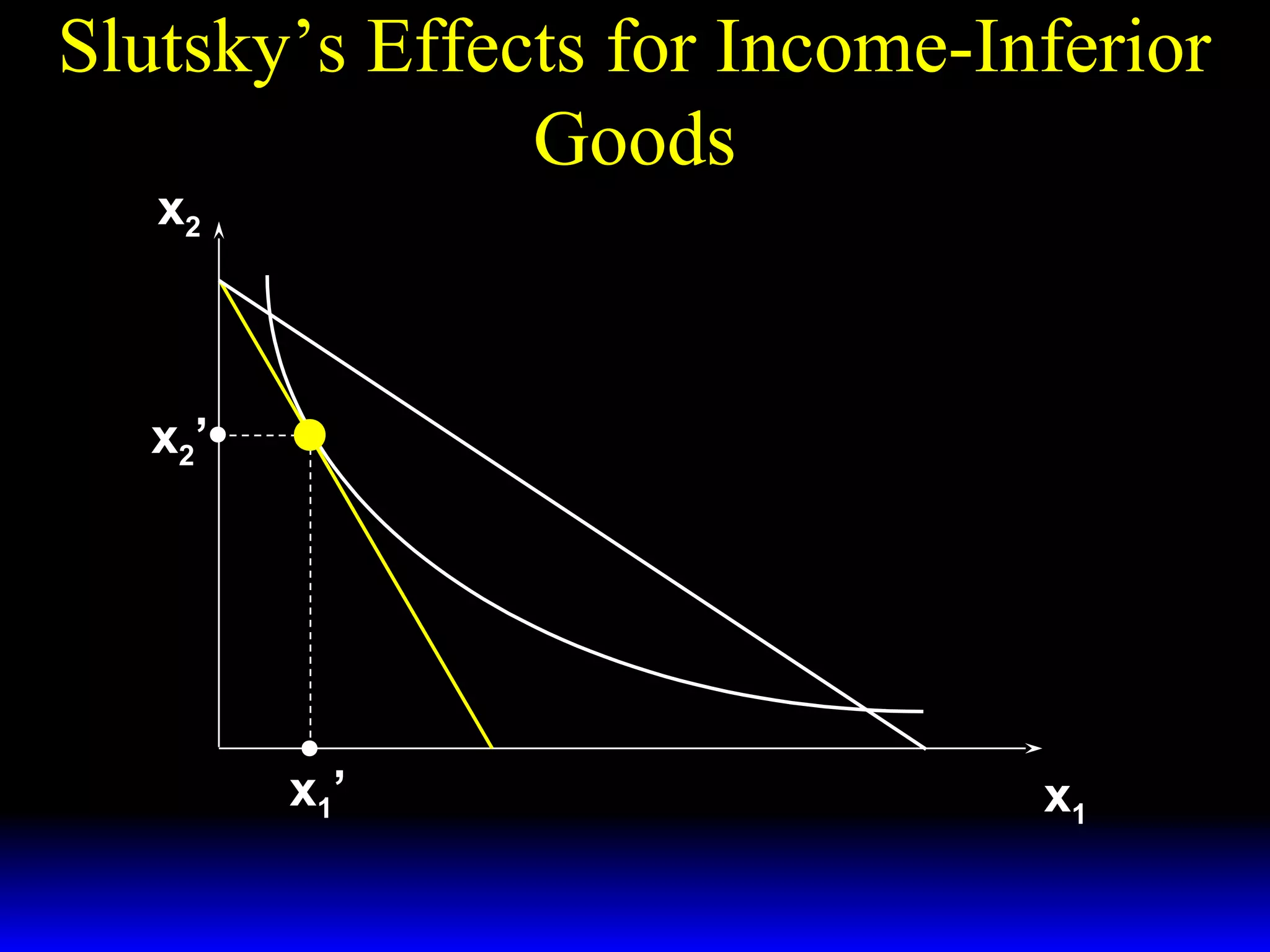
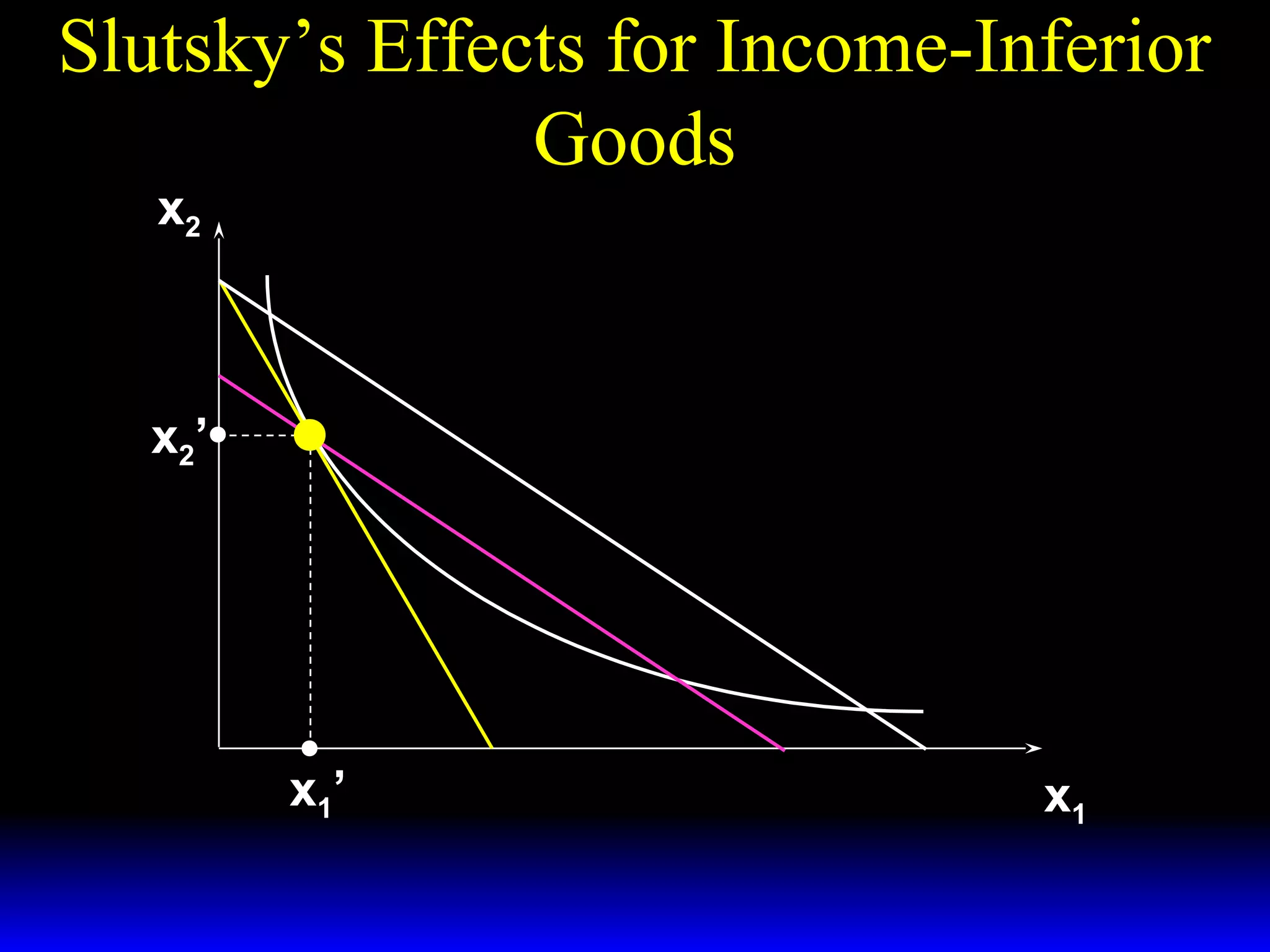
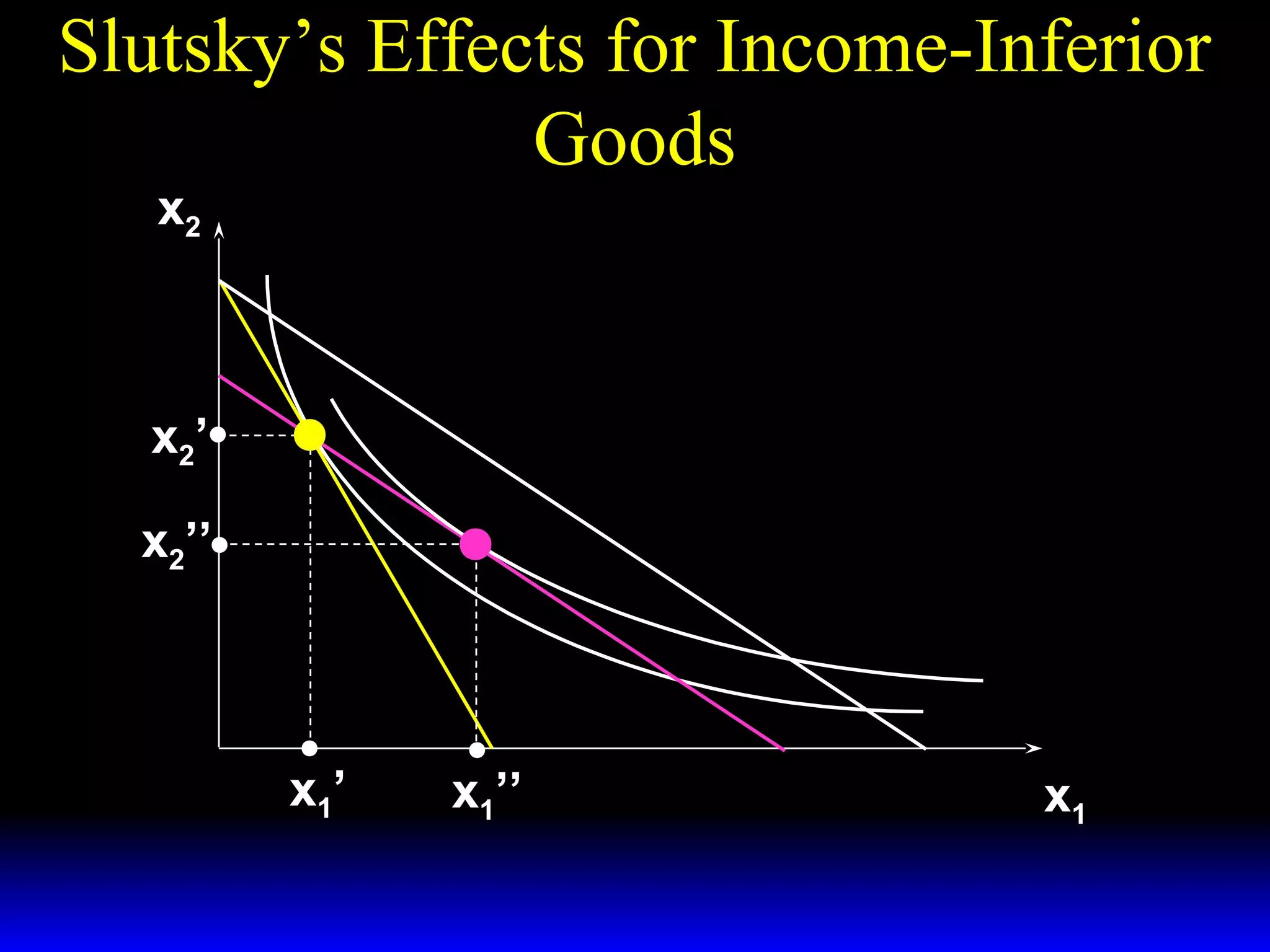
Some goods are income-inferior (i.e.
demand is reduced by higher
income).
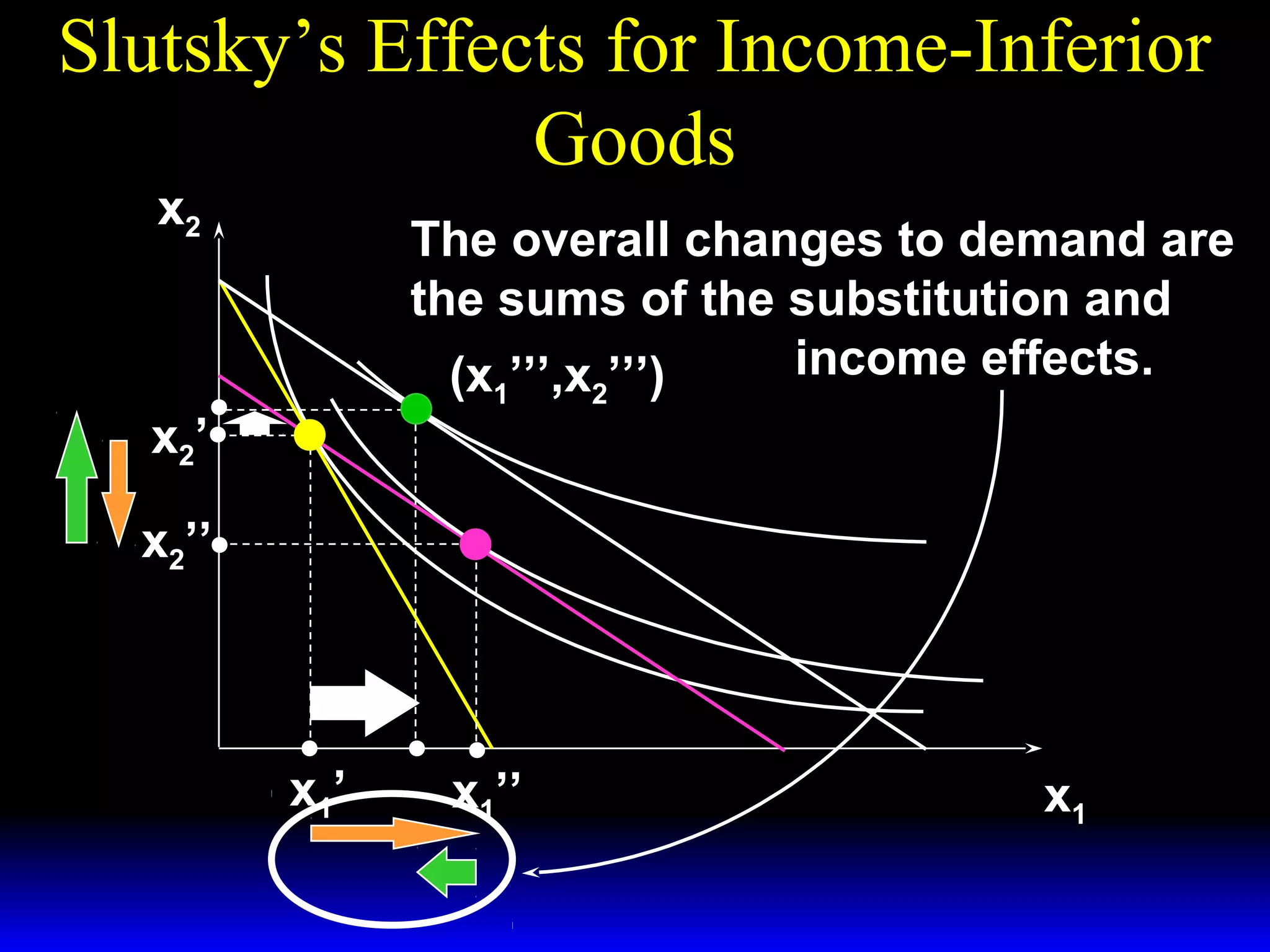
The substitution and income effects
oppose each other when an incomeinferior good’s own price changes.
Slutsky’s Effects for Income-Inferior
Goods
x2

x2 ’

x1’

x1
Slutsky’s Effects for Income-Inferior
Goods
x2

x2 ’

x1’

x1
Slutsky’s Effects for Income-Inferior
Goods
x2

x2 ’

x1’

x1
Slutsky’s Effects for Income-Inferior
Goods
x2

x2 ’
x2’’

x1’

x1’’

x1
Slutsky’s Effects for Income-Inferior
Goods
x2

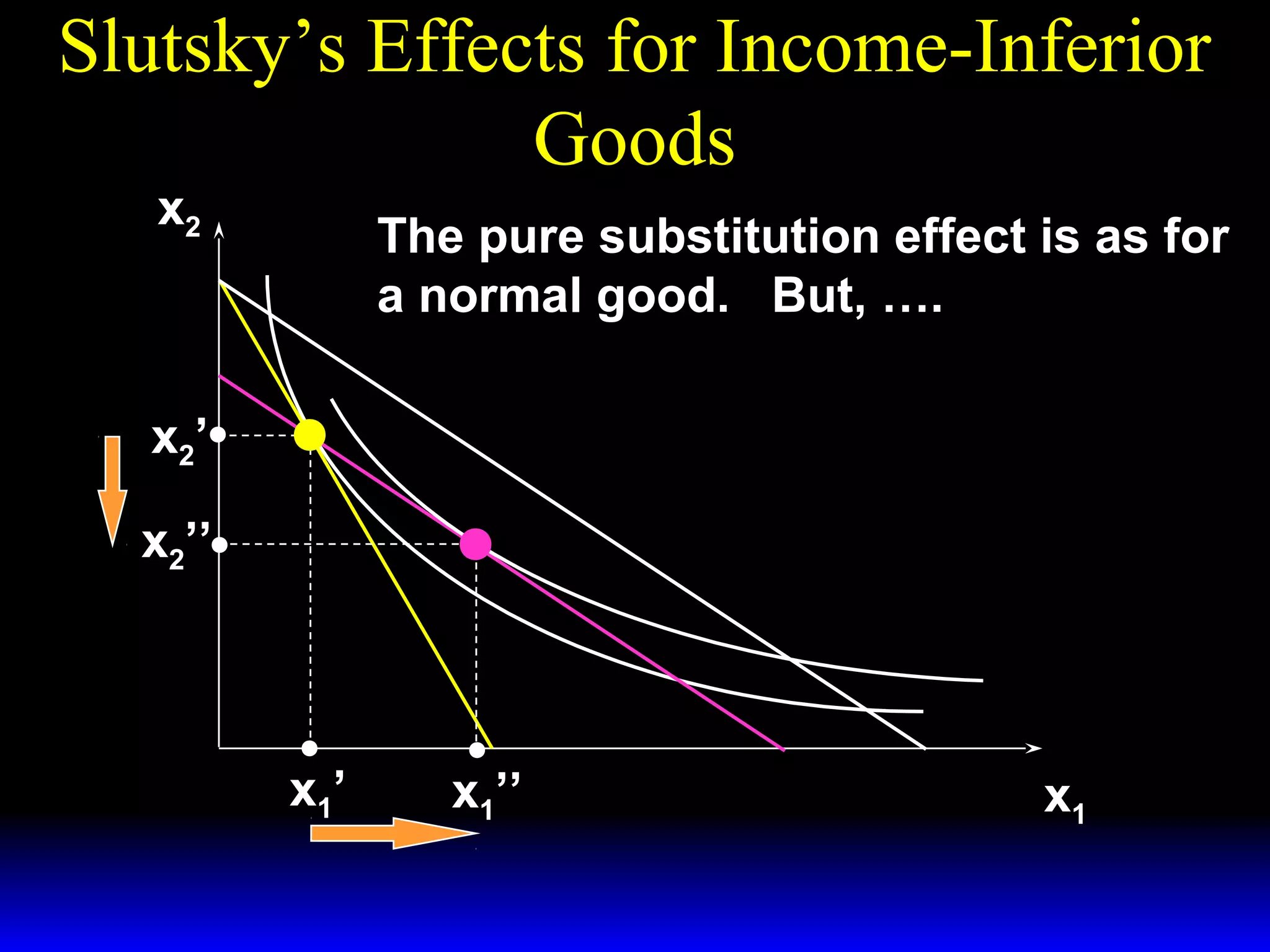
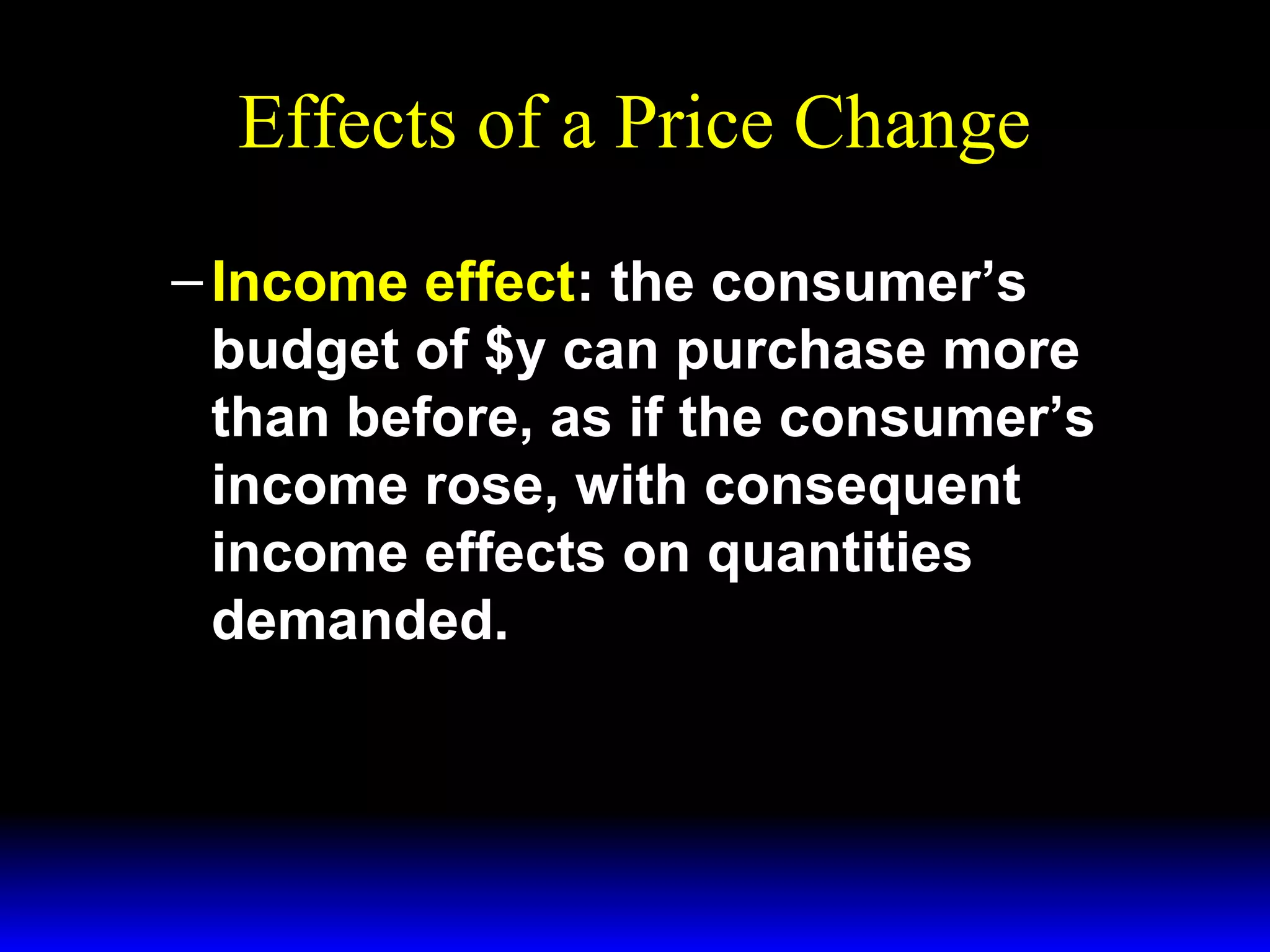
The pure substitution effect is as for
a normal good. But, ….

x2 ’
x2’’

x1’

x1’’

x1
Slutsky’s Effects for Income-Inferior
Goods
x2

x2 ’

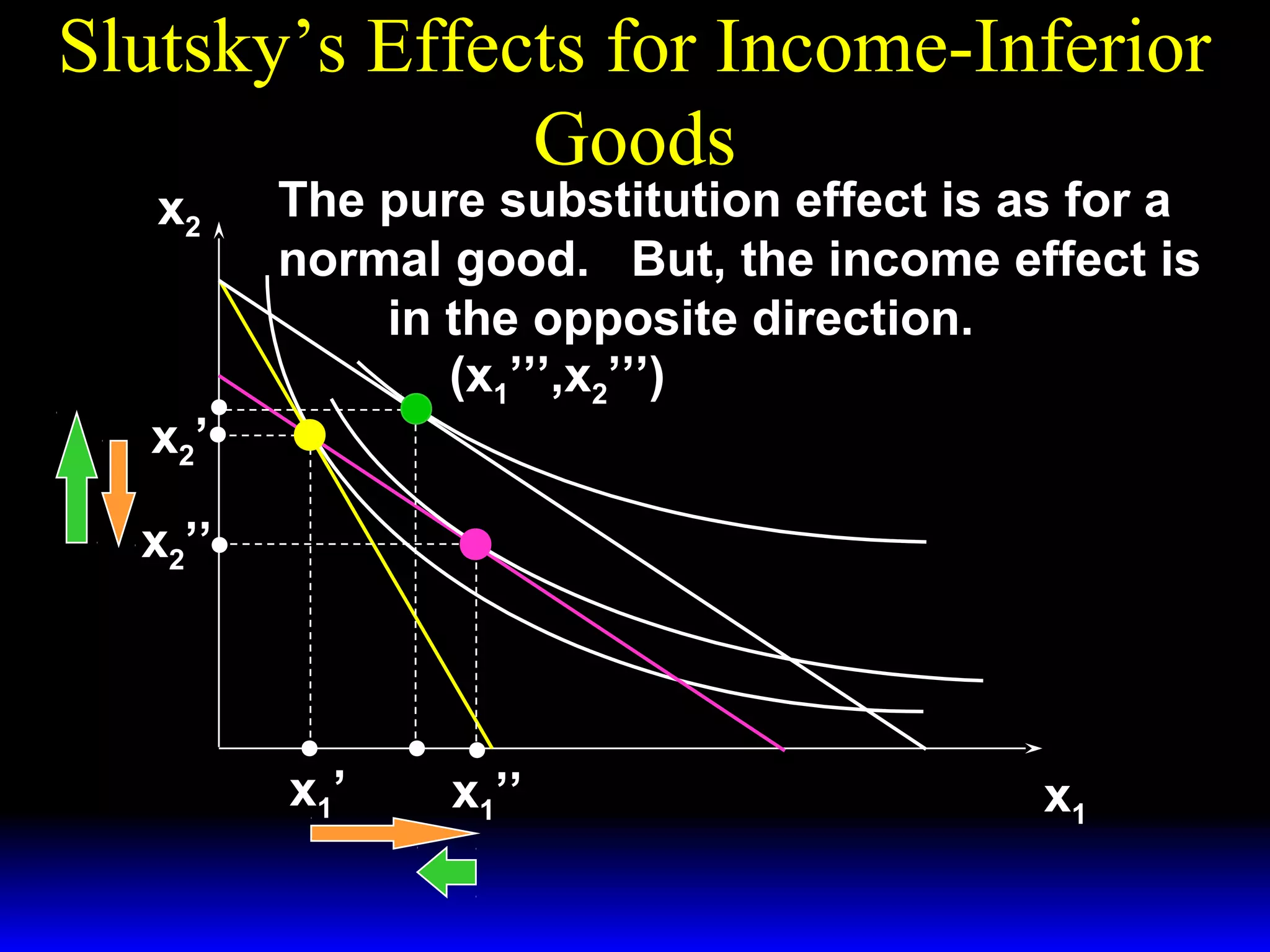
The pure substitution effect is as for a
normal good. But, the income effect is
in the opposite direction.
(x1’’’,x2’’’)

x2’’

x1’

x1’’

x1
Slutsky’s Effects for Income-Inferior
Goods
x2

x2 ’
x2’’

The pure substitution effect is as for a
normal good. But, the income effect is
in the opposite direction. Good 1 is
(x1’’’,x2’’’)
income-inferior
because an
increase to income
causes demand to
fall.
x1’

x1’’

x1
Slutsky’s Effects for Income-Inferior
Goods
x2

The overall changes to demand are
the sums of the substitution and
income effects.
(x ’’’,x ’’’)
1

x2 ’

2

x2’’

x1’

x1’’

x1
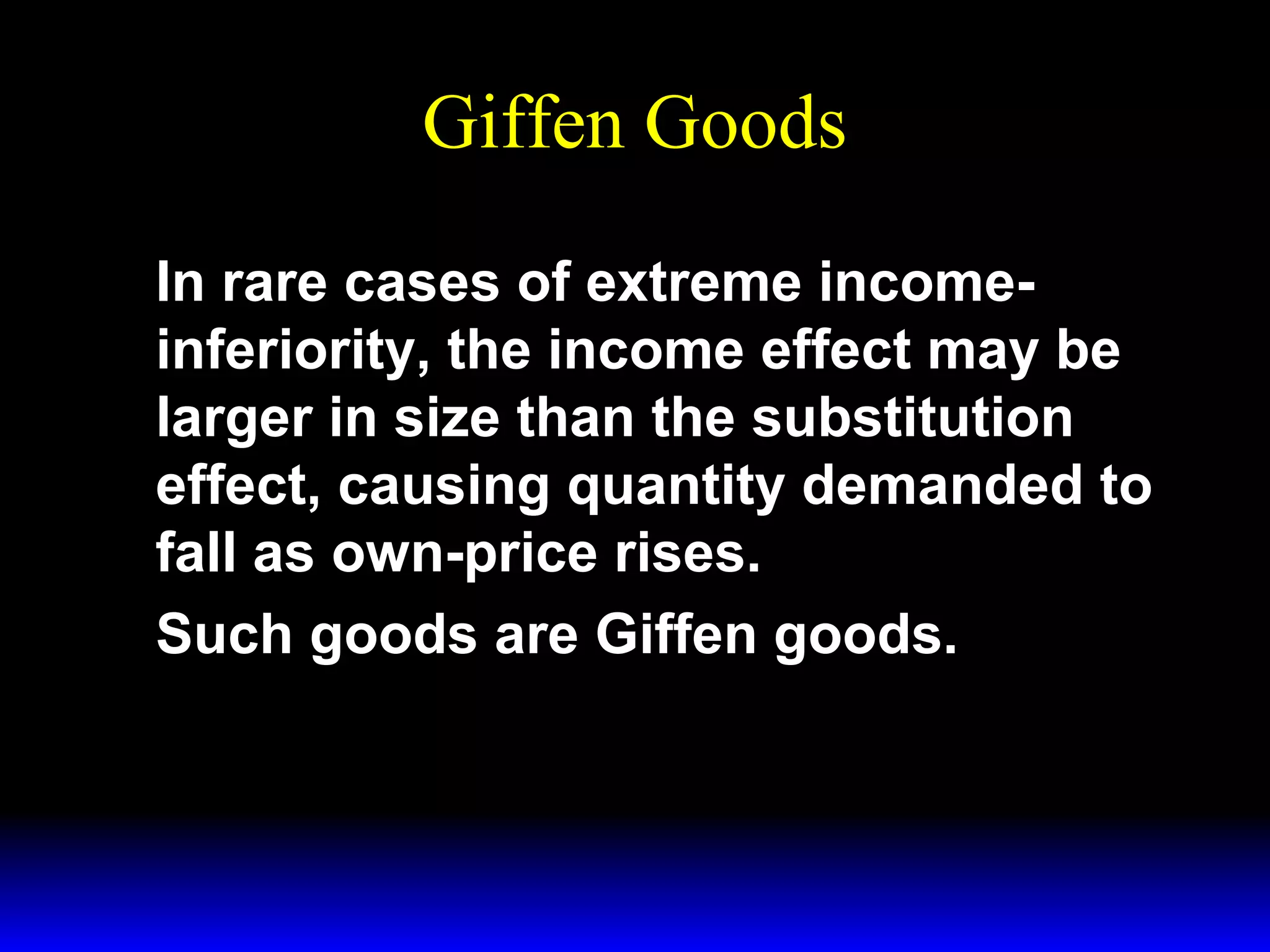
Giffen Goods
In rare cases of extreme incomeinferiority, the income effect may be
larger in size than the substitution
effect, causing quantity demanded to
fall as own-price rises.
Such goods are Giffen goods.
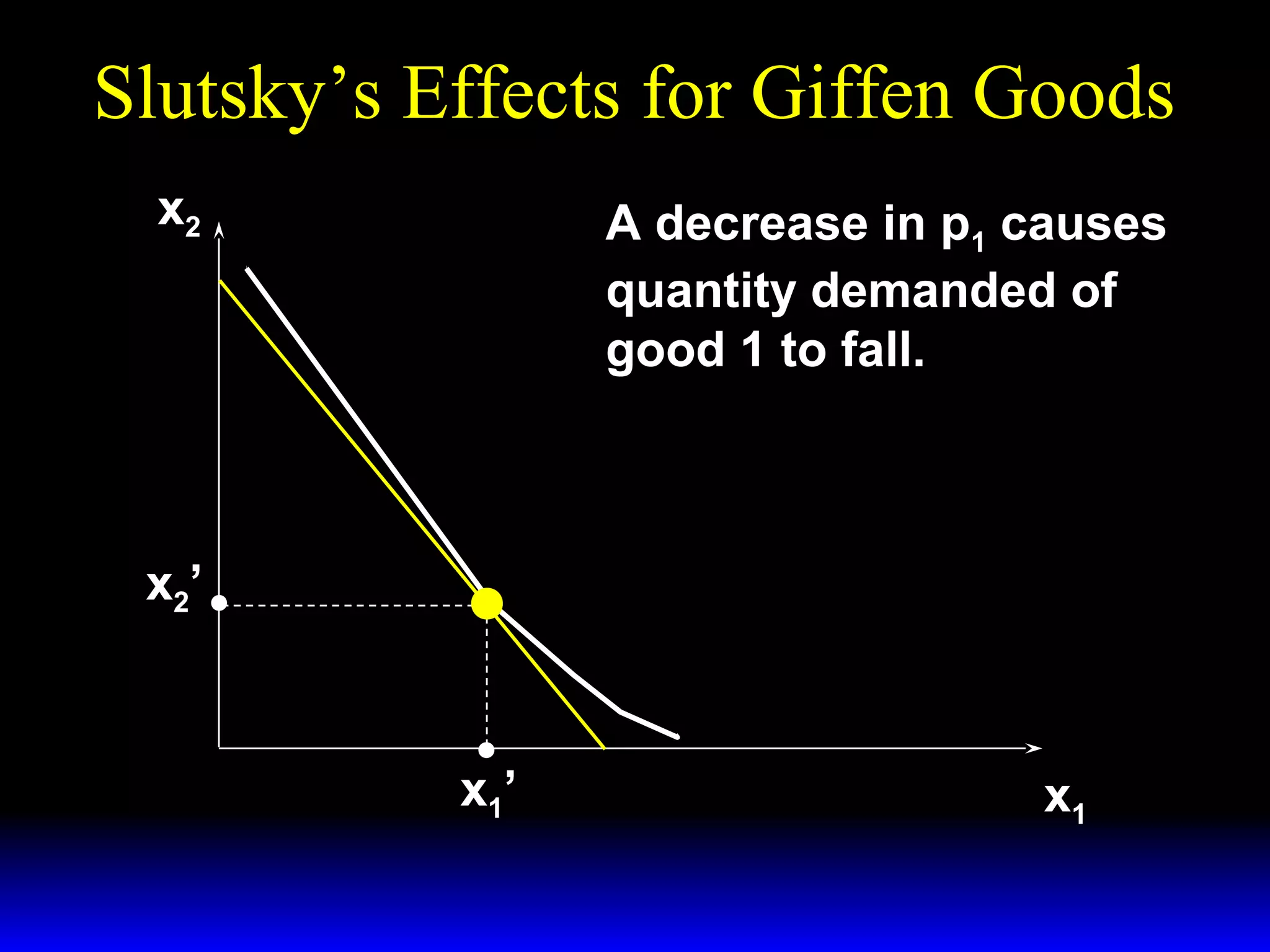
Slutsky’s Effects for Giffen Goods
x2

A decrease in p1 causes
quantity demanded of
good 1 to fall.

x2’

x1’

x1
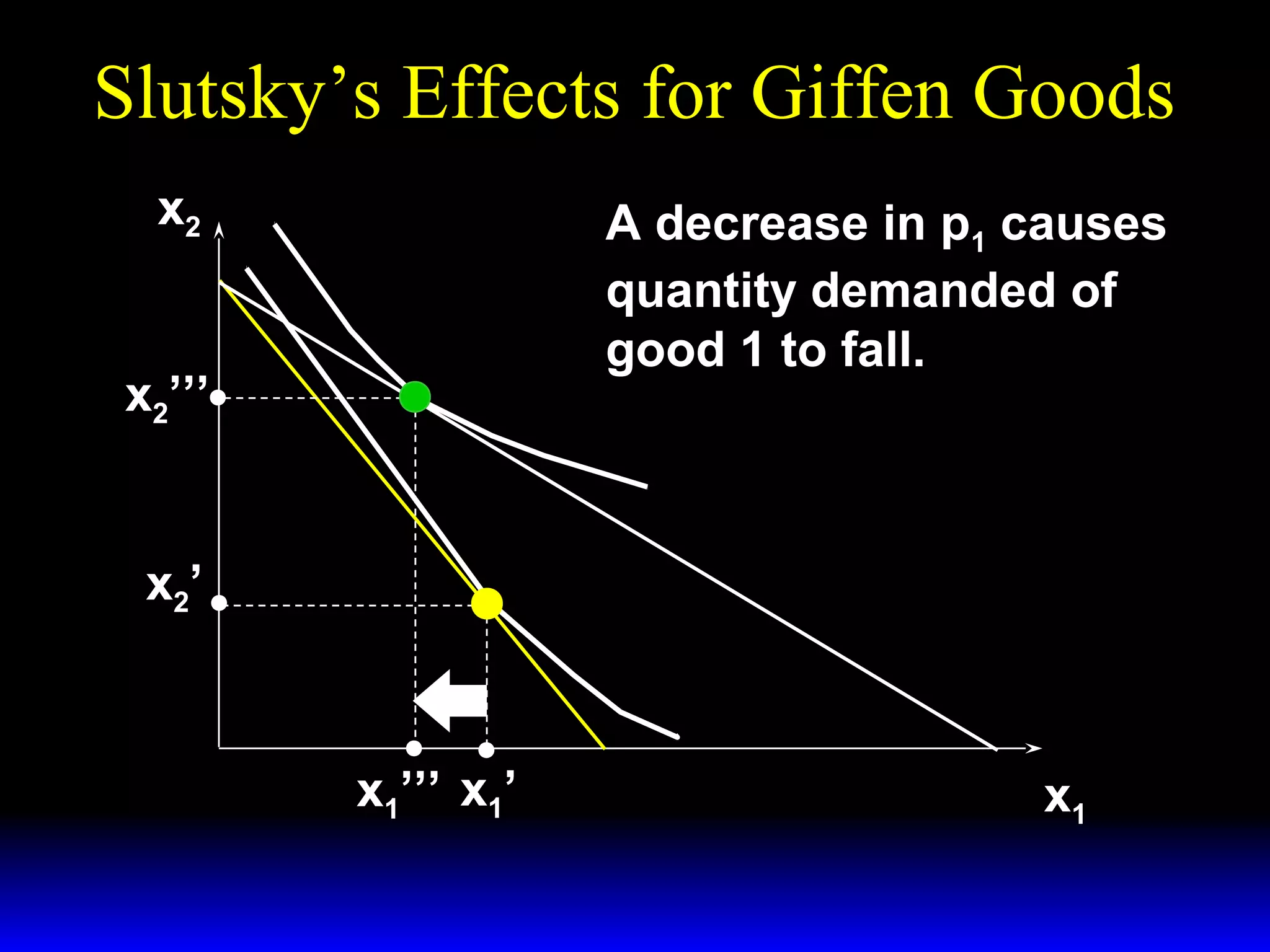
Slutsky’s Effects for Giffen Goods
x2

A decrease in p1 causes
quantity demanded of
good 1 to fall.

x2’’’

x2’

x1’’’ x1’

x1
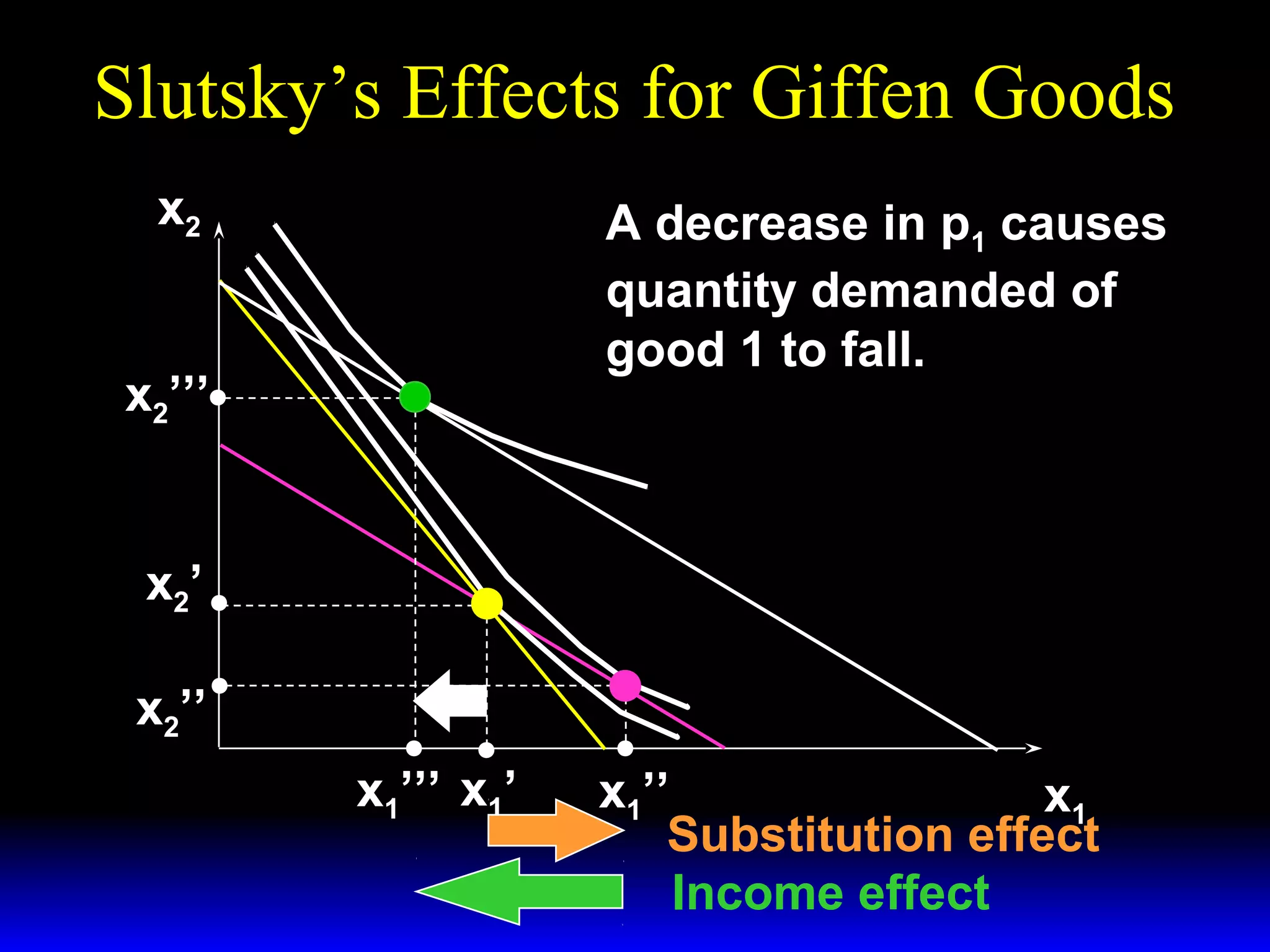
Slutsky’s Effects for Giffen Goods
x2

A decrease in p1 causes
quantity demanded of
good 1 to fall.

x2’’’

x2’
x2’’
x1’’’ x1’

x1’’
x1
Substitution effect
Income effect
Slutsky’s Effects for Giffen
Goods
Slutsky’s decomposition of the effect
of a price change into a pure
substitution effect and an income
effect thus explains why the Law of
Downward-Sloping Demand is
violated for extremely incomeinferior goods.

Ch8

  • 1.
  • 2.
    Effects of aPrice Change What happens when a commodity’s price decreases? – Substitution effect: the commodity is relatively cheaper, so consumers substitute it for now relatively more expensive other commodities.
  • 3.
    Effects of aPrice Change – Income effect: the consumer’s budget of $y can purchase more than before, as if the consumer’s income rose, with consequent income effects on quantities demanded.
  • 4.
    Effects of aPrice Change x2 y p2 Consumer’s budget is $y. Original choice x1
  • 5.
    Effects of aPrice Change x2 y p2 Consumer’s budget is $y. Lower price for commodity 1 pivots the constraint outwards. x1
  • 6.
    Effects of aPrice Change x2 y p2 y' p2 Consumer’s budget is $y. Lower price for commodity 1 pivots the constraint outwards. Now only $y’ are needed to buy the original bundle at the new prices, as if the consumer’s income has increased by $y - $y’. x1
  • 7.
    Effects of aPrice Change Changes to quantities demanded due to this ‘extra’ income are the income effect of the price change.
  • 8.
    Effects of aPrice Change Slutsky discovered that changes to demand from a price change are always the sum of a pure substitution effect and an income effect.
  • 9.
    Real Income Changes Slutskyasserted that if, at the new prices, – less income is needed to buy the original bundle then “real income” is increased – more income is needed to buy the original bundle then “real income” is decreased
  • 10.
    Real Income Changes x2 Originalbudget constraint and choice x1
  • 11.
    Real Income Changes x2 Originalbudget constraint and choice New budget constraint x1
  • 12.
    Real Income Changes x2 Originalbudget constraint and choice New budget constraint; real income has risen x1
  • 13.
    Real Income Changes x2 Originalbudget constraint and choice x1
  • 14.
    Real Income Changes x2 Originalbudget constraint and choice New budget constraint x1
  • 15.
    Real Income Changes x2 Originalbudget constraint and choice New budget constraint; real income has fallen x1
  • 16.
    Pure Substitution Effect Slutskyisolated the change in demand due only to the change in relative prices by asking “What is the change in demand when the consumer’s income is adjusted so that, at the new prices, she can only just buy the original bundle?”
  • 17.
    Pure Substitution EffectOnly x2 x2 ’ x1’ x1
  • 18.
    Pure Substitution EffectOnly x2 x2 ’ x1’ x1
  • 19.
    Pure Substitution EffectOnly x2 x2 ’ x1’ x1
  • 20.
    Pure Substitution EffectOnly x2 x2 ’ x2’’ x1’ x1’’ x1
  • 21.
    Pure Substitution EffectOnly x2 x2 ’ x2’’ x1’ x1’’ x1
  • 22.
    Pure Substitution EffectOnly x2 Lower p1 makes good 1 relatively cheaper and causes a substitution from good 2 to good 1. x2 ’ x2’’ x1’ x1’’ x1
  • 23.
    Pure Substitution EffectOnly x2 Lower p1 makes good 1 relatively cheaper and causes a substitution from good 2 to good 1. (x1’,x2’) → (x1’’,x2’’) is the pure substitution effect. x2 ’ x2’’ x1’ x1’’ x1
  • 24.
    And Now TheIncome Effect x2 (x1’’’,x2’’’) x2 ’ x2’’ x1’ x1’’ x1
  • 25.
    And Now TheIncome Effect x2 The income effect is (x1’’,x2’’) → (x1’’’,x2’’’). (x1’’’,x2’’’) x2 ’ x2’’ x1’ x1’’ x1
  • 26.
    The Overall Changein Demand The change to demand due to lower p1 is the sum of the income and substitution effects, (x1’,x2’) → (x1’’’,x2’’’). (x1’’’,x2’’’) x2 x2 ’ x2’’ x1’ x1’’ x1
  • 27.
    Slutsky’s Effects forNormal Goods Most goods are normal (i.e. demand increases with income). The substitution and income effects reinforce each other when a normal good’s own price changes.
  • 28.
    Slutsky’s Effects forNormal Goods x2 Good 1 is normal because higher income increases demand (x1’’’,x2’’’) x2 ’ x2’’ x1’ x1’’ x1
  • 29.
    Slutsky’s Effects forNormal Goods x2 Good 1 is normal because higher income increases demand, so the income and substitution (x1’’’,x2’’’) effects reinforce each other. x2 ’ x2’’ x1’ x1’’ x1
  • 30.
    Slutsky’s Effects forNormal Goods Since both the substitution and income effects increase demand when own-price falls, a normal good’s ordinary demand curve slopes down. The Law of Downward-Sloping Demand therefore always applies to normal goods.
  • 31.
    Slutsky’s Effects forIncome-Inferior Goods Some goods are income-inferior (i.e. demand is reduced by higher income). The substitution and income effects oppose each other when an incomeinferior good’s own price changes.
  • 32.
    Slutsky’s Effects forIncome-Inferior Goods x2 x2 ’ x1’ x1
  • 33.
    Slutsky’s Effects forIncome-Inferior Goods x2 x2 ’ x1’ x1
  • 34.
    Slutsky’s Effects forIncome-Inferior Goods x2 x2 ’ x1’ x1
  • 35.
    Slutsky’s Effects forIncome-Inferior Goods x2 x2 ’ x2’’ x1’ x1’’ x1
  • 36.
    Slutsky’s Effects forIncome-Inferior Goods x2 The pure substitution effect is as for a normal good. But, …. x2 ’ x2’’ x1’ x1’’ x1
  • 37.
    Slutsky’s Effects forIncome-Inferior Goods x2 x2 ’ The pure substitution effect is as for a normal good. But, the income effect is in the opposite direction. (x1’’’,x2’’’) x2’’ x1’ x1’’ x1
  • 38.
    Slutsky’s Effects forIncome-Inferior Goods x2 x2 ’ x2’’ The pure substitution effect is as for a normal good. But, the income effect is in the opposite direction. Good 1 is (x1’’’,x2’’’) income-inferior because an increase to income causes demand to fall. x1’ x1’’ x1
  • 39.
    Slutsky’s Effects forIncome-Inferior Goods x2 The overall changes to demand are the sums of the substitution and income effects. (x ’’’,x ’’’) 1 x2 ’ 2 x2’’ x1’ x1’’ x1
  • 40.
    Giffen Goods In rarecases of extreme incomeinferiority, the income effect may be larger in size than the substitution effect, causing quantity demanded to fall as own-price rises. Such goods are Giffen goods.
  • 41.
    Slutsky’s Effects forGiffen Goods x2 A decrease in p1 causes quantity demanded of good 1 to fall. x2’ x1’ x1
  • 42.
    Slutsky’s Effects forGiffen Goods x2 A decrease in p1 causes quantity demanded of good 1 to fall. x2’’’ x2’ x1’’’ x1’ x1
  • 43.
    Slutsky’s Effects forGiffen Goods x2 A decrease in p1 causes quantity demanded of good 1 to fall. x2’’’ x2’ x2’’ x1’’’ x1’ x1’’ x1 Substitution effect Income effect
  • 44.
    Slutsky’s Effects forGiffen Goods Slutsky’s decomposition of the effect of a price change into a pure substitution effect and an income effect thus explains why the Law of Downward-Sloping Demand is violated for extremely incomeinferior goods.