Chapter 5
INCOME AND SUBSTITUTION
EFFECTS
Copyright ©2002 by South-Western, a division of Thomson Learning. All rights reserved.
MICROECONOMIC THEORY
BASIC PRINCIPLES AND EXTENSIONS
EIGHTH EDITION
WALTER NICHOLSON
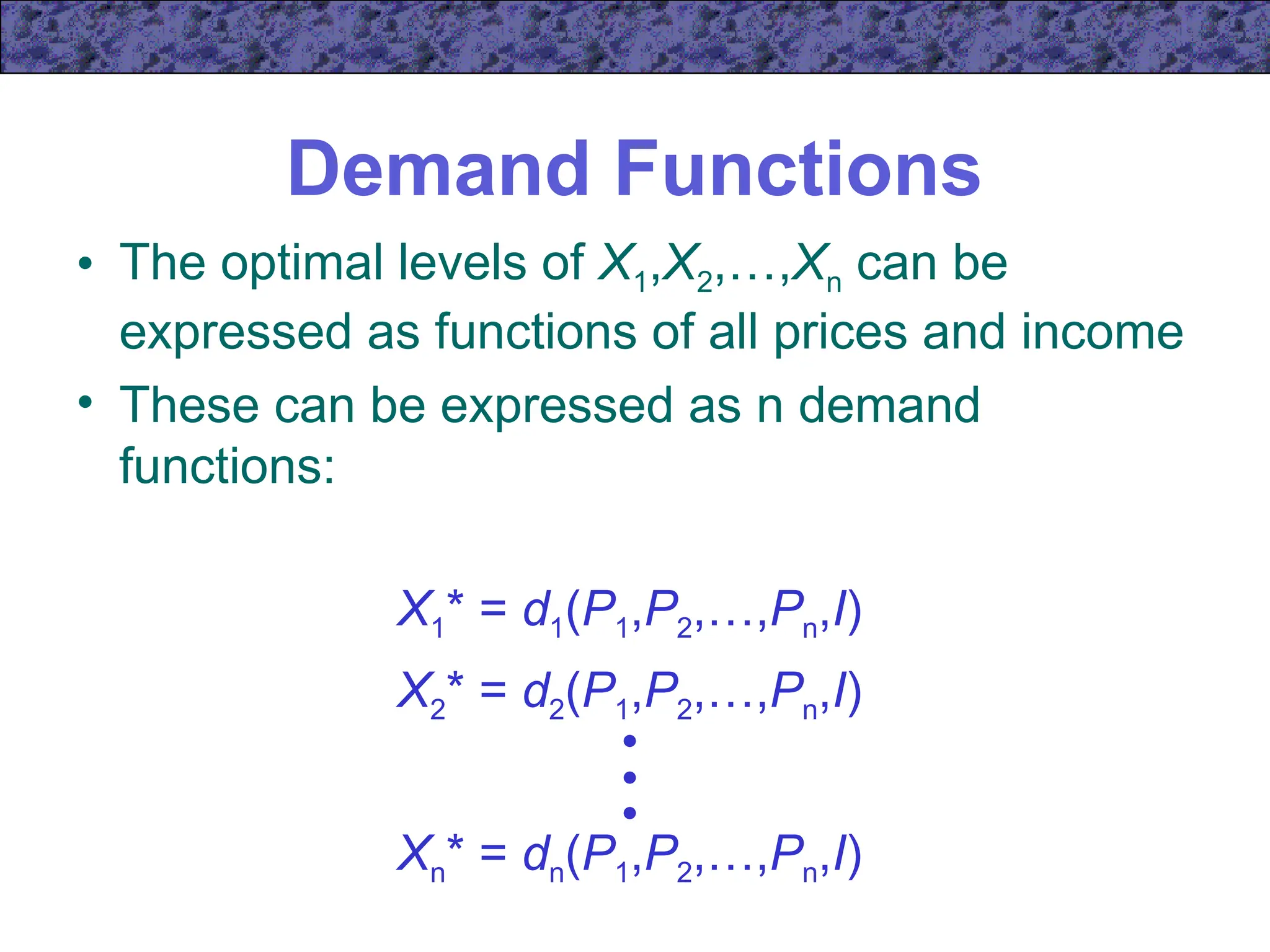
Demand Functions
• The optimal levels of X1,X2,…,Xn can be
expressed as functions of all prices and income
• These can be expressed as n demand
functions:
X1* = d1(P1,P2,…,Pn,I)
X2* = d2(P1,P2,…,Pn,I)
•
•
•
Xn* = dn(P1,P2,…,Pn,I)
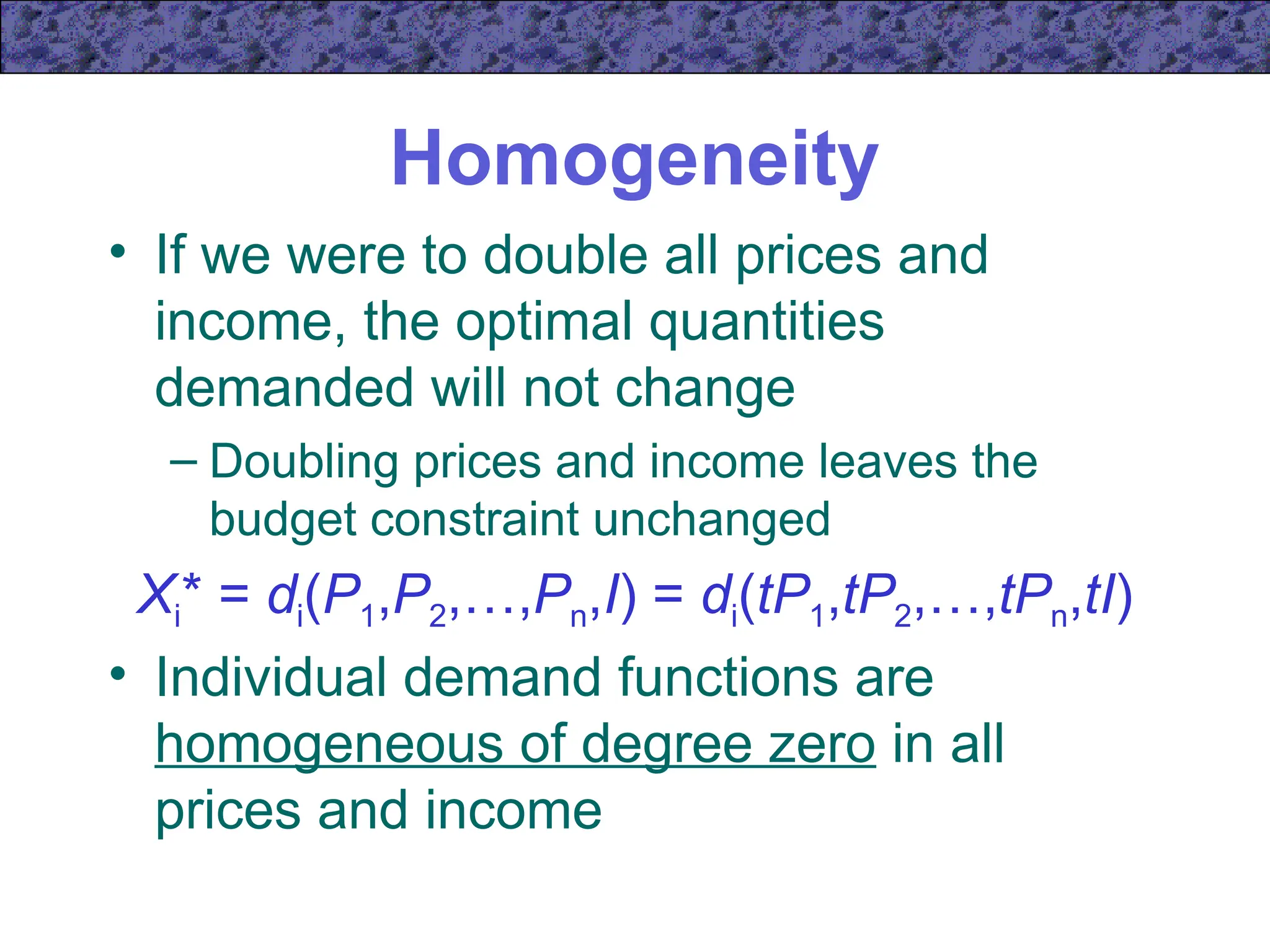
Homogeneity
• If we were to double all prices and
income, the optimal quantities
demanded will not change
– Doubling prices and income leaves the
budget constraint unchanged
Xi* = di(P1,P2,…,Pn,I) = di(tP1,tP2,…,tPn,tI)
• Individual demand functions are
homogeneous of degree zero in all
prices and income
Homogeneity
• With a Cobb-Douglas utility function
utility = U(X,Y) = X0.3
Y0.7
the demand functions are
• Note that a doubling of both prices and
income would leave X* and Y*
unaffected
X
P
X
I
3
0.
* 
X
P
Y
I
7
0.
* 
Homogeneity
• With a CES utility function
utility = U(X,Y) = X0.5
+ Y0.5
the demand functions are
• Note that a doubling of both prices and
income would leave X* and Y*
unaffected
X
Y
X P
P
P
X
I



/
*
1
1
Y
X
Y P
P
P
Y
I



/
*
1
1
Changes in Income
• An increase in income will cause the
budget constraint out in a parallel
manner
• Since PX/PY does not change, the MRS
will stay constant as the worker moves
to higher levels of satisfaction
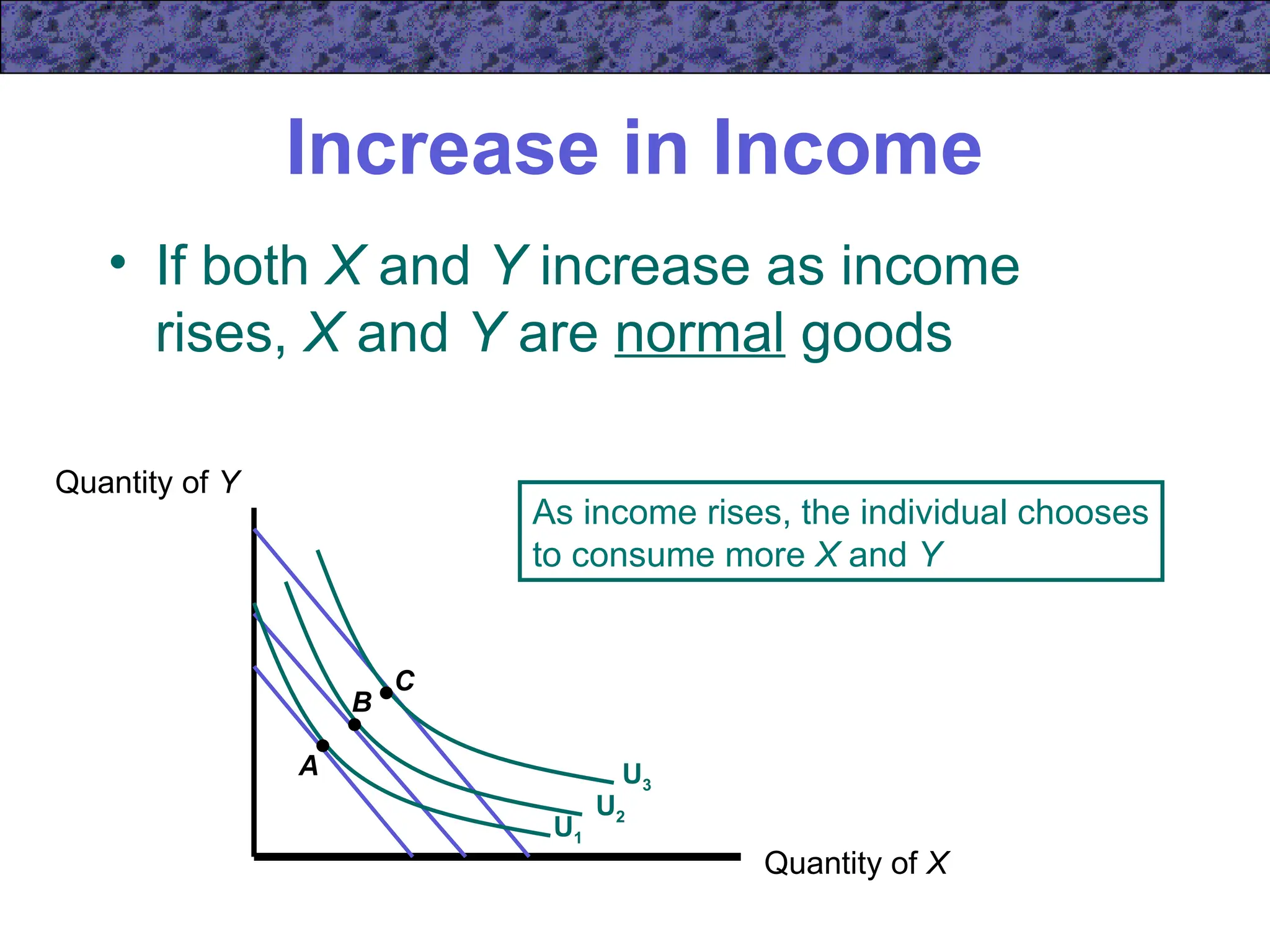
Increase in Income
• If both X and Y increase as income
rises, X and Y are normal goods
Quantity of X
Quantity of Y
C
U3
B
U2
A
U1
As income rises, the individual chooses
to consume more X and Y
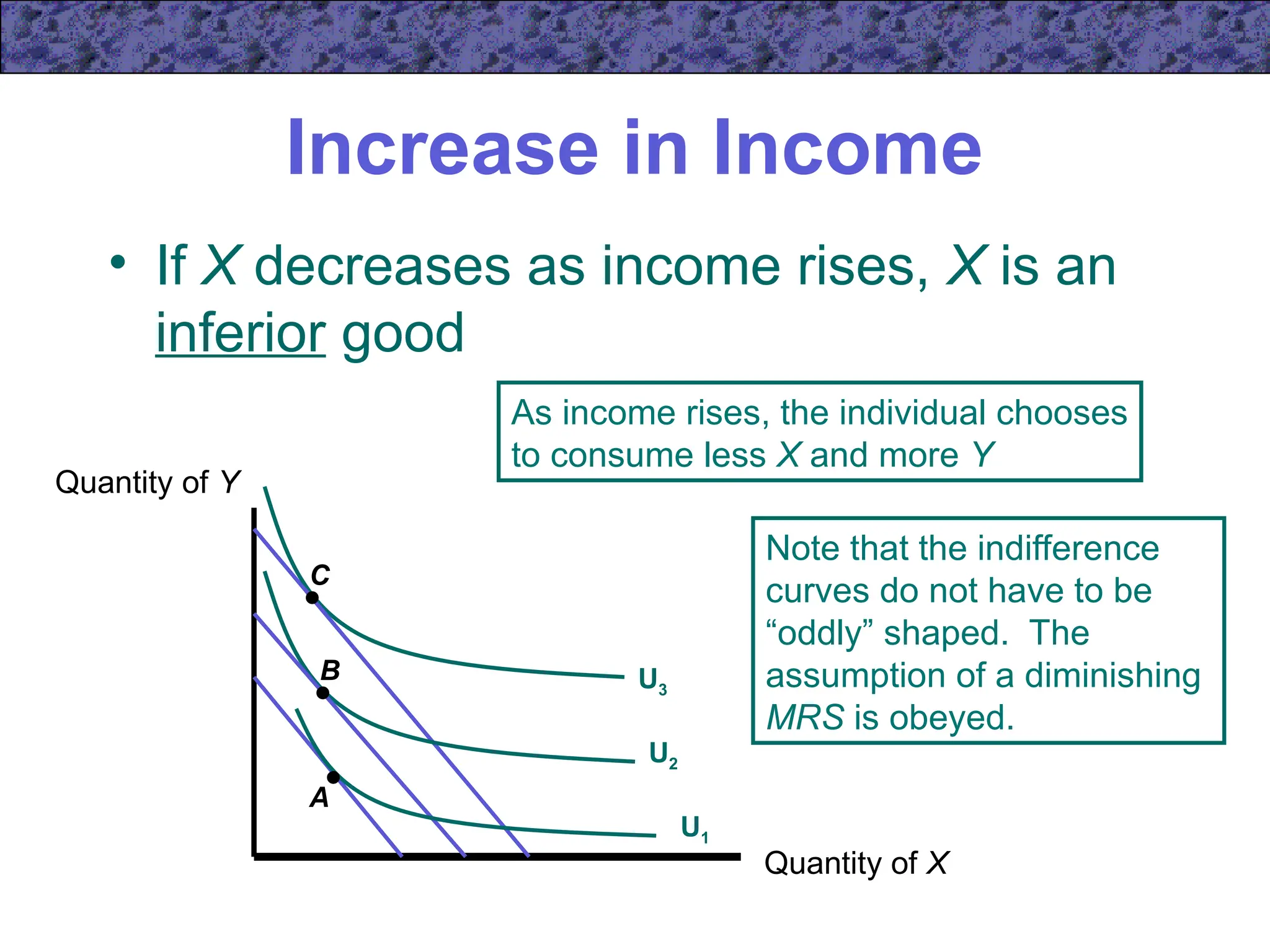
Increase in Income
• If X decreases as income rises, X is an
inferior good
Quantity of X
Quantity of Y
C
U3
As income rises, the individual chooses
to consume less X and more Y
Note that the indifference
curves do not have to be
“oddly” shaped. The
assumption of a diminishing
MRS is obeyed.
B
U2
A
U1
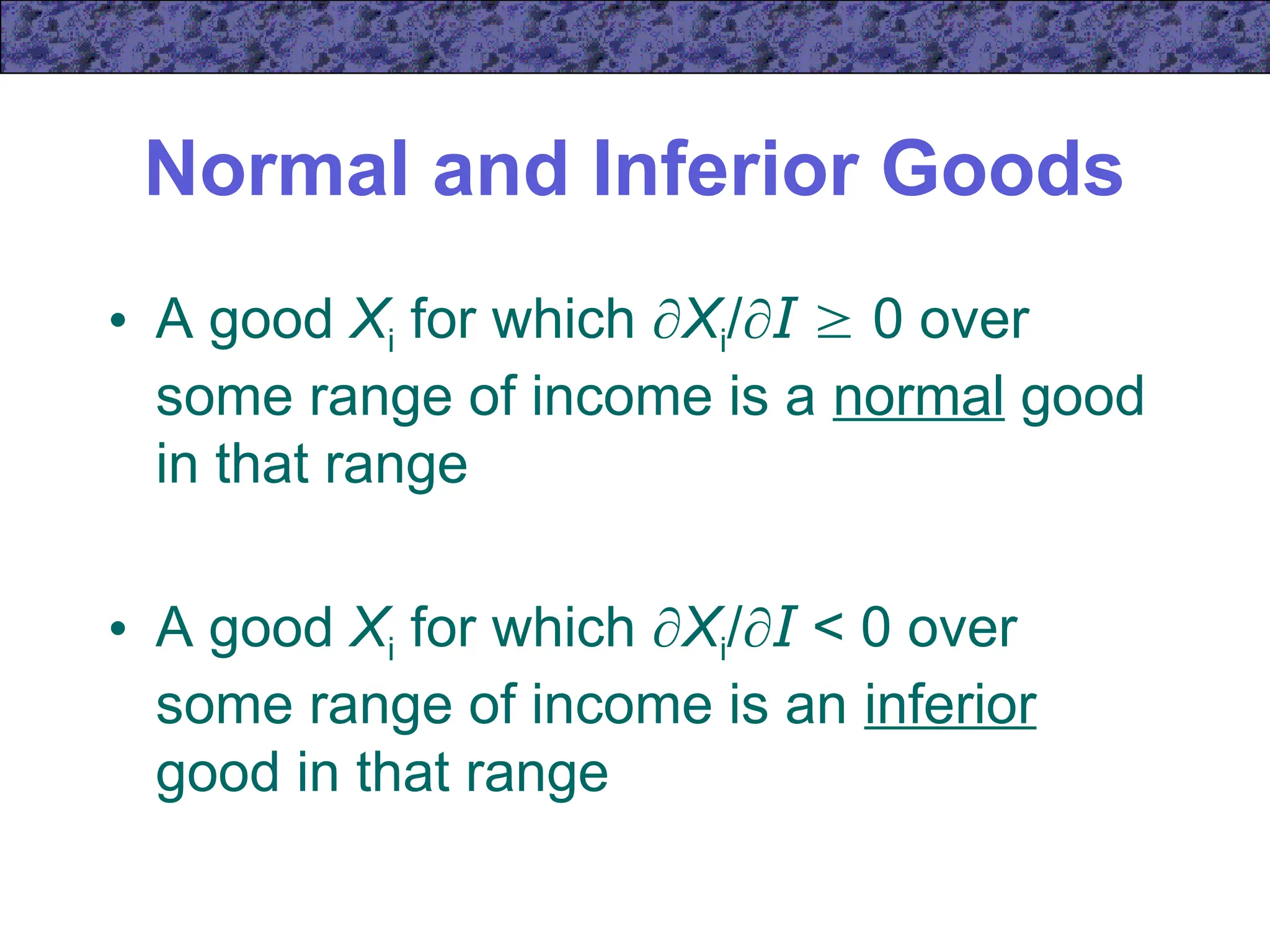
Normal and Inferior Goods
• A good Xi for which Xi/I  0 over
some range of income is a normal good
in that range
• A good Xi for which Xi/I < 0 over
some range of income is an inferior
good in that range
Engel’s Law
• Using Belgian data from 1857, Engel
found an empirical generalization about
consumer behavior
• The proportion of total expenditure
devoted to food declines as income rises
– food is a necessity whose consumption rises
less rapidly than income
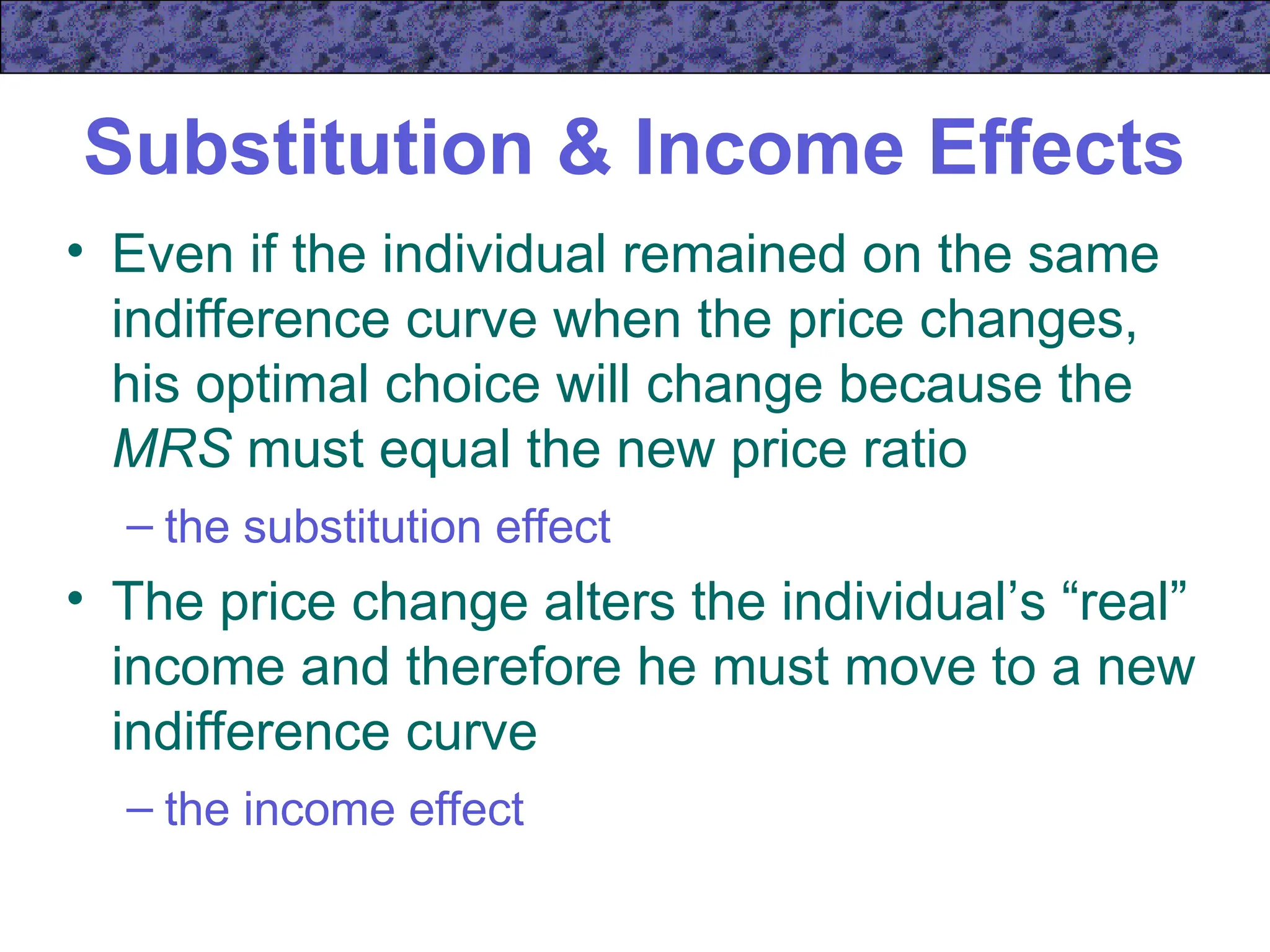
Substitution & Income Effects
• Even if the individual remained on the same
indifference curve when the price changes,
his optimal choice will change because the
MRS must equal the new price ratio
– the substitution effect
• The price change alters the individual’s “real”
income and therefore he must move to a new
indifference curve
– the income effect
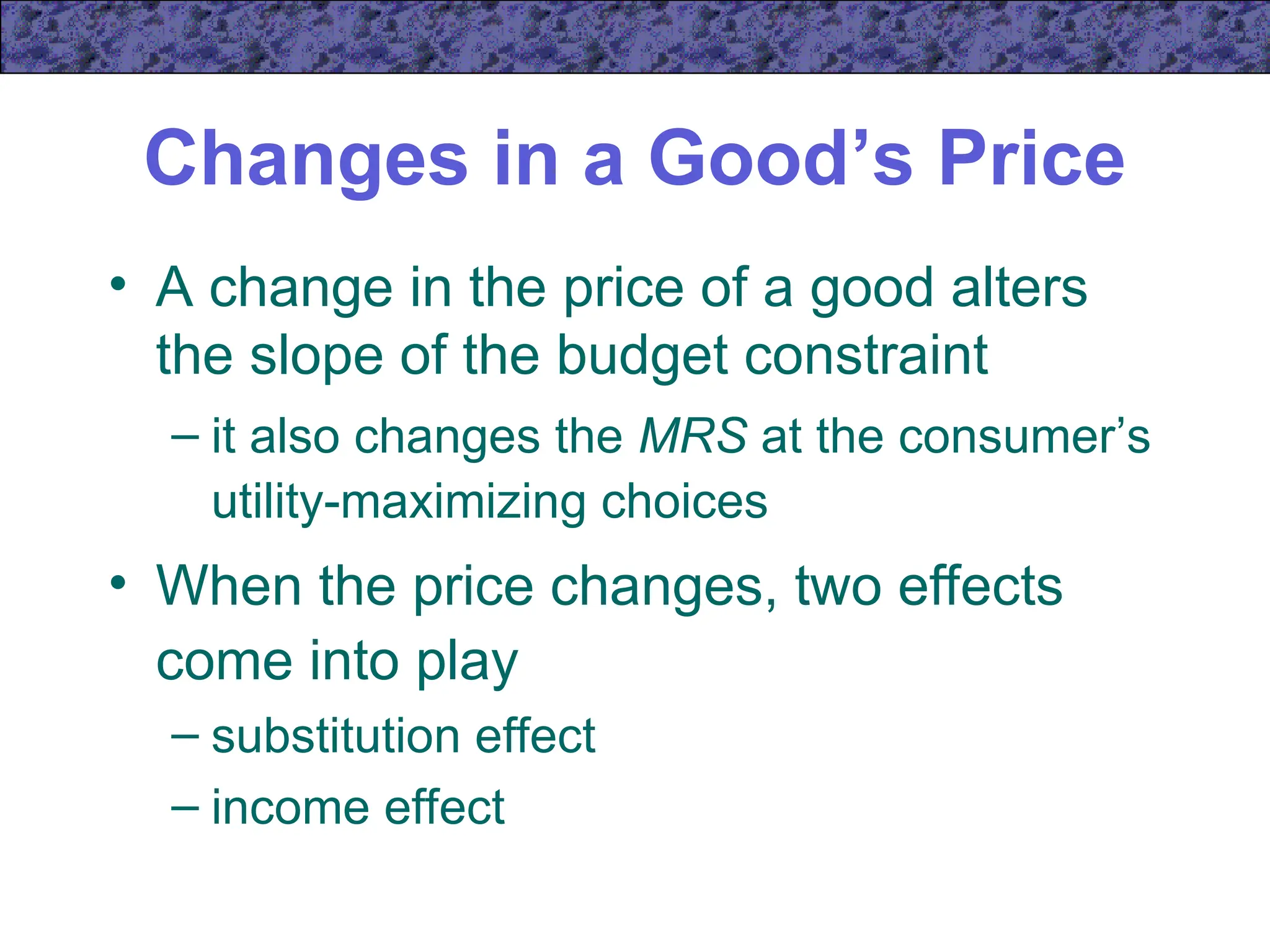
Changes in a Good’s Price
• A change in the price of a good alters
the slope of the budget constraint
– it also changes the MRS at the consumer’s
utility-maximizing choices
• When the price changes, two effects
come into play
– substitution effect
– income effect
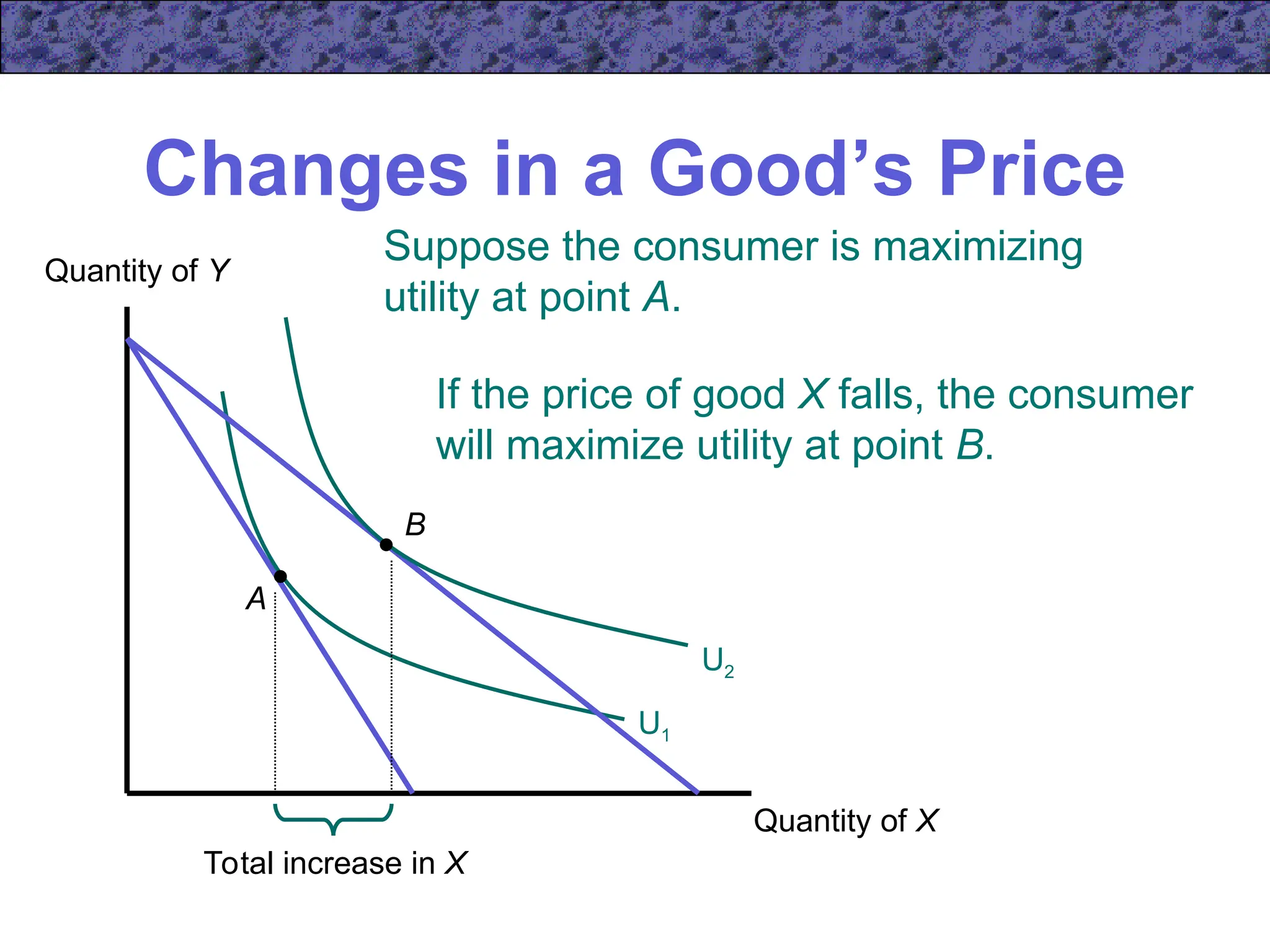
Changes in a Good’s Price
Quantity of X
Quantity of Y
U1
A
Suppose the consumer is maximizing
utility at point A.
U2
B
If the price of good X falls, the consumer
will maximize utility at point B.
Total increase in X
Changes in a Good’s Price
U1
U2
Quantity of X
Quantity of Y
A
B
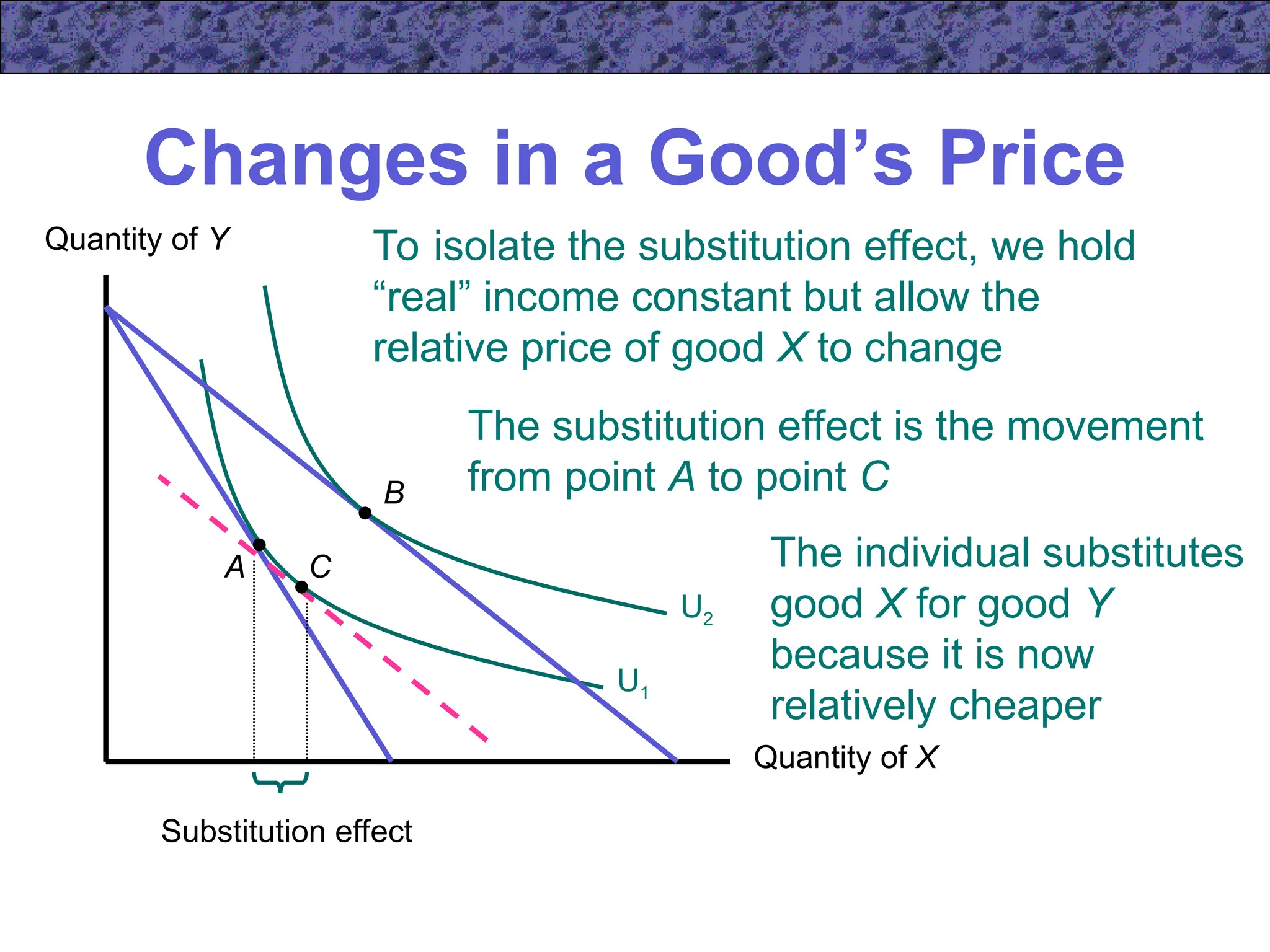
To isolate the substitution effect, we hold
“real” income constant but allow the
relative price of good X to change
C
Substitution effect
The substitution effect is the movement
from point A to point C
The individual substitutes
good X for good Y
because it is now
relatively cheaper
Changes in a Good’s Price
U1
U2
Quantity of X
Quantity of Y
A
B
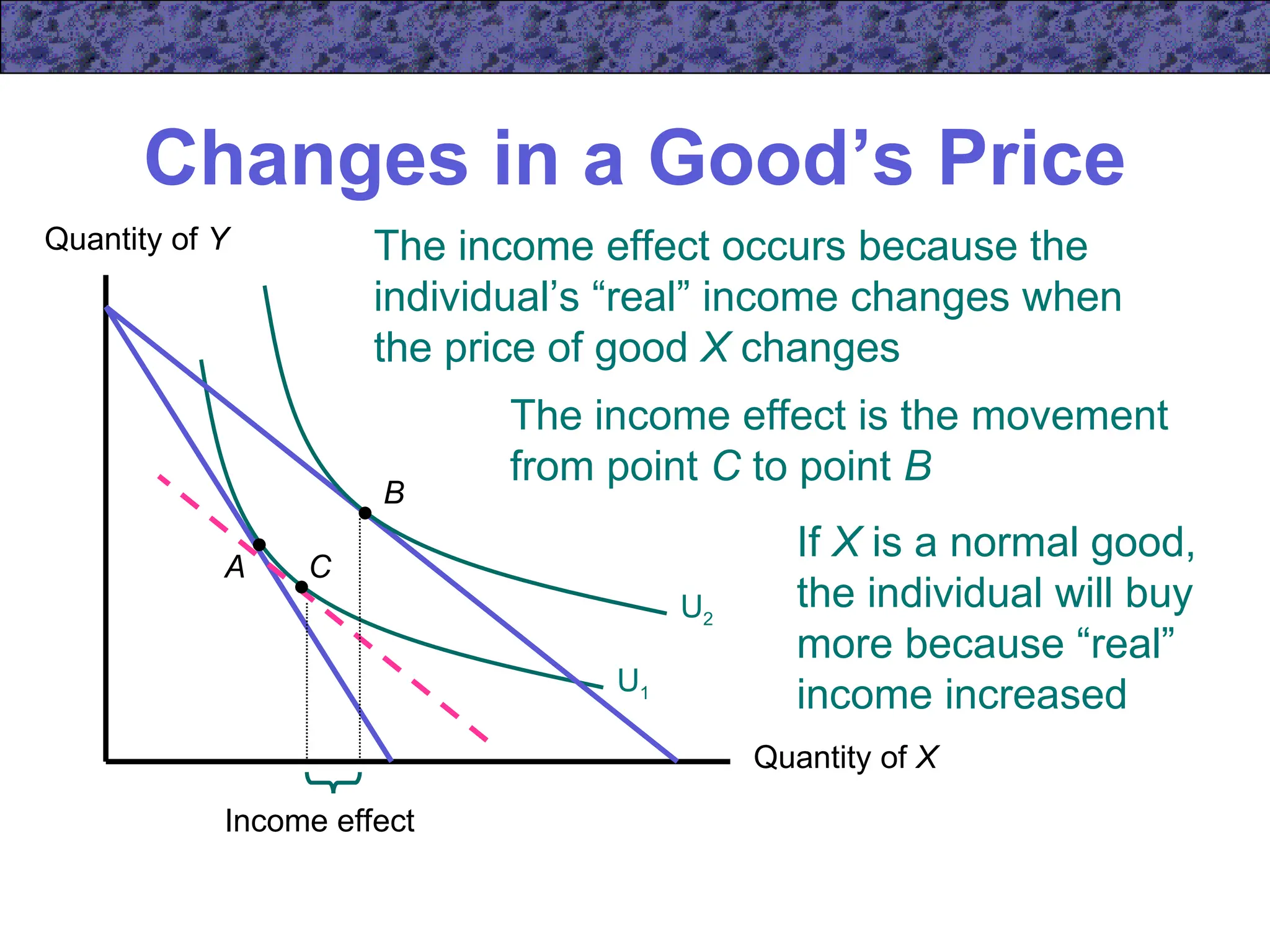
The income effect occurs because the
individual’s “real” income changes when
the price of good X changes
C
Income effect
The income effect is the movement
from point C to point B
If X is a normal good,
the individual will buy
more because “real”
income increased
Changes in a Good’s Price
U2
U1
Quantity of X
Quantity of Y
B
A
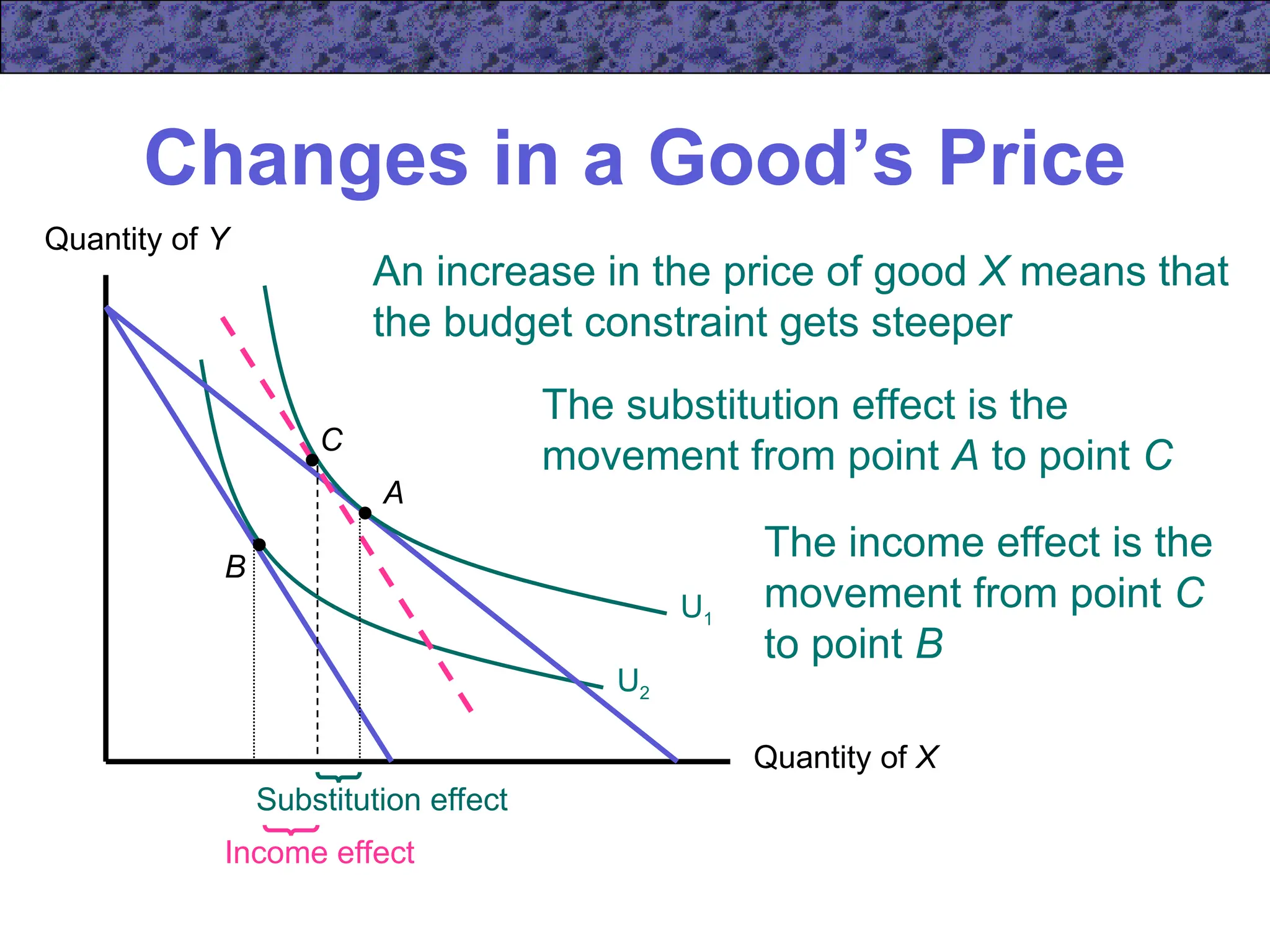
An increase in the price of good X means that
the budget constraint gets steeper
C
The substitution effect is the
movement from point A to point C
Substitution effect
Income effect
The income effect is the
movement from point C
to point B
Price Changes for
Normal Goods
• If a good is normal, substitution and
income effects reinforce one another
– When price falls, both effects lead to a rise
in QD
– When price rises, both effects lead to a drop
in QD
Price Changes for
Inferior Goods
• If a good is inferior, substitution and income
effects move in opposite directions
• The combined effect is indeterminate
– When price rises, the substitution effect leads to
a drop in QD
, but the income effect leads to a
rise in QD
– When price falls, the substitution effect leads to
a rise in QD
, but the income effect leads to a fall
in QD
Giffen’s Paradox
• If the income effect of a price change is
strong enough, there could be a positive
relationship between price and QD
– An increase in price leads to a drop in real
income
– Since the good is inferior, a drop in income
causes QD
to rise
• Thus, a rise in price leads to a rise in QD
Summary of Income &
Substitution Effects
• Utility maximization implies that (for normal
goods) a fall in price leads to an increase in QD
– The substitution effect causes more to be
purchased as the individual moves along an
indifference curve
– The income effect causes more to be purchased
because the resulting rise in purchasing power
allows the individual to move to a higher
indifference curve
Summary of Income &
Substitution Effects
• Utility maximization implies that (for normal
goods) a rise in price leads to a decline in QD
– The substitution effect causes less to be
purchased as the individual moves along an
indifference curve
– The income effect causes less to be purchased
because the resulting drop in purchasing power
moves the individual to a lower indifference curve
Summary of Income &
Substitution Effects
• Utility maximization implies that (for inferior
goods) no definite prediction can be made
for changes in price
– The substitution effect and income effect move
in opposite directions
– If the income effect outweighs the substitution
effect, we have a case of Giffen’s paradox
The Individual’s Demand Curve
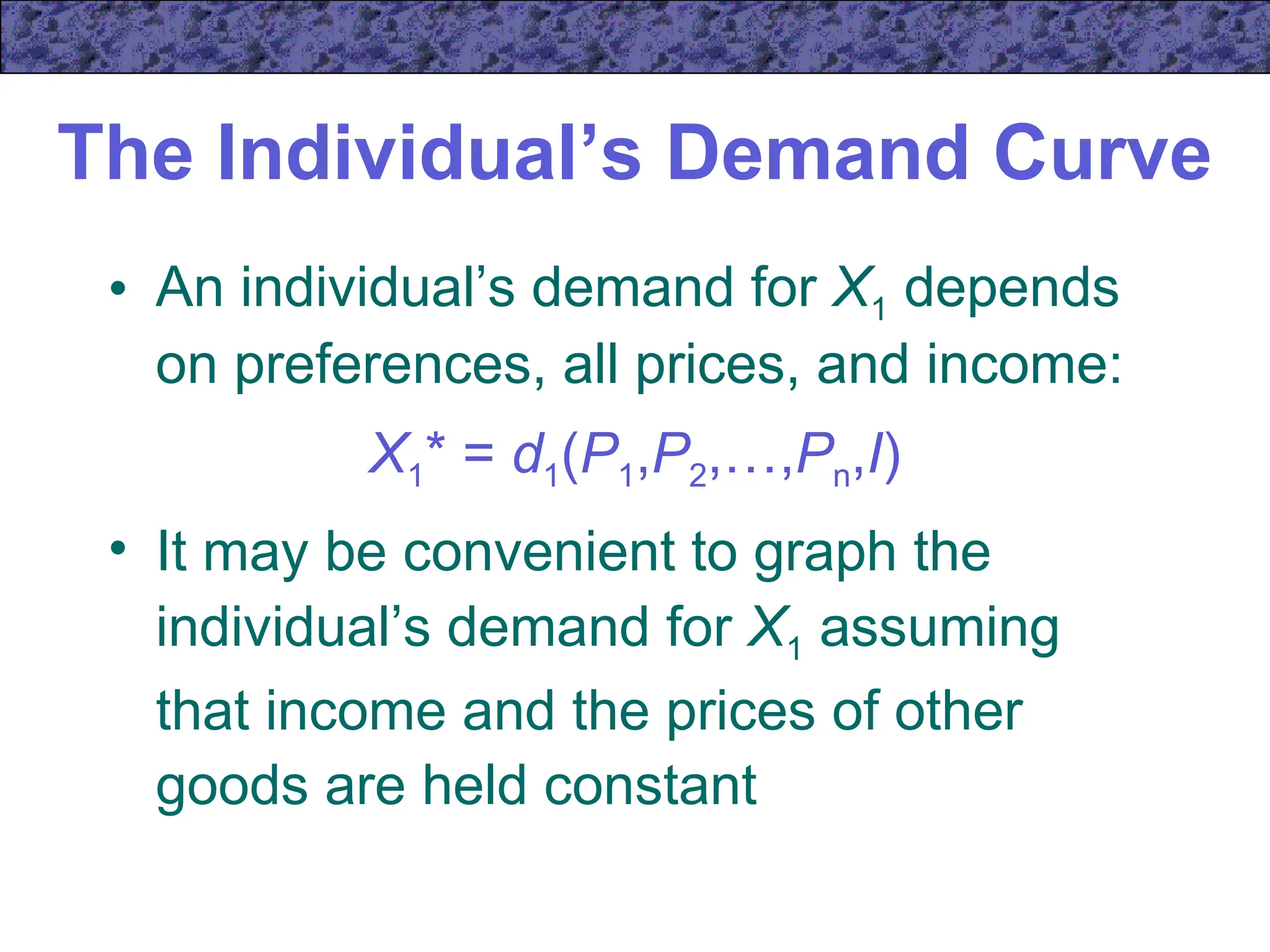
• An individual’s demand for X1 depends
on preferences, all prices, and income:
X1* = d1(P1,P2,…,Pn,I)
• It may be convenient to graph the
individual’s demand for X1 assuming
that income and the prices of other
goods are held constant
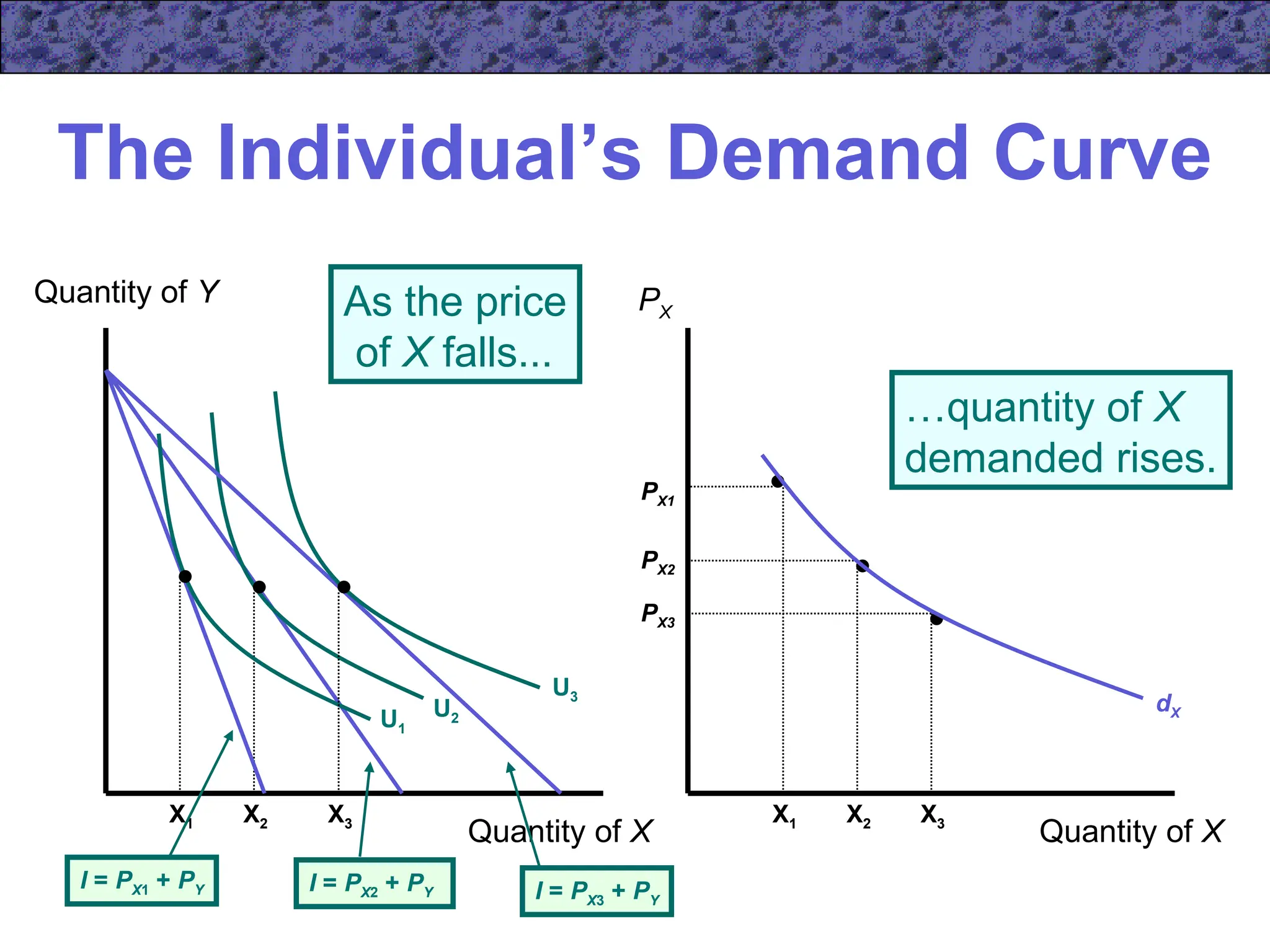
The Individual’s Demand Curve
Quantity of Y
Quantity of X Quantity of X
PX
X2
PX2
U2
X2
I = PX2 + PY
X1
PX1
U1
X1
I = PX1 + PY
X3
PX3
X3
U3
I = PX3 + PY
As the price
of X falls...
dX
…quantity of X
demanded rises.
The Individual’s Demand Curve
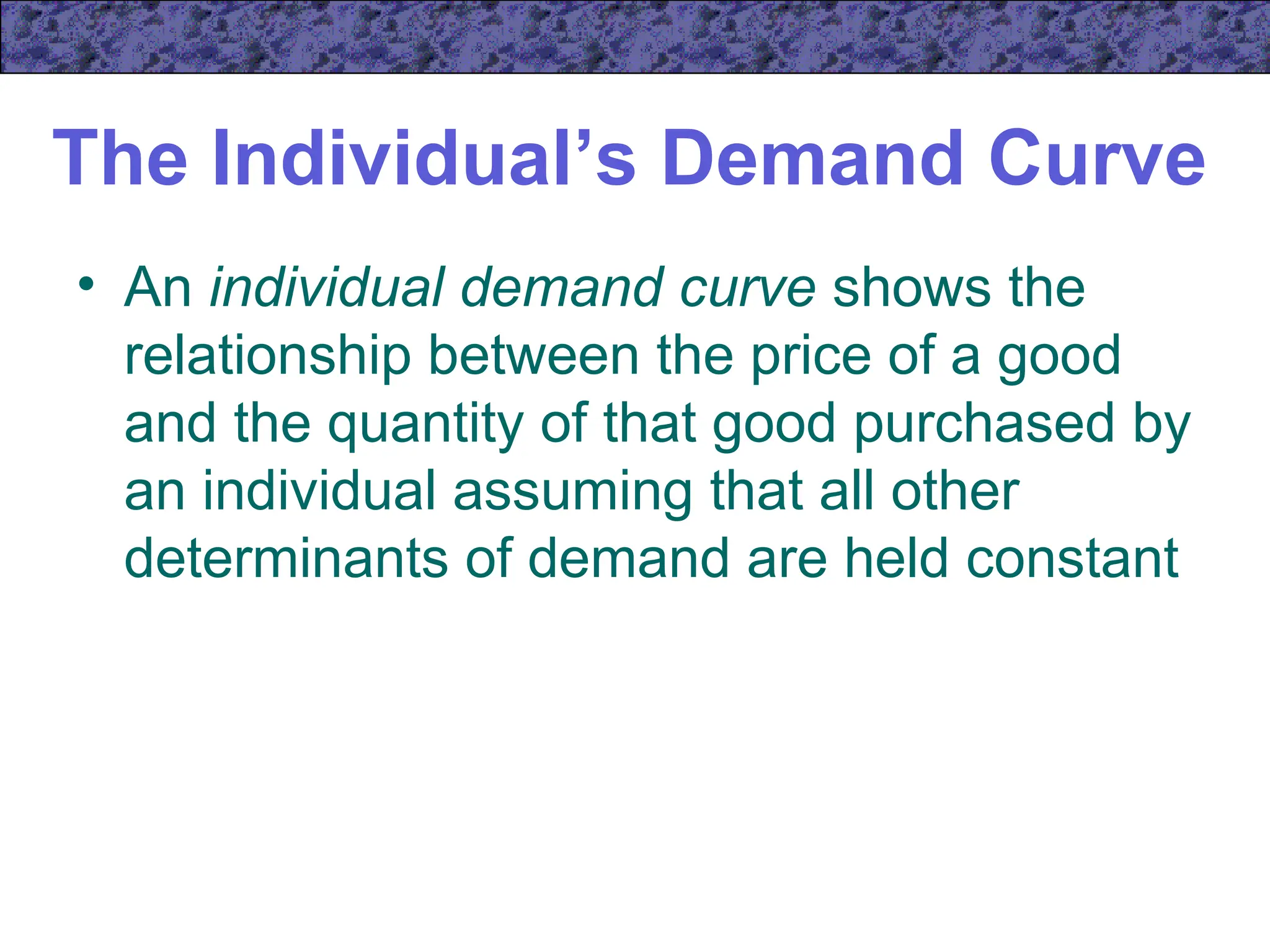
• An individual demand curve shows the
relationship between the price of a good
and the quantity of that good purchased by
an individual assuming that all other
determinants of demand are held constant
Shifts in the Demand Curve
• Three factors are held constant when a
demand curve is derived
– income
– prices of other goods
– the individual’s preferences
• If any of these factors change, the
demand curve will shift to a new position
Shifts in the Demand Curve
• A movement along a given demand
curve is caused by a change in the price
of the good
– called a change in quantity demanded
• A shift in the demand curve is caused by
a change in income, prices of other
goods, or preferences
– called a change in demand
Compensated Demand Curves
• The actual level of utility varies along
the demand curve
• As the price of X falls, the individual
moves to higher indifference curves
– It is assumed that nominal income is held
constant as the demand curve is derived
– This means that “real” income rises as the
price of X falls
Compensated Demand Curves
• An alternative approach holds real income
(or utility) constant while examining
reactions to changes in PX
– The effects of the price change are
“compensated” so as to constrain the
individual to remain on the same indifference
curve
– Reactions to price changes include only
substitution effects
Compensated Demand Curves
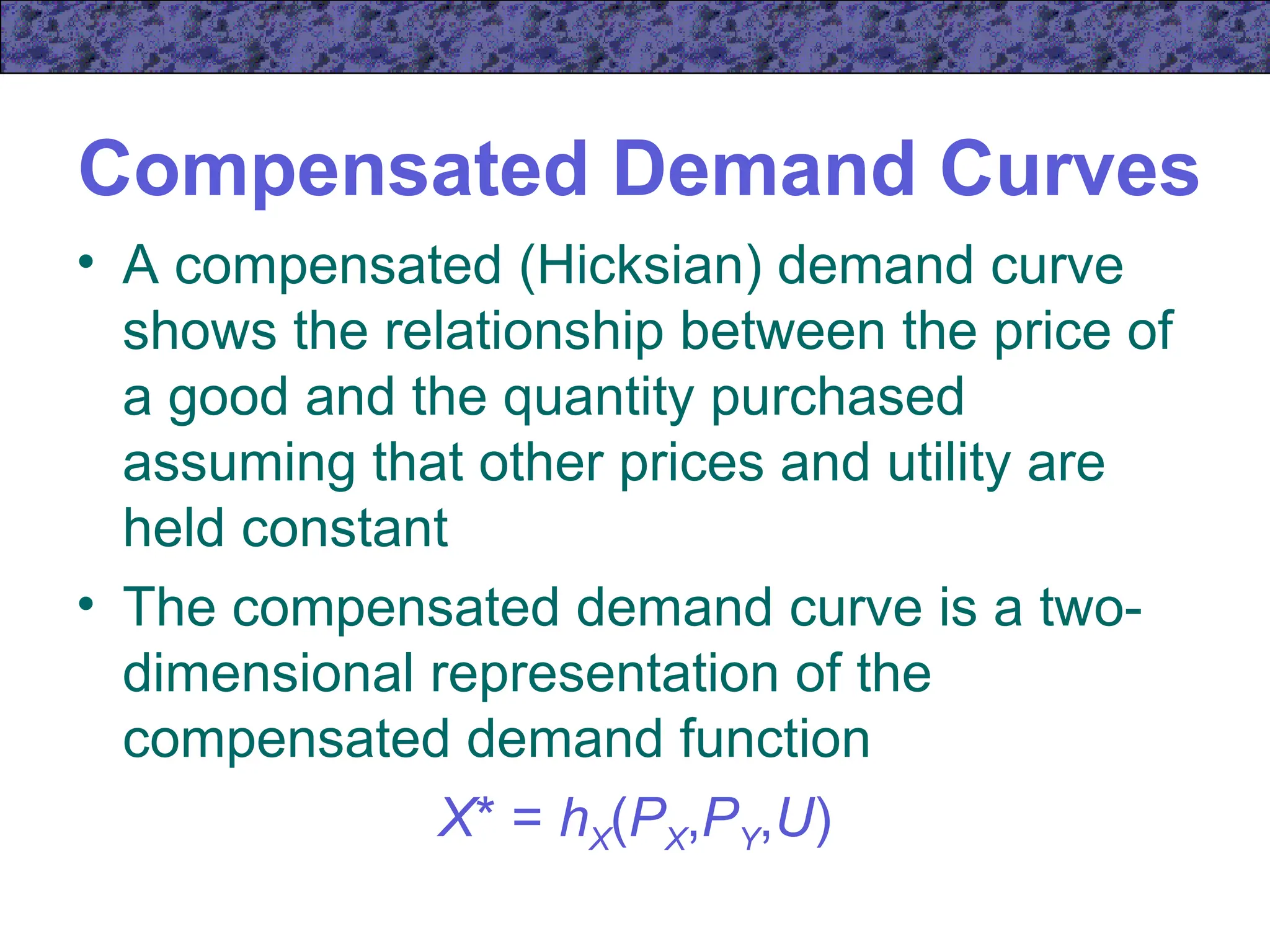
• A compensated (Hicksian) demand curve
shows the relationship between the price of
a good and the quantity purchased
assuming that other prices and utility are
held constant
• The compensated demand curve is a two-
dimensional representation of the
compensated demand function
X* = hX(PX,PY,U)
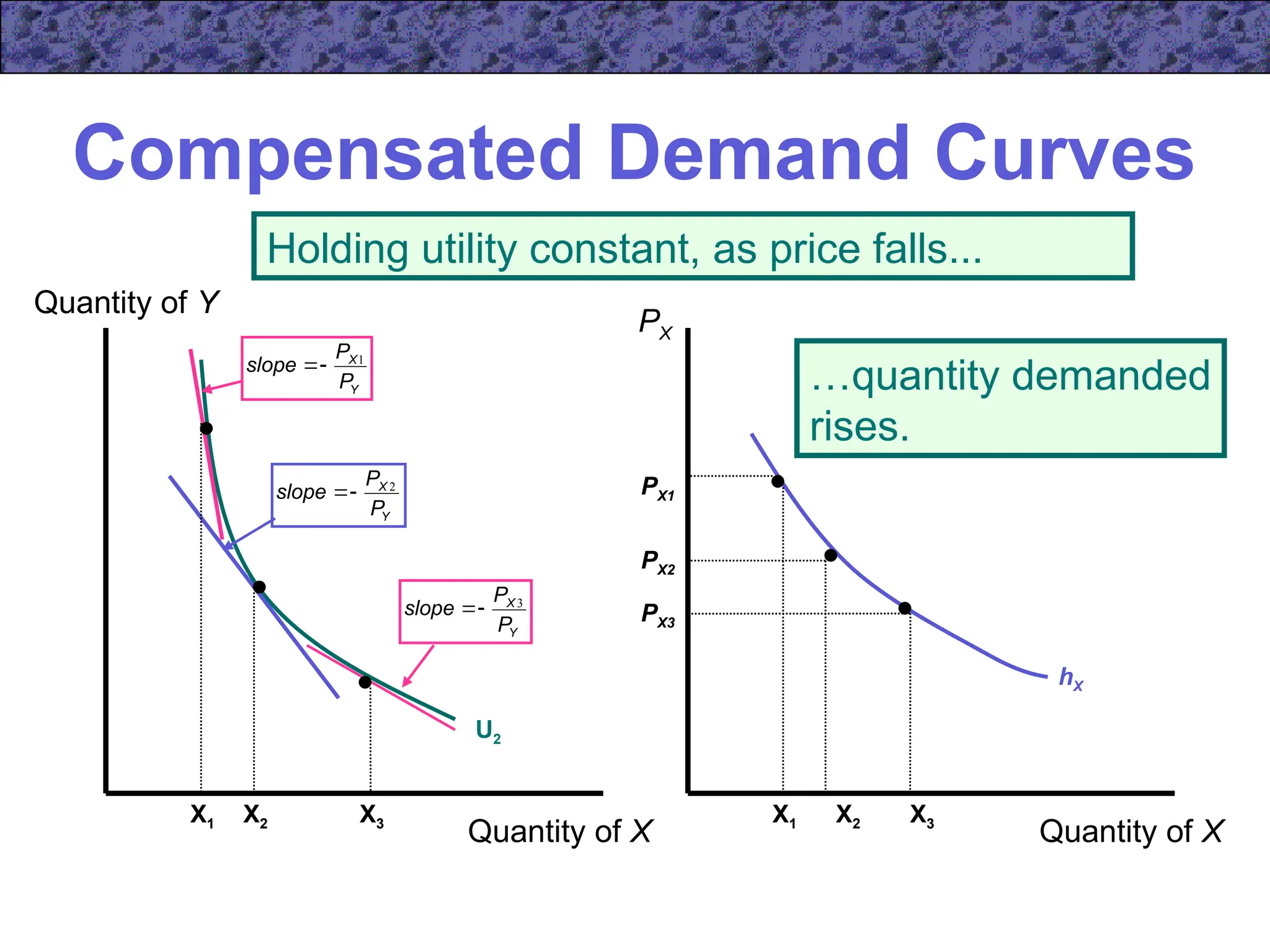
hX
…quantity demanded
rises.
Compensated Demand Curves
Quantity of Y
Quantity of X Quantity of X
PX
U2
X2
PX2
X2
Y
X
P
P
slope 2


X1
PX1
Y
X
P
P
slope 1


X1 X3
PX3
Y
X
P
P
slope 3


X3
Holding utility constant, as price falls...
Compensated &
Uncompensated Demand
Quantity of X
PX
dX
hX
X2
PX2
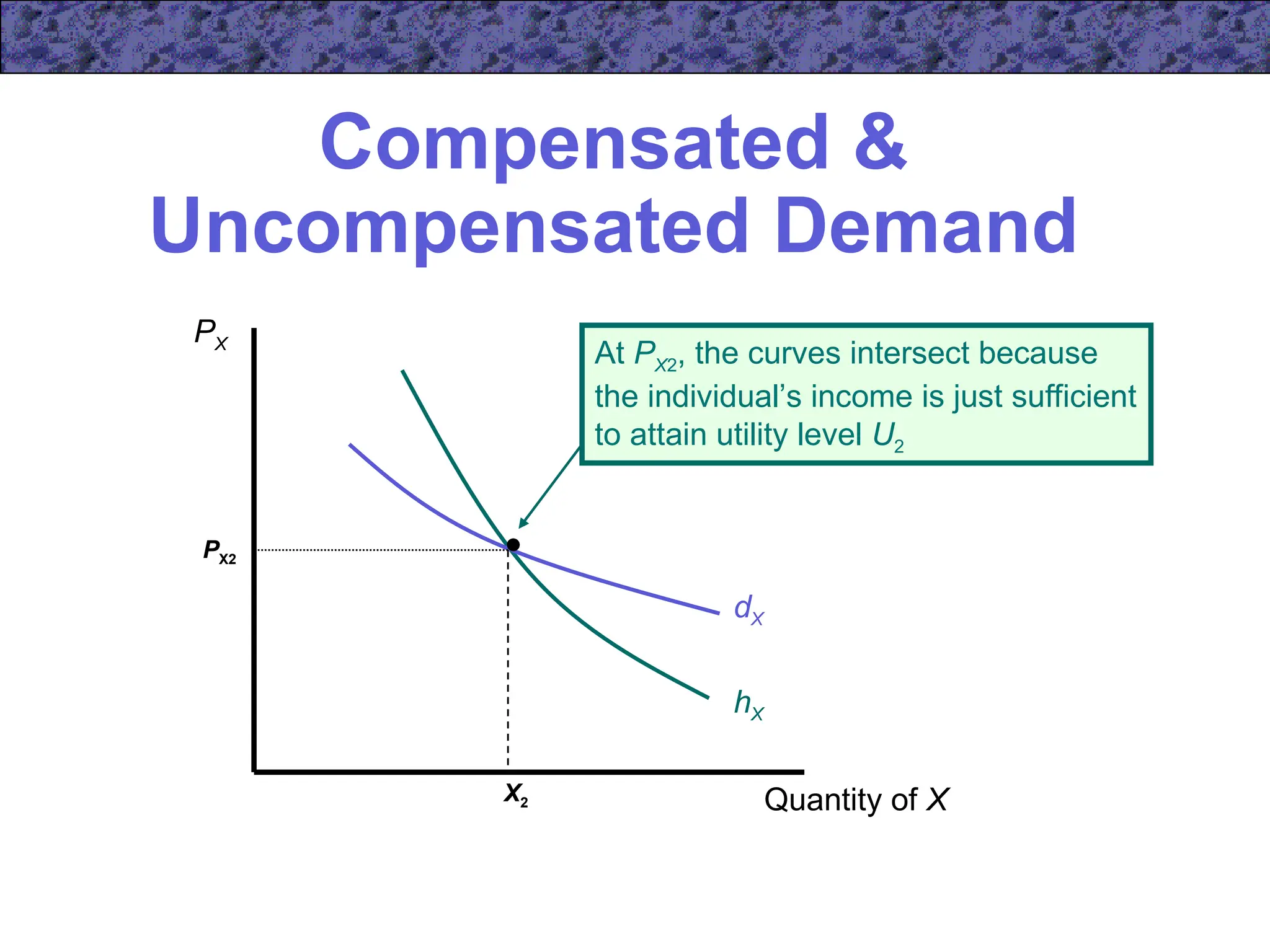
At PX2, the curves intersect because
the individual’s income is just sufficient
to attain utility level U2
Compensated &
Uncompensated Demand
Quantity of X
PX
dX
hX
PX2
X1*
X1
PX1
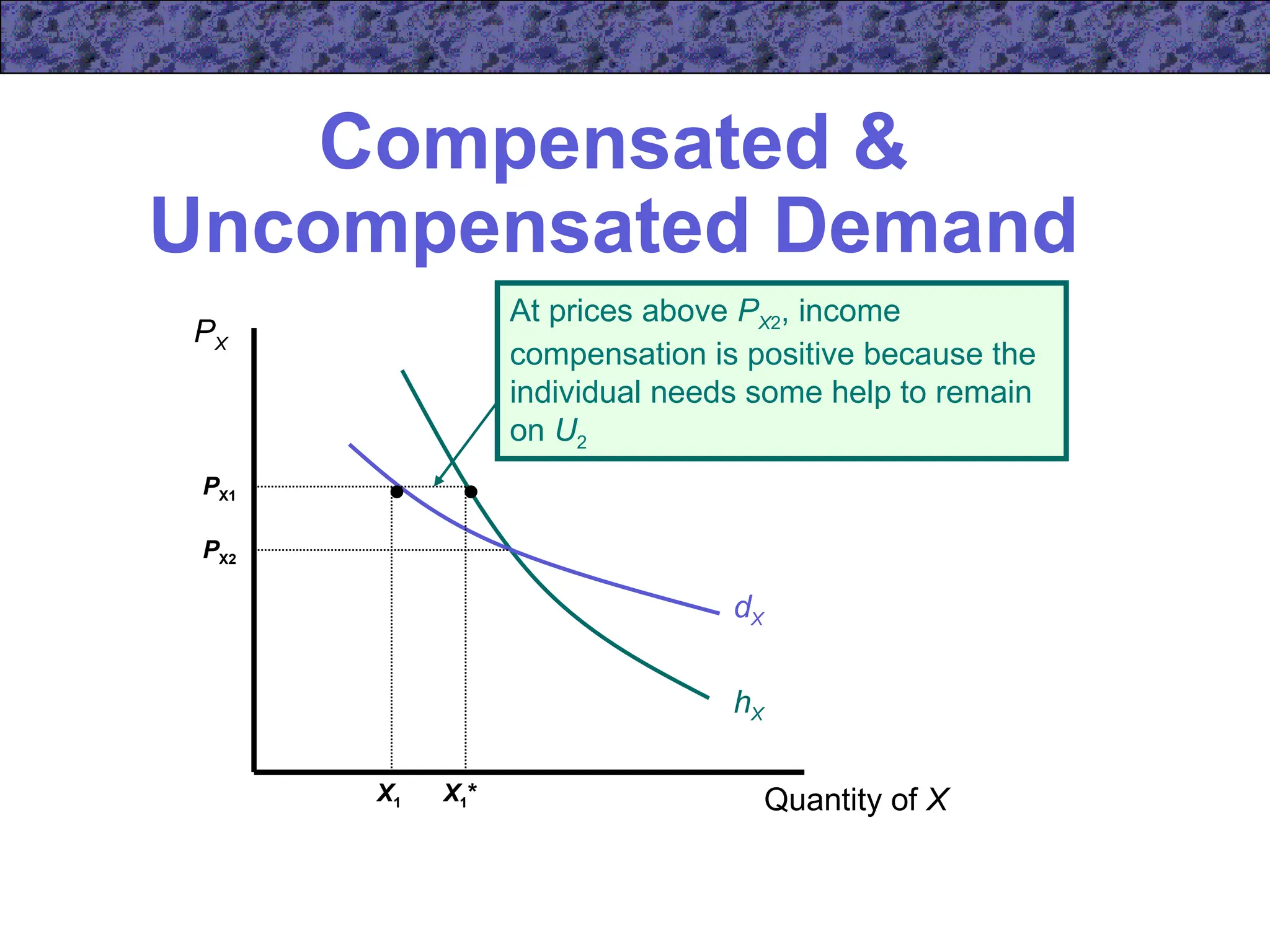
At prices above PX2, income
compensation is positive because the
individual needs some help to remain
on U2
Compensated &
Uncompensated Demand
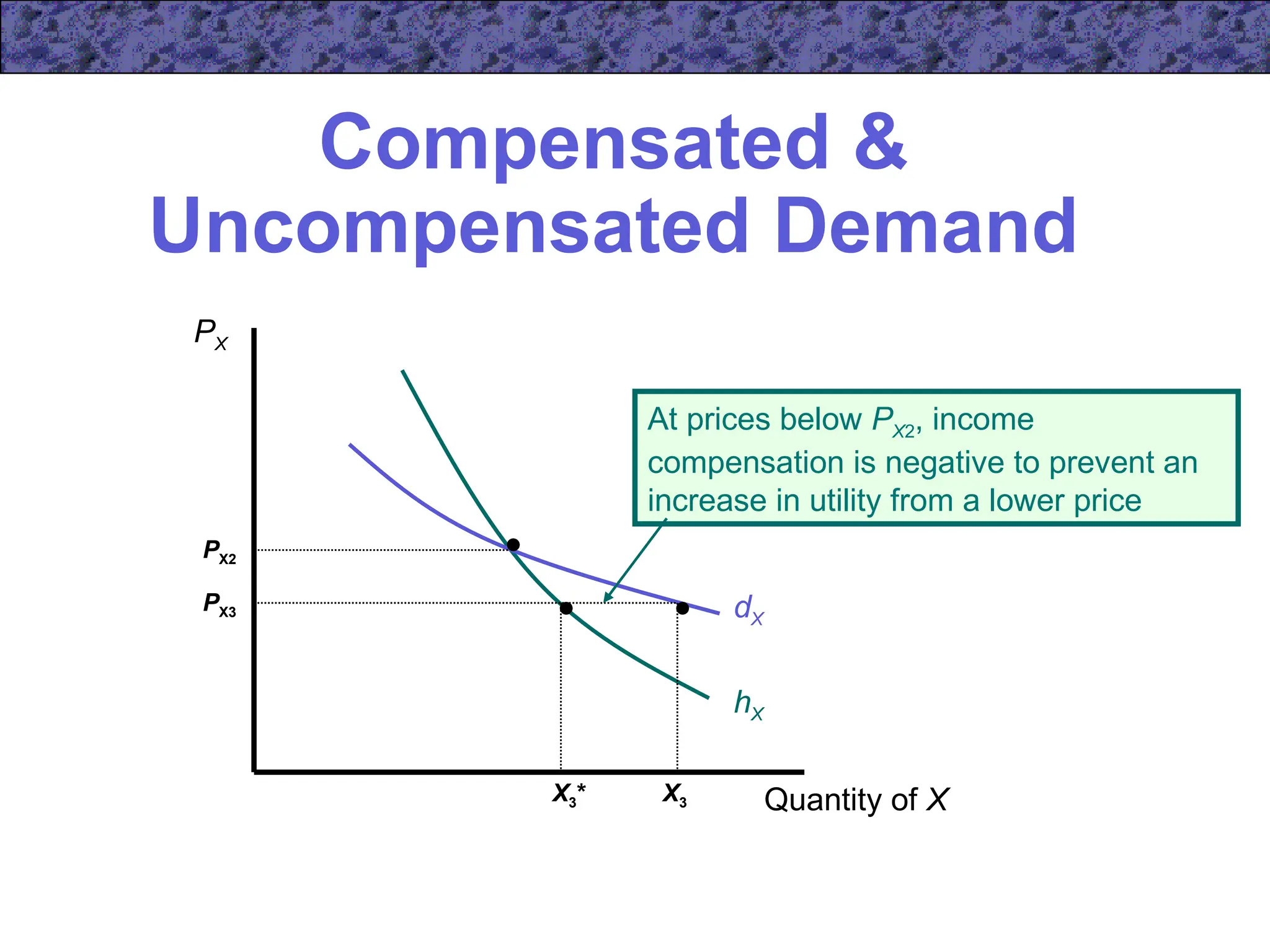
Quantity of X
PX
dX
hX
PX2
X3* X3
PX3
At prices below PX2, income
compensation is negative to prevent an
increase in utility from a lower price
Compensated &
Uncompensated Demand
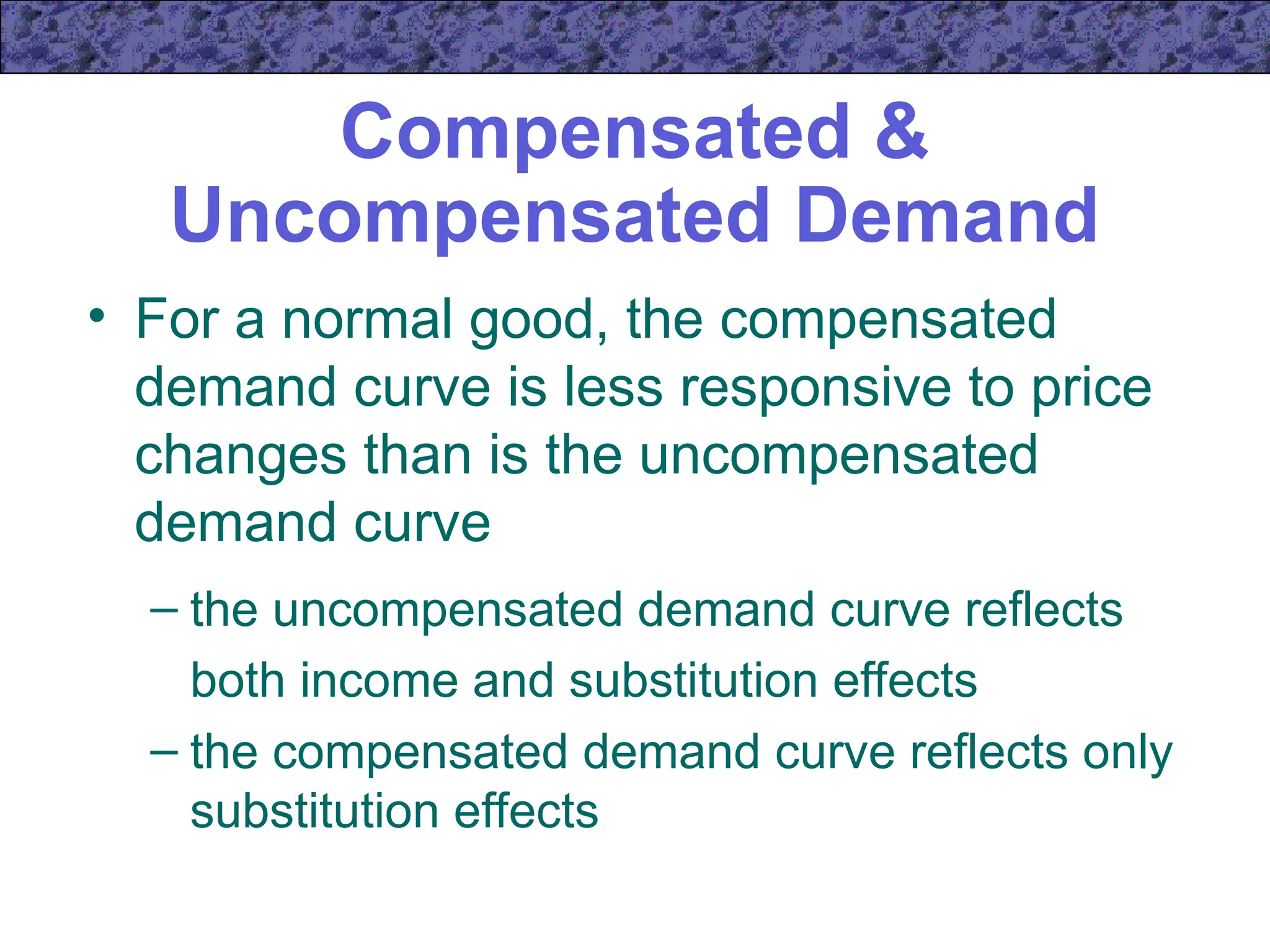
• For a normal good, the compensated
demand curve is less responsive to price
changes than is the uncompensated
demand curve
– the uncompensated demand curve reflects
both income and substitution effects
– the compensated demand curve reflects only
substitution effects
Compensated Demand
Functions
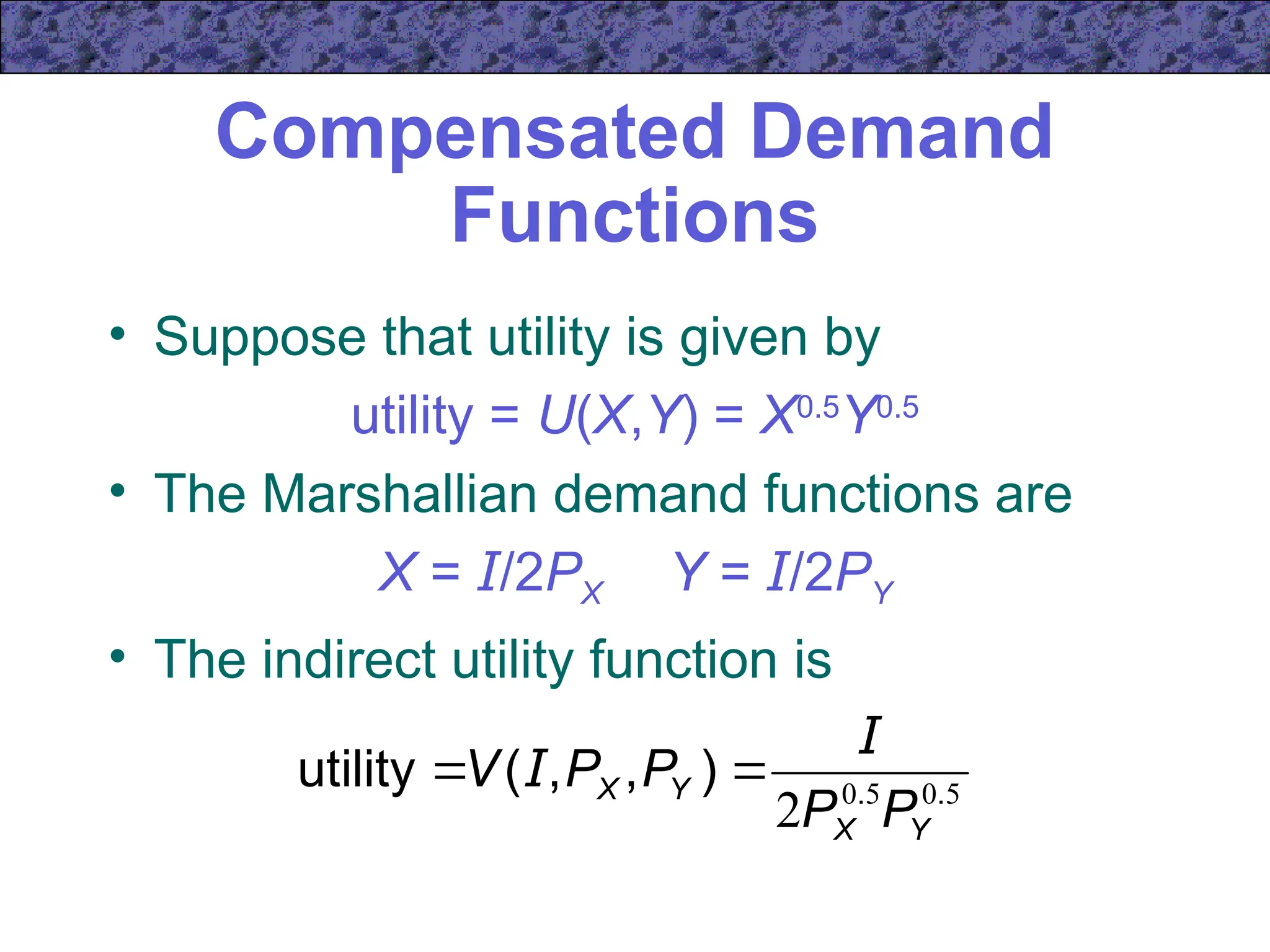
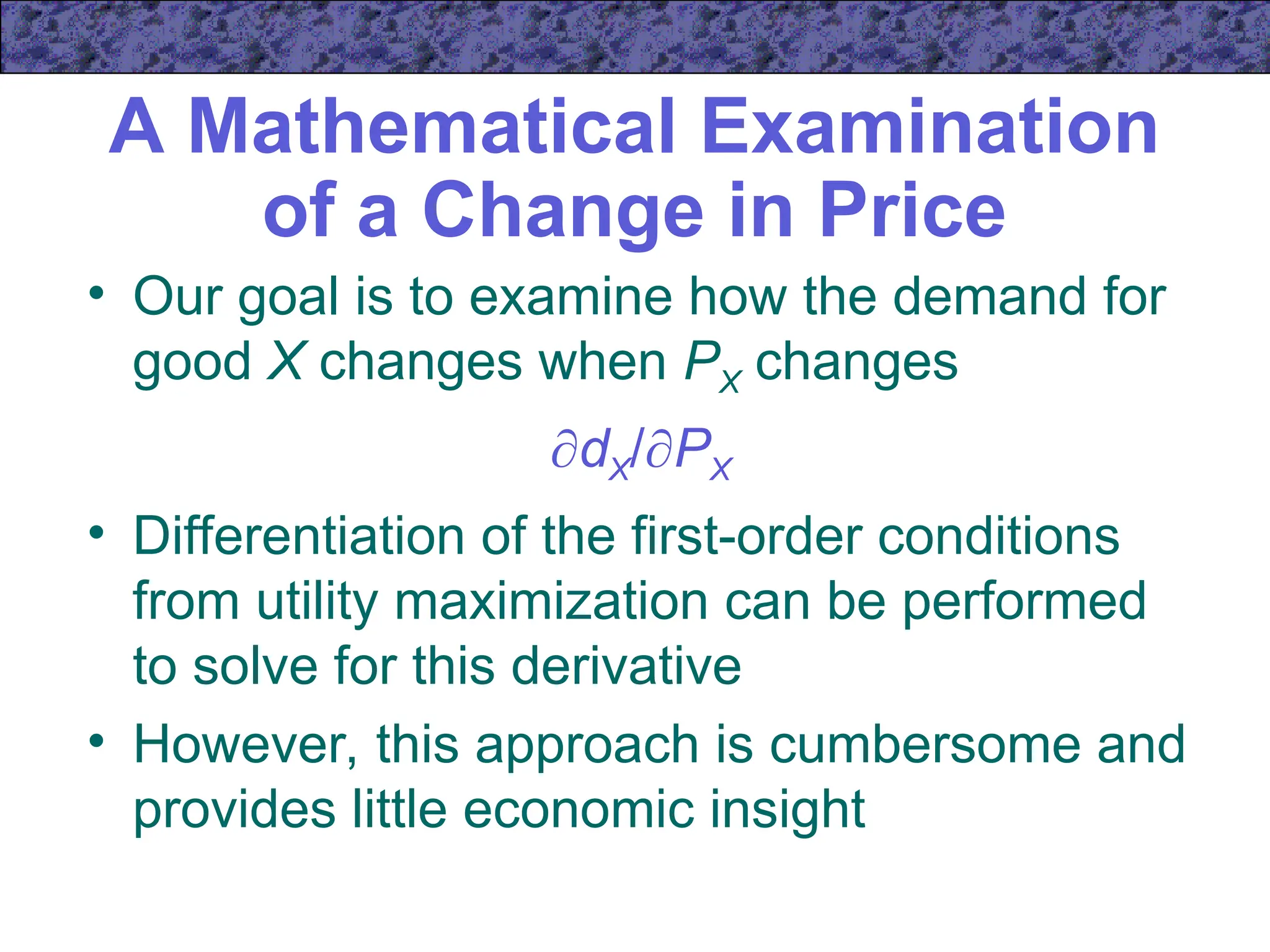
• Suppose that utility is given by
utility = U(X,Y) = X0.5
Y0.5
• The Marshallian demand functions are
X = I/2PX Y = I/2PY
• The indirect utility function is
5
0
5
0
2 .
.
)
,
,
(
utility
Y
X
Y
X
P
P
P
P
V
I
I 

Compensated Demand
Functions
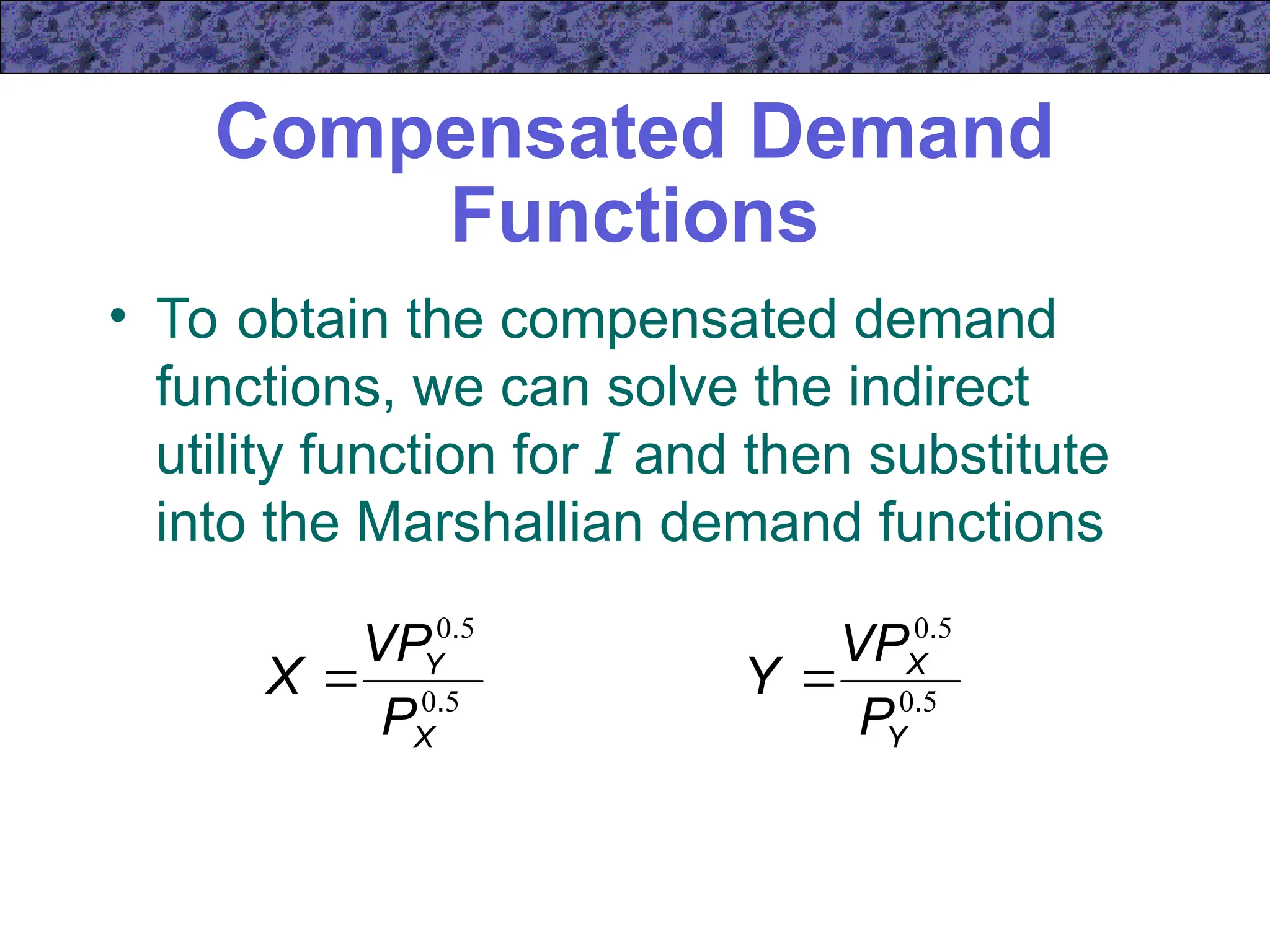
• To obtain the compensated demand
functions, we can solve the indirect
utility function for I and then substitute
into the Marshallian demand functions
5
0
5
0
.
.
X
Y
P
VP
X  5
0
5
0
.
.
Y
X
P
VP
Y 
Compensated Demand
Functions
• Demand now depends on utility rather than income
• Increases in PX reduce the amount of X demanded
– only a substitution effect
5
0
5
0
.
.
X
Y
P
VP
X 
5
0
5
0
.
.
Y
X
P
VP
Y 
A Mathematical Examination
of a Change in Price
• Our goal is to examine how the demand for
good X changes when PX changes
dX/PX
• Differentiation of the first-order conditions
from utility maximization can be performed
to solve for this derivative
• However, this approach is cumbersome and
provides little economic insight
A Mathematical Examination
of a Change in Price
• Instead, we will use an indirect approach
• Remember the expenditure function
minimum expenditure = E(PX,PY,U)
• Then, by definition
hX (PX,PY,U) = dX [PX,PY,E(PX,PY,U)]
– Note that the two demand functions are equal
when income is exactly what is needed to attain
the required utility level
A Mathematical Examination
of a Change in Price
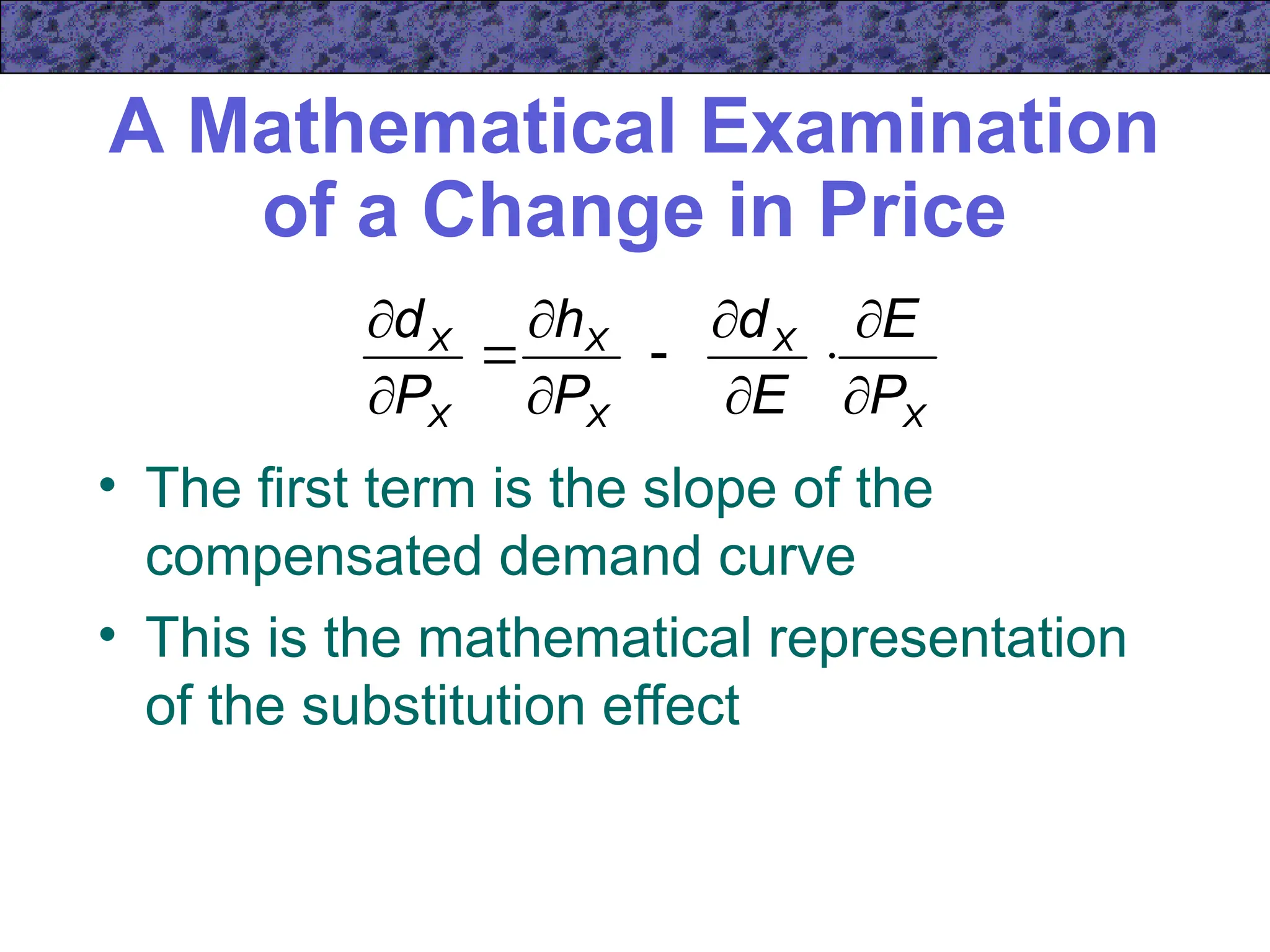
• We can differentiate the compensated
demand function and get
hX (PX,PY,U) = dX [PX,PY,E(PX,PY,U)]
X
X
X
X
X
X
P
E
E
d
P
d
P
h











X
X
X
X
X
X
P
E
E
d
P
h
P
d











A Mathematical Examination
of a Change in Price
• The first term is the slope of the
compensated demand curve
• This is the mathematical representation
of the substitution effect
X
X
X
X
X
X
P
E
E
d
P
h
P
d











A Mathematical Examination
of a Change in Price
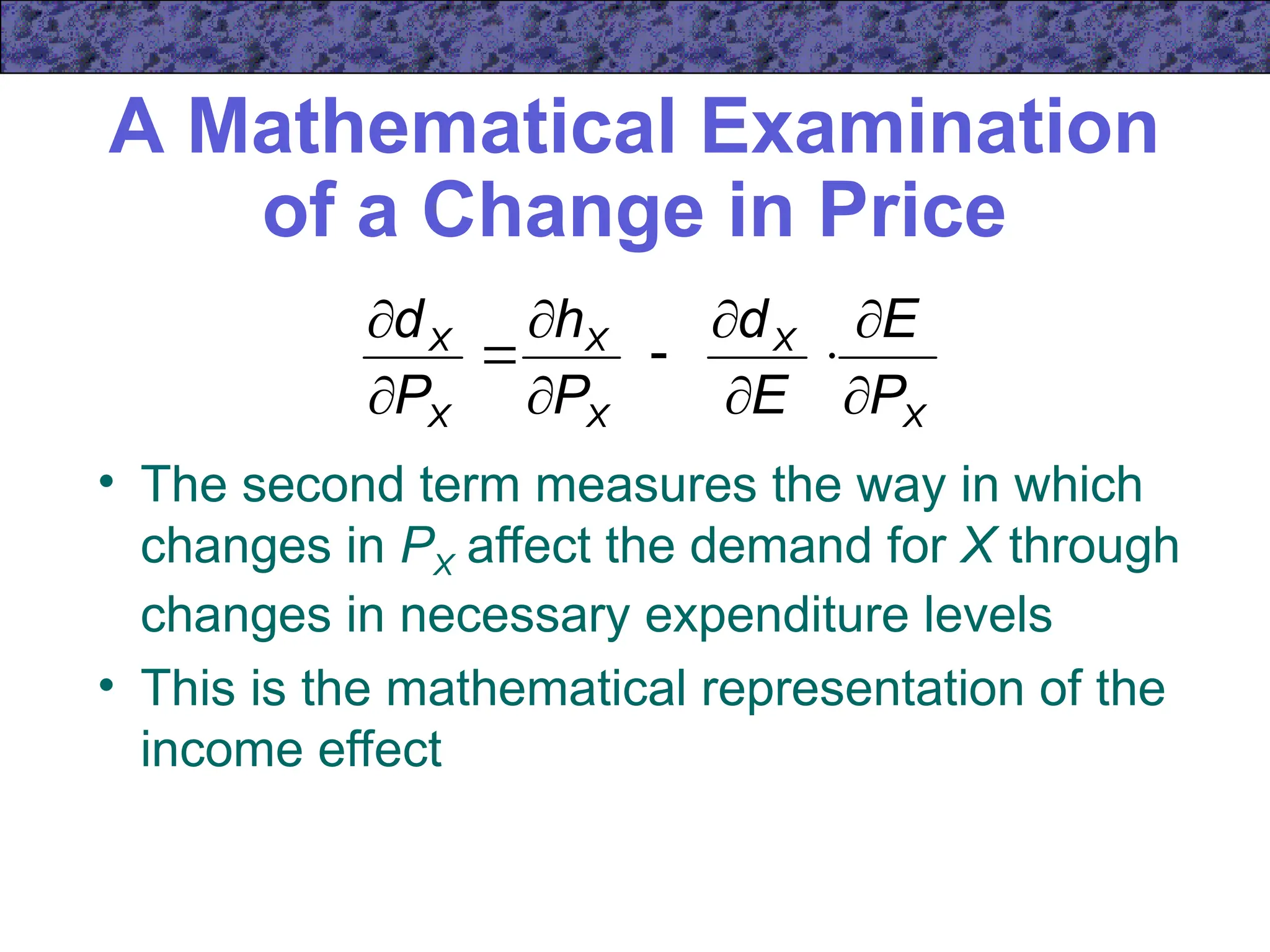
• The second term measures the way in which
changes in PX affect the demand for X through
changes in necessary expenditure levels
• This is the mathematical representation of the
income effect
X
X
X
X
X
X
P
E
E
d
P
h
P
d











The Slutsky Equation
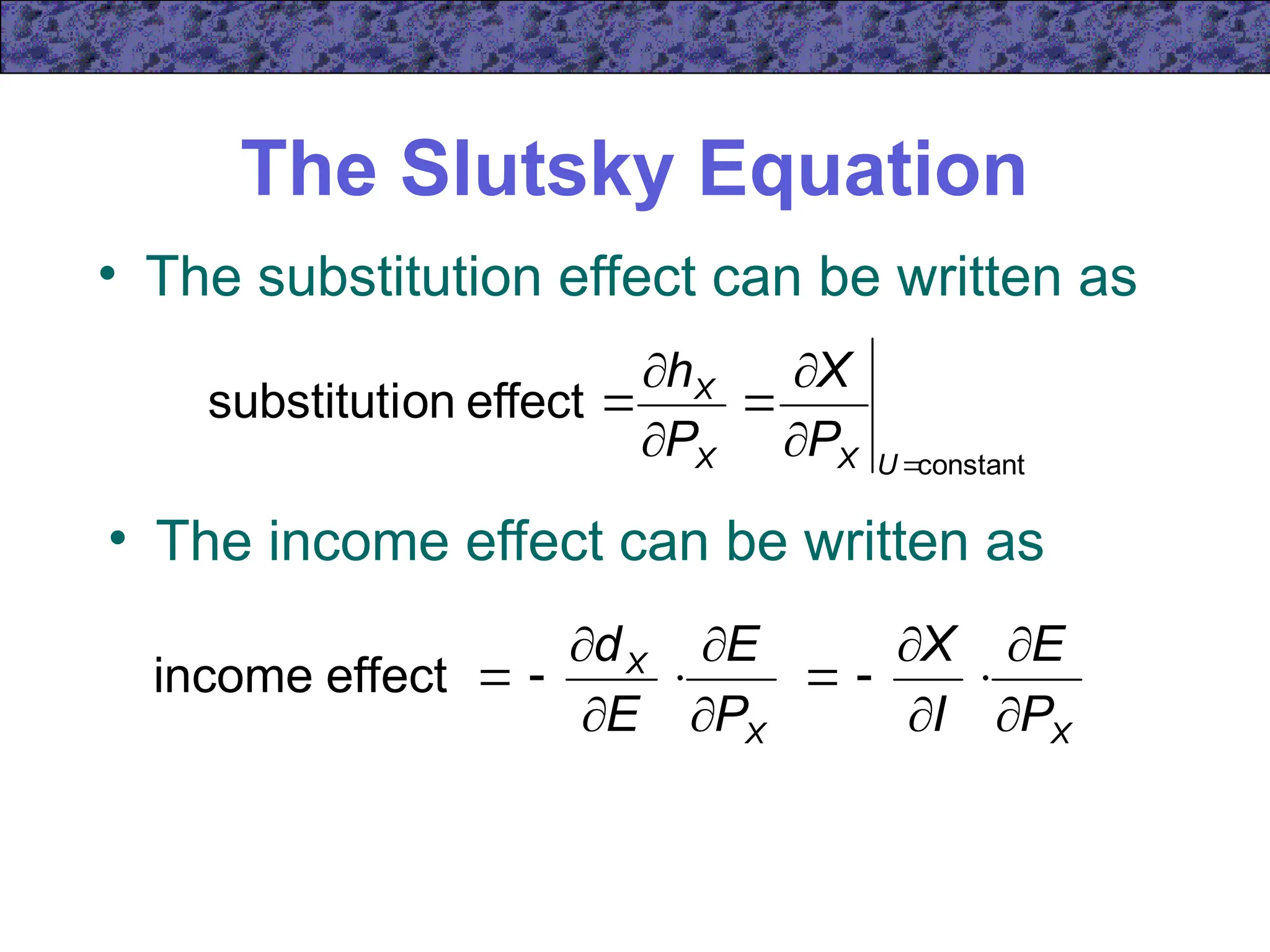
• The substitution effect can be written as
constant
effect
on
substituti







U
X
X
X
P
X
P
h
• The income effect can be written as
X
X
X
P
E
I
X
P
E
E
d














effect
income
The Slutsky Equation
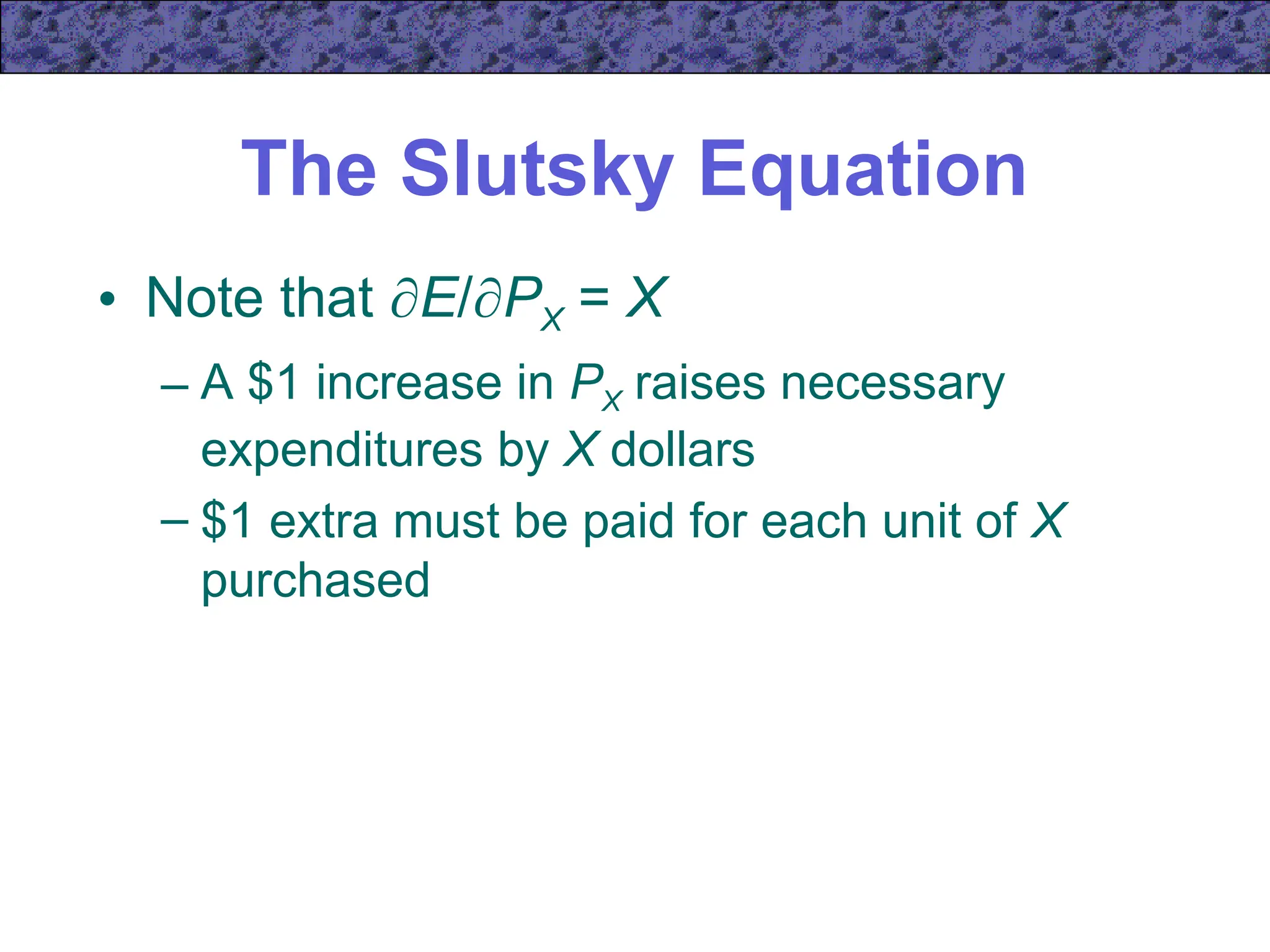
• Note that E/PX = X
– A $1 increase in PX raises necessary
expenditures by X dollars
– $1 extra must be paid for each unit of X
purchased
The Slutsky Equation
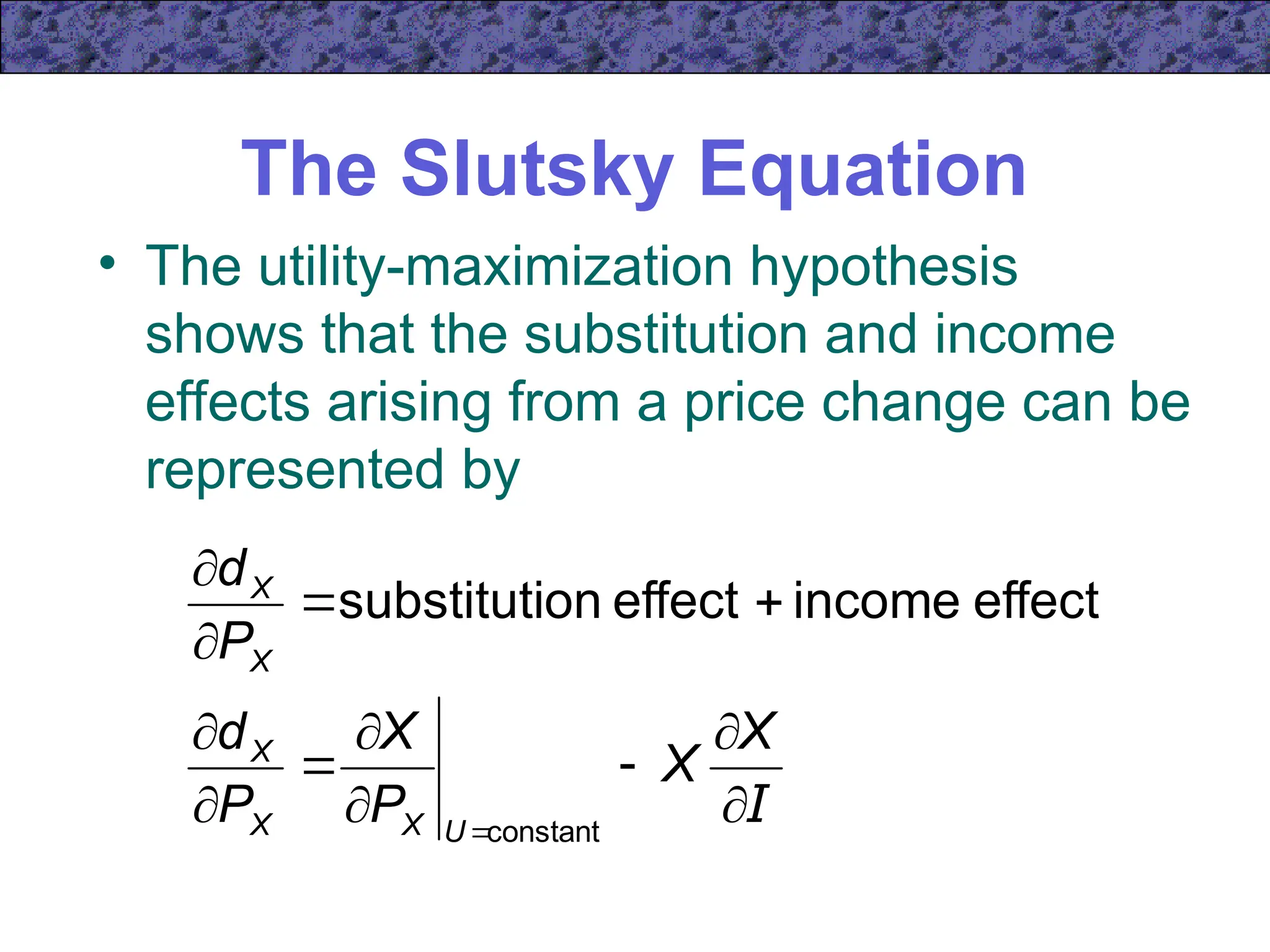
• The utility-maximization hypothesis
shows that the substitution and income
effects arising from a price change can be
represented by
I













X
X
P
X
P
d
P
d
U
X
X
X
X
X
constant
effect
income
effect
on
substituti
The Slutsky Equation
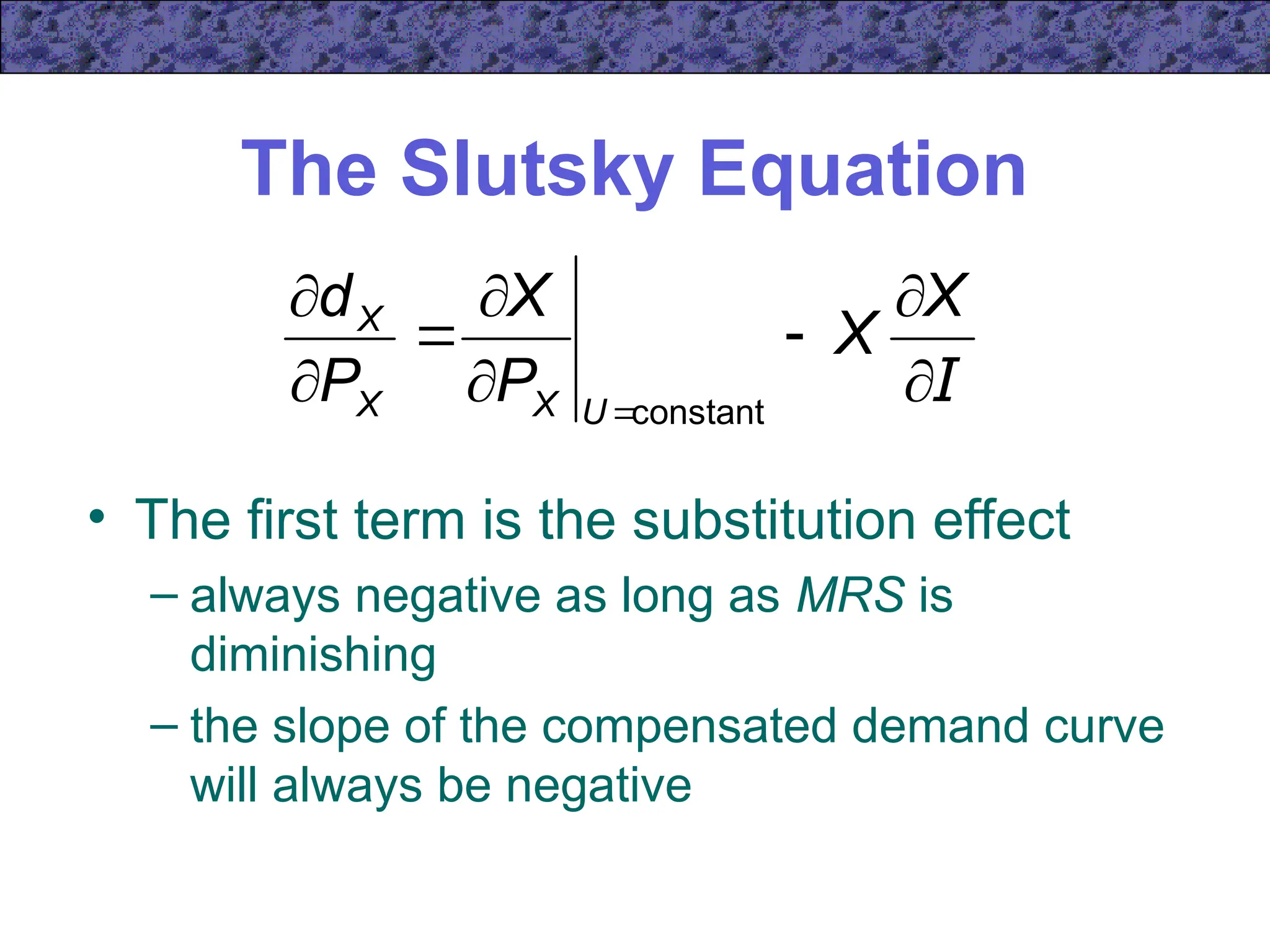
• The first term is the substitution effect
– always negative as long as MRS is
diminishing
– the slope of the compensated demand curve
will always be negative
I









X
X
P
X
P
d
U
X
X
X
constant
The Slutsky Equation
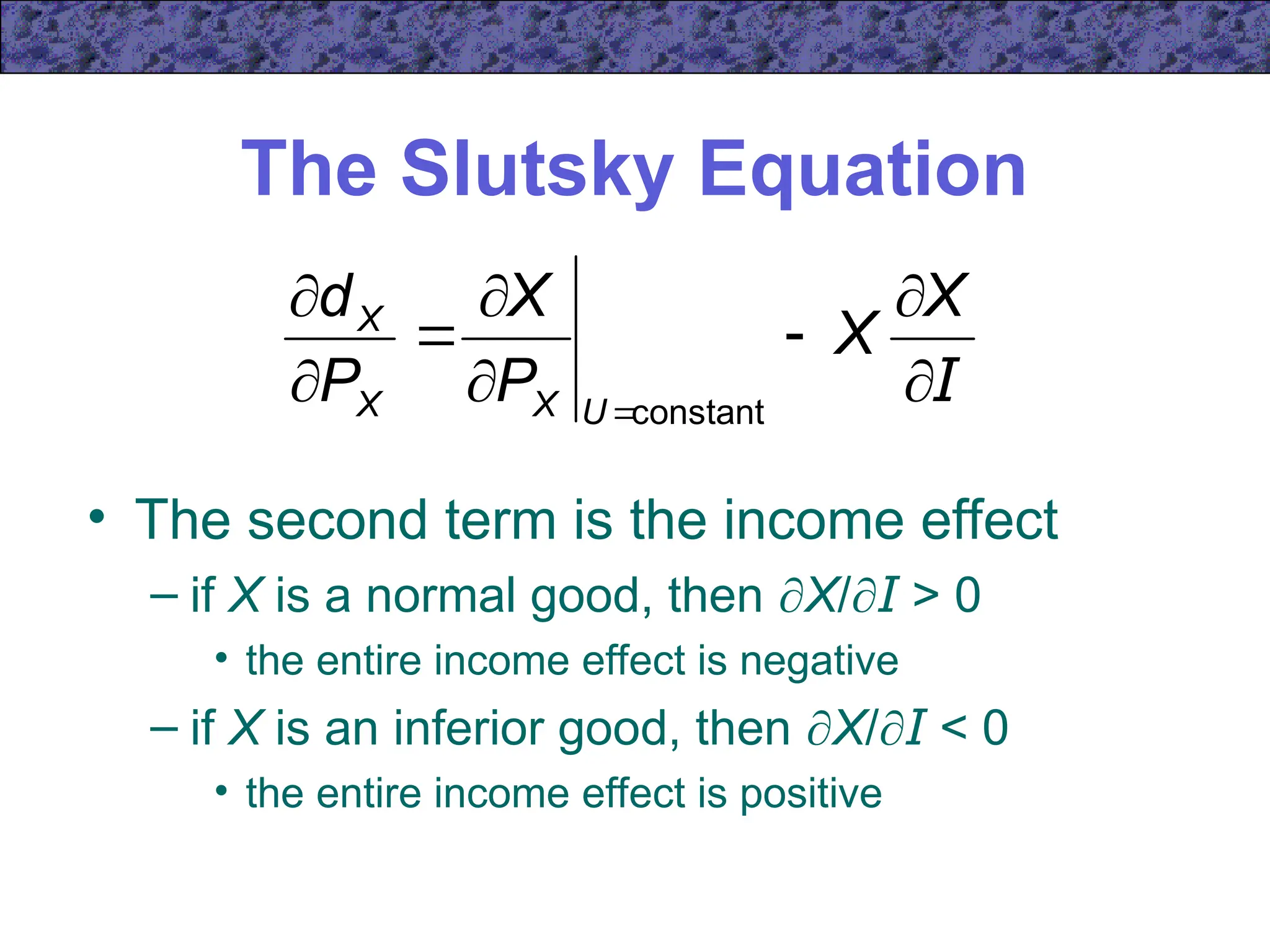
• The second term is the income effect
– if X is a normal good, then X/I > 0
• the entire income effect is negative
– if X is an inferior good, then X/I < 0
• the entire income effect is positive
I









X
X
P
X
P
d
U
X
X
X
constant
Revealed Preference & the
Substitution Effect
• The theory of revealed preference was
proposed by Paul Samuelson in the late
1940s
• The theory defines a principle of
rationality based on observed behavior
and then uses it to approximate an
individual’s utility function
Revealed Preference & the
Substitution Effect
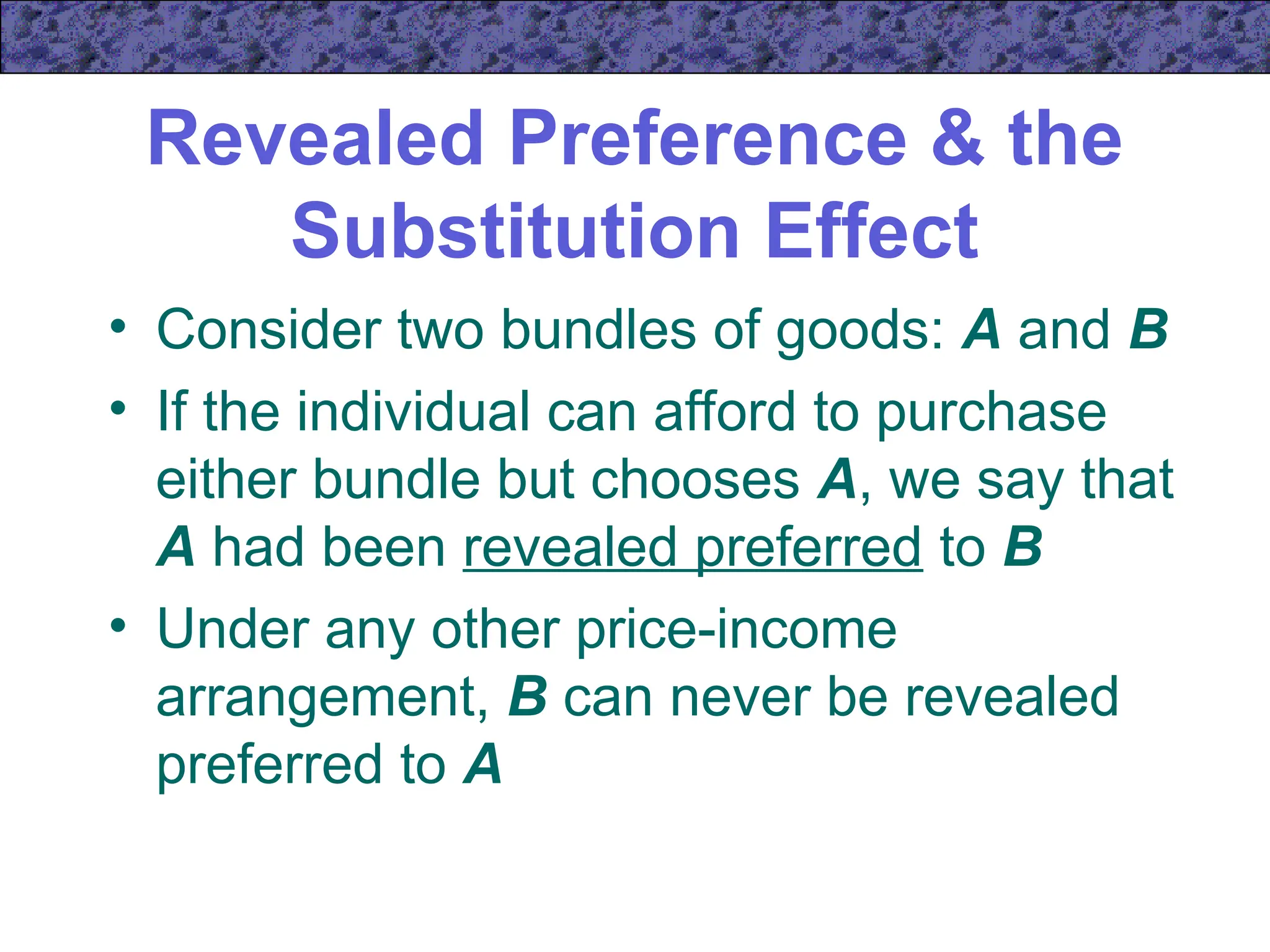
• Consider two bundles of goods: A and B
• If the individual can afford to purchase
either bundle but chooses A, we say that
A had been revealed preferred to B
• Under any other price-income
arrangement, B can never be revealed
preferred to A
Revealed Preference & the
Substitution Effect
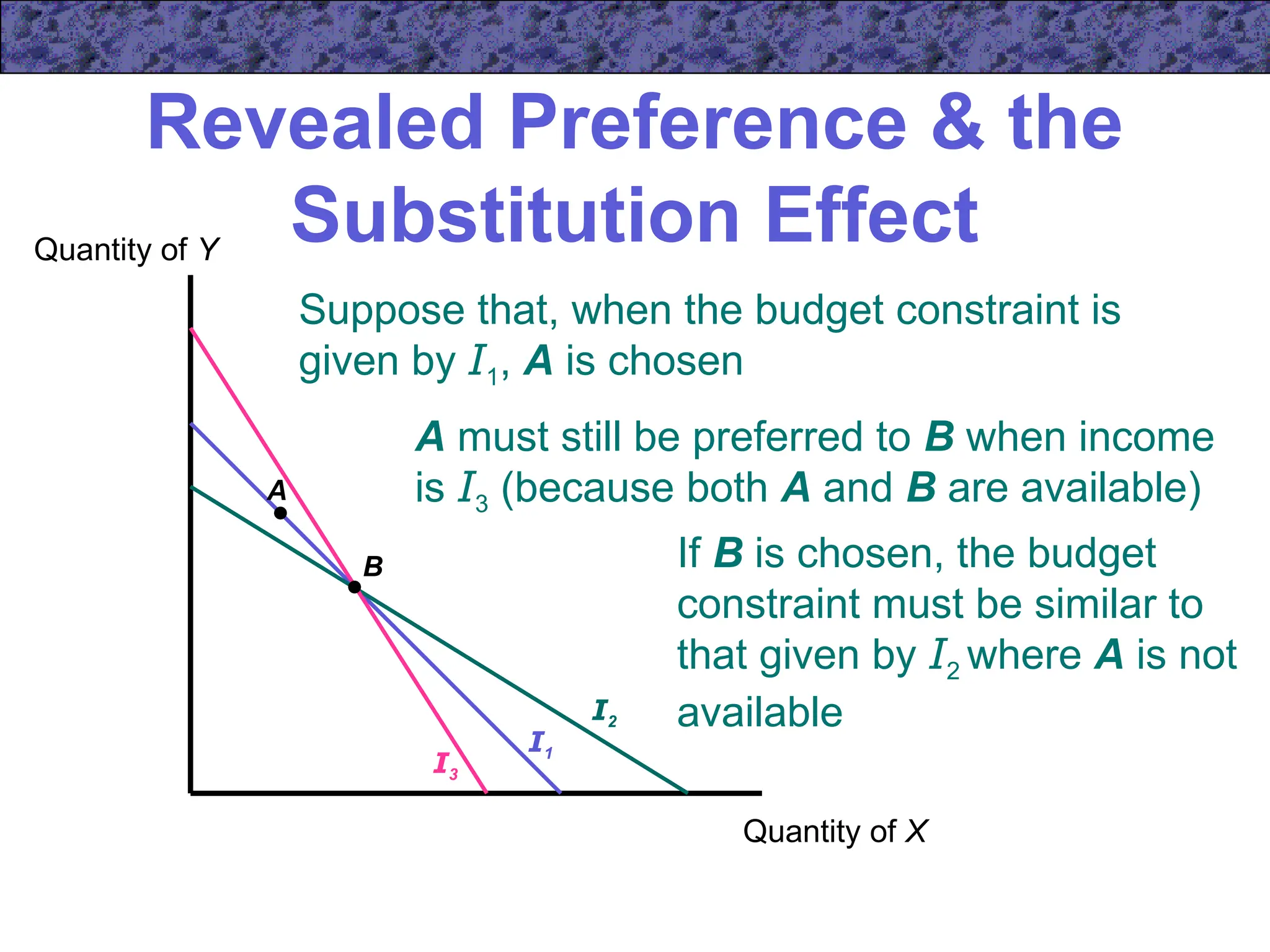
B
A
I1
I2
I3
Quantity of X
Quantity of Y
Suppose that, when the budget constraint is
given by I1, A is chosen
A must still be preferred to B when income
is I3 (because both A and B are available)
If B is chosen, the budget
constraint must be similar to
that given by I2 where A is not
available
Negativity of the
Substitution Effect
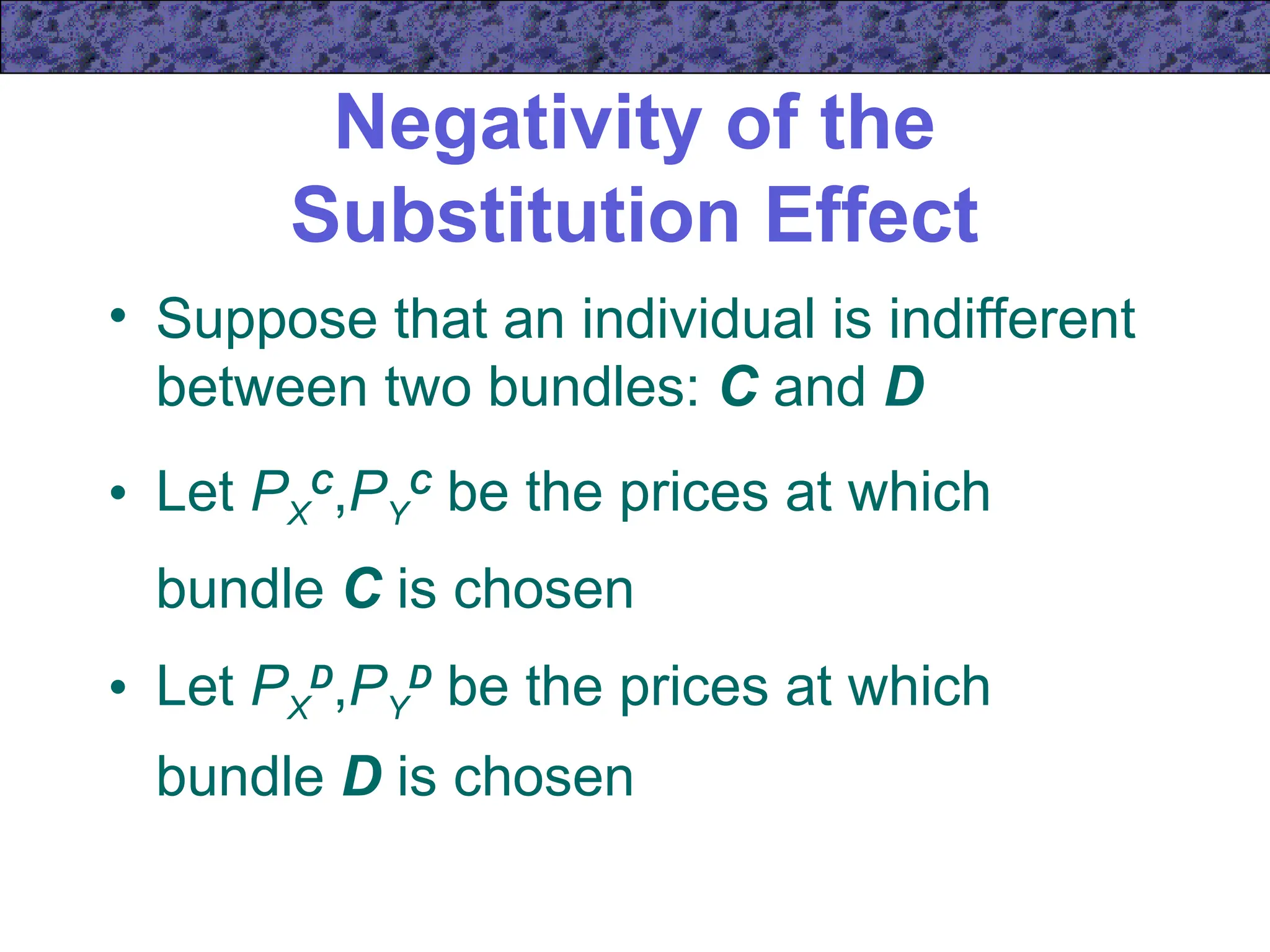
• Suppose that an individual is indifferent
between two bundles: C and D
• Let PX
C
,PY
C
be the prices at which
bundle C is chosen
• Let PX
D
,PY
D
be the prices at which
bundle D is chosen
Negativity of the
Substitution Effect
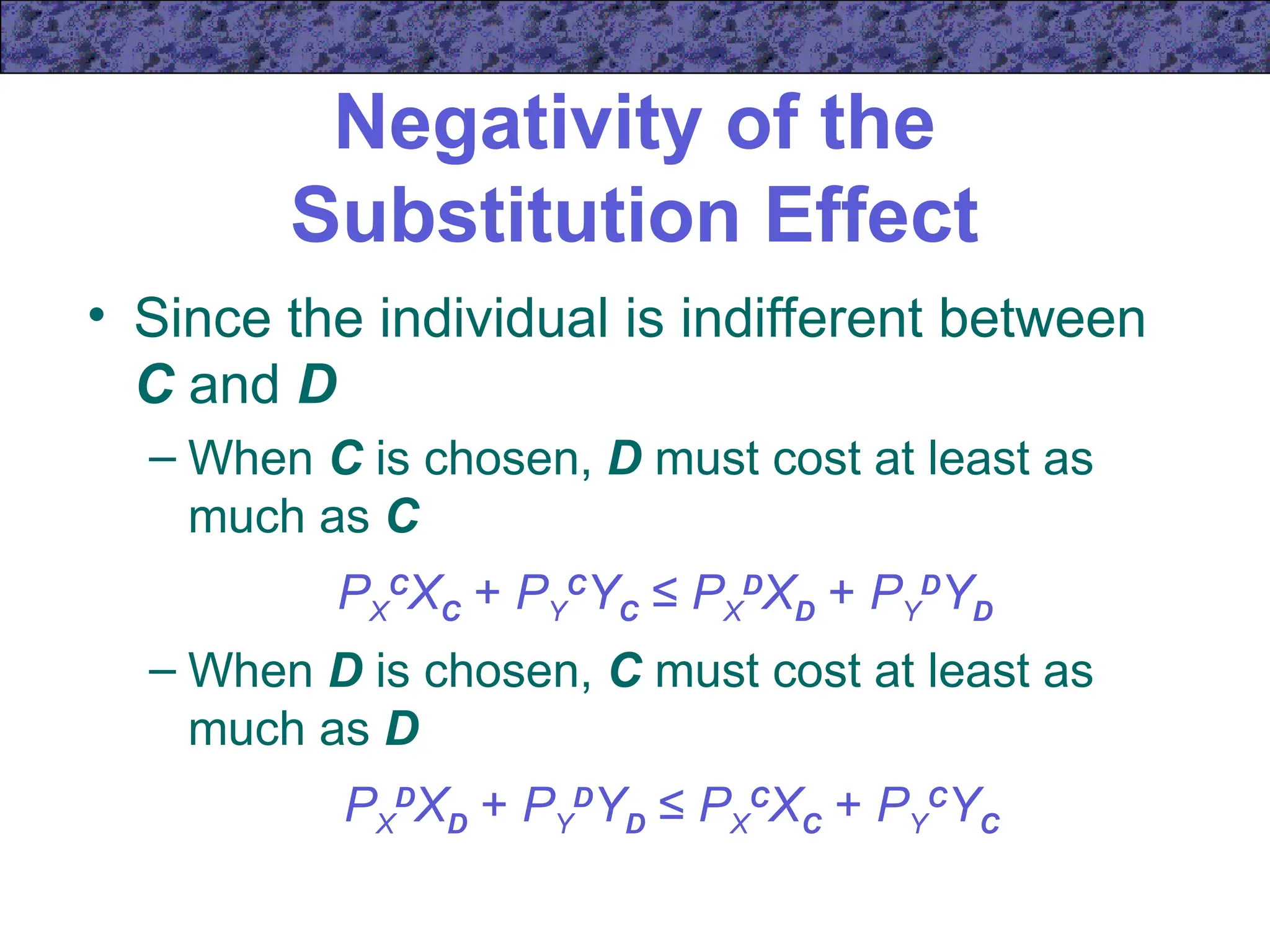
• Since the individual is indifferent between
C and D
– When C is chosen, D must cost at least as
much as C
PX
C
XC + PY
C
YC ≤ PX
D
XD + PY
D
YD
– When D is chosen, C must cost at least as
much as D
PX
D
XD + PY
D
YD ≤ PX
C
XC + PY
C
YC
Negativity of the
Substitution Effect
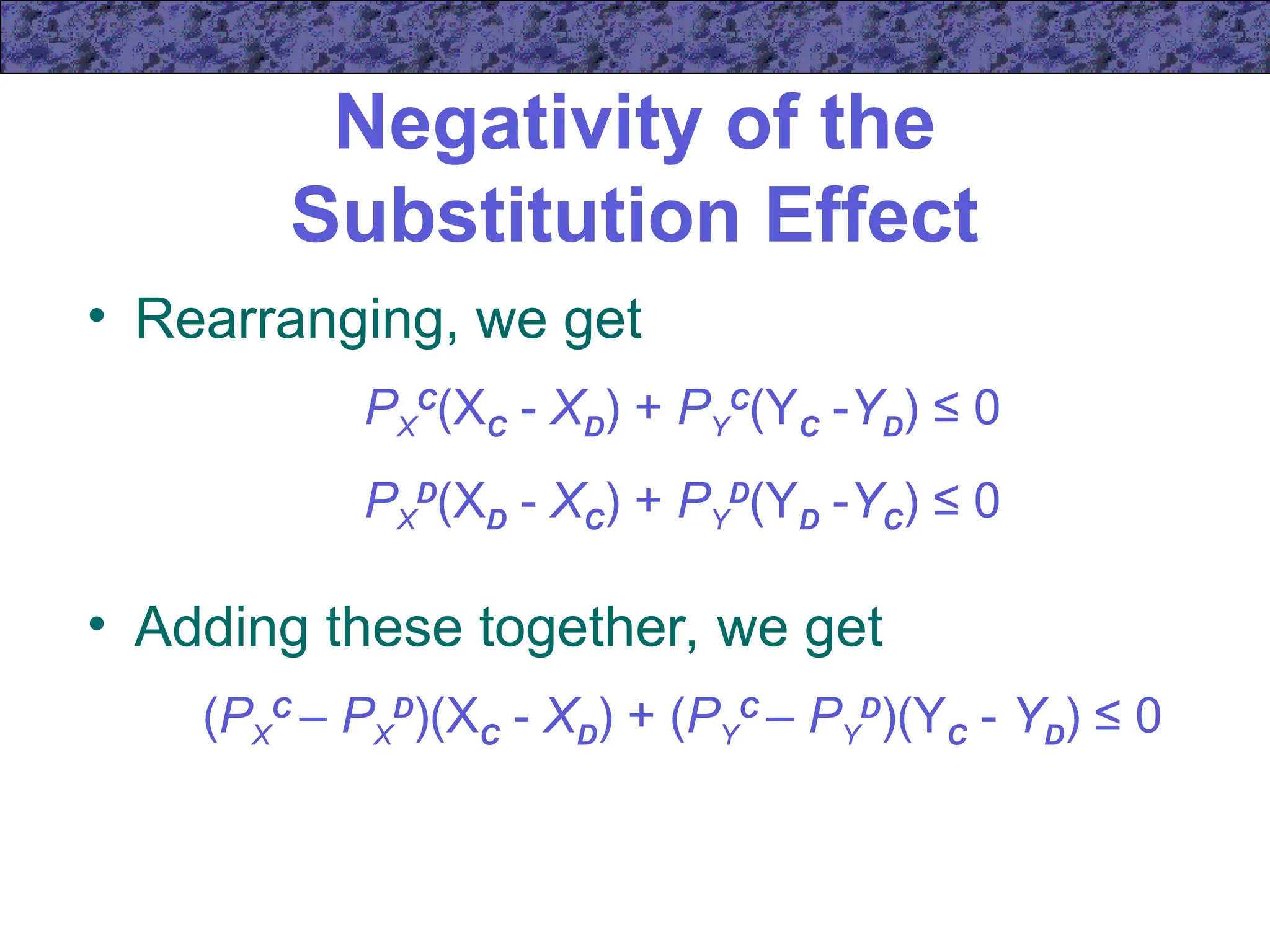
• Rearranging, we get
PX
C
(XC - XD) + PY
C
(YC -YD) ≤ 0
PX
D
(XD - XC) + PY
D
(YD -YC) ≤ 0
• Adding these together, we get
(PX
C
– PX
D
)(XC - XD) + (PY
C
– PY
D
)(YC - YD) ≤ 0
Negativity of the
Substitution Effect
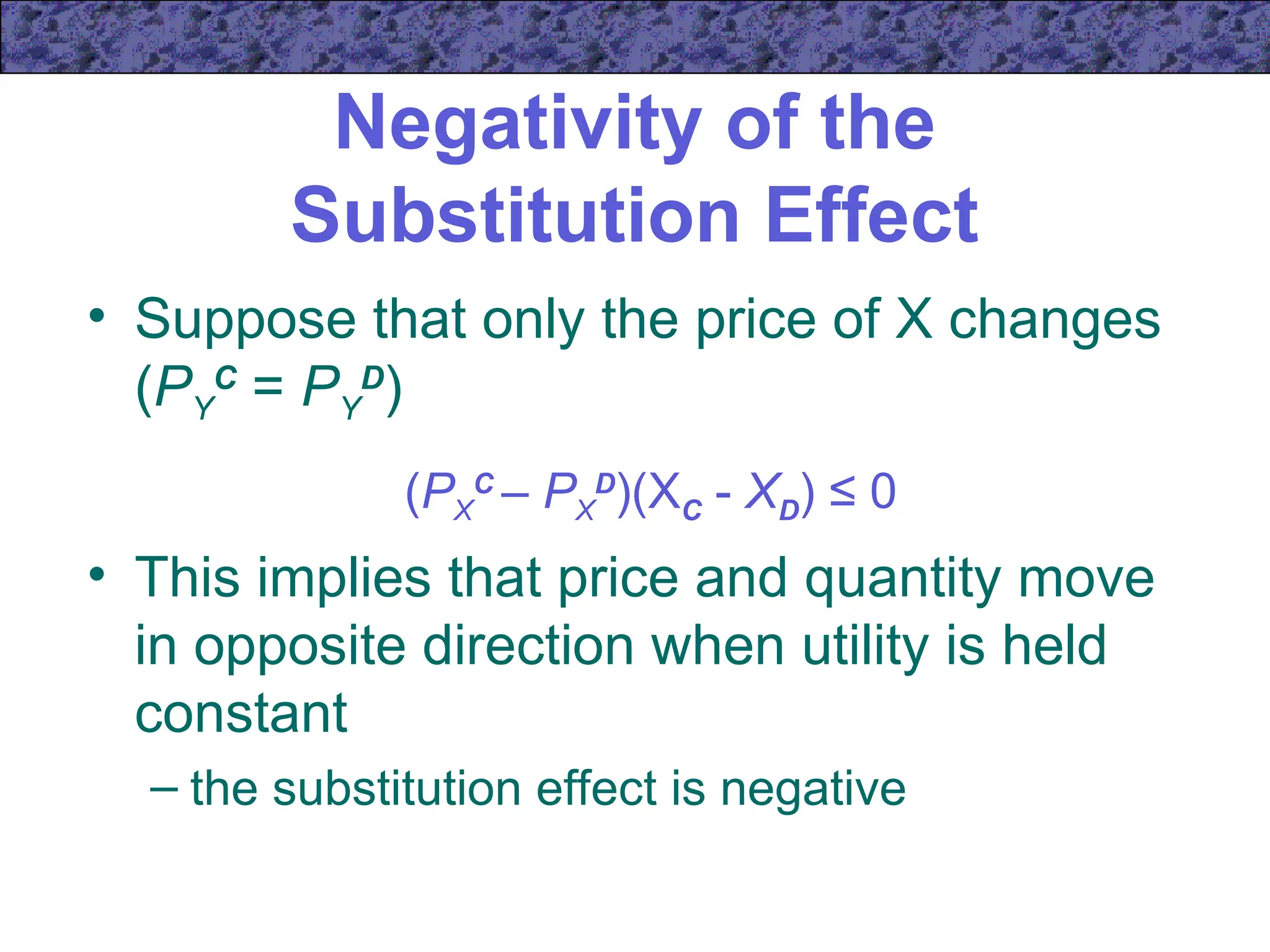
• Suppose that only the price of X changes
(PY
C
= PY
D
)
(PX
C
– PX
D
)(XC - XD) ≤ 0
• This implies that price and quantity move
in opposite direction when utility is held
constant
– the substitution effect is negative
Mathematical Generalization
• If, at prices Pi
0
bundle Xi
0
is chosen instead of
bundle Xi
1
(and bundle Xi
1
is affordable), then
 
 

n
i
n
i
i
i
i
i X
P
X
P
1 1
1
0
0
0
• Bundle 0 has been “revealed preferred”
to bundle 1
Mathematical Generalization
• Consequently, at prices that prevail
when bundle 1 is chosen (Pi
1
), then
 
 

n
i
n
i
i
i
i
i X
P
X
P
1 1
1
1
0
1
• Bundle 0 must be more expensive than
bundle 1
Strong Axiom of Revealed
Preference
• If commodity bundle 0 is revealed
preferred to bundle 1, and if bundle 1 is
revealed preferred to bundle 2, and if
bundle 2 is revealed preferred to bundle 3,
…,and if bundle k-1 is revealed preferred
to bundle k, then bundle k cannot be
revealed preferred to bundle 0
Consumer Welfare
• The expenditure function shows the
minimum expenditure necessary to
achieve a desired utility level (given
prices)
• The function can be denoted as
expenditure = E(PX,PY,U0)
where U0 is the “target” level of utility
Consumer Welfare
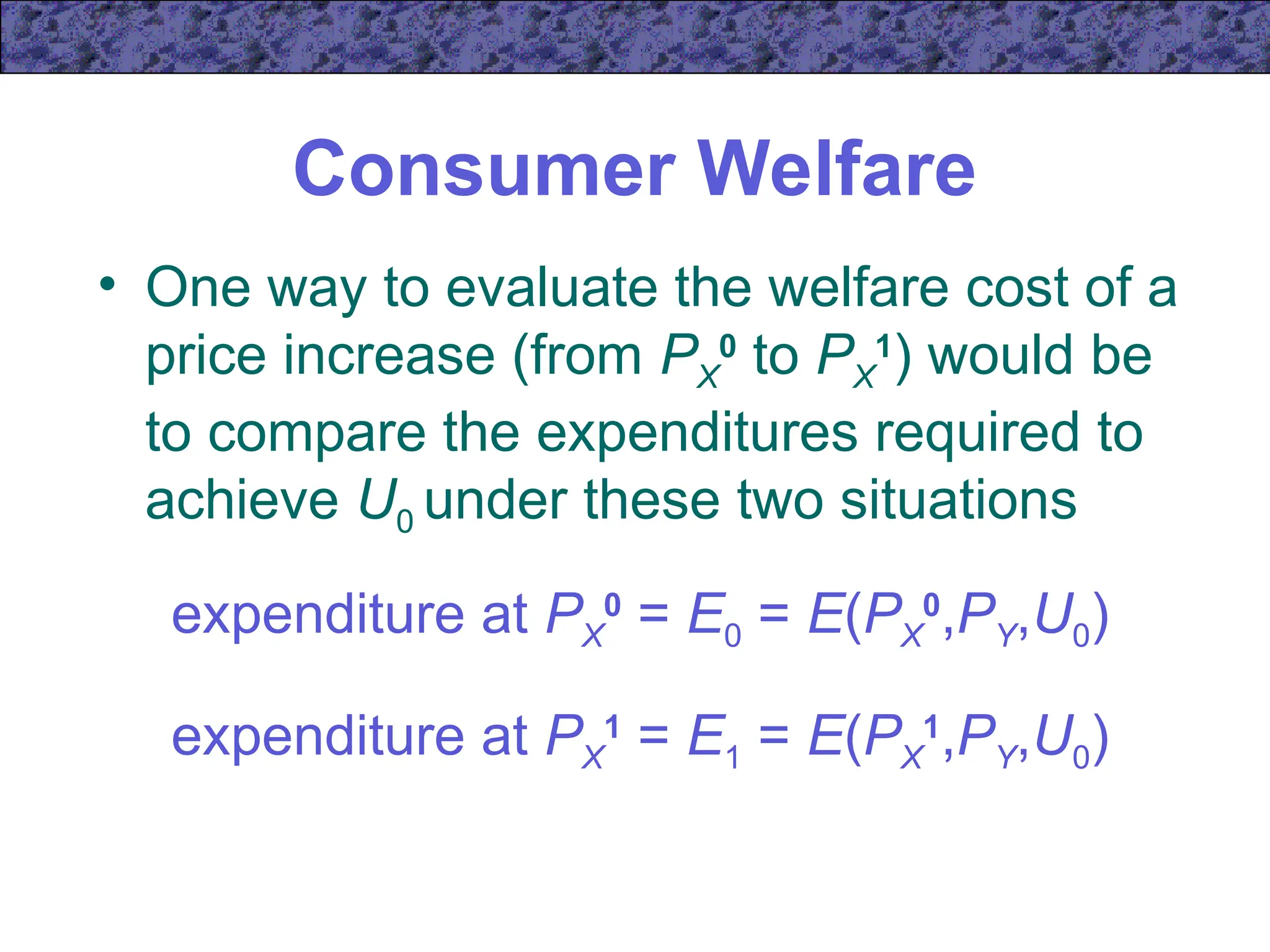
• One way to evaluate the welfare cost of a
price increase (from PX
0
to PX
1
) would be
to compare the expenditures required to
achieve U0 under these two situations
expenditure at PX
0
= E0 = E(PX
0
,PY,U0)
expenditure at PX
1
= E1 = E(PX
1
,PY,U0)
Consumer Welfare
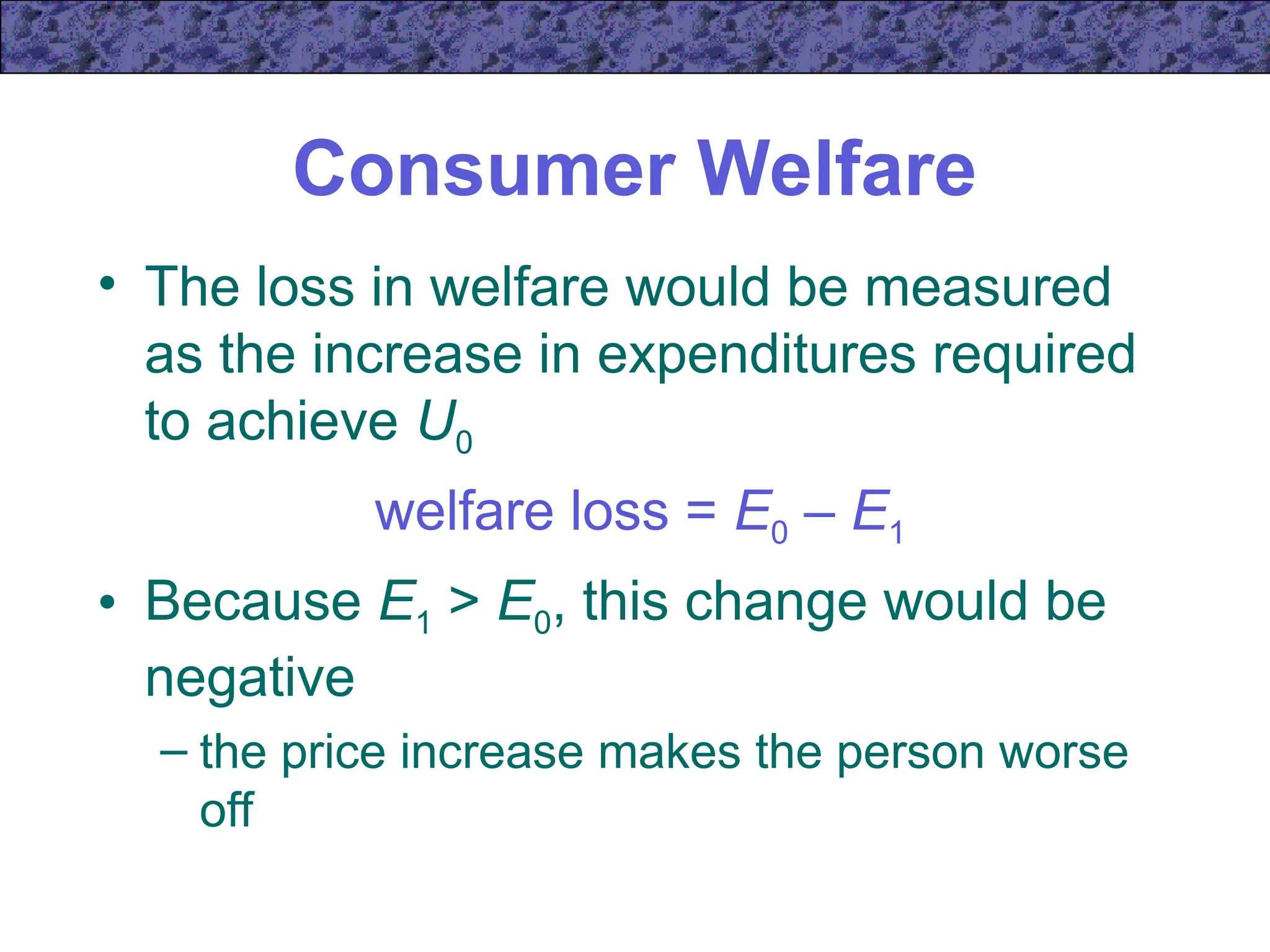
• The loss in welfare would be measured
as the increase in expenditures required
to achieve U0
welfare loss = E0 – E1
• Because E1 > E0, this change would be
negative
– the price increase makes the person worse
off
Consumer Welfare
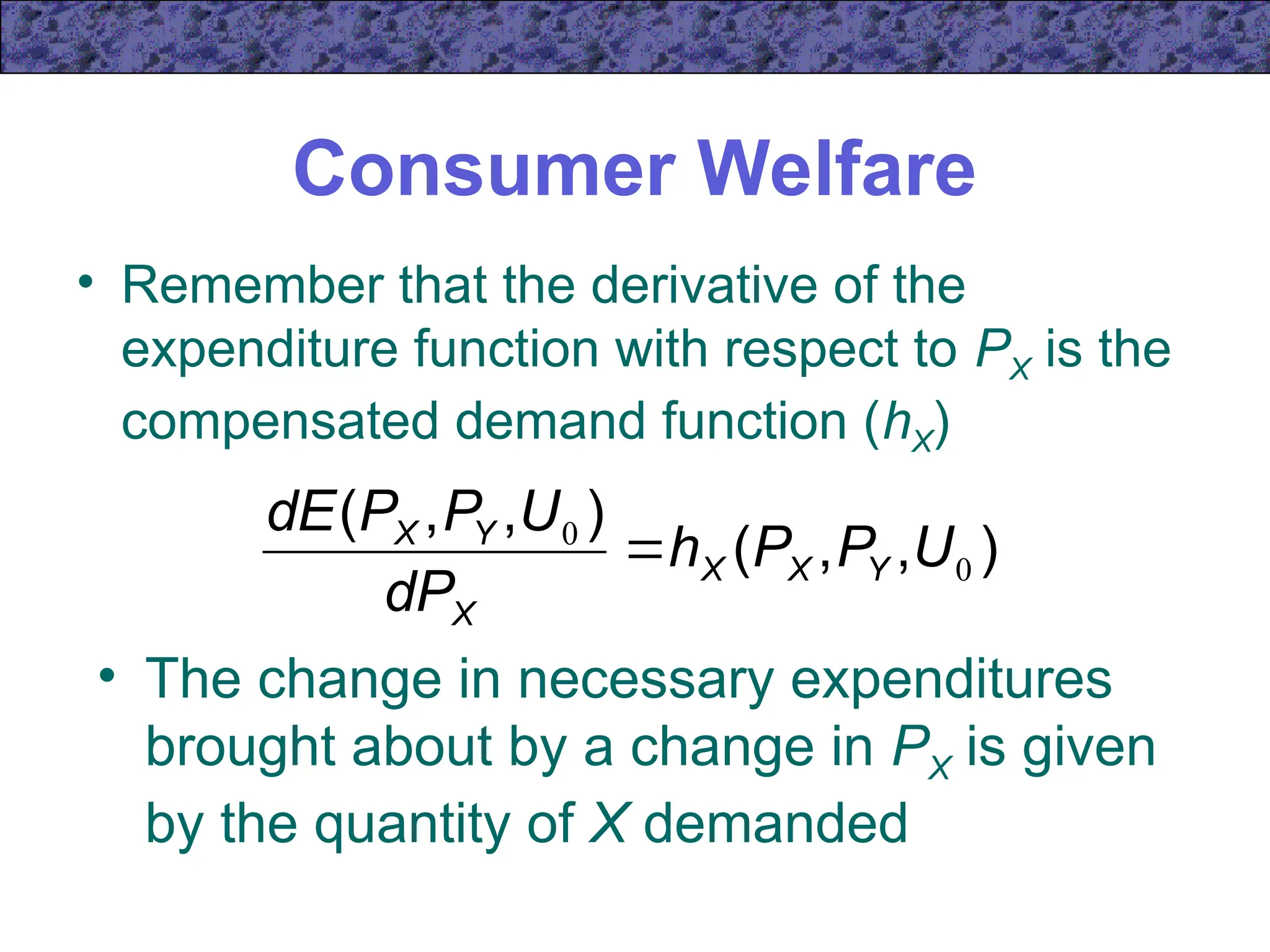
• Remember that the derivative of the
expenditure function with respect to PX is the
compensated demand function (hX)
)
,
,
(
)
,
,
(
0
0
U
P
P
h
dP
U
P
P
dE
Y
X
X
X
Y
X

• The change in necessary expenditures
brought about by a change in PX is given
by the quantity of X demanded
Consumer Welfare
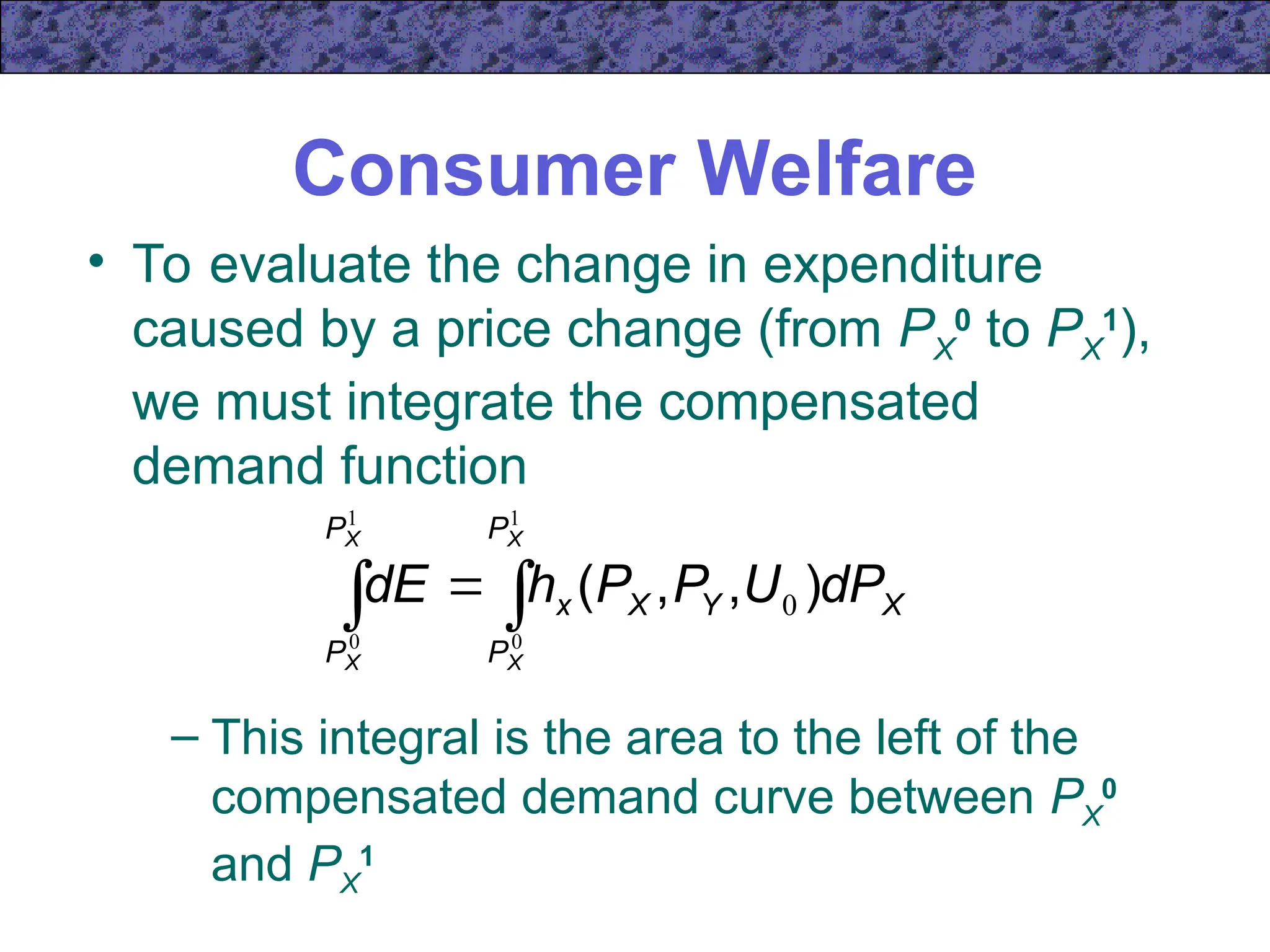
• To evaluate the change in expenditure
caused by a price change (from PX
0
to PX
1
),
we must integrate the compensated
demand function
 

1
0
1
0
0
X
X
X
X
P
P
P
P
X
Y
X
x dP
U
P
P
h
dE )
,
,
(
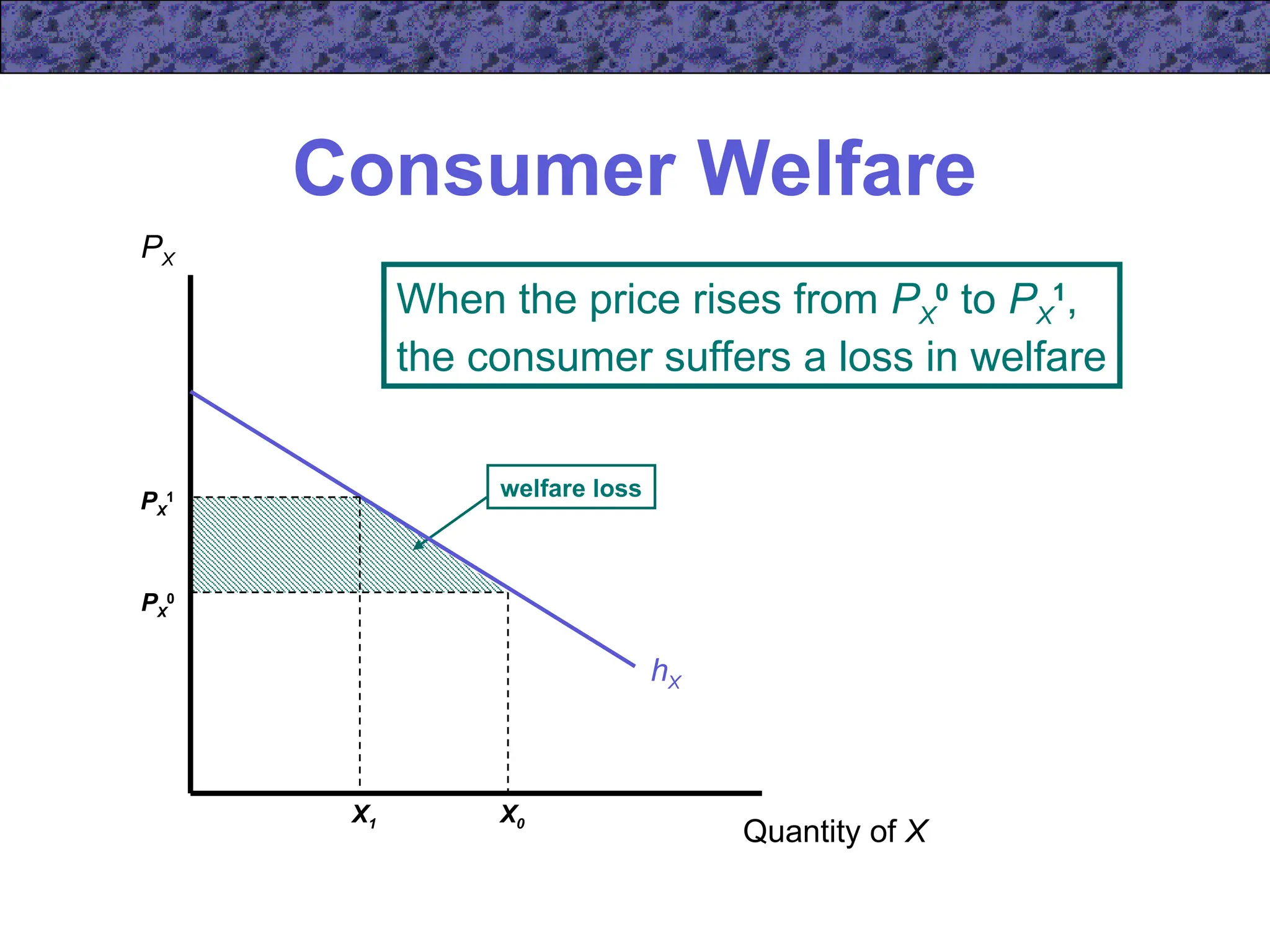
– This integral is the area to the left of the
compensated demand curve between PX
0
and PX
1
welfare loss
Consumer Welfare
Quantity of X
PX
hX
PX
1
X1
PX
0
X0
When the price rises from PX
0
to PX
1
,
the consumer suffers a loss in welfare
Consumer Welfare
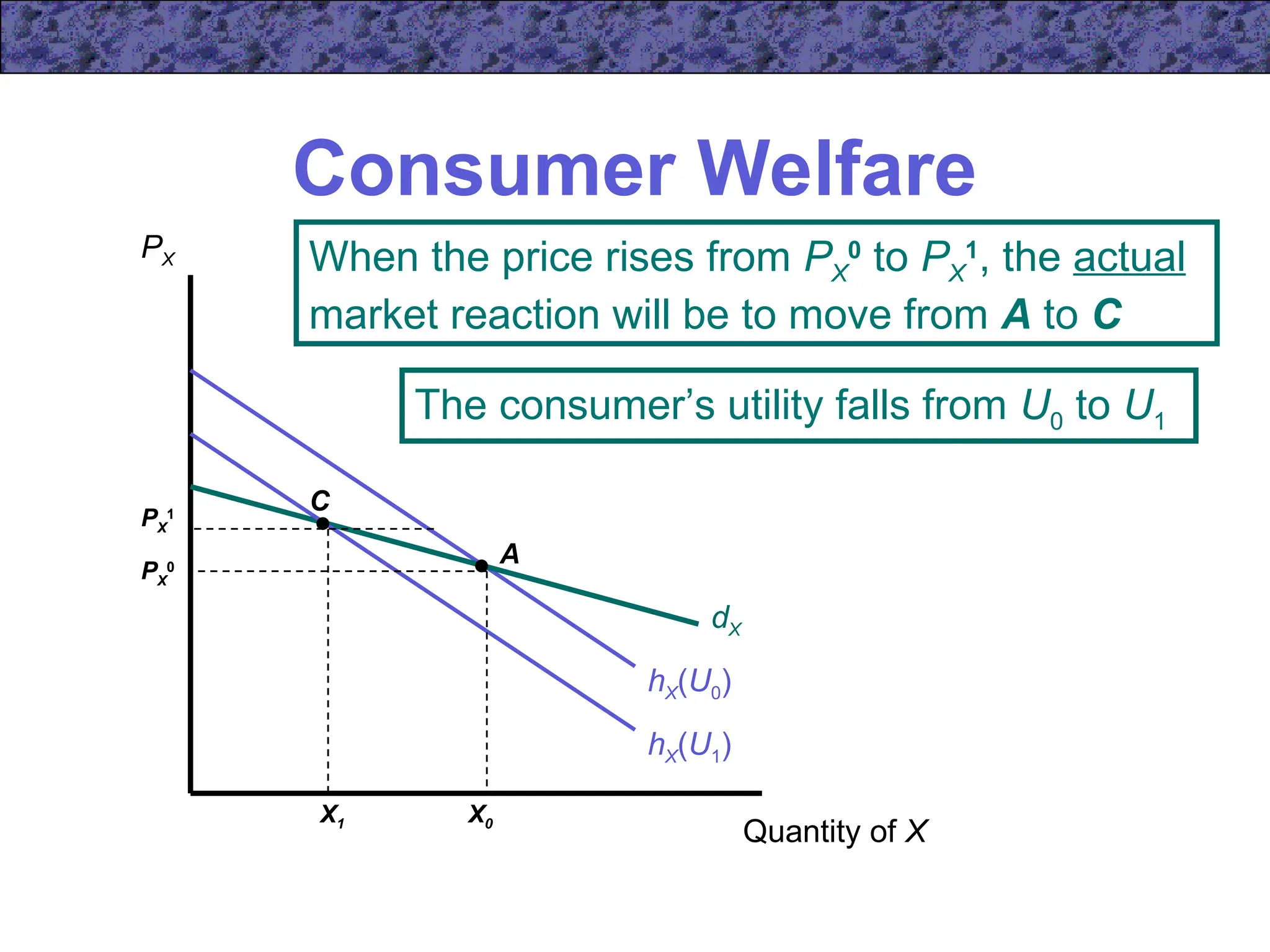
• Because a price change generally
involves both income and substitution
effects, it is unclear which compensated
demand curve should be used
• Do we use the compensated demand
curve for the original target utility (U0) or
the new level of utility after the price
change (U1)?
Consumer Welfare
Quantity of X
PX
hX(U0)
PX
1
X1
When the price rises from PX
0
to PX
1
, the actual
market reaction will be to move from A to C
hX(U1)
dX
A
C
PX
0
X0
The consumer’s utility falls from U0 to U1
Consumer Welfare
Quantity of X
PX
hX(U0)
PX
1
X1
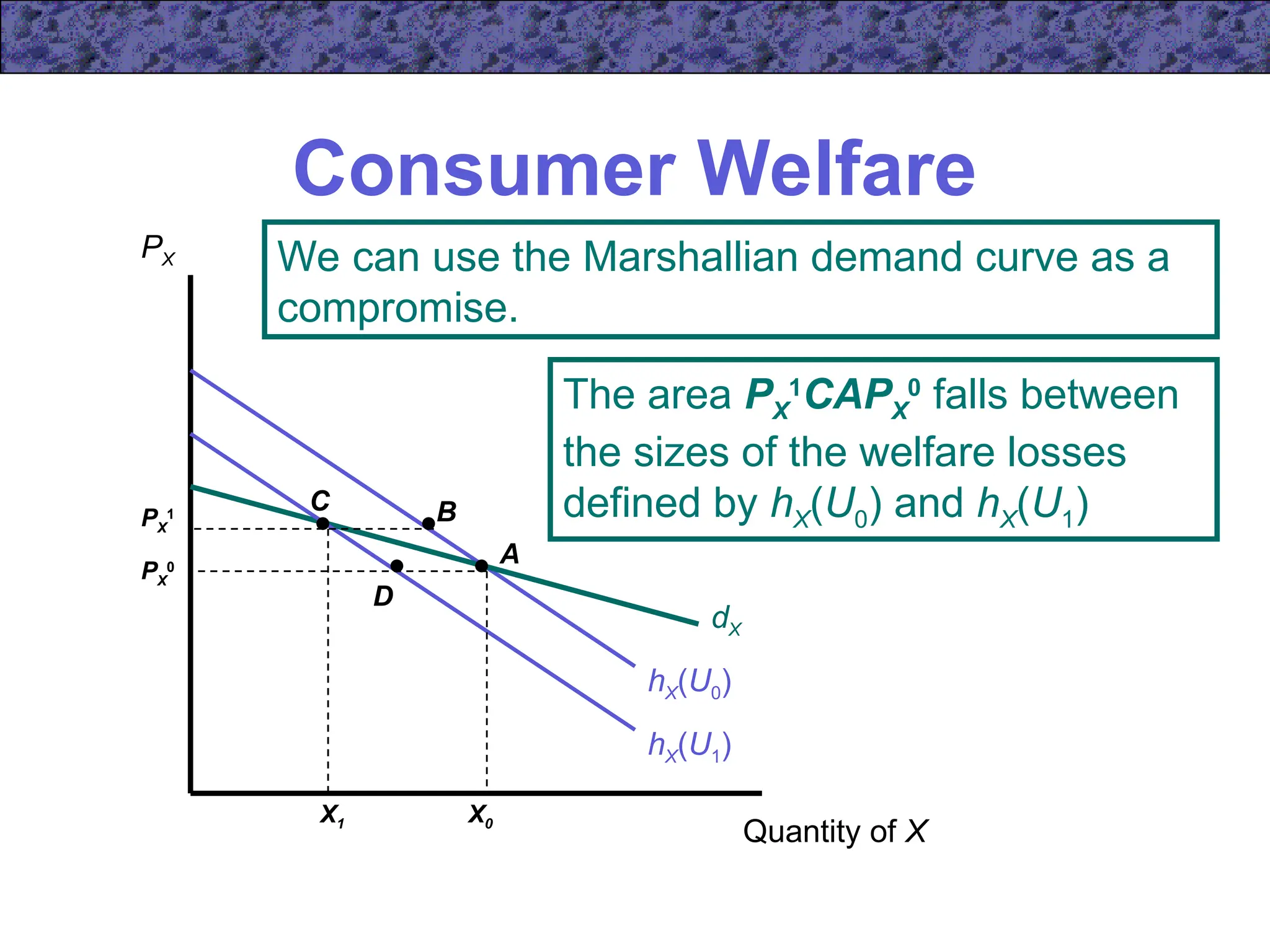
Is the consumer’s loss in welfare best
described by area PX
1
BAPX
0
[using hX(U0)]
or by area PX
1
CDPX
0
[using hX(U1)]?
hX(U1)
dX
A
B
C
D
PX
0
X0
Is U0 or U1 the appropriate
utility target?
Consumer Welfare
Quantity of X
PX
hX(U0)
PX
1
X1
We can use the Marshallian demand curve as a
compromise.
hX(U1)
dX
A
B
C
D
PX
0
X0
The area PX
1
CAPX
0
falls between
the sizes of the welfare losses
defined by hX(U0) and hX(U1)
Loss of Consumer Welfare
from a Rise in Price
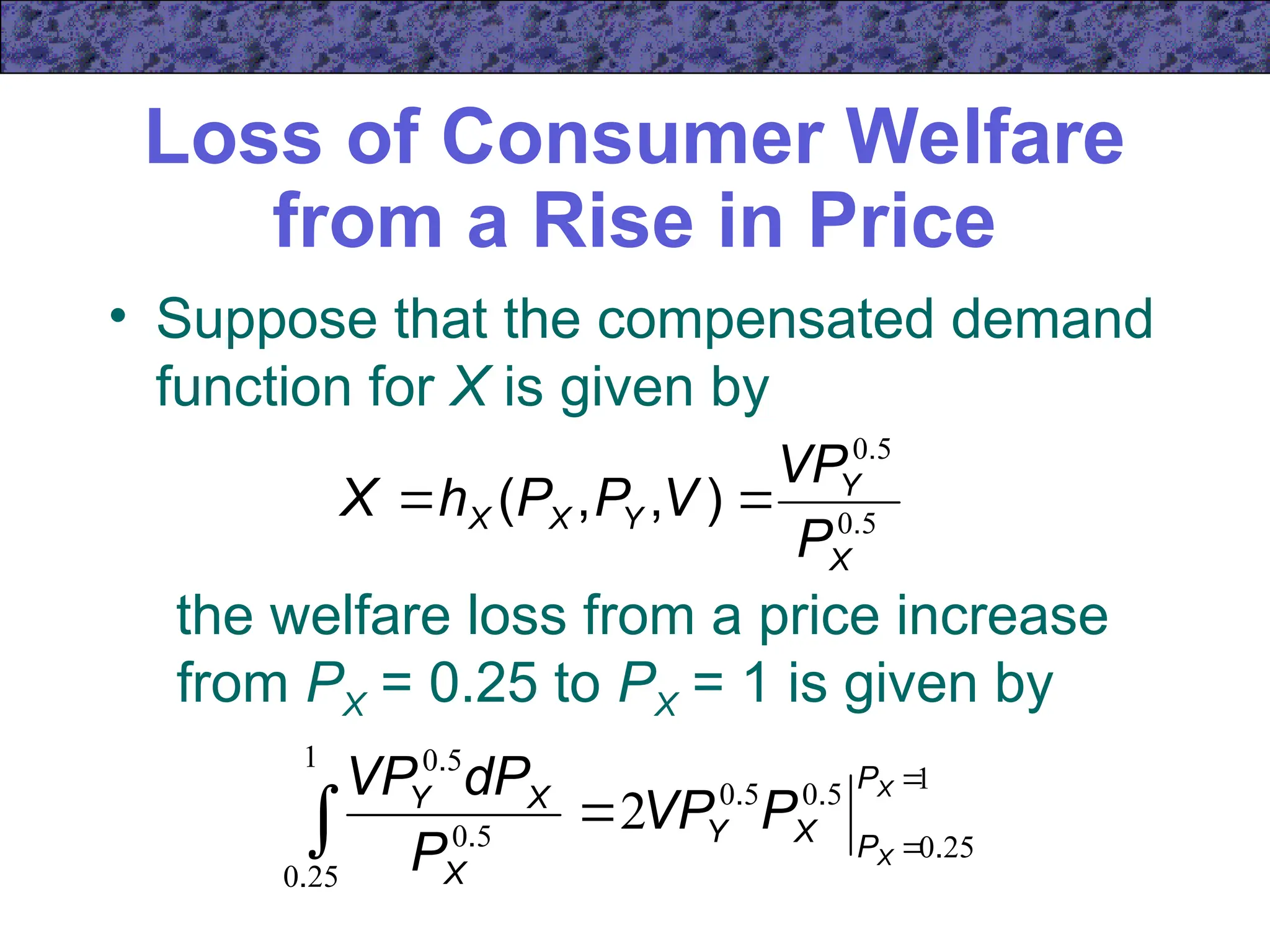
• Suppose that the compensated demand
function for X is given by
5
0
5
0
.
.
)
,
,
(
X
Y
Y
X
X
P
VP
V
P
P
h
X 

the welfare loss from a price increase
from PX = 0.25 to PX = 1 is given by
1
25
0
5
0
5
0
1
25
0
5
0
5
0
2




X
X
P
P
X
Y
X
X
Y
P
VP
P
dP
VP
.
.
.
.
.
.
Loss of Consumer Welfare
from a Rise in Price
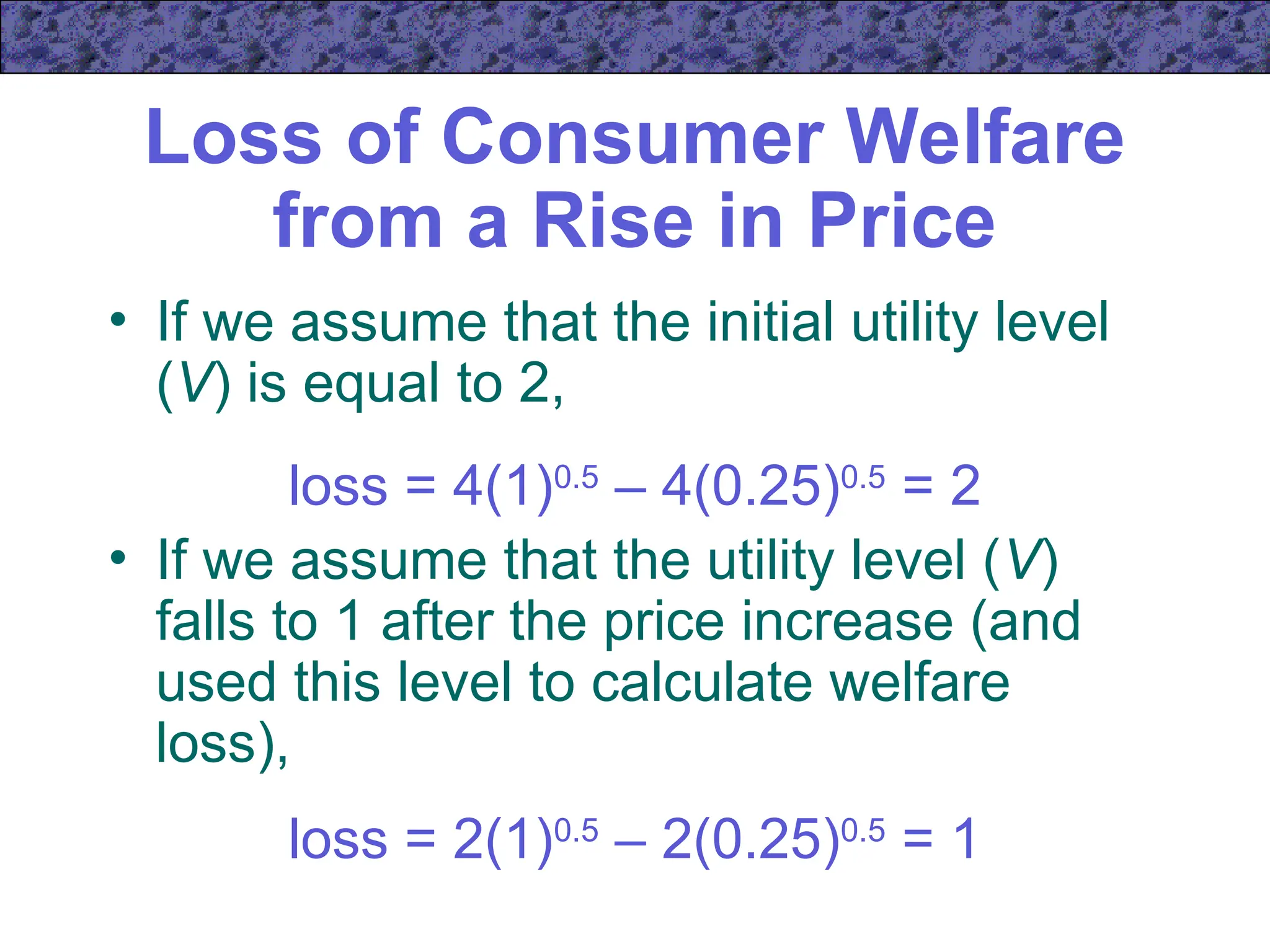
• If we assume that the initial utility level
(V) is equal to 2,
loss = 4(1)0.5
– 4(0.25)0.5
= 2
• If we assume that the utility level (V)
falls to 1 after the price increase (and
used this level to calculate welfare
loss),
loss = 2(1)0.5
– 2(0.25)0.5
= 1
Loss of Consumer Welfare
from a Rise in Price
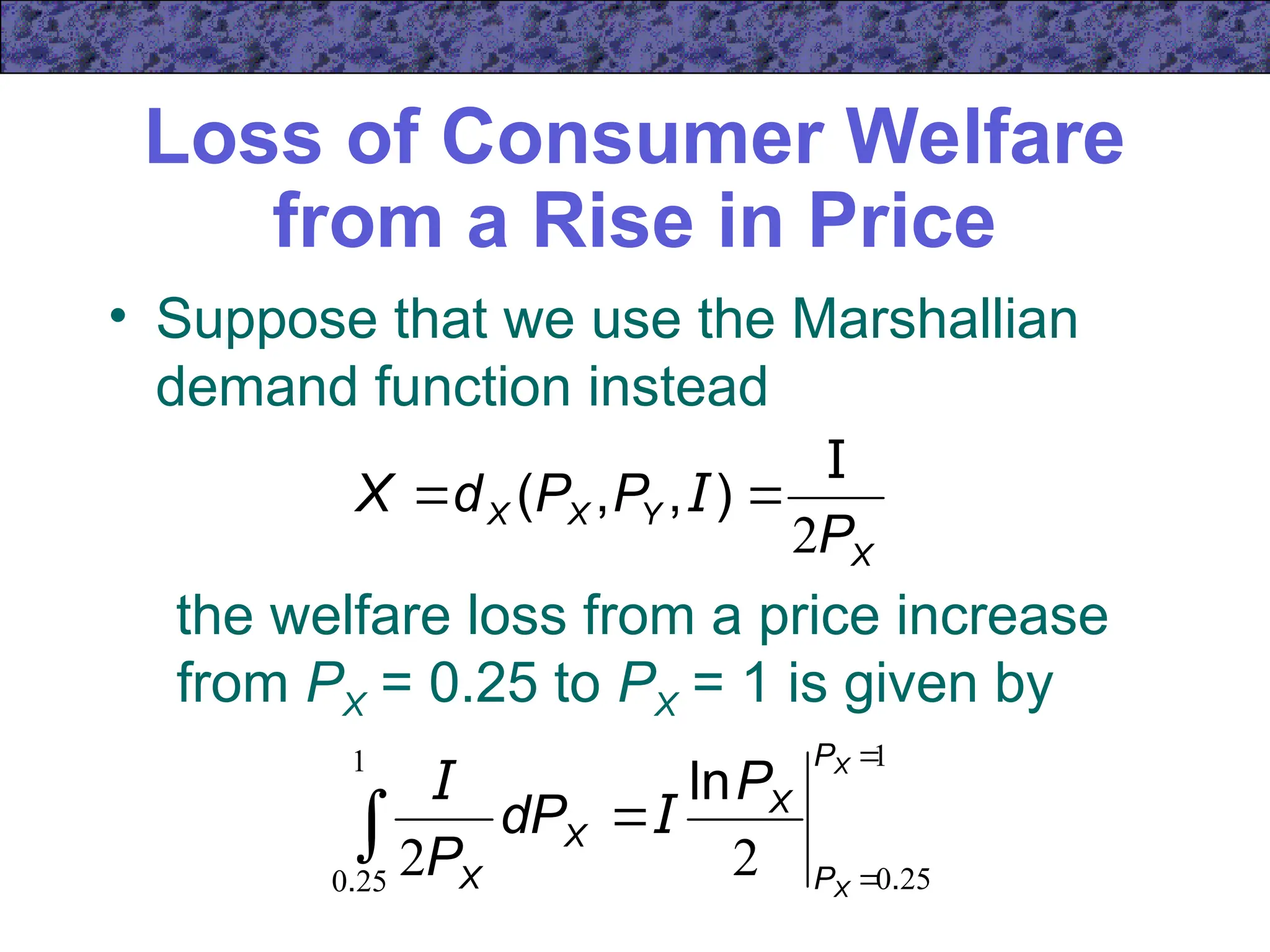
• Suppose that we use the Marshallian
demand function instead
X
Y
X
X
P
P
P
d
X
2
I

 )
,
,
( I
the welfare loss from a price increase
from PX = 0.25 to PX = 1 is given by
1
25
0
1
25
0
2
2




X
X
P
P
X
X
X
P
dP
P .
.
ln
I
I
Loss of Consumer Welfare
from a Rise in Price
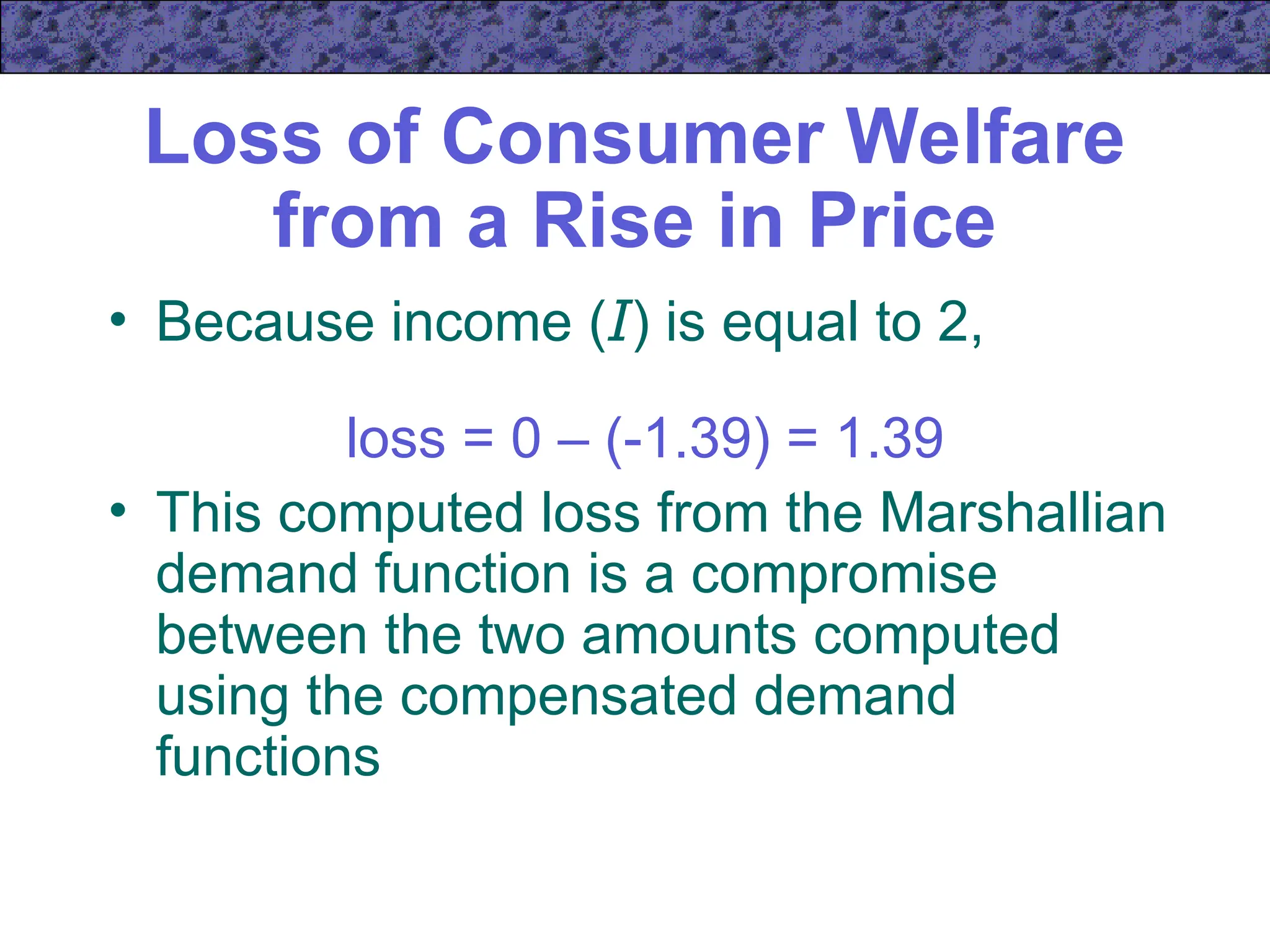
• Because income (I) is equal to 2,
loss = 0 – (-1.39) = 1.39
• This computed loss from the Marshallian
demand function is a compromise
between the two amounts computed
using the compensated demand
functions
Important Points to Note:
• Proportional changes in all prices and
income do not shift the individual’s budget
constraint and therefore do not alter the
quantities of goods chosen
– demand functions are homogeneous of degree
zero in all prices and income
Important Points to Note:
• When purchasing power changes (income
changes but prices remain the same),
budget constraints shift
– for normal goods, an increase in income
means that more is purchased
– for inferior goods, an increase in income
means that less is purchased
Important Points to Note:
• A fall in the price of a good causes
substitution and income effects
– For a normal good, both effects cause more of
the good to be purchased
– For inferior goods, substitution and income
effects work in opposite directions
• A rise in the price of a good also causes
income and substitution effects
– For normal goods, less will be demanded
– For inferior goods, the net result is ambiguous
Important Points to Note:
• The Marshallian demand curve summarizes
the total quantity of a good demanded at
each price
– changes in price prompt movemens along the
curve
– changes in income, prices of other goods, or
preferences may cause the demand curve to
shift
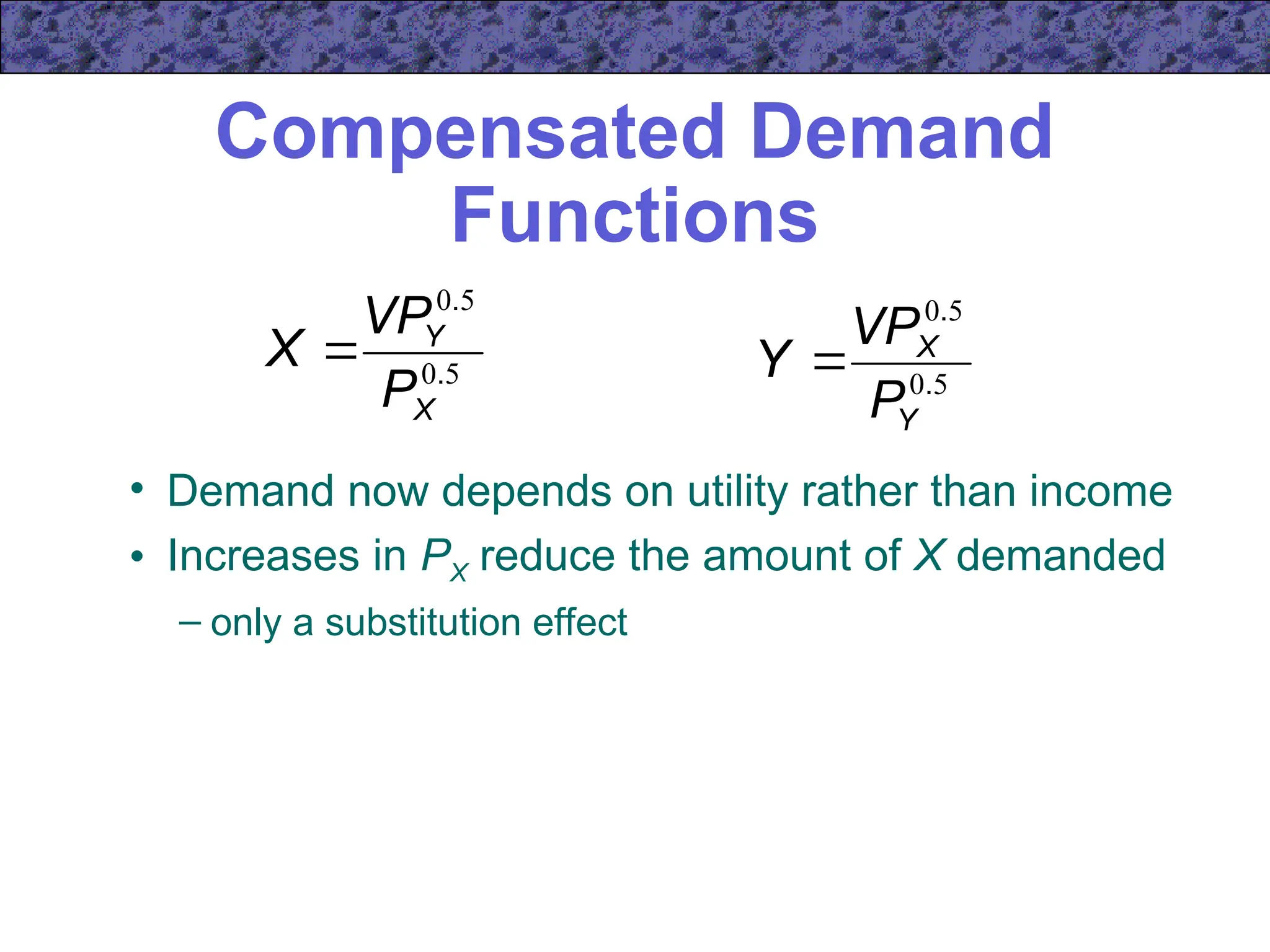
Important Points to Note:
• Compensated demand curves illustrate
movements along a given indifference
curve for alternative prices
– these are constructed by holding utility constant
– they exhibit only the substitution effects from a
price change
– their slope is unambiguously negative (or zero)
Important Points to Note:
• Income and substitution effects can be
analyzed using the Slutsky equation
• Income and substitution effects can also be
examined using revealed preference
• The welfare changes that accompany price
changes can sometimes be measured by
the changing area under the demand curve

ecn5402.ch05.ppt, lecture note, income and substitution effect

  • 1.
    Chapter 5 INCOME ANDSUBSTITUTION EFFECTS Copyright ©2002 by South-Western, a division of Thomson Learning. All rights reserved. MICROECONOMIC THEORY BASIC PRINCIPLES AND EXTENSIONS EIGHTH EDITION WALTER NICHOLSON
  • 2.
    Demand Functions • Theoptimal levels of X1,X2,…,Xn can be expressed as functions of all prices and income • These can be expressed as n demand functions: X1* = d1(P1,P2,…,Pn,I) X2* = d2(P1,P2,…,Pn,I) • • • Xn* = dn(P1,P2,…,Pn,I)
  • 3.
    Homogeneity • If wewere to double all prices and income, the optimal quantities demanded will not change – Doubling prices and income leaves the budget constraint unchanged Xi* = di(P1,P2,…,Pn,I) = di(tP1,tP2,…,tPn,tI) • Individual demand functions are homogeneous of degree zero in all prices and income
  • 4.
    Homogeneity • With aCobb-Douglas utility function utility = U(X,Y) = X0.3 Y0.7 the demand functions are • Note that a doubling of both prices and income would leave X* and Y* unaffected X P X I 3 0. *  X P Y I 7 0. * 
  • 5.
    Homogeneity • With aCES utility function utility = U(X,Y) = X0.5 + Y0.5 the demand functions are • Note that a doubling of both prices and income would leave X* and Y* unaffected X Y X P P P X I    / * 1 1 Y X Y P P P Y I    / * 1 1
  • 6.
    Changes in Income •An increase in income will cause the budget constraint out in a parallel manner • Since PX/PY does not change, the MRS will stay constant as the worker moves to higher levels of satisfaction
  • 7.
    Increase in Income •If both X and Y increase as income rises, X and Y are normal goods Quantity of X Quantity of Y C U3 B U2 A U1 As income rises, the individual chooses to consume more X and Y
  • 8.
    Increase in Income •If X decreases as income rises, X is an inferior good Quantity of X Quantity of Y C U3 As income rises, the individual chooses to consume less X and more Y Note that the indifference curves do not have to be “oddly” shaped. The assumption of a diminishing MRS is obeyed. B U2 A U1
  • 9.
    Normal and InferiorGoods • A good Xi for which Xi/I  0 over some range of income is a normal good in that range • A good Xi for which Xi/I < 0 over some range of income is an inferior good in that range
  • 10.
    Engel’s Law • UsingBelgian data from 1857, Engel found an empirical generalization about consumer behavior • The proportion of total expenditure devoted to food declines as income rises – food is a necessity whose consumption rises less rapidly than income
  • 11.
    Substitution & IncomeEffects • Even if the individual remained on the same indifference curve when the price changes, his optimal choice will change because the MRS must equal the new price ratio – the substitution effect • The price change alters the individual’s “real” income and therefore he must move to a new indifference curve – the income effect
  • 12.
    Changes in aGood’s Price • A change in the price of a good alters the slope of the budget constraint – it also changes the MRS at the consumer’s utility-maximizing choices • When the price changes, two effects come into play – substitution effect – income effect
  • 13.
    Changes in aGood’s Price Quantity of X Quantity of Y U1 A Suppose the consumer is maximizing utility at point A. U2 B If the price of good X falls, the consumer will maximize utility at point B. Total increase in X
  • 14.
    Changes in aGood’s Price U1 U2 Quantity of X Quantity of Y A B To isolate the substitution effect, we hold “real” income constant but allow the relative price of good X to change C Substitution effect The substitution effect is the movement from point A to point C The individual substitutes good X for good Y because it is now relatively cheaper
  • 15.
    Changes in aGood’s Price U1 U2 Quantity of X Quantity of Y A B The income effect occurs because the individual’s “real” income changes when the price of good X changes C Income effect The income effect is the movement from point C to point B If X is a normal good, the individual will buy more because “real” income increased
  • 16.
    Changes in aGood’s Price U2 U1 Quantity of X Quantity of Y B A An increase in the price of good X means that the budget constraint gets steeper C The substitution effect is the movement from point A to point C Substitution effect Income effect The income effect is the movement from point C to point B
  • 17.
    Price Changes for NormalGoods • If a good is normal, substitution and income effects reinforce one another – When price falls, both effects lead to a rise in QD – When price rises, both effects lead to a drop in QD
  • 18.
    Price Changes for InferiorGoods • If a good is inferior, substitution and income effects move in opposite directions • The combined effect is indeterminate – When price rises, the substitution effect leads to a drop in QD , but the income effect leads to a rise in QD – When price falls, the substitution effect leads to a rise in QD , but the income effect leads to a fall in QD
  • 19.
    Giffen’s Paradox • Ifthe income effect of a price change is strong enough, there could be a positive relationship between price and QD – An increase in price leads to a drop in real income – Since the good is inferior, a drop in income causes QD to rise • Thus, a rise in price leads to a rise in QD
  • 20.
    Summary of Income& Substitution Effects • Utility maximization implies that (for normal goods) a fall in price leads to an increase in QD – The substitution effect causes more to be purchased as the individual moves along an indifference curve – The income effect causes more to be purchased because the resulting rise in purchasing power allows the individual to move to a higher indifference curve
  • 21.
    Summary of Income& Substitution Effects • Utility maximization implies that (for normal goods) a rise in price leads to a decline in QD – The substitution effect causes less to be purchased as the individual moves along an indifference curve – The income effect causes less to be purchased because the resulting drop in purchasing power moves the individual to a lower indifference curve
  • 22.
    Summary of Income& Substitution Effects • Utility maximization implies that (for inferior goods) no definite prediction can be made for changes in price – The substitution effect and income effect move in opposite directions – If the income effect outweighs the substitution effect, we have a case of Giffen’s paradox
  • 23.
    The Individual’s DemandCurve • An individual’s demand for X1 depends on preferences, all prices, and income: X1* = d1(P1,P2,…,Pn,I) • It may be convenient to graph the individual’s demand for X1 assuming that income and the prices of other goods are held constant
  • 24.
    The Individual’s DemandCurve Quantity of Y Quantity of X Quantity of X PX X2 PX2 U2 X2 I = PX2 + PY X1 PX1 U1 X1 I = PX1 + PY X3 PX3 X3 U3 I = PX3 + PY As the price of X falls... dX …quantity of X demanded rises.
  • 25.
    The Individual’s DemandCurve • An individual demand curve shows the relationship between the price of a good and the quantity of that good purchased by an individual assuming that all other determinants of demand are held constant
  • 26.
    Shifts in theDemand Curve • Three factors are held constant when a demand curve is derived – income – prices of other goods – the individual’s preferences • If any of these factors change, the demand curve will shift to a new position
  • 27.
    Shifts in theDemand Curve • A movement along a given demand curve is caused by a change in the price of the good – called a change in quantity demanded • A shift in the demand curve is caused by a change in income, prices of other goods, or preferences – called a change in demand
  • 28.
    Compensated Demand Curves •The actual level of utility varies along the demand curve • As the price of X falls, the individual moves to higher indifference curves – It is assumed that nominal income is held constant as the demand curve is derived – This means that “real” income rises as the price of X falls
  • 29.
    Compensated Demand Curves •An alternative approach holds real income (or utility) constant while examining reactions to changes in PX – The effects of the price change are “compensated” so as to constrain the individual to remain on the same indifference curve – Reactions to price changes include only substitution effects
  • 30.
    Compensated Demand Curves •A compensated (Hicksian) demand curve shows the relationship between the price of a good and the quantity purchased assuming that other prices and utility are held constant • The compensated demand curve is a two- dimensional representation of the compensated demand function X* = hX(PX,PY,U)
  • 31.
    hX …quantity demanded rises. Compensated DemandCurves Quantity of Y Quantity of X Quantity of X PX U2 X2 PX2 X2 Y X P P slope 2   X1 PX1 Y X P P slope 1   X1 X3 PX3 Y X P P slope 3   X3 Holding utility constant, as price falls...
  • 32.
    Compensated & Uncompensated Demand Quantityof X PX dX hX X2 PX2 At PX2, the curves intersect because the individual’s income is just sufficient to attain utility level U2
  • 33.
    Compensated & Uncompensated Demand Quantityof X PX dX hX PX2 X1* X1 PX1 At prices above PX2, income compensation is positive because the individual needs some help to remain on U2
  • 34.
    Compensated & Uncompensated Demand Quantityof X PX dX hX PX2 X3* X3 PX3 At prices below PX2, income compensation is negative to prevent an increase in utility from a lower price
  • 35.
    Compensated & Uncompensated Demand •For a normal good, the compensated demand curve is less responsive to price changes than is the uncompensated demand curve – the uncompensated demand curve reflects both income and substitution effects – the compensated demand curve reflects only substitution effects
  • 36.
    Compensated Demand Functions • Supposethat utility is given by utility = U(X,Y) = X0.5 Y0.5 • The Marshallian demand functions are X = I/2PX Y = I/2PY • The indirect utility function is 5 0 5 0 2 . . ) , , ( utility Y X Y X P P P P V I I  
  • 37.
    Compensated Demand Functions • Toobtain the compensated demand functions, we can solve the indirect utility function for I and then substitute into the Marshallian demand functions 5 0 5 0 . . X Y P VP X  5 0 5 0 . . Y X P VP Y 
  • 38.
    Compensated Demand Functions • Demandnow depends on utility rather than income • Increases in PX reduce the amount of X demanded – only a substitution effect 5 0 5 0 . . X Y P VP X  5 0 5 0 . . Y X P VP Y 
  • 39.
    A Mathematical Examination ofa Change in Price • Our goal is to examine how the demand for good X changes when PX changes dX/PX • Differentiation of the first-order conditions from utility maximization can be performed to solve for this derivative • However, this approach is cumbersome and provides little economic insight
  • 40.
    A Mathematical Examination ofa Change in Price • Instead, we will use an indirect approach • Remember the expenditure function minimum expenditure = E(PX,PY,U) • Then, by definition hX (PX,PY,U) = dX [PX,PY,E(PX,PY,U)] – Note that the two demand functions are equal when income is exactly what is needed to attain the required utility level
  • 41.
    A Mathematical Examination ofa Change in Price • We can differentiate the compensated demand function and get hX (PX,PY,U) = dX [PX,PY,E(PX,PY,U)] X X X X X X P E E d P d P h            X X X X X X P E E d P h P d           
  • 42.
    A Mathematical Examination ofa Change in Price • The first term is the slope of the compensated demand curve • This is the mathematical representation of the substitution effect X X X X X X P E E d P h P d           
  • 43.
    A Mathematical Examination ofa Change in Price • The second term measures the way in which changes in PX affect the demand for X through changes in necessary expenditure levels • This is the mathematical representation of the income effect X X X X X X P E E d P h P d           
  • 44.
    The Slutsky Equation •The substitution effect can be written as constant effect on substituti        U X X X P X P h • The income effect can be written as X X X P E I X P E E d               effect income
  • 45.
    The Slutsky Equation •Note that E/PX = X – A $1 increase in PX raises necessary expenditures by X dollars – $1 extra must be paid for each unit of X purchased
  • 46.
    The Slutsky Equation •The utility-maximization hypothesis shows that the substitution and income effects arising from a price change can be represented by I              X X P X P d P d U X X X X X constant effect income effect on substituti
  • 47.
    The Slutsky Equation •The first term is the substitution effect – always negative as long as MRS is diminishing – the slope of the compensated demand curve will always be negative I          X X P X P d U X X X constant
  • 48.
    The Slutsky Equation •The second term is the income effect – if X is a normal good, then X/I > 0 • the entire income effect is negative – if X is an inferior good, then X/I < 0 • the entire income effect is positive I          X X P X P d U X X X constant
  • 49.
    Revealed Preference &the Substitution Effect • The theory of revealed preference was proposed by Paul Samuelson in the late 1940s • The theory defines a principle of rationality based on observed behavior and then uses it to approximate an individual’s utility function
  • 50.
    Revealed Preference &the Substitution Effect • Consider two bundles of goods: A and B • If the individual can afford to purchase either bundle but chooses A, we say that A had been revealed preferred to B • Under any other price-income arrangement, B can never be revealed preferred to A
  • 51.
    Revealed Preference &the Substitution Effect B A I1 I2 I3 Quantity of X Quantity of Y Suppose that, when the budget constraint is given by I1, A is chosen A must still be preferred to B when income is I3 (because both A and B are available) If B is chosen, the budget constraint must be similar to that given by I2 where A is not available
  • 52.
    Negativity of the SubstitutionEffect • Suppose that an individual is indifferent between two bundles: C and D • Let PX C ,PY C be the prices at which bundle C is chosen • Let PX D ,PY D be the prices at which bundle D is chosen
  • 53.
    Negativity of the SubstitutionEffect • Since the individual is indifferent between C and D – When C is chosen, D must cost at least as much as C PX C XC + PY C YC ≤ PX D XD + PY D YD – When D is chosen, C must cost at least as much as D PX D XD + PY D YD ≤ PX C XC + PY C YC
  • 54.
    Negativity of the SubstitutionEffect • Rearranging, we get PX C (XC - XD) + PY C (YC -YD) ≤ 0 PX D (XD - XC) + PY D (YD -YC) ≤ 0 • Adding these together, we get (PX C – PX D )(XC - XD) + (PY C – PY D )(YC - YD) ≤ 0
  • 55.
    Negativity of the SubstitutionEffect • Suppose that only the price of X changes (PY C = PY D ) (PX C – PX D )(XC - XD) ≤ 0 • This implies that price and quantity move in opposite direction when utility is held constant – the substitution effect is negative
  • 56.
    Mathematical Generalization • If,at prices Pi 0 bundle Xi 0 is chosen instead of bundle Xi 1 (and bundle Xi 1 is affordable), then      n i n i i i i i X P X P 1 1 1 0 0 0 • Bundle 0 has been “revealed preferred” to bundle 1
  • 57.
    Mathematical Generalization • Consequently,at prices that prevail when bundle 1 is chosen (Pi 1 ), then      n i n i i i i i X P X P 1 1 1 1 0 1 • Bundle 0 must be more expensive than bundle 1
  • 58.
    Strong Axiom ofRevealed Preference • If commodity bundle 0 is revealed preferred to bundle 1, and if bundle 1 is revealed preferred to bundle 2, and if bundle 2 is revealed preferred to bundle 3, …,and if bundle k-1 is revealed preferred to bundle k, then bundle k cannot be revealed preferred to bundle 0
  • 59.
    Consumer Welfare • Theexpenditure function shows the minimum expenditure necessary to achieve a desired utility level (given prices) • The function can be denoted as expenditure = E(PX,PY,U0) where U0 is the “target” level of utility
  • 60.
    Consumer Welfare • Oneway to evaluate the welfare cost of a price increase (from PX 0 to PX 1 ) would be to compare the expenditures required to achieve U0 under these two situations expenditure at PX 0 = E0 = E(PX 0 ,PY,U0) expenditure at PX 1 = E1 = E(PX 1 ,PY,U0)
  • 61.
    Consumer Welfare • Theloss in welfare would be measured as the increase in expenditures required to achieve U0 welfare loss = E0 – E1 • Because E1 > E0, this change would be negative – the price increase makes the person worse off
  • 62.
    Consumer Welfare • Rememberthat the derivative of the expenditure function with respect to PX is the compensated demand function (hX) ) , , ( ) , , ( 0 0 U P P h dP U P P dE Y X X X Y X  • The change in necessary expenditures brought about by a change in PX is given by the quantity of X demanded
  • 63.
    Consumer Welfare • Toevaluate the change in expenditure caused by a price change (from PX 0 to PX 1 ), we must integrate the compensated demand function    1 0 1 0 0 X X X X P P P P X Y X x dP U P P h dE ) , , ( – This integral is the area to the left of the compensated demand curve between PX 0 and PX 1
  • 64.
    welfare loss Consumer Welfare Quantityof X PX hX PX 1 X1 PX 0 X0 When the price rises from PX 0 to PX 1 , the consumer suffers a loss in welfare
  • 65.
    Consumer Welfare • Becausea price change generally involves both income and substitution effects, it is unclear which compensated demand curve should be used • Do we use the compensated demand curve for the original target utility (U0) or the new level of utility after the price change (U1)?
  • 66.
    Consumer Welfare Quantity ofX PX hX(U0) PX 1 X1 When the price rises from PX 0 to PX 1 , the actual market reaction will be to move from A to C hX(U1) dX A C PX 0 X0 The consumer’s utility falls from U0 to U1
  • 67.
    Consumer Welfare Quantity ofX PX hX(U0) PX 1 X1 Is the consumer’s loss in welfare best described by area PX 1 BAPX 0 [using hX(U0)] or by area PX 1 CDPX 0 [using hX(U1)]? hX(U1) dX A B C D PX 0 X0 Is U0 or U1 the appropriate utility target?
  • 68.
    Consumer Welfare Quantity ofX PX hX(U0) PX 1 X1 We can use the Marshallian demand curve as a compromise. hX(U1) dX A B C D PX 0 X0 The area PX 1 CAPX 0 falls between the sizes of the welfare losses defined by hX(U0) and hX(U1)
  • 69.
    Loss of ConsumerWelfare from a Rise in Price • Suppose that the compensated demand function for X is given by 5 0 5 0 . . ) , , ( X Y Y X X P VP V P P h X   the welfare loss from a price increase from PX = 0.25 to PX = 1 is given by 1 25 0 5 0 5 0 1 25 0 5 0 5 0 2     X X P P X Y X X Y P VP P dP VP . . . . . .
  • 70.
    Loss of ConsumerWelfare from a Rise in Price • If we assume that the initial utility level (V) is equal to 2, loss = 4(1)0.5 – 4(0.25)0.5 = 2 • If we assume that the utility level (V) falls to 1 after the price increase (and used this level to calculate welfare loss), loss = 2(1)0.5 – 2(0.25)0.5 = 1
  • 71.
    Loss of ConsumerWelfare from a Rise in Price • Suppose that we use the Marshallian demand function instead X Y X X P P P d X 2 I   ) , , ( I the welfare loss from a price increase from PX = 0.25 to PX = 1 is given by 1 25 0 1 25 0 2 2     X X P P X X X P dP P . . ln I I
  • 72.
    Loss of ConsumerWelfare from a Rise in Price • Because income (I) is equal to 2, loss = 0 – (-1.39) = 1.39 • This computed loss from the Marshallian demand function is a compromise between the two amounts computed using the compensated demand functions
  • 73.
    Important Points toNote: • Proportional changes in all prices and income do not shift the individual’s budget constraint and therefore do not alter the quantities of goods chosen – demand functions are homogeneous of degree zero in all prices and income
  • 74.
    Important Points toNote: • When purchasing power changes (income changes but prices remain the same), budget constraints shift – for normal goods, an increase in income means that more is purchased – for inferior goods, an increase in income means that less is purchased
  • 75.
    Important Points toNote: • A fall in the price of a good causes substitution and income effects – For a normal good, both effects cause more of the good to be purchased – For inferior goods, substitution and income effects work in opposite directions • A rise in the price of a good also causes income and substitution effects – For normal goods, less will be demanded – For inferior goods, the net result is ambiguous
  • 76.
    Important Points toNote: • The Marshallian demand curve summarizes the total quantity of a good demanded at each price – changes in price prompt movemens along the curve – changes in income, prices of other goods, or preferences may cause the demand curve to shift
  • 77.
    Important Points toNote: • Compensated demand curves illustrate movements along a given indifference curve for alternative prices – these are constructed by holding utility constant – they exhibit only the substitution effects from a price change – their slope is unambiguously negative (or zero)
  • 78.
    Important Points toNote: • Income and substitution effects can be analyzed using the Slutsky equation • Income and substitution effects can also be examined using revealed preference • The welfare changes that accompany price changes can sometimes be measured by the changing area under the demand curve