Chapter Thirteen
Risky Assets
Mean of a Distribution
A random variable (r.v.) w takes
values w1,…,wS with probabilities
π 1,...,π S (π 1 + · · · + π S = 1).
The mean (expected value) of the
distribution is the av. value of the
r.v.;
S
E[ w] = µ w = ∑ wsπ s .
s =1
Variance of a Distribution
The distribution’s variance is the
r.v.’s av. squared deviation from the
mean;
S
2
2
var[ w] = σ w = ∑ ( ws − µ w ) π s .
s =1

Variance measures the r.v.’s
variation.
Standard Deviation of a
Distribution
The distribution’s standard deviation
is the square root of its variance;
2
st. dev[ w] = σ w = σ w =

S
2
∑ ( ws − µ w ) π s .
s =1

St. deviation also measures the r.v.’s
variability.
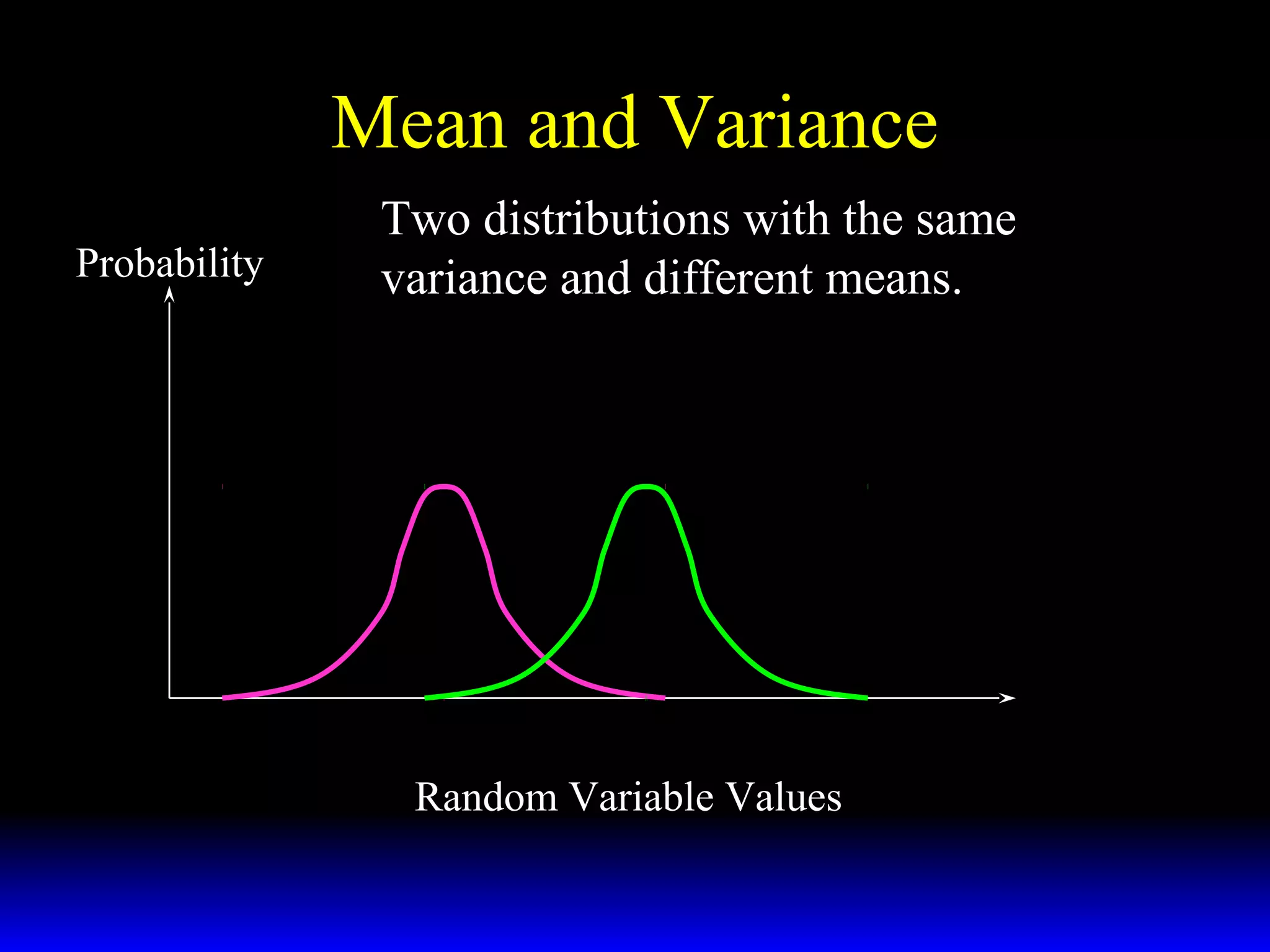
Mean and Variance
Probability

Two distributions with the same
variance and different means.

Random Variable Values
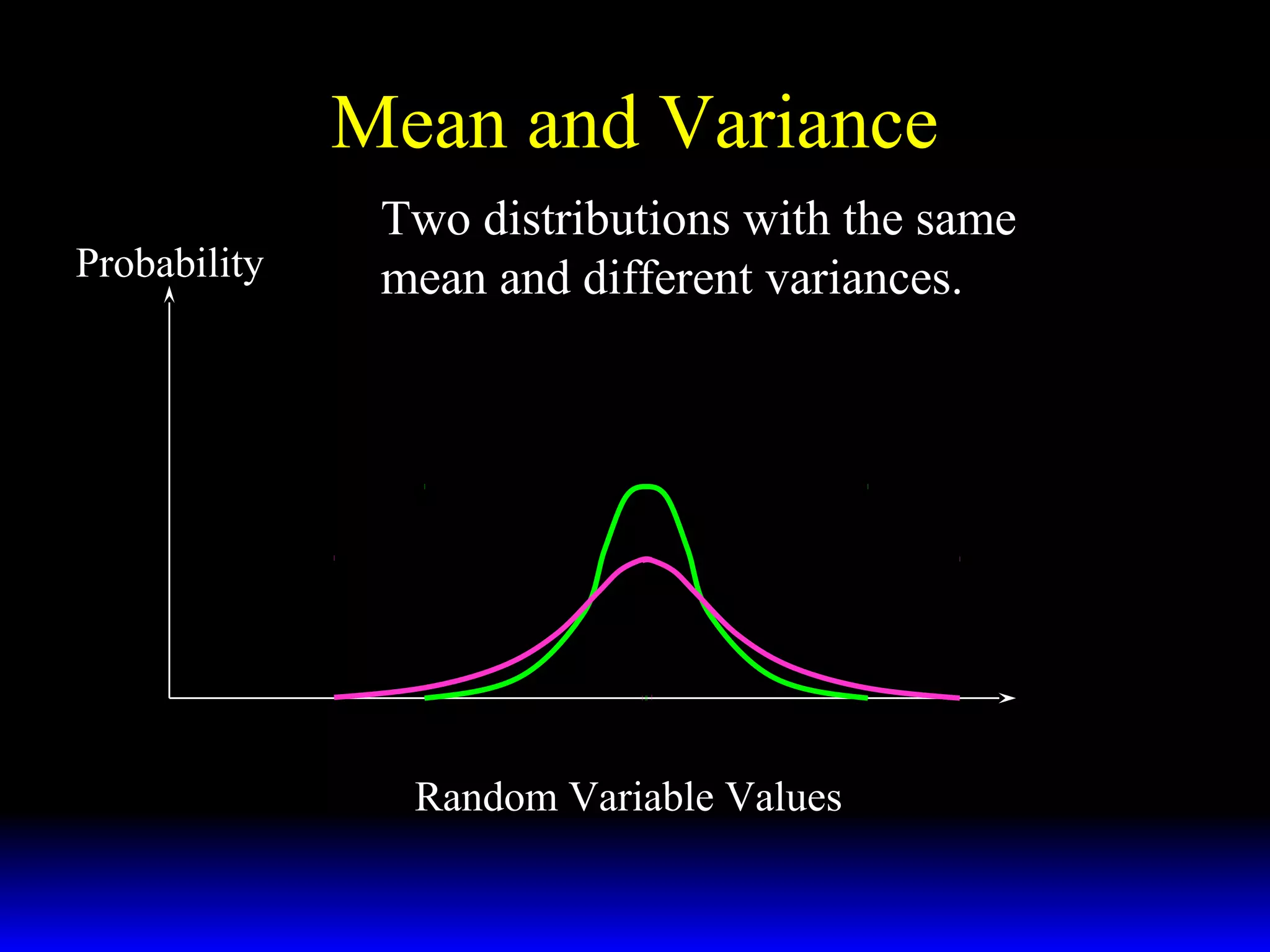
Mean and Variance
Probability

Two distributions with the same
mean and different variances.

Random Variable Values
Preferences over Risky Assets
Higher mean return is preferred.
Less variation in return is preferred
(less risk).
Preferences over Risky Assets
Higher mean return is preferred.
Less variation in return is preferred
(less risk).
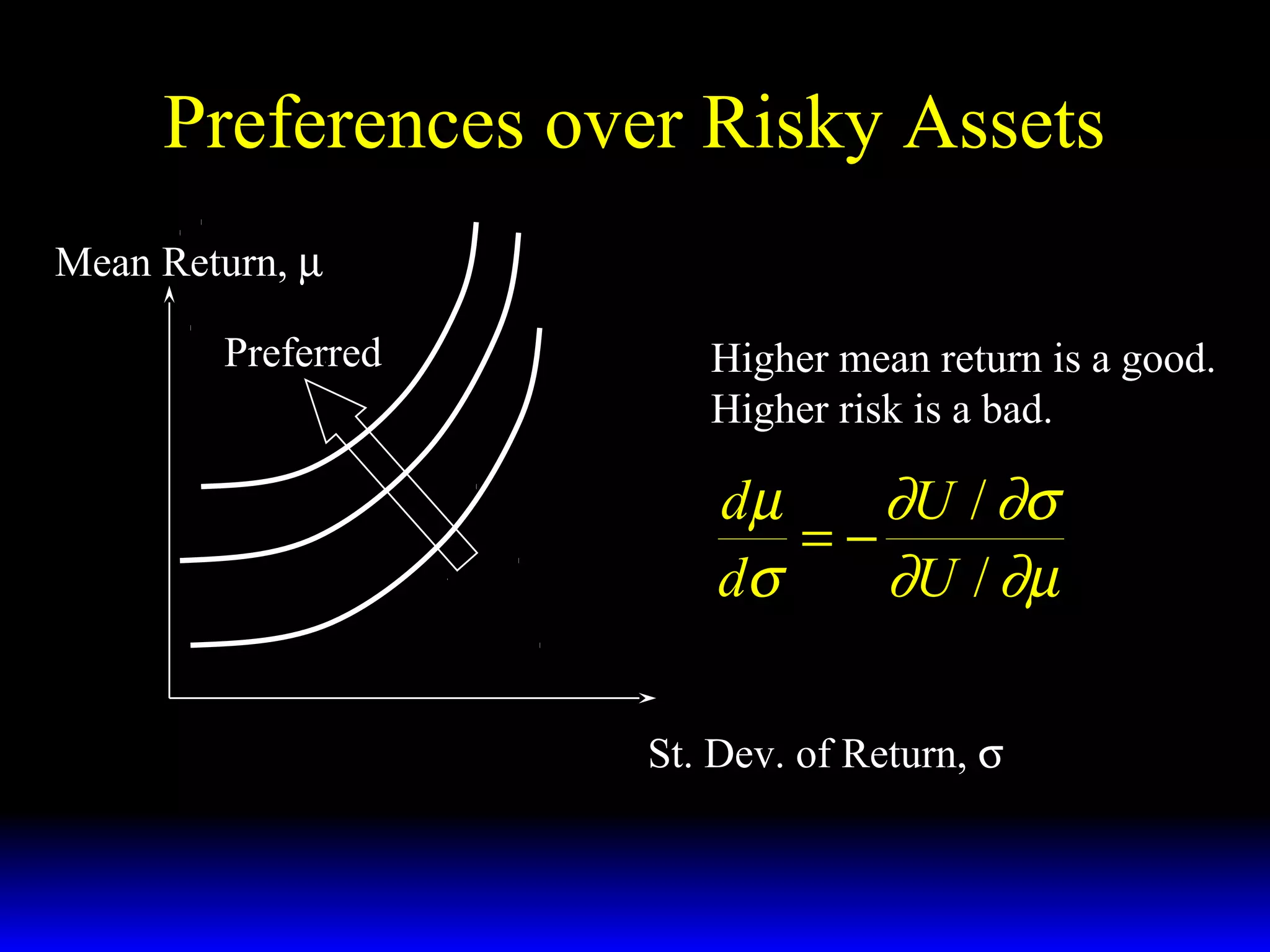
Preferences are represented by a
utility function U(µ,σ).
U ↑ as mean return µ ↑.
U ↓ as risk σ ↑.
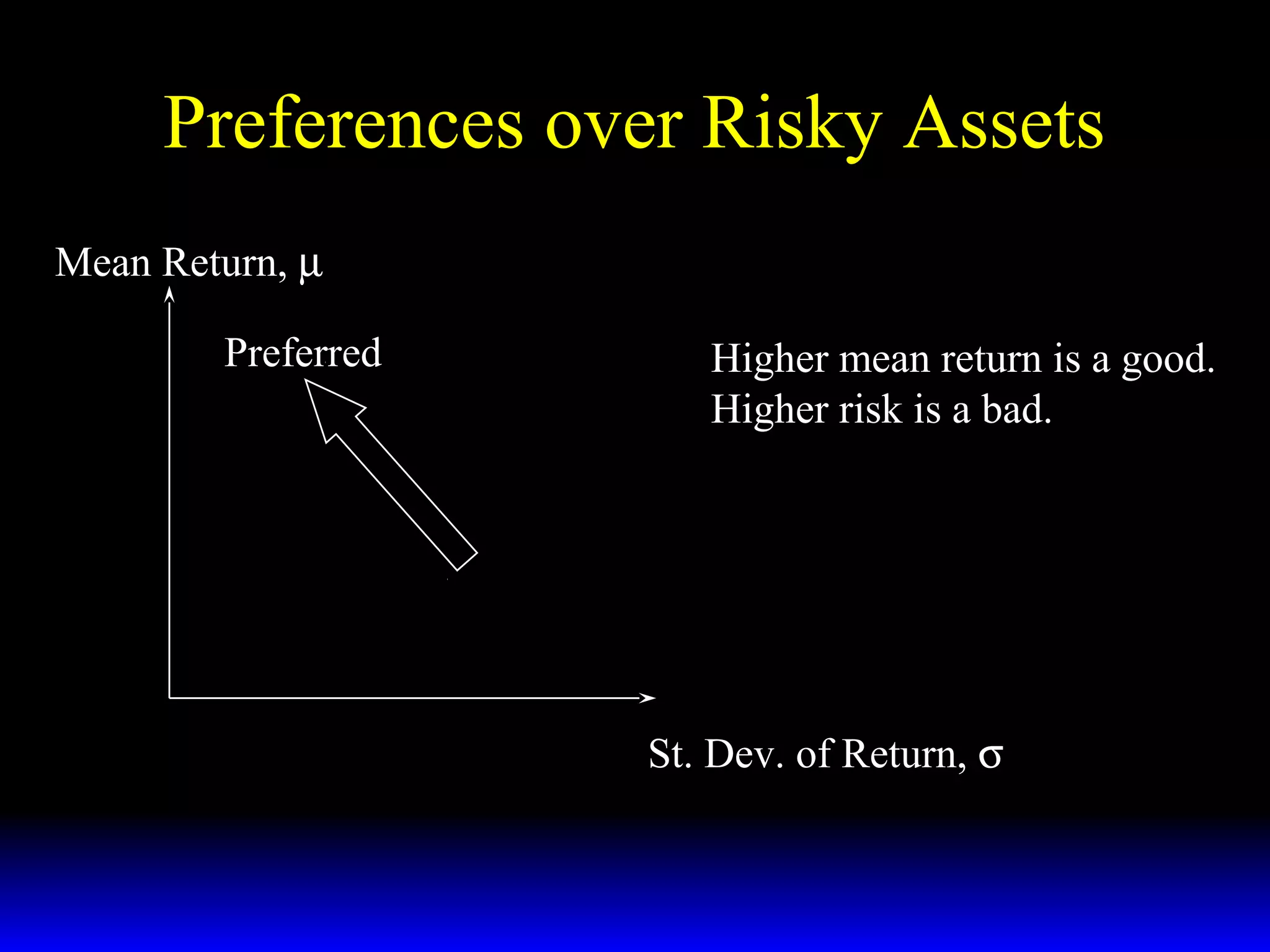
Preferences over Risky Assets
Mean Return, µ
Preferred

Higher mean return is a good.
Higher risk is a bad.

St. Dev. of Return, σ
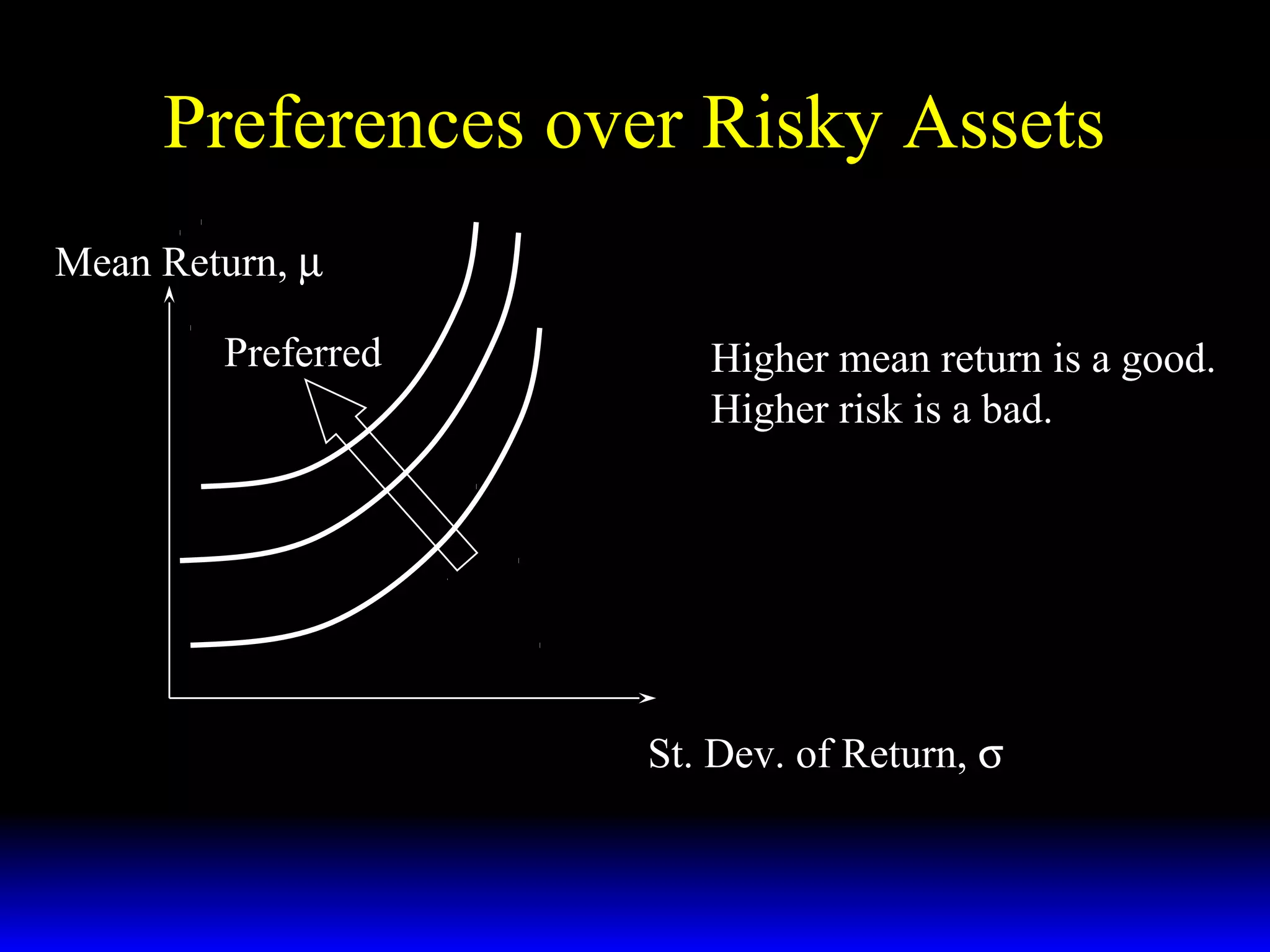
Preferences over Risky Assets
Mean Return, µ
Preferred

Higher mean return is a good.
Higher risk is a bad.

St. Dev. of Return, σ
Preferences over Risky Assets
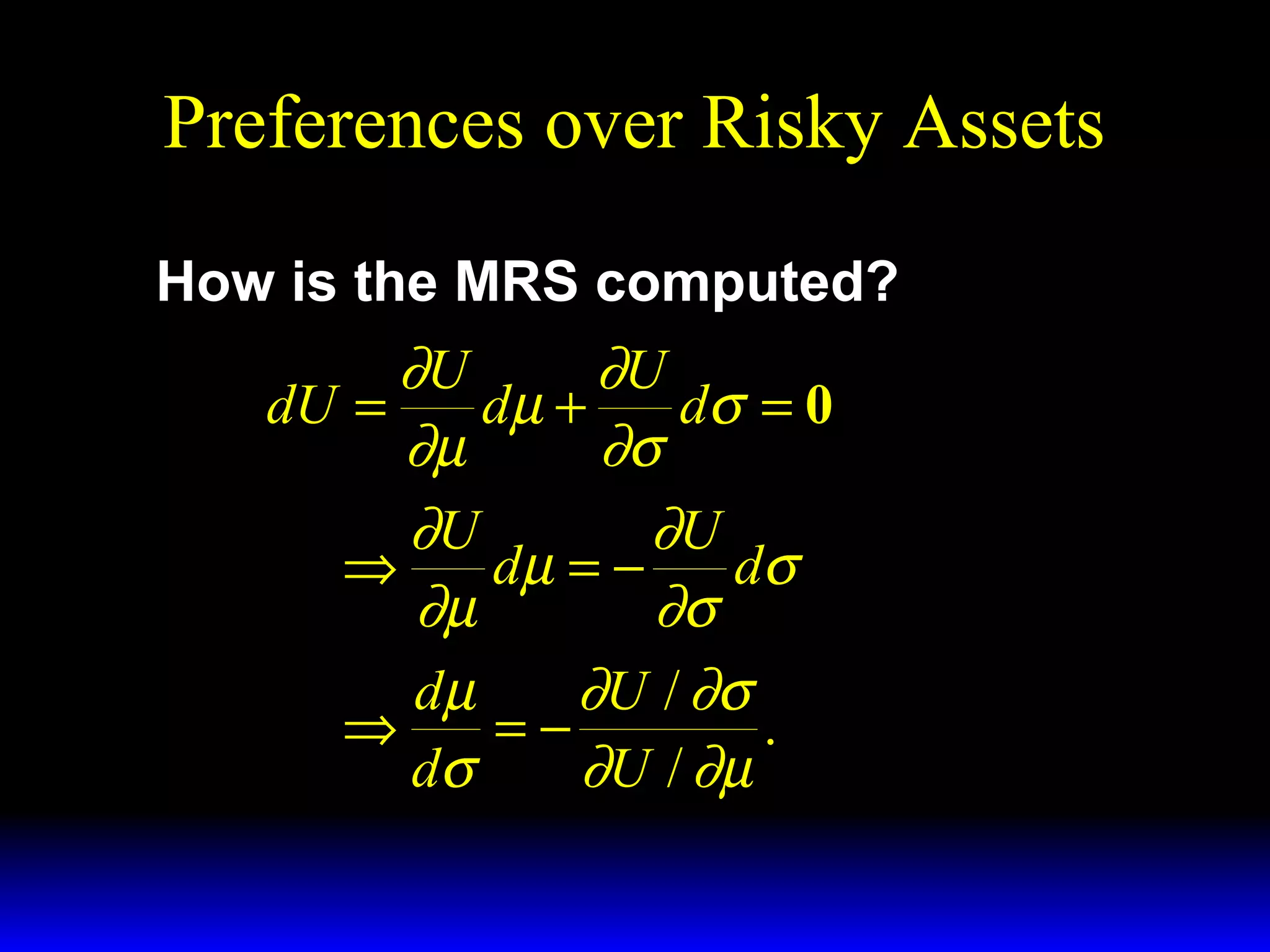
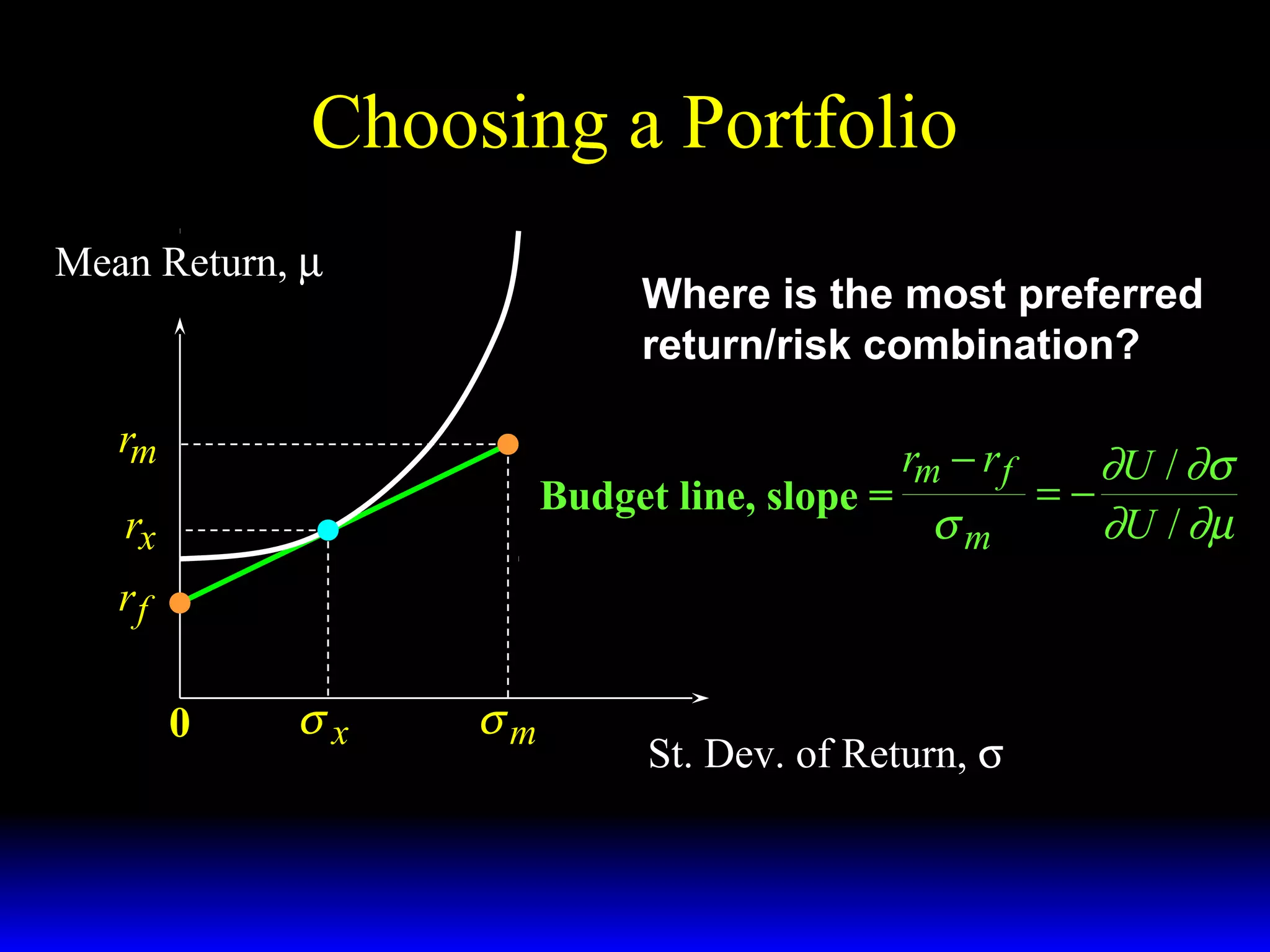
How is the MRS computed?
Preferences over Risky Assets
How is the MRS computed?

∂U
∂U
dU =
dµ +
dσ = 0
∂µ
∂σ
∂U
∂U
⇒
dµ = −
dσ
∂µ
∂σ
dµ
∂U / ∂σ
⇒
=−
.
dσ
∂U / ∂µ
Preferences over Risky Assets
Mean Return, µ
Preferred

Higher mean return is a good.
Higher risk is a bad.

dµ
∂U / ∂σ
=−
dσ
∂U / ∂µ
St. Dev. of Return, σ
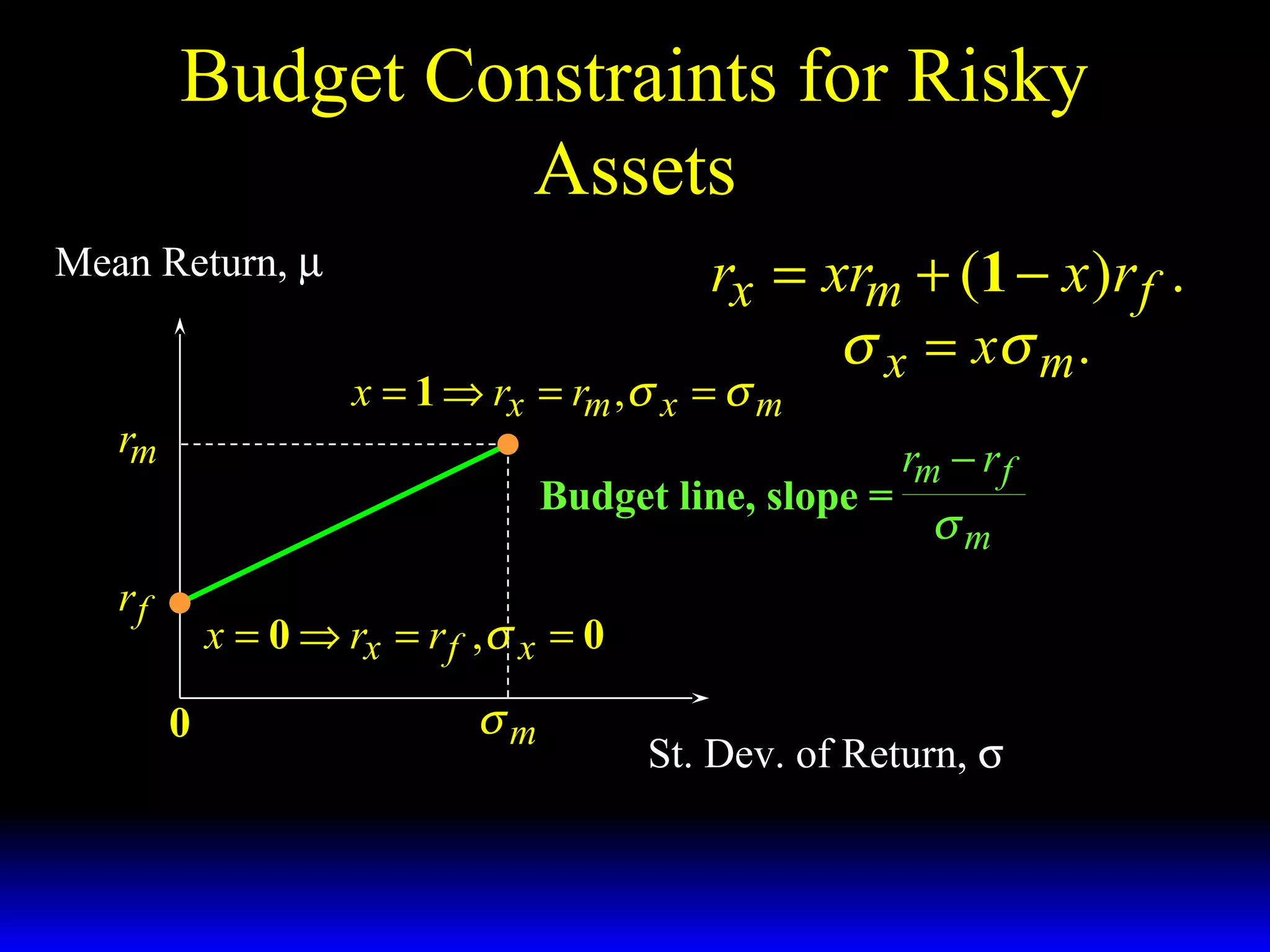
Budget Constraints for Risky
Assets
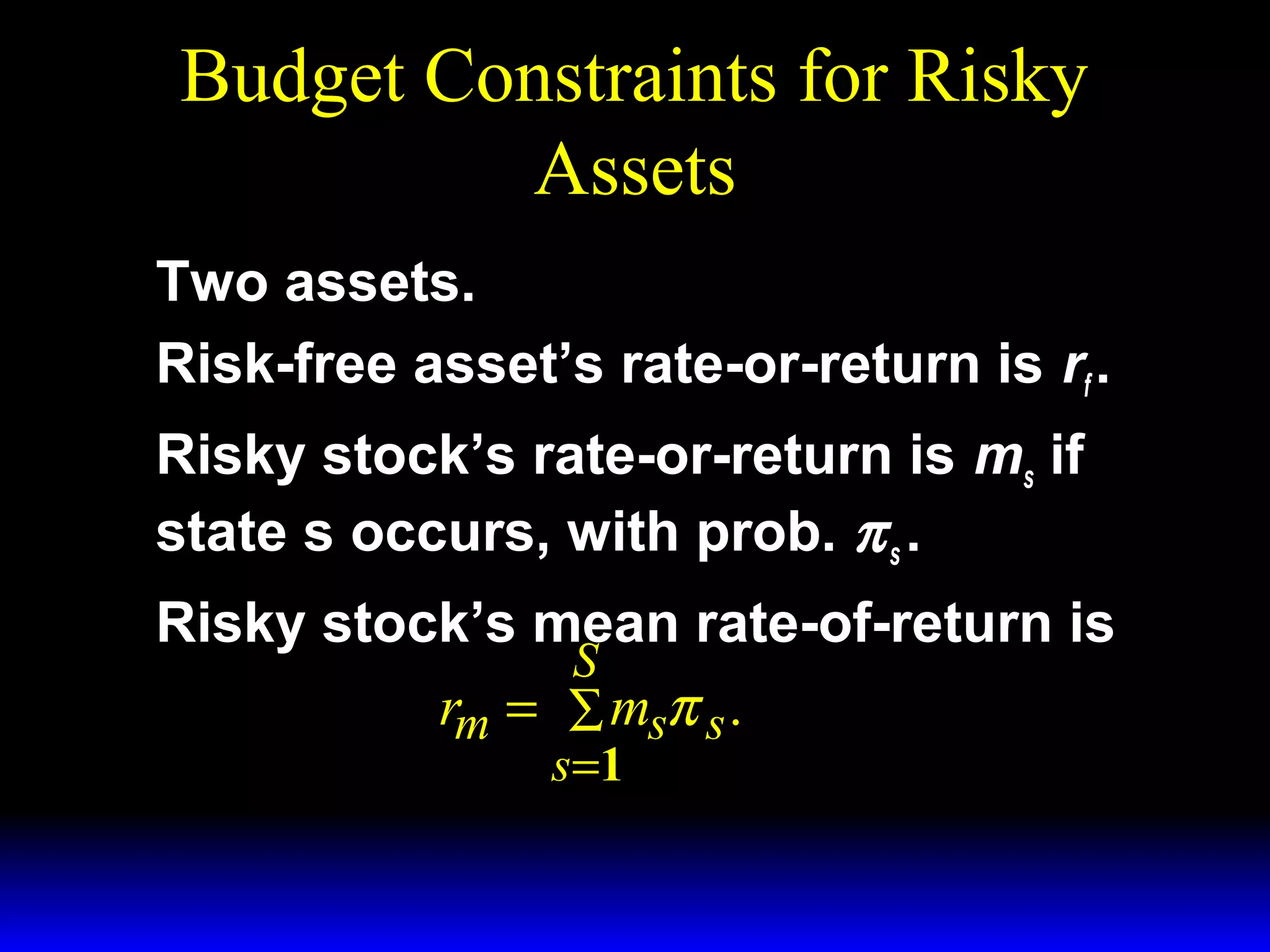
Two assets.
Risk-free asset’s rate-or-return is rf .
Risky stock’s rate-or-return is ms if
state s occurs, with prob. π s .
Risky stock’s mean rate-of-return is
S
rm = ∑ msπ s .
s =1
Budget Constraints for Risky
Assets
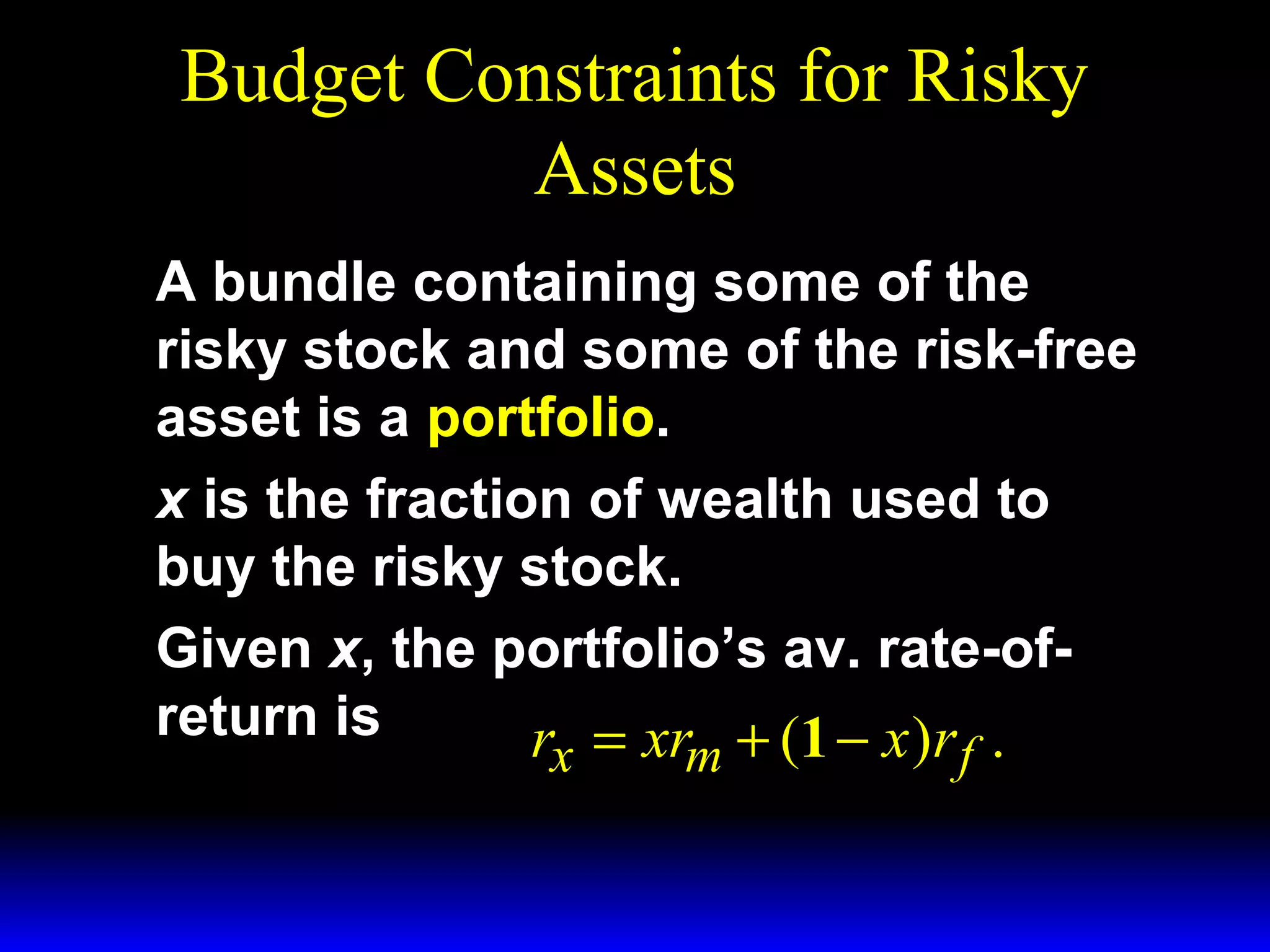
A bundle containing some of the
risky stock and some of the risk-free
asset is a portfolio.
x is the fraction of wealth used to
buy the risky stock.
Given x, the portfolio’s av. rate-ofreturn is
r = xr + (1 − x )r .
x

m

f
Budget Constraints for Risky
Assets
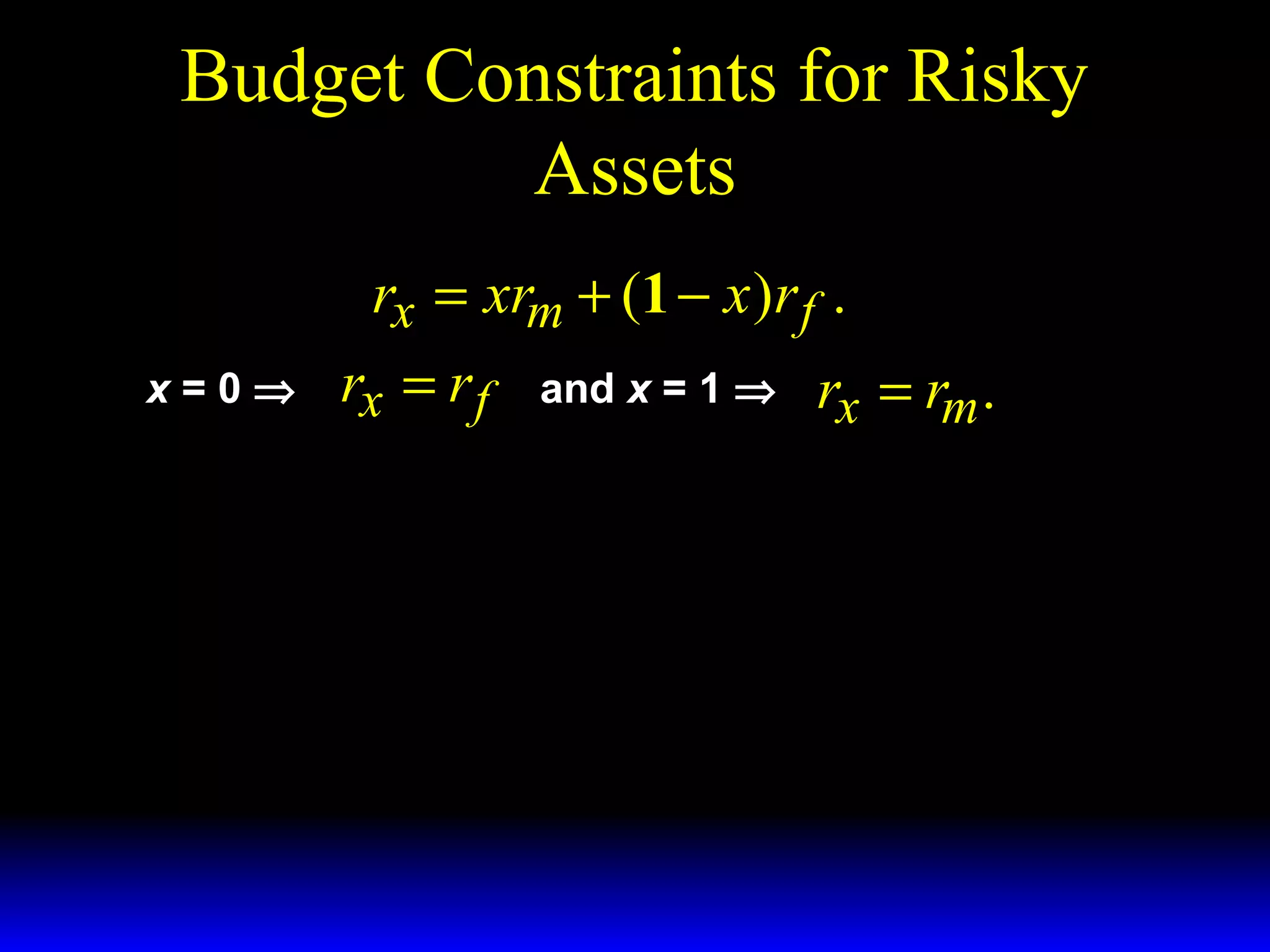
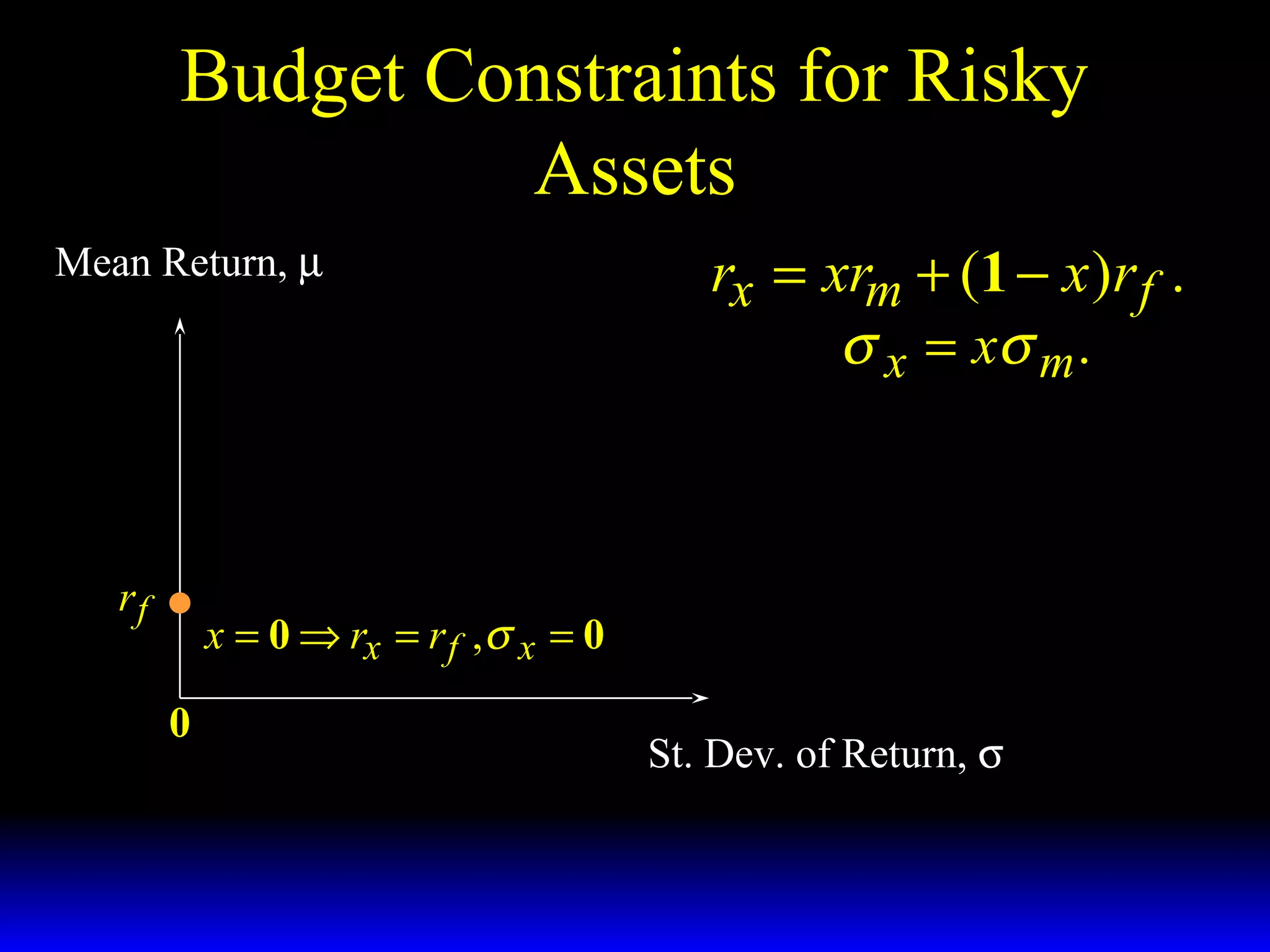
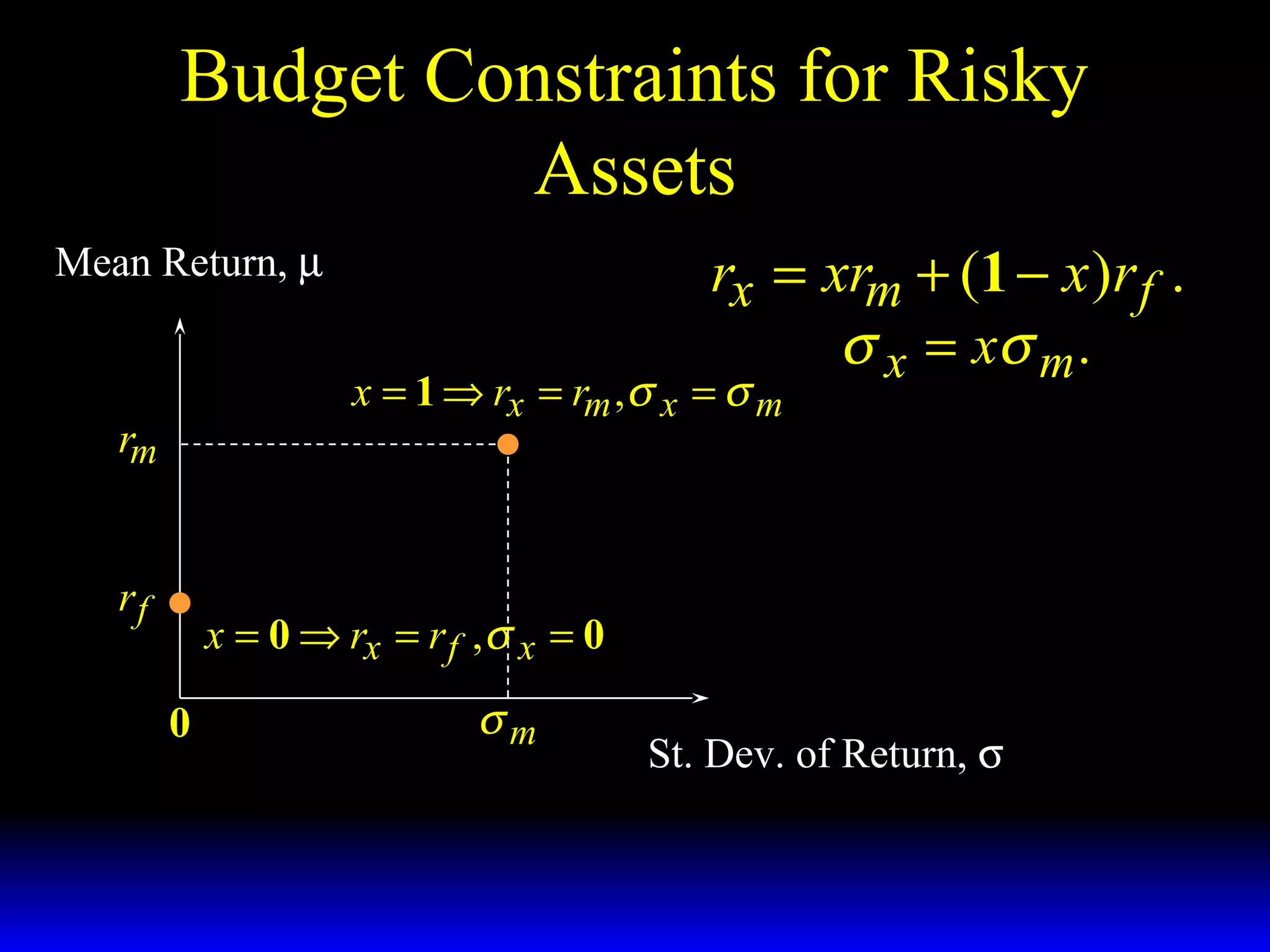
rx = xrm + (1 − x )r f .
x=0⇒

rx = r f

and x = 1 ⇒

rx = rm .
Budget Constraints for Risky
Assets
rx = xrm + (1 − x )r f .
x=0⇒

rx = r f

and x = 1 ⇒

rx = rm .

Since stock is risky and risk is a bad, for stock
to be purchased must have rm > r f .
Budget Constraints for Risky
Assets
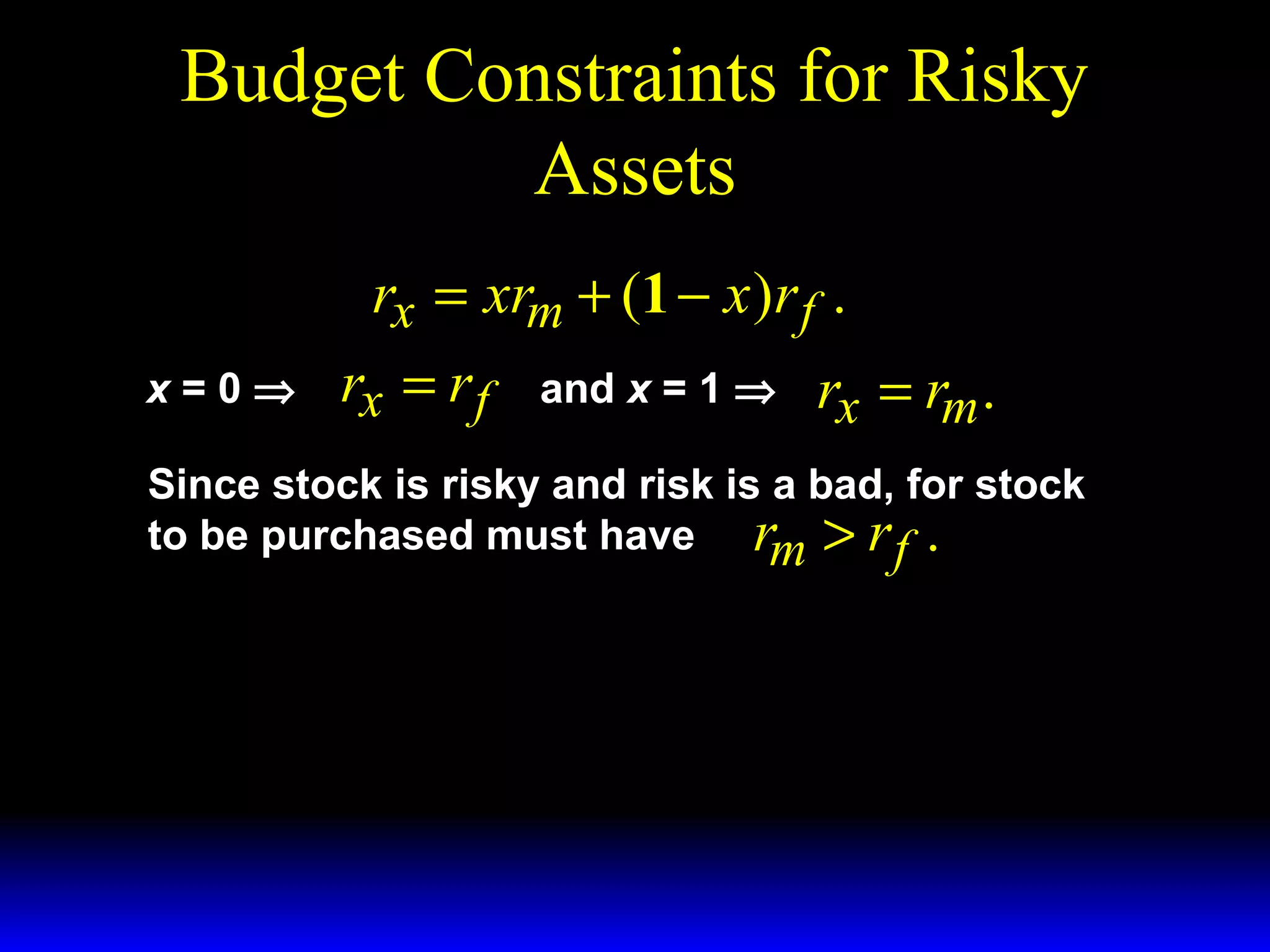
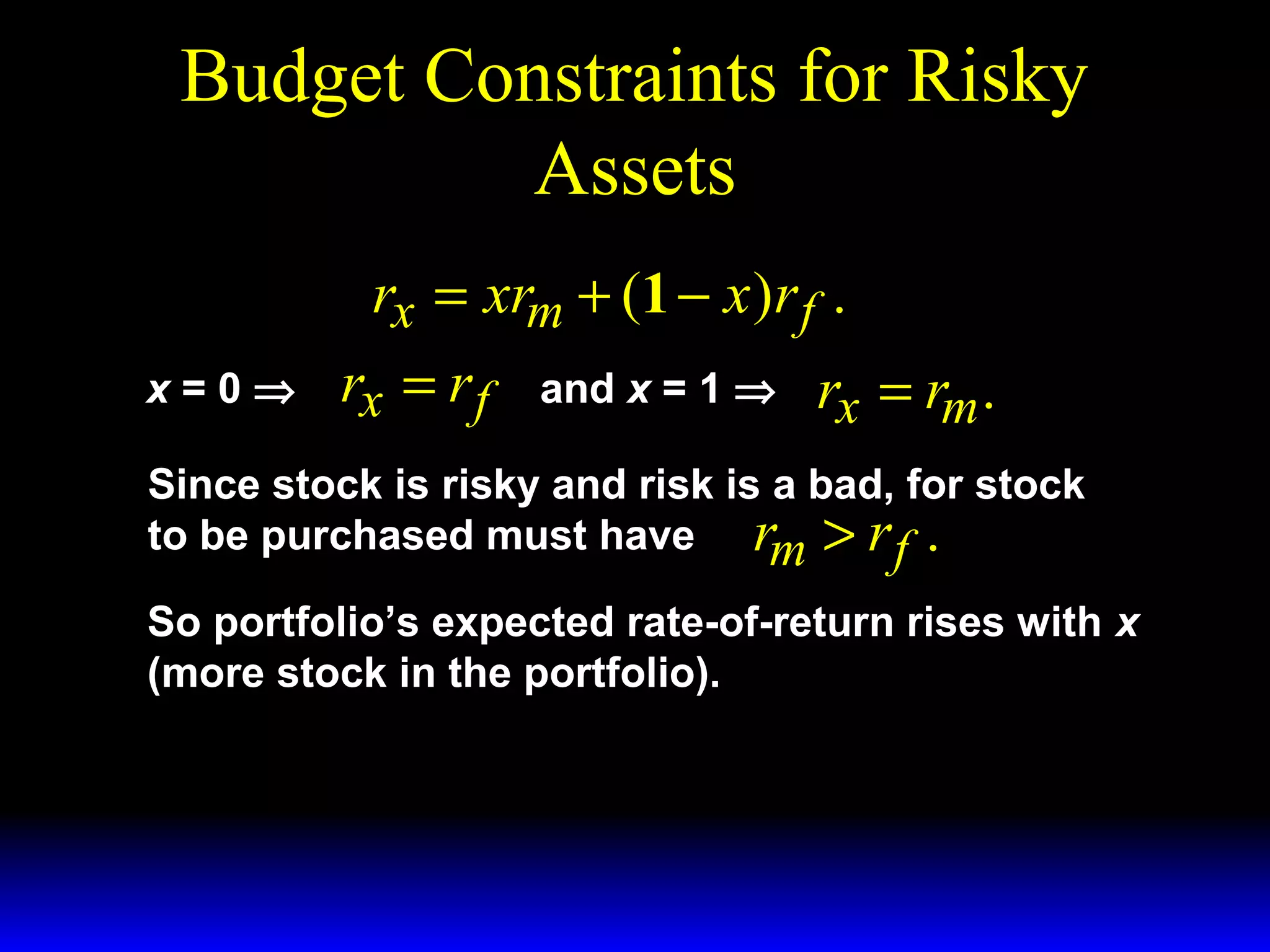
rx = xrm + (1 − x )r f .
x=0⇒

rx = r f

and x = 1 ⇒

rx = rm .

Since stock is risky and risk is a bad, for stock
to be purchased must have rm > r f .
So portfolio’s expected rate-of-return rises with x
(more stock in the portfolio).
Budget Constraints for Risky
Assets
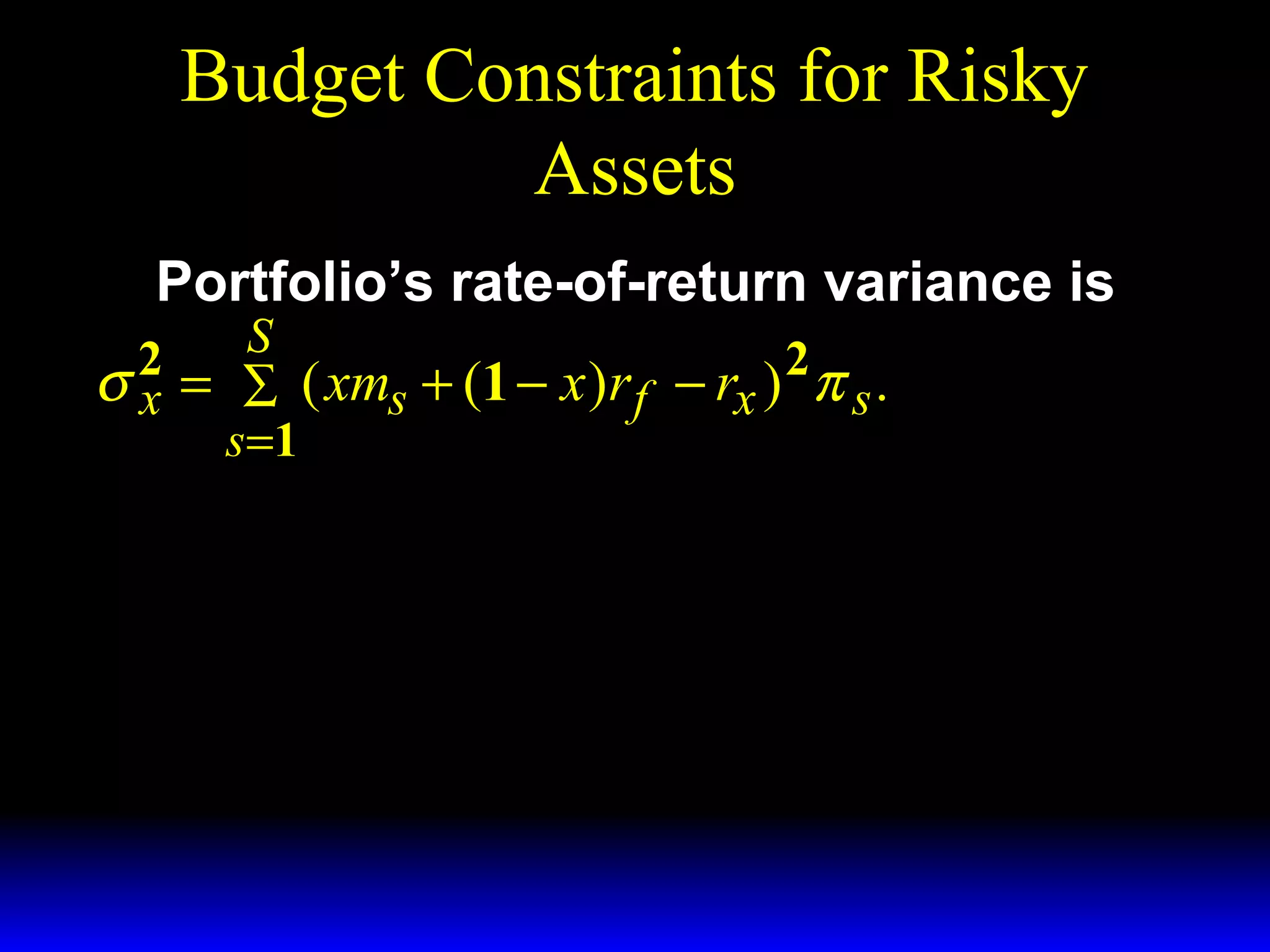
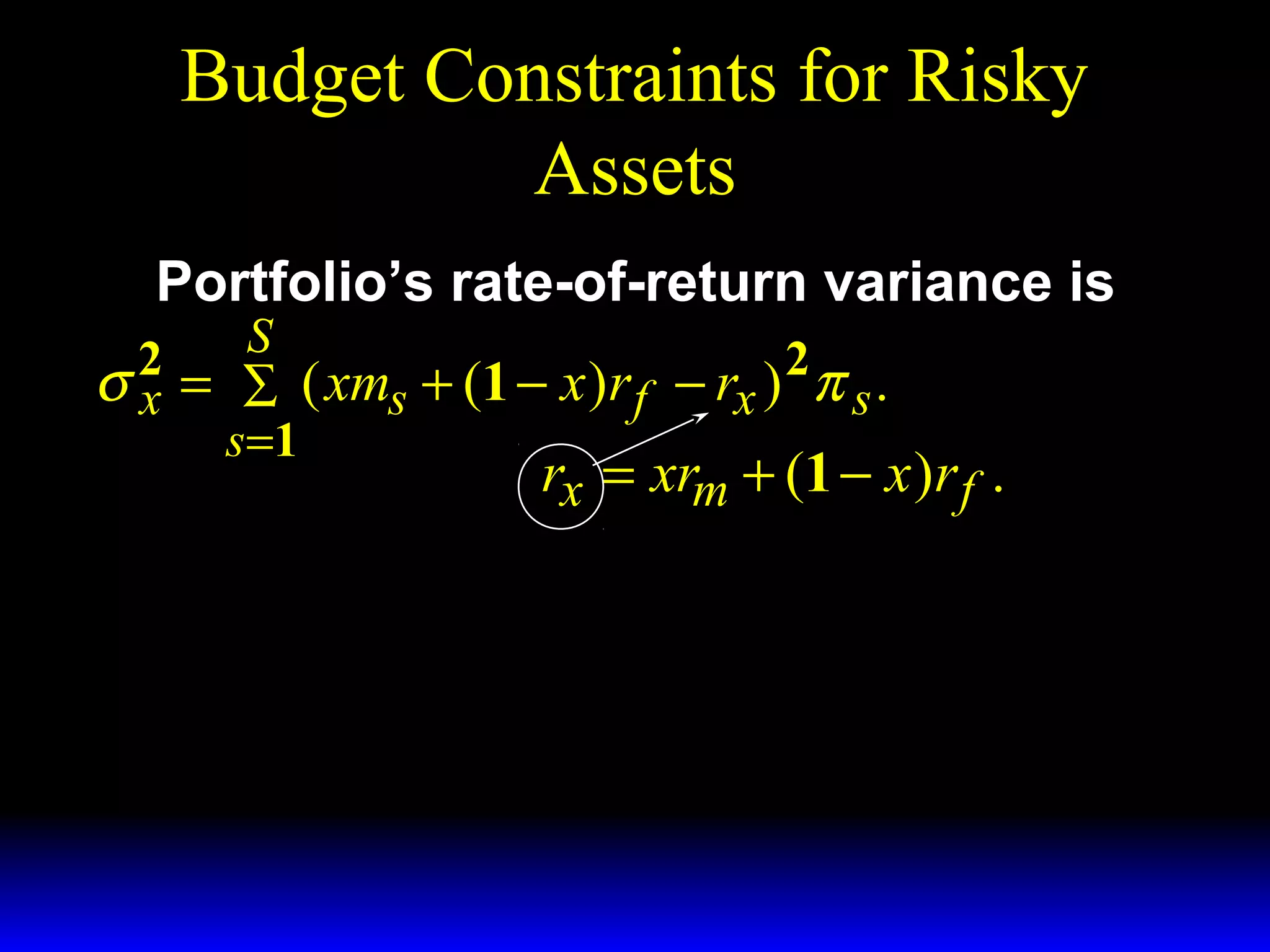
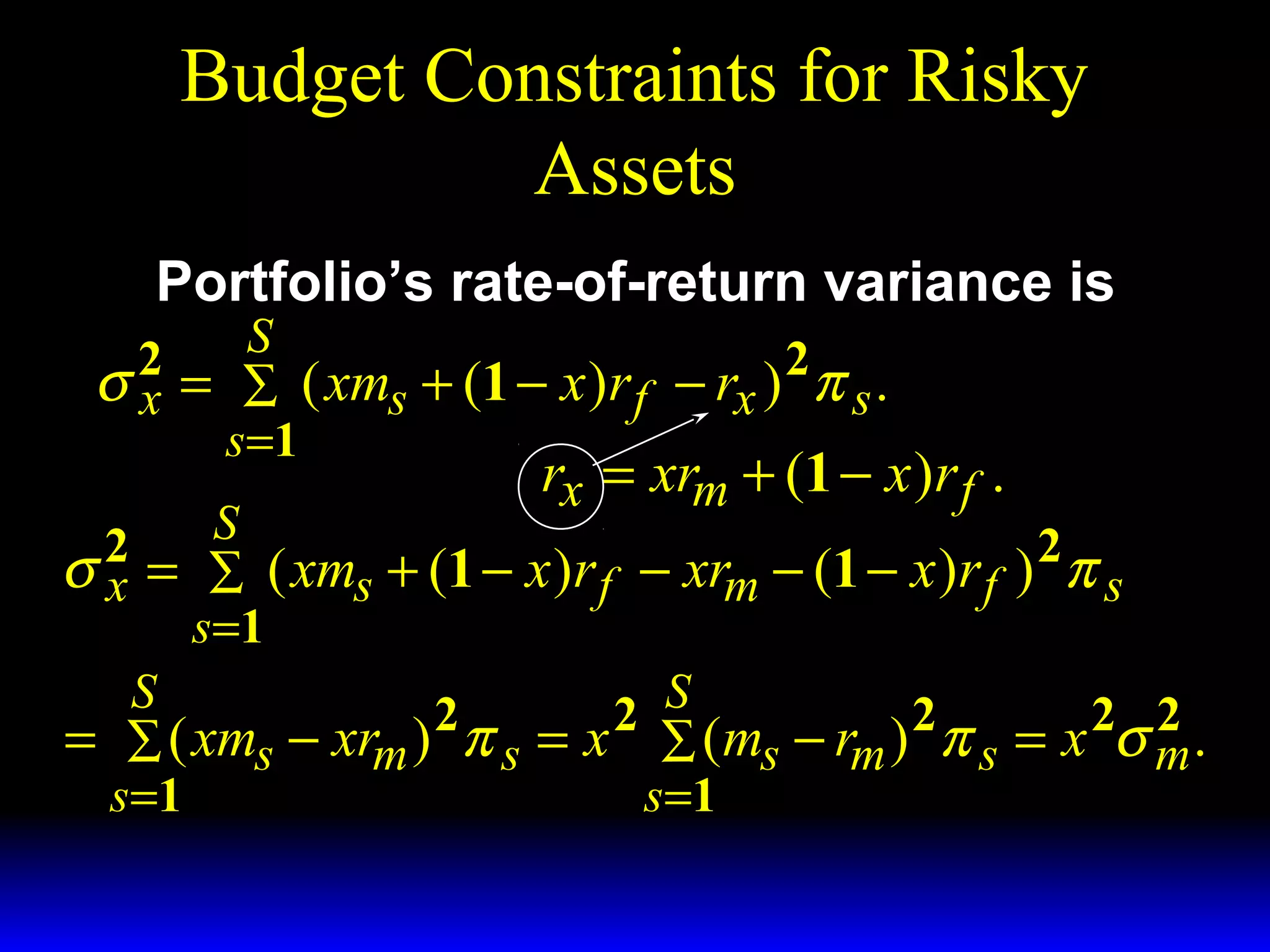
Portfolio’s rate-of-return variance is

S
σ 2 = ∑ ( xms + (1 − x )r f − rx ) 2 π s .
x
s =1
Budget Constraints for Risky
Assets
Portfolio’s rate-of-return variance is

S
σ 2 = ∑ ( xms + (1 − x )r f − rx ) 2 π s .
x
s =1
rx = xrm + (1 − x )r f .
Budget Constraints for Risky
Assets
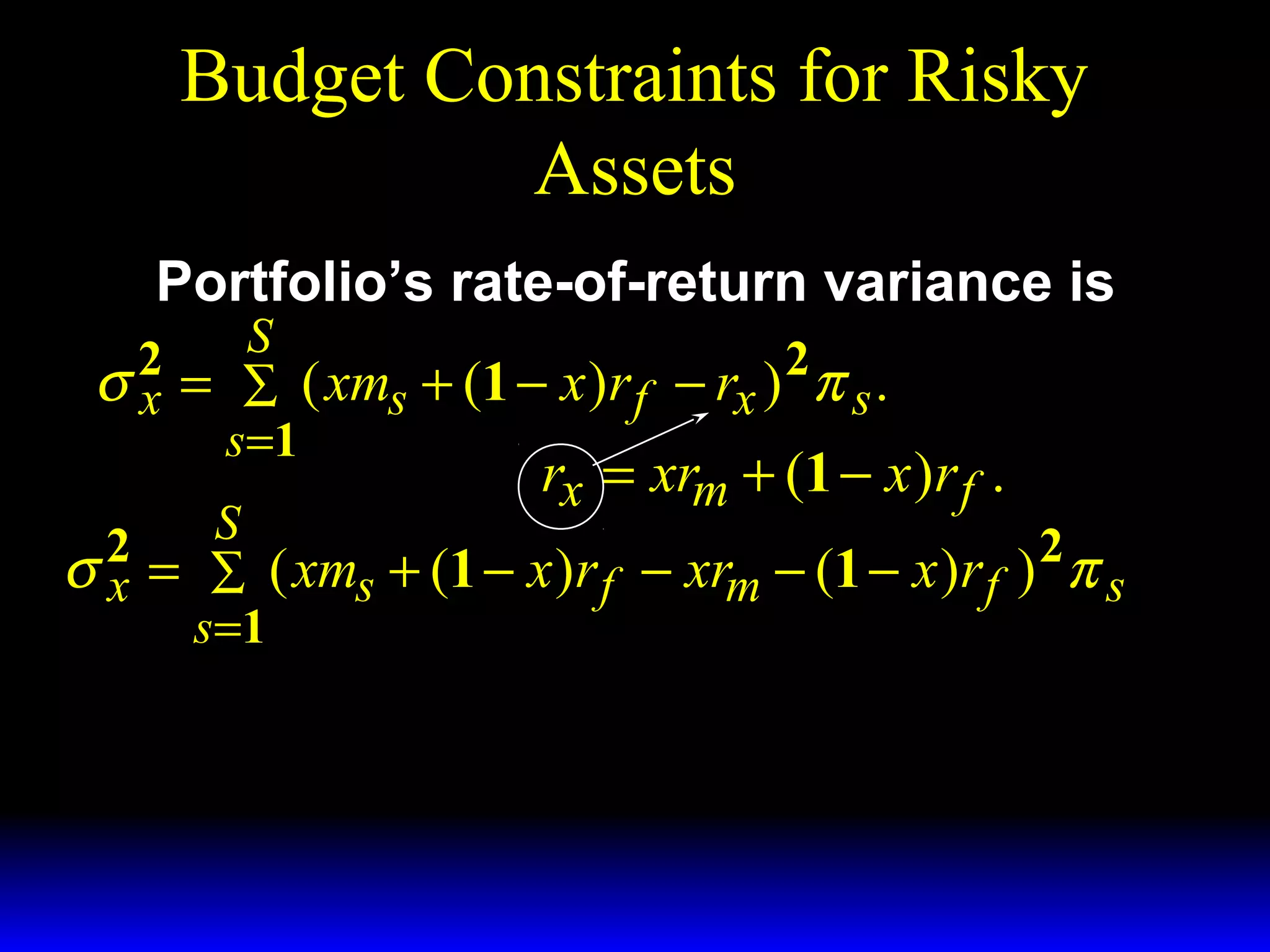
Portfolio’s rate-of-return variance is

S
σ 2 = ∑ ( xms + (1 − x )r f − rx ) 2 π s .
x
s =1
rx = xrm + (1 − x )r f .
S
2
2
σ x = ∑ ( xms + (1 − x )r f − xrm − (1 − x )r f ) π s
s =1
Budget Constraints for Risky
Assets
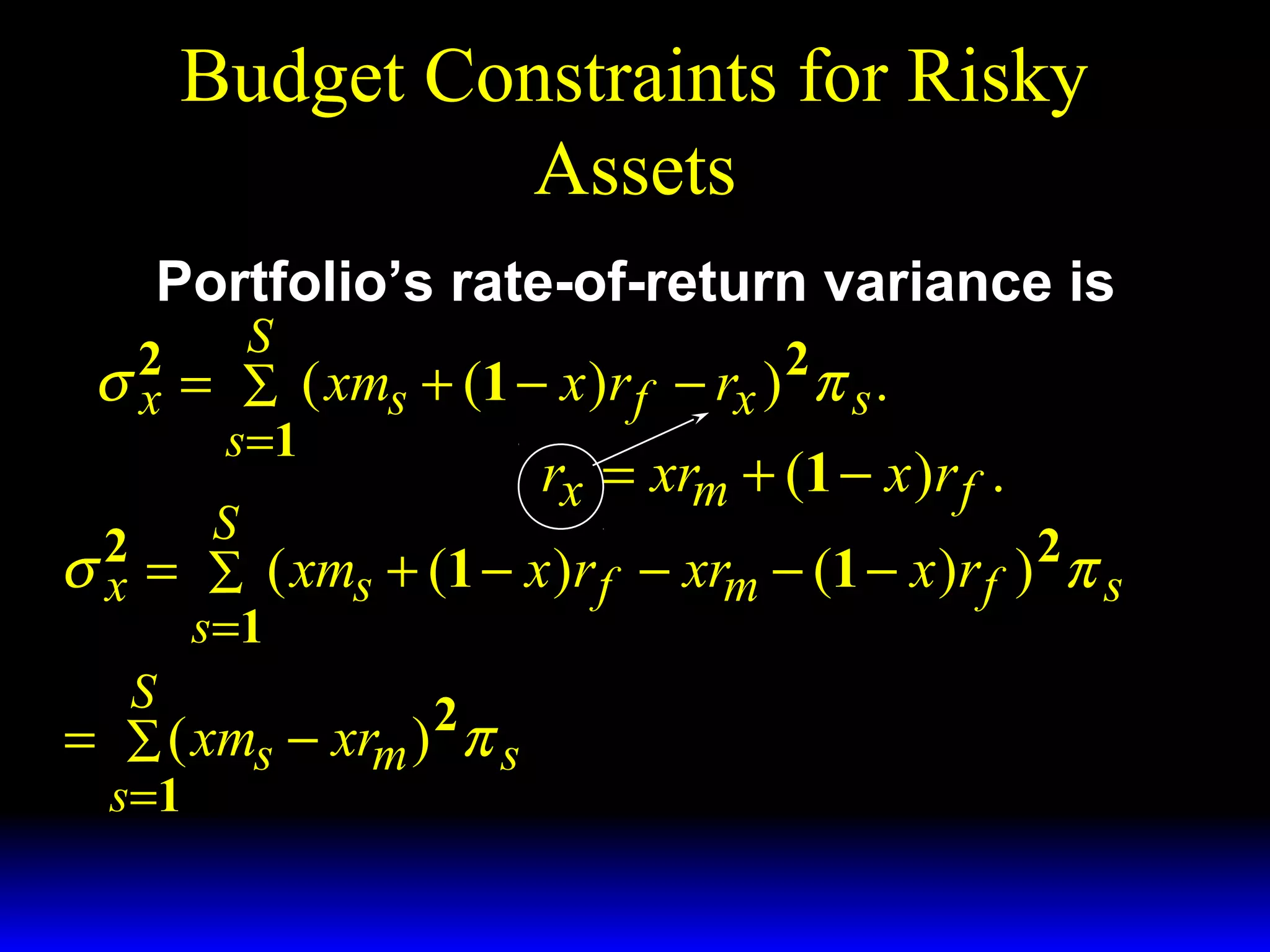
Portfolio’s rate-of-return variance is

S
σ 2 = ∑ ( xms + (1 − x )r f − rx ) 2 π s .
x
s =1
rx = xrm + (1 − x )r f .
S
2
2
σ x = ∑ ( xms + (1 − x )r f − xrm − (1 − x )r f ) π s
s =1
S
2
= ∑ ( xms − xrm ) π s
s =1
Budget Constraints for Risky
Assets
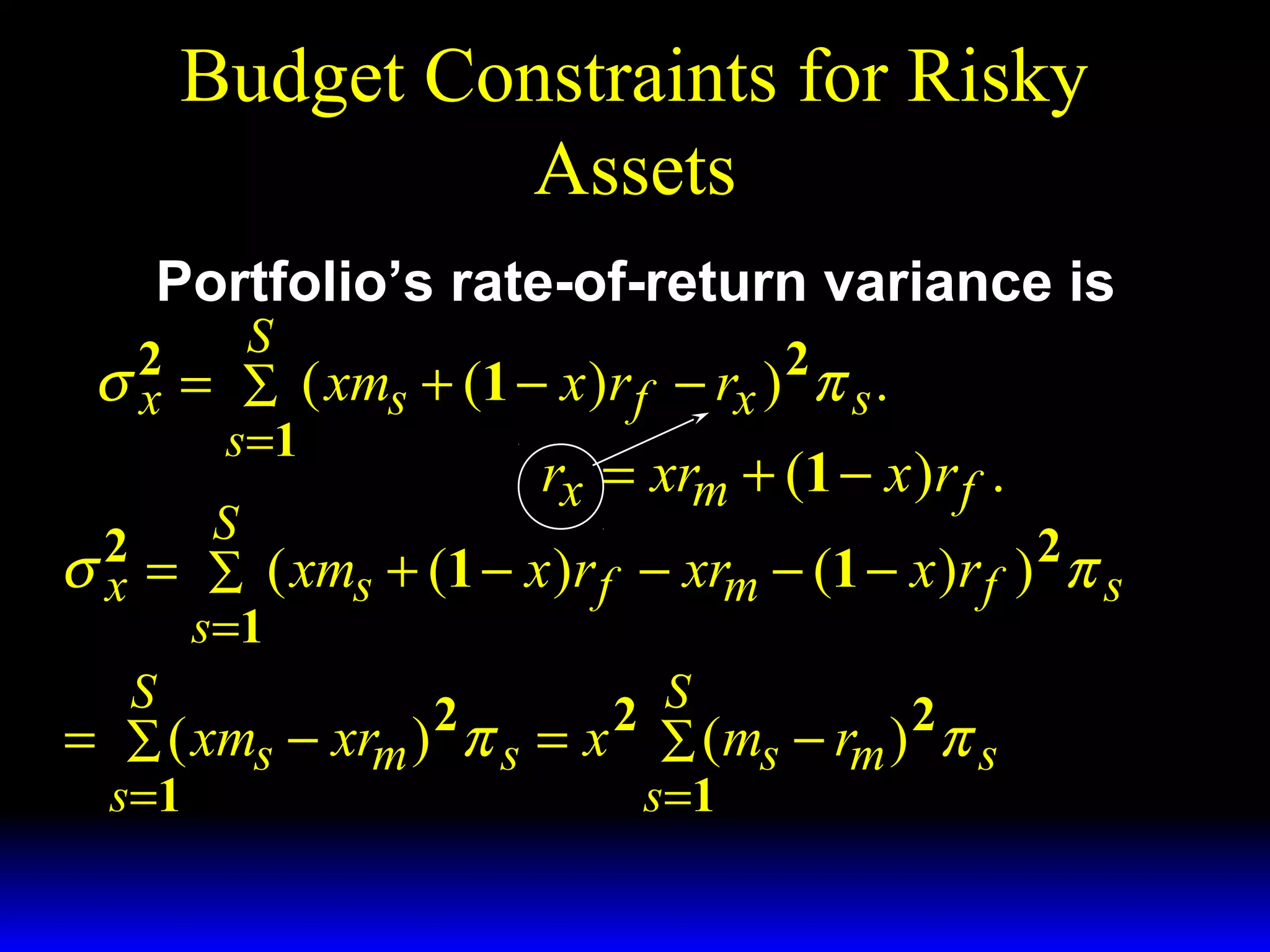
Portfolio’s rate-of-return variance is

S
σ 2 = ∑ ( xms + (1 − x )r f − rx ) 2 π s .
x
s =1
rx = xrm + (1 − x )r f .
S
2
2
σ x = ∑ ( xms + (1 − x )r f − xrm − (1 − x )r f ) π s
s =1
S
2
2 S
2
= ∑ ( xms − xrm ) π s = x ∑ (ms − rm ) π s
s =1
s =1
Budget Constraints for Risky
Assets
Portfolio’s rate-of-return variance is

S
σ 2 = ∑ ( xms + (1 − x )r f − rx ) 2 π s .
x
s =1
rx = xrm + (1 − x )r f .
S
2
2
σ x = ∑ ( xms + (1 − x )r f − xrm − (1 − x )r f ) π s
s =1
S
2
2 S
2
2 2
= ∑ ( xms − xrm ) π s = x ∑ (ms − rm ) π s = x σ m .
s =1
s =1
Budget Constraints for Risky
Assets
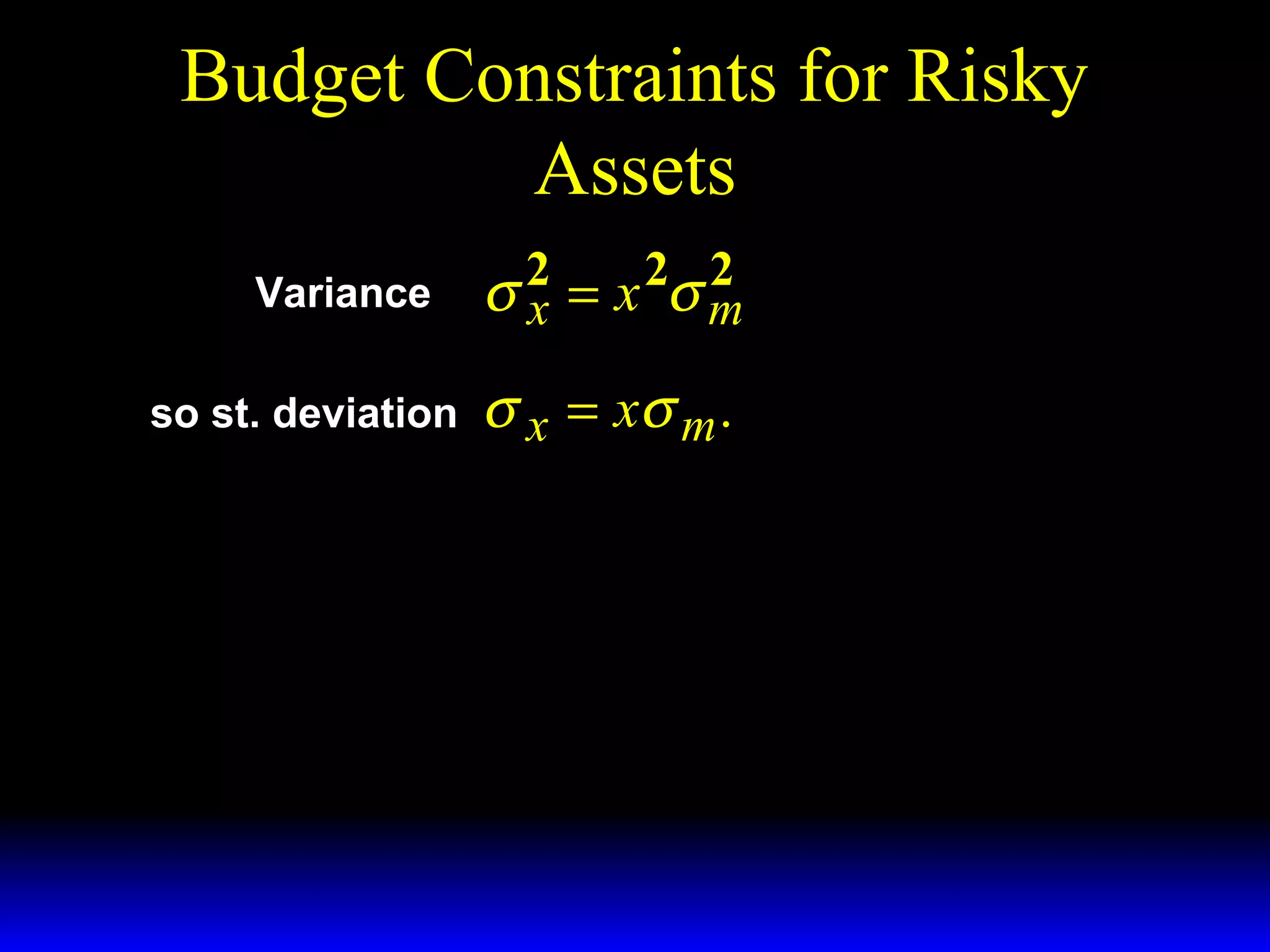
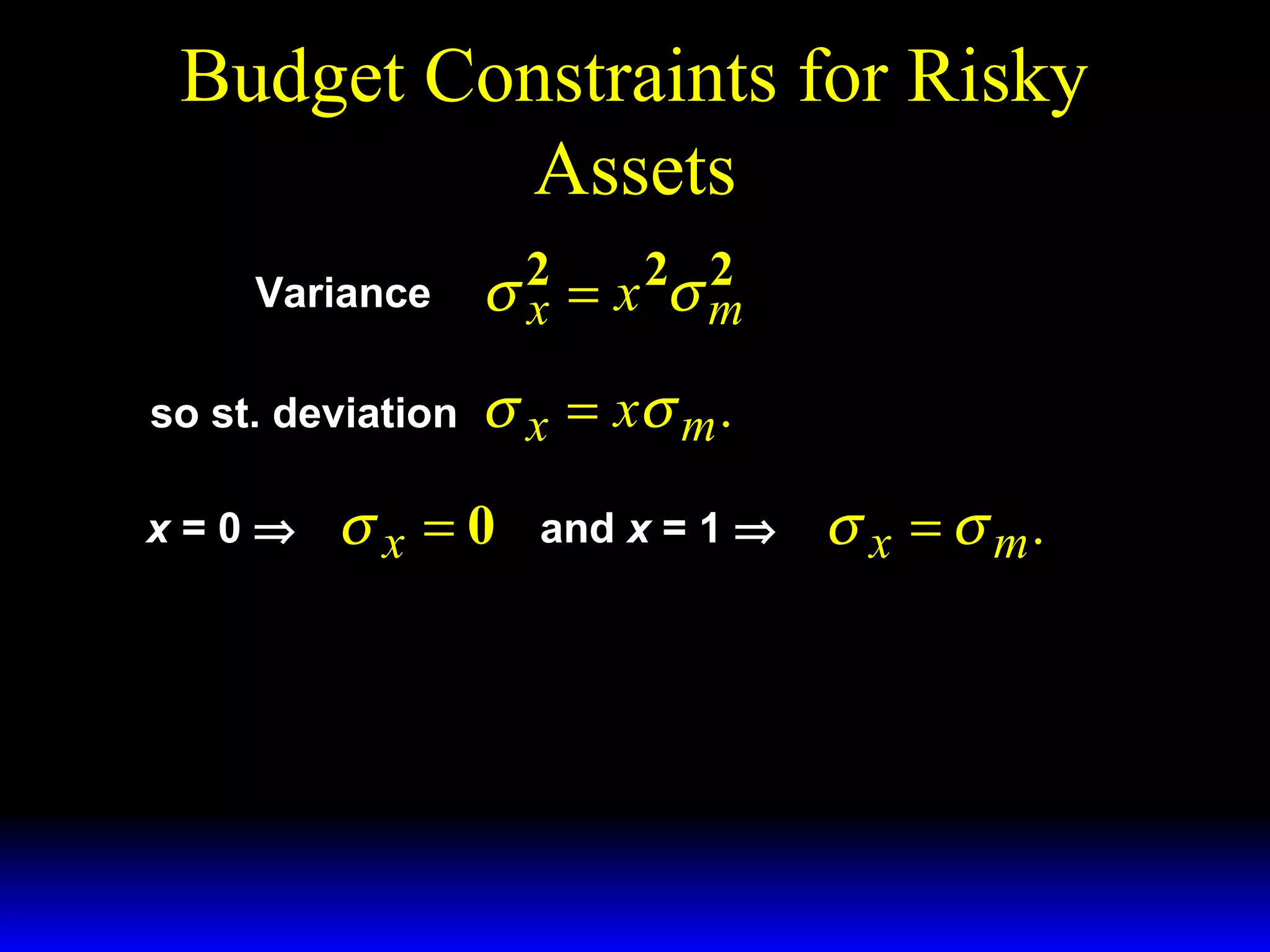
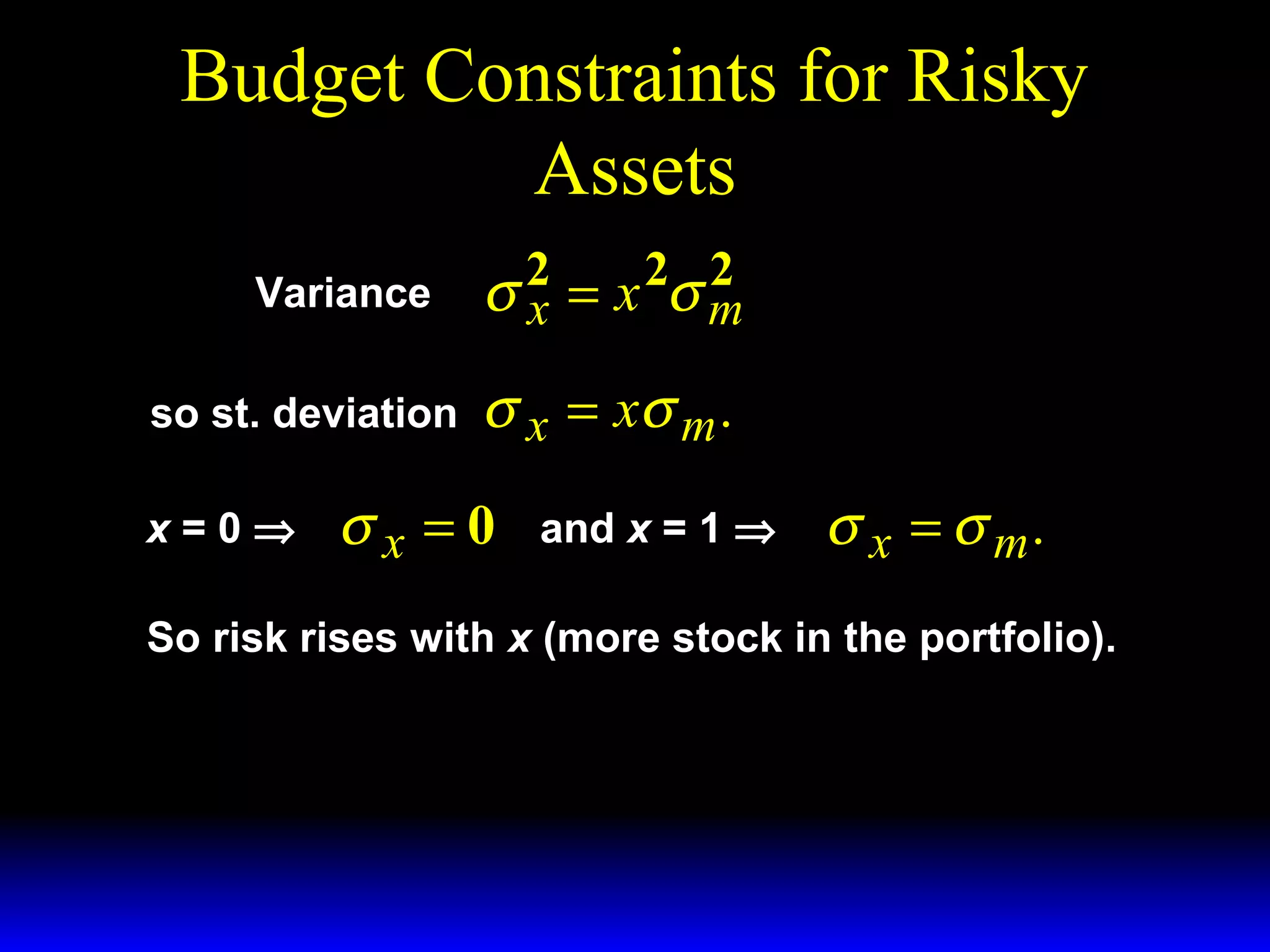
Variance
so st. deviation

2
σ 2 = x 2σ m
x

σ x = xσ m .
Budget Constraints for Risky
Assets
Variance
so st. deviation
x=0⇒

2
σ 2 = x 2σ m
x

σ x = xσ m .

σx =0

and x = 1 ⇒

σ x = σ m.
Budget Constraints for Risky
Assets
Variance
so st. deviation
x=0⇒

2
σ 2 = x 2σ m
x

σ x = xσ m .

σx =0

and x = 1 ⇒

σ x = σ m.

So risk rises with x (more stock in the portfolio).
Budget Constraints for Risky
Assets
Mean Return, µ

St. Dev. of Return, σ
Budget Constraints for Risky
Assets
Mean Return, µ

rf

rx = xrm + (1 − x )r f .
σ x = xσ m .

x = 0 ⇒ rx = r f ,σ x = 0
0

St. Dev. of Return, σ
Budget Constraints for Risky
Assets
rx = xrm + (1 − x )r f .
σ x = xσ m .

Mean Return, µ

x = 1 ⇒ rx = rm ,σ x = σ m

rm
rf

x = 0 ⇒ rx = r f ,σ x = 0
0

σm

St. Dev. of Return, σ
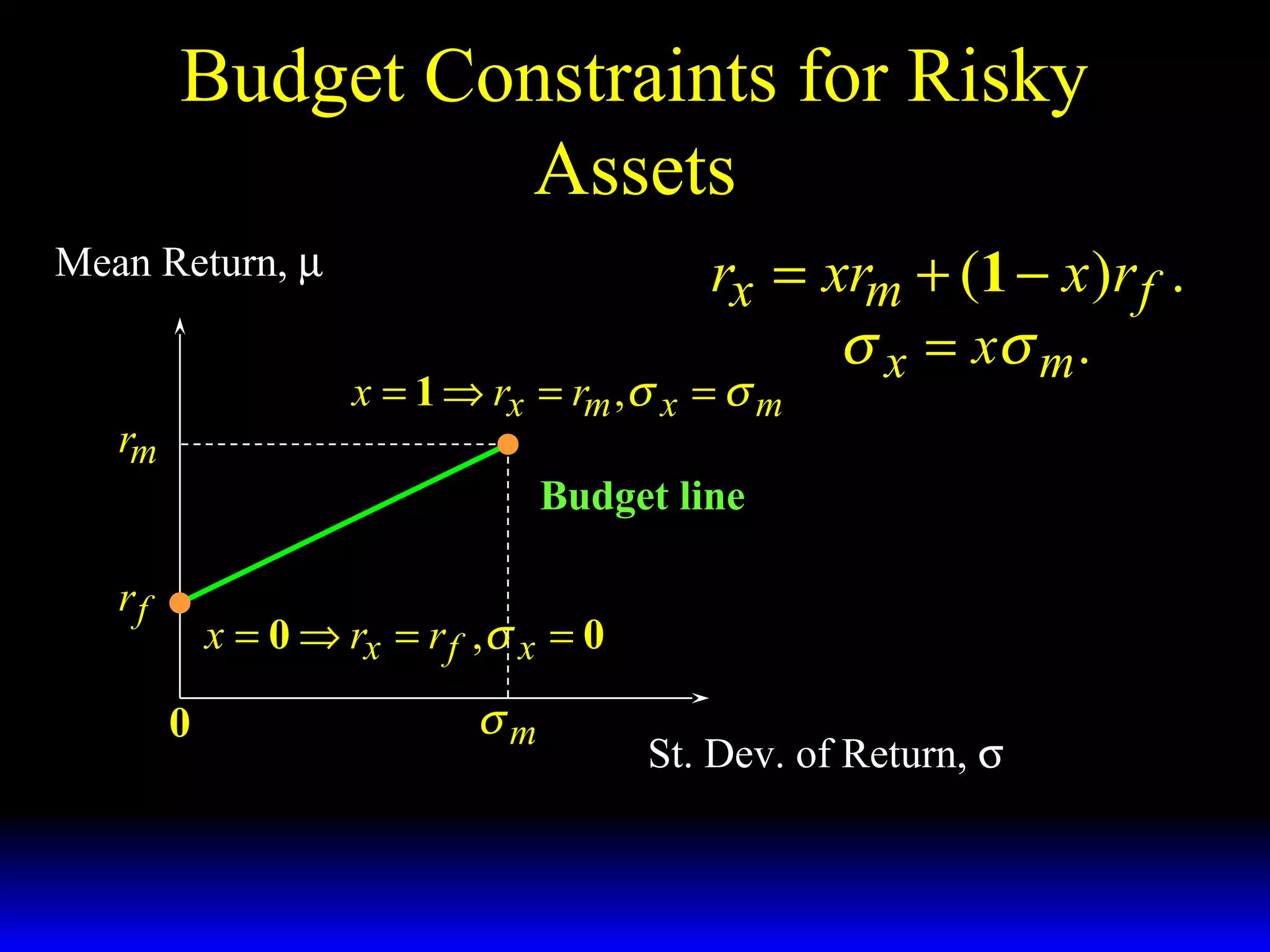
Budget Constraints for Risky
Assets
rx = xrm + (1 − x )r f .
σ x = xσ m .

Mean Return, µ

x = 1 ⇒ rx = rm ,σ x = σ m

rm

Budget line

rf

x = 0 ⇒ rx = r f ,σ x = 0
0

σm

St. Dev. of Return, σ
Budget Constraints for Risky
Assets
rx = xrm + (1 − x )r f .
σ x = xσ m .

Mean Return, µ

x = 1 ⇒ rx = rm ,σ x = σ m

rm

Budget line, slope =

rf

rm − r f

σm

x = 0 ⇒ rx = r f ,σ x = 0
0

σm

St. Dev. of Return, σ
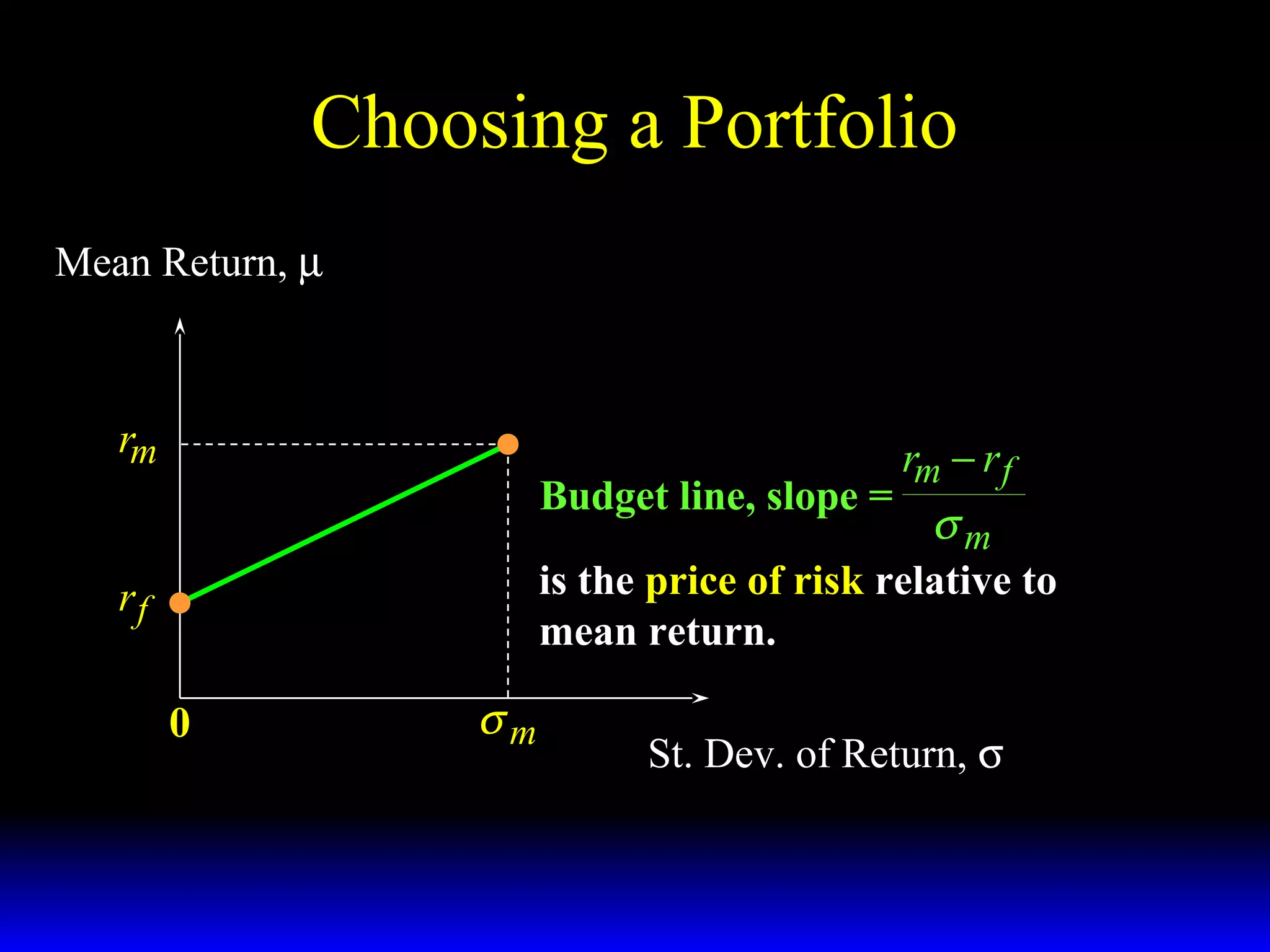
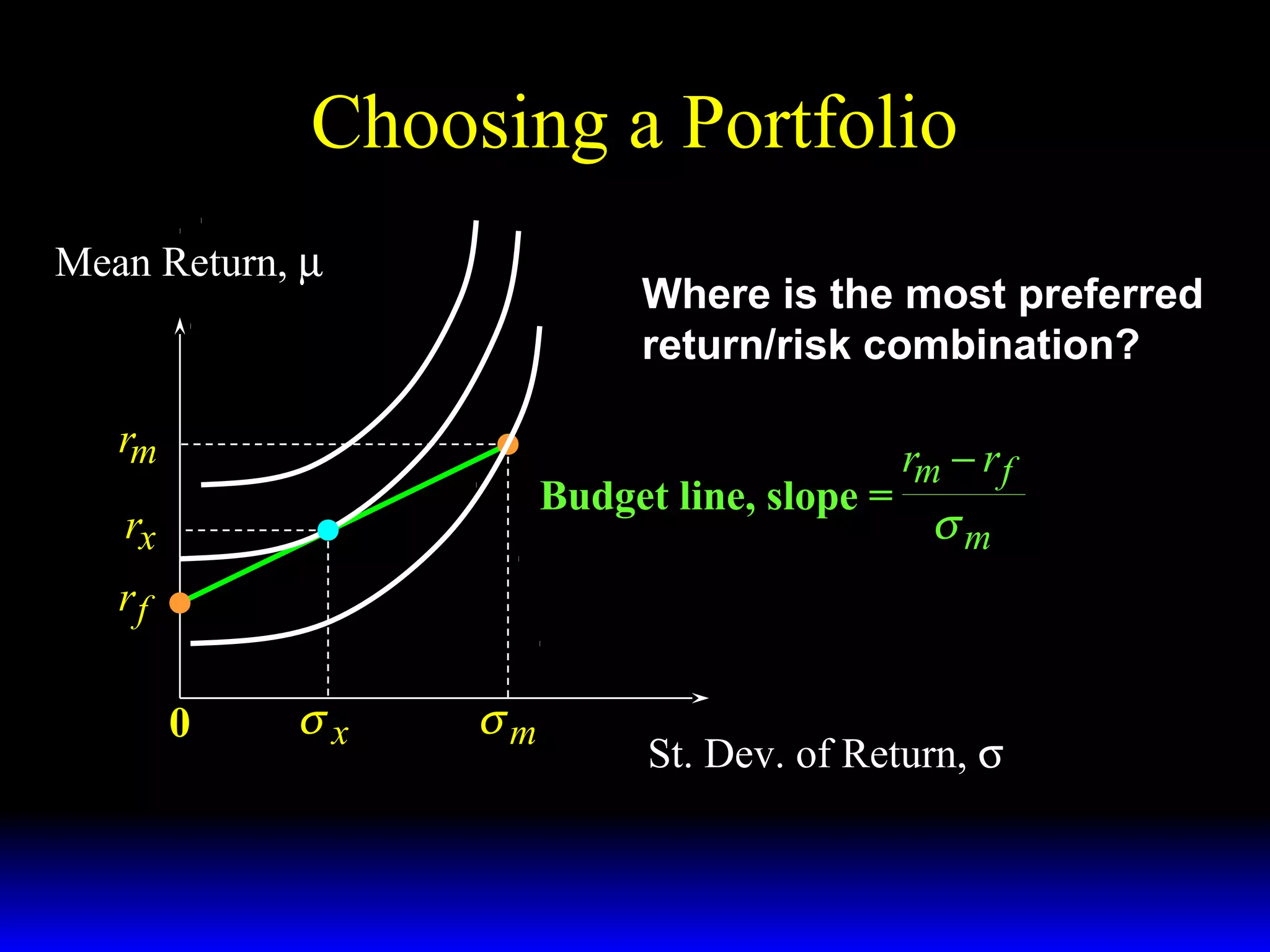
Choosing a Portfolio
Mean Return, µ

rm
Budget line, slope =

rm − r f

σm

is the price of risk relative to
mean return.

rf
0

σm

St. Dev. of Return, σ
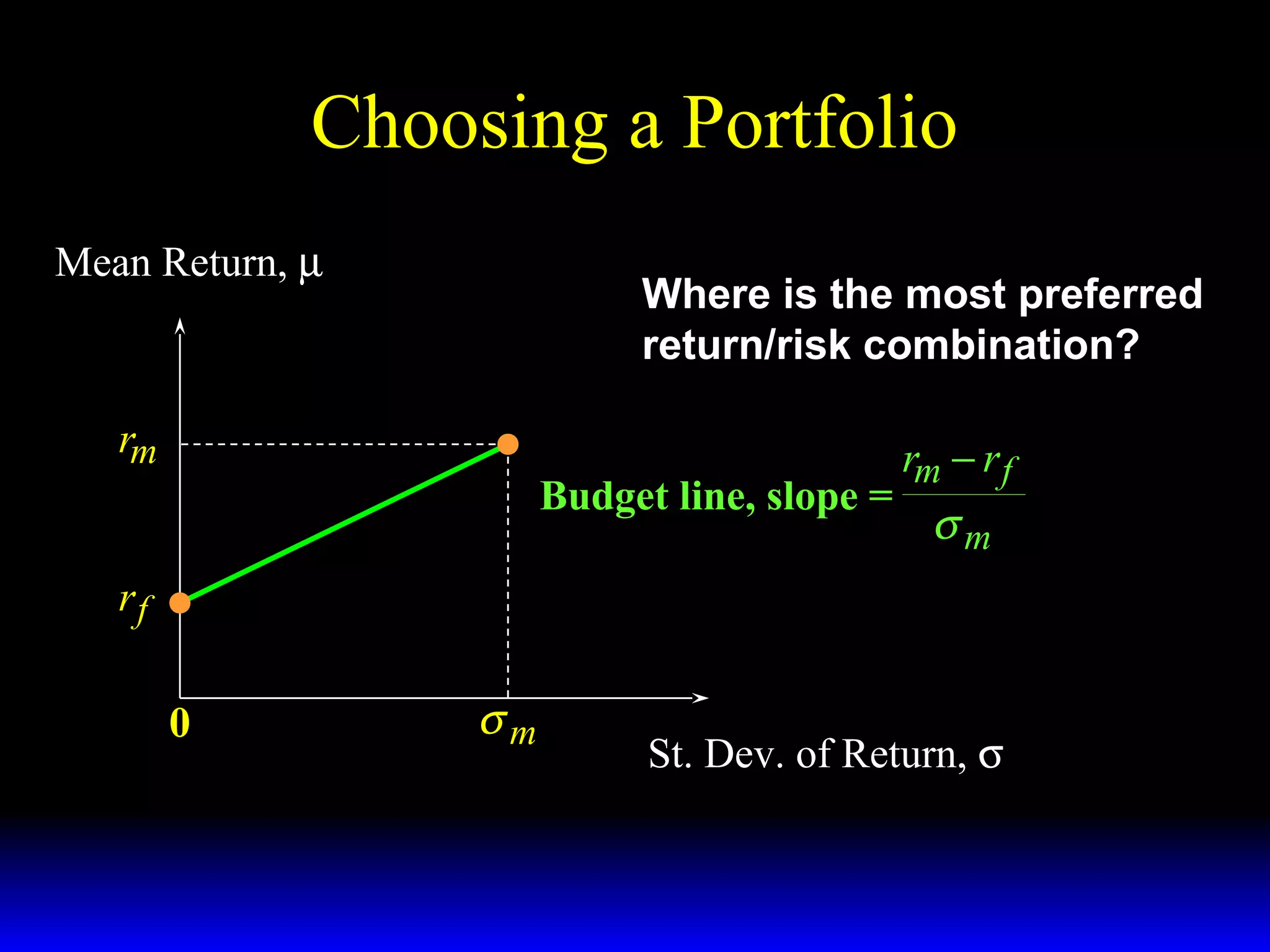
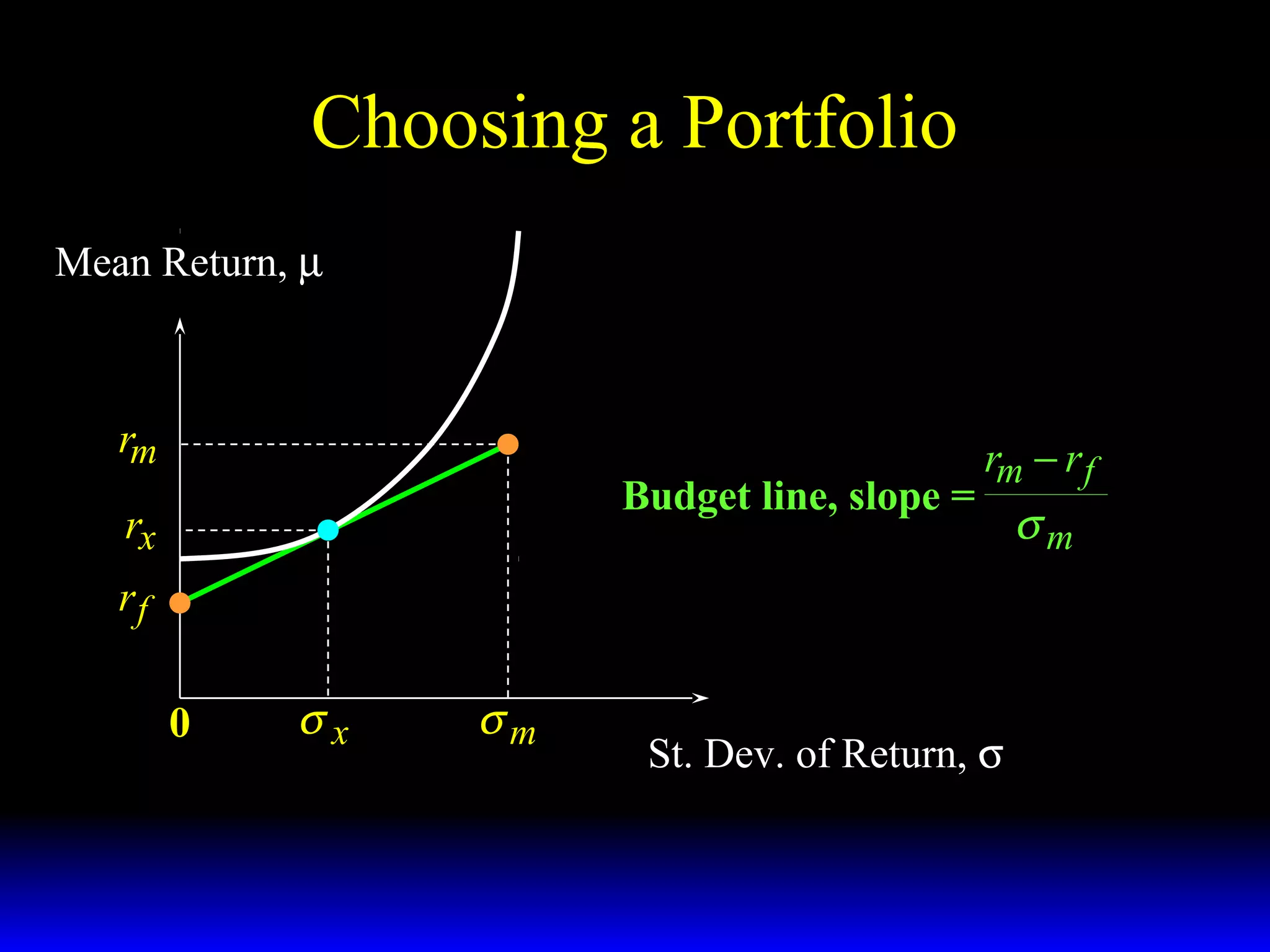
Choosing a Portfolio
Mean Return, µ

Where is the most preferred
return/risk combination?

rm
Budget line, slope =

rm − r f

σm

rf
0

σm

St. Dev. of Return, σ
Choosing a Portfolio
Mean Return, µ

Where is the most preferred
return/risk combination?

rm
Budget line, slope =

rm − r f

σm

rf
0

σm

St. Dev. of Return, σ
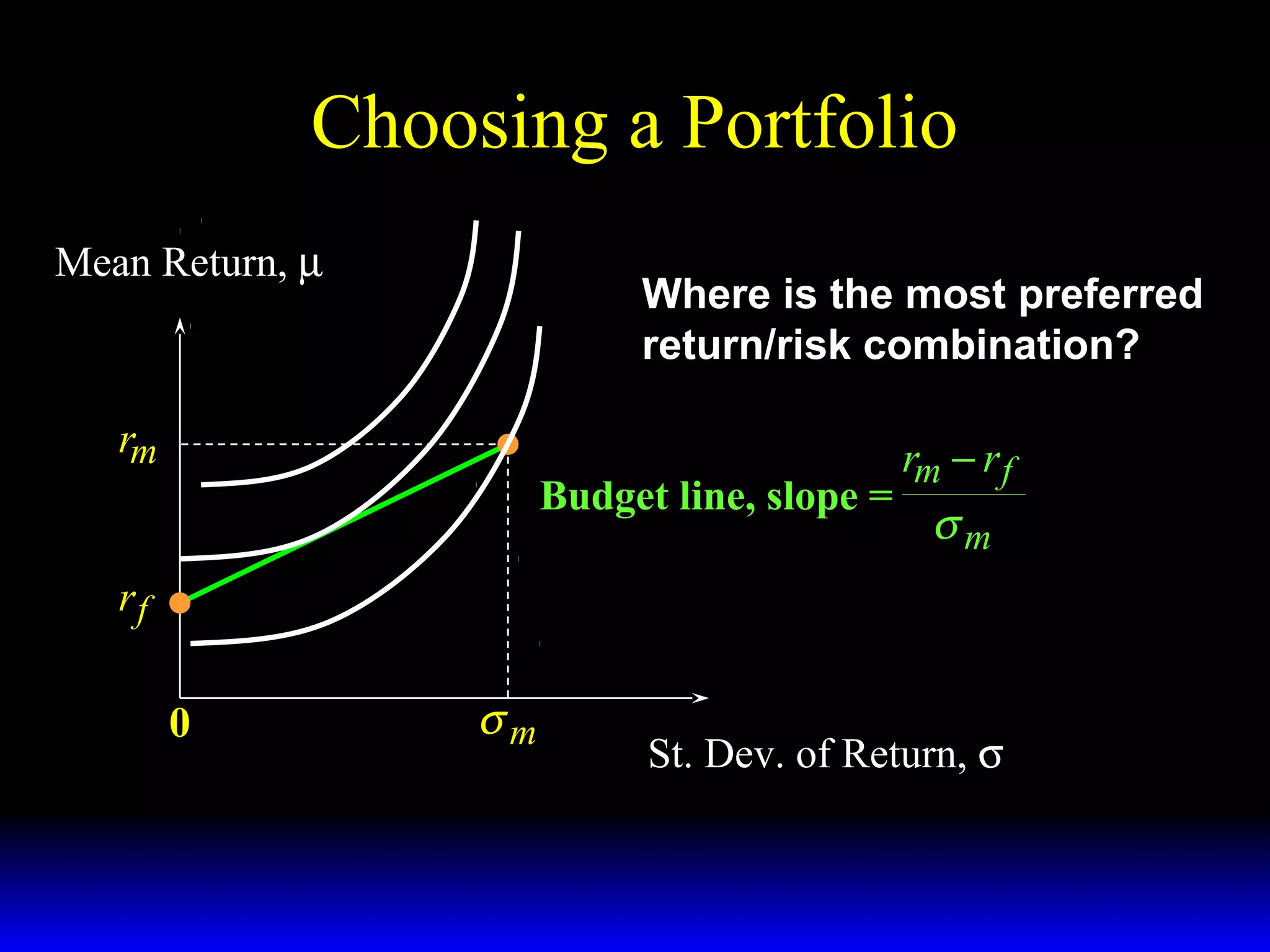
Choosing a Portfolio
Mean Return, µ

Where is the most preferred
return/risk combination?

rm
Budget line, slope =

rx

rm − r f

σm

rf
0

σx

σm

St. Dev. of Return, σ
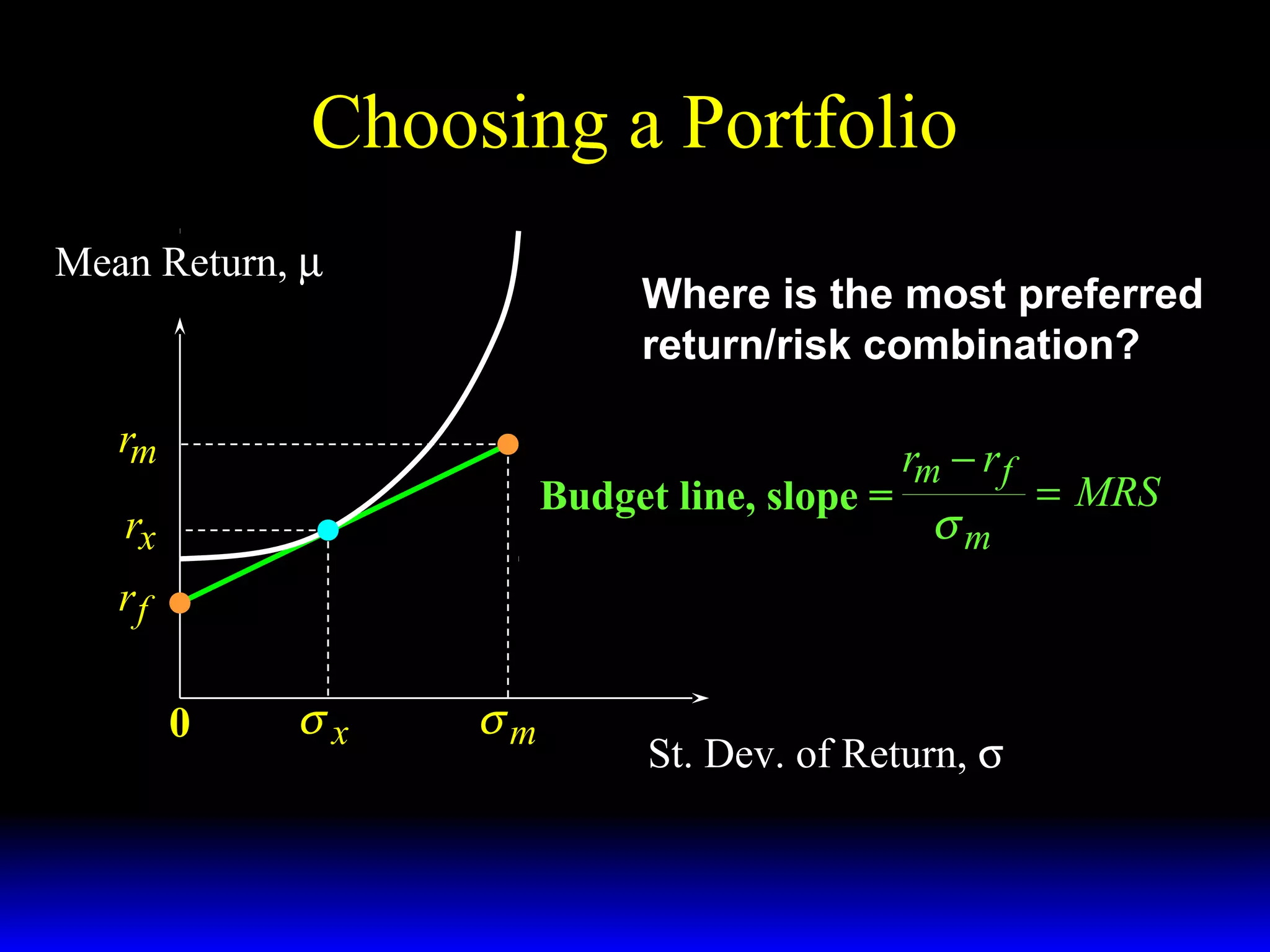
Choosing a Portfolio
Mean Return, µ

Where is the most preferred
return/risk combination?

rm
Budget line, slope =

rx

rm − r f

σm

rf
0

σx

σm

St. Dev. of Return, σ

= MRS
Choosing a Portfolio
Mean Return, µ

Where is the most preferred
return/risk combination?

rm
Budget line, slope =

rx

rm − r f

σm

rf
0

σx

σm

St. Dev. of Return, σ

∂U / ∂σ
=−
∂U / ∂µ
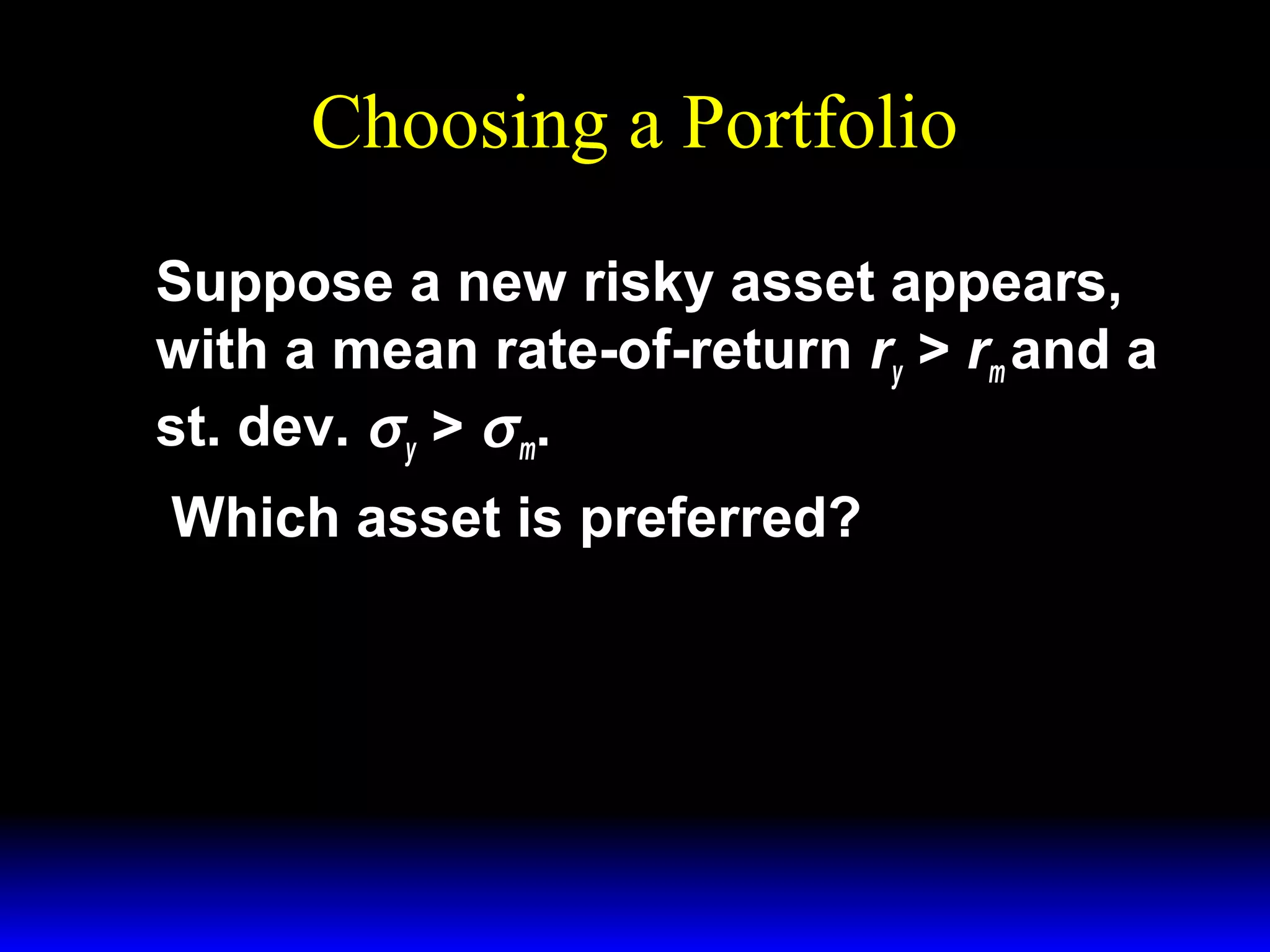
Choosing a Portfolio
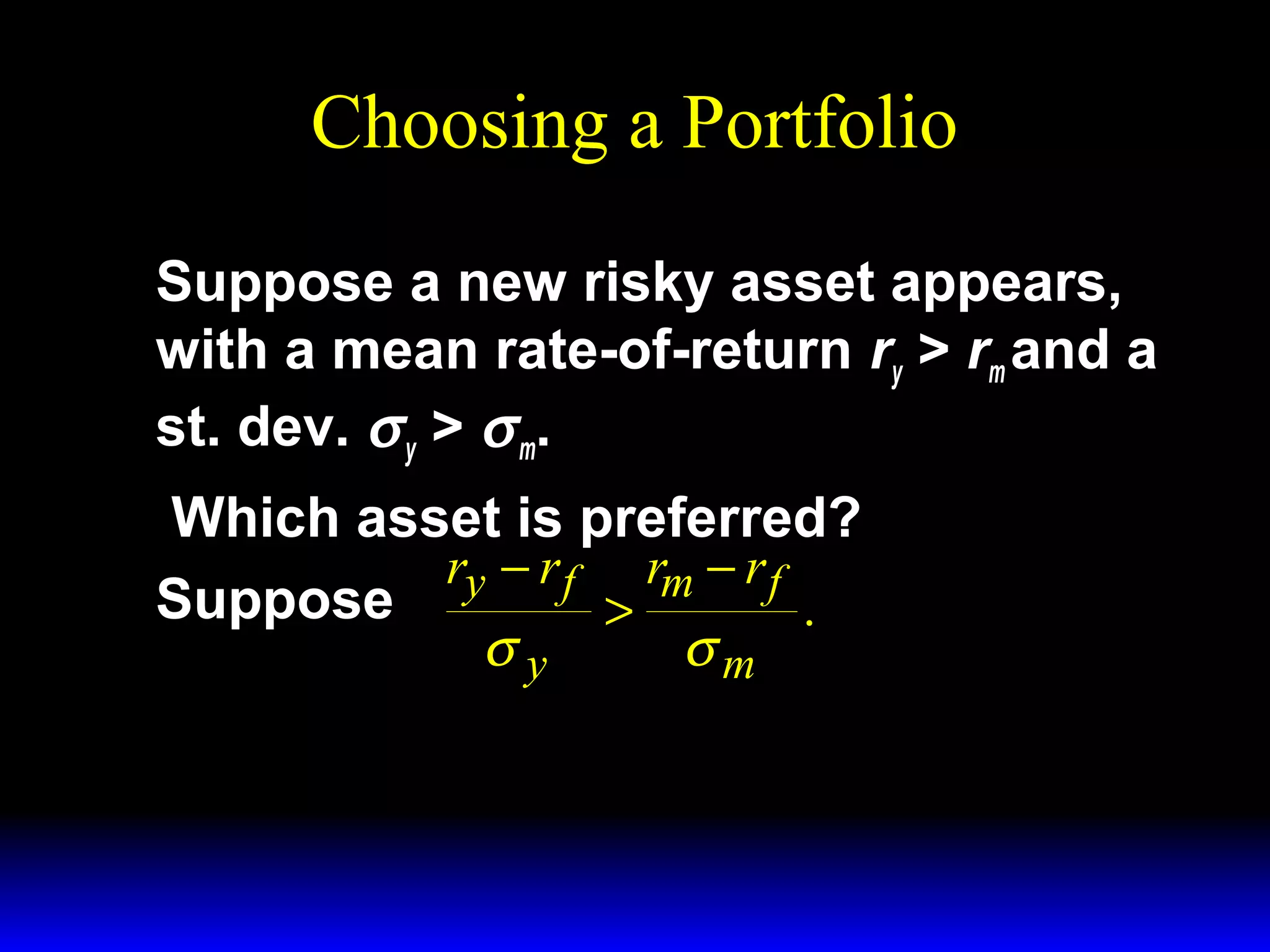
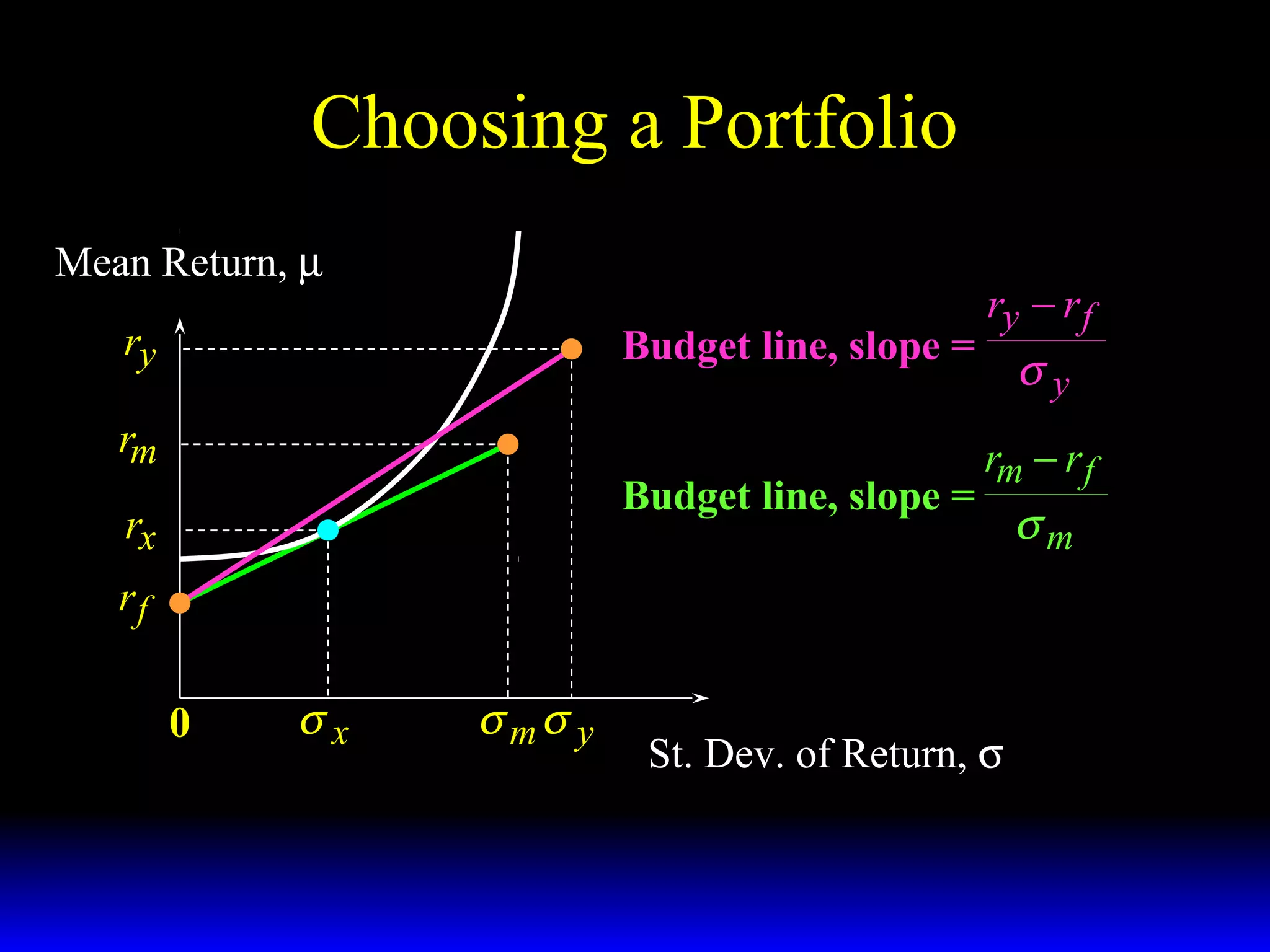
Suppose a new risky asset appears,
with a mean rate-of-return ry > rm and a
st. dev. σ y > σ m.
Which asset is preferred?
Choosing a Portfolio
Suppose a new risky asset appears,
with a mean rate-of-return ry > rm and a
st. dev. σ y > σ m.
Which asset is preferred?
ry − r f rm − r f
Suppose
>
.
σy
σm
Choosing a Portfolio
Mean Return, µ

rm
Budget line, slope =

rx

rm − r f

rf
0

σx

σm

St. Dev. of Return, σ

σm
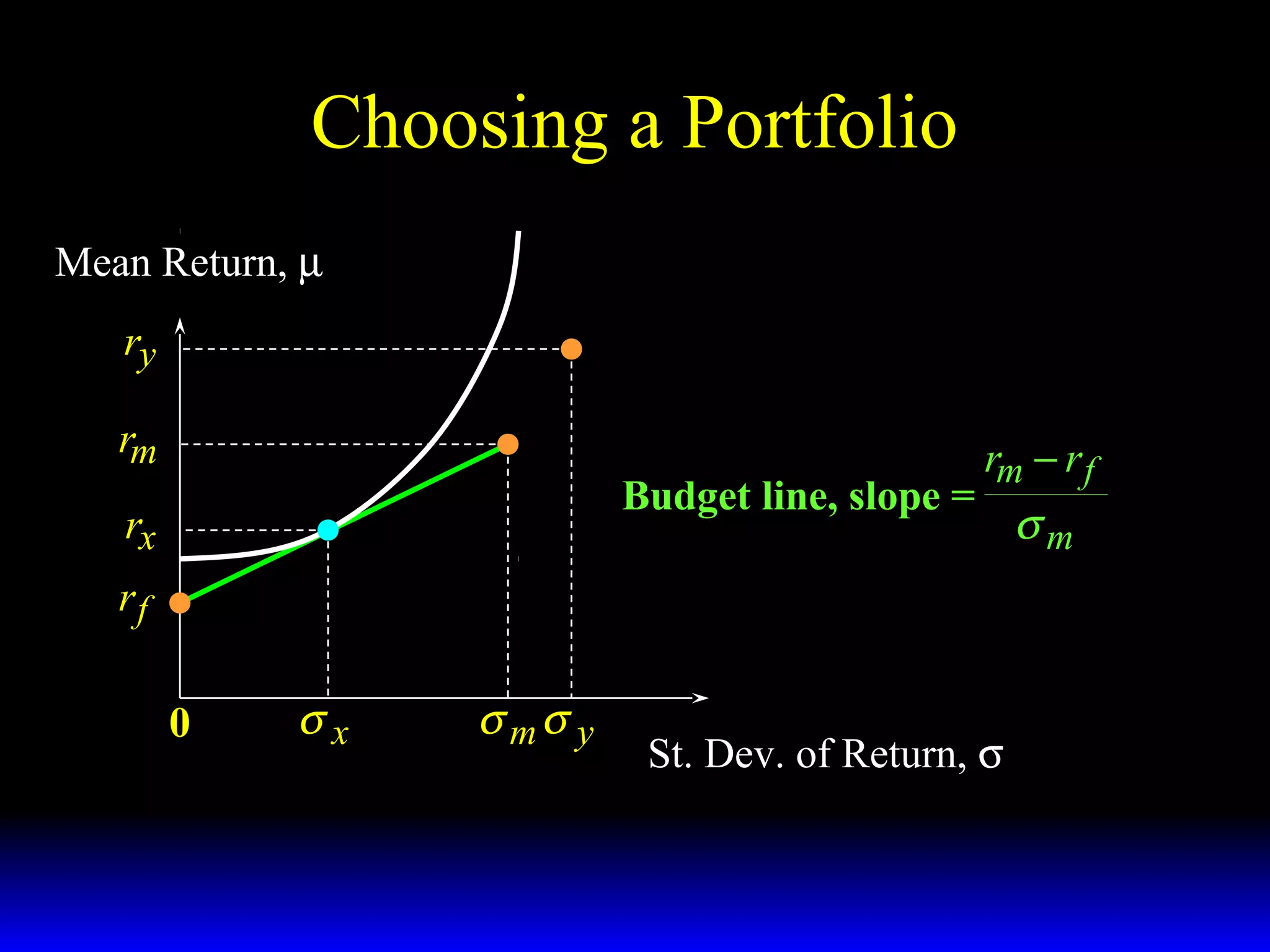
Choosing a Portfolio
Mean Return, µ

ry
rm
Budget line, slope =

rx

rm − r f

rf
0

σx

σ mσ y

St. Dev. of Return, σ

σm
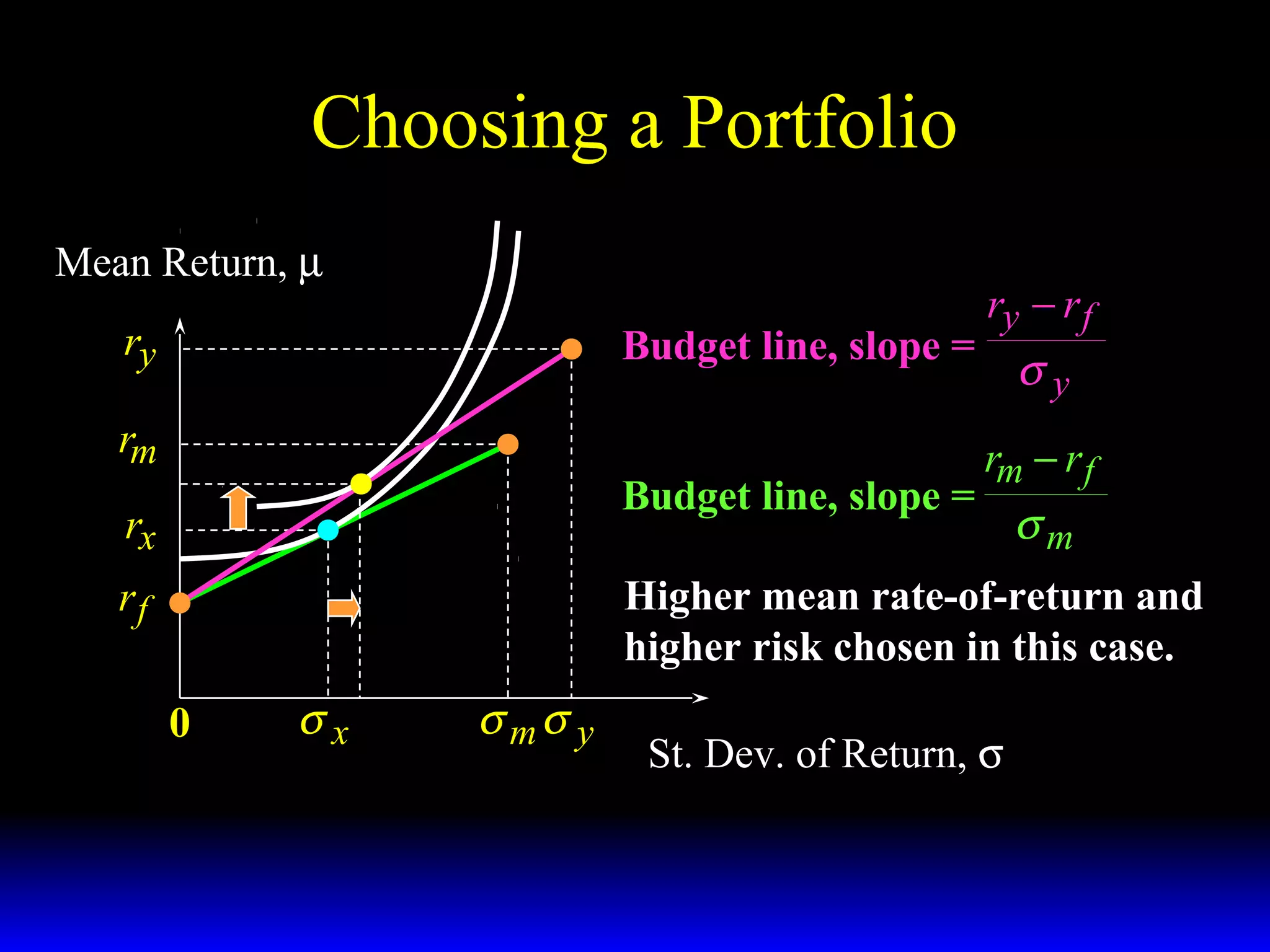
Choosing a Portfolio
Mean Return, µ

ry

Budget line, slope =

rm
Budget line, slope =

rx

ry − r f

σy
rm − r f

rf
0

σx

σ mσ y

St. Dev. of Return, σ

σm
Choosing a Portfolio
Mean Return, µ

ry

Budget line, slope =

rm
Budget line, slope =

rx

ry − r f

σy
rm − r f

σm

Higher mean rate-of-return and
higher risk chosen in this case.

rf
0

σx

σ mσ y

St. Dev. of Return, σ
Measuring Risk
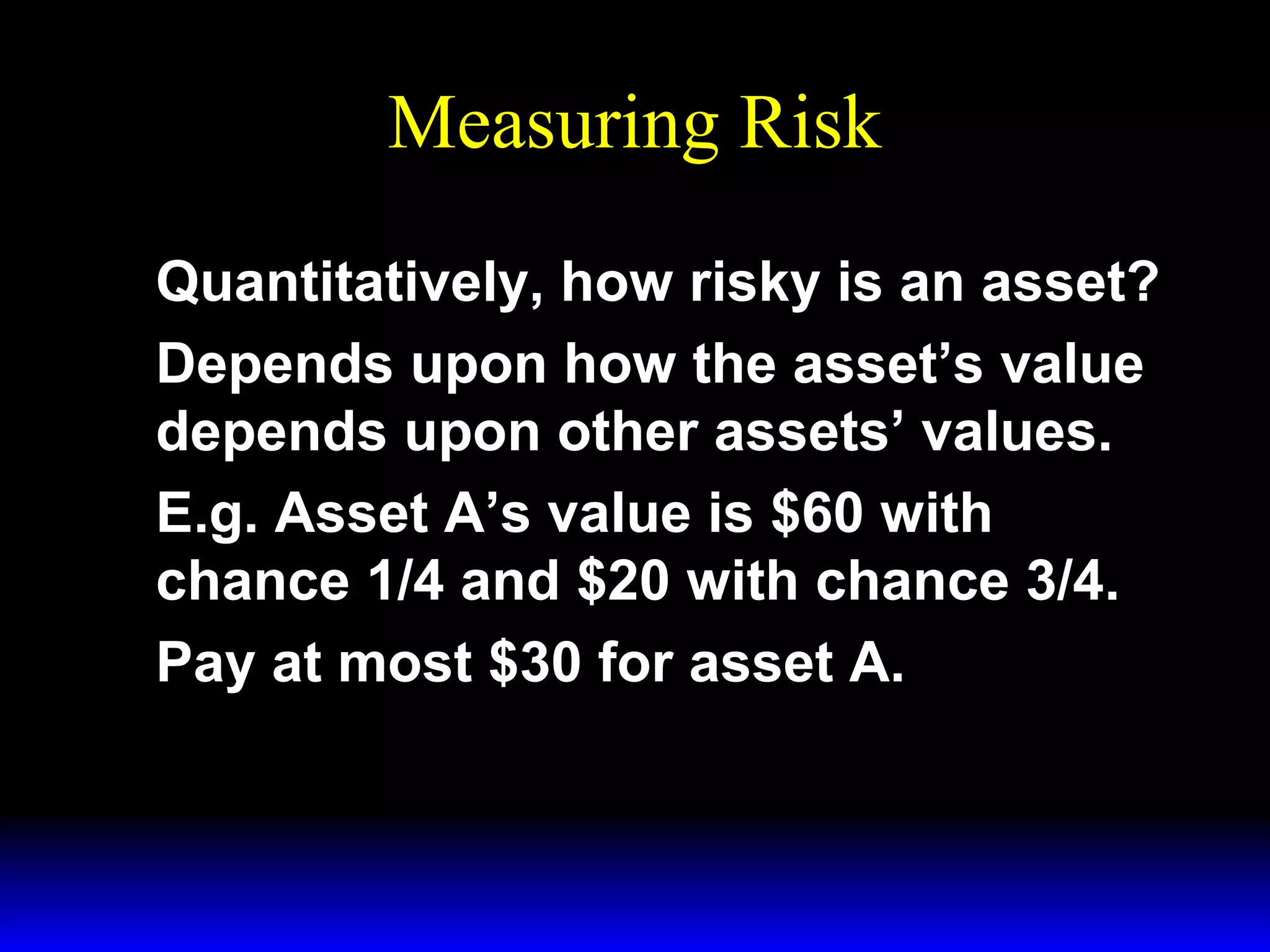
Quantitatively, how risky is an asset?
Depends upon how the asset’s value
depends upon other assets’ values.
E.g. Asset A’s value is $60 with
chance 1/4 and $20 with chance 3/4.
Pay at most $30 for asset A.
Measuring Risk
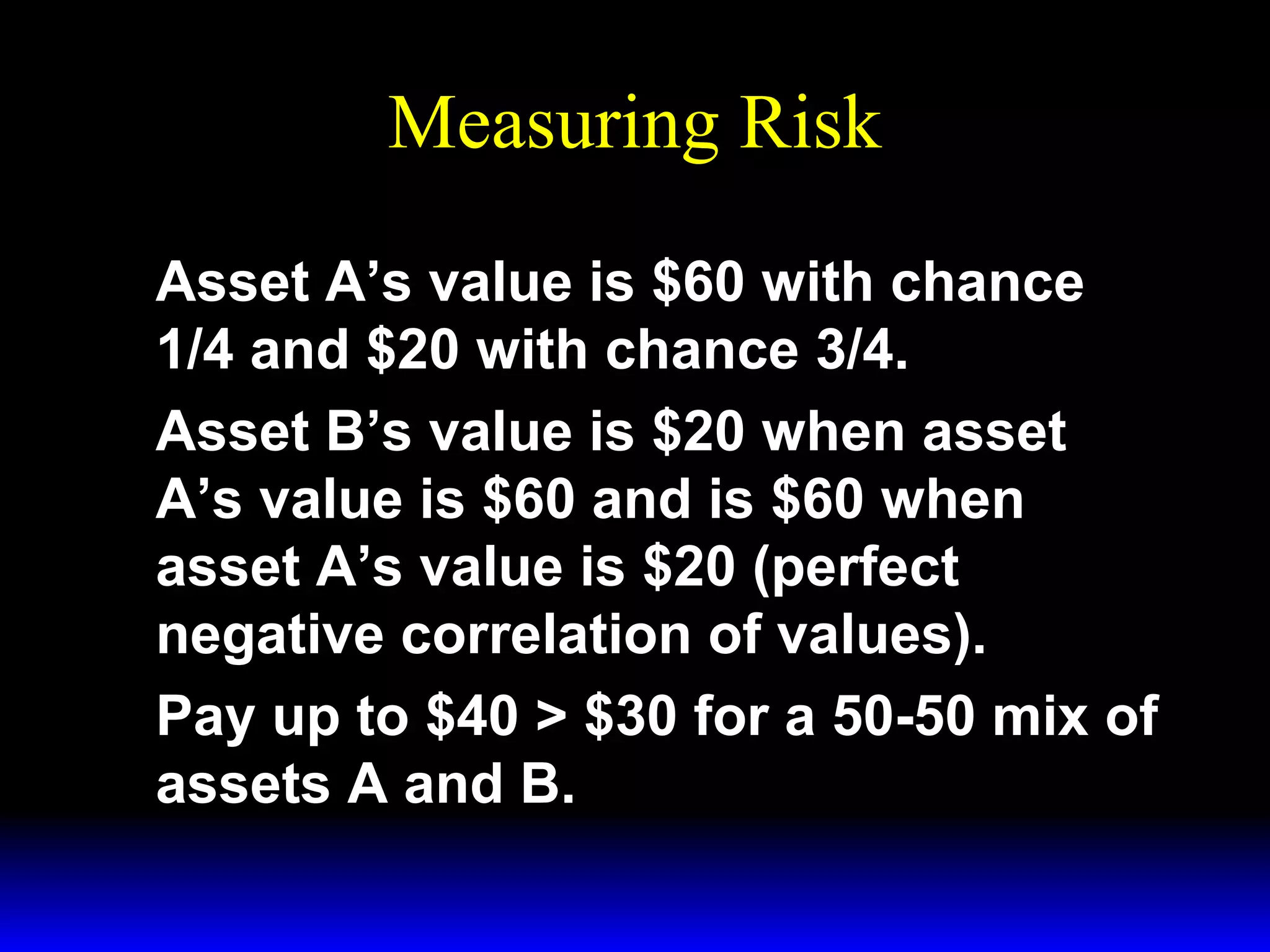
Asset A’s value is $60 with chance
1/4 and $20 with chance 3/4.
Asset B’s value is $20 when asset
A’s value is $60 and is $60 when
asset A’s value is $20 (perfect
negative correlation of values).
Pay up to $40 > $30 for a 50-50 mix of
assets A and B.
Measuring Risk
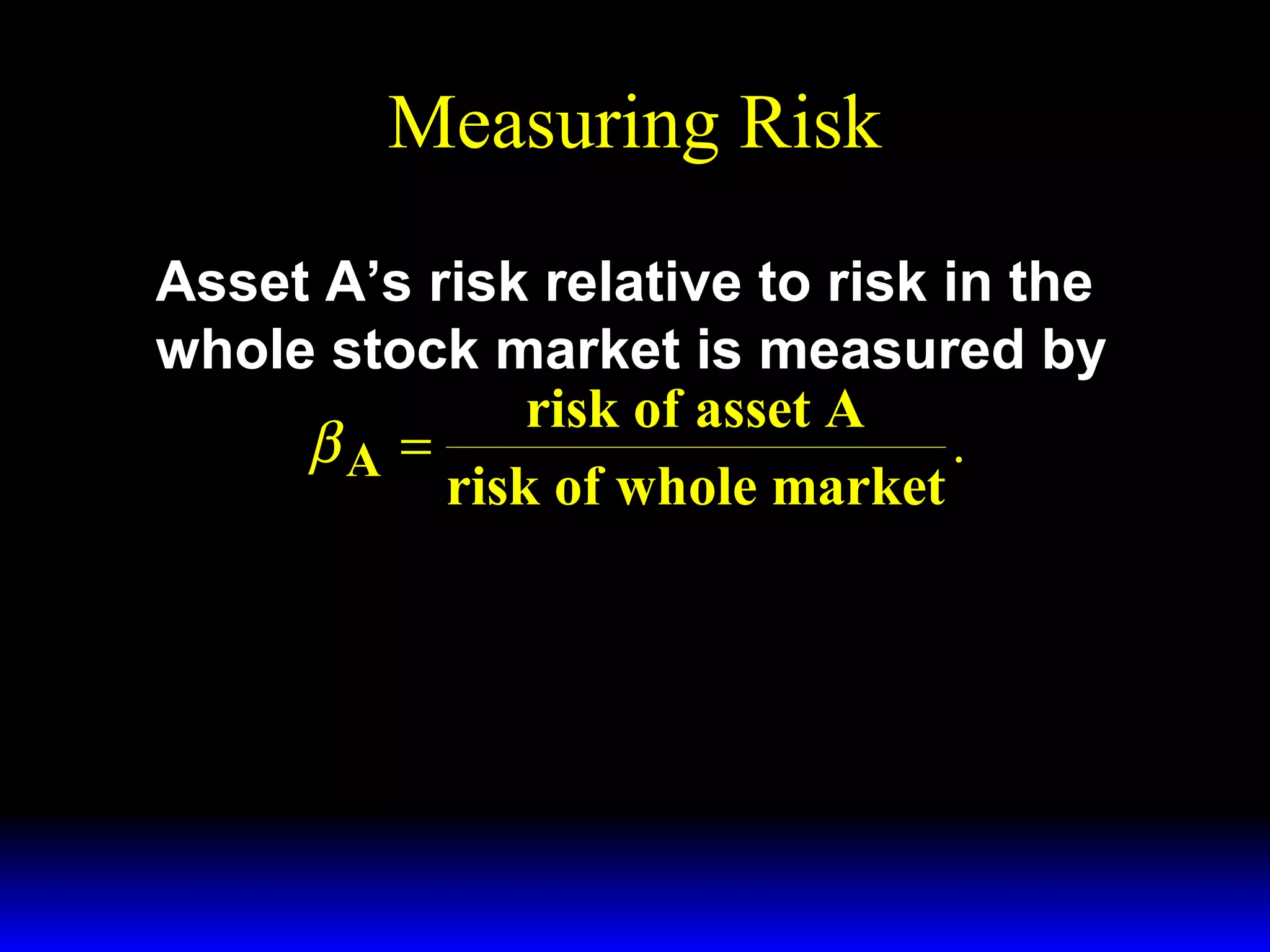
Asset A’s risk relative to risk in the
whole stock market is measured by
risk of asset A
βA =
.
risk of whole market
Measuring Risk
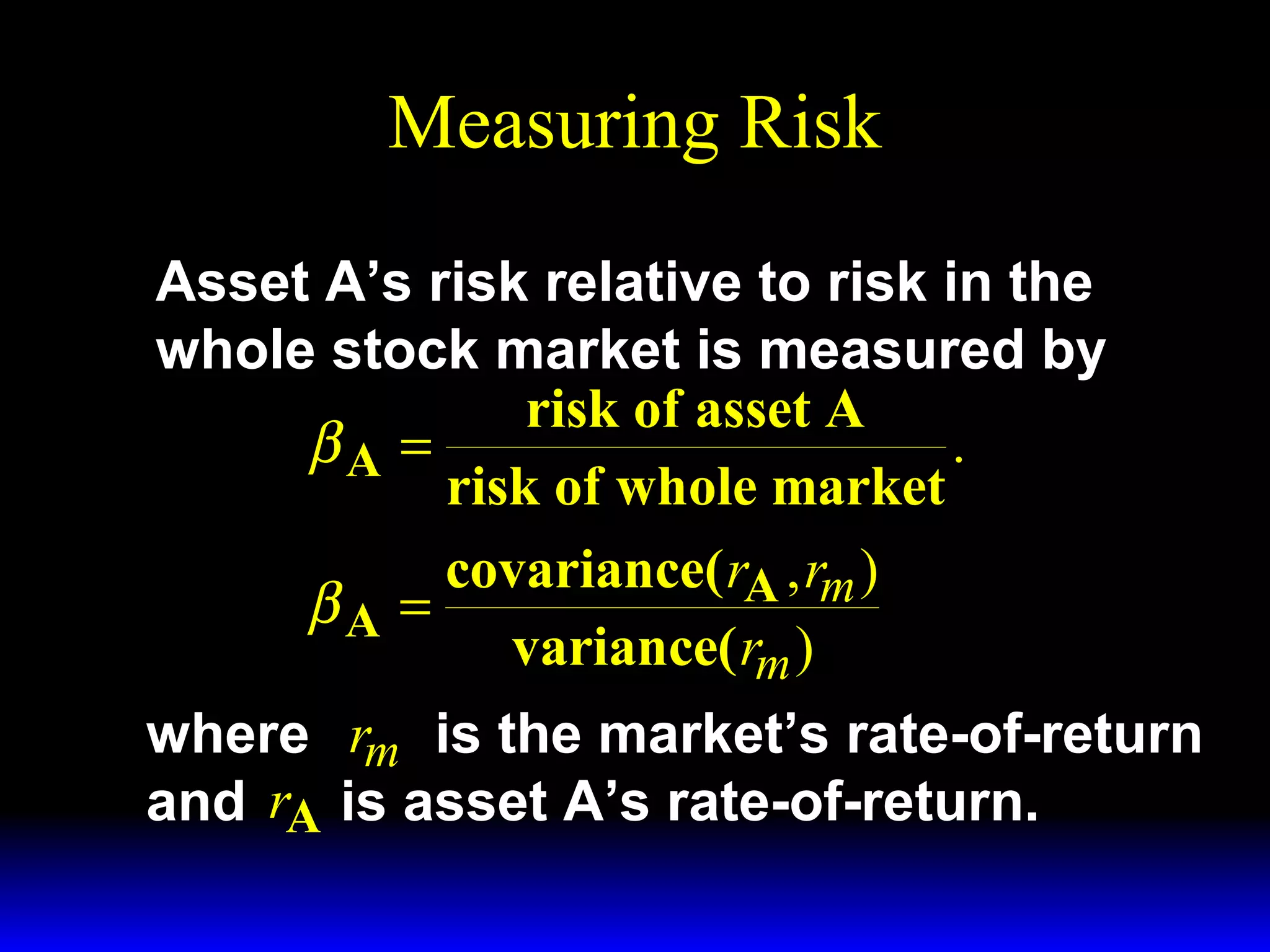
Asset A’s risk relative to risk in the
whole stock market is measured by
risk of asset A
βA =
.
risk of whole market
covariance( rA , rm )
βA =
variance( rm )
where rm is the market’s rate-of-return
and rA is asset A’s rate-of-return.
Measuring Risk
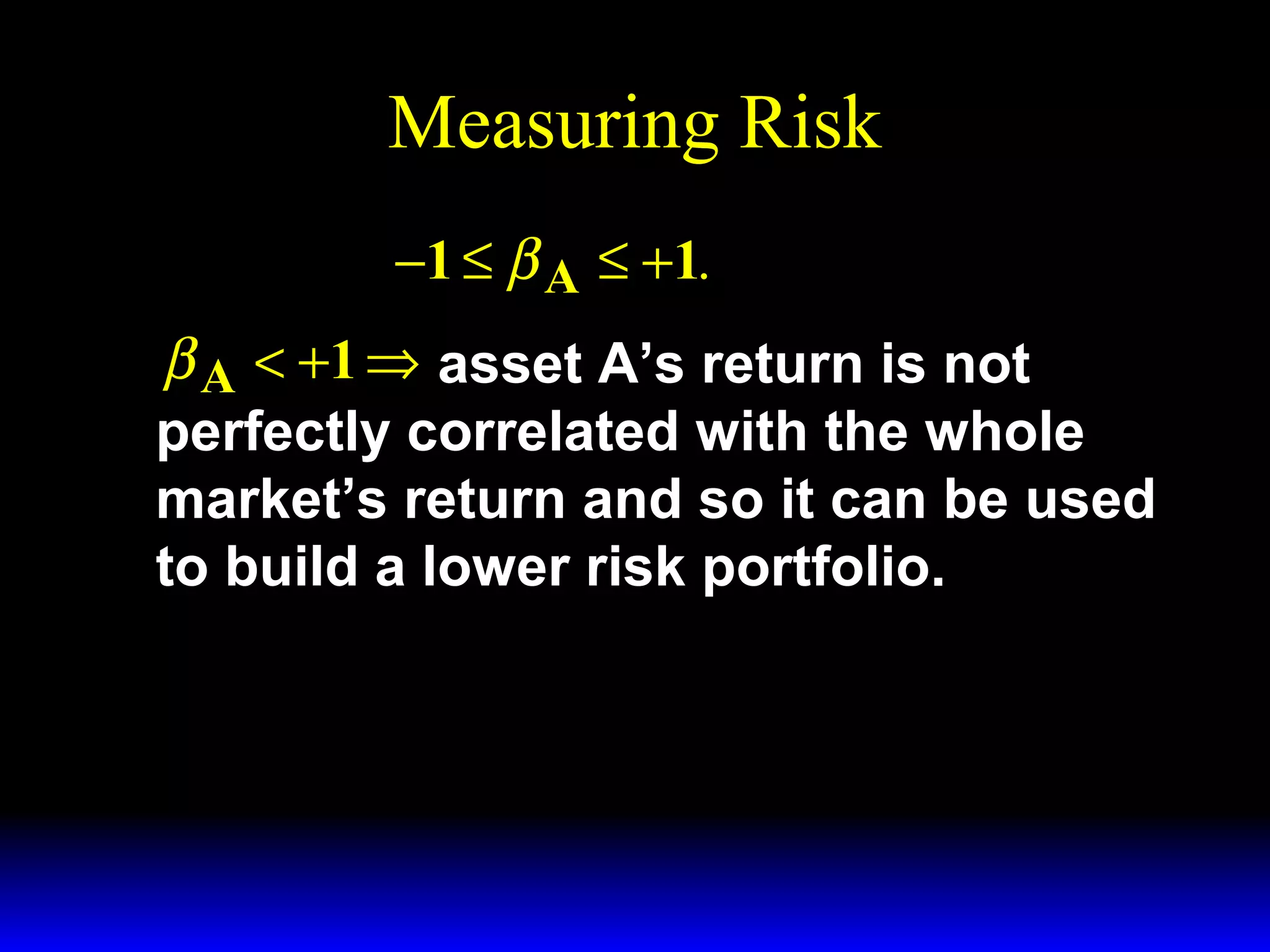
−1 ≤ β A ≤ +1.

β A < +1 ⇒ asset A’s return is not
perfectly correlated with the whole
market’s return and so it can be used
to build a lower risk portfolio.
Equilibrium in Risky Asset
Markets
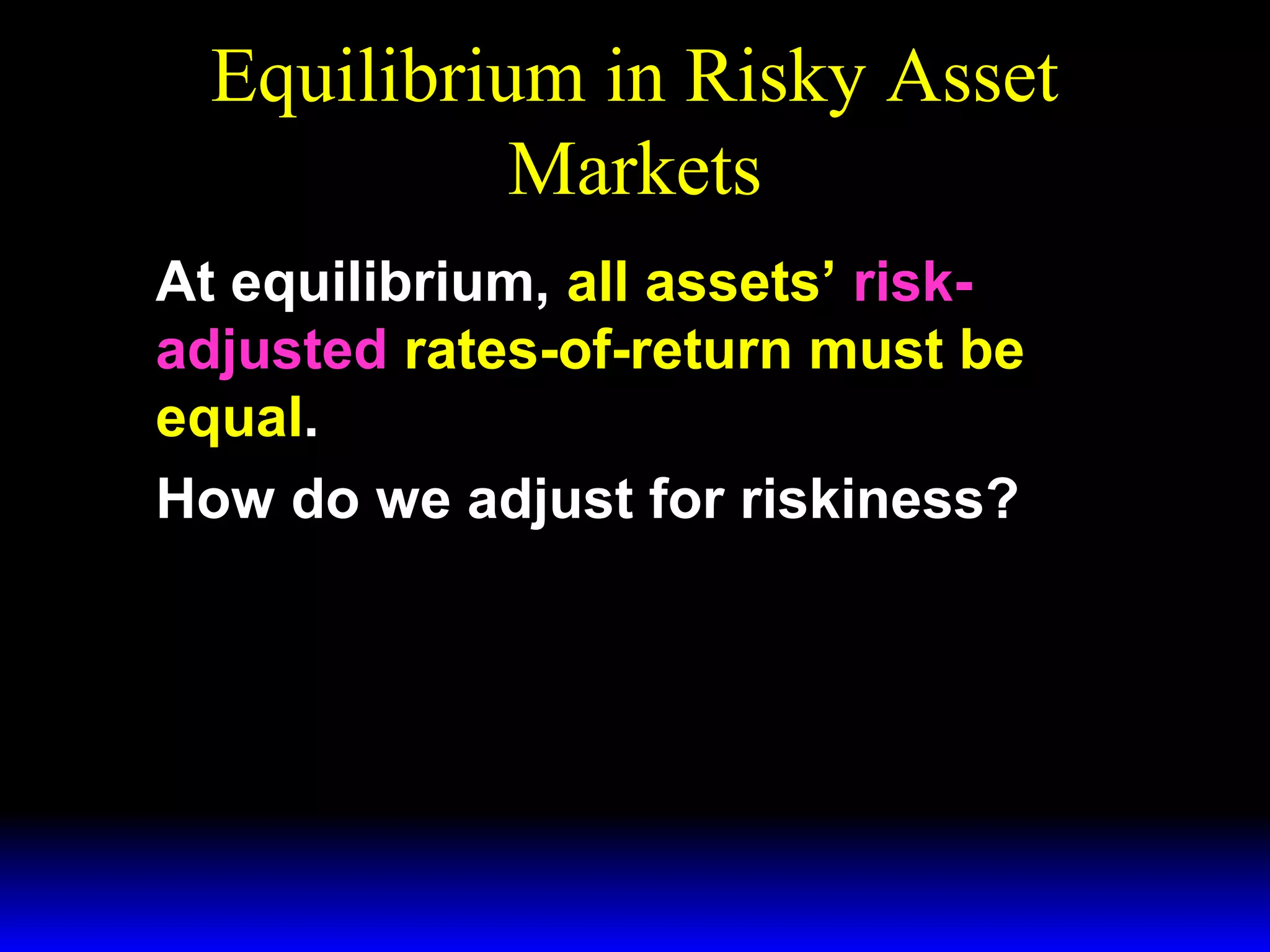
At equilibrium, all assets’ riskadjusted rates-of-return must be
equal.
How do we adjust for riskiness?
Equilibrium in Risky Asset
Markets
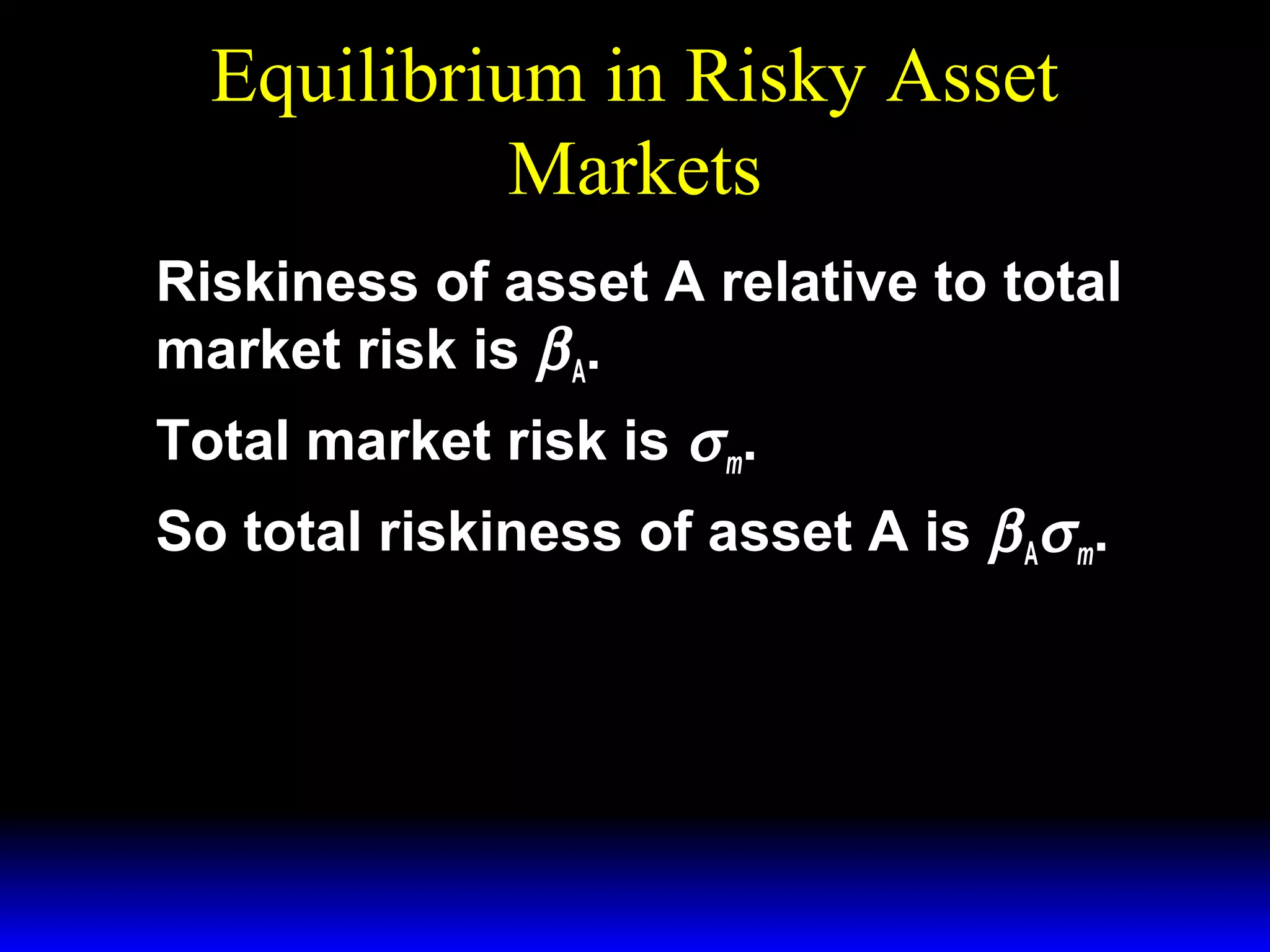
Riskiness of asset A relative to total
market risk is β A.
Total market risk is σ m.
So total riskiness of asset A is β Aσ m.
Equilibrium in Risky Asset
Markets
Riskiness of asset A relative to total
market risk is β A.
Total market risk is σ m.
So total riskiness of asset A is β Aσ m.
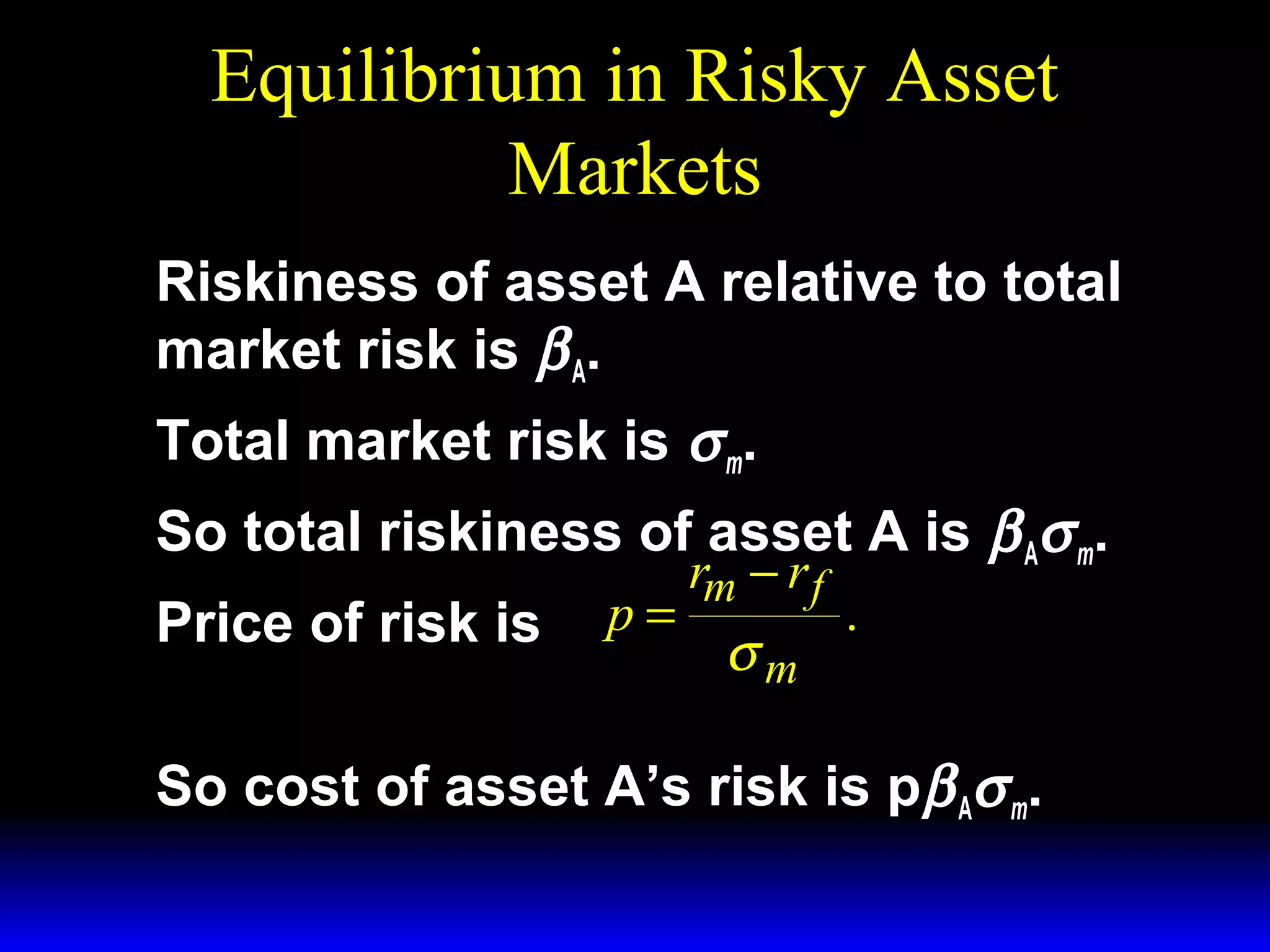
Price of risk is

p=

rm − r f

σm

.

So cost of asset A’s risk is pβ Aσ m.
Equilibrium in Risky Asset
Markets
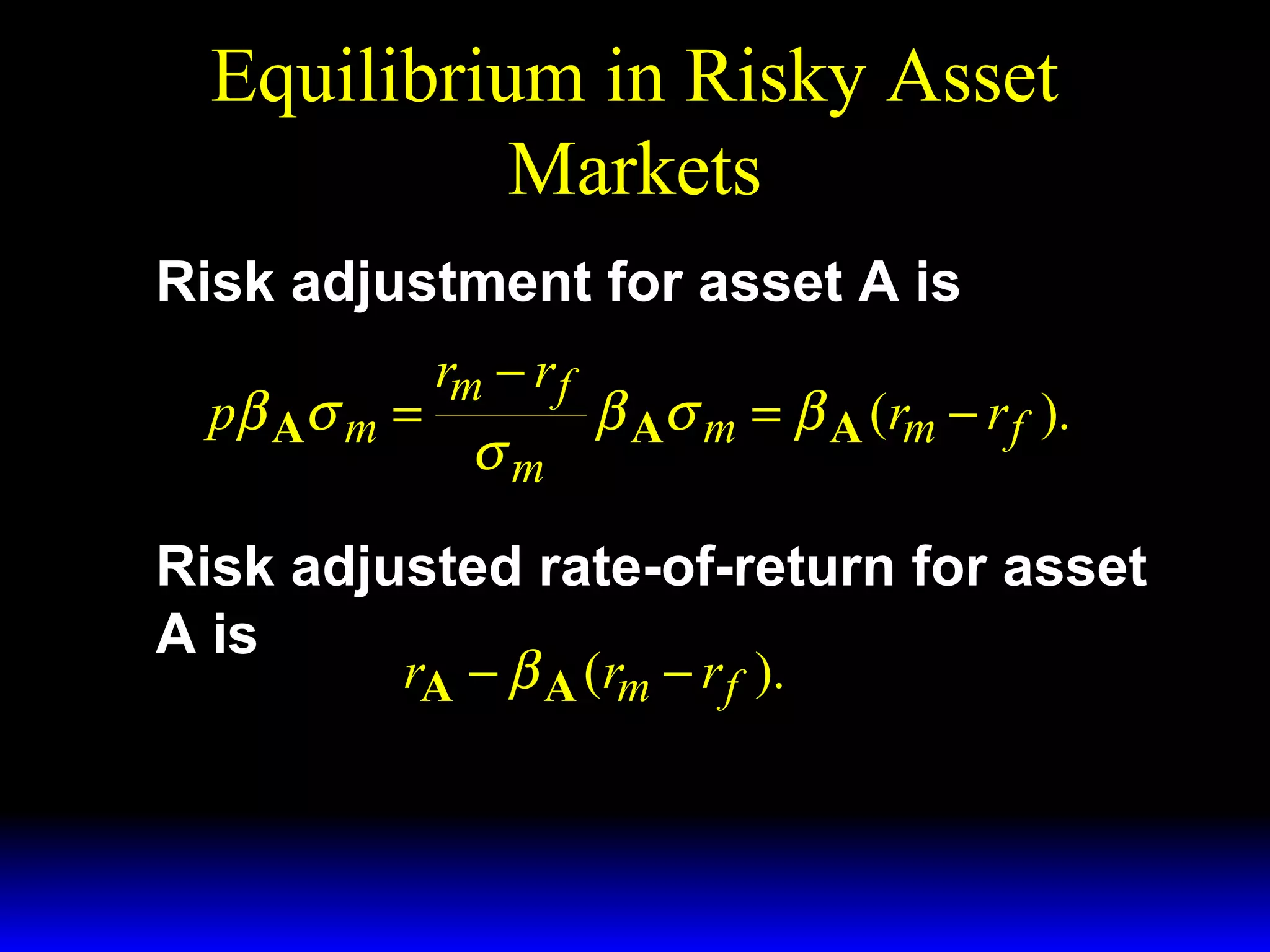
Risk adjustment for asset A is
pβ A σ m =

rm − r f

σm

β Aσ m = β A (rm − r f ).

Risk adjusted rate-of-return for asset
A is
rA − β A (rm − r f ).
Equilibrium in Risky Asset
Markets
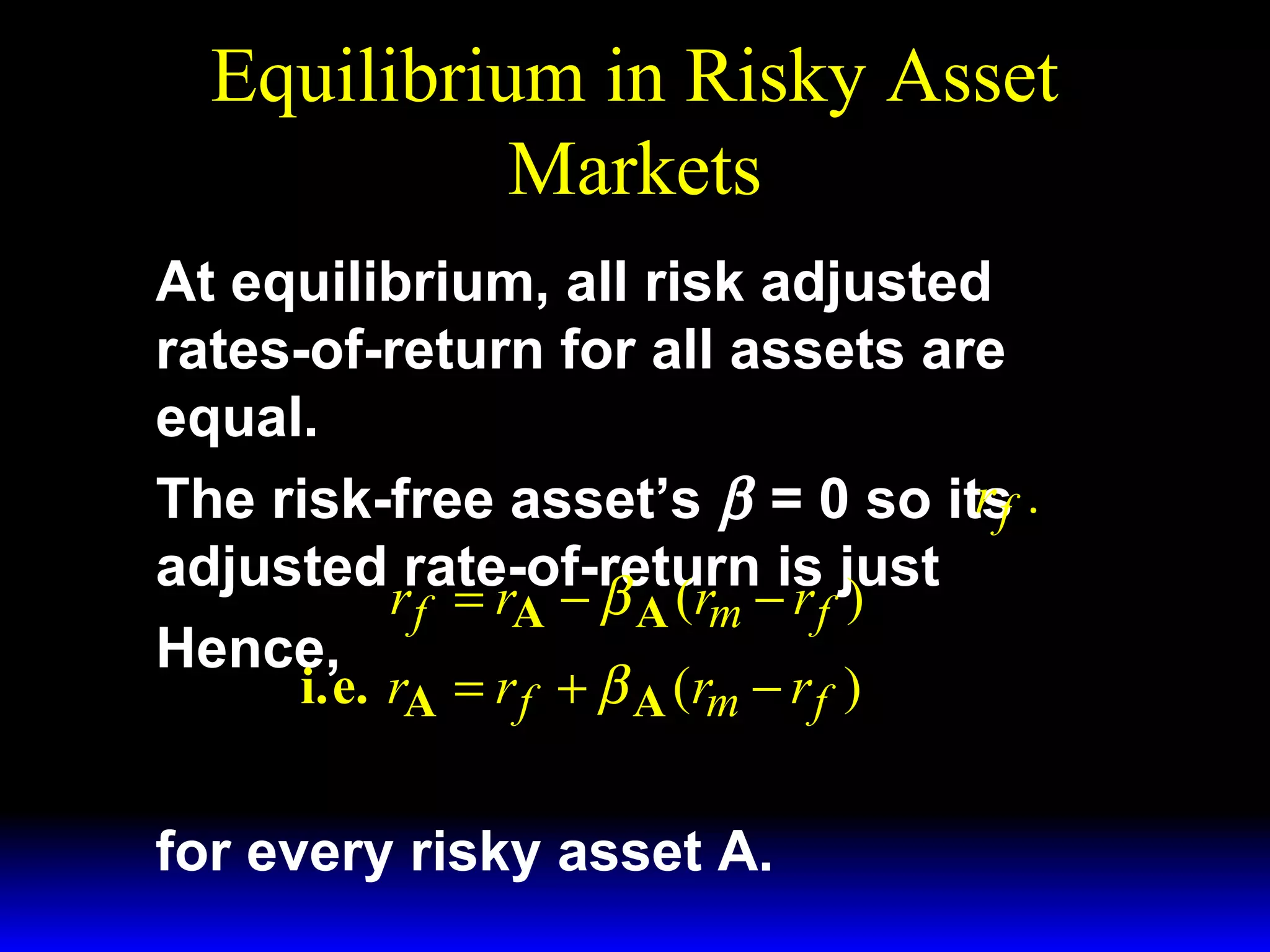
At equilibrium, all risk adjusted
rates-of-return for all assets are
equal.
rf
The risk-free asset’s β = 0 so its .
adjusted rate-of-return is just
r f = rA − β A (rm − r f )
Hence,
i.e. rA = r f + β A (rm − r f )
for every risky asset A.
Equilibrium in Risky Asset
Markets
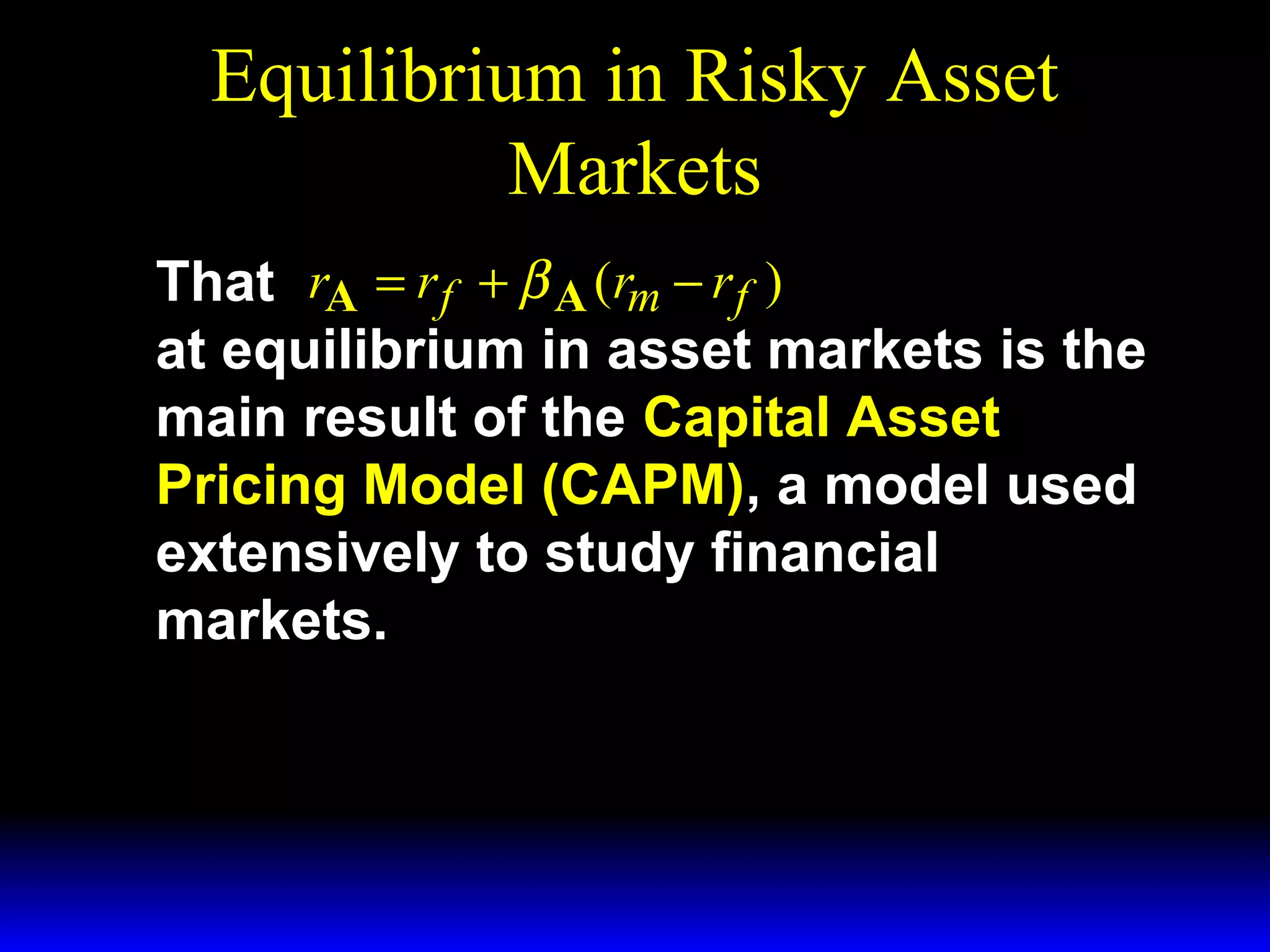
That rA = r f + β A (rm − r f )
at equilibrium in asset markets is the
main result of the Capital Asset
Pricing Model (CAPM), a model used
extensively to study financial
markets.

Ch13

  • 1.
  • 2.
    Mean of aDistribution A random variable (r.v.) w takes values w1,…,wS with probabilities π 1,...,π S (π 1 + · · · + π S = 1). The mean (expected value) of the distribution is the av. value of the r.v.; S E[ w] = µ w = ∑ wsπ s . s =1
  • 3.
    Variance of aDistribution The distribution’s variance is the r.v.’s av. squared deviation from the mean; S 2 2 var[ w] = σ w = ∑ ( ws − µ w ) π s . s =1 Variance measures the r.v.’s variation.
  • 4.
    Standard Deviation ofa Distribution The distribution’s standard deviation is the square root of its variance; 2 st. dev[ w] = σ w = σ w = S 2 ∑ ( ws − µ w ) π s . s =1 St. deviation also measures the r.v.’s variability.
  • 5.
    Mean and Variance Probability Twodistributions with the same variance and different means. Random Variable Values
  • 6.
    Mean and Variance Probability Twodistributions with the same mean and different variances. Random Variable Values
  • 7.
    Preferences over RiskyAssets Higher mean return is preferred. Less variation in return is preferred (less risk).
  • 8.
    Preferences over RiskyAssets Higher mean return is preferred. Less variation in return is preferred (less risk). Preferences are represented by a utility function U(µ,σ). U ↑ as mean return µ ↑. U ↓ as risk σ ↑.
  • 9.
    Preferences over RiskyAssets Mean Return, µ Preferred Higher mean return is a good. Higher risk is a bad. St. Dev. of Return, σ
  • 10.
    Preferences over RiskyAssets Mean Return, µ Preferred Higher mean return is a good. Higher risk is a bad. St. Dev. of Return, σ
  • 11.
    Preferences over RiskyAssets How is the MRS computed?
  • 12.
    Preferences over RiskyAssets How is the MRS computed? ∂U ∂U dU = dµ + dσ = 0 ∂µ ∂σ ∂U ∂U ⇒ dµ = − dσ ∂µ ∂σ dµ ∂U / ∂σ ⇒ =− . dσ ∂U / ∂µ
  • 13.
    Preferences over RiskyAssets Mean Return, µ Preferred Higher mean return is a good. Higher risk is a bad. dµ ∂U / ∂σ =− dσ ∂U / ∂µ St. Dev. of Return, σ
  • 14.
    Budget Constraints forRisky Assets Two assets. Risk-free asset’s rate-or-return is rf . Risky stock’s rate-or-return is ms if state s occurs, with prob. π s . Risky stock’s mean rate-of-return is S rm = ∑ msπ s . s =1
  • 15.
    Budget Constraints forRisky Assets A bundle containing some of the risky stock and some of the risk-free asset is a portfolio. x is the fraction of wealth used to buy the risky stock. Given x, the portfolio’s av. rate-ofreturn is r = xr + (1 − x )r . x m f
  • 16.
    Budget Constraints forRisky Assets rx = xrm + (1 − x )r f . x=0⇒ rx = r f and x = 1 ⇒ rx = rm .
  • 17.
    Budget Constraints forRisky Assets rx = xrm + (1 − x )r f . x=0⇒ rx = r f and x = 1 ⇒ rx = rm . Since stock is risky and risk is a bad, for stock to be purchased must have rm > r f .
  • 18.
    Budget Constraints forRisky Assets rx = xrm + (1 − x )r f . x=0⇒ rx = r f and x = 1 ⇒ rx = rm . Since stock is risky and risk is a bad, for stock to be purchased must have rm > r f . So portfolio’s expected rate-of-return rises with x (more stock in the portfolio).
  • 19.
    Budget Constraints forRisky Assets Portfolio’s rate-of-return variance is S σ 2 = ∑ ( xms + (1 − x )r f − rx ) 2 π s . x s =1
  • 20.
    Budget Constraints forRisky Assets Portfolio’s rate-of-return variance is S σ 2 = ∑ ( xms + (1 − x )r f − rx ) 2 π s . x s =1 rx = xrm + (1 − x )r f .
  • 21.
    Budget Constraints forRisky Assets Portfolio’s rate-of-return variance is S σ 2 = ∑ ( xms + (1 − x )r f − rx ) 2 π s . x s =1 rx = xrm + (1 − x )r f . S 2 2 σ x = ∑ ( xms + (1 − x )r f − xrm − (1 − x )r f ) π s s =1
  • 22.
    Budget Constraints forRisky Assets Portfolio’s rate-of-return variance is S σ 2 = ∑ ( xms + (1 − x )r f − rx ) 2 π s . x s =1 rx = xrm + (1 − x )r f . S 2 2 σ x = ∑ ( xms + (1 − x )r f − xrm − (1 − x )r f ) π s s =1 S 2 = ∑ ( xms − xrm ) π s s =1
  • 23.
    Budget Constraints forRisky Assets Portfolio’s rate-of-return variance is S σ 2 = ∑ ( xms + (1 − x )r f − rx ) 2 π s . x s =1 rx = xrm + (1 − x )r f . S 2 2 σ x = ∑ ( xms + (1 − x )r f − xrm − (1 − x )r f ) π s s =1 S 2 2 S 2 = ∑ ( xms − xrm ) π s = x ∑ (ms − rm ) π s s =1 s =1
  • 24.
    Budget Constraints forRisky Assets Portfolio’s rate-of-return variance is S σ 2 = ∑ ( xms + (1 − x )r f − rx ) 2 π s . x s =1 rx = xrm + (1 − x )r f . S 2 2 σ x = ∑ ( xms + (1 − x )r f − xrm − (1 − x )r f ) π s s =1 S 2 2 S 2 2 2 = ∑ ( xms − xrm ) π s = x ∑ (ms − rm ) π s = x σ m . s =1 s =1
  • 25.
    Budget Constraints forRisky Assets Variance so st. deviation 2 σ 2 = x 2σ m x σ x = xσ m .
  • 26.
    Budget Constraints forRisky Assets Variance so st. deviation x=0⇒ 2 σ 2 = x 2σ m x σ x = xσ m . σx =0 and x = 1 ⇒ σ x = σ m.
  • 27.
    Budget Constraints forRisky Assets Variance so st. deviation x=0⇒ 2 σ 2 = x 2σ m x σ x = xσ m . σx =0 and x = 1 ⇒ σ x = σ m. So risk rises with x (more stock in the portfolio).
  • 28.
    Budget Constraints forRisky Assets Mean Return, µ St. Dev. of Return, σ
  • 29.
    Budget Constraints forRisky Assets Mean Return, µ rf rx = xrm + (1 − x )r f . σ x = xσ m . x = 0 ⇒ rx = r f ,σ x = 0 0 St. Dev. of Return, σ
  • 30.
    Budget Constraints forRisky Assets rx = xrm + (1 − x )r f . σ x = xσ m . Mean Return, µ x = 1 ⇒ rx = rm ,σ x = σ m rm rf x = 0 ⇒ rx = r f ,σ x = 0 0 σm St. Dev. of Return, σ
  • 31.
    Budget Constraints forRisky Assets rx = xrm + (1 − x )r f . σ x = xσ m . Mean Return, µ x = 1 ⇒ rx = rm ,σ x = σ m rm Budget line rf x = 0 ⇒ rx = r f ,σ x = 0 0 σm St. Dev. of Return, σ
  • 32.
    Budget Constraints forRisky Assets rx = xrm + (1 − x )r f . σ x = xσ m . Mean Return, µ x = 1 ⇒ rx = rm ,σ x = σ m rm Budget line, slope = rf rm − r f σm x = 0 ⇒ rx = r f ,σ x = 0 0 σm St. Dev. of Return, σ
  • 33.
    Choosing a Portfolio MeanReturn, µ rm Budget line, slope = rm − r f σm is the price of risk relative to mean return. rf 0 σm St. Dev. of Return, σ
  • 34.
    Choosing a Portfolio MeanReturn, µ Where is the most preferred return/risk combination? rm Budget line, slope = rm − r f σm rf 0 σm St. Dev. of Return, σ
  • 35.
    Choosing a Portfolio MeanReturn, µ Where is the most preferred return/risk combination? rm Budget line, slope = rm − r f σm rf 0 σm St. Dev. of Return, σ
  • 36.
    Choosing a Portfolio MeanReturn, µ Where is the most preferred return/risk combination? rm Budget line, slope = rx rm − r f σm rf 0 σx σm St. Dev. of Return, σ
  • 37.
    Choosing a Portfolio MeanReturn, µ Where is the most preferred return/risk combination? rm Budget line, slope = rx rm − r f σm rf 0 σx σm St. Dev. of Return, σ = MRS
  • 38.
    Choosing a Portfolio MeanReturn, µ Where is the most preferred return/risk combination? rm Budget line, slope = rx rm − r f σm rf 0 σx σm St. Dev. of Return, σ ∂U / ∂σ =− ∂U / ∂µ
  • 39.
    Choosing a Portfolio Supposea new risky asset appears, with a mean rate-of-return ry > rm and a st. dev. σ y > σ m. Which asset is preferred?
  • 40.
    Choosing a Portfolio Supposea new risky asset appears, with a mean rate-of-return ry > rm and a st. dev. σ y > σ m. Which asset is preferred? ry − r f rm − r f Suppose > . σy σm
  • 41.
    Choosing a Portfolio MeanReturn, µ rm Budget line, slope = rx rm − r f rf 0 σx σm St. Dev. of Return, σ σm
  • 42.
    Choosing a Portfolio MeanReturn, µ ry rm Budget line, slope = rx rm − r f rf 0 σx σ mσ y St. Dev. of Return, σ σm
  • 43.
    Choosing a Portfolio MeanReturn, µ ry Budget line, slope = rm Budget line, slope = rx ry − r f σy rm − r f rf 0 σx σ mσ y St. Dev. of Return, σ σm
  • 44.
    Choosing a Portfolio MeanReturn, µ ry Budget line, slope = rm Budget line, slope = rx ry − r f σy rm − r f σm Higher mean rate-of-return and higher risk chosen in this case. rf 0 σx σ mσ y St. Dev. of Return, σ
  • 45.
    Measuring Risk Quantitatively, howrisky is an asset? Depends upon how the asset’s value depends upon other assets’ values. E.g. Asset A’s value is $60 with chance 1/4 and $20 with chance 3/4. Pay at most $30 for asset A.
  • 46.
    Measuring Risk Asset A’svalue is $60 with chance 1/4 and $20 with chance 3/4. Asset B’s value is $20 when asset A’s value is $60 and is $60 when asset A’s value is $20 (perfect negative correlation of values). Pay up to $40 > $30 for a 50-50 mix of assets A and B.
  • 47.
    Measuring Risk Asset A’srisk relative to risk in the whole stock market is measured by risk of asset A βA = . risk of whole market
  • 48.
    Measuring Risk Asset A’srisk relative to risk in the whole stock market is measured by risk of asset A βA = . risk of whole market covariance( rA , rm ) βA = variance( rm ) where rm is the market’s rate-of-return and rA is asset A’s rate-of-return.
  • 49.
    Measuring Risk −1 ≤β A ≤ +1. β A < +1 ⇒ asset A’s return is not perfectly correlated with the whole market’s return and so it can be used to build a lower risk portfolio.
  • 50.
    Equilibrium in RiskyAsset Markets At equilibrium, all assets’ riskadjusted rates-of-return must be equal. How do we adjust for riskiness?
  • 51.
    Equilibrium in RiskyAsset Markets Riskiness of asset A relative to total market risk is β A. Total market risk is σ m. So total riskiness of asset A is β Aσ m.
  • 52.
    Equilibrium in RiskyAsset Markets Riskiness of asset A relative to total market risk is β A. Total market risk is σ m. So total riskiness of asset A is β Aσ m. Price of risk is p= rm − r f σm . So cost of asset A’s risk is pβ Aσ m.
  • 53.
    Equilibrium in RiskyAsset Markets Risk adjustment for asset A is pβ A σ m = rm − r f σm β Aσ m = β A (rm − r f ). Risk adjusted rate-of-return for asset A is rA − β A (rm − r f ).
  • 54.
    Equilibrium in RiskyAsset Markets At equilibrium, all risk adjusted rates-of-return for all assets are equal. rf The risk-free asset’s β = 0 so its . adjusted rate-of-return is just r f = rA − β A (rm − r f ) Hence, i.e. rA = r f + β A (rm − r f ) for every risky asset A.
  • 55.
    Equilibrium in RiskyAsset Markets That rA = r f + β A (rm − r f ) at equilibrium in asset markets is the main result of the Capital Asset Pricing Model (CAPM), a model used extensively to study financial markets.