© Boardworks Ltd 20041 of 36
KS4 Biology
Inheritance
© Boardworks Ltd 20042 of 36
Inheritance
Contents
All about alleles
Homozygous cross
Using a test cross
Co-dominance
Heterozygous cross
© Boardworks Ltd 20043 of 36
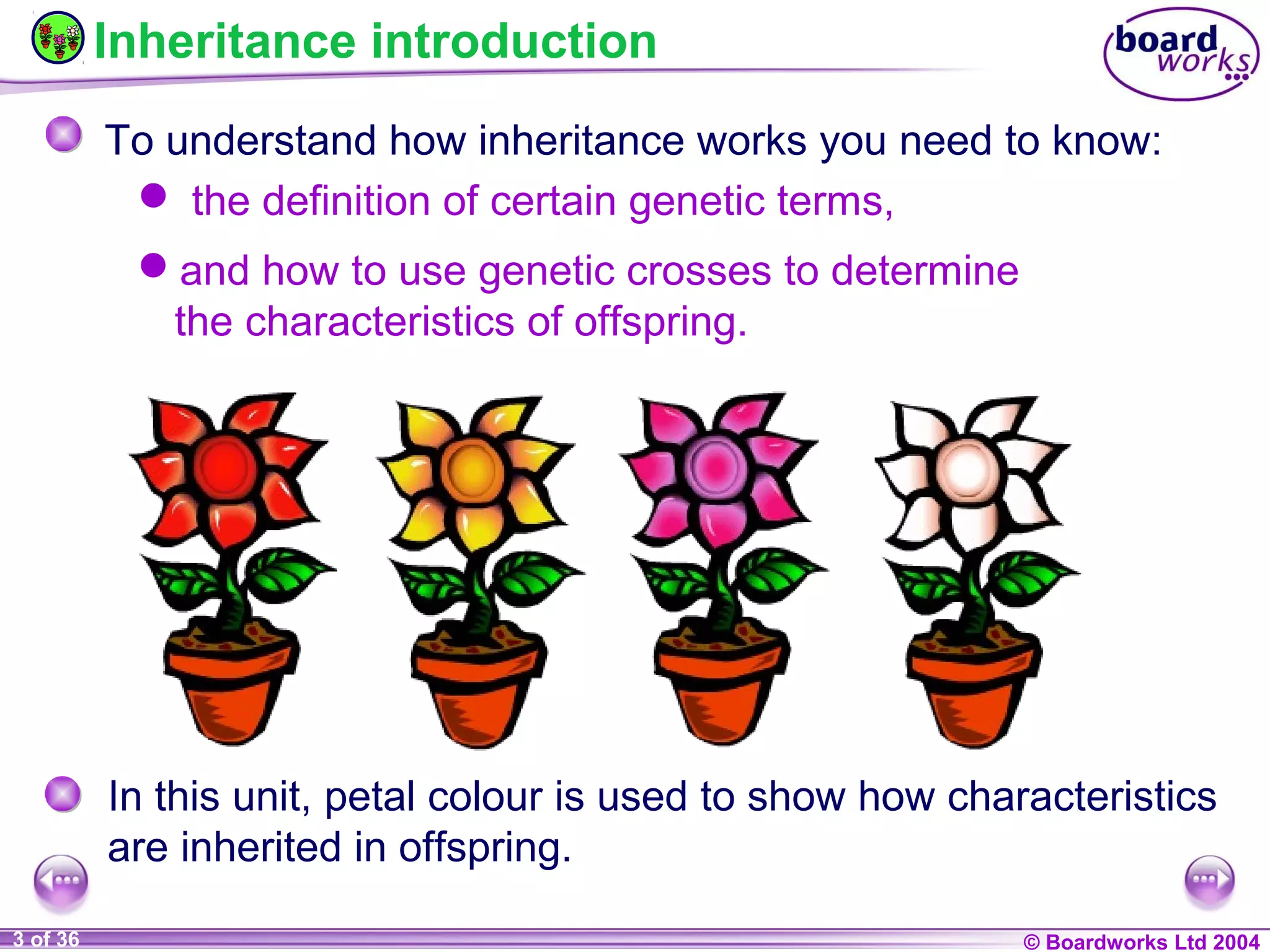
 the definition of certain genetic terms,
Inheritance introduction
To understand how inheritance works you need to know:
and how to use genetic crosses to determine
the characteristics of offspring.
In this unit, petal colour is used to show how characteristics
are inherited in offspring.
© Boardworks Ltd 20044 of 36 © Boardworks Ltd 2004
Homologous chromosomes
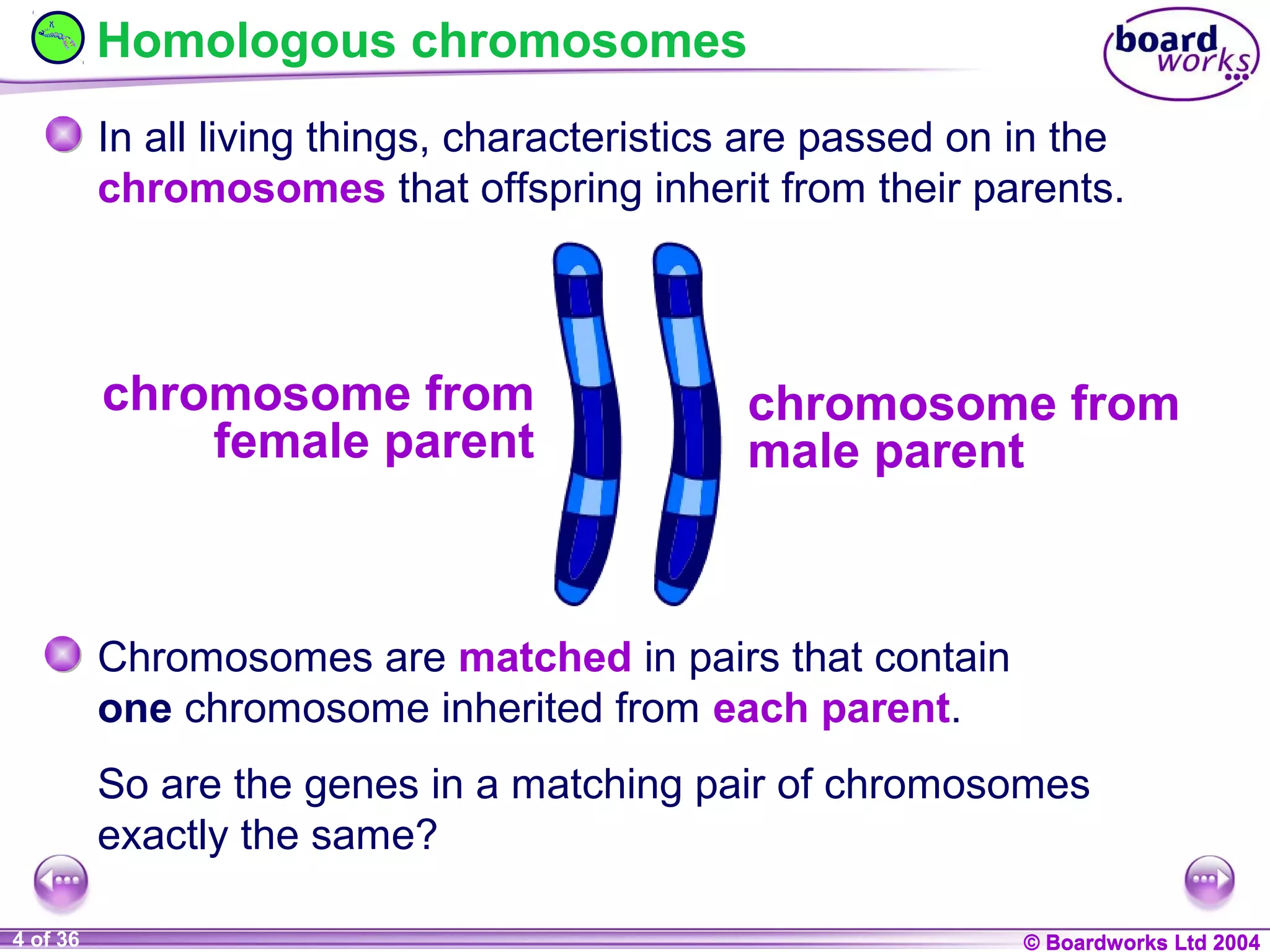
In all living things, characteristics are passed on in the
chromosomes that offspring inherit from their parents.
Chromosomes are matched in pairs that contain
one chromosome inherited from each parent.
So are the genes in a matching pair of chromosomes
exactly the same?
chromosome from
female parent
chromosome from
male parent
© Boardworks Ltd 20045 of 36
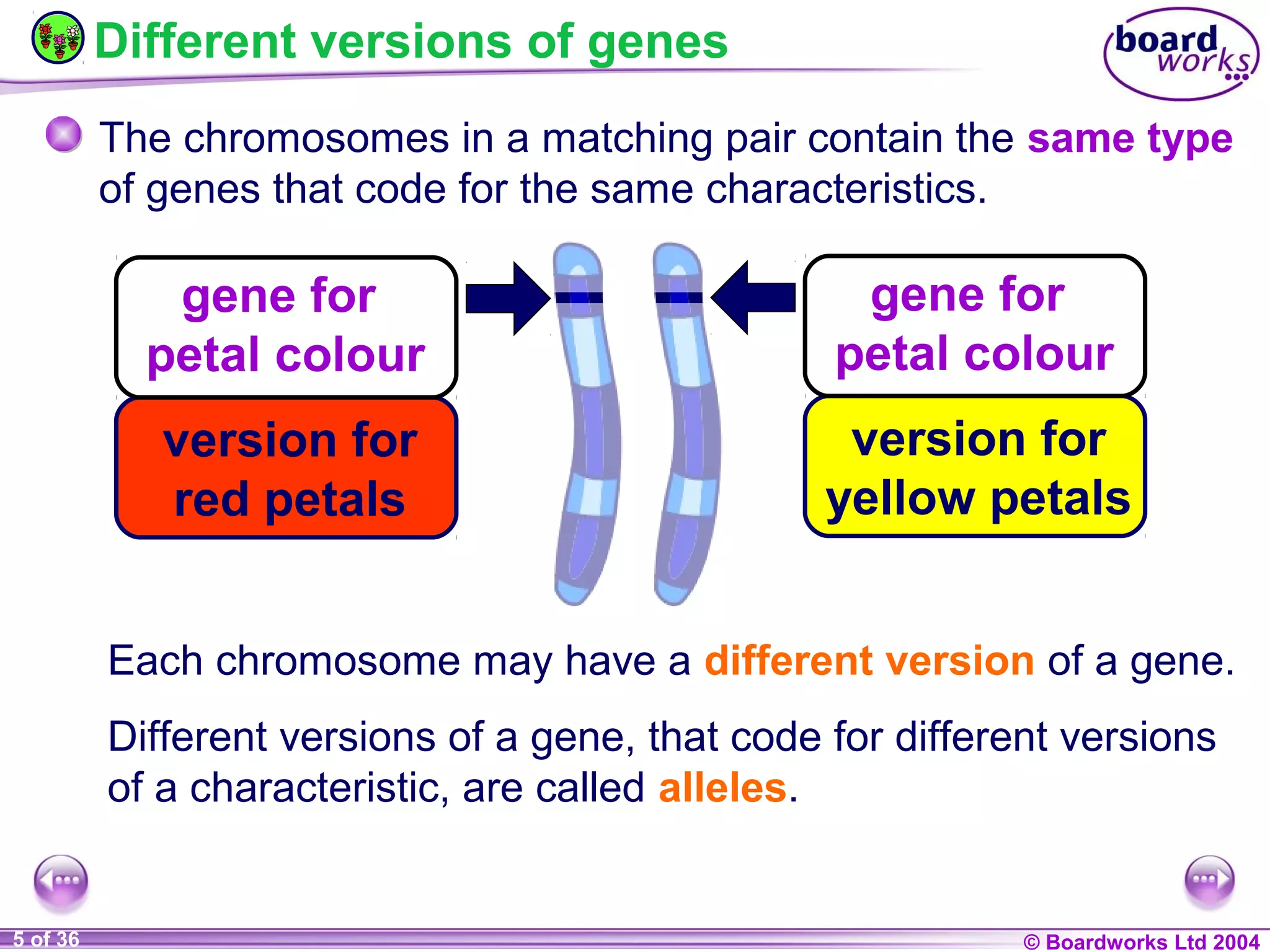
Each chromosome may have a different version of a gene.
Different versions of a gene, that code for different versions
of a characteristic, are called alleles.
The chromosomes in a matching pair contain the same type
of genes that code for the same characteristics.
Different versions of genes
version for
yellow petals
version for
red petals
gene for
petal colour
gene for
petal colour
© Boardworks Ltd 20046 of 36
Pairs of alleles – homozygous
If the alleles in a matching pair are the same,
they are called homozygous alleles.
allele for
yellow petals
allele for
yellow petals
allele for
red petals
allele for
red petals
What colour are the flowers with these
homozygous pairs of alleles?
(Click twice on each bud
to reveal the flower;
click again to close them.)
© Boardworks Ltd 20047 of 36
Pairs of alleles – heterozygous
If the alleles in a matching pair are different,
they are called heterozygous alleles.
Which characteristic is expressed if alleles are different?
allele for
yellow petals
allele for
red petals
Some alleles are dominant to other forms of a gene
and will always be expressed.
Which is the dominant allele in this heterozygous pair?
Which is the recessive allele in this heterozygous pair?
(Click twice on the bud
to reveal the flower;
click again to close it.)
© Boardworks Ltd 20048 of 36
Representing alleles
Letters are used to represent different alleles.
The allele pair for each characteristic is called the genotype.
What colour are flowers with the genotype Rr?
A dominant allele is always a capital letter.
A recessive allele is always the corresponding small letter.
allele for
red petals R
allele for
yellow petals r
=
=
© Boardworks Ltd 20049 of 36
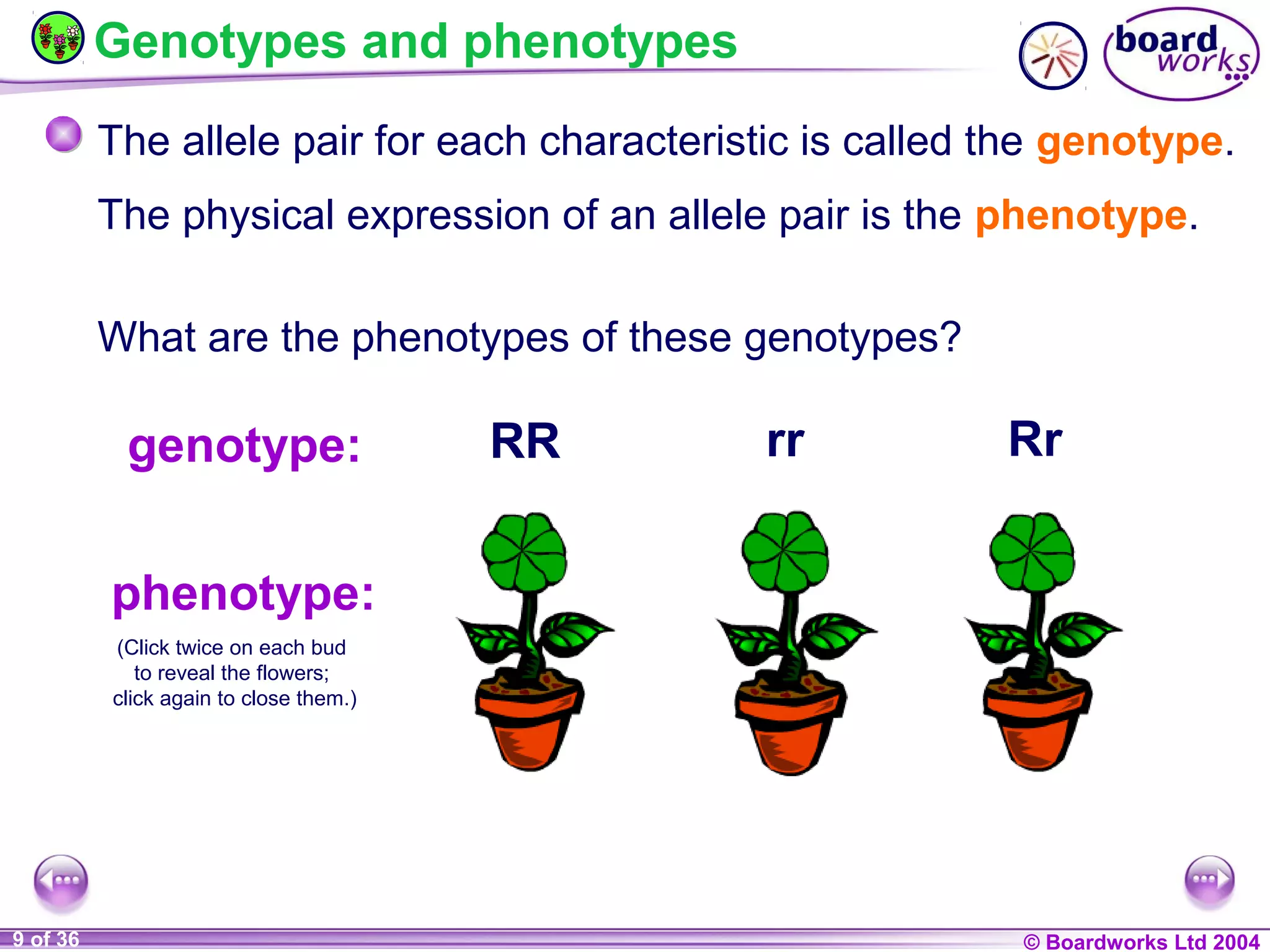
Genotypes and phenotypes
The allele pair for each characteristic is called the genotype.
The physical expression of an allele pair is the phenotype.
What are the phenotypes of these genotypes?
genotype:
phenotype:
RR Rrrr
(Click twice on each bud
to reveal the flowers;
click again to close them.)
© Boardworks Ltd 200410 of 36
Genetic jargon
gene
allele
phenotype
genotype
Section of DNA that codes for a particular trait
or characteristic.
A different form of a gene that codes for a
different version of a characteristic.
A description of the pair of alleles present
for a characteristic.
The physical expression of the alleles.
What do these genetic terms mean?
© Boardworks Ltd 200411 of 36
homozygous
heterozygous
recessive
dominant
Pair of alleles that produce a characteristic
that are the same, e.g. HH.
Pair of alleles that produce a characteristic
that are different, e.g. Hh.
An allele that will only be expressed when
both alleles are of this type, represented
by a lower case letter.
An allele that will always be expressed even
when there is only one of these alleles present,
represented by a capital letter.
Genetic jargon
What do these genetic terms mean?
© Boardworks Ltd 200412 of 36 © Boardworks Ltd 2004
Matching pairs – genes
© Boardworks Ltd 200413 of 36
Matching pairs – characteristics
© Boardworks Ltd 200414 of 36
Contents
All about alleles
Homozygous cross
Using a test cross
Co-dominance
Heterozygous cross
Inheritance
© Boardworks Ltd 200415 of 36
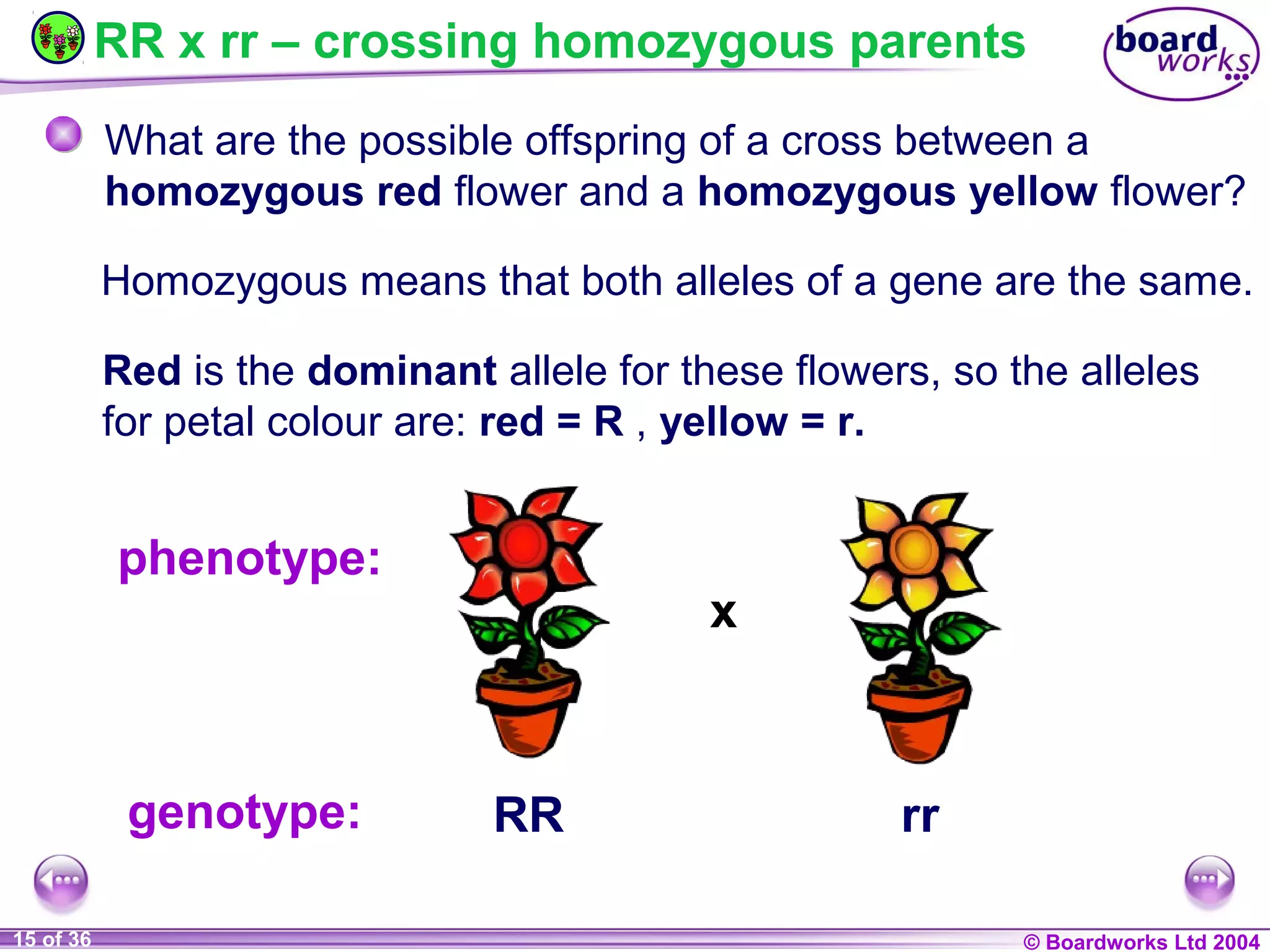
x
phenotype:
genotype: RR rr
Homozygous means that both alleles of a gene are the same.
Red is the dominant allele for these flowers, so the alleles
for petal colour are: red = R , yellow = r.
RR x rr – crossing homozygous parents
What are the possible offspring of a cross between a
homozygous red flower and a homozygous yellow flower?
© Boardworks Ltd 200416 of 36
RR x rr
R R r r
parental genotype:
gametes:
rr
R
R
Rr Rr
RrRrF1 offspring
genotype:
RR x rr – F1 offspring
What are the phenotypes of the F1 offspring?
?
© Boardworks Ltd 200417 of 36
F1 genotypes:
RR x rr – F1 phenotypes
Rr Rr Rr Rr
F1 phenotypes:
(Click twice on the buds
to reveal the flowers;
click again to close them.)
The possible offspring of a cross between two homozygous
parents are always heterozygous and so the dominant
characteristic is always expressed in this generation.
RR x rrparental genotype:
© Boardworks Ltd 200418 of 36 © Boardworks Ltd 2004
Homozygous cross activity
© Boardworks Ltd 200419 of 36
Contents
All about alleles
Homozygous cross
Using a test cross
Co-dominance
Heterozygous cross
Inheritance
© Boardworks Ltd 200420 of 36
The offspring (Rr) from the first cross (RR x rr) are called
the F1 generation. What happens in a cross between
these offspring?
Both parent plants are now heterozygous, so the alleles
in each plant are different.
F1 generation
genotype:
phenotype:
X
Rr Rr
Rr x Rr – crossing heterozygous parents
© Boardworks Ltd 200421 of 36
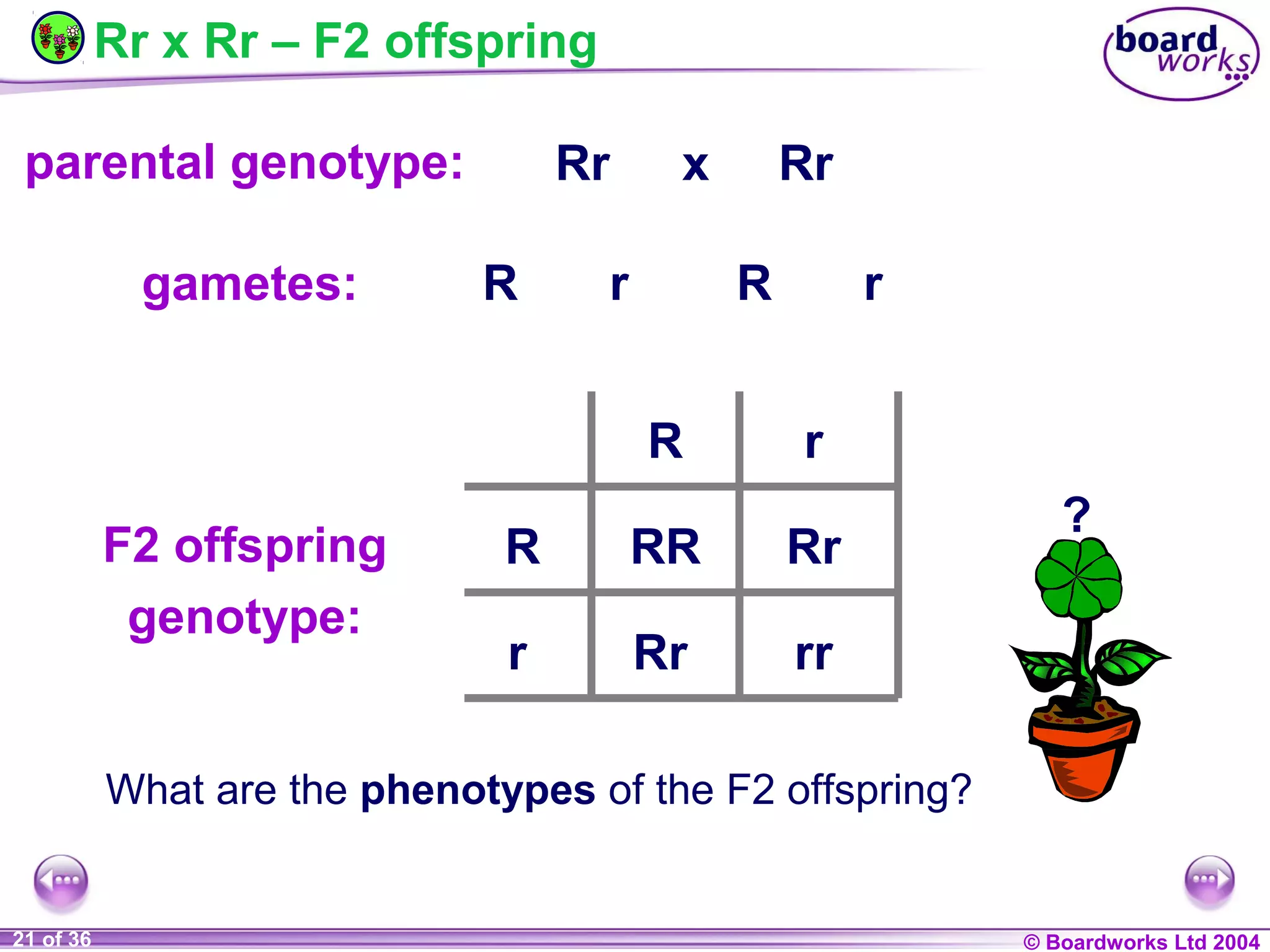
Rr x Rr – F2 offspring
R r
R
r
RR Rr
Rr rr
What are the phenotypes of the F2 offspring?
?
parental genotype: Rr x Rr
R r R rgametes:
F2 offspring
genotype:
© Boardworks Ltd 200422 of 36
Rr x Rr – F2 phenotypes
F2 genotypes: RR Rr Rr rr
F2 phenotypes:
(Click twice on the buds
to reveal the flowers;
click again to close them.)
In the F2 generation, 3 of the 4 possible offspring are red.
Only one offspring shows the recessive phenotype.
When two heterozygous parents are crossed, the possible
offspring will always show a 3:1 ratio in favour of the
dominant phenotype.
parental genotype: Rr x Rr
© Boardworks Ltd 200423 of 36 © Boardworks Ltd 2004
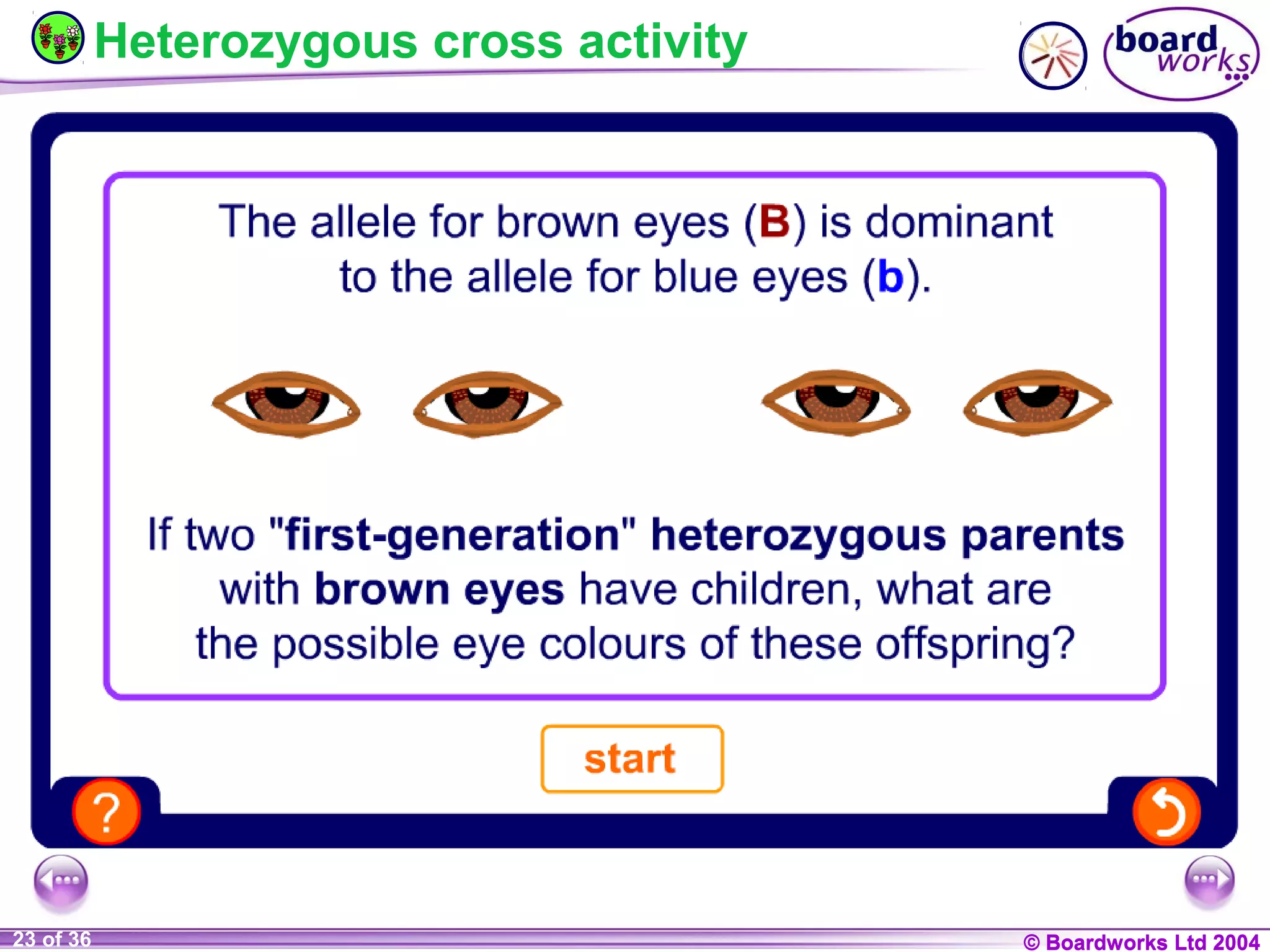
Heterozygous cross activity
© Boardworks Ltd 200424 of 36
Contents
All about alleles
Homozygous cross
Using a test cross
Co-dominance
Heterozygous cross
Inheritance
© Boardworks Ltd 200425 of 36
What is a test cross?
A test cross allows you to find out if an organism showing
a dominant characteristic is homozygous or heterozygous
for the dominant allele.
For example the genotype of a red flower could be:
RR or Rr
What could you cross a red flower with to find its genotype?
© Boardworks Ltd 200426 of 36
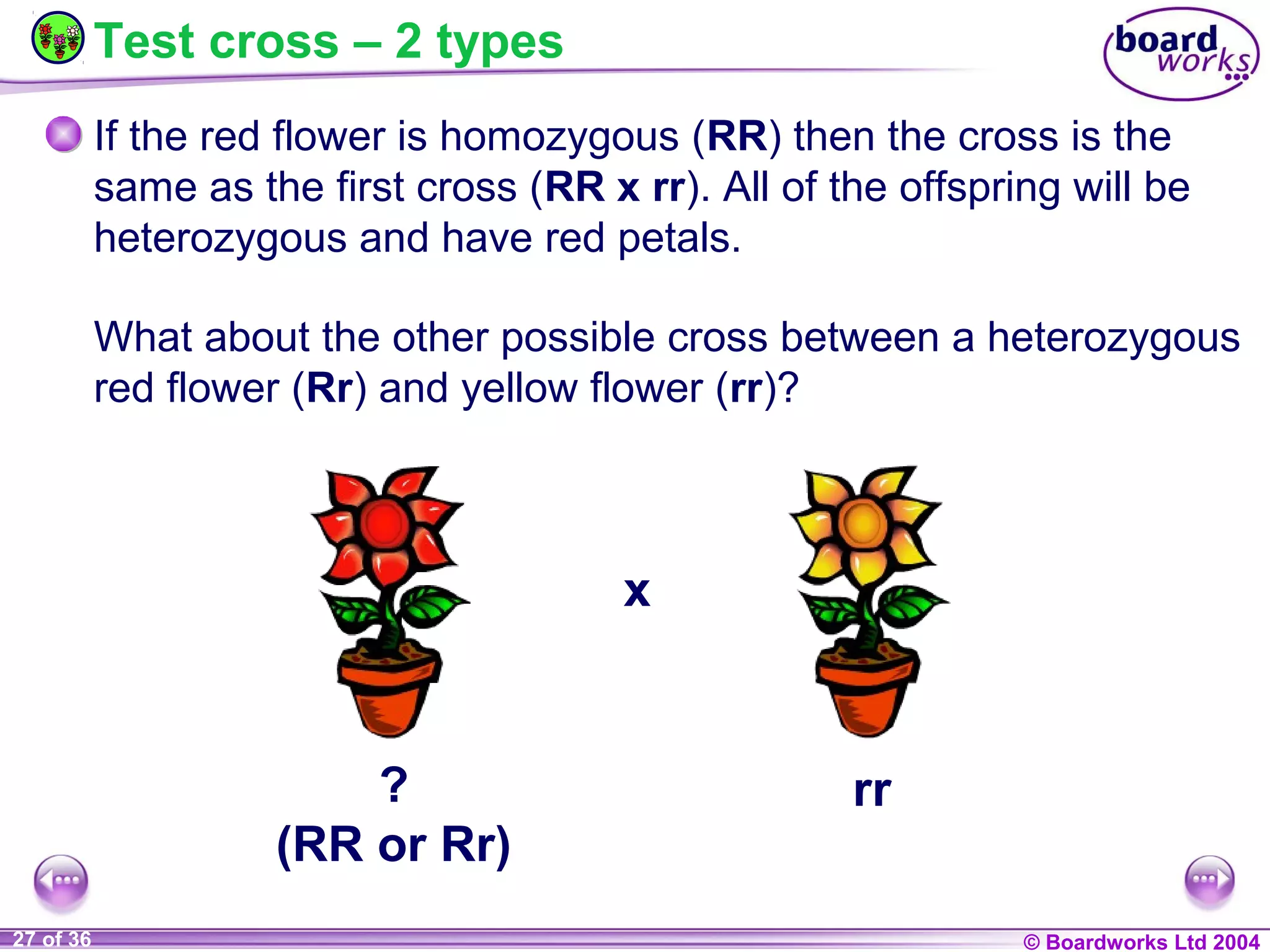
A test cross is carried out between the flower of unknown
genotype and another flower whose genotype is known.
For example, a yellow flower can only have the genotype rr
because it’s recessive.
So the test cross is:
x
?
(RR or Rr)
rr
Carrying out a test cross
© Boardworks Ltd 200427 of 36
Test cross – 2 types
If the red flower is homozygous (RR) then the cross is the
same as the first cross (RR x rr). All of the offspring will be
heterozygous and have red petals.
What about the other possible cross between a heterozygous
red flower (Rr) and yellow flower (rr)?
rr
x
?
(RR or Rr)
© Boardworks Ltd 200428 of 36
Test cross offspring
R r r rgametes:
offspring
genotype:
r r
R
r
Rr Rr
rr rr
What are the phenotypes of these offspring?
?
Rr x rrparental genotype:
© Boardworks Ltd 200429 of 36
Test cross results
F2 genotypes: Rr Rr rr rr
F2 phenotypes:
(Click twice on the buds
to reveal the flowers;
click again to close them.)
A cross between a heterozygous parent and a recessive
parent yields different types of offspring in a 1:1 ratio.
Rr x rrparental genotype:
© Boardworks Ltd 200430 of 36 © Boardworks Ltd 2004
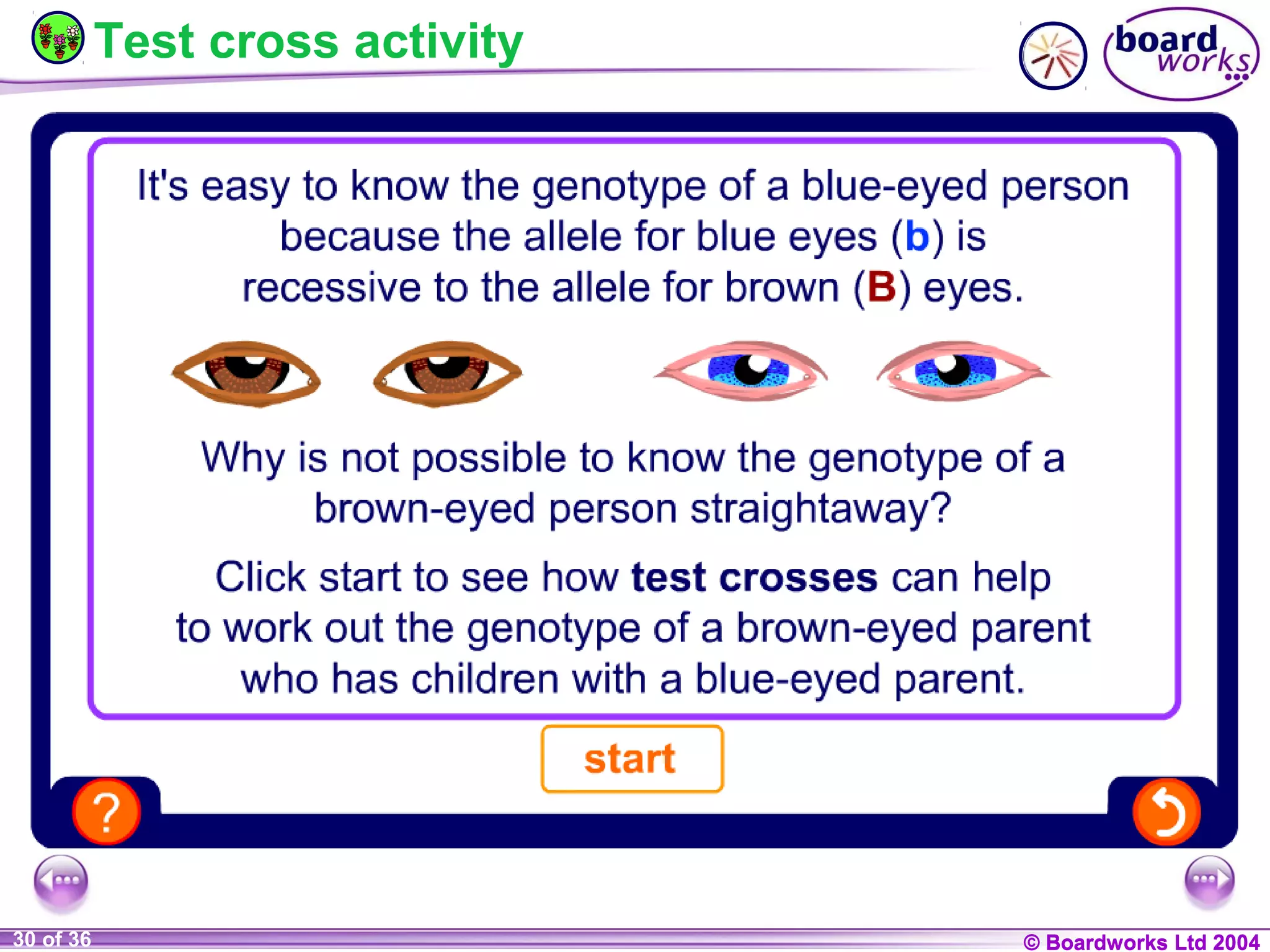
Test cross activity
© Boardworks Ltd 200431 of 36
Contents
All about alleles
Homozygous cross
Using a test cross
Co-dominance
Heterozygous cross
Inheritance
© Boardworks Ltd 200432 of 36
RR WW
What is co-dominance?
Sometimes two alleles are equally dominant to each other.
In genetics, this is called co-dominance and means that
neither allele is recessive to the other allele.
How does co-dominance affect the offspring of a cross?
For example, let’s assume that the red allele (R) and
the white allele (W) are co-dominant:
x
© Boardworks Ltd 200433 of 36
RR x WW
R R W W
parental genotype:
gametes:
offspring
genotype:
R
R
W W
RW RW
RWRW
The alleles are co-dominant so both are expressed.
What will the offspring flowers look like?
Co-dominance cross – offspring
?
© Boardworks Ltd 200434 of 36
RW RW RW RW
Co-dominance cross – phenotypes
offspring
genotypes:
offspring
phenotypes:
(Click twice on the buds
to reveal the flowers;
click again to close them.)
All the offspring flowers are pink because both the red
and white alleles are expressed.
RR x WWparental genotype:
© Boardworks Ltd 200435 of 36 © Boardworks Ltd 2004
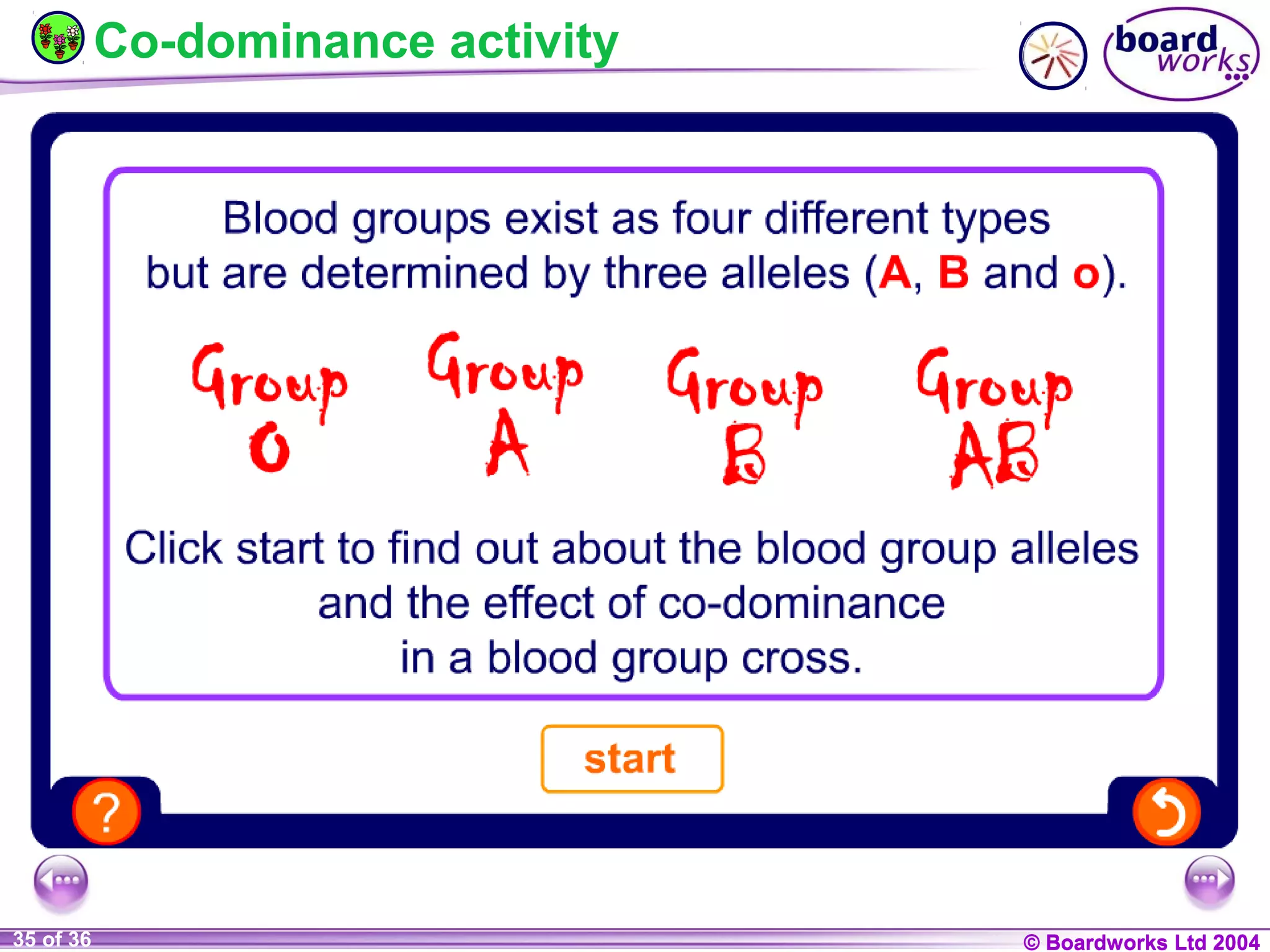
FLASH 5 – Blood groups
Co-dominance activity
© Boardworks Ltd 200436 of 36
Inheritance multiple-choice quiz

Ks4 inheritance

  • 1.
    © Boardworks Ltd20041 of 36 KS4 Biology Inheritance
  • 2.
    © Boardworks Ltd20042 of 36 Inheritance Contents All about alleles Homozygous cross Using a test cross Co-dominance Heterozygous cross
  • 3.
    © Boardworks Ltd20043 of 36  the definition of certain genetic terms, Inheritance introduction To understand how inheritance works you need to know: and how to use genetic crosses to determine the characteristics of offspring. In this unit, petal colour is used to show how characteristics are inherited in offspring.
  • 4.
    © Boardworks Ltd20044 of 36 © Boardworks Ltd 2004 Homologous chromosomes In all living things, characteristics are passed on in the chromosomes that offspring inherit from their parents. Chromosomes are matched in pairs that contain one chromosome inherited from each parent. So are the genes in a matching pair of chromosomes exactly the same? chromosome from female parent chromosome from male parent
  • 5.
    © Boardworks Ltd20045 of 36 Each chromosome may have a different version of a gene. Different versions of a gene, that code for different versions of a characteristic, are called alleles. The chromosomes in a matching pair contain the same type of genes that code for the same characteristics. Different versions of genes version for yellow petals version for red petals gene for petal colour gene for petal colour
  • 6.
    © Boardworks Ltd20046 of 36 Pairs of alleles – homozygous If the alleles in a matching pair are the same, they are called homozygous alleles. allele for yellow petals allele for yellow petals allele for red petals allele for red petals What colour are the flowers with these homozygous pairs of alleles? (Click twice on each bud to reveal the flower; click again to close them.)
  • 7.
    © Boardworks Ltd20047 of 36 Pairs of alleles – heterozygous If the alleles in a matching pair are different, they are called heterozygous alleles. Which characteristic is expressed if alleles are different? allele for yellow petals allele for red petals Some alleles are dominant to other forms of a gene and will always be expressed. Which is the dominant allele in this heterozygous pair? Which is the recessive allele in this heterozygous pair? (Click twice on the bud to reveal the flower; click again to close it.)
  • 8.
    © Boardworks Ltd20048 of 36 Representing alleles Letters are used to represent different alleles. The allele pair for each characteristic is called the genotype. What colour are flowers with the genotype Rr? A dominant allele is always a capital letter. A recessive allele is always the corresponding small letter. allele for red petals R allele for yellow petals r = =
  • 9.
    © Boardworks Ltd20049 of 36 Genotypes and phenotypes The allele pair for each characteristic is called the genotype. The physical expression of an allele pair is the phenotype. What are the phenotypes of these genotypes? genotype: phenotype: RR Rrrr (Click twice on each bud to reveal the flowers; click again to close them.)
  • 10.
    © Boardworks Ltd200410 of 36 Genetic jargon gene allele phenotype genotype Section of DNA that codes for a particular trait or characteristic. A different form of a gene that codes for a different version of a characteristic. A description of the pair of alleles present for a characteristic. The physical expression of the alleles. What do these genetic terms mean?
  • 11.
    © Boardworks Ltd200411 of 36 homozygous heterozygous recessive dominant Pair of alleles that produce a characteristic that are the same, e.g. HH. Pair of alleles that produce a characteristic that are different, e.g. Hh. An allele that will only be expressed when both alleles are of this type, represented by a lower case letter. An allele that will always be expressed even when there is only one of these alleles present, represented by a capital letter. Genetic jargon What do these genetic terms mean?
  • 12.
    © Boardworks Ltd200412 of 36 © Boardworks Ltd 2004 Matching pairs – genes
  • 13.
    © Boardworks Ltd200413 of 36 Matching pairs – characteristics
  • 14.
    © Boardworks Ltd200414 of 36 Contents All about alleles Homozygous cross Using a test cross Co-dominance Heterozygous cross Inheritance
  • 15.
    © Boardworks Ltd200415 of 36 x phenotype: genotype: RR rr Homozygous means that both alleles of a gene are the same. Red is the dominant allele for these flowers, so the alleles for petal colour are: red = R , yellow = r. RR x rr – crossing homozygous parents What are the possible offspring of a cross between a homozygous red flower and a homozygous yellow flower?
  • 16.
    © Boardworks Ltd200416 of 36 RR x rr R R r r parental genotype: gametes: rr R R Rr Rr RrRrF1 offspring genotype: RR x rr – F1 offspring What are the phenotypes of the F1 offspring? ?
  • 17.
    © Boardworks Ltd200417 of 36 F1 genotypes: RR x rr – F1 phenotypes Rr Rr Rr Rr F1 phenotypes: (Click twice on the buds to reveal the flowers; click again to close them.) The possible offspring of a cross between two homozygous parents are always heterozygous and so the dominant characteristic is always expressed in this generation. RR x rrparental genotype:
  • 18.
    © Boardworks Ltd200418 of 36 © Boardworks Ltd 2004 Homozygous cross activity
  • 19.
    © Boardworks Ltd200419 of 36 Contents All about alleles Homozygous cross Using a test cross Co-dominance Heterozygous cross Inheritance
  • 20.
    © Boardworks Ltd200420 of 36 The offspring (Rr) from the first cross (RR x rr) are called the F1 generation. What happens in a cross between these offspring? Both parent plants are now heterozygous, so the alleles in each plant are different. F1 generation genotype: phenotype: X Rr Rr Rr x Rr – crossing heterozygous parents
  • 21.
    © Boardworks Ltd200421 of 36 Rr x Rr – F2 offspring R r R r RR Rr Rr rr What are the phenotypes of the F2 offspring? ? parental genotype: Rr x Rr R r R rgametes: F2 offspring genotype:
  • 22.
    © Boardworks Ltd200422 of 36 Rr x Rr – F2 phenotypes F2 genotypes: RR Rr Rr rr F2 phenotypes: (Click twice on the buds to reveal the flowers; click again to close them.) In the F2 generation, 3 of the 4 possible offspring are red. Only one offspring shows the recessive phenotype. When two heterozygous parents are crossed, the possible offspring will always show a 3:1 ratio in favour of the dominant phenotype. parental genotype: Rr x Rr
  • 23.
    © Boardworks Ltd200423 of 36 © Boardworks Ltd 2004 Heterozygous cross activity
  • 24.
    © Boardworks Ltd200424 of 36 Contents All about alleles Homozygous cross Using a test cross Co-dominance Heterozygous cross Inheritance
  • 25.
    © Boardworks Ltd200425 of 36 What is a test cross? A test cross allows you to find out if an organism showing a dominant characteristic is homozygous or heterozygous for the dominant allele. For example the genotype of a red flower could be: RR or Rr What could you cross a red flower with to find its genotype?
  • 26.
    © Boardworks Ltd200426 of 36 A test cross is carried out between the flower of unknown genotype and another flower whose genotype is known. For example, a yellow flower can only have the genotype rr because it’s recessive. So the test cross is: x ? (RR or Rr) rr Carrying out a test cross
  • 27.
    © Boardworks Ltd200427 of 36 Test cross – 2 types If the red flower is homozygous (RR) then the cross is the same as the first cross (RR x rr). All of the offspring will be heterozygous and have red petals. What about the other possible cross between a heterozygous red flower (Rr) and yellow flower (rr)? rr x ? (RR or Rr)
  • 28.
    © Boardworks Ltd200428 of 36 Test cross offspring R r r rgametes: offspring genotype: r r R r Rr Rr rr rr What are the phenotypes of these offspring? ? Rr x rrparental genotype:
  • 29.
    © Boardworks Ltd200429 of 36 Test cross results F2 genotypes: Rr Rr rr rr F2 phenotypes: (Click twice on the buds to reveal the flowers; click again to close them.) A cross between a heterozygous parent and a recessive parent yields different types of offspring in a 1:1 ratio. Rr x rrparental genotype:
  • 30.
    © Boardworks Ltd200430 of 36 © Boardworks Ltd 2004 Test cross activity
  • 31.
    © Boardworks Ltd200431 of 36 Contents All about alleles Homozygous cross Using a test cross Co-dominance Heterozygous cross Inheritance
  • 32.
    © Boardworks Ltd200432 of 36 RR WW What is co-dominance? Sometimes two alleles are equally dominant to each other. In genetics, this is called co-dominance and means that neither allele is recessive to the other allele. How does co-dominance affect the offspring of a cross? For example, let’s assume that the red allele (R) and the white allele (W) are co-dominant: x
  • 33.
    © Boardworks Ltd200433 of 36 RR x WW R R W W parental genotype: gametes: offspring genotype: R R W W RW RW RWRW The alleles are co-dominant so both are expressed. What will the offspring flowers look like? Co-dominance cross – offspring ?
  • 34.
    © Boardworks Ltd200434 of 36 RW RW RW RW Co-dominance cross – phenotypes offspring genotypes: offspring phenotypes: (Click twice on the buds to reveal the flowers; click again to close them.) All the offspring flowers are pink because both the red and white alleles are expressed. RR x WWparental genotype:
  • 35.
    © Boardworks Ltd200435 of 36 © Boardworks Ltd 2004 FLASH 5 – Blood groups Co-dominance activity
  • 36.
    © Boardworks Ltd200436 of 36 Inheritance multiple-choice quiz

Editor's Notes

  • #3 <number>
  • #15 <number>
  • #20 <number>
  • #25 <number>
  • #32 <number>