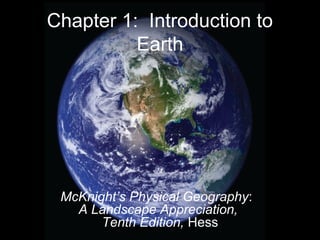
Chapter 1: Introduction to
Earth
McKnight’s Physical Geography:
A Landscape Appreciation,
Tenth Edition, Hess
Introduction to Earth
• Geography as a Field of Learning
• Science and Geography
• The Environmental Spheres
• The Solar System
• The Size and Shape of Earth
• The Geographic Grid
• Earth-Sun Relations
• The Annual March of the Seasons
• Telling Time
2© 2011 Pearson Education, Inc.
Geography as a Field of Learning
• Definition
• Sciences which
branch from
geography
• Physical versus
cultural
• “Why what is where
and so what?”
3© 2011 Pearson Education, Inc.
Science and Geography
• The Scientific Method
– Observe phenomena
– Formulate a hypothesis
– Design an experiment
– Predict the outcome of the experiment
– Conduct the experiment
– Draw conclusions
• Scientific “proof”
4© 2011 Pearson Education, Inc.
Science and Geography
• Measurement Systems
– Need measurement
systems to quantify
scientific processes
– SI versus English units
– Conversions
5© 2011 Pearson Education, Inc.
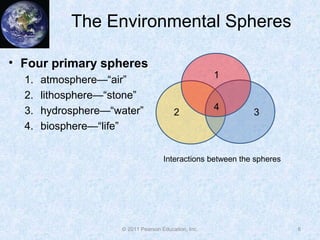
The Environmental Spheres
• Four primary spheres
1. atmosphere—“air”
2. lithosphere—“stone”
3. hydrosphere—“water”
4. biosphere—“life”
6
2 3
1
4
Interactions between the spheres
© 2011 Pearson Education, Inc.
The Solar System
• Formation of the Solar
System
– Formed 4.5 to 5 billion years
ago
– 8 planets revolve around the
Sun
– 4 terrestrial planets
– 4 gas giants
– Earth is the third planet
7
Figure 1-4
© 2011 Pearson Education, Inc.
The Solar System
8
Figure 1-5
© 2011 Pearson Education, Inc.
The Size and Shape of the Earth
• Earth’s Physical
Characteristics
– Equatorial diameter ~ 12,756 km
– Polar diameter ~ 12,714 km
– Circumference of 40,000 km
– Maximum relief
9© 2011 Pearson Education, Inc.
Figure 1-6
The Geographic Grid
• Location on Earth
– Need an accurate location on
Earth to describe geographic
features
– Use Earth’s rotation axis to base
location on the surface
– North Pole and South Pole
– Plane of the Equator—halfway
between poles and
perpendicular to Earth’s surface
– graticule
10
Figure 1-9
© 2011 Pearson Education, Inc.
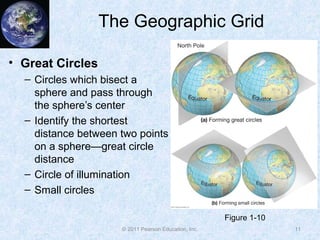
The Geographic Grid
• Great Circles
– Circles which bisect a
sphere and pass through
the sphere’s center
– Identify the shortest
distance between two points
on a sphere—great circle
distance
– Circle of illumination
– Small circles
11
Figure 1-10
© 2011 Pearson Education, Inc.
The Geographic Grid
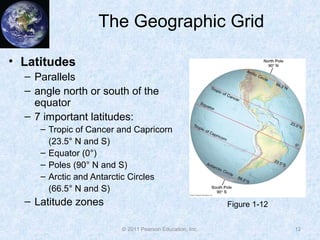
• Latitudes
– Parallels
– angle north or south of the
equator
– 7 important latitudes:
– Tropic of Cancer and Capricorn
(23.5° N and S)
– Equator (0°)
– Poles (90° N and S)
– Arctic and Antarctic Circles
(66.5° N and S)
– Latitude zones
12
Figure 1-12
© 2011 Pearson Education, Inc.
The Geographic Grid
• Longitudes
– Meridians
– Prime Meridian (0° longitude)
located at Greenwich, England
– angle east or west of the Prime
Meridian
– Converge at the poles
13
Figure 1-16
© 2011 Pearson Education, Inc.
Earth-Sun Relations
• Rotation of the Earth
– 24 hours for one rotation
– Circular motion at all latitudes but the poles
– Rotation is counterclockwise relative to the North Pole
– Converge at the poles
– Diurnal transition from light to darkness
– Tidal effects from the Moon and Sun
14© 2011 Pearson Education, Inc.
Earth-Sun Relations
• Earth’s Revolution around
Sun
– One revolution takes 365 ¼
days
– Elliptical orbit
– Aphelion (152,171,500 km)
– Perihelion (147,166,480 km)
– Average distance
(149,597,892 km)
– Earth at perihelion during
Northern Hemisphere winter;
aphelion during Northern
Hemisphere summer
15
Figure 1-19
© 2011 Pearson Education, Inc.
Earth-Sun Relations
• Orbital Properties
– Plane of the Earth’s orbit is the
plane of the ecliptic
– Earth’s axis tilted at 23.5°
– Plane of ecliptic is not parallel
to equatorial plane
• Polarity of the Earth’s axis
– Parallelism
– North Pole always points
toward Polaris (“North Star”)
16
Figure 1-20
© 2011 Pearson Education, Inc.
The Annual March of the Seasons
17
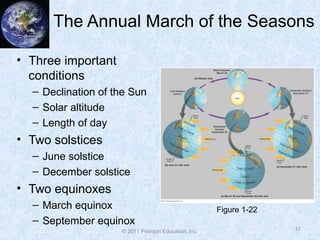
• Three important
conditions
– Declination of the Sun
– Solar altitude
– Length of day
• Two solstices
– June solstice
– December solstice
• Two equinoxes
– March equinox
– September equinox
Figure 1-22
© 2011 Pearson Education, Inc.
The Annual March of the Seasons
18
• June solstice
– Occurs on approximately
June 22 each year
– Sun is directly overhead at
23.5° N latitude
– Antarctic Circle in 24 hours
of darkness
– Marks start of summer in
Northern Hemisphere;
winter in Southern
Hemisphere
Figure 1-22
© 2011 Pearson Education, Inc.
The Annual March of the Seasons
19
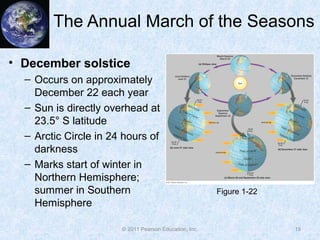
• December solstice
– Occurs on approximately
December 22 each year
– Sun is directly overhead at
23.5° S latitude
– Arctic Circle in 24 hours of
darkness
– Marks start of winter in
Northern Hemisphere;
summer in Southern
Hemisphere
Figure 1-22
© 2011 Pearson Education, Inc.
The Annual March of the Seasons
20
• Equinoxes
– Occur on approximately
March 21 and September
21 each year
– Day length is 12 hours
worldwide (“equinox”)
– Sun is directly overhead at
the equator
Figure 1-22
© 2011 Pearson Education, Inc.
The Annual March of the Seasons
21
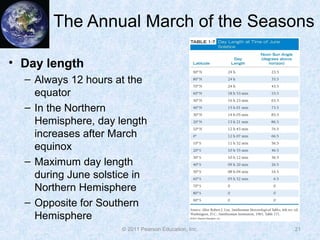
• Day length
– Always 12 hours at the
equator
– In the Northern
Hemisphere, day length
increases after March
equinox
– Maximum day length
during June solstice in
Northern Hemisphere
– Opposite for Southern
Hemisphere
© 2011 Pearson Education, Inc.
The Annual March of the Seasons
22
• Significance of seasonal patterns
– Spread of solar rays over small and large areas
– Tropical latitudes consistently warmer
– Polar latitudes consistently cooler
– Large seasonal variations in temperature in
midlatitudes
© 2011 Pearson Education, Inc.
Telling Time
23
• Three physical measures
of time
– Tropical year
– Lunar month
– Solar day
• Solar noon
– Sun casts the shortest shadow
• Ante-meridian (AM—“before
noon”)
• Post-meridian (PM—“after noon”)
Figure 1-23
© 2011 Pearson Education, Inc.
Telling Time
24
• Current time system
– 24 time zones
– Greenwich Mean Time (GMT) is standard
– Controlling Meridian for each time zone
– Several countries have multiple time zones in their
borders
– Time zone boundaries subject to local political and
economic boundaries of different nations
– 180° meridian chosen as the International Date Line
© 2011 Pearson Education, Inc.
Telling Time
25
Figure 1-24
• Time zones of the world
© 2011 Pearson Education, Inc.
Telling Time
26
• Time zones of the United States
Figure 1-25
© 2011 Pearson Education, Inc.
Telling Time
27
• Daylight-saving time
– Move clocks ahead by an hour during the summer
months
– Originally done by Germans during WWII; now
practiced by many nations
– Conserves lighting energy by providing an extra
hour of daylight
© 2011 Pearson Education, Inc.
Summary
28
• Geography is the study of the distribution of
physical and cultural attributes of Earth
• Many sciences have branched off of geography
• The scientific method is important when doing
scientific studies
• Earth has four primary spheres: the atmosphere,
the lithosphere, the hydrosphere, and the
atmosphere
• The solar system formed 5 billion years ago and
consists of 8 planets
© 2011 Pearson Education, Inc.
Summary
29
• Earth is an imperfect sphere
• A latitude and longitude grid help identify
locations on Earth’s surface
• Earth rotates on its axis in 24 hours
• Earth revolves around the Sun in 365 ¼ days
• Tilt of Earth’s axis causes seasons
• Equinoxes and solstices help identify when a
seasonal transition occurs
© 2011 Pearson Education, Inc.
Summary
30
• Time zones were established to have a
uniform global time system
• Daylight-saving time was devised to conserve
energy by adding an hour of daylight
© 2011 Pearson Education, Inc.

Ch01

  • 1.
    Chapter 1: Introductionto Earth McKnight’s Physical Geography: A Landscape Appreciation, Tenth Edition, Hess
  • 2.
    Introduction to Earth •Geography as a Field of Learning • Science and Geography • The Environmental Spheres • The Solar System • The Size and Shape of Earth • The Geographic Grid • Earth-Sun Relations • The Annual March of the Seasons • Telling Time 2© 2011 Pearson Education, Inc.
  • 3.
    Geography as aField of Learning • Definition • Sciences which branch from geography • Physical versus cultural • “Why what is where and so what?” 3© 2011 Pearson Education, Inc.
  • 4.
    Science and Geography •The Scientific Method – Observe phenomena – Formulate a hypothesis – Design an experiment – Predict the outcome of the experiment – Conduct the experiment – Draw conclusions • Scientific “proof” 4© 2011 Pearson Education, Inc.
  • 5.
    Science and Geography •Measurement Systems – Need measurement systems to quantify scientific processes – SI versus English units – Conversions 5© 2011 Pearson Education, Inc.
  • 6.
    The Environmental Spheres •Four primary spheres 1. atmosphere—“air” 2. lithosphere—“stone” 3. hydrosphere—“water” 4. biosphere—“life” 6 2 3 1 4 Interactions between the spheres © 2011 Pearson Education, Inc.
  • 7.
    The Solar System •Formation of the Solar System – Formed 4.5 to 5 billion years ago – 8 planets revolve around the Sun – 4 terrestrial planets – 4 gas giants – Earth is the third planet 7 Figure 1-4 © 2011 Pearson Education, Inc.
  • 8.
    The Solar System 8 Figure1-5 © 2011 Pearson Education, Inc.
  • 9.
    The Size andShape of the Earth • Earth’s Physical Characteristics – Equatorial diameter ~ 12,756 km – Polar diameter ~ 12,714 km – Circumference of 40,000 km – Maximum relief 9© 2011 Pearson Education, Inc. Figure 1-6
  • 10.
    The Geographic Grid •Location on Earth – Need an accurate location on Earth to describe geographic features – Use Earth’s rotation axis to base location on the surface – North Pole and South Pole – Plane of the Equator—halfway between poles and perpendicular to Earth’s surface – graticule 10 Figure 1-9 © 2011 Pearson Education, Inc.
  • 11.
    The Geographic Grid •Great Circles – Circles which bisect a sphere and pass through the sphere’s center – Identify the shortest distance between two points on a sphere—great circle distance – Circle of illumination – Small circles 11 Figure 1-10 © 2011 Pearson Education, Inc.
  • 12.
    The Geographic Grid •Latitudes – Parallels – angle north or south of the equator – 7 important latitudes: – Tropic of Cancer and Capricorn (23.5° N and S) – Equator (0°) – Poles (90° N and S) – Arctic and Antarctic Circles (66.5° N and S) – Latitude zones 12 Figure 1-12 © 2011 Pearson Education, Inc.
  • 13.
    The Geographic Grid •Longitudes – Meridians – Prime Meridian (0° longitude) located at Greenwich, England – angle east or west of the Prime Meridian – Converge at the poles 13 Figure 1-16 © 2011 Pearson Education, Inc.
  • 14.
    Earth-Sun Relations • Rotationof the Earth – 24 hours for one rotation – Circular motion at all latitudes but the poles – Rotation is counterclockwise relative to the North Pole – Converge at the poles – Diurnal transition from light to darkness – Tidal effects from the Moon and Sun 14© 2011 Pearson Education, Inc.
  • 15.
    Earth-Sun Relations • Earth’sRevolution around Sun – One revolution takes 365 ¼ days – Elliptical orbit – Aphelion (152,171,500 km) – Perihelion (147,166,480 km) – Average distance (149,597,892 km) – Earth at perihelion during Northern Hemisphere winter; aphelion during Northern Hemisphere summer 15 Figure 1-19 © 2011 Pearson Education, Inc.
  • 16.
    Earth-Sun Relations • OrbitalProperties – Plane of the Earth’s orbit is the plane of the ecliptic – Earth’s axis tilted at 23.5° – Plane of ecliptic is not parallel to equatorial plane • Polarity of the Earth’s axis – Parallelism – North Pole always points toward Polaris (“North Star”) 16 Figure 1-20 © 2011 Pearson Education, Inc.
  • 17.
    The Annual Marchof the Seasons 17 • Three important conditions – Declination of the Sun – Solar altitude – Length of day • Two solstices – June solstice – December solstice • Two equinoxes – March equinox – September equinox Figure 1-22 © 2011 Pearson Education, Inc.
  • 18.
    The Annual Marchof the Seasons 18 • June solstice – Occurs on approximately June 22 each year – Sun is directly overhead at 23.5° N latitude – Antarctic Circle in 24 hours of darkness – Marks start of summer in Northern Hemisphere; winter in Southern Hemisphere Figure 1-22 © 2011 Pearson Education, Inc.
  • 19.
    The Annual Marchof the Seasons 19 • December solstice – Occurs on approximately December 22 each year – Sun is directly overhead at 23.5° S latitude – Arctic Circle in 24 hours of darkness – Marks start of winter in Northern Hemisphere; summer in Southern Hemisphere Figure 1-22 © 2011 Pearson Education, Inc.
  • 20.
    The Annual Marchof the Seasons 20 • Equinoxes – Occur on approximately March 21 and September 21 each year – Day length is 12 hours worldwide (“equinox”) – Sun is directly overhead at the equator Figure 1-22 © 2011 Pearson Education, Inc.
  • 21.
    The Annual Marchof the Seasons 21 • Day length – Always 12 hours at the equator – In the Northern Hemisphere, day length increases after March equinox – Maximum day length during June solstice in Northern Hemisphere – Opposite for Southern Hemisphere © 2011 Pearson Education, Inc.
  • 22.
    The Annual Marchof the Seasons 22 • Significance of seasonal patterns – Spread of solar rays over small and large areas – Tropical latitudes consistently warmer – Polar latitudes consistently cooler – Large seasonal variations in temperature in midlatitudes © 2011 Pearson Education, Inc.
  • 23.
    Telling Time 23 • Threephysical measures of time – Tropical year – Lunar month – Solar day • Solar noon – Sun casts the shortest shadow • Ante-meridian (AM—“before noon”) • Post-meridian (PM—“after noon”) Figure 1-23 © 2011 Pearson Education, Inc.
  • 24.
    Telling Time 24 • Currenttime system – 24 time zones – Greenwich Mean Time (GMT) is standard – Controlling Meridian for each time zone – Several countries have multiple time zones in their borders – Time zone boundaries subject to local political and economic boundaries of different nations – 180° meridian chosen as the International Date Line © 2011 Pearson Education, Inc.
  • 25.
    Telling Time 25 Figure 1-24 •Time zones of the world © 2011 Pearson Education, Inc.
  • 26.
    Telling Time 26 • Timezones of the United States Figure 1-25 © 2011 Pearson Education, Inc.
  • 27.
    Telling Time 27 • Daylight-savingtime – Move clocks ahead by an hour during the summer months – Originally done by Germans during WWII; now practiced by many nations – Conserves lighting energy by providing an extra hour of daylight © 2011 Pearson Education, Inc.
  • 28.
    Summary 28 • Geography isthe study of the distribution of physical and cultural attributes of Earth • Many sciences have branched off of geography • The scientific method is important when doing scientific studies • Earth has four primary spheres: the atmosphere, the lithosphere, the hydrosphere, and the atmosphere • The solar system formed 5 billion years ago and consists of 8 planets © 2011 Pearson Education, Inc.
  • 29.
    Summary 29 • Earth isan imperfect sphere • A latitude and longitude grid help identify locations on Earth’s surface • Earth rotates on its axis in 24 hours • Earth revolves around the Sun in 365 ¼ days • Tilt of Earth’s axis causes seasons • Equinoxes and solstices help identify when a seasonal transition occurs © 2011 Pearson Education, Inc.
  • 30.
    Summary 30 • Time zoneswere established to have a uniform global time system • Daylight-saving time was devised to conserve energy by adding an hour of daylight © 2011 Pearson Education, Inc.