Silberschatz, Galvin and GagneOperating System Concepts – 9th
Edition
Chapter 6: CPU Scheduling
6.2 Silberschatz, Galvin and GagneOperating System Concepts – 9th
Edition
Chapter 6: CPU Scheduling
Basic Concepts
Scheduling Criteria
Scheduling Algorithms
Thread Scheduling
Multiple-Processor Scheduling
Real-Time CPU Scheduling
Operating Systems Examples
Algorithm Evaluation
6.3 Silberschatz, Galvin and GagneOperating System Concepts – 9th
Edition
Objectives
To introduce CPU scheduling, which is the basis for
multiprogrammed operating systems
To describe various CPU-scheduling algorithms
To discuss evaluation criteria for selecting a CPU-scheduling
algorithm for a particular system
To examine the scheduling algorithms of several operating
systems
6.4 Silberschatz, Galvin and GagneOperating System Concepts – 9th
Edition
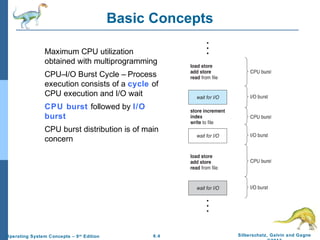
Basic Concepts
Maximum CPU utilization
obtained with multiprogramming
CPU–I/O Burst Cycle – Process
execution consists of a cycle of
CPU execution and I/O wait
CPU burst followed by I/O
burst
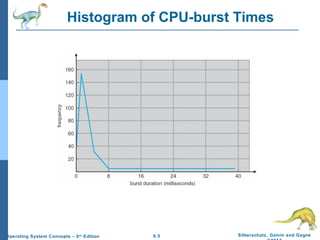
CPU burst distribution is of main
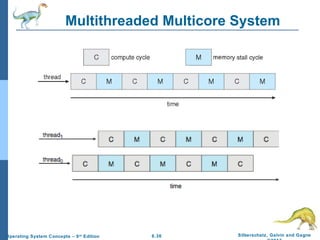
concern
6.5 Silberschatz, Galvin and GagneOperating System Concepts – 9th
Edition
Histogram of CPU-burst Times
6.6 Silberschatz, Galvin and GagneOperating System Concepts – 9th
Edition
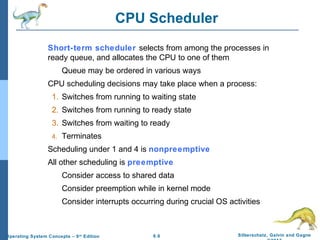
CPU Scheduler
Short-term scheduler selects from among the processes in
ready queue, and allocates the CPU to one of them
Queue may be ordered in various ways
CPU scheduling decisions may take place when a process:
1. Switches from running to waiting state
2. Switches from running to ready state
3. Switches from waiting to ready
4. Terminates
Scheduling under 1 and 4 is nonpreemptive
All other scheduling is preemptive
Consider access to shared data
Consider preemption while in kernel mode
Consider interrupts occurring during crucial OS activities
6.7 Silberschatz, Galvin and GagneOperating System Concepts – 9th
Edition
Dispatcher
Dispatcher module gives control of the CPU to the process
selected by the short-term scheduler; this involves:
switching context
switching to user mode
jumping to the proper location in the user program to
restart that program
Dispatch latency – time it takes for the dispatcher to stop
one process and start another running
6.8 Silberschatz, Galvin and GagneOperating System Concepts – 9th
Edition
Scheduling Criteria
CPU utilization – keep the CPU as busy as possible
Throughput – # of processes that complete their execution per
time unit
Turnaround time – amount of time to execute a particular
process
Waiting time – amount of time a process has been waiting in
the ready queue
Response time – amount of time it takes from when a request
was submitted until the first response is produced, not output (for
time-sharing environment)
6.9 Silberschatz, Galvin and GagneOperating System Concepts – 9th
Edition
Scheduling Algorithm Optimization Criteria
Max CPU utilization
Max throughput
Min turnaround time
Min waiting time
Min response time
6.10 Silberschatz, Galvin and GagneOperating System Concepts – 9th
Edition
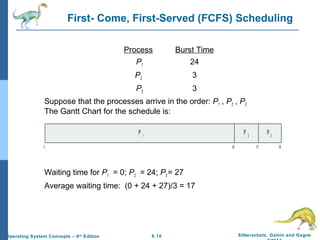
First- Come, First-Served (FCFS) Scheduling
Process Burst Time
P1 24
P2 3
P3 3
Suppose that the processes arrive in the order: P1 , P2 , P3
The Gantt Chart for the schedule is:
Waiting time for P1 = 0; P2 = 24; P3 = 27
Average waiting time: (0 + 24 + 27)/3 = 17
P P P1 2 3
0 24 3027
6.11 Silberschatz, Galvin and GagneOperating System Concepts – 9th
Edition
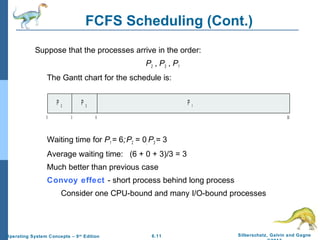
FCFS Scheduling (Cont.)
Suppose that the processes arrive in the order:
P2 , P3 , P1
The Gantt chart for the schedule is:
Waiting time for P1 = 6;P2 = 0; P3 = 3
Average waiting time: (6 + 0 + 3)/3 = 3
Much better than previous case
Convoy effect - short process behind long process
Consider one CPU-bound and many I/O-bound processes
P 1
0 3 6 30
P 2
P 3
6.12 Silberschatz, Galvin and GagneOperating System Concepts – 9th
Edition
Shortest-Job-First (SJF) Scheduling
Associate with each process the length of its next CPU burst
Use these lengths to schedule the process with the shortest
time
SJF is optimal – gives minimum average waiting time for a given
set of processes
The difficulty is knowing the length of the next CPU request
Could ask the user
6.13 Silberschatz, Galvin and GagneOperating System Concepts – 9th
Edition
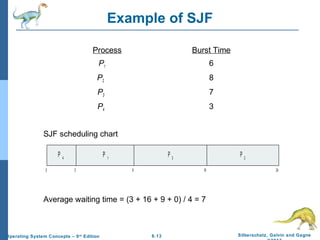
Example of SJF
ProcessArrival Time Burst Time
P1 0.0 6
P2 2.0 8
P3 4.0 7
P4 5.0 3
SJF scheduling chart
Average waiting time = (3 + 16 + 9 + 0) / 4 = 7
P 3
0 3 24
P 4
P 1
169
P 2
6.14 Silberschatz, Galvin and GagneOperating System Concepts – 9th
Edition
Determining Length of Next CPU Burst
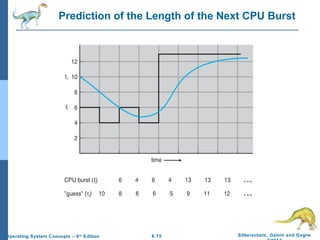
Can only estimate the length – should be similar to the previous one
Then pick process with shortest predicted next CPU burst
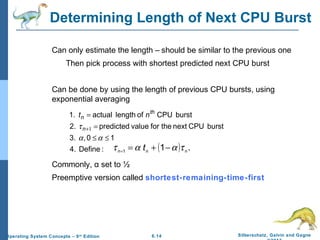
Can be done by using the length of previous CPU bursts, using
exponential averaging
Commonly, α set to ½
Preemptive version called shortest-remaining-time-first
:Define4.
10,3.
burstCPUnexttheforvaluepredicted2.
burstCPUoflengthactual1.
≤≤
=
=
+
αα
τ 1n
th
n nt
( ) .11 nnn
t ταατ −+==
6.15 Silberschatz, Galvin and GagneOperating System Concepts – 9th
Edition
Prediction of the Length of the Next CPU Burst
6.16 Silberschatz, Galvin and GagneOperating System Concepts – 9th
Edition
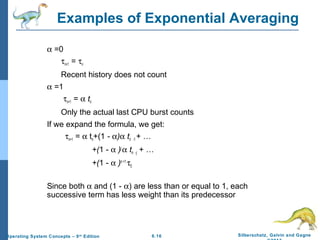
Examples of Exponential Averaging
α =0
τn+1 = τn
Recent history does not count
α =1
τn+1 = α tn
Only the actual last CPU burst counts
If we expand the formula, we get:
τn+1 = α tn+(1 - α)α tn -1 + …
+(1 - α )j
α tn -j + …
+(1 - α )n +1
τ0
Since both α and (1 - α) are less than or equal to 1, each
successive term has less weight than its predecessor
6.17 Silberschatz, Galvin and GagneOperating System Concepts – 9th
Edition
Example of Shortest-remaining-time-first
Now we add the concepts of varying arrival times and preemption to
the analysis
ProcessAarri Arrival TimeT Burst Time
P1 0 8
P2 1 4
P3 2 9
P4 3 5
Preemptive SJF Gantt Chart
Average waiting time = [(10-1)+(1-1)+(17-2)+5-3)]/4 = 26/4 = 6.5 msec
P 4
0 1 26
P 1
P 2
10
P 3
P 1
5 17
6.18 Silberschatz, Galvin and GagneOperating System Concepts – 9th
Edition
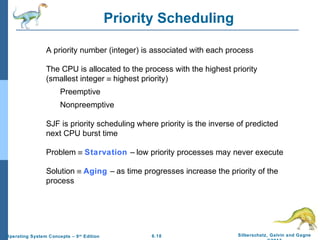
Priority Scheduling
A priority number (integer) is associated with each process
The CPU is allocated to the process with the highest priority
(smallest integer ≡ highest priority)
Preemptive
Nonpreemptive
SJF is priority scheduling where priority is the inverse of predicted
next CPU burst time
Problem ≡ Starvation – low priority processes may never execute
Solution ≡ Aging – as time progresses increase the priority of the
process
6.19 Silberschatz, Galvin and GagneOperating System Concepts – 9th
Edition
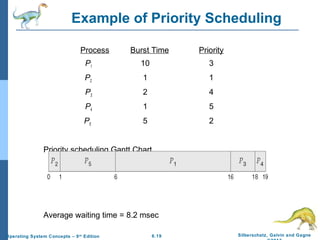
Example of Priority Scheduling
ProcessA arri Burst TimeT Priority
P1 10 3
P2 1 1
P3 2 4
P4 1 5
P5 5 2
Priority scheduling Gantt Chart
Average waiting time = 8.2 msec
6.20 Silberschatz, Galvin and GagneOperating System Concepts – 9th
Edition
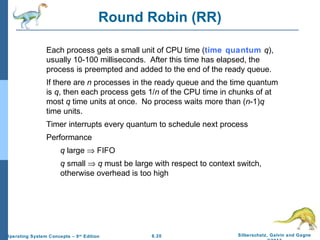
Round Robin (RR)
Each process gets a small unit of CPU time (time quantum q),
usually 10-100 milliseconds. After this time has elapsed, the
process is preempted and added to the end of the ready queue.
If there are n processes in the ready queue and the time quantum
is q, then each process gets 1/n of the CPU time in chunks of at
most q time units at once. No process waits more than (n-1)q
time units.
Timer interrupts every quantum to schedule next process
Performance
q large ⇒ FIFO
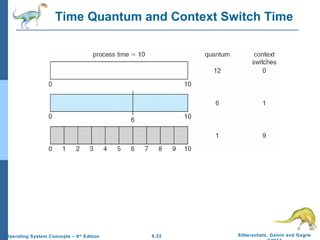
q small ⇒ q must be large with respect to context switch,
otherwise overhead is too high
6.21 Silberschatz, Galvin and GagneOperating System Concepts – 9th
Edition
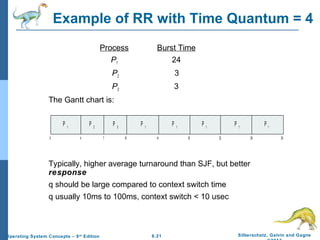
Example of RR with Time Quantum = 4
Process Burst Time
P1 24
P2 3
P3 3
The Gantt chart is:
Typically, higher average turnaround than SJF, but better
response
q should be large compared to context switch time
q usually 10ms to 100ms, context switch < 10 usec
P P P1 1 1
0 18 3026144 7 10 22
P 2
P 3
P 1
P 1
P 1
6.22 Silberschatz, Galvin and GagneOperating System Concepts – 9th
Edition
Time Quantum and Context Switch Time
6.23 Silberschatz, Galvin and GagneOperating System Concepts – 9th
Edition
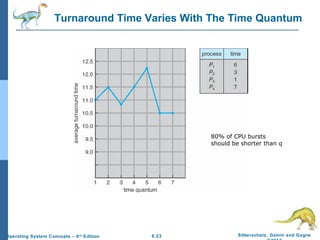
Turnaround Time Varies With The Time Quantum
80% of CPU bursts
should be shorter than q
6.24 Silberschatz, Galvin and GagneOperating System Concepts – 9th
Edition
Multilevel Queue
Ready queue is partitioned into separate queues, eg:
foreground (interactive)
background (batch)
Process permanently in a given queue
Each queue has its own scheduling algorithm:
foreground – RR
background – FCFS
Scheduling must be done between the queues:
Fixed priority scheduling; (i.e., serve all from foreground then
from background). Possibility of starvation.
Time slice – each queue gets a certain amount of CPU time
which it can schedule amongst its processes; i.e., 80% to
foreground in RR
20% to background in FCFS
6.25 Silberschatz, Galvin and GagneOperating System Concepts – 9th
Edition
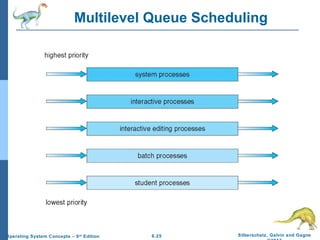
Multilevel Queue Scheduling
6.26 Silberschatz, Galvin and GagneOperating System Concepts – 9th
Edition
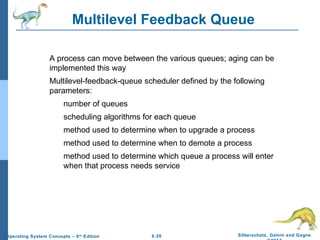
Multilevel Feedback Queue
A process can move between the various queues; aging can be
implemented this way
Multilevel-feedback-queue scheduler defined by the following
parameters:
number of queues
scheduling algorithms for each queue
method used to determine when to upgrade a process
method used to determine when to demote a process
method used to determine which queue a process will enter
when that process needs service
6.27 Silberschatz, Galvin and GagneOperating System Concepts – 9th
Edition
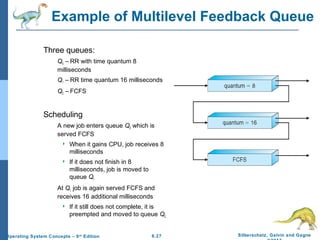
Example of Multilevel Feedback Queue
Three queues:
Q0 – RR with time quantum 8
milliseconds
Q1 – RR time quantum 16 milliseconds
Q2 – FCFS
Scheduling
A new job enters queue Q0 which is
served FCFS
 When it gains CPU, job receives 8
milliseconds
 If it does not finish in 8
milliseconds, job is moved to
queue Q1
At Q1 job is again served FCFS and
receives 16 additional milliseconds
 If it still does not complete, it is
preempted and moved to queue Q2
6.28 Silberschatz, Galvin and GagneOperating System Concepts – 9th
Edition
Thread Scheduling
Distinction between user-level and kernel-level threads
When threads supported, threads scheduled, not processes
Many-to-one and many-to-many models, thread library schedules
user-level threads to run on LWP
Known as process-contention scope (PCS) since scheduling
competition is within the process
Typically done via priority set by programmer
Kernel thread scheduled onto available CPU is system-contention
scope (SCS) – competition among all threads in system
6.29 Silberschatz, Galvin and GagneOperating System Concepts – 9th
Edition
Pthread Scheduling
API allows specifying either PCS or SCS during thread creation
PTHREAD_SCOPE_PROCESS schedules threads using
PCS scheduling
PTHREAD_SCOPE_SYSTEM schedules threads using
SCS scheduling
Can be limited by OS – Linux and Mac OS X only allow
PTHREAD_SCOPE_SYSTEM
6.30 Silberschatz, Galvin and GagneOperating System Concepts – 9th
Edition
Pthread Scheduling API
#include <pthread.h>
#include <stdio.h>
#define NUM_THREADS 5
int main(int argc, char *argv[]) {
int i, scope;
pthread_t tid[NUM THREADS];
pthread_attr_t attr;
/* get the default attributes */
pthread_attr_init(&attr);
/* first inquire on the current scope */
if (pthread_attr_getscope(&attr, &scope) != 0)
fprintf(stderr, "Unable to get scheduling scopen");
else {
if (scope == PTHREAD_SCOPE_PROCESS)
printf("PTHREAD_SCOPE_PROCESS");
else if (scope == PTHREAD_SCOPE_SYSTEM)
printf("PTHREAD_SCOPE_SYSTEM");
else
fprintf(stderr, "Illegal scope value.n");
}
6.31 Silberschatz, Galvin and GagneOperating System Concepts – 9th
Edition
Pthread Scheduling API
/* set the scheduling algorithm to PCS or SCS */
pthread_attr_setscope(&attr, PTHREAD_SCOPE_SYSTEM);
/* create the threads */
for (i = 0; i < NUM_THREADS; i++)
pthread_create(&tid[i],&attr,runner,NULL);
/* now join on each thread */
for (i = 0; i < NUM_THREADS; i++)
pthread_join(tid[i], NULL);
}
/* Each thread will begin control in this function */
void *runner(void *param)
{
/* do some work ... */
pthread_exit(0);
}
6.32 Silberschatz, Galvin and GagneOperating System Concepts – 9th
Edition
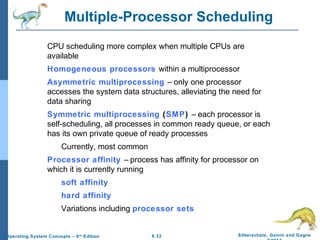
Multiple-Processor Scheduling
CPU scheduling more complex when multiple CPUs are
available
Homogeneous processors within a multiprocessor
Asymmetric multiprocessing – only one processor
accesses the system data structures, alleviating the need for
data sharing
Symmetric multiprocessing (SMP) – each processor is
self-scheduling, all processes in common ready queue, or each
has its own private queue of ready processes
Currently, most common
Processor affinity – process has affinity for processor on
which it is currently running
soft affinity
hard affinity
Variations including processor sets
6.33 Silberschatz, Galvin and GagneOperating System Concepts – 9th
Edition
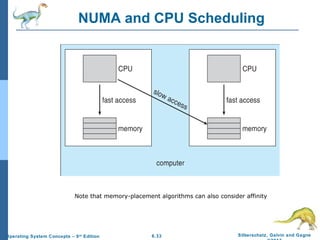
NUMA and CPU Scheduling
Note that memory-placement algorithms can also consider affinity
6.34 Silberschatz, Galvin and GagneOperating System Concepts – 9th
Edition
Multiple-Processor Scheduling – Load Balancing
If SMP, need to keep all CPUs loaded for efficiency
Load balancing attempts to keep workload evenly distributed
Push migration – periodic task checks load on each
processor, and if found pushes task from overloaded CPU to
other CPUs
Pull migration – idle processors pulls waiting task from busy
processor
6.35 Silberschatz, Galvin and GagneOperating System Concepts – 9th
Edition
Multicore Processors
Recent trend to place multiple processor cores on same
physical chip
Faster and consumes less power
Multiple threads per core also growing
Takes advantage of memory stall to make progress on
another thread while memory retrieve happens
6.36 Silberschatz, Galvin and GagneOperating System Concepts – 9th
Edition
Multithreaded Multicore System
6.37 Silberschatz, Galvin and GagneOperating System Concepts – 9th
Edition
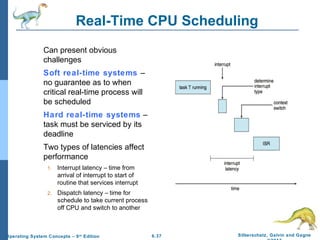
Real-Time CPU Scheduling
Can present obvious
challenges
Soft real-time systems –
no guarantee as to when
critical real-time process will
be scheduled
Hard real-time systems –
task must be serviced by its
deadline
Two types of latencies affect
performance
1. Interrupt latency – time from
arrival of interrupt to start of
routine that services interrupt
2. Dispatch latency – time for
schedule to take current process
off CPU and switch to another
6.38 Silberschatz, Galvin and GagneOperating System Concepts – 9th
Edition
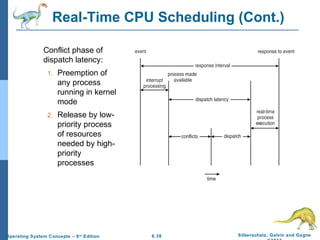
Real-Time CPU Scheduling (Cont.)
Conflict phase of
dispatch latency:
1. Preemption of
any process
running in kernel
mode
2. Release by low-
priority process
of resources
needed by high-
priority
processes
6.39 Silberschatz, Galvin and GagneOperating System Concepts – 9th
Edition
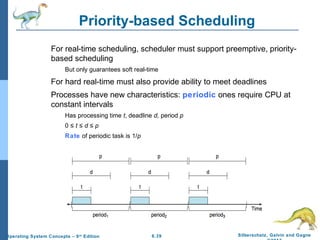
Priority-based Scheduling
For real-time scheduling, scheduler must support preemptive, priority-
based scheduling
But only guarantees soft real-time
For hard real-time must also provide ability to meet deadlines
Processes have new characteristics: periodic ones require CPU at
constant intervals
Has processing time t, deadline d, period p
0 ≤ t ≤ d ≤ p
Rate of periodic task is 1/p
6.40 Silberschatz, Galvin and GagneOperating System Concepts – 9th
Edition
Virtualization and Scheduling
Virtualization software schedules multiple guests onto
CPU(s)
Each guest doing its own scheduling
Not knowing it doesn’t own the CPUs
Can result in poor response time
Can effect time-of-day clocks in guests
Can undo good scheduling algorithm efforts of guests
6.41 Silberschatz, Galvin and GagneOperating System Concepts – 9th
Edition
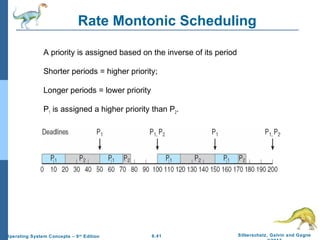
Rate Montonic Scheduling
A priority is assigned based on the inverse of its period
Shorter periods = higher priority;
Longer periods = lower priority
P1 is assigned a higher priority than P2.
6.42 Silberschatz, Galvin and GagneOperating System Concepts – 9th
Edition
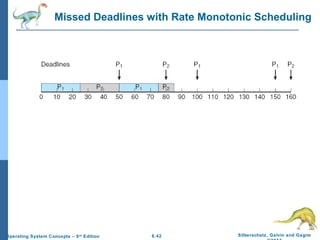
Missed Deadlines with Rate Monotonic Scheduling
6.43 Silberschatz, Galvin and GagneOperating System Concepts – 9th
Edition
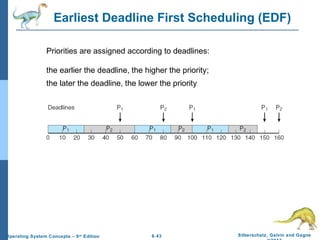
Earliest Deadline First Scheduling (EDF)
Priorities are assigned according to deadlines:
the earlier the deadline, the higher the priority;
the later the deadline, the lower the priority
6.44 Silberschatz, Galvin and GagneOperating System Concepts – 9th
Edition
Proportional Share Scheduling
T shares are allocated among all processes in the system
An application receives N shares where N < T
This ensures each application will receive N / T of the total
processor time
6.45 Silberschatz, Galvin and GagneOperating System Concepts – 9th
Edition
POSIX Real-Time Scheduling
The POSIX.1b standard
API provides functions for managing real-time threads
Defines two scheduling classes for real-time threads:
n SCHED_FIFO - threads are scheduled using a FCFS strategy with a
FIFO queue. There is no time-slicing for threads of equal priority
n SCHED_RR - similar to SCHED_FIFO except time-slicing occurs for
threads of equal priority
Defines two functions for getting and setting scheduling policy:
n pthread_attr_getsched_policy(pthread_attr_t *attr,
int *policy)
n pthread_attr_setsched_policy(pthread_attr_t *attr,
int policy)
6.46 Silberschatz, Galvin and GagneOperating System Concepts – 9th
Edition
POSIX Real-Time Scheduling API
#include <pthread.h>
#include <stdio.h>
#define NUM_THREADS 5
int main(int argc, char *argv[])
{
int i, policy;
pthread_t_tid[NUM_THREADS];
pthread_attr_t attr;
/* get the default attributes */
pthread_attr_init(&attr);
/* get the current scheduling policy */
if (pthread_attr_getschedpolicy(&attr, &policy) != 0)
fprintf(stderr, "Unable to get policy.n");
else {
if (policy == SCHED_OTHER) printf("SCHED_OTHERn");
else if (policy == SCHED_RR) printf("SCHED_RRn");
else if (policy == SCHED_FIFO) printf("SCHED_FIFOn");
}
6.47 Silberschatz, Galvin and GagneOperating System Concepts – 9th
Edition
POSIX Real-Time Scheduling API (Cont.)
/* set the scheduling policy - FIFO, RR, or OTHER */
if (pthread_attr_setschedpolicy(&attr, SCHED_FIFO) != 0)
fprintf(stderr, "Unable to set policy.n");
/* create the threads */
for (i = 0; i < NUM_THREADS; i++)
pthread_create(&tid[i],&attr,runner,NULL);
/* now join on each thread */
for (i = 0; i < NUM_THREADS; i++)
pthread_join(tid[i], NULL);
}
/* Each thread will begin control in this function */
void *runner(void *param)
{
/* do some work ... */
pthread_exit(0);
}
6.48 Silberschatz, Galvin and GagneOperating System Concepts – 9th
Edition
Operating System Examples
Linux scheduling
Windows scheduling
Solaris scheduling
6.49 Silberschatz, Galvin and GagneOperating System Concepts – 9th
Edition
Linux Scheduling Through Version 2.5
Prior to kernel version 2.5, ran variation of standard UNIX
scheduling algorithm
Version 2.5 moved to constant order O(1) scheduling time
Preemptive, priority based
Two priority ranges: time-sharing and real-time
Real-time range from 0 to 99 and nice value from 100 to 140
Map into global priority with numerically lower values indicating higher
priority
Higher priority gets larger q
Task run-able as long as time left in time slice (active)
If no time left (expired), not run-able until all other tasks use their slices
All run-able tasks tracked in per-CPU runqueue data structure
 Two priority arrays (active, expired)
 Tasks indexed by priority
 When no more active, arrays are exchanged
Worked well, but poor response times for interactive processes
6.50 Silberschatz, Galvin and GagneOperating System Concepts – 9th
Edition
Linux Scheduling in Version 2.6.23 +
Completely Fair Scheduler (CFS)
Scheduling classes
Each has specific priority
Scheduler picks highest priority task in highest scheduling class
Rather than quantum based on fixed time allotments, based on proportion of CPU
time
2 scheduling classes included, others can be added
1. default
2. real-time
Quantum calculated based on nice value from -20 to +19
Lower value is higher priority
Calculates target latency – interval of time during which task should run at least
once
Target latency can increase if say number of active tasks increases
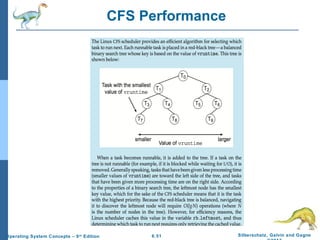
CFS scheduler maintains per task virtual run time in variable vruntime
Associated with decay factor based on priority of task – lower priority is higher
decay rate
Normal default priority yields virtual run time = actual run time
To decide next task to run, scheduler picks task with lowest virtual run time
6.51 Silberschatz, Galvin and GagneOperating System Concepts – 9th
Edition
CFS Performance
6.52 Silberschatz, Galvin and GagneOperating System Concepts – 9th
Edition
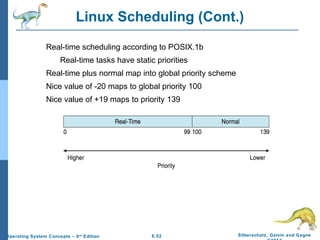
Linux Scheduling (Cont.)
Real-time scheduling according to POSIX.1b
Real-time tasks have static priorities
Real-time plus normal map into global priority scheme
Nice value of -20 maps to global priority 100
Nice value of +19 maps to priority 139
6.53 Silberschatz, Galvin and GagneOperating System Concepts – 9th
Edition
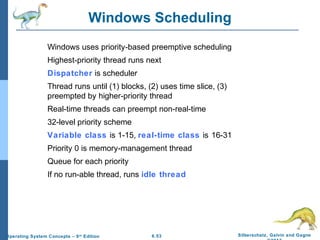
Windows Scheduling
Windows uses priority-based preemptive scheduling
Highest-priority thread runs next
Dispatcher is scheduler
Thread runs until (1) blocks, (2) uses time slice, (3)
preempted by higher-priority thread
Real-time threads can preempt non-real-time
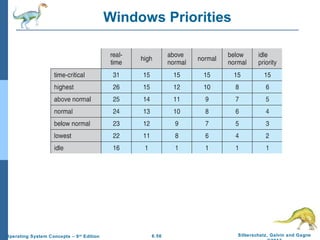
32-level priority scheme
Variable class is 1-15, real-time class is 16-31
Priority 0 is memory-management thread
Queue for each priority
If no run-able thread, runs idle thread
6.54 Silberschatz, Galvin and GagneOperating System Concepts – 9th
Edition
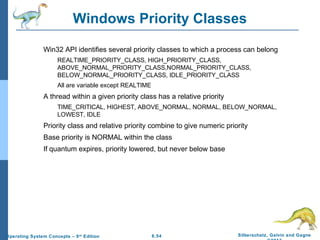
Windows Priority Classes
Win32 API identifies several priority classes to which a process can belong
REALTIME_PRIORITY_CLASS, HIGH_PRIORITY_CLASS,
ABOVE_NORMAL_PRIORITY_CLASS,NORMAL_PRIORITY_CLASS,
BELOW_NORMAL_PRIORITY_CLASS, IDLE_PRIORITY_CLASS
All are variable except REALTIME
A thread within a given priority class has a relative priority
TIME_CRITICAL, HIGHEST, ABOVE_NORMAL, NORMAL, BELOW_NORMAL,
LOWEST, IDLE
Priority class and relative priority combine to give numeric priority
Base priority is NORMAL within the class
If quantum expires, priority lowered, but never below base
6.55 Silberschatz, Galvin and GagneOperating System Concepts – 9th
Edition
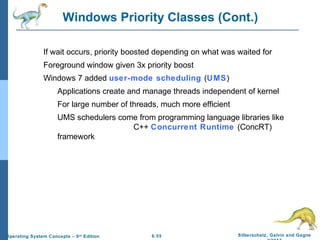
Windows Priority Classes (Cont.)
If wait occurs, priority boosted depending on what was waited for
Foreground window given 3x priority boost
Windows 7 added user-mode scheduling (UMS)
Applications create and manage threads independent of kernel
For large number of threads, much more efficient
UMS schedulers come from programming language libraries like
C++ Concurrent Runtime (ConcRT)
framework
6.56 Silberschatz, Galvin and GagneOperating System Concepts – 9th
Edition
Windows Priorities
6.57 Silberschatz, Galvin and GagneOperating System Concepts – 9th
Edition
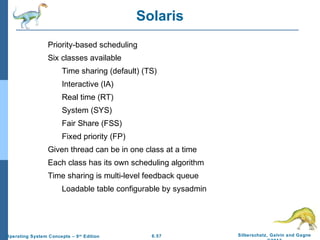
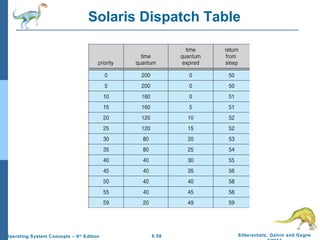
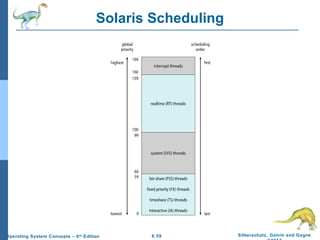
Solaris
Priority-based scheduling
Six classes available
Time sharing (default) (TS)
Interactive (IA)
Real time (RT)
System (SYS)
Fair Share (FSS)
Fixed priority (FP)
Given thread can be in one class at a time
Each class has its own scheduling algorithm
Time sharing is multi-level feedback queue
Loadable table configurable by sysadmin
6.58 Silberschatz, Galvin and GagneOperating System Concepts – 9th
Edition
Solaris Dispatch Table
6.59 Silberschatz, Galvin and GagneOperating System Concepts – 9th
Edition
Solaris Scheduling
6.60 Silberschatz, Galvin and GagneOperating System Concepts – 9th
Edition
Solaris Scheduling (Cont.)
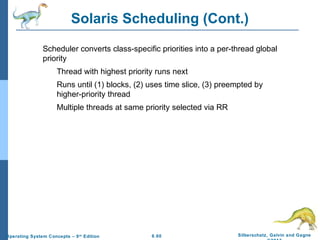
Scheduler converts class-specific priorities into a per-thread global
priority
Thread with highest priority runs next
Runs until (1) blocks, (2) uses time slice, (3) preempted by
higher-priority thread
Multiple threads at same priority selected via RR
6.61 Silberschatz, Galvin and GagneOperating System Concepts – 9th
Edition
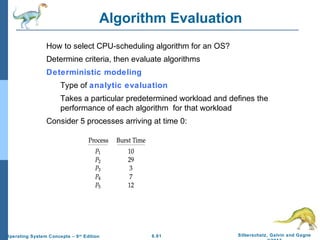
Algorithm Evaluation
How to select CPU-scheduling algorithm for an OS?
Determine criteria, then evaluate algorithms
Deterministic modeling
Type of analytic evaluation
Takes a particular predetermined workload and defines the
performance of each algorithm for that workload
Consider 5 processes arriving at time 0:
6.62 Silberschatz, Galvin and GagneOperating System Concepts – 9th
Edition
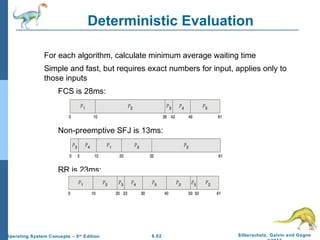
Deterministic Evaluation
For each algorithm, calculate minimum average waiting time
Simple and fast, but requires exact numbers for input, applies only to
those inputs
FCS is 28ms:
Non-preemptive SFJ is 13ms:
RR is 23ms:
6.63 Silberschatz, Galvin and GagneOperating System Concepts – 9th
Edition
Queueing Models
Describes the arrival of processes, and CPU and I/O bursts
probabilistically
Commonly exponential, and described by mean
Computes average throughput, utilization, waiting time, etc
Computer system described as network of servers, each with
queue of waiting processes
Knowing arrival rates and service rates
Computes utilization, average queue length, average wait
time, etc
6.64 Silberschatz, Galvin and GagneOperating System Concepts – 9th
Edition
Little’s Formula
n = average queue length
W = average waiting time in queue
λ = average arrival rate into queue
Little’s law – in steady state, processes leaving queue must equal
processes arriving, thus:
n = λ x W
Valid for any scheduling algorithm and arrival distribution
For example, if on average 7 processes arrive per second, and
normally 14 processes in queue, then average wait time per
process = 2 seconds
6.65 Silberschatz, Galvin and GagneOperating System Concepts – 9th
Edition
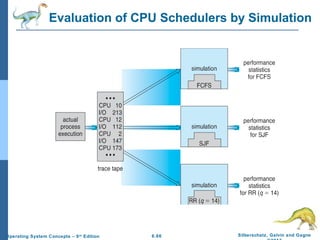
Simulations
Queueing models limited
Simulations more accurate
Programmed model of computer system
Clock is a variable
Gather statistics indicating algorithm performance
Data to drive simulation gathered via
 Random number generator according to probabilities
 Distributions defined mathematically or empirically
 Trace tapes record sequences of real events in real systems
6.66 Silberschatz, Galvin and GagneOperating System Concepts – 9th
Edition
Evaluation of CPU Schedulers by Simulation
6.67 Silberschatz, Galvin and GagneOperating System Concepts – 9th
Edition
Implementation
Even simulations have limited accuracy
Just implement new scheduler and test in real systems
High cost, high risk
Environments vary
Most flexible schedulers can be modified per-site or per-system
Or APIs to modify priorities
But again environments vary
Silberschatz, Galvin and GagneOperating System Concepts – 9th
Edition
End of Chapter 6

Cpu scheduling (1)

  • 1.
    Silberschatz, Galvin andGagneOperating System Concepts – 9th Edition Chapter 6: CPU Scheduling
  • 2.
    6.2 Silberschatz, Galvinand GagneOperating System Concepts – 9th Edition Chapter 6: CPU Scheduling Basic Concepts Scheduling Criteria Scheduling Algorithms Thread Scheduling Multiple-Processor Scheduling Real-Time CPU Scheduling Operating Systems Examples Algorithm Evaluation
  • 3.
    6.3 Silberschatz, Galvinand GagneOperating System Concepts – 9th Edition Objectives To introduce CPU scheduling, which is the basis for multiprogrammed operating systems To describe various CPU-scheduling algorithms To discuss evaluation criteria for selecting a CPU-scheduling algorithm for a particular system To examine the scheduling algorithms of several operating systems
  • 4.
    6.4 Silberschatz, Galvinand GagneOperating System Concepts – 9th Edition Basic Concepts Maximum CPU utilization obtained with multiprogramming CPU–I/O Burst Cycle – Process execution consists of a cycle of CPU execution and I/O wait CPU burst followed by I/O burst CPU burst distribution is of main concern
  • 5.
    6.5 Silberschatz, Galvinand GagneOperating System Concepts – 9th Edition Histogram of CPU-burst Times
  • 6.
    6.6 Silberschatz, Galvinand GagneOperating System Concepts – 9th Edition CPU Scheduler Short-term scheduler selects from among the processes in ready queue, and allocates the CPU to one of them Queue may be ordered in various ways CPU scheduling decisions may take place when a process: 1. Switches from running to waiting state 2. Switches from running to ready state 3. Switches from waiting to ready 4. Terminates Scheduling under 1 and 4 is nonpreemptive All other scheduling is preemptive Consider access to shared data Consider preemption while in kernel mode Consider interrupts occurring during crucial OS activities
  • 7.
    6.7 Silberschatz, Galvinand GagneOperating System Concepts – 9th Edition Dispatcher Dispatcher module gives control of the CPU to the process selected by the short-term scheduler; this involves: switching context switching to user mode jumping to the proper location in the user program to restart that program Dispatch latency – time it takes for the dispatcher to stop one process and start another running
  • 8.
    6.8 Silberschatz, Galvinand GagneOperating System Concepts – 9th Edition Scheduling Criteria CPU utilization – keep the CPU as busy as possible Throughput – # of processes that complete their execution per time unit Turnaround time – amount of time to execute a particular process Waiting time – amount of time a process has been waiting in the ready queue Response time – amount of time it takes from when a request was submitted until the first response is produced, not output (for time-sharing environment)
  • 9.
    6.9 Silberschatz, Galvinand GagneOperating System Concepts – 9th Edition Scheduling Algorithm Optimization Criteria Max CPU utilization Max throughput Min turnaround time Min waiting time Min response time
  • 10.
    6.10 Silberschatz, Galvinand GagneOperating System Concepts – 9th Edition First- Come, First-Served (FCFS) Scheduling Process Burst Time P1 24 P2 3 P3 3 Suppose that the processes arrive in the order: P1 , P2 , P3 The Gantt Chart for the schedule is: Waiting time for P1 = 0; P2 = 24; P3 = 27 Average waiting time: (0 + 24 + 27)/3 = 17 P P P1 2 3 0 24 3027
  • 11.
    6.11 Silberschatz, Galvinand GagneOperating System Concepts – 9th Edition FCFS Scheduling (Cont.) Suppose that the processes arrive in the order: P2 , P3 , P1 The Gantt chart for the schedule is: Waiting time for P1 = 6;P2 = 0; P3 = 3 Average waiting time: (6 + 0 + 3)/3 = 3 Much better than previous case Convoy effect - short process behind long process Consider one CPU-bound and many I/O-bound processes P 1 0 3 6 30 P 2 P 3
  • 12.
    6.12 Silberschatz, Galvinand GagneOperating System Concepts – 9th Edition Shortest-Job-First (SJF) Scheduling Associate with each process the length of its next CPU burst Use these lengths to schedule the process with the shortest time SJF is optimal – gives minimum average waiting time for a given set of processes The difficulty is knowing the length of the next CPU request Could ask the user
  • 13.
    6.13 Silberschatz, Galvinand GagneOperating System Concepts – 9th Edition Example of SJF ProcessArrival Time Burst Time P1 0.0 6 P2 2.0 8 P3 4.0 7 P4 5.0 3 SJF scheduling chart Average waiting time = (3 + 16 + 9 + 0) / 4 = 7 P 3 0 3 24 P 4 P 1 169 P 2
  • 14.
    6.14 Silberschatz, Galvinand GagneOperating System Concepts – 9th Edition Determining Length of Next CPU Burst Can only estimate the length – should be similar to the previous one Then pick process with shortest predicted next CPU burst Can be done by using the length of previous CPU bursts, using exponential averaging Commonly, α set to ½ Preemptive version called shortest-remaining-time-first :Define4. 10,3. burstCPUnexttheforvaluepredicted2. burstCPUoflengthactual1. ≤≤ = = + αα τ 1n th n nt ( ) .11 nnn t ταατ −+==
  • 15.
    6.15 Silberschatz, Galvinand GagneOperating System Concepts – 9th Edition Prediction of the Length of the Next CPU Burst
  • 16.
    6.16 Silberschatz, Galvinand GagneOperating System Concepts – 9th Edition Examples of Exponential Averaging α =0 τn+1 = τn Recent history does not count α =1 τn+1 = α tn Only the actual last CPU burst counts If we expand the formula, we get: τn+1 = α tn+(1 - α)α tn -1 + … +(1 - α )j α tn -j + … +(1 - α )n +1 τ0 Since both α and (1 - α) are less than or equal to 1, each successive term has less weight than its predecessor
  • 17.
    6.17 Silberschatz, Galvinand GagneOperating System Concepts – 9th Edition Example of Shortest-remaining-time-first Now we add the concepts of varying arrival times and preemption to the analysis ProcessAarri Arrival TimeT Burst Time P1 0 8 P2 1 4 P3 2 9 P4 3 5 Preemptive SJF Gantt Chart Average waiting time = [(10-1)+(1-1)+(17-2)+5-3)]/4 = 26/4 = 6.5 msec P 4 0 1 26 P 1 P 2 10 P 3 P 1 5 17
  • 18.
    6.18 Silberschatz, Galvinand GagneOperating System Concepts – 9th Edition Priority Scheduling A priority number (integer) is associated with each process The CPU is allocated to the process with the highest priority (smallest integer ≡ highest priority) Preemptive Nonpreemptive SJF is priority scheduling where priority is the inverse of predicted next CPU burst time Problem ≡ Starvation – low priority processes may never execute Solution ≡ Aging – as time progresses increase the priority of the process
  • 19.
    6.19 Silberschatz, Galvinand GagneOperating System Concepts – 9th Edition Example of Priority Scheduling ProcessA arri Burst TimeT Priority P1 10 3 P2 1 1 P3 2 4 P4 1 5 P5 5 2 Priority scheduling Gantt Chart Average waiting time = 8.2 msec
  • 20.
    6.20 Silberschatz, Galvinand GagneOperating System Concepts – 9th Edition Round Robin (RR) Each process gets a small unit of CPU time (time quantum q), usually 10-100 milliseconds. After this time has elapsed, the process is preempted and added to the end of the ready queue. If there are n processes in the ready queue and the time quantum is q, then each process gets 1/n of the CPU time in chunks of at most q time units at once. No process waits more than (n-1)q time units. Timer interrupts every quantum to schedule next process Performance q large ⇒ FIFO q small ⇒ q must be large with respect to context switch, otherwise overhead is too high
  • 21.
    6.21 Silberschatz, Galvinand GagneOperating System Concepts – 9th Edition Example of RR with Time Quantum = 4 Process Burst Time P1 24 P2 3 P3 3 The Gantt chart is: Typically, higher average turnaround than SJF, but better response q should be large compared to context switch time q usually 10ms to 100ms, context switch < 10 usec P P P1 1 1 0 18 3026144 7 10 22 P 2 P 3 P 1 P 1 P 1
  • 22.
    6.22 Silberschatz, Galvinand GagneOperating System Concepts – 9th Edition Time Quantum and Context Switch Time
  • 23.
    6.23 Silberschatz, Galvinand GagneOperating System Concepts – 9th Edition Turnaround Time Varies With The Time Quantum 80% of CPU bursts should be shorter than q
  • 24.
    6.24 Silberschatz, Galvinand GagneOperating System Concepts – 9th Edition Multilevel Queue Ready queue is partitioned into separate queues, eg: foreground (interactive) background (batch) Process permanently in a given queue Each queue has its own scheduling algorithm: foreground – RR background – FCFS Scheduling must be done between the queues: Fixed priority scheduling; (i.e., serve all from foreground then from background). Possibility of starvation. Time slice – each queue gets a certain amount of CPU time which it can schedule amongst its processes; i.e., 80% to foreground in RR 20% to background in FCFS
  • 25.
    6.25 Silberschatz, Galvinand GagneOperating System Concepts – 9th Edition Multilevel Queue Scheduling
  • 26.
    6.26 Silberschatz, Galvinand GagneOperating System Concepts – 9th Edition Multilevel Feedback Queue A process can move between the various queues; aging can be implemented this way Multilevel-feedback-queue scheduler defined by the following parameters: number of queues scheduling algorithms for each queue method used to determine when to upgrade a process method used to determine when to demote a process method used to determine which queue a process will enter when that process needs service
  • 27.
    6.27 Silberschatz, Galvinand GagneOperating System Concepts – 9th Edition Example of Multilevel Feedback Queue Three queues: Q0 – RR with time quantum 8 milliseconds Q1 – RR time quantum 16 milliseconds Q2 – FCFS Scheduling A new job enters queue Q0 which is served FCFS  When it gains CPU, job receives 8 milliseconds  If it does not finish in 8 milliseconds, job is moved to queue Q1 At Q1 job is again served FCFS and receives 16 additional milliseconds  If it still does not complete, it is preempted and moved to queue Q2
  • 28.
    6.28 Silberschatz, Galvinand GagneOperating System Concepts – 9th Edition Thread Scheduling Distinction between user-level and kernel-level threads When threads supported, threads scheduled, not processes Many-to-one and many-to-many models, thread library schedules user-level threads to run on LWP Known as process-contention scope (PCS) since scheduling competition is within the process Typically done via priority set by programmer Kernel thread scheduled onto available CPU is system-contention scope (SCS) – competition among all threads in system
  • 29.
    6.29 Silberschatz, Galvinand GagneOperating System Concepts – 9th Edition Pthread Scheduling API allows specifying either PCS or SCS during thread creation PTHREAD_SCOPE_PROCESS schedules threads using PCS scheduling PTHREAD_SCOPE_SYSTEM schedules threads using SCS scheduling Can be limited by OS – Linux and Mac OS X only allow PTHREAD_SCOPE_SYSTEM
  • 30.
    6.30 Silberschatz, Galvinand GagneOperating System Concepts – 9th Edition Pthread Scheduling API #include <pthread.h> #include <stdio.h> #define NUM_THREADS 5 int main(int argc, char *argv[]) { int i, scope; pthread_t tid[NUM THREADS]; pthread_attr_t attr; /* get the default attributes */ pthread_attr_init(&attr); /* first inquire on the current scope */ if (pthread_attr_getscope(&attr, &scope) != 0) fprintf(stderr, "Unable to get scheduling scopen"); else { if (scope == PTHREAD_SCOPE_PROCESS) printf("PTHREAD_SCOPE_PROCESS"); else if (scope == PTHREAD_SCOPE_SYSTEM) printf("PTHREAD_SCOPE_SYSTEM"); else fprintf(stderr, "Illegal scope value.n"); }
  • 31.
    6.31 Silberschatz, Galvinand GagneOperating System Concepts – 9th Edition Pthread Scheduling API /* set the scheduling algorithm to PCS or SCS */ pthread_attr_setscope(&attr, PTHREAD_SCOPE_SYSTEM); /* create the threads */ for (i = 0; i < NUM_THREADS; i++) pthread_create(&tid[i],&attr,runner,NULL); /* now join on each thread */ for (i = 0; i < NUM_THREADS; i++) pthread_join(tid[i], NULL); } /* Each thread will begin control in this function */ void *runner(void *param) { /* do some work ... */ pthread_exit(0); }
  • 32.
    6.32 Silberschatz, Galvinand GagneOperating System Concepts – 9th Edition Multiple-Processor Scheduling CPU scheduling more complex when multiple CPUs are available Homogeneous processors within a multiprocessor Asymmetric multiprocessing – only one processor accesses the system data structures, alleviating the need for data sharing Symmetric multiprocessing (SMP) – each processor is self-scheduling, all processes in common ready queue, or each has its own private queue of ready processes Currently, most common Processor affinity – process has affinity for processor on which it is currently running soft affinity hard affinity Variations including processor sets
  • 33.
    6.33 Silberschatz, Galvinand GagneOperating System Concepts – 9th Edition NUMA and CPU Scheduling Note that memory-placement algorithms can also consider affinity
  • 34.
    6.34 Silberschatz, Galvinand GagneOperating System Concepts – 9th Edition Multiple-Processor Scheduling – Load Balancing If SMP, need to keep all CPUs loaded for efficiency Load balancing attempts to keep workload evenly distributed Push migration – periodic task checks load on each processor, and if found pushes task from overloaded CPU to other CPUs Pull migration – idle processors pulls waiting task from busy processor
  • 35.
    6.35 Silberschatz, Galvinand GagneOperating System Concepts – 9th Edition Multicore Processors Recent trend to place multiple processor cores on same physical chip Faster and consumes less power Multiple threads per core also growing Takes advantage of memory stall to make progress on another thread while memory retrieve happens
  • 36.
    6.36 Silberschatz, Galvinand GagneOperating System Concepts – 9th Edition Multithreaded Multicore System
  • 37.
    6.37 Silberschatz, Galvinand GagneOperating System Concepts – 9th Edition Real-Time CPU Scheduling Can present obvious challenges Soft real-time systems – no guarantee as to when critical real-time process will be scheduled Hard real-time systems – task must be serviced by its deadline Two types of latencies affect performance 1. Interrupt latency – time from arrival of interrupt to start of routine that services interrupt 2. Dispatch latency – time for schedule to take current process off CPU and switch to another
  • 38.
    6.38 Silberschatz, Galvinand GagneOperating System Concepts – 9th Edition Real-Time CPU Scheduling (Cont.) Conflict phase of dispatch latency: 1. Preemption of any process running in kernel mode 2. Release by low- priority process of resources needed by high- priority processes
  • 39.
    6.39 Silberschatz, Galvinand GagneOperating System Concepts – 9th Edition Priority-based Scheduling For real-time scheduling, scheduler must support preemptive, priority- based scheduling But only guarantees soft real-time For hard real-time must also provide ability to meet deadlines Processes have new characteristics: periodic ones require CPU at constant intervals Has processing time t, deadline d, period p 0 ≤ t ≤ d ≤ p Rate of periodic task is 1/p
  • 40.
    6.40 Silberschatz, Galvinand GagneOperating System Concepts – 9th Edition Virtualization and Scheduling Virtualization software schedules multiple guests onto CPU(s) Each guest doing its own scheduling Not knowing it doesn’t own the CPUs Can result in poor response time Can effect time-of-day clocks in guests Can undo good scheduling algorithm efforts of guests
  • 41.
    6.41 Silberschatz, Galvinand GagneOperating System Concepts – 9th Edition Rate Montonic Scheduling A priority is assigned based on the inverse of its period Shorter periods = higher priority; Longer periods = lower priority P1 is assigned a higher priority than P2.
  • 42.
    6.42 Silberschatz, Galvinand GagneOperating System Concepts – 9th Edition Missed Deadlines with Rate Monotonic Scheduling
  • 43.
    6.43 Silberschatz, Galvinand GagneOperating System Concepts – 9th Edition Earliest Deadline First Scheduling (EDF) Priorities are assigned according to deadlines: the earlier the deadline, the higher the priority; the later the deadline, the lower the priority
  • 44.
    6.44 Silberschatz, Galvinand GagneOperating System Concepts – 9th Edition Proportional Share Scheduling T shares are allocated among all processes in the system An application receives N shares where N < T This ensures each application will receive N / T of the total processor time
  • 45.
    6.45 Silberschatz, Galvinand GagneOperating System Concepts – 9th Edition POSIX Real-Time Scheduling The POSIX.1b standard API provides functions for managing real-time threads Defines two scheduling classes for real-time threads: n SCHED_FIFO - threads are scheduled using a FCFS strategy with a FIFO queue. There is no time-slicing for threads of equal priority n SCHED_RR - similar to SCHED_FIFO except time-slicing occurs for threads of equal priority Defines two functions for getting and setting scheduling policy: n pthread_attr_getsched_policy(pthread_attr_t *attr, int *policy) n pthread_attr_setsched_policy(pthread_attr_t *attr, int policy)
  • 46.
    6.46 Silberschatz, Galvinand GagneOperating System Concepts – 9th Edition POSIX Real-Time Scheduling API #include <pthread.h> #include <stdio.h> #define NUM_THREADS 5 int main(int argc, char *argv[]) { int i, policy; pthread_t_tid[NUM_THREADS]; pthread_attr_t attr; /* get the default attributes */ pthread_attr_init(&attr); /* get the current scheduling policy */ if (pthread_attr_getschedpolicy(&attr, &policy) != 0) fprintf(stderr, "Unable to get policy.n"); else { if (policy == SCHED_OTHER) printf("SCHED_OTHERn"); else if (policy == SCHED_RR) printf("SCHED_RRn"); else if (policy == SCHED_FIFO) printf("SCHED_FIFOn"); }
  • 47.
    6.47 Silberschatz, Galvinand GagneOperating System Concepts – 9th Edition POSIX Real-Time Scheduling API (Cont.) /* set the scheduling policy - FIFO, RR, or OTHER */ if (pthread_attr_setschedpolicy(&attr, SCHED_FIFO) != 0) fprintf(stderr, "Unable to set policy.n"); /* create the threads */ for (i = 0; i < NUM_THREADS; i++) pthread_create(&tid[i],&attr,runner,NULL); /* now join on each thread */ for (i = 0; i < NUM_THREADS; i++) pthread_join(tid[i], NULL); } /* Each thread will begin control in this function */ void *runner(void *param) { /* do some work ... */ pthread_exit(0); }
  • 48.
    6.48 Silberschatz, Galvinand GagneOperating System Concepts – 9th Edition Operating System Examples Linux scheduling Windows scheduling Solaris scheduling
  • 49.
    6.49 Silberschatz, Galvinand GagneOperating System Concepts – 9th Edition Linux Scheduling Through Version 2.5 Prior to kernel version 2.5, ran variation of standard UNIX scheduling algorithm Version 2.5 moved to constant order O(1) scheduling time Preemptive, priority based Two priority ranges: time-sharing and real-time Real-time range from 0 to 99 and nice value from 100 to 140 Map into global priority with numerically lower values indicating higher priority Higher priority gets larger q Task run-able as long as time left in time slice (active) If no time left (expired), not run-able until all other tasks use their slices All run-able tasks tracked in per-CPU runqueue data structure  Two priority arrays (active, expired)  Tasks indexed by priority  When no more active, arrays are exchanged Worked well, but poor response times for interactive processes
  • 50.
    6.50 Silberschatz, Galvinand GagneOperating System Concepts – 9th Edition Linux Scheduling in Version 2.6.23 + Completely Fair Scheduler (CFS) Scheduling classes Each has specific priority Scheduler picks highest priority task in highest scheduling class Rather than quantum based on fixed time allotments, based on proportion of CPU time 2 scheduling classes included, others can be added 1. default 2. real-time Quantum calculated based on nice value from -20 to +19 Lower value is higher priority Calculates target latency – interval of time during which task should run at least once Target latency can increase if say number of active tasks increases CFS scheduler maintains per task virtual run time in variable vruntime Associated with decay factor based on priority of task – lower priority is higher decay rate Normal default priority yields virtual run time = actual run time To decide next task to run, scheduler picks task with lowest virtual run time
  • 51.
    6.51 Silberschatz, Galvinand GagneOperating System Concepts – 9th Edition CFS Performance
  • 52.
    6.52 Silberschatz, Galvinand GagneOperating System Concepts – 9th Edition Linux Scheduling (Cont.) Real-time scheduling according to POSIX.1b Real-time tasks have static priorities Real-time plus normal map into global priority scheme Nice value of -20 maps to global priority 100 Nice value of +19 maps to priority 139
  • 53.
    6.53 Silberschatz, Galvinand GagneOperating System Concepts – 9th Edition Windows Scheduling Windows uses priority-based preemptive scheduling Highest-priority thread runs next Dispatcher is scheduler Thread runs until (1) blocks, (2) uses time slice, (3) preempted by higher-priority thread Real-time threads can preempt non-real-time 32-level priority scheme Variable class is 1-15, real-time class is 16-31 Priority 0 is memory-management thread Queue for each priority If no run-able thread, runs idle thread
  • 54.
    6.54 Silberschatz, Galvinand GagneOperating System Concepts – 9th Edition Windows Priority Classes Win32 API identifies several priority classes to which a process can belong REALTIME_PRIORITY_CLASS, HIGH_PRIORITY_CLASS, ABOVE_NORMAL_PRIORITY_CLASS,NORMAL_PRIORITY_CLASS, BELOW_NORMAL_PRIORITY_CLASS, IDLE_PRIORITY_CLASS All are variable except REALTIME A thread within a given priority class has a relative priority TIME_CRITICAL, HIGHEST, ABOVE_NORMAL, NORMAL, BELOW_NORMAL, LOWEST, IDLE Priority class and relative priority combine to give numeric priority Base priority is NORMAL within the class If quantum expires, priority lowered, but never below base
  • 55.
    6.55 Silberschatz, Galvinand GagneOperating System Concepts – 9th Edition Windows Priority Classes (Cont.) If wait occurs, priority boosted depending on what was waited for Foreground window given 3x priority boost Windows 7 added user-mode scheduling (UMS) Applications create and manage threads independent of kernel For large number of threads, much more efficient UMS schedulers come from programming language libraries like C++ Concurrent Runtime (ConcRT) framework
  • 56.
    6.56 Silberschatz, Galvinand GagneOperating System Concepts – 9th Edition Windows Priorities
  • 57.
    6.57 Silberschatz, Galvinand GagneOperating System Concepts – 9th Edition Solaris Priority-based scheduling Six classes available Time sharing (default) (TS) Interactive (IA) Real time (RT) System (SYS) Fair Share (FSS) Fixed priority (FP) Given thread can be in one class at a time Each class has its own scheduling algorithm Time sharing is multi-level feedback queue Loadable table configurable by sysadmin
  • 58.
    6.58 Silberschatz, Galvinand GagneOperating System Concepts – 9th Edition Solaris Dispatch Table
  • 59.
    6.59 Silberschatz, Galvinand GagneOperating System Concepts – 9th Edition Solaris Scheduling
  • 60.
    6.60 Silberschatz, Galvinand GagneOperating System Concepts – 9th Edition Solaris Scheduling (Cont.) Scheduler converts class-specific priorities into a per-thread global priority Thread with highest priority runs next Runs until (1) blocks, (2) uses time slice, (3) preempted by higher-priority thread Multiple threads at same priority selected via RR
  • 61.
    6.61 Silberschatz, Galvinand GagneOperating System Concepts – 9th Edition Algorithm Evaluation How to select CPU-scheduling algorithm for an OS? Determine criteria, then evaluate algorithms Deterministic modeling Type of analytic evaluation Takes a particular predetermined workload and defines the performance of each algorithm for that workload Consider 5 processes arriving at time 0:
  • 62.
    6.62 Silberschatz, Galvinand GagneOperating System Concepts – 9th Edition Deterministic Evaluation For each algorithm, calculate minimum average waiting time Simple and fast, but requires exact numbers for input, applies only to those inputs FCS is 28ms: Non-preemptive SFJ is 13ms: RR is 23ms:
  • 63.
    6.63 Silberschatz, Galvinand GagneOperating System Concepts – 9th Edition Queueing Models Describes the arrival of processes, and CPU and I/O bursts probabilistically Commonly exponential, and described by mean Computes average throughput, utilization, waiting time, etc Computer system described as network of servers, each with queue of waiting processes Knowing arrival rates and service rates Computes utilization, average queue length, average wait time, etc
  • 64.
    6.64 Silberschatz, Galvinand GagneOperating System Concepts – 9th Edition Little’s Formula n = average queue length W = average waiting time in queue λ = average arrival rate into queue Little’s law – in steady state, processes leaving queue must equal processes arriving, thus: n = λ x W Valid for any scheduling algorithm and arrival distribution For example, if on average 7 processes arrive per second, and normally 14 processes in queue, then average wait time per process = 2 seconds
  • 65.
    6.65 Silberschatz, Galvinand GagneOperating System Concepts – 9th Edition Simulations Queueing models limited Simulations more accurate Programmed model of computer system Clock is a variable Gather statistics indicating algorithm performance Data to drive simulation gathered via  Random number generator according to probabilities  Distributions defined mathematically or empirically  Trace tapes record sequences of real events in real systems
  • 66.
    6.66 Silberschatz, Galvinand GagneOperating System Concepts – 9th Edition Evaluation of CPU Schedulers by Simulation
  • 67.
    6.67 Silberschatz, Galvinand GagneOperating System Concepts – 9th Edition Implementation Even simulations have limited accuracy Just implement new scheduler and test in real systems High cost, high risk Environments vary Most flexible schedulers can be modified per-site or per-system Or APIs to modify priorities But again environments vary
  • 68.
    Silberschatz, Galvin andGagneOperating System Concepts – 9th Edition End of Chapter 6