CPU Scheduling Algorithm
Presented by: Group 02
Charmi Chokshi (201501021)
Hena Ghonia (201501032)
Subject: CSC341- Operating Systems Lab
Guided by: Dr. Sanjay Chaudhary
Prof. M. T. Savaliya
Outline
● Problem Definition
● Project Modules and Technical Details
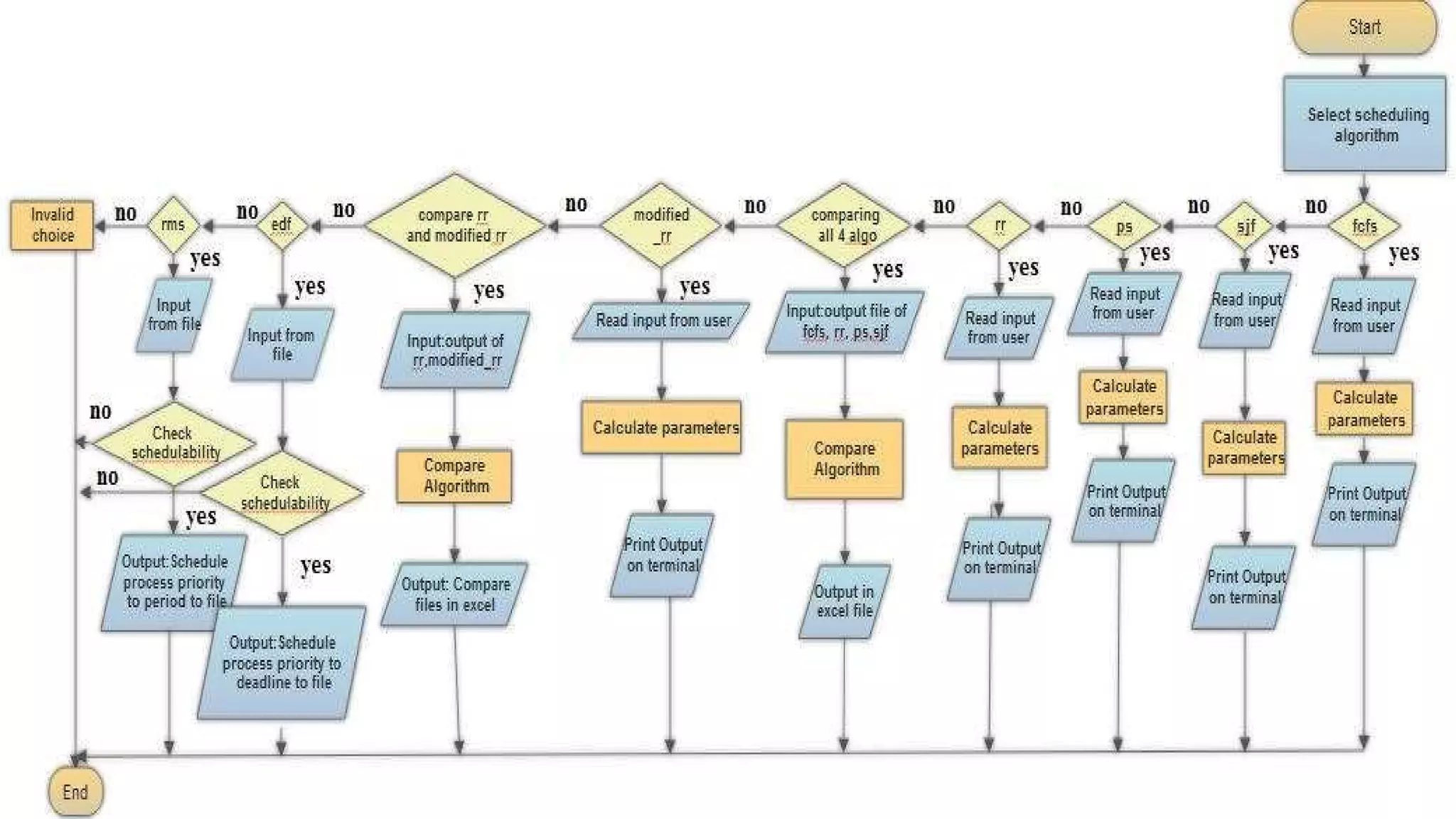
● Flow Chart
● Operating Systems Concepts used
● Why we Modified existing RR Algorithm?
● Live Demo
● Conclusion
● Future Work
● References
● Q&A
Problem Definition
● Process Scheduling: An act of determining which process in the ready state should be moved to the
running state
● CPU scheduling: A process which allows one process to use the CPU while the execution of another
process is on hold/ in waiting state
● The Aim of CPU scheduling is to make the system
○ Efficient
○ Fast
○ Fair
● For achieving this, the scheduler must apply appropriate rules/ algorithms for swapping processes IN
and OUT of CPU.
● There are many different criteria to check when considering the "best" scheduling algorithm:
○ Turnaround time
○ Starvation
○ Context Switching
○ Possibility of Deadlock
○ CPU utilization
○ Throughput
○ Waiting time
○ Response Time
Project Modules and
Technical Details
This project is aimed at Implementation and Analysis of the following CPU scheduling Algorithms:
● Uniprocessor Scheduling Algorithms:
○ First-Come-First-Served (FCFS)
○ Round Robin (RR)
○ Shortest-Job-First (SJF)
○ Priority Scheduling (PS)
● Real Time Scheduling Algorithms:
○ Earliest Deadline First (EDF)
○ Rate Monotonic Scheduling (RMS)
● The project also include implementation of Modified Round Robin Algorithm
There is a Simulator which runs different CPU scheduling algorithms and gives different Utilization
matrices:
● Waiting time of each process and average waiting time
● Turn-around time of each process and average turnaround time
● Number of context switches in case of RR and Modified RR algorithms
● Throughput for given time span
● Gantt Chart
Project Modules
● Arrival time for each processes in FCFS, PS, RR, SJF and Modified RR Algorithm is 0 ms
● Deadline and Time Periods in EDF and RMS Algorithm are of type integer
● Number of processes to compare all 4 algorithms is set to 4
● Number of processes to compare RR and Modified RR is set to 5
● The value of Time Quantum in Modified RR is doubled after first iteration
Assumptions
● The project is made using C Programming language
● Comparison of different scheduling algorithms by generating Bar Graphs is done using
Libxlsxwriter which is a C library for creating Excel XLSX files
● It has contains 1 C file and 11 header files for implementation of different tasks
● Some inputs are taken from user at run time and some are taken and stored in file
Note
Flow Chart
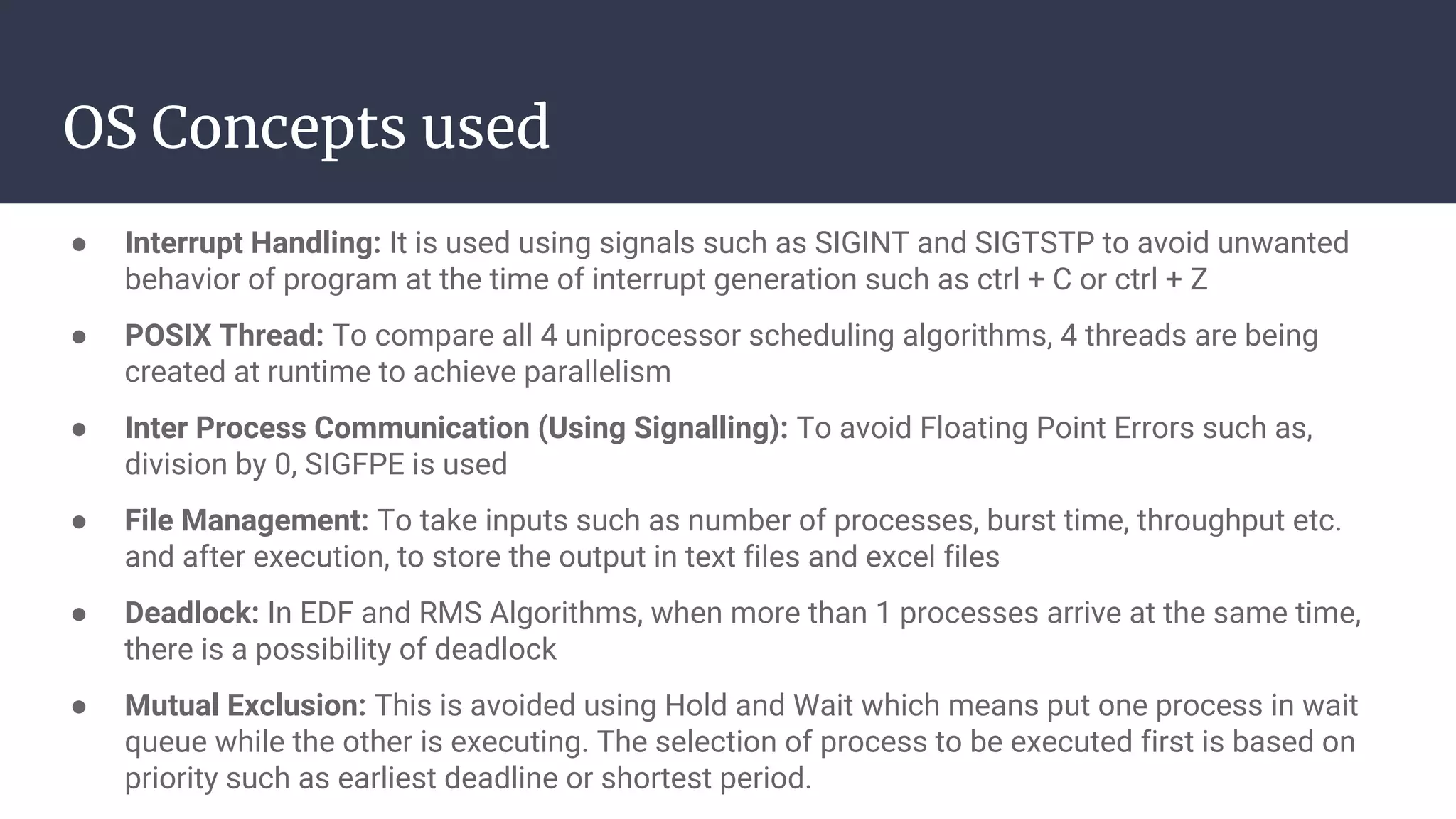
OS Concepts used
● Interrupt Handling: It is used using signals such as SIGINT and SIGTSTP to avoid unwanted
behavior of program at the time of interrupt generation such as ctrl + C or ctrl + Z
● POSIX Thread: To compare all 4 uniprocessor scheduling algorithms, 4 threads are being
created at runtime to achieve parallelism
● Inter Process Communication (Using Signalling): To avoid Floating Point Errors such as,
division by 0, SIGFPE is used
● File Management: To take inputs such as number of processes, burst time, throughput etc.
and after execution, to store the output in text files and excel files
● Deadlock: In EDF and RMS Algorithms, when more than 1 processes arrive at the same time,
there is a possibility of deadlock
● Mutual Exclusion: This is avoided using Hold and Wait which means put one process in wait
queue while the other is executing. The selection of process to be executed first is based on
priority such as earliest deadline or shortest period.
OS Concepts used cont...
● Starvation: The process which has to wait for longer period of time to get the CPU access
is a process which starves the most
● Context Switching: A process of storing and restoring the state of a process or thread so
that execution can be resumed from the same point at a later time, it is used in n RR and
Modified RR
● CPU Utilization
● Throughput
● Turnaround Time
● Waiting Time
● Uniprocessor Scheduling
● Real Time Scheduling
Why we opt for modifying RR
Algorithm?
● Round Robin reduces the penalty that short
jobs suffer with FCFS by preempting running
jobs periodically, and also saves starving of
longer jobs and scheduling effort in case of
SJF.
● The main advantage of Round Robin
Scheduling is that every process gets the
CPU and thus there is no starvation.
● But it has scope of improvement on
following parameters:
○ High wait time
○ High turnaround time
○ Low throughput
○ More context switches
Modified Round Robin
Proposed Modified Round Robin Algorithm is
an amalgamation of:
● Traditional Round Robin Algorithm
● Priority Scheduling Algorithm
● It also uses concept of change in
quantum time
Step 1: Allocate every process to CPU, a single time by applying RR scheduling with a initial
time quantum (say k units)
Step 2: After completing first cycle perform the following steps:
● Double the initial time quantum (2k units)
● Select the shortest process from the waiting queue and assign to CPU
● After that we have to select the next shortest process for execution by excluding the
already executed ones
Step 3: For the complete execution of all the processes we have to repeat steps 1 and 2 in
cycle
Algorithm of Modified Round Robin
Input: 1
Number of processes: 5
Burst time of processes: 22, 18, 21, 10, 5
Time Quantum: 5
Throughput to test: 30 ms
Input: 2
Number of processes: 5
Burst time of processes: 22, 9, 11, 17, 5
Time Quantum: 10
Throughput to test: 45 ms
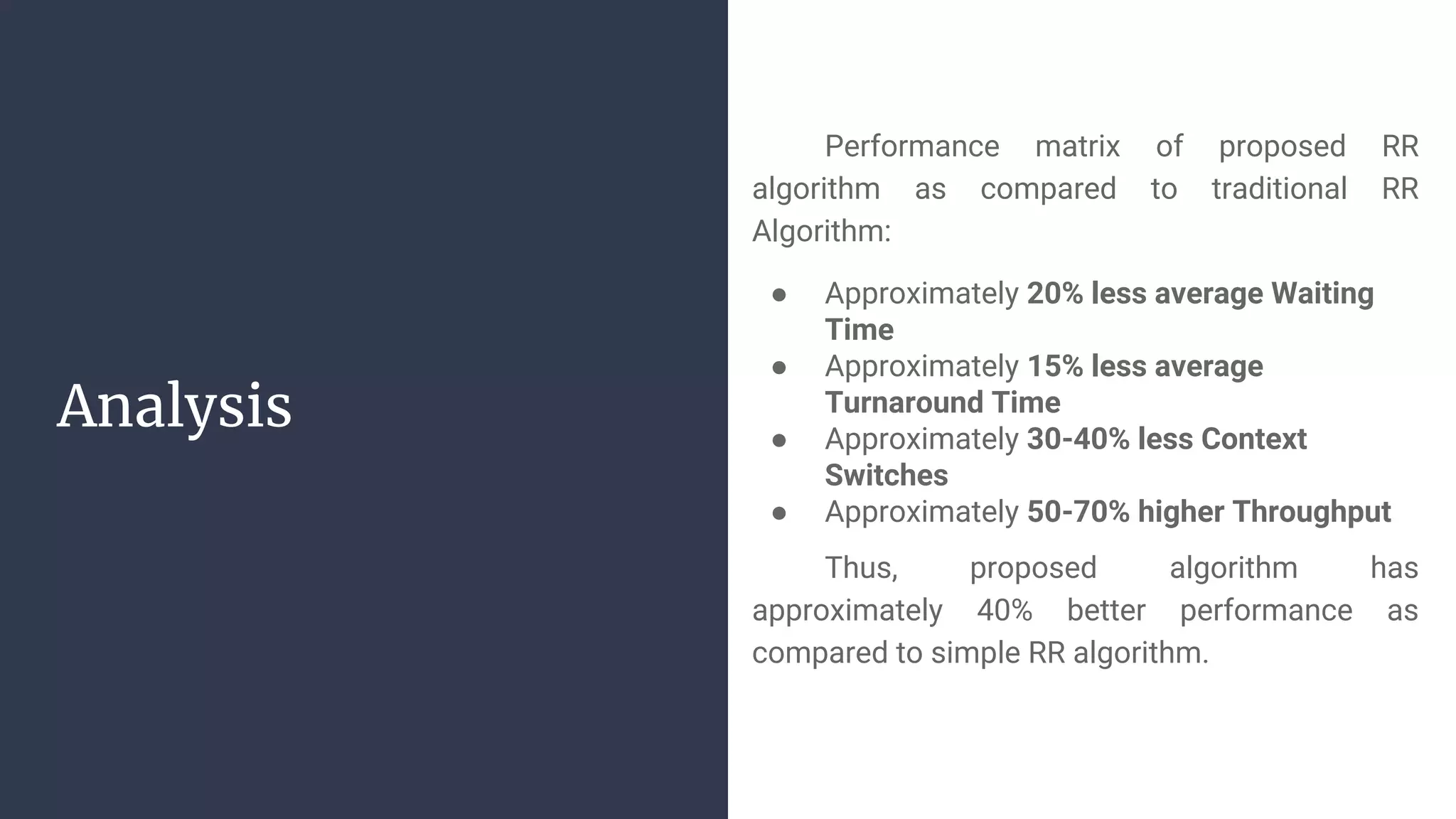
Analysis
Performance matrix of proposed RR
algorithm as compared to traditional RR
Algorithm:
● Approximately 20% less average Waiting
Time
● Approximately 15% less average
Turnaround Time
● Approximately 30-40% less Context
Switches
● Approximately 50-70% higher Throughput
Thus, proposed algorithm has
approximately 40% better performance as
compared to simple RR algorithm.
Live Demo
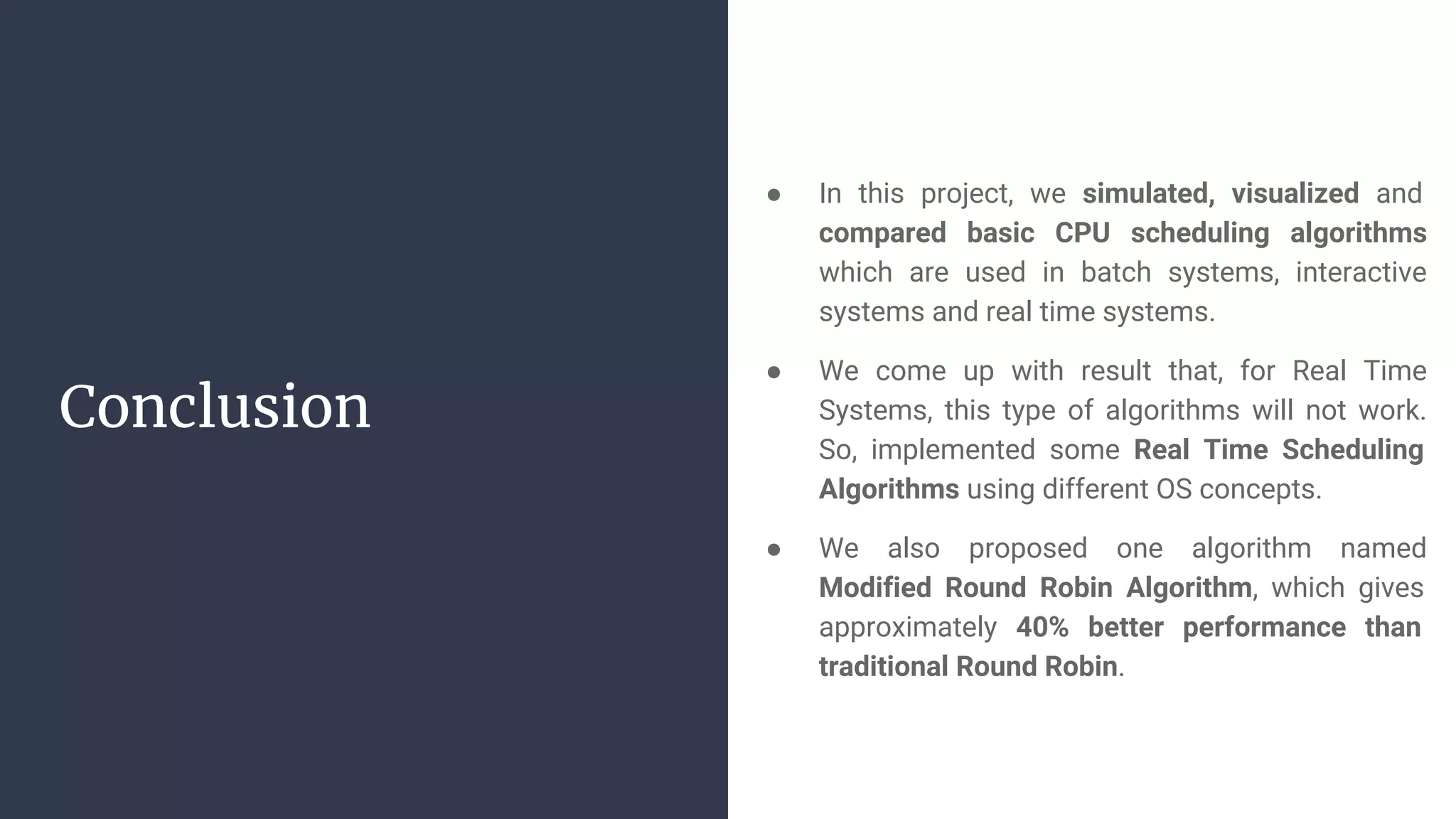
Conclusion
● In this project, we simulated, visualized and
compared basic CPU scheduling algorithms
which are used in batch systems, interactive
systems and real time systems.
● We come up with result that, for Real Time
Systems, this type of algorithms will not work.
So, implemented some Real Time Scheduling
Algorithms using different OS concepts.
● We also proposed one algorithm named
Modified Round Robin Algorithm, which gives
approximately 40% better performance than
traditional Round Robin.
Future Work
● Algorithms we implemented was based on
uniprocessor, but this could be done in
multiprocessor system.
● Also complexities could be modified and
multiprogramming can be considered. Even
more variables and criteria could be used to
provide a broader range for comparison.
● Extension of this project could be
Re-Compilation of Linux Kernel using both
real time and batch scheduling algorithms.
References
● Research Paper:
● https://www.researchgate.net/publication/501942
16_An_Optimized_Round_Robin_Scheduling_Algorit
hm_for_CPU_Scheduling
● http://ipasj.org/IIJCS/Volume2Issue11/IIJCS-2014-
11-17-28.pdf
● https://www.coursera.org/learn/real-time-systems/
.../earliest-deadline-first-example
● Websites:
● http://www.geeksforgeeks.org/gate-notes-operatin
g-system-process-scheduling/
● https://en.wikipedia.org/wiki/Scheduling_(computi
ng)
● https://www.cs.uic.edu/~jbell/CourseNotes/Operat
ingSystems/5_CPU_Scheduling.html
● Reference Book:
● Operating Systems-Internals and Design principles
by William Stallings.
Any Questions…??
Thank you!

Os prj ppt

  • 1.
    CPU Scheduling Algorithm Presentedby: Group 02 Charmi Chokshi (201501021) Hena Ghonia (201501032) Subject: CSC341- Operating Systems Lab Guided by: Dr. Sanjay Chaudhary Prof. M. T. Savaliya
  • 2.
    Outline ● Problem Definition ●Project Modules and Technical Details ● Flow Chart ● Operating Systems Concepts used ● Why we Modified existing RR Algorithm? ● Live Demo ● Conclusion ● Future Work ● References ● Q&A
  • 3.
    Problem Definition ● ProcessScheduling: An act of determining which process in the ready state should be moved to the running state ● CPU scheduling: A process which allows one process to use the CPU while the execution of another process is on hold/ in waiting state ● The Aim of CPU scheduling is to make the system ○ Efficient ○ Fast ○ Fair ● For achieving this, the scheduler must apply appropriate rules/ algorithms for swapping processes IN and OUT of CPU. ● There are many different criteria to check when considering the "best" scheduling algorithm: ○ Turnaround time ○ Starvation ○ Context Switching ○ Possibility of Deadlock ○ CPU utilization ○ Throughput ○ Waiting time ○ Response Time
  • 4.
  • 5.
    This project isaimed at Implementation and Analysis of the following CPU scheduling Algorithms: ● Uniprocessor Scheduling Algorithms: ○ First-Come-First-Served (FCFS) ○ Round Robin (RR) ○ Shortest-Job-First (SJF) ○ Priority Scheduling (PS) ● Real Time Scheduling Algorithms: ○ Earliest Deadline First (EDF) ○ Rate Monotonic Scheduling (RMS) ● The project also include implementation of Modified Round Robin Algorithm There is a Simulator which runs different CPU scheduling algorithms and gives different Utilization matrices: ● Waiting time of each process and average waiting time ● Turn-around time of each process and average turnaround time ● Number of context switches in case of RR and Modified RR algorithms ● Throughput for given time span ● Gantt Chart Project Modules
  • 6.
    ● Arrival timefor each processes in FCFS, PS, RR, SJF and Modified RR Algorithm is 0 ms ● Deadline and Time Periods in EDF and RMS Algorithm are of type integer ● Number of processes to compare all 4 algorithms is set to 4 ● Number of processes to compare RR and Modified RR is set to 5 ● The value of Time Quantum in Modified RR is doubled after first iteration Assumptions ● The project is made using C Programming language ● Comparison of different scheduling algorithms by generating Bar Graphs is done using Libxlsxwriter which is a C library for creating Excel XLSX files ● It has contains 1 C file and 11 header files for implementation of different tasks ● Some inputs are taken from user at run time and some are taken and stored in file Note
  • 7.
  • 9.
    OS Concepts used ●Interrupt Handling: It is used using signals such as SIGINT and SIGTSTP to avoid unwanted behavior of program at the time of interrupt generation such as ctrl + C or ctrl + Z ● POSIX Thread: To compare all 4 uniprocessor scheduling algorithms, 4 threads are being created at runtime to achieve parallelism ● Inter Process Communication (Using Signalling): To avoid Floating Point Errors such as, division by 0, SIGFPE is used ● File Management: To take inputs such as number of processes, burst time, throughput etc. and after execution, to store the output in text files and excel files ● Deadlock: In EDF and RMS Algorithms, when more than 1 processes arrive at the same time, there is a possibility of deadlock ● Mutual Exclusion: This is avoided using Hold and Wait which means put one process in wait queue while the other is executing. The selection of process to be executed first is based on priority such as earliest deadline or shortest period.
  • 10.
    OS Concepts usedcont... ● Starvation: The process which has to wait for longer period of time to get the CPU access is a process which starves the most ● Context Switching: A process of storing and restoring the state of a process or thread so that execution can be resumed from the same point at a later time, it is used in n RR and Modified RR ● CPU Utilization ● Throughput ● Turnaround Time ● Waiting Time ● Uniprocessor Scheduling ● Real Time Scheduling
  • 11.
    Why we optfor modifying RR Algorithm? ● Round Robin reduces the penalty that short jobs suffer with FCFS by preempting running jobs periodically, and also saves starving of longer jobs and scheduling effort in case of SJF. ● The main advantage of Round Robin Scheduling is that every process gets the CPU and thus there is no starvation. ● But it has scope of improvement on following parameters: ○ High wait time ○ High turnaround time ○ Low throughput ○ More context switches Modified Round Robin Proposed Modified Round Robin Algorithm is an amalgamation of: ● Traditional Round Robin Algorithm ● Priority Scheduling Algorithm ● It also uses concept of change in quantum time
  • 12.
    Step 1: Allocateevery process to CPU, a single time by applying RR scheduling with a initial time quantum (say k units) Step 2: After completing first cycle perform the following steps: ● Double the initial time quantum (2k units) ● Select the shortest process from the waiting queue and assign to CPU ● After that we have to select the next shortest process for execution by excluding the already executed ones Step 3: For the complete execution of all the processes we have to repeat steps 1 and 2 in cycle Algorithm of Modified Round Robin
  • 13.
    Input: 1 Number ofprocesses: 5 Burst time of processes: 22, 18, 21, 10, 5 Time Quantum: 5 Throughput to test: 30 ms Input: 2 Number of processes: 5 Burst time of processes: 22, 9, 11, 17, 5 Time Quantum: 10 Throughput to test: 45 ms
  • 14.
    Analysis Performance matrix ofproposed RR algorithm as compared to traditional RR Algorithm: ● Approximately 20% less average Waiting Time ● Approximately 15% less average Turnaround Time ● Approximately 30-40% less Context Switches ● Approximately 50-70% higher Throughput Thus, proposed algorithm has approximately 40% better performance as compared to simple RR algorithm.
  • 15.
  • 16.
    Conclusion ● In thisproject, we simulated, visualized and compared basic CPU scheduling algorithms which are used in batch systems, interactive systems and real time systems. ● We come up with result that, for Real Time Systems, this type of algorithms will not work. So, implemented some Real Time Scheduling Algorithms using different OS concepts. ● We also proposed one algorithm named Modified Round Robin Algorithm, which gives approximately 40% better performance than traditional Round Robin.
  • 17.
    Future Work ● Algorithmswe implemented was based on uniprocessor, but this could be done in multiprocessor system. ● Also complexities could be modified and multiprogramming can be considered. Even more variables and criteria could be used to provide a broader range for comparison. ● Extension of this project could be Re-Compilation of Linux Kernel using both real time and batch scheduling algorithms.
  • 18.
    References ● Research Paper: ●https://www.researchgate.net/publication/501942 16_An_Optimized_Round_Robin_Scheduling_Algorit hm_for_CPU_Scheduling ● http://ipasj.org/IIJCS/Volume2Issue11/IIJCS-2014- 11-17-28.pdf ● https://www.coursera.org/learn/real-time-systems/ .../earliest-deadline-first-example ● Websites: ● http://www.geeksforgeeks.org/gate-notes-operatin g-system-process-scheduling/ ● https://en.wikipedia.org/wiki/Scheduling_(computi ng) ● https://www.cs.uic.edu/~jbell/CourseNotes/Operat ingSystems/5_CPU_Scheduling.html ● Reference Book: ● Operating Systems-Internals and Design principles by William Stallings.
  • 19.
  • 20.