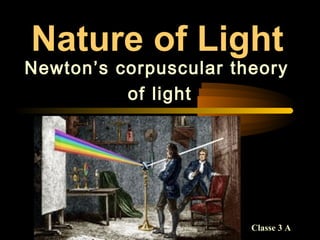
Nature of Light
Newton’s corpuscular theory
of light
Classe 3 A
A long time ago …
Aristotle (384 - 322 B.C.), an ancient
Greek, thought that we see the
world by sending “something” out
of our eye and that reflects from the
object.
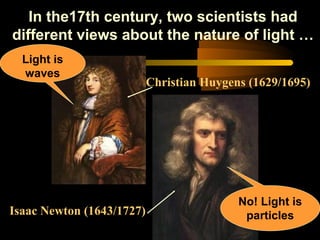
In the17th century, two scientists had
different views about the nature of light …
Christian Huygens (1629/1695)
Isaac Newton (1643/1727)
No! Light is
particles
Light is
waves
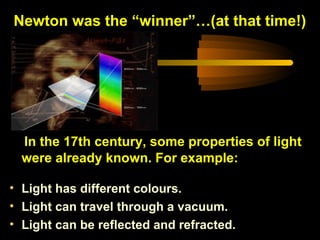
In the 17th century, some properties of light
were already known. For example:
• Light has different colours.
• Light can travel through a vacuum.
• Light can be reflected and refracted.
Newton was the “winner”…(at that time!)
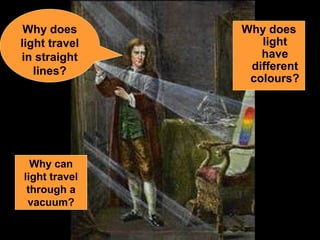
Why does
light
have
different
colours?
Why does
light travel
in straight
lines?
Why can
light travel
through a
vacuum?
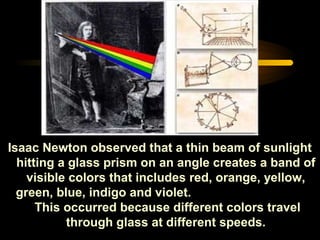
Isaac Newton observed that a thin beam of sunlight
hitting a glass prism on an angle creates a band of
visible colors that includes red, orange, yellow,
green, blue, indigo and violet.
This occurred because different colors travel
through glass at different speeds.
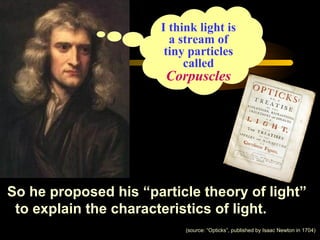
So he proposed his “particle theory of light”
to explain the characteristics of light.
I think light is
a stream of
tiny particles
called
Corpuscles
(source: “Opticks”, published by Isaac Newton in 1704)
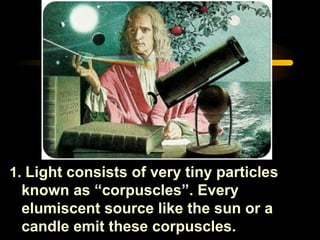
1. Light consists of very tiny particles
known as “corpuscles”. Every
elumiscent source like the sun or a
candle emit these corpuscles.
2. These corpuscles on emission
from the source of light travel in
straight line with high velocity in
all possible directions.
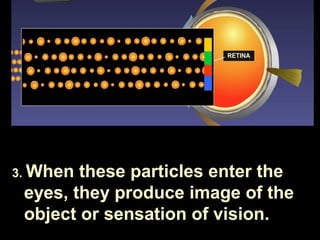
3. When these particles enter the
eyes, they produce image of the
object or sensation of vision.
4. Corpuscles of different
colours have different sizes.
Newton’s particle theory of light had a
greater explanatory power than Huygens’
wave theory and dominated optics during
the 18th
century even if it was not correct.

Newton

  • 1.
    Nature of Light Newton’scorpuscular theory of light Classe 3 A
  • 2.
    A long timeago … Aristotle (384 - 322 B.C.), an ancient Greek, thought that we see the world by sending “something” out of our eye and that reflects from the object.
  • 3.
    In the17th century,two scientists had different views about the nature of light … Christian Huygens (1629/1695) Isaac Newton (1643/1727) No! Light is particles Light is waves
  • 4.
    In the 17thcentury, some properties of light were already known. For example: • Light has different colours. • Light can travel through a vacuum. • Light can be reflected and refracted. Newton was the “winner”…(at that time!)
  • 5.
    Why does light have different colours? Why does lighttravel in straight lines? Why can light travel through a vacuum?
  • 6.
    Isaac Newton observedthat a thin beam of sunlight hitting a glass prism on an angle creates a band of visible colors that includes red, orange, yellow, green, blue, indigo and violet. This occurred because different colors travel through glass at different speeds.
  • 7.
    So he proposedhis “particle theory of light” to explain the characteristics of light. I think light is a stream of tiny particles called Corpuscles (source: “Opticks”, published by Isaac Newton in 1704)
  • 8.
    1. Light consistsof very tiny particles known as “corpuscles”. Every elumiscent source like the sun or a candle emit these corpuscles.
  • 9.
    2. These corpuscleson emission from the source of light travel in straight line with high velocity in all possible directions.
  • 10.
    3. When theseparticles enter the eyes, they produce image of the object or sensation of vision.
  • 11.
    4. Corpuscles ofdifferent colours have different sizes.
  • 12.
    Newton’s particle theoryof light had a greater explanatory power than Huygens’ wave theory and dominated optics during the 18th century even if it was not correct.