External sorting
R & G – Chapter 13
Brian Cooper
Yahoo! Research
A little bit about Y!
 Yahoo! is the most visited website in the
world
 Sorry Google
 500 million unique visitors per month
 74 percent of U.S. users use Y! (per month)
 13 percent of U.S. users’ online time is on Y!
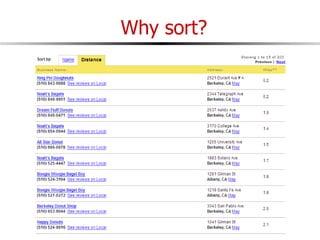
Why sort?
Why sort?
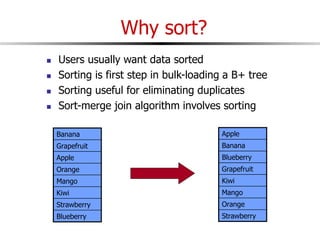
 Users usually want data sorted
 Sorting is first step in bulk-loading a B+ tree
 Sorting useful for eliminating duplicates
 Sort-merge join algorithm involves sorting
Banana
Grapefruit
Apple
Orange
Mango
Kiwi
Strawberry
Blueberry
Apple
Banana
Blueberry
Grapefruit
Kiwi
Mango
Orange
Strawberry
So?
 Don’t we know how to sort?
 Quicksort
 Mergesort
 Heapsort
 Selection sort
 Insertion sort
 Radix sort
 Bubble sort
 Etc.
 Why don’t these work for databases?
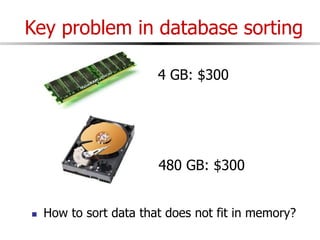
Key problem in database sorting
4 GB: $300
480 GB: $300
 How to sort data that does not fit in memory?
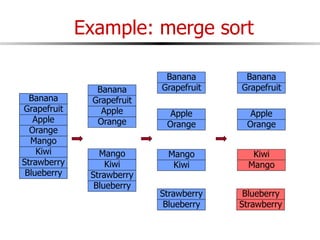
Example: merge sort
Apple
Banana
Blueberry
Grapefruit
Kiwi
Mango
Orange
Strawberry
Apple
Banana
Blueberry
Grapefruit
Kiwi
Mango
Orange
Strawberry
Apple
Banana
Grapefruit
Orange
Blueberry
Kiwi
Mango
Strawberry
Apple
Banana
Grapefruit
Orange
Blueberry
Kiwi
Mango
Strawberry
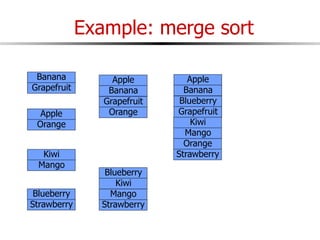
Example: merge sort
Apple
Banana
Grapefruit
Orange
Strawberry
Mango
Kiwi
Blueberry
Grapefruit
Apple
Banana
Orange
Strawberry
Kiwi
Blueberry
Mango
Blueberry
Apple
Banana
Grapefruit
Strawberry
Mango
Kiwi
Orange
Isn’t that good enough?
 Consider a file with N records
 Merge sort is O(N lg N) comparisons
 We want to minimize disk I/Os
 Don’t want to go to disk O(N lg N) times!
 Key insight: sort based on pages, not records
 Read whole pages into RAM, not individual records
 Do some in-memory processing
 Write processed blocks out to disk
 Repeat
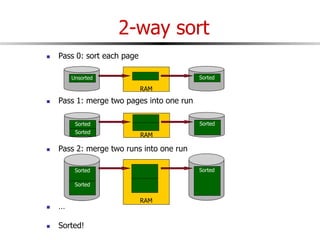
 Pass 0: sort each page
 Pass 1: merge two pages into one run
 Pass 2: merge two runs into one run
 …
 Sorted!
2-way sort
Unsorted Sorted
RAM
Sorted Sorted
RAM
Sorted
Sorted Sorted
RAM
Sorted
What did that cost us?
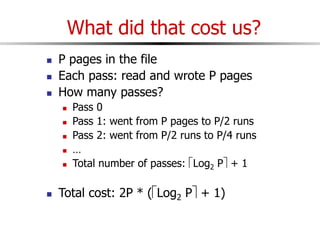
 P pages in the file
 Each pass: read and wrote P pages
 How many passes?
 Pass 0
 Pass 1: went from P pages to P/2 runs
 Pass 2: went from P/2 runs to P/4 runs
 …
 Total number of passes: Log2 P + 1
 Total cost: 2P * (Log2 P + 1)
What did that cost us?
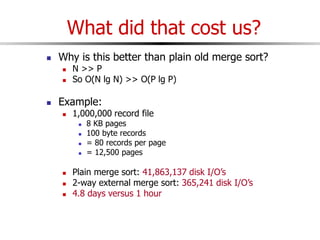
 Why is this better than plain old merge sort?
 N >> P
 So O(N lg N) >> O(P lg P)
 Example:
 1,000,000 record file
 8 KB pages
 100 byte records
 = 80 records per page
 = 12,500 pages
 Plain merge sort: 41,863,137 disk I/O’s
 2-way external merge sort: 365,241 disk I/O’s
 4.8 days versus 1 hour
Can we do better?
 2-way merge sort only uses 3 memory buffers
 Two buffers to hold input records
 One buffer to hold output records
 When that buffer fills up, flush to disk
 Usually we have a lot more memory than that
 Set aside 100 MB for sort scratch space = 12,800 buffer
pages
 Idea: read as much data into memory as possible
each pass
 Thus reducing the number of passes
 Recall total cost:
2P * Passes
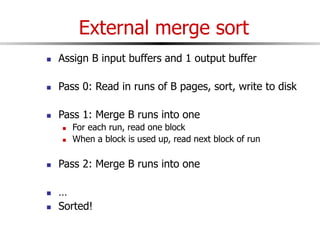
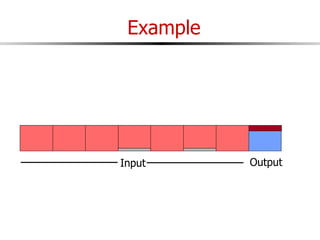
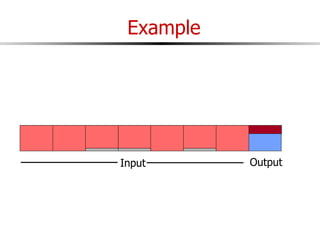
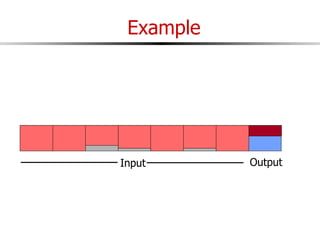
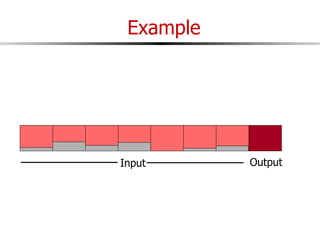
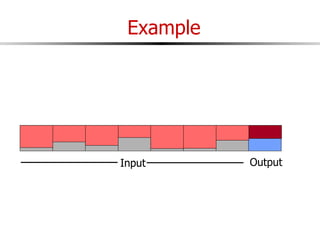
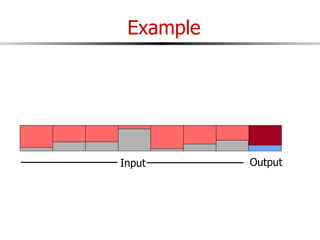
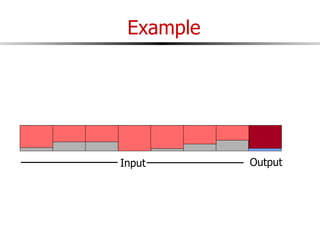
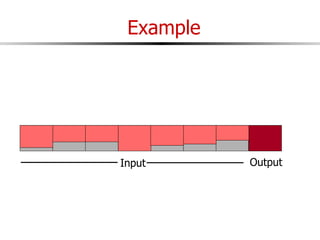
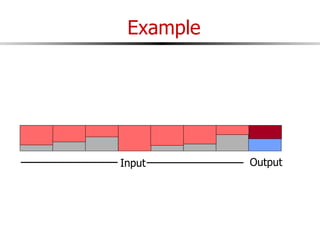
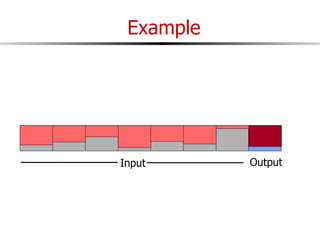
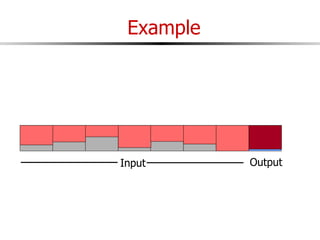
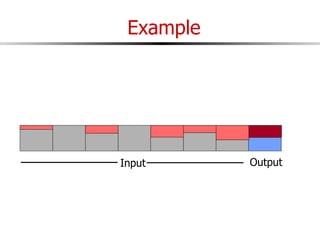
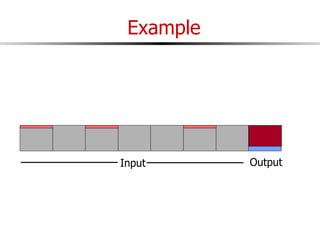
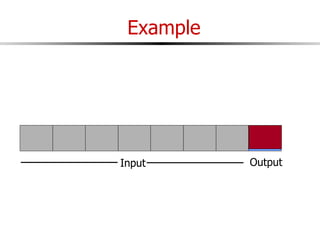
External merge sort
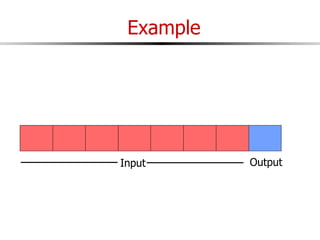
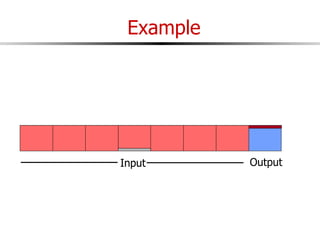
 Assign B input buffers and 1 output buffer
 Pass 0: Read in runs of B pages, sort, write to disk
 Pass 1: Merge B runs into one
 For each run, read one block
 When a block is used up, read next block of run
 Pass 2: Merge B runs into one
 …
 Sorted!
Example
Input Output
Example
Input Output
Example
Input Output
Example
Input Output
Example
Input Output
Example
Input Output
Example
Input Output
Example
Input Output
Example
Input Output
Example
Input Output
Example
Input Output
Example
Input Output
Example
Input Output
Example
Input Output
Example
Input Output
Example
Input Output
Example
Input Output
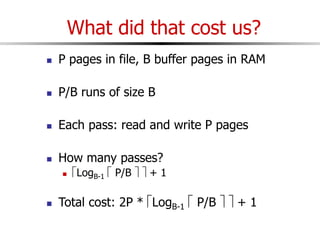
What did that cost us?
 P pages in file, B buffer pages in RAM
 P/B runs of size B
 Each pass: read and write P pages
 How many passes?
 LogB-1  P/B   + 1
 Total cost: 2P * LogB-1  P/B   + 1
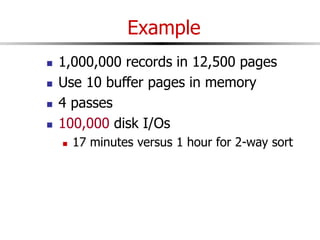
Example
 1,000,000 records in 12,500 pages
 Use 10 buffer pages in memory
 4 passes
 100,000 disk I/Os
 17 minutes versus 1 hour for 2-way sort
Can I do two passes?
 Pass 0: sort runs
 Pass 1: merge runs
 Given B buffers
 Need:
 No more than B-1 runs
 Each run no longer than B pages
 Can do two passes if P ≤ B * (B-1)
 Question: what’s the largest file we can sort in three
passes? N passes?
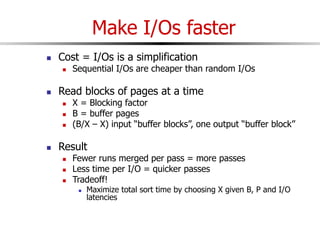
Make I/Os faster
 Cost = I/Os is a simplification
 Sequential I/Os are cheaper than random I/Os
 Read blocks of pages at a time
 X = Blocking factor
 B = buffer pages
 (B/X – X) input “buffer blocks”, one output “buffer block”
 Result
 Fewer runs merged per pass = more passes
 Less time per I/O = quicker passes
 Tradeoff!
 Maximize total sort time by choosing X given B, P and I/O
latencies
Overlap computation and I/O
 Problem: CPU must wait for I/O
 Suppose I need to read a new block
 Stop merging
 Initiate I/O
 Wait
 Complete I/O
 Resume merging
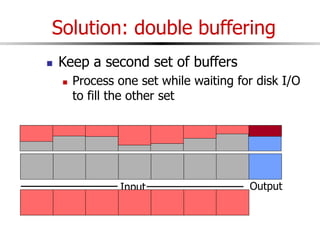
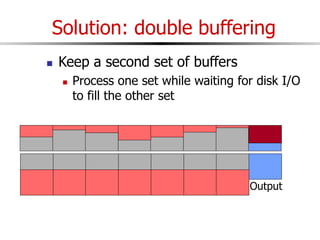
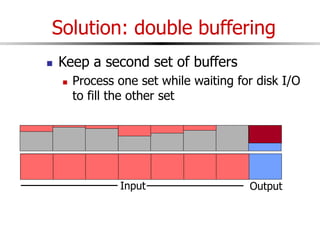
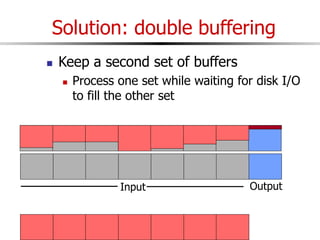
Solution: double buffering
 Keep a second set of buffers
 Process one set while waiting for disk I/O
to fill the other set
Input Output
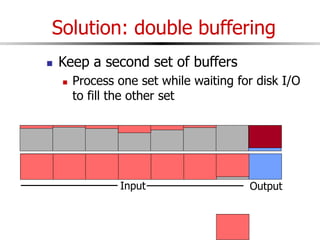
Solution: double buffering
 Keep a second set of buffers
 Process one set while waiting for disk I/O
to fill the other set
Input Output
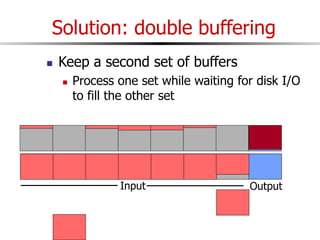
Solution: double buffering
 Keep a second set of buffers
 Process one set while waiting for disk I/O
to fill the other set
Input
Output
Solution: double buffering
 Keep a second set of buffers
 Process one set while waiting for disk I/O
to fill the other set
Input Output
Solution: double buffering
 Keep a second set of buffers
 Process one set while waiting for disk I/O
to fill the other set
Input Output
Solution: double buffering
 Keep a second set of buffers
 Process one set while waiting for disk I/O
to fill the other set
Input Output
What if the data is already sorted?
 Yay!
 Often this happens because of a B+
tree index
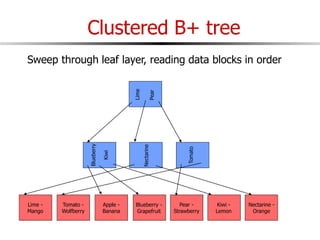
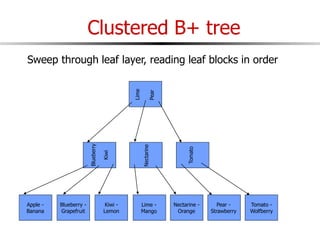
 Leaf level of a B+ tree has all records in
sorted order
 Two possibilities: B+ tree is clustered or
unclustered
Clustered B+ tree
Apple -
Banana
Pear -
Strawberry
Kiwi -
Lemon
Lime -
Mango
Nectarine -
Orange
Blueberry -
Grapefruit
Tomato -
Wolfberry
Nectarine
Tomato
Kiwi
Blueberry
Lime
Pear
Sweep through leaf layer, reading data blocks in order
Clustered B+ tree
Kiwi -
Lemon
Nectarine -
Orange
Pear -
Strawberry
Apple -
Banana
Tomato -
Wolfberry
Lime -
Mango
Blueberry -
Grapefruit
Nectarine
Tomato
Kiwi
Blueberry
Lime
Pear
Sweep through leaf layer, reading leaf blocks in order
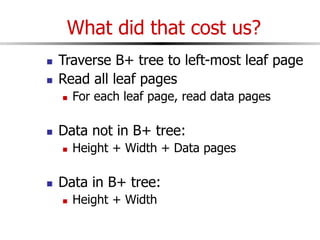
What did that cost us?
 Traverse B+ tree to left-most leaf page
 Read all leaf pages
 For each leaf page, read data pages
 Data not in B+ tree:
 Height + Width + Data pages
 Data in B+ tree:
 Height + Width
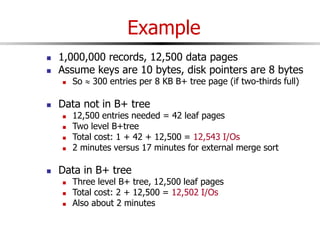
Example
 1,000,000 records, 12,500 data pages
 Assume keys are 10 bytes, disk pointers are 8 bytes
 So  300 entries per 8 KB B+ tree page (if two-thirds full)
 Data not in B+ tree
 12,500 entries needed = 42 leaf pages
 Two level B+tree
 Total cost: 1 + 42 + 12,500 = 12,543 I/Os
 2 minutes versus 17 minutes for external merge sort
 Data in B+ tree
 Three level B+ tree, 12,500 leaf pages
 Total cost: 2 + 12,500 = 12,502 I/Os
 Also about 2 minutes
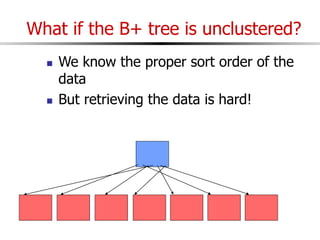
What if the B+ tree is unclustered?
 We know the proper sort order of the
data
 But retrieving the data is hard!
What if the B+ tree is unclustered?
 Result is that in the worst case, may
need one disk I/O per record
 Even though we know the sort order!
 Usually external merge sort is better in
these cases
 Unless all you need is the set of keys
Summary
 Sorting is very important
 Basic algorithms not sufficient
 Assume memory access free, CPU is costly
 In databases, memory (e.g. disk) access is costly, CPU is
(almost free)
 Try to minimize disk accesses
 2-way sort: read and write records in blocks
 External merge sort: fill up as much memory as possible
 Blocked I/O: try to do sequential I/O
 Double buffering: read and compute at the same time
 Clustering B+ tree: the data is already sorted. Hooray!
 Unclusered B+ tree: no help at all
08-Sorting.ppt

08-Sorting.ppt

  • 1.
    External sorting R &G – Chapter 13 Brian Cooper Yahoo! Research
  • 2.
    A little bitabout Y!  Yahoo! is the most visited website in the world  Sorry Google  500 million unique visitors per month  74 percent of U.S. users use Y! (per month)  13 percent of U.S. users’ online time is on Y!
  • 3.
  • 5.
    Why sort?  Usersusually want data sorted  Sorting is first step in bulk-loading a B+ tree  Sorting useful for eliminating duplicates  Sort-merge join algorithm involves sorting Banana Grapefruit Apple Orange Mango Kiwi Strawberry Blueberry Apple Banana Blueberry Grapefruit Kiwi Mango Orange Strawberry
  • 6.
    So?  Don’t weknow how to sort?  Quicksort  Mergesort  Heapsort  Selection sort  Insertion sort  Radix sort  Bubble sort  Etc.  Why don’t these work for databases?
  • 7.
    Key problem indatabase sorting 4 GB: $300 480 GB: $300  How to sort data that does not fit in memory?
  • 8.
  • 9.
  • 10.
    Isn’t that goodenough?  Consider a file with N records  Merge sort is O(N lg N) comparisons  We want to minimize disk I/Os  Don’t want to go to disk O(N lg N) times!  Key insight: sort based on pages, not records  Read whole pages into RAM, not individual records  Do some in-memory processing  Write processed blocks out to disk  Repeat
  • 11.
     Pass 0:sort each page  Pass 1: merge two pages into one run  Pass 2: merge two runs into one run  …  Sorted! 2-way sort Unsorted Sorted RAM Sorted Sorted RAM Sorted Sorted Sorted RAM Sorted
  • 12.
    What did thatcost us?  P pages in the file  Each pass: read and wrote P pages  How many passes?  Pass 0  Pass 1: went from P pages to P/2 runs  Pass 2: went from P/2 runs to P/4 runs  …  Total number of passes: Log2 P + 1  Total cost: 2P * (Log2 P + 1)
  • 13.
    What did thatcost us?  Why is this better than plain old merge sort?  N >> P  So O(N lg N) >> O(P lg P)  Example:  1,000,000 record file  8 KB pages  100 byte records  = 80 records per page  = 12,500 pages  Plain merge sort: 41,863,137 disk I/O’s  2-way external merge sort: 365,241 disk I/O’s  4.8 days versus 1 hour
  • 14.
    Can we dobetter?  2-way merge sort only uses 3 memory buffers  Two buffers to hold input records  One buffer to hold output records  When that buffer fills up, flush to disk  Usually we have a lot more memory than that  Set aside 100 MB for sort scratch space = 12,800 buffer pages  Idea: read as much data into memory as possible each pass  Thus reducing the number of passes  Recall total cost: 2P * Passes
  • 15.
    External merge sort Assign B input buffers and 1 output buffer  Pass 0: Read in runs of B pages, sort, write to disk  Pass 1: Merge B runs into one  For each run, read one block  When a block is used up, read next block of run  Pass 2: Merge B runs into one  …  Sorted!
  • 16.
  • 17.
  • 18.
  • 19.
  • 20.
  • 21.
  • 22.
  • 23.
  • 24.
  • 25.
  • 26.
  • 27.
  • 28.
  • 29.
  • 30.
  • 31.
  • 32.
  • 33.
    What did thatcost us?  P pages in file, B buffer pages in RAM  P/B runs of size B  Each pass: read and write P pages  How many passes?  LogB-1  P/B   + 1  Total cost: 2P * LogB-1  P/B   + 1
  • 34.
    Example  1,000,000 recordsin 12,500 pages  Use 10 buffer pages in memory  4 passes  100,000 disk I/Os  17 minutes versus 1 hour for 2-way sort
  • 35.
    Can I dotwo passes?  Pass 0: sort runs  Pass 1: merge runs  Given B buffers  Need:  No more than B-1 runs  Each run no longer than B pages  Can do two passes if P ≤ B * (B-1)  Question: what’s the largest file we can sort in three passes? N passes?
  • 36.
    Make I/Os faster Cost = I/Os is a simplification  Sequential I/Os are cheaper than random I/Os  Read blocks of pages at a time  X = Blocking factor  B = buffer pages  (B/X – X) input “buffer blocks”, one output “buffer block”  Result  Fewer runs merged per pass = more passes  Less time per I/O = quicker passes  Tradeoff!  Maximize total sort time by choosing X given B, P and I/O latencies
  • 37.
    Overlap computation andI/O  Problem: CPU must wait for I/O  Suppose I need to read a new block  Stop merging  Initiate I/O  Wait  Complete I/O  Resume merging
  • 38.
    Solution: double buffering Keep a second set of buffers  Process one set while waiting for disk I/O to fill the other set Input Output
  • 39.
    Solution: double buffering Keep a second set of buffers  Process one set while waiting for disk I/O to fill the other set Input Output
  • 40.
    Solution: double buffering Keep a second set of buffers  Process one set while waiting for disk I/O to fill the other set Input Output
  • 41.
    Solution: double buffering Keep a second set of buffers  Process one set while waiting for disk I/O to fill the other set Input Output
  • 42.
    Solution: double buffering Keep a second set of buffers  Process one set while waiting for disk I/O to fill the other set Input Output
  • 43.
    Solution: double buffering Keep a second set of buffers  Process one set while waiting for disk I/O to fill the other set Input Output
  • 44.
    What if thedata is already sorted?  Yay!  Often this happens because of a B+ tree index  Leaf level of a B+ tree has all records in sorted order  Two possibilities: B+ tree is clustered or unclustered
  • 45.
    Clustered B+ tree Apple- Banana Pear - Strawberry Kiwi - Lemon Lime - Mango Nectarine - Orange Blueberry - Grapefruit Tomato - Wolfberry Nectarine Tomato Kiwi Blueberry Lime Pear Sweep through leaf layer, reading data blocks in order
  • 46.
    Clustered B+ tree Kiwi- Lemon Nectarine - Orange Pear - Strawberry Apple - Banana Tomato - Wolfberry Lime - Mango Blueberry - Grapefruit Nectarine Tomato Kiwi Blueberry Lime Pear Sweep through leaf layer, reading leaf blocks in order
  • 47.
    What did thatcost us?  Traverse B+ tree to left-most leaf page  Read all leaf pages  For each leaf page, read data pages  Data not in B+ tree:  Height + Width + Data pages  Data in B+ tree:  Height + Width
  • 48.
    Example  1,000,000 records,12,500 data pages  Assume keys are 10 bytes, disk pointers are 8 bytes  So  300 entries per 8 KB B+ tree page (if two-thirds full)  Data not in B+ tree  12,500 entries needed = 42 leaf pages  Two level B+tree  Total cost: 1 + 42 + 12,500 = 12,543 I/Os  2 minutes versus 17 minutes for external merge sort  Data in B+ tree  Three level B+ tree, 12,500 leaf pages  Total cost: 2 + 12,500 = 12,502 I/Os  Also about 2 minutes
  • 49.
    What if theB+ tree is unclustered?  We know the proper sort order of the data  But retrieving the data is hard!
  • 50.
    What if theB+ tree is unclustered?  Result is that in the worst case, may need one disk I/O per record  Even though we know the sort order!  Usually external merge sort is better in these cases  Unless all you need is the set of keys
  • 51.
    Summary  Sorting isvery important  Basic algorithms not sufficient  Assume memory access free, CPU is costly  In databases, memory (e.g. disk) access is costly, CPU is (almost free)  Try to minimize disk accesses  2-way sort: read and write records in blocks  External merge sort: fill up as much memory as possible  Blocked I/O: try to do sequential I/O  Double buffering: read and compute at the same time  Clustering B+ tree: the data is already sorted. Hooray!  Unclusered B+ tree: no help at all