NAME – ARJUN KUMAR
CLASS – XI Com.
ROLL No. - 18
SUBJECT – ECONOMICS
TOPIC - COLLECTION OF DATA
SCHOOL – K.V. No.2 BHUJ
Data: – Information which can be expressed in numbers.
Two sources of data: – Primary & Secondary.
Primary Data.
The data which is collected for
the first time by investigators or
enumerators to serve a specific
purpose is called Primary data.
They are based on first-hand
information. In other words such
a data is of original in nature.
The sources from where these
data can be collected are known
as Sources.
Secondary Data.
The data which is originally
collected and published by the
authorities other than who require
it or the data which is obtained
from published or unpublished
sources is called Secondary data.
Such data is already available in
some government publications,
research study, journals or
newspaper etc.
Sources of Collection of Primary Data:
 Direct Personal Interview
 Indirect Oral Investigation
 Information from correspondents
 Mailed questionnaire
 Questionnaire filled by enumerators
 Telephonic interviews
Direct Personal Investigation
Under this method, investigators personally visit respondents, ask
them questions pertaining to the enquiry and collect the desired
information. In other words it is a method by which data are
personally collected by the investigator from the respondents or
informants. The investigator establishes direct relation with a
person from whom the information is to be obtained.
Advantages…
1. Highest response rate
2. Allows all types of questions
3. Allows clearing doubts regarding questions
Disadvantages…
1. Most expensive
2. Informants can be influenced
3. Takes more time
Indirect Oral Investigation
Under this method, investigator collect data by contracting with the
third party or informants who are supposed to possess the
information on the problem under investigation. In other words the
data will be collected from those persons who may possess some
knowledge about the investigation. Such persons are known as
“Witnesses”.
Advantage… Disadvantage…
1. Less Expensive 1. Lack of Accuracy
2. Experts Opinion 2. Lack of Uniformity
3. Wide Coverage 3. Lack of Reliability
Telephonic interviews
In a telephone interview the investigator asks questions over the
telephone. The investigator instead of presenting himself before
the informants contacts them via telephone and collects the
desired information.
Advantages… Disadvantages…
1) Relatively low cost 1) Limited use
2) Relatively high response rate 2) Reactions cannot be
watched
3) Less influence on informants 3) Respondents can be
influenced
Information from correspondents
According to this method, the correspondents or local agencies in
different regions collect the required information in their own
way and subsequently submit their reports or transmit the
information to the central office where data are processed and
finally analyzed. When the information is to be collected
regularly on a timely basis (daily, weekly or monthly)
correspondents may be posted at various places. This method is
usually adopted by newspaper agencies that require political
information in areas like sports, economic trends, share markets,
law and order etc.
Mailed questionnaire
Under this method, a well-designed questionnaire is mailed to the
informants with a request to fill it up and return the same within the
specific time schedule. It is pointed out in the covering letter to the
correspondents that information supplied by them in the
questionnaire will be kept secretly confidential. In the prevalent
knowledge based environment, an investigator may e-mail the
questionnaire to target group of respondents and can mobilize the
desired information subject to certain conditions. The success of this
method is based on the ability to design the questionnaire,
knowledge of the respondents and their response to questionnaire.
Questionnaire filled by enumerators
Under this method, a well-designed questionnaire is mailed to the
informants with a request to fill it up and return the same within
the specific time schedule. It is pointed out in the covering letter to
the correspondents that information supplied by them in the
questionnaire will be kept secretly confidential. In the prevalent
knowledge based environment, an investigator may e-mail the
questionnaire to target group of respondents and can mobilize the
desired information subject to certain conditions. The success of this
method is based on the ability to design the questionnaire,
knowledge of the respondents and their response to questionnaire.
The two popular approaches used by the
statistician...
• A survey, which includes
every element of the
population, is known as
census or method of
complete enumeration. In
other words when data are
collected for each and every
unit of the investigation, it is
called census method.
Sampling Method
• Sampling investigation refers to
the process of learning about the
population on the basis of sample
drawn from it. In sampling
method instead of every items of
the universe only a part of the
universe is studied and
conclusions are drawn on the
same basis for entire universe.
Census Method
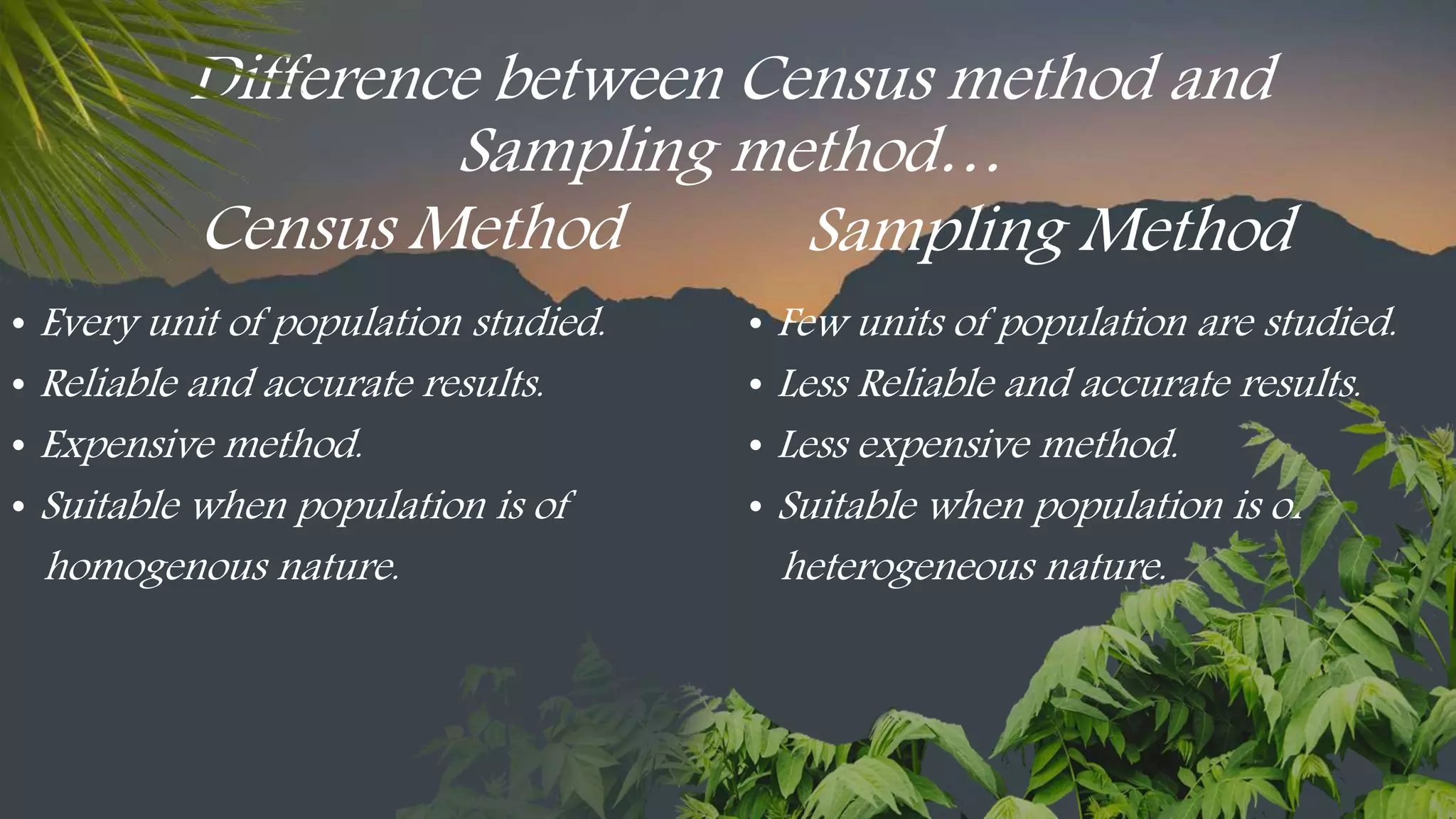
Difference between Census method and
Sampling method…
Census Method
• Every unit of population studied.
• Reliable and accurate results.
• Expensive method.
• Suitable when population is of
homogenous nature.
Sampling Method
• Few units of population are studied.
• Less Reliable and accurate results.
• Less expensive method.
• Suitable when population is of
heterogeneous nature.
Types of
Sampling
Random
Sampling
Unrestricted
Random
Sampling
Restricted
Random
Sampling
Non-Random
Sampling
Random Sampling
When every item of the population or universe can have an equal
chance (equal opportunity) of being selected in sample, it is
known as random sampling. In other words under this method,
sample from universe is taken at random. It is also known as
“Probability Sampling” or “Representative Sampling”. Personal
interests or bias of investigator does not affect the selection of the
sample. There are two methods under Random Sampling:-
(a) Simple or Unrestricted Sampling.
(b) Restricted Random Sampling.
Non- Random Sampling
In a non- random sampling method, all the units or
items of the universe do not have an equal chance of
being selected and convenience or judgement of the
investigator or enumerator plays an important role in
the selection of items in the sample. Samples are
selected on the basis of judgement, purpose,
convenience or quota.
Sampling and Non-Sampling Errors
Sampling Errors
Sampling errors refers to the
difference between the sample
estimated and the actual value of
characteristics of the population
or universe. It is error that occurs
when we make an observation
from the population. The
difference between the actual
value of a parameter of the
population and its estimate is the
sampling error. The magnitude of
sampling error can be reduce by
taking a large sample from the
Non-Sampling Errors
These errors can occur in any type
of survey whether it be a census or
sample survey. Non-sampling
errors are more serious than
sampling errors. Some of the non-
sampling errors are as follows:-
• Errors in Data Acquisition
• Non-Response Errors
• Sampling Bias
• Measurement Errors
The End…
Thank you…
Sub.-Statistics {Eco.}
Made By- Arjun Kumar

Economice (collection of data)

  • 1.
    NAME – ARJUNKUMAR CLASS – XI Com. ROLL No. - 18 SUBJECT – ECONOMICS TOPIC - COLLECTION OF DATA SCHOOL – K.V. No.2 BHUJ
  • 2.
    Data: – Informationwhich can be expressed in numbers. Two sources of data: – Primary & Secondary. Primary Data. The data which is collected for the first time by investigators or enumerators to serve a specific purpose is called Primary data. They are based on first-hand information. In other words such a data is of original in nature. The sources from where these data can be collected are known as Sources. Secondary Data. The data which is originally collected and published by the authorities other than who require it or the data which is obtained from published or unpublished sources is called Secondary data. Such data is already available in some government publications, research study, journals or newspaper etc.
  • 3.
    Sources of Collectionof Primary Data:  Direct Personal Interview  Indirect Oral Investigation  Information from correspondents  Mailed questionnaire  Questionnaire filled by enumerators  Telephonic interviews
  • 4.
    Direct Personal Investigation Underthis method, investigators personally visit respondents, ask them questions pertaining to the enquiry and collect the desired information. In other words it is a method by which data are personally collected by the investigator from the respondents or informants. The investigator establishes direct relation with a person from whom the information is to be obtained. Advantages… 1. Highest response rate 2. Allows all types of questions 3. Allows clearing doubts regarding questions Disadvantages… 1. Most expensive 2. Informants can be influenced 3. Takes more time
  • 5.
    Indirect Oral Investigation Underthis method, investigator collect data by contracting with the third party or informants who are supposed to possess the information on the problem under investigation. In other words the data will be collected from those persons who may possess some knowledge about the investigation. Such persons are known as “Witnesses”. Advantage… Disadvantage… 1. Less Expensive 1. Lack of Accuracy 2. Experts Opinion 2. Lack of Uniformity 3. Wide Coverage 3. Lack of Reliability
  • 6.
    Telephonic interviews In atelephone interview the investigator asks questions over the telephone. The investigator instead of presenting himself before the informants contacts them via telephone and collects the desired information. Advantages… Disadvantages… 1) Relatively low cost 1) Limited use 2) Relatively high response rate 2) Reactions cannot be watched 3) Less influence on informants 3) Respondents can be influenced
  • 7.
    Information from correspondents Accordingto this method, the correspondents or local agencies in different regions collect the required information in their own way and subsequently submit their reports or transmit the information to the central office where data are processed and finally analyzed. When the information is to be collected regularly on a timely basis (daily, weekly or monthly) correspondents may be posted at various places. This method is usually adopted by newspaper agencies that require political information in areas like sports, economic trends, share markets, law and order etc.
  • 8.
    Mailed questionnaire Under thismethod, a well-designed questionnaire is mailed to the informants with a request to fill it up and return the same within the specific time schedule. It is pointed out in the covering letter to the correspondents that information supplied by them in the questionnaire will be kept secretly confidential. In the prevalent knowledge based environment, an investigator may e-mail the questionnaire to target group of respondents and can mobilize the desired information subject to certain conditions. The success of this method is based on the ability to design the questionnaire, knowledge of the respondents and their response to questionnaire.
  • 9.
    Questionnaire filled byenumerators Under this method, a well-designed questionnaire is mailed to the informants with a request to fill it up and return the same within the specific time schedule. It is pointed out in the covering letter to the correspondents that information supplied by them in the questionnaire will be kept secretly confidential. In the prevalent knowledge based environment, an investigator may e-mail the questionnaire to target group of respondents and can mobilize the desired information subject to certain conditions. The success of this method is based on the ability to design the questionnaire, knowledge of the respondents and their response to questionnaire.
  • 10.
    The two popularapproaches used by the statistician... • A survey, which includes every element of the population, is known as census or method of complete enumeration. In other words when data are collected for each and every unit of the investigation, it is called census method. Sampling Method • Sampling investigation refers to the process of learning about the population on the basis of sample drawn from it. In sampling method instead of every items of the universe only a part of the universe is studied and conclusions are drawn on the same basis for entire universe. Census Method
  • 11.
    Difference between Censusmethod and Sampling method… Census Method • Every unit of population studied. • Reliable and accurate results. • Expensive method. • Suitable when population is of homogenous nature. Sampling Method • Few units of population are studied. • Less Reliable and accurate results. • Less expensive method. • Suitable when population is of heterogeneous nature.
  • 12.
  • 13.
    Random Sampling When everyitem of the population or universe can have an equal chance (equal opportunity) of being selected in sample, it is known as random sampling. In other words under this method, sample from universe is taken at random. It is also known as “Probability Sampling” or “Representative Sampling”. Personal interests or bias of investigator does not affect the selection of the sample. There are two methods under Random Sampling:- (a) Simple or Unrestricted Sampling. (b) Restricted Random Sampling.
  • 14.
    Non- Random Sampling Ina non- random sampling method, all the units or items of the universe do not have an equal chance of being selected and convenience or judgement of the investigator or enumerator plays an important role in the selection of items in the sample. Samples are selected on the basis of judgement, purpose, convenience or quota.
  • 15.
    Sampling and Non-SamplingErrors Sampling Errors Sampling errors refers to the difference between the sample estimated and the actual value of characteristics of the population or universe. It is error that occurs when we make an observation from the population. The difference between the actual value of a parameter of the population and its estimate is the sampling error. The magnitude of sampling error can be reduce by taking a large sample from the Non-Sampling Errors These errors can occur in any type of survey whether it be a census or sample survey. Non-sampling errors are more serious than sampling errors. Some of the non- sampling errors are as follows:- • Errors in Data Acquisition • Non-Response Errors • Sampling Bias • Measurement Errors
  • 16.
    The End… Thank you… Sub.-Statistics{Eco.} Made By- Arjun Kumar