Dynamics of Rotational Motion
The main problem of dynamics: How a net force affects
(i) translational (linear) motion (Newtons’ 2nd
law)
(ii) rotational motion ???
(iii) combination of translational
and rotational motions ???
amF

=⇒
m F

αz
Axis of
rotation
a

Level arm l is the distance between the
line of action and the axis of rotation,
measured on a line that is to both.⊥
Definition of torque: Fr

×=τ
A torque applied to a door
Units: [ τ ] = newton·meter = N·m
τz > 0 if the force acts counterclockwise
τz < 0 if the force acts clockwise
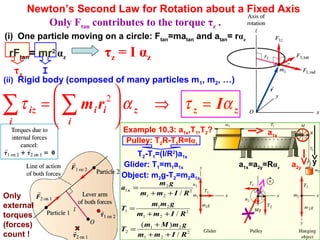
Newton’s Second Law for Rotation about a Fixed Axis
(i) One particle moving on a circle: Ftan=matan and atan= rαz
rFtan= mr2
αz τz = I αz
Only Ftan contributes to the torque τz .
τz I
(ii) Rigid body (composed of many particles m1, m2, …)
zzz
i i
iiiz Irm ατατ =⇒





=∑ ∑ 2
Only
external
torques
(forces)
count !
Example 10.3: a1x,T1,T2? a1x
a2y
y
Pulley: T2R-T1R=Iαz
a1x=a2y=Rαz
X
T2-T1=(I/R2
)a1x
Glider: T1=m1a1x
Object: m2g-T2=m2a1x
2
21
21
2
2
21
21
1
2
21
2
1
/
)(
/
/
RImm
gmMm
T
RImm
gmm
T
RImm
gm
a x
++
+
=
++
=
++
=
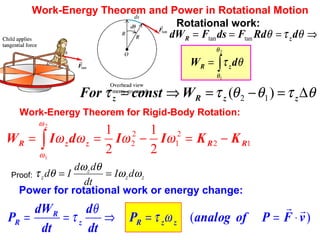
Work-Energy Theorem and Power in Rotational Motion
Rotational work:
∫=
⇒===
2
1
tantan
θ
θ
θτ
θτθ
dW
dRdFdsFdW
zR
zR
θτθθττ ∆=−=⇒= zzRz WconstFor )( 12
Work-Energy Theorem for Rigid-Body Rotation:
12
2
1
2
2
2
1
2
1
2
1
RRzzR KKIIdIW −=−== ∫
ω
ω
ωωωω
Power for rotational work or energy change:
)( vFPofganaloP
dt
d
dt
dW
P zzRz
R
R

⋅==⇒== ωτ
θ
τ
zz
z
z dI
dt
dd
Id ωω
θω
θτ ==Proof:
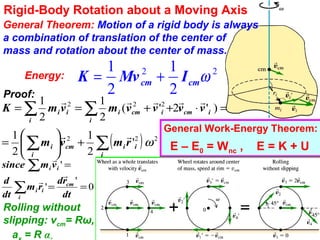
Rigid-Body Rotation about a Moving Axis
22
2
1
2
1
ωcmcm IMvK +=
Proof:
General Theorem: Motion of a rigid body is always
a combination of translation of the center of
mass and rotation about the center of mass.
( )∑∑
∑ ∑
+





=
=⋅++==
i
iicm
i
i
icm
i i
icmiii
rmvm
vvvvmvmK
222
222
'
2
1
2
1
)'2'(
2
1
2
1
ω


Rolling without
slipping: vcm= Rω,
a = R α
Energy:
General Work-Energy Theorem:
E – E0 = Wnc , E = K + U
∑
∑
==
=
i
cm
ii
ii
dt
rd
rm
dt
d
vmncesi
0
'
'
'



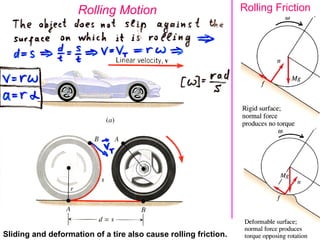
Rolling Motion Rolling Friction
Sliding and deformation of a tire also cause rolling friction.
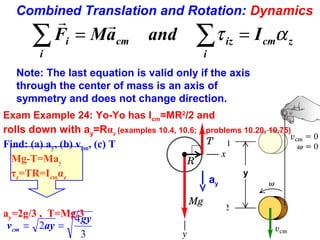
Combined Translation and Rotation: Dynamics
∑∑ ==
i
zcmiz
i
cmi IandaMF ατ

Note: The last equation is valid only if the axis
through the center of mass is an axis of
symmetry and does not change direction.
Exam Example 24: Yo-Yo has Icm=MR2
/2 and
rolls down with ay=Rαz (examples 10.4, 10.6; problems 10.20, 10.75)
Find: (a) ay, (b) vcm, (c) T
Mg-T=May
τz=TR=Icmαz
ay=2g/3 , T=Mg/3
ay
3
4
2
gy
ayvcm ==
y
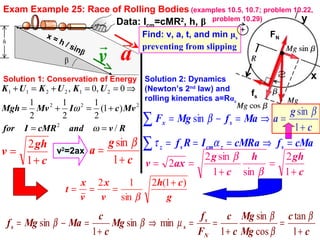
Exam Example 25: Race of Rolling Bodies (examples 10.5, 10.7; problem 10.22,
problem 10.29)
β v

a

Data: Icm=cMR2
, h, β
Find: v, a, t, and min μs
preventing from slipping
y
xSolution 1: Conservation of Energy Solution 2: Dynamics
(Newton’s 2nd
law) and
rolling kinematics a=Rαz
RvandcMRIfor
MvcIMvMgh
UKUKUK
/
)1(
2
1
2
1
2
1
0,0,
2
222
212211
==
+=+=
⇒==+=+
ω
ω
c
gh
v
+
=
1
2
x = h / sinβ
v2
=2ax
c
g
a
+
=
1
sin β
g
ch
v
x
v
x
t
)1(2
sin
12 +
===
β
fs
c
c
Mg
Mg
c
c
F
f
Mg
c
c
MaMgf
N
s
ss
+
=
+
==⇒
+
=−=
1
tan
cos
sin
1
minsin
1
sin
β
β
β
µββ
FN
∑
∑
=⇒===
+
=⇒=−=
cMafcMRaIRf
c
g
aMafMgF
szcmsz
sx
ατ
β
β
1
sin
sin
c
ghh
c
g
axv
+
=
+
==
1
2
sin1
sin2
2
β
β
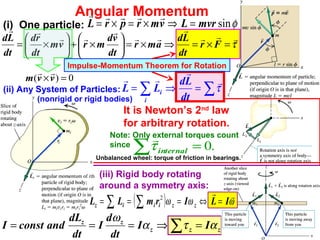
Angular Momentum
(i) One particle: φsinmvrLvmrprL =⇒×=×=

τ






=×=⇒×=





×+





×= Fr
dt
Ld
amr
dt
vd
mrvm
dt
rd
dt
Ld
0)( =×vvm

(ii) Any System of Particles: ∑ ∑=⇒=
i
i
dt
Ld
LL τ



It is Newton’s 2nd
law
for arbitrary rotation.
Note: Only external torques count
since .0∑ =ternalinτ

(iii) Rigid body rotating
around a symmetry axis:
(nonrigid or rigid bodies)
( )∑ ∑ =⇔=== ωωω

ILIrmLL zziiiz
2
Unbalanced wheel: torque of friction in bearings.
∑ =⇒=== zzz
zz
II
dt
d
I
dt
dL
andconstI ατα
ω
Impulse-Momentum Theorem for Rotation
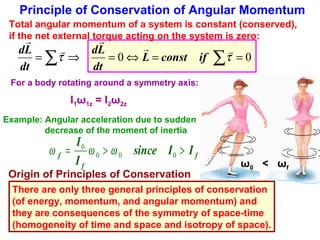
Principle of Conservation of Angular Momentum
Total angular momentum of a system is constant (conserved),
if the net external torque acting on the system is zero:
∑∑ ==⇔=⇒= 00 ττ




ifconstL
dt
Ld
dt
Ld
Example: Angular acceleration due to sudden
decrease of the moment of inertia
f
f
f IIncesi
I
I
>>= 000
0
ωωω
For a body rotating around a symmetry axis:
I1ω1z = I2ω2z
ω0 < ωf
Origin of Principles of Conservation
There are only three general principles of conservation
(of energy, momentum, and angular momentum) and
they are consequences of the symmetry of space-time
(homogeneity of time and space and isotropy of space).
I n [ 2 8 ] : = f s _ :  N I n t e g r a t e 1 S q r t 1  x  x  s  x  6  s , x , 0 , s ;
P l o t f s , 1 , s , 0 , 1 
O u t [ 2 9 ] =
0 .2 0 .4 0 .6 0 .8 1 .0
1 .0
1 .1
1 .2
Hinged board (faster than free fall)
α
h=L sinα
Mg
m Ball: 0
2
sin)/2(/22/ αgLvhtmvmgh ball ==⇒=
Board: I=(1/3)ML2
∫
∫
−−
=
−
=
−=−
≡=
−
0
0
sin
0 0
2
0
0 0
0
222
0
))(sin1(sin6
1
sinsin3
)sin(sin
3
2
)/(
322
α
α
αα
αα
α
αα
α
αω
xx
dx
t
t
d
g
L
t
L
g
dt
d
dtdMLIhh
Mg
ball
cup
cup
0sinα
ball
cup
t
t
0
0 50≈αCritical3/2
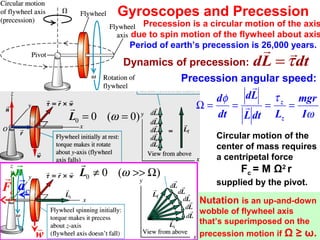
Gyroscopes and Precession
cF

ca

)0(00 == ωL

)(00 Ω>>≠ ωL

w

n

Dynamics of precession: dtLd τ

=
Precession is a circular motion of the axis
due to spin motion of the flywheel about axis
Precession angular speed:
ω
τφ
I
mgr
LdtL
Ld
dt
d
z
z
====Ω 

Circular motion of the
center of mass requires
a centripetal force
Fc = M Ω2
r
supplied by the pivot.
Nutation is an up-and-down
wobble of flywheel axis
that’s superimposed on the
precession motion if Ω ≥ ω.
Period of earth’s precession is 26,000 years.
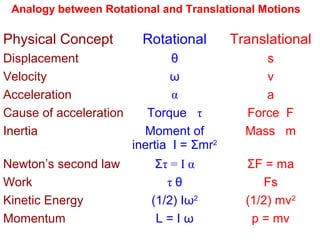
Analogy between Rotational and Translational Motions
Physical Concept Rotational Translational
Displacement θ s
Velocity ω v
Acceleration α a
Cause of acceleration Torque τ Force F
Inertia Moment of
inertia I = Σmr2
Mass m
Newton’s second law Στ = I α ΣF = ma
Work τ θ Fs
Kinetic Energy (1/2) Iω2
(1/2) mv2
Momentum L = I ω p = mv

Ch10

  • 1.
    Dynamics of RotationalMotion The main problem of dynamics: How a net force affects (i) translational (linear) motion (Newtons’ 2nd law) (ii) rotational motion ??? (iii) combination of translational and rotational motions ??? amF  =⇒ m F  αz Axis of rotation a  Level arm l is the distance between the line of action and the axis of rotation, measured on a line that is to both.⊥ Definition of torque: Fr  ×=τ A torque applied to a door Units: [ τ ] = newton·meter = N·m τz > 0 if the force acts counterclockwise τz < 0 if the force acts clockwise
  • 2.
    Newton’s Second Lawfor Rotation about a Fixed Axis (i) One particle moving on a circle: Ftan=matan and atan= rαz rFtan= mr2 αz τz = I αz Only Ftan contributes to the torque τz . τz I (ii) Rigid body (composed of many particles m1, m2, …) zzz i i iiiz Irm ατατ =⇒      =∑ ∑ 2 Only external torques (forces) count ! Example 10.3: a1x,T1,T2? a1x a2y y Pulley: T2R-T1R=Iαz a1x=a2y=Rαz X T2-T1=(I/R2 )a1x Glider: T1=m1a1x Object: m2g-T2=m2a1x 2 21 21 2 2 21 21 1 2 21 2 1 / )( / / RImm gmMm T RImm gmm T RImm gm a x ++ + = ++ = ++ =
  • 3.
    Work-Energy Theorem andPower in Rotational Motion Rotational work: ∫= ⇒=== 2 1 tantan θ θ θτ θτθ dW dRdFdsFdW zR zR θτθθττ ∆=−=⇒= zzRz WconstFor )( 12 Work-Energy Theorem for Rigid-Body Rotation: 12 2 1 2 2 2 1 2 1 2 1 RRzzR KKIIdIW −=−== ∫ ω ω ωωωω Power for rotational work or energy change: )( vFPofganaloP dt d dt dW P zzRz R R  ⋅==⇒== ωτ θ τ zz z z dI dt dd Id ωω θω θτ ==Proof:
  • 4.
    Rigid-Body Rotation abouta Moving Axis 22 2 1 2 1 ωcmcm IMvK += Proof: General Theorem: Motion of a rigid body is always a combination of translation of the center of mass and rotation about the center of mass. ( )∑∑ ∑ ∑ +      = =⋅++== i iicm i i icm i i icmiii rmvm vvvvmvmK 222 222 ' 2 1 2 1 )'2'( 2 1 2 1 ω   Rolling without slipping: vcm= Rω, a = R α Energy: General Work-Energy Theorem: E – E0 = Wnc , E = K + U ∑ ∑ == = i cm ii ii dt rd rm dt d vmncesi 0 ' ' '   
  • 5.
    Rolling Motion RollingFriction Sliding and deformation of a tire also cause rolling friction.
  • 6.
    Combined Translation andRotation: Dynamics ∑∑ == i zcmiz i cmi IandaMF ατ  Note: The last equation is valid only if the axis through the center of mass is an axis of symmetry and does not change direction. Exam Example 24: Yo-Yo has Icm=MR2 /2 and rolls down with ay=Rαz (examples 10.4, 10.6; problems 10.20, 10.75) Find: (a) ay, (b) vcm, (c) T Mg-T=May τz=TR=Icmαz ay=2g/3 , T=Mg/3 ay 3 4 2 gy ayvcm == y
  • 7.
    Exam Example 25:Race of Rolling Bodies (examples 10.5, 10.7; problem 10.22, problem 10.29) β v  a  Data: Icm=cMR2 , h, β Find: v, a, t, and min μs preventing from slipping y xSolution 1: Conservation of Energy Solution 2: Dynamics (Newton’s 2nd law) and rolling kinematics a=Rαz RvandcMRIfor MvcIMvMgh UKUKUK / )1( 2 1 2 1 2 1 0,0, 2 222 212211 == +=+= ⇒==+=+ ω ω c gh v + = 1 2 x = h / sinβ v2 =2ax c g a + = 1 sin β g ch v x v x t )1(2 sin 12 + === β fs c c Mg Mg c c F f Mg c c MaMgf N s ss + = + ==⇒ + =−= 1 tan cos sin 1 minsin 1 sin β β β µββ FN ∑ ∑ =⇒=== + =⇒=−= cMafcMRaIRf c g aMafMgF szcmsz sx ατ β β 1 sin sin c ghh c g axv + = + == 1 2 sin1 sin2 2 β β
  • 8.
    Angular Momentum (i) Oneparticle: φsinmvrLvmrprL =⇒×=×=  τ       =×=⇒×=      ×+      ×= Fr dt Ld amr dt vd mrvm dt rd dt Ld 0)( =×vvm  (ii) Any System of Particles: ∑ ∑=⇒= i i dt Ld LL τ    It is Newton’s 2nd law for arbitrary rotation. Note: Only external torques count since .0∑ =ternalinτ  (iii) Rigid body rotating around a symmetry axis: (nonrigid or rigid bodies) ( )∑ ∑ =⇔=== ωωω  ILIrmLL zziiiz 2 Unbalanced wheel: torque of friction in bearings. ∑ =⇒=== zzz zz II dt d I dt dL andconstI ατα ω Impulse-Momentum Theorem for Rotation
  • 9.
    Principle of Conservationof Angular Momentum Total angular momentum of a system is constant (conserved), if the net external torque acting on the system is zero: ∑∑ ==⇔=⇒= 00 ττ     ifconstL dt Ld dt Ld Example: Angular acceleration due to sudden decrease of the moment of inertia f f f IIncesi I I >>= 000 0 ωωω For a body rotating around a symmetry axis: I1ω1z = I2ω2z ω0 < ωf Origin of Principles of Conservation There are only three general principles of conservation (of energy, momentum, and angular momentum) and they are consequences of the symmetry of space-time (homogeneity of time and space and isotropy of space).
  • 10.
    I n [2 8 ] : = f s _ :  N I n t e g r a t e 1 S q r t 1  x  x  s  x  6  s , x , 0 , s ; P l o t f s , 1 , s , 0 , 1  O u t [ 2 9 ] = 0 .2 0 .4 0 .6 0 .8 1 .0 1 .0 1 .1 1 .2 Hinged board (faster than free fall) α h=L sinα Mg m Ball: 0 2 sin)/2(/22/ αgLvhtmvmgh ball ==⇒= Board: I=(1/3)ML2 ∫ ∫ −− = − = −=− ≡= − 0 0 sin 0 0 2 0 0 0 0 222 0 ))(sin1(sin6 1 sinsin3 )sin(sin 3 2 )/( 322 α α αα αα α αα α αω xx dx t t d g L t L g dt d dtdMLIhh Mg ball cup cup 0sinα ball cup t t 0 0 50≈αCritical3/2
  • 11.
    Gyroscopes and Precession cF  ca  )0(00== ωL  )(00 Ω>>≠ ωL  w  n  Dynamics of precession: dtLd τ  = Precession is a circular motion of the axis due to spin motion of the flywheel about axis Precession angular speed: ω τφ I mgr LdtL Ld dt d z z ====Ω   Circular motion of the center of mass requires a centripetal force Fc = M Ω2 r supplied by the pivot. Nutation is an up-and-down wobble of flywheel axis that’s superimposed on the precession motion if Ω ≥ ω. Period of earth’s precession is 26,000 years.
  • 12.
    Analogy between Rotationaland Translational Motions Physical Concept Rotational Translational Displacement θ s Velocity ω v Acceleration α a Cause of acceleration Torque τ Force F Inertia Moment of inertia I = Σmr2 Mass m Newton’s second law Στ = I α ΣF = ma Work τ θ Fs Kinetic Energy (1/2) Iω2 (1/2) mv2 Momentum L = I ω p = mv