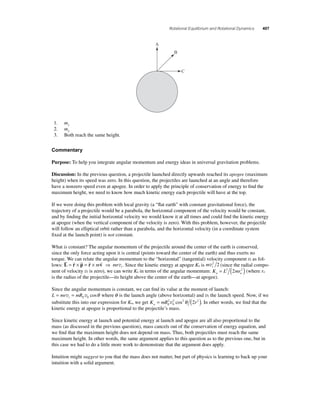
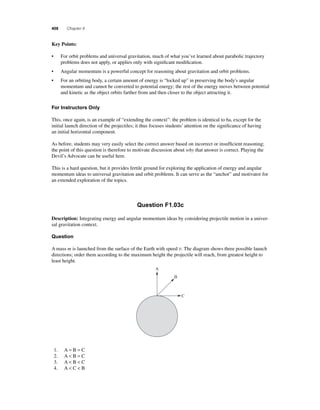
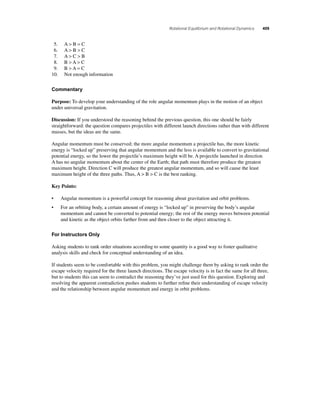
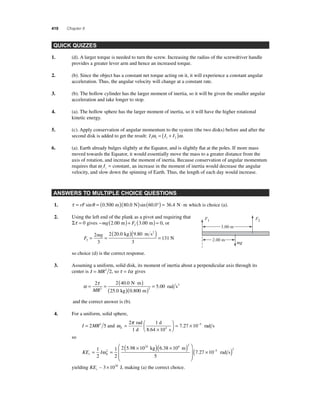
8 
Rotational Equilibrium and Rotational 
Dynamics 
CLICKER QUESTIONS 
Question E1.01 
Description: Reasoning with rotational inertia. 
Question 
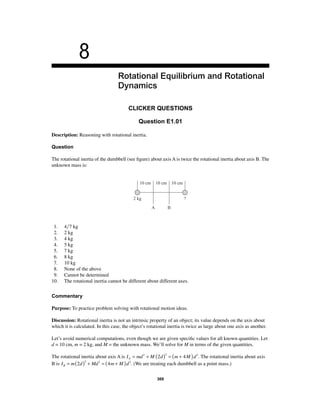
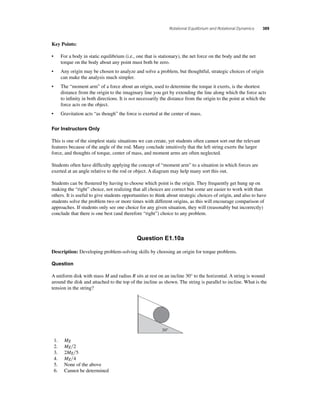
The rotational inertia of the dumbbell (see fi gure) about axis A is twice the rotational inertia about axis B. The 
unknown mass is: 
10 cm 10 cm 10 cm 
A B 
2 kg 
? 
1. 47 kg 
2. 2 kg 
3. 4 kg 
4. 5 kg 
5. 7 kg 
6. 8 kg 
7. 10 kg 
8. None of the above 
9. Cannot be determined 
10. The rotational inertia cannot be different about different axes. 
Commentary 
Purpose: To practice problem solving with rotational motion ideas. 
Discussion: Rotational inertia is not an intrinsic property of an object; its value depends on the axis about 
which it is calculated. In this case, the object’s rotational inertia is twice as large about one axis as another. 
Let’s avoid numerical computations, even though we are given specifi c values for all known quantities. Let 
d = 10 cm, m = 2 kg, and M = the unknown mass. We’ll solve for M in terms of the given quantities. 
The rotational inertia about axis A is IA = md2 + M (2d)2 = (m + 4M)d2. The rotational inertia about axis 
B is I m d Md m M d B = (2 ) + = (4 + ) 2 2 2. (We are treating each dumbbell as a point mass.) 
369
370 Chapter 8 
W e are told that the rotational inertia about axis A is twice as large as that about axis B (IA = 2IB), 
so m + 4M = 2(4m + M ). (Note that d has cancelled out, and does not affect the answer.) Therefore, 
M = 72 m. Since m = 2 kg, M = 7 kg. 
Key Points: 
• An object's rotational inertia (“moment of inertia”) depends on the axis you choose to calculate it 
about. 
• The rotational of inertia of a point-like object about an axis is md2, where m is the object’s mass and d 
is its distance from the axis. 
• The rotational of inertia of an object composed of multiple subobjects is just the sum of their individual 
rotational inertias (about the same axis). 
• Avoid putting numbers into calculations until the very end. Instead, defi ne variables and work with 
those. (Often, some will cancel out, simplifying your calculations.) 
For Instructors Only 
Students can get bogged down in unnecessary calculations and computations. This problem presents a good 
opportunity to discuss problem solving procedures. 
Many students will translate the given relationship between rotational inertias incorrectly, and will interpret 
“The rotational inertia . . . about axis A is twice the rotational inertia about axis B” as 2IA = IB. Those who do 
this will get M = 4 7 kg. (This is a well-documented error in translating verbal to algebraic representations.) 
Students should be encouraged to decide on qualitative grounds which mass is larger, so that they can check 
their answers for reasonability. 
Question E1.02a 
Description: Integrating linear and rotational dynamics ideas. 
Question 
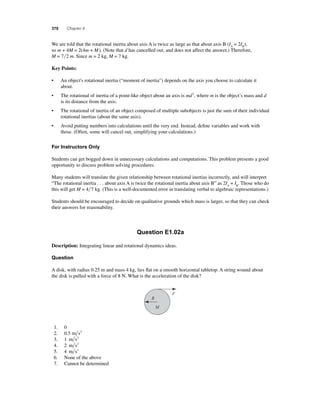
A disk, with radius 0.25 m and mass 4 kg, lies fl at on a smooth horizontal tabletop. A string wound about 
the disk is pulled with a force of 8 N. What is the acceleration of the disk? 
F 
R 
M 
1. 0 
2. 0.5 m s2 
3. 1 m s2 
4. 2 m s2 
5. 4 m s2 
6. None of the above 
7. Cannot be determined
Rotational Equilibrium and Rotational Dynamics 371 
Commentary 
Purpose: To elicit and confront the common misconception that Newton’s second law is somehow invalid 
for objects that rotate as well as translate, or for forces that are are also torques. 
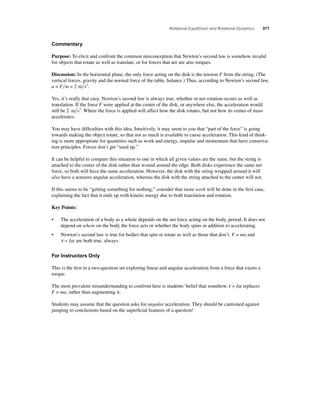
Discussion: In the horizontal plane, the only force acting on the disk is the tension F from the string. (The 
vertical forces, gravity and the normal force of the table, balance.) Thus, according to Newton’s second law, 
a = Fm = 2 m s2. 
Yes, it’s really that easy. Newton’s second law is always true, whether or not rotation occurs as well as 
translation. If the force F were applied at the center of the disk, or anywhere else, the acceleration would 
still be 2 m s2. Where the force is applied will affect how the disk rotates, but not how its center of mass 
accelerates. 
You may have diffi culties with this idea. Intuitively, it may seem to you that “part of the force” is going 
towards making the object rotate, so that not as much is available to cause acceleration. This kind of think-ing 
is more appropriate for quantities such as work and energy, impulse and momentum that have conserva-tion 
principles. Forces don’t get “used up.” 
It can be helpful to compare this situation to one in which all given values are the same, but the string is 
attached to the center of the disk rather than wound around the edge. Both disks experience the same net 
force, so both will have the same acceleration. However, the disk with the string wrapped around it will 
also have a nonzero angular acceleration, whereas the disk with the string attached to the center will not. 
If this seems to be “getting something for nothing,” consider that more work will be done in the fi rst case, 
explaining the fact that it ends up with kinetic energy due to both translation and rotation. 
Key Points: 
• The acceleration of a body as a whole depends on the net force acting on the body, period. It does not 
depend on where on the body the force acts or whether the body spins in addition to accelerating. 
• Newton’s second law is true for bodies that spin or rotate as well as those that don’t. F = ma and 
τ = Iα are both true, always. 
For Instructors Only 
This is the fi rst in a two-question set exploring linear and angular acceleration from a force that exerts a 
torque. 
The most prevalent misunderstanding to confront here is students’ belief that somehow τ = Iα replaces 
F = ma, rather than augmenting it. 
Students may assume that the question asks for angular acceleration. They should be cautioned against 
jumping to conclusions based on the superfi cial features of a question!
372 Chapter 8 
Question E1.02b 
Description: Integrating linear and rotational dynamics ideas. 
Question 
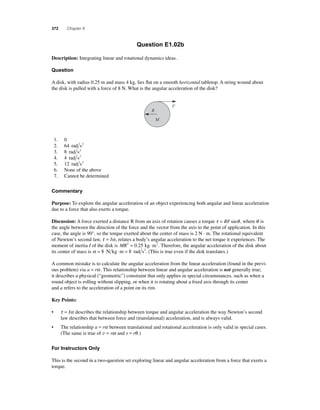
A disk, with radius 0.25 m and mass 4 kg, lies fl at on a smooth horizontal tabletop. A string wound about 
the disk is pulled with a force of 8 N. What is the angular acceleration of the disk? 
F 
R 
M 
1. 0 
2. 64 rad s2 
3. 8 rad s2 
4. 4 rad s2 
5. 12 rad s2 
6. None of the above 
7. Cannot be determined 
Commentary 
Purpose: To explore the angular acceleration of an object experiencing both angular and linear acceleration 
due to a force that also exerts a torque. 
Discussion: A force exerted a distance R from an axis of rotation causes a torque τ = RFsinθ , where θ is 
the angle between the direction of the force and the vector from the axis to the point of application. In this 
case, the angle is 90°, so the torque exerted about the center of mass is 2 N · m. The rotational equivalent 
of Newton’s second law, τ = Iα, relates a body’s angular acceleration to the net torque it experiences. The 
moment of inertia I of the disk is MR2 = 0.25 kg ⋅m2. Therefore, the angular acceleration of the disk about 
its center of mass is α = 8 N kg ⋅m = 8 rad s2. (This is true even if the disk translates.) 
A common mistake is to calculate the angular acceleration from the linear acceleration (found in the previ-ous 
problem) via a = rα . This relationship between linear and angular acceleration is not generally true; 
it describes a physical (“geometric”) constraint that only applies in special circumstances, such as when a 
round object is rolling without slipping, or when it is rotating about a fi xed axis through its center 
and a refers to the acceleration of a point on its rim. 
Key Points: 
• τ = Iα describes the relationship between torque and angular acceleration the way Newton’s second 
law describes that between force and (translational) acceleration, and is always valid. 
• The relationship a = rα between translational and rotational acceleration is only valid in special cases. 
(The same is true of v = rω and s = rθ .) 
For Instructors Only 
This is the second in a two-question set exploring linear and angular acceleration from a force that exerts a 
torque.
Rotational Equilibrium and Rotational Dynamics 373 
Some students will get the correct answer by misunderstanding the problem and thinking that the center of 
the disk is fi xed in place. The question “Is there friction at the pivot?” indicates such a misunderstanding. 
Other students will give an answer less than 8 rad s2, thinking that the translational motion somehow 
reduces the torque or its effect. 
Question E1.03a 
Description: Linking force and torque ideas in the context of mechanical advantage. 
Question 
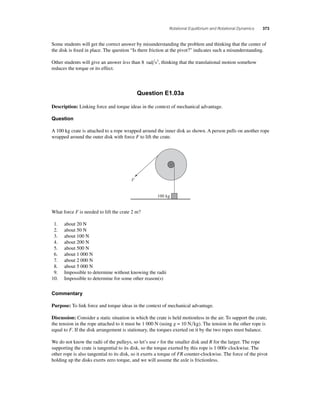
A 100 kg crate is attached to a rope wrapped around the inner disk as shown. A person pulls on another rope 
wrapped around the outer disk with force F to lift the crate. 
100 kg 
F 
What force F is needed to lift the crate 2 m? 
1. about 20 N 
2. about 50 N 
3. about 100 N 
4. about 200 N 
5. about 500 N 
6. about 1 000 N 
7. about 2 000 N 
8. about 5 000 N 
9. Impossible to determine without knowing the radii 
10. Impossible to determine for some other reason(s) 
Commentary 
Purpose: To link force and torque ideas in the context of mechanical advantage. 
Discussion: Consider a static situation in which the crate is held motionless in the air. To support the crate, 
the tension in the rope attached to it must be 1 000 N (using g = 10 Nkg). The tension in the other rope is 
equal to F. If the disk arrangement is stationary, the torques exerted on it by the two ropes must balance. 
We do not know the radii of the pulleys, so let’s use r for the smaller disk and R for the larger. The rope 
supporting the crate is tangential to its disk, so the torque exerted by this rope is 1 000r clockwise. The 
other rope is also tangential to its disk, so it exerts a torque of FR counter-clockwise. The force of the pivot 
holding up the disks exerts zero torque, and we will assume the axle is frictionless.
374 Chapter 8 
F or the torques to balance each other, FR = (1 000 N) × r , or F = (1 000 N) × r R. In other words, the 
force exerted by the person is a fraction of the weight of the crate, and the fraction depends on the ratio of 
the disk radii. 
We do not know the exact ratio rR, but we can estimate it from the diagram. It looks to be about 15, so 
the force needed is about 200 N. 
That’s the force required to hold the crate stationary in the air, or to lift or lower it with constant speed 
(no acceleration). In order to start the crate moving from rest, a slightly larger force is necessary, but it can 
be infi nitesimally larger. (If there were friction in the pivot, the force to get it moving would have to be 
enough larger to support the weight of the crate and overcome static friction.) 
The angle at which F is applied does not matter, as long as it acts tangentially to the disk. (It would, 
however, affect the force exerted on and by the pivot axle.) 
Key Points: 
• Two different forces can exert the same torque on an object. 
• “Mechanical advantage” is gained by having the applied force act farther from the pivot point than the 
force acting on the object to be move. 
• The closer to the pivot point a force acts, the larger it must be to balance other torque-causing forces. 
For Instructors Only 
This is the fi rst of two questions exploring the concepts of force, torque, work, and energy in this 
mechanical advantage situation. 
Many students may say that F is impossible to determine, either because they are not given the radii and 
don’t assume the diagram is to scale or they are not told if friction can be neglected. These are defensible 
responses. 
Other students may say that the answer is impossible to determine for another reason, such as not knowing 
the speed of the crate or the angle of the rope. These are not valid reasons. 
Some students will ignore units and treat 100 kg as the “weight,” and therefore say that F is “about 20.” 
Some will invert the ratio, thinking the applied force is 5 000 N, even though this does not agree with 
experience. 
Some students, not understanding mechanical advantage, will think that a force of 1 000 N must be applied 
to lift the crate no matter what the radii are. 
Question E1.03b 
Description: Linking force, torque, work, and energy ideas in the context of mechanical advantage. 
Question 
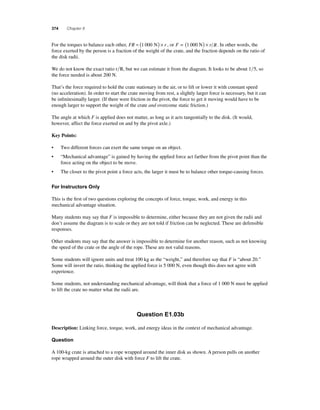
A 100-kg crate is attached to a rope wrapped around the inner disk as shown. A person pulls on another 
rope wrapped around the outer disk with force F to lift the crate.
Rotational Equilibrium and Rotational Dynamics 375 
100 kg 
F 
How much work is done by the person to lift the crate 2 m? 
1. about 400 J 
2. slightly less than 2 000 J 
3. exactly 2 000 J 
4. slightly more than 2 000 J 
5. much more than 2 000 J 
6. Impossible to determine without knowing F 
7. Impossible to determine without knowing the radii 
8. Impossible to determine without knowing the mass of the pulley 
9. Impossible to determine for two or more of the reasons given in 6, 7, and 8 above 
10. Impossible to determine for some other reason(s) 
Commentary 
Purpose: To link force, torque, work, and energy ideas in the context of mechanical advantage. 
Discussion: The only ambiguity here is whether or not to ignore frictional effects at the axle where the two 
disks are attached. If friction can be ignored, then energy conservation demands that the work done by the 
person is exactly equal to the work done on the crate, which is mg(Δy) = 2 000 J. 
If friction is not ignored, then the work done by the person must be larger than the work done on the crate. 
Note that even though the force F is much smaller than the weight of the crate, it acts through a much larger 
displacement than the crate travels. If, for example, the ratio of the disk diameters is 1 to 5, then the force 
F would be about 200 N and the displacement of the end of the rope would be about 10 m, even though the 
crate only moves up by 2 m. 
Key Points: 
• The presence of mechanical advantage in a system does not invalidate the work–energy theorem. 
• A smaller force can do as much work as a larger one if it the smaller one acts through a longer distance. 
For Instructors Only 
This is the second of two questions exploring the concepts of force, torque, work, and energy in this 
mechanical advantage situation. 
Some students will say that the work done is impossible to determine, because they are not told if friction 
can be neglected. This is a defensible response.
376 Chapter 8 
O ther students will say that it is impossible to determine for another reason, such as not knowing the speed 
of the crate, the angle of the rope, the force F, the radii of the disks, or whether the diagram is to scale. 
These are not valid responses, since none of that information is required to answer the question. 
Some students will use g = 9.8 Nkg, and get a value “slightly less than 2 000 J.” 
Students who are including friction are likely to choose “slightly more than 2 000 J,” perhaps assuming that 
friction is small. If the coeffi cient of friction is large enough, a valid response would be “much more than 
2 000 J,” though students might choose this response for other reasons as well. 
Question E1.04a 
Description: Reasoning and problem solving with linear and rotational forms of Newtons’ laws in the 
context of rolling without slipping. 
Question 
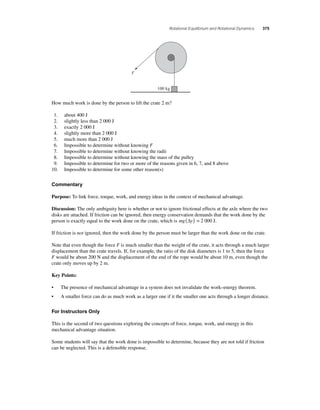
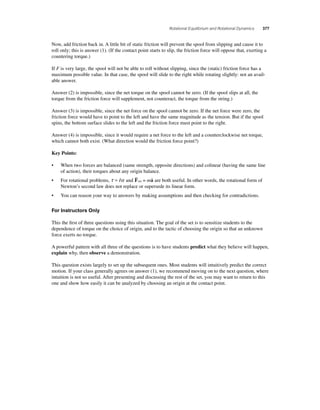
A spool has string wrapped around its center axle and is sitting on a horizontal surface. If the string is 
pulled in the horizontal direction when tangent to the top of the axle, the spool will: 
F 
1. Roll to the right 
2. Not roll, only slide to the right 
3. Spin and slip, without moving left or right 
4. Roll to the left 
5. None of the above 
6. The motion cannot be determined. 
Commentary 
Purpose: To reason about a rotational system using the linear and rotational forms of Newton’s second law. 
Discussion: There are four forces on the spool: (1) gravitation, down; (2) normal, up; (3) tension, right; and 
(4) friction, left or right. Gravitation is balanced by the normal force, and their torques balance about any 
origin. We don’t know yet which direction friction will point. 
First, imagine that the surface is frictionless. The net force is then due exclusively to the tension, producing 
an acceleration to the right. The net torque about the spool’s center is also due exclusively to the tension, 
producing a clockwise angular acceleration. The spool will start to move to the right and also rotate clock-wise. 
It will be rolling to the right, and perhaps slipping at the same time. (An object only rolls without 
slipping when its rate of rotation and translation are just right so the contact point has zero velocity.)
Rotational Equilibrium and Rotational Dynamics 377 
Now, add friction back in. A little bit of static friction will prevent the spool from slipping and cause it to 
roll only; this is answer (1). (If the contact point starts to slip, the friction force will oppose that, exerting a 
countering torque.) 
If F is very large, the spool will not be able to roll without slipping, since the (static) friction force has a 
maximum possible value. In that case, the spool will slide to the right while rotating slightly: not an avail-able 
answer. 
Answer (2) is impossible, since the net torque on the spool cannot be zero. (If the spool slips at all, the 
torque from the friction force will supplement, not counteract, the torque from the string.) 
Answer (3) is impossible, since the net force on the spool cannot be zero. If the net force were zero, the 
friction force would have to point to the left and have the same magnitude as the tension. But if the spool 
spins, the bottom surface slides to the left and the friction force must point to the right. 
Answer (4) is impossible, since it would require a net force to the left and a counterclockwise net torque, 
which cannot both exist. (What direction would the friction force point?) 
Key Points: 
• When two forces are balanced (same strength, opposite directions) and colinear (having the same line 
of action), their torques about any origin balance. 
• For rotational problems, τ α = I and F  
net = ma  
are both useful. In other words, the rotational form of 
Newton’s second law does not replace or supersede its linear form. 
• You can reason your way to answers by making assumptions and then checking for contradictions. 
For Instructors Only 
This the fi rst of three questions using this situation. The goal of the set is to sensitize students to the 
dependence of torque on the choice of origin, and to the tactic of choosing the origin so that an unknown 
force exerts no torque. 
A powerful pattern with all three of the questions is to have students predict what they believe will happen, 
explain why, then observe a demonstration. 
This question exists largely to set up the subsequent ones. Most students will intuitively predict the correct 
motion. If your class generally agrees on answer (1), we recommend moving on to the next question, where 
intuition is not so useful. After presenting and discussing the rest of the set, you may want to return to this 
one and show how easily it can be analyzed by choosing an origin at the contact point.
378 Chapter 8 
Question E1.04b 
Description: Reasoning and problem solving with linear and rotational forms of Newton’s laws in the 
context of rolling without slipping. 
Question 
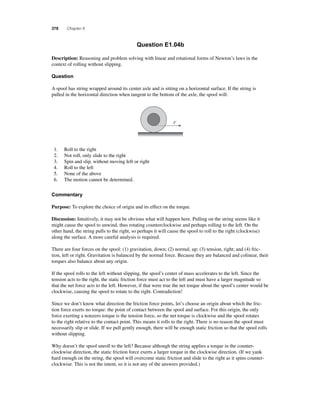
A spool has string wrapped around its center axle and is sitting on a horizontal surface. If the string is 
pulled in the horizontal direction when tangent to the bottom of the axle, the spool will: 
F 
1. Roll to the right 
2. Not roll, only slide to the right 
3. Spin and slip, without moving left or right 
4. Roll to the left 
5. None of the above 
6. The motion cannot be determined. 
Commentary 
Purpose: To explore the choice of origin and its effect on the torque. 
Discussion: Intuitively, it may not be obvious what will happen here. Pulling on the string seems like it 
might cause the spool to unwind, thus rotating counterclockwise and perhaps rolling to the left. On the 
other hand, the string pulls to the right, so perhaps it will cause the spool to roll to the right (clockwise) 
along the surface. A more careful analysis is required. 
There are four forces on the spool: (1) gravitation, down; (2) normal, up; (3) tension, right; and (4) fric-tion, 
left or right. Gravitation is balanced by the normal force. Because they are balanced and colinear, their 
torques also balance about any origin. 
If the spool rolls to the left without slipping, the spool’s center of mass accelerates to the left. Since the 
tension acts to the right, the static friction force must act to the left and must have a larger magnitude so 
that the net force acts to the left. However, if that were true the net torque about the spool’s center would be 
clockwise, causing the spool to rotate to the right. Contradiction! 
Since we don’t know what direction the friction force points, let’s choose an origin about which the fric-tion 
force exerts no torque: the point of contact between the spool and surface. For this origin, the only 
force exerting a nonzero torque is the tension force, so the net torque is clockwise and the spool rotates 
to the right relative to the contact point. This means it rolls to the right. There is no reason the spool must 
necessarily slip or slide. If we pull gently enough, there will be enough static friction so that the spool rolls 
without slipping. 
Why doesn’t the spool unroll to the left? Because although the string applies a torque in the counter-clockwise 
direction, the static friction force exerts a larger torque in the clockwise direction. (If we yank 
hard enough on the string, the spool will overcome static friction and slide to the right as it spins counter-clockwise. 
This is not the intent, so it is not any of the answers provided.)
Rotational Equilibrium and Rotational Dynamics 379 
Key Points: 
• By choosing your origin carefully, you can avoid dealing with torques due to an unknown force. 
• The torque exerted by a force depends on the origin you calculate it about. 
• You do not need to choose the center of the object as the origin. 
• τ α = I is true, valid, and useful in addition to, not instead of, F  
= ma  
. In other words, Newton’s second 
law in its rotational form does not replace or supersede Newton’s second law in its linear form. Both 
are valid and useful, and often both are needed to analyze a situation. 
For Instructors Only 
This the second of three questions using this situation. The goal of the set is to sensitize students to the 
dependence of torque on the choice of origin, and also to the strategic choice of origin to resolve confl ict 
or inconsistency. A powerful pattern with all three of the questions is to have students predict what they 
believe will happen, explain why, then observe a demonstration (the predict and observe instructional 
tactic). As a whole, the set also demonstrates the compare and contrast tactic by varying only one feature 
from question to question. 
This is a counterintuitive situation. Most students will have a strong intuitive belief that the spool should 
unroll to the left, and the demonstration will intrigue and motivate them. It is important, however, to collect 
explanations without comment, since most will be faulty in some way, and then show the demonstration. 
You can explain the result after you have shown the demonstration. Students will have great diffi culty 
believing you if you discuss the situation before doing the demonstration. 
During the demonstration, only a gentle tug on the string is needed to cause the spool to roll to the right. 
Students might think that you will pull hard, which means it will move to the right while unwinding 
counterclockwise. This is not the intent, so they will need to answer “None of the above.” 
Most students automatically use the center of the spool as the default origin. They might not realize that 
they can place the origin anywhere they want. 
Students often abandon the linear form of Newton’s second law when they start learning its rotational form. 
They often think that the rotational form supersedes andor replaces the linear form. They are often not 
given suffi cient opportunities to see that sometimes both are needed, and that the two relationships are com-pletely 
separate and independent. Students also often do not realize or fully appreciate that the rotational 
form is actually an infi nite number of relationships, one for every possible origin. (In practice, there are a 
limited number of independent relationships.) 
Even after observing the demonstration, many students will not understand how the net force can act to 
right at the same time as the net torque about the center is clockwise. The static friction force must be only 
slightly smaller than the tension force so that it can exert the larger torque about the center of the spool.
380 Chapter 8 
Question E1.04c 
Description: Reasoning and problem solving with linear and rotational forms of Newton’s laws in the 
context of rolling without slipping. 
Question 
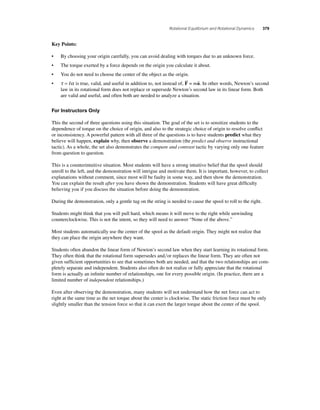
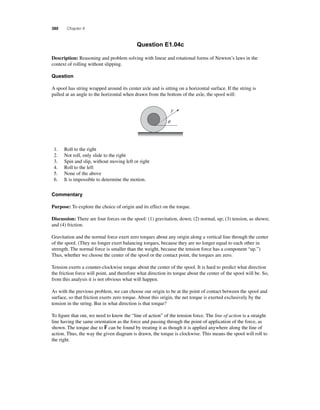
A spool has string wrapped around its center axle and is sitting on a horizontal surface. If the string is 
pulled at an angle to the horizontal when drawn from the bottom of the axle, the spool will: 
F 
q 
1. Roll to the right 
2. Not roll, only slide to the right 
3. Spin and slip, without moving left or right 
4. Roll to the left 
5. None of the above 
6. It is impossible to determine the motion. 
Commentary 
Purpose: To explore the choice of origin and its effect on the torque. 
Discussion: There are four forces on the spool: (1) gravitation, down; (2) normal, up; (3) tension, as shown; 
and (4) friction. 
Gravitation and the normal force exert zero torques about any origin along a vertical line through the center 
of the spool. (They no longer exert balancing torques, because they are no longer equal to each other in 
strength. The normal force is smaller than the weight, because the tension force has a component “up.”) 
Thus, whether we choose the center of the spool or the contact point, the torques are zero. 
Tension exerts a counter-clockwise torque about the center of the spool. It is hard to predict what direction 
the friction force will point, and therefore what direction its torque about the center of the spool will be. So, 
from this analysis it is not obvious what will happen. 
As with the previous problem, we can choose our origin to be at the point of contact between the spool and 
surface, so that friction exerts zero torque. About this origin, the net torque is exerted exclusively by the 
tension in the string. But in what direction is that torque? 
To fi gure that out, we need to know the “line of action” of the tension force. The line of action is a straight 
line having the same orientation as the force and passing through the point of application of the force, as 
shown. The torque due to F 
can be found by treating it as though it is applied anywhere along the line of 
action. Thus, the way the given diagram is drawn, the torque is clockwise. This means the spool will roll to 
the right.
Rotational Equilibrium and Rotational Dynamics 381 
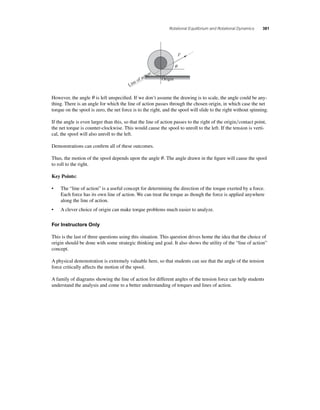
F 
q 
Origin 
Line of action 
However, the angle θ is left unspecifi ed. If we don’t assume the drawing is to scale, the angle could be any-thing. 
There is an angle for which the line of action passes through the chosen origin, in which case the net 
torque on the spool is zero, the net force is to the right, and the spool will slide to the right without spinning. 
If the angle is even larger than this, so that the line of action passes to the right of the origincontact point, 
the net torque is counter-clockwise. This would cause the spool to unroll to the left. If the tension is verti-cal, 
the spool will also unroll to the left. 
Demonstrations can confi rm all of these outcomes. 
Thus, the motion of the spool depends upon the angle θ . The angle drawn in the fi gure will cause the spool 
to roll to the right. 
Key Points: 
• The “line of action” is a useful concept for determining the direction of the torque exerted by a force. 
Each force has its own line of action. We can treat the torque as though the force is applied anywhere 
along the line of action. 
• A clever choice of origin can make torque problems much easier to analyze. 
For Instructors Only 
This is the last of three questions using this situation. This question drives home the idea that the choice of 
origin should be done with some strategic thinking and goal. It also shows the utility of the “line of action” 
concept. 
A physical demonstration is extremely valuable here, so that students can see that the angle of the tension 
force critically affects the motion of the spool. 
A family of diagrams showing the line of action for different angles of the tension force can help students 
understand the analysis and come to a better understanding of torques and lines of action.
382 Chapter 8 
Question E1.06a 
Description: Reasoning with force, energy, and torque ideas in the context of mechanical advantage. 
Question 
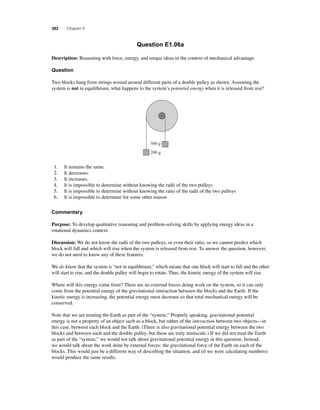
Two blocks hang from strings wound around different parts of a double pulley as shown. Assuming the 
system is not in equilibrium, what happens to the system’s potential energy when it is released from rest? 
500 g 
200 g 
1. It remains the same. 
2. It decreases. 
3. It increases. 
4. It is impossible to determine without knowing the radii of the two pulleys 
5. It is impossible to determine without knowing the ratio of the radii of the two pulleys 
6. It is impossible to determine for some other reason 
Commentary 
Purpose: To develop qualitative reasoning and problem-solving skills by applying energy ideas in a 
rotational dynamics context. 
Discussion: We do not know the radii of the two pulleys, or even their ratio, so we cannot predict which 
block will fall and which will rise when the system is released from rest. To answer the question, however, 
we do not need to know any of these features. 
We do know that the system is “not in equilibrium,” which means that one block will start to fall and the other 
will start to rise, and the double pulley will begin to rotate. Thus, the kinetic energy of the system will rise. 
Where will this energy come from? There are no external forces doing work on the system, so it can only 
come from the potential energy of the gravitational interaction between the blocks and the Earth. If the 
kinetic energy is increasing, the potential energy must decrease so that total mechanical energy will be 
conserved. 
Note that we are treating the Earth as part of the “system.” Properly speaking, gravitational potential 
energy is not a property of an object such as a block, but rather of the interaction between two objects—in 
this case, between each block and the Earth. (There is also gravitational potential energy between the two 
blocks and between each and the double pulley, but these are truly miniscule.) If we did not treat the Earth 
as part of the “system,” we would not talk about gravitational potential energy in this question. Instead, 
we would talk about the work done by external forces: the gravitational force of the Earth on each of the 
blocks. This would just be a different way of describing the situation, and (if we were calculating numbers) 
would produce the same results.
Rotational Equilibrium and Rotational Dynamics 383 
Key Points: 
• Many questions can be answered through qualitative reasoning from general principles, without 
numerical calculations or solving for anything. 
• If the kinetic energy of a system increases, then either external forces are doing positive work on the 
system, or the potential energy of an interaction among parts of the system is decreasing. 
• To be precise, we talk about the potential energy of an interaction between objects, not the potential 
energy of an object. 
For Instructors Only 
This is the fi rst of two questions on this situation. This one explores qualitative reasoning with energy 
ideas; the next is similar but applies force ideas. Although the “topics” of these two questions are conserva-tion 
of energy and forces, they are useful as broader “integrating” questions that teach students to use their 
inventory of basic physics principles for reasoning about various situations. 
The most likely stumbling block for students with this problem is that they will want to solve for the 
motion and will not be able to. That makes it a good context for teaching the value of qualitative, principle-based 
reasoning. 
Treating the diagram as a scale drawing will not help students determine which way the pulley rotates, 
since the ratio of the radii is about 2:5, the same as the ratio of the block masses. 
Question E1.06b 
Description: Reasoning with force, energy, and torque ideas in the context of mechanical advantage. 
Question 
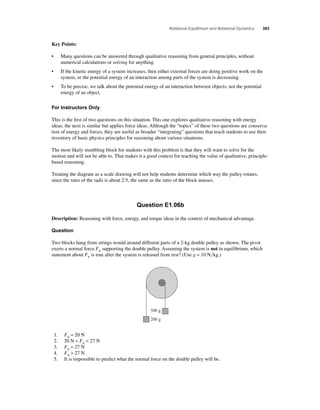
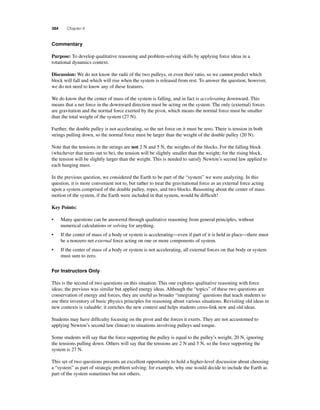
Two blocks hang from strings would around different parts of a 2-kg double pulley as shown. The pivot 
exerts a normal force FN supporting the double pulley. Assuming the system is not in equilibrium, which 
statement about FN is true after the system is released from rest? (Use g = 10 Nkg.) 
500 g 
200 g 
1. FN = 20 N 
2. 20 N  FN  27 N 
3. FN = 27 N 
4. FN  27 N 
5. It is impossible to predict what the normal force on the double pulley will be.
384 Chapter 8 
C ommentary 
Purpose: To develop qualitative reasoning and problem-solving skills by applying force ideas in a 
rotational dynamics context. 
Discussion: We do not know the radii of the two pulleys, or even their ratio, so we cannot predict which 
block will fall and which will rise when the system is released from rest. To answer the question, however, 
we do not need to know any of these features. 
We do know that the center of mass of the system is falling, and in fact is accelerating downward. This 
means that a net force in the downward direction must be acting on the system. The only (external) forces 
are gravitation and the normal force exerted by the pivot, which means the normal force must be smaller 
than the total weight of the system (27 N). 
Further, the double pulley is not accelerating, so the net force on it must be zero. There is tension in both 
strings pulling down, so the normal force must be larger than the weight of the double pulley (20 N). 
Note that the tensions in the strings are not 2 N and 5 N, the weights of the blocks. For the falling block 
(whichever that turns out to be), the tension will be slightly smaller than the weight; for the rising block, 
the tension will be slightly larger than the weight. This is needed to satisfy Newton’s second law applied to 
each hanging mass. 
In the previous question, we considered the Earth to be part of the “system” we were analyzing. In this 
question, it is more convenient not to, but rather to treat the gravitational force as an external force acting 
upon a system comprised of the double pulley, ropes, and two blocks. Reasoning about the center of mass 
motion of the system, if the Earth were included in that system, would be diffi cult! 
Key Points: 
• Many questions can be answered through qualitative reasoning from general principles, without 
numerical calculations or solving for anything. 
• If the center of mass of a body or system is accelerating—even if part of it is held in place—there must 
be a nonzero net external force acting on one or more components of system. 
• If the center of mass of a body or system is not accelerating, all external forces on that body or system 
must sum to zero. 
For Instructors Only 
This is the second of two questions on this situation. This one explores qualitative reasoning with force 
ideas; the previous was similar but applied energy ideas. Although the “topics” of these two questions are 
conservation of energy and forces, they are useful as broader “integrating” questions that teach students to 
use their inventory of basic physics principles for reasoning about various situations. Revisiting old ideas in 
new contexts is valuable: it enriches the new context and helps students cross-link new and old ideas. 
Students may have diffi culty focusing on the pivot and the forces it exerts. They are not accustomed to 
applying Newton’s second law (linear) to situations involving pulleys and torque. 
Some students will say that the force supporting the pulley is equal to the pulley’s weight, 20 N, ignoring 
the tensions pulling down. Others will say that the tensions are 2 N and 5 N, so the force supporting the 
system is 27 N. 
This set of two questions presents an excellent opportunity to hold a higher-level discussion about choosing 
a “system” as part of strategic problem solving: for example, why one would decide to include the Earth as 
part of the system sometimes but not others.
Rotational Equilibrium and Rotational Dynamics 385 
Note that treating the diagram as a scale drawing will not help students determine which mass falls and 
which rises, since the ratio of the radii is the same as the ratio of the hanging masses (2:5). 
Question E1.07 
Description: Developing problem solving skills by choosing an origin for statics problems. 
Question 
A uniform rod of length L, mass M, is suspended by two thin strings. Which of the following statements is 
true regarding the tensions in the strings? 
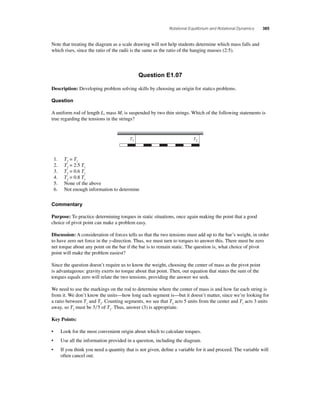
T1 T2 
1. T2 = T1 
2. T2 = 2.5 T1 
3. T2 = 0.6 T1 
4. T2 = 0.8 T1 
5. None of the above 
6. Not enough information to determine 
Commentary 
Purpose: To practice determining torques in static situations, once again making the point that a good 
choice of pivot point can make a problem easy. 
Discussion: A consideration of forces tells us that the two tensions must add up to the bar’s weight, in order 
to have zero net force in the y-direction. Thus, we must turn to torques to answer this. There must be zero 
net torque about any point on the bar if the bar is to remain static. The question is, what choice of pivot 
point will make the problem easiest? 
Since the question doesn’t require us to know the weight, choosing the center of mass as the pivot point 
is advantageous: gravity exerts no torque about that point. Then, our equation that states the sum of the 
torques equals zero will relate the two tensions, providing the answer we seek. 
We need to use the markings on the rod to determine where the center of mass is and how far each string is 
from it. We don’t know the units—how long each segment is—but it doesn’t matter, since we’re looking for 
a ratio between T1 and T2. Counting segments, we see that T2 acts 5 units from the center and T1 acts 3 units 
away, so T2 must be 35 of T1. Thus, answer (3) is appropriate. 
Key Points: 
• Look for the most convenient origin about which to calculate torques. 
• Use all the information provided in a question, including the diagram. 
• If you think you need a quantity that is not given, defi ne a variable for it and proceed. The variable will 
often cancel out.
386 Chapter 8 
F or Instructors Only 
If any students choose “Not enough information,” we suggest asking them what it is they would need to 
know to make the question answerable, and why they need it. It’s likely they want to know physical dimen-sions 
for the locations of the string. They may not realize they can count segments to fi nd relative distances, 
or they may not be comfortable working with ratios rather than actual distances. 
Question E1.08 
Description: Developing problem-solving skills by working with forces and torques in a nontrivial statics 
situation. 
Question 
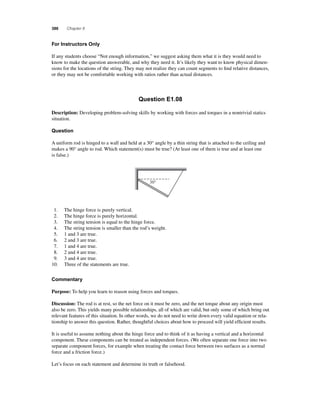
A uniform rod is hinged to a wall and held at a 30° angle by a thin string that is attached to the ceiling and 
makes a 90° angle to rod. Which statement(s) must be true? (At least one of them is true and at least one 
is false.) 
30° 
1. The hinge force is purely vertical. 
2. The hinge force is purely horizontal. 
3. The string tension is equal to the hinge force. 
4. The string tension is smaller than the rod’s weight. 
5. 1 and 3 are true. 
6. 2 and 3 are true. 
7. 1 and 4 are true. 
8. 2 and 4 are true. 
9. 3 and 4 are true. 
10. Three of the statements are true. 
Commentary 
Purpose: To help you learn to reason using forces and torques. 
Discussion: The rod is at rest, so the net force on it must be zero, and the net torque about any origin must 
also be zero. This yields many possible relationships, all of which are valid, but only some of which bring out 
relevant features of this situation. In other words, we do not need to write down every valid equation or rela-tionship 
to answer this question. Rather, thoughtful choices about how to proceed will yield effi cient results. 
It is useful to assume nothing about the hinge force and to think of it as having a vertical and a horizontal 
component. These components can be treated as independent forces. (We often separate one force into two 
separate component forces, for example when treating the contact force between two surfaces as a normal 
force and a friction force.) 
Let’s focus on each statement and determine its truth or falsehood.
Rotational Equilibrium and Rotational Dynamics 387 
The hinge force is purely vertical. This statement is false, because the net force in the horizontal direction 
must be zero. The tension force has a component pulling to the right, so the hinge must pull to the left with 
an equal force. 
The hinge force is purely horizontal. This statement is false, because the net torque about the center 
of mass must be zero. Both the tension force and the horizontal component of the hinge force exert 
counterclockwise torques about the center of mass of the rod. Therefore, the hinge must have a vertical 
component to provide a balancing clockwise torque. 
The string tension is equal to the hinge force. This statement is false, since the two forces have different 
directions, with the hinge pulling up and to the left and the tension pulling up and to the right. (It turns out 
that the two forces do have the same magnitude.) 
The string tension is smaller than the rod’s weight. This statement is true, since the net torque about the left 
end of the rod must be zero. The torque exerted by the hinge is zero (about this point), so the tension must 
balance the weight. The moment arm is larger for the tension, so the force must be smaller. 
Key Points: 
• For an object at rest, all components of the net force and the net torque about any origin are zero. 
• Strategic choices of relationships and origins can make analysis and reasoning particularly effi cient. 
• To isolate an unknown, choose an origin such that the torque due to the other unknown(s) is zero. You 
can consider the situation using several different origins if you want; τ = Iα must be true for all of 
them. 
For Instructors Only 
This question provides an excellent opportunity to explore problem-solving approaches and strategies. The 
equations are simple; fi nding the most effi cient use of those equations is more diffi cult. 
Students can be either unaware of or overwhelmed by the decision making needed to solve statics 
problems. It all looks so easy when the instructor does it, yet when students are doing homework or exams, 
it becomes impossible, largely because they have not practiced the skill of strategic thinking. 
The key to evaluating statements 1 and 2 is to focus on the other component to determine its validity. That 
is, to determine if the hinge force is purely vertical, one must fi nd out whether the horizontal component is 
zero. (Students sometimes think that hinges only exert vertical forces.) 
Some good students might fi gure out that the hinge force and the tension force have the same magnitude, 
since their horizontal components balance and their vertical components each support half the weight of 
the rod. They might not realize, however, that statement 3 is about vector equality, requiring magnitudes 
and directions to be the same. (This falls into the category of students giving the right answer to the wrong 
question.)
388 Chapter 8 
Question E1.09 
Description: Problem solving with forces and torques in a statics context. 
Question 
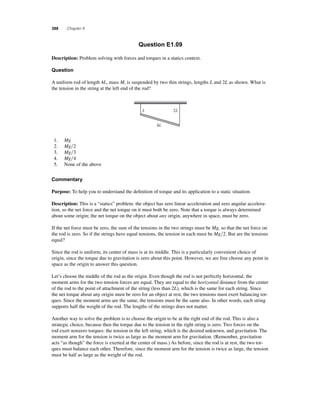
A uniform rod of length 4L, mass M, is suspended by two thin strings, lengths L and 2L as shown. What is 
the tension in the string at the left end of the rod? 
L 2L 
4L 
1. Mg 
2. Mg2 
3. Mg3 
4. Mg4 
5. None of the above 
Commentary 
Purpose: To help you to understand the defi nition of torque and its application to a static situation. 
Description: This is a “statics” problem: the object has zero linear acceleration and zero angular accelera-tion, 
so the net force and the net torque on it must both be zero. Note that a torque is always determined 
about some origin; the net torque on the object about any origin, anywhere in space, must be zero. 
If the net force must be zero, the sum of the tensions in the two strings must be Mg, so that the net force on 
the rod is zero. So if the strings have equal tensions, the tension in each must be Mg2. But are the tensions 
equal? 
Since the rod is uniform, its center of mass is at its middle. This is a particularly convenient choice of 
origin, since the torque due to gravitation is zero about this point. However, we are free choose any point in 
space as the origin to answer this question. 
Let’s choose the middle of the rod as the origin. Even though the rod is not perfectly horizontal, the 
moment arms for the two tension forces are equal. They are equal to the horizontal distance from the center 
of the rod to the point of attachment of the string (less than 2L), which is the same for each string. Since 
the net torque about any origin must be zero for an object at rest, the two tensions must exert balancing tor-ques. 
Since the moment arms are the same, the tensions must be the same also. In other words, each string 
supports half the weight of the rod. The lengths of the strings does not matter. 
Another way to solve the problem is to choose the origin to be at the right end of the rod. This is also a 
strategic choice, because then the torque due to the tension in the right string is zero. Two forces on the 
rod exert nonzero torques: the tension in the left string, which is the desired unknown, and gravitation. The 
moment arm for the tension is twice as large as the moment arm for gravitation. (Remember, gravitation 
acts “as though” the force is exerted at the center of mass.) As before, since the rod is at rest, the two tor-ques 
must balance each other. Therefore, since the moment arm for the tension is twice as large, the tension 
must be half as large as the weight of the rod.
Rotational Equilibrium and Rotational Dynamics 389 
Key Points: 
• For a body in static equilibrium (i.e., one that is stationary), the net force on the body and the net 
torque on the body about any point must both be zero. 
• Any origin may be chosen to analyze and solve a problem, but thoughtful, strategic choices of origin 
can make the analysis much simpler. 
• The “moment arm” of a force about an origin, used to determine the torque it exerts, is the shortest 
distance from the origin to the imaginary line you get by extending the line along which the force acts 
to infi nity in both directions. It is not necessarily the distance from the origin to the point at which the 
force acts on the object. 
• Gravitation acts “as though” the force is exerted at the center of mass. 
For Instructors Only 
This is one of the simplest static situations we can create, yet students often cannot sort out the relevant 
features because of the angle of the rod. Many conclude intuitively that the left string exerts the larger 
force, and thoughts of torque, center of mass, and moment arms are often neglected. 
Students often have diffi culty applying the concept of “moment arm” to a situation in which forces are 
exerted at an angle relative to the rod or object. A diagram may help many sort this out. 
Students can be fl ustered by having to choose which point is the origin. They frequently get hung up on 
making the “right” choice, not realizing that all choices are correct but some are easier to work with than 
others. It is useful to give students opportunities to think about strategic choices of origin, and also to have 
students solve the problem two or more times with different origins, as this will encourage comparison of 
approaches. If students only see one choice for any given situation, they will (reasonably but incorrectly) 
conclude that there is one best (and therefore “right”) choice to any problem. 
Question E1.10a 
Description: Developing problem-solving skills by choosing an origin for torque problems. 
Question 
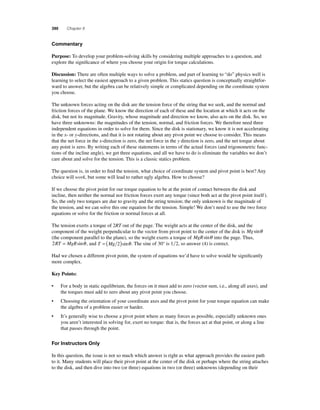
A uniform disk with mass M and radius R sits at rest on an incline 30° to the horizontal. A string is wound 
around the disk and attached to the top of the incline as shown. The string is parallel to incline. What is the 
tension in the string? 
30° 
1. Mg 
2. Mg2 
3. 2Mg5 
4. Mg4 
5. None of the above 
6. Cannot be determined
390 Chapter 8 
C ommentary 
Purpose: To develop your problem-solving skills by considering multiple approaches to a question, and 
explore the signifi cance of where you choose your origin for torque calculations. 
Discussion: There are often multiple ways to solve a problem, and part of learning to “do” physics well is 
learning to select the easiest approach to a given problem. This statics question is conceptually straightfor-ward 
to answer, but the algebra can be relatively simple or complicated depending on the coordinate system 
you choose. 
The unknown forces acting on the disk are the tension force of the string that we seek, and the normal and 
friction forces of the plane. We know the direction of each of these and the location at which it acts on the 
disk, but not its magnitude. Gravity, whose magnitude and direction we know, also acts on the disk. So, we 
have three unknowns: the magnitudes of the tension, normal, and friction forces. We therefore need three 
independent equations in order to solve for them. Since the disk is stationary, we know it is not accelerating 
in the x- or y-directions, and that it is not rotating about any pivot point we choose to consider. This means 
that the net force in the x-direction is zero, the net force in the y direction is zero, and the net torque about 
any point is zero. By writing each of these statements in terms of the actual forces (and trigonometric func-tions 
of the incline angle), we get three equations, and all we have to do is eliminate the variables we don’t 
care about and solve for the tension. This is a classic statics problem. 
The question is, in order to fi nd the tension, what choice of coordinate system and pivot point is best? Any 
choice will work, but some will lead to rather ugly algebra. How to choose? 
If we choose the pivot point for our torque equation to be at the point of contact between the disk and 
incline, then neither the normal nor friction forces exert any torque (since both act at the pivot point itself ). 
So, the only two torques are due to gravity and the string tension; the only unknown is the magnitude of 
the tension, and we can solve this one equation for the tension. Simple! We don’t need to use the two force 
equations or solve for the friction or normal forces at all. 
The tension exerts a torque of 2RT out of the page. The weight acts at the center of the disk, and the 
component of the weight perpendicular to the vector from pivot point to the center of the disk is Mgsinθ 
(the component parallel to the plane), so the weight exerts a torque of MgRsinθ into the page. Thus, 
2RT = MgRsinθ , and T = (Mg 2)sinθ . The sine of 30° is 12, so answer (4) is correct. 
Had we chosen a different pivot point, the system of equations we’d have to solve would be signifi cantly 
more complex. 
Key Points: 
• For a body in static equilibrium, the forces on it must add to zero (vector sum, i.e., along all axes), and 
the torques must add to zero about any pivot point you choose. 
• Choosing the orientation of your coordinate axes and the pivot point for your torque equation can make 
the algebra of a problem easier or harder. 
• It’s generally wise to choose a pivot point where as many forces as possible, especially unknown ones 
you aren’t interested in solving for, exert no torque: that is, the forces act at that point, or along a line 
that passes through the point. 
For Instructors Only 
In this question, the issue is not so much which answer is right as what approach provides the easiest path 
to it. Many students will place their pivot point at the center of the disk or perhaps where the string attaches 
to the disk, and then dive into two (or three) equations in two (or three) unknowns (depending on their
Rotational Equilibrium and Rotational Dynamics 391 
choice of coordinate system). When the simple solution described above is revealed during discussion, a 
good deal of forehead-smacking occurs, and the point is taken to heart. 
We fi nd that talking explicitly about problem-solving strategies and providing questions with multiple 
approaches, some clearly superior to others, helps students to become more effective, effi cient, and aware 
problem solvers. 
Question E1.10b 
Description: Developing problem-solving skills by choosing an origin for torque problems. 
Question 
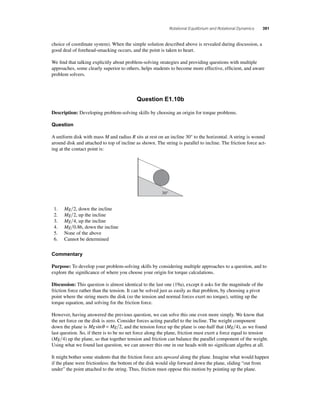
A uniform disk with mass M and radius R sits at rest on an incline 30° to the horizontal. A string is wound 
around disk and attached to top of incline as shown. The string is parallel to incline. The friction force act-ing 
at the contact point is: 
30° 
1. Mg2, down the incline 
2. Mg2, up the incline 
3. Mg4, up the incline 
4. Mg0.86, down the incline 
5. None of the above 
6. Cannot be determined 
Commentary 
Purpose: To develop your problem-solving skills by considering multiple approaches to a question, and to 
explore the signifi cance of where you choose your origin for torque calculations. 
Discussion: This question is almost identical to the last one (19a), except it asks for the magnitude of the 
friction force rather than the tension. It can be solved just as easily as that problem, by choosing a pivot 
point where the string meets the disk (so the tension and normal forces exert no torque), setting up the 
torque equation, and solving for the friction force. 
However, having answered the previous question, we can solve this one even more simply. We know that 
the net force on the disk is zero. Consider forces acting parallel to the incline. The weight component 
down the plane is Mgsinθ = Mg 2, and the tension force up the plane is one-half that (Mg4), as we found 
last question. So, if there is to be no net force along the plane, friction must exert a force equal to tension 
(Mg4) up the plane, so that together tension and friction can balance the parallel component of the weight. 
Using what we found last question, we can answer this one in our heads with no signifi cant algebra at all. 
It might bother some students that the friction force acts upward along the plane. Imagine what would happen 
if the plane were frictionless: the bottom of the disk would slip forward down the plane, sliding “out from 
under” the point attached to the string. Thus, friction must oppose this motion by pointing up the plane.
392 Chapter 8 
K ey Points: 
• Again, think carefully before diving into a calculation. You might already know enough, or be able to 
reason enough, to answer a question without getting into the algebra. “Work smarter, not harder.” 
• The moral of these questions isn’t just to choose the best pivot point for a statics problem. It’s to use all 
your information and knowledge to choose the easiest way to answer a question. 
For Instructors Only 
This question is meant to follow 19a. We suggest thoroughly discussing 19a before beginning this one. 
Some students will not have taken the point of 19a, and will once again wade into multiple equations in 
multiple unknowns. Some will have taken the specifi c moral about choosing a pivot point carefully, and 
will repeat that approach here—better, but not ideal. Few are likely to use what they found last question to 
reason the answer, as outlined above. 
We strongly suggest drawing a free-body diagram of the disk to support the argument above. Not only does 
this help some students grasp the argument, but it communicates by example that graphical representa-tions 
such as free-body diagrams are useful problem-solving tools that should be part of students’ working 
toolkit. 
Question E2.01 
Description: Developing understanding of angular momentum for linear, circular, and spinning motion. 
Question 
Which situation has the least magnitude of angular momentum about the origin? 
A. A 2-kg mass travels along the line y = 3 m with speed 1.5 ms. 
B. A 1-kg mass travels in a circle of r = 4.5 m about the origin with speed 2 ms. 
C. A disk with I = 3 kg · m2 rotates about its center (on origin) with ω = 3 rad s. 
1. A 
2. B 
3. C 
4. Both A and B 
5. Both A and C 
6. Both B and C 
7. All have the same magnitude angular momentum. 
Commentary 
Purpose: To hone your understanding of angular momentum and confront a common misconception that 
objects traveling in a straight line must have zero angular momentum. 
   = × , where r  
Discussion: The angular momentum of a point-like object is defi ned by L r p 
is the vector 
from the origin (about which angular momentum is being determined) to the object, and p is the object’s 
momentum. For a rigid object rotating about an axis, we can use this to derive an expression for the object’s 
total angular momentum: L = Iω , where I is the moment of inertia of the extended object about the rotation 
axis and ω is its angular velocity about that axis.
Rotational Equilibrium and Rotational Dynamics 393 
If we simply apply the fi rst form to situation A we fi nd that the angular momentum has a magnitude of 
9 kg ·m2 /s2. Note that an object does not need to be rotating or traveling in a curve to have nonzero angular 
momentum; it merely needs a nonzero velocity that isn’t purely radial (towards or away from the origin). 
If this bothers you, imagine that the mass in situation A strikes and sticks to a stationary disk free to rotate 
about an axis at the origin. What will happen? The disk with the mass stuck to it will begin to rotate about 
the axis. The fi nal situation clearly has nonzero angular momentum. For the principle of “conservation of 
angular momentum” to have any meaning, the initial situation—the mass moving in a straight line—must 
also have nonzero angular momentum. 
Similarly, we can apply the fi rst form to situation B to fi nd an angular momentum of 9 kg ·m2 /s2. Alterna-tively, 
we can use the second form determining the angular velocity from the speed and the circle’s circum-ference, 
and using I = mR2 as the moment of inertia of a point mass a distance R from the axis. We will get 
the same answer. 
Applying the second form to situation C also yields an angular momentum of 9 kg ·m2 /s2. Thus, the best 
answer is (7). 
Key Points: 
   = × for a point mass. 
• Angular momentum is defi ned by L r p 
• The total angular momentum of a rigid, rotating object can be determined using L = Iω. 
• A mass does not need to be rotating or spinning to have nonzero angular momentum. Translating past 
the origin a nonzero distance away is suffi cient. 
For Instructors Only 
Answer (1) is common, and reveals the prevalent misconception that objects traveling along a straight line 
have no angular momentum. 
Answer (4) reveals the less prevalent misconception that only nonpoint, rotating objects can have a nonzero 
angular momentum. 
The other incorrect answers are merely distractors. 
This is a good problem for stressing that the angular momentum of an object depends on one’s choice of 
origin. The mass moving linearly in situation A would have no angular momentum if one chose an origin 
directly along its path, rather than off to the side.
394 Chapter 8 
Question E2.02a 
Description: Exploring student thinking about rotational motion and angular momentum conservation. 
Question 
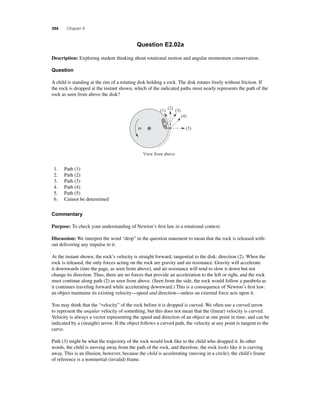
A child is standing at the rim of a rotating disk holding a rock. The disk rotates freely without friction. If 
the rock is dropped at the instant shown, which of the indicated paths most nearly represents the path of the 
rock as seen from above the disk? 
ω 
(1) (2) (3) 
View from above 
(4) 
(5) 
1. Path (1) 
2. Path (2) 
3. Path (3) 
4. Path (4) 
5. Path (5) 
6. Cannot be determined 
Commentary 
Purpose: To check your understanding of Newton’s fi rst law in a rotational context. 
Discussion: We interpret the word “drop” in the question statement to mean that the rock is released with-out 
delivering any impulse to it. 
At the instant shown, the rock’s velocity is straight forward, tangential to the disk: direction (2). When the 
rock is released, the only forces acting on the rock are gravity and air resistance. Gravity will accelerate 
it downwards (into the page, as seen from above), and air resistance will tend to slow it down but not 
change its direction. Thus, there are no forces that provide an acceleration to the left or right, and the rock 
must continue along path (2) as seen from above. (Seen from the side, the rock would follow a parabola as 
it continues traveling forward while accelerating downward.) This is a consequence of Newton’s fi rst law: 
an object maintains its existing velocity—speed and direction—unless an external force acts upon it. 
You may think that the “velocity” of the rock before it is dropped is curved. We often use a curved arrow 
to represent the angular velocity of something, but this does not mean that the (linear) velocity is curved. 
Velocity is always a vector representing the speed and direction of an object at one point in time, and can be 
indicated by a (straight) arrow. If the object follows a curved path, the velocity at any point is tangent to the 
curve. 
Path (3) might be what the trajectory of the rock would look like to the child who dropped it. In other 
words, the child is moving away from the path of the rock, and therefore, the rock looks like it is curving 
away. This is an illusion, however, because the child is accelerating (moving in a circle); the child’s frame 
of reference is a noninertial (invalid) frame.
Rotational Equilibrium and Rotational Dynamics 395 
You might think that the rock travels along path (1), that the velocity changes direction because the rock 
experiences a “centripetal acceleration,” and that this acceleration is caused by the “centripetal force.” 
Centripetal force is not a real force. Rather, it is a component of the net force. The “centripetal force” is 
whatever component points radially inward when all the actual forces, caused by interactions with other 
objects, are summed. In this situation, the only forces acting on the rock after it is released are gravity and 
air resistance, so the net force has no component in the radial direction. Thus, the “centripetal force” is zero. 
You might think that the rock travels along paths (3), (4), or (5) because it is acted upon by the “centrifugal 
force.” There is no such force. “Centrifugal force” is an illusion experienced within an accelerated 
(noninertial) reference frame. To the child, it feels like something is pulling the rock outward from her 
hand; that is the illusory centrifugal force. In reality, the rock’s inertia is just carrying it in a straight line 
according to Newton’s fi rst law, and the child must exert a force radially inward on it to make it travel in a 
circle (until she drops it). 
Key Points: 
• Newton's fi rst law says that an object travels with constant velocity unless a force acts upon it to 
change its speed andor direction. 
• An object travels along a circular path only if some interaction with another object pulls it towards the 
center of that circle; when that interaction ceases, the object stops moving in a curve and continues in a 
straight line. 
• “Centripetal force” is not a real force like tension, gravity, and the like, but is a way of talking about 
one component of the sum of all forces. 
• “Centrifugal force” is an illusion experienced in an accelerating reference frame, not a real force. 
For Instructors Only 
This is the fi rst of three questions about this situation. Later questions explore conservation of angu-lar 
momentum and energy; this question sets those up by clarifying the situation, establishing students’ 
understanding of the rock’s actual trajectory. It also provides a valuable refresher on Newton’s fi rst law and 
reveals stubborn misconceptions about circular motion. 
You may be surprised by how many misconceptions this question can reveal, and how tenaciously students 
cling to them. This question, and others integrating rotational and linear ideas, deserve extended discussion 
time. 
To stimulate productive discussion, you may wish to pose questions such as: What path would the child 
see? What is the velocity of the rock just before and just after it is dropped? What would the path of the 
rock have been if the child continued to hold it? Do you expect the path to be the same or different when 
the child drops it?
396 Chapter 8 
Question E2.02b 
Description: Exploring student thinking about rotational motion and angular momentum conservation. 
Question 
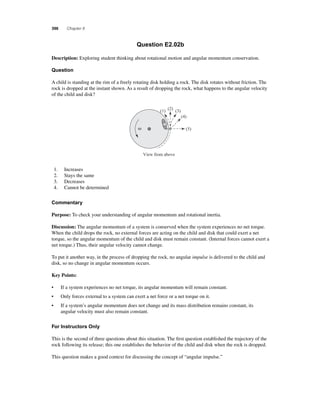
A child is standing at the rim of a freely rotating disk holding a rock. The disk rotates without friction. The 
rock is dropped at the instant shown. As a result of dropping the rock, what happens to the angular velocity 
of the child and disk? 
ω 
(1) (2) (3) 
View from above 
(4) 
(5) 
1. Increases 
2. Stays the same 
3. Decreases 
4. Cannot be determined 
Commentary 
Purpose: To check your understanding of angular momentum and rotational inertia. 
Discussion: The angular momentum of a system is conserved when the system experiences no net torque. 
When the child drops the rock, no external forces are acting on the child and disk that could exert a net 
torque, so the angular momentum of the child and disk must remain constant. (Internal forces cannot exert a 
net torque.) Thus, their angular velocity cannot change. 
To put it another way, in the process of dropping the rock, no angular impulse is delivered to the child and 
disk, so no change in angular momentum occurs. 
Key Points: 
• If a system experiences no net torque, its angular momentum will remain constant. 
• Only forces external to a system can exert a net force or a net torque on it. 
• If a system’s angular momentum does not change and its mass distribution remains constant, its 
angular velocity must also remain constant. 
For Instructors Only 
This is the second of three questions about this situation. The fi rst question established the trajectory of the 
rock following its release; this one establishes the behavior of the child and disk when the rock is dropped. 
This question makes a good context for discussing the concept of “angular impulse.”
Rotational Equilibrium and Rotational Dynamics 397 
Students may confuse themselves on this question by applying angular momentum conservation incor-rectly. 
They may, for example, believe that the angular momentum of the disk-child-rock system must be 
constant, and that the rock has no angular momentum after it is released, so the angular momentum of the 
disk and child must increase. This confusion may be addressed in the context of discussion about the next 
question in the set. 
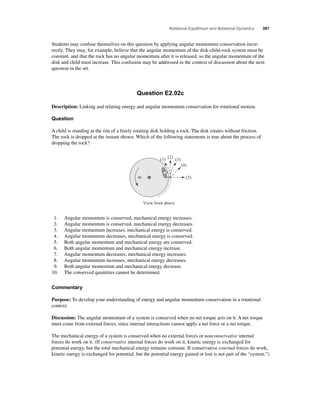
Question E2.02c 
Description: Linking and relating energy and angular momentum conservation for rotational motion. 
Question 
A child is standing at the rim of a freely rotating disk holding a rock. The disk rotates without friction. 
The rock is dropped at the instant shown. Which of the following statements is true about the process of 
dropping the rock? 
ω 
(1) (2) (3) 
View from above 
(4) 
(5) 
1. Angular momentum is conserved, mechanical energy increases. 
2. Angular momentum is conserved, mechanical energy decreases. 
3. Angular momentum increases, mechanical energy is conserved. 
4. Angular momentum decreases, mechanical energy is conserved. 
5. Both angular momentum and mechanical energy are conserved. 
6. Both angular momentum and mechanical energy increase. 
7. Angular momentum decreases, mechanical energy increases. 
8. Angular momentum increases, mechanical energy decreases. 
9. Both angular momentum and mechanical energy decrease. 
10. The conserved quantities cannot be determined. 
Commentary 
Purpose: To develop your understanding of energy and angular momentum conservation in a rotational 
context. 
Discussion: The angular momentum of a system is conserved when no net torque acts on it. A net torque 
must come from external forces, since internal interactions cannot apply a net force or a net torque. 
The mechanical energy of a system is conserved when no external forces or nonconservative internal 
forces do work on it. (If conservative internal forces do work on it, kinetic energy is exchanged for 
potential energy, but the total mechanical energy remains constant. If conservative external forces do work, 
kinetic energy is exchanged for potential, but the potential energy gained or lost is not part of the “system.”)
398 Chapter 8 
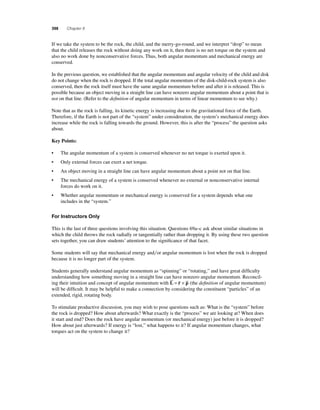
I f we take the system to be the rock, the child, and the merry-go-round, and we interpret “drop” to mean 
that the child releases the rock without doing any work on it, then there is no net torque on the system and 
also no work done by nonconservative forces. Thus, both angular momentum and mechanical energy are 
conserved. 
In the previous question, we established that the angular momentum and angular velocity of the child and disk 
do not change when the rock is dropped. If the total angular momentum of the disk-child-rock system is also 
conserved, then the rock itself must have the same angular momentum before and after it is released. This is 
possible because an object moving in a straight line can have nonzero angular momentum about a point that is 
not on that line. (Refer to the defi nition of angular momentum in terms of linear momentum to see why.) 
Note that as the rock is falling, its kinetic energy is increasing due to the gravitational force of the Earth. 
Therefore, if the Earth is not part of the “system” under consideration, the system’s mechanical energy does 
increase while the rock is falling towards the ground. However, this is after the “process” the question asks 
about. 
Key Points: 
• The angular momentum of a system is conserved whenever no net torque is exerted upon it. 
• Only external forces can exert a net torque. 
• An object moving in a straight line can have angular momentum about a point not on that line. 
• The mechanical energy of a system is conserved whenever no external or nonconservative internal 
forces do work on it. 
• Whether angular momentum or mechanical energy is conserved for a system depends what one 
includes in the “system.” 
For Instructors Only 
This is the last of three questions involving this situation. Questions 69a–c ask about similar situations in 
which the child throws the rock radially or tangentially rather than dropping it. By using these two question 
sets together, you can draw students’ attention to the signifi cance of that facet. 
Some students will say that mechanical energy andor angular momentum is lost when the rock is dropped 
because it is no longer part of the system. 
Students generally understand angular momentum as “spinning” or “rotating,” and have great diffi culty 
understanding how something moving in a straight line can have nonzero angular momentum. Reconcil-ing 
   = × (the defi nition of angular momentum) 
their intuition and concept of angular momentum with L r p 
will be diffi cult. It may be helpful to make a connection by considering the constituent “particles” of an 
extended, rigid, rotating body. 
To stimulate productive discussion, you may wish to pose questions such as: What is the “system” before 
the rock is dropped? How about afterwards? What exactly is the “process” we are looking at? When does 
it start and end? Does the rock have angular momentum (or mechanical energy) just before it is dropped? 
How about just afterwards? If energy is “lost,” what happens to it? If angular momentum changes, what 
torques act on the system to change it?
Rotational Equilibrium and Rotational Dynamics 399 
Question E2.03a 
Description: Developing understanding of angular momentum and energy in rotational motion (set-up: 
addressing velocity vector addition). 
Question 
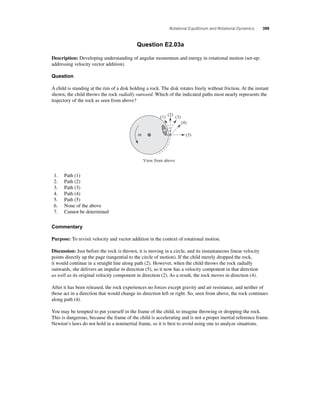
A child is standing at the rim of a disk holding a rock. The disk rotates freely without friction. At the instant 
shown, the child throws the rock radially outward. Which of the indicated paths most nearly represents the 
trajectory of the rock as seen from above? 
ω 
(1) (2) (3) 
View from above 
(4) 
(5) 
1. Path (1) 
2. Path (2) 
3. Path (3) 
4. Path (4) 
5. Path (5) 
6. None of the above 
7. Cannot be determined 
Commentary 
Purpose: To revisit velocity and vector addition in the context of rotational motion. 
Discussion: Just before the rock is thrown, it is moving in a circle, and its instantaneous linear velocity 
points directly up the page (tangential to the circle of motion). If the child merely dropped the rock, 
it would continue in a straight line along path (2). However, when the child throws the rock radially 
outwards, she delivers an impulse in direction (5), so it now has a velocity component in that direction 
as well as its original velocity component in direction (2). As a result, the rock moves in direction (4). 
After it has been released, the rock experiences no forces except gravity and air resistance, and neither of 
those act in a direction that would change its direction left or right. So, seen from above, the rock continues 
along path (4). 
You may be tempted to put yourself in the frame of the child, to imagine throwing or dropping the rock. 
This is dangerous, because the frame of the child is accelerating and is not a proper inertial reference frame. 
Newton’s laws do not hold in a noninertial frame, so it is best to avoid using one to analyze situations.
400 Chapter 8 
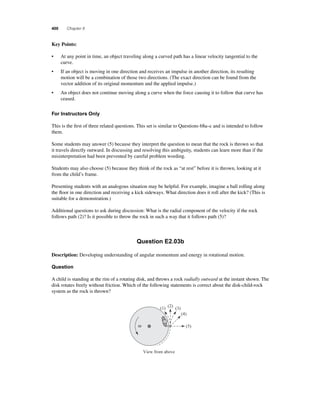
K ey Points: 
• At any point in time, an object traveling along a curved path has a linear velocity tangential to the 
curve. 
• If an object is moving in one direction and receives an impulse in another direction, its resulting 
motion will be a combination of those two directions. (The exact direction can be found from the 
vector addition of its original momentum and the applied impulse.) 
• An object does not continue moving along a curve when the force causing it to follow that curve has 
ceased. 
For Instructors Only 
This is the fi rst of three related questions. This set is similar to Questions 68a–c and is intended to follow 
them. 
Some students may answer (5) because they interpret the question to mean that the rock is thrown so that 
it travels directly outward. In discussing and resolving this ambiguity, students can learn more than if the 
misinterpretation had been prevented by careful problem wording. 
Students may also choose (5) because they think of the rock as “at rest” before it is thrown, looking at it 
from the child’s frame. 
Presenting students with an analogous situation may be helpful. For example, imagine a ball rolling along 
the fl oor in one direction and receiving a kick sideways. What direction does it roll after the kick? (This is 
suitable for a demonstration.) 
Additional questions to ask during discussion: What is the radial component of the velocity if the rock 
follows path (2)? Is it possible to throw the rock in such a way that it follows path (5)? 
Question E2.03b 
Description: Developing understanding of angular momentum and energy in rotational motion. 
Question 
A child is standing at the rim of a rotating disk, and throws a rock radially outward at the instant shown. The 
disk rotates freely without friction. Which of the following statements is correct about the disk-child-rock 
system as the rock is thrown? 
ω 
(1) (2) (3) 
View from above 
(4) 
(5)
Rotational Equilibrium and Rotational Dynamics 401 
1. Angular momentum is conserved; mechanical energy increases. 
2. Angular momentum is conserved; mechanical energy decreases. 
3. Angular momentum increases; mechanical energy is conserved. 
4. Angular momentum decreases; mechanical energy is conserved. 
5. Both angular momentum and mechanical energy are conserved. 
6. Both angular momentum and mechanical energy increase. 
7. Angular momentum decreases; mechanical energy increases. 
8. Angular momentum increases; mechanical energy decreases. 
9. Both angular momentum and mechanical energy decrease. 
10. The conserved quantities cannot be determined. 
Commentary 
Purpose: To hone your understanding of energy and angular momentum conservation in a rotational con-text. 
Discussion: The angular momentum of a system is conserved when no net torque acts on it. A net torque 
must come from external forces, since internal interactions cannot apply a net force or a net torque. 
The mechanical energy of a system is conserved when no external forces or nonconservative internal forces 
do work on it. (If conservative internal forces do work on it, kinetic energy is exchanged for potential energy, 
but the total mechanical energy remains constant. If conservative external forces do work, kinetic energy is 
exchanged for potential, but the potential energy gained or lost is not part of the “system.”) 
Any forces between the child and rock during the act of throwing are internal to the system, and therefore 
cannot exert a torque on the system. No other forces are present that can exert a torque, so no net torque 
exists, and the system’s angular momentum is conserved. (After the rock is thrown, it still has angular 
momentum even though it is traveling in a straight line.) 
Internal forces between the child and rock are doing work, however. The kinetic energy of the rock 
increases. Furthermore, these are nonconservative forces, and so the total mechanical energy of the 
system increases during the throwing. 
Key Points: 
• The angular momentum of a system is conserved whenever no net torque is exerted upon it. 
• Only external forces can exert a net torque. 
• The mechanical energy of a system is conserved whenever no external or nonconservative internal 
forces do work on it. 
• Nonconservative internal forces can do work on and increase the mechanical energy of a system. 
For Instructors Only 
This is the second of three related questions. It is parallel to Question E2.02c, but for a thrown rather than 
dropped rock. 
Students who answer that mechanical energy is conserved – (3), (4), or (5) – may be expressing their belief 
that “energy is always conserved,” without appreciating that this does not require the mechanical energy 
of a particular system to always be conserved. Leading these students to realize that the kinetic energy of 
the moving rock comes from chemical energy in the tissues of the child’s muscles, which is not considered 
“mechanical energy,” may be helpful.
402 Chapter 8 
O ther students who answer that mechanical energy is conserved may not realize that internal forces can do 
work on the system. Discussing analogous situations may be helpful: for example, an accelerating bicycle 
or automobile, in which internal forces provide the energy (but static friction provides the impulse). 
Students who answer that mechanical energy decreases – (2), (8), or (9) – may think that the thrown rock is 
no longer part of the “system,” and so its kinetic energy is removed from the system’s mechanical energy. 
Students may be surprised to encounter a system whose mechanical energy increases; most of their experi-ence 
is with forces that dissipate, rather than add, energy. 
Additional Questions: 
1. If the rock is thrown instead in direction (2), (a) would the angular momentum of the system increase, 
decrease, or stay the same, and (b) would the angular momentum of the rock increase, decrease, or 
stay the same? 
2. The child throws the rock such that it is moving in direction (5) with the same speed as before. 
(a) Explain how this is possible. (b) What is the angular momentum of the rock afterwards? (c) What 
quantities must change for the disk-child system during this process? How do they change? Explain. 
Question E2.03c 
Description: Developing understanding of angular momentum and energy in rotational motion. 
Question 
A child is standing at the rim of a rotating disk holding a rock, and throws a rock in direction (2) at the 
instant shown. The disk rotates freely without friction. What happens to the angular speed of the disk? 
ω 
(1) (2) (3) 
View from above 
(4) 
(5) 
1. Increases 
2. Remains the same 
3. Decreases 
4. Impossible to determine 
Commentary 
Purpose: To hone and relate the concepts of angular velocity, angular momentum, angular impulse, and 
torque. 
Discussion: The angular momentum of a system is conserved when no net torque acts on it. A net torque 
must come from external forces, since internal interactions cannot apply a net force or a net torque. For 
the system consisting of the disk, child, and rock, any forces between the child and rock during the act of
Rotational Equilibrium and Rotational Dynamics 403 
throwing are internal and cannot exert a net torque on the system (as a whole). If no net torque exists, no 
angular impulse is delivered, so the angular momentum of the system cannot change. 
However, this does not tell us whether the angular velocity of the disk and child changes. Let’s consider the 
“system” consisting of the disk and child, but not the rock. During the act of throwing, the child must exert a 
force on the rock in the direction the rock is being thrown: direction (2). According to Newton’s third law, the 
rock must be exerting a force of equal magnitude on the child’s hand, pointing back in the opposite direction. 
As far as the child and disk are concerned, this is an external force, and exerts a torque in the clockwise direc-tion. 
This torque causes an angular impulse, changing the angular momentum of the child and disk. Since the 
torque is in the opposite direction of the rotation, the angular velocity of the disk and child decrease. 
How is it possible for the angular momentum of the child and disk to decrease if the angular momentum 
of the child, disk, and rock together is conserved? Because the angular momentum of the rock increases 
as it is thrown. Recall that an object traveling in a straight line can have nonzero angular momentum about 
a point not on that line, according to the defi nition of angular momentum L r p 
 ( =  × ). The rock’s linear 
momentum increases as it is thrown, so its angular momentum about the center of the disk does as well. 
Key Points: 
• The angular momentum of a system is conserved whenever no net torque is exerted upon it. 
• Only external forces can exert a net torque on a system. 
• An object traveling in a straight line has nonzero angular momentum about a point not on that line. 
• Choosing your “system” wisely makes analyzing situations and answering questions easier. 
For Instructors Only 
This is the third of three related questions. This question differs from the others in that the rock is thrown 
tangentially rather than radially, drawing students’ attention to the signifi cance of that change. 
This question is useful for relating several different concepts: force, torque, momentum, angular momen-tum, 
impulse, angular impulse, velocity, and angular velocity. We encourage you to lead a discussion 
that explores the situation and question from many angles, helping students to fi t these ideas together and 
resolve apparent contradictions. 
For example, many students will still most likely have diffi culty with the idea that an object traveling in a 
straight line can have angular momentum, but that is crucial to understanding how the system as a whole 
can conserve angular momentum when the disk and child alone do not. 
Many students may choose the correct answer based on intuition or vague heuristic reasoning, and should 
be encouraged to formalize or defend this with rigorous analysis. 
Note that the kinetic energy of the system has increased, even though the angular speed of the disk-child 
system has decreased.
404 Chapter 8 
Question E2.04 
Description: Relating angular momentum to kinetic energy for rotation. 
Question 
An ice skater begins a spin in the middle of a large rink, but then starts to spin faster by pulling her arms in. 
Which of the following statements is true? 
1. Both kinetic energy and angular momentum are conserved. 
2. Kinetic energy is conserved; angular momentum increases. 
3. Kinetic energy is conserved; angular momentum decreases. 
4. Kinetic energy increases; angular momentum is conserved. 
5. Kinetic energy decreases; angular momentum is conserved. 
6. Both kinetic energy and angular momentum increase. 
7. Kinetic energy increases; angular momentum decreases. 
8. Kinetic energy decreases; angular momentum increases. 
9. Both kinetic energy and angular momentum decrease. 
10. Impossible to determine 
Commentary 
Purpose: To improve your understanding of conservation laws and internal forces. 
Discussion: If we treat the ice as frictionless, only two external forces act on the skater: gravitation (down) 
due to the Earth and a normal force (up) due to the ice. Neither of these exerts a torque about the skater’s 
center of mass, so her angular momentum is conserved. By pulling in her arms, however, she has decreased 
her rotational inertia, so her angular velocity must increase: L = Iω. 
Her kinetic energy, however, must increase. If angular momentum is conserved, I1ω= Iω. This means 
1 22that if her rotational inertia I has decreased by a factor we’ll call f (so that I= If ), her angular speed 
2 1must increase by that same factor: ω = f ω . Her kinetic energy must therefore increase by a factor of f: 
2 1 K = I ω 2 
2 = fI ω 2 
2 = fK . 
2 2 2 
1 1 
1 Where does the additional energy come from? As the skater pulls her arms in, she is applying a force 
through a displacement and thus doing work on the system. She is converting chemical energy stored in her 
body to kinetic energy. 
Key Points: 
• If a system experiences no net external torque, its angular momentum does not change. 
• Internal forces can do work on a system and increase its kinetic energy. 
• Angular momentum can remain constant while angular speed increases (or decreases), if rotational 
inertia decreases (or increases) by the same factor. 
• If angular speed changes but angular momentum does not, kinetic energy from rotation must also 
change. 
For Instructors Only 
Students who indicate that angular momentum decreases – (3), (7), or (9) – may be taking friction into 
account. They are not incorrect; they are merely not making the “expected” assumption.
Rotational Equilibrium and Rotational Dynamics 405 
Students may claim that angular momentum increases – (2), (6), or (8) – because they associate larger 
angular speed with larger angular momentum, ignoring the role of rotational inertia or not realizing that it 
decreases suffi ciently in this situation. 
Some students may correctly believe that kinetic energy increases, but without understanding how this 
arises from the interplay between I and ω. 
Students indicating that kinetic energy decreases – (5), (8), or (9) – may think that kinetic energy would be 
conserved except for the effect of friction. 
Question F1.03a 
Description: Integrating energy and angular momentum ideas by considering projectile motion in a univer-sal 
gravitation context. 
Question 
Two masses m1 and m2, having m1  m2, are launched with the same speed in the direction A. Which mass 
reaches the greatest height? 
A 
B 
C 
1. m1 
2. m2 
3. Both reach the same height. 
Commentary 
Purpose: To extend your understanding of energy conservation and projectile motion into the realm of 
“universal gravitation.” 
Discussion: Under the assumptions of “local gravity,” the maximum height a projectile reaches does not 
depend on the object’s mass, only on its launch direction and speed. This problem inquires whether that is 
also true under universal gravitation, thus stimulating you to generalize your understanding of projectile 
motion and work with universal gravitation ideas.
406 Chapter 8 
A ssuming each projectile’s launch speed is less than its escape velocity, it will rise straight up, gradually 
slow, stop momentarily, and fall back down. Its maximum height thus occurs when the kinetic energy is 
zero. Initially, a projectile has some positive kinetic energy and some negative potential energy. (Under 
universal gravitation, all gravitational potential energy is negative; the closer one is to the source of 
attraction, the more negative it becomes.) At the highest point, it has only negative potential energy. Since all 
forces are conservative, total mechanical energy is conserved, initial energy is equal to fi nal energy, and by 
writing the appropriate expressions for kinetic and potential energy, we can solve for the projectile’s height. 
We don’t, however, actually have to solve for the height here. Note that the expressions for kinetic and 
potential energy are both proportional to the projectile’s mass m: K = mv22 and U = –GmMEarthr. Thus, the 
mass cancels out of the equation, meaning that the maximum height achieved is independent of the mass. 
(The same argument applies to the analogous problem in local gravitation, though the equation for potential 
energy is different.) 
It may be tempting to argue qualitatively that the heavier object has more initial kinetic energy, and there-fore 
will have more fi nal potential energy, and thus must go higher; this argument overlooks the fact that 
the heavier object also requires more energy to reach a given height. 
Key Points: 
• Object masses often drop out of gravitational problems, for both local and universal gravitation. 
• Understanding the reasoning behind facts and derived results helps you to know whether they are valid 
in new circumstances (e.g., universal gravitation vs. local gravitation). 
For Instructors Only 
This question is an example of the “extend the context” pattern, presenting a familiar question in a novel 
circumstance: in this case, a common projectile-motion question in a situation requiring universal rather 
than local gravitation. 
Do not stop after fi nding out whether students provide the correct answer; persevere to fi nd out their rea-soning. 
Some students will get the right answer by erroneously applying “the square root of 2gh” or similar 
rules memorized during local gravitation, and this must be detected and challenged. 
Question F1.03b 
Description: Integrating energy and angular momentum ideas by considering projectile motion in a univer-sal 
gravitation context. 
Question 
Two masses m1 and m2, having m1  m2, are launched with the same speed in the direction B. Which mass 
reaches the greatest height?
Rotational Equilibrium and Rotational Dynamics 407 
A 
B 
C 
1. m1 
2. m2 
3. Both reach the same height. 
Commentary 
Purpose: To help you integrate angular momentum and energy ideas in universal gravitation problems. 
Discussion: In the previous question, a projectile launched directly upwards reached its apogee (maximum 
height) when its speed was zero. In this question, the projectiles are launched at an angle and therefore 
have a nonzero speed even at apogee. In order to apply the principle of conservation of energy to fi nd the 
maximum height, we need to know how much kinetic energy each projectile will have at the top. 
If we were doing this problem with local gravity (a “fl at earth” with constant gravitational force), the 
trajectory of a projectile would be a parabola, the horizontal component of the velocity would be constant, 
and by fi nding the initial horizontal velocity we would know it at all times and could fi nd the kinetic energy 
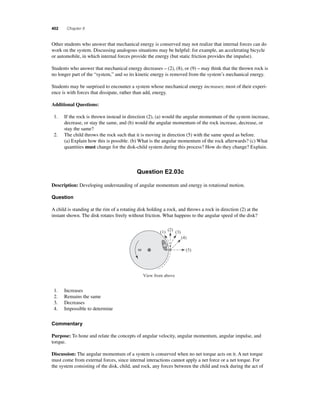
at apogee (when the vertical component of the velocity is zero). With this problem, however, the projectile 
will follow an elliptical orbit rather than a parabola, and the horizontal velocity (in a coordinate system 
fi xed at the launch point) is not constant. 
What is constant? The angular momentum of the projectile around the center of the earth is conserved, 
since the only force acting upon it is central (points toward the center of the earth) and thus exerts no 
torque. We can relate the angular momentum to the “horizontal” (tangential) velocity component vt as fol-lows: 
 =  ×  =  ×  ⇒ m mrt 
L r p r v 
v . Since the kinetic energy at apogee Ka is m t v2 2 (since the radial compo-nent 
of velocity vr is zero), we can write Ka in terms of the angular momentum: K L mr a a = 2 (2 2 ) (where ra 
is the radius of the projectile—its height above the center of the earth—at apogee). 
Since the angular momentum is constant, we can fi nd its value at the moment of launch: 
L = mr v = mR vcosθ where θ is the launch angle (above horizontal) and v0 the launch speed. Now, if we 
t E 0 substitute this into our expression for Ka, we get K = mR 2 v2 cos2θ ( 2 r 2 ) 
. In other words, we fi nd that the 
a E 0 
kinetic energy at apogee is proportional to the projectile’s mass. 
Since kinetic energy at launch and potential energy at launch and apogee are all also proportional to the 
mass (as discussed in the previous question), mass cancels out of the conservation of energy equation, and 
we fi nd that the maximum height does not depend on mass. Thus, both projectiles must reach the same 
maximum height. In other words, the same argument applies to this question as to the previous one, but in 
this case we had to do a little more work to demonstrate that the argument does apply. 
Intuition might suggest to you that the mass does not matter, but part of physics is learning to back up your 
intuition with a solid argument.
408 Chapter 8 
K ey Points: 
• For orbit problems and universal gravitation, much of what you’ve learned about parabolic trajectory 
problems does not apply, or applies only with signifi cant modifi cation. 
• Angular momentum is a powerful concept for reasoning about gravitation and orbit problems. 
• For an orbiting body, a certain amount of energy is “locked up” in preserving the body's angular 
momentum and cannot be converted to potential energy; the rest of the energy moves between potential 
and kinetic as the object orbits farther from and then closer to the object attracting it. 
For Instructors Only 
This, once again, is an example of “extending the context”: the problem is identical to 6a, except for the 
initial launch direction of the projectiles; it thus focuses students’ attention on the signifi cance of having 
an initial horizontal component. 
As before, students may very easily select the correct answer based on incorrect or insuffi cient reasoning; 
the point of this question is therefore to motivate discussion about why that answer is correct. Playing the 
Devil’s Advocate can be useful here. 
This is a hard question, but it provides fertile ground for exploring the application of energy and angular 
momentum ideas to universal gravitation and orbit problems. It can serve as the “anchor” and motivator for 
an extended exploration of the topics. 
Question F1.03c 
Description: Integrating energy and angular momentum ideas by considering projectile motion in a univer-sal 
gravitation context. 
Question 
A mass m is launched from the surface of the Earth with speed v. The diagram shows three possible launch 
directions; order them according to the maximum height the projectile will reach, from greatest height to 
least height. 
A 
B 
C 
1. A = B = C 
2. A  B = C 
3. A  B  C 
4. A  C  B
Rotational Equilibrium and Rotational Dynamics 409 
5. A  B = C 
6. A  B  C 
7. A  C  B 
8. B  A  C 
9. B  A = C 
10. Not enough information 
Commentary 
Purpose: To develop your understanding of the role angular momentum plays in the motion of an object 
under universal gravitation. 
Discussion: If you understood the reasoning behind the previous question, this one should be fairly 
straightforward: the question compares projectiles with different launch directions rather than with different 
masses, but the ideas are the same. 
Angular momentum must be conserved; the more angular momentum a projectile has, the more kinetic 
energy is “locked up” preserving that angular momentum and the less is available to convert to gravitational 
potential energy, so the lower the projectile’s maximum height will be. A projectile launched in direction 
A has no angular momentum about the center of the Earth; that path must therefore produce the greatest 
maximum height. Direction C will produce the greatest angular momentum, and so will cause the least 
maximum height of the three paths. Thus, A  B  C is the best ranking. 
Key Points: 
• Angular momentum is a powerful concept for reasoning about gravitation and orbit problems. 
• For an orbiting body, a certain amount of energy is “locked up” in preserving the body’s angular 
momentum and cannot be converted to potential energy; the rest of the energy moves between potential 
and kinetic as the object orbits farther from and then closer to the object attracting it. 
For Instructors Only 
Asking students to rank order situations according to some quantity is a good way to foster qualitative 
analysis skills and check for conceptual understanding of an idea. 
If students seem to be comfortable with this problem, you might challenge them by asking to rank order the 
escape velocity required for the three launch directions. The escape velocity is in fact the same for all three, 
but to students this can seem to contradict the reasoning they’ve just used for this question. Exploring and 
resolving the apparent contradiction pushes students to further refi ne their understanding of escape velocity 
and the relationship between angular momentum and energy in orbit problems.
410 Chapter 8 
QUICK QUIZZES 
1. (d). A larger torque is needed to turn the screw. Increasing the radius of the screwdriver handle 
provides a greater lever arm and hence an increased torque. 
2. (b). Since the object has a constant net torque acting on it, it will experience a constant angular 
acceleration. Thus, the angular velocity will change at a constant rate. 
3. (b). The hollow cylinder has the larger moment of inertia, so it will be given the smaller angular 
acceleration and take longer to stop. 
4. (a). The hollow sphere has the larger moment of inertia, so it will have the higher rotational 
kinetic energy. 
5. (c). Apply conservation of angular momentum to the system (the two disks) before and after the 
second disk is added to get the result: I1ω1 = (I1 + I2 )ω . 
6. (a). Earth already bulges slightly at the Equator, and is slightly fl at at the poles. If more mass 
moved towards the Equator, it would essentially move the mass to a greater distance from the 
axis of rotation, and increase the moment of inertia. Because conservation of angular momentum 
requires that ωz z I = constant, an increase in the moment of inertia would decrease the angular 
velocity, and slow down the spinning of Earth. Thus, the length of each day would increase. 
ANSWERS TO MULTIPLE CHOICE QUESTIONS 
1. τ = rF sinθ = (0.500 m)(80.0 N)sin(60.0°) = 36.4 N⋅⋅m which is choice (a). 
2. Using the left end of the plank as a pivot and requiring that 
Στ = 0 gives −mg(2 00 )+ F (3 00 ) = 0 2 . m . m , or 
F 
mg 
2 
2 
3 
( . kg )( . m s 
) = 
2 20 0 9 80 
= = 131 
3 
N 
2 
so choice (d) is the correct response. 
3. Assuming a uniform, solid disk, its moment of inertia about a perpendicular axis through its 
center is I = MR2 2, so τ = Iα gives 
α = τ = 
( ⋅ ) 
2 2 400 
. 
( )( ) = 5 00 MR2 2 
25 0 0 800 
. . 
. 
N m 
kg m 
rad s2 
and the correct answer is (b). 
4. For a uniform, solid sphere, 
I = 2MR2 5 and ω π 
E = 
rad 
d 
7 27 10 5 1 d 
× 
⎛⎝ ⎜ 
⎞⎠ ⎟ 
2 1 = × − 
8.64 10 
s 
r 4 . ad s 
so 
1 ⎛ ( × )( × ) 
2 
KE I r E = = 
1 
2 
2 5 98 10 6 38 10 
5 
2 
24 6 2 
ω 
. kg . m 
⎝ ⎜⎜ 
⎞ 
⎠ ⎟⎟ 
(7 27 × 10−5 )2 
. rad s 
yielding KEr ∼ 3 ×1029 J, making (a) the correct choice. 
F1 
mg 
F2 
3.00 m 
2.00 m
Rotational Equilibrium and Rotational Dynamics 411 
5. In order for an object to be in equilibrium, it must be in both translational equilibrium and 
rotational equilibrium. Thus, it must meet two conditions of equilibrium, namely F 
net = 0 and 
τ  
net = 0. The correct answer is therefore choice (d). 
6. In a rigid, rotating body, all points in that body rotate about the axis at the same rate (or have the 
same angular velocity). The centripetal acceleration, tangential acceleration, linear velocity, and 
total acceleration of a point in the body all vary with the distance that point is from the axis of 
rotation. Thus, the only correct choice is (b). 
7. The moment of inertia of a body is determined by its mass and the way that mass is distributed 
about the rotation axis. Also, the location of the body’s center of mass is determined by how 
its mass is distributed. As long as these qualities do not change, both the moment of inertia and 
the center of mass are constant. From τ = Iα , we see that when a body experiences a constant, 
nonzero torque, it will have a constant, nonzero angular acceleration. However, since the angular 
acceleration is nonzero, the angular velocity ω (and hence the angular momentum, L = Iω) will 
vary in time. The correct responses to this question are then (b) and (e). 
8. When objects travel down ramps of the same length, the one with the greatest translational kinetic 
energy at the bottom will have the greatest fi nal translational speed (and, hence, greatest average 
translational speed). This means that it will require less time to travel the length of the ramp. Of 
the objects listed, all will have the same total kinetic energy at the bottom, since they have the 
same decrease in gravitational potential energy (due to the ramps having the same vertical drop) 
and no energy has been spent overcoming friction. All of the block’s kinetic energy is in the form 
of translational kinetic energy. Of the rolling bodies, the fraction of their total kinetic energy that 
is in the translational form is 
f 
KE 
KE KE 
M 
1 
M I I M 
t 
t r 
= 
+ 
= 
+ 
= 
+ ( )( ) = 
1 
2 
2 
1 
2 
2 1 
2 
2 2 
1 
v 
v ω ω v 
1 
1+ I (MR2 ) 
Since the ratio I MR2 equals 2 5 for a solid ball and 2 3 for a hollow sphere, the ball has the 
larger translational kinetic energy at the bottom and will arrive before the hollow sphere. The 
correct rankings of arrival times, from shortest to longest, is then block, ball, sphere, and choice 
(e) is the correct response. 
9. Please read the answer to Question 8 above, since most of what is said there also applies to this 
question. The total kinetic energy of either the disk or the hoop at the bottom of the ramp will be 
KE Mgh total = , where M is the mass of the body in question and h is the vertical drop of the ramp. 
The translational kinetic energy of this body will then be KE f KE fMgh t= = total , where f is the 
fraction discussed in Question 8. Hence, M v2 2 = f M gh and the translational speed at the 
bottom is v = 2 fgh. 
Since f = 1 (1+ 1 2) = 2 3 for the disk and f = 1 (1+ 1) = 1 2 for the hoop, we see that the disk 
will have the greater translational speed at the bottom, and hence, will arrive fi rst. Notice that 
both the mass and radius of the object has canceled in the calculation. Our conclusion is then 
independent of the object’s mass andor radius. Therefore, the only correct response is choice (d).
412 Chapter 8 
1 0. The ratio of rotational kinetic energy to the total kinetic energy for an object that rolls without 
slipping is 
KE 
KE 
KE 
+ 
KE KE 
I 
ω 1 
v ω v 
M I M 
I 
= 
r r 
total t r 
= 
+ 
= 
1 
2 
2 
1 
2 
2 1 
2 
2 
ω 
⎛⎝ 
⎞⎠ 
+ 
= 
+ 
2 2 
1 
1 
1 
MR 
I 
For a solid cylinder, I = MR2 2 and this ratio becomes 
KE 
KE 
r 
total 
= 
= 1 
2 1 
+ 
1 
3 
so the correct answer is (c). 
11. If a car is to reach the bottom of the hill in the shortest time, it must have the greatest translational 
speed at the bottom (and hence, greatest average speed for the trip). To maximize its fi nal trans-lational 
speed, the car should be designed so as much as possible of the car’s total kinetic energy 
is in the form of translational kinetic energy. This means that the rotating parts of the car (i.e., the 
wheels) should have as little kinetic energy as possible. Therefore, the mass of these parts should 
be kept small, and the mass they do have should be concentrated near the axle in order to keep the 
moment of inertia as small as possible. The correct response to this question is (e). 
12. Please review the answers given above for questions 8 and 9. In the answer to question 9, it is 
shown that the translational speed at the bottom of the hill of an object that rolls without slipping is 
v = 2 fgh where h is the vertical drop of the hill and f is the ratio of the translational kinetic energy 
to the total kinetic energy of the rolling body. For a solid sphere, I = 2MR2 5, so the ratio f is 
f 
= 1 
I MR 
= 
+ ( ) = 
+ 
1 
1 
1 2 5 
1 
2 1.4 
and the translational speed at the bottom of the hill is v = 2gh 1.4. Notice that this result is the 
same for all uniform, solid, spheres. Thus, the two spheres have the same translational speed at 
the bottom of the hill. This also means that they have the same average speed for the trip, and 
hence, both make the trip in the same time. The correct answer to this question is (d). 
13. Since the axle of the turntable is frictionless, no external agent exerts a torque about this vertical 
axis of the mouse-turntable system. This means that the total angular momentum of the mouse-turntable 
system will remain constant at its initial value of zero. Thus, as the mouse starts 
walking around the axis (and developing an angular momentum, L Imouse m m = ω , in the direction 
of its angular velocity), the turntable must start to turn in the opposite direction so it will possess 
an angular momentum, L Itable t t = ω , such that L L L I I total mouse table m m t t = + = ω + ω = 0. Thus, the 
angular velocity of the table will be ω ω t m t m = −(I I ) . The negative sign means that if the mouse 
is walking around the axis in a clockwise direction, the turntable will be rotating in the opposite 
direction, or counterclockwise. The correct choice for this question is (d).
Rotational Equilibrium and Rotational Dynamics 413 
ANSWERS TO EVEN-NUMBERED CONCEPTUAL QUESTIONS 
2. If the bar is, say, seven feet above the ground, a high jumper has to lift his center of gravity 
approximately to a height of seven feet in order to clear the bar. A tall person already has his 
center of gravity higher than that of a short person. Thus, the taller athlete has to raise his center 
of gravity through a smaller distance. 
4. The lever arm of a particular force is found with respect to some reference point. Thus, an origin 
for calculating torques must be specifi ed. However, for an object in equilibrium, the calculation 
of the total torque is independent of the location of the origin. 
6. The critical factor is the total torque being exerted about the line of the hinges. For simplicity, 
we assume that the paleontologist and the botanist exert equal magnitude forces. The free body 
diagram of the original situation is shown on the left and that for the modifi ed situation is shown 
on the right in the sketches below: 
Pivot point 
→F 
→F 
→F 
Pivot point 
8 cm 
d0 d 
Original situation Modified situation 
In order for the torque exerted on the door in the modifi ed situation to equal that of the original 
situation, it is necessary that Fd = Fd + F( ) 0 8 cm or d = d + 0 8 cm. Thus, the paleontologist 
would need to relocate about 8 cm farther from the hinge. 
8. 
Stable 
rotation 
axis 
Stable rotation axis 
Unstable 
rotation 
axis 
10. After the head crosses the bar, the jumper should arch his back so the head and legs are lower 
than the midsection of the body. In this position, the center of gravity may pass under the bar 
while the midsection of the body is still above the bar. As the feet approach the bar, the legs 
should be straightened to avoid hitting the bar. 
12. (a) Consider two people, at the ends of a long table, pushing with equal magnitude forces 
directed in opposite directions perpendicular to the length of the table. The net force will be 
zero, yet the net torque is not zero. 
(b) Consider a falling body. The net force acting on it is its weight, yet the net torque about the 
center of gravity is zero. 
14. As the cat falls, angular momentum must be conserved. Thus, if the upper half of the body twists 
in one direction, something must get an equal angular momentum in the opposite direction. 
Rotating the lower half of the body in the opposite direction satisfi es the law of conservation of 
angular momentum.
414 Chapter 8 
PROBLEM SOLUTIONS 
8.1 Since the friction force is tangential to a point on the rim of the wheel, it is perpendicular to the 
radius line connecting this point with the center of the wheel. The torque of this force about 
the axis through the center of the wheel is then τ = rf sin 90.0° = rf , and the friction force is 
f 
= τ = 76 0 ⋅ = 
r 
217 
. N m 
0.350 m 
N 
8.2 The torque of the applied force is τ = rFsinθ . Thus, if r = 0.330 m, θ = 75.0°, and the torque has 
the maximum allowed value of τ max = 65.0 N⋅m, the applied force is 
F 
τ = 
= = ⋅ 
r 
( ) ° 
max 
sin 
θ 
. 
sin . 
65 0 
75 0 
204 
N m 
0.330 m 
N 
8.3 First resolve all of the forces shown in Figure P8.3 into components parallel to and perpendicular 
to the beam as shown in the sketch below. 
(30 N)cos45° 
O C 
(25 N)cos30° 
(25 N)sin30° (10 N)cos20° 
(30 N)sin45° 2.0 m 
(10 N)sin20° 
4.0 m 
(a) τ O = + ( ) ° ⎡⎣ 
25 N cos 30 2.0 m 10 N sin 20° (4.0 m) = +30 N⋅m 
⎤⎦ 
( ) − ( ) ⎡⎣ 
⎤⎦ 
or τ O= 30 N⋅m counterclockwise 
(b) τ C = + ( ) ⎡⎣ 
30 N sin 45 2.0 m 10 N sin 20° (2.0 m) = +36 N⋅m 
° ( ) − ( ) ⎡⎣ 
⎤⎦ 
⎤⎦ 
or τ C= 36 N⋅m counterclockwise 
8.4 The lever arm is d = (1.20 × 10⁻² m)cos 48.0° = 8.03 × 10⁻³ m, and the torque is 
τ = Fd = (80.0 N)(8.03 ×10⁻³ m) = 0.642 N⋅m counterclockwise 
8.5 (a) τ = F ⋅ (lever arm) = (mg)⋅[ θ ] g  sin 
= ( )( )⋅ ( ) ⎡⎣ 
3.0 kg 9.8 m s2 2.0 m sin 5.0° = 5.1 N⋅⋅m 
⎤⎦ 
Pivot 
 
q 
Fg  mg 
q 
(b) The magnitude of the torque is proportional to the sinθ , where θ is the angle between the 
direction of the force and the line from the pivot to the point where the force acts. Note from 
the sketch that this is the same as the angle the pendulum string makes with the vertical. 
Since sinθ increases as θ increases, the torque also increases with the angle.
Rotational Equilibrium and Rotational Dynamics 415 
8.6 The object is in both translational and rotational equilibrium. Thus, we may write: 
ΣFx = 0 ⇒ Fx − Rx = 0 
ΣF F R F y y y g = 0 ⇒ + − = 0 
and 
Στ = ⎜ 
⎛⎝ ⇒  F ( cos θ )− F ( sin θ )− F cos θ ⎟ = 0 
O y x g ⎞⎠ 
0 
2 
  
8.7 
0.080 m 
FtyFt sin12.0° 
FtxFt cos12.0° 
0.290 m 
Pivot 41.5 N 
Requiring that Στ = 0, using the shoulder joint at point O as a pivot, gives 
Στ = (F °)( ) − ( )( ) = t sin12.0 0.080 m 41.5 N 0.290 m 0, or Ft = 724 N 
Τhen ΣFy= 0 ⇒ −F + ( ) ° − sy 724 N sin12.0 41.5 N = 0, yielding Fsy = 109 N. 
ΣFx = 0 gives Fsx − (724 N)cos12.0° =0, or Fsx = 708 N 
Therefore, 
F F F s sx sy = 2 + 2 = ( )2 + ( )2 = 708 N 109 N 716 N 
8.8 (a) Since the beam is in equilibrium, we choose the center 
as our pivot point and require that 
Στ ) = − ( ) + ( ) = center Sam Joe F 2.80 m F 1.80 m 0 
or 
F F Joe Sam = 1.56 [1] 
Also, 
ΣF F F y= 0 ⇒ + = 450 N Sam Joe [2] 
Substitute Equation [1] into [2] to get the following: 
F F Sam Sam + 1.56 = 450 N or FSam 
x  2.80 m y  1.80 m 
x y 
FSam FJoe 
= 450 
N 
= N 2.56 
176 
Then, Equation [1] yields FJoe = 1.56(176 N) = 274 N . 
Fsx 
Fsy 
Fsy 
Fsx 
q 
→ 
Fs 
Fg  450 N 
continued on next page
416 Chapter 8 
(b) If Sam moves closer to the center of the beam, his lever arm about the beam center decreases, 
so the force FSam must increase to continue applying a clockwise torque capable of offsetting 
Joe’s counterclockwise torque. At the same time, the force FJoe would decrease since the 
sum of the two upward forces equal the magnitude of the downward gravitational force. 
(c) If Sam moves to the right of the center of the beam, his torque about the midpoint would 
then be counterclockwise. Joe would have to hold down on the beam in order to exert an 
offsetting clockwise torque. 
8.9 Require that Στ = 0 about an axis through the elbow and perpendicular to the page. This gives 
Στ = + ( )( ) ⎡⎣ 
2.00 kg 9.80 m s2 (25.0 cm+8.00 cm) − (F °)( ) = B cos 75.0 8.00 cm 0 
⎤⎦ 
or 
FB = ( )( ) 
( ) ° 
= 
19 6 33 0 
8 00 75 0 
312 
. . 
. cos . 
N cm 
cm 
N 
8.10 Since the bare meter stick balances at the 
49.7 cm mark when placed on the fulcrum, the 
center of gravity of the meter stick is located 
49.7 cm from the zero end. Thus, the entire 
weight of the meter stick may be considered to 
be concentrated at this point. The free-body 
diagram of the stick when it is balanced with the 
50.0-g mass attached at the 10.0 cm mark is as 
given at the right. 
39.2 cm 
(50.0 g)g 
Requiring that the sum of the torques about point O be zero yields 
+ ( ) ⎡⎣ 
→ 
50.0 g g (39.2 cm −10.0 cm)− M g (49.7 cm − 39.2 cm) = 0 
⎤⎦ 
or 
M = ( ) − 
− 
⎛⎝ ⎜ 
50 0 
39 2 10 0 
49 7 39 2 
. 
. . 
. . 
g 
cm cm 
cm cm 
⎞⎠ ⎟ 
= 139 g 
8.11 Consider the remaining plywood to consist of two 
parts: A1is a 4.00-ft-by-4.00-ft section with center of 
gravity located at (2.00 ft, 2.00 ft), while A2 is a 
2.00-ft-by-4.00-ft section with center of gravity at 
(6.00 ft, 1.00 ft). Since the plywood is uniform, its mass 
per area σ is constant and the mass of a section having 
area A is m =σ A. The center of gravity of the remaining 
plywood has coordinates given by 
x 
m =Σ x 
( ) 
Σ 
m 
σ A x σ 
A x 
σ A σ 
A 
i i 
i 
cg 
ft2 
= = + 
1 1 2 2 
+ 
1 2 
( )+( )( ) 
( )+ 0 
16.0 2. . . 
00 8 00 6 00 
ft ft ft 
ft 
ft ( 2 ) = . 
16 . 0 8 . 
0 
2 
2 
3 33 
ft 
and 
y 
m =Σ y 
( ) 
Σ 
m 
σ A y σ 
A y 
σ A σ 
A 
i i 
i 
cg 
ft2 
= = + 
1 1 2 2 
+ 
1 2 
( )+( )( ) 
( )+ 0 
16.0 2. . . 
00 8 00 1 00 
ft ft ft 
ft 
ft ( 2 ) = . 
16 . 0 8 . 
0 
2 
2 
1 67 
ft 
R 
→ 
49.7 cm 
→ 
Mg 
10.0 
cm 
Point O 
y (ft) 
A1 
A2 
x (ft) 
4.00 
2.00 
2.00 4.00 6.00 8.00 
0
Rotational Equilibrium and Rotational Dynamics 417 
8.12 (a) 
mg 
Mg 
x 
3.00 m 
4.00 m 
n2 
Mg = (90.0 kg)(9.80 m s2 ) = 882 N 
mg = (55.0 kg)(9.80 m s2 ) = 539 N 
n1 
(b) The woman is at x = 0 when n is greatest. 1 With this location of the woman, the 
counterclockwise torque about the center of the beam is a maximum. Thus, n1 must be 
exerting its maximum clockwise torque about the center to hold the beam in rotational 
equilibrium. 
(c) n1 = 0 As the woman walks to the right along the beam, she will eventually reach a point 
where the beam will start to rotate clockwise about the rightmost pivot. At this point, the 
beam is starting to lift up off of the leftmost pivot and the normal force exerted by that 
pivot will have diminished to zero. 
(d) When the beam is about to tip, n1 = 0, and ΣFy = 0 gives 0 0 2 + n − Mg − mg = , or 
= + = 882 N+ 539 N = 1.42 ×10³ N 
n Mg mg 2 
(e) Requiring that Στ )rightmost = 
pivot 
0 when the beam is about to tip (n1 = 0) gives 
+(4.00 m − x)mg + (4.00 m − 3.00 m)Mg = 0 
or (mg) x = (1.00 m)Mg + (4.00 m)mg, and 
x 
M 
m 
= (1.00 m) + 4.00 m 
Thus, 
x =( )( ) 
90 . 
0 
55 . 
0 
kg 
kg 
. )1 00 m ( + 4 . 
00 
= 
m 5.64 m 
(f ) When n1 = 0 and n2 
= 1.42 ×10³ N, requiring that Στ ) = left 
end 
0 gives 
0 − (539 N) x − (882 N)(3.00 m) + (1.42 ×10 3 N)(4.00 m) = 0 
or 
x =− × ⋅ 
= 3 03 10 
− 
539 
5 62 
. 3 
. 
N m 
N 
N 
which, within limits of rounding errors, is the same as the answer to part (e) .
418 Chapter 8 
8 .13 Requiring that x m x m cg i i i = Σ Σ = 0 gives 
(5.0 kg)(0) + (3.0 kg)(0) + (4.0 kg)(3.0 m) + 8.0 kg 
kg 
( ) 
x 
( + + + ) = 
5 0 3 0 4 0 8 0 
0 
. . . . 
or 8.0 x +12 m = 0 which yields x = −1.5 m 
Also, requiring that y my m cg i i i = Σ Σ = 0 gives 
(5.0 kg)(0) + (3.0 kg)(4.0 m) + (4.0 kg)(0) + 8.0 kg 
kg 
( ) 
y 
( + + + ) = 
5 0 3 0 4 0 8 0 
0 
. . . . 
or 8.0 y +12 m = 0 yielding y = −1.5 m 
Thus, the 8.0-kg object should be placed at coordinates (−1.5 m,−1.5 m) . 
8.14 (a) As the woman walks to the right along the beam, she 
will eventually reach a point where the beam will 
start to rotate clockwise about the rightmost pivot. 
At this point, the beam is starting to lift up off of the 
leftmost pivot and the normal force, n1, exerted by 
that pivot will have diminished to zero. 
Then, ΣF mg Mg n y= 0 ⇒ 0 − − + = 0 2 , or 
n m Mg 2= ( + ) 
(b) When n n m M g 1 2 = 0 and = ( + ) , requiring that Στ )left = 
end 
0 gives 
0 
L 
− (mg) x − (Mg) + ( + ) = 0 
2 
mg Mg  or x 
L = + ⎛⎝ ⎜ 
M 
m 
M 
m 
⎞⎠ ⎟ 
−⎛⎝ ⎜ 
⎞⎠ ⎟ 
1 
2 
 
(c) If the woman is to just reach the right end of the beam (x = L) when n n m M g 1 2 = 0 and = ( + ) 
(i.e., the beam is ready to tip), then the result from Part (b) requires that 
L 
L = + ⎛⎝ ⎜ 
⎞⎠ ⎟1 
M 
m 
M 
m 
⎞⎠ ⎟ 
−⎛⎝ ⎜ 
 or  = 
2 
( 1 + 2 
) + 
2 
( 1 
+ ) = + 
⎛⎝ ⎜ 
⎞⎠ ⎟ 
M m 
M m 
m M 
m M 
L 
8.15 In each case, the distance from the bar to the center of mass of the body is given by 
x 
Σ + + 
Σ 
m x m x m i i 
m x 
m 
i 
cg 
arms arms torso torso thigh = = 
x m x 
s thighs legs legs 
m m m m 
arms torso thighs l 
+ 
+ + +e 
egs 
where the distance x for any body part is the distance from the bar to the center of gravity of 
that body part. In each case, we shall take the positive direction for distances to run from the bar 
toward the location of the head. 
Note that Σmi= (6.87 + 33.57 +14.07 + 7.54) kg = 62.05 kg. 
mg 
Mg 
L/2 
 
x 
n1 
n2 
continued on next page
Rotational Equilibrium and Rotational Dynamics 419 
With the body positioned as shown in Figure P8.15b, the distances x for each body part is 
computed using the sketch given below: 
Positive direction 
Knee 
joint 
Hip 
joint 
Shoulder 
joint Bar 
thighs torso arms 
(rcg)legs (rcg)thighs (rcg)torso (rcg)arms 
= +( ) = +0.239 m 
x r arms cg arms 
=  + ( ) = + 0.548 m+ 0.337 m = 0.885 m 
x r torso arms cg torso 
=  +  + ( ) = (+ 0.548+ 0.601+ 0.151) m = 1.30 m 
x r thighs arms torso cg thighs 
=  +  +  + ( ) = (+ 0.548+ 0.601+ 0.374+ 0.227) m = 1.75 m 
x r legs arms torso thighs cg legs 
With these distances and the given masses we fi nd 
xcg 
= + ⋅ = + m 62 8 
kg m 
kg 
62 05 
1 01 
. 
. 
. 
With the body positioned as shown in Figure P8.15c, we use the following sketch to determine 
the distance x for each body part: 
Positive direction 
Knee 
joint 
Hip 
joint 
Shoulder 
Joint 
Bar 
thighs 
torso 
(rcg)arms 
arms 
(rcg)legs 
(rcg)torso 
(rcg)thighs 
= +( ) = +0.239 m 
x r arms cg arms 
=  − ( ) = + 0.548 m − 0.337 m = +0.211 m 
x r torso arms cg torso 
=  −  − ( ) = (+ 0.548 − 0.601− 0.151) m = −0.204 m 
x r thighs arms torso cg thighs 
=  −  −  − ( ) = (+ 0.548 −− 0.601− 0.374 − 0.227) m = −0.654 m 
x r legs arms torso thighs cg legs 
With these distances, the location (relative to the bar) of the center of gravity of the body is 
xcg 
= + ⋅ = + m = m to 0 924 
kg m 
kg 
62 05 
0 015 0 015 
. 
. 
. . wards the head
420 Chapter 8 
8 .16 With the coordinate system shown below, the coordinates of the center of gravity of each body 
part may be computed: 
y 
x 
Bar 
Origin 
60.0° 
arms 
thighs 
(rcg)arms 
(rcg)legs 
(rcg)thighs 
(rcg)torso 
torso 
xcg,arms = 0 
=  − ( ) = 0.309 m 
y r cg,arms arms cg arms 
= ( ) = 0.337 m 
x r cg, torso cg torso 
ycg, torso = 0 
=  + ( ) cos60.0° = 0.676 m y r cg, thighs cg thighs 
x r cg, thighs torso cg thighs 
= ( ) sin 60.0° = 0.131 m 
=  +  cos60.0° + ( ) = 1.02 m ycg,legs thighs =  sin 60.0° = 0.324 m 
x r cg,legs torso thighs cg legs 
With these coordinates for individual body parts and the masses given in Problem 8.15, the 
coordinates of the center of mass for the entire body are found to be 
x 
+ + g, thighs legs cg,legs 
m x m x m x 
cg 
arms cg,arms torso cg, torso thighs c = 
arms torso thighs 
+ 
+ + 
m x 
m m m + 
= ⋅ = 
mlegs 
kg m 
62.05 kg 
m 
28 5 
0 459 
. 
. 
and 
y 
+ + g, thighs legs cg,legs 
m y m y m y 
cg 
arms cg,arms torso cg, torso thighs c = 
arms torso thighs 
+ 
+ + 
m y 
m m m + 
= ⋅ = 
mlegs 
kg m 
62.05 kg 
m 
6 41 
0 103 
. 
.
Rotational Equilibrium and Rotational Dynamics 421 
8.17 The free-body diagram for the spine is shown below. 
Ry Ty  Tsin12.0 
Rx 
Tx  Tcos12.0 
200 N 
350 N 
Point O 
2L/3 
L/2 
L 
When the spine is in rotational equilibrium, the sum of the torques about the left end (point O) 
must be zero. Thus, 
+ ⎛⎝ ⎜ 
⎞⎠ ⎟ 
− ( )⎛⎝ ⎜ 
⎞⎠ ⎟ 
2 
3 
L L 
T 350 
− ( )( ) = 
N 200 N 0 
L y 
2 
yielding T T y= sin12.0° = 562 N. 
The tension in the back muscle is then T = 
× = 562 
12 0 
° 
2 71 
N 
=2.71 103 N kN 
sin . 
. . 
The spine is also in translational equilibrium, so ΣF R T x x x = 0 ⇒ − = 0 and the compression 
force in the spine is 
R T T x x = = cos12.0° = (2.71 kN)cos12.0° = 2.65 kN
422 Chapter 8 
8 .18 In the free-body diagram of the foot 
given at the right, note that the force 
R 
 
(exerted on the foot by the tibia) 
has been replaced by its horizontal 
and vertical components. Employ-ing 
both conditions of equilibrium 
(using point O as the pivot point) 
gives the following three equations: 
ΣF R T x= 0 ⇒ sin15.0° − sinθ = 0 
or 
R 
T = 
θ 
15 0 
° 
sin 
sin . 
[1] 
18.0 cm 
T → 
⎡⎣ 
ΣF = 0 ⇒ 700 N − R cos15.0° + T cosθ = 0 [2] 
yΣτ = 0 ⇒ − ( 700 N ) ( 18.0 cm ) cos θ + T (25.0 cm − 18.0 cm) = 0 
O ⎤⎦ 
or 
T = (1 800 N)cosθ [3] 
Substituting Equation [3] into Equation [1] gives 
R = 
° 
⎛⎝ ⎜ 
⎞⎠ ⎟ 
1 800 
15 0 
N 
sin . 
sinθ cosθ [4] 
Substituting Equations [3] and [4] into Equation [2] yields 
1 800 
15 0 
N 
1 800 N 
2 tan . 
sin cos cos 
° 
⎛⎝ ⎜ 
⎞⎠ ⎟ 
θ θ − ( ) θ = 700 N 
which reduces to: sinθ cosθ = (tan15.0°)cos2θ + 0.104 2. 
Squaring this result and using the identity sin2θ = 1− cos2θ gives 
tan . cos tan . . 2 4 15 0 1 2 15 0 0 104 2 ° ( ) + ⎡⎣ 
⎤⎦ 
+ ° ( )( ) − θ 1 0 104 2 0 2 2 ⎡⎣ 
⎤⎦ 
cos + ( . ) = 
In this last result, let u = cos2θ and evaluate the constants to obtain the quadratic equation 
(1.071 8)u2 − (0.944 2)u + (0.010 9) = 0 
The quadratic formula yields the solutions u = 0.869 3 and u = 0.011 7. 
Thus, 
θ = cos−1 ( 0.869 3) = 21.2° or θ = cos−1 ( 0.011 7) = 83.8° 
We ignore the second solution since it is physically impossible for the human foot to stand with 
the sole inclined at 83.8° to the fl oor. We are the left with: θ = 21.2° . 
Equation [3] then yields 
T = (1 800 N)cos 21.2° = 1.68 ×10³ N 
and Equation [1] gives 
R = 
( × ) ° 
° 
= × 
1 68 10 21 2 
15 0 
2 34 10 
3 
3 . sin . 
sin . 
. 
N 
N 
Rx  Rsin15.0 
Ry  Rcos15.0 
n700 N 
25.0 cm 
Point O 
q 
q
Rotational Equilibrium and Rotational Dynamics 423 
8.19 Consider the torques about an axis perpendicular to the page through the left end of the rod. 
Rx 
Ry 
Ty  Tcos30.0 
Tx  Tsin30.0 
6.00 m 
100 N 
3.00 m 
4.00 m 500 N 
=( 100 N )( 3 00 m )+( 500 N )( 4 00 
m 
) Στ= 0 
⇒ 6 0 
T 
. . 
( . 0 m)cos 30.0° 
T = 443 N 
ΣF R T x x = 0 ⇒ = sin 30.0° = (443 N)sin 30.0° 
Rx = 221 N toward the right 
ΣF R T y y = 0 ⇒ + cos 30.0° −100 N − 500 N = 0 
Ry= 600 N − (443 N)cos 30.0° = 217 N upward 
8.20 Consider the torques about an axis perpendicular to the page through the left end of the scaffold. 
Στ = 0⇒ (0) − (700 )(1 00 ) − (200 )(1 50 1 T N . m N . m) +T ( ) = 2 3.00 m 0 
From which, T2 = 333 N . 
Then, from ΣFy = 0, we have 
T T 1 2 + − 700 N − 200 N = 0 
or 
→ 
T1 
T T 1 2 = 900 N − = 900 N − 333 N = 567 N 
→ 
T2 
1.00 m 2.00 m 
200 N 
700 N 
1.50 m
424 Chapter 8 
8 .21 Consider the torques about an axis 
perpendicular to the page and through the 
left end of the plank. 
Στ = 0 gives 
→ 
→ 
−(700 )(0 500 ) − (294 )(1 00 ) + 40 0 1 N . m N . m (T sin . °)(2.00 m) = 0 
or T1 = 501 N . 
Then, ΣFx = 0 gives −T + T = 3 1 cos 40.0° 0, or 
T3 = (501 N)cos 40.0° = 384 N 
From ΣFy = 0, T T 2 1 − 994 N+ sin 40.0° = 0, 
or T2 = 994 N − (501 N)sin 40.0° = 672 N . 
8.22 (a) See the diagram below 
T → 
→ 
H 
V → 
60.0° 
x 
700 N 
3.00 m 3.00 m 
200 N 80.0 N 
(b) If x = 1.00 m, then 
Στ ) = ⇒−( )( ) − ( ) left end 0 700 N 1.00 m 200 N 3.00 m 
0.0 N .00 
( ) 
− (8 )(6 m) + (T sin 60.0°)(6.00 m) = 0 
giving T = 343 N . 
Then, ΣF H T x= 0 ⇒ − cos 60.0° = 0, or H = (343 N)cos60.0° = 172 N , 
and ΣF V y= 0 ⇒ − 980 N+ (343 N)sin 60.0° = 0, or V = 683 N . 
(c) When the wire is on the verge of breaking, T = 900 N and 
Στ ) = −( ) − ( )( ) left end max 700 N x 200 N 3.00 m 
− (80.0 N)(6.00 m) + [(900 N)sin 60.0°](6.00 m) = 0 
which gives xmax = 5.14 m . 
→ 
T1 
T2 
T3 
0.500 m 
1.00 m 
40.0° 
1.00 m 
mg  294 N 
700 N
Rotational Equilibrium and Rotational Dynamics 425 
8.23 The required dimensions are as follows: 
d1 = (4.00 m)cos 50.0° = 2.57 m 
d d d 2 = cos 50.0° = (0.643) 
d3 = (8.00 m)sin 50.0° = 6.13 m 
ΣFy = 0 yields F1 − 200 N − 800 N=0, or F1 
= 1.00 ×10³ N. 
When the ladder is on the verge of slipping, 
→ 
f f n F s s s =( ) = = max μ μ 1 or f = (0.600)(1.00 ×10³ N) = 600 N 
→ 
Then, ΣFx = 0 gives F2 =600 N to the left . 
Finally, using an axis perpendicular to the page and through the lower end of the ladder, Στ = 0 
gives 
−(200 N)(2.57 m) − (800 N)(0.643)d + (600 N)(6.13 m) = 0 
or 
d = 
( 3 × − 5 
) ⋅ 
( ) = 
800 
6 15 
.68 10 50 N m 
0.643 N 
m 
3 
. when the ladder is ready to slip 
8.24 (a) 
q 
(b) The point of intersection of two unknown forces is always a good choice as the pivot point 
in a torque calculation. Doing this eliminates these two unknowns from the calculation 
(since they have zero lever arms about the chosen pivot) and makes it 
easier to solve the resulting equilibrium equation . 
(c) Στ θ θ ) = ⇒ + − ⎛⎝ 
⎞⎠ 
+ ( ) = hinge 0 0 0 
2 
mg 
L 
cos T L sin 0 
F1 
f → 
F2 
8.00 m 
d d3 
d2 
d1 
800 N 
200 N 
50.0° 
T 
L/2 
L 
Fy 
Fx 
mg 
q 
continued on next page
426 Chapter 8 
(d) Solving the above result for the tension in the cable gives 
T 
=( mg 2 
) L 
= 
mg L 
θ 2 
θ 
θ 
cos 
sin tan 
or 
=( kg )( m s 
) 
T ° 
= 
16 0 9 80 
2 300 
136 
. . 
tan . 
N 
2 
(e) ΣF F T x x = 0 ⇒ − = 0 and ΣF F mg y y = 0 ⇒ − = 0 
(f ) Solving the above results for the components of the hinge force gives 
F T x= =136 N and F mg y= = (16.0 kg)(9.80 m s2 ) = 157 N 
(g) Attaching the cable higher up would allow the cable to bear some of the weight, thereby 
reducing the stress on the hinge. It would also reduce the tension in the cable. 
8.25 Consider the free-body diagram of the 
material making up the center point in 
the rope given at the right. Since this 
material is in equilibrium, it is necessary 
to have ΣF ΣF x y = 0 and = 0, giving 
ΣFx = 0: +T −T = 2 1 sinθ sinθ 0 
6.00 m 
q q 
or T T 2 1 = , meaning that the rope has a uniform tension T throughout its length. 
ΣFy = 0: T cosθ +T cosθ − 475 N = 0 where cos 
6.00 m 
0 500 
. 
m 
. 
θ = 
( )+( ) 
0 500 2 2 
6.00 m m 
and the tension in the rope (force applied to the car) is 
T= =475 (475 ) ( ) + (0 500 ) 
N kN ( ) = . × = . 
2 0 
2 2 
N 
2 cos 
N 6.00 m m 
θ 
. 
.500 
2 86 103 2 86 
m 
8.26 (a) 
(b) Στ θ θ ) = ⇒ + − ⎛⎝ 
⎞⎠ 
lower 0 0 0 
+ 
end 
2 
mg 
L 
cos T (L sin ) = 0 
or T 
⎛ 
cot θ 
θ 
cos 
sin 
mg mg = 
⎝ ⎜ 
⎞ 
⎠ ⎟ 
= 
2 2 
θ 
(c) ΣF T n x s = 0 ⇒ − +μ = 0 or T n s = μ [1] 
ΣF n mg y= 0 ⇒ − = 0 or n = mg [2] 
Substitute Equation [2] into [1] to obtain T mg s = μ . 
0.500 m 
T1 T2 
F  475 N 
n 
T 
mg 
fs  ( fs)max  msn 
L/2 
L/2 
q 
continued on next page
Rotational Equilibrium and Rotational Dynamics 427 
(d) Equate the results of parts (b) and (c) to obtain μ θ s = cot 2 . 
This result is valid only at the critical angle θ where the beam is on the verge of slipping 
(i.e., where f f s s =( )max is valid.) 
(e) At angles below the critical angle (where f f s s =( )max is valid), the beam will slip. At larger 
angles, the static friction force is reduced below the maximum value, and it is no longer 
appropriate to use μs in the calculation. 
8.27 Consider the torques about an axis perpendicular 
to the page and through the point where the force 
T  
 
acts on the jawbone. 
Στ = 0⇒(50.0 N) (7.50 cm) − R(3.50 cm) = 0, which 
yields R = 107 N . 
Then, ΣF T y= 0⇒− (50.0 N) + − 107 N = 0, or T = 157 N . 
8.28 Observe that the cable is perpendicular to the boom. Then, using Στ = 0 for an axis perpendicular 
to the page and through the lower end of the boom gives 
−( )⎛⎝ ⎜ 
⎞⎠ ⎟ 
+ ⎛⎝ ⎜ 
⎞⎠ ⎟ 
L 
cos T L ( )(L cos 65°) = 0 
1 − 
2 
65 
3 
4 
.20 kN ° 2.00 kN 
or T = 1.47 kN . 
From ΣFx = 0, H = T cos 25° = 1.33 kN to the right , 
and ΣFy = 0 gives 
V = 3.20 kN −T sin 25° = 2.58 kN upward 
8.29 First, we resolve all forces into components parallel to and 
perpendicular to the tibia, as shown. Note that θ = 40 0 . ° and 
wy = (30.0 N)sin 40.0° = 19.3 N 
Fy = (12.5 N)sin 40.0° = 8.03 N 
and 
T T y= sin 25.0° 
Using Στ = 0 for an axis perpendicular to the page and 
through the upper end of the tibia gives 
( T 
°) − ( N) − (8 03 N) = 0 
d d 
sin 25.0 . . d 
5 
19 3 
2 
or T = 209 N . 
Fc  50.0 N 
3.50 cm 
7.50 cm 
R 
T 
2.00 kN 
→ 
1.20 kN 
65° 
25° 
L 
L 
T 
→ 
V 
→ 
H 
34 
L2 
d/5 
Tx 
d/2 
d 
q 
q 
Rx 
Ry 
Ty 
Fy 
Fx 
wx 
wy
428 Chapter 8 
8 .30 When x = xmin, the rod is on the verge of slipping, so 
f f n n s s =( ) = = max μ 0.50 . 
From ΣFx = 0, n − T cos 37° = 0, or n = 0.80T. Thus, 
f = 0.50 (0.80T ) = 0.40T. 
From ΣFy = 0, f + T sin 37° − 2w = 0, or 
0.40T + 0.60T − 2w = 0, giving T = 2w. 
→ 
T 
Using Στ = 0 for an axis perpendicular to the page and through the left end of the beam gives 
− w ⋅ x − w ( 2.0 m ) + ( 2 w ) sin 37° ( 4.0 m ) = 0, which reduces to x= min 2.8 m . 
⎡⎣ 
min ⎤⎦ 
8.31 The moment of inertia for rotations about an axis is I mri i = Σ 2 , where ri is the distance mass mi 
is from that axis. 
(a) For rotation about the x-axis, 
Ix = ( )( ) + ( )( ) 
300 300 200 300 
2 
+ 
2 2 . . . . 
. 
kg m kg m 
00 3 00 4 00 3 00 99 0 2 2 ( kg)( . m) + ( . kg)( . m) = . kg ⋅m2 
(b) When rotating about the y-axis, 
Iy = ( )( ) + ( )( ) 
300 200 200 200 
2 
+ 
2 2 . . . . 
. 
kg m kg m 
00 2 00 4 00 2 00 44 0 2 2 ( kg)( . m) + ( . kg)( . m) = . kg ⋅m2 
(c) For rotations about an axis perpendicular to the page through point O, the distance ri for 
each mass is 
ri = (2 00 ) + (3 00 ) = 13 0 2 2 . m . m . m 
Thus, 
3.00 2.00 2.00 4.00 kg (13.0 m2 ) = 143 kg ⋅m2 
IO= + + + ( ) ⎡⎣ 
⎤⎦ 
8.32 The required torque in each case is τ = Iα. Thus, 
τ α x x= I = (99.0 kg ⋅m2 ) (1.50 rad s2 ) = 149 N⋅m 
τ α y y= I = (44.0 kg ⋅m2 )(1.50 rad s2 ) = 66.0 N⋅m 
and 
τ α O O= I = (143 kg ⋅m2 )(1.50 rad s2 ) = 215 N⋅m 
→ 
2.0 m 
2.0 m 
x 
37° 
f → 
w → 
w 
n→
Rotational Equilibrium and Rotational Dynamics 429 
net m = ⇒ = = ° = ( ) I I 
τ 
α α net 
8.33 (a) τ α 
2 ( )= ⋅ 
rF sin 90 0.330 250 
0 940 
87 8 
N 
rad s 
kg m 2 
. 
. 
(b) For a solid cylinder, I = Mr2 2, so 
M 
I 
r 
= = 
( ⋅ ) 
( ) 
3 . 
. 
= × 2 2 878 
1 61 10 2 2 
0 330 
. 
kg m 
m 
kg 
2 
(c) ω =ω +α = + ( )( ) = 0 t 0 0.940 rad s2 5.00 s 4.70 rad s 
8.34 (a) I = 2I + I = 2(MR2 2)+ mr2 2 
disk cylinder or I = MR2 + mr2 2 
(b) τ g = 0 Since the line of action of the gravitational force passes through the rotation axis, it 
has zero lever arm about this axis and zero torque. 
(c) The torque due to the tension force is positive. Imagine gripping the cylinder with your 
right hand so your fi ngers on the front side of the cylinder point upward in the direction of 
the tension force. The thumb of your right hand then points toward the left (positive direc-tion) 
along the rotation axis. Because 
  s = I` , the torque and angular acceleration 
have the same direction. Thus, a positive torque produces a positive angular acceleration. 
When released, the center of mass of the yoyo drops downward, in the negative direction. 
The translational acceleration is negative. 
(d) Since, with the chosen sign convention, the translational acceleration is negative when 
the angular acceleration is positive, we must include a negative sign in the proportionality 
between these two quantities. Thus, we write: a = −rα or α = −a r 
(e) Translation: 
ΣF m a T M m g M ma y= ⇒ − ( + ) = ( + ) total 2 2 [1] 
(f ) Rotational: 
Στ = Iα ⇒ rT sin 90° = Iα or rT = Iα [2] 
(g) Substitute the results of (d) and (a) into Equation [2] to obtain 
T I 
r 
I 
a r 
r 
MR 
mr a 
r 
= ⎛⎝ 
⎞⎠ 
= − ⎛⎝⎞⎠ 
⎛ 
= − + 
⎝ ⎜ 
⎞ 
⎠ ⎟ 
α 2 
2 
2 2 
or T M 
R 
r 
m 
a = − ⎛⎝ 
⎞⎠ 
+ 
⎡ 
⎣ ⎢ 
⎤ 
⎦ ⎥ 
2 
2 
[3] 
Substituting Equation [3] into [1] yields 
− ( ) + ⎡⎣ 
⎤⎦ 
M R r m a − ( M + m) g = ( M + m)a 2 2 2 2 or a 
M m g 
M M Rr m 
= 
−( 2 
+ ) 
+ ( ) + 
2 3 2 2 
(h) a = 
2 2 00 1 00 (9 80 ) 
− ( ) + ⎡⎣ 
⎤⎦ 
2 200 
. . . 
. 
kg kg m s 
kg 
2 
2 72 2 . . . . 
( )+( )( )+( ) 
= − 
2 00 10 0 4 00 3 1 00 2 
. 
kg kg 
m s2 
(i) From Equation [1],T = (2M + m)(g + a) = (5.00 kg)(9.80 m s2 − 2.72 m s2 ) = 35.4 N . 
( j) Δ 
=( )+ ( Δ 
) ⇒ = = 
y t at t 
y 
a 
(− ) 
− 
0 2 
2 2 1 00 
2 72 
2 
. m 
. m s 
s 2 = 0.857
430 Chapter 8 
8 .35 (a) Consider the free-body diagrams of the cylinder and man given at the 
right. Note that we shall adopt a sign convention with clockwise and 
downward as the positive directions. Thus, both a and α are positive in 
the indicated directions and a = rα . We apply the appropriate form of 
Newton’s second law to each diagram to obtain the following: 
Rotation of Cylinder: τ = Iα ⇒ rT sin 90° = Iα , or T = Iα r, 
so 
T 
r 
Mr 
a 
r 
= ⎛⎝ ⎜ 
⎞⎠ ⎟ 
⎛⎝ ⎜ 
⎞⎠ ⎟ 
1 1 
2 
2 and T = Ma 1 
2 
[1] 
Translation of man: 
a 
ΣF ma mg T ma y= ⇒ − = or T = m(g − a) [2] 
2 Ma = m(g − a), or 
Equating Equations [1] and [2] gives 1 
a 
mg 
m M 
= 
+ 
=( 75 . 0 kg )( 9 . 
80 
m s 
2 
) 
2 
75 . 
0 
kg+ 225 kg 2 
( )= 3.92 m s2 
(b) From a = rα , we have 
α= = = a 
r 
3 92 
0 400 
9 80 
. 
. 
. 
m s 
m 
rad s 
2 
2 
(c) As the rope leaves the cylinder, the mass of the cylinder decreases, thereby 
decreasing the moment of inertia. At the same time, the weight of the rope leaving 
the cylinder would increase the downward force acting tangential to the cylinder, 
and hence increase the torque exerted on the cylinder. Both of these effects 
will cause the acceleration of the system to increase with time. (The increase would be 
slight in this case, given the large mass of the cylinder.) 
8.36 The angular acceleration is α = (ω − ω ) = − (ω ) f i i Δt Δt since ω f = 0. 
Thus, the torque is τ = Iα = − Iω t i ( Δ ). But, the torque is also τ = − fr, so the magnitude of the 
required friction force is 
f 
I 
r t 
= i ( ) = 
( kg ⋅ m )( rev min 
) 
( ) 
ω 
Δ 
12 50 
0 50 m 
6 0 
2 
. . s 
2 rad 
1 
= 1 rev 
min 
60 s 
⎛⎝ 
⎞⎠ 
⎛⎝ 
⎞⎠ 
( ) 
21 
N π 
Therefore, the coeffi cient of friction is 
μk 
= = = 21 
f 
n 
0 30 
N 
70 N 
. 
M 
m 
mg 
a 
r 
T 
T
Rotational Equilibrium and Rotational Dynamics 431 
8.37 (a) τ = F ⋅ r = (0.800 N)(30.0 m) = 24.0 N⋅m 
(b) α = τ = τ = 24 0 
⋅ 
( )( ) = 
I mr2 2 
0 750 30 0 
0 035 
. 
. . 
. 
N m 
kg m 
6 rad s2 
(c) a r t= α = (30.0 m)(0.0356 rad s2 ) = 1.07 m s2 
8.38 I = MR2 = (1.80 kg)(0 320 m) = 0.184 kg ⋅m . 2 2 
τ τ τ α net applied resistive = − = I , or F ⋅ r − f ⋅ R = Iα 
yielding 
F 
= α + ⋅ 
I f R 
r 
(a) F = 
(0.184 kg ⋅m2 )(4.50 rad s2 )+ (120 N)(0.320 m) 
= 4 50 10− 
872 . 2 m 
× 
N 
(b) F = 
(0.184 kg ⋅m2 )(4.50 rad s2 )+ (120 N)(0.320 m) 
= 2 80 10− 
1 40 . 2 
× 
. 
m 
kN 
8.39 I = MR = ( )( ) = ⋅ 1 
2 
1 
2 
2 150 kg 1 50 m 169 kg m . 2 2 
and 
α 
ω − 
ω = 
= 
π − ( )⎛⎝ 
f i 
Δt 
0 500 0 
. rev s 
2 
2 . 
00 
s 
rad 
⎜ 1 rev 
⎞⎠ ⎟ 
= π 
2 
rad s2 
Thus, τ = F ⋅ r = Iα gives 
F 
I 
r 
= = 
⋅ ( )⎛⎝ ⎜ 
⎞⎠ ⎟ 
π 
1 kg m rad s 
α = 
1.50 m 
N 
69 2 2 
2 
177
432 Chapter 8 
8 .40 (a) It is necessary that the tensions T1 and T2 be different in order 
to provide a net torque about the axis of the pulley 
and produce an angular acceleration of the pulley. Since 
intuition tells us that the system will accelerate in the direc-tions 
shown in the diagrams at the right when m m 2 1  , it is 
necessary that T T 2 1  . 
(b) We adopt a sign convention for each object with the positive 
direction being the indicated direction of the acceleration of 
that object in the diagrams at the right. Then, apply Newton’s 
second law to each object: 
r 
T2 
T2 
a a 
For m F ma T mg ma 1 y 1 1 1 1 : Σ = ⇒ − = or T m g a 1 1 = ( + ) [1] 
For m F ma mg T ma 2 y 2 2 2 2 : Σ = ⇒ − = or T m g a 2 2 = ( − ) [2] 
For M: Στ = Iα ⇒ rT − rT = Iα 2 1 or T T I r 2 1 − = α [3] 
Substitute Equations [1] and [2], along with the relations I = Mr2 2 and α = a r , into 
Equation [3] to obtain 
m g a m g a 
Mr 
r 
a 
r 
Ma 
2 1 
2 
2 2 
− ( ) − + ( ) = ⎛⎝ ⎜ 
⎞⎠ ⎟ 
+ + ⎛⎝ ⎜ 
= or m m 
M 
⎞⎠ ⎟ 
= ( − ) 
a m m g 1 2 2 1 2 
and 
a 
( − ) 2 1 
m m g 
m m M 
= 
( − ) 
+ + 
= 
1 2 2 
m s ( ) 
20.0 kg 10.0 kg 9.80 m s2 
2 
+ ( ) = 
kg kg + 8.00 kg 
20 0 10 0 2 
2 88 
. . 
. 
(c) From Equation [1]: T1 = (10.0 kg)(9.80 m s2 + 2.88 m s2 ) = 127 N . 
From Equation [2]: T2 = (20.0 kg)(9.80 m s2 − 2.88 m s2 ) = 138 N . 
8.41 The initial angular velocity of the wheel is zero, and the fi nal angular velocity is 
= = = v 5 
ω f r 
1 
40 0 
0.0 m s 
.25 m 
. rad s 
Hence, the angular acceleration is 
α 
ω − 
ω 
= 
f i 
= 40 0 − 0 
= Δt 
0 480 
83 3 
. 
. 
. 
rad s 
s 
rad s2 
The torque acting on the wheel is τ = f ⋅ r k , so τ = Iα gives 
f 
( ⋅ )( )α = × 110 83 3 
I 
r k= = 
7 33 1 
2 . 2 
kg m rad s 
1.25 m 
. 03 N 
Thus, the coeffi cient of friction is 
μk 
= = × 
k f 
n 
= 7 33 10 
× 
10 
0 524 
3 
4 
. 
. 
N 
1.40 N 
M 
m1 m2 
m1g m2g 
T1 
T1 
a
Rotational Equilibrium and Rotational Dynamics 433 
8.42 (a) The moment of inertia of the fl ywheel is 
I = MR = ( )( ) = × ⋅ 1 
2 
1 
2 
2 500 kg 2.00 m 2 1.00 103 kg m2 
and the angular velocity is 
ω π =⎛⎝ ⎜ 
⎞⎠ ⎟ 
⎛⎝ ⎜ 
⎞⎠ ⎟ 
5000 
rad s ⎛⎝ ⎜ 
rev 
2 rad 
1 
min 
1 rev 
min 
60 s 
⎞⎠ ⎟ 
= 524 
Therefore, the stored kinetic energy is 
= 1 = ( × kg ⋅m2 )( rad s) 
2 
KE I stored 
1 
2 
ω 2 1.00 103 524 2 = 1.37 × 10⁸ J 
(b) A 10.0-hp motor supplies energy at the rate of 
P = ( )⎛ 
W 
hp 
10 0 = × 
⎝ ⎜ 
⎞ 
⎠ ⎟ 
746 
1 
. hp 7.46 103 
J s 
The time the fl ywheel could supply energy at this rate is 
t 
KE = = × 
1 37 10 
J 
stored = × P 7 46 10 
J s 
. 4 
. 
× 
1 84 10 
8 
3 
. s = 5.10 h 
8.43 The moment of inertia of the cylinder is 
= = R ⎛ 
I MR 
w 
g 
⎝ ⎜ 
⎞ 
⎠ ⎟ 
= 
⎛ 
⎝ ⎜ 
⎞ 
⎠ ⎟ 
1 
2 
1 
2 
1 
2 
800 
2 2 1 N 
9.80 m s2 .50 m 91.8 kg m ( )2 = ⋅ 2 
The angular acceleration is given by 
α = τ = ⋅ = ( )( ) 
⋅ 
= 
I 
F R 
I 
50 0 1 50 
0 817 
. . 
. 
N m 
91.8 kg m 
2 rad s2 
At t = 3.00 s, the angular velocity is 
ω =ω +α = + ( )( ) = i t 0 0.817 rad s2 3.00 s 2.45 rad s 
and the kinetic energy is 
= = ( kg ⋅m2 )( rad s) = 1 
2 
KE I rot 
1 
2 
2 91 8 2 45 2 276 ω . . J
434 Chapter 8 
8.44 (a) Hoop: I = MR2 = ( )( )2 = ⋅ 4.80 kg 0.230 m 0.254 kg m2 
Solid Cylinder: I = MR = ( )( ) = ⋅ 1 
2 
1 
2 
2 4 80 0 230 2 0 127 . kg . m . kg m2 
Solid Sphere: I = MR = ( )( ) = ⋅ 2 
5 
2 
5 
2 4 80 0 230 2 0 102 . kg . m . kg m2 
Thin, Spherical, Shell: I = MR = ( )( ) = ⋅ 2 
3 
2 
3 
2 4 80 0 230 2 0 169 . kg . m . kg m2 
(b) When different objects of mass M and radius R roll 
without slipping (⇒ a = Rα ) down a ramp, the one with 
the largest translational acceleration a will have the 
highest translational speed at the bottom. To determine 
the translational acceleration for the various objects, 
consider the free-body diagram at the right: 
ΣF Ma Mg f Ma x= ⇒ sinθ − = [1] 
τ = Iα ⇒ f R = I (a R) or f = Ia R2 [2] 
Substitute Equation [2] into [1] to obtain 
Mg sinθ − Ia R2 = Ma or a 
Mg 
M I R 
= 
+ 
sinθ 
2 
n 
a 
Mg 
a 
x 
f 
R 
q 
q 
M 
Since M, R, g, and θ are the same for all of the objects, we see that the translational accel-eration 
(and hence the translational speed) increases as the moment of inertia decreases. 
Thus, the proper rankings from highest to lowest by translational speed will be: 
solid sphere; solid cylinder; thin, spherical, shell; and hoop 
(c) When an object rolls down the ramp without slipping, the friction force does no work and 
mechanical energy is conserved. Then, the total kinetic energy gained equals the gravitational 
potential energy given up: KE + KE = −Δ PE = Mgh and KE = Mgh −1 
M v2, where 
r t g r2 
h is the vertical drop of the ramp and v is the translational speed at the bottom. Since M, 
g, and h are the same for all of the objects, the rotational kinetic energy decreases as the 
translational speed increases. Using this fact, along with the result of Part (b), we rank the 
object’s fi nal rotational kinetic energies, from highest to lowest, as: 
hoop; thin, spherical, shell; solid cylinder; and solid sphere
Rotational Equilibrium and Rotational Dynamics 435 
8.45 (a) Treating the particles on the ends of the rod as point masses, the total moment of inertia of 
12 ( 2) ( 2)2. If the mass 
the rotating system is I = I + I + I = m L 2 
+ m L 2 
+ m L rod 3 4 rod 
3 
4 
of the rod can be ignored, this reduces to 
I m m L 
= + + ( )⎛⎝ ⎜ 
⎞⎠ ⎟ 
0 = ( + ) 
3 00 4 00 0 500 3 4 
2 
2 
. kg . kg ( . m) = kg ⋅m2 2 1.75 
and the rotational kinetic energy is 
KE I r= = ( ⋅ )( ) = 1 
2 
1 
2 
2 1 75 2 50 2 5 47 ω . kg m2 . rad s . J 
(b) If the rod has mass mrod = 2.00 kg 
I = ( )( )+ ⋅ = ⋅ 1 
12 
2 00 1 00 1 75 1 92 2 . kg . m . kg m2 . kg m2 
and 
KE I r= = ( ⋅ )( ) = 1 
2 
1 
2 
2 1 92 2 50 2 6 00 ω . kg m2 . rad s . J 
8.46 Using conservation of mechanical energy, 
KE KE PE KE KE PE trans rot g f trans rot g i ( + + ) = ( + + ) 
or 
1 
2 
1 
2 
M 2 I 2 0 0 0 Mg L t v + ω + = + + ( sinθ ) 
Since I = 2 5M R2 for a solid sphere and vt = Rω when rolling without slipping, this becomes 
1 
2 
1 
5 
M R2ω 2 + M R2ω 2 = Mg(Lsinθ ) 
and reduces to 
ω = θ = 10 ( )( ) ° 
7 
m s2 .0 m 
10 9 8 6 37 
sin . sin 
rad s ( ) = 2 36 
7 020 2 
gL 
R 
. 
m
436 Chapter 8 
8 .47 (a) Assuming the disk rolls without slipping, the friction force between the disk and the ramp 
does no work. In this case, the total mechanical energy of the disk is constant with the value 
E KE PE Mgh MgL i g i = + ( ) = 0 + = sinθ . When the disk gets to the bottom of the ramp, 
PEg = 0 and KE KE KE E MgL f t r = + = = sinθ . Also, since the disk does not slip, 
ω = v R and 
= 1 
2 
M r= = ⎛⎝ 
KE I MR 
R 
⎞⎠ 
⎛⎝ 
⎞⎠ 
= ⎛⎝ 
⎞⎠ 
1 
2 
1 
2 
1 
2 
1 
2 
1 
2 
2 2 
2 
ω 2 v 
v KEt 
Then, 
KE KE KE E MgL total t t = + = = 1 
2 
sinθ or 
3 
2 
1 
2 
2 M M gL v ⎛⎝ 
⎞⎠ 
= sinθ 
and 
v= = ( )( ) ° 
= 4 
3 
4 9 80 4 50 15 0 
3 
3 9 
gL sin . . sin . 
. 
θ m s2 m 
0 m s 
(b) The angular speed of the disk at the bottom is 
ω= = = v 
R 
3 90 
15 6 
. 
. 
m s 
0.250 m 
rad s 
8.48 (a) Assuming the solid sphere starts from rest, and taking y = 0 at the level of the bottom of 
= ( ) = will be split among three 
the incline, the total mechanical energy E PE mgh g i 
distinct forms of energy as the sphere rolls down the incline. These are 
rotational kinetic energy, 
1 
2 
Iω 2 
translational kinetic energy, 
1 
2 
mv2 
and 
gravitational potential energy, mgy 
where y is the current height of the center of mass of the sphere above the level of the 
bottom of the incline. 
(b) The force of static friction, exerted on the sphere by the incline and directed up the incline, 
exerts a torque about the center of mass giving the sphere an angular acceleration. 
v and ω 2 where v = Rω (since the sphere rolls without slipping) and 
(c) KE = 1 M 2 KE = 
1 
I t 2 
r 2 
I MR = 25 
2 for a solid sphere. Therefore, 
KE 
KE KE 
I 
M I 
MR 
M R M 
r 
t r + 
= 
+ 
= ( ) 
( ) + 
ω 
ω 
ω 
ω 
2 
2 2 
2 2 
2 
2 
2 2 
2 5 
v 2 R 
MR 
2 2 
2 
MR MR 2 2 
5 2 2 2 2 
5 2 
2 
( ) = 
= 
ω 
+ 
7 ω 
ω ω
Rotational Equilibrium and Rotational Dynamics 437 
8.49 Using Wnet = KEf − KEi = 1 I − 
2 
f ω 2 0, we have 
ω f 
= 2 = 2 ⋅ = 2 ( 5 . 57 N )( 0 . 800 
m 
) 
net W 
I 
F s 
I 
× − 
4 00 10 4 
rad s ⋅ 2 
. kg m 
= 149 
8.50 The work done on the grindstone is W Fs F r Fr net = ⋅ = ⋅( θ ) = ( ⋅ )θ = τ ⋅θ . 
Thus, W = τ ⋅θ = 1 I ω 2 − 1 
I ω 
net 2 
f 2 
i 2, or 
25 0 15 0 
π = 
2 1 
. N m . rev 0.1 
2 
rad 
1 rev 
⋅ ( )( )⎛⎝ ⎜ 
⎞⎠ ⎟ 
( 30 kg ⋅m2 )ω 2 − 0 f 
This yields 
π f =⎛⎝ 
ω 
⎞⎠ 
⎛ 
190 = 
⎝ ⎜ 
⎞ 
⎠ ⎟ 
1 
30 3 
rad 
s 
rev 
2 rad 
. rev s 
8.51 (a) KE m trans t = = ( kg)( m s) = J 1 
2 
1 
2 
2 10 0 10 0 2 500 v . . 
1 
2 
ω v 
rot= = ⎛⎝ 
2 2 
(b) KE I mR 
R 
m 
t 
t 
⎞⎠ 
⎛ 
⎝ ⎜ 
⎞ 
⎠ ⎟ 
= = 
1 
2 
1 
2 
1 
4 
1 
2 
2 
2 
v 
4 
10 0 10 0 250 2 ( . kg)( . m s) = J 
(c) KE KE KE total trans rot = + = 750 J 
8.52 As the bucket drops, it loses gravitational potential energy. The spool 
12 
gains rotational kinetic energy and the bucket gains translational kinetic 
energy. Since the string does not slip on the spool, v = rω where r is the 
radius of the spool. The moment of inertia of the spool is I = Mr 2, 
where M is the mass of the spool. Conservation of energy gives 
( + + ) = ( + + ) 
1 
2 
KE KE PE KE KE PE t r g f t r g i 
1 
2 
m 2 I 2 mgy 0 0 mgy f i v + ω + = + + 
or 
1 
2 
m r 2 Mr2 2 mg y y i f ω ω ( ) + ⎛⎝ ⎜ 
1 
2 
1 
2 
⎞⎠ ⎟ 
= ( − ) 
This gives 
ω = 
( − ) 
2 2(3 00 )(9 80 ) 4 
( ) 
i f . kg . m s2 . 
( + ) = 
12 
2 
mg y y 
m M r 
( ) ⎡⎣ 
⎤⎦ 
( ) = 0 9 . rad s 
. . . 
00 
3 00 5 00 0 600 
1 
12 
2 
m 
kg + kg m 
ω 
I 
→ 
V m
438 Chapter 8 
8 .53 (a) The arm consists of a uniform rod of 10.0 m length and the mass of the seats at the lower 
end is negligible. The center of gravity of this system is then located at the 
geometric center of the arm, located 5.00 m from the upper end . 
From the sketch at the right, the height of the center of gravity above the zero level is 
ycg = 10.0 m − (5.00 m)cosθ . 
(b) When θ = 45.0°, ycg = 10.0 m − (5.00 m)cos 45.0° = 6.46 m 
and 
PE mgy g= =( )( )( )= × cg 
365 kg 9.80 m s2 6.46 m 2.31 104 J 
(c) In the vertical orientation, θ = 0° and cosθ = 1, giving 
ycg = 10.0 m − 5.00 m = 5.00 m. Then, 
PE mgy g= =( )( )( )= × cg 
365 kg 9.80 m s2 5.00 m 1.79 104 J 
(d) Using conservation of mechanical energy as the arm starts 
from rest in the 45° orientation and rotates about the upper 
end to the vertical orientation gives 
1 
2 
I 2 mg y 0 mg y end f cg f cg i ω + ( ) = + ( ) or ω f 
ycg 
mg y y 
i f 
I 
= 
( ) − ( ) ⎡⎣⎢ 
⎤⎦⎥ 
2 cg cg 
end 
[1] 
For a long, thin rod: I mL end = 2 3. Equation [1] then becomes 
ω f 
2 ( ) − ( 
cg cg cg cg ) ⎡⎣⎢ 
mg y y 
i f i 
mL 
g y y 
= 
( ) − ( ) ⎡⎣⎢ 
⎤⎦⎥ 
= 
3 
6 
2 
⎤⎦⎥ 
= ( )( − ) 
f 
L2 
m s2 m m 
6 9 . 80 6 . 46 5 . 
00 
( = 0.927 
rad s 10 . 
0 
m 
) 2 Then, from v = rω, the translational speed of the seats at the lower end of the rod is 
v = (10.0 m)(0.927 rad s) = 9.27 m s 
8.54 (a) L = Iω = (MR2 )ω = ( )( )2 ( ) = 2.40 kg 0.180 m 35.0 rad s 2.72 kg ⋅m2 s 
(b) L I MR = =⎛⎝ ⎜ 
⎞⎠ ⎟ 
ω ω = ( )( ) 1 
2 
1 
2 
2 2 40 0 180 2 35 0 . kg . m ( . rad s) = 1.36 kg ⋅m2 s 
(c) L I MR = =⎛⎝ ⎜ 
⎞⎠ ⎟ 
ω ω = ( )( ) 2 
5 
2 
5 
2 2 40 0 180 2 35 0 . kg . m ( . rad s) = 1.09 kg ⋅m2 s 
(d) L I MR = =⎛⎝ ⎜ 
⎞⎠ ⎟ 
ω ω = ( )( ) 2 
3 
2 
3 
2 2 40 0 180 2 35 0 . kg . m ( . rad s) = 1.81 kg ⋅m2 s 
mg 
cg 
10.0 m 
5.00 m 
q
Rotational Equilibrium and Rotational Dynamics 439 
8.55 (a) The rotational speed of Earth is 
ω π 
E = 
2 1 = × − 
rad 
d 
7 27 10 5 1 d 
× 
⎛⎝ 
⎞⎠ 
8.64 10 
s 
rad s 4 . 
ω ω 2 
L I MR spin sphere E E E E 
k 
= =⎛⎝ 
⎞⎠ 
= × 
5 
2 
5 
5 98 10 
2 
24 . g m rad s ( ) × ( ) ⎡⎣⎢ 
6.38 106 2 (7.27 × 10⁻⁵ ) = 7.08 × 1033 J ⋅ s 
⎤⎦⎥ 
(b) For Earth’s orbital motion, 
ω π 
2 1 = × − 
rad 
1 y 
y 
orbit 7 
3.156 s 
= 
× 
⎛⎝ 
⎞⎠ 
10 
1.99 10 7 rad s 
and using data from Table 7.3, we fi nd 
orbit = =( ) 
= × 
ω 2 
ω 
(5.98 1024 kg)(1.496 × 10¹¹ m)2 (1.99 × 10⁻⁷ rad s) = 2.67 × 1040 J ⋅ s 
L I MRorbit point orbit E orbit 
8.56 (a) Yes , the bullet has angular momentum about an axis through the 
hinges of the door before the collision. Consider the sketch at 
the right, showing the bullet the instant before it hits the door. The 
physical situation is identical to that of a point mass mB moving in 
a circular path of radius r with tangential speed v v t i = . For that 
situation the angular momentum is 
ω 2 v = 
B i = =( )⎛⎝ 
L I mr 
i 
m r i i i B 
r 
⎞⎠ 
v 
and this is also the angular momentum of the bullet about the axis 
through the hinge at the instant just before impact. 
(b) No, mechanical energy is not conserved in the collision. The bullet embeds itself in the 
door with the two moving as a unit after impact. This is a perfectly inelastic collision in 
which a signifi cant amount of mechanical energy is converted to other forms, notably 
thermal energy. 
(c) Apply conservation of angular momentum with L mr i B i = v as discussed in part (a). After 
impact, L = I ω = ( I + I )ω = ( 1 
M L 2 + mr 2 
)ω f f f door bullet f 2 
door 
B f where L = 1.00 m = the width 
of the door and r = L − 10.0 cm = 0.900 m. Then, 
L L 
ω m r 
v 
M L mr 
f i f 
B i 
B 
= ⇒ =( 
)+ 
= 
door 
1 
3 
( 0 005 
)( )( × ) 
( ) 
2 2 
. kg 0 900 m 1 00 10 
m s 
kg 
1 
3 
18 0 1 00 
. . 3 
. ( . m)2 + ( kg)( m)2 0.005 0.900 
yielding ω f = 0.749 rad s . 
Hinge 
r 
mB vi 
continued on next page
440 Chapter 8 
(d) The kinetic energy of the door-bullet system immediately after impact is 
2 18 0 1 00 2 0 005 ω ⎡ . kg . m ( . kg)( ) 
KE I f f f = = ( )( ) + 1 
2 
1 
2 
1 
3 
⎣ ⎢ 
⎤ 
0 900 (0 749 ) 2 2 . m . rad s 
⎦ ⎥ 
or KEf = 1.68 J . 
The kinetic energy (of the bullet) just before impact was 
KE m i B i = = ( )( × ) = 1 
2 
1 
2 
2 0 005 1 00 103 2 2 50 v . kg . m s . × 103 J 
8.57 Each mass moves in a circular path of radius r = 0.500 m s about the center of the connecting 
rod. Their angular speed is 
ω= = = v 
r 
5 00 
0 500 
10 0 
. 
. 
. 
m s 
m 
m s 
Neglecting the moment of inertia of the light connecting rod, the angular momentum of this 
rotating system is 
ω ω = ( + ) 1 
L I m r m r = = + ⎡⎣ 
⎤⎦ 
2 
2 
2 4.00 kg 3.00 kg (0.500 m) ( rad s) = J ⋅ s 2 10.0 17.5 
8.58 Using conservation of angular momentum, L L aphelion perihelion = . 
Thus, (mr ) (mr ) a a p p 
2 ω = 2 ω . Since ω = vt r at both aphelion and perihelion, this is equivalent to 
(mr ) r (mr ) r a a a p p p 
2 v = 2 v , giving 
p 
v v a 
a 
p 
r 
r 
= 
⎛ 
⎝ ⎜ 
⎞ 
⎠ ⎟ 
=⎛⎝ 
0 59 ( 
3 
⎞⎠ 
54 
. A.U. 
5 A.U. 
km s) = 0.91 km s 
8.59 The initial moment of inertia of the system is 
Σ 2 2 = ( ) 4 1.0 m 4.0 m2 
I mr M M i ii = = ( ) ⎡⎣ 
⎤⎦ 
The moment of inertia of the system after the spokes are shortened is 
Σ 2 2 = ( ) 4 0.50 m 1.0 m2 
I mr M M f f f = = ( ) ⎡⎣ 
⎤⎦ 
From conservation of angular momentum, I I f f i i ω = ω , or 
ω i 
ω f 
f 
i 
I 
I 
= 
⎛ 
⎝ ⎜ 
⎞ 
⎠ ⎟ 
= (4)(2.0 rev s) = 8.0 rev s
Rotational Equilibrium and Rotational Dynamics 441 
child m g r f f child m g r i i ( + ) = ( + ) − − − − ω ω 
8.60 From conservation of angular momentum: I I I I 
kg m2 − −= 275 ⋅ is the constant moment of inertia of the merry-go-round. 
where Im g r 
Treating the child as a point object, I mr child = 2 where r is the distance the child is from the 
rotation axis. Conservation of angular momentum then gives 
i 
= − − ( ) 
− − 
( ) + ⋅ 2 
ω ω f 
f 
i 
mr I 
mr I 
= 
+ 
+ 
⎛ 
⎝ ⎜ 
⎞ 
⎠ ⎟ 
2 
2 
m g r 25 0 
m g r 
2 
. kg 1 00 275 
25 0 2 00 275 
( )( ) 2 
+ kg m 
. 
. . 
m kg m 
kg m 
rev min ⋅ 2 
⎡ 
⎣ ⎢ 
⎤ 
⎦ ⎥ 
(14.0 ) 
or 
ω π 
11 2 ⎛ 
f = ⎛⎝ ⎜ 
⎞⎠ ⎟ 
2 1 
. 
rev 
min 
rad 
1 rev 
min 
60.0 s ⎝ ⎜ 
⎞⎠ ⎟ 
= 1.17 rad s 
8.61 The moment of inertia of the cylinder before the putty arrives is 
I MR i= =( )( )= ⋅ 1 
2 
1 
2 
2 10 0 1 00 2 5 00 . kg . m . kg m2 
After the putty sticks to the cylinder, the moment of inertia is 
I I mr f i = + 2 = ⋅ + ( )( )2 = 5.00 kg m2 0.250 kg 0.900 m 5.20 kg ⋅m2 
Conservation of angular momentum gives I I f f i i ω = ω , or 
ω i 
ω f 
f 
i 
I 
I 
= 
⎛ 
⎝ ⎜ 
⎞ 
⎠ ⎟ 
= ⋅ 
⋅ 
⎛ 
⎝ ⎜ 
⎞ 
⎠ ⎟ 
5 00 
5 20 
7 
. 
. 
kg m 
kg m 
2 
2 ( .00 rad s) = 6.73 rad s 
8.62 The total moment of inertia of the system is 
= + = 2 ( 2 )+ 3.0 kg ⋅m2 
I I I mr total masses student 
Initially, r = 1 0 . m, and Ii = ( )( ) ⎡⎣ 
⎤⎦ 
2 3 0 1 0 + 3 0 ⋅ = 9 0 ⋅ 2 . kg . m . kg m2 . kg m2. 
Afterward, r = 0.30 m, so 
I f = ( )( ) ⎡⎣ 
⎤⎦ 
2 3 0 0 + 3 0 ⋅ = 3 5 ⋅ 2 . kg .30 m . kg m2 . kg m2 
(a) From conservation of angular momentum, I I f f i i ω = ω , or 
⎝ ⎜⎞ 
ω i 
ω f 
f 
i 
I 
I 
= 
⎛ 
⎝ ⎜ 
⎞ 
⎠ ⎟ 
= ⋅ 
⋅ 
⎛ 
⎠ ⎟ 
9 0 
3 5 
0 7 
. 
. 
. 
kg m 
kg m 
2 
2 ( 5 rad s) = 1.9 rad s 
(b) KE I i i i = = ( ⋅ )( ) = 1 
2 
1 
2 
2 9 0 0 75 2 2 5 ω . kg m2 . rad s . J 
KE I f f f = = ( ⋅ )( ) = 1 
2 
1 
2 
2 3 1 9 2 6 3 ω .5 kg m2 . rad s . J
442 Chapter 8 
8 .63 The initial angular velocity of the puck is 
ωi 
( v = t )= 0 800 
i 
= 
i r 
0 400 
2 00 
. 
. 
. 
m s 
m 
rad 
s 
Since the tension in the string does not exert a torque about the axis of revolution, the angular 
momentum of the puck is conserved, or I I f f i i ω = ω . 
Thus, 
2 
2.00 5.12 
rad s rad s ⎛⎝ ⎜ 
ω i 
ω ω f 
f 
i 
i 
f 
i 
I 
I 
mr 
mr 
= 
⎛ 
⎝ ⎜ 
⎞ 
⎠ ⎟ 
= 
⎛ 
⎝ ⎜ 
⎞ 
⎠ ⎟ 
= 
2 
2 
0.400 m 
0.250 m 
⎞⎠ ⎟ 
( ) = 
The net work done on the puck is 
W KE KE I I mr mr net f i f f i i f f = − = − = ( ) − 1 
2 
1 
2 
1 
2 
m 
2 ( ) ⎡⎣ 
⎤⎦ 
= − ⎡⎣ 
2 2 2 2 ω ω ωi 
i i f f i i 
2 2 r2 2 r2 2 
⎤⎦ 
ω ω ω 
or 
Wnet 
= m .12 rad s ( ) ( ) ( ) − 
. kg 
0 250 2 5 2 
0 40 0 120 
2 
. .0 200 2 2 m rad s ( ) ( ) ⎡⎣ 
⎤⎦ 
. 
This yields Wnet = 5.99 × 10⁻² J . 
8.64 For one of the crew, ΣF ma c c = becomes n m r mr t i = (v2 ) = ω 2. We require n = mg, so the initial 
angular velocity must be ωi 
= g r . From conservation of angular momentum, I I f f i i ω = ω , or 
ω ω f i f i = (I I ) . Thus, the angular velocity of the station during the union meeting is 
ω f 
i 
f 
I 
I 
g 
r 
= 
⎛ 
⎝ ⎜ 
⎞ 
⎠ ⎟ 
= 
5.00 × 10⁸ kg ⋅m2 + 150(65.0 kg) 100 
5 00 10 50 65 0 100 
2 
( m 
) 
. × ⋅ + ( . )( ) 
8 2 
kg m2 kg m 
⎡ 
⎣ ⎢⎢ 
⎤ 
⎦ ⎥⎥ 
= g 
r 
g 
r 
1.12 
The centripetal acceleration experienced by the managers still on the rim is 
g 
r c f = ω 2 = ( )2 = ( )2 ( 12.3 m s2 1.12 1.12 9.80 m s2 ) = 12.3 m s2 
a r r 
8.65 (a) From conservation of angular momentum, I I f f i i ω = ω , so 
ω i 
ω ω f 
f 
i o 
I 
I 
I 
I I 
= 
⎛ 
⎝ ⎜ 
⎞ 
⎠ ⎟ 
= 
+ 
⎛ 
⎞ 
⎟ 
⎠ ⎜⎝ 1 
1 2 
= 1 
2 
I 
I f f f o = = ( + ) + 
ω ω 
(b) KE I I I 
I 
I I 
⎛ 
⎝ ⎜ 
⎞ 
⎠ ⎟ 
1 
2 
2 
1 2 
1 
1 2 
2 
2 1 
1 
+ 
⎛ 
⎝ ⎜ 
⎞ 
⎠ ⎟ 
⎡ 
⎣ ⎢ 
⎤ 
⎦ ⎥ 
= 
+ 
⎛ 
⎝ ⎜ 
⎞ 
⎠ ⎟ 
I 
I 
I 
I I 
KE o i 
2 
1 
2 1 
1 2 
1 
2 
ω 
or 
KE 
KE 
I 
I I 
f 
i 
= 
1 
+ 
1 2 
Since this is less than 1.0, kinetic energy was lost.
Rotational Equilibrium and Rotational Dynamics 443 
8.66 The initial angular velocity of the system is 
ω π π i =⎛⎝ ⎜ 
⎞⎠ ⎟ 
⎛⎝ ⎜ 
⎞⎠ ⎟ 
2 
rev 
s 
rad 
0 20 = 
. 0.40 
1 rev 
rad s 
The total moment of inertia is given by 
I = I + I = mr + M R = ( )r + man cylinder 2 2 kg 2 k 1 
2 
80 
1 
2 
(25 g)(2 0 m)2 . 
Initially, the man is at r = 2 0 . m from the axis, and this gives Ii= 3.7 × 10² kg ⋅m2. At the end, 
when r = 1.0 m, the moment of inertia is I f= 1.3 × 10² kg ⋅m2. 
(a) From conservation of angular momentum, I I f f i i ω = ω , or 
⎛ 3 7 10 
1 3 10 
ω i 
ω f 
f 
i 
I 
I 
= 
⎛ 
⎝ ⎜ 
⎞ 
⎠ ⎟ 
2 
= × ⋅ 
× 2 
⋅ 
. 
. 
kg m 
kg m 
2 
2 ⎝ ⎜ 
⎞ 
⎠ ⎟ 
(0.40π rad s) = 1.14π rad s = 3.6 rad s 
(b) The change in kinetic energy is ΔKE = 1 I − 
I 2 
f f f i ω 2 1 
ω 2, or 
2 
ΔKE = × ⋅ ( )⎛⎝ ⎜ 
⎞⎠ ⎟ 
2 
− 1 
2 
2 π 7 102 0 
1 3 10 1 14 
1 
2 
rad 
s 
2 3 
. kg m . . 
2 
× ⋅ ( )⎛⎝ ⎜ 
⎞⎠ ⎟ 
kg m .40 
rad 
s 
2 π 
or ΔKE = 5.4 × 10² J . The difference is the work done by the man as he walks inward. 
8.67 (a) The table turns counterclockwise, opposite to the way the woman walks. Its angular 
momentum cancels that of the woman so the total angular momentum maintains a constant 
value of L L L total woman table = + =0. 
Since the fi nal angular momentum is L I I total w w t t = ω + ω = 0, we have 
I 
m r 
w w I 
I r 
ω w 
ω t 
t 
w 
w 
t 
m r 
I 
= − 
⎛ 
⎝ ⎜ 
⎞ 
⎠ ⎟ 
= − 
⎛ 
⎝ ⎜ 
⎞ 
⎠ ⎟ 
⎛⎝ 
⎞⎠ 
= − 
2 v 
t 
w 
⎛ 
⎞ 
⎟ 
⎠ ⎜⎝ v 
or 
ωt 
= − ( )( ) 
⋅ 
⎡ 
⎣ ⎢ 
⎤ 
⎦ ⎥ 
− 
60 0 2 00 
500 
1 50 
. . 
. 
kg m 
kg m 
m 2 ( s) = 0.360 rad s 
Hence, ωtable = 0.360 rad s counterclockwise . 
1 
2 
1 
2 
(b) W KE KE m I net f w t t = Δ = − 0 = + 
v2 ω 2 
Wnet 
= 1 ( 60 0 kg)( 1 50 
m s) + ( kg ⋅m2 ) 
2 
1 
2 
500 0 3 2 . . .60 99 9 2 ( rad s) = . J
444 Chapter 8 
8 .68 (a) In the sketch at the right, choose an axis perpendicular to 
the page and passing through the indicated pivot. Then, 
with θ = ° 30 0 . , the lever arm of the force P  
is observed to be 
= = = 5 00 5 00 
30 0 
5 77 
. 
cos 
. 
cos . 
. 
cm cm 
° 
cm 
θ 
and Στ = 0 gives 
+ P(5.77 cm) − (150 N)(30.0 cm) = 0 
so 
( 150 )( 30 0 
) P = = 
5 77 
780 
N cm 
cm 
N 
. 
. 
(b) ΣF n P y= 0 ⇒ − cos 30.0° = 0, giving 
n = P cos 30.0° = (780 N)cos30.0° = 675 N 
ΣF f F P x= 0 ⇒ + − sin 30.0° = 0, or 
f = Psin 30.0° − F = (780 N)sin 30.0° − 150 N = 240 N 
The resultant force exerted on the hammer at the pivot is 
R = f 2 + n2 = ( )2 + ( )2 = 240 N 675 N 716 N 
at θ = tan−1(n f ) = tan−1(675 N 240 N) = 70.4°, or 
 
= 716 N at 70.4° above the horizontal to the right 
R 
8.69 (a) Since no horizontal force acts on the child-boat system, the center of gravity of this system 
will remain stationary, or 
x 
+ 
+ 
m x m x 
= child child boat boat 
con 
m m cg 
child boat 
= stant 
The masses do not change, so this result becomes m x m x child child boat boat + = constant. 
Thus, as the child walks to the right, the boat will move to the left . 
→f 
→P 
→n 
 
F  150 N 
30.0 cm 
5.00 
cm 
Pivot 
q 
q 
continued on next page
Rotational Equilibrium and Rotational Dynamics 445 
(b) Measuring distances from the stationary pier, with away from the pier being positive, 
the child is initially at (x ) . child i = 3 00 m and the center of gravity of the boat is 
at (x ) . boat i = 5 00 m. At the end, the child is at the right end of the boat, so 
(x ) (x ) . child f boat f = + 2 00 m. Since the center of gravity of the system does not move, 
we have (m x m x ) (m x m child child boat boat f child child + = + boat boat x i ) , or 
m x m x m child child f boat child f m ( ) + ( ) − ⎡⎣ 
⎤⎦ 
2.00 = child boat (3.00 m) + m (5.00 m) 
and 
( ) () + = m 3.00 m m 
(5.00 m + 2.00 m ) 
x 
child boat child f 
m + m child boat 
kg m kg m ( ) = (40.0 )(3.00 ) + (70.0 )(5.00 + ) 
x child f 
+ 
= 
2 00 
40 0 70 0 
5 55 
. 
. . 
. 
m 
kg kg 
m 
(c) When the child arrives at the right end of the boat, the greatest distance from the pier that 
he can reach is x x max f = ( ) + . = + . = . child 1 00 m 5.55 m 1 00 m 6 55 m. This leaves him 
0.45 m short of reaching the turtle . 
8.70 (a) Consider the free-body diagram of the block given at 
the right. If the +x-axis is directed down the incline, 
ΣF ma x x = gives 
= ( sin 37.0° − ) 
mg T mat sin . 37 0° − = , or T m g at 
T = ( ) ( ) − ⎡⎣ 
⎤⎦ 
= 
12.0 kg 9.80 m s2 sin 37.0° 2.00 m s2 
46 8 . N 
(b) Now, consider the free-body diagram of the pulley. 
Choose an axis perpendicular to the page and passing 
through the center of the pulley, Στ = Iα gives 
T r I 
a 
r 
⎛ 
t ⋅ = 
⎝ ⎜ 
⎞ 
⎠ ⎟ 
or 
I 
= ⋅ = ( )( ) = 
T r 
at 
2 2 46 8 0 100 
2 00 
0 234 
. . 
. 
. 
N m 
m s 
k 2 g ⋅m2 
(c) ω ω α = + = + ⎛⎝ ⎜ 
⎞⎠ ⎟ 
= 
⎛ 
⎝ ⎜ 
⎞ 
⎠ ⎟ 
i 
a 
r 
t t 
0 t 
2 00 
2 
. m s 
0.100 m 
2 
( .00 s) = 40.0 rad s 
→T 
→n 
→a 
t 
12.0 kg 
37.0° 
x 
m→g 
→T 
→ 
H 
→V 
 
r
446 Chapter 8 
8 .71 If the ladder is on the verge of slipping, f f n s s = ( ) = max μ at both the 
fl oor and the wall. 
From ΣFx = 0, we fi nd f n 1 2 − = 0, or 
n n2 s 1 = μ [1] 
Also, ΣFy = 0 gives n w n1 s 2 − + μ = 0. 
Using Equation [1], this becomes 
n w n 1 s s 1 − + μ (μ ) = 0 
or 
n 
w w 
w 
= 0 80 
1 1 2 1 25 
s 
+ 
= = 
μ . 
. 0 [2] 
Thus, Equation [1] gives 
n w w 2 = 0.500(0.800 ) = 0.400 [3] 
Choose an axis perpendicular to the page and passing through the lower end of the ladder. Then, 
Στ = 0 yields 
− ⎛⎝ ⎜ 
⎞⎠ ⎟ 
L 
w + n ( L ) + f ( L 
) = 
2 
0 2 2 cosθ sinθ cosθ 
Making the substitutions n w 2 = 0.400 and f n w 2 s 2 = μ = 0.200 , this becomes 
− ⎛⎝ ⎜ 
⎞⎠ ⎟ 
L 
w + ( )( ) + ( ) 
w L w L 
2 
cosθ 0.400 sinθ 0.200 ( cosθθ ) = 0 
and reduces to 
sin 
⎜ 
θ = . − . 
cosθ ⎛⎝ . 
⎞⎠ ⎟ 
0 500 0 200 
0 400 
Hence, tanθ = 0.750 and θ = 36.9° . 
8.72 
We treat each astronaut as a point object, m, moving at speed v in a circle of radius r = d 2. Then 
the total angular momentum is 
ω ω 2 2 2 v 
= + = ( )= m r 1 2 
⎛⎝ 
L I I mr 
r 
⎞⎠ 
⎡ 
⎣ ⎢ 
⎤ 
⎦ ⎥ 
v 
q 
q 
L/2 
L/2 
f2  sn2 
f1  sn1 
→n 
1 
→n 
2 
→w 
 m→g 
CG 
d 
continued on next page
Rotational Equilibrium and Rotational Dynamics 447 
(a) Li = 2mviri = 2(75.0 kg)(5.00 m s)(5.00 m) 
Li= 3.75 × 10³ kg ⋅m2 s 
1 
2 1 1 
(b) KE m m m i i i i = + = ⎛⎝ 
⎞⎠ 
1 
2 
1 
2 
v 2 
v2 2 
v2 
2 2 
KEi = (75 0 )(5 00 ) = 1 88 × 10 1 88 . kg . m s 2 . 3 J = . kJ 
(c) Angular momentum is conserved: L L f i = = 3.75 × 10³ kg ⋅m2 s . 
(d) vf 
L 
3 
= f 
( ) = . × ⋅ 
mr 
( ) = 10 0. ms 
2 ( ) 
f 
3 75 10 
2 75 0 2 50 
2 
kg m s 
. . 
kg m 
1 
2 
(e) KE m f f = ⎛⎝ 
⎞⎠ 
2 = ( )( ) = 
2 75 0 10 0 2 7 50 v . kg . m s . kJ 
(f ) W KE KE net f i = − = 5.62 kJ 
2 = 
8.73 (a) L M 
d 
M d i = ⎛⎝ 
⎞⎠ 
⎡ 
⎣ ⎢ 
⎤ 
v v 
⎦ ⎥ 
2 
1 
2 
(b) KE M M i i = ⎛⎝ 
⎞⎠ 
2 = 
v2 v2 
(c) L L M d f i = = v 
(d) v 
v 
L 
f 
Mr 
v f 
f 
M d 
M d 
= ( ) = ( ) = 
2 2 4 
2 
1 
2 
(e) KE M M M f f = ⎛⎝ 
⎞⎠ 
2 = ( ) = 
v2 2 v 2 4 v2 
(f ) W KE KE M net f i = − = 3 v2 
8.74 Choose an axis that is perpendicular to the page 
and passing through the left end of the scaffold. 
Then Στ = 0 gives 
−( 750 )( 1 00 ) − ( 3 )( 1 50 
) 
− 
N m 45N m 
00 
5 
. . 
( N)(2.00 m) − (1 000 N)(2.50 m) 
+ T ( m) = R 3.00 0 
or 
TR= 1.59 × 10³ N = 1.59 kN 
Then, 
750 N 500 N 
1.00 m 
1.50 m 
2.00 m 
345 N 1000 N 
2.50 m 
3.00 m 
→T 
L 
ΣF T y L = 0 ⇒ = (750 + 345 + 500 + 1000) N − 1.59 × 10³ N = 1.01 kN 
→T 
R
448 Chapter 8 
8 .75 (a) From conservation of angular momentum, L I I L f f f i i i = ω = ω = , or 
ω i 
ω ω f 
f 
i 
i 
f 
i 
i 
f 
I 
I 
MR 
MR 
R 
R 
= 
⎛ 
⎝ ⎜ 
⎞ 
⎠ ⎟ 
= 
⎛ 
⎝ ⎜ 
⎞ 
⎠ ⎟ 
= 
⎛ 
⎝ 
25 
2 
25 
2 ⎜ 
⎞ 
⎠ ⎟ 
= × 
3 ( rev d) 
0 010 0 ωi 
× 
⎛ 
⎝ ⎜ 
⎞ 
⎠ ⎟ 
2 
9 2 
1 50 10 
10 
. 
. 
m 
15.0 m 
giving 
ω π 
f= × ⎛ 
⎝ ⎜ 
⎞ 
⎠ ⎟ 
× 
1 00 10 
2 1 
10 
. 8 
rev 
d 
rad 
1 rev 
d 
8.64 4 s 
rad s 
⎛ 
⎝ ⎜ 
⎞ 
⎠ ⎟ 
= 7.27 × 10³ 
(b) vt f f f ( ) = R ω = (15.0 × 10³ m)(7.27 × 10³ rad s) = 1.09 × 10⁸ m s (which is about 
one-third the speed of light). 
8.76 (a) Taking PEg = 0 at the level of the horizontal axis 
passing through the center of the rod, the total 
energy of the rod in the vertical position is 
g = + 
= 0 + (+ ) + (− ) = ( − ) 1 2 1 2 
E KE PE 
m g L m g L m m gL 
(b) In the rotated position of Figure P8.76b, the rod is 
in motion and the total energy is 
E KE PE I mgy mgy r g = + = + + 1 
2 
ω 
2 
total 1 1 2 2 L 
= 1 ( + ) + (+ ) + (− ) 
2 1 
m L 2 
m L 2 ω 2 
m g L sinθ m g L sinθ 
2 
1 2 or 
E 
( m + m ) L 
2 ω 
2 
1 2 + ( − ) 
= m m gL 
1 2 2 
sinθ 
(c) In the absence of any nonconservative forces that do work on the rotating system, the total 
mechanical energy of the system is constant. Thus, the results of parts (a) and (b) may be 
equated to yield an equation that can be solved for the angular speed, ω, of the system 
as a function of angle θ . 
(d) In the vertical position, the net torque acting on the system is zero, τ net = 0 . This is 
because the lines of action of both external gravitational forces m g m g 1 2 ( and ) pass through 
the pivot and hence have zero lever arms about the rotation axis. In the rotated position, the 
net torque (taking clockwise as positive) is 
τ τ θ θ net= Σ = m g(L ) − m g(L ) = (m − m )gL 1 2 1 2 cos cos cos 
Note that the net torque is not constant as the system rotates. Thus, the angular acceleration 
of the rotating system, given by α = τ net I , will vary as a function of θ . Since a net torque of 
varying magnitude acts on the system, the angular momentum of the system will change at 
a nonuniform rate. 
(e) In the rotated position, the angular acceleration is 
α 
( − ) 
( − ) net 
I 
τ θ θ 
= = 
+ 
1 2 cos cos 
= 
m m gL 
m L m L 
m m g 1 2 
1 
2 
2 
2 
m m L 1 2 ( + ) 
Figure P8.76 
m1 
m2 
m1 
m2 
L 
(a) (b) 
q
Rotational Equilibrium and Rotational Dynamics 449 
8.77 Let mp be the mass of the pulley, m1 be the mass of the sliding block, and m2 be the mass of the 
counterweight. 
(a) The moment of inertia of the pulley is I = 1 
mR2 
p p 2 and its angular velocity at any time is 
ω = v Rp, where v is the linear speed of the other objects. The friction force retarding the 
sliding block is fk = μkn = μk (m g) 1 
Choose PEg = 0 at the level of the counterweight when the sliding object reaches the sec-ond 
photogate. Then, from the work–energy theorem, 
W KE KE PE KE KE PE nc g f g = ( + + ) − ( + + trans rot trans rot )i 
1 
2 1 2 
− ⋅ = + ( ) + ⎛⎝ 
⎞⎠ 
⎛ 
⎝ ⎜ 
⎞ 
⎠ 
f s m m m R 
v 
⎟ + 
R k f p p 
f 
p 
1 
2 
1 
2 
2 2 
2 
2 v 
− + 
0 
1 
2 1 2 m m ( ) − ⎛⎝ 
⎞⎠ 
⎛ 
2 
v − 
2 2 m gs 
⎝ ⎜ 
⎞ 
⎠ ⎟ 
v 
i p p 
i 
p 
m R 
R 
2 2 
1 
2 
1 
2 
or 
1 
2 
1 
1 
1 
1 2 
2 
2 
2 m + m + m 2 
m m m 2 
mg p f 1 2 
p i 2 ⎛⎝ 
⎞⎠ 
= + + ⎛⎝ 
⎞⎠ 
v v + s m g s k − μ ( )⋅ 1 
This reduces to 
v v f i 
m mgs 
k 
m m m 
p 
= + 
( − ) 
+ + 
2 2 1 
1 2 
2 
1 
2 
μ 
and yields 
vf = ⎛⎝ 
( )( ) 0 820 
⎞⎠ 
kg m s2 m 
2 2 0 208 9 80 0 700 
+ 
. 
m . . . 
s 
1.45 kg 
m s 
( ) 
= 1.63 
(b) ω f 
v 1 63 
f 
= = = 
p R 
0 030 0 
54 2 
. 
. 
. 
m s 
m 
rad s 
8.78 (a) The frame and the center of each wheel moves forward at v = 3.35 m s and each 
wheel also turns at angular speed ω = v R . The total kinetic energy of the bicycle is 
KE KE KE t r = + , or 
= + ( ) + ⎛⎝ 
frame wheel wheel v ω 
KE m m I 
m 
⎞⎠ 
= 
1 
2 
2 2 
1 
2 
1 
2 
2 2 
frame wheel wheel ( + ) + ( )⎛ 
⎝ ⎜ 
⎞ 
⎠ ⎟ 
2 
1 
2 
2 2 
2 
2 m m R 
R 
v 
v 
This yields 
1 
2 
KE = (m + 3 
m ) 
1 
2 
frame wheel 
. . ( ) ⎡⎣ 
= + 
2 
v 
8 44 3 0 820 
kg kg 
⎤⎦ 
(3 35 ) = 61 2 2 . m s . J 
continued on next page
450 Chapter 8 
(b) Since the block does not slip on the roller, its forward speed must 
equal that of point A, the uppermost point on the rim of the roller. 
That is, v = v 
AE 
where v 
AE 
is the velocity of A relative to Earth. 
Since the roller does not slip on the ground, the velocity of point O 
(the roller center) must have the same magnitude as the tangential 
speed of point B (the point on the roller rim in contact with the 
ground). That is, v 
OE 
= R = O ω v . Also, note that the velocity of 
point A relative to the roller center has a magnitude equal to the 
tangential speed Rω, or v 
AO 
= R = O ω v . 
A 
O 
block 
B 
From the discussion of relative velocities in Chapter 3, we know that v v v 
= + . 
AE AO OE 
R 
Since all of these velocities are in the same direction, we may add their magnitudes getting v v v AE AO OE = + , or v = v + v = v = O O O 2 2Rω. 
The total kinetic energy is KE KE KE t r = + , or 
v 
+ 1 
2 
KE m m I = + ⎛⎝ 
⎞⎠ 
⎡ 
⎣ ⎢ 
⎤ 
⎦ ⎥ 
2 
1 
2 2 
2 
1 
2 
2 
2 
stone tree tre v 
e 
1 2 
2 
stone tree tree 
ω 2 
2 2 
1 
4 
1 
2 
⎛⎝ 
⎞⎠ 
= + ⎛⎝ 
⎞⎠ 
m m v + m R 
v 
4R2 
⎛ 
⎝ ⎜ 
⎞ 
⎠ ⎟ 
This gives KE = 1(m + 3 
m ) 
2 
4 
2 
stone tree v , or 
KE = ⎡ + ( ) 
( ) = 1 
2 
⎣ ⎢ 
⎤ 
⎦ ⎥ 
844 
3 
4 
82 0 0 335 50 2 kg . kg . m s .8 J 
8.79 We neglect the weight of the board and assume that 
the woman’s feet are directly above the point of 
support by the rightmost scale. Then, the free-body 
diagram for the situation is as shown at the right. 
From ΣFy = 0 , we have F F w g1 g2 + − = 0, or w = 380 N + 320 N= 700 N. 
Choose an axis perpendicular to the page and passing through point P. 
⋅ − ( ) = 1 2.00 m 0, or 
Then Στ = 0 gives w x Fg 
x 
F 
( 2 00 ) ( 380 )( 2 00 
) = g 1 = = w 
700 
1 09 
. . 
. 
m N m 
N 
m 
8.80 Choose PEg = 0 at the level of the base of the ramp. Then, conservation of mechanical energy 
gives 
KE KE PE KE KE PE trans rot g f trans rot g i ( + + ) = ( + + ) 
+ + ( ) ⋅ ( ) = + ( )⎛⎝ 
0 0 
1 
2 
1 
2 
2 
⎞⎠ 
v 
sinθ v i 
mg s m mR + 
2 2 0 
R i 
or 
s 
= i = i = v2 2 2 ( )2 ( )2 3 0 3 0 
g 
R 
g 
. . 
ω 
θ 
m ( 2 ) ° 
θ . 
sin sin 9 
m rads 
80 20 
24 
m s 
= 
sin 
→v 
→v 
AE 
→v 
OE 
→v 
OE  vO  R 
w 
→F 
g1 
→ 
Fg2 
→w 
2.00 m 
P 
x
Rotational Equilibrium and Rotational Dynamics 451 
8.81 Choose an axis perpendicular to the page and passing 
through the center of the cylinder. Then, applying Στ = Iα to the 
cylinder gives 
( 2 
⎜ 
⎛⎝ )⋅ =t 1 
2 
1 
2 
T R M R2 M R2 
a 
R 
⎞⎠ ⎟ 
=⎛⎝ ⎜ 
⎞⎠ ⎟ 
⎛⎝ ⎜ 
⎞⎠ ⎟ 
= 1 
4 
α , or T Mat 
[1] 
Now apply ΣF ma y y = to the falling objects to obtain 
T 
m t = − [2] 
2 2 2 m g T m at 
( ) − =( ) , or a g 
(a) Substituting Equation [2] into [1] yields 
T 
Mg M 
= − T 
m 
⎛ 
⎝ ⎜ 
⎞ 
⎠ ⎟ 
4 4 
which reduces to T 
Mmg 
M m 
= 
+ 4 
(b) From Equation [2] above, 
a g 
m 
Mmg 
M m 
g 
Mg 
M m 
mg 
M m t = − 
+ 
⎛ 
⎝ ⎜ 
⎞ 
⎠ ⎟ 
= − 
+ 
= 
+ 
1 
4 4 
4 
4 
→T 
8.82 (a) A smooth (that is, frictionless) wall cannot exert a force parallel to its surface. Thus, the only 
force the vertical wall can exert on the upper end of the ladder is a horizontal normal force. 
(b) Consider the free-body diagram of the ladder given at the 
right. If the rotation axis is perpendicular to the page 
and passing through the lower end of the ladder, the 
lever arm of the normal force 
n 
2 that the wall exerts 
on the upper end of the ladder is 
d L 2 = sinθ 
(c) The lever arm of the force of gravity, m 
g 
, acting on 
the ladder is 
d L L  = ( 2)cosθ = ( cosθ ) 2 
2 
2 
→T 
→a 
t 
a 
2m→g 
2m 
M 
R 
→f 
1 
L  4.00 m 
x 
q 
L/2 
d2 
n2 
n1 
mpg 
mg 
continued on next page
452 Chapter 8 
(d) Refer to the free-body diagram given in part (b) of this solution and make use of the fact 
that the ladder is in both translational and rotational equilibrium. 
ΣF n m g m g y p = 0 ⇒ − − = 0 1  , or n m m g 1 p = ( + )  . 
When the ladder is on the verge of slipping, f f n m m g 1 1 s 1 s p = ( ) = = ( + ) max μ μ  . 
Then ΣF n f x= 0 ⇒ = 2 1 , or n m m g 2 s p = μ ( + )  . 
Finally, Στ = 0 ⇒ ( θ ) − ( 2 θ ) − θ = 0 2 n L mg L m gx p sin ( ) cos cos  where x is the maximum 
distance the painter can go up the ladder before it will start to slip. Solving for x gives 
x 
θ θ 
n L mg 
L 
m 
m p 
m g 
s 
p 
= 
( ) − ⎛⎝ ⎜ 
⎞⎠ ⎟ 
= + 
2 2 
1 
sin cos 
θ 
cos 
μ 
 
 ⎛ 
⎝ ⎜ 
⎞ 
⎠ ⎟ 
− 
⎛ 
⎝ ⎜ 
⎞ 
⎠ ⎟ 
L 
m 
m 
L 
p 
tanθ  
2 
and using the given numerical data, we fi nd 
x = ( ) + ⎛ 
kg 
kg 
0 45 ( ) ° − 
⎝ ⎜ 
⎞ 
⎠ ⎟ 
30 
80 
1 40 53 
30 
. . m 
tan 
kg 
kg 
4 0 2 5 ( ) 
m m 
2 80 
⎡ 
⎣ ⎢ 
⎤ 
⎦ ⎥ 
( . ) = . 
8.83 The large mass (m1 = 60.0 kg) moves in 
a circular path of radius r 1 = 0.140 m, 
while the radius of the path for the small 
mass (m2 = 0.120 kg) is 
r r 2 1 
= − 
= − = 
 
. m . m . m 
3 00 0 140 2 86 
The system has maximum angular speed 
when the rod is in the vertical position as 
shown at the right. 
max 
 
r1 r2   r1 
1  0 
r2 
r1 
Initial State Final State 
We take PEg = 0 at the level of the 
horizontal rotation axis and use conservation of energy to fi nd: 
+ ( ) = + ( ) ⇒ + 
2 2 1 1 0 0 ⎛⎝ ⎜ 
1 
2 
1 
2 1 
ω 2 
ω max 2 max 
KE PE KE PE I I f g f i g i 
2 
⎞⎠ ⎟ 
+ (m gr − m gr ) = + 
= 2 
and = 2. The energy 
Approximating the two objects as point masses, we have I mr I mr 1 11 
2 22 
conservation equation then becomes 12 
( mr 2 
+ m r 2 )ω 2 
= ( mr − m r ) g and yields 
1 1 
2 2 
max 1 1 2 2 ωmax 
2 2 (60 0 ) 0 1 1 1 2 2 
. . ( . ) 
. ( . 
m ) − ( kg )( ⎡⎣ 
m ) m s 2 = 
( − ) 
m r m r g 
m r m r 
+ 
= 
2 
1 1 
2 
2 2 
⎤⎦ 
kg 40 0 120 2 86 9 80 
60 
.0 0 140 0 120 2 86 2 2 ( kg)( . m) + ( . kg)( . m) 
or ωmax = 8.56 rad s. The maximum linear speed of the small mass object is then 
v2 2 ( ) = = (2 86 )(8 56 ) = 24 5 max max rω . m . rad s . m s 
m2 
m1 m2 m1
Rotational Equilibrium and Rotational Dynamics 453 
8.84 (a) Note that the cylinder has both translational and rotational 
motion. The center of gravity accelerates downward while 
the cylinder rotates around the center of gravity. Thus, we 
apply both the translational and the rotational forms of 
Newton’s second law to the cylinder: 
ΣFy = may ⇒ T − mg = m(−a) 
or 
T = m(g − a) [1] 
Στ = Iα ⇒ − Tr = I (− a r) 
For a uniform, solid cylinder, I = 1 mr 
2 
2 so our last result becomes 
Tr 
mr a 
r 
= 
⎛ 
⎝ ⎜ 
⎞ 
⎠ ⎟ 
⎛⎝ ⎜ 
⎞⎠ ⎟ 
2 
2 
or a 
= 2 
T 
m 
[2] 
a 
r 
Substituting Equation [2] into Equation [1] gives T = mg − 2T , and solving for T yields 
T = mg 3 . 
(b) From Equation [2] above, 
a 
g = = ⎛⎝ ⎜ 
T 
m m 
mg 
⎞⎠ ⎟ 
= 2 2 
3 
2 3 
= 2 + 2 Δ gives 
(c) Considering the translational motion of the center of gravity, v v y y y 2 a y 
0 
vy 
2 
3 
g 
h gh = + − ⎛⎝ 
⎞⎠ 
0 2 (− ) = 
4 3 
Using conservation of energy with PEg = 0 at the fi nal level of the cylinder gives 
( + + ) = ( + + ) or 1 
KE KE PE KE KE PE t r g f t r g i 
2 
m v 2 + 1 
I ω 2 + 0 = 0 + 0 + 
mgh y 2 
Since ω = v r and I = 1 mr 
y2 
2, this becomes 1 
2 
v 
v 
2 1 
y 1 
mgh y 
2 
2 
2 
2 
2 
m mr 
r 
+ ( )⎛ 
⎝ ⎜ 
⎞ 
⎠ ⎟ 
= , or 
3 
4 
m 2 mgh y v = yielding vy = 4gh 3 . 
→T 
   
ay  a 
r 
m→g
454 Chapter 8 
8 .85 Considering the shoulder joint as the pivot, the second 
condition of equilibrium gives 
Στ = 0 ⇒ ( ) − ( °)( ) = 
2 
70 cm 45 4 0 cm 0 
w 
Fm sin . 
or 
w m = ( ) 
F 
w 
( ) ° 
= 
70 
2 40 45 
12 4 
cm 
. cm sin 
. 
Recall that this is the total force exerted on the arm by a set of two muscles. If we approximate 
that the two muscles of this pair exert equal magnitude forces, the force exerted by each muscle is 
F 
F w 
m w 
each 
muscle 
= = = = ( N) = × 
2 
12 4 
2 
6 2 6 2 750 4 6 
. 
. . . 103 N = 4.6 kN 
8.86 Observe that since the torque opposing the rotational motion of the gymnast is constant, the work 
done by nonconservative forces as the gymnast goes from position 1 to position 2 (an angular 
displacement of π 2 rad) will be the same as that done while the gymnast goes from position 2 
to position 3 (another angular displacement of π 2 rad). 
Choose PEg = 0 at the level of the bar, and let the distance from the bar to the 
center of gravity of the outstretched body be rcg. Applying the work–energy theorem, 
W KE PE KE PE nc g f g i 
= ( + ) − ( + ) , to the rotation from position 1 to position 2 gives 
W I mgr nc ( ) = ( + ) − ( + ) 12 
12 
ω 2 0 0 or ( W ) = I − mgr 2 
cg nc 12 
12 
ω 2 cg [1] 
2 
Now, apply the work–energy theorem to the rotation from position 2 to position 3 to obtain 
W I mg r I nc ( ) = + − ( ) ⎡⎣ 
− ( + ) 23 
ω ω 2 0 cg or W I I mgr nc ( ) = − − 23 
⎤⎦ 
12 
2 12 
3 
2 
12 
ω ω 2 cg [2] 
2 12 
3 
2 
Since the frictional torque is constant and these two segments of the motion involve equal angular 
displacements, W W nc nc ( ) = ( ) 23 12. Thus, equating Equation [2] to Equation [1] gives 
12 
Iω − Iω − mgr = Iω 2 − mgr cg cg 
2 12 
3 
2 12 
2 
2 
= 2 2, or ω ω 3 2 = 2 = 2 (4.0 rad s) = 5.7 rad s . 
which yields ω 2 
ω 3 
2 
→F 
shoulder 
→F 
m 
Shoulder 
joint 
45° 
4.0 cm 
70 cm 
→w 
2
Rotational Equilibrium and Rotational Dynamics 455 
8.87 (a) Free-body diagrams for each block and the 
pulley are given at the right. Observe that 
the angular acceleration of the pulley will be 
clockwise in direction and has been given a 
negative sign. Since Στ = Iα , the positive 
sense for torques and angular acceleration 
must be the same (counterclockwise). 
For m1: ΣF ma T mg m a y y = ⇒ − = (− ) 1 1 1 , or 
T m g a 1 1 = ( − ) [1] 
For m2: 
ΣF ma T ma x x = ⇒ = 2 2 [2] 
For the pulley: Στ = Iα ⇒ T r − T r = I (−a r) 2 1 , or 
a 1 2 2 − =⎛⎝ ⎜ 
T T 
I 
r 
⎞⎠ ⎟ 
[3] 
Substitute Equations [1] and [2] into Equation [3] and solve for a to obtain 
a 
m g 
= ( 1 
2 
)+ + 
I r m m 
1 2 
or 
a = 
( 4 00 )( 9 80 
) 
( 0 500 
⋅ ) ( ) 
. . 
. 
kg m s 
kg m 0.300 m 
2 
2 2 4 00 3 00 
3 12 
+ + 
= 
. . 
. 
kg kg 
m s2 
(b) Equation [1] above gives: T1 = (4.00 kg)(9.80 m s2 − 3.12 m s2 ) = 26.7 N , 
and Equation [2] yields: T2 = (3.00 kg)(3.12 m s2 ) = 9.37 N . 
a   
→T 
1 
→T 
2 
→ 
T2 
→T 
1 
ay  a 
ax  a 
a 
r 
I 
r 
→g 
m1 
m1 
m2
456 Chapter 8 
8 .88 (a) 
L 
x 
L/2 
mmonkeyg  98.0 N 
nW 
nF 
120 N 
T 
60.0° 
(b) ΣF n m g y F = 0 ⇒ − 120 N − = 0 monkey , so 
nF= 120 N + (10.0 kg)(9.80 m s2 ) = 218 N 
(c) When x = 2L 3, we consider the bottom end of the ladder as our pivot and obtain 
Στ ) = ⇒−( )⎛ 
N 60 0° 60 0° 0 W ( )⎛ 
L 
cos . .0 
bottom 0 120 N ° 
− 
end 
⎝ ⎜ 
⎞ 
⎠ ⎟ 
2 
60 0 98 
2 
3 
⎝ ⎜ 
⎞ 
L 
cos . + n ( L sin . 
) = ⎠ ⎟ 
or 
nW 
N N 
= 
+ ( ) ⎡⎣ 
⎤⎦ 
° 
° 
= 
60 0 196 3 60 0 
60 0 
72 4 
. cos . 
sin . 
. N 
Then, 
ΣF T n x= 0 ⇒ − = 0 W or T = n = W 72.4 N 
(d) When the rope is ready to break, T = n = W 80.0 N. Then Στ )bottom = 
end 
0 yields 
−( )⎛⎝ ⎜ 
⎞⎠ ⎟ 
L 
cos . . x cos . (80.0 N)(L sin 60.0°) = 0 
120 N 60 0 ° − ( 98 0 N ) 60 0 
° + 
2 
or 
x 
L 
= 
( ) ° − ( ) ⎡⎣ 
⎤⎦ 
80 . 0 N sin 60 . 0 60 . 0 N 
cos 60 . 
0° 
( ) 0 802 0 802 3 00 m 2 41 
m 98 
. 
0 N 
600 
° 
= = ( ) = 
cos . 
. L . . . 
(e) If the horizontal surface were rough and the rope removed, a horizontal static friction force 
directed toward the wall would act on the bottom end of the ladder. Otherwise, the analysis 
would be much as what is done above. The maximum distance the monkey could 
climb would correspond to the condition that the friction force have its maximum value, 
μsnF , so you would need to know the coeffi cient of static friction to solve part (d).

Solucionario Fundamentos de Física Serway 9na edición Capitulo 8

  • 1.
    8 Rotational Equilibriumand Rotational Dynamics CLICKER QUESTIONS Question E1.01 Description: Reasoning with rotational inertia. Question The rotational inertia of the dumbbell (see fi gure) about axis A is twice the rotational inertia about axis B. The unknown mass is: 10 cm 10 cm 10 cm A B 2 kg ? 1. 47 kg 2. 2 kg 3. 4 kg 4. 5 kg 5. 7 kg 6. 8 kg 7. 10 kg 8. None of the above 9. Cannot be determined 10. The rotational inertia cannot be different about different axes. Commentary Purpose: To practice problem solving with rotational motion ideas. Discussion: Rotational inertia is not an intrinsic property of an object; its value depends on the axis about which it is calculated. In this case, the object’s rotational inertia is twice as large about one axis as another. Let’s avoid numerical computations, even though we are given specifi c values for all known quantities. Let d = 10 cm, m = 2 kg, and M = the unknown mass. We’ll solve for M in terms of the given quantities. The rotational inertia about axis A is IA = md2 + M (2d)2 = (m + 4M)d2. The rotational inertia about axis B is I m d Md m M d B = (2 ) + = (4 + ) 2 2 2. (We are treating each dumbbell as a point mass.) 369
  • 2.
    370 Chapter 8 W e are told that the rotational inertia about axis A is twice as large as that about axis B (IA = 2IB), so m + 4M = 2(4m + M ). (Note that d has cancelled out, and does not affect the answer.) Therefore, M = 72 m. Since m = 2 kg, M = 7 kg. Key Points: • An object's rotational inertia (“moment of inertia”) depends on the axis you choose to calculate it about. • The rotational of inertia of a point-like object about an axis is md2, where m is the object’s mass and d is its distance from the axis. • The rotational of inertia of an object composed of multiple subobjects is just the sum of their individual rotational inertias (about the same axis). • Avoid putting numbers into calculations until the very end. Instead, defi ne variables and work with those. (Often, some will cancel out, simplifying your calculations.) For Instructors Only Students can get bogged down in unnecessary calculations and computations. This problem presents a good opportunity to discuss problem solving procedures. Many students will translate the given relationship between rotational inertias incorrectly, and will interpret “The rotational inertia . . . about axis A is twice the rotational inertia about axis B” as 2IA = IB. Those who do this will get M = 4 7 kg. (This is a well-documented error in translating verbal to algebraic representations.) Students should be encouraged to decide on qualitative grounds which mass is larger, so that they can check their answers for reasonability. Question E1.02a Description: Integrating linear and rotational dynamics ideas. Question A disk, with radius 0.25 m and mass 4 kg, lies fl at on a smooth horizontal tabletop. A string wound about the disk is pulled with a force of 8 N. What is the acceleration of the disk? F R M 1. 0 2. 0.5 m s2 3. 1 m s2 4. 2 m s2 5. 4 m s2 6. None of the above 7. Cannot be determined
  • 3.
    Rotational Equilibrium andRotational Dynamics 371 Commentary Purpose: To elicit and confront the common misconception that Newton’s second law is somehow invalid for objects that rotate as well as translate, or for forces that are are also torques. Discussion: In the horizontal plane, the only force acting on the disk is the tension F from the string. (The vertical forces, gravity and the normal force of the table, balance.) Thus, according to Newton’s second law, a = Fm = 2 m s2. Yes, it’s really that easy. Newton’s second law is always true, whether or not rotation occurs as well as translation. If the force F were applied at the center of the disk, or anywhere else, the acceleration would still be 2 m s2. Where the force is applied will affect how the disk rotates, but not how its center of mass accelerates. You may have diffi culties with this idea. Intuitively, it may seem to you that “part of the force” is going towards making the object rotate, so that not as much is available to cause acceleration. This kind of think-ing is more appropriate for quantities such as work and energy, impulse and momentum that have conserva-tion principles. Forces don’t get “used up.” It can be helpful to compare this situation to one in which all given values are the same, but the string is attached to the center of the disk rather than wound around the edge. Both disks experience the same net force, so both will have the same acceleration. However, the disk with the string wrapped around it will also have a nonzero angular acceleration, whereas the disk with the string attached to the center will not. If this seems to be “getting something for nothing,” consider that more work will be done in the fi rst case, explaining the fact that it ends up with kinetic energy due to both translation and rotation. Key Points: • The acceleration of a body as a whole depends on the net force acting on the body, period. It does not depend on where on the body the force acts or whether the body spins in addition to accelerating. • Newton’s second law is true for bodies that spin or rotate as well as those that don’t. F = ma and τ = Iα are both true, always. For Instructors Only This is the fi rst in a two-question set exploring linear and angular acceleration from a force that exerts a torque. The most prevalent misunderstanding to confront here is students’ belief that somehow τ = Iα replaces F = ma, rather than augmenting it. Students may assume that the question asks for angular acceleration. They should be cautioned against jumping to conclusions based on the superfi cial features of a question!
  • 4.
    372 Chapter 8 Question E1.02b Description: Integrating linear and rotational dynamics ideas. Question A disk, with radius 0.25 m and mass 4 kg, lies fl at on a smooth horizontal tabletop. A string wound about the disk is pulled with a force of 8 N. What is the angular acceleration of the disk? F R M 1. 0 2. 64 rad s2 3. 8 rad s2 4. 4 rad s2 5. 12 rad s2 6. None of the above 7. Cannot be determined Commentary Purpose: To explore the angular acceleration of an object experiencing both angular and linear acceleration due to a force that also exerts a torque. Discussion: A force exerted a distance R from an axis of rotation causes a torque τ = RFsinθ , where θ is the angle between the direction of the force and the vector from the axis to the point of application. In this case, the angle is 90°, so the torque exerted about the center of mass is 2 N · m. The rotational equivalent of Newton’s second law, τ = Iα, relates a body’s angular acceleration to the net torque it experiences. The moment of inertia I of the disk is MR2 = 0.25 kg ⋅m2. Therefore, the angular acceleration of the disk about its center of mass is α = 8 N kg ⋅m = 8 rad s2. (This is true even if the disk translates.) A common mistake is to calculate the angular acceleration from the linear acceleration (found in the previ-ous problem) via a = rα . This relationship between linear and angular acceleration is not generally true; it describes a physical (“geometric”) constraint that only applies in special circumstances, such as when a round object is rolling without slipping, or when it is rotating about a fi xed axis through its center and a refers to the acceleration of a point on its rim. Key Points: • τ = Iα describes the relationship between torque and angular acceleration the way Newton’s second law describes that between force and (translational) acceleration, and is always valid. • The relationship a = rα between translational and rotational acceleration is only valid in special cases. (The same is true of v = rω and s = rθ .) For Instructors Only This is the second in a two-question set exploring linear and angular acceleration from a force that exerts a torque.
  • 5.
    Rotational Equilibrium andRotational Dynamics 373 Some students will get the correct answer by misunderstanding the problem and thinking that the center of the disk is fi xed in place. The question “Is there friction at the pivot?” indicates such a misunderstanding. Other students will give an answer less than 8 rad s2, thinking that the translational motion somehow reduces the torque or its effect. Question E1.03a Description: Linking force and torque ideas in the context of mechanical advantage. Question A 100 kg crate is attached to a rope wrapped around the inner disk as shown. A person pulls on another rope wrapped around the outer disk with force F to lift the crate. 100 kg F What force F is needed to lift the crate 2 m? 1. about 20 N 2. about 50 N 3. about 100 N 4. about 200 N 5. about 500 N 6. about 1 000 N 7. about 2 000 N 8. about 5 000 N 9. Impossible to determine without knowing the radii 10. Impossible to determine for some other reason(s) Commentary Purpose: To link force and torque ideas in the context of mechanical advantage. Discussion: Consider a static situation in which the crate is held motionless in the air. To support the crate, the tension in the rope attached to it must be 1 000 N (using g = 10 Nkg). The tension in the other rope is equal to F. If the disk arrangement is stationary, the torques exerted on it by the two ropes must balance. We do not know the radii of the pulleys, so let’s use r for the smaller disk and R for the larger. The rope supporting the crate is tangential to its disk, so the torque exerted by this rope is 1 000r clockwise. The other rope is also tangential to its disk, so it exerts a torque of FR counter-clockwise. The force of the pivot holding up the disks exerts zero torque, and we will assume the axle is frictionless.
  • 6.
    374 Chapter 8 F or the torques to balance each other, FR = (1 000 N) × r , or F = (1 000 N) × r R. In other words, the force exerted by the person is a fraction of the weight of the crate, and the fraction depends on the ratio of the disk radii. We do not know the exact ratio rR, but we can estimate it from the diagram. It looks to be about 15, so the force needed is about 200 N. That’s the force required to hold the crate stationary in the air, or to lift or lower it with constant speed (no acceleration). In order to start the crate moving from rest, a slightly larger force is necessary, but it can be infi nitesimally larger. (If there were friction in the pivot, the force to get it moving would have to be enough larger to support the weight of the crate and overcome static friction.) The angle at which F is applied does not matter, as long as it acts tangentially to the disk. (It would, however, affect the force exerted on and by the pivot axle.) Key Points: • Two different forces can exert the same torque on an object. • “Mechanical advantage” is gained by having the applied force act farther from the pivot point than the force acting on the object to be move. • The closer to the pivot point a force acts, the larger it must be to balance other torque-causing forces. For Instructors Only This is the fi rst of two questions exploring the concepts of force, torque, work, and energy in this mechanical advantage situation. Many students may say that F is impossible to determine, either because they are not given the radii and don’t assume the diagram is to scale or they are not told if friction can be neglected. These are defensible responses. Other students may say that the answer is impossible to determine for another reason, such as not knowing the speed of the crate or the angle of the rope. These are not valid reasons. Some students will ignore units and treat 100 kg as the “weight,” and therefore say that F is “about 20.” Some will invert the ratio, thinking the applied force is 5 000 N, even though this does not agree with experience. Some students, not understanding mechanical advantage, will think that a force of 1 000 N must be applied to lift the crate no matter what the radii are. Question E1.03b Description: Linking force, torque, work, and energy ideas in the context of mechanical advantage. Question A 100-kg crate is attached to a rope wrapped around the inner disk as shown. A person pulls on another rope wrapped around the outer disk with force F to lift the crate.
  • 7.
    Rotational Equilibrium andRotational Dynamics 375 100 kg F How much work is done by the person to lift the crate 2 m? 1. about 400 J 2. slightly less than 2 000 J 3. exactly 2 000 J 4. slightly more than 2 000 J 5. much more than 2 000 J 6. Impossible to determine without knowing F 7. Impossible to determine without knowing the radii 8. Impossible to determine without knowing the mass of the pulley 9. Impossible to determine for two or more of the reasons given in 6, 7, and 8 above 10. Impossible to determine for some other reason(s) Commentary Purpose: To link force, torque, work, and energy ideas in the context of mechanical advantage. Discussion: The only ambiguity here is whether or not to ignore frictional effects at the axle where the two disks are attached. If friction can be ignored, then energy conservation demands that the work done by the person is exactly equal to the work done on the crate, which is mg(Δy) = 2 000 J. If friction is not ignored, then the work done by the person must be larger than the work done on the crate. Note that even though the force F is much smaller than the weight of the crate, it acts through a much larger displacement than the crate travels. If, for example, the ratio of the disk diameters is 1 to 5, then the force F would be about 200 N and the displacement of the end of the rope would be about 10 m, even though the crate only moves up by 2 m. Key Points: • The presence of mechanical advantage in a system does not invalidate the work–energy theorem. • A smaller force can do as much work as a larger one if it the smaller one acts through a longer distance. For Instructors Only This is the second of two questions exploring the concepts of force, torque, work, and energy in this mechanical advantage situation. Some students will say that the work done is impossible to determine, because they are not told if friction can be neglected. This is a defensible response.
  • 8.
    376 Chapter 8 O ther students will say that it is impossible to determine for another reason, such as not knowing the speed of the crate, the angle of the rope, the force F, the radii of the disks, or whether the diagram is to scale. These are not valid responses, since none of that information is required to answer the question. Some students will use g = 9.8 Nkg, and get a value “slightly less than 2 000 J.” Students who are including friction are likely to choose “slightly more than 2 000 J,” perhaps assuming that friction is small. If the coeffi cient of friction is large enough, a valid response would be “much more than 2 000 J,” though students might choose this response for other reasons as well. Question E1.04a Description: Reasoning and problem solving with linear and rotational forms of Newtons’ laws in the context of rolling without slipping. Question A spool has string wrapped around its center axle and is sitting on a horizontal surface. If the string is pulled in the horizontal direction when tangent to the top of the axle, the spool will: F 1. Roll to the right 2. Not roll, only slide to the right 3. Spin and slip, without moving left or right 4. Roll to the left 5. None of the above 6. The motion cannot be determined. Commentary Purpose: To reason about a rotational system using the linear and rotational forms of Newton’s second law. Discussion: There are four forces on the spool: (1) gravitation, down; (2) normal, up; (3) tension, right; and (4) friction, left or right. Gravitation is balanced by the normal force, and their torques balance about any origin. We don’t know yet which direction friction will point. First, imagine that the surface is frictionless. The net force is then due exclusively to the tension, producing an acceleration to the right. The net torque about the spool’s center is also due exclusively to the tension, producing a clockwise angular acceleration. The spool will start to move to the right and also rotate clock-wise. It will be rolling to the right, and perhaps slipping at the same time. (An object only rolls without slipping when its rate of rotation and translation are just right so the contact point has zero velocity.)
  • 9.
    Rotational Equilibrium andRotational Dynamics 377 Now, add friction back in. A little bit of static friction will prevent the spool from slipping and cause it to roll only; this is answer (1). (If the contact point starts to slip, the friction force will oppose that, exerting a countering torque.) If F is very large, the spool will not be able to roll without slipping, since the (static) friction force has a maximum possible value. In that case, the spool will slide to the right while rotating slightly: not an avail-able answer. Answer (2) is impossible, since the net torque on the spool cannot be zero. (If the spool slips at all, the torque from the friction force will supplement, not counteract, the torque from the string.) Answer (3) is impossible, since the net force on the spool cannot be zero. If the net force were zero, the friction force would have to point to the left and have the same magnitude as the tension. But if the spool spins, the bottom surface slides to the left and the friction force must point to the right. Answer (4) is impossible, since it would require a net force to the left and a counterclockwise net torque, which cannot both exist. (What direction would the friction force point?) Key Points: • When two forces are balanced (same strength, opposite directions) and colinear (having the same line of action), their torques about any origin balance. • For rotational problems, τ α = I and F net = ma are both useful. In other words, the rotational form of Newton’s second law does not replace or supersede its linear form. • You can reason your way to answers by making assumptions and then checking for contradictions. For Instructors Only This the fi rst of three questions using this situation. The goal of the set is to sensitize students to the dependence of torque on the choice of origin, and to the tactic of choosing the origin so that an unknown force exerts no torque. A powerful pattern with all three of the questions is to have students predict what they believe will happen, explain why, then observe a demonstration. This question exists largely to set up the subsequent ones. Most students will intuitively predict the correct motion. If your class generally agrees on answer (1), we recommend moving on to the next question, where intuition is not so useful. After presenting and discussing the rest of the set, you may want to return to this one and show how easily it can be analyzed by choosing an origin at the contact point.
  • 10.
    378 Chapter 8 Question E1.04b Description: Reasoning and problem solving with linear and rotational forms of Newton’s laws in the context of rolling without slipping. Question A spool has string wrapped around its center axle and is sitting on a horizontal surface. If the string is pulled in the horizontal direction when tangent to the bottom of the axle, the spool will: F 1. Roll to the right 2. Not roll, only slide to the right 3. Spin and slip, without moving left or right 4. Roll to the left 5. None of the above 6. The motion cannot be determined. Commentary Purpose: To explore the choice of origin and its effect on the torque. Discussion: Intuitively, it may not be obvious what will happen here. Pulling on the string seems like it might cause the spool to unwind, thus rotating counterclockwise and perhaps rolling to the left. On the other hand, the string pulls to the right, so perhaps it will cause the spool to roll to the right (clockwise) along the surface. A more careful analysis is required. There are four forces on the spool: (1) gravitation, down; (2) normal, up; (3) tension, right; and (4) fric-tion, left or right. Gravitation is balanced by the normal force. Because they are balanced and colinear, their torques also balance about any origin. If the spool rolls to the left without slipping, the spool’s center of mass accelerates to the left. Since the tension acts to the right, the static friction force must act to the left and must have a larger magnitude so that the net force acts to the left. However, if that were true the net torque about the spool’s center would be clockwise, causing the spool to rotate to the right. Contradiction! Since we don’t know what direction the friction force points, let’s choose an origin about which the fric-tion force exerts no torque: the point of contact between the spool and surface. For this origin, the only force exerting a nonzero torque is the tension force, so the net torque is clockwise and the spool rotates to the right relative to the contact point. This means it rolls to the right. There is no reason the spool must necessarily slip or slide. If we pull gently enough, there will be enough static friction so that the spool rolls without slipping. Why doesn’t the spool unroll to the left? Because although the string applies a torque in the counter-clockwise direction, the static friction force exerts a larger torque in the clockwise direction. (If we yank hard enough on the string, the spool will overcome static friction and slide to the right as it spins counter-clockwise. This is not the intent, so it is not any of the answers provided.)
  • 11.
    Rotational Equilibrium andRotational Dynamics 379 Key Points: • By choosing your origin carefully, you can avoid dealing with torques due to an unknown force. • The torque exerted by a force depends on the origin you calculate it about. • You do not need to choose the center of the object as the origin. • τ α = I is true, valid, and useful in addition to, not instead of, F = ma . In other words, Newton’s second law in its rotational form does not replace or supersede Newton’s second law in its linear form. Both are valid and useful, and often both are needed to analyze a situation. For Instructors Only This the second of three questions using this situation. The goal of the set is to sensitize students to the dependence of torque on the choice of origin, and also to the strategic choice of origin to resolve confl ict or inconsistency. A powerful pattern with all three of the questions is to have students predict what they believe will happen, explain why, then observe a demonstration (the predict and observe instructional tactic). As a whole, the set also demonstrates the compare and contrast tactic by varying only one feature from question to question. This is a counterintuitive situation. Most students will have a strong intuitive belief that the spool should unroll to the left, and the demonstration will intrigue and motivate them. It is important, however, to collect explanations without comment, since most will be faulty in some way, and then show the demonstration. You can explain the result after you have shown the demonstration. Students will have great diffi culty believing you if you discuss the situation before doing the demonstration. During the demonstration, only a gentle tug on the string is needed to cause the spool to roll to the right. Students might think that you will pull hard, which means it will move to the right while unwinding counterclockwise. This is not the intent, so they will need to answer “None of the above.” Most students automatically use the center of the spool as the default origin. They might not realize that they can place the origin anywhere they want. Students often abandon the linear form of Newton’s second law when they start learning its rotational form. They often think that the rotational form supersedes andor replaces the linear form. They are often not given suffi cient opportunities to see that sometimes both are needed, and that the two relationships are com-pletely separate and independent. Students also often do not realize or fully appreciate that the rotational form is actually an infi nite number of relationships, one for every possible origin. (In practice, there are a limited number of independent relationships.) Even after observing the demonstration, many students will not understand how the net force can act to right at the same time as the net torque about the center is clockwise. The static friction force must be only slightly smaller than the tension force so that it can exert the larger torque about the center of the spool.
  • 12.
    380 Chapter 8 Question E1.04c Description: Reasoning and problem solving with linear and rotational forms of Newton’s laws in the context of rolling without slipping. Question A spool has string wrapped around its center axle and is sitting on a horizontal surface. If the string is pulled at an angle to the horizontal when drawn from the bottom of the axle, the spool will: F q 1. Roll to the right 2. Not roll, only slide to the right 3. Spin and slip, without moving left or right 4. Roll to the left 5. None of the above 6. It is impossible to determine the motion. Commentary Purpose: To explore the choice of origin and its effect on the torque. Discussion: There are four forces on the spool: (1) gravitation, down; (2) normal, up; (3) tension, as shown; and (4) friction. Gravitation and the normal force exert zero torques about any origin along a vertical line through the center of the spool. (They no longer exert balancing torques, because they are no longer equal to each other in strength. The normal force is smaller than the weight, because the tension force has a component “up.”) Thus, whether we choose the center of the spool or the contact point, the torques are zero. Tension exerts a counter-clockwise torque about the center of the spool. It is hard to predict what direction the friction force will point, and therefore what direction its torque about the center of the spool will be. So, from this analysis it is not obvious what will happen. As with the previous problem, we can choose our origin to be at the point of contact between the spool and surface, so that friction exerts zero torque. About this origin, the net torque is exerted exclusively by the tension in the string. But in what direction is that torque? To fi gure that out, we need to know the “line of action” of the tension force. The line of action is a straight line having the same orientation as the force and passing through the point of application of the force, as shown. The torque due to F can be found by treating it as though it is applied anywhere along the line of action. Thus, the way the given diagram is drawn, the torque is clockwise. This means the spool will roll to the right.
  • 13.
    Rotational Equilibrium andRotational Dynamics 381 F q Origin Line of action However, the angle θ is left unspecifi ed. If we don’t assume the drawing is to scale, the angle could be any-thing. There is an angle for which the line of action passes through the chosen origin, in which case the net torque on the spool is zero, the net force is to the right, and the spool will slide to the right without spinning. If the angle is even larger than this, so that the line of action passes to the right of the origincontact point, the net torque is counter-clockwise. This would cause the spool to unroll to the left. If the tension is verti-cal, the spool will also unroll to the left. Demonstrations can confi rm all of these outcomes. Thus, the motion of the spool depends upon the angle θ . The angle drawn in the fi gure will cause the spool to roll to the right. Key Points: • The “line of action” is a useful concept for determining the direction of the torque exerted by a force. Each force has its own line of action. We can treat the torque as though the force is applied anywhere along the line of action. • A clever choice of origin can make torque problems much easier to analyze. For Instructors Only This is the last of three questions using this situation. This question drives home the idea that the choice of origin should be done with some strategic thinking and goal. It also shows the utility of the “line of action” concept. A physical demonstration is extremely valuable here, so that students can see that the angle of the tension force critically affects the motion of the spool. A family of diagrams showing the line of action for different angles of the tension force can help students understand the analysis and come to a better understanding of torques and lines of action.
  • 14.
    382 Chapter 8 Question E1.06a Description: Reasoning with force, energy, and torque ideas in the context of mechanical advantage. Question Two blocks hang from strings wound around different parts of a double pulley as shown. Assuming the system is not in equilibrium, what happens to the system’s potential energy when it is released from rest? 500 g 200 g 1. It remains the same. 2. It decreases. 3. It increases. 4. It is impossible to determine without knowing the radii of the two pulleys 5. It is impossible to determine without knowing the ratio of the radii of the two pulleys 6. It is impossible to determine for some other reason Commentary Purpose: To develop qualitative reasoning and problem-solving skills by applying energy ideas in a rotational dynamics context. Discussion: We do not know the radii of the two pulleys, or even their ratio, so we cannot predict which block will fall and which will rise when the system is released from rest. To answer the question, however, we do not need to know any of these features. We do know that the system is “not in equilibrium,” which means that one block will start to fall and the other will start to rise, and the double pulley will begin to rotate. Thus, the kinetic energy of the system will rise. Where will this energy come from? There are no external forces doing work on the system, so it can only come from the potential energy of the gravitational interaction between the blocks and the Earth. If the kinetic energy is increasing, the potential energy must decrease so that total mechanical energy will be conserved. Note that we are treating the Earth as part of the “system.” Properly speaking, gravitational potential energy is not a property of an object such as a block, but rather of the interaction between two objects—in this case, between each block and the Earth. (There is also gravitational potential energy between the two blocks and between each and the double pulley, but these are truly miniscule.) If we did not treat the Earth as part of the “system,” we would not talk about gravitational potential energy in this question. Instead, we would talk about the work done by external forces: the gravitational force of the Earth on each of the blocks. This would just be a different way of describing the situation, and (if we were calculating numbers) would produce the same results.
  • 15.
    Rotational Equilibrium andRotational Dynamics 383 Key Points: • Many questions can be answered through qualitative reasoning from general principles, without numerical calculations or solving for anything. • If the kinetic energy of a system increases, then either external forces are doing positive work on the system, or the potential energy of an interaction among parts of the system is decreasing. • To be precise, we talk about the potential energy of an interaction between objects, not the potential energy of an object. For Instructors Only This is the fi rst of two questions on this situation. This one explores qualitative reasoning with energy ideas; the next is similar but applies force ideas. Although the “topics” of these two questions are conserva-tion of energy and forces, they are useful as broader “integrating” questions that teach students to use their inventory of basic physics principles for reasoning about various situations. The most likely stumbling block for students with this problem is that they will want to solve for the motion and will not be able to. That makes it a good context for teaching the value of qualitative, principle-based reasoning. Treating the diagram as a scale drawing will not help students determine which way the pulley rotates, since the ratio of the radii is about 2:5, the same as the ratio of the block masses. Question E1.06b Description: Reasoning with force, energy, and torque ideas in the context of mechanical advantage. Question Two blocks hang from strings would around different parts of a 2-kg double pulley as shown. The pivot exerts a normal force FN supporting the double pulley. Assuming the system is not in equilibrium, which statement about FN is true after the system is released from rest? (Use g = 10 Nkg.) 500 g 200 g 1. FN = 20 N 2. 20 N FN 27 N 3. FN = 27 N 4. FN 27 N 5. It is impossible to predict what the normal force on the double pulley will be.
  • 16.
    384 Chapter 8 C ommentary Purpose: To develop qualitative reasoning and problem-solving skills by applying force ideas in a rotational dynamics context. Discussion: We do not know the radii of the two pulleys, or even their ratio, so we cannot predict which block will fall and which will rise when the system is released from rest. To answer the question, however, we do not need to know any of these features. We do know that the center of mass of the system is falling, and in fact is accelerating downward. This means that a net force in the downward direction must be acting on the system. The only (external) forces are gravitation and the normal force exerted by the pivot, which means the normal force must be smaller than the total weight of the system (27 N). Further, the double pulley is not accelerating, so the net force on it must be zero. There is tension in both strings pulling down, so the normal force must be larger than the weight of the double pulley (20 N). Note that the tensions in the strings are not 2 N and 5 N, the weights of the blocks. For the falling block (whichever that turns out to be), the tension will be slightly smaller than the weight; for the rising block, the tension will be slightly larger than the weight. This is needed to satisfy Newton’s second law applied to each hanging mass. In the previous question, we considered the Earth to be part of the “system” we were analyzing. In this question, it is more convenient not to, but rather to treat the gravitational force as an external force acting upon a system comprised of the double pulley, ropes, and two blocks. Reasoning about the center of mass motion of the system, if the Earth were included in that system, would be diffi cult! Key Points: • Many questions can be answered through qualitative reasoning from general principles, without numerical calculations or solving for anything. • If the center of mass of a body or system is accelerating—even if part of it is held in place—there must be a nonzero net external force acting on one or more components of system. • If the center of mass of a body or system is not accelerating, all external forces on that body or system must sum to zero. For Instructors Only This is the second of two questions on this situation. This one explores qualitative reasoning with force ideas; the previous was similar but applied energy ideas. Although the “topics” of these two questions are conservation of energy and forces, they are useful as broader “integrating” questions that teach students to use their inventory of basic physics principles for reasoning about various situations. Revisiting old ideas in new contexts is valuable: it enriches the new context and helps students cross-link new and old ideas. Students may have diffi culty focusing on the pivot and the forces it exerts. They are not accustomed to applying Newton’s second law (linear) to situations involving pulleys and torque. Some students will say that the force supporting the pulley is equal to the pulley’s weight, 20 N, ignoring the tensions pulling down. Others will say that the tensions are 2 N and 5 N, so the force supporting the system is 27 N. This set of two questions presents an excellent opportunity to hold a higher-level discussion about choosing a “system” as part of strategic problem solving: for example, why one would decide to include the Earth as part of the system sometimes but not others.
  • 17.
    Rotational Equilibrium andRotational Dynamics 385 Note that treating the diagram as a scale drawing will not help students determine which mass falls and which rises, since the ratio of the radii is the same as the ratio of the hanging masses (2:5). Question E1.07 Description: Developing problem solving skills by choosing an origin for statics problems. Question A uniform rod of length L, mass M, is suspended by two thin strings. Which of the following statements is true regarding the tensions in the strings? T1 T2 1. T2 = T1 2. T2 = 2.5 T1 3. T2 = 0.6 T1 4. T2 = 0.8 T1 5. None of the above 6. Not enough information to determine Commentary Purpose: To practice determining torques in static situations, once again making the point that a good choice of pivot point can make a problem easy. Discussion: A consideration of forces tells us that the two tensions must add up to the bar’s weight, in order to have zero net force in the y-direction. Thus, we must turn to torques to answer this. There must be zero net torque about any point on the bar if the bar is to remain static. The question is, what choice of pivot point will make the problem easiest? Since the question doesn’t require us to know the weight, choosing the center of mass as the pivot point is advantageous: gravity exerts no torque about that point. Then, our equation that states the sum of the torques equals zero will relate the two tensions, providing the answer we seek. We need to use the markings on the rod to determine where the center of mass is and how far each string is from it. We don’t know the units—how long each segment is—but it doesn’t matter, since we’re looking for a ratio between T1 and T2. Counting segments, we see that T2 acts 5 units from the center and T1 acts 3 units away, so T2 must be 35 of T1. Thus, answer (3) is appropriate. Key Points: • Look for the most convenient origin about which to calculate torques. • Use all the information provided in a question, including the diagram. • If you think you need a quantity that is not given, defi ne a variable for it and proceed. The variable will often cancel out.
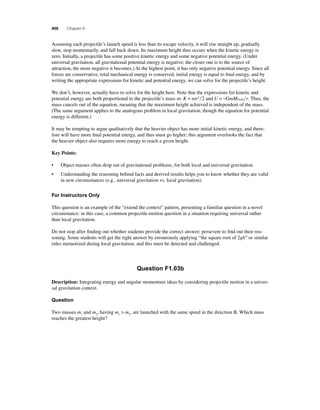
  • 18.
    386 Chapter 8 F or Instructors Only If any students choose “Not enough information,” we suggest asking them what it is they would need to know to make the question answerable, and why they need it. It’s likely they want to know physical dimen-sions for the locations of the string. They may not realize they can count segments to fi nd relative distances, or they may not be comfortable working with ratios rather than actual distances. Question E1.08 Description: Developing problem-solving skills by working with forces and torques in a nontrivial statics situation. Question A uniform rod is hinged to a wall and held at a 30° angle by a thin string that is attached to the ceiling and makes a 90° angle to rod. Which statement(s) must be true? (At least one of them is true and at least one is false.) 30° 1. The hinge force is purely vertical. 2. The hinge force is purely horizontal. 3. The string tension is equal to the hinge force. 4. The string tension is smaller than the rod’s weight. 5. 1 and 3 are true. 6. 2 and 3 are true. 7. 1 and 4 are true. 8. 2 and 4 are true. 9. 3 and 4 are true. 10. Three of the statements are true. Commentary Purpose: To help you learn to reason using forces and torques. Discussion: The rod is at rest, so the net force on it must be zero, and the net torque about any origin must also be zero. This yields many possible relationships, all of which are valid, but only some of which bring out relevant features of this situation. In other words, we do not need to write down every valid equation or rela-tionship to answer this question. Rather, thoughtful choices about how to proceed will yield effi cient results. It is useful to assume nothing about the hinge force and to think of it as having a vertical and a horizontal component. These components can be treated as independent forces. (We often separate one force into two separate component forces, for example when treating the contact force between two surfaces as a normal force and a friction force.) Let’s focus on each statement and determine its truth or falsehood.
  • 19.
    Rotational Equilibrium andRotational Dynamics 387 The hinge force is purely vertical. This statement is false, because the net force in the horizontal direction must be zero. The tension force has a component pulling to the right, so the hinge must pull to the left with an equal force. The hinge force is purely horizontal. This statement is false, because the net torque about the center of mass must be zero. Both the tension force and the horizontal component of the hinge force exert counterclockwise torques about the center of mass of the rod. Therefore, the hinge must have a vertical component to provide a balancing clockwise torque. The string tension is equal to the hinge force. This statement is false, since the two forces have different directions, with the hinge pulling up and to the left and the tension pulling up and to the right. (It turns out that the two forces do have the same magnitude.) The string tension is smaller than the rod’s weight. This statement is true, since the net torque about the left end of the rod must be zero. The torque exerted by the hinge is zero (about this point), so the tension must balance the weight. The moment arm is larger for the tension, so the force must be smaller. Key Points: • For an object at rest, all components of the net force and the net torque about any origin are zero. • Strategic choices of relationships and origins can make analysis and reasoning particularly effi cient. • To isolate an unknown, choose an origin such that the torque due to the other unknown(s) is zero. You can consider the situation using several different origins if you want; τ = Iα must be true for all of them. For Instructors Only This question provides an excellent opportunity to explore problem-solving approaches and strategies. The equations are simple; fi nding the most effi cient use of those equations is more diffi cult. Students can be either unaware of or overwhelmed by the decision making needed to solve statics problems. It all looks so easy when the instructor does it, yet when students are doing homework or exams, it becomes impossible, largely because they have not practiced the skill of strategic thinking. The key to evaluating statements 1 and 2 is to focus on the other component to determine its validity. That is, to determine if the hinge force is purely vertical, one must fi nd out whether the horizontal component is zero. (Students sometimes think that hinges only exert vertical forces.) Some good students might fi gure out that the hinge force and the tension force have the same magnitude, since their horizontal components balance and their vertical components each support half the weight of the rod. They might not realize, however, that statement 3 is about vector equality, requiring magnitudes and directions to be the same. (This falls into the category of students giving the right answer to the wrong question.)
  • 20.
    388 Chapter 8 Question E1.09 Description: Problem solving with forces and torques in a statics context. Question A uniform rod of length 4L, mass M, is suspended by two thin strings, lengths L and 2L as shown. What is the tension in the string at the left end of the rod? L 2L 4L 1. Mg 2. Mg2 3. Mg3 4. Mg4 5. None of the above Commentary Purpose: To help you to understand the defi nition of torque and its application to a static situation. Description: This is a “statics” problem: the object has zero linear acceleration and zero angular accelera-tion, so the net force and the net torque on it must both be zero. Note that a torque is always determined about some origin; the net torque on the object about any origin, anywhere in space, must be zero. If the net force must be zero, the sum of the tensions in the two strings must be Mg, so that the net force on the rod is zero. So if the strings have equal tensions, the tension in each must be Mg2. But are the tensions equal? Since the rod is uniform, its center of mass is at its middle. This is a particularly convenient choice of origin, since the torque due to gravitation is zero about this point. However, we are free choose any point in space as the origin to answer this question. Let’s choose the middle of the rod as the origin. Even though the rod is not perfectly horizontal, the moment arms for the two tension forces are equal. They are equal to the horizontal distance from the center of the rod to the point of attachment of the string (less than 2L), which is the same for each string. Since the net torque about any origin must be zero for an object at rest, the two tensions must exert balancing tor-ques. Since the moment arms are the same, the tensions must be the same also. In other words, each string supports half the weight of the rod. The lengths of the strings does not matter. Another way to solve the problem is to choose the origin to be at the right end of the rod. This is also a strategic choice, because then the torque due to the tension in the right string is zero. Two forces on the rod exert nonzero torques: the tension in the left string, which is the desired unknown, and gravitation. The moment arm for the tension is twice as large as the moment arm for gravitation. (Remember, gravitation acts “as though” the force is exerted at the center of mass.) As before, since the rod is at rest, the two tor-ques must balance each other. Therefore, since the moment arm for the tension is twice as large, the tension must be half as large as the weight of the rod.
  • 21.
    Rotational Equilibrium andRotational Dynamics 389 Key Points: • For a body in static equilibrium (i.e., one that is stationary), the net force on the body and the net torque on the body about any point must both be zero. • Any origin may be chosen to analyze and solve a problem, but thoughtful, strategic choices of origin can make the analysis much simpler. • The “moment arm” of a force about an origin, used to determine the torque it exerts, is the shortest distance from the origin to the imaginary line you get by extending the line along which the force acts to infi nity in both directions. It is not necessarily the distance from the origin to the point at which the force acts on the object. • Gravitation acts “as though” the force is exerted at the center of mass. For Instructors Only This is one of the simplest static situations we can create, yet students often cannot sort out the relevant features because of the angle of the rod. Many conclude intuitively that the left string exerts the larger force, and thoughts of torque, center of mass, and moment arms are often neglected. Students often have diffi culty applying the concept of “moment arm” to a situation in which forces are exerted at an angle relative to the rod or object. A diagram may help many sort this out. Students can be fl ustered by having to choose which point is the origin. They frequently get hung up on making the “right” choice, not realizing that all choices are correct but some are easier to work with than others. It is useful to give students opportunities to think about strategic choices of origin, and also to have students solve the problem two or more times with different origins, as this will encourage comparison of approaches. If students only see one choice for any given situation, they will (reasonably but incorrectly) conclude that there is one best (and therefore “right”) choice to any problem. Question E1.10a Description: Developing problem-solving skills by choosing an origin for torque problems. Question A uniform disk with mass M and radius R sits at rest on an incline 30° to the horizontal. A string is wound around the disk and attached to the top of the incline as shown. The string is parallel to incline. What is the tension in the string? 30° 1. Mg 2. Mg2 3. 2Mg5 4. Mg4 5. None of the above 6. Cannot be determined
  • 22.
    390 Chapter 8 C ommentary Purpose: To develop your problem-solving skills by considering multiple approaches to a question, and explore the signifi cance of where you choose your origin for torque calculations. Discussion: There are often multiple ways to solve a problem, and part of learning to “do” physics well is learning to select the easiest approach to a given problem. This statics question is conceptually straightfor-ward to answer, but the algebra can be relatively simple or complicated depending on the coordinate system you choose. The unknown forces acting on the disk are the tension force of the string that we seek, and the normal and friction forces of the plane. We know the direction of each of these and the location at which it acts on the disk, but not its magnitude. Gravity, whose magnitude and direction we know, also acts on the disk. So, we have three unknowns: the magnitudes of the tension, normal, and friction forces. We therefore need three independent equations in order to solve for them. Since the disk is stationary, we know it is not accelerating in the x- or y-directions, and that it is not rotating about any pivot point we choose to consider. This means that the net force in the x-direction is zero, the net force in the y direction is zero, and the net torque about any point is zero. By writing each of these statements in terms of the actual forces (and trigonometric func-tions of the incline angle), we get three equations, and all we have to do is eliminate the variables we don’t care about and solve for the tension. This is a classic statics problem. The question is, in order to fi nd the tension, what choice of coordinate system and pivot point is best? Any choice will work, but some will lead to rather ugly algebra. How to choose? If we choose the pivot point for our torque equation to be at the point of contact between the disk and incline, then neither the normal nor friction forces exert any torque (since both act at the pivot point itself ). So, the only two torques are due to gravity and the string tension; the only unknown is the magnitude of the tension, and we can solve this one equation for the tension. Simple! We don’t need to use the two force equations or solve for the friction or normal forces at all. The tension exerts a torque of 2RT out of the page. The weight acts at the center of the disk, and the component of the weight perpendicular to the vector from pivot point to the center of the disk is Mgsinθ (the component parallel to the plane), so the weight exerts a torque of MgRsinθ into the page. Thus, 2RT = MgRsinθ , and T = (Mg 2)sinθ . The sine of 30° is 12, so answer (4) is correct. Had we chosen a different pivot point, the system of equations we’d have to solve would be signifi cantly more complex. Key Points: • For a body in static equilibrium, the forces on it must add to zero (vector sum, i.e., along all axes), and the torques must add to zero about any pivot point you choose. • Choosing the orientation of your coordinate axes and the pivot point for your torque equation can make the algebra of a problem easier or harder. • It’s generally wise to choose a pivot point where as many forces as possible, especially unknown ones you aren’t interested in solving for, exert no torque: that is, the forces act at that point, or along a line that passes through the point. For Instructors Only In this question, the issue is not so much which answer is right as what approach provides the easiest path to it. Many students will place their pivot point at the center of the disk or perhaps where the string attaches to the disk, and then dive into two (or three) equations in two (or three) unknowns (depending on their
  • 23.
    Rotational Equilibrium andRotational Dynamics 391 choice of coordinate system). When the simple solution described above is revealed during discussion, a good deal of forehead-smacking occurs, and the point is taken to heart. We fi nd that talking explicitly about problem-solving strategies and providing questions with multiple approaches, some clearly superior to others, helps students to become more effective, effi cient, and aware problem solvers. Question E1.10b Description: Developing problem-solving skills by choosing an origin for torque problems. Question A uniform disk with mass M and radius R sits at rest on an incline 30° to the horizontal. A string is wound around disk and attached to top of incline as shown. The string is parallel to incline. The friction force act-ing at the contact point is: 30° 1. Mg2, down the incline 2. Mg2, up the incline 3. Mg4, up the incline 4. Mg0.86, down the incline 5. None of the above 6. Cannot be determined Commentary Purpose: To develop your problem-solving skills by considering multiple approaches to a question, and to explore the signifi cance of where you choose your origin for torque calculations. Discussion: This question is almost identical to the last one (19a), except it asks for the magnitude of the friction force rather than the tension. It can be solved just as easily as that problem, by choosing a pivot point where the string meets the disk (so the tension and normal forces exert no torque), setting up the torque equation, and solving for the friction force. However, having answered the previous question, we can solve this one even more simply. We know that the net force on the disk is zero. Consider forces acting parallel to the incline. The weight component down the plane is Mgsinθ = Mg 2, and the tension force up the plane is one-half that (Mg4), as we found last question. So, if there is to be no net force along the plane, friction must exert a force equal to tension (Mg4) up the plane, so that together tension and friction can balance the parallel component of the weight. Using what we found last question, we can answer this one in our heads with no signifi cant algebra at all. It might bother some students that the friction force acts upward along the plane. Imagine what would happen if the plane were frictionless: the bottom of the disk would slip forward down the plane, sliding “out from under” the point attached to the string. Thus, friction must oppose this motion by pointing up the plane.
  • 24.
    392 Chapter 8 K ey Points: • Again, think carefully before diving into a calculation. You might already know enough, or be able to reason enough, to answer a question without getting into the algebra. “Work smarter, not harder.” • The moral of these questions isn’t just to choose the best pivot point for a statics problem. It’s to use all your information and knowledge to choose the easiest way to answer a question. For Instructors Only This question is meant to follow 19a. We suggest thoroughly discussing 19a before beginning this one. Some students will not have taken the point of 19a, and will once again wade into multiple equations in multiple unknowns. Some will have taken the specifi c moral about choosing a pivot point carefully, and will repeat that approach here—better, but not ideal. Few are likely to use what they found last question to reason the answer, as outlined above. We strongly suggest drawing a free-body diagram of the disk to support the argument above. Not only does this help some students grasp the argument, but it communicates by example that graphical representa-tions such as free-body diagrams are useful problem-solving tools that should be part of students’ working toolkit. Question E2.01 Description: Developing understanding of angular momentum for linear, circular, and spinning motion. Question Which situation has the least magnitude of angular momentum about the origin? A. A 2-kg mass travels along the line y = 3 m with speed 1.5 ms. B. A 1-kg mass travels in a circle of r = 4.5 m about the origin with speed 2 ms. C. A disk with I = 3 kg · m2 rotates about its center (on origin) with ω = 3 rad s. 1. A 2. B 3. C 4. Both A and B 5. Both A and C 6. Both B and C 7. All have the same magnitude angular momentum. Commentary Purpose: To hone your understanding of angular momentum and confront a common misconception that objects traveling in a straight line must have zero angular momentum. = × , where r Discussion: The angular momentum of a point-like object is defi ned by L r p is the vector from the origin (about which angular momentum is being determined) to the object, and p is the object’s momentum. For a rigid object rotating about an axis, we can use this to derive an expression for the object’s total angular momentum: L = Iω , where I is the moment of inertia of the extended object about the rotation axis and ω is its angular velocity about that axis.
  • 25.
    Rotational Equilibrium andRotational Dynamics 393 If we simply apply the fi rst form to situation A we fi nd that the angular momentum has a magnitude of 9 kg ·m2 /s2. Note that an object does not need to be rotating or traveling in a curve to have nonzero angular momentum; it merely needs a nonzero velocity that isn’t purely radial (towards or away from the origin). If this bothers you, imagine that the mass in situation A strikes and sticks to a stationary disk free to rotate about an axis at the origin. What will happen? The disk with the mass stuck to it will begin to rotate about the axis. The fi nal situation clearly has nonzero angular momentum. For the principle of “conservation of angular momentum” to have any meaning, the initial situation—the mass moving in a straight line—must also have nonzero angular momentum. Similarly, we can apply the fi rst form to situation B to fi nd an angular momentum of 9 kg ·m2 /s2. Alterna-tively, we can use the second form determining the angular velocity from the speed and the circle’s circum-ference, and using I = mR2 as the moment of inertia of a point mass a distance R from the axis. We will get the same answer. Applying the second form to situation C also yields an angular momentum of 9 kg ·m2 /s2. Thus, the best answer is (7). Key Points: = × for a point mass. • Angular momentum is defi ned by L r p • The total angular momentum of a rigid, rotating object can be determined using L = Iω. • A mass does not need to be rotating or spinning to have nonzero angular momentum. Translating past the origin a nonzero distance away is suffi cient. For Instructors Only Answer (1) is common, and reveals the prevalent misconception that objects traveling along a straight line have no angular momentum. Answer (4) reveals the less prevalent misconception that only nonpoint, rotating objects can have a nonzero angular momentum. The other incorrect answers are merely distractors. This is a good problem for stressing that the angular momentum of an object depends on one’s choice of origin. The mass moving linearly in situation A would have no angular momentum if one chose an origin directly along its path, rather than off to the side.
  • 26.
    394 Chapter 8 Question E2.02a Description: Exploring student thinking about rotational motion and angular momentum conservation. Question A child is standing at the rim of a rotating disk holding a rock. The disk rotates freely without friction. If the rock is dropped at the instant shown, which of the indicated paths most nearly represents the path of the rock as seen from above the disk? ω (1) (2) (3) View from above (4) (5) 1. Path (1) 2. Path (2) 3. Path (3) 4. Path (4) 5. Path (5) 6. Cannot be determined Commentary Purpose: To check your understanding of Newton’s fi rst law in a rotational context. Discussion: We interpret the word “drop” in the question statement to mean that the rock is released with-out delivering any impulse to it. At the instant shown, the rock’s velocity is straight forward, tangential to the disk: direction (2). When the rock is released, the only forces acting on the rock are gravity and air resistance. Gravity will accelerate it downwards (into the page, as seen from above), and air resistance will tend to slow it down but not change its direction. Thus, there are no forces that provide an acceleration to the left or right, and the rock must continue along path (2) as seen from above. (Seen from the side, the rock would follow a parabola as it continues traveling forward while accelerating downward.) This is a consequence of Newton’s fi rst law: an object maintains its existing velocity—speed and direction—unless an external force acts upon it. You may think that the “velocity” of the rock before it is dropped is curved. We often use a curved arrow to represent the angular velocity of something, but this does not mean that the (linear) velocity is curved. Velocity is always a vector representing the speed and direction of an object at one point in time, and can be indicated by a (straight) arrow. If the object follows a curved path, the velocity at any point is tangent to the curve. Path (3) might be what the trajectory of the rock would look like to the child who dropped it. In other words, the child is moving away from the path of the rock, and therefore, the rock looks like it is curving away. This is an illusion, however, because the child is accelerating (moving in a circle); the child’s frame of reference is a noninertial (invalid) frame.
  • 27.
    Rotational Equilibrium andRotational Dynamics 395 You might think that the rock travels along path (1), that the velocity changes direction because the rock experiences a “centripetal acceleration,” and that this acceleration is caused by the “centripetal force.” Centripetal force is not a real force. Rather, it is a component of the net force. The “centripetal force” is whatever component points radially inward when all the actual forces, caused by interactions with other objects, are summed. In this situation, the only forces acting on the rock after it is released are gravity and air resistance, so the net force has no component in the radial direction. Thus, the “centripetal force” is zero. You might think that the rock travels along paths (3), (4), or (5) because it is acted upon by the “centrifugal force.” There is no such force. “Centrifugal force” is an illusion experienced within an accelerated (noninertial) reference frame. To the child, it feels like something is pulling the rock outward from her hand; that is the illusory centrifugal force. In reality, the rock’s inertia is just carrying it in a straight line according to Newton’s fi rst law, and the child must exert a force radially inward on it to make it travel in a circle (until she drops it). Key Points: • Newton's fi rst law says that an object travels with constant velocity unless a force acts upon it to change its speed andor direction. • An object travels along a circular path only if some interaction with another object pulls it towards the center of that circle; when that interaction ceases, the object stops moving in a curve and continues in a straight line. • “Centripetal force” is not a real force like tension, gravity, and the like, but is a way of talking about one component of the sum of all forces. • “Centrifugal force” is an illusion experienced in an accelerating reference frame, not a real force. For Instructors Only This is the fi rst of three questions about this situation. Later questions explore conservation of angu-lar momentum and energy; this question sets those up by clarifying the situation, establishing students’ understanding of the rock’s actual trajectory. It also provides a valuable refresher on Newton’s fi rst law and reveals stubborn misconceptions about circular motion. You may be surprised by how many misconceptions this question can reveal, and how tenaciously students cling to them. This question, and others integrating rotational and linear ideas, deserve extended discussion time. To stimulate productive discussion, you may wish to pose questions such as: What path would the child see? What is the velocity of the rock just before and just after it is dropped? What would the path of the rock have been if the child continued to hold it? Do you expect the path to be the same or different when the child drops it?
  • 28.
    396 Chapter 8 Question E2.02b Description: Exploring student thinking about rotational motion and angular momentum conservation. Question A child is standing at the rim of a freely rotating disk holding a rock. The disk rotates without friction. The rock is dropped at the instant shown. As a result of dropping the rock, what happens to the angular velocity of the child and disk? ω (1) (2) (3) View from above (4) (5) 1. Increases 2. Stays the same 3. Decreases 4. Cannot be determined Commentary Purpose: To check your understanding of angular momentum and rotational inertia. Discussion: The angular momentum of a system is conserved when the system experiences no net torque. When the child drops the rock, no external forces are acting on the child and disk that could exert a net torque, so the angular momentum of the child and disk must remain constant. (Internal forces cannot exert a net torque.) Thus, their angular velocity cannot change. To put it another way, in the process of dropping the rock, no angular impulse is delivered to the child and disk, so no change in angular momentum occurs. Key Points: • If a system experiences no net torque, its angular momentum will remain constant. • Only forces external to a system can exert a net force or a net torque on it. • If a system’s angular momentum does not change and its mass distribution remains constant, its angular velocity must also remain constant. For Instructors Only This is the second of three questions about this situation. The fi rst question established the trajectory of the rock following its release; this one establishes the behavior of the child and disk when the rock is dropped. This question makes a good context for discussing the concept of “angular impulse.”
  • 29.
    Rotational Equilibrium andRotational Dynamics 397 Students may confuse themselves on this question by applying angular momentum conservation incor-rectly. They may, for example, believe that the angular momentum of the disk-child-rock system must be constant, and that the rock has no angular momentum after it is released, so the angular momentum of the disk and child must increase. This confusion may be addressed in the context of discussion about the next question in the set. Question E2.02c Description: Linking and relating energy and angular momentum conservation for rotational motion. Question A child is standing at the rim of a freely rotating disk holding a rock. The disk rotates without friction. The rock is dropped at the instant shown. Which of the following statements is true about the process of dropping the rock? ω (1) (2) (3) View from above (4) (5) 1. Angular momentum is conserved, mechanical energy increases. 2. Angular momentum is conserved, mechanical energy decreases. 3. Angular momentum increases, mechanical energy is conserved. 4. Angular momentum decreases, mechanical energy is conserved. 5. Both angular momentum and mechanical energy are conserved. 6. Both angular momentum and mechanical energy increase. 7. Angular momentum decreases, mechanical energy increases. 8. Angular momentum increases, mechanical energy decreases. 9. Both angular momentum and mechanical energy decrease. 10. The conserved quantities cannot be determined. Commentary Purpose: To develop your understanding of energy and angular momentum conservation in a rotational context. Discussion: The angular momentum of a system is conserved when no net torque acts on it. A net torque must come from external forces, since internal interactions cannot apply a net force or a net torque. The mechanical energy of a system is conserved when no external forces or nonconservative internal forces do work on it. (If conservative internal forces do work on it, kinetic energy is exchanged for potential energy, but the total mechanical energy remains constant. If conservative external forces do work, kinetic energy is exchanged for potential, but the potential energy gained or lost is not part of the “system.”)
  • 30.
    398 Chapter 8 I f we take the system to be the rock, the child, and the merry-go-round, and we interpret “drop” to mean that the child releases the rock without doing any work on it, then there is no net torque on the system and also no work done by nonconservative forces. Thus, both angular momentum and mechanical energy are conserved. In the previous question, we established that the angular momentum and angular velocity of the child and disk do not change when the rock is dropped. If the total angular momentum of the disk-child-rock system is also conserved, then the rock itself must have the same angular momentum before and after it is released. This is possible because an object moving in a straight line can have nonzero angular momentum about a point that is not on that line. (Refer to the defi nition of angular momentum in terms of linear momentum to see why.) Note that as the rock is falling, its kinetic energy is increasing due to the gravitational force of the Earth. Therefore, if the Earth is not part of the “system” under consideration, the system’s mechanical energy does increase while the rock is falling towards the ground. However, this is after the “process” the question asks about. Key Points: • The angular momentum of a system is conserved whenever no net torque is exerted upon it. • Only external forces can exert a net torque. • An object moving in a straight line can have angular momentum about a point not on that line. • The mechanical energy of a system is conserved whenever no external or nonconservative internal forces do work on it. • Whether angular momentum or mechanical energy is conserved for a system depends what one includes in the “system.” For Instructors Only This is the last of three questions involving this situation. Questions 69a–c ask about similar situations in which the child throws the rock radially or tangentially rather than dropping it. By using these two question sets together, you can draw students’ attention to the signifi cance of that facet. Some students will say that mechanical energy andor angular momentum is lost when the rock is dropped because it is no longer part of the system. Students generally understand angular momentum as “spinning” or “rotating,” and have great diffi culty understanding how something moving in a straight line can have nonzero angular momentum. Reconcil-ing = × (the defi nition of angular momentum) their intuition and concept of angular momentum with L r p will be diffi cult. It may be helpful to make a connection by considering the constituent “particles” of an extended, rigid, rotating body. To stimulate productive discussion, you may wish to pose questions such as: What is the “system” before the rock is dropped? How about afterwards? What exactly is the “process” we are looking at? When does it start and end? Does the rock have angular momentum (or mechanical energy) just before it is dropped? How about just afterwards? If energy is “lost,” what happens to it? If angular momentum changes, what torques act on the system to change it?
  • 31.
    Rotational Equilibrium andRotational Dynamics 399 Question E2.03a Description: Developing understanding of angular momentum and energy in rotational motion (set-up: addressing velocity vector addition). Question A child is standing at the rim of a disk holding a rock. The disk rotates freely without friction. At the instant shown, the child throws the rock radially outward. Which of the indicated paths most nearly represents the trajectory of the rock as seen from above? ω (1) (2) (3) View from above (4) (5) 1. Path (1) 2. Path (2) 3. Path (3) 4. Path (4) 5. Path (5) 6. None of the above 7. Cannot be determined Commentary Purpose: To revisit velocity and vector addition in the context of rotational motion. Discussion: Just before the rock is thrown, it is moving in a circle, and its instantaneous linear velocity points directly up the page (tangential to the circle of motion). If the child merely dropped the rock, it would continue in a straight line along path (2). However, when the child throws the rock radially outwards, she delivers an impulse in direction (5), so it now has a velocity component in that direction as well as its original velocity component in direction (2). As a result, the rock moves in direction (4). After it has been released, the rock experiences no forces except gravity and air resistance, and neither of those act in a direction that would change its direction left or right. So, seen from above, the rock continues along path (4). You may be tempted to put yourself in the frame of the child, to imagine throwing or dropping the rock. This is dangerous, because the frame of the child is accelerating and is not a proper inertial reference frame. Newton’s laws do not hold in a noninertial frame, so it is best to avoid using one to analyze situations.
  • 32.
    400 Chapter 8 K ey Points: • At any point in time, an object traveling along a curved path has a linear velocity tangential to the curve. • If an object is moving in one direction and receives an impulse in another direction, its resulting motion will be a combination of those two directions. (The exact direction can be found from the vector addition of its original momentum and the applied impulse.) • An object does not continue moving along a curve when the force causing it to follow that curve has ceased. For Instructors Only This is the fi rst of three related questions. This set is similar to Questions 68a–c and is intended to follow them. Some students may answer (5) because they interpret the question to mean that the rock is thrown so that it travels directly outward. In discussing and resolving this ambiguity, students can learn more than if the misinterpretation had been prevented by careful problem wording. Students may also choose (5) because they think of the rock as “at rest” before it is thrown, looking at it from the child’s frame. Presenting students with an analogous situation may be helpful. For example, imagine a ball rolling along the fl oor in one direction and receiving a kick sideways. What direction does it roll after the kick? (This is suitable for a demonstration.) Additional questions to ask during discussion: What is the radial component of the velocity if the rock follows path (2)? Is it possible to throw the rock in such a way that it follows path (5)? Question E2.03b Description: Developing understanding of angular momentum and energy in rotational motion. Question A child is standing at the rim of a rotating disk, and throws a rock radially outward at the instant shown. The disk rotates freely without friction. Which of the following statements is correct about the disk-child-rock system as the rock is thrown? ω (1) (2) (3) View from above (4) (5)
  • 33.
    Rotational Equilibrium andRotational Dynamics 401 1. Angular momentum is conserved; mechanical energy increases. 2. Angular momentum is conserved; mechanical energy decreases. 3. Angular momentum increases; mechanical energy is conserved. 4. Angular momentum decreases; mechanical energy is conserved. 5. Both angular momentum and mechanical energy are conserved. 6. Both angular momentum and mechanical energy increase. 7. Angular momentum decreases; mechanical energy increases. 8. Angular momentum increases; mechanical energy decreases. 9. Both angular momentum and mechanical energy decrease. 10. The conserved quantities cannot be determined. Commentary Purpose: To hone your understanding of energy and angular momentum conservation in a rotational con-text. Discussion: The angular momentum of a system is conserved when no net torque acts on it. A net torque must come from external forces, since internal interactions cannot apply a net force or a net torque. The mechanical energy of a system is conserved when no external forces or nonconservative internal forces do work on it. (If conservative internal forces do work on it, kinetic energy is exchanged for potential energy, but the total mechanical energy remains constant. If conservative external forces do work, kinetic energy is exchanged for potential, but the potential energy gained or lost is not part of the “system.”) Any forces between the child and rock during the act of throwing are internal to the system, and therefore cannot exert a torque on the system. No other forces are present that can exert a torque, so no net torque exists, and the system’s angular momentum is conserved. (After the rock is thrown, it still has angular momentum even though it is traveling in a straight line.) Internal forces between the child and rock are doing work, however. The kinetic energy of the rock increases. Furthermore, these are nonconservative forces, and so the total mechanical energy of the system increases during the throwing. Key Points: • The angular momentum of a system is conserved whenever no net torque is exerted upon it. • Only external forces can exert a net torque. • The mechanical energy of a system is conserved whenever no external or nonconservative internal forces do work on it. • Nonconservative internal forces can do work on and increase the mechanical energy of a system. For Instructors Only This is the second of three related questions. It is parallel to Question E2.02c, but for a thrown rather than dropped rock. Students who answer that mechanical energy is conserved – (3), (4), or (5) – may be expressing their belief that “energy is always conserved,” without appreciating that this does not require the mechanical energy of a particular system to always be conserved. Leading these students to realize that the kinetic energy of the moving rock comes from chemical energy in the tissues of the child’s muscles, which is not considered “mechanical energy,” may be helpful.
  • 34.
    402 Chapter 8 O ther students who answer that mechanical energy is conserved may not realize that internal forces can do work on the system. Discussing analogous situations may be helpful: for example, an accelerating bicycle or automobile, in which internal forces provide the energy (but static friction provides the impulse). Students who answer that mechanical energy decreases – (2), (8), or (9) – may think that the thrown rock is no longer part of the “system,” and so its kinetic energy is removed from the system’s mechanical energy. Students may be surprised to encounter a system whose mechanical energy increases; most of their experi-ence is with forces that dissipate, rather than add, energy. Additional Questions: 1. If the rock is thrown instead in direction (2), (a) would the angular momentum of the system increase, decrease, or stay the same, and (b) would the angular momentum of the rock increase, decrease, or stay the same? 2. The child throws the rock such that it is moving in direction (5) with the same speed as before. (a) Explain how this is possible. (b) What is the angular momentum of the rock afterwards? (c) What quantities must change for the disk-child system during this process? How do they change? Explain. Question E2.03c Description: Developing understanding of angular momentum and energy in rotational motion. Question A child is standing at the rim of a rotating disk holding a rock, and throws a rock in direction (2) at the instant shown. The disk rotates freely without friction. What happens to the angular speed of the disk? ω (1) (2) (3) View from above (4) (5) 1. Increases 2. Remains the same 3. Decreases 4. Impossible to determine Commentary Purpose: To hone and relate the concepts of angular velocity, angular momentum, angular impulse, and torque. Discussion: The angular momentum of a system is conserved when no net torque acts on it. A net torque must come from external forces, since internal interactions cannot apply a net force or a net torque. For the system consisting of the disk, child, and rock, any forces between the child and rock during the act of
  • 35.
    Rotational Equilibrium andRotational Dynamics 403 throwing are internal and cannot exert a net torque on the system (as a whole). If no net torque exists, no angular impulse is delivered, so the angular momentum of the system cannot change. However, this does not tell us whether the angular velocity of the disk and child changes. Let’s consider the “system” consisting of the disk and child, but not the rock. During the act of throwing, the child must exert a force on the rock in the direction the rock is being thrown: direction (2). According to Newton’s third law, the rock must be exerting a force of equal magnitude on the child’s hand, pointing back in the opposite direction. As far as the child and disk are concerned, this is an external force, and exerts a torque in the clockwise direc-tion. This torque causes an angular impulse, changing the angular momentum of the child and disk. Since the torque is in the opposite direction of the rotation, the angular velocity of the disk and child decrease. How is it possible for the angular momentum of the child and disk to decrease if the angular momentum of the child, disk, and rock together is conserved? Because the angular momentum of the rock increases as it is thrown. Recall that an object traveling in a straight line can have nonzero angular momentum about a point not on that line, according to the defi nition of angular momentum L r p ( = × ). The rock’s linear momentum increases as it is thrown, so its angular momentum about the center of the disk does as well. Key Points: • The angular momentum of a system is conserved whenever no net torque is exerted upon it. • Only external forces can exert a net torque on a system. • An object traveling in a straight line has nonzero angular momentum about a point not on that line. • Choosing your “system” wisely makes analyzing situations and answering questions easier. For Instructors Only This is the third of three related questions. This question differs from the others in that the rock is thrown tangentially rather than radially, drawing students’ attention to the signifi cance of that change. This question is useful for relating several different concepts: force, torque, momentum, angular momen-tum, impulse, angular impulse, velocity, and angular velocity. We encourage you to lead a discussion that explores the situation and question from many angles, helping students to fi t these ideas together and resolve apparent contradictions. For example, many students will still most likely have diffi culty with the idea that an object traveling in a straight line can have angular momentum, but that is crucial to understanding how the system as a whole can conserve angular momentum when the disk and child alone do not. Many students may choose the correct answer based on intuition or vague heuristic reasoning, and should be encouraged to formalize or defend this with rigorous analysis. Note that the kinetic energy of the system has increased, even though the angular speed of the disk-child system has decreased.
  • 36.
    404 Chapter 8 Question E2.04 Description: Relating angular momentum to kinetic energy for rotation. Question An ice skater begins a spin in the middle of a large rink, but then starts to spin faster by pulling her arms in. Which of the following statements is true? 1. Both kinetic energy and angular momentum are conserved. 2. Kinetic energy is conserved; angular momentum increases. 3. Kinetic energy is conserved; angular momentum decreases. 4. Kinetic energy increases; angular momentum is conserved. 5. Kinetic energy decreases; angular momentum is conserved. 6. Both kinetic energy and angular momentum increase. 7. Kinetic energy increases; angular momentum decreases. 8. Kinetic energy decreases; angular momentum increases. 9. Both kinetic energy and angular momentum decrease. 10. Impossible to determine Commentary Purpose: To improve your understanding of conservation laws and internal forces. Discussion: If we treat the ice as frictionless, only two external forces act on the skater: gravitation (down) due to the Earth and a normal force (up) due to the ice. Neither of these exerts a torque about the skater’s center of mass, so her angular momentum is conserved. By pulling in her arms, however, she has decreased her rotational inertia, so her angular velocity must increase: L = Iω. Her kinetic energy, however, must increase. If angular momentum is conserved, I1ω= Iω. This means 1 22that if her rotational inertia I has decreased by a factor we’ll call f (so that I= If ), her angular speed 2 1must increase by that same factor: ω = f ω . Her kinetic energy must therefore increase by a factor of f: 2 1 K = I ω 2 2 = fI ω 2 2 = fK . 2 2 2 1 1 1 Where does the additional energy come from? As the skater pulls her arms in, she is applying a force through a displacement and thus doing work on the system. She is converting chemical energy stored in her body to kinetic energy. Key Points: • If a system experiences no net external torque, its angular momentum does not change. • Internal forces can do work on a system and increase its kinetic energy. • Angular momentum can remain constant while angular speed increases (or decreases), if rotational inertia decreases (or increases) by the same factor. • If angular speed changes but angular momentum does not, kinetic energy from rotation must also change. For Instructors Only Students who indicate that angular momentum decreases – (3), (7), or (9) – may be taking friction into account. They are not incorrect; they are merely not making the “expected” assumption.
  • 37.
    Rotational Equilibrium andRotational Dynamics 405 Students may claim that angular momentum increases – (2), (6), or (8) – because they associate larger angular speed with larger angular momentum, ignoring the role of rotational inertia or not realizing that it decreases suffi ciently in this situation. Some students may correctly believe that kinetic energy increases, but without understanding how this arises from the interplay between I and ω. Students indicating that kinetic energy decreases – (5), (8), or (9) – may think that kinetic energy would be conserved except for the effect of friction. Question F1.03a Description: Integrating energy and angular momentum ideas by considering projectile motion in a univer-sal gravitation context. Question Two masses m1 and m2, having m1 m2, are launched with the same speed in the direction A. Which mass reaches the greatest height? A B C 1. m1 2. m2 3. Both reach the same height. Commentary Purpose: To extend your understanding of energy conservation and projectile motion into the realm of “universal gravitation.” Discussion: Under the assumptions of “local gravity,” the maximum height a projectile reaches does not depend on the object’s mass, only on its launch direction and speed. This problem inquires whether that is also true under universal gravitation, thus stimulating you to generalize your understanding of projectile motion and work with universal gravitation ideas.
  • 38.
    406 Chapter 8 A ssuming each projectile’s launch speed is less than its escape velocity, it will rise straight up, gradually slow, stop momentarily, and fall back down. Its maximum height thus occurs when the kinetic energy is zero. Initially, a projectile has some positive kinetic energy and some negative potential energy. (Under universal gravitation, all gravitational potential energy is negative; the closer one is to the source of attraction, the more negative it becomes.) At the highest point, it has only negative potential energy. Since all forces are conservative, total mechanical energy is conserved, initial energy is equal to fi nal energy, and by writing the appropriate expressions for kinetic and potential energy, we can solve for the projectile’s height. We don’t, however, actually have to solve for the height here. Note that the expressions for kinetic and potential energy are both proportional to the projectile’s mass m: K = mv22 and U = –GmMEarthr. Thus, the mass cancels out of the equation, meaning that the maximum height achieved is independent of the mass. (The same argument applies to the analogous problem in local gravitation, though the equation for potential energy is different.) It may be tempting to argue qualitatively that the heavier object has more initial kinetic energy, and there-fore will have more fi nal potential energy, and thus must go higher; this argument overlooks the fact that the heavier object also requires more energy to reach a given height. Key Points: • Object masses often drop out of gravitational problems, for both local and universal gravitation. • Understanding the reasoning behind facts and derived results helps you to know whether they are valid in new circumstances (e.g., universal gravitation vs. local gravitation). For Instructors Only This question is an example of the “extend the context” pattern, presenting a familiar question in a novel circumstance: in this case, a common projectile-motion question in a situation requiring universal rather than local gravitation. Do not stop after fi nding out whether students provide the correct answer; persevere to fi nd out their rea-soning. Some students will get the right answer by erroneously applying “the square root of 2gh” or similar rules memorized during local gravitation, and this must be detected and challenged. Question F1.03b Description: Integrating energy and angular momentum ideas by considering projectile motion in a univer-sal gravitation context. Question Two masses m1 and m2, having m1 m2, are launched with the same speed in the direction B. Which mass reaches the greatest height?
  • 39.
    Rotational Equilibrium andRotational Dynamics 407 A B C 1. m1 2. m2 3. Both reach the same height. Commentary Purpose: To help you integrate angular momentum and energy ideas in universal gravitation problems. Discussion: In the previous question, a projectile launched directly upwards reached its apogee (maximum height) when its speed was zero. In this question, the projectiles are launched at an angle and therefore have a nonzero speed even at apogee. In order to apply the principle of conservation of energy to fi nd the maximum height, we need to know how much kinetic energy each projectile will have at the top. If we were doing this problem with local gravity (a “fl at earth” with constant gravitational force), the trajectory of a projectile would be a parabola, the horizontal component of the velocity would be constant, and by fi nding the initial horizontal velocity we would know it at all times and could fi nd the kinetic energy at apogee (when the vertical component of the velocity is zero). With this problem, however, the projectile will follow an elliptical orbit rather than a parabola, and the horizontal velocity (in a coordinate system fi xed at the launch point) is not constant. What is constant? The angular momentum of the projectile around the center of the earth is conserved, since the only force acting upon it is central (points toward the center of the earth) and thus exerts no torque. We can relate the angular momentum to the “horizontal” (tangential) velocity component vt as fol-lows: = × = × ⇒ m mrt L r p r v v . Since the kinetic energy at apogee Ka is m t v2 2 (since the radial compo-nent of velocity vr is zero), we can write Ka in terms of the angular momentum: K L mr a a = 2 (2 2 ) (where ra is the radius of the projectile—its height above the center of the earth—at apogee). Since the angular momentum is constant, we can fi nd its value at the moment of launch: L = mr v = mR vcosθ where θ is the launch angle (above horizontal) and v0 the launch speed. Now, if we t E 0 substitute this into our expression for Ka, we get K = mR 2 v2 cos2θ ( 2 r 2 ) . In other words, we fi nd that the a E 0 kinetic energy at apogee is proportional to the projectile’s mass. Since kinetic energy at launch and potential energy at launch and apogee are all also proportional to the mass (as discussed in the previous question), mass cancels out of the conservation of energy equation, and we fi nd that the maximum height does not depend on mass. Thus, both projectiles must reach the same maximum height. In other words, the same argument applies to this question as to the previous one, but in this case we had to do a little more work to demonstrate that the argument does apply. Intuition might suggest to you that the mass does not matter, but part of physics is learning to back up your intuition with a solid argument.
  • 40.
    408 Chapter 8 K ey Points: • For orbit problems and universal gravitation, much of what you’ve learned about parabolic trajectory problems does not apply, or applies only with signifi cant modifi cation. • Angular momentum is a powerful concept for reasoning about gravitation and orbit problems. • For an orbiting body, a certain amount of energy is “locked up” in preserving the body's angular momentum and cannot be converted to potential energy; the rest of the energy moves between potential and kinetic as the object orbits farther from and then closer to the object attracting it. For Instructors Only This, once again, is an example of “extending the context”: the problem is identical to 6a, except for the initial launch direction of the projectiles; it thus focuses students’ attention on the signifi cance of having an initial horizontal component. As before, students may very easily select the correct answer based on incorrect or insuffi cient reasoning; the point of this question is therefore to motivate discussion about why that answer is correct. Playing the Devil’s Advocate can be useful here. This is a hard question, but it provides fertile ground for exploring the application of energy and angular momentum ideas to universal gravitation and orbit problems. It can serve as the “anchor” and motivator for an extended exploration of the topics. Question F1.03c Description: Integrating energy and angular momentum ideas by considering projectile motion in a univer-sal gravitation context. Question A mass m is launched from the surface of the Earth with speed v. The diagram shows three possible launch directions; order them according to the maximum height the projectile will reach, from greatest height to least height. A B C 1. A = B = C 2. A B = C 3. A B C 4. A C B
  • 41.
    Rotational Equilibrium andRotational Dynamics 409 5. A B = C 6. A B C 7. A C B 8. B A C 9. B A = C 10. Not enough information Commentary Purpose: To develop your understanding of the role angular momentum plays in the motion of an object under universal gravitation. Discussion: If you understood the reasoning behind the previous question, this one should be fairly straightforward: the question compares projectiles with different launch directions rather than with different masses, but the ideas are the same. Angular momentum must be conserved; the more angular momentum a projectile has, the more kinetic energy is “locked up” preserving that angular momentum and the less is available to convert to gravitational potential energy, so the lower the projectile’s maximum height will be. A projectile launched in direction A has no angular momentum about the center of the Earth; that path must therefore produce the greatest maximum height. Direction C will produce the greatest angular momentum, and so will cause the least maximum height of the three paths. Thus, A B C is the best ranking. Key Points: • Angular momentum is a powerful concept for reasoning about gravitation and orbit problems. • For an orbiting body, a certain amount of energy is “locked up” in preserving the body’s angular momentum and cannot be converted to potential energy; the rest of the energy moves between potential and kinetic as the object orbits farther from and then closer to the object attracting it. For Instructors Only Asking students to rank order situations according to some quantity is a good way to foster qualitative analysis skills and check for conceptual understanding of an idea. If students seem to be comfortable with this problem, you might challenge them by asking to rank order the escape velocity required for the three launch directions. The escape velocity is in fact the same for all three, but to students this can seem to contradict the reasoning they’ve just used for this question. Exploring and resolving the apparent contradiction pushes students to further refi ne their understanding of escape velocity and the relationship between angular momentum and energy in orbit problems.
  • 42.
    410 Chapter 8 QUICK QUIZZES 1. (d). A larger torque is needed to turn the screw. Increasing the radius of the screwdriver handle provides a greater lever arm and hence an increased torque. 2. (b). Since the object has a constant net torque acting on it, it will experience a constant angular acceleration. Thus, the angular velocity will change at a constant rate. 3. (b). The hollow cylinder has the larger moment of inertia, so it will be given the smaller angular acceleration and take longer to stop. 4. (a). The hollow sphere has the larger moment of inertia, so it will have the higher rotational kinetic energy. 5. (c). Apply conservation of angular momentum to the system (the two disks) before and after the second disk is added to get the result: I1ω1 = (I1 + I2 )ω . 6. (a). Earth already bulges slightly at the Equator, and is slightly fl at at the poles. If more mass moved towards the Equator, it would essentially move the mass to a greater distance from the axis of rotation, and increase the moment of inertia. Because conservation of angular momentum requires that ωz z I = constant, an increase in the moment of inertia would decrease the angular velocity, and slow down the spinning of Earth. Thus, the length of each day would increase. ANSWERS TO MULTIPLE CHOICE QUESTIONS 1. τ = rF sinθ = (0.500 m)(80.0 N)sin(60.0°) = 36.4 N⋅⋅m which is choice (a). 2. Using the left end of the plank as a pivot and requiring that Στ = 0 gives −mg(2 00 )+ F (3 00 ) = 0 2 . m . m , or F mg 2 2 3 ( . kg )( . m s ) = 2 20 0 9 80 = = 131 3 N 2 so choice (d) is the correct response. 3. Assuming a uniform, solid disk, its moment of inertia about a perpendicular axis through its center is I = MR2 2, so τ = Iα gives α = τ = ( ⋅ ) 2 2 400 . ( )( ) = 5 00 MR2 2 25 0 0 800 . . . N m kg m rad s2 and the correct answer is (b). 4. For a uniform, solid sphere, I = 2MR2 5 and ω π E = rad d 7 27 10 5 1 d × ⎛⎝ ⎜ ⎞⎠ ⎟ 2 1 = × − 8.64 10 s r 4 . ad s so 1 ⎛ ( × )( × ) 2 KE I r E = = 1 2 2 5 98 10 6 38 10 5 2 24 6 2 ω . kg . m ⎝ ⎜⎜ ⎞ ⎠ ⎟⎟ (7 27 × 10−5 )2 . rad s yielding KEr ∼ 3 ×1029 J, making (a) the correct choice. F1 mg F2 3.00 m 2.00 m
  • 43.
    Rotational Equilibrium andRotational Dynamics 411 5. In order for an object to be in equilibrium, it must be in both translational equilibrium and rotational equilibrium. Thus, it must meet two conditions of equilibrium, namely F net = 0 and τ net = 0. The correct answer is therefore choice (d). 6. In a rigid, rotating body, all points in that body rotate about the axis at the same rate (or have the same angular velocity). The centripetal acceleration, tangential acceleration, linear velocity, and total acceleration of a point in the body all vary with the distance that point is from the axis of rotation. Thus, the only correct choice is (b). 7. The moment of inertia of a body is determined by its mass and the way that mass is distributed about the rotation axis. Also, the location of the body’s center of mass is determined by how its mass is distributed. As long as these qualities do not change, both the moment of inertia and the center of mass are constant. From τ = Iα , we see that when a body experiences a constant, nonzero torque, it will have a constant, nonzero angular acceleration. However, since the angular acceleration is nonzero, the angular velocity ω (and hence the angular momentum, L = Iω) will vary in time. The correct responses to this question are then (b) and (e). 8. When objects travel down ramps of the same length, the one with the greatest translational kinetic energy at the bottom will have the greatest fi nal translational speed (and, hence, greatest average translational speed). This means that it will require less time to travel the length of the ramp. Of the objects listed, all will have the same total kinetic energy at the bottom, since they have the same decrease in gravitational potential energy (due to the ramps having the same vertical drop) and no energy has been spent overcoming friction. All of the block’s kinetic energy is in the form of translational kinetic energy. Of the rolling bodies, the fraction of their total kinetic energy that is in the translational form is f KE KE KE M 1 M I I M t t r = + = + = + ( )( ) = 1 2 2 1 2 2 1 2 2 2 1 v v ω ω v 1 1+ I (MR2 ) Since the ratio I MR2 equals 2 5 for a solid ball and 2 3 for a hollow sphere, the ball has the larger translational kinetic energy at the bottom and will arrive before the hollow sphere. The correct rankings of arrival times, from shortest to longest, is then block, ball, sphere, and choice (e) is the correct response. 9. Please read the answer to Question 8 above, since most of what is said there also applies to this question. The total kinetic energy of either the disk or the hoop at the bottom of the ramp will be KE Mgh total = , where M is the mass of the body in question and h is the vertical drop of the ramp. The translational kinetic energy of this body will then be KE f KE fMgh t= = total , where f is the fraction discussed in Question 8. Hence, M v2 2 = f M gh and the translational speed at the bottom is v = 2 fgh. Since f = 1 (1+ 1 2) = 2 3 for the disk and f = 1 (1+ 1) = 1 2 for the hoop, we see that the disk will have the greater translational speed at the bottom, and hence, will arrive fi rst. Notice that both the mass and radius of the object has canceled in the calculation. Our conclusion is then independent of the object’s mass andor radius. Therefore, the only correct response is choice (d).
  • 44.
    412 Chapter 8 1 0. The ratio of rotational kinetic energy to the total kinetic energy for an object that rolls without slipping is KE KE KE + KE KE I ω 1 v ω v M I M I = r r total t r = + = 1 2 2 1 2 2 1 2 2 ω ⎛⎝ ⎞⎠ + = + 2 2 1 1 1 MR I For a solid cylinder, I = MR2 2 and this ratio becomes KE KE r total = = 1 2 1 + 1 3 so the correct answer is (c). 11. If a car is to reach the bottom of the hill in the shortest time, it must have the greatest translational speed at the bottom (and hence, greatest average speed for the trip). To maximize its fi nal trans-lational speed, the car should be designed so as much as possible of the car’s total kinetic energy is in the form of translational kinetic energy. This means that the rotating parts of the car (i.e., the wheels) should have as little kinetic energy as possible. Therefore, the mass of these parts should be kept small, and the mass they do have should be concentrated near the axle in order to keep the moment of inertia as small as possible. The correct response to this question is (e). 12. Please review the answers given above for questions 8 and 9. In the answer to question 9, it is shown that the translational speed at the bottom of the hill of an object that rolls without slipping is v = 2 fgh where h is the vertical drop of the hill and f is the ratio of the translational kinetic energy to the total kinetic energy of the rolling body. For a solid sphere, I = 2MR2 5, so the ratio f is f = 1 I MR = + ( ) = + 1 1 1 2 5 1 2 1.4 and the translational speed at the bottom of the hill is v = 2gh 1.4. Notice that this result is the same for all uniform, solid, spheres. Thus, the two spheres have the same translational speed at the bottom of the hill. This also means that they have the same average speed for the trip, and hence, both make the trip in the same time. The correct answer to this question is (d). 13. Since the axle of the turntable is frictionless, no external agent exerts a torque about this vertical axis of the mouse-turntable system. This means that the total angular momentum of the mouse-turntable system will remain constant at its initial value of zero. Thus, as the mouse starts walking around the axis (and developing an angular momentum, L Imouse m m = ω , in the direction of its angular velocity), the turntable must start to turn in the opposite direction so it will possess an angular momentum, L Itable t t = ω , such that L L L I I total mouse table m m t t = + = ω + ω = 0. Thus, the angular velocity of the table will be ω ω t m t m = −(I I ) . The negative sign means that if the mouse is walking around the axis in a clockwise direction, the turntable will be rotating in the opposite direction, or counterclockwise. The correct choice for this question is (d).
  • 45.
    Rotational Equilibrium andRotational Dynamics 413 ANSWERS TO EVEN-NUMBERED CONCEPTUAL QUESTIONS 2. If the bar is, say, seven feet above the ground, a high jumper has to lift his center of gravity approximately to a height of seven feet in order to clear the bar. A tall person already has his center of gravity higher than that of a short person. Thus, the taller athlete has to raise his center of gravity through a smaller distance. 4. The lever arm of a particular force is found with respect to some reference point. Thus, an origin for calculating torques must be specifi ed. However, for an object in equilibrium, the calculation of the total torque is independent of the location of the origin. 6. The critical factor is the total torque being exerted about the line of the hinges. For simplicity, we assume that the paleontologist and the botanist exert equal magnitude forces. The free body diagram of the original situation is shown on the left and that for the modifi ed situation is shown on the right in the sketches below: Pivot point →F →F →F Pivot point 8 cm d0 d Original situation Modified situation In order for the torque exerted on the door in the modifi ed situation to equal that of the original situation, it is necessary that Fd = Fd + F( ) 0 8 cm or d = d + 0 8 cm. Thus, the paleontologist would need to relocate about 8 cm farther from the hinge. 8. Stable rotation axis Stable rotation axis Unstable rotation axis 10. After the head crosses the bar, the jumper should arch his back so the head and legs are lower than the midsection of the body. In this position, the center of gravity may pass under the bar while the midsection of the body is still above the bar. As the feet approach the bar, the legs should be straightened to avoid hitting the bar. 12. (a) Consider two people, at the ends of a long table, pushing with equal magnitude forces directed in opposite directions perpendicular to the length of the table. The net force will be zero, yet the net torque is not zero. (b) Consider a falling body. The net force acting on it is its weight, yet the net torque about the center of gravity is zero. 14. As the cat falls, angular momentum must be conserved. Thus, if the upper half of the body twists in one direction, something must get an equal angular momentum in the opposite direction. Rotating the lower half of the body in the opposite direction satisfi es the law of conservation of angular momentum.
  • 46.
    414 Chapter 8 PROBLEM SOLUTIONS 8.1 Since the friction force is tangential to a point on the rim of the wheel, it is perpendicular to the radius line connecting this point with the center of the wheel. The torque of this force about the axis through the center of the wheel is then τ = rf sin 90.0° = rf , and the friction force is f = τ = 76 0 ⋅ = r 217 . N m 0.350 m N 8.2 The torque of the applied force is τ = rFsinθ . Thus, if r = 0.330 m, θ = 75.0°, and the torque has the maximum allowed value of τ max = 65.0 N⋅m, the applied force is F τ = = = ⋅ r ( ) ° max sin θ . sin . 65 0 75 0 204 N m 0.330 m N 8.3 First resolve all of the forces shown in Figure P8.3 into components parallel to and perpendicular to the beam as shown in the sketch below. (30 N)cos45° O C (25 N)cos30° (25 N)sin30° (10 N)cos20° (30 N)sin45° 2.0 m (10 N)sin20° 4.0 m (a) τ O = + ( ) ° ⎡⎣ 25 N cos 30 2.0 m 10 N sin 20° (4.0 m) = +30 N⋅m ⎤⎦ ( ) − ( ) ⎡⎣ ⎤⎦ or τ O= 30 N⋅m counterclockwise (b) τ C = + ( ) ⎡⎣ 30 N sin 45 2.0 m 10 N sin 20° (2.0 m) = +36 N⋅m ° ( ) − ( ) ⎡⎣ ⎤⎦ ⎤⎦ or τ C= 36 N⋅m counterclockwise 8.4 The lever arm is d = (1.20 × 10⁻² m)cos 48.0° = 8.03 × 10⁻³ m, and the torque is τ = Fd = (80.0 N)(8.03 ×10⁻³ m) = 0.642 N⋅m counterclockwise 8.5 (a) τ = F ⋅ (lever arm) = (mg)⋅[ θ ] g sin = ( )( )⋅ ( ) ⎡⎣ 3.0 kg 9.8 m s2 2.0 m sin 5.0° = 5.1 N⋅⋅m ⎤⎦ Pivot q Fg mg q (b) The magnitude of the torque is proportional to the sinθ , where θ is the angle between the direction of the force and the line from the pivot to the point where the force acts. Note from the sketch that this is the same as the angle the pendulum string makes with the vertical. Since sinθ increases as θ increases, the torque also increases with the angle.
  • 47.
    Rotational Equilibrium andRotational Dynamics 415 8.6 The object is in both translational and rotational equilibrium. Thus, we may write: ΣFx = 0 ⇒ Fx − Rx = 0 ΣF F R F y y y g = 0 ⇒ + − = 0 and Στ = ⎜ ⎛⎝ ⇒ F ( cos θ )− F ( sin θ )− F cos θ ⎟ = 0 O y x g ⎞⎠ 0 2 8.7 0.080 m FtyFt sin12.0° FtxFt cos12.0° 0.290 m Pivot 41.5 N Requiring that Στ = 0, using the shoulder joint at point O as a pivot, gives Στ = (F °)( ) − ( )( ) = t sin12.0 0.080 m 41.5 N 0.290 m 0, or Ft = 724 N Τhen ΣFy= 0 ⇒ −F + ( ) ° − sy 724 N sin12.0 41.5 N = 0, yielding Fsy = 109 N. ΣFx = 0 gives Fsx − (724 N)cos12.0° =0, or Fsx = 708 N Therefore, F F F s sx sy = 2 + 2 = ( )2 + ( )2 = 708 N 109 N 716 N 8.8 (a) Since the beam is in equilibrium, we choose the center as our pivot point and require that Στ ) = − ( ) + ( ) = center Sam Joe F 2.80 m F 1.80 m 0 or F F Joe Sam = 1.56 [1] Also, ΣF F F y= 0 ⇒ + = 450 N Sam Joe [2] Substitute Equation [1] into [2] to get the following: F F Sam Sam + 1.56 = 450 N or FSam x 2.80 m y 1.80 m x y FSam FJoe = 450 N = N 2.56 176 Then, Equation [1] yields FJoe = 1.56(176 N) = 274 N . Fsx Fsy Fsy Fsx q → Fs Fg 450 N continued on next page
  • 48.
    416 Chapter 8 (b) If Sam moves closer to the center of the beam, his lever arm about the beam center decreases, so the force FSam must increase to continue applying a clockwise torque capable of offsetting Joe’s counterclockwise torque. At the same time, the force FJoe would decrease since the sum of the two upward forces equal the magnitude of the downward gravitational force. (c) If Sam moves to the right of the center of the beam, his torque about the midpoint would then be counterclockwise. Joe would have to hold down on the beam in order to exert an offsetting clockwise torque. 8.9 Require that Στ = 0 about an axis through the elbow and perpendicular to the page. This gives Στ = + ( )( ) ⎡⎣ 2.00 kg 9.80 m s2 (25.0 cm+8.00 cm) − (F °)( ) = B cos 75.0 8.00 cm 0 ⎤⎦ or FB = ( )( ) ( ) ° = 19 6 33 0 8 00 75 0 312 . . . cos . N cm cm N 8.10 Since the bare meter stick balances at the 49.7 cm mark when placed on the fulcrum, the center of gravity of the meter stick is located 49.7 cm from the zero end. Thus, the entire weight of the meter stick may be considered to be concentrated at this point. The free-body diagram of the stick when it is balanced with the 50.0-g mass attached at the 10.0 cm mark is as given at the right. 39.2 cm (50.0 g)g Requiring that the sum of the torques about point O be zero yields + ( ) ⎡⎣ → 50.0 g g (39.2 cm −10.0 cm)− M g (49.7 cm − 39.2 cm) = 0 ⎤⎦ or M = ( ) − − ⎛⎝ ⎜ 50 0 39 2 10 0 49 7 39 2 . . . . . g cm cm cm cm ⎞⎠ ⎟ = 139 g 8.11 Consider the remaining plywood to consist of two parts: A1is a 4.00-ft-by-4.00-ft section with center of gravity located at (2.00 ft, 2.00 ft), while A2 is a 2.00-ft-by-4.00-ft section with center of gravity at (6.00 ft, 1.00 ft). Since the plywood is uniform, its mass per area σ is constant and the mass of a section having area A is m =σ A. The center of gravity of the remaining plywood has coordinates given by x m =Σ x ( ) Σ m σ A x σ A x σ A σ A i i i cg ft2 = = + 1 1 2 2 + 1 2 ( )+( )( ) ( )+ 0 16.0 2. . . 00 8 00 6 00 ft ft ft ft ft ( 2 ) = . 16 . 0 8 . 0 2 2 3 33 ft and y m =Σ y ( ) Σ m σ A y σ A y σ A σ A i i i cg ft2 = = + 1 1 2 2 + 1 2 ( )+( )( ) ( )+ 0 16.0 2. . . 00 8 00 1 00 ft ft ft ft ft ( 2 ) = . 16 . 0 8 . 0 2 2 1 67 ft R → 49.7 cm → Mg 10.0 cm Point O y (ft) A1 A2 x (ft) 4.00 2.00 2.00 4.00 6.00 8.00 0
  • 49.
    Rotational Equilibrium andRotational Dynamics 417 8.12 (a) mg Mg x 3.00 m 4.00 m n2 Mg = (90.0 kg)(9.80 m s2 ) = 882 N mg = (55.0 kg)(9.80 m s2 ) = 539 N n1 (b) The woman is at x = 0 when n is greatest. 1 With this location of the woman, the counterclockwise torque about the center of the beam is a maximum. Thus, n1 must be exerting its maximum clockwise torque about the center to hold the beam in rotational equilibrium. (c) n1 = 0 As the woman walks to the right along the beam, she will eventually reach a point where the beam will start to rotate clockwise about the rightmost pivot. At this point, the beam is starting to lift up off of the leftmost pivot and the normal force exerted by that pivot will have diminished to zero. (d) When the beam is about to tip, n1 = 0, and ΣFy = 0 gives 0 0 2 + n − Mg − mg = , or = + = 882 N+ 539 N = 1.42 ×10³ N n Mg mg 2 (e) Requiring that Στ )rightmost = pivot 0 when the beam is about to tip (n1 = 0) gives +(4.00 m − x)mg + (4.00 m − 3.00 m)Mg = 0 or (mg) x = (1.00 m)Mg + (4.00 m)mg, and x M m = (1.00 m) + 4.00 m Thus, x =( )( ) 90 . 0 55 . 0 kg kg . )1 00 m ( + 4 . 00 = m 5.64 m (f ) When n1 = 0 and n2 = 1.42 ×10³ N, requiring that Στ ) = left end 0 gives 0 − (539 N) x − (882 N)(3.00 m) + (1.42 ×10 3 N)(4.00 m) = 0 or x =− × ⋅ = 3 03 10 − 539 5 62 . 3 . N m N N which, within limits of rounding errors, is the same as the answer to part (e) .
  • 50.
    418 Chapter 8 8 .13 Requiring that x m x m cg i i i = Σ Σ = 0 gives (5.0 kg)(0) + (3.0 kg)(0) + (4.0 kg)(3.0 m) + 8.0 kg kg ( ) x ( + + + ) = 5 0 3 0 4 0 8 0 0 . . . . or 8.0 x +12 m = 0 which yields x = −1.5 m Also, requiring that y my m cg i i i = Σ Σ = 0 gives (5.0 kg)(0) + (3.0 kg)(4.0 m) + (4.0 kg)(0) + 8.0 kg kg ( ) y ( + + + ) = 5 0 3 0 4 0 8 0 0 . . . . or 8.0 y +12 m = 0 yielding y = −1.5 m Thus, the 8.0-kg object should be placed at coordinates (−1.5 m,−1.5 m) . 8.14 (a) As the woman walks to the right along the beam, she will eventually reach a point where the beam will start to rotate clockwise about the rightmost pivot. At this point, the beam is starting to lift up off of the leftmost pivot and the normal force, n1, exerted by that pivot will have diminished to zero. Then, ΣF mg Mg n y= 0 ⇒ 0 − − + = 0 2 , or n m Mg 2= ( + ) (b) When n n m M g 1 2 = 0 and = ( + ) , requiring that Στ )left = end 0 gives 0 L − (mg) x − (Mg) + ( + ) = 0 2 mg Mg or x L = + ⎛⎝ ⎜ M m M m ⎞⎠ ⎟ −⎛⎝ ⎜ ⎞⎠ ⎟ 1 2 (c) If the woman is to just reach the right end of the beam (x = L) when n n m M g 1 2 = 0 and = ( + ) (i.e., the beam is ready to tip), then the result from Part (b) requires that L L = + ⎛⎝ ⎜ ⎞⎠ ⎟1 M m M m ⎞⎠ ⎟ −⎛⎝ ⎜ or = 2 ( 1 + 2 ) + 2 ( 1 + ) = + ⎛⎝ ⎜ ⎞⎠ ⎟ M m M m m M m M L 8.15 In each case, the distance from the bar to the center of mass of the body is given by x Σ + + Σ m x m x m i i m x m i cg arms arms torso torso thigh = = x m x s thighs legs legs m m m m arms torso thighs l + + + +e egs where the distance x for any body part is the distance from the bar to the center of gravity of that body part. In each case, we shall take the positive direction for distances to run from the bar toward the location of the head. Note that Σmi= (6.87 + 33.57 +14.07 + 7.54) kg = 62.05 kg. mg Mg L/2 x n1 n2 continued on next page
  • 51.
    Rotational Equilibrium andRotational Dynamics 419 With the body positioned as shown in Figure P8.15b, the distances x for each body part is computed using the sketch given below: Positive direction Knee joint Hip joint Shoulder joint Bar thighs torso arms (rcg)legs (rcg)thighs (rcg)torso (rcg)arms = +( ) = +0.239 m x r arms cg arms = + ( ) = + 0.548 m+ 0.337 m = 0.885 m x r torso arms cg torso = + + ( ) = (+ 0.548+ 0.601+ 0.151) m = 1.30 m x r thighs arms torso cg thighs = + + + ( ) = (+ 0.548+ 0.601+ 0.374+ 0.227) m = 1.75 m x r legs arms torso thighs cg legs With these distances and the given masses we fi nd xcg = + ⋅ = + m 62 8 kg m kg 62 05 1 01 . . . With the body positioned as shown in Figure P8.15c, we use the following sketch to determine the distance x for each body part: Positive direction Knee joint Hip joint Shoulder Joint Bar thighs torso (rcg)arms arms (rcg)legs (rcg)torso (rcg)thighs = +( ) = +0.239 m x r arms cg arms = − ( ) = + 0.548 m − 0.337 m = +0.211 m x r torso arms cg torso = − − ( ) = (+ 0.548 − 0.601− 0.151) m = −0.204 m x r thighs arms torso cg thighs = − − − ( ) = (+ 0.548 −− 0.601− 0.374 − 0.227) m = −0.654 m x r legs arms torso thighs cg legs With these distances, the location (relative to the bar) of the center of gravity of the body is xcg = + ⋅ = + m = m to 0 924 kg m kg 62 05 0 015 0 015 . . . . wards the head
  • 52.
    420 Chapter 8 8 .16 With the coordinate system shown below, the coordinates of the center of gravity of each body part may be computed: y x Bar Origin 60.0° arms thighs (rcg)arms (rcg)legs (rcg)thighs (rcg)torso torso xcg,arms = 0 = − ( ) = 0.309 m y r cg,arms arms cg arms = ( ) = 0.337 m x r cg, torso cg torso ycg, torso = 0 = + ( ) cos60.0° = 0.676 m y r cg, thighs cg thighs x r cg, thighs torso cg thighs = ( ) sin 60.0° = 0.131 m = + cos60.0° + ( ) = 1.02 m ycg,legs thighs = sin 60.0° = 0.324 m x r cg,legs torso thighs cg legs With these coordinates for individual body parts and the masses given in Problem 8.15, the coordinates of the center of mass for the entire body are found to be x + + g, thighs legs cg,legs m x m x m x cg arms cg,arms torso cg, torso thighs c = arms torso thighs + + + m x m m m + = ⋅ = mlegs kg m 62.05 kg m 28 5 0 459 . . and y + + g, thighs legs cg,legs m y m y m y cg arms cg,arms torso cg, torso thighs c = arms torso thighs + + + m y m m m + = ⋅ = mlegs kg m 62.05 kg m 6 41 0 103 . .
  • 53.
    Rotational Equilibrium andRotational Dynamics 421 8.17 The free-body diagram for the spine is shown below. Ry Ty Tsin12.0 Rx Tx Tcos12.0 200 N 350 N Point O 2L/3 L/2 L When the spine is in rotational equilibrium, the sum of the torques about the left end (point O) must be zero. Thus, + ⎛⎝ ⎜ ⎞⎠ ⎟ − ( )⎛⎝ ⎜ ⎞⎠ ⎟ 2 3 L L T 350 − ( )( ) = N 200 N 0 L y 2 yielding T T y= sin12.0° = 562 N. The tension in the back muscle is then T = × = 562 12 0 ° 2 71 N =2.71 103 N kN sin . . . The spine is also in translational equilibrium, so ΣF R T x x x = 0 ⇒ − = 0 and the compression force in the spine is R T T x x = = cos12.0° = (2.71 kN)cos12.0° = 2.65 kN
  • 54.
    422 Chapter 8 8 .18 In the free-body diagram of the foot given at the right, note that the force R (exerted on the foot by the tibia) has been replaced by its horizontal and vertical components. Employ-ing both conditions of equilibrium (using point O as the pivot point) gives the following three equations: ΣF R T x= 0 ⇒ sin15.0° − sinθ = 0 or R T = θ 15 0 ° sin sin . [1] 18.0 cm T → ⎡⎣ ΣF = 0 ⇒ 700 N − R cos15.0° + T cosθ = 0 [2] yΣτ = 0 ⇒ − ( 700 N ) ( 18.0 cm ) cos θ + T (25.0 cm − 18.0 cm) = 0 O ⎤⎦ or T = (1 800 N)cosθ [3] Substituting Equation [3] into Equation [1] gives R = ° ⎛⎝ ⎜ ⎞⎠ ⎟ 1 800 15 0 N sin . sinθ cosθ [4] Substituting Equations [3] and [4] into Equation [2] yields 1 800 15 0 N 1 800 N 2 tan . sin cos cos ° ⎛⎝ ⎜ ⎞⎠ ⎟ θ θ − ( ) θ = 700 N which reduces to: sinθ cosθ = (tan15.0°)cos2θ + 0.104 2. Squaring this result and using the identity sin2θ = 1− cos2θ gives tan . cos tan . . 2 4 15 0 1 2 15 0 0 104 2 ° ( ) + ⎡⎣ ⎤⎦ + ° ( )( ) − θ 1 0 104 2 0 2 2 ⎡⎣ ⎤⎦ cos + ( . ) = In this last result, let u = cos2θ and evaluate the constants to obtain the quadratic equation (1.071 8)u2 − (0.944 2)u + (0.010 9) = 0 The quadratic formula yields the solutions u = 0.869 3 and u = 0.011 7. Thus, θ = cos−1 ( 0.869 3) = 21.2° or θ = cos−1 ( 0.011 7) = 83.8° We ignore the second solution since it is physically impossible for the human foot to stand with the sole inclined at 83.8° to the fl oor. We are the left with: θ = 21.2° . Equation [3] then yields T = (1 800 N)cos 21.2° = 1.68 ×10³ N and Equation [1] gives R = ( × ) ° ° = × 1 68 10 21 2 15 0 2 34 10 3 3 . sin . sin . . N N Rx Rsin15.0 Ry Rcos15.0 n700 N 25.0 cm Point O q q
  • 55.
    Rotational Equilibrium andRotational Dynamics 423 8.19 Consider the torques about an axis perpendicular to the page through the left end of the rod. Rx Ry Ty Tcos30.0 Tx Tsin30.0 6.00 m 100 N 3.00 m 4.00 m 500 N =( 100 N )( 3 00 m )+( 500 N )( 4 00 m ) Στ= 0 ⇒ 6 0 T . . ( . 0 m)cos 30.0° T = 443 N ΣF R T x x = 0 ⇒ = sin 30.0° = (443 N)sin 30.0° Rx = 221 N toward the right ΣF R T y y = 0 ⇒ + cos 30.0° −100 N − 500 N = 0 Ry= 600 N − (443 N)cos 30.0° = 217 N upward 8.20 Consider the torques about an axis perpendicular to the page through the left end of the scaffold. Στ = 0⇒ (0) − (700 )(1 00 ) − (200 )(1 50 1 T N . m N . m) +T ( ) = 2 3.00 m 0 From which, T2 = 333 N . Then, from ΣFy = 0, we have T T 1 2 + − 700 N − 200 N = 0 or → T1 T T 1 2 = 900 N − = 900 N − 333 N = 567 N → T2 1.00 m 2.00 m 200 N 700 N 1.50 m
  • 56.
    424 Chapter 8 8 .21 Consider the torques about an axis perpendicular to the page and through the left end of the plank. Στ = 0 gives → → −(700 )(0 500 ) − (294 )(1 00 ) + 40 0 1 N . m N . m (T sin . °)(2.00 m) = 0 or T1 = 501 N . Then, ΣFx = 0 gives −T + T = 3 1 cos 40.0° 0, or T3 = (501 N)cos 40.0° = 384 N From ΣFy = 0, T T 2 1 − 994 N+ sin 40.0° = 0, or T2 = 994 N − (501 N)sin 40.0° = 672 N . 8.22 (a) See the diagram below T → → H V → 60.0° x 700 N 3.00 m 3.00 m 200 N 80.0 N (b) If x = 1.00 m, then Στ ) = ⇒−( )( ) − ( ) left end 0 700 N 1.00 m 200 N 3.00 m 0.0 N .00 ( ) − (8 )(6 m) + (T sin 60.0°)(6.00 m) = 0 giving T = 343 N . Then, ΣF H T x= 0 ⇒ − cos 60.0° = 0, or H = (343 N)cos60.0° = 172 N , and ΣF V y= 0 ⇒ − 980 N+ (343 N)sin 60.0° = 0, or V = 683 N . (c) When the wire is on the verge of breaking, T = 900 N and Στ ) = −( ) − ( )( ) left end max 700 N x 200 N 3.00 m − (80.0 N)(6.00 m) + [(900 N)sin 60.0°](6.00 m) = 0 which gives xmax = 5.14 m . → T1 T2 T3 0.500 m 1.00 m 40.0° 1.00 m mg 294 N 700 N
  • 57.
    Rotational Equilibrium andRotational Dynamics 425 8.23 The required dimensions are as follows: d1 = (4.00 m)cos 50.0° = 2.57 m d d d 2 = cos 50.0° = (0.643) d3 = (8.00 m)sin 50.0° = 6.13 m ΣFy = 0 yields F1 − 200 N − 800 N=0, or F1 = 1.00 ×10³ N. When the ladder is on the verge of slipping, → f f n F s s s =( ) = = max μ μ 1 or f = (0.600)(1.00 ×10³ N) = 600 N → Then, ΣFx = 0 gives F2 =600 N to the left . Finally, using an axis perpendicular to the page and through the lower end of the ladder, Στ = 0 gives −(200 N)(2.57 m) − (800 N)(0.643)d + (600 N)(6.13 m) = 0 or d = ( 3 × − 5 ) ⋅ ( ) = 800 6 15 .68 10 50 N m 0.643 N m 3 . when the ladder is ready to slip 8.24 (a) q (b) The point of intersection of two unknown forces is always a good choice as the pivot point in a torque calculation. Doing this eliminates these two unknowns from the calculation (since they have zero lever arms about the chosen pivot) and makes it easier to solve the resulting equilibrium equation . (c) Στ θ θ ) = ⇒ + − ⎛⎝ ⎞⎠ + ( ) = hinge 0 0 0 2 mg L cos T L sin 0 F1 f → F2 8.00 m d d3 d2 d1 800 N 200 N 50.0° T L/2 L Fy Fx mg q continued on next page
  • 58.
    426 Chapter 8 (d) Solving the above result for the tension in the cable gives T =( mg 2 ) L = mg L θ 2 θ θ cos sin tan or =( kg )( m s ) T ° = 16 0 9 80 2 300 136 . . tan . N 2 (e) ΣF F T x x = 0 ⇒ − = 0 and ΣF F mg y y = 0 ⇒ − = 0 (f ) Solving the above results for the components of the hinge force gives F T x= =136 N and F mg y= = (16.0 kg)(9.80 m s2 ) = 157 N (g) Attaching the cable higher up would allow the cable to bear some of the weight, thereby reducing the stress on the hinge. It would also reduce the tension in the cable. 8.25 Consider the free-body diagram of the material making up the center point in the rope given at the right. Since this material is in equilibrium, it is necessary to have ΣF ΣF x y = 0 and = 0, giving ΣFx = 0: +T −T = 2 1 sinθ sinθ 0 6.00 m q q or T T 2 1 = , meaning that the rope has a uniform tension T throughout its length. ΣFy = 0: T cosθ +T cosθ − 475 N = 0 where cos 6.00 m 0 500 . m . θ = ( )+( ) 0 500 2 2 6.00 m m and the tension in the rope (force applied to the car) is T= =475 (475 ) ( ) + (0 500 ) N kN ( ) = . × = . 2 0 2 2 N 2 cos N 6.00 m m θ . .500 2 86 103 2 86 m 8.26 (a) (b) Στ θ θ ) = ⇒ + − ⎛⎝ ⎞⎠ lower 0 0 0 + end 2 mg L cos T (L sin ) = 0 or T ⎛ cot θ θ cos sin mg mg = ⎝ ⎜ ⎞ ⎠ ⎟ = 2 2 θ (c) ΣF T n x s = 0 ⇒ − +μ = 0 or T n s = μ [1] ΣF n mg y= 0 ⇒ − = 0 or n = mg [2] Substitute Equation [2] into [1] to obtain T mg s = μ . 0.500 m T1 T2 F 475 N n T mg fs ( fs)max msn L/2 L/2 q continued on next page
  • 59.
    Rotational Equilibrium andRotational Dynamics 427 (d) Equate the results of parts (b) and (c) to obtain μ θ s = cot 2 . This result is valid only at the critical angle θ where the beam is on the verge of slipping (i.e., where f f s s =( )max is valid.) (e) At angles below the critical angle (where f f s s =( )max is valid), the beam will slip. At larger angles, the static friction force is reduced below the maximum value, and it is no longer appropriate to use μs in the calculation. 8.27 Consider the torques about an axis perpendicular to the page and through the point where the force T acts on the jawbone. Στ = 0⇒(50.0 N) (7.50 cm) − R(3.50 cm) = 0, which yields R = 107 N . Then, ΣF T y= 0⇒− (50.0 N) + − 107 N = 0, or T = 157 N . 8.28 Observe that the cable is perpendicular to the boom. Then, using Στ = 0 for an axis perpendicular to the page and through the lower end of the boom gives −( )⎛⎝ ⎜ ⎞⎠ ⎟ + ⎛⎝ ⎜ ⎞⎠ ⎟ L cos T L ( )(L cos 65°) = 0 1 − 2 65 3 4 .20 kN ° 2.00 kN or T = 1.47 kN . From ΣFx = 0, H = T cos 25° = 1.33 kN to the right , and ΣFy = 0 gives V = 3.20 kN −T sin 25° = 2.58 kN upward 8.29 First, we resolve all forces into components parallel to and perpendicular to the tibia, as shown. Note that θ = 40 0 . ° and wy = (30.0 N)sin 40.0° = 19.3 N Fy = (12.5 N)sin 40.0° = 8.03 N and T T y= sin 25.0° Using Στ = 0 for an axis perpendicular to the page and through the upper end of the tibia gives ( T °) − ( N) − (8 03 N) = 0 d d sin 25.0 . . d 5 19 3 2 or T = 209 N . Fc 50.0 N 3.50 cm 7.50 cm R T 2.00 kN → 1.20 kN 65° 25° L L T → V → H 34 L2 d/5 Tx d/2 d q q Rx Ry Ty Fy Fx wx wy
  • 60.
    428 Chapter 8 8 .30 When x = xmin, the rod is on the verge of slipping, so f f n n s s =( ) = = max μ 0.50 . From ΣFx = 0, n − T cos 37° = 0, or n = 0.80T. Thus, f = 0.50 (0.80T ) = 0.40T. From ΣFy = 0, f + T sin 37° − 2w = 0, or 0.40T + 0.60T − 2w = 0, giving T = 2w. → T Using Στ = 0 for an axis perpendicular to the page and through the left end of the beam gives − w ⋅ x − w ( 2.0 m ) + ( 2 w ) sin 37° ( 4.0 m ) = 0, which reduces to x= min 2.8 m . ⎡⎣ min ⎤⎦ 8.31 The moment of inertia for rotations about an axis is I mri i = Σ 2 , where ri is the distance mass mi is from that axis. (a) For rotation about the x-axis, Ix = ( )( ) + ( )( ) 300 300 200 300 2 + 2 2 . . . . . kg m kg m 00 3 00 4 00 3 00 99 0 2 2 ( kg)( . m) + ( . kg)( . m) = . kg ⋅m2 (b) When rotating about the y-axis, Iy = ( )( ) + ( )( ) 300 200 200 200 2 + 2 2 . . . . . kg m kg m 00 2 00 4 00 2 00 44 0 2 2 ( kg)( . m) + ( . kg)( . m) = . kg ⋅m2 (c) For rotations about an axis perpendicular to the page through point O, the distance ri for each mass is ri = (2 00 ) + (3 00 ) = 13 0 2 2 . m . m . m Thus, 3.00 2.00 2.00 4.00 kg (13.0 m2 ) = 143 kg ⋅m2 IO= + + + ( ) ⎡⎣ ⎤⎦ 8.32 The required torque in each case is τ = Iα. Thus, τ α x x= I = (99.0 kg ⋅m2 ) (1.50 rad s2 ) = 149 N⋅m τ α y y= I = (44.0 kg ⋅m2 )(1.50 rad s2 ) = 66.0 N⋅m and τ α O O= I = (143 kg ⋅m2 )(1.50 rad s2 ) = 215 N⋅m → 2.0 m 2.0 m x 37° f → w → w n→
  • 61.
    Rotational Equilibrium andRotational Dynamics 429 net m = ⇒ = = ° = ( ) I I τ α α net 8.33 (a) τ α 2 ( )= ⋅ rF sin 90 0.330 250 0 940 87 8 N rad s kg m 2 . . (b) For a solid cylinder, I = Mr2 2, so M I r = = ( ⋅ ) ( ) 3 . . = × 2 2 878 1 61 10 2 2 0 330 . kg m m kg 2 (c) ω =ω +α = + ( )( ) = 0 t 0 0.940 rad s2 5.00 s 4.70 rad s 8.34 (a) I = 2I + I = 2(MR2 2)+ mr2 2 disk cylinder or I = MR2 + mr2 2 (b) τ g = 0 Since the line of action of the gravitational force passes through the rotation axis, it has zero lever arm about this axis and zero torque. (c) The torque due to the tension force is positive. Imagine gripping the cylinder with your right hand so your fi ngers on the front side of the cylinder point upward in the direction of the tension force. The thumb of your right hand then points toward the left (positive direc-tion) along the rotation axis. Because s = I` , the torque and angular acceleration have the same direction. Thus, a positive torque produces a positive angular acceleration. When released, the center of mass of the yoyo drops downward, in the negative direction. The translational acceleration is negative. (d) Since, with the chosen sign convention, the translational acceleration is negative when the angular acceleration is positive, we must include a negative sign in the proportionality between these two quantities. Thus, we write: a = −rα or α = −a r (e) Translation: ΣF m a T M m g M ma y= ⇒ − ( + ) = ( + ) total 2 2 [1] (f ) Rotational: Στ = Iα ⇒ rT sin 90° = Iα or rT = Iα [2] (g) Substitute the results of (d) and (a) into Equation [2] to obtain T I r I a r r MR mr a r = ⎛⎝ ⎞⎠ = − ⎛⎝⎞⎠ ⎛ = − + ⎝ ⎜ ⎞ ⎠ ⎟ α 2 2 2 2 or T M R r m a = − ⎛⎝ ⎞⎠ + ⎡ ⎣ ⎢ ⎤ ⎦ ⎥ 2 2 [3] Substituting Equation [3] into [1] yields − ( ) + ⎡⎣ ⎤⎦ M R r m a − ( M + m) g = ( M + m)a 2 2 2 2 or a M m g M M Rr m = −( 2 + ) + ( ) + 2 3 2 2 (h) a = 2 2 00 1 00 (9 80 ) − ( ) + ⎡⎣ ⎤⎦ 2 200 . . . . kg kg m s kg 2 2 72 2 . . . . ( )+( )( )+( ) = − 2 00 10 0 4 00 3 1 00 2 . kg kg m s2 (i) From Equation [1],T = (2M + m)(g + a) = (5.00 kg)(9.80 m s2 − 2.72 m s2 ) = 35.4 N . ( j) Δ =( )+ ( Δ ) ⇒ = = y t at t y a (− ) − 0 2 2 2 1 00 2 72 2 . m . m s s 2 = 0.857
  • 62.
    430 Chapter 8 8 .35 (a) Consider the free-body diagrams of the cylinder and man given at the right. Note that we shall adopt a sign convention with clockwise and downward as the positive directions. Thus, both a and α are positive in the indicated directions and a = rα . We apply the appropriate form of Newton’s second law to each diagram to obtain the following: Rotation of Cylinder: τ = Iα ⇒ rT sin 90° = Iα , or T = Iα r, so T r Mr a r = ⎛⎝ ⎜ ⎞⎠ ⎟ ⎛⎝ ⎜ ⎞⎠ ⎟ 1 1 2 2 and T = Ma 1 2 [1] Translation of man: a ΣF ma mg T ma y= ⇒ − = or T = m(g − a) [2] 2 Ma = m(g − a), or Equating Equations [1] and [2] gives 1 a mg m M = + =( 75 . 0 kg )( 9 . 80 m s 2 ) 2 75 . 0 kg+ 225 kg 2 ( )= 3.92 m s2 (b) From a = rα , we have α= = = a r 3 92 0 400 9 80 . . . m s m rad s 2 2 (c) As the rope leaves the cylinder, the mass of the cylinder decreases, thereby decreasing the moment of inertia. At the same time, the weight of the rope leaving the cylinder would increase the downward force acting tangential to the cylinder, and hence increase the torque exerted on the cylinder. Both of these effects will cause the acceleration of the system to increase with time. (The increase would be slight in this case, given the large mass of the cylinder.) 8.36 The angular acceleration is α = (ω − ω ) = − (ω ) f i i Δt Δt since ω f = 0. Thus, the torque is τ = Iα = − Iω t i ( Δ ). But, the torque is also τ = − fr, so the magnitude of the required friction force is f I r t = i ( ) = ( kg ⋅ m )( rev min ) ( ) ω Δ 12 50 0 50 m 6 0 2 . . s 2 rad 1 = 1 rev min 60 s ⎛⎝ ⎞⎠ ⎛⎝ ⎞⎠ ( ) 21 N π Therefore, the coeffi cient of friction is μk = = = 21 f n 0 30 N 70 N . M m mg a r T T
  • 63.
    Rotational Equilibrium andRotational Dynamics 431 8.37 (a) τ = F ⋅ r = (0.800 N)(30.0 m) = 24.0 N⋅m (b) α = τ = τ = 24 0 ⋅ ( )( ) = I mr2 2 0 750 30 0 0 035 . . . . N m kg m 6 rad s2 (c) a r t= α = (30.0 m)(0.0356 rad s2 ) = 1.07 m s2 8.38 I = MR2 = (1.80 kg)(0 320 m) = 0.184 kg ⋅m . 2 2 τ τ τ α net applied resistive = − = I , or F ⋅ r − f ⋅ R = Iα yielding F = α + ⋅ I f R r (a) F = (0.184 kg ⋅m2 )(4.50 rad s2 )+ (120 N)(0.320 m) = 4 50 10− 872 . 2 m × N (b) F = (0.184 kg ⋅m2 )(4.50 rad s2 )+ (120 N)(0.320 m) = 2 80 10− 1 40 . 2 × . m kN 8.39 I = MR = ( )( ) = ⋅ 1 2 1 2 2 150 kg 1 50 m 169 kg m . 2 2 and α ω − ω = = π − ( )⎛⎝ f i Δt 0 500 0 . rev s 2 2 . 00 s rad ⎜ 1 rev ⎞⎠ ⎟ = π 2 rad s2 Thus, τ = F ⋅ r = Iα gives F I r = = ⋅ ( )⎛⎝ ⎜ ⎞⎠ ⎟ π 1 kg m rad s α = 1.50 m N 69 2 2 2 177
  • 64.
    432 Chapter 8 8 .40 (a) It is necessary that the tensions T1 and T2 be different in order to provide a net torque about the axis of the pulley and produce an angular acceleration of the pulley. Since intuition tells us that the system will accelerate in the direc-tions shown in the diagrams at the right when m m 2 1 , it is necessary that T T 2 1 . (b) We adopt a sign convention for each object with the positive direction being the indicated direction of the acceleration of that object in the diagrams at the right. Then, apply Newton’s second law to each object: r T2 T2 a a For m F ma T mg ma 1 y 1 1 1 1 : Σ = ⇒ − = or T m g a 1 1 = ( + ) [1] For m F ma mg T ma 2 y 2 2 2 2 : Σ = ⇒ − = or T m g a 2 2 = ( − ) [2] For M: Στ = Iα ⇒ rT − rT = Iα 2 1 or T T I r 2 1 − = α [3] Substitute Equations [1] and [2], along with the relations I = Mr2 2 and α = a r , into Equation [3] to obtain m g a m g a Mr r a r Ma 2 1 2 2 2 − ( ) − + ( ) = ⎛⎝ ⎜ ⎞⎠ ⎟ + + ⎛⎝ ⎜ = or m m M ⎞⎠ ⎟ = ( − ) a m m g 1 2 2 1 2 and a ( − ) 2 1 m m g m m M = ( − ) + + = 1 2 2 m s ( ) 20.0 kg 10.0 kg 9.80 m s2 2 + ( ) = kg kg + 8.00 kg 20 0 10 0 2 2 88 . . . (c) From Equation [1]: T1 = (10.0 kg)(9.80 m s2 + 2.88 m s2 ) = 127 N . From Equation [2]: T2 = (20.0 kg)(9.80 m s2 − 2.88 m s2 ) = 138 N . 8.41 The initial angular velocity of the wheel is zero, and the fi nal angular velocity is = = = v 5 ω f r 1 40 0 0.0 m s .25 m . rad s Hence, the angular acceleration is α ω − ω = f i = 40 0 − 0 = Δt 0 480 83 3 . . . rad s s rad s2 The torque acting on the wheel is τ = f ⋅ r k , so τ = Iα gives f ( ⋅ )( )α = × 110 83 3 I r k= = 7 33 1 2 . 2 kg m rad s 1.25 m . 03 N Thus, the coeffi cient of friction is μk = = × k f n = 7 33 10 × 10 0 524 3 4 . . N 1.40 N M m1 m2 m1g m2g T1 T1 a
  • 65.
    Rotational Equilibrium andRotational Dynamics 433 8.42 (a) The moment of inertia of the fl ywheel is I = MR = ( )( ) = × ⋅ 1 2 1 2 2 500 kg 2.00 m 2 1.00 103 kg m2 and the angular velocity is ω π =⎛⎝ ⎜ ⎞⎠ ⎟ ⎛⎝ ⎜ ⎞⎠ ⎟ 5000 rad s ⎛⎝ ⎜ rev 2 rad 1 min 1 rev min 60 s ⎞⎠ ⎟ = 524 Therefore, the stored kinetic energy is = 1 = ( × kg ⋅m2 )( rad s) 2 KE I stored 1 2 ω 2 1.00 103 524 2 = 1.37 × 10⁸ J (b) A 10.0-hp motor supplies energy at the rate of P = ( )⎛ W hp 10 0 = × ⎝ ⎜ ⎞ ⎠ ⎟ 746 1 . hp 7.46 103 J s The time the fl ywheel could supply energy at this rate is t KE = = × 1 37 10 J stored = × P 7 46 10 J s . 4 . × 1 84 10 8 3 . s = 5.10 h 8.43 The moment of inertia of the cylinder is = = R ⎛ I MR w g ⎝ ⎜ ⎞ ⎠ ⎟ = ⎛ ⎝ ⎜ ⎞ ⎠ ⎟ 1 2 1 2 1 2 800 2 2 1 N 9.80 m s2 .50 m 91.8 kg m ( )2 = ⋅ 2 The angular acceleration is given by α = τ = ⋅ = ( )( ) ⋅ = I F R I 50 0 1 50 0 817 . . . N m 91.8 kg m 2 rad s2 At t = 3.00 s, the angular velocity is ω =ω +α = + ( )( ) = i t 0 0.817 rad s2 3.00 s 2.45 rad s and the kinetic energy is = = ( kg ⋅m2 )( rad s) = 1 2 KE I rot 1 2 2 91 8 2 45 2 276 ω . . J
  • 66.
    434 Chapter 8 8.44 (a) Hoop: I = MR2 = ( )( )2 = ⋅ 4.80 kg 0.230 m 0.254 kg m2 Solid Cylinder: I = MR = ( )( ) = ⋅ 1 2 1 2 2 4 80 0 230 2 0 127 . kg . m . kg m2 Solid Sphere: I = MR = ( )( ) = ⋅ 2 5 2 5 2 4 80 0 230 2 0 102 . kg . m . kg m2 Thin, Spherical, Shell: I = MR = ( )( ) = ⋅ 2 3 2 3 2 4 80 0 230 2 0 169 . kg . m . kg m2 (b) When different objects of mass M and radius R roll without slipping (⇒ a = Rα ) down a ramp, the one with the largest translational acceleration a will have the highest translational speed at the bottom. To determine the translational acceleration for the various objects, consider the free-body diagram at the right: ΣF Ma Mg f Ma x= ⇒ sinθ − = [1] τ = Iα ⇒ f R = I (a R) or f = Ia R2 [2] Substitute Equation [2] into [1] to obtain Mg sinθ − Ia R2 = Ma or a Mg M I R = + sinθ 2 n a Mg a x f R q q M Since M, R, g, and θ are the same for all of the objects, we see that the translational accel-eration (and hence the translational speed) increases as the moment of inertia decreases. Thus, the proper rankings from highest to lowest by translational speed will be: solid sphere; solid cylinder; thin, spherical, shell; and hoop (c) When an object rolls down the ramp without slipping, the friction force does no work and mechanical energy is conserved. Then, the total kinetic energy gained equals the gravitational potential energy given up: KE + KE = −Δ PE = Mgh and KE = Mgh −1 M v2, where r t g r2 h is the vertical drop of the ramp and v is the translational speed at the bottom. Since M, g, and h are the same for all of the objects, the rotational kinetic energy decreases as the translational speed increases. Using this fact, along with the result of Part (b), we rank the object’s fi nal rotational kinetic energies, from highest to lowest, as: hoop; thin, spherical, shell; solid cylinder; and solid sphere
  • 67.
    Rotational Equilibrium andRotational Dynamics 435 8.45 (a) Treating the particles on the ends of the rod as point masses, the total moment of inertia of 12 ( 2) ( 2)2. If the mass the rotating system is I = I + I + I = m L 2 + m L 2 + m L rod 3 4 rod 3 4 of the rod can be ignored, this reduces to I m m L = + + ( )⎛⎝ ⎜ ⎞⎠ ⎟ 0 = ( + ) 3 00 4 00 0 500 3 4 2 2 . kg . kg ( . m) = kg ⋅m2 2 1.75 and the rotational kinetic energy is KE I r= = ( ⋅ )( ) = 1 2 1 2 2 1 75 2 50 2 5 47 ω . kg m2 . rad s . J (b) If the rod has mass mrod = 2.00 kg I = ( )( )+ ⋅ = ⋅ 1 12 2 00 1 00 1 75 1 92 2 . kg . m . kg m2 . kg m2 and KE I r= = ( ⋅ )( ) = 1 2 1 2 2 1 92 2 50 2 6 00 ω . kg m2 . rad s . J 8.46 Using conservation of mechanical energy, KE KE PE KE KE PE trans rot g f trans rot g i ( + + ) = ( + + ) or 1 2 1 2 M 2 I 2 0 0 0 Mg L t v + ω + = + + ( sinθ ) Since I = 2 5M R2 for a solid sphere and vt = Rω when rolling without slipping, this becomes 1 2 1 5 M R2ω 2 + M R2ω 2 = Mg(Lsinθ ) and reduces to ω = θ = 10 ( )( ) ° 7 m s2 .0 m 10 9 8 6 37 sin . sin rad s ( ) = 2 36 7 020 2 gL R . m
  • 68.
    436 Chapter 8 8 .47 (a) Assuming the disk rolls without slipping, the friction force between the disk and the ramp does no work. In this case, the total mechanical energy of the disk is constant with the value E KE PE Mgh MgL i g i = + ( ) = 0 + = sinθ . When the disk gets to the bottom of the ramp, PEg = 0 and KE KE KE E MgL f t r = + = = sinθ . Also, since the disk does not slip, ω = v R and = 1 2 M r= = ⎛⎝ KE I MR R ⎞⎠ ⎛⎝ ⎞⎠ = ⎛⎝ ⎞⎠ 1 2 1 2 1 2 1 2 1 2 2 2 2 ω 2 v v KEt Then, KE KE KE E MgL total t t = + = = 1 2 sinθ or 3 2 1 2 2 M M gL v ⎛⎝ ⎞⎠ = sinθ and v= = ( )( ) ° = 4 3 4 9 80 4 50 15 0 3 3 9 gL sin . . sin . . θ m s2 m 0 m s (b) The angular speed of the disk at the bottom is ω= = = v R 3 90 15 6 . . m s 0.250 m rad s 8.48 (a) Assuming the solid sphere starts from rest, and taking y = 0 at the level of the bottom of = ( ) = will be split among three the incline, the total mechanical energy E PE mgh g i distinct forms of energy as the sphere rolls down the incline. These are rotational kinetic energy, 1 2 Iω 2 translational kinetic energy, 1 2 mv2 and gravitational potential energy, mgy where y is the current height of the center of mass of the sphere above the level of the bottom of the incline. (b) The force of static friction, exerted on the sphere by the incline and directed up the incline, exerts a torque about the center of mass giving the sphere an angular acceleration. v and ω 2 where v = Rω (since the sphere rolls without slipping) and (c) KE = 1 M 2 KE = 1 I t 2 r 2 I MR = 25 2 for a solid sphere. Therefore, KE KE KE I M I MR M R M r t r + = + = ( ) ( ) + ω ω ω ω 2 2 2 2 2 2 2 2 2 2 5 v 2 R MR 2 2 2 MR MR 2 2 5 2 2 2 2 5 2 2 ( ) = = ω + 7 ω ω ω
  • 69.
    Rotational Equilibrium andRotational Dynamics 437 8.49 Using Wnet = KEf − KEi = 1 I − 2 f ω 2 0, we have ω f = 2 = 2 ⋅ = 2 ( 5 . 57 N )( 0 . 800 m ) net W I F s I × − 4 00 10 4 rad s ⋅ 2 . kg m = 149 8.50 The work done on the grindstone is W Fs F r Fr net = ⋅ = ⋅( θ ) = ( ⋅ )θ = τ ⋅θ . Thus, W = τ ⋅θ = 1 I ω 2 − 1 I ω net 2 f 2 i 2, or 25 0 15 0 π = 2 1 . N m . rev 0.1 2 rad 1 rev ⋅ ( )( )⎛⎝ ⎜ ⎞⎠ ⎟ ( 30 kg ⋅m2 )ω 2 − 0 f This yields π f =⎛⎝ ω ⎞⎠ ⎛ 190 = ⎝ ⎜ ⎞ ⎠ ⎟ 1 30 3 rad s rev 2 rad . rev s 8.51 (a) KE m trans t = = ( kg)( m s) = J 1 2 1 2 2 10 0 10 0 2 500 v . . 1 2 ω v rot= = ⎛⎝ 2 2 (b) KE I mR R m t t ⎞⎠ ⎛ ⎝ ⎜ ⎞ ⎠ ⎟ = = 1 2 1 2 1 4 1 2 2 2 v 4 10 0 10 0 250 2 ( . kg)( . m s) = J (c) KE KE KE total trans rot = + = 750 J 8.52 As the bucket drops, it loses gravitational potential energy. The spool 12 gains rotational kinetic energy and the bucket gains translational kinetic energy. Since the string does not slip on the spool, v = rω where r is the radius of the spool. The moment of inertia of the spool is I = Mr 2, where M is the mass of the spool. Conservation of energy gives ( + + ) = ( + + ) 1 2 KE KE PE KE KE PE t r g f t r g i 1 2 m 2 I 2 mgy 0 0 mgy f i v + ω + = + + or 1 2 m r 2 Mr2 2 mg y y i f ω ω ( ) + ⎛⎝ ⎜ 1 2 1 2 ⎞⎠ ⎟ = ( − ) This gives ω = ( − ) 2 2(3 00 )(9 80 ) 4 ( ) i f . kg . m s2 . ( + ) = 12 2 mg y y m M r ( ) ⎡⎣ ⎤⎦ ( ) = 0 9 . rad s . . . 00 3 00 5 00 0 600 1 12 2 m kg + kg m ω I → V m
  • 70.
    438 Chapter 8 8 .53 (a) The arm consists of a uniform rod of 10.0 m length and the mass of the seats at the lower end is negligible. The center of gravity of this system is then located at the geometric center of the arm, located 5.00 m from the upper end . From the sketch at the right, the height of the center of gravity above the zero level is ycg = 10.0 m − (5.00 m)cosθ . (b) When θ = 45.0°, ycg = 10.0 m − (5.00 m)cos 45.0° = 6.46 m and PE mgy g= =( )( )( )= × cg 365 kg 9.80 m s2 6.46 m 2.31 104 J (c) In the vertical orientation, θ = 0° and cosθ = 1, giving ycg = 10.0 m − 5.00 m = 5.00 m. Then, PE mgy g= =( )( )( )= × cg 365 kg 9.80 m s2 5.00 m 1.79 104 J (d) Using conservation of mechanical energy as the arm starts from rest in the 45° orientation and rotates about the upper end to the vertical orientation gives 1 2 I 2 mg y 0 mg y end f cg f cg i ω + ( ) = + ( ) or ω f ycg mg y y i f I = ( ) − ( ) ⎡⎣⎢ ⎤⎦⎥ 2 cg cg end [1] For a long, thin rod: I mL end = 2 3. Equation [1] then becomes ω f 2 ( ) − ( cg cg cg cg ) ⎡⎣⎢ mg y y i f i mL g y y = ( ) − ( ) ⎡⎣⎢ ⎤⎦⎥ = 3 6 2 ⎤⎦⎥ = ( )( − ) f L2 m s2 m m 6 9 . 80 6 . 46 5 . 00 ( = 0.927 rad s 10 . 0 m ) 2 Then, from v = rω, the translational speed of the seats at the lower end of the rod is v = (10.0 m)(0.927 rad s) = 9.27 m s 8.54 (a) L = Iω = (MR2 )ω = ( )( )2 ( ) = 2.40 kg 0.180 m 35.0 rad s 2.72 kg ⋅m2 s (b) L I MR = =⎛⎝ ⎜ ⎞⎠ ⎟ ω ω = ( )( ) 1 2 1 2 2 2 40 0 180 2 35 0 . kg . m ( . rad s) = 1.36 kg ⋅m2 s (c) L I MR = =⎛⎝ ⎜ ⎞⎠ ⎟ ω ω = ( )( ) 2 5 2 5 2 2 40 0 180 2 35 0 . kg . m ( . rad s) = 1.09 kg ⋅m2 s (d) L I MR = =⎛⎝ ⎜ ⎞⎠ ⎟ ω ω = ( )( ) 2 3 2 3 2 2 40 0 180 2 35 0 . kg . m ( . rad s) = 1.81 kg ⋅m2 s mg cg 10.0 m 5.00 m q
  • 71.
    Rotational Equilibrium andRotational Dynamics 439 8.55 (a) The rotational speed of Earth is ω π E = 2 1 = × − rad d 7 27 10 5 1 d × ⎛⎝ ⎞⎠ 8.64 10 s rad s 4 . ω ω 2 L I MR spin sphere E E E E k = =⎛⎝ ⎞⎠ = × 5 2 5 5 98 10 2 24 . g m rad s ( ) × ( ) ⎡⎣⎢ 6.38 106 2 (7.27 × 10⁻⁵ ) = 7.08 × 1033 J ⋅ s ⎤⎦⎥ (b) For Earth’s orbital motion, ω π 2 1 = × − rad 1 y y orbit 7 3.156 s = × ⎛⎝ ⎞⎠ 10 1.99 10 7 rad s and using data from Table 7.3, we fi nd orbit = =( ) = × ω 2 ω (5.98 1024 kg)(1.496 × 10¹¹ m)2 (1.99 × 10⁻⁷ rad s) = 2.67 × 1040 J ⋅ s L I MRorbit point orbit E orbit 8.56 (a) Yes , the bullet has angular momentum about an axis through the hinges of the door before the collision. Consider the sketch at the right, showing the bullet the instant before it hits the door. The physical situation is identical to that of a point mass mB moving in a circular path of radius r with tangential speed v v t i = . For that situation the angular momentum is ω 2 v = B i = =( )⎛⎝ L I mr i m r i i i B r ⎞⎠ v and this is also the angular momentum of the bullet about the axis through the hinge at the instant just before impact. (b) No, mechanical energy is not conserved in the collision. The bullet embeds itself in the door with the two moving as a unit after impact. This is a perfectly inelastic collision in which a signifi cant amount of mechanical energy is converted to other forms, notably thermal energy. (c) Apply conservation of angular momentum with L mr i B i = v as discussed in part (a). After impact, L = I ω = ( I + I )ω = ( 1 M L 2 + mr 2 )ω f f f door bullet f 2 door B f where L = 1.00 m = the width of the door and r = L − 10.0 cm = 0.900 m. Then, L L ω m r v M L mr f i f B i B = ⇒ =( )+ = door 1 3 ( 0 005 )( )( × ) ( ) 2 2 . kg 0 900 m 1 00 10 m s kg 1 3 18 0 1 00 . . 3 . ( . m)2 + ( kg)( m)2 0.005 0.900 yielding ω f = 0.749 rad s . Hinge r mB vi continued on next page
  • 72.
    440 Chapter 8 (d) The kinetic energy of the door-bullet system immediately after impact is 2 18 0 1 00 2 0 005 ω ⎡ . kg . m ( . kg)( ) KE I f f f = = ( )( ) + 1 2 1 2 1 3 ⎣ ⎢ ⎤ 0 900 (0 749 ) 2 2 . m . rad s ⎦ ⎥ or KEf = 1.68 J . The kinetic energy (of the bullet) just before impact was KE m i B i = = ( )( × ) = 1 2 1 2 2 0 005 1 00 103 2 2 50 v . kg . m s . × 103 J 8.57 Each mass moves in a circular path of radius r = 0.500 m s about the center of the connecting rod. Their angular speed is ω= = = v r 5 00 0 500 10 0 . . . m s m m s Neglecting the moment of inertia of the light connecting rod, the angular momentum of this rotating system is ω ω = ( + ) 1 L I m r m r = = + ⎡⎣ ⎤⎦ 2 2 2 4.00 kg 3.00 kg (0.500 m) ( rad s) = J ⋅ s 2 10.0 17.5 8.58 Using conservation of angular momentum, L L aphelion perihelion = . Thus, (mr ) (mr ) a a p p 2 ω = 2 ω . Since ω = vt r at both aphelion and perihelion, this is equivalent to (mr ) r (mr ) r a a a p p p 2 v = 2 v , giving p v v a a p r r = ⎛ ⎝ ⎜ ⎞ ⎠ ⎟ =⎛⎝ 0 59 ( 3 ⎞⎠ 54 . A.U. 5 A.U. km s) = 0.91 km s 8.59 The initial moment of inertia of the system is Σ 2 2 = ( ) 4 1.0 m 4.0 m2 I mr M M i ii = = ( ) ⎡⎣ ⎤⎦ The moment of inertia of the system after the spokes are shortened is Σ 2 2 = ( ) 4 0.50 m 1.0 m2 I mr M M f f f = = ( ) ⎡⎣ ⎤⎦ From conservation of angular momentum, I I f f i i ω = ω , or ω i ω f f i I I = ⎛ ⎝ ⎜ ⎞ ⎠ ⎟ = (4)(2.0 rev s) = 8.0 rev s
  • 73.
    Rotational Equilibrium andRotational Dynamics 441 child m g r f f child m g r i i ( + ) = ( + ) − − − − ω ω 8.60 From conservation of angular momentum: I I I I kg m2 − −= 275 ⋅ is the constant moment of inertia of the merry-go-round. where Im g r Treating the child as a point object, I mr child = 2 where r is the distance the child is from the rotation axis. Conservation of angular momentum then gives i = − − ( ) − − ( ) + ⋅ 2 ω ω f f i mr I mr I = + + ⎛ ⎝ ⎜ ⎞ ⎠ ⎟ 2 2 m g r 25 0 m g r 2 . kg 1 00 275 25 0 2 00 275 ( )( ) 2 + kg m . . . m kg m kg m rev min ⋅ 2 ⎡ ⎣ ⎢ ⎤ ⎦ ⎥ (14.0 ) or ω π 11 2 ⎛ f = ⎛⎝ ⎜ ⎞⎠ ⎟ 2 1 . rev min rad 1 rev min 60.0 s ⎝ ⎜ ⎞⎠ ⎟ = 1.17 rad s 8.61 The moment of inertia of the cylinder before the putty arrives is I MR i= =( )( )= ⋅ 1 2 1 2 2 10 0 1 00 2 5 00 . kg . m . kg m2 After the putty sticks to the cylinder, the moment of inertia is I I mr f i = + 2 = ⋅ + ( )( )2 = 5.00 kg m2 0.250 kg 0.900 m 5.20 kg ⋅m2 Conservation of angular momentum gives I I f f i i ω = ω , or ω i ω f f i I I = ⎛ ⎝ ⎜ ⎞ ⎠ ⎟ = ⋅ ⋅ ⎛ ⎝ ⎜ ⎞ ⎠ ⎟ 5 00 5 20 7 . . kg m kg m 2 2 ( .00 rad s) = 6.73 rad s 8.62 The total moment of inertia of the system is = + = 2 ( 2 )+ 3.0 kg ⋅m2 I I I mr total masses student Initially, r = 1 0 . m, and Ii = ( )( ) ⎡⎣ ⎤⎦ 2 3 0 1 0 + 3 0 ⋅ = 9 0 ⋅ 2 . kg . m . kg m2 . kg m2. Afterward, r = 0.30 m, so I f = ( )( ) ⎡⎣ ⎤⎦ 2 3 0 0 + 3 0 ⋅ = 3 5 ⋅ 2 . kg .30 m . kg m2 . kg m2 (a) From conservation of angular momentum, I I f f i i ω = ω , or ⎝ ⎜⎞ ω i ω f f i I I = ⎛ ⎝ ⎜ ⎞ ⎠ ⎟ = ⋅ ⋅ ⎛ ⎠ ⎟ 9 0 3 5 0 7 . . . kg m kg m 2 2 ( 5 rad s) = 1.9 rad s (b) KE I i i i = = ( ⋅ )( ) = 1 2 1 2 2 9 0 0 75 2 2 5 ω . kg m2 . rad s . J KE I f f f = = ( ⋅ )( ) = 1 2 1 2 2 3 1 9 2 6 3 ω .5 kg m2 . rad s . J
  • 74.
    442 Chapter 8 8 .63 The initial angular velocity of the puck is ωi ( v = t )= 0 800 i = i r 0 400 2 00 . . . m s m rad s Since the tension in the string does not exert a torque about the axis of revolution, the angular momentum of the puck is conserved, or I I f f i i ω = ω . Thus, 2 2.00 5.12 rad s rad s ⎛⎝ ⎜ ω i ω ω f f i i f i I I mr mr = ⎛ ⎝ ⎜ ⎞ ⎠ ⎟ = ⎛ ⎝ ⎜ ⎞ ⎠ ⎟ = 2 2 0.400 m 0.250 m ⎞⎠ ⎟ ( ) = The net work done on the puck is W KE KE I I mr mr net f i f f i i f f = − = − = ( ) − 1 2 1 2 1 2 m 2 ( ) ⎡⎣ ⎤⎦ = − ⎡⎣ 2 2 2 2 ω ω ωi i i f f i i 2 2 r2 2 r2 2 ⎤⎦ ω ω ω or Wnet = m .12 rad s ( ) ( ) ( ) − . kg 0 250 2 5 2 0 40 0 120 2 . .0 200 2 2 m rad s ( ) ( ) ⎡⎣ ⎤⎦ . This yields Wnet = 5.99 × 10⁻² J . 8.64 For one of the crew, ΣF ma c c = becomes n m r mr t i = (v2 ) = ω 2. We require n = mg, so the initial angular velocity must be ωi = g r . From conservation of angular momentum, I I f f i i ω = ω , or ω ω f i f i = (I I ) . Thus, the angular velocity of the station during the union meeting is ω f i f I I g r = ⎛ ⎝ ⎜ ⎞ ⎠ ⎟ = 5.00 × 10⁸ kg ⋅m2 + 150(65.0 kg) 100 5 00 10 50 65 0 100 2 ( m ) . × ⋅ + ( . )( ) 8 2 kg m2 kg m ⎡ ⎣ ⎢⎢ ⎤ ⎦ ⎥⎥ = g r g r 1.12 The centripetal acceleration experienced by the managers still on the rim is g r c f = ω 2 = ( )2 = ( )2 ( 12.3 m s2 1.12 1.12 9.80 m s2 ) = 12.3 m s2 a r r 8.65 (a) From conservation of angular momentum, I I f f i i ω = ω , so ω i ω ω f f i o I I I I I = ⎛ ⎝ ⎜ ⎞ ⎠ ⎟ = + ⎛ ⎞ ⎟ ⎠ ⎜⎝ 1 1 2 = 1 2 I I f f f o = = ( + ) + ω ω (b) KE I I I I I I ⎛ ⎝ ⎜ ⎞ ⎠ ⎟ 1 2 2 1 2 1 1 2 2 2 1 1 + ⎛ ⎝ ⎜ ⎞ ⎠ ⎟ ⎡ ⎣ ⎢ ⎤ ⎦ ⎥ = + ⎛ ⎝ ⎜ ⎞ ⎠ ⎟ I I I I I KE o i 2 1 2 1 1 2 1 2 ω or KE KE I I I f i = 1 + 1 2 Since this is less than 1.0, kinetic energy was lost.
  • 75.
    Rotational Equilibrium andRotational Dynamics 443 8.66 The initial angular velocity of the system is ω π π i =⎛⎝ ⎜ ⎞⎠ ⎟ ⎛⎝ ⎜ ⎞⎠ ⎟ 2 rev s rad 0 20 = . 0.40 1 rev rad s The total moment of inertia is given by I = I + I = mr + M R = ( )r + man cylinder 2 2 kg 2 k 1 2 80 1 2 (25 g)(2 0 m)2 . Initially, the man is at r = 2 0 . m from the axis, and this gives Ii= 3.7 × 10² kg ⋅m2. At the end, when r = 1.0 m, the moment of inertia is I f= 1.3 × 10² kg ⋅m2. (a) From conservation of angular momentum, I I f f i i ω = ω , or ⎛ 3 7 10 1 3 10 ω i ω f f i I I = ⎛ ⎝ ⎜ ⎞ ⎠ ⎟ 2 = × ⋅ × 2 ⋅ . . kg m kg m 2 2 ⎝ ⎜ ⎞ ⎠ ⎟ (0.40π rad s) = 1.14π rad s = 3.6 rad s (b) The change in kinetic energy is ΔKE = 1 I − I 2 f f f i ω 2 1 ω 2, or 2 ΔKE = × ⋅ ( )⎛⎝ ⎜ ⎞⎠ ⎟ 2 − 1 2 2 π 7 102 0 1 3 10 1 14 1 2 rad s 2 3 . kg m . . 2 × ⋅ ( )⎛⎝ ⎜ ⎞⎠ ⎟ kg m .40 rad s 2 π or ΔKE = 5.4 × 10² J . The difference is the work done by the man as he walks inward. 8.67 (a) The table turns counterclockwise, opposite to the way the woman walks. Its angular momentum cancels that of the woman so the total angular momentum maintains a constant value of L L L total woman table = + =0. Since the fi nal angular momentum is L I I total w w t t = ω + ω = 0, we have I m r w w I I r ω w ω t t w w t m r I = − ⎛ ⎝ ⎜ ⎞ ⎠ ⎟ = − ⎛ ⎝ ⎜ ⎞ ⎠ ⎟ ⎛⎝ ⎞⎠ = − 2 v t w ⎛ ⎞ ⎟ ⎠ ⎜⎝ v or ωt = − ( )( ) ⋅ ⎡ ⎣ ⎢ ⎤ ⎦ ⎥ − 60 0 2 00 500 1 50 . . . kg m kg m m 2 ( s) = 0.360 rad s Hence, ωtable = 0.360 rad s counterclockwise . 1 2 1 2 (b) W KE KE m I net f w t t = Δ = − 0 = + v2 ω 2 Wnet = 1 ( 60 0 kg)( 1 50 m s) + ( kg ⋅m2 ) 2 1 2 500 0 3 2 . . .60 99 9 2 ( rad s) = . J
  • 76.
    444 Chapter 8 8 .68 (a) In the sketch at the right, choose an axis perpendicular to the page and passing through the indicated pivot. Then, with θ = ° 30 0 . , the lever arm of the force P is observed to be = = = 5 00 5 00 30 0 5 77 . cos . cos . . cm cm ° cm θ and Στ = 0 gives + P(5.77 cm) − (150 N)(30.0 cm) = 0 so ( 150 )( 30 0 ) P = = 5 77 780 N cm cm N . . (b) ΣF n P y= 0 ⇒ − cos 30.0° = 0, giving n = P cos 30.0° = (780 N)cos30.0° = 675 N ΣF f F P x= 0 ⇒ + − sin 30.0° = 0, or f = Psin 30.0° − F = (780 N)sin 30.0° − 150 N = 240 N The resultant force exerted on the hammer at the pivot is R = f 2 + n2 = ( )2 + ( )2 = 240 N 675 N 716 N at θ = tan−1(n f ) = tan−1(675 N 240 N) = 70.4°, or = 716 N at 70.4° above the horizontal to the right R 8.69 (a) Since no horizontal force acts on the child-boat system, the center of gravity of this system will remain stationary, or x + + m x m x = child child boat boat con m m cg child boat = stant The masses do not change, so this result becomes m x m x child child boat boat + = constant. Thus, as the child walks to the right, the boat will move to the left . →f →P →n F 150 N 30.0 cm 5.00 cm Pivot q q continued on next page
  • 77.
    Rotational Equilibrium andRotational Dynamics 445 (b) Measuring distances from the stationary pier, with away from the pier being positive, the child is initially at (x ) . child i = 3 00 m and the center of gravity of the boat is at (x ) . boat i = 5 00 m. At the end, the child is at the right end of the boat, so (x ) (x ) . child f boat f = + 2 00 m. Since the center of gravity of the system does not move, we have (m x m x ) (m x m child child boat boat f child child + = + boat boat x i ) , or m x m x m child child f boat child f m ( ) + ( ) − ⎡⎣ ⎤⎦ 2.00 = child boat (3.00 m) + m (5.00 m) and ( ) () + = m 3.00 m m (5.00 m + 2.00 m ) x child boat child f m + m child boat kg m kg m ( ) = (40.0 )(3.00 ) + (70.0 )(5.00 + ) x child f + = 2 00 40 0 70 0 5 55 . . . . m kg kg m (c) When the child arrives at the right end of the boat, the greatest distance from the pier that he can reach is x x max f = ( ) + . = + . = . child 1 00 m 5.55 m 1 00 m 6 55 m. This leaves him 0.45 m short of reaching the turtle . 8.70 (a) Consider the free-body diagram of the block given at the right. If the +x-axis is directed down the incline, ΣF ma x x = gives = ( sin 37.0° − ) mg T mat sin . 37 0° − = , or T m g at T = ( ) ( ) − ⎡⎣ ⎤⎦ = 12.0 kg 9.80 m s2 sin 37.0° 2.00 m s2 46 8 . N (b) Now, consider the free-body diagram of the pulley. Choose an axis perpendicular to the page and passing through the center of the pulley, Στ = Iα gives T r I a r ⎛ t ⋅ = ⎝ ⎜ ⎞ ⎠ ⎟ or I = ⋅ = ( )( ) = T r at 2 2 46 8 0 100 2 00 0 234 . . . . N m m s k 2 g ⋅m2 (c) ω ω α = + = + ⎛⎝ ⎜ ⎞⎠ ⎟ = ⎛ ⎝ ⎜ ⎞ ⎠ ⎟ i a r t t 0 t 2 00 2 . m s 0.100 m 2 ( .00 s) = 40.0 rad s →T →n →a t 12.0 kg 37.0° x m→g →T → H →V r
  • 78.
    446 Chapter 8 8 .71 If the ladder is on the verge of slipping, f f n s s = ( ) = max μ at both the fl oor and the wall. From ΣFx = 0, we fi nd f n 1 2 − = 0, or n n2 s 1 = μ [1] Also, ΣFy = 0 gives n w n1 s 2 − + μ = 0. Using Equation [1], this becomes n w n 1 s s 1 − + μ (μ ) = 0 or n w w w = 0 80 1 1 2 1 25 s + = = μ . . 0 [2] Thus, Equation [1] gives n w w 2 = 0.500(0.800 ) = 0.400 [3] Choose an axis perpendicular to the page and passing through the lower end of the ladder. Then, Στ = 0 yields − ⎛⎝ ⎜ ⎞⎠ ⎟ L w + n ( L ) + f ( L ) = 2 0 2 2 cosθ sinθ cosθ Making the substitutions n w 2 = 0.400 and f n w 2 s 2 = μ = 0.200 , this becomes − ⎛⎝ ⎜ ⎞⎠ ⎟ L w + ( )( ) + ( ) w L w L 2 cosθ 0.400 sinθ 0.200 ( cosθθ ) = 0 and reduces to sin ⎜ θ = . − . cosθ ⎛⎝ . ⎞⎠ ⎟ 0 500 0 200 0 400 Hence, tanθ = 0.750 and θ = 36.9° . 8.72 We treat each astronaut as a point object, m, moving at speed v in a circle of radius r = d 2. Then the total angular momentum is ω ω 2 2 2 v = + = ( )= m r 1 2 ⎛⎝ L I I mr r ⎞⎠ ⎡ ⎣ ⎢ ⎤ ⎦ ⎥ v q q L/2 L/2 f2 sn2 f1 sn1 →n 1 →n 2 →w m→g CG d continued on next page
  • 79.
    Rotational Equilibrium andRotational Dynamics 447 (a) Li = 2mviri = 2(75.0 kg)(5.00 m s)(5.00 m) Li= 3.75 × 10³ kg ⋅m2 s 1 2 1 1 (b) KE m m m i i i i = + = ⎛⎝ ⎞⎠ 1 2 1 2 v 2 v2 2 v2 2 2 KEi = (75 0 )(5 00 ) = 1 88 × 10 1 88 . kg . m s 2 . 3 J = . kJ (c) Angular momentum is conserved: L L f i = = 3.75 × 10³ kg ⋅m2 s . (d) vf L 3 = f ( ) = . × ⋅ mr ( ) = 10 0. ms 2 ( ) f 3 75 10 2 75 0 2 50 2 kg m s . . kg m 1 2 (e) KE m f f = ⎛⎝ ⎞⎠ 2 = ( )( ) = 2 75 0 10 0 2 7 50 v . kg . m s . kJ (f ) W KE KE net f i = − = 5.62 kJ 2 = 8.73 (a) L M d M d i = ⎛⎝ ⎞⎠ ⎡ ⎣ ⎢ ⎤ v v ⎦ ⎥ 2 1 2 (b) KE M M i i = ⎛⎝ ⎞⎠ 2 = v2 v2 (c) L L M d f i = = v (d) v v L f Mr v f f M d M d = ( ) = ( ) = 2 2 4 2 1 2 (e) KE M M M f f = ⎛⎝ ⎞⎠ 2 = ( ) = v2 2 v 2 4 v2 (f ) W KE KE M net f i = − = 3 v2 8.74 Choose an axis that is perpendicular to the page and passing through the left end of the scaffold. Then Στ = 0 gives −( 750 )( 1 00 ) − ( 3 )( 1 50 ) − N m 45N m 00 5 . . ( N)(2.00 m) − (1 000 N)(2.50 m) + T ( m) = R 3.00 0 or TR= 1.59 × 10³ N = 1.59 kN Then, 750 N 500 N 1.00 m 1.50 m 2.00 m 345 N 1000 N 2.50 m 3.00 m →T L ΣF T y L = 0 ⇒ = (750 + 345 + 500 + 1000) N − 1.59 × 10³ N = 1.01 kN →T R
  • 80.
    448 Chapter 8 8 .75 (a) From conservation of angular momentum, L I I L f f f i i i = ω = ω = , or ω i ω ω f f i i f i i f I I MR MR R R = ⎛ ⎝ ⎜ ⎞ ⎠ ⎟ = ⎛ ⎝ ⎜ ⎞ ⎠ ⎟ = ⎛ ⎝ 25 2 25 2 ⎜ ⎞ ⎠ ⎟ = × 3 ( rev d) 0 010 0 ωi × ⎛ ⎝ ⎜ ⎞ ⎠ ⎟ 2 9 2 1 50 10 10 . . m 15.0 m giving ω π f= × ⎛ ⎝ ⎜ ⎞ ⎠ ⎟ × 1 00 10 2 1 10 . 8 rev d rad 1 rev d 8.64 4 s rad s ⎛ ⎝ ⎜ ⎞ ⎠ ⎟ = 7.27 × 10³ (b) vt f f f ( ) = R ω = (15.0 × 10³ m)(7.27 × 10³ rad s) = 1.09 × 10⁸ m s (which is about one-third the speed of light). 8.76 (a) Taking PEg = 0 at the level of the horizontal axis passing through the center of the rod, the total energy of the rod in the vertical position is g = + = 0 + (+ ) + (− ) = ( − ) 1 2 1 2 E KE PE m g L m g L m m gL (b) In the rotated position of Figure P8.76b, the rod is in motion and the total energy is E KE PE I mgy mgy r g = + = + + 1 2 ω 2 total 1 1 2 2 L = 1 ( + ) + (+ ) + (− ) 2 1 m L 2 m L 2 ω 2 m g L sinθ m g L sinθ 2 1 2 or E ( m + m ) L 2 ω 2 1 2 + ( − ) = m m gL 1 2 2 sinθ (c) In the absence of any nonconservative forces that do work on the rotating system, the total mechanical energy of the system is constant. Thus, the results of parts (a) and (b) may be equated to yield an equation that can be solved for the angular speed, ω, of the system as a function of angle θ . (d) In the vertical position, the net torque acting on the system is zero, τ net = 0 . This is because the lines of action of both external gravitational forces m g m g 1 2 ( and ) pass through the pivot and hence have zero lever arms about the rotation axis. In the rotated position, the net torque (taking clockwise as positive) is τ τ θ θ net= Σ = m g(L ) − m g(L ) = (m − m )gL 1 2 1 2 cos cos cos Note that the net torque is not constant as the system rotates. Thus, the angular acceleration of the rotating system, given by α = τ net I , will vary as a function of θ . Since a net torque of varying magnitude acts on the system, the angular momentum of the system will change at a nonuniform rate. (e) In the rotated position, the angular acceleration is α ( − ) ( − ) net I τ θ θ = = + 1 2 cos cos = m m gL m L m L m m g 1 2 1 2 2 2 m m L 1 2 ( + ) Figure P8.76 m1 m2 m1 m2 L (a) (b) q
  • 81.
    Rotational Equilibrium andRotational Dynamics 449 8.77 Let mp be the mass of the pulley, m1 be the mass of the sliding block, and m2 be the mass of the counterweight. (a) The moment of inertia of the pulley is I = 1 mR2 p p 2 and its angular velocity at any time is ω = v Rp, where v is the linear speed of the other objects. The friction force retarding the sliding block is fk = μkn = μk (m g) 1 Choose PEg = 0 at the level of the counterweight when the sliding object reaches the sec-ond photogate. Then, from the work–energy theorem, W KE KE PE KE KE PE nc g f g = ( + + ) − ( + + trans rot trans rot )i 1 2 1 2 − ⋅ = + ( ) + ⎛⎝ ⎞⎠ ⎛ ⎝ ⎜ ⎞ ⎠ f s m m m R v ⎟ + R k f p p f p 1 2 1 2 2 2 2 2 v − + 0 1 2 1 2 m m ( ) − ⎛⎝ ⎞⎠ ⎛ 2 v − 2 2 m gs ⎝ ⎜ ⎞ ⎠ ⎟ v i p p i p m R R 2 2 1 2 1 2 or 1 2 1 1 1 1 2 2 2 2 m + m + m 2 m m m 2 mg p f 1 2 p i 2 ⎛⎝ ⎞⎠ = + + ⎛⎝ ⎞⎠ v v + s m g s k − μ ( )⋅ 1 This reduces to v v f i m mgs k m m m p = + ( − ) + + 2 2 1 1 2 2 1 2 μ and yields vf = ⎛⎝ ( )( ) 0 820 ⎞⎠ kg m s2 m 2 2 0 208 9 80 0 700 + . m . . . s 1.45 kg m s ( ) = 1.63 (b) ω f v 1 63 f = = = p R 0 030 0 54 2 . . . m s m rad s 8.78 (a) The frame and the center of each wheel moves forward at v = 3.35 m s and each wheel also turns at angular speed ω = v R . The total kinetic energy of the bicycle is KE KE KE t r = + , or = + ( ) + ⎛⎝ frame wheel wheel v ω KE m m I m ⎞⎠ = 1 2 2 2 1 2 1 2 2 2 frame wheel wheel ( + ) + ( )⎛ ⎝ ⎜ ⎞ ⎠ ⎟ 2 1 2 2 2 2 2 m m R R v v This yields 1 2 KE = (m + 3 m ) 1 2 frame wheel . . ( ) ⎡⎣ = + 2 v 8 44 3 0 820 kg kg ⎤⎦ (3 35 ) = 61 2 2 . m s . J continued on next page
  • 82.
    450 Chapter 8 (b) Since the block does not slip on the roller, its forward speed must equal that of point A, the uppermost point on the rim of the roller. That is, v = v AE where v AE is the velocity of A relative to Earth. Since the roller does not slip on the ground, the velocity of point O (the roller center) must have the same magnitude as the tangential speed of point B (the point on the roller rim in contact with the ground). That is, v OE = R = O ω v . Also, note that the velocity of point A relative to the roller center has a magnitude equal to the tangential speed Rω, or v AO = R = O ω v . A O block B From the discussion of relative velocities in Chapter 3, we know that v v v = + . AE AO OE R Since all of these velocities are in the same direction, we may add their magnitudes getting v v v AE AO OE = + , or v = v + v = v = O O O 2 2Rω. The total kinetic energy is KE KE KE t r = + , or v + 1 2 KE m m I = + ⎛⎝ ⎞⎠ ⎡ ⎣ ⎢ ⎤ ⎦ ⎥ 2 1 2 2 2 1 2 2 2 stone tree tre v e 1 2 2 stone tree tree ω 2 2 2 1 4 1 2 ⎛⎝ ⎞⎠ = + ⎛⎝ ⎞⎠ m m v + m R v 4R2 ⎛ ⎝ ⎜ ⎞ ⎠ ⎟ This gives KE = 1(m + 3 m ) 2 4 2 stone tree v , or KE = ⎡ + ( ) ( ) = 1 2 ⎣ ⎢ ⎤ ⎦ ⎥ 844 3 4 82 0 0 335 50 2 kg . kg . m s .8 J 8.79 We neglect the weight of the board and assume that the woman’s feet are directly above the point of support by the rightmost scale. Then, the free-body diagram for the situation is as shown at the right. From ΣFy = 0 , we have F F w g1 g2 + − = 0, or w = 380 N + 320 N= 700 N. Choose an axis perpendicular to the page and passing through point P. ⋅ − ( ) = 1 2.00 m 0, or Then Στ = 0 gives w x Fg x F ( 2 00 ) ( 380 )( 2 00 ) = g 1 = = w 700 1 09 . . . m N m N m 8.80 Choose PEg = 0 at the level of the base of the ramp. Then, conservation of mechanical energy gives KE KE PE KE KE PE trans rot g f trans rot g i ( + + ) = ( + + ) + + ( ) ⋅ ( ) = + ( )⎛⎝ 0 0 1 2 1 2 2 ⎞⎠ v sinθ v i mg s m mR + 2 2 0 R i or s = i = i = v2 2 2 ( )2 ( )2 3 0 3 0 g R g . . ω θ m ( 2 ) ° θ . sin sin 9 m rads 80 20 24 m s = sin →v →v AE →v OE →v OE vO R w →F g1 → Fg2 →w 2.00 m P x
  • 83.
    Rotational Equilibrium andRotational Dynamics 451 8.81 Choose an axis perpendicular to the page and passing through the center of the cylinder. Then, applying Στ = Iα to the cylinder gives ( 2 ⎜ ⎛⎝ )⋅ =t 1 2 1 2 T R M R2 M R2 a R ⎞⎠ ⎟ =⎛⎝ ⎜ ⎞⎠ ⎟ ⎛⎝ ⎜ ⎞⎠ ⎟ = 1 4 α , or T Mat [1] Now apply ΣF ma y y = to the falling objects to obtain T m t = − [2] 2 2 2 m g T m at ( ) − =( ) , or a g (a) Substituting Equation [2] into [1] yields T Mg M = − T m ⎛ ⎝ ⎜ ⎞ ⎠ ⎟ 4 4 which reduces to T Mmg M m = + 4 (b) From Equation [2] above, a g m Mmg M m g Mg M m mg M m t = − + ⎛ ⎝ ⎜ ⎞ ⎠ ⎟ = − + = + 1 4 4 4 4 →T 8.82 (a) A smooth (that is, frictionless) wall cannot exert a force parallel to its surface. Thus, the only force the vertical wall can exert on the upper end of the ladder is a horizontal normal force. (b) Consider the free-body diagram of the ladder given at the right. If the rotation axis is perpendicular to the page and passing through the lower end of the ladder, the lever arm of the normal force n 2 that the wall exerts on the upper end of the ladder is d L 2 = sinθ (c) The lever arm of the force of gravity, m g , acting on the ladder is d L L = ( 2)cosθ = ( cosθ ) 2 2 2 →T →a t a 2m→g 2m M R →f 1 L 4.00 m x q L/2 d2 n2 n1 mpg mg continued on next page
  • 84.
    452 Chapter 8 (d) Refer to the free-body diagram given in part (b) of this solution and make use of the fact that the ladder is in both translational and rotational equilibrium. ΣF n m g m g y p = 0 ⇒ − − = 0 1 , or n m m g 1 p = ( + ) . When the ladder is on the verge of slipping, f f n m m g 1 1 s 1 s p = ( ) = = ( + ) max μ μ . Then ΣF n f x= 0 ⇒ = 2 1 , or n m m g 2 s p = μ ( + ) . Finally, Στ = 0 ⇒ ( θ ) − ( 2 θ ) − θ = 0 2 n L mg L m gx p sin ( ) cos cos where x is the maximum distance the painter can go up the ladder before it will start to slip. Solving for x gives x θ θ n L mg L m m p m g s p = ( ) − ⎛⎝ ⎜ ⎞⎠ ⎟ = + 2 2 1 sin cos θ cos μ ⎛ ⎝ ⎜ ⎞ ⎠ ⎟ − ⎛ ⎝ ⎜ ⎞ ⎠ ⎟ L m m L p tanθ 2 and using the given numerical data, we fi nd x = ( ) + ⎛ kg kg 0 45 ( ) ° − ⎝ ⎜ ⎞ ⎠ ⎟ 30 80 1 40 53 30 . . m tan kg kg 4 0 2 5 ( ) m m 2 80 ⎡ ⎣ ⎢ ⎤ ⎦ ⎥ ( . ) = . 8.83 The large mass (m1 = 60.0 kg) moves in a circular path of radius r 1 = 0.140 m, while the radius of the path for the small mass (m2 = 0.120 kg) is r r 2 1 = − = − = . m . m . m 3 00 0 140 2 86 The system has maximum angular speed when the rod is in the vertical position as shown at the right. max r1 r2 r1 1 0 r2 r1 Initial State Final State We take PEg = 0 at the level of the horizontal rotation axis and use conservation of energy to fi nd: + ( ) = + ( ) ⇒ + 2 2 1 1 0 0 ⎛⎝ ⎜ 1 2 1 2 1 ω 2 ω max 2 max KE PE KE PE I I f g f i g i 2 ⎞⎠ ⎟ + (m gr − m gr ) = + = 2 and = 2. The energy Approximating the two objects as point masses, we have I mr I mr 1 11 2 22 conservation equation then becomes 12 ( mr 2 + m r 2 )ω 2 = ( mr − m r ) g and yields 1 1 2 2 max 1 1 2 2 ωmax 2 2 (60 0 ) 0 1 1 1 2 2 . . ( . ) . ( . m ) − ( kg )( ⎡⎣ m ) m s 2 = ( − ) m r m r g m r m r + = 2 1 1 2 2 2 ⎤⎦ kg 40 0 120 2 86 9 80 60 .0 0 140 0 120 2 86 2 2 ( kg)( . m) + ( . kg)( . m) or ωmax = 8.56 rad s. The maximum linear speed of the small mass object is then v2 2 ( ) = = (2 86 )(8 56 ) = 24 5 max max rω . m . rad s . m s m2 m1 m2 m1
  • 85.
    Rotational Equilibrium andRotational Dynamics 453 8.84 (a) Note that the cylinder has both translational and rotational motion. The center of gravity accelerates downward while the cylinder rotates around the center of gravity. Thus, we apply both the translational and the rotational forms of Newton’s second law to the cylinder: ΣFy = may ⇒ T − mg = m(−a) or T = m(g − a) [1] Στ = Iα ⇒ − Tr = I (− a r) For a uniform, solid cylinder, I = 1 mr 2 2 so our last result becomes Tr mr a r = ⎛ ⎝ ⎜ ⎞ ⎠ ⎟ ⎛⎝ ⎜ ⎞⎠ ⎟ 2 2 or a = 2 T m [2] a r Substituting Equation [2] into Equation [1] gives T = mg − 2T , and solving for T yields T = mg 3 . (b) From Equation [2] above, a g = = ⎛⎝ ⎜ T m m mg ⎞⎠ ⎟ = 2 2 3 2 3 = 2 + 2 Δ gives (c) Considering the translational motion of the center of gravity, v v y y y 2 a y 0 vy 2 3 g h gh = + − ⎛⎝ ⎞⎠ 0 2 (− ) = 4 3 Using conservation of energy with PEg = 0 at the fi nal level of the cylinder gives ( + + ) = ( + + ) or 1 KE KE PE KE KE PE t r g f t r g i 2 m v 2 + 1 I ω 2 + 0 = 0 + 0 + mgh y 2 Since ω = v r and I = 1 mr y2 2, this becomes 1 2 v v 2 1 y 1 mgh y 2 2 2 2 2 m mr r + ( )⎛ ⎝ ⎜ ⎞ ⎠ ⎟ = , or 3 4 m 2 mgh y v = yielding vy = 4gh 3 . →T ay a r m→g
  • 86.
    454 Chapter 8 8 .85 Considering the shoulder joint as the pivot, the second condition of equilibrium gives Στ = 0 ⇒ ( ) − ( °)( ) = 2 70 cm 45 4 0 cm 0 w Fm sin . or w m = ( ) F w ( ) ° = 70 2 40 45 12 4 cm . cm sin . Recall that this is the total force exerted on the arm by a set of two muscles. If we approximate that the two muscles of this pair exert equal magnitude forces, the force exerted by each muscle is F F w m w each muscle = = = = ( N) = × 2 12 4 2 6 2 6 2 750 4 6 . . . . 103 N = 4.6 kN 8.86 Observe that since the torque opposing the rotational motion of the gymnast is constant, the work done by nonconservative forces as the gymnast goes from position 1 to position 2 (an angular displacement of π 2 rad) will be the same as that done while the gymnast goes from position 2 to position 3 (another angular displacement of π 2 rad). Choose PEg = 0 at the level of the bar, and let the distance from the bar to the center of gravity of the outstretched body be rcg. Applying the work–energy theorem, W KE PE KE PE nc g f g i = ( + ) − ( + ) , to the rotation from position 1 to position 2 gives W I mgr nc ( ) = ( + ) − ( + ) 12 12 ω 2 0 0 or ( W ) = I − mgr 2 cg nc 12 12 ω 2 cg [1] 2 Now, apply the work–energy theorem to the rotation from position 2 to position 3 to obtain W I mg r I nc ( ) = + − ( ) ⎡⎣ − ( + ) 23 ω ω 2 0 cg or W I I mgr nc ( ) = − − 23 ⎤⎦ 12 2 12 3 2 12 ω ω 2 cg [2] 2 12 3 2 Since the frictional torque is constant and these two segments of the motion involve equal angular displacements, W W nc nc ( ) = ( ) 23 12. Thus, equating Equation [2] to Equation [1] gives 12 Iω − Iω − mgr = Iω 2 − mgr cg cg 2 12 3 2 12 2 2 = 2 2, or ω ω 3 2 = 2 = 2 (4.0 rad s) = 5.7 rad s . which yields ω 2 ω 3 2 →F shoulder →F m Shoulder joint 45° 4.0 cm 70 cm →w 2
  • 87.
    Rotational Equilibrium andRotational Dynamics 455 8.87 (a) Free-body diagrams for each block and the pulley are given at the right. Observe that the angular acceleration of the pulley will be clockwise in direction and has been given a negative sign. Since Στ = Iα , the positive sense for torques and angular acceleration must be the same (counterclockwise). For m1: ΣF ma T mg m a y y = ⇒ − = (− ) 1 1 1 , or T m g a 1 1 = ( − ) [1] For m2: ΣF ma T ma x x = ⇒ = 2 2 [2] For the pulley: Στ = Iα ⇒ T r − T r = I (−a r) 2 1 , or a 1 2 2 − =⎛⎝ ⎜ T T I r ⎞⎠ ⎟ [3] Substitute Equations [1] and [2] into Equation [3] and solve for a to obtain a m g = ( 1 2 )+ + I r m m 1 2 or a = ( 4 00 )( 9 80 ) ( 0 500 ⋅ ) ( ) . . . kg m s kg m 0.300 m 2 2 2 4 00 3 00 3 12 + + = . . . kg kg m s2 (b) Equation [1] above gives: T1 = (4.00 kg)(9.80 m s2 − 3.12 m s2 ) = 26.7 N , and Equation [2] yields: T2 = (3.00 kg)(3.12 m s2 ) = 9.37 N . a →T 1 →T 2 → T2 →T 1 ay a ax a a r I r →g m1 m1 m2
  • 88.
    456 Chapter 8 8 .88 (a) L x L/2 mmonkeyg 98.0 N nW nF 120 N T 60.0° (b) ΣF n m g y F = 0 ⇒ − 120 N − = 0 monkey , so nF= 120 N + (10.0 kg)(9.80 m s2 ) = 218 N (c) When x = 2L 3, we consider the bottom end of the ladder as our pivot and obtain Στ ) = ⇒−( )⎛ N 60 0° 60 0° 0 W ( )⎛ L cos . .0 bottom 0 120 N ° − end ⎝ ⎜ ⎞ ⎠ ⎟ 2 60 0 98 2 3 ⎝ ⎜ ⎞ L cos . + n ( L sin . ) = ⎠ ⎟ or nW N N = + ( ) ⎡⎣ ⎤⎦ ° ° = 60 0 196 3 60 0 60 0 72 4 . cos . sin . . N Then, ΣF T n x= 0 ⇒ − = 0 W or T = n = W 72.4 N (d) When the rope is ready to break, T = n = W 80.0 N. Then Στ )bottom = end 0 yields −( )⎛⎝ ⎜ ⎞⎠ ⎟ L cos . . x cos . (80.0 N)(L sin 60.0°) = 0 120 N 60 0 ° − ( 98 0 N ) 60 0 ° + 2 or x L = ( ) ° − ( ) ⎡⎣ ⎤⎦ 80 . 0 N sin 60 . 0 60 . 0 N cos 60 . 0° ( ) 0 802 0 802 3 00 m 2 41 m 98 . 0 N 600 ° = = ( ) = cos . . L . . . (e) If the horizontal surface were rough and the rope removed, a horizontal static friction force directed toward the wall would act on the bottom end of the ladder. Otherwise, the analysis would be much as what is done above. The maximum distance the monkey could climb would correspond to the condition that the friction force have its maximum value, μsnF , so you would need to know the coeffi cient of static friction to solve part (d).