Presentation Slides to Accompany Organizational Behavior   10 th  Edition Don Hellriegel and John W. Slocum, Jr. Chapter 5 —Achieving Motivation in the Workplace
Slide 5.1 Learning Objectives for Achieving Motivation in the Workplace Define motivation and describe the motivation process Describe two basic human needs approaches to motivation Explain how the design of jobs affects motivation Describe the expectancy model of motivation Explain how feelings of equity affect motivation
Slide 5.2 Key Approaches to Motivation in the Workplace Meeting basic human needs Designing jobs that motivate people Enhancing the belief that desired rewards can be achieved Treating people equitably
Slide 5.3 Factors Necessary for Arousing Employee Motivation Individuals must be: Attracted to join the organization and remain in it Allowed to perform the tasks for which they were hired Stimulated to go beyond routine performance and become creative and innovative in their work
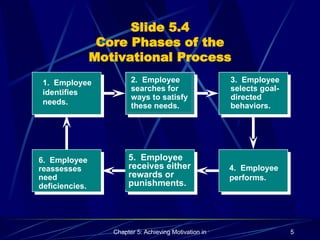
Slide 5.4 Core Phases of the Motivational Process 1.  Employee identifies needs. 2.  Employee searches for  ways to satisfy these needs. 3.  Employee selects goal- directed  behaviors. 4.  Employee performs. 5.  Employee receives either rewards or punishments. 6.  Employee reassesses  need deficiencies.
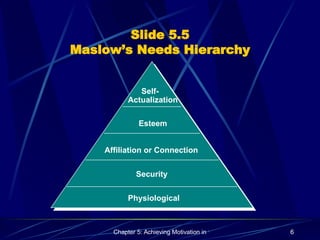
Slide 5.5 Maslow’s Needs Hierarchy Self- Actualization Esteem Affiliation or Connection Security Physiological
Slide 5.6 Assumptions of Maslow’s Needs Hierarchy A satisfied need ceases to motivate behavior Several needs affect a person’s behavior at any one time Lower level needs must be satisfied before higher level needs are activated More ways to satisfy higher level needs than lower level needs
Slide 5.7 Using the Needs Hierarchy Model Satisfaction of  deficiency needs  fosters physical and psychological health Satisfaction of  growth needs  helps development as a human being If not blocked, higher level needs will emerge and motivate behavior Order of needs may be influenced by culture Organizational position or team membership can facilitate growth need satisfaction
Slide 5.8 McClelland’s Learned Needs Power motive Action that affects others’ behavior and has a strong emotional appeal Affiliation motive Establish, maintain, and restore close personal relationships with others   Achievement motive  Compete against a standard of excellence or provide a unique contribution
Slide 5.9 Using the Achievement Motivation Model Provide periodic performance feedback to employees Provide good role models Help employees modify self-images  Guide employee aspirations in setting and attaining realistic goals Communicate that managerial success is related more to power than to affiliation
Slide 5.10 Motivator–Hygiene Model Motivator factors Work itself, recognition, advancement, and responsibility Hygiene factors Company policy and administration, technical supervision, salary, working conditions, and interpersonal relations
Slide 5.11 Using Motivators and Hygienes Jobs designed with motivators enhance competencies Motivators provide feedback Satisfaction and dissatisfaction can exist simultaneously Criticisms of the model Method-bound Separate dimensions of satisfaction and dissatisfaction
Slide 5.12 Basic Assumptions of the Expectancy Model A combination of forces determines behavior Individuals decide their own behaviors in organizations Different individuals have different needs and goals, and want different rewards I ndividuals decide among alternatives based on their perceptions
Slide 5.13 Key Variables in the Expectancy Model First-level outcomes — results of doing the job Second-level outcomes — positive or negative events produced by first-level outcomes  Expectancy —effort-performance  belief  Instrumentality — relationship between first-level and second-level outcomes. Valence — preference for a second-level outcome
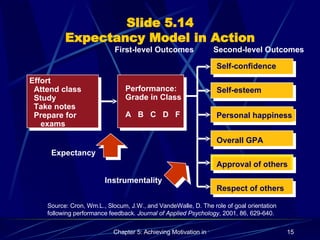
Slide 5.14 Expectancy Model in Action Self-confidence Self-esteem Personal happiness Effort Attend class Study Take notes Prepare for  exams Performance: Grade in Class A  B  C  D  F Expectancy First-level Outcomes Overall GPA Second-level Outcomes Source: Cron, Wm.L., Slocum, J.W., and VandeWalle, D. The role of goal orientation following performance feedback.  Journal of Applied Psychology , 2001, 86, 629-640. Instrumentality Respect of others Approval of others
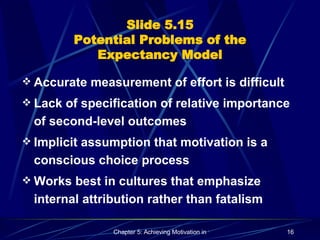
Slide 5.15 Potential Problems of the Expectancy Model Accurate measurement of effort is difficult Lack of specification of relative importance of second-level outcomes Implicit assumption that motivation is a conscious choice process Works best in cultures that emphasize internal attribution rather than fatalism
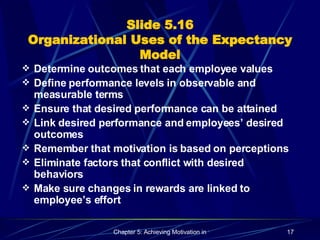
Slide 5.16 Organizational Uses of the Expectancy Model Determine outcomes that each employee values Define performance levels in observable and measurable terms Ensure that desired performance can be attained Link desired performance and employees’ desired outcomes Remember that motivation is based on perceptions Eliminate factors that conflict with desired behaviors Make sure changes in rewards are linked to employee’s effort
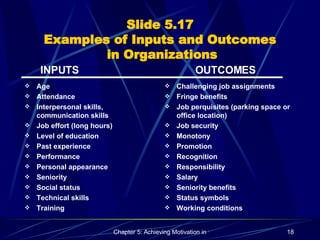
Slide 5.17 Examples of Inputs and Outcomes  in Organizations Age Attendance Interpersonal skills,  communication skills Job effort (long hours) Level of education Past experience Performance Personal appearance Seniority Social status Technical skills Training Challenging job assignments Fringe benefits Job perquisites (parking space or office location) Job security Monotony Promotion Recognition Responsibility Salary Seniority benefits Status symbols Working conditions INPUTS OUTCOMES
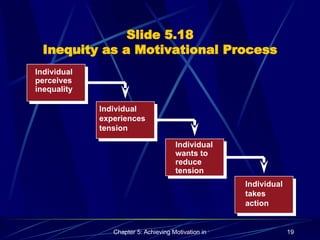
Slide 5.18 Inequity as a Motivational Process Individual perceives inequality Individual experiences tension Individual wants to  reduce tension Individual takes action
Slide 5.19 Ways to Reduce Tensions Produced by Inequity Actually change inputs Actually change outcomes Mentally distort inputs or outcomes Leave organization or transfer to another department Change the reference group Distort others’ inputs or outcomes
Slide 5.20 Organizational Uses  of the Equity Model Treat employees fairly People make decisions concerning equity after comparing themselves with others Procedural justice influences perceptions of organizational fairness

Ch05

  • 1.
    Presentation Slides toAccompany Organizational Behavior 10 th Edition Don Hellriegel and John W. Slocum, Jr. Chapter 5 —Achieving Motivation in the Workplace
  • 2.
    Slide 5.1 LearningObjectives for Achieving Motivation in the Workplace Define motivation and describe the motivation process Describe two basic human needs approaches to motivation Explain how the design of jobs affects motivation Describe the expectancy model of motivation Explain how feelings of equity affect motivation
  • 3.
    Slide 5.2 KeyApproaches to Motivation in the Workplace Meeting basic human needs Designing jobs that motivate people Enhancing the belief that desired rewards can be achieved Treating people equitably
  • 4.
    Slide 5.3 FactorsNecessary for Arousing Employee Motivation Individuals must be: Attracted to join the organization and remain in it Allowed to perform the tasks for which they were hired Stimulated to go beyond routine performance and become creative and innovative in their work
  • 5.
    Slide 5.4 CorePhases of the Motivational Process 1. Employee identifies needs. 2. Employee searches for ways to satisfy these needs. 3. Employee selects goal- directed behaviors. 4. Employee performs. 5. Employee receives either rewards or punishments. 6. Employee reassesses need deficiencies.
  • 6.
    Slide 5.5 Maslow’sNeeds Hierarchy Self- Actualization Esteem Affiliation or Connection Security Physiological
  • 7.
    Slide 5.6 Assumptionsof Maslow’s Needs Hierarchy A satisfied need ceases to motivate behavior Several needs affect a person’s behavior at any one time Lower level needs must be satisfied before higher level needs are activated More ways to satisfy higher level needs than lower level needs
  • 8.
    Slide 5.7 Usingthe Needs Hierarchy Model Satisfaction of deficiency needs fosters physical and psychological health Satisfaction of growth needs helps development as a human being If not blocked, higher level needs will emerge and motivate behavior Order of needs may be influenced by culture Organizational position or team membership can facilitate growth need satisfaction
  • 9.
    Slide 5.8 McClelland’sLearned Needs Power motive Action that affects others’ behavior and has a strong emotional appeal Affiliation motive Establish, maintain, and restore close personal relationships with others   Achievement motive Compete against a standard of excellence or provide a unique contribution
  • 10.
    Slide 5.9 Usingthe Achievement Motivation Model Provide periodic performance feedback to employees Provide good role models Help employees modify self-images Guide employee aspirations in setting and attaining realistic goals Communicate that managerial success is related more to power than to affiliation
  • 11.
    Slide 5.10 Motivator–HygieneModel Motivator factors Work itself, recognition, advancement, and responsibility Hygiene factors Company policy and administration, technical supervision, salary, working conditions, and interpersonal relations
  • 12.
    Slide 5.11 UsingMotivators and Hygienes Jobs designed with motivators enhance competencies Motivators provide feedback Satisfaction and dissatisfaction can exist simultaneously Criticisms of the model Method-bound Separate dimensions of satisfaction and dissatisfaction
  • 13.
    Slide 5.12 BasicAssumptions of the Expectancy Model A combination of forces determines behavior Individuals decide their own behaviors in organizations Different individuals have different needs and goals, and want different rewards I ndividuals decide among alternatives based on their perceptions
  • 14.
    Slide 5.13 KeyVariables in the Expectancy Model First-level outcomes — results of doing the job Second-level outcomes — positive or negative events produced by first-level outcomes Expectancy —effort-performance belief Instrumentality — relationship between first-level and second-level outcomes. Valence — preference for a second-level outcome
  • 15.
    Slide 5.14 ExpectancyModel in Action Self-confidence Self-esteem Personal happiness Effort Attend class Study Take notes Prepare for exams Performance: Grade in Class A B C D F Expectancy First-level Outcomes Overall GPA Second-level Outcomes Source: Cron, Wm.L., Slocum, J.W., and VandeWalle, D. The role of goal orientation following performance feedback. Journal of Applied Psychology , 2001, 86, 629-640. Instrumentality Respect of others Approval of others
  • 16.
    Slide 5.15 PotentialProblems of the Expectancy Model Accurate measurement of effort is difficult Lack of specification of relative importance of second-level outcomes Implicit assumption that motivation is a conscious choice process Works best in cultures that emphasize internal attribution rather than fatalism
  • 17.
    Slide 5.16 OrganizationalUses of the Expectancy Model Determine outcomes that each employee values Define performance levels in observable and measurable terms Ensure that desired performance can be attained Link desired performance and employees’ desired outcomes Remember that motivation is based on perceptions Eliminate factors that conflict with desired behaviors Make sure changes in rewards are linked to employee’s effort
  • 18.
    Slide 5.17 Examplesof Inputs and Outcomes in Organizations Age Attendance Interpersonal skills, communication skills Job effort (long hours) Level of education Past experience Performance Personal appearance Seniority Social status Technical skills Training Challenging job assignments Fringe benefits Job perquisites (parking space or office location) Job security Monotony Promotion Recognition Responsibility Salary Seniority benefits Status symbols Working conditions INPUTS OUTCOMES
  • 19.
    Slide 5.18 Inequityas a Motivational Process Individual perceives inequality Individual experiences tension Individual wants to reduce tension Individual takes action
  • 20.
    Slide 5.19 Waysto Reduce Tensions Produced by Inequity Actually change inputs Actually change outcomes Mentally distort inputs or outcomes Leave organization or transfer to another department Change the reference group Distort others’ inputs or outcomes
  • 21.
    Slide 5.20 OrganizationalUses of the Equity Model Treat employees fairly People make decisions concerning equity after comparing themselves with others Procedural justice influences perceptions of organizational fairness