

Your Instructor Rex Black President RBCS, CTO RBCSNZ, CTO PureTesting: worldwide testing services companies President ASTQB and ISTQB: non-profit professional organizations Quarter century of software engineering experience Author of 5 books and dozens of articles Married, father of two
The Materials The slides follow the ISTQB Foundation Syllabus 2007 The terms come from the latest ISTQB Glossary Two mock exams are included to assess your readiness for the ISTQB Foundation exam Each section includes sample exam questions to check your knowledge as you proceed Exercises are included for main techniques
ISTQB Foundation Syllabus 2007 Developed by a team of nine authors spanning seven countries: Thomas M ü ller (chair), Rex Black, Sigrid Eldh, Debra Friedenberg, Dorothy Graham, Kalus Olsen, Maaret Pyh äjärvi, Geoff Thompson and Erik van Veenendaal Forty primary reviewers spanning nine countries Final review and approval by 33 National Boards Distills over 1,000 person-years of experience The ISTQB and the authors are the source of the syllabus (copyright © 2005 and 2007 by the authors and ISTQB) which is used by permission as the basis for this course
The Main Topics Covered Fundamentals of testing Testing throughout the software lifecycle Static techniques Test design techniques Test management Tool support for testing
What You’ll Gain from This Course Understand the foundational best practices of software testing Adapt testing efforts for the context in which they will occur Design tests using black-box, white-box, and experienced-based techniques Build confidence, reduce risk, and find defects in the software you test Explain software testing objectives and results to non-testers in terms they’ll understand Identify and successfully introduce appropriate testing tools and processes
Preparing for the ISTQB Foundation Exam Download the Foundation Syllabus and Glossary from  www.astqb.org Read the Syllabus and study Glossary definitions Take the first mock exam (end of this section), noting carefully areas you need to give special attention Work through each chapter and section of this course, trying all sample exam questions and exercises, reviewing topics as needed Take the second mock exam at the end of  the course If you pass, you should be ready for the real exam If you fail, go back and review the materials you missed Contact your National Board about exam options (e.g.,  www.astqb.org  in the United States)
Test Engineering Foundation Essential Knowledge for Test Professionals Mock Exam
Let’s See Where You Stand Starting on the next slide, you’ll find the first mock exam for this course This exam will measure where you stand on the material covered in the syllabus Don’t worry if you don’t pass this exam, just pay attention to the questions you miss You’ll want to pay special attention to these topics
Articulate Quizmaker Quiz  Place holder - Mock Exam1
Chapter 1 : Fundamentals of Testing
Test Engineering Foundation Essential Knowledge for Test Professionals Chapter 1: Foundation of Testing
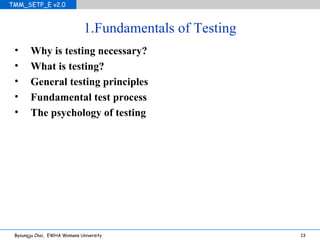
1.Fundamentals of Testing Why is testing necessary? What is testing? General testing principles Fundamental test process The psychology of testing
Test Engineering Foundation Essential Knowledge for Test Professionals Chapter 1: Fundamentals of Testing Section 1: Why is testing necessary? Part 1
Why is Testing Necessary? Key concepts How bugs can cause harm Bugs and their effects The necessity of testing The role of testing in quality assurance Terms to remember
The Threat of Bugs Company Damaged reputation for quality High or unpredictable maintenance costs Unexpected delays in release cycles Lack of confidence in system Lawsuits Environment Pollution Waste People, societies, and states Lost jobs Lost lives Lost rights Lost missions Lost wars
Where Bugs Come From and What Bugs Do People make errors which put bugs (defects) into the system Requirements and design specifications Code (business logic and user interface) Documentation (electronic and hard copy) When defective code is executed, failures occur If there failures are visible to customers, users, or other stakeholders, dissatisfaction with system quality may result
Test Engineering Foundation Essential Knowledge for Test Professionals Chapter 1: Foundation of Testing Section 1: Why is testing necessary? Part 1: Sample exam questions
Articulate Quizmaker Quiz Placeholder – Ch1S1P1
Test Engineering Foundation Essential Knowledge for Test Professionals Chapter 1: Foundation of Testing Section 1: Why is testing necessary? Part 2
What Does “Quality” Mean to You? “ Fitness for use” vs. “Conformance to requirements” Testing and quality Tests give confidence where they find few bugs Passing tests reduce the level of quality risk Failing tests provide a chance to improve quality The test set gives an assessment of quality What are the important quality characteristics for your system? Are you testing them (enough)? Testing, quality assurance, and quality improvement Ideally, testing is part of a larger quality assurance strategy for a project For future projects, analyze the root causes of defects found on current projects and take steps to reduce their incidence
Test Engineering Foundation Essential Knowledge for Test Professionals Chapter 1: Fundamentals of Testing Section 1: Why is testing necessary? Part 2: Sample exam questions
Articulate Quizmaker Quiz Placeholder – Ch1S1P2
Test Engineering Foundation Essential Knowledge for Test Professionals Chapter 1: Fundamentals of Testing Section 2: What is testing? Part 1

Ch14

  • 1.
  • 2.
    Your Instructor RexBlack President RBCS, CTO RBCSNZ, CTO PureTesting: worldwide testing services companies President ASTQB and ISTQB: non-profit professional organizations Quarter century of software engineering experience Author of 5 books and dozens of articles Married, father of two
  • 3.
    The Materials Theslides follow the ISTQB Foundation Syllabus 2007 The terms come from the latest ISTQB Glossary Two mock exams are included to assess your readiness for the ISTQB Foundation exam Each section includes sample exam questions to check your knowledge as you proceed Exercises are included for main techniques
  • 4.
    ISTQB Foundation Syllabus2007 Developed by a team of nine authors spanning seven countries: Thomas M ü ller (chair), Rex Black, Sigrid Eldh, Debra Friedenberg, Dorothy Graham, Kalus Olsen, Maaret Pyh äjärvi, Geoff Thompson and Erik van Veenendaal Forty primary reviewers spanning nine countries Final review and approval by 33 National Boards Distills over 1,000 person-years of experience The ISTQB and the authors are the source of the syllabus (copyright © 2005 and 2007 by the authors and ISTQB) which is used by permission as the basis for this course
  • 5.
    The Main TopicsCovered Fundamentals of testing Testing throughout the software lifecycle Static techniques Test design techniques Test management Tool support for testing
  • 6.
    What You’ll Gainfrom This Course Understand the foundational best practices of software testing Adapt testing efforts for the context in which they will occur Design tests using black-box, white-box, and experienced-based techniques Build confidence, reduce risk, and find defects in the software you test Explain software testing objectives and results to non-testers in terms they’ll understand Identify and successfully introduce appropriate testing tools and processes
  • 7.
    Preparing for theISTQB Foundation Exam Download the Foundation Syllabus and Glossary from www.astqb.org Read the Syllabus and study Glossary definitions Take the first mock exam (end of this section), noting carefully areas you need to give special attention Work through each chapter and section of this course, trying all sample exam questions and exercises, reviewing topics as needed Take the second mock exam at the end of the course If you pass, you should be ready for the real exam If you fail, go back and review the materials you missed Contact your National Board about exam options (e.g., www.astqb.org in the United States)
  • 8.
    Test Engineering FoundationEssential Knowledge for Test Professionals Mock Exam
  • 9.
    Let’s See WhereYou Stand Starting on the next slide, you’ll find the first mock exam for this course This exam will measure where you stand on the material covered in the syllabus Don’t worry if you don’t pass this exam, just pay attention to the questions you miss You’ll want to pay special attention to these topics
  • 10.
    Articulate Quizmaker Quiz Place holder - Mock Exam1
  • 11.
    Chapter 1 :Fundamentals of Testing
  • 12.
    Test Engineering FoundationEssential Knowledge for Test Professionals Chapter 1: Foundation of Testing
  • 13.
    1.Fundamentals of TestingWhy is testing necessary? What is testing? General testing principles Fundamental test process The psychology of testing
  • 14.
    Test Engineering FoundationEssential Knowledge for Test Professionals Chapter 1: Fundamentals of Testing Section 1: Why is testing necessary? Part 1
  • 15.
    Why is TestingNecessary? Key concepts How bugs can cause harm Bugs and their effects The necessity of testing The role of testing in quality assurance Terms to remember
  • 16.
    The Threat ofBugs Company Damaged reputation for quality High or unpredictable maintenance costs Unexpected delays in release cycles Lack of confidence in system Lawsuits Environment Pollution Waste People, societies, and states Lost jobs Lost lives Lost rights Lost missions Lost wars
  • 17.
    Where Bugs ComeFrom and What Bugs Do People make errors which put bugs (defects) into the system Requirements and design specifications Code (business logic and user interface) Documentation (electronic and hard copy) When defective code is executed, failures occur If there failures are visible to customers, users, or other stakeholders, dissatisfaction with system quality may result
  • 18.
    Test Engineering FoundationEssential Knowledge for Test Professionals Chapter 1: Foundation of Testing Section 1: Why is testing necessary? Part 1: Sample exam questions
  • 19.
    Articulate Quizmaker QuizPlaceholder – Ch1S1P1
  • 20.
    Test Engineering FoundationEssential Knowledge for Test Professionals Chapter 1: Foundation of Testing Section 1: Why is testing necessary? Part 2
  • 21.
    What Does “Quality”Mean to You? “ Fitness for use” vs. “Conformance to requirements” Testing and quality Tests give confidence where they find few bugs Passing tests reduce the level of quality risk Failing tests provide a chance to improve quality The test set gives an assessment of quality What are the important quality characteristics for your system? Are you testing them (enough)? Testing, quality assurance, and quality improvement Ideally, testing is part of a larger quality assurance strategy for a project For future projects, analyze the root causes of defects found on current projects and take steps to reduce their incidence
  • 22.
    Test Engineering FoundationEssential Knowledge for Test Professionals Chapter 1: Fundamentals of Testing Section 1: Why is testing necessary? Part 2: Sample exam questions
  • 23.
    Articulate Quizmaker QuizPlaceholder – Ch1S1P2
  • 24.
    Test Engineering FoundationEssential Knowledge for Test Professionals Chapter 1: Fundamentals of Testing Section 2: What is testing? Part 1