Lindsay Anderson
The Norman Conquest
       of England
           
 (beginning Sept. 28, 1066) William, the Duke of
  Normandy, invaded England in the autumn of 1066,
  beginning a campaign of conquest leading to his crowning
  as the King of England and the establishment of Norman
  rule over England.
 When Edward the Confessor died in 1066, he left a
  disputed succession. The throne was seized by his leading
  aristocrat, Harold Godwinson, who was rapidly crowned.
 Almost immediately, Harold faced two invasions - one
  from the king of Norway, Harald Hardrada, who was
  supported by Harold Godwinson's brother Tostig, and the
  other from William, Duke of Normandy.
The Norman Conquest
        of England
            
 Harold defeated the Norwegian invasion at the Battle of Stamford
  Bridge in September 1066, but he was defeated and killed shortly
  afterwards at the Battle of Hastings, on October 14 in the same year.
 The victorious William, now known as 'the Conqueror', brought a new
  aristocracy to England from Normandy and some other areas of
  France. He also strengthened aristocratic lordship and moved towards
  reform of the church.
 The Norman conquest was a pivotal event in English history. It largely
  removed the native ruling class, replacing it with a foreign, French-
  speaking monarchy, aristocracy, and clerical hierarchy. This, in
  turn, brought about a transformation of the English language and the
  culture of England in a new era often referred to as Norman England.
The Norman Conquest of
         England
                              
 By bringing England under the control of rulers originating in
  France, the Norman conquest linked the country more closely
  with continental Europe, and also set the stage for a rivalry
  with France that would continue for many centuries. It also had
  important consequences for the rest of the British Isles, paving
  the way for further Norman conquests in Wales and
  Ireland, and the extensive penetration of the aristocracy of
  Scotland by Norman and other French-speaking families, with
  the accompanying spread of continental institutions and
  cultural influences.
The Battle of Hastings
             
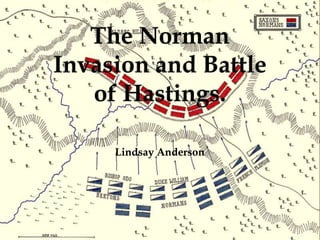
 The Battle of Hastings occurred on October 14, 1066 during the
  Norman Conquest of England between the Norman-French
  army under Duke William II of Normandy and the English
  army under King Harold II. It took place at Senlac Hill,
  approximately 6 miles northwest of Hastings, close to the
  present-day town of Battle, East Sussex, and was a Norman
  victory.
The Battle of Hastings
             
 With quick military action, William squashed any thought
  of the throne going to Harold on October 14th, 1066. He
  landed his 7000 troops and began his southern advance
  on the beach of Pevensey. William's army set up and
  battled fiercely the next day until Harold and the Saxon
  army were eventually cut down by Norman swords. In
  one systematic act, taking less than 10 hours time and
  rendering any Saxon retaliation virtually
  impossible, south and southeastern England were shortly
  torched and destroyed at William's command. The Saxon
  society did not gain a favorable first impression of
  William, and their struggles with his leadership
  continued on for 21 years. Nonetheless, by Christmas day
  1066 in Westminster, England, William was crowned
  King of England.
The Battle of Hastings
             
 Harold II was killed in the battle—legend has it that
  he was shot through the eye with an arrow. He was
  the last English king to die in battle on English soil
  until Richard III was killed at the Battle of Bosworth
  Field. The battle marked the last successful foreign
  invasion of the British Isles. Although there was
  further English resistance, this battle is seen as the
  point at which William gained control of England,
  becoming its first Norman ruler as King William I.
Aftermath of the Battle
      of Hastings
          
 A significant change coming as a result of the
  battle was the new language and culture that
  was adopted, replacing the previous Anglo-
  Saxon customs of 300 years. This new rule under
  William threw out the Anglo Saxon culture and
  brought a French dialect instead.
 Another significant result of the battle of Hastings was the
  introduction of the feudal system to England. William
  had earlier developed a centralized feudal state in
  Normandy. In this system, the king would usually offer
  to his warriors a plot of land called a fief, in exchange for
  their loyalty.
Resources
                 
 http://www.thenagain.info/webchron/westeurope
  /hastings.html
 http://en.wikipedia.org/wiki/Battle_of_Hastings
 http://www.battle1066.com/
 http://www.eyewitnesstohistory.com/bayeux.htm
 http://medievaleurope.mrdonn.org/normanconque
  st.html
 http://en.wikipedia.org/wiki/Norman_conquest_of
  _England

The norman invasion2

  • 1.
  • 2.
    The Norman Conquest of England   (beginning Sept. 28, 1066) William, the Duke of Normandy, invaded England in the autumn of 1066, beginning a campaign of conquest leading to his crowning as the King of England and the establishment of Norman rule over England.  When Edward the Confessor died in 1066, he left a disputed succession. The throne was seized by his leading aristocrat, Harold Godwinson, who was rapidly crowned.  Almost immediately, Harold faced two invasions - one from the king of Norway, Harald Hardrada, who was supported by Harold Godwinson's brother Tostig, and the other from William, Duke of Normandy.
  • 3.
    The Norman Conquest of England   Harold defeated the Norwegian invasion at the Battle of Stamford Bridge in September 1066, but he was defeated and killed shortly afterwards at the Battle of Hastings, on October 14 in the same year.  The victorious William, now known as 'the Conqueror', brought a new aristocracy to England from Normandy and some other areas of France. He also strengthened aristocratic lordship and moved towards reform of the church.  The Norman conquest was a pivotal event in English history. It largely removed the native ruling class, replacing it with a foreign, French- speaking monarchy, aristocracy, and clerical hierarchy. This, in turn, brought about a transformation of the English language and the culture of England in a new era often referred to as Norman England.
  • 4.
    The Norman Conquestof England   By bringing England under the control of rulers originating in France, the Norman conquest linked the country more closely with continental Europe, and also set the stage for a rivalry with France that would continue for many centuries. It also had important consequences for the rest of the British Isles, paving the way for further Norman conquests in Wales and Ireland, and the extensive penetration of the aristocracy of Scotland by Norman and other French-speaking families, with the accompanying spread of continental institutions and cultural influences.
  • 5.
    The Battle ofHastings   The Battle of Hastings occurred on October 14, 1066 during the Norman Conquest of England between the Norman-French army under Duke William II of Normandy and the English army under King Harold II. It took place at Senlac Hill, approximately 6 miles northwest of Hastings, close to the present-day town of Battle, East Sussex, and was a Norman victory.
  • 6.
    The Battle ofHastings   With quick military action, William squashed any thought of the throne going to Harold on October 14th, 1066. He landed his 7000 troops and began his southern advance on the beach of Pevensey. William's army set up and battled fiercely the next day until Harold and the Saxon army were eventually cut down by Norman swords. In one systematic act, taking less than 10 hours time and rendering any Saxon retaliation virtually impossible, south and southeastern England were shortly torched and destroyed at William's command. The Saxon society did not gain a favorable first impression of William, and their struggles with his leadership continued on for 21 years. Nonetheless, by Christmas day 1066 in Westminster, England, William was crowned King of England.
  • 7.
    The Battle ofHastings   Harold II was killed in the battle—legend has it that he was shot through the eye with an arrow. He was the last English king to die in battle on English soil until Richard III was killed at the Battle of Bosworth Field. The battle marked the last successful foreign invasion of the British Isles. Although there was further English resistance, this battle is seen as the point at which William gained control of England, becoming its first Norman ruler as King William I.
  • 8.
    Aftermath of theBattle of Hastings   A significant change coming as a result of the battle was the new language and culture that was adopted, replacing the previous Anglo- Saxon customs of 300 years. This new rule under William threw out the Anglo Saxon culture and brought a French dialect instead.  Another significant result of the battle of Hastings was the introduction of the feudal system to England. William had earlier developed a centralized feudal state in Normandy. In this system, the king would usually offer to his warriors a plot of land called a fief, in exchange for their loyalty.
  • 9.
    Resources   http://www.thenagain.info/webchron/westeurope /hastings.html  http://en.wikipedia.org/wiki/Battle_of_Hastings  http://www.battle1066.com/  http://www.eyewitnesstohistory.com/bayeux.htm  http://medievaleurope.mrdonn.org/normanconque st.html  http://en.wikipedia.org/wiki/Norman_conquest_of _England