Dr.K.Baranidharan
Present by…
Engineering
Economics &
Financial
Accountingment
Ee&fa
213 July 2013
DEMAND & SUPPLY ANALYSIS
By
Dr.K.Baranidharan
A P . II - M B A
Sri Sairam Institute Technology
3
DEMAND
4
What is DEMAND?
• “Every want supported by the
willingness and ability to buy” –
constitutes demand for a particular
product or services…..
• In other words, if a person wants a CAR
and cannot pay for it. There is no
demand for the CAR from his or her
side………..
5
• A product or service is said to have
demand when three conditions are
met:
• 1.Desire on the part of the buyer to buy.
• 2.Willing to pay for it
• 3,Ability to pay the specified price for it.
• Unless all these conditions are fulfilled,
the product is not said to have any
demand.
6
7
“ A p e r s o n w h e n
d e s i r i n g i s
w i l l i n g a n d a b l e t o
p a y f o r w h a t h e /s h e
d e s i r e s , t h e d e s i r e
i s c h a n g e d i n t o
d e m a n d .
D e m a n d i s a l w a y s : @
P r i c e , P e r U n i t
T i m e .
Types of DEMAND
•Demand can be of three
types:
•1. Price Demand
•2. Income Demand
•3. Cross demand
8
Price DEMAND
•Price demand refers to
the quantity of a
particular product or
service demanded at a
given price
9
Income DEMAND
•Income demand refers to
the quantity of a particular
product or service
demanded at a given level
of income of a consumer or
household.
10
Cross DEMAND
• Cross demand refers to the
quantity demanded for a
particular product or service,
given the price of a related good.
• The related good may be
complementary or a substitute…
11
• Example:
• 1.Tyres and tubes are
complementary goods (one
cannot go without the other)
• 2.Tea and Coffee are
substitutees. Take one and
you have to leave the other.
12
Nature of DEMAND
• The nature of demand is better understood
when we see these variations as follows:
• Consumer goods vs producer goods
• Autonomous demand vs derived demand
• Durable vs perishable goods
• Firm demand vs industry demand
• Short-run demand vs long-run demand
• New demand vs replacement demand
13
Consumer goods vs producer goods
• The goods can be grouped under consumer
goods and producer goods.
• Cg refers to such product and services,
which are capable to satisfying human
needs.
• Cg are those which are available for
ultimate consumption.(give direct and
immediate satisfaction)
• Example: bread, apple, rice, etc
14
• Pg are those which are used for further
processing or production of goods/service to
earn to INCOME.
• This goods yield indirect satisfactionand are used
to produce cg
• Example: machinery , tractor etc.,
• The product may be both pg & cg
• The farmer having 10 bags of paddy, 5 bags
personel use, next 5 bags as SEEDS for the next
crop.
• PADDY is both pg & cg
15
Autonomous demand vs derived demand
• Ad refers to direct demand for product and
services.
• Example: the demand for the service of a
super-specialty hospital can be consider ad
• Dd the demand for the product arises out of
the purchase of a parent product.
• Example: the demand for hotel around that
hospital is called dd.
• A demand for houses is autonomous whereas
a demand for these input is derived.
16
Durable vs perishable goods
• Durable goods are those goods
that give service for relatively long
period.
• Example: rice, sugar etc.,
• The life of perishable goods is very
small –a few hours or days.
• Example: vegetable, milk, fish etc.,
17
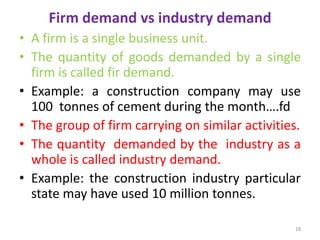
Firm demand vs industry demand
• A firm is a single business unit.
• The quantity of goods demanded by a single
firm is called fir demand.
• Example: a construction company may use
100 tonnes of cement during the month….fd
• The group of firm carrying on similar activities.
• The quantity demanded by the industry as a
whole is called industry demand.
• Example: the construction industry particular
state may have used 10 million tonnes.
18
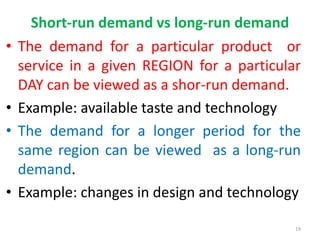
Short-run demand vs long-run demand
• The demand for a particular product or
service in a given REGION for a particular
DAY can be viewed as a shor-run demand.
• Example: available taste and technology
• The demand for a longer period for the
same region can be viewed as a long-run
demand.
• Example: changes in design and technology
19
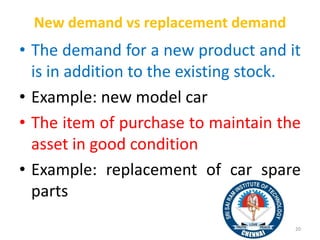
New demand vs replacement demand
• The demand for a new product and it
is in addition to the existing stock.
• Example: new model car
• The item of purchase to maintain the
asset in good condition
• Example: replacement of car spare
parts
20
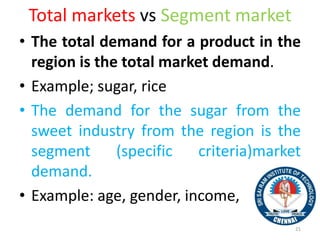
Total markets vs Segment market
• The total demand for a product in the
region is the total market demand.
• Example; sugar, rice
• The demand for the sugar from the
sweet industry from the region is the
segment (specific criteria)market
demand.
• Example: age, gender, income,
21
Determinants of Demand
 Price of the product
 Price of the related goods
 Consumer’s income level
 Distribution pattern of national income
 Consumer’s taste and preferences
 Advertisement of the product
 Consumer’s expectation about future price and supply
position
 Demonstration effect and Band-Wagon effect
 Consumer credit facility
 Demography and growth rate of population
 General std. of living and spending habits
 Climatic and weather conditions
 Customs
Factors determining DEMAND
• The following factor determine the demand
for a given product:
• 1.Price of the product (P)
• 2.Income level of the consumer (I)
• 3.Tastes and preferences of the consumer (T)
• 4.Prices of related goods which may be
substitutes/complementary (PR)
• 5.Expectation about the prices in future (EP)
23
• 6.Expectation about the incomes in
future (EI)
• 7.Size of population (SP)
• 8.Distribution of consumers over
different region (DC)
• 9.Advertising efforts (A)
• 10.Any other factor capable of
affecting the demand (O)
24
DEMAND function
• Demand function describe the relationship
between one variable and its determinants.
• It describe the quantity of goods bought at
alternative prices of a goods and related
goods. Alternative income levels and
alternative values of other variables affecting
demand.
• The demand function for a goods relates to
the quantity of a goods that consumer
demand during the given period to the factor
that influenced demand.
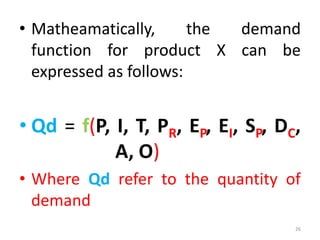
25
• Matheamatically, the demand
function for product X can be
expressed as follows:
• Qd = f(P, I, T, PR, EP, EI, SP, DC,
A, O)
• Where Qd refer to the quantity of
demand
26
Impact of DEMAND factors
27
1.Price of the product
• Demand for a product is inversely
related to its price.
• In other words, if the price rise, the
demand falls and vice versa.
• This is the price demand function
showing the PRICE EFFECT OF
DEMAND
28
2.Income of the consumer
• The income of the consumer or the
household increases, there is a
tendency to buy more and more up
to a particular limits.
• The demand for product is directly
related to the income of the
consumer
29
3.Prices of Substitutes or
Complementaries
• The demand for product X is determined by
the prices of its related products: substitutes
or complementaries.
• If there is an increase in the price of a
substitute, the demand of product X will go
up and vice versa.
• Similarly, if the price of complementary goods
goes up, the demand for product X will fall.
30
Tastes and Preferences
• If the tastes and preference of the consumers
change, there is change in the product
demanded also.
• The companies keep changing the product
and services…(when T & P)
• The companies take advantages of the
technological changes and upgrade the
product and services.(to meet specific
requirements of customers)
31
Law of DEMAND
32
Law of demand
Statement of Law : “ Other things
being equal, the higher the price of
a commodity, the smaller is the
quantity demanded and lower the
price, larger the quantity
demanded”.
The Law of Demand states the relationship
between price and demand of a
particular product or services
Assumptions of the Law of DEMAND
• Other things being equal : include
income level of the consumer, tastes
and preferences of the consumer,
prices of related goods, expectation
about the prices or incomes in the
future, size of population, advertising
efforts and any other factor capable of
affecting the demand
34
The Law of Demand
•When a good’s price is lower,
consumers will buy more of it
•When a good’s price is higher,
consumers will buy less of it
3636
DEMAND Curve
• The graph has two axis - vertical
line is labeled as price and the
horizontal line is for the quantity
number.
• Remember to state the units used
for price and quantity and name the
graph.
3737
DEMAND Curve
• Demand reflects an inverse
relationship between price and
quantity demanded.
• The Demand Curve is a graph
reflecting the price consumers
are willing to pay and the
quantity consumers are willing
buy.
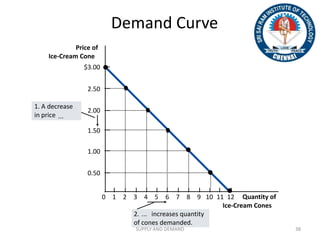
Demand Curve
Copyright © 2004 South-Western
Price of
Ice-Cream Cone
0
2.50
2.00
1.50
1.00
0.50
1 2 3 4 5 6 7 8 9 10 11 Quantity of
Ice-Cream Cones
$3.00
12
1. A decrease
in price ...
2. ... increases quantity
of cones demanded.
38SUPPLY AND DEMAND
Law of Demand and Income effect
• When there is a fall in the price of a
commodity. It leads to a rise in the real
income of the consumer.
• Rise in real income means the consumer
will be able to buy more commodities
for a given amount of money.
• Example:the price of fall in bananas
39
Law of Demand and Substitution effect
• The price of commodity falls, the prices of its
substitutes remaining the same, the
commodity will now be cheaper when
compared to substitutes.
–When consumers react to an increase on a
good’s price by consuming less of that
good and more of other goods.
• Ex.- McDonalds raise prices, more people buy
Burger King
40
Changes in demand
• The increase or decrease in demand
due to change in the factor other
than price is called change in
demand.
• Change in demand leads to a shift
in the demand curve to the right or
to the left.
41
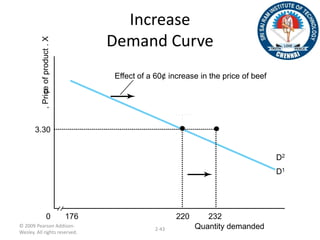
Increase DEMAND
• If the consumers are willing and
able to buy more of a particular
brand of shirts (say.X) at the
same price, the result will be an
increase in demand.
• The demand curve will shift to
the right
42
© 2009 Pearson Addison-
Wesley. All rights reserved.
2-43
Increase
Demand Curvep,Priceofproduct.X
220176
Effect of a 60¢ increase in the price of beef
D1
D2
232
Quantity demanded
0
3.30
Decrease in DEMAND
• A decrease in demand occurs
when buyers buy less of a
product at each possible price
rise because of factors like fall in
income, rise in price of
complementary goods etc.,
44
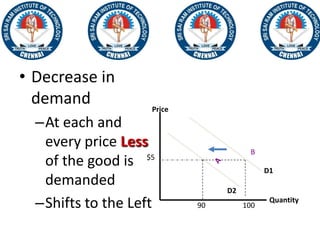
• Decrease in
demand
–At each and
every price Less
of the good is
demanded
–Shifts to the Left
D2
$5
D1
B
Price
Quantity
90 100
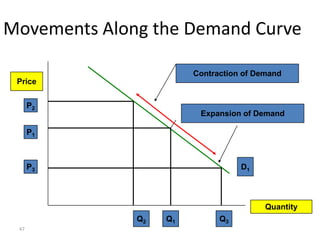
Extension and Contraction in DEMAND
• Extension is a downward movement
along the demand curve, which idicates
that a higher quantity is demand for a
given fall in the price of a good.
• Contraction is an upward movement
along the demand curve which idicates
that a lower quantity is demanded for a
given increase in the price of the good
46
47
Movements Along the Demand Curve
Price
Quantity
D1
P2
P1
P3
Q2 Q1 Q3
Contraction of Demand
Expansion of Demand

DEMAND - ENGINEERING ECONOMICS AND FINANCIAL ACCOUNTING

  • 1.
  • 2.
  • 3.
    DEMAND & SUPPLYANALYSIS By Dr.K.Baranidharan A P . II - M B A Sri Sairam Institute Technology 3
  • 4.
  • 5.
    What is DEMAND? •“Every want supported by the willingness and ability to buy” – constitutes demand for a particular product or services….. • In other words, if a person wants a CAR and cannot pay for it. There is no demand for the CAR from his or her side……….. 5
  • 6.
    • A productor service is said to have demand when three conditions are met: • 1.Desire on the part of the buyer to buy. • 2.Willing to pay for it • 3,Ability to pay the specified price for it. • Unless all these conditions are fulfilled, the product is not said to have any demand. 6
  • 7.
    7 “ A pe r s o n w h e n d e s i r i n g i s w i l l i n g a n d a b l e t o p a y f o r w h a t h e /s h e d e s i r e s , t h e d e s i r e i s c h a n g e d i n t o d e m a n d . D e m a n d i s a l w a y s : @ P r i c e , P e r U n i t T i m e .
  • 8.
    Types of DEMAND •Demandcan be of three types: •1. Price Demand •2. Income Demand •3. Cross demand 8
  • 9.
    Price DEMAND •Price demandrefers to the quantity of a particular product or service demanded at a given price 9
  • 10.
    Income DEMAND •Income demandrefers to the quantity of a particular product or service demanded at a given level of income of a consumer or household. 10
  • 11.
    Cross DEMAND • Crossdemand refers to the quantity demanded for a particular product or service, given the price of a related good. • The related good may be complementary or a substitute… 11
  • 12.
    • Example: • 1.Tyresand tubes are complementary goods (one cannot go without the other) • 2.Tea and Coffee are substitutees. Take one and you have to leave the other. 12
  • 13.
    Nature of DEMAND •The nature of demand is better understood when we see these variations as follows: • Consumer goods vs producer goods • Autonomous demand vs derived demand • Durable vs perishable goods • Firm demand vs industry demand • Short-run demand vs long-run demand • New demand vs replacement demand 13
  • 14.
    Consumer goods vsproducer goods • The goods can be grouped under consumer goods and producer goods. • Cg refers to such product and services, which are capable to satisfying human needs. • Cg are those which are available for ultimate consumption.(give direct and immediate satisfaction) • Example: bread, apple, rice, etc 14
  • 15.
    • Pg arethose which are used for further processing or production of goods/service to earn to INCOME. • This goods yield indirect satisfactionand are used to produce cg • Example: machinery , tractor etc., • The product may be both pg & cg • The farmer having 10 bags of paddy, 5 bags personel use, next 5 bags as SEEDS for the next crop. • PADDY is both pg & cg 15
  • 16.
    Autonomous demand vsderived demand • Ad refers to direct demand for product and services. • Example: the demand for the service of a super-specialty hospital can be consider ad • Dd the demand for the product arises out of the purchase of a parent product. • Example: the demand for hotel around that hospital is called dd. • A demand for houses is autonomous whereas a demand for these input is derived. 16
  • 17.
    Durable vs perishablegoods • Durable goods are those goods that give service for relatively long period. • Example: rice, sugar etc., • The life of perishable goods is very small –a few hours or days. • Example: vegetable, milk, fish etc., 17
  • 18.
    Firm demand vsindustry demand • A firm is a single business unit. • The quantity of goods demanded by a single firm is called fir demand. • Example: a construction company may use 100 tonnes of cement during the month….fd • The group of firm carrying on similar activities. • The quantity demanded by the industry as a whole is called industry demand. • Example: the construction industry particular state may have used 10 million tonnes. 18
  • 19.
    Short-run demand vslong-run demand • The demand for a particular product or service in a given REGION for a particular DAY can be viewed as a shor-run demand. • Example: available taste and technology • The demand for a longer period for the same region can be viewed as a long-run demand. • Example: changes in design and technology 19
  • 20.
    New demand vsreplacement demand • The demand for a new product and it is in addition to the existing stock. • Example: new model car • The item of purchase to maintain the asset in good condition • Example: replacement of car spare parts 20
  • 21.
    Total markets vsSegment market • The total demand for a product in the region is the total market demand. • Example; sugar, rice • The demand for the sugar from the sweet industry from the region is the segment (specific criteria)market demand. • Example: age, gender, income, 21
  • 22.
    Determinants of Demand Price of the product  Price of the related goods  Consumer’s income level  Distribution pattern of national income  Consumer’s taste and preferences  Advertisement of the product  Consumer’s expectation about future price and supply position  Demonstration effect and Band-Wagon effect  Consumer credit facility  Demography and growth rate of population  General std. of living and spending habits  Climatic and weather conditions  Customs
  • 23.
    Factors determining DEMAND •The following factor determine the demand for a given product: • 1.Price of the product (P) • 2.Income level of the consumer (I) • 3.Tastes and preferences of the consumer (T) • 4.Prices of related goods which may be substitutes/complementary (PR) • 5.Expectation about the prices in future (EP) 23
  • 24.
    • 6.Expectation aboutthe incomes in future (EI) • 7.Size of population (SP) • 8.Distribution of consumers over different region (DC) • 9.Advertising efforts (A) • 10.Any other factor capable of affecting the demand (O) 24
  • 25.
    DEMAND function • Demandfunction describe the relationship between one variable and its determinants. • It describe the quantity of goods bought at alternative prices of a goods and related goods. Alternative income levels and alternative values of other variables affecting demand. • The demand function for a goods relates to the quantity of a goods that consumer demand during the given period to the factor that influenced demand. 25
  • 26.
    • Matheamatically, thedemand function for product X can be expressed as follows: • Qd = f(P, I, T, PR, EP, EI, SP, DC, A, O) • Where Qd refer to the quantity of demand 26
  • 27.
    Impact of DEMANDfactors 27
  • 28.
    1.Price of theproduct • Demand for a product is inversely related to its price. • In other words, if the price rise, the demand falls and vice versa. • This is the price demand function showing the PRICE EFFECT OF DEMAND 28
  • 29.
    2.Income of theconsumer • The income of the consumer or the household increases, there is a tendency to buy more and more up to a particular limits. • The demand for product is directly related to the income of the consumer 29
  • 30.
    3.Prices of Substitutesor Complementaries • The demand for product X is determined by the prices of its related products: substitutes or complementaries. • If there is an increase in the price of a substitute, the demand of product X will go up and vice versa. • Similarly, if the price of complementary goods goes up, the demand for product X will fall. 30
  • 31.
    Tastes and Preferences •If the tastes and preference of the consumers change, there is change in the product demanded also. • The companies keep changing the product and services…(when T & P) • The companies take advantages of the technological changes and upgrade the product and services.(to meet specific requirements of customers) 31
  • 32.
  • 33.
    Law of demand Statementof Law : “ Other things being equal, the higher the price of a commodity, the smaller is the quantity demanded and lower the price, larger the quantity demanded”. The Law of Demand states the relationship between price and demand of a particular product or services
  • 34.
    Assumptions of theLaw of DEMAND • Other things being equal : include income level of the consumer, tastes and preferences of the consumer, prices of related goods, expectation about the prices or incomes in the future, size of population, advertising efforts and any other factor capable of affecting the demand 34
  • 35.
    The Law ofDemand •When a good’s price is lower, consumers will buy more of it •When a good’s price is higher, consumers will buy less of it
  • 36.
    3636 DEMAND Curve • Thegraph has two axis - vertical line is labeled as price and the horizontal line is for the quantity number. • Remember to state the units used for price and quantity and name the graph.
  • 37.
    3737 DEMAND Curve • Demandreflects an inverse relationship between price and quantity demanded. • The Demand Curve is a graph reflecting the price consumers are willing to pay and the quantity consumers are willing buy.
  • 38.
    Demand Curve Copyright ©2004 South-Western Price of Ice-Cream Cone 0 2.50 2.00 1.50 1.00 0.50 1 2 3 4 5 6 7 8 9 10 11 Quantity of Ice-Cream Cones $3.00 12 1. A decrease in price ... 2. ... increases quantity of cones demanded. 38SUPPLY AND DEMAND
  • 39.
    Law of Demandand Income effect • When there is a fall in the price of a commodity. It leads to a rise in the real income of the consumer. • Rise in real income means the consumer will be able to buy more commodities for a given amount of money. • Example:the price of fall in bananas 39
  • 40.
    Law of Demandand Substitution effect • The price of commodity falls, the prices of its substitutes remaining the same, the commodity will now be cheaper when compared to substitutes. –When consumers react to an increase on a good’s price by consuming less of that good and more of other goods. • Ex.- McDonalds raise prices, more people buy Burger King 40
  • 41.
    Changes in demand •The increase or decrease in demand due to change in the factor other than price is called change in demand. • Change in demand leads to a shift in the demand curve to the right or to the left. 41
  • 42.
    Increase DEMAND • Ifthe consumers are willing and able to buy more of a particular brand of shirts (say.X) at the same price, the result will be an increase in demand. • The demand curve will shift to the right 42
  • 43.
    © 2009 PearsonAddison- Wesley. All rights reserved. 2-43 Increase Demand Curvep,Priceofproduct.X 220176 Effect of a 60¢ increase in the price of beef D1 D2 232 Quantity demanded 0 3.30
  • 44.
    Decrease in DEMAND •A decrease in demand occurs when buyers buy less of a product at each possible price rise because of factors like fall in income, rise in price of complementary goods etc., 44
  • 45.
    • Decrease in demand –Ateach and every price Less of the good is demanded –Shifts to the Left D2 $5 D1 B Price Quantity 90 100
  • 46.
    Extension and Contractionin DEMAND • Extension is a downward movement along the demand curve, which idicates that a higher quantity is demand for a given fall in the price of a good. • Contraction is an upward movement along the demand curve which idicates that a lower quantity is demanded for a given increase in the price of the good 46
  • 47.
    47 Movements Along theDemand Curve Price Quantity D1 P2 P1 P3 Q2 Q1 Q3 Contraction of Demand Expansion of Demand