H E L P I N G Y O U T H T O
B E T T E R U N D E R S T A N D A N D
W O R K T O O V E R C O M E T H E C O N G R E G A T I O N A L
W O R S H I P M U S I C D I V I D E
WorshipYouth &
The Back Story of the Problem
“As long as we have had organized church and people with
personal preferences, there has been conflict.”
– Kenny Lamm
 As churches grow and adapt to the changing world, many
try to:
o Incorporate different styles of music in their worship
service to attract the younger, fresher crowd
 while at the same time
o Hold onto their older members.
o Conflict may arise from differing members’ music
preferences
Worship Traditions
Luther wrote hymns for congregational worship
o in the language of the common people
o putting hymn-like lyrics to traditional folk tunes to ensure they
were singable
o providing everyday Christians with opportunities to
participate in worship and “gain a collective religious identity”
 Today, Lutheran churches still use many of these hymns
because they help give worshippers a sense of common
identity as members of the church.
Music = IDENTITY
“Deciding what music to listen to is a significant part of deciding and
announcing to people not just who you ‘want to be’….but who you are.”
– Nicholas Cook.
 Music is a form of communication
 Music can invoke emotions of all kinds!
 Music can create a sense of “group cohesiveness” that
makes you feel like you belong (or DON’T belong!)
A Study on the “Worship Wars”...
 Social Identity Theory - Groups view themselves positively or
negatively depending on how they compare with other groups.
o When a group’s positive identity is challenged or imposed on by another
group, conflict often arises.
o Organizational identity - “Who are we?”
 Central and relatively permanent core qualities that distinguish your
organization (group) from any other
 An individual’s relationship/membership to a group
1. Does worship preference predict organizational identification?
2. Does music preference predict worship style preference?
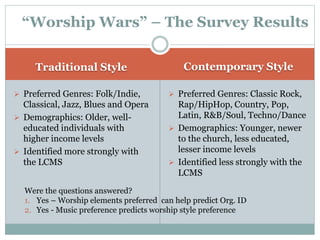
Traditional Style Contemporary Style
 Preferred Genres: Folk/Indie,
Classical, Jazz, Blues and Opera
 Demographics: Older, well-
educated individuals with
higher income levels
 Identified more strongly with
the LCMS
 Preferred Genres: Classic Rock,
Rap/HipHop, Country, Pop,
Latin, R&B/Soul, Techno/Dance
 Demographics: Younger, newer
to the church, less educated,
lesser income levels
 Identified less strongly with the
LCMS
“Worship Wars” – The Survey Results
Were the questions answered?
1. Yes – Worship elements preferred can help predict Org. ID
2. Yes - Music preference predicts worship style preference
The TRUTH of the Matter...
John 17: 17, 21 – Jesus prayed that WE would be
one, in him and in God, united in worship!
1 Peter 2:9 – We are ALL called to proclaim the
gospel.
Phil. 2:4 – Set aside style disputes for the sake of
unity
Col. 3:16 – Praise God through a variety of music!
Suggestions for YOU!
 Teach on the importance of musical diversity in worship
 Lead your congregation/youth group into other
expressions of worship: offering, scripture, testimonies,
service
 Challenge yourself: Try engaging in a different style or
expression of worship that is out of your comfort zone!
 “View worship as a journey together rather than the
music at your weekly meetings” – Center your worship
on the message of the gospel, not just singing songs that
mention Jesus.
 Worship style doesn’t matter to God. What’s MORE
important is the heart behind the leaders.
 Musical worship is a tool to help people have a genuine
experience with God. The style is a factor of culture,
audience, and environment.
 Musical worship should help to create an atmosphere that
helps open people’s hearts to hear the truth!
Truths about Worship
Sources
 Ruis, David. “Canned Worship.” Ministry Today Magazine. Charisma Media,
2014. Web. May 16, 2014
 Worship Wars – Kenny Lamm, Renewing Worship
o http://blog.ncbaptist.org/renewingworship/2011/02/09/worship-wars/
 Worship Styles, Music and Social Identity: A Communication Study
o http://academic.csuohio.edu/kneuendorf/vitae/JohnsonRuddNeuendorfetal10.pdf
 Worship Matters – Bob Kauflin

Youth & Worship

  • 1.
    H E LP I N G Y O U T H T O B E T T E R U N D E R S T A N D A N D W O R K T O O V E R C O M E T H E C O N G R E G A T I O N A L W O R S H I P M U S I C D I V I D E WorshipYouth &
  • 2.
    The Back Storyof the Problem “As long as we have had organized church and people with personal preferences, there has been conflict.” – Kenny Lamm  As churches grow and adapt to the changing world, many try to: o Incorporate different styles of music in their worship service to attract the younger, fresher crowd  while at the same time o Hold onto their older members. o Conflict may arise from differing members’ music preferences
  • 3.
    Worship Traditions Luther wrotehymns for congregational worship o in the language of the common people o putting hymn-like lyrics to traditional folk tunes to ensure they were singable o providing everyday Christians with opportunities to participate in worship and “gain a collective religious identity”  Today, Lutheran churches still use many of these hymns because they help give worshippers a sense of common identity as members of the church.
  • 4.
    Music = IDENTITY “Decidingwhat music to listen to is a significant part of deciding and announcing to people not just who you ‘want to be’….but who you are.” – Nicholas Cook.  Music is a form of communication  Music can invoke emotions of all kinds!  Music can create a sense of “group cohesiveness” that makes you feel like you belong (or DON’T belong!)
  • 5.
    A Study onthe “Worship Wars”...  Social Identity Theory - Groups view themselves positively or negatively depending on how they compare with other groups. o When a group’s positive identity is challenged or imposed on by another group, conflict often arises. o Organizational identity - “Who are we?”  Central and relatively permanent core qualities that distinguish your organization (group) from any other  An individual’s relationship/membership to a group 1. Does worship preference predict organizational identification? 2. Does music preference predict worship style preference?
  • 6.
    Traditional Style ContemporaryStyle  Preferred Genres: Folk/Indie, Classical, Jazz, Blues and Opera  Demographics: Older, well- educated individuals with higher income levels  Identified more strongly with the LCMS  Preferred Genres: Classic Rock, Rap/HipHop, Country, Pop, Latin, R&B/Soul, Techno/Dance  Demographics: Younger, newer to the church, less educated, lesser income levels  Identified less strongly with the LCMS “Worship Wars” – The Survey Results Were the questions answered? 1. Yes – Worship elements preferred can help predict Org. ID 2. Yes - Music preference predicts worship style preference
  • 7.
    The TRUTH ofthe Matter... John 17: 17, 21 – Jesus prayed that WE would be one, in him and in God, united in worship! 1 Peter 2:9 – We are ALL called to proclaim the gospel. Phil. 2:4 – Set aside style disputes for the sake of unity Col. 3:16 – Praise God through a variety of music!
  • 8.
    Suggestions for YOU! Teach on the importance of musical diversity in worship  Lead your congregation/youth group into other expressions of worship: offering, scripture, testimonies, service  Challenge yourself: Try engaging in a different style or expression of worship that is out of your comfort zone!  “View worship as a journey together rather than the music at your weekly meetings” – Center your worship on the message of the gospel, not just singing songs that mention Jesus.
  • 9.
     Worship styledoesn’t matter to God. What’s MORE important is the heart behind the leaders.  Musical worship is a tool to help people have a genuine experience with God. The style is a factor of culture, audience, and environment.  Musical worship should help to create an atmosphere that helps open people’s hearts to hear the truth! Truths about Worship
  • 10.
    Sources  Ruis, David.“Canned Worship.” Ministry Today Magazine. Charisma Media, 2014. Web. May 16, 2014  Worship Wars – Kenny Lamm, Renewing Worship o http://blog.ncbaptist.org/renewingworship/2011/02/09/worship-wars/  Worship Styles, Music and Social Identity: A Communication Study o http://academic.csuohio.edu/kneuendorf/vitae/JohnsonRuddNeuendorfetal10.pdf  Worship Matters – Bob Kauflin