Ch. 5.4Alexander-Empire Builder
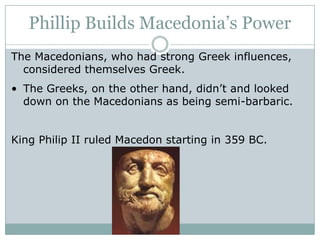
Phillip Builds Macedonia’s PowerThe Macedonians, who had strong Greek influences, considered themselves Greek.The Greeks, on the other hand, didn’t and looked down on the Macedonians as being semi-barbaric.King Philip II ruled Macedon starting in 359 BC.
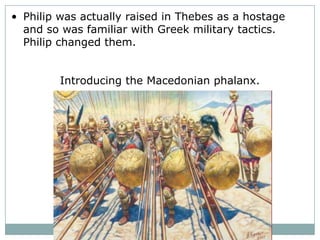
Philip was actually raised in Thebes as a hostage and so was familiar with Greek military tactics.  Philip changed them.  Introducing the Macedonian phalanx.
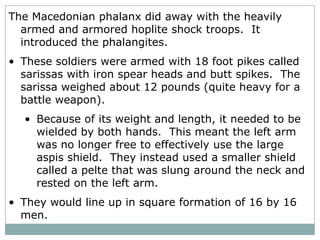
The Macedonian phalanx did away with the heavily armed and armored hoplite shock troops.  It introduced the phalangites.These soldiers were armed with 18 foot pikes called sarissas with iron spear heads and butt spikes.  The sarissa weighed about 12 pounds (quite heavy for a battle weapon).
Because of its weight and length, it needed to be wielded by both hands.  This meant the left arm was no longer free to effectively use the large aspis shield.  They instead used a smaller shield called a pelte that was slung around the neck and rested on the left arm.
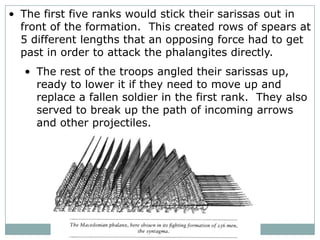
They would line up in square formation of 16 by 16 men.The first five ranks would stick their sarissas out in front of the formation.  This created rows of spears at 5 different lengths that an opposing force had to get past in order to attack the phalangites directly.
The rest of the troops angled their sarissas up, ready to lower it if they need to move up and replace a fallen soldier in the first rank.  They also served to break up the path of incoming arrows and other projectiles.The sarissa was broken down into two sections for carrying – it’s hard to carry an 18 foot pike when marching, after all.  It would be reattached before battle.
The butt spike wasn’t offensive, but served two purposes:
First, it counterbalanced the spear head.  If you hold an 18 foot pole with nearly 15 feet sticking out in front of you and there’s a weight on the end, you need an even heavier weight on the short end balance it out.  Otherwise, it would be impossible to hold up for more than a few minutes.
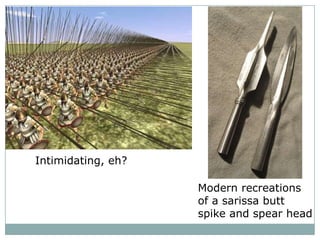
Second, the phalangites could drive the butt spike into the ground, thus anchoring the sarissa.  If they did this, the phlanax was nearly impossible to move or to attack.Intimidating, eh?Modern recreations of a sarissa butt spike and spear head
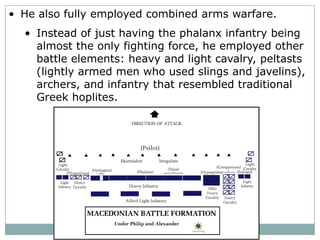
Philip did more than just improve the phalanx, however.First off, he created the first real professional standing army.  No longer was it a part-time endeavor of yeomen when needed.  They were paid and this was their job.  The constant training made them very good.He also fully employed combined arms warfare.
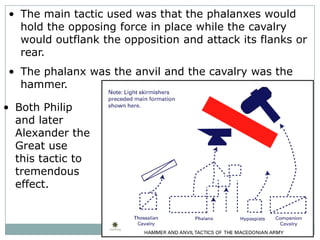
Instead of just having the phalanx infantry being almost the only fighting force, he employed other battle elements: heavy and light cavalry, peltasts (lightly armed men who used slings and javelins), archers, and infantry that resembled traditional Greek hoplites.The main tactic used was that the phalanxes would hold the opposing force in place while the cavalry would outflank the opposition and attack its flanks or rear.
The phalanx was the anvil and the cavalry was the hammer.
Both Philip and later Alexander the Great use this tactic to tremendous effect.Macedonian phalanx pros and consProsNearly invincible from the front.  A force couldn’t break through the line of pikes.Due to the offensive/defensive nature of the pikes, the phalangites didn’t need to have all the armor that hoplites did.  This made arming them far cheaper and the Macedonians could afford the standing army.ConsThe formation had almost no maneuverability.  Due to those long pikes, it couldn’t turn or protect its flanks; it could only go straight ahead.  This meant a fast and/or maneuverable enemy could outflank it and tear it apartCould lose formation over uneven terrain and open up gaps that could be exposed by the enemy.
Conquest of GreeceThe Athenian orator Demosthenes (dee•MAHS•thuh•NEEZ) tried to warn the Greeks of the threat Philip and his army posed. He urged them to unite against him.They didn’t listenThe Macedonians soundly defeated the Greeks at the battle of Chaeronea (KAIR•uh•NEE•uh).
Phillip’s SuccessorPhillip planned to invade Persia next, but never got the chance. He was stabbed by a former guardsman at his daughter’s wedding.His son, Alexander, takes over for daddy.
AlexanderHe was personally tutored by the philosopher Aristotle (who was Plato’s student and Plato was Socrates’ student).Aristotle taught him philosophy, ethics, rhetoric, literature, etc.Also gave Alex a copy of the Iliad which Alex held dear and read often.Bear in mind the Iliad contains a lot of heroics and doing great deeds.Alexander becomes king and immediately gains the full support of the army (the most important thing).Though he was only 20 at the time, he had already proved himself in battle as both an effective warrior and a good commander.
Nobody messes with the PhilipHis first job was to put down the rebellion of the Greek city-states which had taken the opportunity of Philip’s death and the transfer of power to throw off the Macedonian yoke.
First they submitted and then they later rebelled again.
The second time around, most hesitated while Thebes decided to resist.  The Thebans were crushed.
As punishment and as a warning to others, Alexander razed the city sold the populace into slavery (6,000 killed and 30,000 sold for 440 talents of silver).
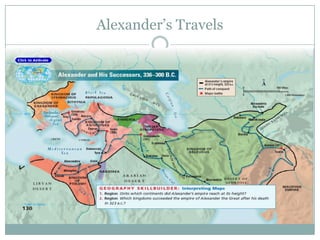
Everybody else got the message and submitted.  The Athenians exiled all the anti-Macedon folks, starting with Demosthenes.Invasion of PersiaIn 334 BC, Alexander invades the Persian empire with 30,000 men.Those who had preyed on Greece now became the prey themselves.Not only did Alexander thirst for power, adventure, and especially glory, but he also wanted to get revenge on Persia for its ill-treatment of Greece.Alexander was also a lead from the front type of commander.  He didn’t stay at the back of the army where he’d be safest.  He rode with the cavalry and actively engaged in hand to hand combat.
Invasion of Persia cont’The Persian king, Darius III, at first doesn’t take Alexander all that seriously.
Darius is soundly defeated at both Granicus and Issus, however, and Alexander liberates the Greek city-states in Asia Minor.

Ch. 5.4 -alexander-empire builder

  • 1.
  • 2.
    Phillip Builds Macedonia’sPowerThe Macedonians, who had strong Greek influences, considered themselves Greek.The Greeks, on the other hand, didn’t and looked down on the Macedonians as being semi-barbaric.King Philip II ruled Macedon starting in 359 BC.
  • 3.
    Philip was actuallyraised in Thebes as a hostage and so was familiar with Greek military tactics. Philip changed them. Introducing the Macedonian phalanx.
  • 4.
    The Macedonian phalanxdid away with the heavily armed and armored hoplite shock troops. It introduced the phalangites.These soldiers were armed with 18 foot pikes called sarissas with iron spear heads and butt spikes. The sarissa weighed about 12 pounds (quite heavy for a battle weapon).
  • 5.
    Because of itsweight and length, it needed to be wielded by both hands. This meant the left arm was no longer free to effectively use the large aspis shield. They instead used a smaller shield called a pelte that was slung around the neck and rested on the left arm.
  • 6.
    They would lineup in square formation of 16 by 16 men.The first five ranks would stick their sarissas out in front of the formation. This created rows of spears at 5 different lengths that an opposing force had to get past in order to attack the phalangites directly.
  • 7.
    The rest ofthe troops angled their sarissas up, ready to lower it if they need to move up and replace a fallen soldier in the first rank. They also served to break up the path of incoming arrows and other projectiles.The sarissa was broken down into two sections for carrying – it’s hard to carry an 18 foot pike when marching, after all. It would be reattached before battle.
  • 8.
    The butt spikewasn’t offensive, but served two purposes:
  • 9.
    First, it counterbalancedthe spear head. If you hold an 18 foot pole with nearly 15 feet sticking out in front of you and there’s a weight on the end, you need an even heavier weight on the short end balance it out. Otherwise, it would be impossible to hold up for more than a few minutes.
  • 10.
    Second, the phalangitescould drive the butt spike into the ground, thus anchoring the sarissa. If they did this, the phlanax was nearly impossible to move or to attack.Intimidating, eh?Modern recreations of a sarissa butt spike and spear head
  • 11.
    Philip did morethan just improve the phalanx, however.First off, he created the first real professional standing army. No longer was it a part-time endeavor of yeomen when needed. They were paid and this was their job. The constant training made them very good.He also fully employed combined arms warfare.
  • 12.
    Instead of justhaving the phalanx infantry being almost the only fighting force, he employed other battle elements: heavy and light cavalry, peltasts (lightly armed men who used slings and javelins), archers, and infantry that resembled traditional Greek hoplites.The main tactic used was that the phalanxes would hold the opposing force in place while the cavalry would outflank the opposition and attack its flanks or rear.
  • 13.
    The phalanx wasthe anvil and the cavalry was the hammer.
  • 14.
    Both Philip andlater Alexander the Great use this tactic to tremendous effect.Macedonian phalanx pros and consProsNearly invincible from the front. A force couldn’t break through the line of pikes.Due to the offensive/defensive nature of the pikes, the phalangites didn’t need to have all the armor that hoplites did. This made arming them far cheaper and the Macedonians could afford the standing army.ConsThe formation had almost no maneuverability. Due to those long pikes, it couldn’t turn or protect its flanks; it could only go straight ahead. This meant a fast and/or maneuverable enemy could outflank it and tear it apartCould lose formation over uneven terrain and open up gaps that could be exposed by the enemy.
  • 15.
    Conquest of GreeceTheAthenian orator Demosthenes (dee•MAHS•thuh•NEEZ) tried to warn the Greeks of the threat Philip and his army posed. He urged them to unite against him.They didn’t listenThe Macedonians soundly defeated the Greeks at the battle of Chaeronea (KAIR•uh•NEE•uh).
  • 16.
    Phillip’s SuccessorPhillip plannedto invade Persia next, but never got the chance. He was stabbed by a former guardsman at his daughter’s wedding.His son, Alexander, takes over for daddy.
  • 17.
    AlexanderHe was personallytutored by the philosopher Aristotle (who was Plato’s student and Plato was Socrates’ student).Aristotle taught him philosophy, ethics, rhetoric, literature, etc.Also gave Alex a copy of the Iliad which Alex held dear and read often.Bear in mind the Iliad contains a lot of heroics and doing great deeds.Alexander becomes king and immediately gains the full support of the army (the most important thing).Though he was only 20 at the time, he had already proved himself in battle as both an effective warrior and a good commander.
  • 18.
    Nobody messes withthe PhilipHis first job was to put down the rebellion of the Greek city-states which had taken the opportunity of Philip’s death and the transfer of power to throw off the Macedonian yoke.
  • 19.
    First they submittedand then they later rebelled again.
  • 20.
    The second timearound, most hesitated while Thebes decided to resist. The Thebans were crushed.
  • 21.
    As punishment andas a warning to others, Alexander razed the city sold the populace into slavery (6,000 killed and 30,000 sold for 440 talents of silver).
  • 22.
    Everybody else gotthe message and submitted. The Athenians exiled all the anti-Macedon folks, starting with Demosthenes.Invasion of PersiaIn 334 BC, Alexander invades the Persian empire with 30,000 men.Those who had preyed on Greece now became the prey themselves.Not only did Alexander thirst for power, adventure, and especially glory, but he also wanted to get revenge on Persia for its ill-treatment of Greece.Alexander was also a lead from the front type of commander. He didn’t stay at the back of the army where he’d be safest. He rode with the cavalry and actively engaged in hand to hand combat.
  • 23.
    Invasion of Persiacont’The Persian king, Darius III, at first doesn’t take Alexander all that seriously.
  • 24.
    Darius is soundlydefeated at both Granicus and Issus, however, and Alexander liberates the Greek city-states in Asia Minor.