
He was a king of Macedon, a state in northern ancient Greece.
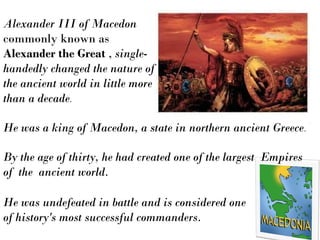
Alexander III of Macedon
commonly known as
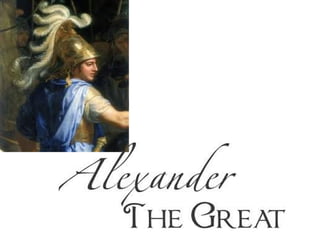
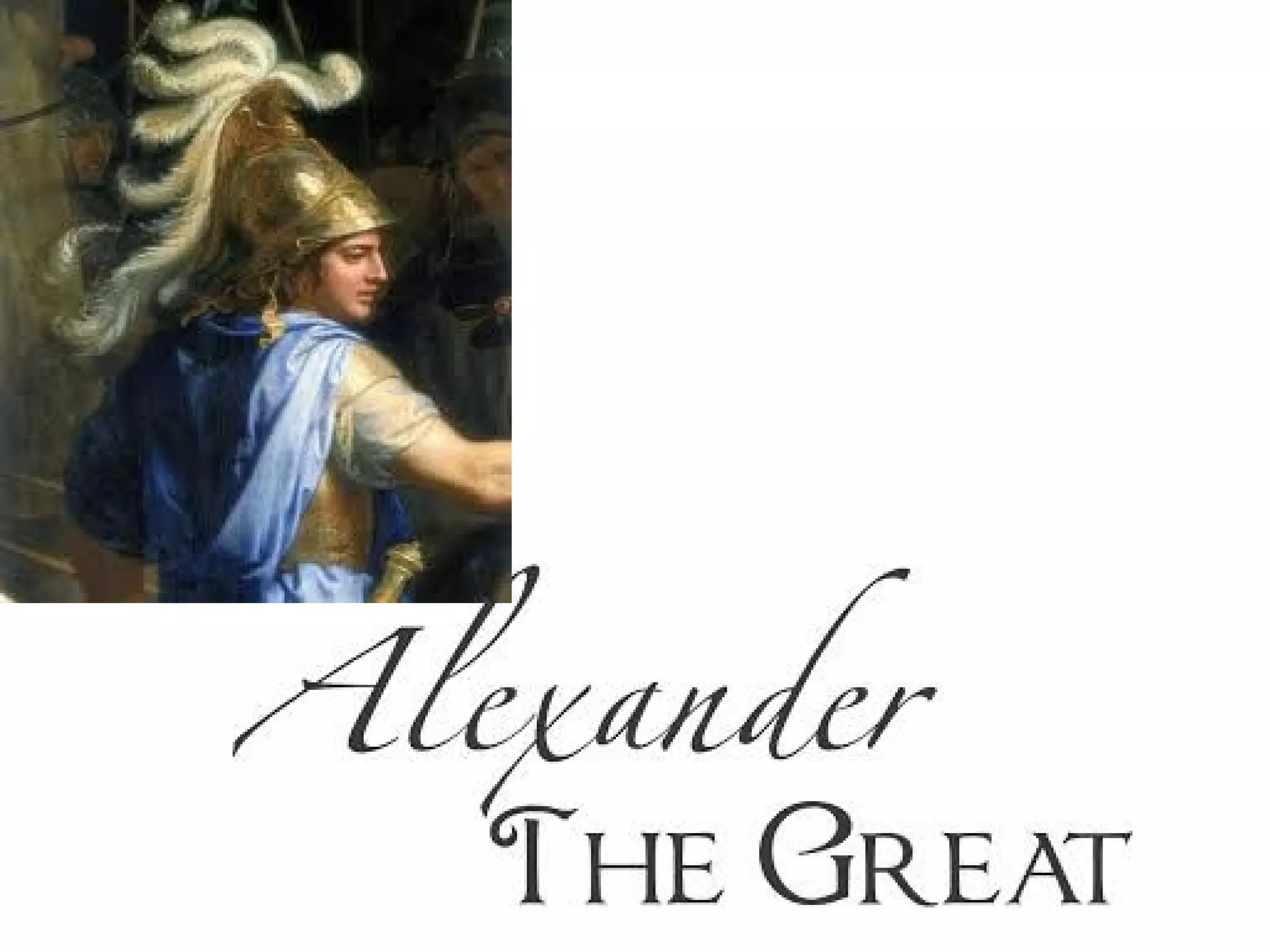
Alexander the Great , single-
handedly changed the nature of
the ancient world in little more
than a decade.
He was undefeated in battle and is considered one
of history's most successful commanders.
By the age of thirty, he had created one of the largest Empires
of the ancient world.
Origin
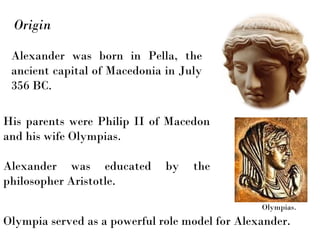
His parents were Philip II of Macedon
and his wife Olympias.
Alexander was educated by the
philosopher Aristotle.
Alexander was born in Pella, the
ancient capital of Macedonia in July
356 BC.
Olympia served as a powerful role model for Alexander.
Olympias.
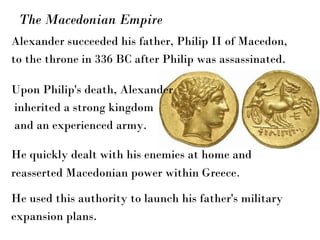
Alexander succeeded his father, Philip II of Macedon,
to the throne in 336 BC after Philip was assassinated.
Upon Philip's death, Alexander
inherited a strong kingdom
and an experienced army.
He quickly dealt with his enemies at home and
reasserted Macedonian power within Greece.
He used this authority to launch his father's military
expansion plans.
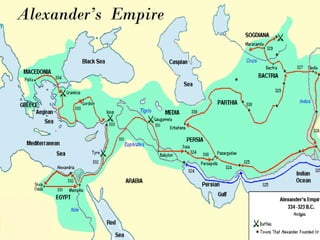
The Macedonian Empire
Succeeding his father, Alexander set out to conquer the
massive Persian Empire.
During a decade of campaigning, Alexander conquered the
whole Persian Empire, overthrowing the Persian King
Darius III.
He led his army to victories across the Persian territories of
Asia Minor, Syria and Egypt without suffering a single
defeat.
His greatest victory was at the Battle of Gaugamela, in what
is now northern Iraq, in 331 BC.
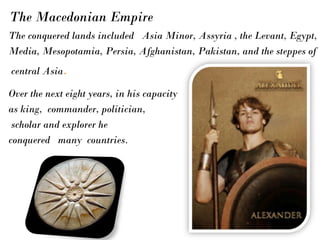
The conquered lands included Asia Minor, Assyria , the Levant, Egypt,
Media, Mesopotamia, Persia, Afghanistan, Pakistan, and the steppes of
central Asia.
Over the next eight years, in his capacity
as king, commander, politician,
scholar and explorer he
conquered many countries.
The Macedonian Empire
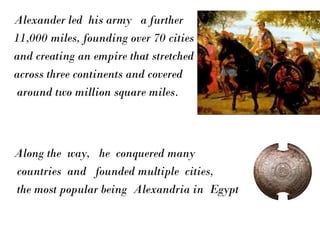
Alexander led his army a further
11,000 miles, founding over 70 cities
and creating an empire that stretched
across three continents and covered
around two million square miles.
Along the way, he conquered many
countries and founded multiple cities,
the most popular being Alexandria in Egypt
Alexander’s Empire
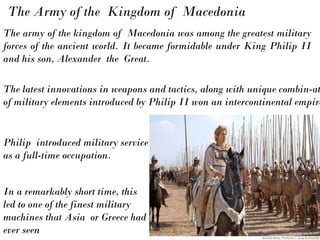
Philip introduced military service
as a full-time occupation.
In a remarkably short time, this
led to one of the finest military
machines that Asia or Greece had
ever seen
The army of the kingdom of Macedonia was among the greatest military
forces of the ancient world. It became formidable under King Philip II
and his son, Alexander the Great.
The Army of the Kingdom of Macedonia
The latest innovations in weapons and tactics, along with unique combin-at
of military elements introduced by Philip II won an intercontinental empire
Tactical innovations included adaptations of
the latest tactics applied to the traditional Greek
phalanx by men such as Epaminondas of
Thebes, as well as coordinated attacks.
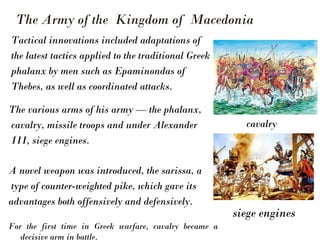
The various arms of his army — the phalanx,
cavalry, missile troops and under Alexander
III, siege engines.
A novel weapon was introduced, the sarissa, a
type of counter-weighted pike, which gave its
advantages both offensively and defensively.
For the first time in Greek warfare, cavalry became a
decisive arm in battle.
The Army of the Kingdom of Macedonia
siege engines
cavalry
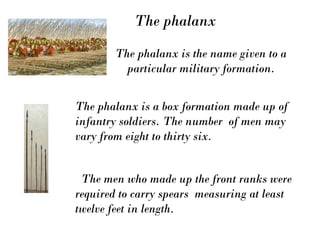
The phalanx
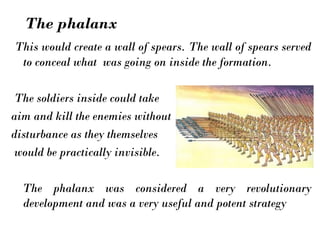
The phalanx is the name given to a
particular military formation.
The phalanx is a box formation made up of
infantry soldiers. The number of men may
vary from eight to thirty six.
The men who made up the front ranks were
required to carry spears measuring at least
twelve feet in length.
This would create a wall of spears. The wall of spears served
to conceal what was going on inside the formation.
The soldiers inside could take
aim and kill the enemies without
disturbance as they themselves
would be practically invisible.
The phalanx was considered a very revolutionary
development and was a very useful and potent strategy
The phalanx
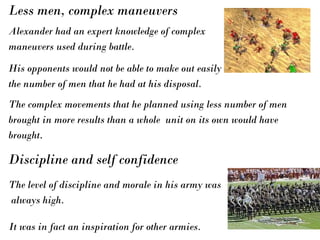
Less men, complex maneuvers
Alexander had an expert knowledge of complex
maneuvers used during battle.
His opponents would not be able to make out easily
the number of men that he had at his disposal.
The complex movements that he planned using less number of men
brought in more results than a whole unit on its own would have
brought. 
Discipline and self confidence
The level of discipline and morale in his army was
always high.
It was in fact an inspiration for other armies. 
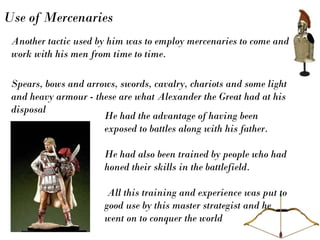
Use of Mercenaries
Another tactic used by him was to employ mercenaries to come and
work with his men from time to time.
Spears, bows and arrows, swords, cavalry, chariots and some light
and heavy armour - these are what Alexander the Great had at his
disposal
He had the advantage of having been
exposed to battles along with his father.
He had also been trained by people who had
honed their skills in the battlefield.
All this training and experience was put to
good use by this master strategist and he
went on to conquer the world
Facts about Alexander the Great
 Alexander the Great had three wives: Roxane, Statiera,
and Parysatis.
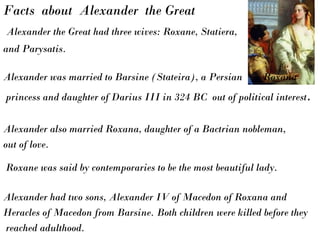
Alexander was married to Barsine (Stateira), a Persian Roxana
princess and daughter of Darius III in 324 BC out of political interest. 
Alexander also married Roxana, daughter of a Bactrian nobleman,
out of love.
Roxane was said by contemporaries to be the most beautiful lady.
Alexander had two sons, Alexander IV of Macedon of Roxana and
Heracles of Macedon from Barsine. Both children were killed before they
reached adulthood.
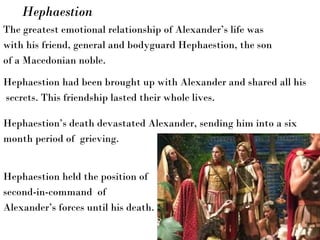
The greatest emotional relationship of Alexander’s life was
with his friend, general and bodyguard Hephaestion, the son
of a Macedonian noble.
Hephaestion had been brought up with Alexander and shared all his
secrets. This friendship lasted their whole lives.
Hephaestion’s death devastated Alexander, sending him into a six
month period of grieving.
Hephaestion held the position of
second-in-command of
Alexander’s forces until his death.
Hephaestion
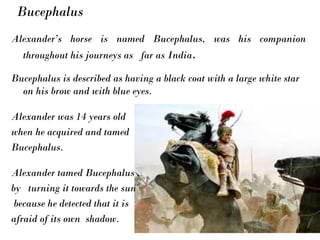
Alexander’s horse is named Bucephalus, was his companion
throughout his journeys as far as India. 
Bucephalus is described as having a black coat with a large white star
on his brow and with blue eyes.
Alexander was 14 years old
when he acquired and tamed
Bucephalus.
Alexander tamed Bucephalus ,
by turning it towards the sun
because he detected that it is
afraid of its own shadow.
Bucephalus
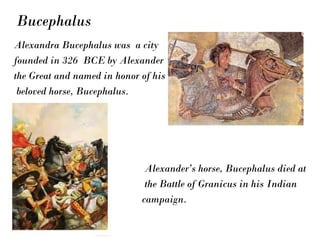
Alexandra Bucephalus was a city
founded in 326 BCE by Alexander
the Great and named in honor of his
beloved horse, Bucephalus.
Alexander’s horse, Bucephalus died at
the Battle of Granicus in his Indian
campaign.
Bucephalus
Alexander was acknowledged as a
military genius who always led by
example, although his belief in his own
indestructibility meant he was often
reckless with his own life and those of
his soldiers.
The fact that his army only refused to
follow him once in 13 years of a reign
during which there was constant
fighting, indicates the loyalty he
inspired.
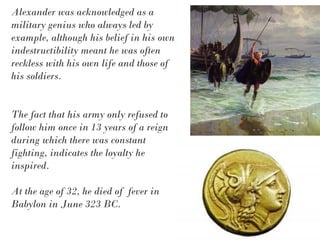
At the age of 32, he died of fever in
Babylon in June 323 BC.
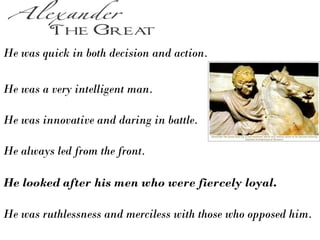
He was quick in both decision and action.
He was a very intelligent man.
He was innovative and daring in battle.
He always led from the front.
He looked after his men who were fiercely loyal.
He was ruthlessness and merciless with those who opposed him.
“ I am not afraid of an army of lions led by a
sheep; I am afraid of an army of sheep led by a
lion.”
“I had rather excel others in the knowledge of
what is excellent, than in the extent of my power
and dominion.”
“ There is nothing impossible to him who will try.”
-Alexander the Great
Quotes
BY S.Vanitha, Thottakurichy

Alexander the Great

  • 2.
    He was aking of Macedon, a state in northern ancient Greece. Alexander III of Macedon commonly known as Alexander the Great , single- handedly changed the nature of the ancient world in little more than a decade. He was undefeated in battle and is considered one of history's most successful commanders. By the age of thirty, he had created one of the largest Empires of the ancient world.
  • 3.
    Origin His parents werePhilip II of Macedon and his wife Olympias. Alexander was educated by the philosopher Aristotle. Alexander was born in Pella, the ancient capital of Macedonia in July 356 BC. Olympia served as a powerful role model for Alexander. Olympias.
  • 4.
    Alexander succeeded hisfather, Philip II of Macedon, to the throne in 336 BC after Philip was assassinated. Upon Philip's death, Alexander inherited a strong kingdom and an experienced army. He quickly dealt with his enemies at home and reasserted Macedonian power within Greece. He used this authority to launch his father's military expansion plans. The Macedonian Empire
  • 5.
    The Macedonian Empire Succeedinghis father, Alexander set out to conquer the massive Persian Empire. During a decade of campaigning, Alexander conquered the whole Persian Empire, overthrowing the Persian King Darius III. He led his army to victories across the Persian territories of Asia Minor, Syria and Egypt without suffering a single defeat. His greatest victory was at the Battle of Gaugamela, in what is now northern Iraq, in 331 BC.
  • 6.
    The conquered landsincluded Asia Minor, Assyria , the Levant, Egypt, Media, Mesopotamia, Persia, Afghanistan, Pakistan, and the steppes of central Asia. Over the next eight years, in his capacity as king, commander, politician, scholar and explorer he conquered many countries. The Macedonian Empire
  • 7.
    Alexander led hisarmy a further 11,000 miles, founding over 70 cities and creating an empire that stretched across three continents and covered around two million square miles. Along the way, he conquered many countries and founded multiple cities, the most popular being Alexandria in Egypt
  • 8.
  • 9.
    Philip introduced militaryservice as a full-time occupation. In a remarkably short time, this led to one of the finest military machines that Asia or Greece had ever seen The army of the kingdom of Macedonia was among the greatest military forces of the ancient world. It became formidable under King Philip II and his son, Alexander the Great. The Army of the Kingdom of Macedonia The latest innovations in weapons and tactics, along with unique combin-at of military elements introduced by Philip II won an intercontinental empire
  • 10.
    Tactical innovations includedadaptations of the latest tactics applied to the traditional Greek phalanx by men such as Epaminondas of Thebes, as well as coordinated attacks. The various arms of his army — the phalanx, cavalry, missile troops and under Alexander III, siege engines. A novel weapon was introduced, the sarissa, a type of counter-weighted pike, which gave its advantages both offensively and defensively. For the first time in Greek warfare, cavalry became a decisive arm in battle. The Army of the Kingdom of Macedonia siege engines cavalry
  • 11.
    The phalanx The phalanxis the name given to a particular military formation. The phalanx is a box formation made up of infantry soldiers. The number of men may vary from eight to thirty six. The men who made up the front ranks were required to carry spears measuring at least twelve feet in length.
  • 12.
    This would createa wall of spears. The wall of spears served to conceal what was going on inside the formation. The soldiers inside could take aim and kill the enemies without disturbance as they themselves would be practically invisible. The phalanx was considered a very revolutionary development and was a very useful and potent strategy The phalanx
  • 13.
    Less men, complexmaneuvers Alexander had an expert knowledge of complex maneuvers used during battle. His opponents would not be able to make out easily the number of men that he had at his disposal. The complex movements that he planned using less number of men brought in more results than a whole unit on its own would have brought.  Discipline and self confidence The level of discipline and morale in his army was always high. It was in fact an inspiration for other armies. 
  • 14.
    Use of Mercenaries Anothertactic used by him was to employ mercenaries to come and work with his men from time to time. Spears, bows and arrows, swords, cavalry, chariots and some light and heavy armour - these are what Alexander the Great had at his disposal He had the advantage of having been exposed to battles along with his father. He had also been trained by people who had honed their skills in the battlefield. All this training and experience was put to good use by this master strategist and he went on to conquer the world
  • 15.
    Facts about Alexanderthe Great  Alexander the Great had three wives: Roxane, Statiera, and Parysatis. Alexander was married to Barsine (Stateira), a Persian Roxana princess and daughter of Darius III in 324 BC out of political interest.  Alexander also married Roxana, daughter of a Bactrian nobleman, out of love. Roxane was said by contemporaries to be the most beautiful lady. Alexander had two sons, Alexander IV of Macedon of Roxana and Heracles of Macedon from Barsine. Both children were killed before they reached adulthood.
  • 16.
    The greatest emotionalrelationship of Alexander’s life was with his friend, general and bodyguard Hephaestion, the son of a Macedonian noble. Hephaestion had been brought up with Alexander and shared all his secrets. This friendship lasted their whole lives. Hephaestion’s death devastated Alexander, sending him into a six month period of grieving. Hephaestion held the position of second-in-command of Alexander’s forces until his death. Hephaestion
  • 17.
    Alexander’s horse isnamed Bucephalus, was his companion throughout his journeys as far as India.  Bucephalus is described as having a black coat with a large white star on his brow and with blue eyes. Alexander was 14 years old when he acquired and tamed Bucephalus. Alexander tamed Bucephalus , by turning it towards the sun because he detected that it is afraid of its own shadow. Bucephalus
  • 18.
    Alexandra Bucephalus wasa city founded in 326 BCE by Alexander the Great and named in honor of his beloved horse, Bucephalus. Alexander’s horse, Bucephalus died at the Battle of Granicus in his Indian campaign. Bucephalus
  • 19.
    Alexander was acknowledgedas a military genius who always led by example, although his belief in his own indestructibility meant he was often reckless with his own life and those of his soldiers. The fact that his army only refused to follow him once in 13 years of a reign during which there was constant fighting, indicates the loyalty he inspired. At the age of 32, he died of fever in Babylon in June 323 BC.
  • 20.
    He was quickin both decision and action. He was a very intelligent man. He was innovative and daring in battle. He always led from the front. He looked after his men who were fiercely loyal. He was ruthlessness and merciless with those who opposed him.
  • 21.
    “ I amnot afraid of an army of lions led by a sheep; I am afraid of an army of sheep led by a lion.” “I had rather excel others in the knowledge of what is excellent, than in the extent of my power and dominion.” “ There is nothing impossible to him who will try.” -Alexander the Great Quotes
  • 22.