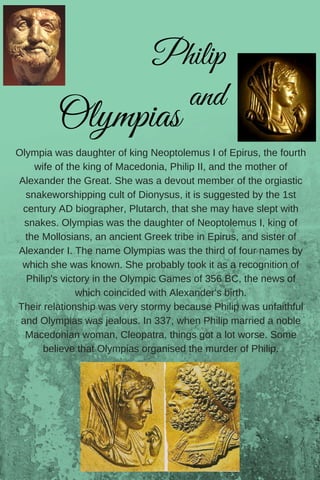
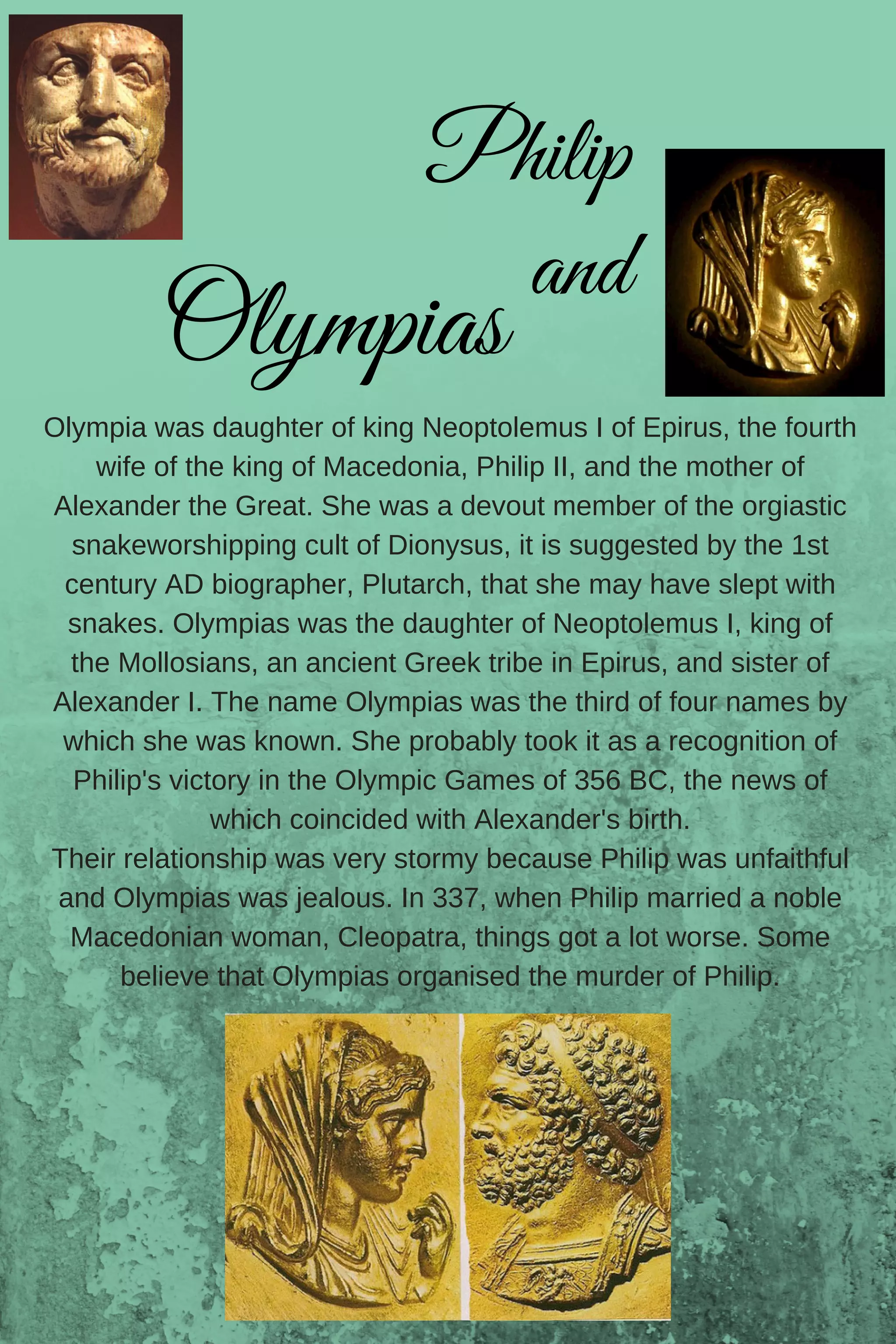
Olympia was daughter of king Neoptolemus I of Epirus, the fourth
wife of the king of Macedonia, Philip II, and the mother of
Alexander the Great. She was a devout member of the orgiastic
snakeworshipping cult of Dionysus, it is suggested by the 1st
century AD biographer, Plutarch, that she may have slept with
snakes. Olympias was the daughter of Neoptolemus I, king of
the Mollosians, an ancient Greek tribe in Epirus, and sister of
Alexander I. The name Olympias was the third of four names by
which she was known. She probably took it as a recognition of
Philip's victory in the Olympic Games of 356 BC, the news of
which coincided with Alexander's birth.
Their relationship was very stormy because Philip was unfaithful
and Olympias was jealous. In 337, when Philip married a noble
Macedonian woman, Cleopatra, things got a lot worse. Some
believe that Olympias organised the murder of Philip.
      Philip
and
Olympias
When he reached the age of 13,Philip hired the Greek
philosopher Aristotle to be Alexander's personal
tutor.During the next three years Aristotle gave
Alexander a training in rhetoric and literature and
stimulated his interest in science,medicine,and
philosophy,all of which became of importance in
Alexander's later life
ALEXANDER  CHILDHOOD
Alexander spent his childhood
watching his father
transforming Macedonia into a
great military power. At the age
of 12 he showed his equestrian
skill to his father and all who
where watching when he
tamed Bucephalus.
ALEXANDER  CHILDHOOD
As a child he learnt to read,write,fight and hunt
as was typical for sons of noble birth in that
era.He grew up to be a brave boy and tamed
an unruly horse when he was 12 years old.The
horse,named Bucephalas, became his favorite
horse and served him for several years. King
Philip asked the great philosopher, Aristotle, to
teach Alexander and provided the Temple of
the Nymphs at Mieza as a classroom.
Aristotle tutored Alexander and the children of
Macedonian nobles in subjects like medicine,
philosophy, morals, religion, logic and art.
Taught by him Alexander also developed love
for literature. When Alexander was 16, his
father left him in charge of the kingdom as a
regent while fighting against Byzantion. While
Philip was away, the Thracians rose against
Macedonia. Even though he was a young boy,
Alexander managed to push them away.
In 349 BC [15] Leonidas, a relative of the Olympiad,
assumed the responsibility of raising the prince.
Under his supervision, Alexander taught arithmetic,
geometry, music, and he was particularly involved in
horse riding. Later, Philip pledged his son Aristotle,
who taught him the history, astronomy, geography,
medicine, literature and political sciences, along with
the rest of the young members of the Macedonian
aristocracy. [16] The apprenticeship near the great
philosopher played a decisive role in the character of
the young Alexander
ALEXANDER CHILDHOOD
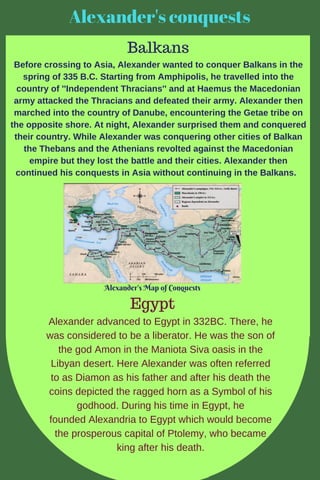
Alexander's conquests
Add a little bit of body text
Add subheading
Asia
Balkans
Before crossing to Asia, Alexander wanted to conquer Balkans in the
spring of 335 B.C. Starting from Amphipolis, he travelled into the
country of ''Independent Thracians'' and at Haemus the Macedonian
army attacked the Thracians and defeated their army. Alexander then
marched into the country of Danube, encountering the Getae tribe on
the opposite shore. At night, Alexander surprised them and conquered
their country. While Alexander was conquering other cities of Balkan
the Thebans and the Athenians revolted against the Macedonian
empire but they lost the battle and their cities. Alexander then
continued his conquests in Asia without continuing in the Balkans.
Egypt
Alexander advanced to Egypt in 332BC. There, he
was considered to be a liberator. He was the son of
the god Amon in the Maniota Siva oasis in the
Libyan desert. Here Alexander was often referred
to as Diamon as his father and after his death the
coins depicted the ragged horn as a Symbol of his
godhood. During his time in Egypt, he
founded Alexandria to Egypt which would become
the prosperous capital of Ptolemy, who became
king after his death.
Alexander's Map of Conquests
Add subheadingAdd subheading
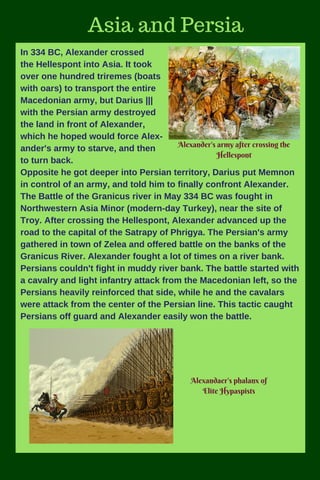
Asia and Persia
In 334 BC, Alexander crossed
the Hellespont into Asia. It took
over one hundred triremes (boats
with oars) to transport the entire
Macedonian army, but Darius |||
with the Persian army destroyed
the land in front of Alexander,
which he hoped would force Alex-
ander's army to starve, and then
to turn back.
Opposite he got deeper into Persian territory, Darius put Memnon
in control of an army, and told him to finally confront Alexander.
The Battle of the Granicus river in May 334 BC was fought in
Northwestern Asia Minor (modern-day Turkey), near the site of
Troy. After crossing the Hellespont, Alexander advanced up the
road to the capital of the Satrapy of Phrigya. The Persian's army
gathered in town of Zelea and offered battle on the banks of the
Granicus River. Alexander fought a lot of times on a river bank.
Persians couldn't fight in muddy river bank. The battle started with
a cavalry and light infantry attack from the Macedonian left, so the
Persians heavily reinforced that side, while he and the cavalars
were attack from the center of the Persian line. This tactic caught
Persians off guard and Alexander easily won the battle.
Alexander's army after crossing the
Hellespont
Alexandaer's phalanx of
Elite Hypaspists
At the end of the 5th century Archelaus I brought to his court
artists, poets, and philosophers from all over the Greek
world: it was, for example, at Aigai that Euripides wrote and
presented his last tragedies.At the beginning of the 4th
century BC, Archelaus transferred the Macedonian capital
north-east to Pella on the central Macedonian plain .
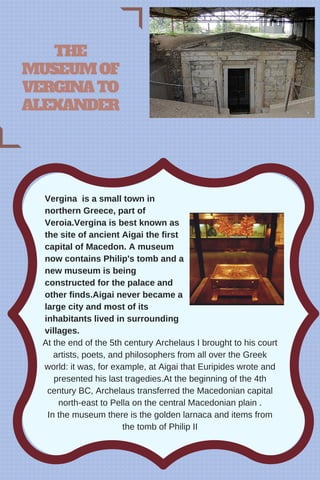
In the museum there is the golden larnaca and items from
the tomb of Philip II
THE
MUSEUMOF
VERGINATO
ALEXANDER
Vergina is a small town in
northern Greece, part of
Veroia.Vergina is best known as
the site of ancient Aigai the first
capital of Macedon. A museum
now contains Philip's tomb and a
new museum is being
constructed for the palace and
other finds.Aigai never became a
large city and most of its
inhabitants lived in surrounding
villages.
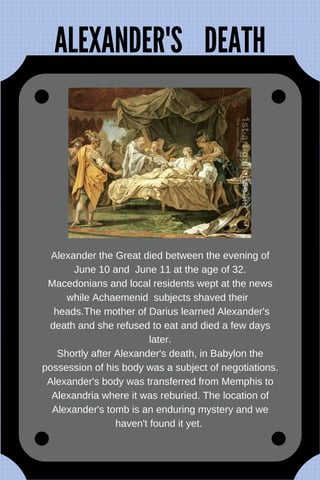
ALEXANDER'S DEATH
Alexander the Great died between the evening of
June 10 and June 11 at the age of 32.
Macedonians and local residents wept at the news
while Achaemenid subjects shaved their
heads.The mother of Darius learned Alexander's
death and she refused to eat and died a few days
later.
Shortly after Alexander's death, in Babylon the
possession of his body was a subject of negotiations.
Alexander's body was transferred from Memphis to
Alexandria where it was reburied. The location of
Alexander's tomb is an enduring mystery and we
haven't found it yet.

Alexander the Great - a quick overview

  • 1.
    Olympia was daughterof king Neoptolemus I of Epirus, the fourth wife of the king of Macedonia, Philip II, and the mother of Alexander the Great. She was a devout member of the orgiastic snakeworshipping cult of Dionysus, it is suggested by the 1st century AD biographer, Plutarch, that she may have slept with snakes. Olympias was the daughter of Neoptolemus I, king of the Mollosians, an ancient Greek tribe in Epirus, and sister of Alexander I. The name Olympias was the third of four names by which she was known. She probably took it as a recognition of Philip's victory in the Olympic Games of 356 BC, the news of which coincided with Alexander's birth. Their relationship was very stormy because Philip was unfaithful and Olympias was jealous. In 337, when Philip married a noble Macedonian woman, Cleopatra, things got a lot worse. Some believe that Olympias organised the murder of Philip.       Philip and Olympias
  • 2.
    When he reachedthe age of 13,Philip hired the Greek philosopher Aristotle to be Alexander's personal tutor.During the next three years Aristotle gave Alexander a training in rhetoric and literature and stimulated his interest in science,medicine,and philosophy,all of which became of importance in Alexander's later life ALEXANDER  CHILDHOOD Alexander spent his childhood watching his father transforming Macedonia into a great military power. At the age of 12 he showed his equestrian skill to his father and all who where watching when he tamed Bucephalus.
  • 3.
    ALEXANDER  CHILDHOOD As achild he learnt to read,write,fight and hunt as was typical for sons of noble birth in that era.He grew up to be a brave boy and tamed an unruly horse when he was 12 years old.The horse,named Bucephalas, became his favorite horse and served him for several years. King Philip asked the great philosopher, Aristotle, to teach Alexander and provided the Temple of the Nymphs at Mieza as a classroom. Aristotle tutored Alexander and the children of Macedonian nobles in subjects like medicine, philosophy, morals, religion, logic and art. Taught by him Alexander also developed love for literature. When Alexander was 16, his father left him in charge of the kingdom as a regent while fighting against Byzantion. While Philip was away, the Thracians rose against Macedonia. Even though he was a young boy, Alexander managed to push them away.
  • 4.
    In 349 BC[15] Leonidas, a relative of the Olympiad, assumed the responsibility of raising the prince. Under his supervision, Alexander taught arithmetic, geometry, music, and he was particularly involved in horse riding. Later, Philip pledged his son Aristotle, who taught him the history, astronomy, geography, medicine, literature and political sciences, along with the rest of the young members of the Macedonian aristocracy. [16] The apprenticeship near the great philosopher played a decisive role in the character of the young Alexander ALEXANDER CHILDHOOD
  • 5.
    Alexander's conquests Add alittle bit of body text Add subheading Asia Balkans Before crossing to Asia, Alexander wanted to conquer Balkans in the spring of 335 B.C. Starting from Amphipolis, he travelled into the country of ''Independent Thracians'' and at Haemus the Macedonian army attacked the Thracians and defeated their army. Alexander then marched into the country of Danube, encountering the Getae tribe on the opposite shore. At night, Alexander surprised them and conquered their country. While Alexander was conquering other cities of Balkan the Thebans and the Athenians revolted against the Macedonian empire but they lost the battle and their cities. Alexander then continued his conquests in Asia without continuing in the Balkans. Egypt Alexander advanced to Egypt in 332BC. There, he was considered to be a liberator. He was the son of the god Amon in the Maniota Siva oasis in the Libyan desert. Here Alexander was often referred to as Diamon as his father and after his death the coins depicted the ragged horn as a Symbol of his godhood. During his time in Egypt, he founded Alexandria to Egypt which would become the prosperous capital of Ptolemy, who became king after his death. Alexander's Map of Conquests
  • 6.
    Add subheadingAdd subheading Asiaand Persia In 334 BC, Alexander crossed the Hellespont into Asia. It took over one hundred triremes (boats with oars) to transport the entire Macedonian army, but Darius ||| with the Persian army destroyed the land in front of Alexander, which he hoped would force Alex- ander's army to starve, and then to turn back. Opposite he got deeper into Persian territory, Darius put Memnon in control of an army, and told him to finally confront Alexander. The Battle of the Granicus river in May 334 BC was fought in Northwestern Asia Minor (modern-day Turkey), near the site of Troy. After crossing the Hellespont, Alexander advanced up the road to the capital of the Satrapy of Phrigya. The Persian's army gathered in town of Zelea and offered battle on the banks of the Granicus River. Alexander fought a lot of times on a river bank. Persians couldn't fight in muddy river bank. The battle started with a cavalry and light infantry attack from the Macedonian left, so the Persians heavily reinforced that side, while he and the cavalars were attack from the center of the Persian line. This tactic caught Persians off guard and Alexander easily won the battle. Alexander's army after crossing the Hellespont Alexandaer's phalanx of Elite Hypaspists
  • 7.
    At the endof the 5th century Archelaus I brought to his court artists, poets, and philosophers from all over the Greek world: it was, for example, at Aigai that Euripides wrote and presented his last tragedies.At the beginning of the 4th century BC, Archelaus transferred the Macedonian capital north-east to Pella on the central Macedonian plain . In the museum there is the golden larnaca and items from the tomb of Philip II THE MUSEUMOF VERGINATO ALEXANDER Vergina is a small town in northern Greece, part of Veroia.Vergina is best known as the site of ancient Aigai the first capital of Macedon. A museum now contains Philip's tomb and a new museum is being constructed for the palace and other finds.Aigai never became a large city and most of its inhabitants lived in surrounding villages.
  • 8.
    ALEXANDER'S DEATH Alexander theGreat died between the evening of June 10 and June 11 at the age of 32. Macedonians and local residents wept at the news while Achaemenid subjects shaved their heads.The mother of Darius learned Alexander's death and she refused to eat and died a few days later. Shortly after Alexander's death, in Babylon the possession of his body was a subject of negotiations. Alexander's body was transferred from Memphis to Alexandria where it was reburied. The location of Alexander's tomb is an enduring mystery and we haven't found it yet.