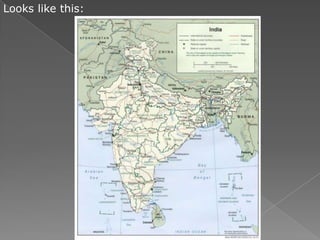
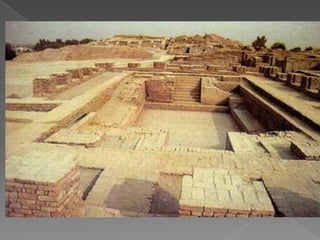
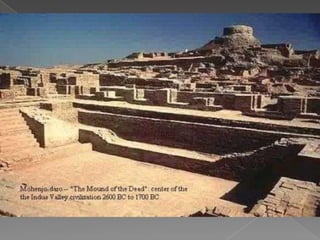
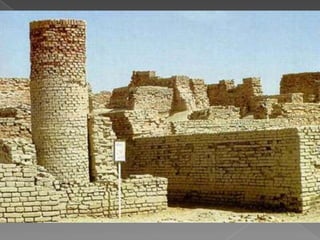
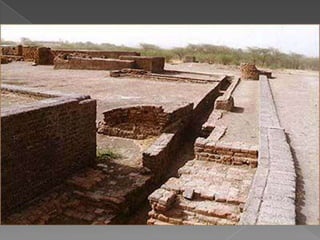
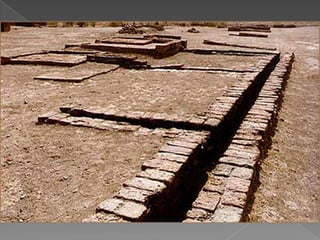
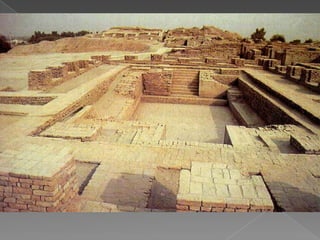
Looks like this:
Various rulers
• Over the past 4,000 years, various cultures and powers
  have lived in India, creating its own cultural blend.
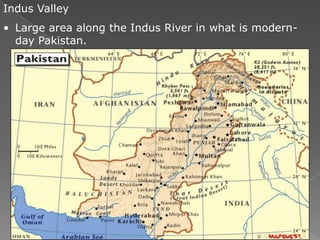
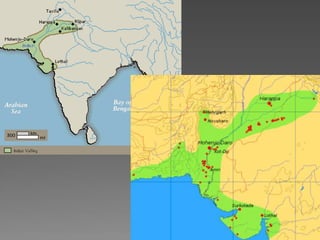
Indus Valley
• Large area along the Indus River in what is modern-
  day Pakistan.
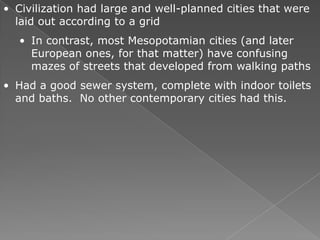
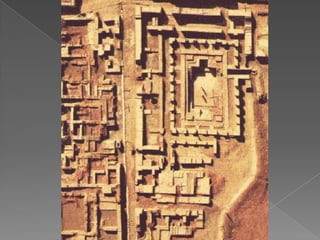
• Civilization had large and well-planned cities that were
  laid out according to a grid
   • In contrast, most Mesopotamian cities (and later
     European ones, for that matter) have confusing
     mazes of streets that developed from walking paths
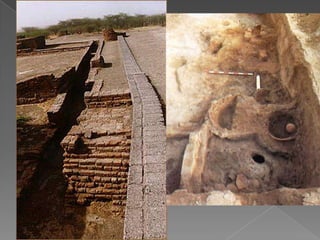
• Had a good sewer system, complete with indoor toilets
  and baths. No other contemporary cities had this.
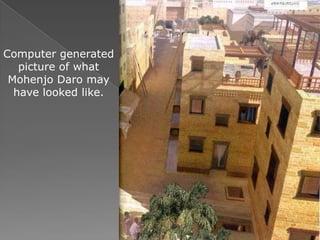
Computer generated
   picture of what
 Mohenjo Daro may
  have looked like.
Around 1900 BC, the Indus Valley Civilization declines
  and the cities are abandoned by 1700 BC. Several
  theories why:
1. Invasion
   • There was an invasion of Aryans from the north
     (they weren’t blond, blue-eyed people – that’s a
     later connotation).
   • They conquered the Indus Valley folk
2. Weather patterns
  • It appears the area become cooler and drier around
    this time and this affected water flow and food
    sources
3. Combination
  • Weather disruptions weakened the civ and left it
    open for conquering. Nobody knows for sure.
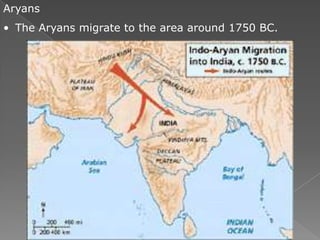
Aryans
• The Aryans migrate to the area around 1750 BC.
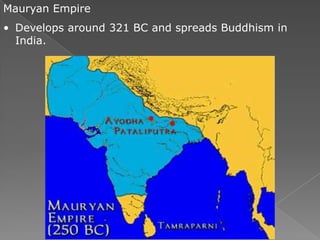
Mauryan Empire
• Develops around 321 BC and spreads Buddhism in
  India.
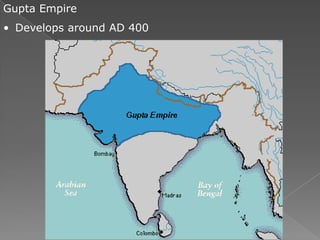
Gupta Empire
• Develops around AD 400
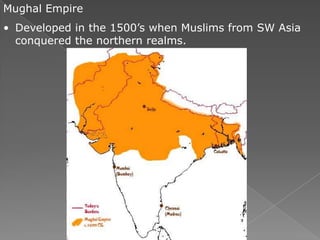
Mughal Empire
• Developed in the 1500’s when Muslims from SW Asia
  conquered the northern realms.
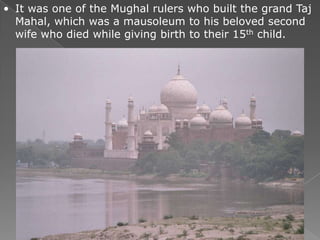
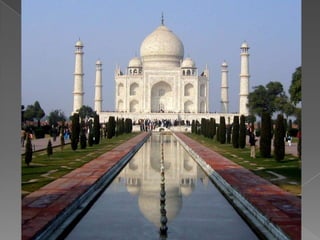
• It was one of the Mughal rulers who built the grand Taj
  Mahal, which was a mausoleum to his beloved second
  wife who died while giving birth to their 15th child.
British control
• The British, by way of the British East India Company,
  were able to dominate India’s trade by 1757.
      • It had ―the right to acquire territory, raise an
        army, mint its own money, and exercise legal
        jurisdiction in areas under its control.‖
• By 1857, India was a full-fledged part of the British
  Empire when the East India Company was absorbed
  into the crown. It was ruled by the raj.
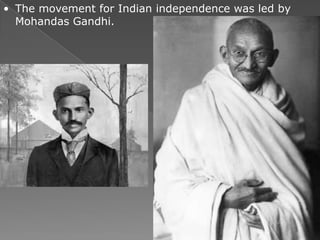
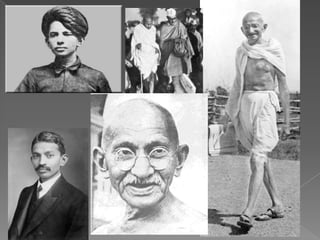
• The movement for Indian independence was led by
  Mohandas Gandhi.
• Gandhi reached out to everyone (by focusing on
  issues that touched everyone, such as salt) and
  preached a policy of civil, or nonviolent, resistance.
   • Instead of trying to fight the rulers or engage in
     violence, they held peaceful protests and
     withdrew from government positions, had
     commercial strikes, boycotted British goods,
     refused to engage in the colonial economy, etc.
   • The British response was varied, but it did involve
     violence and mass imprisonment (over 100,000
     were arrested during one movement).
     Demonstrators were sometimes publicly flogged.
     This strengthened Gandhi’s position.
• You see, the strength of nonviolent disobedience
  lies in hitting the ruling power in its economic
  interests, forcing the ruler to use extreme
  violence against those who use none.
  • Put simply, folks are moved by seeing people
    being violently suppressed when they were
    acting peacefully.
• Gandhi’s non-violence was fairly radical. While he
  was Hindu, it was also rooted in other religions, such
  as Christianity, e.g. turning the other cheek.
• He didn’t think everybody could be brave and
  faithful enough to practice such a thing, but
  thought it was always best. Quotes:
  • "An eye for an eye makes the whole world blind.―
  • "There are many causes that I am prepared to die for
    but no causes that I am prepared to kill for.―
  • "When I despair, I remember that all through history
    the way of truth and love has always won. There have
    been tyrants and murderers and for a time they seem
    invincible, but in the end, they always fall — think of it,
    always.―
  • "What difference does it make to the dead, the orphans,
    and the homeless, whether the mad destruction is
    wrought under the name of totalitarianism or the holy
    name of liberty and democracy?"
• His advice to the British in 1940, when it seemed
  nearly inevitable that Great Britain would be
  invaded and likely conquered by Nazi Germany,
  was the following:
   • "I would like you to lay down the arms you have as
     being useless for saving you or humanity. You will invite
     Herr Hitler and Signor Mussolini to take what they want
     of the countries you call your possessions.... If these
     gentlemen choose to occupy your homes, you will
     vacate them. If they do not give you free passage out,
     you will allow yourselves, man, woman, and child, to be
     slaughtered, but you will refuse to owe allegiance to
     them.―

• Do you think Gandhi’s is correct to practice
  nonviolence on such an extreme level?
• Gandhi is one of history’s greatest figures and one of
  the most influential of the 20th century.
   • This is because he influenced numerous colonial
     independence movements and many important
     figures.
      • The Dalai Lama (trying to gain freedom for Tibet
        from China), Desmond Tutu and Nelson Mandela
        (helped end apartheid in South Africa), and
        Martin Luther King.
         • All of the above are winners of the Nobel
           Peace Prize. Gandhi was never awarded it due
           to politics.
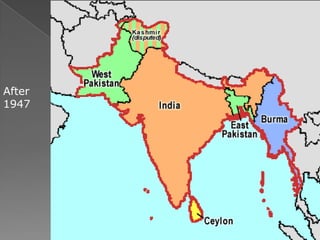
When India gained its independence, there were still
 more problems.
• Most of India was Hindu. Many of the people in the
  eastern and western parts of India, though, were
  Muslim.
  • A great deal of violence resulted and the Muslims
    formed their own countries of Pakistan in the west
    and Bangladesh in the east (they were originally just
    Pakistan, but Bangladesh gained its independence
    from Pakistan in 1971).
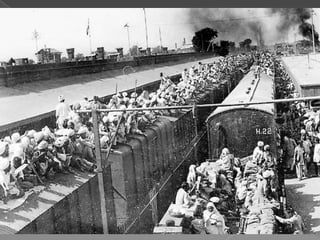
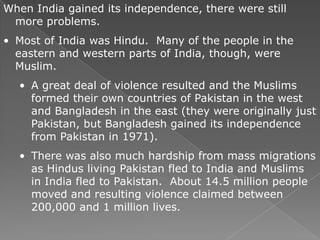
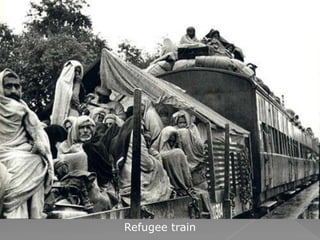
  • There was also much hardship from mass migrations
    as Hindus living Pakistan fled to India and Muslims
    in India fled to Pakistan. About 14.5 million people
    moved and resulting violence claimed between
    200,000 and 1 million lives.
Refugee train
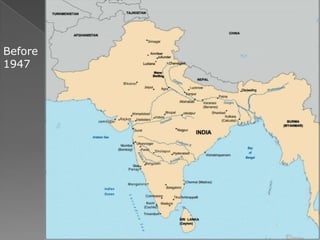
Before
1947
After
1947
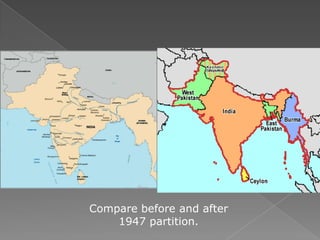
Compare before and after
    1947 partition.
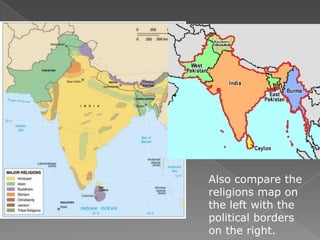
Also compare the
religions map on
the left with the
political borders
on the right.
Government
• India is the world’s largest democracy.
• Consider that the U.S. has about 300 million people
  and India has about 1 billion.
• It has a federal structure with states, but is a bicameral
  parliamentary government. That means it’s a
  parliament with two legislative houses. The lower
  house has 540 members and the upper house has 250.
• While India is majority Hindu, it still has significant
  minorities of Muslims (150 million), Sikhs (13.8
  million), and Tamil (63 million).
Economy
• With 1 billion people, India has a large economy, but
  it’s per capita income is low.
  • It’s GDP is ranked fourth in the world at $3.8 trillion
    but it’s per capita income is ranked 122 at $3,320.
• About two thirds of India’s people are involved in
  agriculture, but most farms are small with low crop
  yields and families engage in subsistence farming.
• Land reform has been proposed to give more people
  more land, but that hasn’t gone anywhere since the
  people who already have the land tend to have political
  power.
• The Green Revolution of the 1960’s and ’70’s greatly
  increased crop yields due to new farming and irrigation
  methods and better crop types. Resistance to these
  new things remains high with some people, however.
• Industry
  • Industry is very important with textiles and iron and
    steel processing.
  • The high tech industry is also becoming very big.
     • India’s getting a more educated populace and is
       spending lots of money to develop its high tech
       sector.
  • Call centers
     • It’s true… many call centers are relocating to
       India due to its education level, familiarity with
       English and its low labor costs.
 The Castes
 Reincarnation
 Karma
 Nirvana

25.1 india

  • 2.
  • 3.
    Various rulers • Overthe past 4,000 years, various cultures and powers have lived in India, creating its own cultural blend.
  • 4.
    Indus Valley • Largearea along the Indus River in what is modern- day Pakistan.
  • 6.
    • Civilization hadlarge and well-planned cities that were laid out according to a grid • In contrast, most Mesopotamian cities (and later European ones, for that matter) have confusing mazes of streets that developed from walking paths • Had a good sewer system, complete with indoor toilets and baths. No other contemporary cities had this.
  • 8.
    Computer generated picture of what Mohenjo Daro may have looked like.
  • 16.
    Around 1900 BC,the Indus Valley Civilization declines and the cities are abandoned by 1700 BC. Several theories why: 1. Invasion • There was an invasion of Aryans from the north (they weren’t blond, blue-eyed people – that’s a later connotation). • They conquered the Indus Valley folk
  • 17.
    2. Weather patterns • It appears the area become cooler and drier around this time and this affected water flow and food sources 3. Combination • Weather disruptions weakened the civ and left it open for conquering. Nobody knows for sure.
  • 18.
    Aryans • The Aryansmigrate to the area around 1750 BC.
  • 19.
    Mauryan Empire • Developsaround 321 BC and spreads Buddhism in India.
  • 20.
  • 21.
    Mughal Empire • Developedin the 1500’s when Muslims from SW Asia conquered the northern realms.
  • 22.
    • It wasone of the Mughal rulers who built the grand Taj Mahal, which was a mausoleum to his beloved second wife who died while giving birth to their 15th child.
  • 27.
    British control • TheBritish, by way of the British East India Company, were able to dominate India’s trade by 1757. • It had ―the right to acquire territory, raise an army, mint its own money, and exercise legal jurisdiction in areas under its control.‖ • By 1857, India was a full-fledged part of the British Empire when the East India Company was absorbed into the crown. It was ruled by the raj.
  • 28.
    • The movementfor Indian independence was led by Mohandas Gandhi.
  • 29.
    • Gandhi reachedout to everyone (by focusing on issues that touched everyone, such as salt) and preached a policy of civil, or nonviolent, resistance. • Instead of trying to fight the rulers or engage in violence, they held peaceful protests and withdrew from government positions, had commercial strikes, boycotted British goods, refused to engage in the colonial economy, etc. • The British response was varied, but it did involve violence and mass imprisonment (over 100,000 were arrested during one movement). Demonstrators were sometimes publicly flogged. This strengthened Gandhi’s position.
  • 30.
    • You see,the strength of nonviolent disobedience lies in hitting the ruling power in its economic interests, forcing the ruler to use extreme violence against those who use none. • Put simply, folks are moved by seeing people being violently suppressed when they were acting peacefully.
  • 31.
    • Gandhi’s non-violencewas fairly radical. While he was Hindu, it was also rooted in other religions, such as Christianity, e.g. turning the other cheek.
  • 32.
    • He didn’tthink everybody could be brave and faithful enough to practice such a thing, but thought it was always best. Quotes: • "An eye for an eye makes the whole world blind.― • "There are many causes that I am prepared to die for but no causes that I am prepared to kill for.― • "When I despair, I remember that all through history the way of truth and love has always won. There have been tyrants and murderers and for a time they seem invincible, but in the end, they always fall — think of it, always.― • "What difference does it make to the dead, the orphans, and the homeless, whether the mad destruction is wrought under the name of totalitarianism or the holy name of liberty and democracy?"
  • 33.
    • His adviceto the British in 1940, when it seemed nearly inevitable that Great Britain would be invaded and likely conquered by Nazi Germany, was the following: • "I would like you to lay down the arms you have as being useless for saving you or humanity. You will invite Herr Hitler and Signor Mussolini to take what they want of the countries you call your possessions.... If these gentlemen choose to occupy your homes, you will vacate them. If they do not give you free passage out, you will allow yourselves, man, woman, and child, to be slaughtered, but you will refuse to owe allegiance to them.― • Do you think Gandhi’s is correct to practice nonviolence on such an extreme level?
  • 35.
    • Gandhi isone of history’s greatest figures and one of the most influential of the 20th century. • This is because he influenced numerous colonial independence movements and many important figures. • The Dalai Lama (trying to gain freedom for Tibet from China), Desmond Tutu and Nelson Mandela (helped end apartheid in South Africa), and Martin Luther King. • All of the above are winners of the Nobel Peace Prize. Gandhi was never awarded it due to politics.
  • 38.
    When India gainedits independence, there were still more problems. • Most of India was Hindu. Many of the people in the eastern and western parts of India, though, were Muslim. • A great deal of violence resulted and the Muslims formed their own countries of Pakistan in the west and Bangladesh in the east (they were originally just Pakistan, but Bangladesh gained its independence from Pakistan in 1971). • There was also much hardship from mass migrations as Hindus living Pakistan fled to India and Muslims in India fled to Pakistan. About 14.5 million people moved and resulting violence claimed between 200,000 and 1 million lives.
  • 39.
  • 41.
  • 42.
  • 43.
    Compare before andafter 1947 partition.
  • 44.
    Also compare the religionsmap on the left with the political borders on the right.
  • 45.
    Government • India isthe world’s largest democracy. • Consider that the U.S. has about 300 million people and India has about 1 billion. • It has a federal structure with states, but is a bicameral parliamentary government. That means it’s a parliament with two legislative houses. The lower house has 540 members and the upper house has 250. • While India is majority Hindu, it still has significant minorities of Muslims (150 million), Sikhs (13.8 million), and Tamil (63 million).
  • 46.
    Economy • With 1billion people, India has a large economy, but it’s per capita income is low. • It’s GDP is ranked fourth in the world at $3.8 trillion but it’s per capita income is ranked 122 at $3,320. • About two thirds of India’s people are involved in agriculture, but most farms are small with low crop yields and families engage in subsistence farming.
  • 47.
    • Land reformhas been proposed to give more people more land, but that hasn’t gone anywhere since the people who already have the land tend to have political power. • The Green Revolution of the 1960’s and ’70’s greatly increased crop yields due to new farming and irrigation methods and better crop types. Resistance to these new things remains high with some people, however.
  • 48.
    • Industry • Industry is very important with textiles and iron and steel processing. • The high tech industry is also becoming very big. • India’s getting a more educated populace and is spending lots of money to develop its high tech sector. • Call centers • It’s true… many call centers are relocating to India due to its education level, familiarity with English and its low labor costs.
  • 49.
     The Castes Reincarnation  Karma  Nirvana