He said “There is nothing impossible to him who will try.”
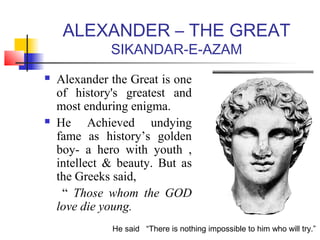
ALEXANDER – THE GREAT
SIKANDAR-E-AZAM
 Alexander the Great is one
of history's greatest and
most enduring enigma.
 He Achieved undying
fame as history’s golden
boy- a hero with youth ,
intellect & beauty. But as
the Greeks said,
“ Those whom the GOD
love die young.
UNCOVERING THE LEGEND
 Alexander, was born on July 20, 356 B.C.E. 32
years and eight months old.
 He was tutored by the famous Greek philosopher
Aristotle for several years.
 He developed a great respect for the Greek
culture, literature, and science. Alexander took
geographers and other scientists with his army to
expand his knowledge of plants, animals, and
geography. Alexander proved himself to be an
incredible military commander.
I had rather excel others in the knowledge of what is excelle
LIFE & PERSONALITY TRAITS
 ARISTOTLE taught him an appreciation for the
fine arts of music, poetry, and drama, Philosophy,
medicine, botany, zoology, and geography &
Inspired him with a love for poetry and Greek
culture
 Alexander the Great is the most fascinating and
enigmatic man in all of history. Any thorough
study of his life is likely to yield a highly confused
portrait of this great conqueror and king I SEE
HIM as a man motivated by a need to explore the
WORLD
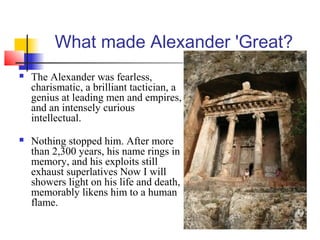
What made Alexander 'Great?
 The Alexander was fearless,
charismatic, a brilliant tactician, a
genius at leading men and empires,
and an intensely curious
intellectual.
 Nothing stopped him. After more
than 2,300 years, his name rings in
memory, and his exploits still
exhaust superlatives Now I will
showers light on his life and death,
memorably likens him to a human
flame.
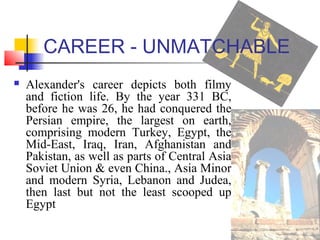
CAREER - UNMATCHABLE
 Alexander's career depicts both filmy
and fiction life. By the year 331 BC,
before he was 26, he had conquered the
Persian empire, the largest on earth,
comprising modern Turkey, Egypt, the
Mid-East, Iraq, Iran, Afghanistan and
Pakistan, as well as parts of Central Asia
Soviet Union & even China., Asia Minor
and modern Syria, Lebanon and Judea,
then last but not the least scooped up
Egypt
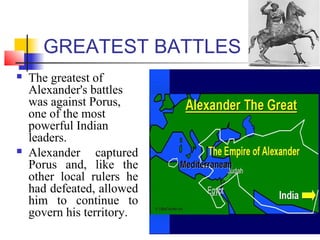
GREATEST BATTLES
 The greatest of
Alexander's battles
was against Porus,
one of the most
powerful Indian
leaders.
 Alexander captured
Porus and, like the
other local rulers he
had defeated, allowed
him to continue to
govern his territory.
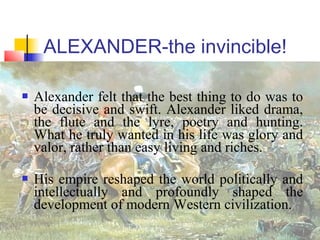
ALEXANDER-the invincible!
 Alexander felt that the best thing to do was to
be decisive and swift. Alexander liked drama,
the flute and the lyre, poetry and hunting.
What he truly wanted in his life was glory and
valor, rather than easy living and riches.
 His empire reshaped the world politically and
intellectually and profoundly shaped the
development of modern Western civilization.
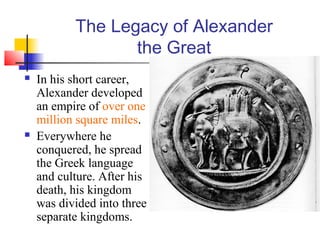
The Legacy of Alexander
the Great
 In his short career,
Alexander developed
an empire of over one
million square miles.
 Everywhere he
conquered, he spread
the Greek language
and culture. After his
death, his kingdom
was divided into three
separate kingdoms.
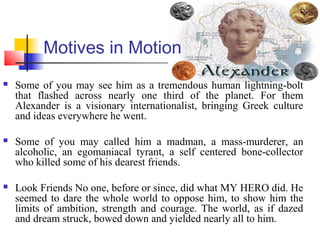
Motives in Motion
 Some of you may see him as a tremendous human lightning-bolt
that flashed across nearly one third of the planet. For them
Alexander is a visionary internationalist, bringing Greek culture
and ideas everywhere he went.
 Some of you may called him a madman, a mass-murderer, an
alcoholic, an egomaniacal tyrant, a self centered bone-collector
who killed some of his dearest friends.
 Look Friends No one, before or since, did what MY HERO did. He
seemed to dare the whole world to oppose him, to show him the
limits of ambition, strength and courage. The world, as if dazed
and dream struck, bowed down and yielded nearly all to him.
In faith and hope the world will disagree, but all mankind's c
Innovative & Brilliant Military
Commander
 Alexander was the most brilliant military commander
in Greek history, a far-seeing statesman who made the
Macedonian army into the most ferocious fighting
machine the world had yet seen.
Innovative:
 Macedonian infantry massed six deep, carrying razor-
pointed, thin-bladed spears 18 feet long, called
"sarissae," which they handled like pole-vaulters, two-
handedly, so that the entire formation looked like an
angry, lethal porcupine.
“I am not afraid of an army of lions led by a sheep; I am afra
ALEXENDER THE DIVINE ?
 A Theory was here that Alexander was
poisoned by friends who were worn out by
his brilliance, egotism and ambition, and that
the murder was hushed up with a cover-story
that he died of illness.
 He died as mortals must, slain most likely by
a malarial mosquito, but not before achieving
immortality in human memory.
Alexander the Great
A Mystery
 Alexander the Great shall remain a mystery (a
fascinating one) for a very long time.
 Huge armies with elephants, vast distances, dizzying
mountains, unaffordable rivers, uncrossable deserts,
hunger, thirst, the sea itself, the uttermost extremes of
physical hardship and battle –
 he had 21 healed wounds in his body when he died –
nothing on earth could halt Alexander the Great.
Q & A
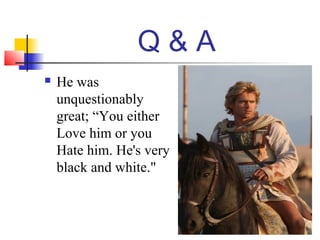
 He was
unquestionably
great; “You either
Love him or you
Hate him. He's very
black and white."

Alexander the Great-Leadership

  • 2.
    He said “Thereis nothing impossible to him who will try.” ALEXANDER – THE GREAT SIKANDAR-E-AZAM  Alexander the Great is one of history's greatest and most enduring enigma.  He Achieved undying fame as history’s golden boy- a hero with youth , intellect & beauty. But as the Greeks said, “ Those whom the GOD love die young.
  • 3.
    UNCOVERING THE LEGEND Alexander, was born on July 20, 356 B.C.E. 32 years and eight months old.  He was tutored by the famous Greek philosopher Aristotle for several years.  He developed a great respect for the Greek culture, literature, and science. Alexander took geographers and other scientists with his army to expand his knowledge of plants, animals, and geography. Alexander proved himself to be an incredible military commander.
  • 4.
    I had ratherexcel others in the knowledge of what is excelle LIFE & PERSONALITY TRAITS  ARISTOTLE taught him an appreciation for the fine arts of music, poetry, and drama, Philosophy, medicine, botany, zoology, and geography & Inspired him with a love for poetry and Greek culture  Alexander the Great is the most fascinating and enigmatic man in all of history. Any thorough study of his life is likely to yield a highly confused portrait of this great conqueror and king I SEE HIM as a man motivated by a need to explore the WORLD
  • 5.
    What made Alexander'Great?  The Alexander was fearless, charismatic, a brilliant tactician, a genius at leading men and empires, and an intensely curious intellectual.  Nothing stopped him. After more than 2,300 years, his name rings in memory, and his exploits still exhaust superlatives Now I will showers light on his life and death, memorably likens him to a human flame.
  • 6.
    CAREER - UNMATCHABLE Alexander's career depicts both filmy and fiction life. By the year 331 BC, before he was 26, he had conquered the Persian empire, the largest on earth, comprising modern Turkey, Egypt, the Mid-East, Iraq, Iran, Afghanistan and Pakistan, as well as parts of Central Asia Soviet Union & even China., Asia Minor and modern Syria, Lebanon and Judea, then last but not the least scooped up Egypt
  • 7.
    GREATEST BATTLES  Thegreatest of Alexander's battles was against Porus, one of the most powerful Indian leaders.  Alexander captured Porus and, like the other local rulers he had defeated, allowed him to continue to govern his territory.
  • 8.
    ALEXANDER-the invincible!  Alexanderfelt that the best thing to do was to be decisive and swift. Alexander liked drama, the flute and the lyre, poetry and hunting. What he truly wanted in his life was glory and valor, rather than easy living and riches.  His empire reshaped the world politically and intellectually and profoundly shaped the development of modern Western civilization.
  • 9.
    The Legacy ofAlexander the Great  In his short career, Alexander developed an empire of over one million square miles.  Everywhere he conquered, he spread the Greek language and culture. After his death, his kingdom was divided into three separate kingdoms.
  • 10.
    Motives in Motion Some of you may see him as a tremendous human lightning-bolt that flashed across nearly one third of the planet. For them Alexander is a visionary internationalist, bringing Greek culture and ideas everywhere he went.  Some of you may called him a madman, a mass-murderer, an alcoholic, an egomaniacal tyrant, a self centered bone-collector who killed some of his dearest friends.  Look Friends No one, before or since, did what MY HERO did. He seemed to dare the whole world to oppose him, to show him the limits of ambition, strength and courage. The world, as if dazed and dream struck, bowed down and yielded nearly all to him.
  • 12.
    In faith andhope the world will disagree, but all mankind's c Innovative & Brilliant Military Commander  Alexander was the most brilliant military commander in Greek history, a far-seeing statesman who made the Macedonian army into the most ferocious fighting machine the world had yet seen. Innovative:  Macedonian infantry massed six deep, carrying razor- pointed, thin-bladed spears 18 feet long, called "sarissae," which they handled like pole-vaulters, two- handedly, so that the entire formation looked like an angry, lethal porcupine.
  • 14.
    “I am notafraid of an army of lions led by a sheep; I am afra ALEXENDER THE DIVINE ?  A Theory was here that Alexander was poisoned by friends who were worn out by his brilliance, egotism and ambition, and that the murder was hushed up with a cover-story that he died of illness.  He died as mortals must, slain most likely by a malarial mosquito, but not before achieving immortality in human memory.
  • 15.
    Alexander the Great AMystery  Alexander the Great shall remain a mystery (a fascinating one) for a very long time.  Huge armies with elephants, vast distances, dizzying mountains, unaffordable rivers, uncrossable deserts, hunger, thirst, the sea itself, the uttermost extremes of physical hardship and battle –  he had 21 healed wounds in his body when he died – nothing on earth could halt Alexander the Great.
  • 16.
    Q & A He was unquestionably great; “You either Love him or you Hate him. He's very black and white."

Editor's Notes

  • #2 PRESENTED BY AMIR SALEEM & MUJAHID RAFIQ
  • #9 Historians talk about Alexander's furious his "desire." His portrait-sculptures, his coins, reflect a kind of upward gaze as if he were staring into the very heavens, yearning for something unreachable. His whole life is a struggle against insurmountable odds, which he then proceeds to surmount.
  • #15 Who gonna forget his last words… “ Sikandar Jab Dunia se gia to Dono Hath Khali Thay”