Standards
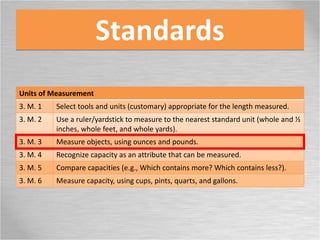
Units of Measurement
3. M. 1 Select tools and units (customary) appropriate for the length measured.
3. M. 2 Use a ruler/yardstick to measure to the nearest standard unit (whole and ½
inches, whole feet, and whole yards).
3. M. 3 Measure objects, using ounces and pounds.
3. M. 4 Recognize capacity as an attribute that can be measured.
3. M. 5 Compare capacities (e.g., Which contains more? Which contains less?).
3. M. 6 Measure capacity, using cups, pints, quarts, and gallons.
Video
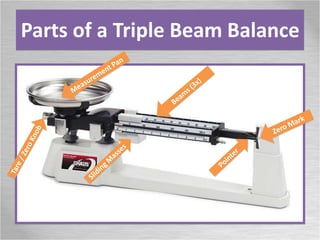
Parts of a Triple Beam Balance
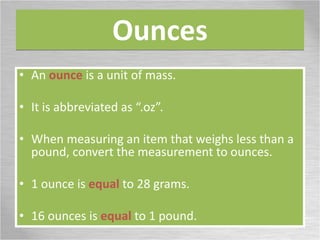
Ounces
• An ounce is a unit of mass.
• It is abbreviated as “.oz”.
• When measuring an item that weighs less than a
pound, convert the measurement to ounces.
• 1 ounce is equal to 28 grams.
• 16 ounces is equal to 1 pound.
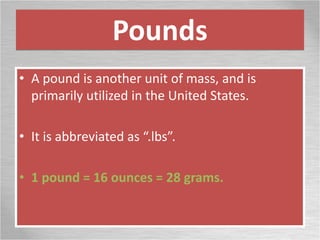
Pounds
• A pound is another unit of mass, and is
primarily utilized in the United States.
• It is abbreviated as “.lbs”.
• 1 pound = 16 ounces = 28 grams.
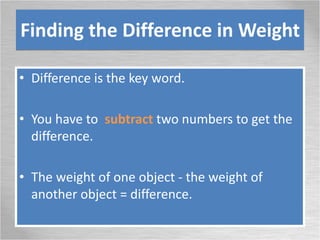
Finding the Difference in Weight
• Difference is the key word.
• You have to subtract two numbers to get the
difference.
• The weight of one object - the weight of
another object = difference.
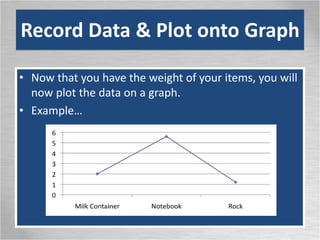
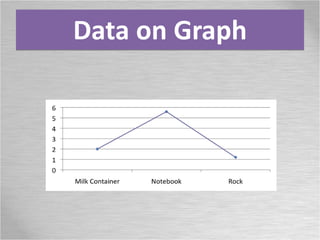
Record Data & Plot onto Graph
• Now that you have the weight of your items, you will
now plot the data on a graph.
• Example…
SMART Board Activity
http://www.touchspin.com/c
hem/DisplayTBB.html
Using the Triple Beam Balance
• You will now measure your items on a physical
triple beam balance scale.
• Make sure that you record the data for every
object that you weigh.
Data on Graph
Word Problem
• Now that you have measured your items and
recorded your data, create a word problem using
each item’s weight.
• Example: My milk container weighs 2oz., my
notebook weighs 5.5oz., and my rock weighs 3oz.
How much do all three objects weigh together?
Literature Connection
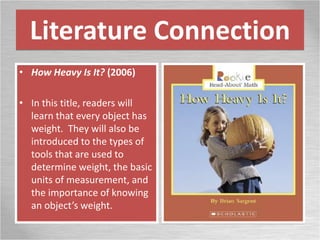
• How Heavy Is It? (2006)
• In this title, readers will
learn that every object has
weight. They will also be
introduced to the types of
tools that are used to
determine weight, the basic
units of measurement, and
the importance of knowing
an object’s weight.
Additional Resources
 Units of measurement Dictionary:
 http://www.unc.edu/~rowlett/units/
 AAA Math – Measurement:
 http://www.aaamath.com/mea.html
 Fish Tales Measurement Game:
 http://www.compasslearningodyssey.com/sample_act/math1_2/01MADB03a-
fish_tails_v2.swf
 Choose the Appropriate Measuring Tool:
 http://www.ixl.com/math/practice/grade-2-choose-the-appropriate-measuring-tool
 Choose the Appropriate Unit of Measurement:
 http://www.ixl.com/math/practice/grade-3-which-customary-unit-is-appropriate

3rd Grade Measurement

  • 2.
    Standards Units of Measurement 3.M. 1 Select tools and units (customary) appropriate for the length measured. 3. M. 2 Use a ruler/yardstick to measure to the nearest standard unit (whole and ½ inches, whole feet, and whole yards). 3. M. 3 Measure objects, using ounces and pounds. 3. M. 4 Recognize capacity as an attribute that can be measured. 3. M. 5 Compare capacities (e.g., Which contains more? Which contains less?). 3. M. 6 Measure capacity, using cups, pints, quarts, and gallons.
  • 3.
  • 4.
    Parts of aTriple Beam Balance
  • 5.
    Ounces • An ounceis a unit of mass. • It is abbreviated as “.oz”. • When measuring an item that weighs less than a pound, convert the measurement to ounces. • 1 ounce is equal to 28 grams. • 16 ounces is equal to 1 pound.
  • 6.
    Pounds • A poundis another unit of mass, and is primarily utilized in the United States. • It is abbreviated as “.lbs”. • 1 pound = 16 ounces = 28 grams.
  • 7.
    Finding the Differencein Weight • Difference is the key word. • You have to subtract two numbers to get the difference. • The weight of one object - the weight of another object = difference.
  • 8.
    Record Data &Plot onto Graph • Now that you have the weight of your items, you will now plot the data on a graph. • Example…
  • 9.
  • 10.
    Using the TripleBeam Balance • You will now measure your items on a physical triple beam balance scale. • Make sure that you record the data for every object that you weigh.
  • 11.
  • 12.
    Word Problem • Nowthat you have measured your items and recorded your data, create a word problem using each item’s weight. • Example: My milk container weighs 2oz., my notebook weighs 5.5oz., and my rock weighs 3oz. How much do all three objects weigh together?
  • 13.
    Literature Connection • HowHeavy Is It? (2006) • In this title, readers will learn that every object has weight. They will also be introduced to the types of tools that are used to determine weight, the basic units of measurement, and the importance of knowing an object’s weight.
  • 14.
    Additional Resources  Unitsof measurement Dictionary:  http://www.unc.edu/~rowlett/units/  AAA Math – Measurement:  http://www.aaamath.com/mea.html  Fish Tales Measurement Game:  http://www.compasslearningodyssey.com/sample_act/math1_2/01MADB03a- fish_tails_v2.swf  Choose the Appropriate Measuring Tool:  http://www.ixl.com/math/practice/grade-2-choose-the-appropriate-measuring-tool  Choose the Appropriate Unit of Measurement:  http://www.ixl.com/math/practice/grade-3-which-customary-unit-is-appropriate