Chapter 1
Introduction to Physics
Cikgu Desikan
Edited by
SMK Changkat Beruas, Perak
Cikgu Khairul Anuar
SMK Seri Mahkota, Kuantan
PHYSICS
FORM 4
In collaboration with
FORM4PHYSICS
2016
1. Understanding Physics
2. Understanding base quantities and derived quantities
3. Understanding scalar and vector Quantities
4. Understanding measurements
5. Analysing scientific investigations
Analysis of Past Year Questions
Learning Objectives :
Dear students,
With the new day comes new strength and new
thoughts.
Introduction to Physics
Chapter 1
2007 2008 2009 2010 2011 2012 2013 2014 2015
P1 3 3 3 2 3 3 4 1
P2
A - - - 1 - 1 - -
B - - - - - - - -
C - - - - - - - -
P3
A - 1 1 1 - - 1 -
B - - - - - - - -
Concept Map
Dear students,
By failing to prepare, you are preparing to fail !!!
Introduction to Physics
Physics
Concepts
Physics Quantity Measurement Scientific
Investigation
Field of
Physics
Base
Quantity
Approximation
Introduction to Physics
Derived
Quantity
Base Unit Derived Unit
Prefix Scientific
Notation
Conversion of
Units
Instrument for
Measurement
Error
Accuracy
Sensitivity Consistency
Chapter 1
1.1 Understanding Physics
Physics is the study to find a rational explanation (why and how) about the nature of matter,
energy and natural phenomena.
What is Physics?
Fields of study
in physics
1.__________ & ________
Investigate the action of
force and motion
2. _________________
Studies the influence of
heat on different
types of matter 3. ________________
Explains the different
phenomena due to light
4. _________________
Understand the
properties of different
types of waves and
their uses
6. ___________
Studies the use of
electronic devices in
various fields
5. _______________
Investigates the
interactions of electric &
magnetic fields
7. ______________
Study of nuclear
structure and their
application
4
Heat
Forces Motion
Nuclear Physics
Electronics Electromagnetism
Waves
Light
Derived quantities
(symbol)
Expressed in base quantities Derived units
Area, A Area = length x width m2
Volume, V Volume = length x width x height m3
1.2 Physical Quantities
Physical Quantities is a physical
characteristic that can be measured.
All physical quantities can be classified
into two groups :
1. ____________________________
2. ____________________________
Base quantities
Base quantities are quantities that cannot be
___________ in terms of other base quantities.
Base quantity Symbol S.I. Unit
Symbol
for S.I.
Unit
Length L meter m
Mass m kilogram kg
Time t second s
Current I Ampere A
Temperature T Kelvin K
Derived quantity is one which obtained by
__________________ base quantities by
multiplication, division or both these
operations. Its unit is derived from a
similar combination of the base units.
1
2
5
Derived quantities
Base quantities
Derived quantities
derived
combining
6
Derived
quantities
(symbol)
Expressed in base quantities Derived units
Density , ρ kgm–3
Velocity , v ms–1
Acceleration, a ms–2
Momentum, p Momentum = mass x velocity kgms–1
Force, F Force = mass x acceleration N / kgms–2
Pressure, P Nm–2/ Pa / kgm–1s–2
Weight, W Weight = mass x gravitational acceleration N / kgms–2
Volume
Mass
Density 
Time
ntDisplaceme
Velocity
Area
Force
Pressure
Time
velocityinChange
onAccelerati 
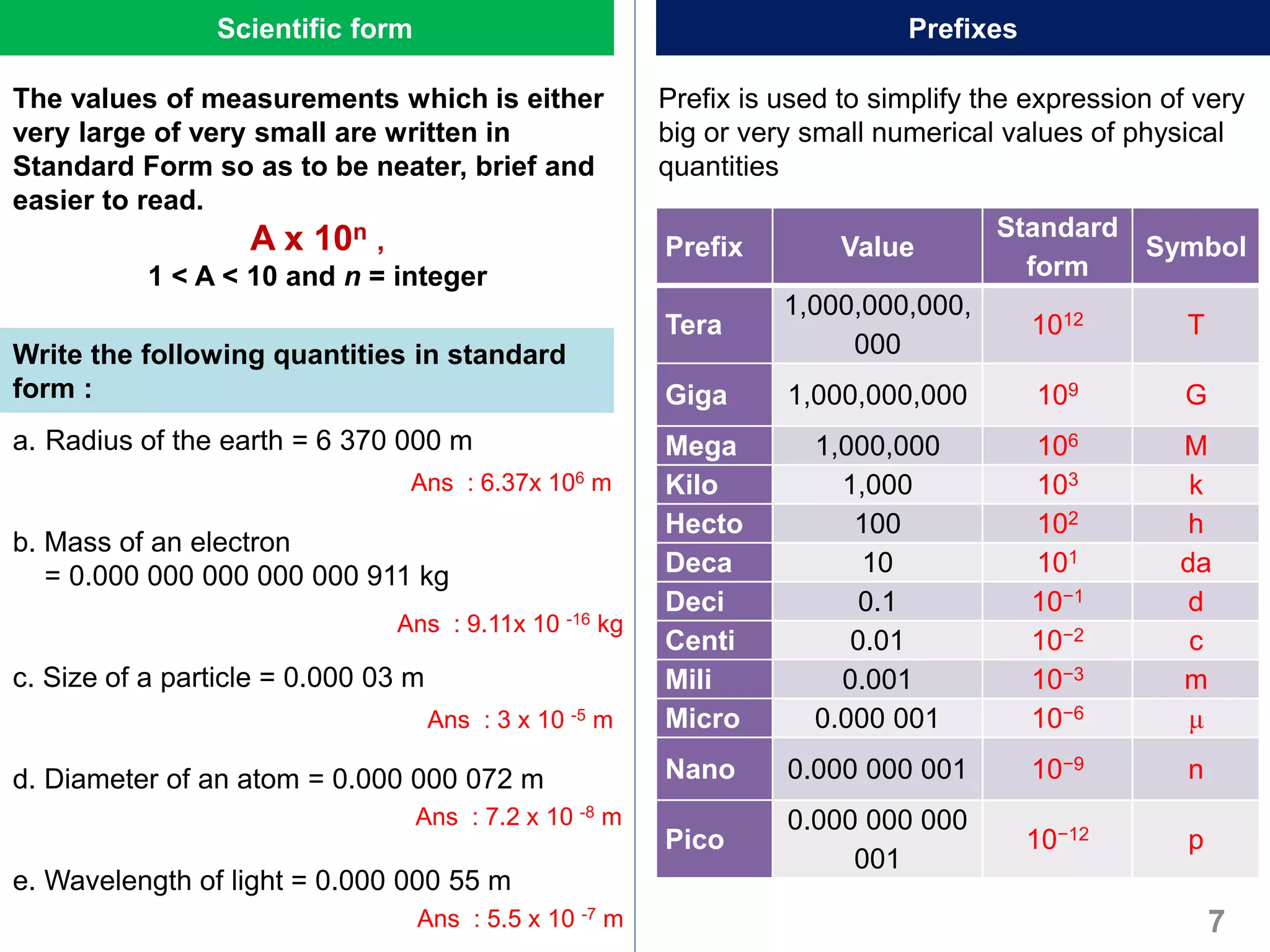
Scientific form
Write the following quantities in standard
form :
The values of measurements which is either
very large of very small are written in
Standard Form so as to be neater, brief and
easier to read.
A x 10n ,
1 < A < 10 and n = integer
Prefix Value
Standard
form
Symbol
Tera
1,000,000,000,
000
1012 T
Giga 1,000,000,000 109 G
Mega 1,000,000 106 M
Kilo 1,000 103 k
Hecto 100 102 h
Deca 10 101 da
Deci 0.1 10−1 d
Centi 0.01 10−2 c
Mili 0.001 10−3 m
Micro 0.000 001 10−6 μ
Nano 0.000 000 001 10−9 n
Pico
0.000 000 000
001
10−12 p
Prefix is used to simplify the expression of very
big or very small numerical values of physical
quantities
7
a. Radius of the earth = 6 370 000 m
b. Mass of an electron
= 0.000 000 000 000 000 911 kg
c. Size of a particle = 0.000 03 m
d. Diameter of an atom = 0.000 000 072 m
e. Wavelength of light = 0.000 000 55 m
Prefixes
Ans : 6.37x 10⁶ m
Ans : 9.11x 10 -16 kg
Ans : 3 x 10 -5 m
Ans : 7.2 x 10 -8 m
Ans : 5.5 x 10 -7 m
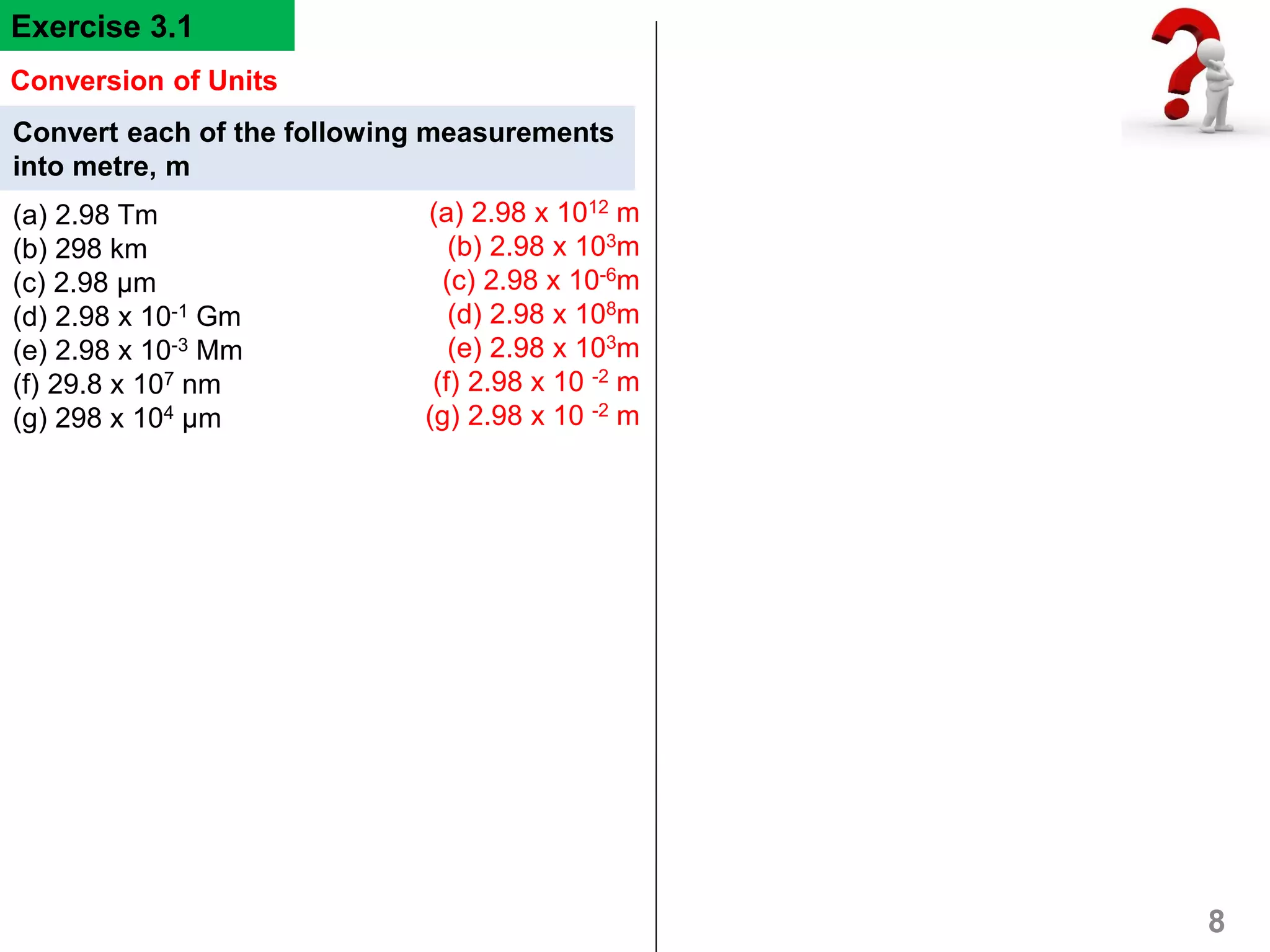
Convert each of the following measurements
into metre, m
(a) 2.98 Tm
(b) 298 km
(c) 2.98 μm
(d) 2.98 x 10⁻¹ Gm
(e) 2.98 x 10⁻³ Mm
(f) 29.8 x 10⁷ nm
(g) 298 x 104 μm
8
Conversion of Units
Exercise 3.1
(a) 2.98 x 10¹² m
(b) 2.98 x 10³m
(c) 2.98 x 10⁻⁶m
(d) 2.98 x 10⁸m
(e) 2.98 x 10³m
(f) 2.98 x 10 -2 m
(g) 2.98 x 10 -2 m
9
Convert
a. 4 m2 into the units of cm2
b. 30 cm2 into the units of m2
c. 2.5 m2 to unit of mm2
d. 500 mm2 into the units of m2
e. 200 m3 into the units of mm3
f. 11.5 cm3 into the units of m3
g. 72 km h-1 into the units of ms-1
h. 5 g cm-3 into the units of kg m-3
a) 4 x 10⁴ m2
b) 3 x 10⁻³ m2
c) 2.5 x 10⁶ m2
d) 5 x 10⁻⁴ m2
e) 2 x 10¹¹ m2
f) 1.15 x 10⁻⁵ m2
g) 20 ms-1
h) 5000 kgm-3
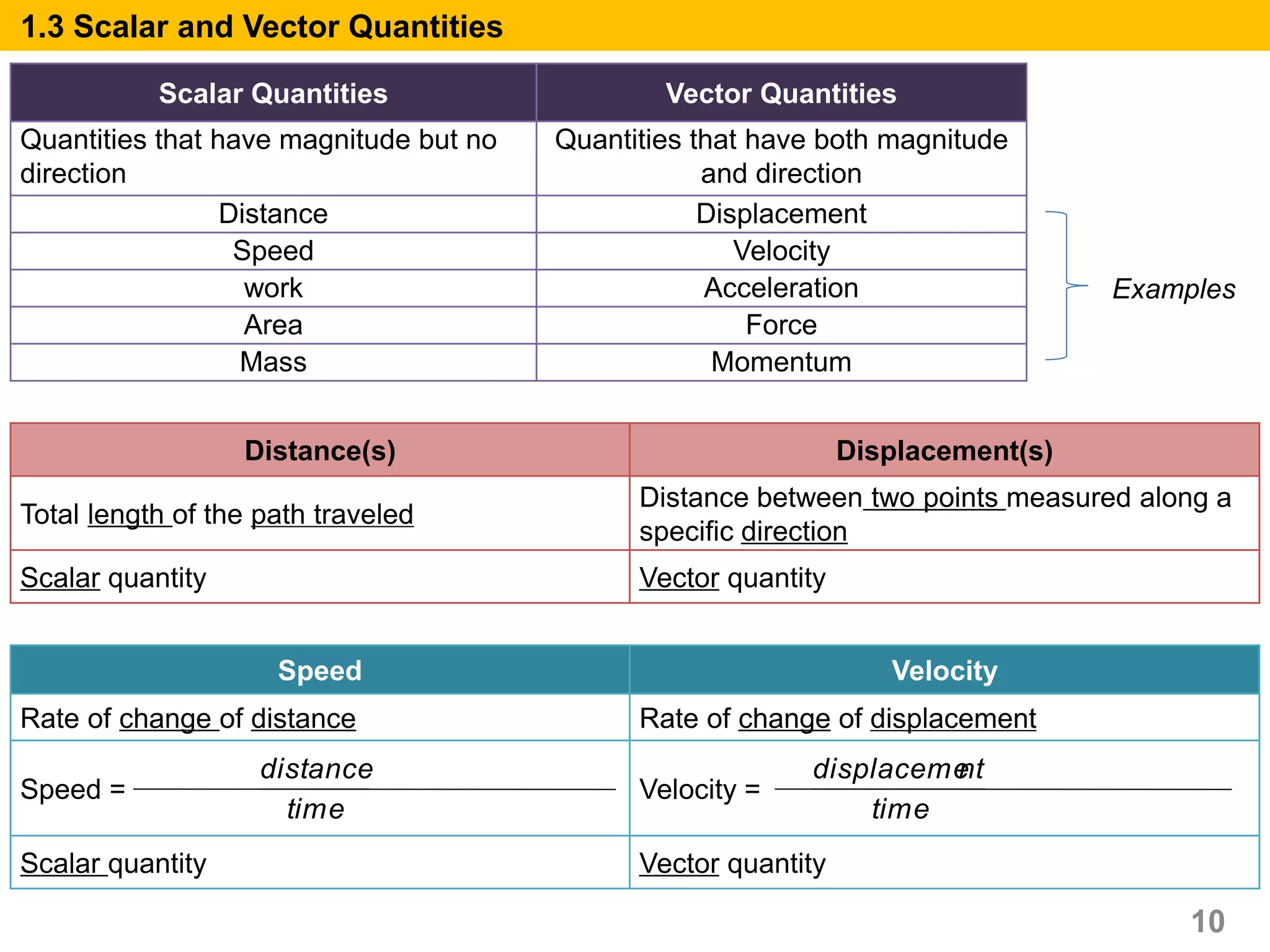
1.3 Scalar and Vector Quantities
Distance(s) Displacement(s)
Total length of the path traveled
Distance between two points measured along a
specific direction
Scalar quantity Vector quantity
Speed Velocity
Rate of change of distance Rate of change of displacement
Speed = Velocity =
Scalar quantity Vector quantity
10
Scalar Quantities Vector Quantities
Quantities that have magnitude but no
direction
Quantities that have both magnitude
and direction
Distance Displacement
Speed Velocity
work Acceleration
Area Force
Mass Momentum
Examples
time
distance
time
ntdisplaceme
Consistency Accuracy Sensitivity
Shooter Consistency Accuracy
A High Low
B Low High
C High High
D Low Low
The diagram shows the result for four shooters A, B, C and D
in a tournament. Every shooter shot five times.
(Use High / Low)
11
1.4 Measuring Instruments
Consistency in
measurements refers to how
little deviation there is
among the measurements
made when a quantity is
measured several times.
Accuracy of a measurement
is how close the
measurement made is to the
actual value of the quantity.
Sensitivity of an instrument is
its ability to detect a small
change in the quantity to be
measured in a short period
of time.
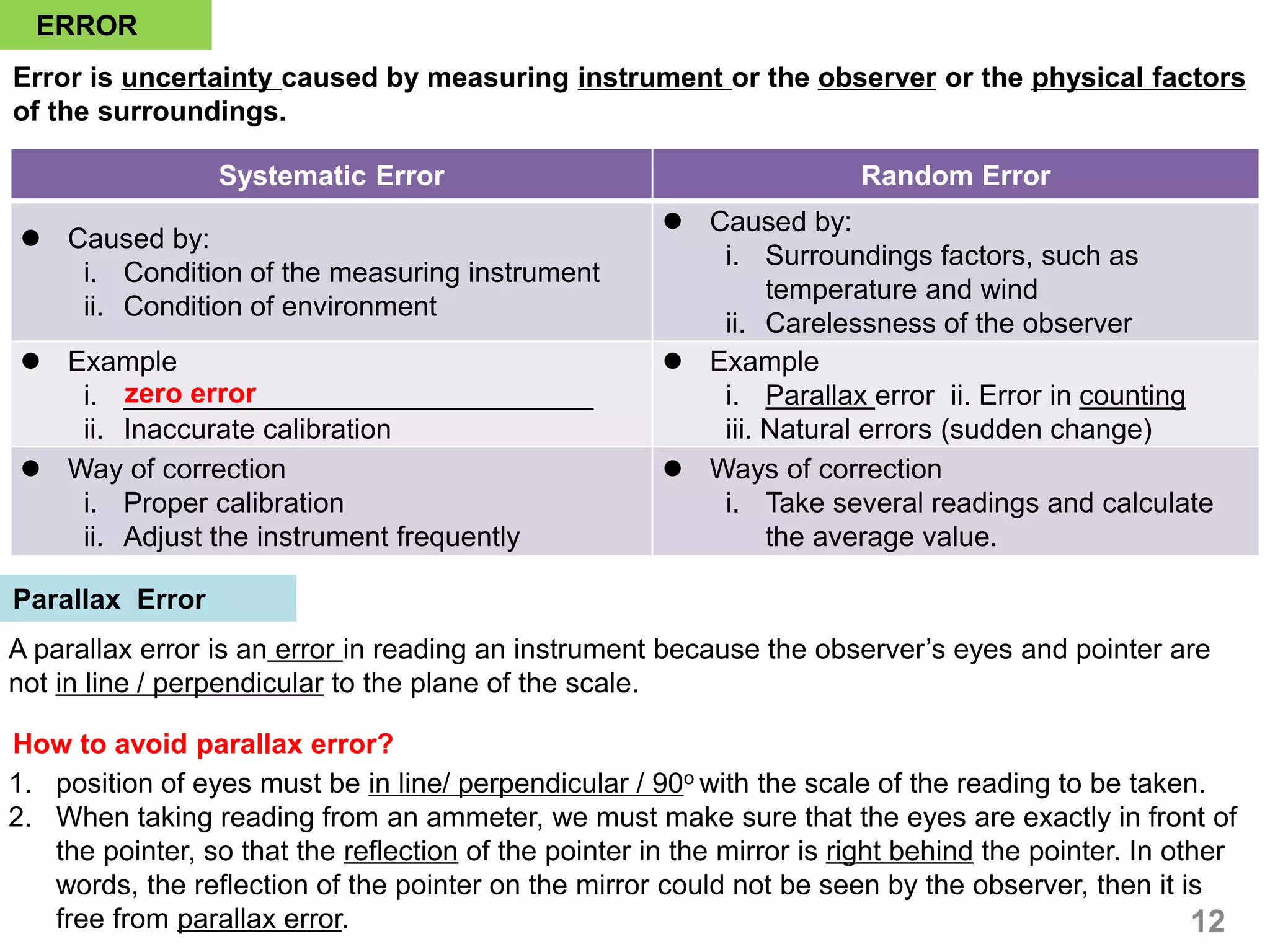
ERROR
Error is uncertainty caused by measuring instrument or the observer or the physical factors
of the surroundings.
Systematic Error Random Error
 Caused by:
i. Condition of the measuring instrument
ii. Condition of environment
 Caused by:
i. Surroundings factors, such as
temperature and wind
ii. Carelessness of the observer
 Example
i. ______________________________
ii. Inaccurate calibration
 Example
i. Parallax error ii. Error in counting
iii. Natural errors (sudden change)
 Way of correction
i. Proper calibration
ii. Adjust the instrument frequently
 Ways of correction
i. Take several readings and calculate
the average value.
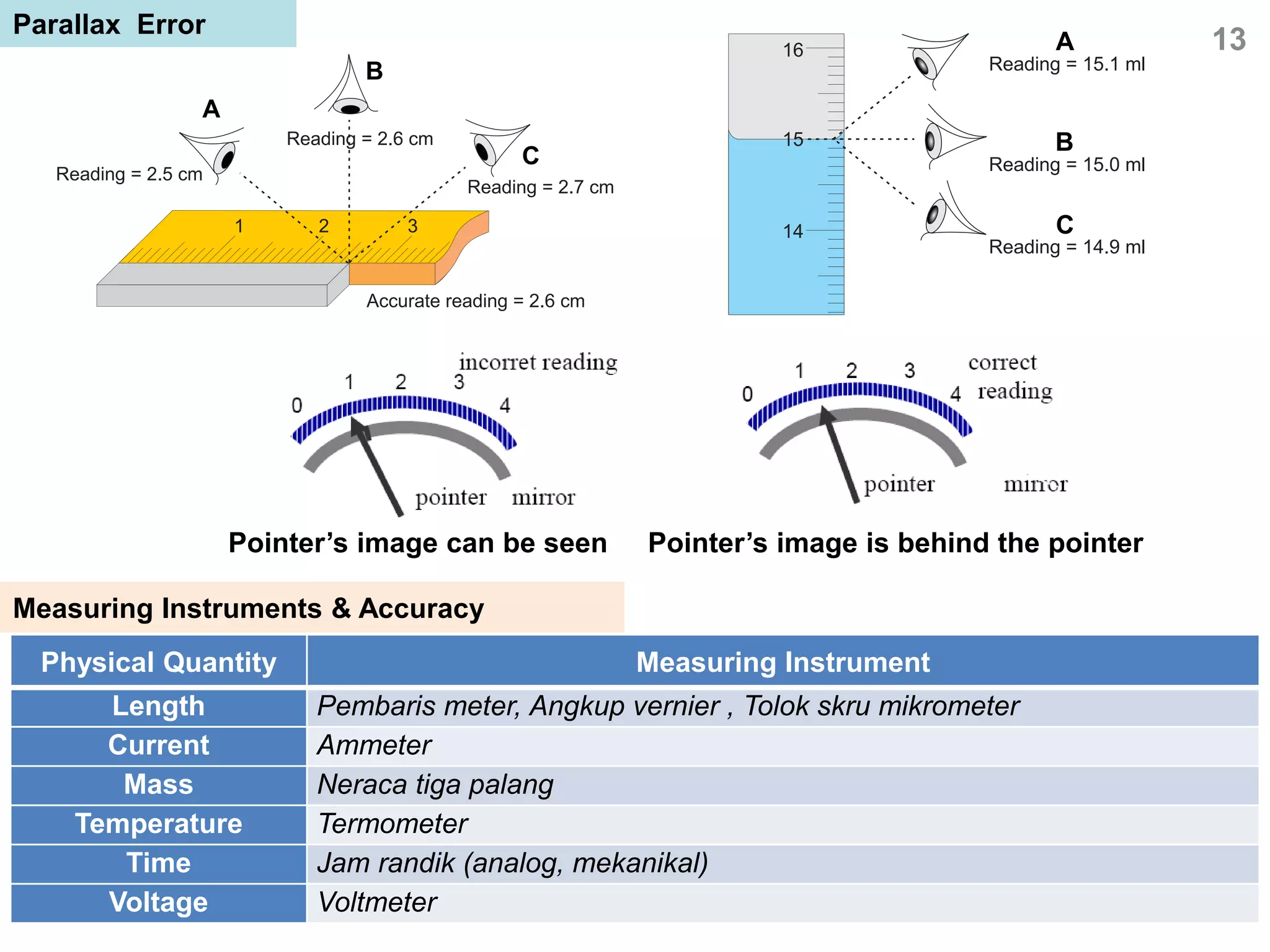
A parallax error is an error in reading an instrument because the observer’s eyes and pointer are
not in line / perpendicular to the plane of the scale.
1. position of eyes must be in line/ perpendicular / 90o with the scale of the reading to be taken.
2. When taking reading from an ammeter, we must make sure that the eyes are exactly in front of
the pointer, so that the reflection of the pointer in the mirror is right behind the pointer. In other
words, the reflection of the pointer on the mirror could not be seen by the observer, then it is
free from parallax error.
How to avoid parallax error?
12
Parallax Error
zero error
Measuring Instruments & Accuracy
Physical Quantity Measuring Instrument
Length Pembaris meter, Angkup vernier , Tolok skru mikrometer
Current Ammeter
Mass Neraca tiga palang
Temperature Termometer
Time Jam randik (analog, mekanikal)
Voltage Voltmeter
13
Parallax Error
A
B
C
1 2 3
Accurate reading = 2.6 cm
Reading = 2.7 cm
Reading = 2.6 cm
Reading = 2.5 cm
B
A
C
Reading = 15.0 ml
Reading = 15.1 ml
Reading = 14.9 ml
15
16
14
Pointer’s image can be seen Pointer’s image is behind the pointer
Depth probe
Measure
depths
Outside jaws
Measure external diameter
of an object
Vernier
scale
(in)
Retainer
Block
movable
parts
Vernier
scale
(cm)
Main scale
(cm)
Main scale
(in)
Inside
jaws
Measure
internal
diameter/
thickness
of an object
VERNIER CALLIPER
Measurements
Reading from main scale :
Reading from main Vernier scale :
Reading of Vernier caliper : 14
3.2 cm
0.04 cm
3.24 cm
15
10
0 5 10
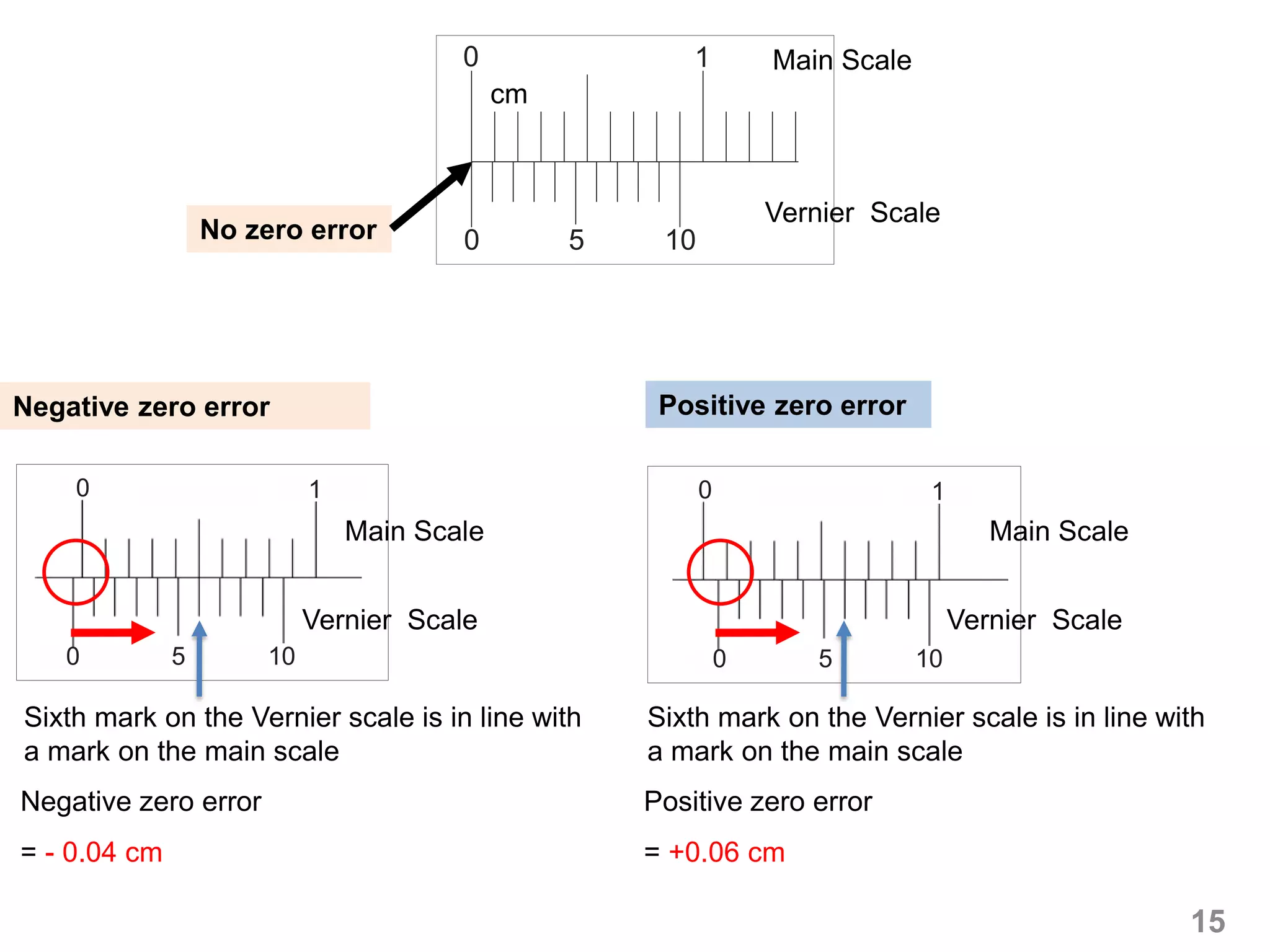
Negative zero error
Main Scale
Vernier Scale
Positive zero error
Sixth mark on the Vernier scale is in line with
a mark on the main scale
Positive zero error
= +0.06 cm
10
0 5 10
Main Scale
Vernier Scale
Sixth mark on the Vernier scale is in line with
a mark on the main scale
Negative zero error
= - 0.04 cm
No zero error
Main Scale
Vernier Scale
cm
0
0
5 10
1
16
1. Write down the readings shown by vernier calipers in the following figures:
0 1
0 105
b)0 1
0 105
a)
Try this !!!
0 1
0 105
d)0 1
0 105
c)
+0.03 cm - 0.06 cm
+0.01 cm - 0.03 cm
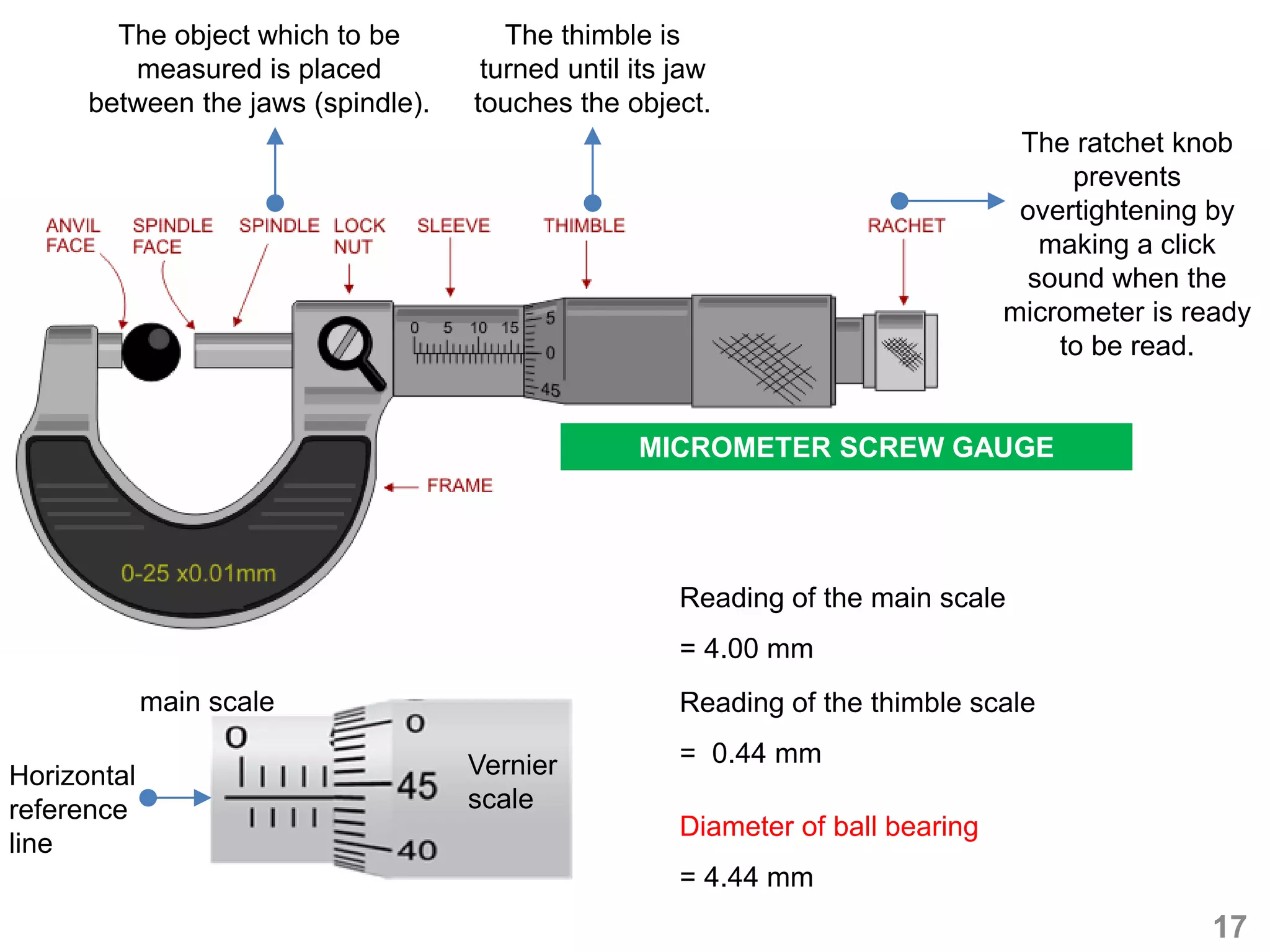
Reading of the main scale
= 4.00 mm
Reading of the thimble scale
= 0.44 mm
Diameter of ball bearing
= 4.44 mm
17
MICROMETER SCREW GAUGE
The object which to be
measured is placed
between the jaws (spindle).
The thimble is
turned until its jaw
touches the object.
The ratchet knob
prevents
overtightening by
making a click
sound when the
micrometer is ready
to be read.
main scale
Vernier
scale
Horizontal
reference
line
0
0
5
40
45
0
0
5
40
10
45
No Zero Error
18
To elliminate the zero error ***
Correct Reading = Reading Obtained − Zero Error
Horizontal
reference
line
0 mark
0
0
5
10
45
Horizontal
reference
line
2nd mark
above 0
Horizontal
reference
line
3th mark
below 0
Positive zero error = Negative zero error =+ 0.02 mm - 0.03 mm
Positive zero error Negative zero error
0 105
2 3c)
0 105
3 4a)
0 105
1 2d)
0 105
6 7b)
Latihan 3.4
2. Write down the readings shown by the following micrometer screw gauges.
a) b)
19
4.71 mm 9.17 mm
2.96 cm
2.12 cm
6.66 cm
1.11 cm
0
20
15
25 0 5
15
20
1. Write down the readings shown Vernier calipers in the following figures:
20
3. The following diagram shows the scale of a vernier callipers when the jaws are closed.
The following diagram shows the scale of the same vernier callipers when there are 50
pieces of cardboard between the jaws. Determine the thickness of one piece of cardboard.
0 1
0 105
5 6
0 105
(a) (b)
- 0.04 cm 5.64 cm
Zero error : - 0.04 cm
Reading of Vernier caliper : 5.64 cm
Thickness of 50 cardboards : 5.64 cm – (-0.04 cm)
= 5.68 cm
Thickness of 1 cardboard : 5.68 cm / 50
= 0.1136 cm
20 30
21
Metre Rule
A V
Ammeter Voltmeter
Thermometer
Mercury
Bulb
Mercury column
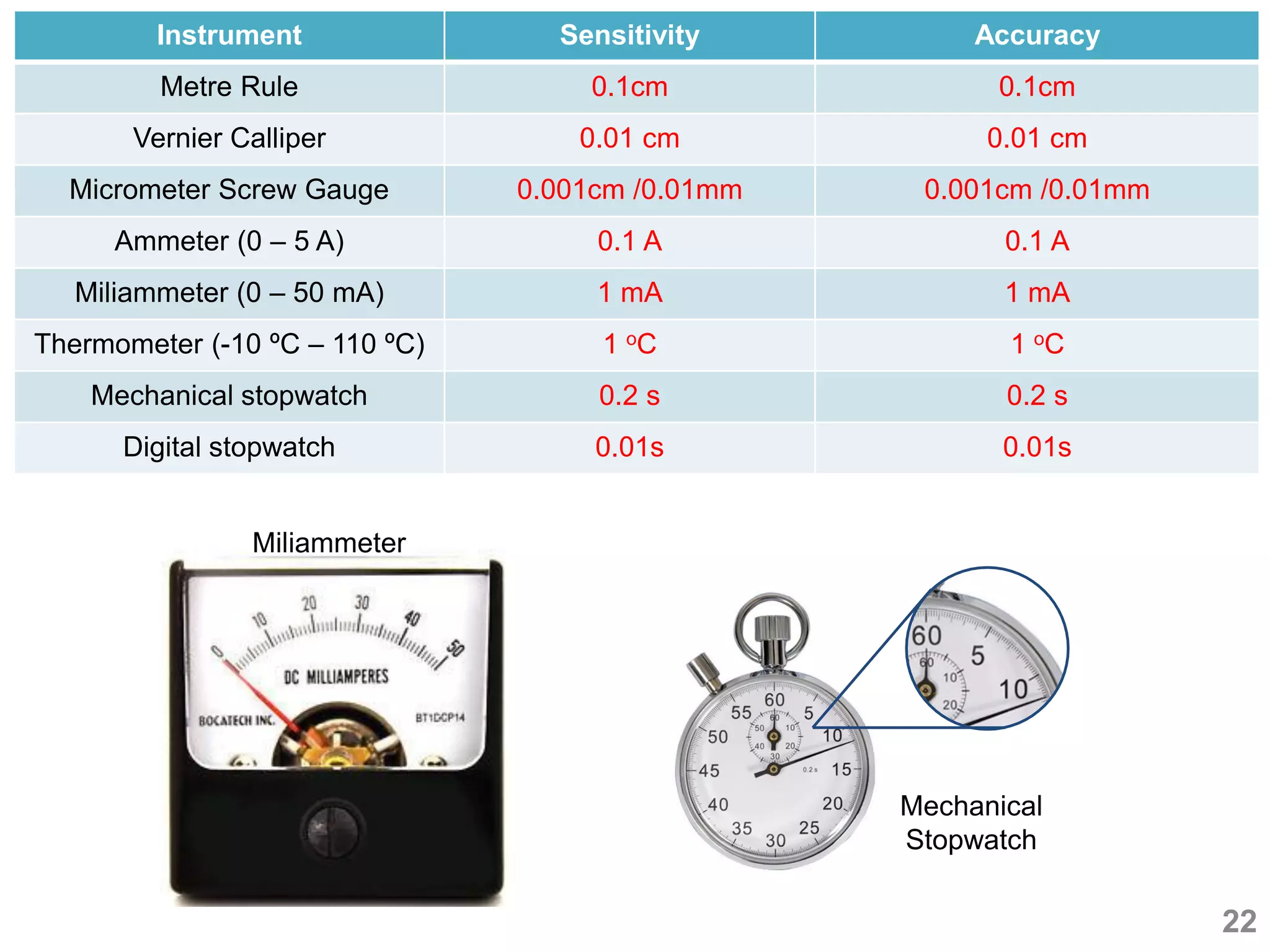
Sensitivity & Accuracy of Measuring Instruments
Digital Stopwatch
Instrument Sensitivity Accuracy
Metre Rule 0.1cm 0.1cm
Vernier Calliper 0.01 cm 0.01 cm
Micrometer Screw Gauge 0.001cm /0.01mm 0.001cm /0.01mm
Ammeter (0 – 5 A) 0.1 A 0.1 A
Miliammeter (0 – 50 mA) 1 mA 1 mA
Thermometer (-10 ºC – 110 ºC) 1 oC 1 oC
Mechanical stopwatch 0.2 s 0.2 s
Digital stopwatch 0.01s 0.01s
22
Miliammeter
Mechanical
Stopwatch
1.5 Scientific Investigation
______________________________
The quantity whose values we deliberately
choose to change or a primary variable which
causes other secondary variable to change.
________________________________
The quantity whose value depend on the
manipulated variable or a secondary variable
which changes in response to the change in
the manipulated variable.
________________________________
The quantity whose value is kept constant
throughout the experiment.
23
Identifying the problems/ questions /
situations
Identifying the variables involve
Forming a Hypothesis
Recording and Presenting data
Design and Carry out an experiment
Analysing and Interpreting data
Making conclusion
Writing a Report
The problem is identified and stated by asking
question. The problem is usually arised from
an observation
The question asked must be one that can be
solved experimentally.
2
1
Identifying the variables involve
Manipulated variable
Identifying the problems/ questions /
situations
Responding variable
Constant variable
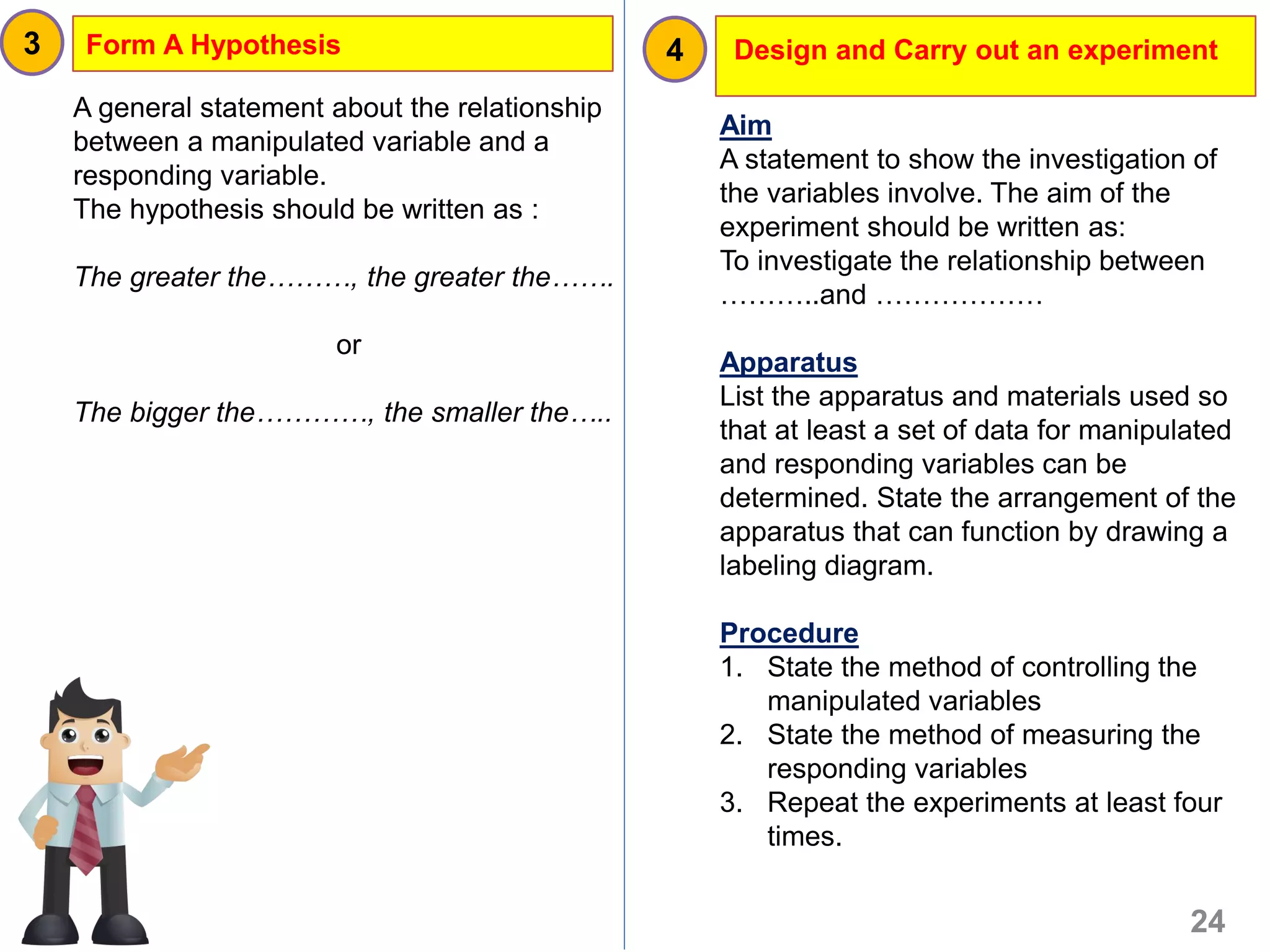
A general statement about the relationship
between a manipulated variable and a
responding variable.
The hypothesis should be written as :
The greater the………, the greater the…….
or
The bigger the…………, the smaller the…..
3 4
24
Form A Hypothesis Design and Carry out an experiment
Aim
A statement to show the investigation of
the variables involve. The aim of the
experiment should be written as:
To investigate the relationship between
………..and ………………
Apparatus
List the apparatus and materials used so
that at least a set of data for manipulated
and responding variables can be
determined. State the arrangement of the
apparatus that can function by drawing a
labeling diagram.
Procedure
1. State the method of controlling the
manipulated variables
2. State the method of measuring the
responding variables
3. Repeat the experiments at least four
times.
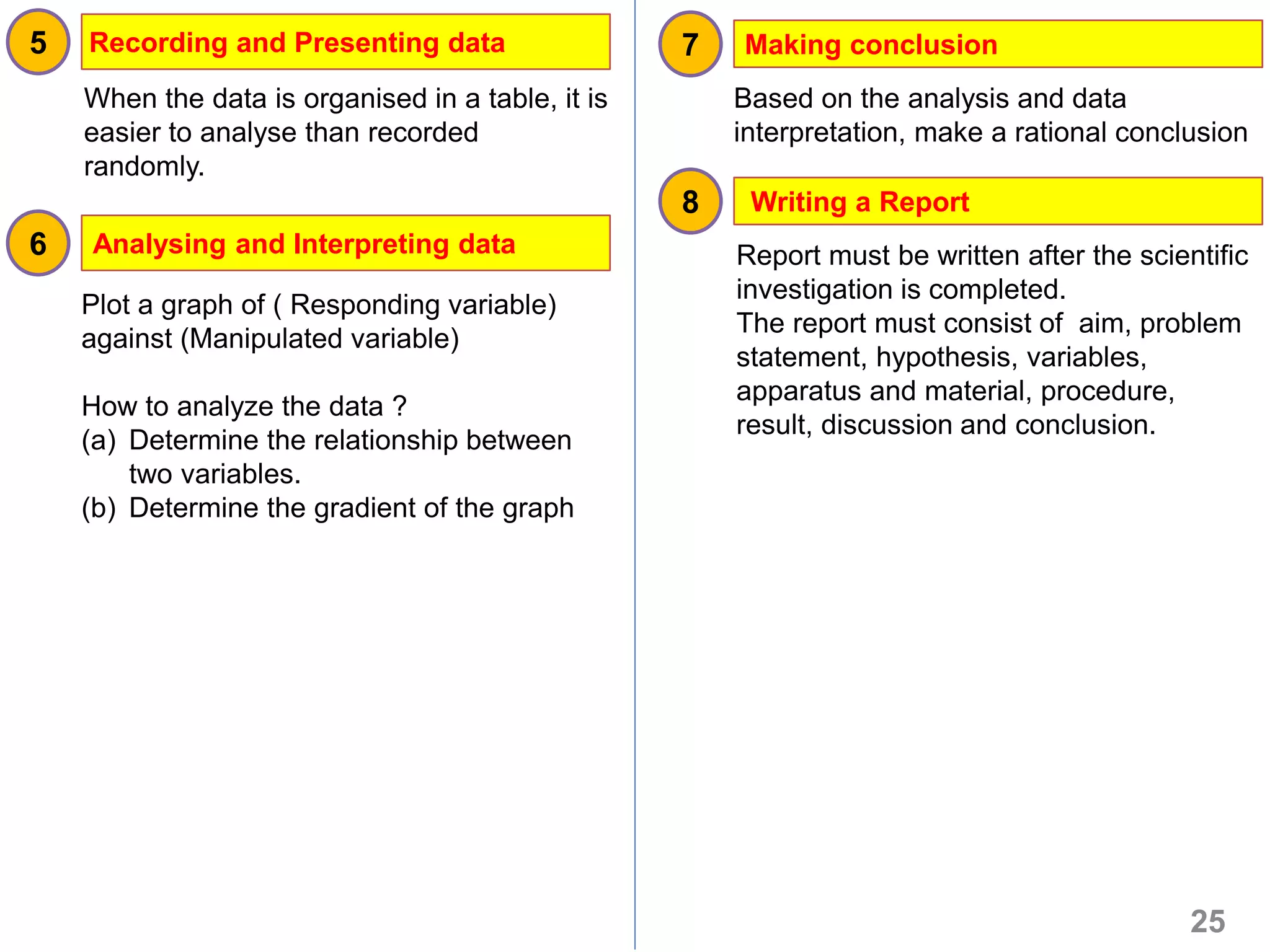
When the data is organised in a table, it is
easier to analyse than recorded
randomly.
5
6
7
8
25
Recording and Presenting data
Analysing and Interpreting data
Making conclusion
Writing a Report
Plot a graph of ( Responding variable)
against (Manipulated variable)
How to analyze the data ?
(a) Determine the relationship between
two variables.
(b) Determine the gradient of the graph
Based on the analysis and data
interpretation, make a rational conclusion
Report must be written after the scientific
investigation is completed.
The report must consist of aim, problem
statement, hypothesis, variables,
apparatus and material, procedure,
result, discussion and conclusion.
x
y
0
y increasing linearly
with x
x
y
0
y decreasing linearly with
x
F
a
a ∝ F
m
a
1
m
a
0 0 0
a ∝ 1
m
a ∝1
m
a is directly
proportional to F
a is inversely
proportional to m
a is directly proportional to 1
m
Relationship between two variables
26
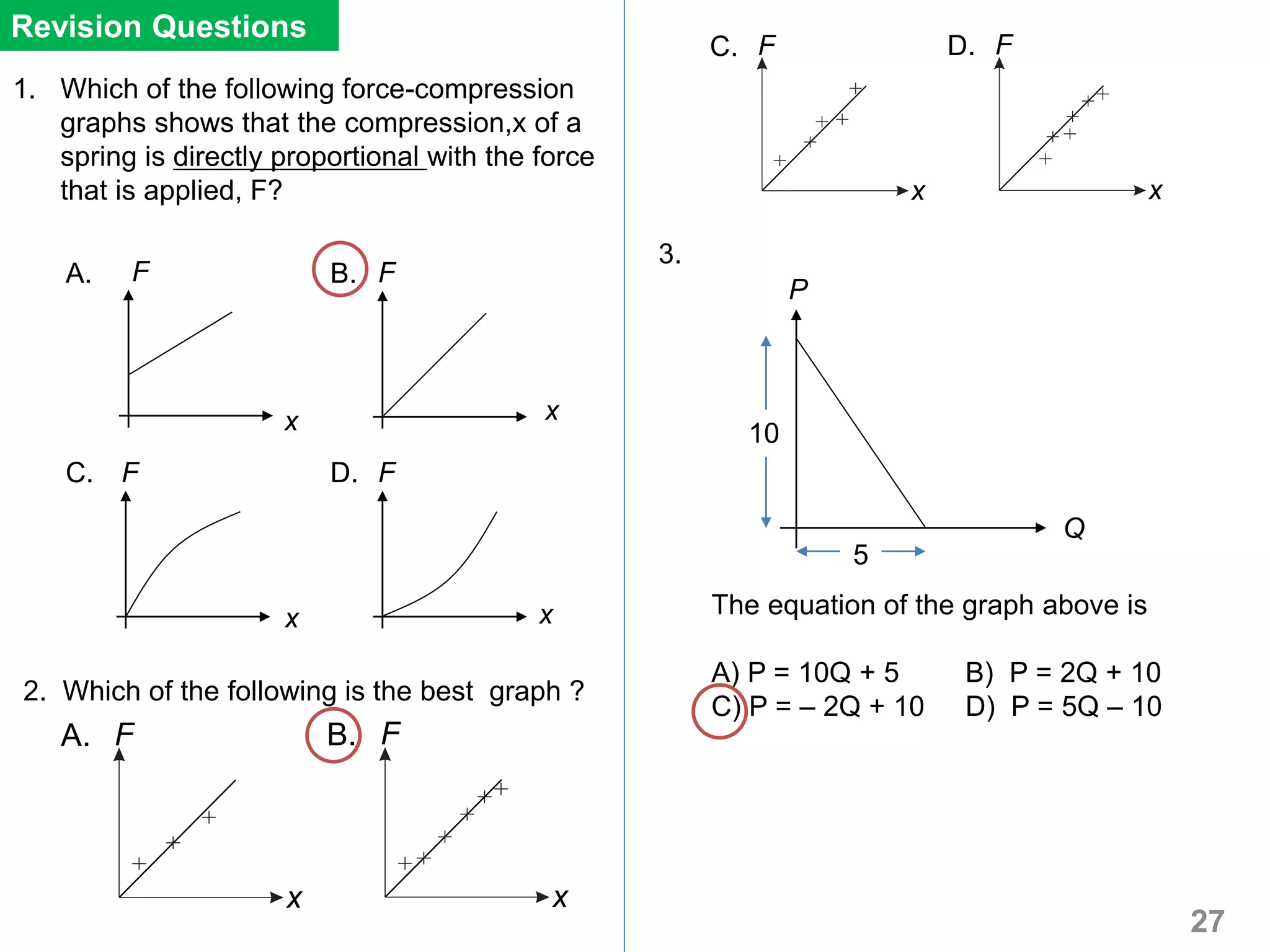
2. Which of the following is the best graph ?
The equation of the graph above is
A) P = 10Q + 5 B) P = 2Q + 10
C) P = – 2Q + 10 D) P = 5Q – 10
1. Which of the following force-compression
graphs shows that the compression,x of a
spring is directly proportional with the force
that is applied, F?
3.
A. B.
x
F
x
F
x
F
x
F
27
C. D.
A. B.
x x
F F
C. D.
x x
F F
Q
P
5
10
Revision Questions
28
4. Table shows the readings of the length of a rod as recorded by two students, X and Y
Reading of student X/cm Reading of student Y/cm
2.42 2.43
2.38 2.41
2.40 2.38
2.36 2.34
a) What was the instrument used by both students?
b) Why four readings were taken for each measurement?
c) What is the average value of the readings made by
i) student X ?
ii) student Y ?
d) Which set of reading is more accurate? Why?
e) Apart from the instrument in (a), what instruments can be used although they are
less accurate?
cm39.2
4
36.240.238.242.2


cm39.2
4
34.238.241.243.2


a) Vernier caliper
b) To increase the accuracy
c) (i) student X (ii) student Y ?
d) Both are same accurate. Their average readings are the same.
e) Meter ruler
Answers :
Load
W/N
Time for 10
oscillations, t/s
Period of
oscillation, T/s
T2/s2 W/T2 N s-2
1.0 6.7 0.67 0.449 2.228
2.0 9.5 0.95 0.903 2.216
3.0 11.6 1.16 1.346 2.229
4.0 13.4 1.34 1.796 2.228
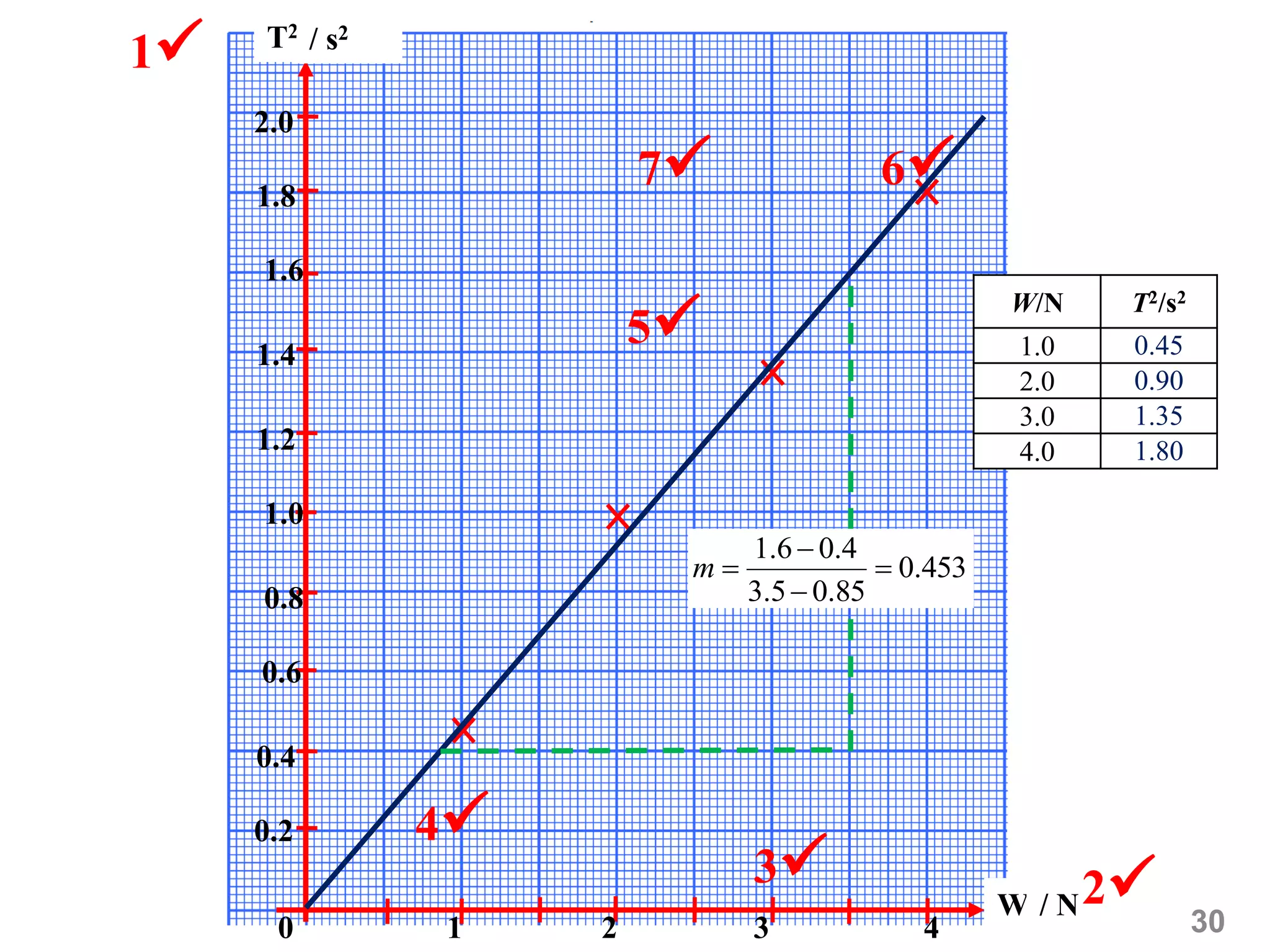
The above table shows the experimental data that is obtained by a student using the
weighted spring oscillation system.
a) Name the variable that is manipulated.
b) Name the variable that responds.
c) Complete the above table with the corresponding values.
d) State the derived unit for W/T2.
e) Draw the graph of T2 against W.
f) Interpret the shape of the graph that you have drawn.
g) Calculate the gradient of your graph.
h) Write relationship between the load and the period.
5.
29
a) Weight of load, W
b) Period of oscillation, T
d) kgms-3 / N s-2
f) A straight line originated from 0 and with positive gradient.
g) 0.453 N -1s2
h) T2 directly proportional with W
Answers :
W
T2
1 2 3 40
0.2
0.4
0.6
0.8
1.0
1.2
1.4
1.6
1.8
2.0
/ s2
/ N
1
23
4
5
67
W/N T2/s2
1.0 0.45
2.0 0.90
3.0 1.35
4.0 1.80
453.0
85.05.3
4.06.1



m
30

1 introducation to physics t

  • 1.
    Chapter 1 Introduction toPhysics Cikgu Desikan Edited by SMK Changkat Beruas, Perak Cikgu Khairul Anuar SMK Seri Mahkota, Kuantan PHYSICS FORM 4 In collaboration with
  • 2.
    FORM4PHYSICS 2016 1. Understanding Physics 2.Understanding base quantities and derived quantities 3. Understanding scalar and vector Quantities 4. Understanding measurements 5. Analysing scientific investigations Analysis of Past Year Questions Learning Objectives : Dear students, With the new day comes new strength and new thoughts. Introduction to Physics Chapter 1 2007 2008 2009 2010 2011 2012 2013 2014 2015 P1 3 3 3 2 3 3 4 1 P2 A - - - 1 - 1 - - B - - - - - - - - C - - - - - - - - P3 A - 1 1 1 - - 1 - B - - - - - - - -
  • 3.
    Concept Map Dear students, Byfailing to prepare, you are preparing to fail !!! Introduction to Physics Physics Concepts Physics Quantity Measurement Scientific Investigation Field of Physics Base Quantity Approximation Introduction to Physics Derived Quantity Base Unit Derived Unit Prefix Scientific Notation Conversion of Units Instrument for Measurement Error Accuracy Sensitivity Consistency Chapter 1
  • 4.
    1.1 Understanding Physics Physicsis the study to find a rational explanation (why and how) about the nature of matter, energy and natural phenomena. What is Physics? Fields of study in physics 1.__________ & ________ Investigate the action of force and motion 2. _________________ Studies the influence of heat on different types of matter 3. ________________ Explains the different phenomena due to light 4. _________________ Understand the properties of different types of waves and their uses 6. ___________ Studies the use of electronic devices in various fields 5. _______________ Investigates the interactions of electric & magnetic fields 7. ______________ Study of nuclear structure and their application 4 Heat Forces Motion Nuclear Physics Electronics Electromagnetism Waves Light
  • 5.
    Derived quantities (symbol) Expressed inbase quantities Derived units Area, A Area = length x width m2 Volume, V Volume = length x width x height m3 1.2 Physical Quantities Physical Quantities is a physical characteristic that can be measured. All physical quantities can be classified into two groups : 1. ____________________________ 2. ____________________________ Base quantities Base quantities are quantities that cannot be ___________ in terms of other base quantities. Base quantity Symbol S.I. Unit Symbol for S.I. Unit Length L meter m Mass m kilogram kg Time t second s Current I Ampere A Temperature T Kelvin K Derived quantity is one which obtained by __________________ base quantities by multiplication, division or both these operations. Its unit is derived from a similar combination of the base units. 1 2 5 Derived quantities Base quantities Derived quantities derived combining
  • 6.
    6 Derived quantities (symbol) Expressed in basequantities Derived units Density , ρ kgm–3 Velocity , v ms–1 Acceleration, a ms–2 Momentum, p Momentum = mass x velocity kgms–1 Force, F Force = mass x acceleration N / kgms–2 Pressure, P Nm–2/ Pa / kgm–1s–2 Weight, W Weight = mass x gravitational acceleration N / kgms–2 Volume Mass Density  Time ntDisplaceme Velocity Area Force Pressure Time velocityinChange onAccelerati 
  • 7.
    Scientific form Write thefollowing quantities in standard form : The values of measurements which is either very large of very small are written in Standard Form so as to be neater, brief and easier to read. A x 10n , 1 < A < 10 and n = integer Prefix Value Standard form Symbol Tera 1,000,000,000, 000 1012 T Giga 1,000,000,000 109 G Mega 1,000,000 106 M Kilo 1,000 103 k Hecto 100 102 h Deca 10 101 da Deci 0.1 10−1 d Centi 0.01 10−2 c Mili 0.001 10−3 m Micro 0.000 001 10−6 μ Nano 0.000 000 001 10−9 n Pico 0.000 000 000 001 10−12 p Prefix is used to simplify the expression of very big or very small numerical values of physical quantities 7 a. Radius of the earth = 6 370 000 m b. Mass of an electron = 0.000 000 000 000 000 911 kg c. Size of a particle = 0.000 03 m d. Diameter of an atom = 0.000 000 072 m e. Wavelength of light = 0.000 000 55 m Prefixes Ans : 6.37x 10⁶ m Ans : 9.11x 10 -16 kg Ans : 3 x 10 -5 m Ans : 7.2 x 10 -8 m Ans : 5.5 x 10 -7 m
  • 8.
    Convert each ofthe following measurements into metre, m (a) 2.98 Tm (b) 298 km (c) 2.98 μm (d) 2.98 x 10⁻¹ Gm (e) 2.98 x 10⁻³ Mm (f) 29.8 x 10⁷ nm (g) 298 x 104 μm 8 Conversion of Units Exercise 3.1 (a) 2.98 x 10¹² m (b) 2.98 x 10³m (c) 2.98 x 10⁻⁶m (d) 2.98 x 10⁸m (e) 2.98 x 10³m (f) 2.98 x 10 -2 m (g) 2.98 x 10 -2 m
  • 9.
    9 Convert a. 4 m2into the units of cm2 b. 30 cm2 into the units of m2 c. 2.5 m2 to unit of mm2 d. 500 mm2 into the units of m2 e. 200 m3 into the units of mm3 f. 11.5 cm3 into the units of m3 g. 72 km h-1 into the units of ms-1 h. 5 g cm-3 into the units of kg m-3 a) 4 x 10⁴ m2 b) 3 x 10⁻³ m2 c) 2.5 x 10⁶ m2 d) 5 x 10⁻⁴ m2 e) 2 x 10¹¹ m2 f) 1.15 x 10⁻⁵ m2 g) 20 ms-1 h) 5000 kgm-3
  • 10.
    1.3 Scalar andVector Quantities Distance(s) Displacement(s) Total length of the path traveled Distance between two points measured along a specific direction Scalar quantity Vector quantity Speed Velocity Rate of change of distance Rate of change of displacement Speed = Velocity = Scalar quantity Vector quantity 10 Scalar Quantities Vector Quantities Quantities that have magnitude but no direction Quantities that have both magnitude and direction Distance Displacement Speed Velocity work Acceleration Area Force Mass Momentum Examples time distance time ntdisplaceme
  • 11.
    Consistency Accuracy Sensitivity ShooterConsistency Accuracy A High Low B Low High C High High D Low Low The diagram shows the result for four shooters A, B, C and D in a tournament. Every shooter shot five times. (Use High / Low) 11 1.4 Measuring Instruments Consistency in measurements refers to how little deviation there is among the measurements made when a quantity is measured several times. Accuracy of a measurement is how close the measurement made is to the actual value of the quantity. Sensitivity of an instrument is its ability to detect a small change in the quantity to be measured in a short period of time.
  • 12.
    ERROR Error is uncertaintycaused by measuring instrument or the observer or the physical factors of the surroundings. Systematic Error Random Error  Caused by: i. Condition of the measuring instrument ii. Condition of environment  Caused by: i. Surroundings factors, such as temperature and wind ii. Carelessness of the observer  Example i. ______________________________ ii. Inaccurate calibration  Example i. Parallax error ii. Error in counting iii. Natural errors (sudden change)  Way of correction i. Proper calibration ii. Adjust the instrument frequently  Ways of correction i. Take several readings and calculate the average value. A parallax error is an error in reading an instrument because the observer’s eyes and pointer are not in line / perpendicular to the plane of the scale. 1. position of eyes must be in line/ perpendicular / 90o with the scale of the reading to be taken. 2. When taking reading from an ammeter, we must make sure that the eyes are exactly in front of the pointer, so that the reflection of the pointer in the mirror is right behind the pointer. In other words, the reflection of the pointer on the mirror could not be seen by the observer, then it is free from parallax error. How to avoid parallax error? 12 Parallax Error zero error
  • 13.
    Measuring Instruments &Accuracy Physical Quantity Measuring Instrument Length Pembaris meter, Angkup vernier , Tolok skru mikrometer Current Ammeter Mass Neraca tiga palang Temperature Termometer Time Jam randik (analog, mekanikal) Voltage Voltmeter 13 Parallax Error A B C 1 2 3 Accurate reading = 2.6 cm Reading = 2.7 cm Reading = 2.6 cm Reading = 2.5 cm B A C Reading = 15.0 ml Reading = 15.1 ml Reading = 14.9 ml 15 16 14 Pointer’s image can be seen Pointer’s image is behind the pointer
  • 14.
    Depth probe Measure depths Outside jaws Measureexternal diameter of an object Vernier scale (in) Retainer Block movable parts Vernier scale (cm) Main scale (cm) Main scale (in) Inside jaws Measure internal diameter/ thickness of an object VERNIER CALLIPER Measurements Reading from main scale : Reading from main Vernier scale : Reading of Vernier caliper : 14 3.2 cm 0.04 cm 3.24 cm
  • 15.
    15 10 0 5 10 Negativezero error Main Scale Vernier Scale Positive zero error Sixth mark on the Vernier scale is in line with a mark on the main scale Positive zero error = +0.06 cm 10 0 5 10 Main Scale Vernier Scale Sixth mark on the Vernier scale is in line with a mark on the main scale Negative zero error = - 0.04 cm No zero error Main Scale Vernier Scale cm 0 0 5 10 1
  • 16.
    16 1. Write downthe readings shown by vernier calipers in the following figures: 0 1 0 105 b)0 1 0 105 a) Try this !!! 0 1 0 105 d)0 1 0 105 c) +0.03 cm - 0.06 cm +0.01 cm - 0.03 cm
  • 17.
    Reading of themain scale = 4.00 mm Reading of the thimble scale = 0.44 mm Diameter of ball bearing = 4.44 mm 17 MICROMETER SCREW GAUGE The object which to be measured is placed between the jaws (spindle). The thimble is turned until its jaw touches the object. The ratchet knob prevents overtightening by making a click sound when the micrometer is ready to be read. main scale Vernier scale Horizontal reference line
  • 18.
    0 0 5 40 45 0 0 5 40 10 45 No Zero Error 18 Toelliminate the zero error *** Correct Reading = Reading Obtained − Zero Error Horizontal reference line 0 mark 0 0 5 10 45 Horizontal reference line 2nd mark above 0 Horizontal reference line 3th mark below 0 Positive zero error = Negative zero error =+ 0.02 mm - 0.03 mm Positive zero error Negative zero error
  • 19.
    0 105 2 3c) 0105 3 4a) 0 105 1 2d) 0 105 6 7b) Latihan 3.4 2. Write down the readings shown by the following micrometer screw gauges. a) b) 19 4.71 mm 9.17 mm 2.96 cm 2.12 cm 6.66 cm 1.11 cm 0 20 15 25 0 5 15 20 1. Write down the readings shown Vernier calipers in the following figures:
  • 20.
    20 3. The followingdiagram shows the scale of a vernier callipers when the jaws are closed. The following diagram shows the scale of the same vernier callipers when there are 50 pieces of cardboard between the jaws. Determine the thickness of one piece of cardboard. 0 1 0 105 5 6 0 105 (a) (b) - 0.04 cm 5.64 cm Zero error : - 0.04 cm Reading of Vernier caliper : 5.64 cm Thickness of 50 cardboards : 5.64 cm – (-0.04 cm) = 5.68 cm Thickness of 1 cardboard : 5.68 cm / 50 = 0.1136 cm
  • 21.
    20 30 21 Metre Rule AV Ammeter Voltmeter Thermometer Mercury Bulb Mercury column Sensitivity & Accuracy of Measuring Instruments Digital Stopwatch
  • 22.
    Instrument Sensitivity Accuracy MetreRule 0.1cm 0.1cm Vernier Calliper 0.01 cm 0.01 cm Micrometer Screw Gauge 0.001cm /0.01mm 0.001cm /0.01mm Ammeter (0 – 5 A) 0.1 A 0.1 A Miliammeter (0 – 50 mA) 1 mA 1 mA Thermometer (-10 ºC – 110 ºC) 1 oC 1 oC Mechanical stopwatch 0.2 s 0.2 s Digital stopwatch 0.01s 0.01s 22 Miliammeter Mechanical Stopwatch
  • 23.
    1.5 Scientific Investigation ______________________________ Thequantity whose values we deliberately choose to change or a primary variable which causes other secondary variable to change. ________________________________ The quantity whose value depend on the manipulated variable or a secondary variable which changes in response to the change in the manipulated variable. ________________________________ The quantity whose value is kept constant throughout the experiment. 23 Identifying the problems/ questions / situations Identifying the variables involve Forming a Hypothesis Recording and Presenting data Design and Carry out an experiment Analysing and Interpreting data Making conclusion Writing a Report The problem is identified and stated by asking question. The problem is usually arised from an observation The question asked must be one that can be solved experimentally. 2 1 Identifying the variables involve Manipulated variable Identifying the problems/ questions / situations Responding variable Constant variable
  • 24.
    A general statementabout the relationship between a manipulated variable and a responding variable. The hypothesis should be written as : The greater the………, the greater the……. or The bigger the…………, the smaller the….. 3 4 24 Form A Hypothesis Design and Carry out an experiment Aim A statement to show the investigation of the variables involve. The aim of the experiment should be written as: To investigate the relationship between ………..and ……………… Apparatus List the apparatus and materials used so that at least a set of data for manipulated and responding variables can be determined. State the arrangement of the apparatus that can function by drawing a labeling diagram. Procedure 1. State the method of controlling the manipulated variables 2. State the method of measuring the responding variables 3. Repeat the experiments at least four times.
  • 25.
    When the datais organised in a table, it is easier to analyse than recorded randomly. 5 6 7 8 25 Recording and Presenting data Analysing and Interpreting data Making conclusion Writing a Report Plot a graph of ( Responding variable) against (Manipulated variable) How to analyze the data ? (a) Determine the relationship between two variables. (b) Determine the gradient of the graph Based on the analysis and data interpretation, make a rational conclusion Report must be written after the scientific investigation is completed. The report must consist of aim, problem statement, hypothesis, variables, apparatus and material, procedure, result, discussion and conclusion.
  • 26.
    x y 0 y increasing linearly withx x y 0 y decreasing linearly with x F a a ∝ F m a 1 m a 0 0 0 a ∝ 1 m a ∝1 m a is directly proportional to F a is inversely proportional to m a is directly proportional to 1 m Relationship between two variables 26
  • 27.
    2. Which ofthe following is the best graph ? The equation of the graph above is A) P = 10Q + 5 B) P = 2Q + 10 C) P = – 2Q + 10 D) P = 5Q – 10 1. Which of the following force-compression graphs shows that the compression,x of a spring is directly proportional with the force that is applied, F? 3. A. B. x F x F x F x F 27 C. D. A. B. x x F F C. D. x x F F Q P 5 10 Revision Questions
  • 28.
    28 4. Table showsthe readings of the length of a rod as recorded by two students, X and Y Reading of student X/cm Reading of student Y/cm 2.42 2.43 2.38 2.41 2.40 2.38 2.36 2.34 a) What was the instrument used by both students? b) Why four readings were taken for each measurement? c) What is the average value of the readings made by i) student X ? ii) student Y ? d) Which set of reading is more accurate? Why? e) Apart from the instrument in (a), what instruments can be used although they are less accurate? cm39.2 4 36.240.238.242.2   cm39.2 4 34.238.241.243.2   a) Vernier caliper b) To increase the accuracy c) (i) student X (ii) student Y ? d) Both are same accurate. Their average readings are the same. e) Meter ruler Answers :
  • 29.
    Load W/N Time for 10 oscillations,t/s Period of oscillation, T/s T2/s2 W/T2 N s-2 1.0 6.7 0.67 0.449 2.228 2.0 9.5 0.95 0.903 2.216 3.0 11.6 1.16 1.346 2.229 4.0 13.4 1.34 1.796 2.228 The above table shows the experimental data that is obtained by a student using the weighted spring oscillation system. a) Name the variable that is manipulated. b) Name the variable that responds. c) Complete the above table with the corresponding values. d) State the derived unit for W/T2. e) Draw the graph of T2 against W. f) Interpret the shape of the graph that you have drawn. g) Calculate the gradient of your graph. h) Write relationship between the load and the period. 5. 29 a) Weight of load, W b) Period of oscillation, T d) kgms-3 / N s-2 f) A straight line originated from 0 and with positive gradient. g) 0.453 N -1s2 h) T2 directly proportional with W Answers :
  • 30.
    W T2 1 2 340 0.2 0.4 0.6 0.8 1.0 1.2 1.4 1.6 1.8 2.0 / s2 / N 1 23 4 5 67 W/N T2/s2 1.0 0.45 2.0 0.90 3.0 1.35 4.0 1.80 453.0 85.05.3 4.06.1    m 30