English for Academic and
Professional Purposes
Quarter 2 – Module 5:
Designing and Conducting Research
Instruments
English for Academic and Professional Purposes – Senior High School
Quarter 2 – Module 5: Designing and Conducting Research Instruments
First Edition, 2020
Republic Act 8293, section 176 states that: No copyright shall subsist in any work
of the Government of the Philippines. However, prior approval of the government agency or
office wherein the work is created shall be necessary for exploitation of such work for profit.
Such agency or office may, among other things, impose as a condition the payment of
royalties.
Borrowed materials (i.e., songs, stories, poems, pictures, photos, brand names,
trademarks, etc.) included in this module are owned by their respective copyright holders.
Every effort has been exerted to locate and seek permission to use these materials from
their respective copyright owners. The publisher and authors do not represent nor claim
ownership over them.
Published by the Department of Education – Region XI
Regional Director: Evelyn R. Fetalvero
Assistant Regional Director: Maria Ines C. Asuncion
Printed in the Philippines by ________________________
Department of Education – Panabo City Division
Office Address: City Hall Drive, Bgy. JP Laurel, Km. 31
Panabo City, Davao del Norte
Telefax: (084) 823-1469, (084) 628-4066
E-mail Address: panabocity.division@deped.gov.ph
Development Team of the Module
Writers: Jo Janine Nikkie I. Tuna
Editors: Jeanne S. Bajao, Liezel M. Solicar
Reviewers: Janice A. Fernandez, Christopher U. Gonzales, Divilyn M. Rodriguez
Template Developer: Neil Edward D. Diaz
Management Team:
Evelyn R. Fetalvero Reynante A. Solitario
Mary Jeanne B. Aldeguer Janwario E. Yamota
Analiza C. Almazan Djhoane C. Aguilar
Manuel P. Vallejo Maria Perpetua Angelita G. Suelto
English for Academic
and Professional
Purposes
Quarter 2 – Module 5:
Designing and Conducting
Research Instruments
ii
Introductory Message
For the facilitator:
As a facilitator, you are expected to orient the learners on how to use
this module. You also need to keep track of the learners' progress while
allowing them to manage their own learning at home. Furthermore, you are
expected to encourage and assist the learners as they do the tasks included
in the module.
For the learner:
As a learner, you must learn to become responsible of your own
learning. Take time to read, understand, and perform the different activities
in the module.
As you go through the different activities of this module be reminded
of the following:
1. Use the module with care. Do not put unnecessary mark/s on any
part of the module. Use a separate sheet of paper in answering the
exercises.
2. Don’t forget to answer Let Us Try before moving on to the other
activities.
3. Read the instructions carefully before doing each task.
4. Observe honesty and integrity in doing the tasks and checking your
answers.
5. Finish the task at hand before proceeding to the next.
6. Return this module to your teacher/facilitator once you are done.
If you encounter any difficulty in answering the tasks in this module,
do not hesitate to consult your teacher or facilitator. Always bear in mind
that you are not alone. We hope that through this material, you will
experience meaningful learning and gain deep understanding of the relevant
competencies.
You can do it!
1
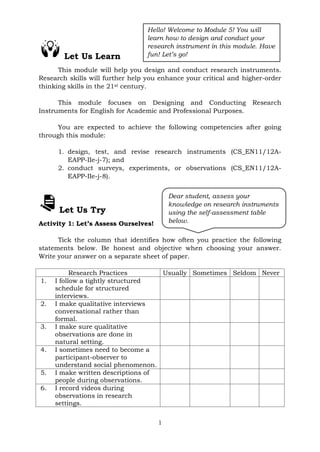
Let Us Learn
This module will help you design and conduct research instruments.
Research skills will further help you enhance your critical and higher-order
thinking skills in the 21st century.
This module focuses on Designing and Conducting Research
Instruments for English for Academic and Professional Purposes.
You are expected to achieve the following competencies after going
through this module:
1. design, test, and revise research instruments (CS_EN11/12A-
EAPP-IIe-j-7); and
2. conduct surveys, experiments, or observations (CS_EN11/12A-
EAPP-IIe-j-8).
Let Us Try
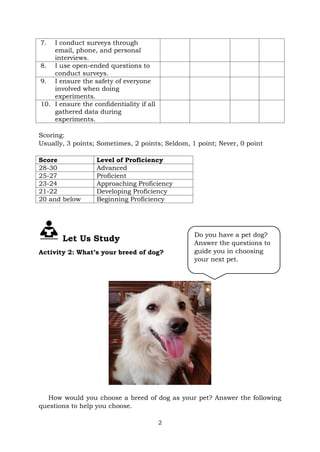
Activity 1: Let’s Assess Ourselves!
Tick the column that identifies how often you practice the following
statements below. Be honest and objective when choosing your answer.
Write your answer on a separate sheet of paper.
Research Practices Usually Sometimes Seldom Never
1. I follow a tightly structured
schedule for structured
interviews.
2. I make qualitative interviews
conversational rather than
formal.
3. I make sure qualitative
observations are done in
natural setting.
4. I sometimes need to become a
participant-observer to
understand social phenomenon.
5. I make written descriptions of
people during observations.
6. I record videos during
observations in research
settings.
Hello! Welcome to Module 5! You will
learn how to design and conduct your
research instrument in this module. Have
fun! Let’s go!
Dear student, assess your
knowledge on research instruments
using the self-assessment table
below.
2
7. I conduct surveys through
email, phone, and personal
interviews.
8. I use open-ended questions to
conduct surveys.
9. I ensure the safety of everyone
involved when doing
experiments.
10. I ensure the confidentiality if all
gathered data during
experiments.
Scoring:
Usually, 3 points; Sometimes, 2 points; Seldom, 1 point; Never, 0 point
Score Level of Proficiency
28-30 Advanced
25-27 Proficient
23-24 Approaching Proficiency
21-22 Developing Proficiency
20 and below Beginning Proficiency
Let Us Study
Activity 2: What’s your breed of dog?
How would you choose a breed of dog as your pet? Answer the following
questions to help you choose.
Do you have a pet dog?
Answer the questions to
guide you in choosing
your next pet.
3
1. Will you research using the internet?
2. Will you interview people with a particular breed of dog?
3. Will you survey dog breeders?
4. Will you observe dog owners?
Data collection approaches for research usually involves:
1. Direct interaction with individuals on a one to one basis
2. Direct interaction with individuals in a group setting
The main methods for collecting data are:
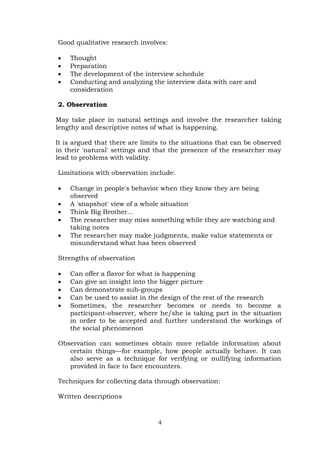
1. Interviews
Unstructured
 Can be referred to as 'depth' or 'in-depth' interviews
 They have very little structure at all
 The interviewer may just go with the aim of discussing a limited
number of topics, sometimes as few as just one or two
 The interviewer may frame the interview questions based on the
interviewee and his/her previous response
 This allows the discussion to cover areas in great detail
 They involve the researcher wanting to know or find out more
about a specific topic without there being a structure or a
preconceived plan or expectation as to how they will deal with the
topic
Structured
 The interviewee will ask the respondent the same questions in the
same way. A tightly structured schedule is used
 The questions may be phrased in order that a limited range of
responses may be given - i.e. 'Do you rate our services as very
good, good or poor'. A researcher needs to consider whether a
questionnaire or structured interview is more appropriate
 If the interview schedule is too tightly structured this may not
enable the phenomena under investigation to be explored in terms
of either breadth or depth
 Qualitative interviews should be fairly informal and participants
feel they are taking part in a conversation or discussion rather
than in a formal question and answer situation
 There is a skill required and involved in successful qualitative
research approaches—which requires careful consideration and
planning
4
Good qualitative research involves:
 Thought
 Preparation
 The development of the interview schedule
 Conducting and analyzing the interview data with care and
consideration
2. Observation
May take place in natural settings and involve the researcher taking
lengthy and descriptive notes of what is happening.
It is argued that there are limits to the situations that can be observed
in their 'natural' settings and that the presence of the researcher may
lead to problems with validity.
Limitations with observation include:
 Change in people's behavior when they know they are being
observed
 A 'snapshot' view of a whole situation
 Think Big Brother...
 The researcher may miss something while they are watching and
taking notes
 The researcher may make judgments, make value statements or
misunderstand what has been observed
Strengths of observation
 Can offer a flavor for what is happening
 Can give an insight into the bigger picture
 Can demonstrate sub-groups
 Can be used to assist in the design of the rest of the research
 Sometimes, the researcher becomes or needs to become a
participant-observer, where he/she is taking part in the situation
in order to be accepted and further understand the workings of
the social phenomenon
Observation can sometimes obtain more reliable information about
certain things—for example, how people actually behave. It can
also serve as a technique for verifying or nullifying information
provided in face to face encounters.
Techniques for collecting data through observation:
Written descriptions
5
 The researcher makes written descriptions of the people,
situations, or environment
 Limitations include
oResearcher might miss out on observation as they are taking
notes
oThe researcher may be focused on a particular event or
situation
oThere is room for subjective interpretation of what is happening
Video recording
 Allows the researcher to also record notes
 Limitations may include
oPeople acting unnaturally towards the camera or others
avoiding the camera
oThe camera may not always see everything
Photographs and artifacts
 Useful when there is a need to collect observable information or
phenomena such as buildings, neighborhoods, dress, and
appearance
 Artifacts include objects of significance—memorabilia,
instruments, tools, and others.
3. Survey
Survey is done to present and explain the actual experiences of a
certain population.
Conducting survey is done in three (3) steps: 1) by email; 2) phone;
3) personal interview. The method of data collection can be from
observation to content analysis and this can be used in the survey.
The challenges and limitations of the survey are seen according to
the following criteria: 1) appropriateness of the method; 2) accuracy of
what to observe; 3) generalizability of the findings; 4) administrative
constraints; 5) ethical and political difficulties
An example of a survey is the open-ended questions. This is placed
in a box form and will permit your respondents to provide a unique
answer. This kind of approach is able to provide the respondents the
freedom to say what they feel about a topic, which provides you with
exploratory data that may unleash important issues, opportunities,
issues, or quotes.
4. Experiment
An experiment is a procedure undertaken scientifically and
systematically to make a discovery and to test the hypothesis. An
6
experiment can be performed in a laboratory or a natural setting
following these steps:
 Make observations.
 Develop the hypothesis.
 Design the experiment.
 Conduct the experiment.
 Analyze the results.
 Accept or reject the hypothesis.
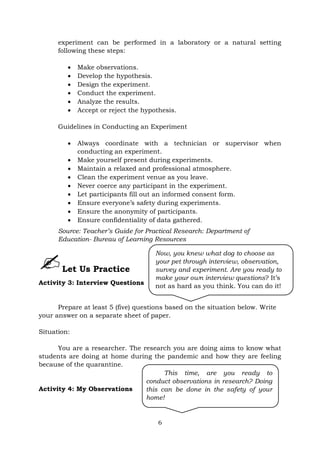
Guidelines in Conducting an Experiment
 Always coordinate with a technician or supervisor when
conducting an experiment.
 Make yourself present during experiments.
 Maintain a relaxed and professional atmosphere.
 Clean the experiment venue as you leave.
 Never coerce any participant in the experiment.
 Let participants fill out an informed consent form.
 Ensure everyone’s safety during experiments.
 Ensure the anonymity of participants.
 Ensure confidentiality of data gathered.
Source: Teacher’s Guide for Practical Research: Department of
Education- Bureau of Learning Resources
Let Us Practice
Activity 3: Interview Questions
Prepare at least 5 (five) questions based on the situation below. Write
your answer on a separate sheet of paper.
Situation:
You are a researcher. The research you are doing aims to know what
students are doing at home during the pandemic and how they are feeling
because of the quarantine.
Activity 4: My Observations
This time, are you ready to
conduct observations in research? Doing
this can be done in the safety of your
home!
Now, you knew what dog to choose as
your pet through interview, observation,
survey and experiment. Are you ready to
make your own interview questions? It’s
not as hard as you think. You can do it!
7
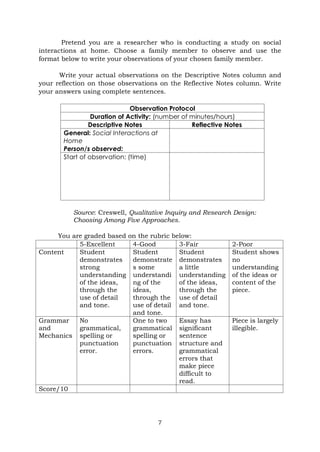
Pretend you are a researcher who is conducting a study on social
interactions at home. Choose a family member to observe and use the
format below to write your observations of your chosen family member.
Write your actual observations on the Descriptive Notes column and
your reflection on those observations on the Reflective Notes column. Write
your answers using complete sentences.
Observation Protocol
Duration of Activity: (number of minutes/hours)
Descriptive Notes Reflective Notes
General: Social Interactions at
Home
Person/s observed:
Start of observation: (time)
Source: Creswell, Qualitative Inquiry and Research Design:
Choosing Among Five Approaches.
You are graded based on the rubric below:
5-Excellent 4-Good 3-Fair 2-Poor
Content Student
demonstrates
strong
understanding
of the ideas,
through the
use of detail
and tone.
Student
demonstrate
s some
understandi
ng of the
ideas,
through the
use of detail
and tone.
Student
demonstrates
a little
understanding
of the ideas,
through the
use of detail
and tone.
Student shows
no
understanding
of the ideas or
content of the
piece.
Grammar
and
Mechanics
No
grammatical,
spelling or
punctuation
error.
One to two
grammatical
spelling or
punctuation
errors.
Essay has
significant
sentence
structure and
grammatical
errors that
make piece
difficult to
read.
Piece is largely
illegible.
Score/10
8
Let Us Practice More
Activity 5: Survey Questions
Look at the topics below:
 New Normal
 Facebook and Social Media
 Tiktok and Fame
 Selfies and Filters
 Youtube Trends
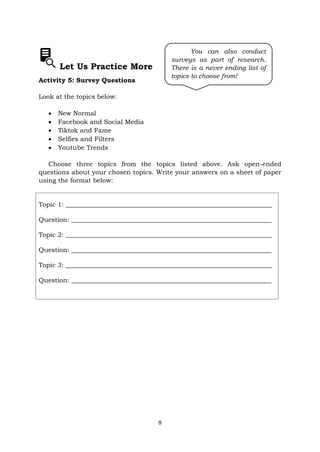
Choose three topics from the topics listed above. Ask open-ended
questions about your chosen topics. Write your answers on a sheet of paper
using the format below:
Topic 1: ________________________________________________________________
Question: ______________________________________________________________
Topic 2: ________________________________________________________________
Question: ______________________________________________________________
Topic 3: ________________________________________________________________
Question: ______________________________________________________________
You can also conduct
surveys as part of research.
There is a never ending list of
topics to choose from!
9
Activity 6: Studying an Experiment
Look for a study/research paper with an experimental design. Study
the method part and analyze how the instrument was conducted.
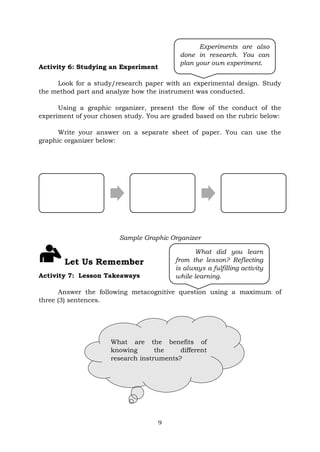
Using a graphic organizer, present the flow of the conduct of the
experiment of your chosen study. You are graded based on the rubric below:
Write your answer on a separate sheet of paper. You can use the
graphic organizer below:
Sample Graphic Organizer
Let Us Remember
Activity 7: Lesson Takeaways
Answer the following metacognitive question using a maximum of
three (3) sentences.
What are the benefits of
knowing the different
research instruments?
What did you learn
from the lesson? Reflecting
is always a fulfilling activity
while learning.
Experiments are also
done in research. You can
plan your own experiment.
10
Let Us Assess
Activity 8: Multiple Choice Test
Read and answer the following questions on research instruments. Write
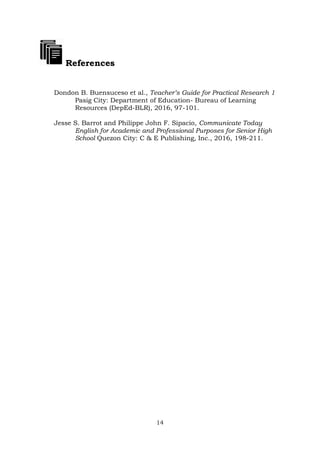
the letter of your choice on a separate sheet of paper.
1. It is a research instrument where participants are part of a
conversation or question and answer portion.
A. Interview
B. Observation
C. Survey
D. Experiment
2. Which of the following is one of the limitations of the observation
method?
A. It can show sub-groups.
B. They take place in natural setting.
C. Researcher may miss something while observing.
D. Can present the bigger picture.
3. Which of the following is NOT a step in conducting surveys?
A. Observation
B. Email
C. Phone
D. Interview
4. How can we conduct an effective and successful experiment in
research?
A. Make sure you are not directly involved during the experiment.
B. Force unwilling participants to be involved in your experiment.
C. See to it that all gathered data are confidential.
D. Disclose the identities of your research participants.
5. Which of the following is the advantage of using a questionnaire in
research?
A. Involves more participants
B. Less expensive
C. Easier data to analyze
D. Requires participant to read and write
We are almost at the
end. Enhance your learning
on designing and
conducting research
instruments. Keep going!

11
6. Which of the following research instruments is conducted in the
natural setting?
A. Structured Interview
B. Unstructured Interview
C. Observation
D. Survey
7. Which of the following is the disadvantage of conducting experiments?
A. It can be replicated
B. Results in artificial situations
C. Influence on data because of the observer
D. It does not establish cause and effect
8. Which of the following are kinds of artifacts for observation?
A. video
B. social media posts
C. emails
D. memorabilia
9. Which of the following is an open-ended question used in conducting
surveys?
A. Do you like to study Mathematics as a subject in school?
B. Why do some parents allow their children to play online games all
day?
C. Are you in favor of conducting classes using social media
platforms?
D. Which do you prefer, online or modular learning?
10. In this method of research, the researcher frames questions based on
the participant’s previous response.
A. Unstructured Interview
B. Structured Interview
C. Direct Observation
D. Indirect Observation
Activity 9: My Research Topic
What research topic would you want to pursue? What research
instrument/s is/are suitable for your chosen topic? Why are these the most
suitable?
Write your answer in an essay format containing a maximum of ten
(10) sentences only. Use a separate sheet of paper.
12
Let Us Enhance
Activity 10: Let’s List Down
From the items listed below, select the items that show good research
practices and write them on your paper.
 Christian is researching about practices of teachers in teaching
Science to students. In his questionnaire, he asks about the love life of
his participants.
 Dareen makes a planned interview schedule to inform the participants
of her research.
 Judy used the data from her interview to blackmail her participants.
 Rhea thanked her participants after conducting her research.
 Mary Ann takes descriptive notes of what is happening during her
observation.
 Jonard conducts and analyzes data with care and consideration.
 Randy makes a structured interview with very limited structure.
 Because of fear to waste time in conducting his research, Joe did not
allow his participants to use the toilet.
 Beverly writes the name of her participants in her published research
manuscript.
 Eunice cleans the laboratory after conducting her experiments.
Let Us Reflect
Activity 11: My Reflections
Fill out the table below with your initial thoughts before the lesson
and your new learnings after the lesson. Use a separate sheet of paper to
write your answers.
Before the lesson After the lesson
I thought… I learned that…
Congratulations! You are in
the last part of the module. Reflect
on your learning as you proceed to
the next module.
We are almost at the
end. Enhance your learning
on designing and conducting
research instruments. Keep
going!
13
Answer Key
Let
Us
Assess
1.
A
2.
C
3.
A
4.
C
5.
D
Let
Us
Assess
6.
C
7.
B
8.
D
9.
B
10.
A
Let
Us
Enhance
1.
Dareen
makes
a
planned
interview
schedule
to
inform
the
participants
of
her
research.
2.
Rhea
thanked
her
participants
after
conducting
her
research.
3.
Mary
Ann
takes
descriptive
notes
of
what
is
happening
during
her
observation.
4.
Jonard
conducts
and
analyzes
data
with
care
and
consideration.
5.
Eunice
cleans
the
laboratory
after
conducting
her
experiments.
14
References
Dondon B. Buensuceso et al., Teacher’s Guide for Practical Research 1
Pasig City: Department of Education- Bureau of Learning
Resources (DepEd-BLR), 2016, 97-101.
Jesse S. Barrot and Philippe John F. Sipacio, Communicate Today
English for Academic and Professional Purposes for Senior High
School Quezon City: C & E Publishing, Inc., 2016, 198-211.
For inquiries or feedback, please write or call:
Department of Education – Region XI
F. Torres St., Davao City
Telefax: (082) 291-1665, (082) 221-6147
Email Address: lrms.regionxi@deped.gov.ph

EAPP Q2 - M5_ Designing and Conducting ResearchInstruments.pdf

  • 1.
    English for Academicand Professional Purposes Quarter 2 – Module 5: Designing and Conducting Research Instruments
  • 2.
    English for Academicand Professional Purposes – Senior High School Quarter 2 – Module 5: Designing and Conducting Research Instruments First Edition, 2020 Republic Act 8293, section 176 states that: No copyright shall subsist in any work of the Government of the Philippines. However, prior approval of the government agency or office wherein the work is created shall be necessary for exploitation of such work for profit. Such agency or office may, among other things, impose as a condition the payment of royalties. Borrowed materials (i.e., songs, stories, poems, pictures, photos, brand names, trademarks, etc.) included in this module are owned by their respective copyright holders. Every effort has been exerted to locate and seek permission to use these materials from their respective copyright owners. The publisher and authors do not represent nor claim ownership over them. Published by the Department of Education – Region XI Regional Director: Evelyn R. Fetalvero Assistant Regional Director: Maria Ines C. Asuncion Printed in the Philippines by ________________________ Department of Education – Panabo City Division Office Address: City Hall Drive, Bgy. JP Laurel, Km. 31 Panabo City, Davao del Norte Telefax: (084) 823-1469, (084) 628-4066 E-mail Address: panabocity.division@deped.gov.ph Development Team of the Module Writers: Jo Janine Nikkie I. Tuna Editors: Jeanne S. Bajao, Liezel M. Solicar Reviewers: Janice A. Fernandez, Christopher U. Gonzales, Divilyn M. Rodriguez Template Developer: Neil Edward D. Diaz Management Team: Evelyn R. Fetalvero Reynante A. Solitario Mary Jeanne B. Aldeguer Janwario E. Yamota Analiza C. Almazan Djhoane C. Aguilar Manuel P. Vallejo Maria Perpetua Angelita G. Suelto
  • 3.
    English for Academic andProfessional Purposes Quarter 2 – Module 5: Designing and Conducting Research Instruments
  • 4.
    ii Introductory Message For thefacilitator: As a facilitator, you are expected to orient the learners on how to use this module. You also need to keep track of the learners' progress while allowing them to manage their own learning at home. Furthermore, you are expected to encourage and assist the learners as they do the tasks included in the module. For the learner: As a learner, you must learn to become responsible of your own learning. Take time to read, understand, and perform the different activities in the module. As you go through the different activities of this module be reminded of the following: 1. Use the module with care. Do not put unnecessary mark/s on any part of the module. Use a separate sheet of paper in answering the exercises. 2. Don’t forget to answer Let Us Try before moving on to the other activities. 3. Read the instructions carefully before doing each task. 4. Observe honesty and integrity in doing the tasks and checking your answers. 5. Finish the task at hand before proceeding to the next. 6. Return this module to your teacher/facilitator once you are done. If you encounter any difficulty in answering the tasks in this module, do not hesitate to consult your teacher or facilitator. Always bear in mind that you are not alone. We hope that through this material, you will experience meaningful learning and gain deep understanding of the relevant competencies. You can do it!
  • 5.
    1 Let Us Learn Thismodule will help you design and conduct research instruments. Research skills will further help you enhance your critical and higher-order thinking skills in the 21st century. This module focuses on Designing and Conducting Research Instruments for English for Academic and Professional Purposes. You are expected to achieve the following competencies after going through this module: 1. design, test, and revise research instruments (CS_EN11/12A- EAPP-IIe-j-7); and 2. conduct surveys, experiments, or observations (CS_EN11/12A- EAPP-IIe-j-8). Let Us Try Activity 1: Let’s Assess Ourselves! Tick the column that identifies how often you practice the following statements below. Be honest and objective when choosing your answer. Write your answer on a separate sheet of paper. Research Practices Usually Sometimes Seldom Never 1. I follow a tightly structured schedule for structured interviews. 2. I make qualitative interviews conversational rather than formal. 3. I make sure qualitative observations are done in natural setting. 4. I sometimes need to become a participant-observer to understand social phenomenon. 5. I make written descriptions of people during observations. 6. I record videos during observations in research settings. Hello! Welcome to Module 5! You will learn how to design and conduct your research instrument in this module. Have fun! Let’s go! Dear student, assess your knowledge on research instruments using the self-assessment table below.
  • 6.
    2 7. I conductsurveys through email, phone, and personal interviews. 8. I use open-ended questions to conduct surveys. 9. I ensure the safety of everyone involved when doing experiments. 10. I ensure the confidentiality if all gathered data during experiments. Scoring: Usually, 3 points; Sometimes, 2 points; Seldom, 1 point; Never, 0 point Score Level of Proficiency 28-30 Advanced 25-27 Proficient 23-24 Approaching Proficiency 21-22 Developing Proficiency 20 and below Beginning Proficiency Let Us Study Activity 2: What’s your breed of dog? How would you choose a breed of dog as your pet? Answer the following questions to help you choose. Do you have a pet dog? Answer the questions to guide you in choosing your next pet.
  • 7.
    3 1. Will youresearch using the internet? 2. Will you interview people with a particular breed of dog? 3. Will you survey dog breeders? 4. Will you observe dog owners? Data collection approaches for research usually involves: 1. Direct interaction with individuals on a one to one basis 2. Direct interaction with individuals in a group setting The main methods for collecting data are: 1. Interviews Unstructured  Can be referred to as 'depth' or 'in-depth' interviews  They have very little structure at all  The interviewer may just go with the aim of discussing a limited number of topics, sometimes as few as just one or two  The interviewer may frame the interview questions based on the interviewee and his/her previous response  This allows the discussion to cover areas in great detail  They involve the researcher wanting to know or find out more about a specific topic without there being a structure or a preconceived plan or expectation as to how they will deal with the topic Structured  The interviewee will ask the respondent the same questions in the same way. A tightly structured schedule is used  The questions may be phrased in order that a limited range of responses may be given - i.e. 'Do you rate our services as very good, good or poor'. A researcher needs to consider whether a questionnaire or structured interview is more appropriate  If the interview schedule is too tightly structured this may not enable the phenomena under investigation to be explored in terms of either breadth or depth  Qualitative interviews should be fairly informal and participants feel they are taking part in a conversation or discussion rather than in a formal question and answer situation  There is a skill required and involved in successful qualitative research approaches—which requires careful consideration and planning
  • 8.
    4 Good qualitative researchinvolves:  Thought  Preparation  The development of the interview schedule  Conducting and analyzing the interview data with care and consideration 2. Observation May take place in natural settings and involve the researcher taking lengthy and descriptive notes of what is happening. It is argued that there are limits to the situations that can be observed in their 'natural' settings and that the presence of the researcher may lead to problems with validity. Limitations with observation include:  Change in people's behavior when they know they are being observed  A 'snapshot' view of a whole situation  Think Big Brother...  The researcher may miss something while they are watching and taking notes  The researcher may make judgments, make value statements or misunderstand what has been observed Strengths of observation  Can offer a flavor for what is happening  Can give an insight into the bigger picture  Can demonstrate sub-groups  Can be used to assist in the design of the rest of the research  Sometimes, the researcher becomes or needs to become a participant-observer, where he/she is taking part in the situation in order to be accepted and further understand the workings of the social phenomenon Observation can sometimes obtain more reliable information about certain things—for example, how people actually behave. It can also serve as a technique for verifying or nullifying information provided in face to face encounters. Techniques for collecting data through observation: Written descriptions
  • 9.
    5  The researchermakes written descriptions of the people, situations, or environment  Limitations include oResearcher might miss out on observation as they are taking notes oThe researcher may be focused on a particular event or situation oThere is room for subjective interpretation of what is happening Video recording  Allows the researcher to also record notes  Limitations may include oPeople acting unnaturally towards the camera or others avoiding the camera oThe camera may not always see everything Photographs and artifacts  Useful when there is a need to collect observable information or phenomena such as buildings, neighborhoods, dress, and appearance  Artifacts include objects of significance—memorabilia, instruments, tools, and others. 3. Survey Survey is done to present and explain the actual experiences of a certain population. Conducting survey is done in three (3) steps: 1) by email; 2) phone; 3) personal interview. The method of data collection can be from observation to content analysis and this can be used in the survey. The challenges and limitations of the survey are seen according to the following criteria: 1) appropriateness of the method; 2) accuracy of what to observe; 3) generalizability of the findings; 4) administrative constraints; 5) ethical and political difficulties An example of a survey is the open-ended questions. This is placed in a box form and will permit your respondents to provide a unique answer. This kind of approach is able to provide the respondents the freedom to say what they feel about a topic, which provides you with exploratory data that may unleash important issues, opportunities, issues, or quotes. 4. Experiment An experiment is a procedure undertaken scientifically and systematically to make a discovery and to test the hypothesis. An
  • 10.
    6 experiment can beperformed in a laboratory or a natural setting following these steps:  Make observations.  Develop the hypothesis.  Design the experiment.  Conduct the experiment.  Analyze the results.  Accept or reject the hypothesis. Guidelines in Conducting an Experiment  Always coordinate with a technician or supervisor when conducting an experiment.  Make yourself present during experiments.  Maintain a relaxed and professional atmosphere.  Clean the experiment venue as you leave.  Never coerce any participant in the experiment.  Let participants fill out an informed consent form.  Ensure everyone’s safety during experiments.  Ensure the anonymity of participants.  Ensure confidentiality of data gathered. Source: Teacher’s Guide for Practical Research: Department of Education- Bureau of Learning Resources Let Us Practice Activity 3: Interview Questions Prepare at least 5 (five) questions based on the situation below. Write your answer on a separate sheet of paper. Situation: You are a researcher. The research you are doing aims to know what students are doing at home during the pandemic and how they are feeling because of the quarantine. Activity 4: My Observations This time, are you ready to conduct observations in research? Doing this can be done in the safety of your home! Now, you knew what dog to choose as your pet through interview, observation, survey and experiment. Are you ready to make your own interview questions? It’s not as hard as you think. You can do it!
  • 11.
    7 Pretend you area researcher who is conducting a study on social interactions at home. Choose a family member to observe and use the format below to write your observations of your chosen family member. Write your actual observations on the Descriptive Notes column and your reflection on those observations on the Reflective Notes column. Write your answers using complete sentences. Observation Protocol Duration of Activity: (number of minutes/hours) Descriptive Notes Reflective Notes General: Social Interactions at Home Person/s observed: Start of observation: (time) Source: Creswell, Qualitative Inquiry and Research Design: Choosing Among Five Approaches. You are graded based on the rubric below: 5-Excellent 4-Good 3-Fair 2-Poor Content Student demonstrates strong understanding of the ideas, through the use of detail and tone. Student demonstrate s some understandi ng of the ideas, through the use of detail and tone. Student demonstrates a little understanding of the ideas, through the use of detail and tone. Student shows no understanding of the ideas or content of the piece. Grammar and Mechanics No grammatical, spelling or punctuation error. One to two grammatical spelling or punctuation errors. Essay has significant sentence structure and grammatical errors that make piece difficult to read. Piece is largely illegible. Score/10
  • 12.
    8 Let Us PracticeMore Activity 5: Survey Questions Look at the topics below:  New Normal  Facebook and Social Media  Tiktok and Fame  Selfies and Filters  Youtube Trends Choose three topics from the topics listed above. Ask open-ended questions about your chosen topics. Write your answers on a sheet of paper using the format below: Topic 1: ________________________________________________________________ Question: ______________________________________________________________ Topic 2: ________________________________________________________________ Question: ______________________________________________________________ Topic 3: ________________________________________________________________ Question: ______________________________________________________________ You can also conduct surveys as part of research. There is a never ending list of topics to choose from!
  • 13.
    9 Activity 6: Studyingan Experiment Look for a study/research paper with an experimental design. Study the method part and analyze how the instrument was conducted. Using a graphic organizer, present the flow of the conduct of the experiment of your chosen study. You are graded based on the rubric below: Write your answer on a separate sheet of paper. You can use the graphic organizer below: Sample Graphic Organizer Let Us Remember Activity 7: Lesson Takeaways Answer the following metacognitive question using a maximum of three (3) sentences. What are the benefits of knowing the different research instruments? What did you learn from the lesson? Reflecting is always a fulfilling activity while learning. Experiments are also done in research. You can plan your own experiment.
  • 14.
    10 Let Us Assess Activity8: Multiple Choice Test Read and answer the following questions on research instruments. Write the letter of your choice on a separate sheet of paper. 1. It is a research instrument where participants are part of a conversation or question and answer portion. A. Interview B. Observation C. Survey D. Experiment 2. Which of the following is one of the limitations of the observation method? A. It can show sub-groups. B. They take place in natural setting. C. Researcher may miss something while observing. D. Can present the bigger picture. 3. Which of the following is NOT a step in conducting surveys? A. Observation B. Email C. Phone D. Interview 4. How can we conduct an effective and successful experiment in research? A. Make sure you are not directly involved during the experiment. B. Force unwilling participants to be involved in your experiment. C. See to it that all gathered data are confidential. D. Disclose the identities of your research participants. 5. Which of the following is the advantage of using a questionnaire in research? A. Involves more participants B. Less expensive C. Easier data to analyze D. Requires participant to read and write We are almost at the end. Enhance your learning on designing and conducting research instruments. Keep going!
  • 15.
    11 6. Which ofthe following research instruments is conducted in the natural setting? A. Structured Interview B. Unstructured Interview C. Observation D. Survey 7. Which of the following is the disadvantage of conducting experiments? A. It can be replicated B. Results in artificial situations C. Influence on data because of the observer D. It does not establish cause and effect 8. Which of the following are kinds of artifacts for observation? A. video B. social media posts C. emails D. memorabilia 9. Which of the following is an open-ended question used in conducting surveys? A. Do you like to study Mathematics as a subject in school? B. Why do some parents allow their children to play online games all day? C. Are you in favor of conducting classes using social media platforms? D. Which do you prefer, online or modular learning? 10. In this method of research, the researcher frames questions based on the participant’s previous response. A. Unstructured Interview B. Structured Interview C. Direct Observation D. Indirect Observation Activity 9: My Research Topic What research topic would you want to pursue? What research instrument/s is/are suitable for your chosen topic? Why are these the most suitable? Write your answer in an essay format containing a maximum of ten (10) sentences only. Use a separate sheet of paper.
  • 16.
    12 Let Us Enhance Activity10: Let’s List Down From the items listed below, select the items that show good research practices and write them on your paper.  Christian is researching about practices of teachers in teaching Science to students. In his questionnaire, he asks about the love life of his participants.  Dareen makes a planned interview schedule to inform the participants of her research.  Judy used the data from her interview to blackmail her participants.  Rhea thanked her participants after conducting her research.  Mary Ann takes descriptive notes of what is happening during her observation.  Jonard conducts and analyzes data with care and consideration.  Randy makes a structured interview with very limited structure.  Because of fear to waste time in conducting his research, Joe did not allow his participants to use the toilet.  Beverly writes the name of her participants in her published research manuscript.  Eunice cleans the laboratory after conducting her experiments. Let Us Reflect Activity 11: My Reflections Fill out the table below with your initial thoughts before the lesson and your new learnings after the lesson. Use a separate sheet of paper to write your answers. Before the lesson After the lesson I thought… I learned that… Congratulations! You are in the last part of the module. Reflect on your learning as you proceed to the next module. We are almost at the end. Enhance your learning on designing and conducting research instruments. Keep going!
  • 17.
  • 18.
    14 References Dondon B. Buensucesoet al., Teacher’s Guide for Practical Research 1 Pasig City: Department of Education- Bureau of Learning Resources (DepEd-BLR), 2016, 97-101. Jesse S. Barrot and Philippe John F. Sipacio, Communicate Today English for Academic and Professional Purposes for Senior High School Quezon City: C & E Publishing, Inc., 2016, 198-211.
  • 19.
    For inquiries orfeedback, please write or call: Department of Education – Region XI F. Torres St., Davao City Telefax: (082) 291-1665, (082) 221-6147 Email Address: lrms.regionxi@deped.gov.ph