MODULE 1:
LESSON 1.3:
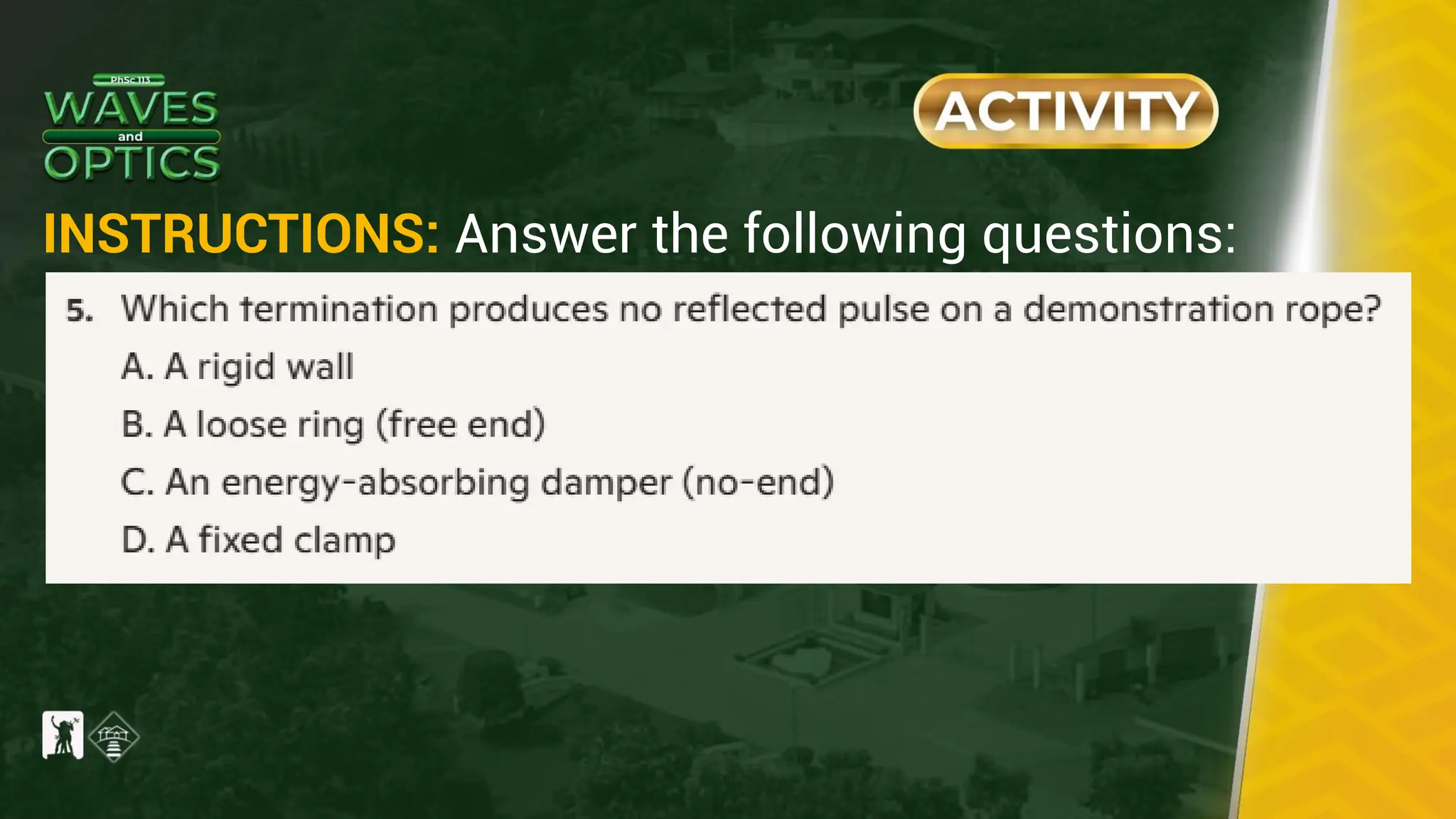
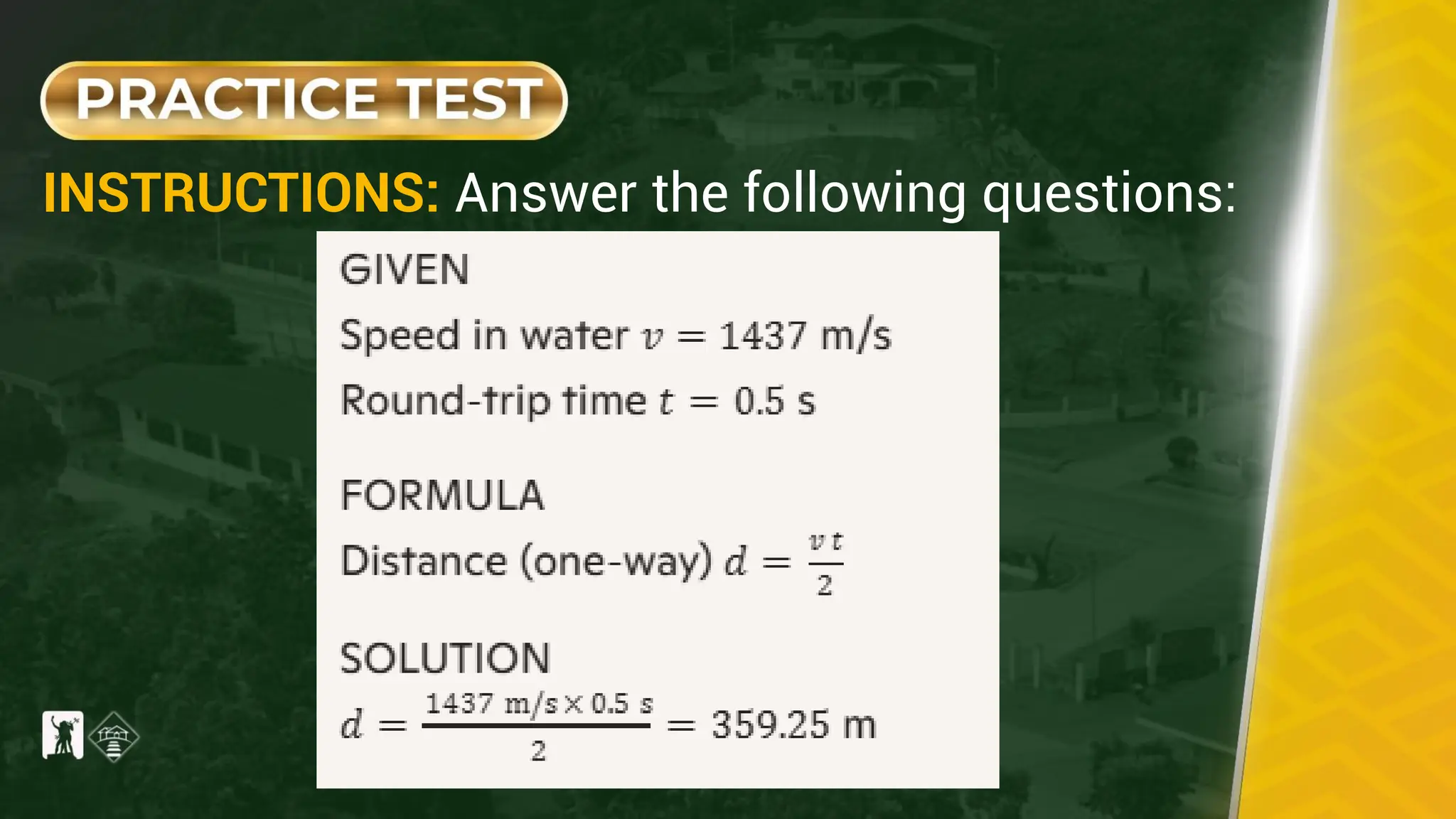
INSTRUCTIONS: Answer the following questions:
• Relate a wave’s speed to the medium in
which the wave travels.
• Describe how waves are reflected and
refracted at boundaries between media.
• Apply the principle of superposition to
the phenomenon of interference
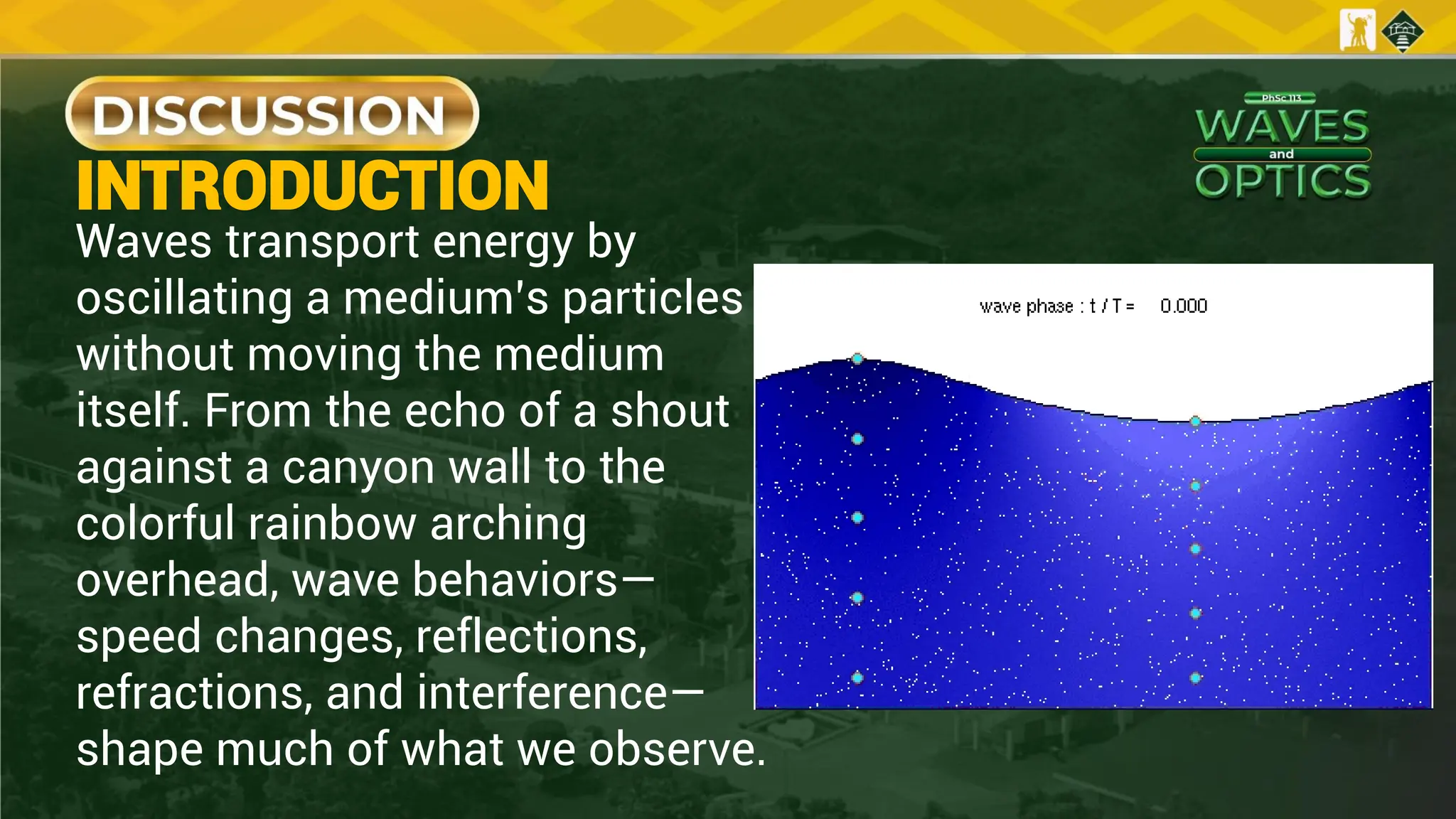
Waves transport energy by
oscillating a medium’s particles
without moving the medium
itself. From the echo of a shout
against a canyon wall to the
colorful rainbow arching
overhead, wave behaviors—
speed changes, reflections,
refractions, and interference—
shape much of what we observe.
INTRODUCTION
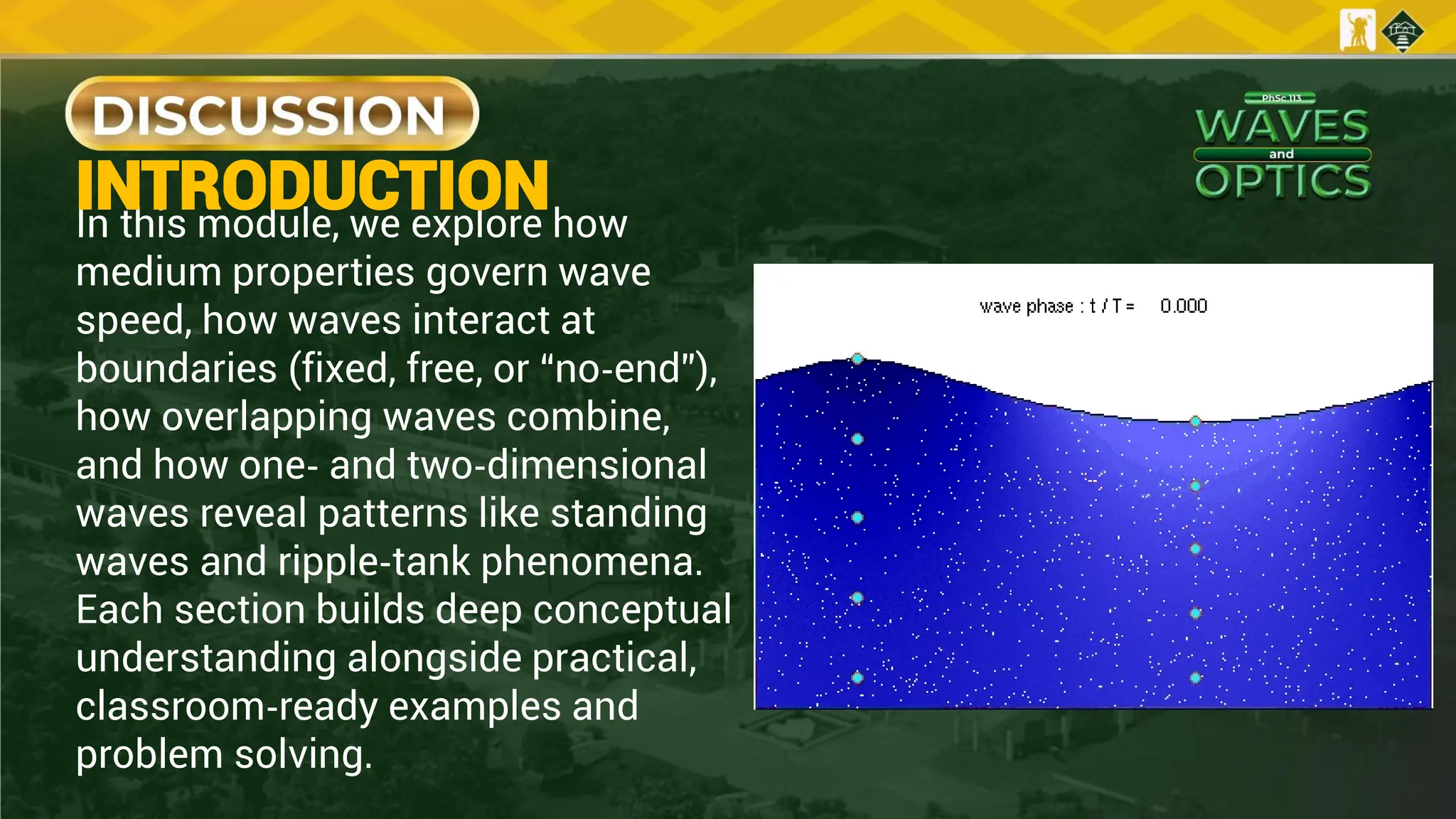
In this module, we explore how
medium properties govern wave
speed, how waves interact at
boundaries (fixed, free, or “no‐end”),
how overlapping waves combine,
and how one‐ and two‐dimensional
waves reveal patterns like standing
waves and ripple‐tank phenomena.
Each section builds deep conceptual
understanding alongside practical,
classroom‐ready examples and
problem solving.
INTRODUCTION
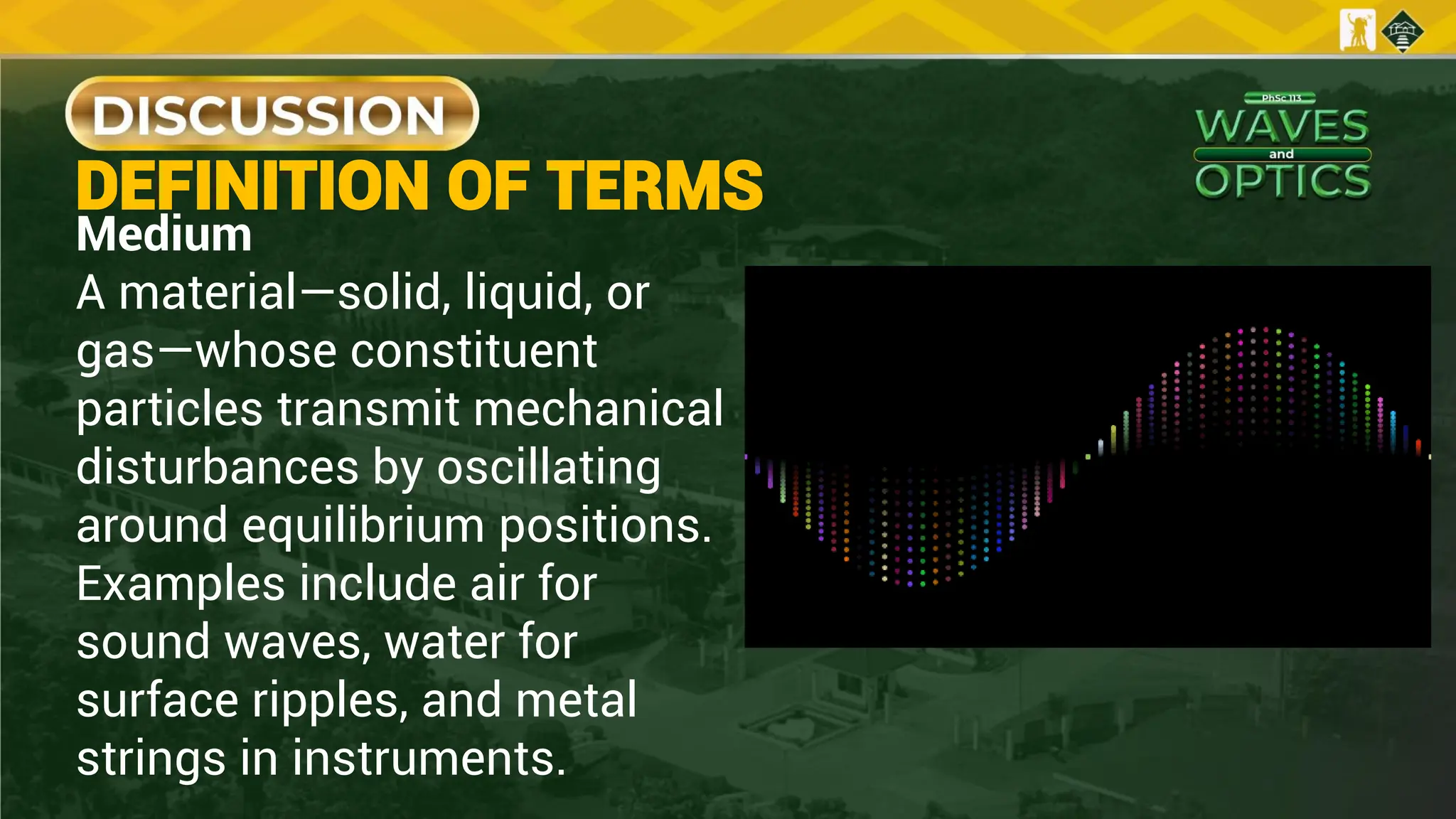
Medium
A material—solid, liquid, or
gas—whose constituent
particles transmit mechanical
disturbances by oscillating
around equilibrium positions.
Examples include air for
sound waves, water for
surface ripples, and metal
strings in instruments.
DEFINITION OF TERMS
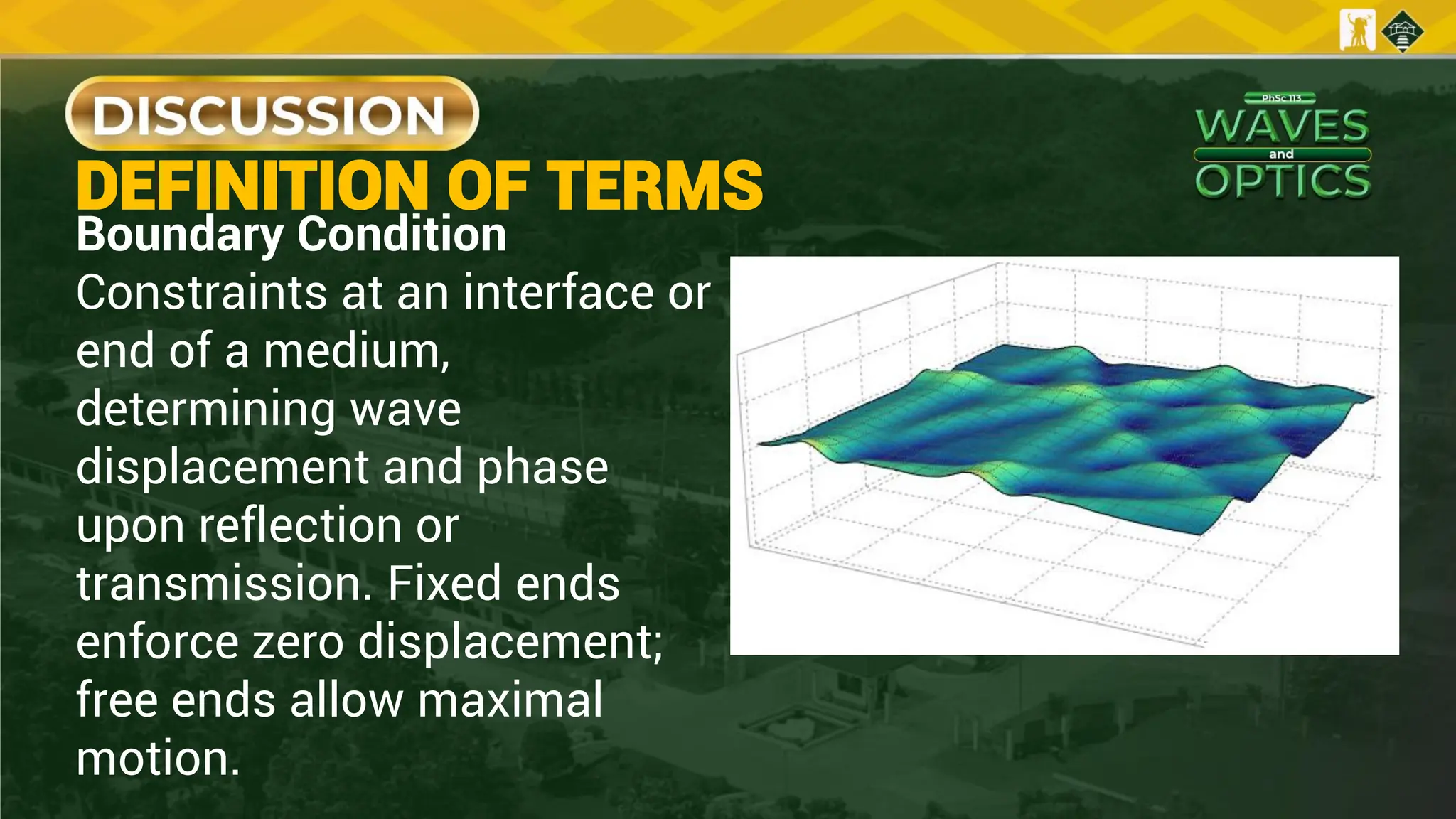
Boundary Condition
Constraints at an interface or
end of a medium,
determining wave
displacement and phase
upon reflection or
transmission. Fixed ends
enforce zero displacement;
free ends allow maximal
motion.
DEFINITION OF TERMS
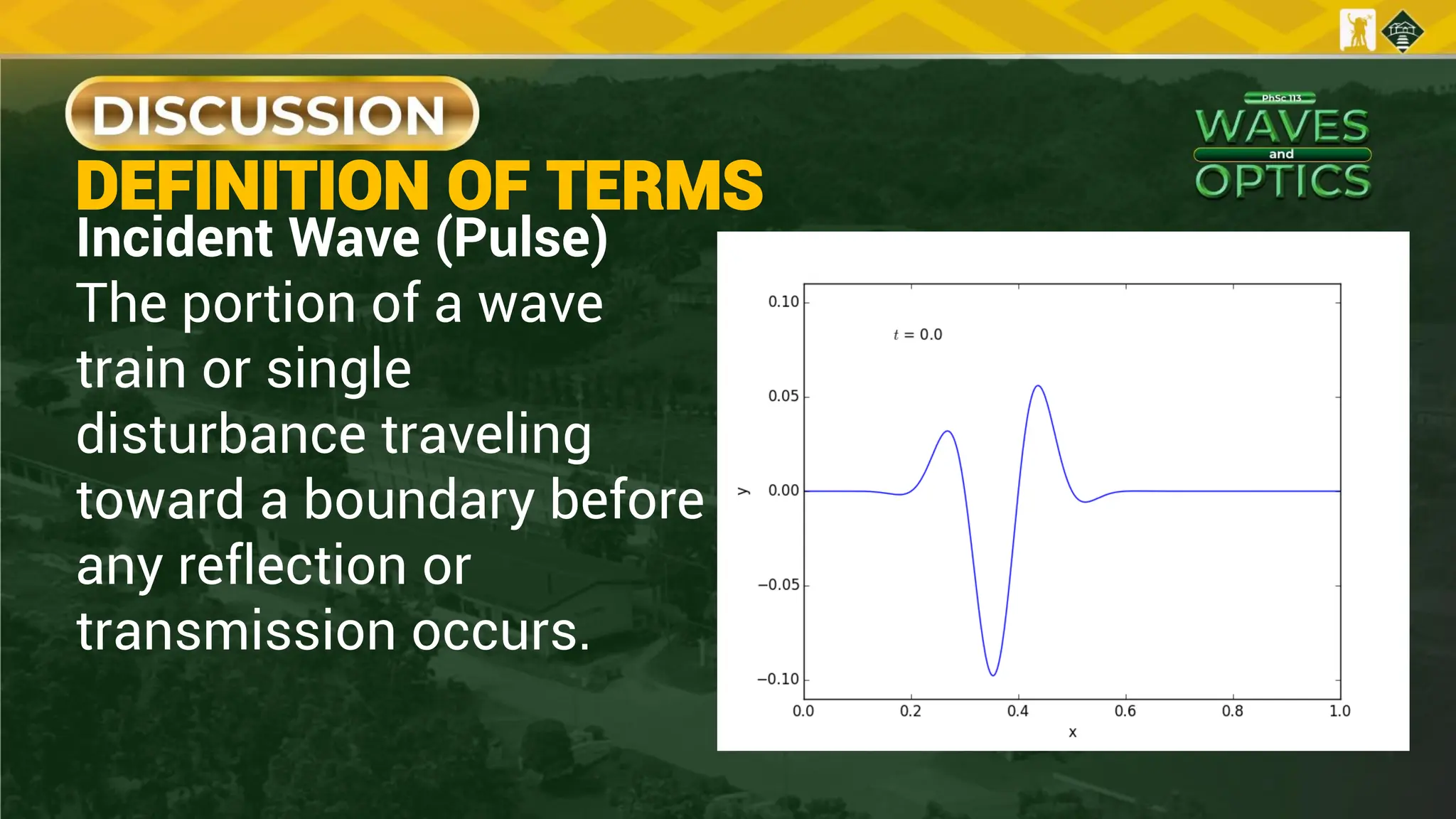
Incident Wave (Pulse)
The portion of a wave
train or single
disturbance traveling
toward a boundary before
any reflection or
transmission occurs.
DEFINITION OF TERMS
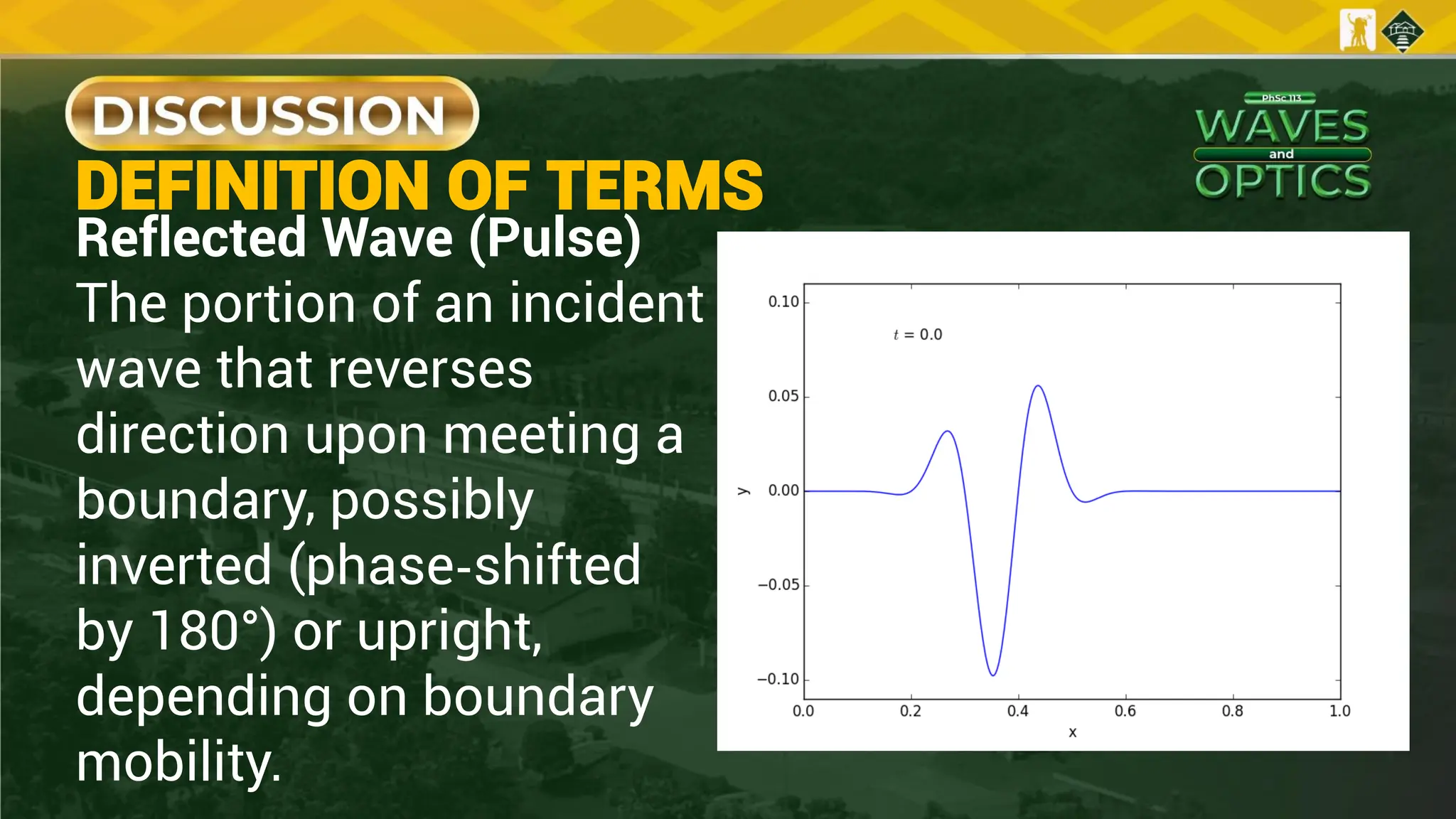
Reflected Wave (Pulse)
The portion of an incident
wave that reverses
direction upon meeting a
boundary, possibly
inverted (phase‐shifted
by 180°) or upright,
depending on boundary
mobility.
DEFINITION OF TERMS
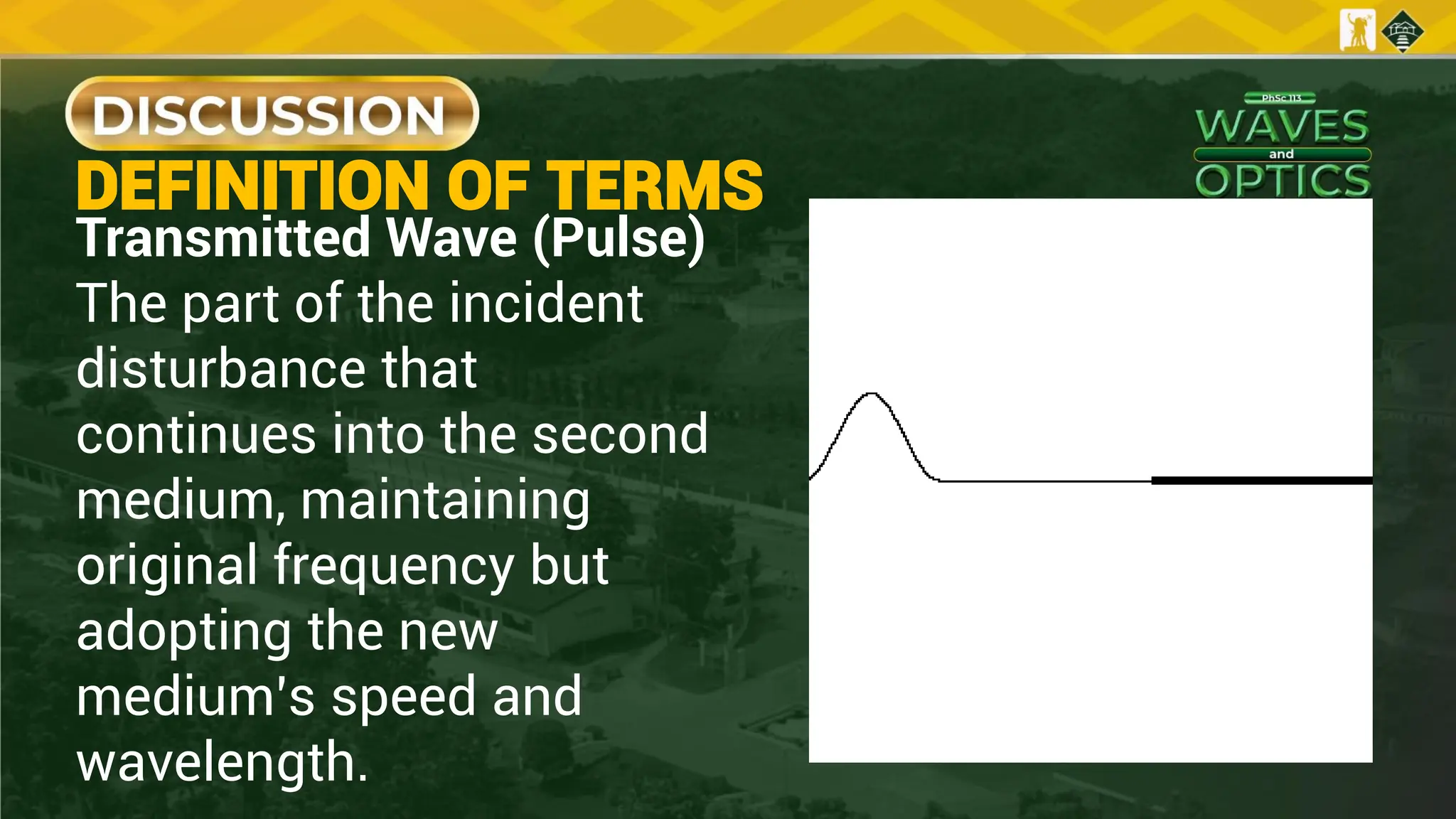
Transmitted Wave (Pulse)
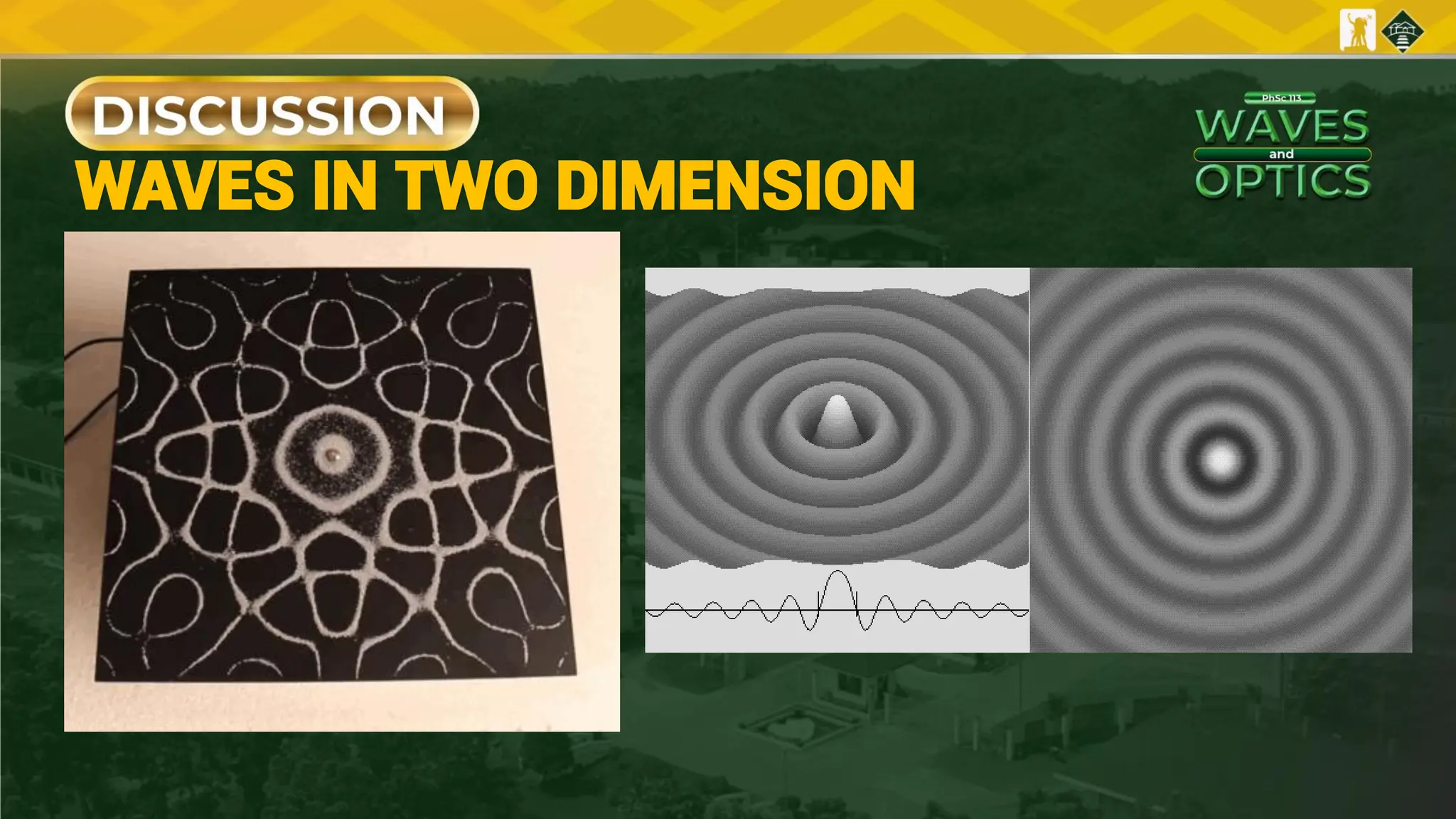
The part of the incident
disturbance that
continues into the second
medium, maintaining
original frequency but
adopting the new
medium’s speed and
wavelength.
DEFINITION OF TERMS
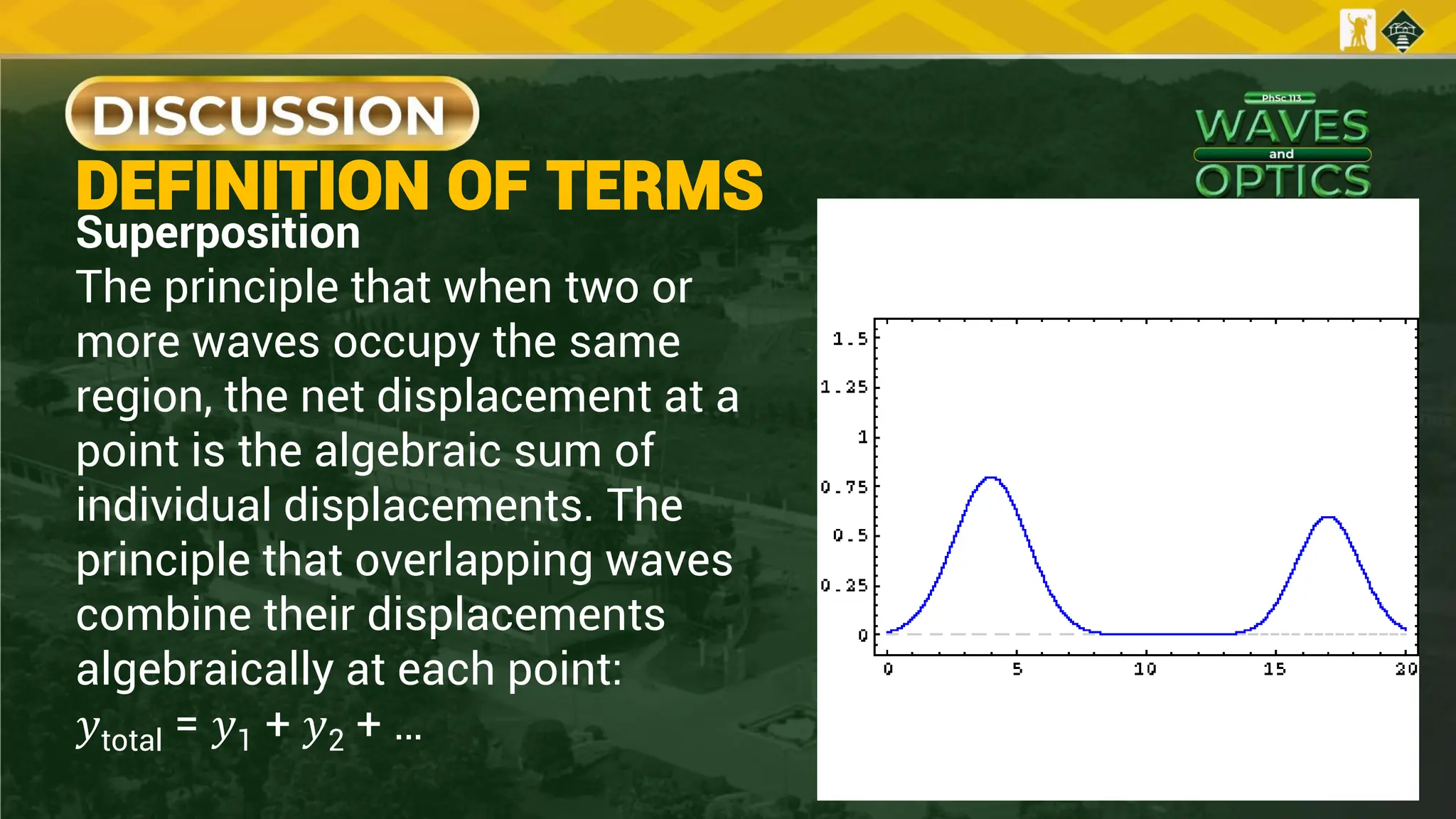
Superposition
The principle that when two or
more waves occupy the same
region, the net displacement at a
point is the algebraic sum of
individual displacements. The
principle that overlapping waves
combine their displacements
algebraically at each point:
𝑦total = 𝑦1 + 𝑦2 + …
DEFINITION OF TERMS
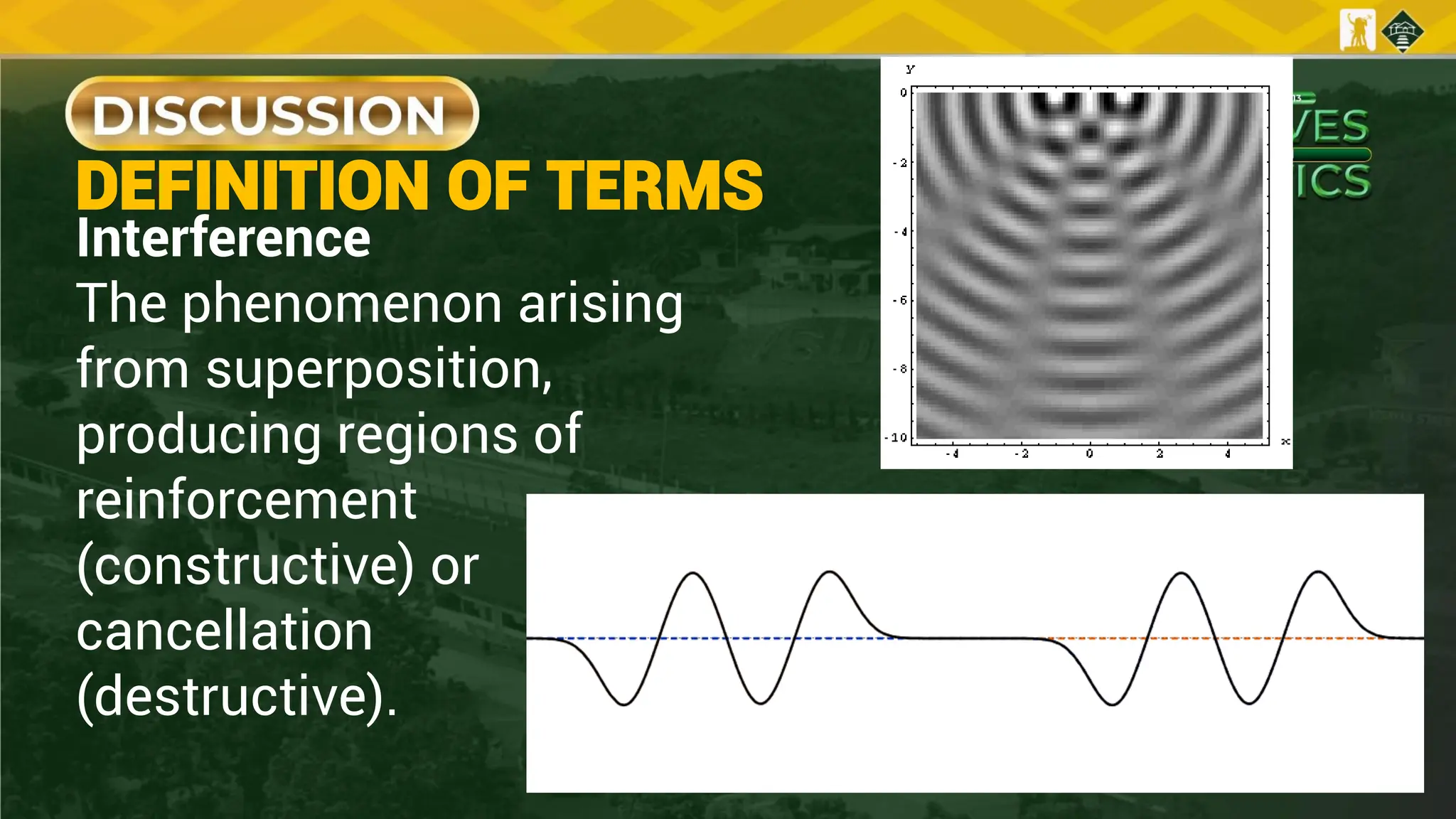
Interference
The phenomenon arising
from superposition,
producing regions of
reinforcement
(constructive) or
cancellation
(destructive).
DEFINITION OF TERMS
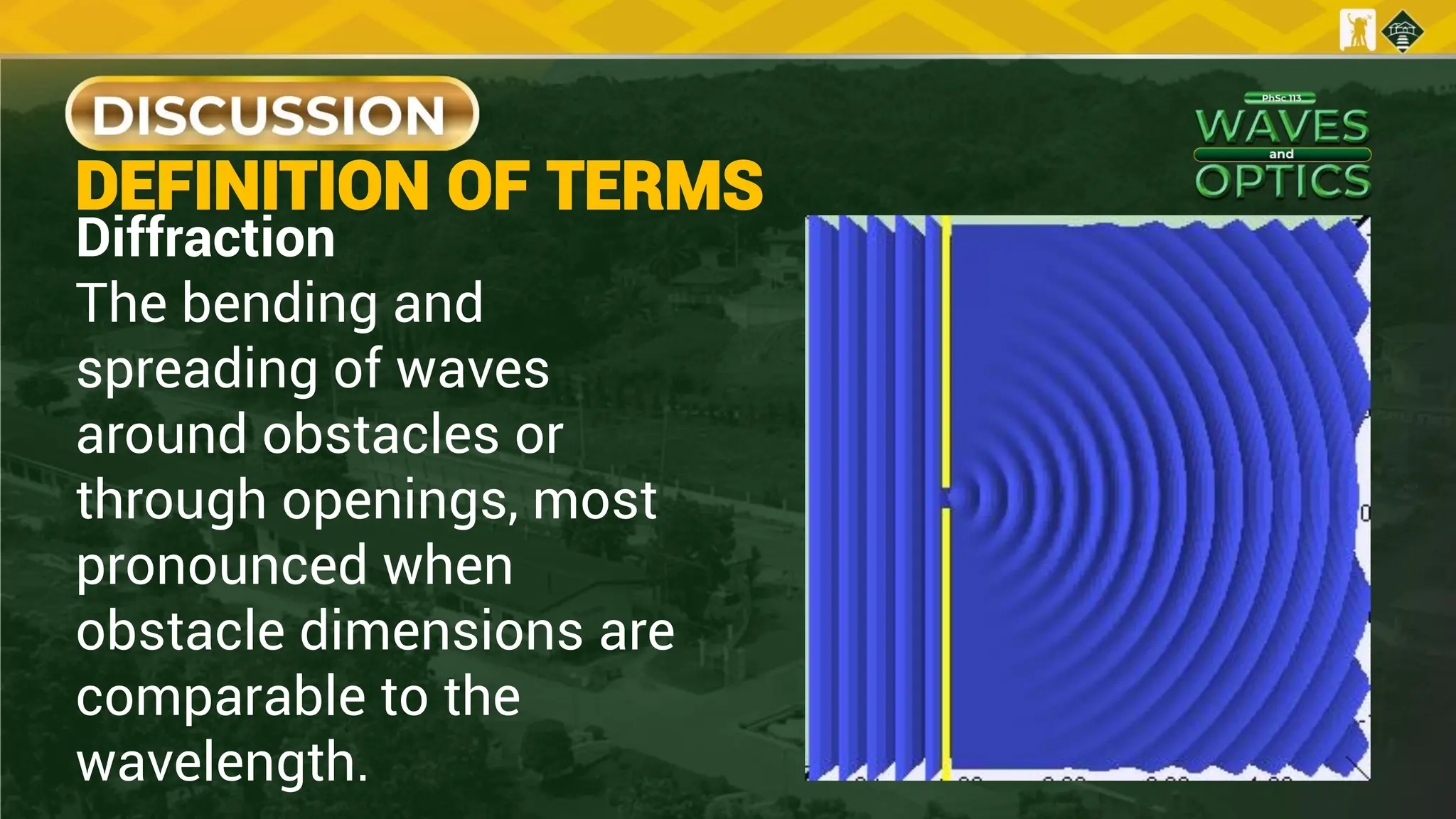
Diffraction
The bending and
spreading of waves
around obstacles or
through openings, most
pronounced when
obstacle dimensions are
comparable to the
wavelength.
DEFINITION OF TERMS
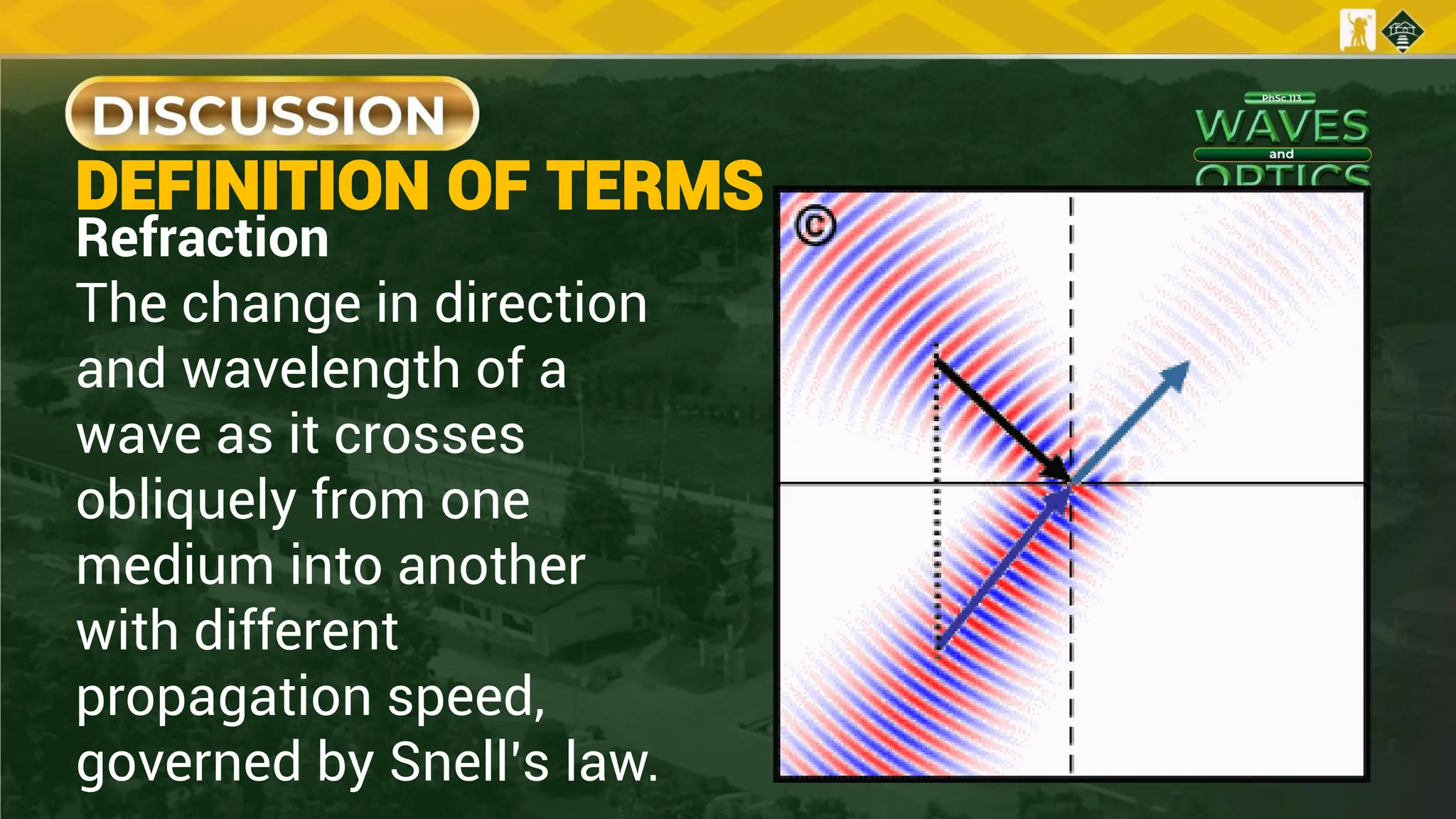
Refraction
The change in direction
and wavelength of a
wave as it crosses
obliquely from one
medium into another
with different
propagation speed,
governed by Snell’s law.
DEFINITION OF TERMS
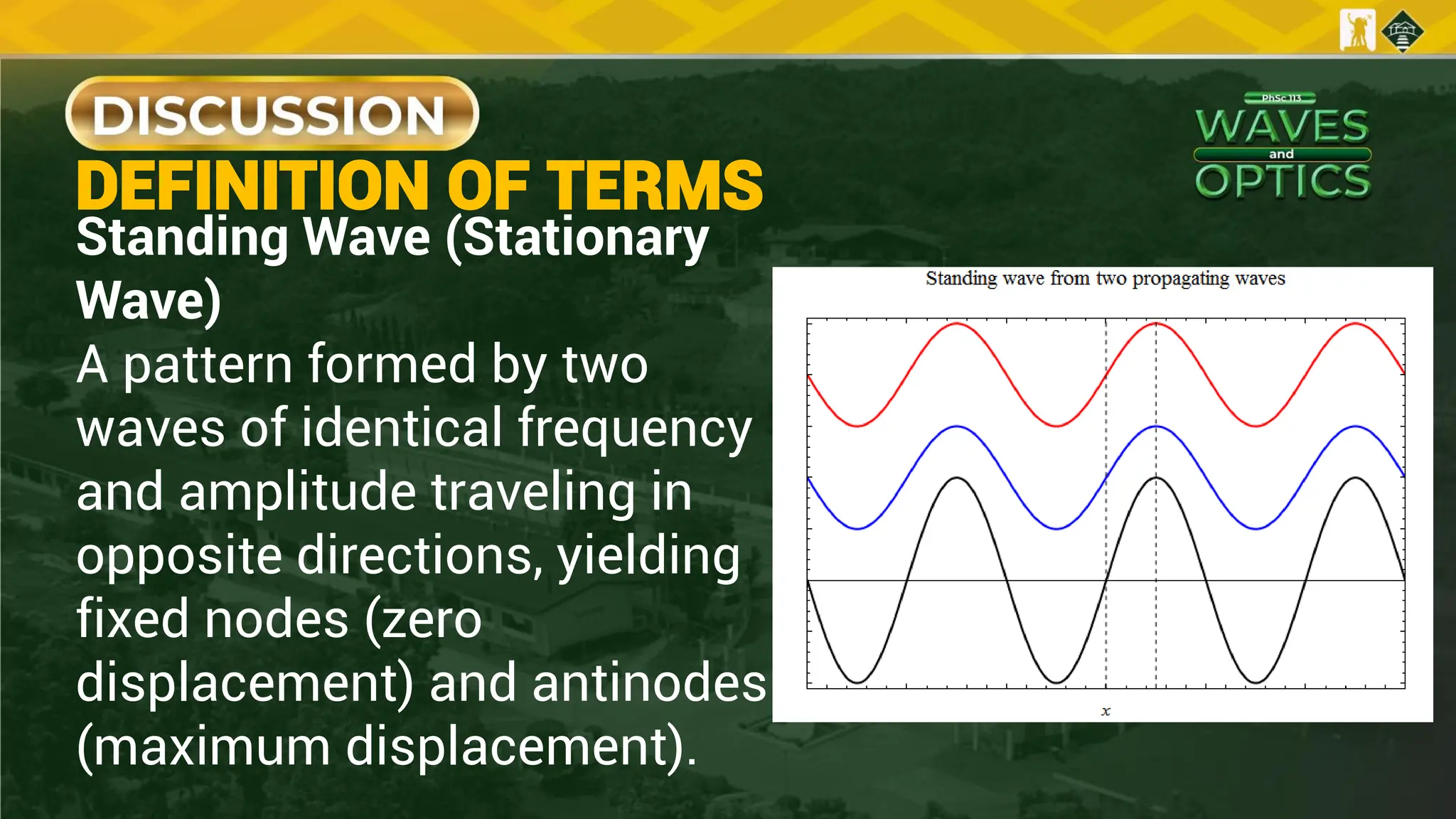
Standing Wave (Stationary
Wave)
A pattern formed by two
waves of identical frequency
and amplitude traveling in
opposite directions, yielding
fixed nodes (zero
displacement) and antinodes
(maximum displacement).
DEFINITION OF TERMS
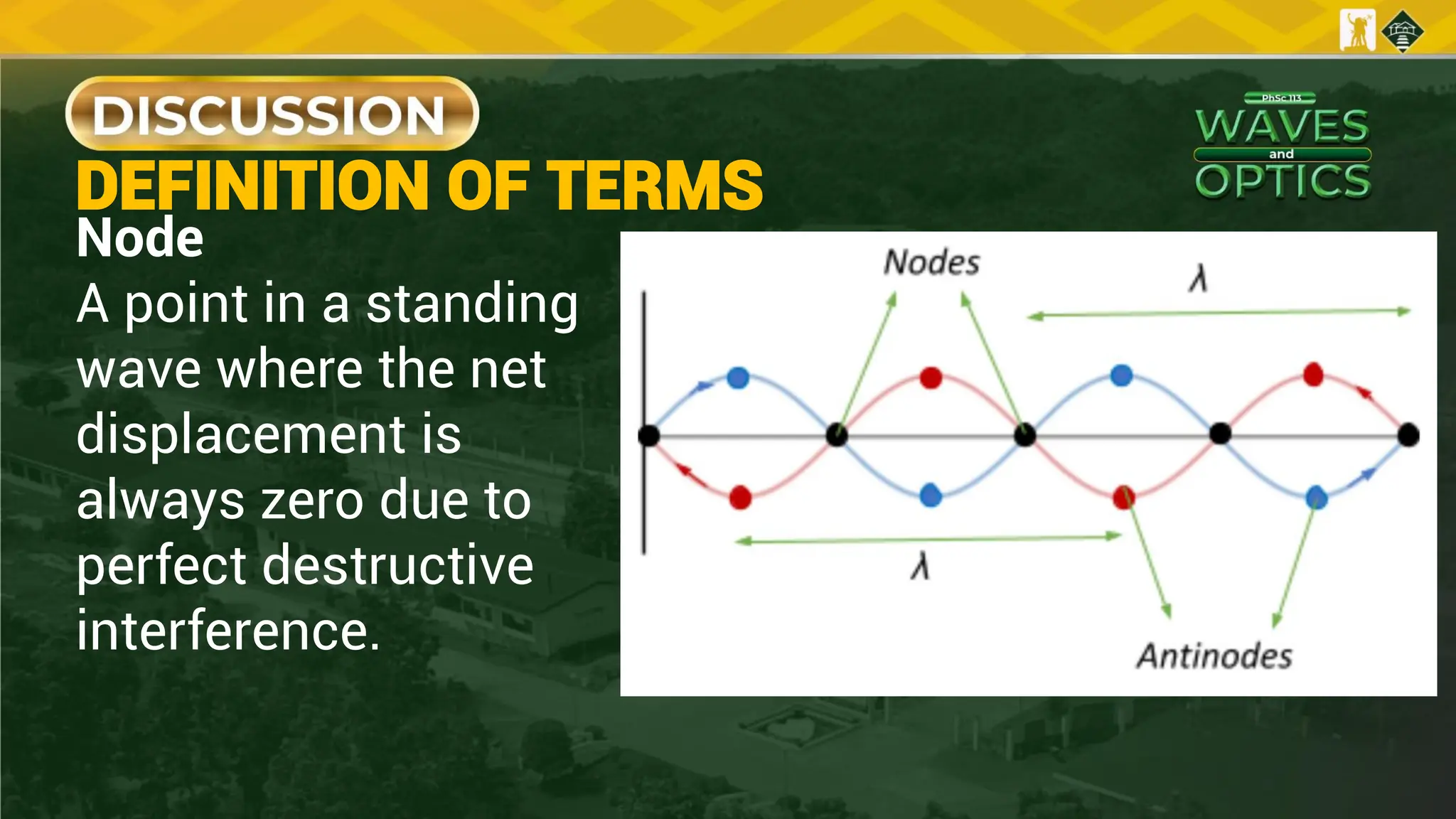
Node
A point in a standing
wave where the net
displacement is
always zero due to
perfect destructive
interference.
DEFINITION OF TERMS
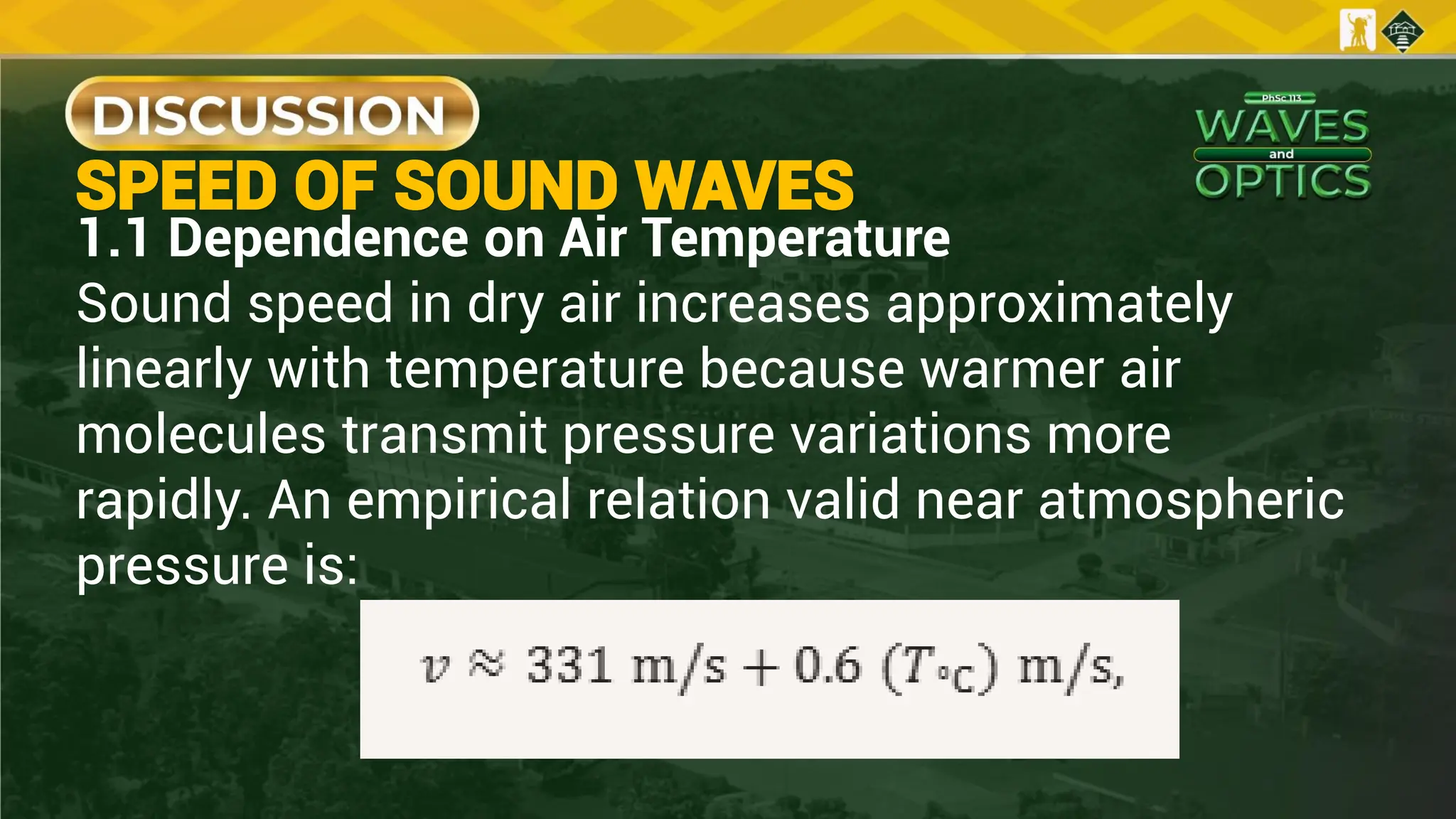
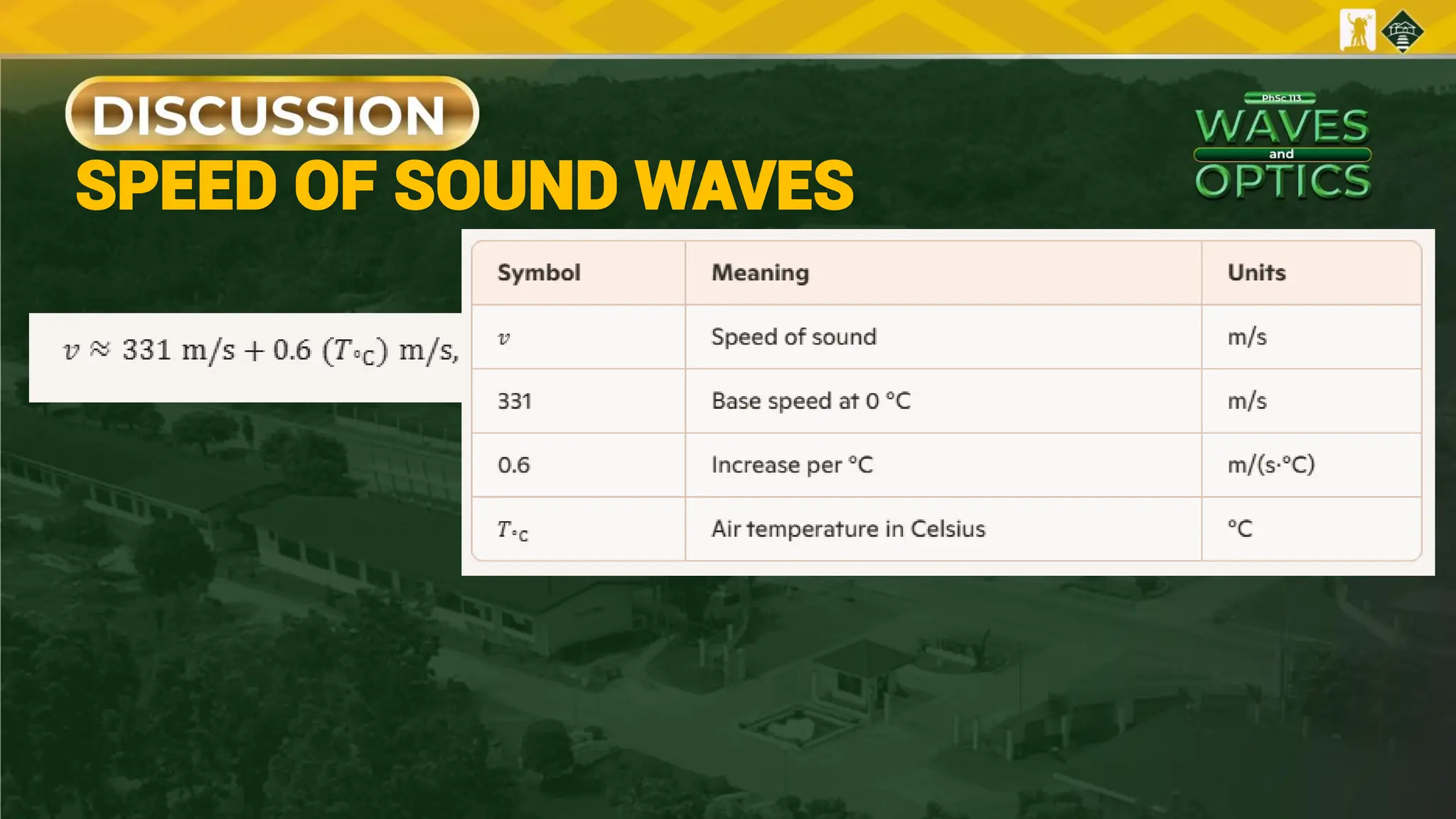
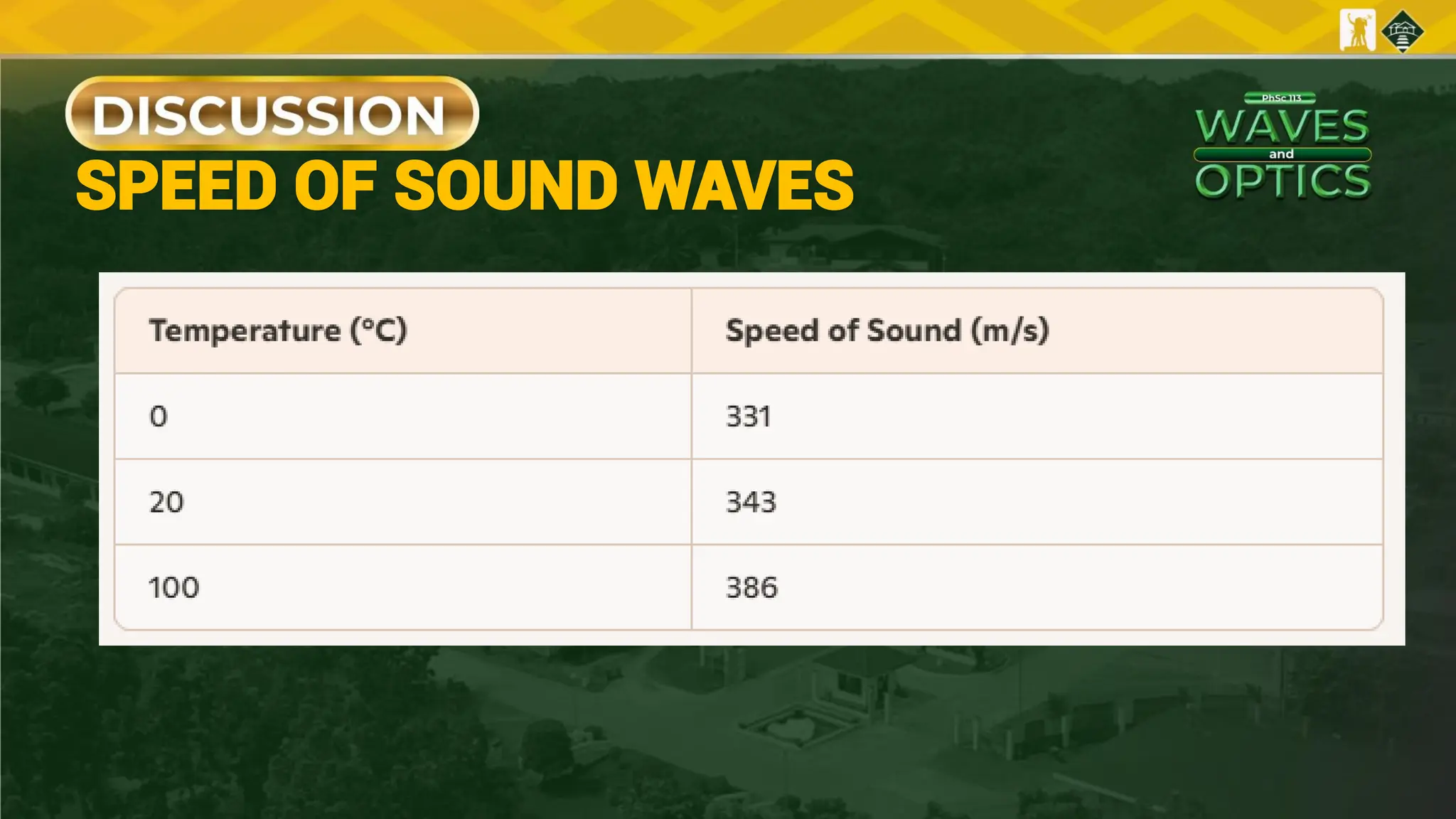
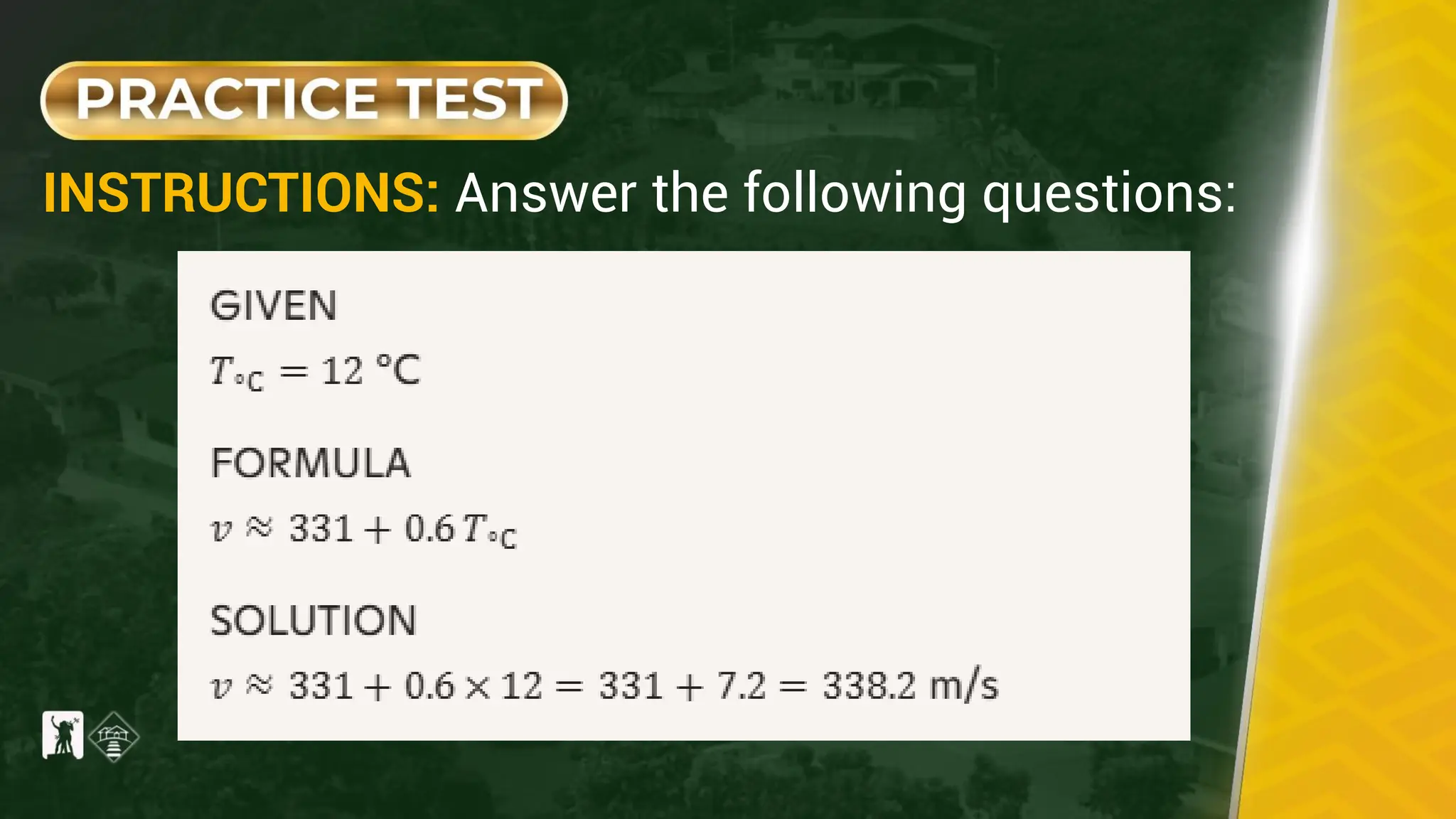
1.1 Dependence on Air Temperature
Sound speed in dry air increases approximately
linearly with temperature because warmer air
molecules transmit pressure variations more
rapidly. An empirical relation valid near atmospheric
pressure is:
SPEED OF SOUND WAVES
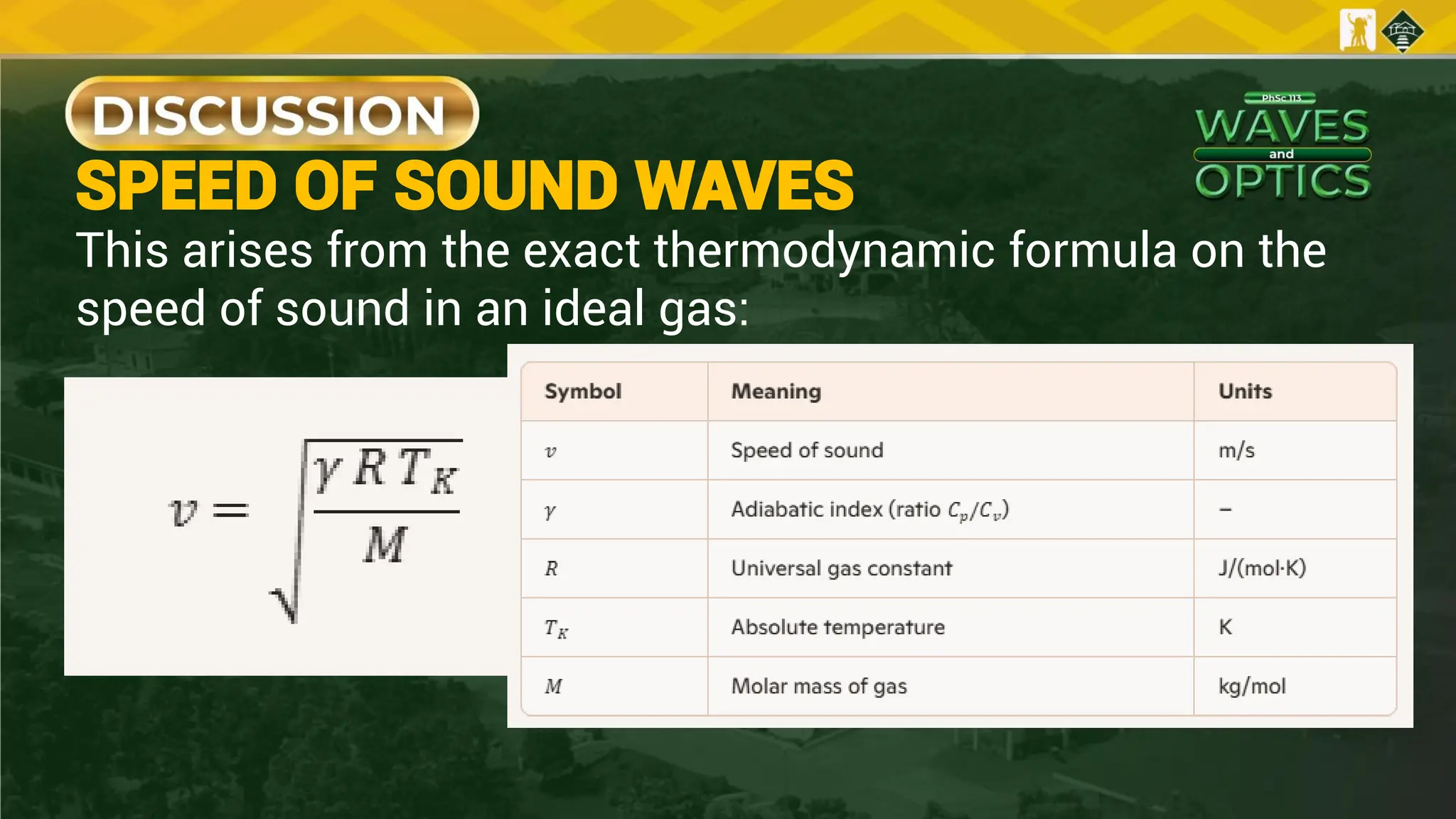
This arises from the exact thermodynamic formula on the
speed of sound in an ideal gas:
SPEED OF SOUND WAVES
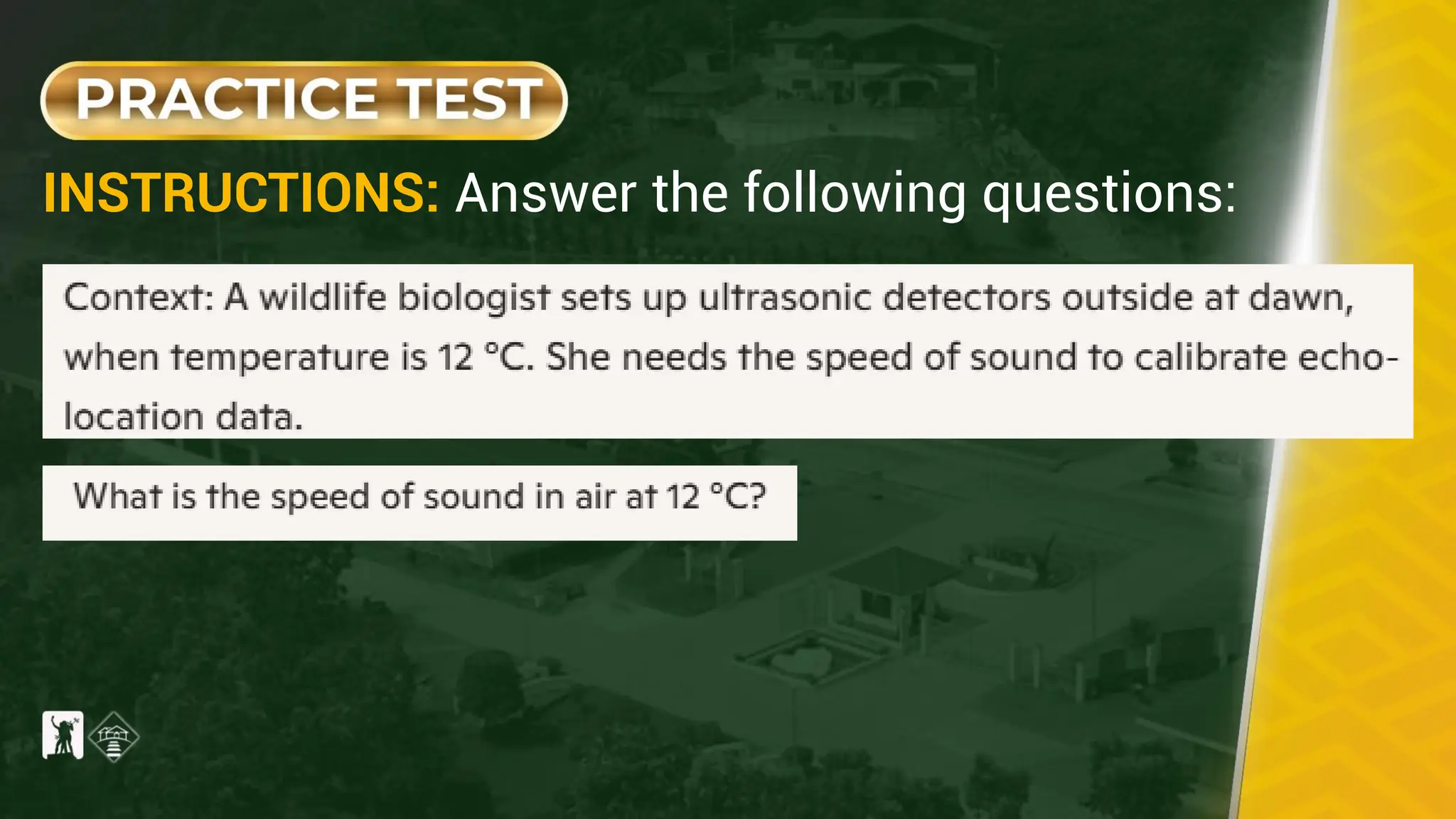
INSTRUCTIONS: Answer the following questions:
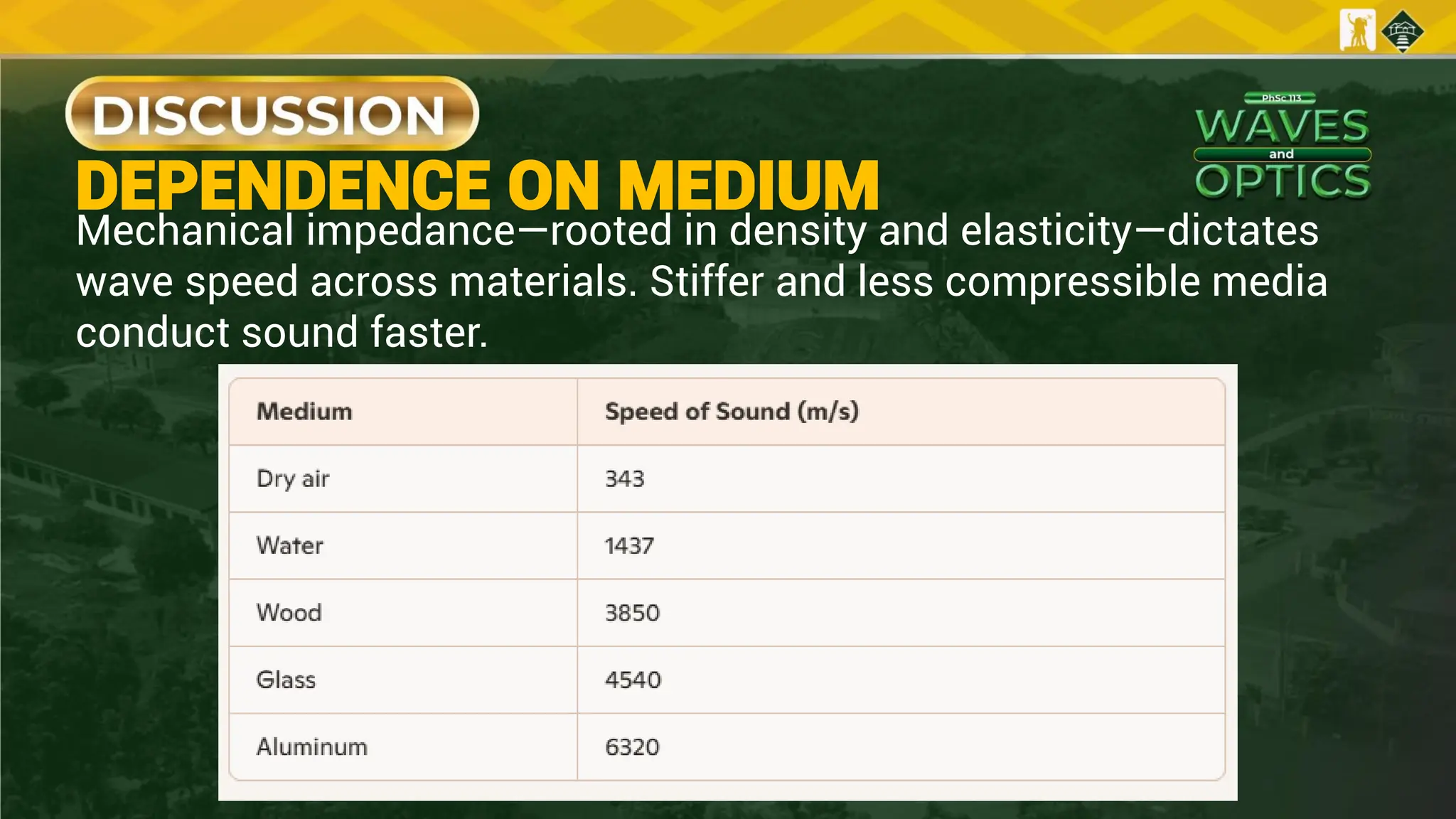
Mechanical impedance—rooted in density and elasticity—dictates
wave speed across materials. Stiffer and less compressible media
conduct sound faster.
DEPENDENCE ON MEDIUM
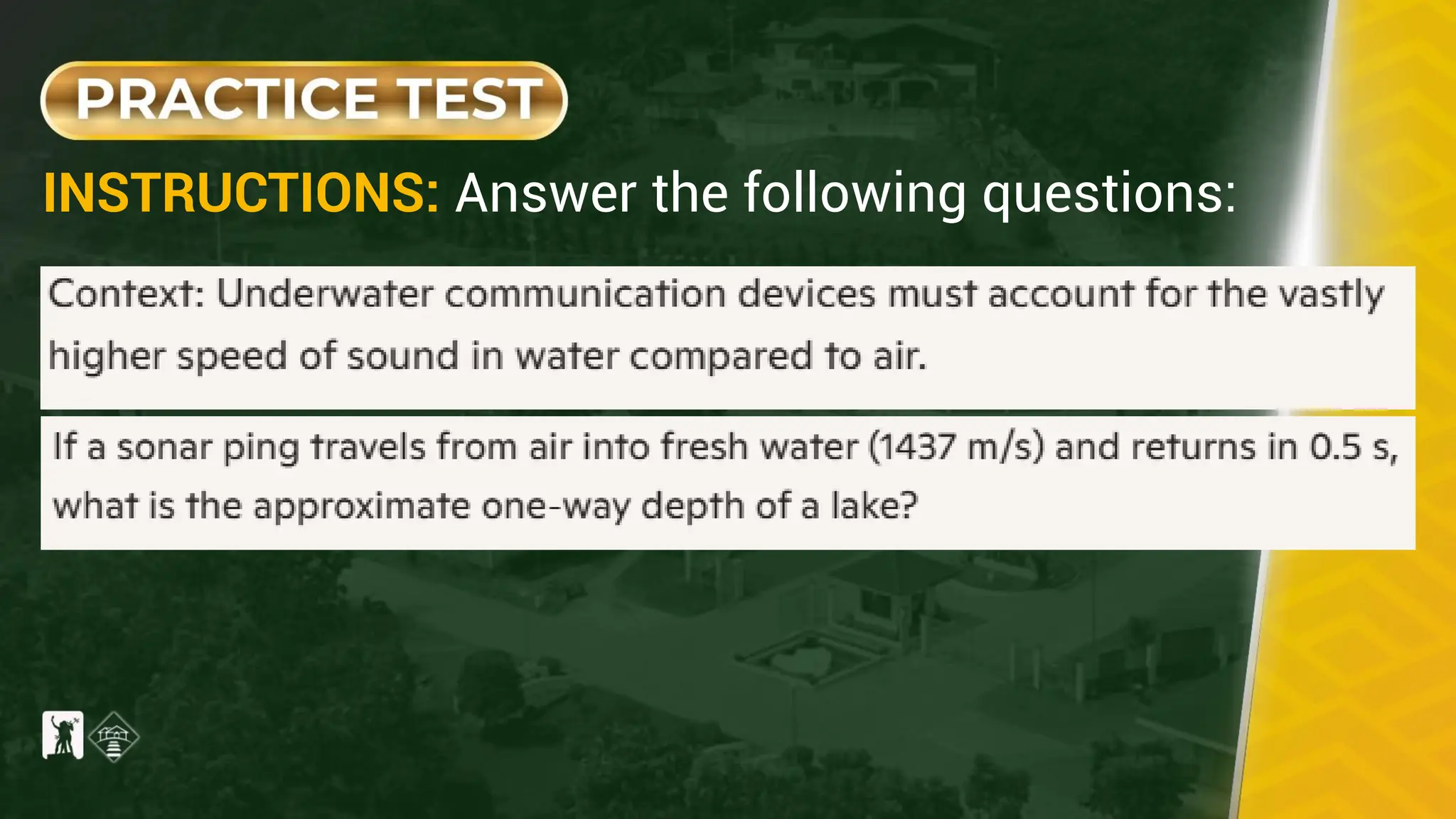
INSTRUCTIONS: Answer the following questions:
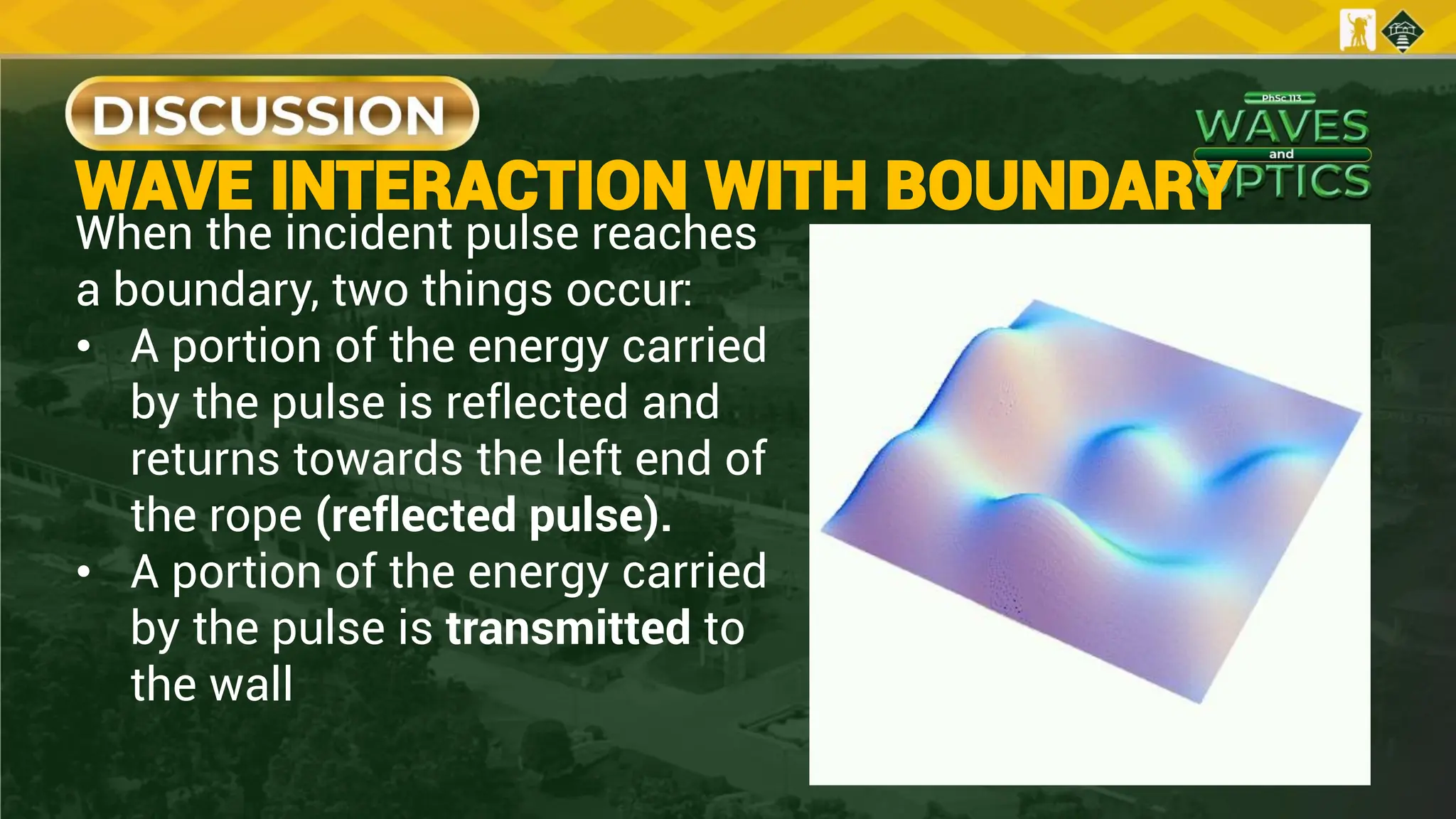
When the incident pulse reaches
a boundary, two things occur:
• A portion of the energy carried
by the pulse is reflected and
returns towards the left end of
the rope (reflected pulse).
• A portion of the energy carried
by the pulse is transmitted to
the wall
WAVE INTERACTION WITH BOUNDARY
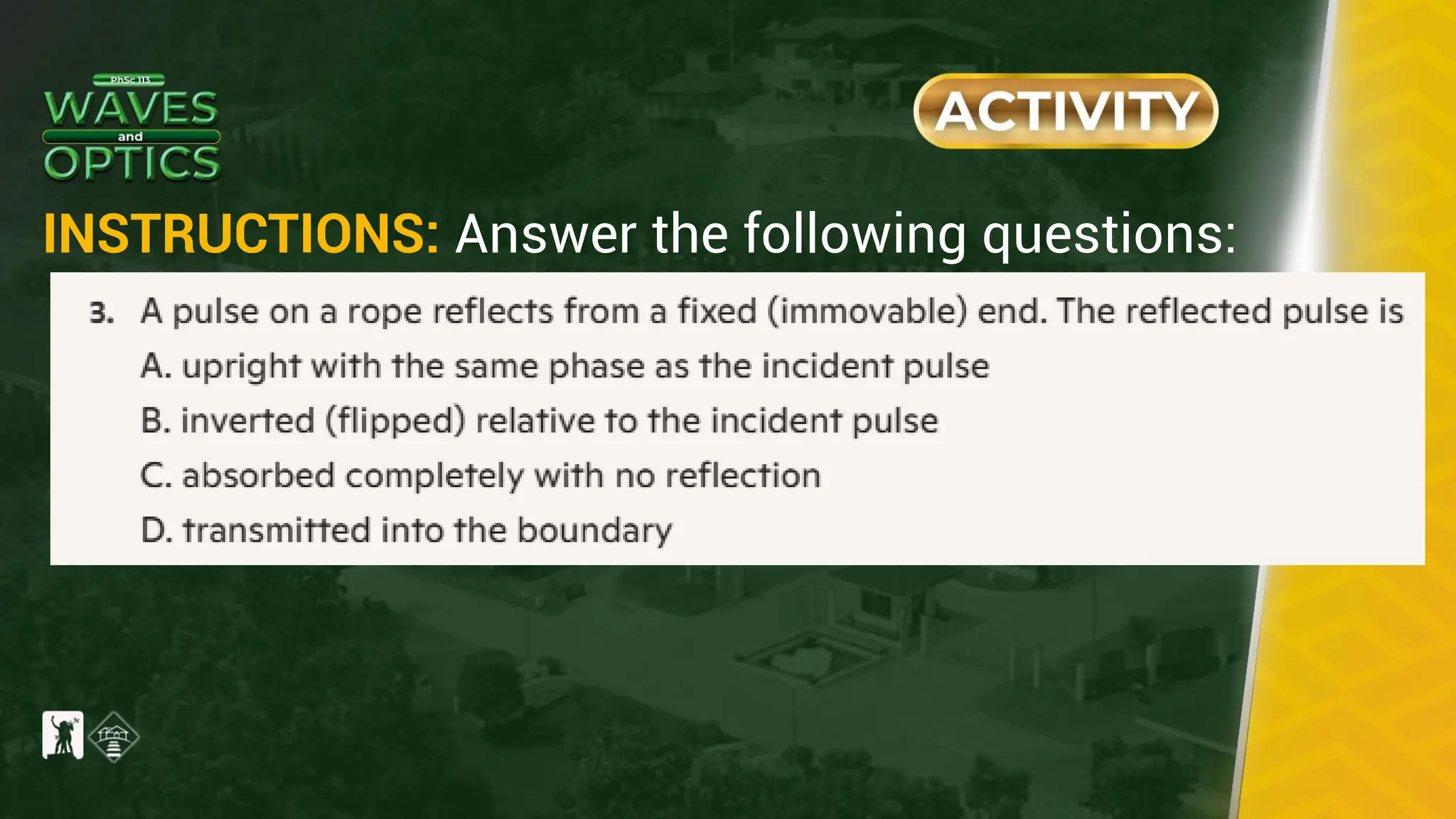
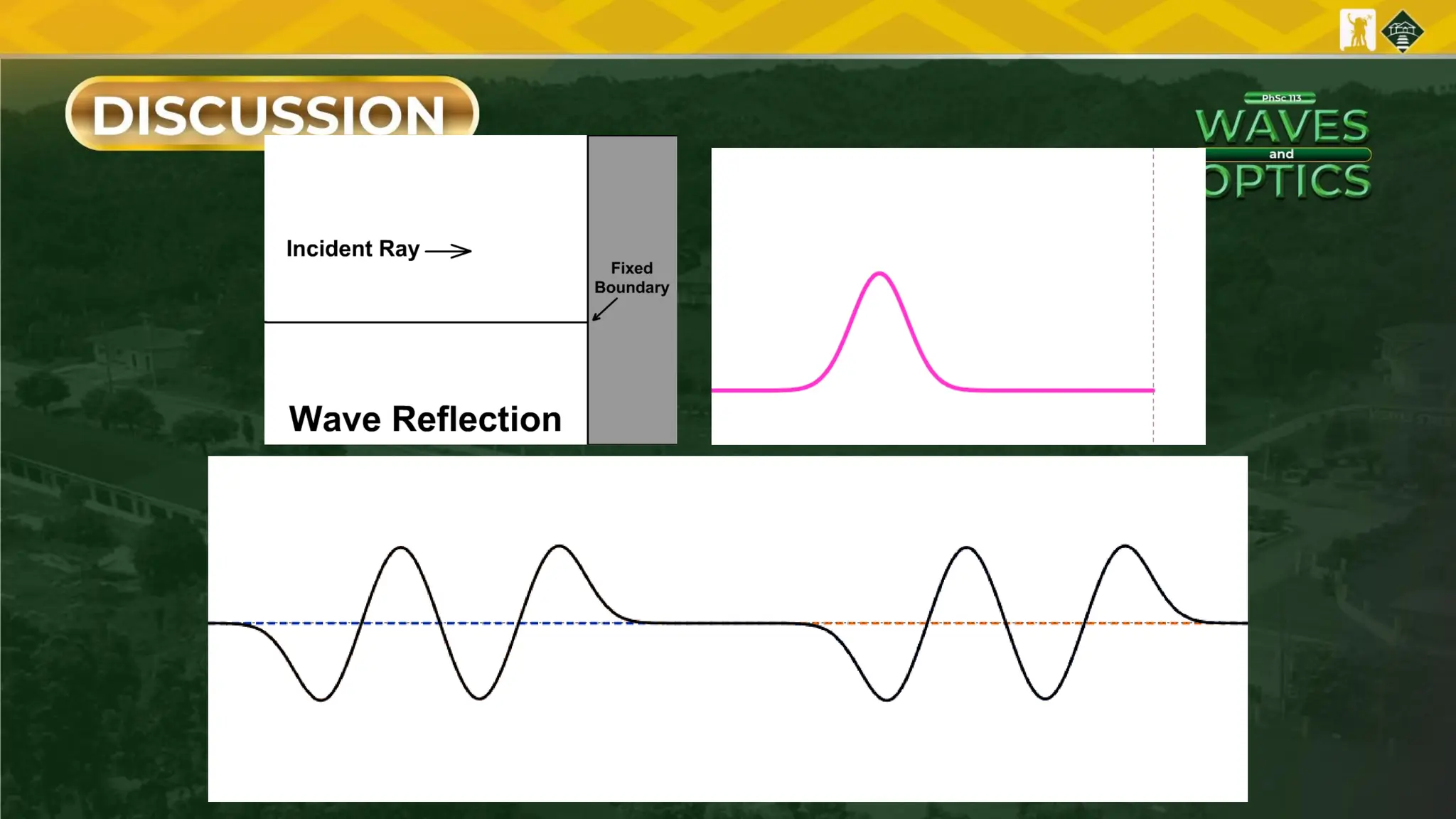
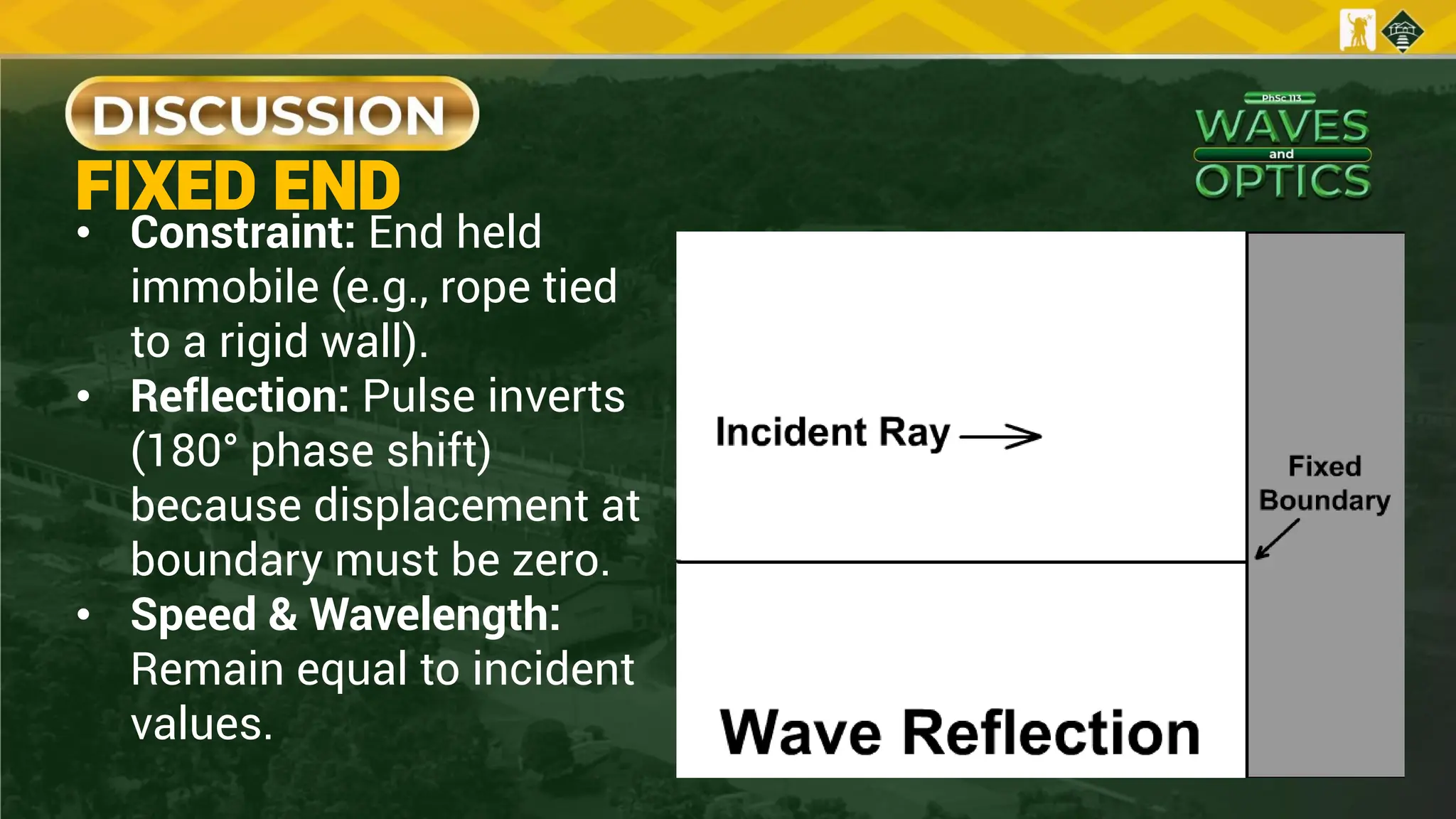
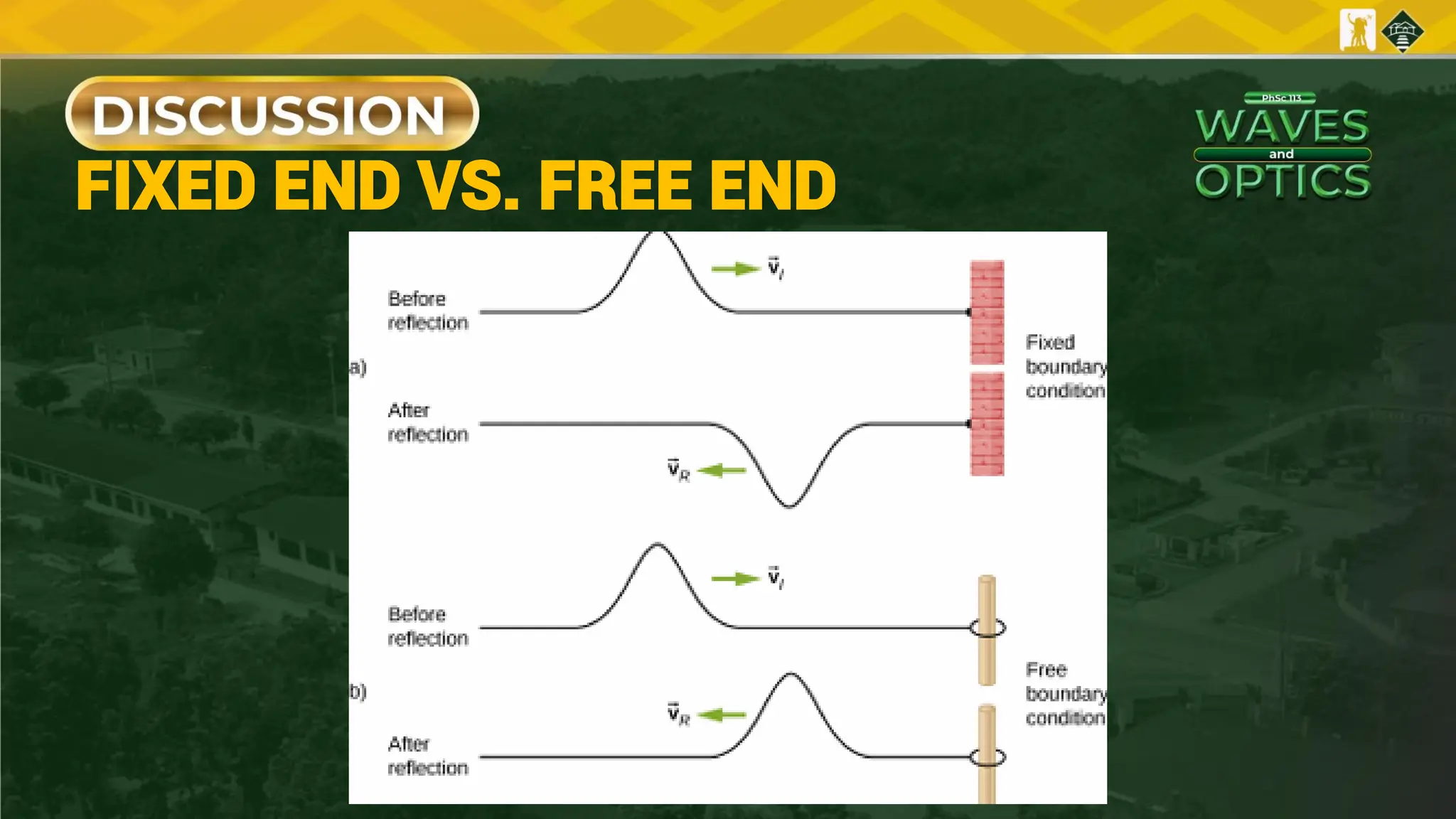
• Constraint: End held
immobile (e.g., rope tied
to a rigid wall).
• Reflection: Pulse inverts
(180° phase shift)
because displacement at
boundary must be zero.
• Speed & Wavelength:
Remain equal to incident
values.
FIXED END
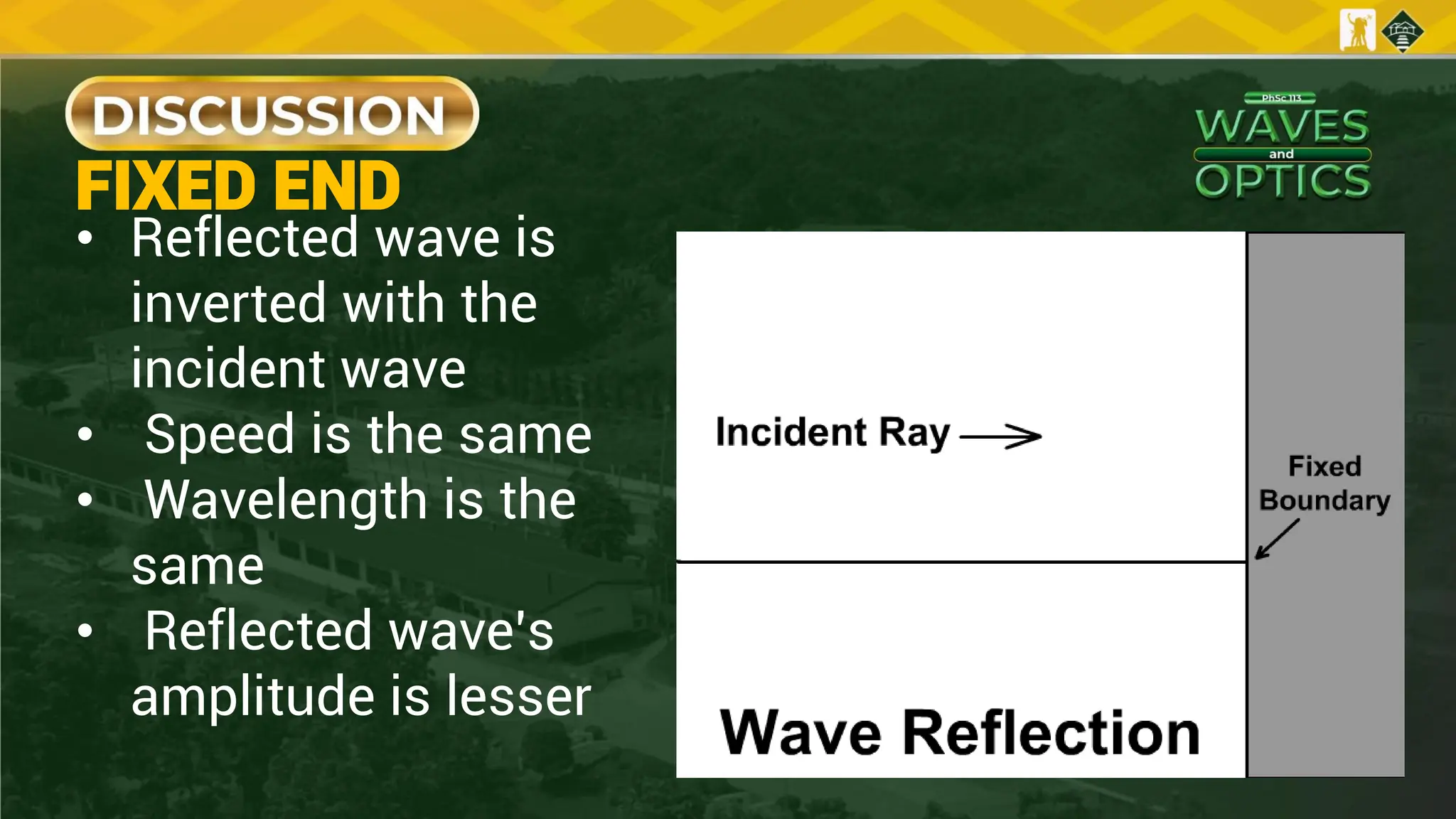
• Reflected wave is
inverted with the
incident wave
• Speed is the same
• Wavelength is the
same
• Reflected wave’s
amplitude is lesser
FIXED END
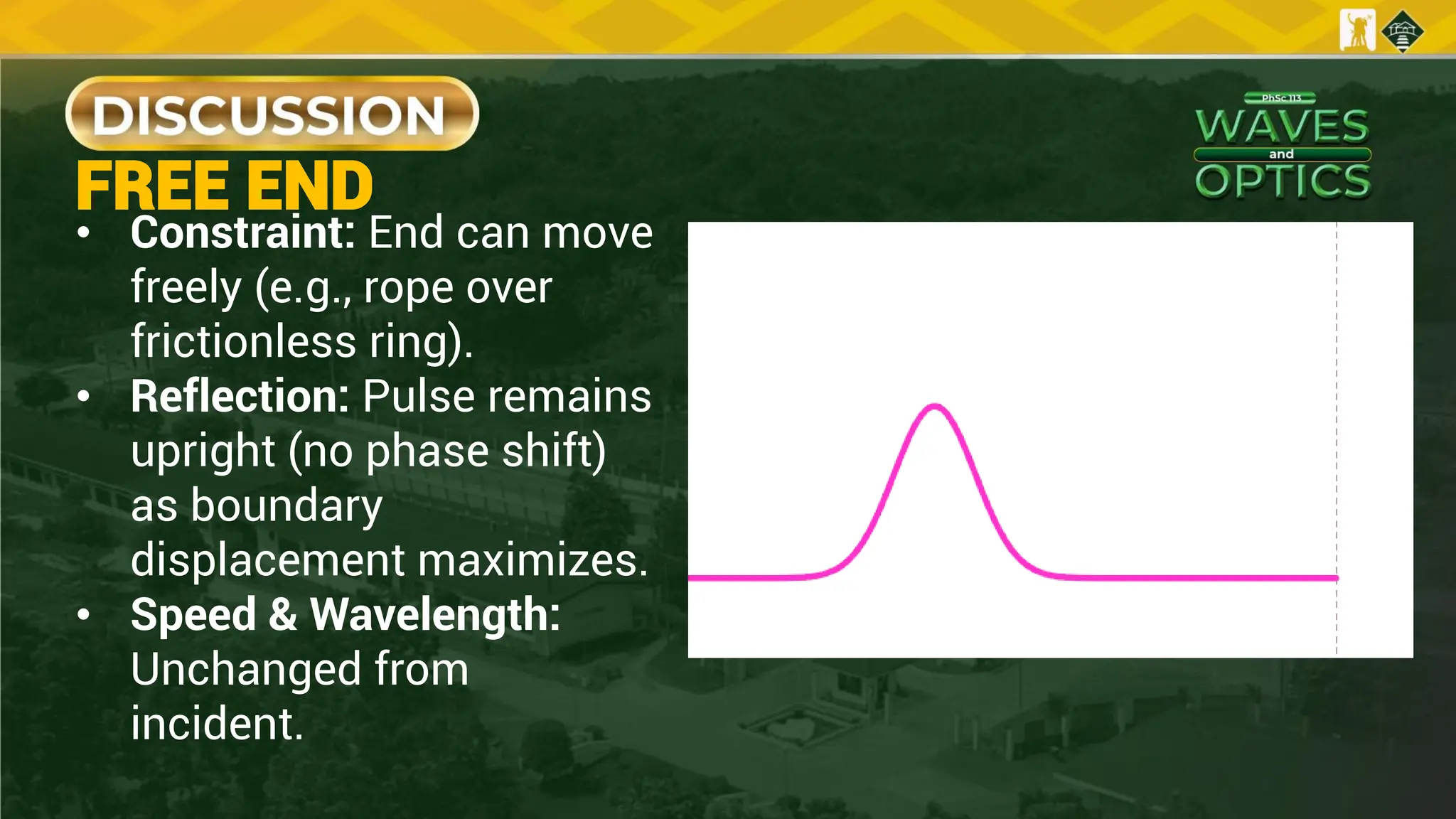
• Constraint: End can move
freely (e.g., rope over
frictionless ring).
• Reflection: Pulse remains
upright (no phase shift)
as boundary
displacement maximizes.
• Speed & Wavelength:
Unchanged from
incident.
FREE END
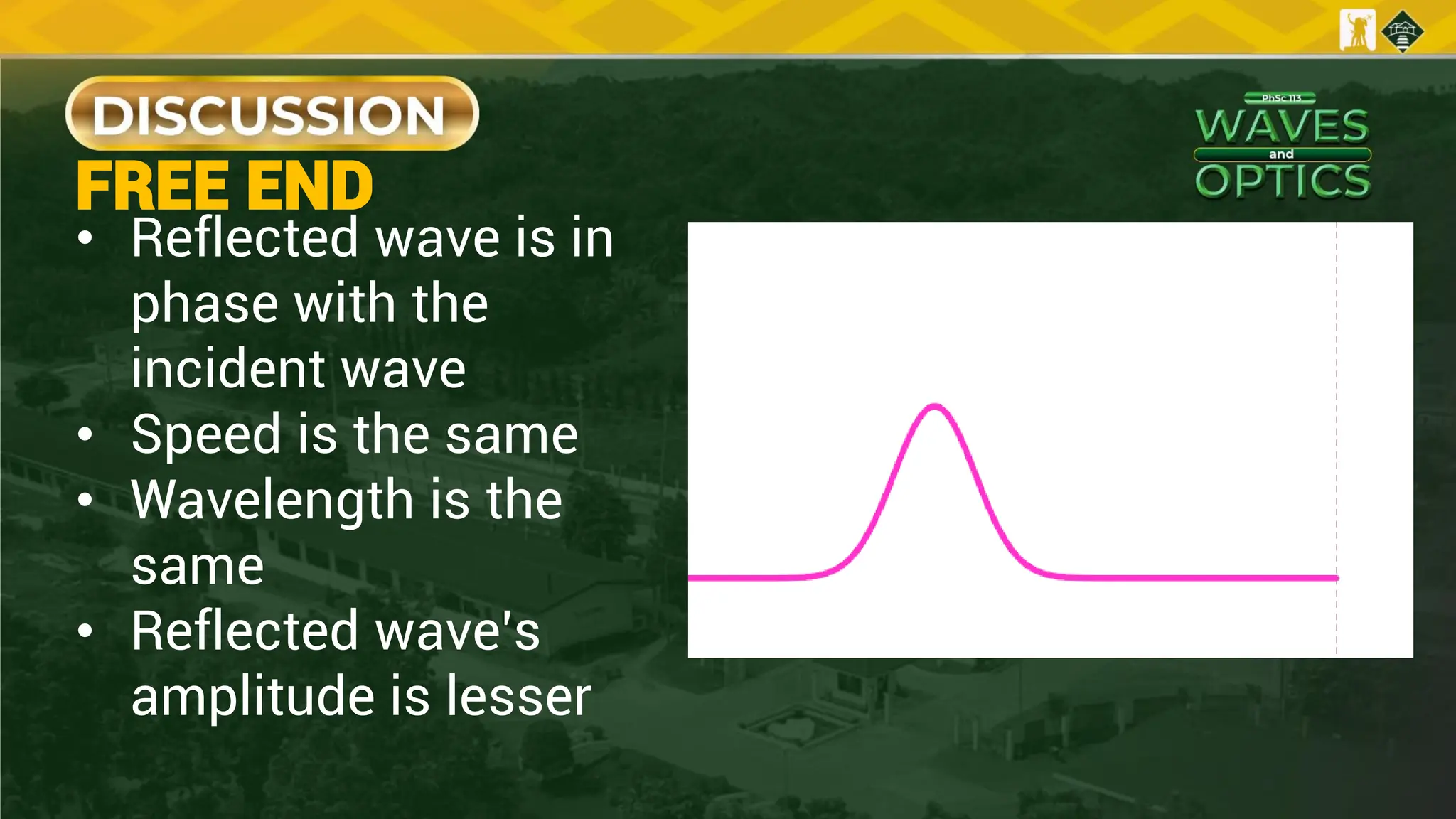
• Reflected wave is in
phase with the
incident wave
• Speed is the same
• Wavelength is the
same
• Reflected wave’s
amplitude is lesser
FREE END
FIXED END VS. FREE END
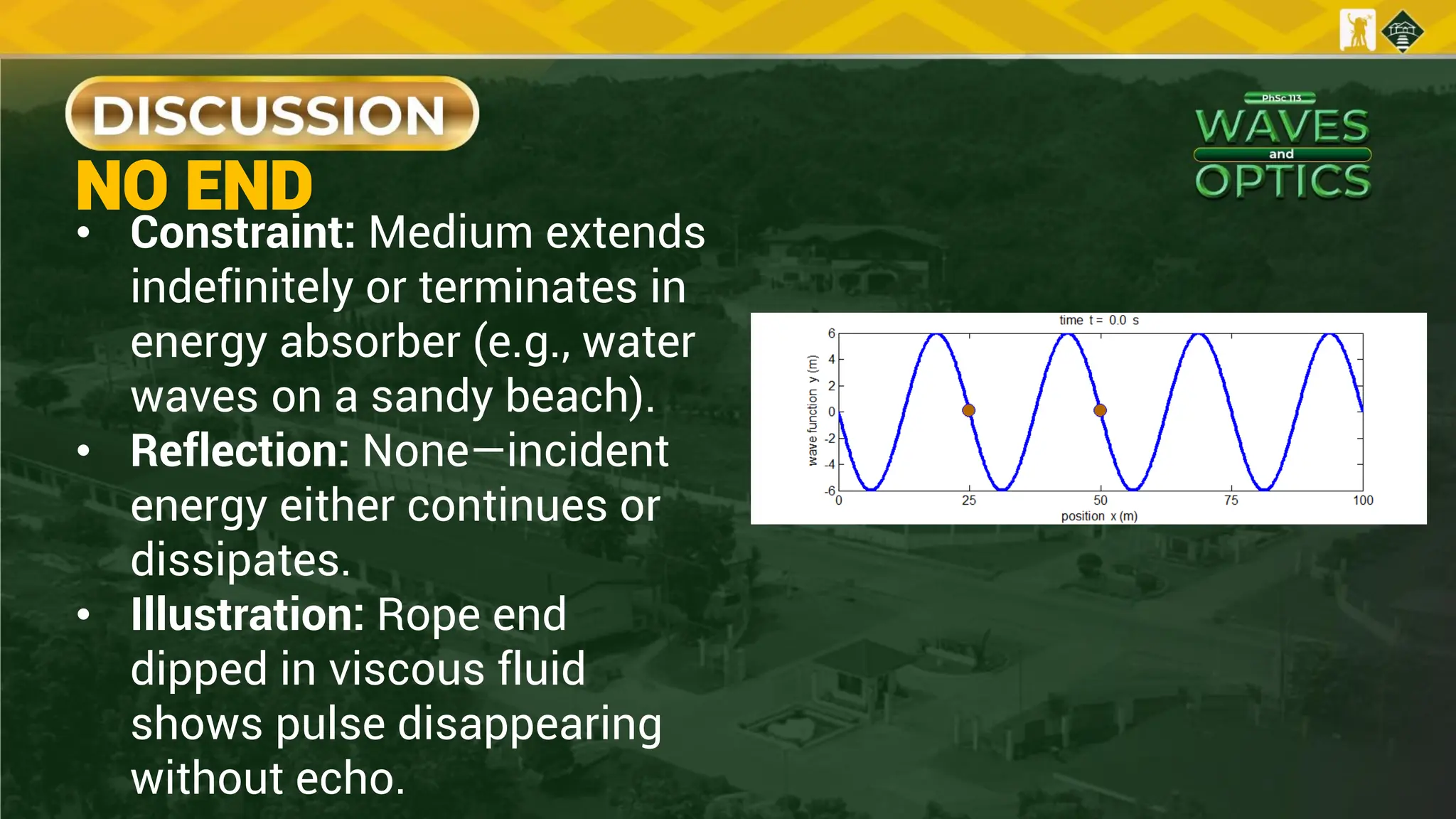
• Constraint: Medium extends
indefinitely or terminates in
energy absorber (e.g., water
waves on a sandy beach).
• Reflection: None—incident
energy either continues or
dissipates.
• Illustration: Rope end
dipped in viscous fluid
shows pulse disappearing
without echo.
NO END
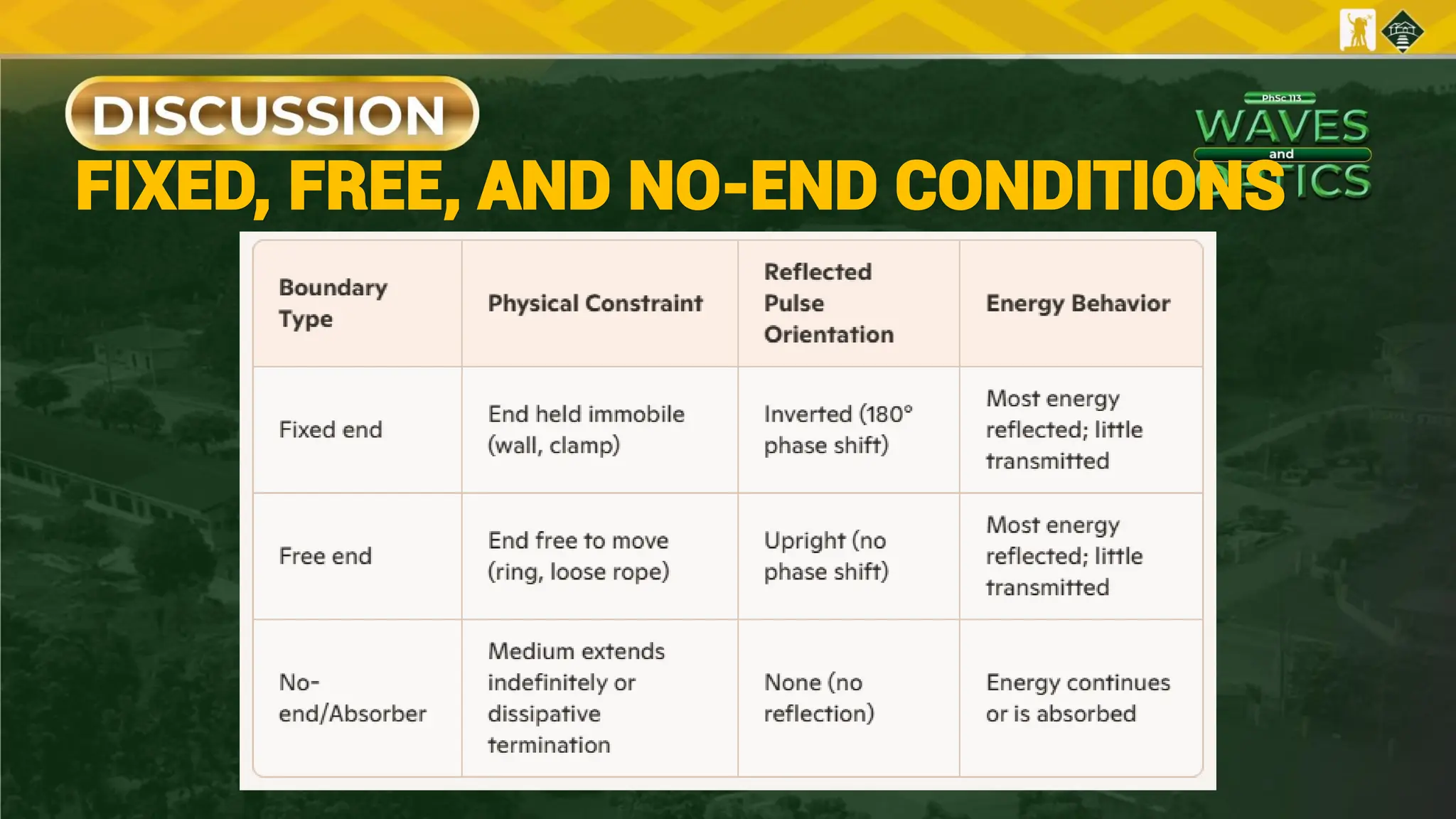
FIXED, FREE, AND NO-END CONDITIONS
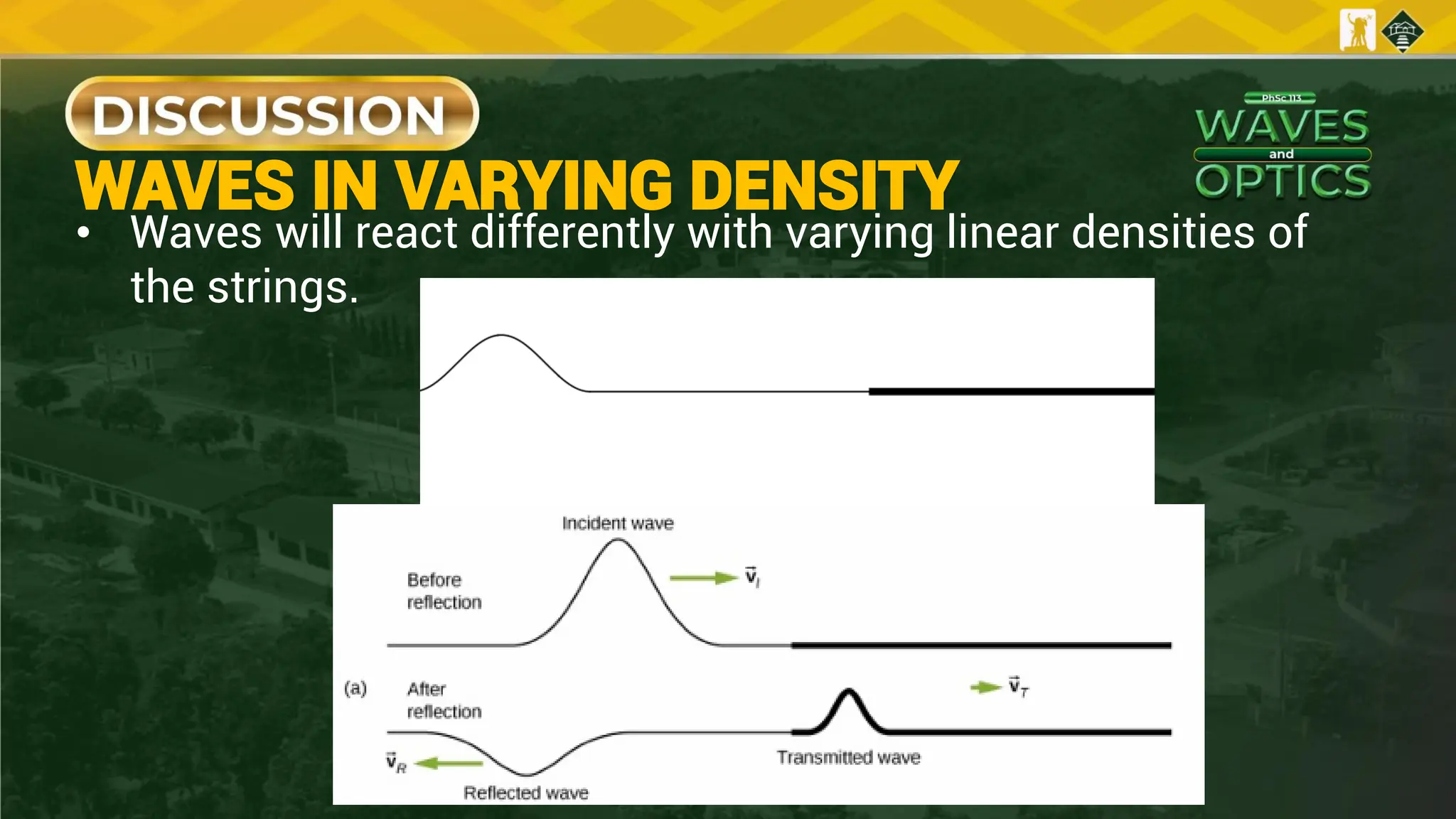
• Waves will react differently with varying linear densities of
the strings.
WAVES IN VARYING DENSITY
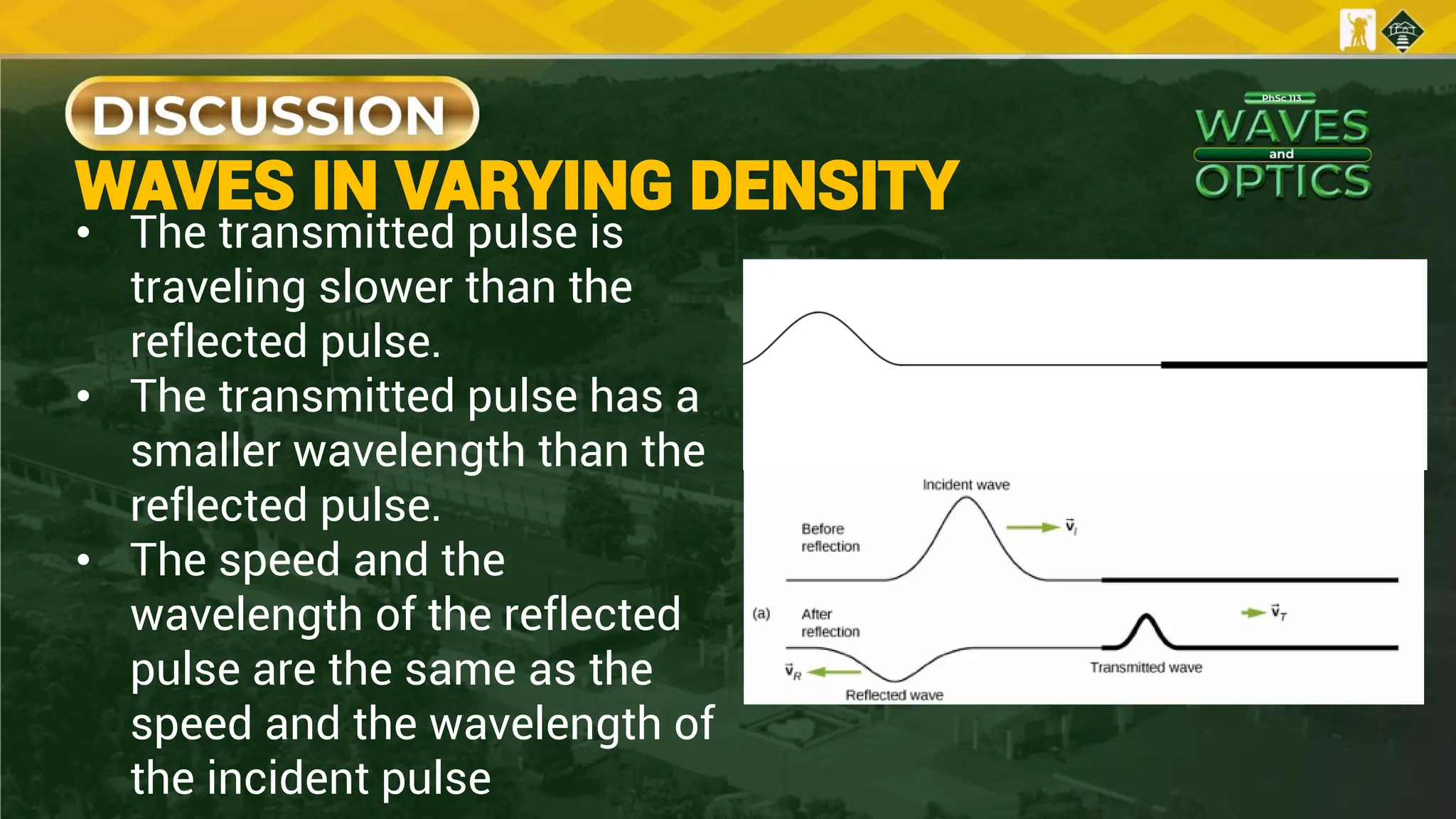
• The transmitted pulse is
traveling slower than the
reflected pulse.
• The transmitted pulse has a
smaller wavelength than the
reflected pulse.
• The speed and the
wavelength of the reflected
pulse are the same as the
speed and the wavelength of
the incident pulse
WAVES IN VARYING DENSITY
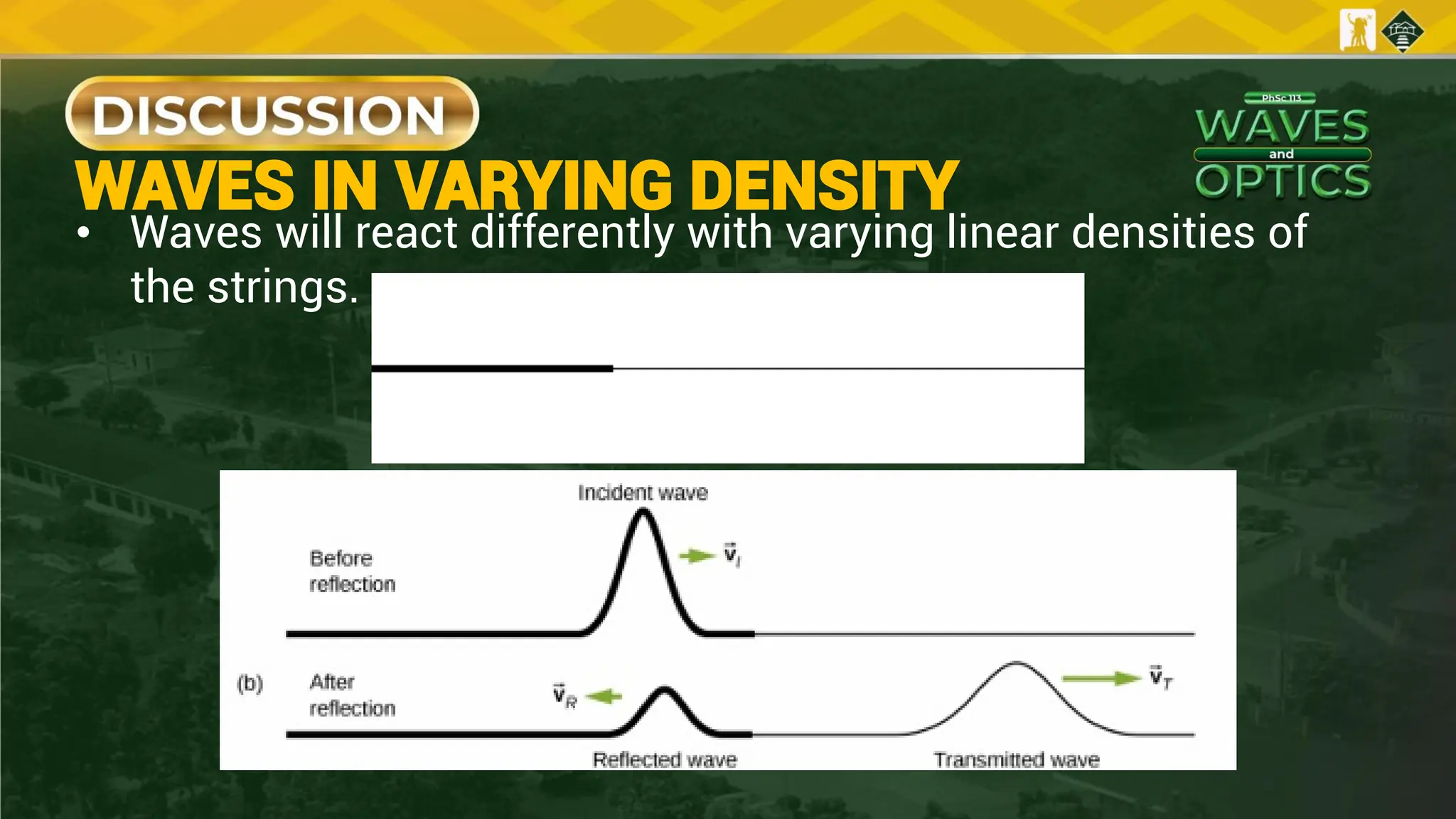
• Waves will react differently with varying linear densities of
the strings.
WAVES IN VARYING DENSITY
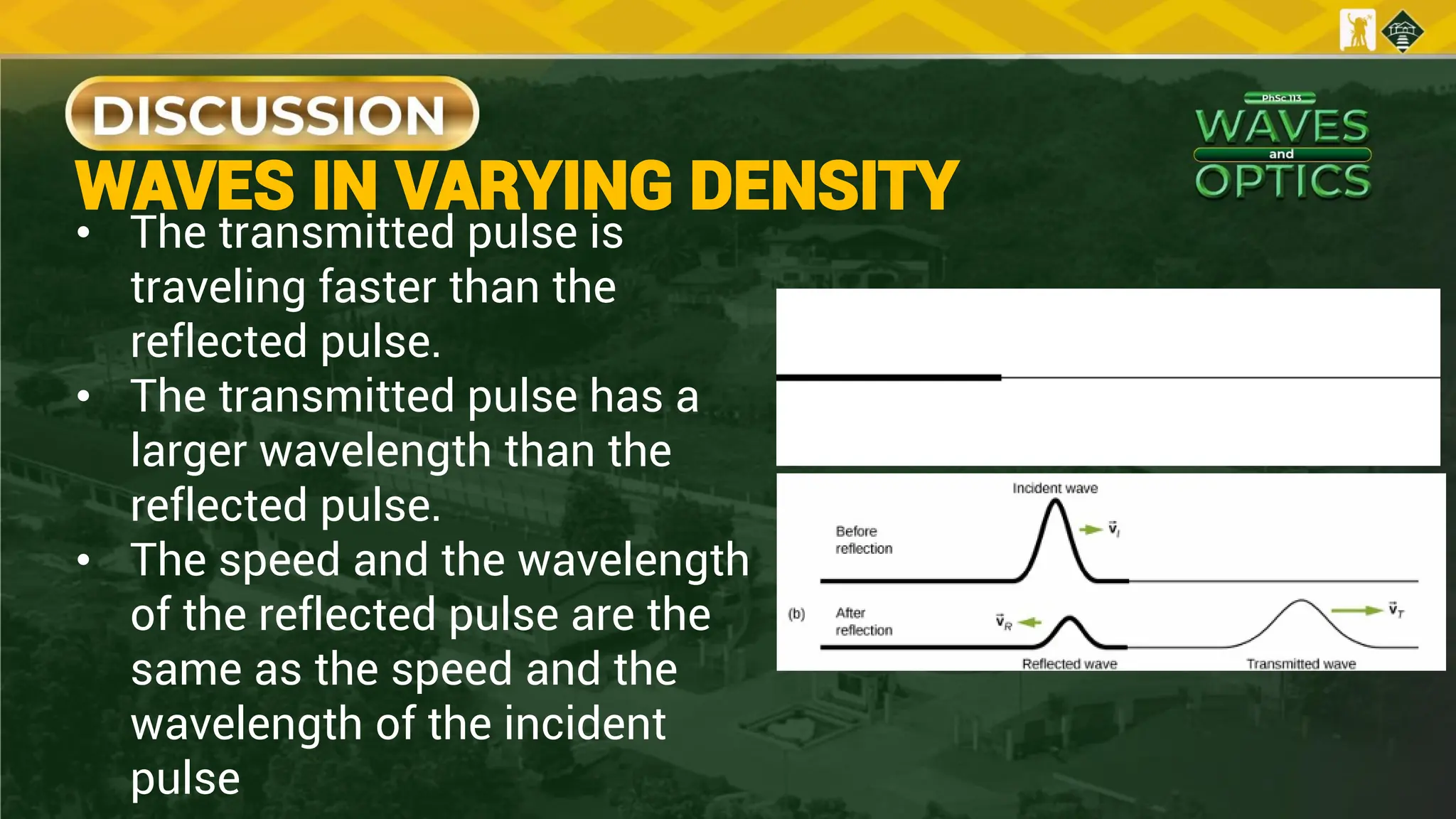
• The transmitted pulse is
traveling faster than the
reflected pulse.
• The transmitted pulse has a
larger wavelength than the
reflected pulse.
• The speed and the wavelength
of the reflected pulse are the
same as the speed and the
wavelength of the incident
pulse
WAVES IN VARYING DENSITY
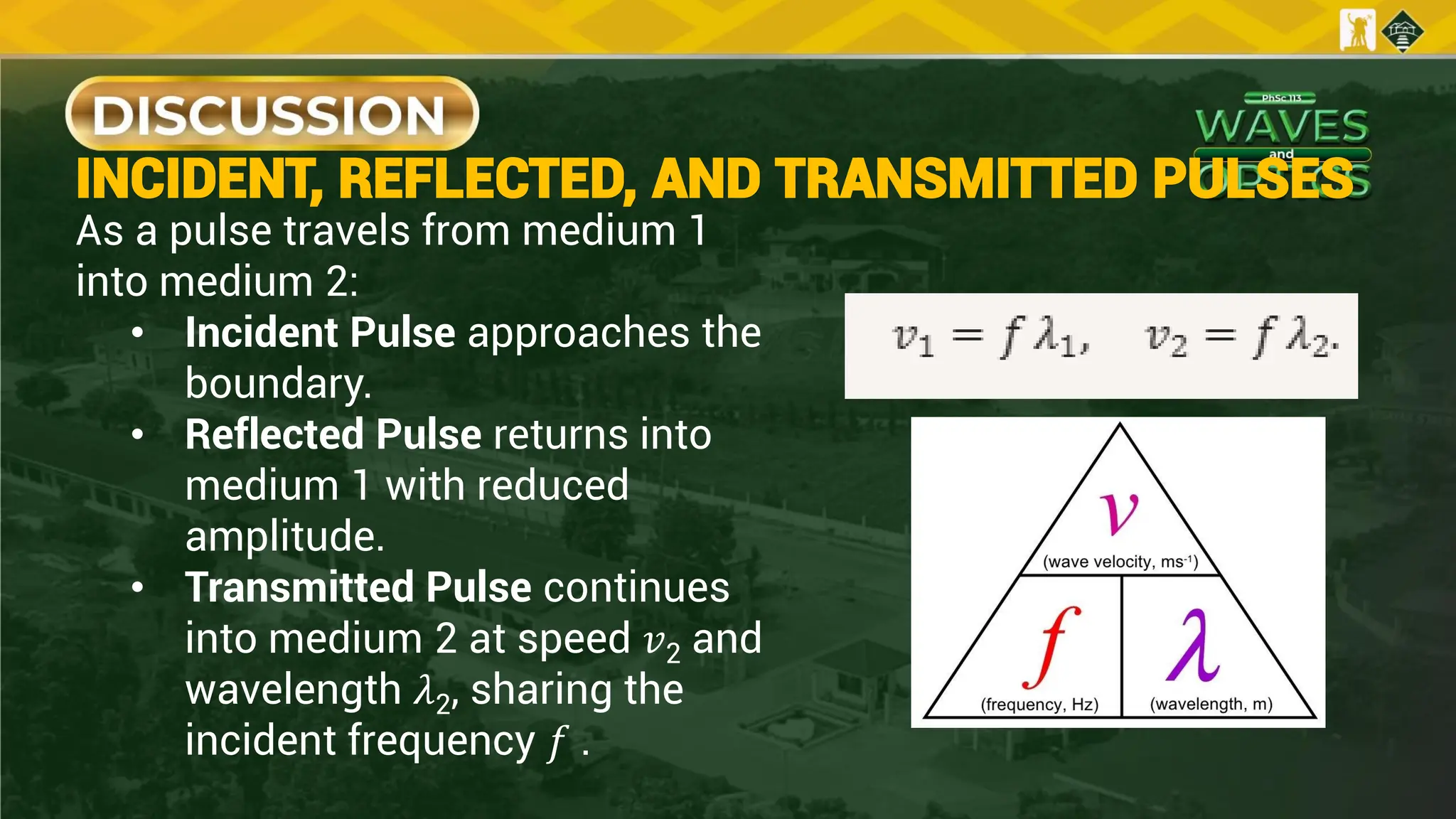
As a pulse travels from medium 1
into medium 2:
• Incident Pulse approaches the
boundary.
• Reflected Pulse returns into
medium 1 with reduced
amplitude.
• Transmitted Pulse continues
into medium 2 at speed 𝑣2 and
wavelength 𝜆2, sharing the
incident frequency 𝑓 .
INCIDENT, REFLECTED, AND TRANSMITTED PULSES
INSTRUCTIONS: Answer the following questions:
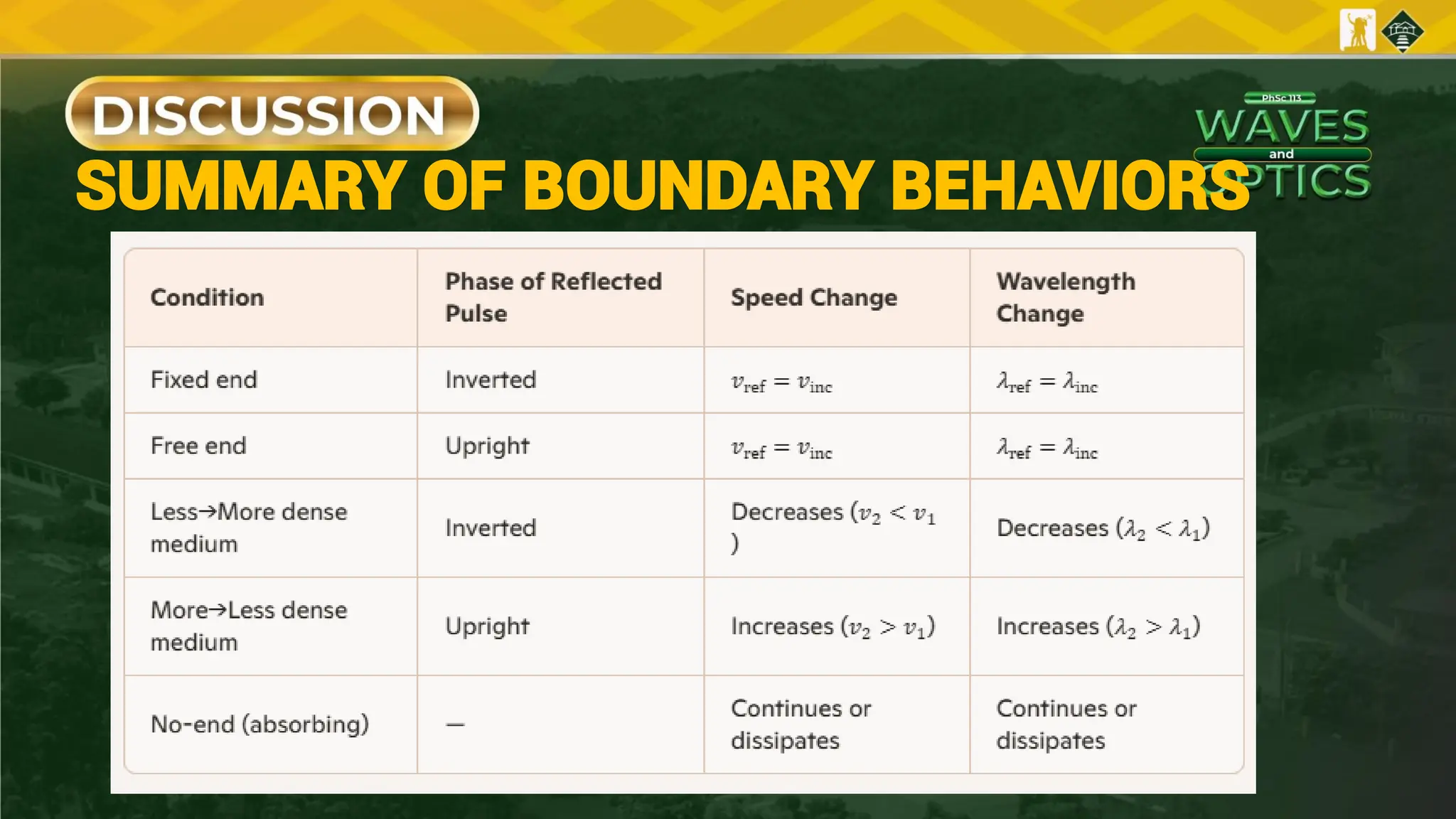
SUMMARY OF BOUNDARY BEHAVIORS
What happens when two waves
meet while they travel through
the same medium?
SUPERPOSITION AND INTERFERENCE
INTERFERENCE
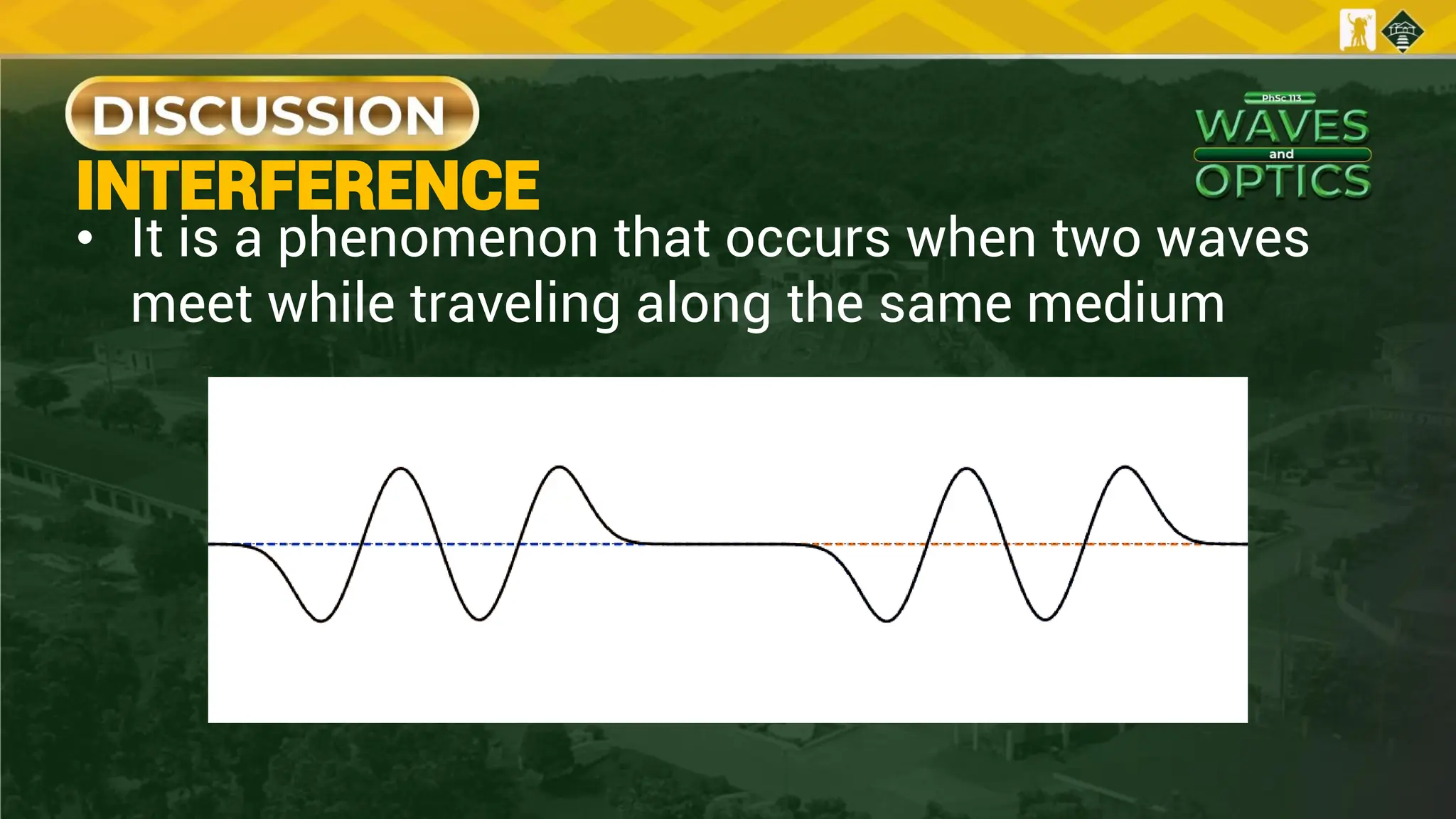
• It is a phenomenon that occurs when two waves
meet while traveling along the same medium
PRINCIPLE OF SUPERPOSITION
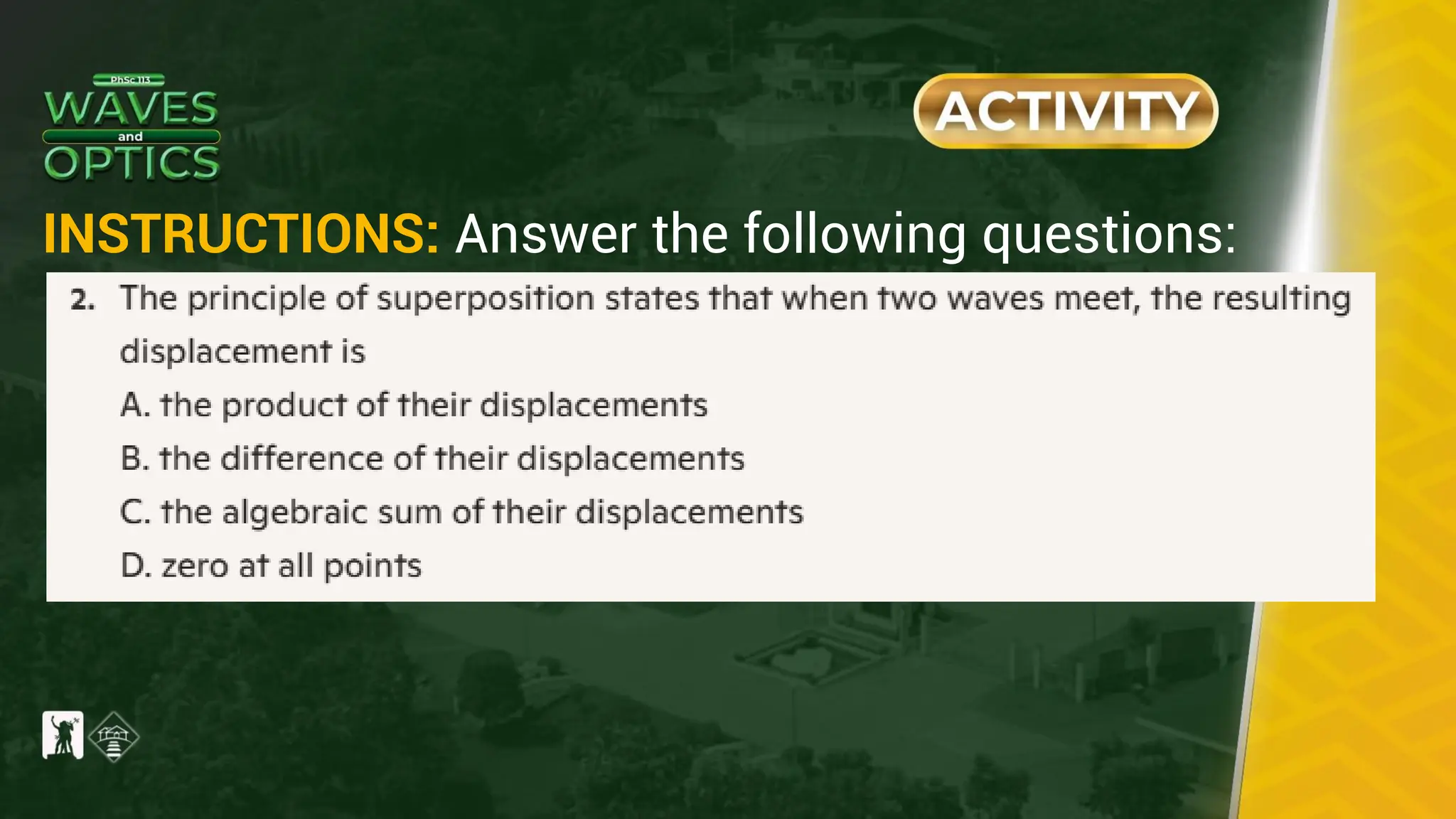
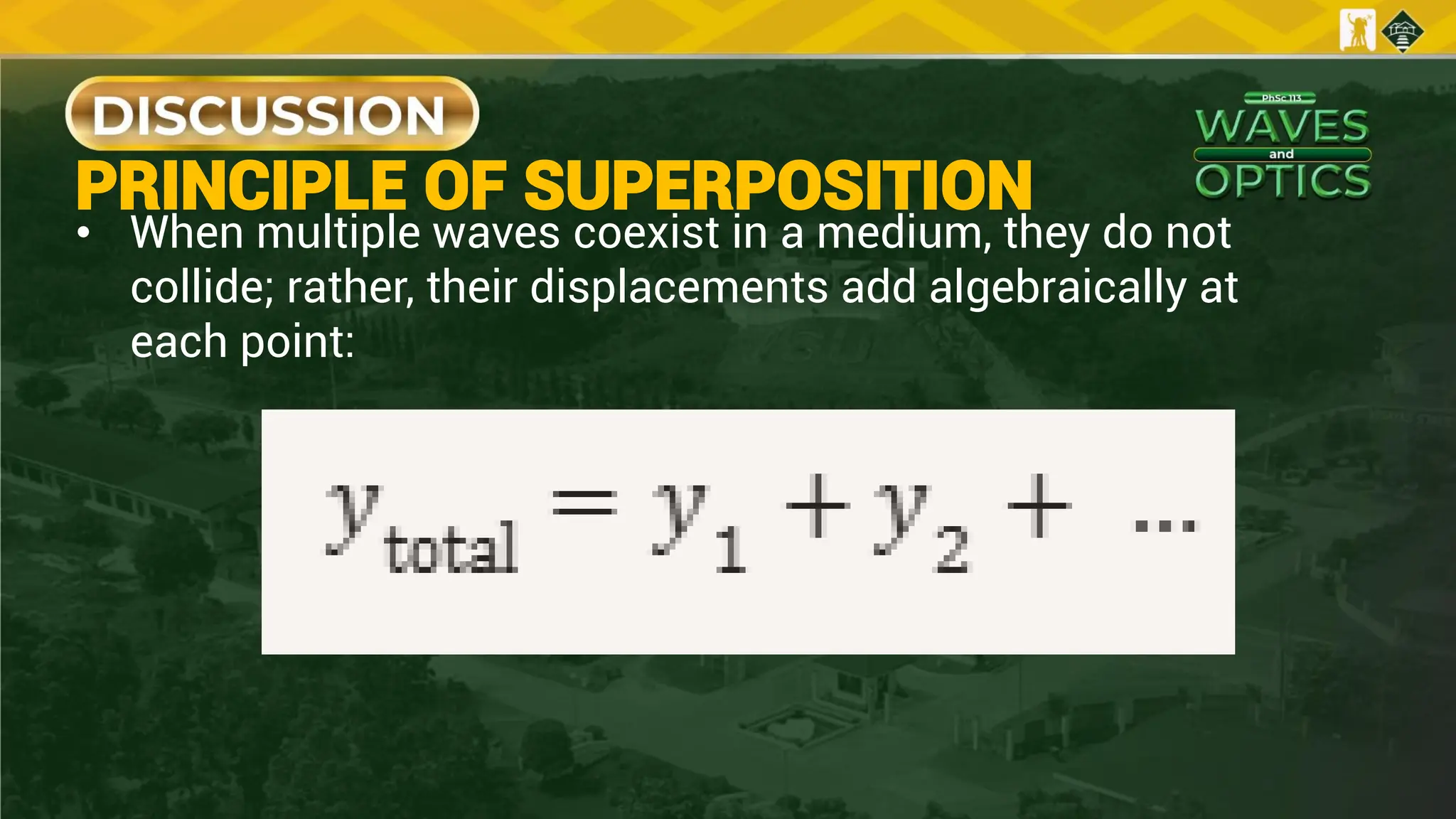
• When multiple waves coexist in a medium, they do not
collide; rather, their displacements add algebraically at
each point:
PRINCIPLE OF SUPERPOSITION
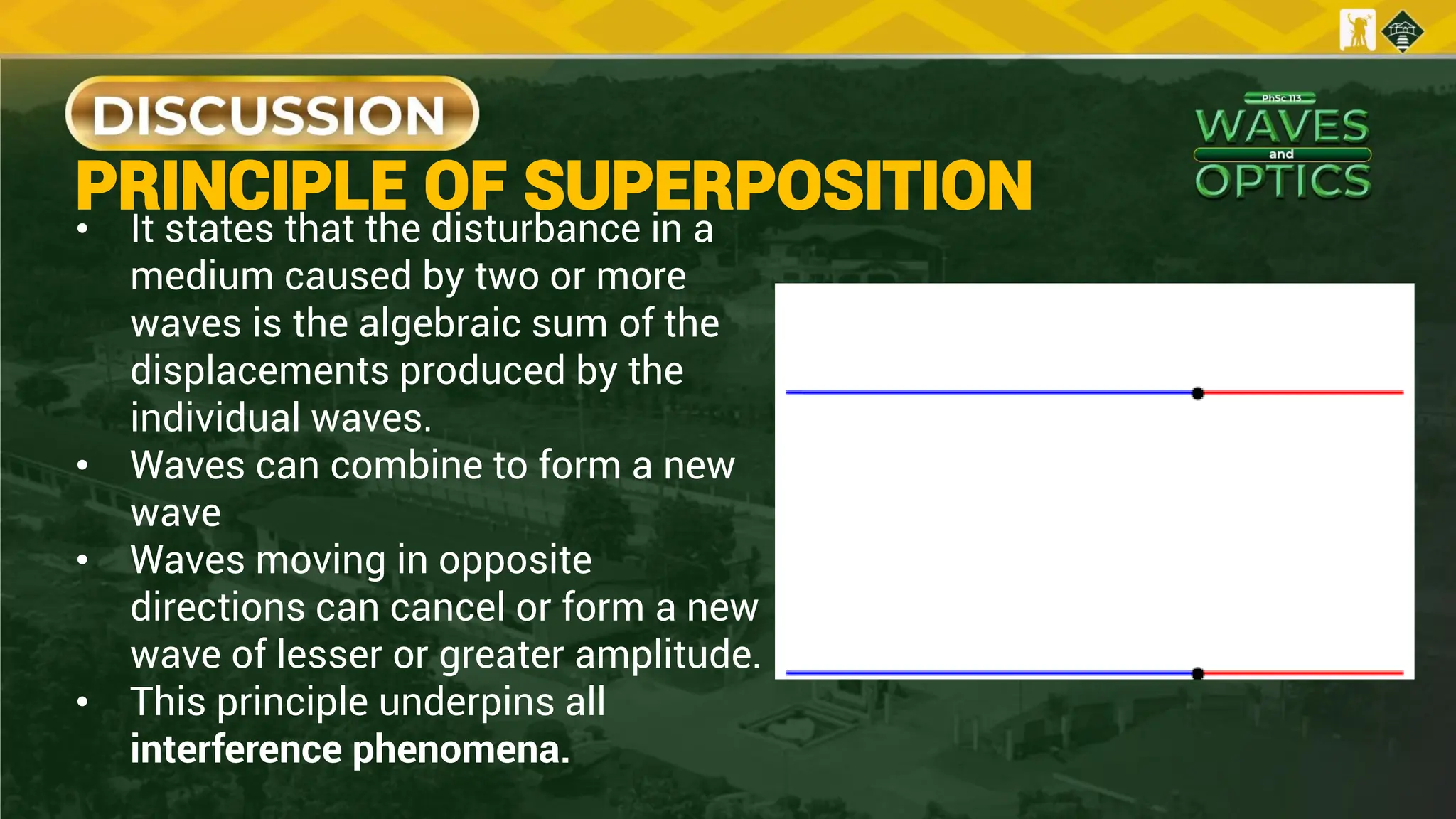
• It states that the disturbance in a
medium caused by two or more
waves is the algebraic sum of the
displacements produced by the
individual waves.
• Waves can combine to form a new
wave
• Waves moving in opposite
directions can cancel or form a new
wave of lesser or greater amplitude.
• This principle underpins all
interference phenomena.
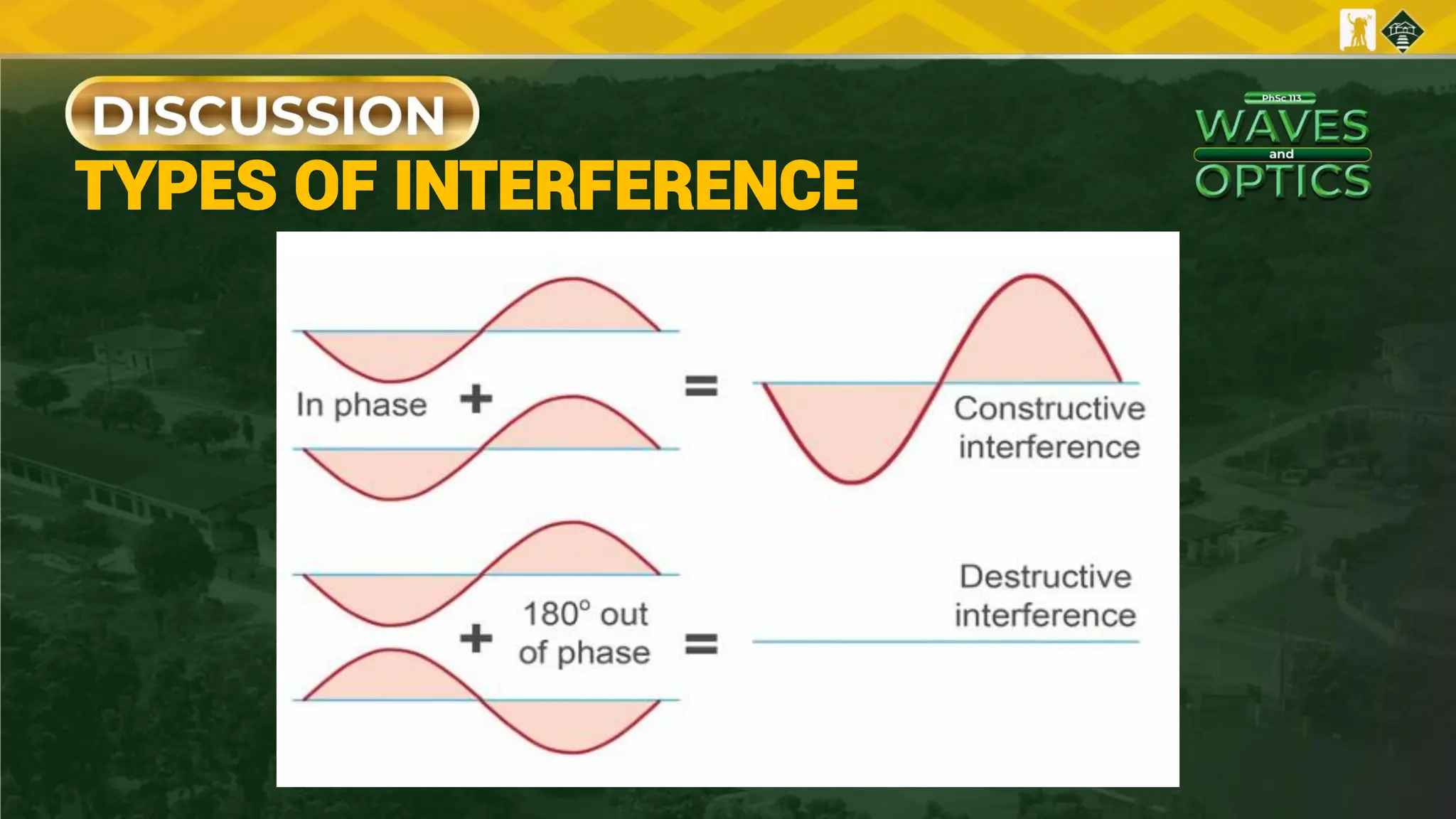
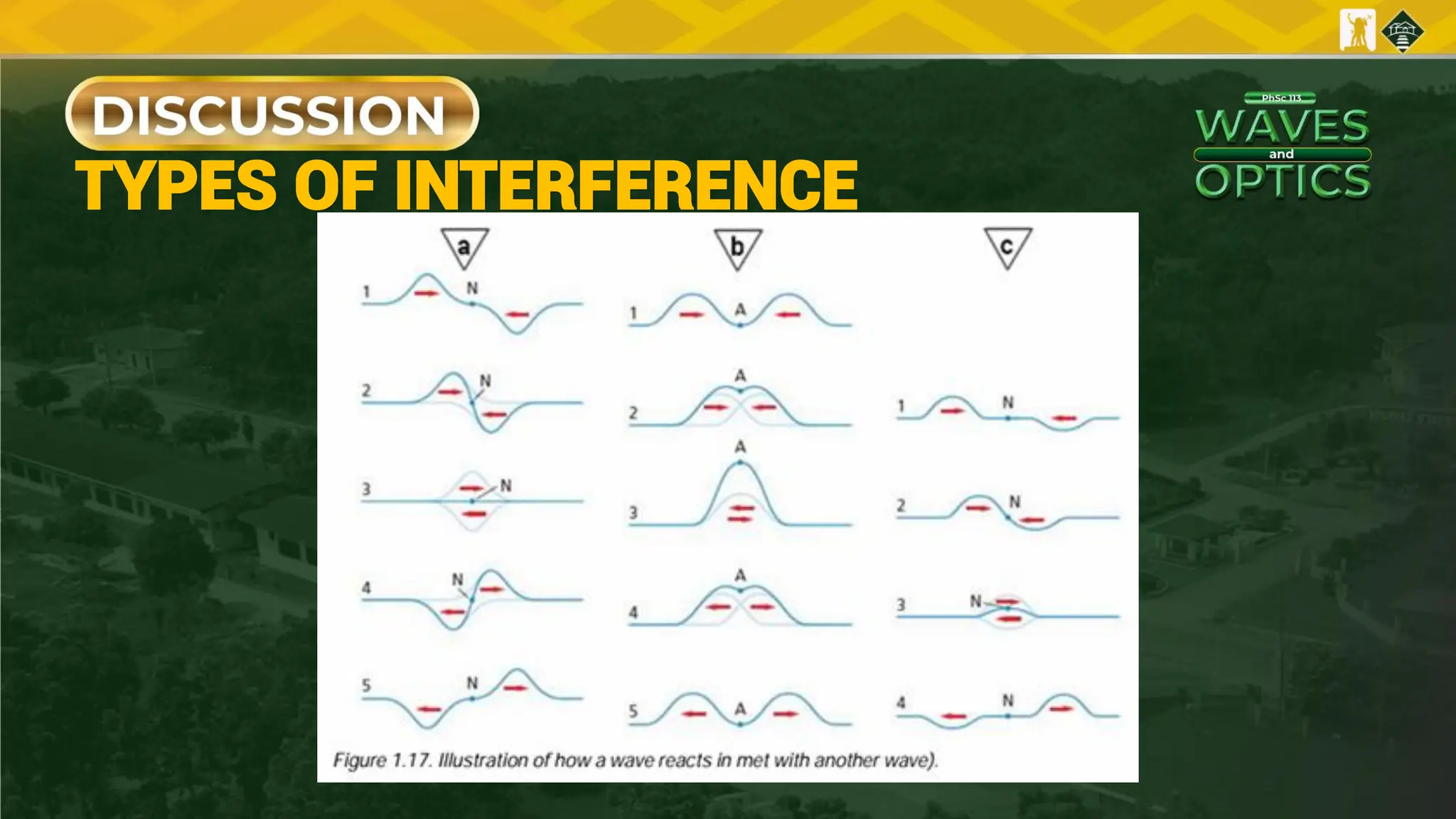
TYPES OF INTERFERENCE
CONSTRUCTIVE INTERFERENCE
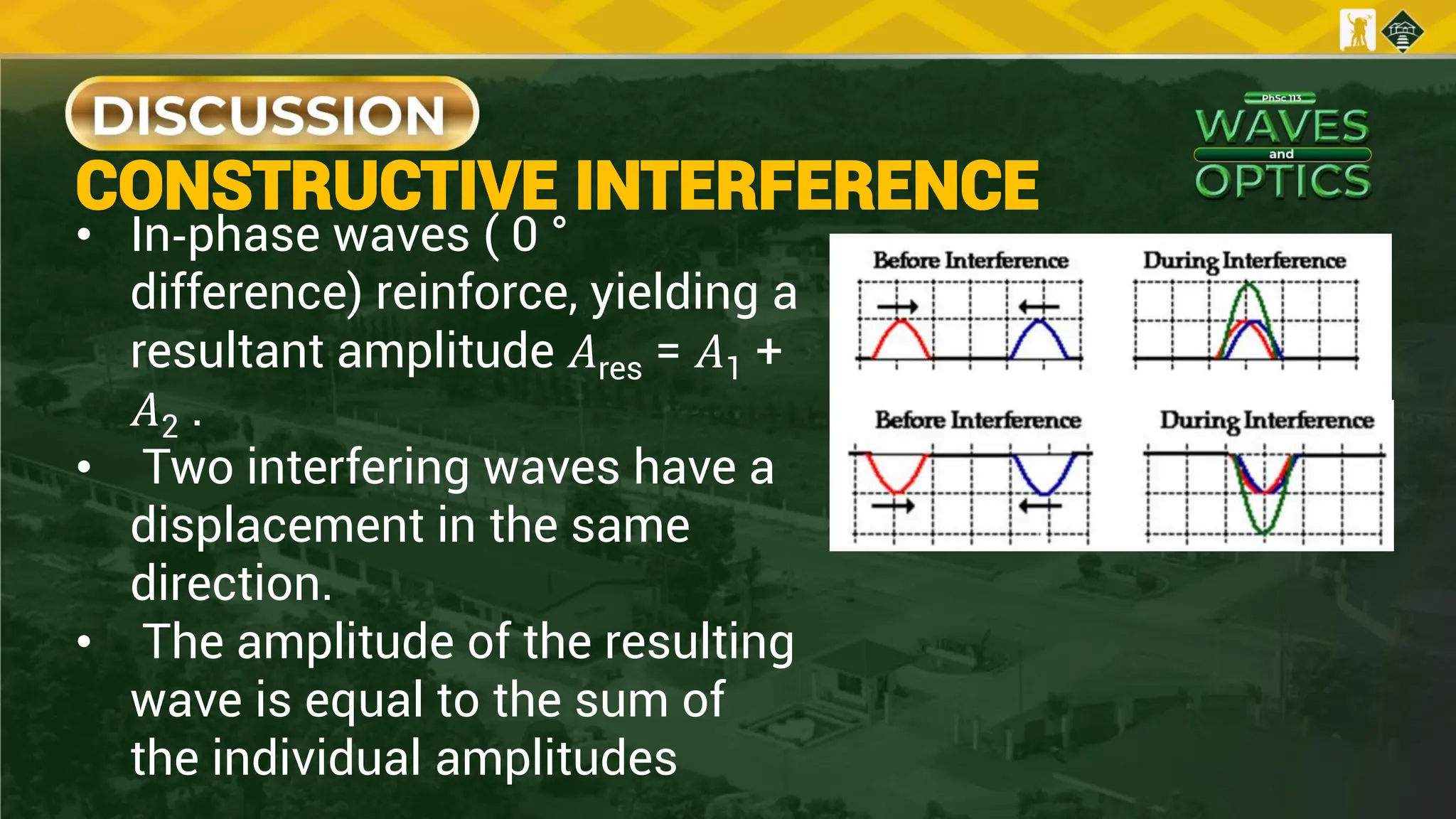
• In‐phase waves ( 0 °
difference) reinforce, yielding a
resultant amplitude 𝐴res = 𝐴1 +
𝐴2 .
• Two interfering waves have a
displacement in the same
direction.
• The amplitude of the resulting
wave is equal to the sum of
the individual amplitudes
CONSTRUCTIVE INTERFERENCE
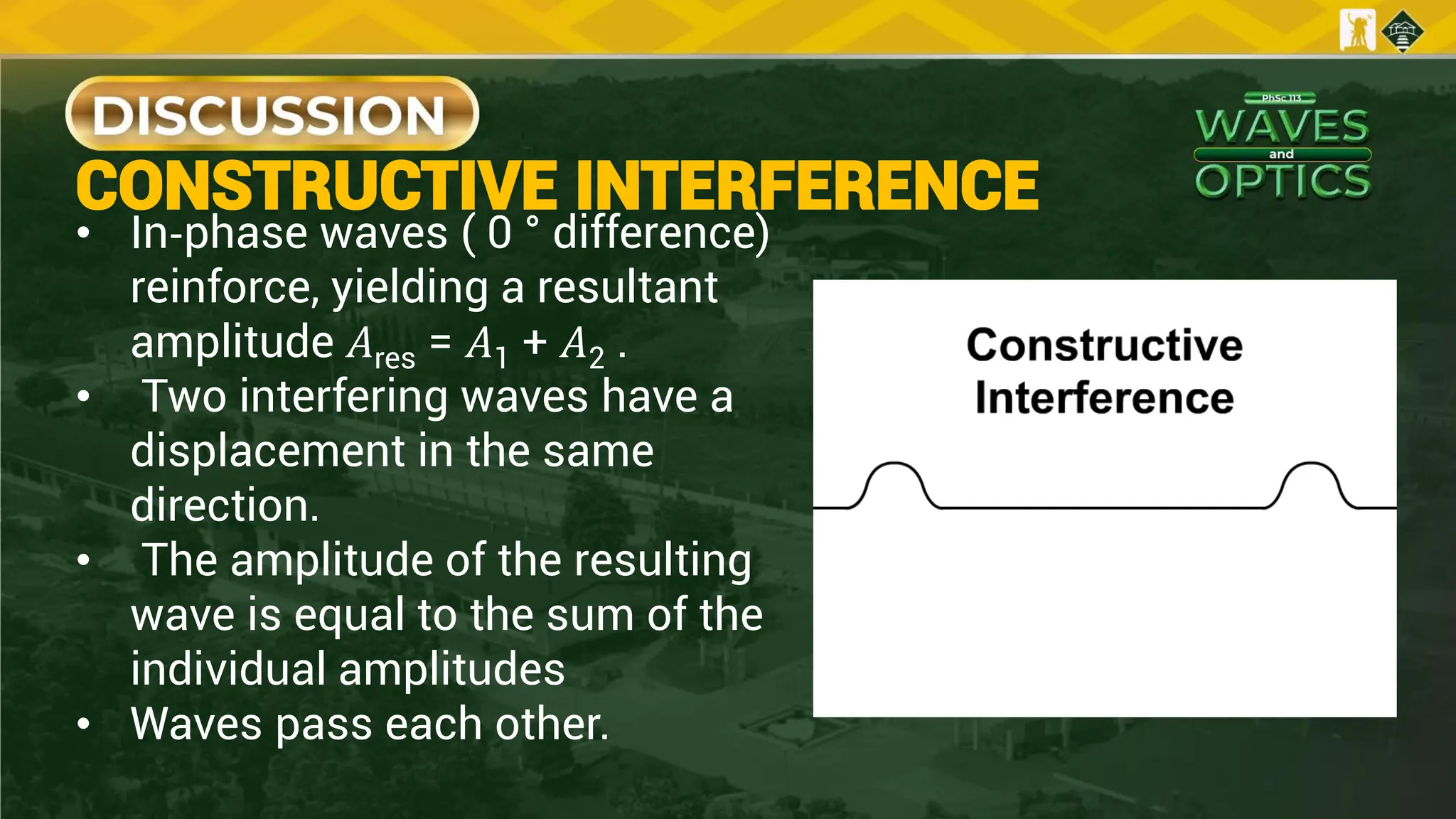
• In‐phase waves ( 0 ° difference)
reinforce, yielding a resultant
amplitude 𝐴res = 𝐴1 + 𝐴2 .
• Two interfering waves have a
displacement in the same
direction.
• The amplitude of the resulting
wave is equal to the sum of the
individual amplitudes
• Waves pass each other.
CONSTRUCTIVE INTERFERENCE
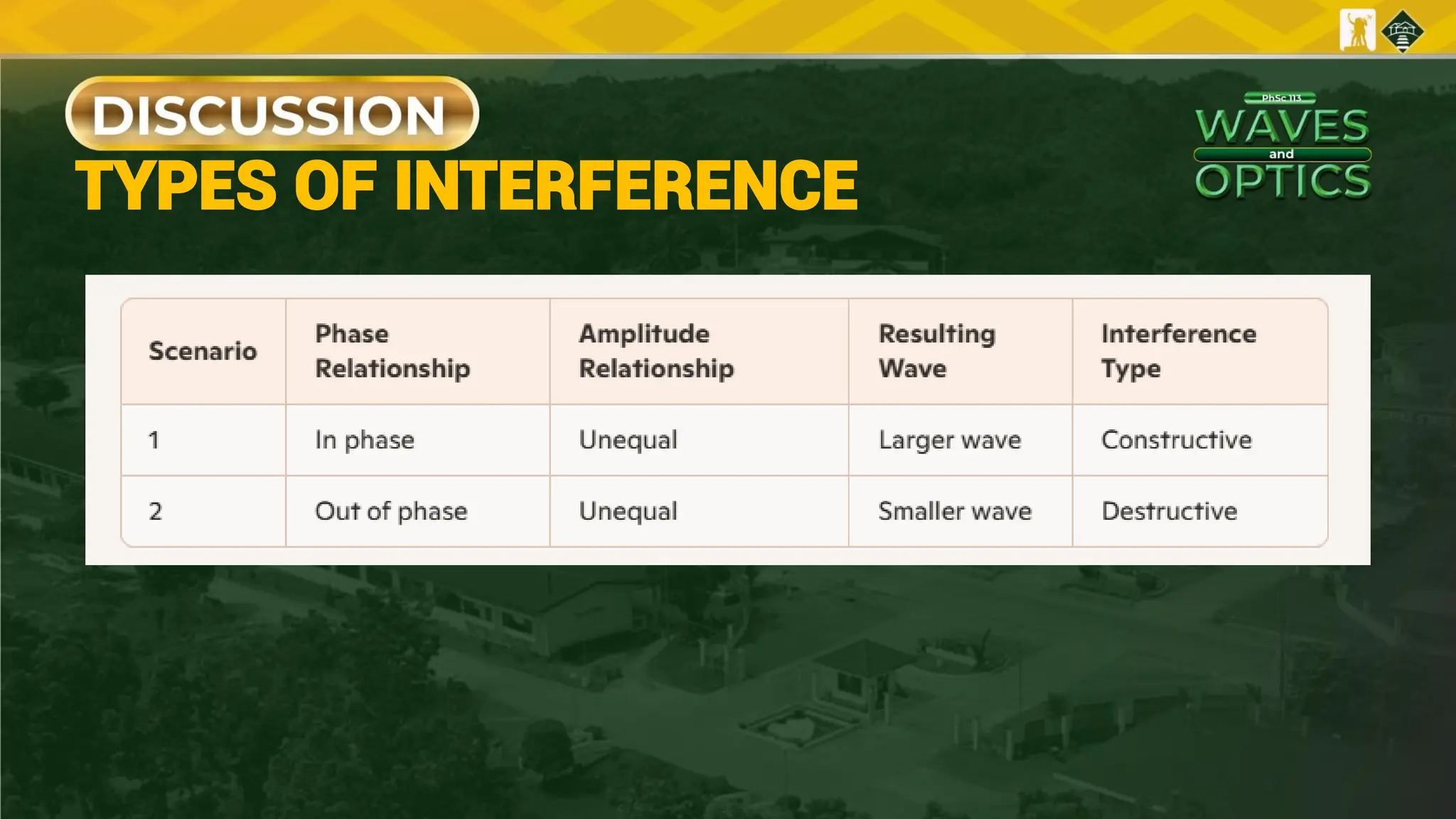
Scenario 1: Same Phase, Unequal Amplitudes
• Description: Two waves are in phase, meaning their crests and
troughs align perfectly. But one wave has a larger amplitude
than the other.
• Result: The amplitudes add together, so the resultant wave has
a larger amplitude than either wave individually.
• Type of Interference: Constructive interference—even though
the amplitudes are unequal, the waves reinforce each other.
• Nickname: You could call this partial constructive interference,
but it's still fundamentally constructive.
DESTRUCTIVE INTERFERENCE
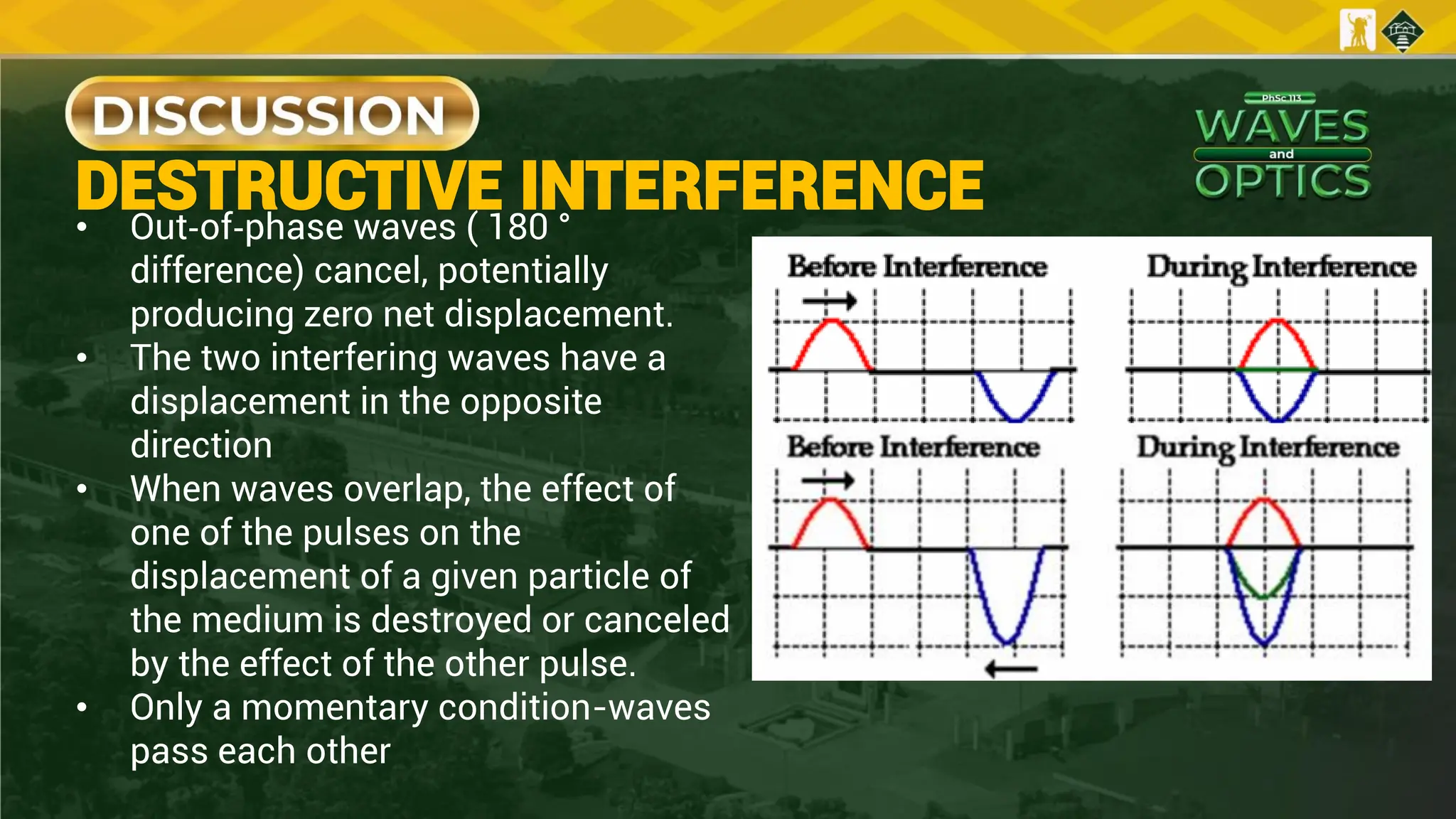
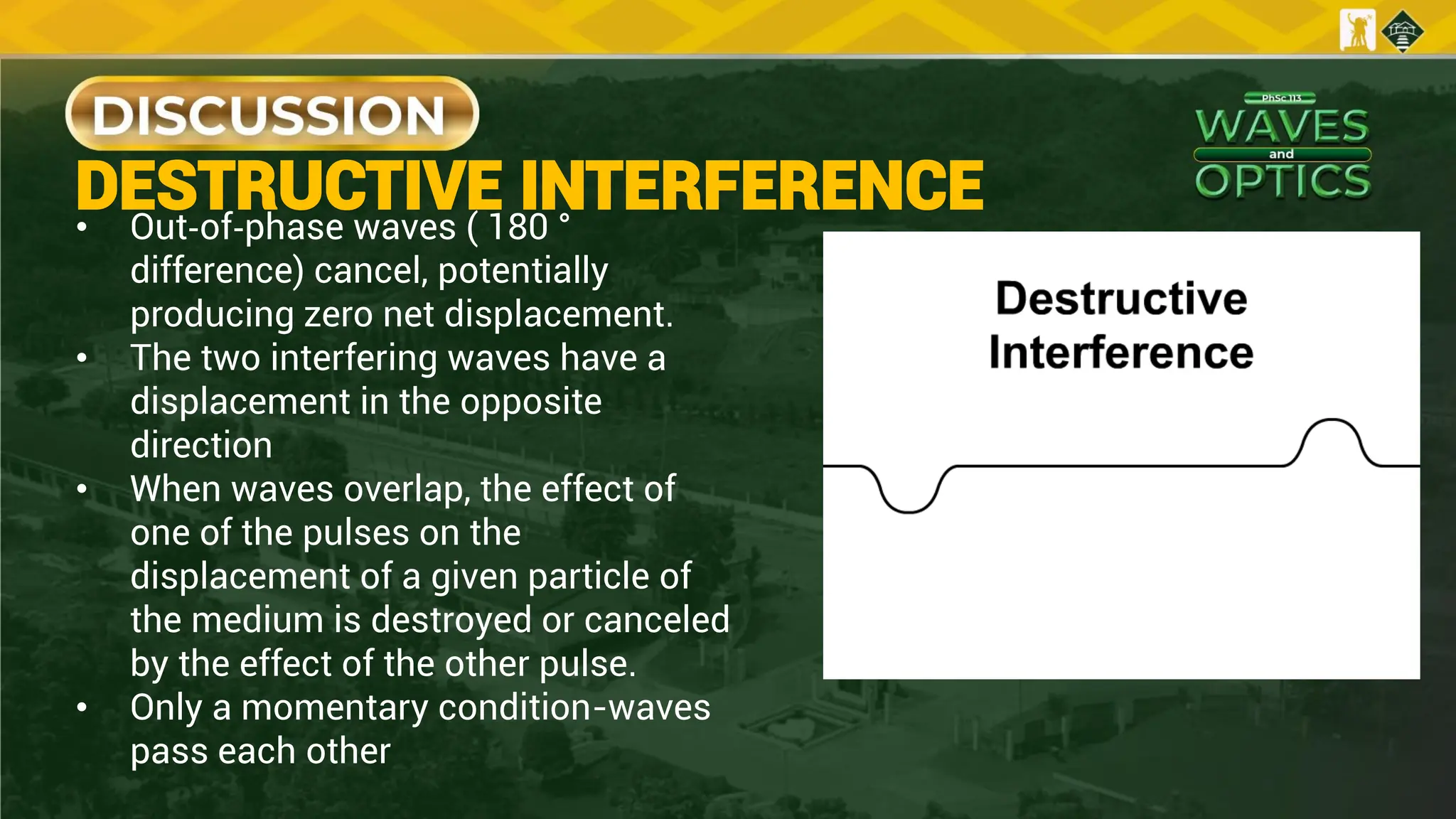
• Out‐of‐phase waves ( 180 °
difference) cancel, potentially
producing zero net displacement.
• The two interfering waves have a
displacement in the opposite
direction
• When waves overlap, the effect of
one of the pulses on the
displacement of a given particle of
the medium is destroyed or canceled
by the effect of the other pulse.
• Only a momentary condition-waves
pass each other
DESTRUCTIVE INTERFERENCE
• Out‐of‐phase waves ( 180 °
difference) cancel, potentially
producing zero net displacement.
• The two interfering waves have a
displacement in the opposite
direction
• When waves overlap, the effect of
one of the pulses on the
displacement of a given particle of
the medium is destroyed or canceled
by the effect of the other pulse.
• Only a momentary condition-waves
pass each other
DESTRUCTIVE INTERFERENCE
Scenario 2: Out of Phase, Unequal Amplitudes
• Description: The waves are out of phase (e.g., crest
meets trough), but one wave is larger than the other.
• Result: The smaller wave partially cancels the larger one,
resulting in a wave with reduced amplitude, but not zero.
• Type of Interference: Destructive interference—because
cancellation occurs, even if it's not complete.
• Nickname: This is often called partial destructive
interference or incomplete cancellation.
TYPES OF INTERFERENCE
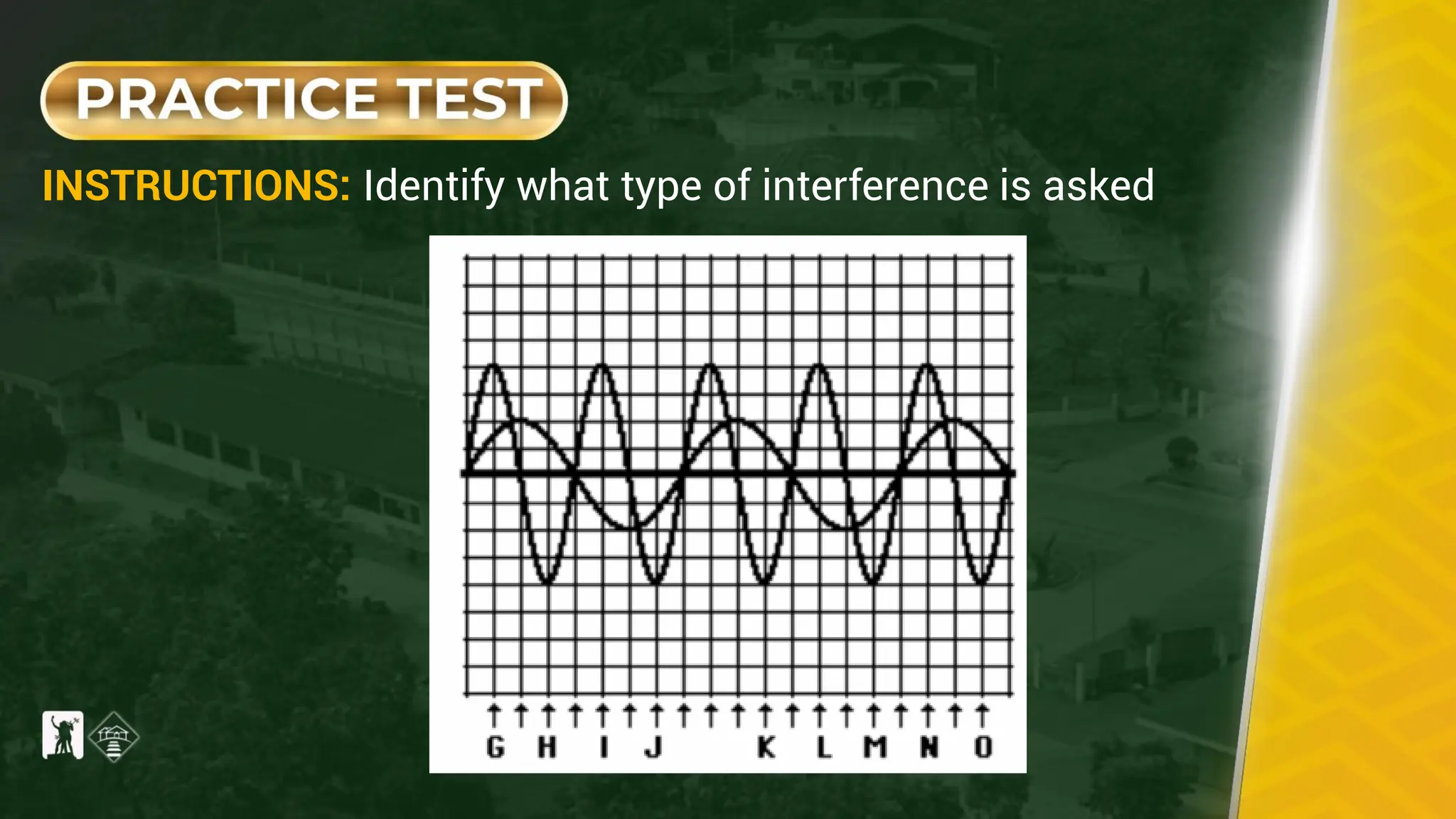
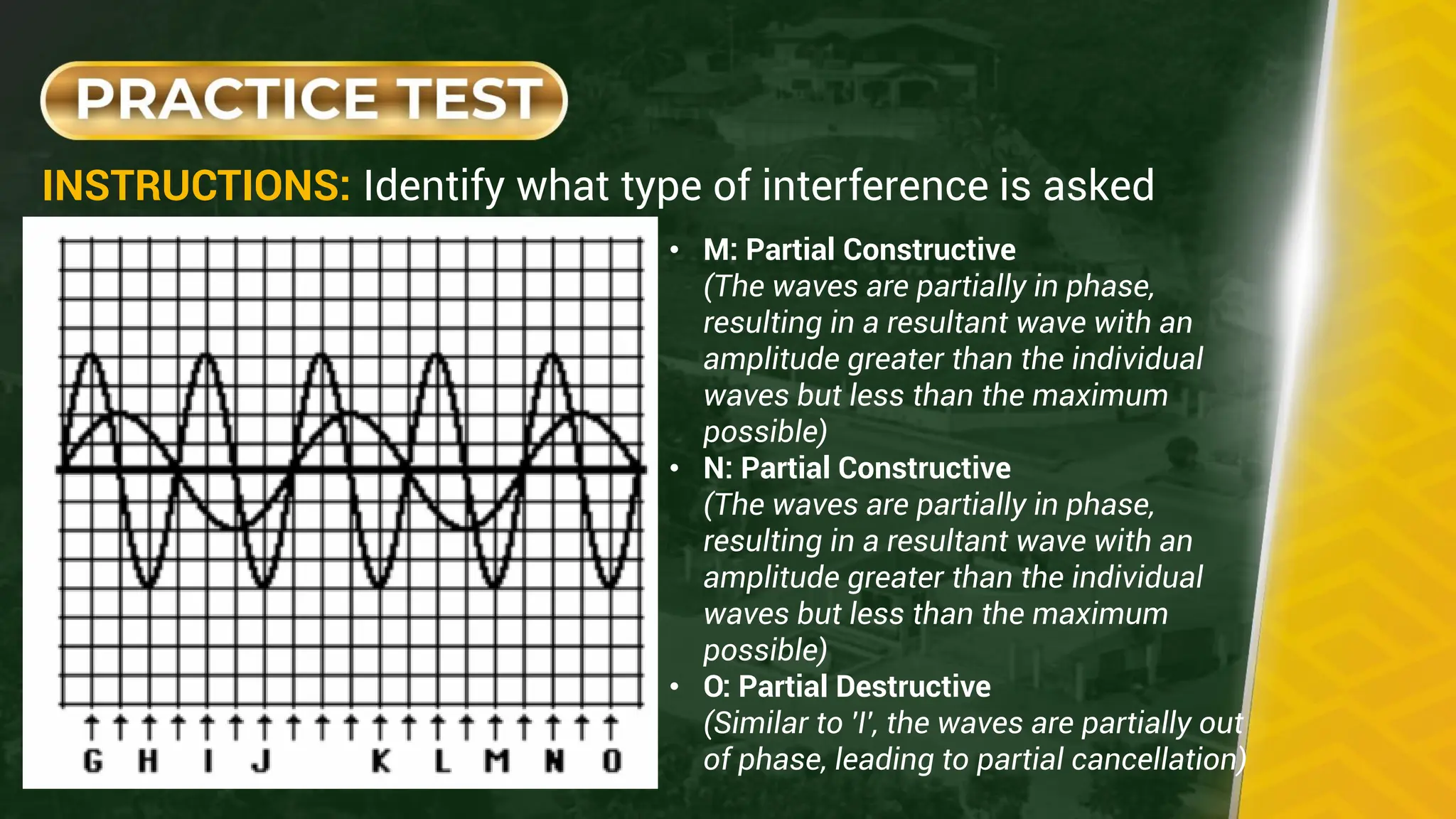
INSTRUCTIONS: Identify what type of interference is asked
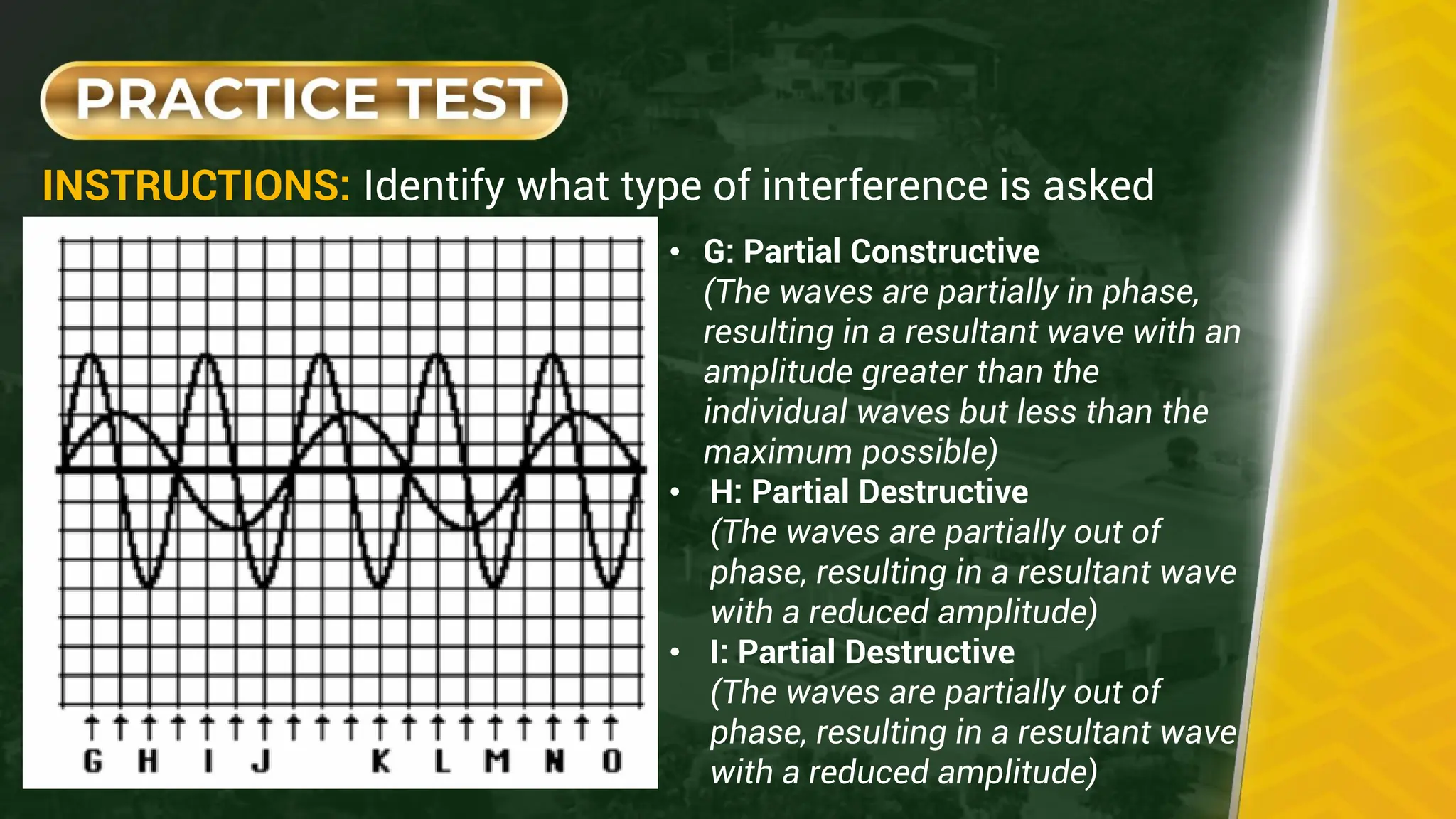
• G: Partial Constructive
(The waves are partially in phase,
resulting in a resultant wave with an
amplitude greater than the
individual waves but less than the
maximum possible)
• H: Partial Destructive
(The waves are partially out of
phase, resulting in a resultant wave
with a reduced amplitude)
• I: Partial Destructive
(The waves are partially out of
phase, resulting in a resultant wave
with a reduced amplitude)
INSTRUCTIONS: Identify what type of interference is asked
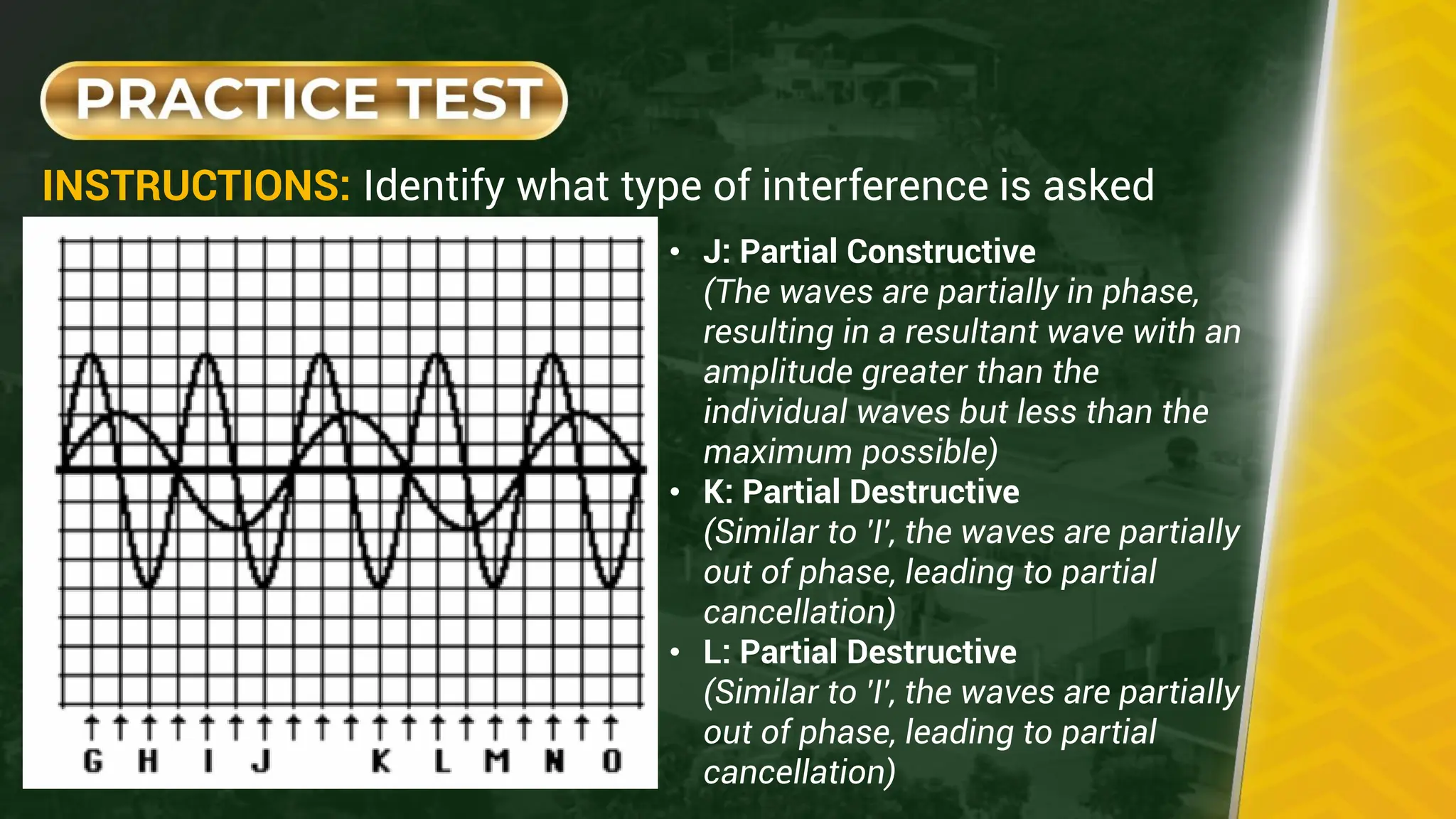
• J: Partial Constructive
(The waves are partially in phase,
resulting in a resultant wave with an
amplitude greater than the
individual waves but less than the
maximum possible)
• K: Partial Destructive
(Similar to 'I', the waves are partially
out of phase, leading to partial
cancellation)
• L: Partial Destructive
(Similar to 'I', the waves are partially
out of phase, leading to partial
cancellation)
INSTRUCTIONS: Identify what type of interference is asked
• M: Partial Constructive
(The waves are partially in phase,
resulting in a resultant wave with an
amplitude greater than the individual
waves but less than the maximum
possible)
• N: Partial Constructive
(The waves are partially in phase,
resulting in a resultant wave with an
amplitude greater than the individual
waves but less than the maximum
possible)
• O: Partial Destructive
(Similar to 'I', the waves are partially out
of phase, leading to partial cancellation)
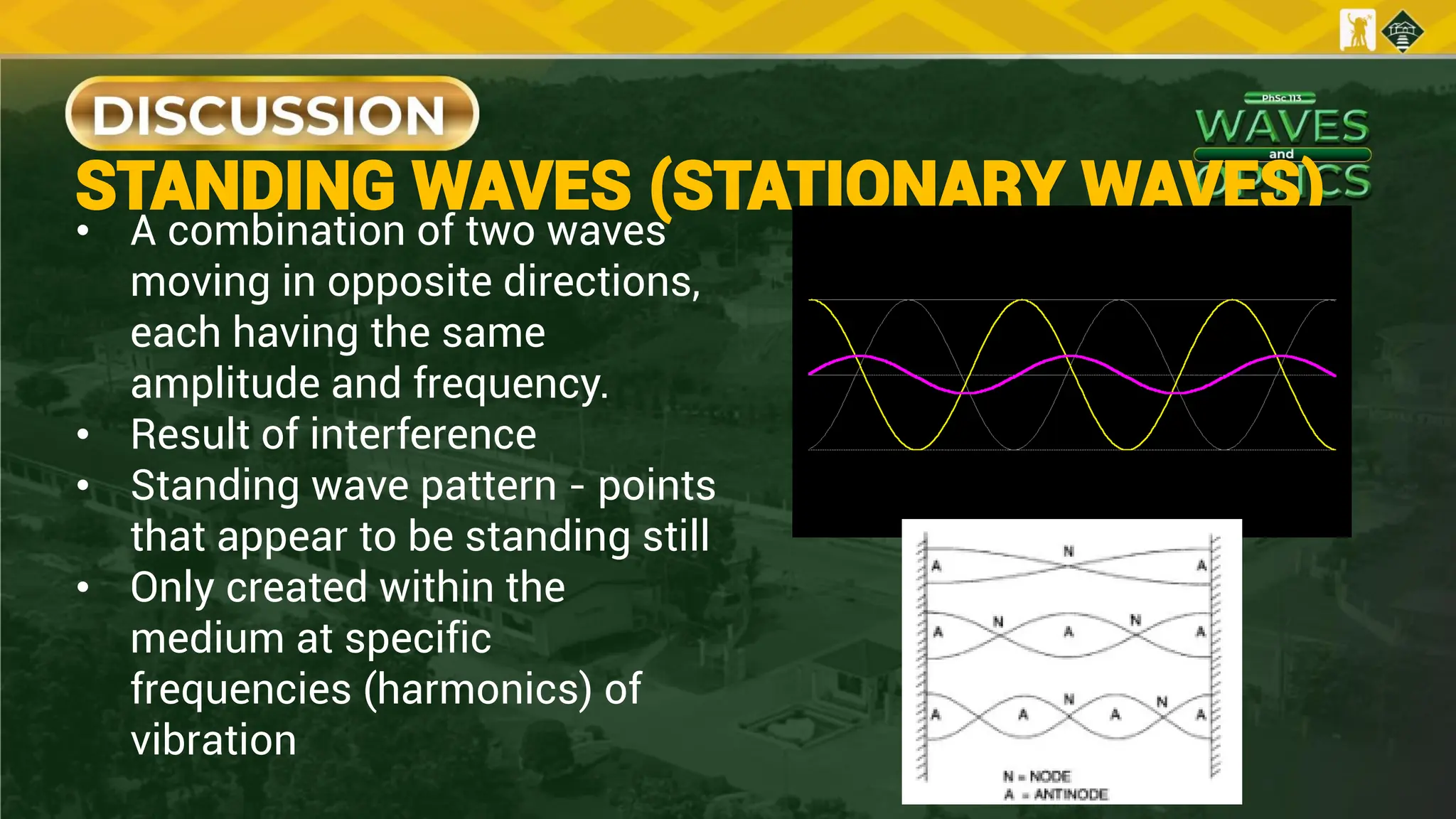
STANDING WAVES (STATIONARY WAVES)
• A combination of two waves
moving in opposite directions,
each having the same
amplitude and frequency.
• Result of interference
• Standing wave pattern - points
that appear to be standing still
• Only created within the
medium at specific
frequencies (harmonics) of
vibration
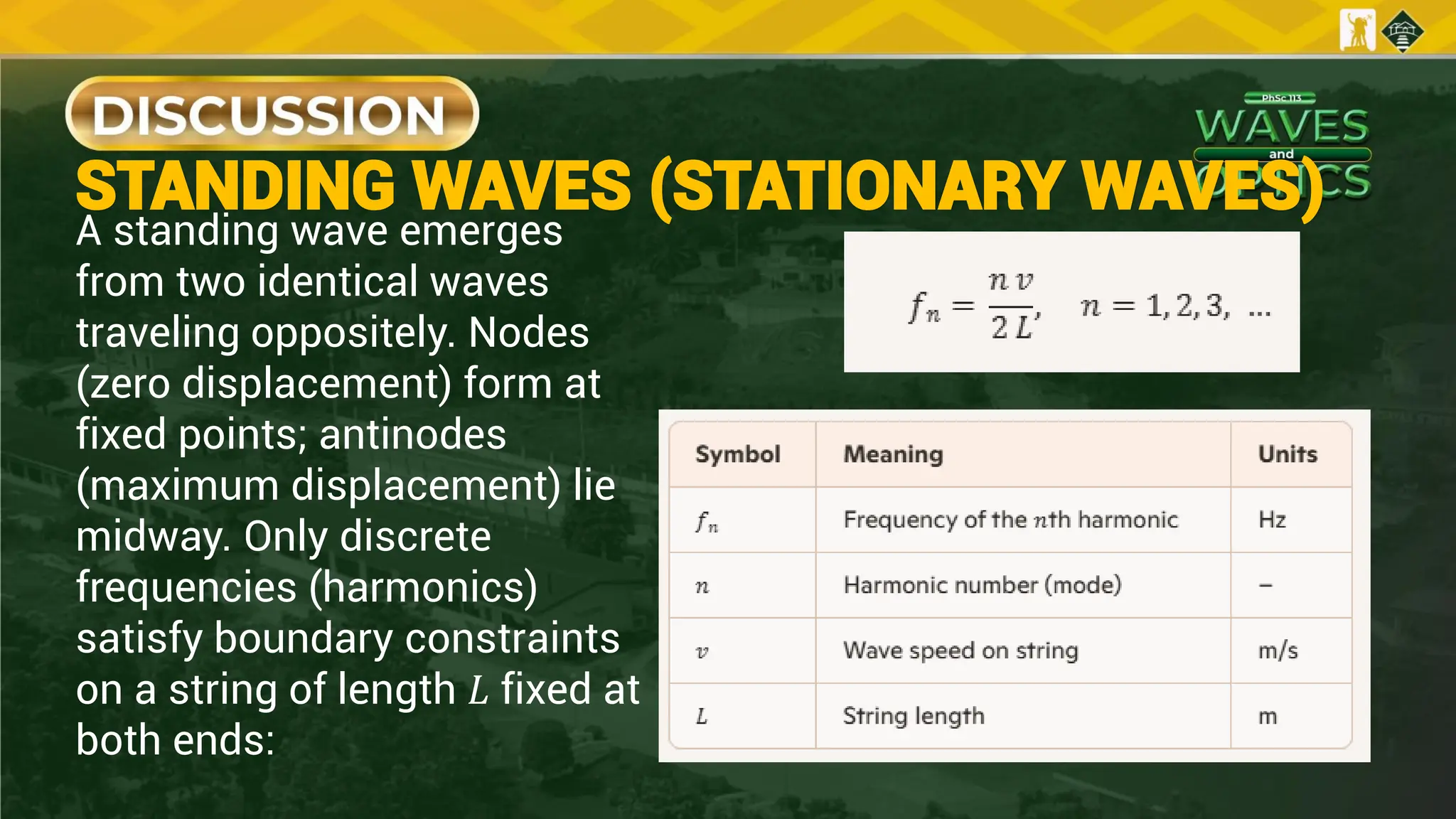
STANDING WAVES (STATIONARY WAVES)
A standing wave emerges
from two identical waves
traveling oppositely. Nodes
(zero displacement) form at
fixed points; antinodes
(maximum displacement) lie
midway. Only discrete
frequencies (harmonics)
satisfy boundary constraints
on a string of length 𝐿 fixed at
both ends:
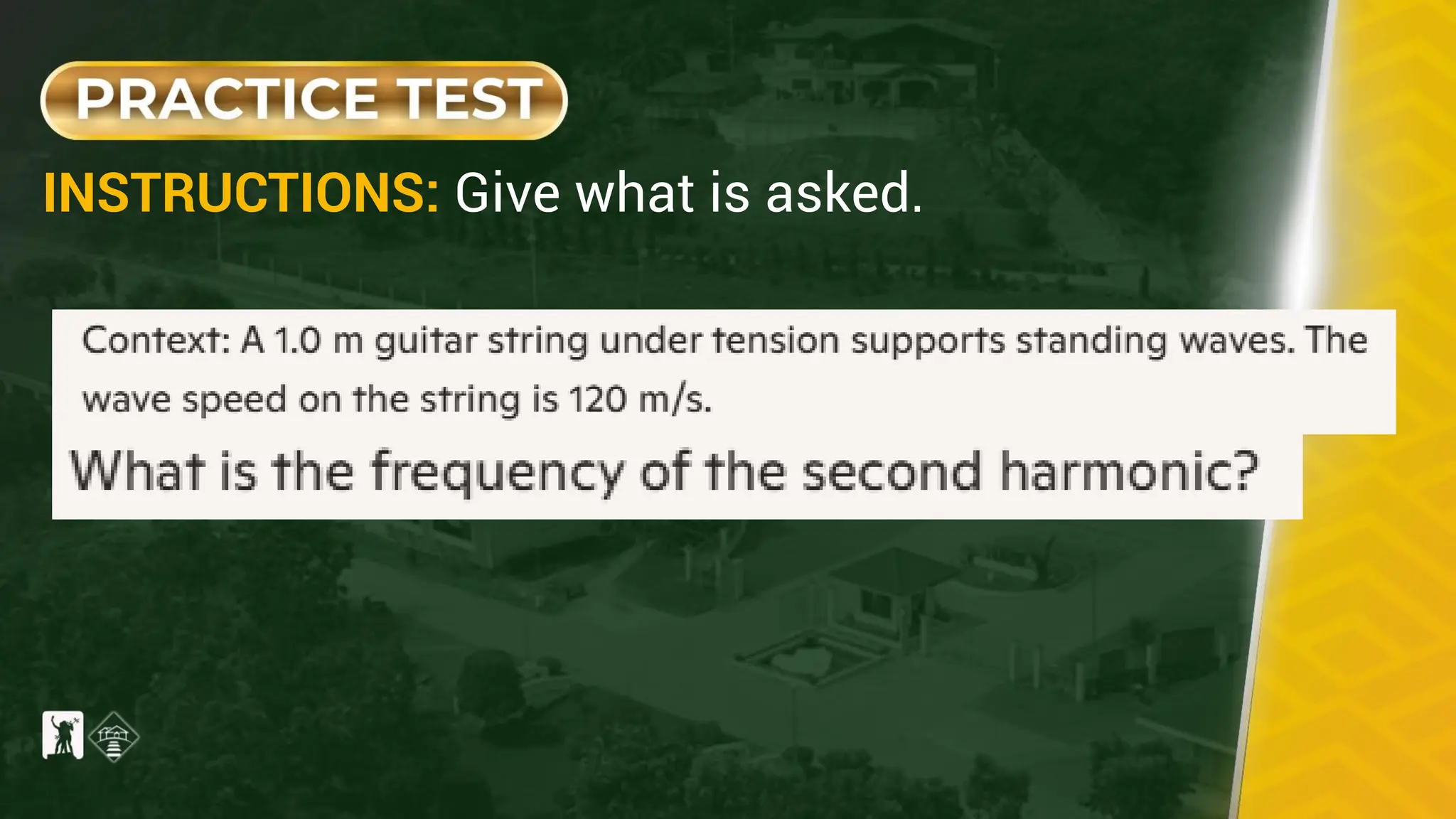
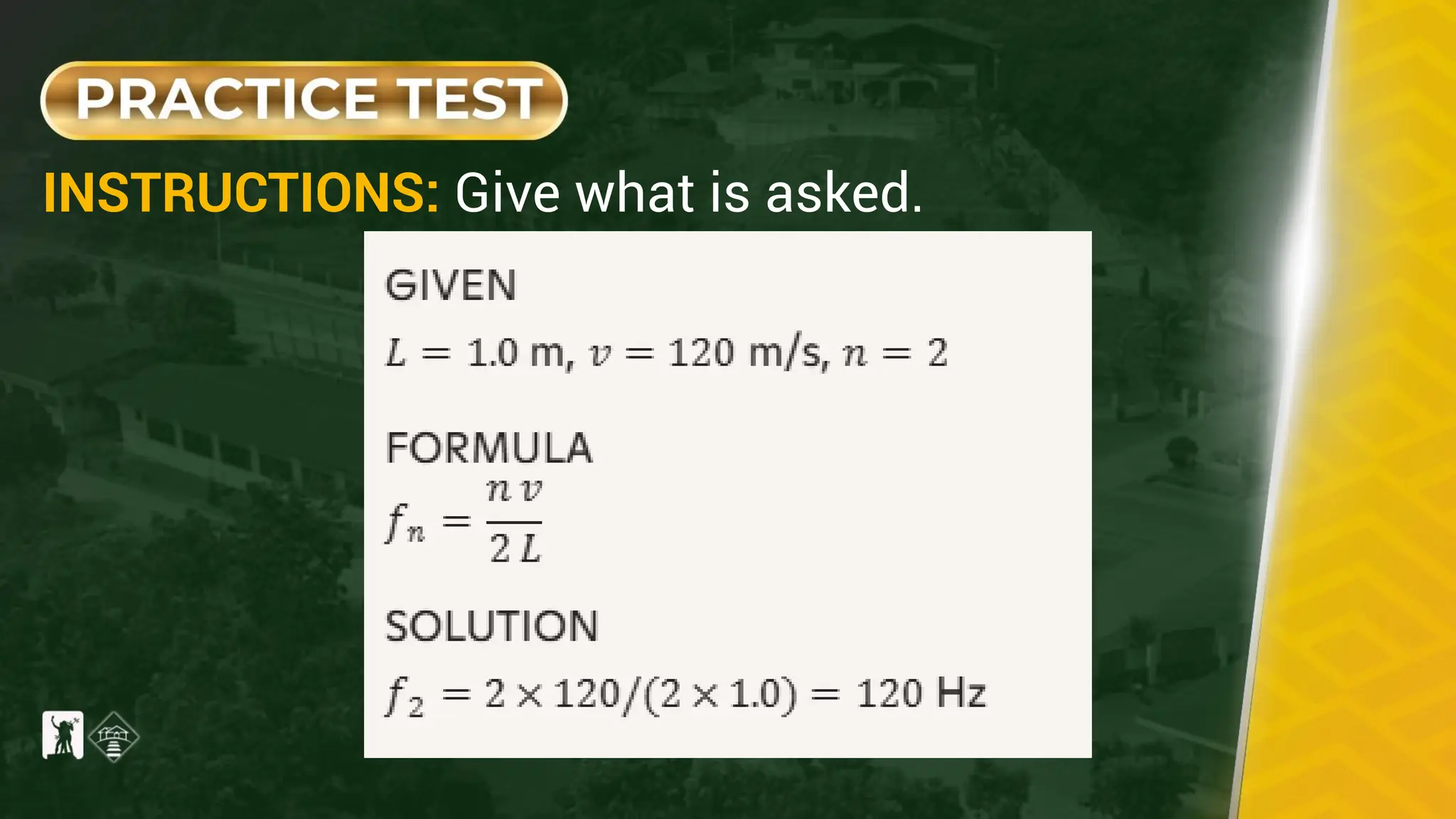
INSTRUCTIONS: Give what is asked.
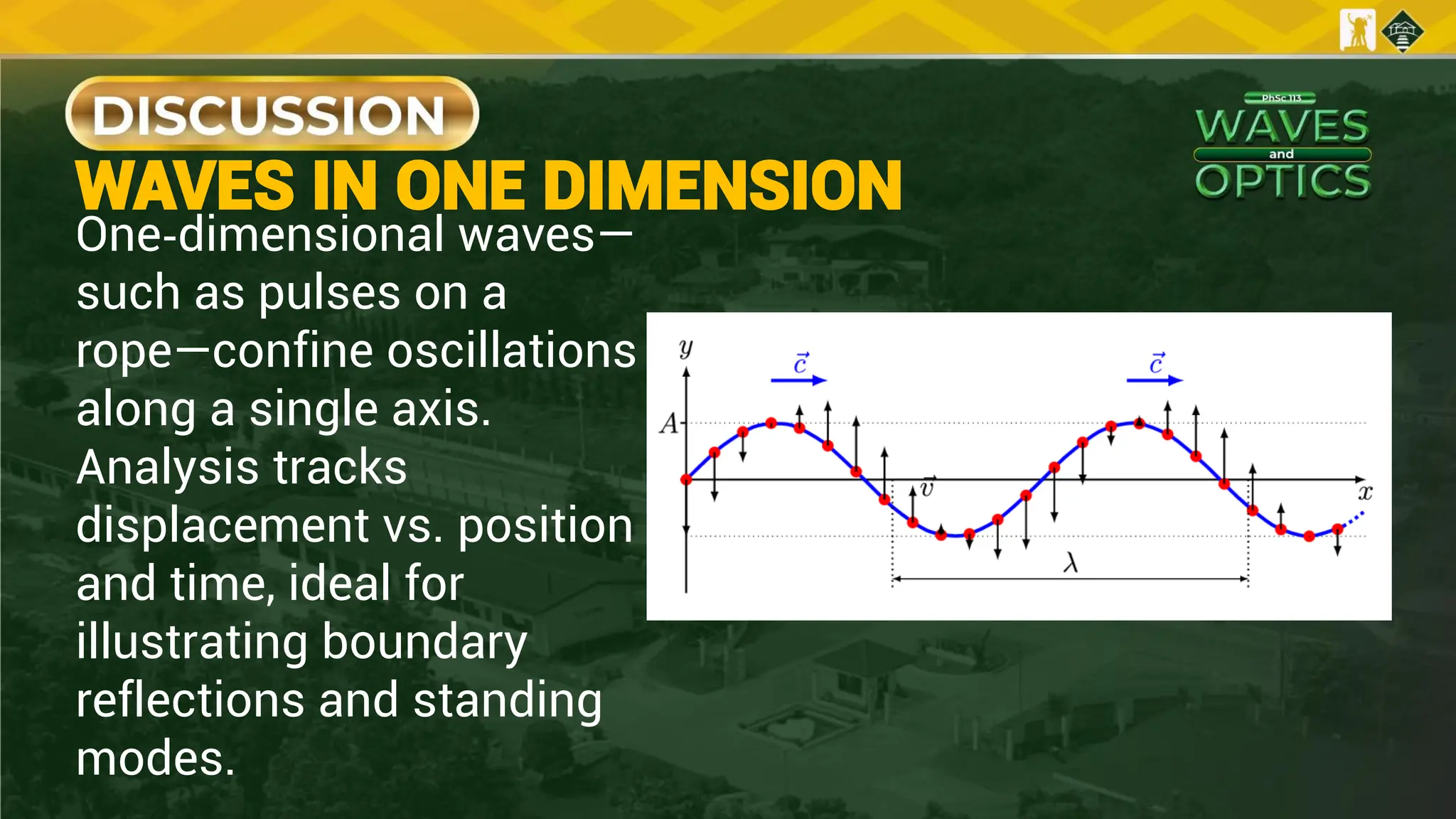
WAVES IN ONE DIMENSION
One‐dimensional waves—
such as pulses on a
rope—confine oscillations
along a single axis.
Analysis tracks
displacement vs. position
and time, ideal for
illustrating boundary
reflections and standing
modes.
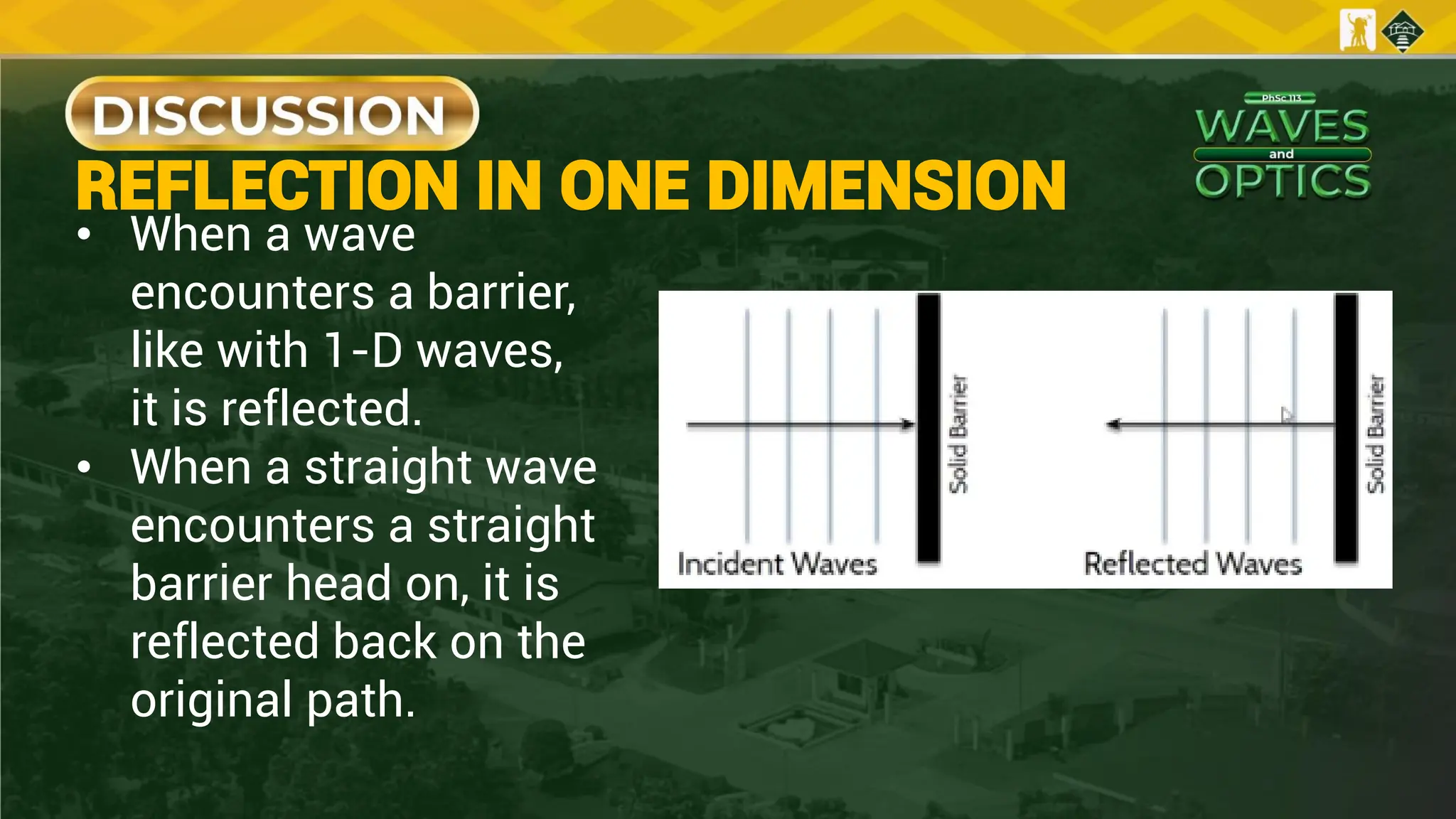
REFLECTION IN ONE DIMENSION
• When a wave
encounters a barrier,
like with 1-D waves,
it is reflected.
• When a straight wave
encounters a straight
barrier head on, it is
reflected back on the
original path.
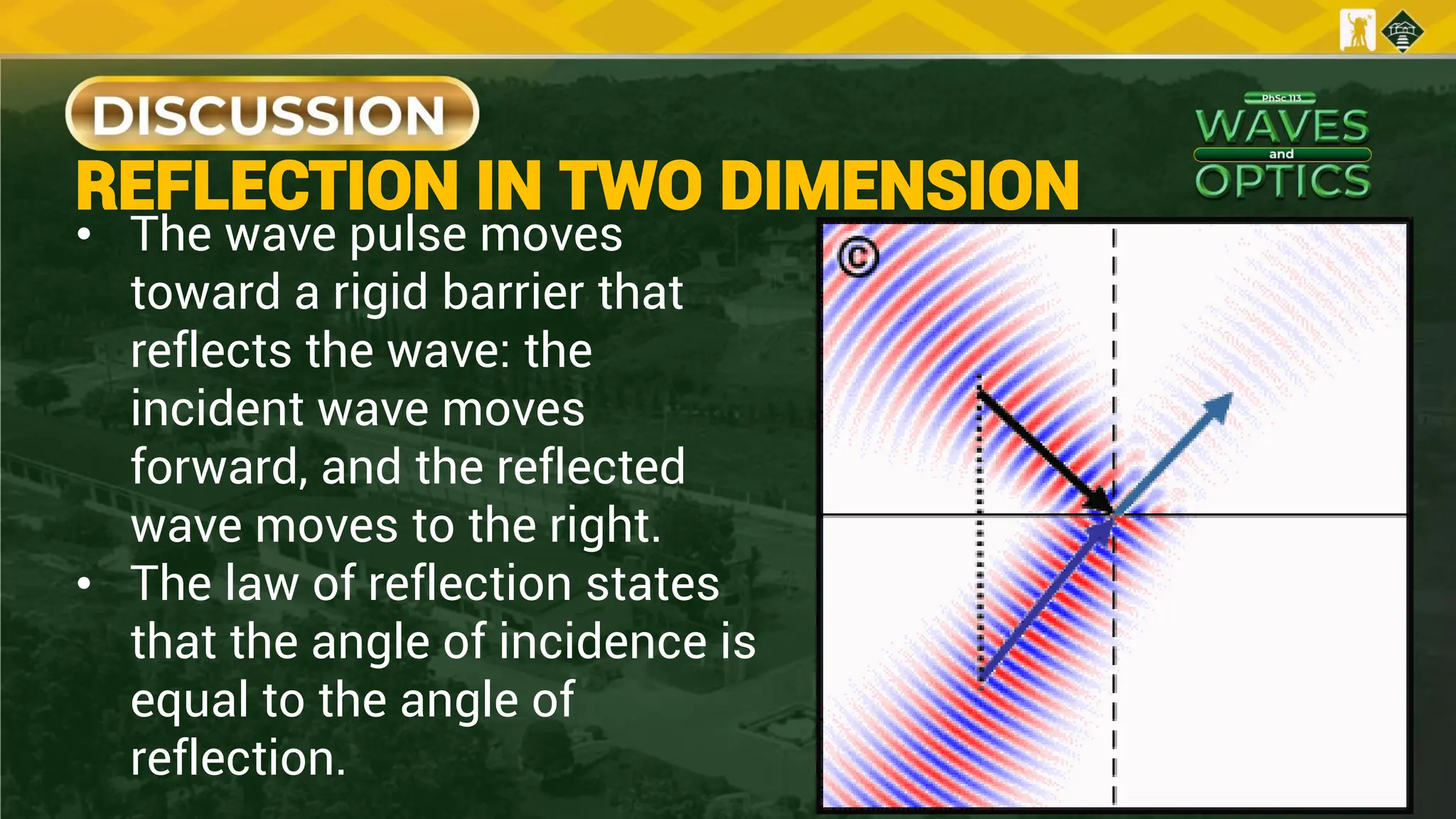
REFLECTION IN TWO DIMENSION
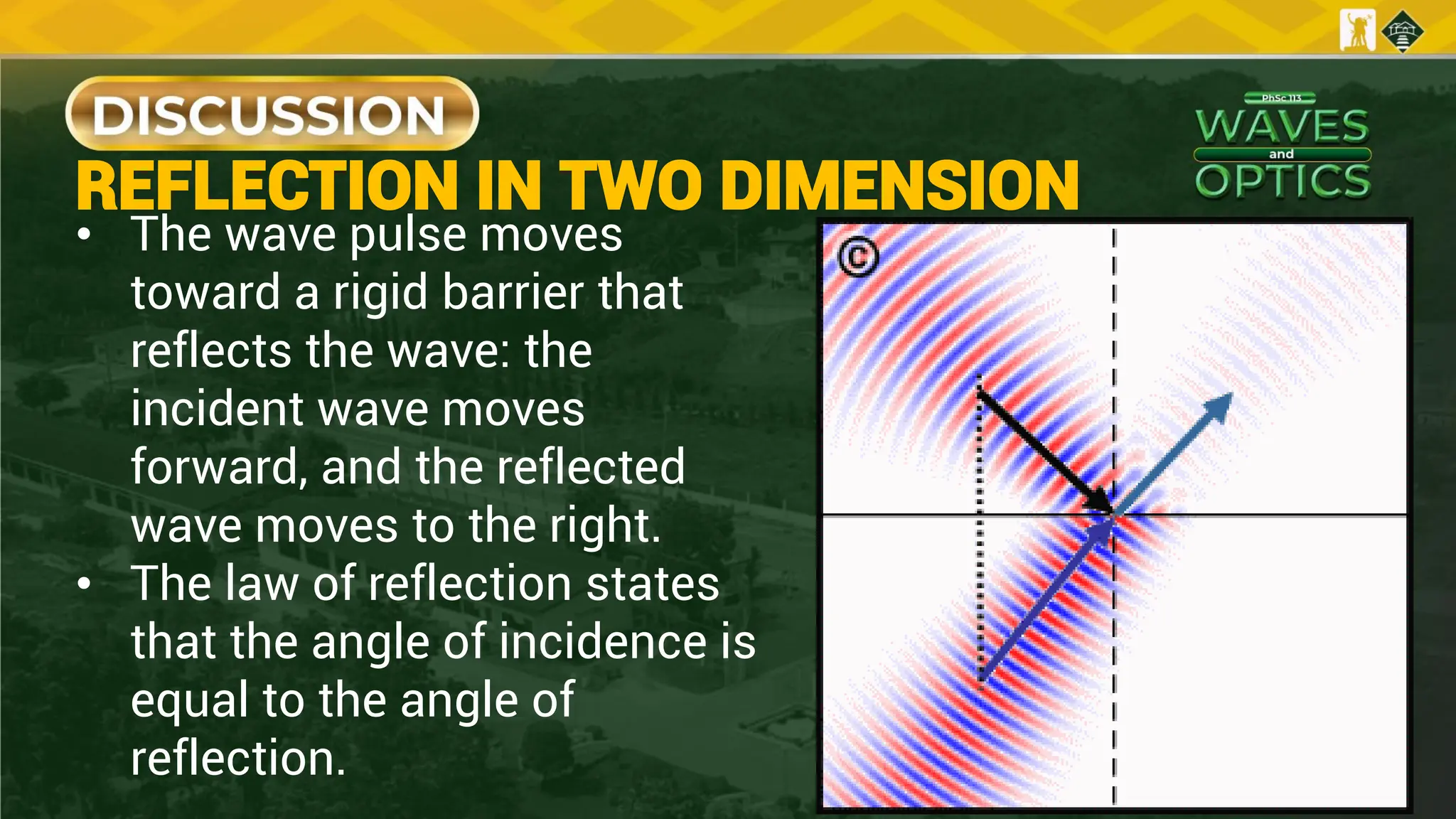
• The wave pulse moves
toward a rigid barrier that
reflects the wave: the
incident wave moves
forward, and the reflected
wave moves to the right.
• The law of reflection states
that the angle of incidence is
equal to the angle of
reflection.
WAVES IN TWO DIMENSION
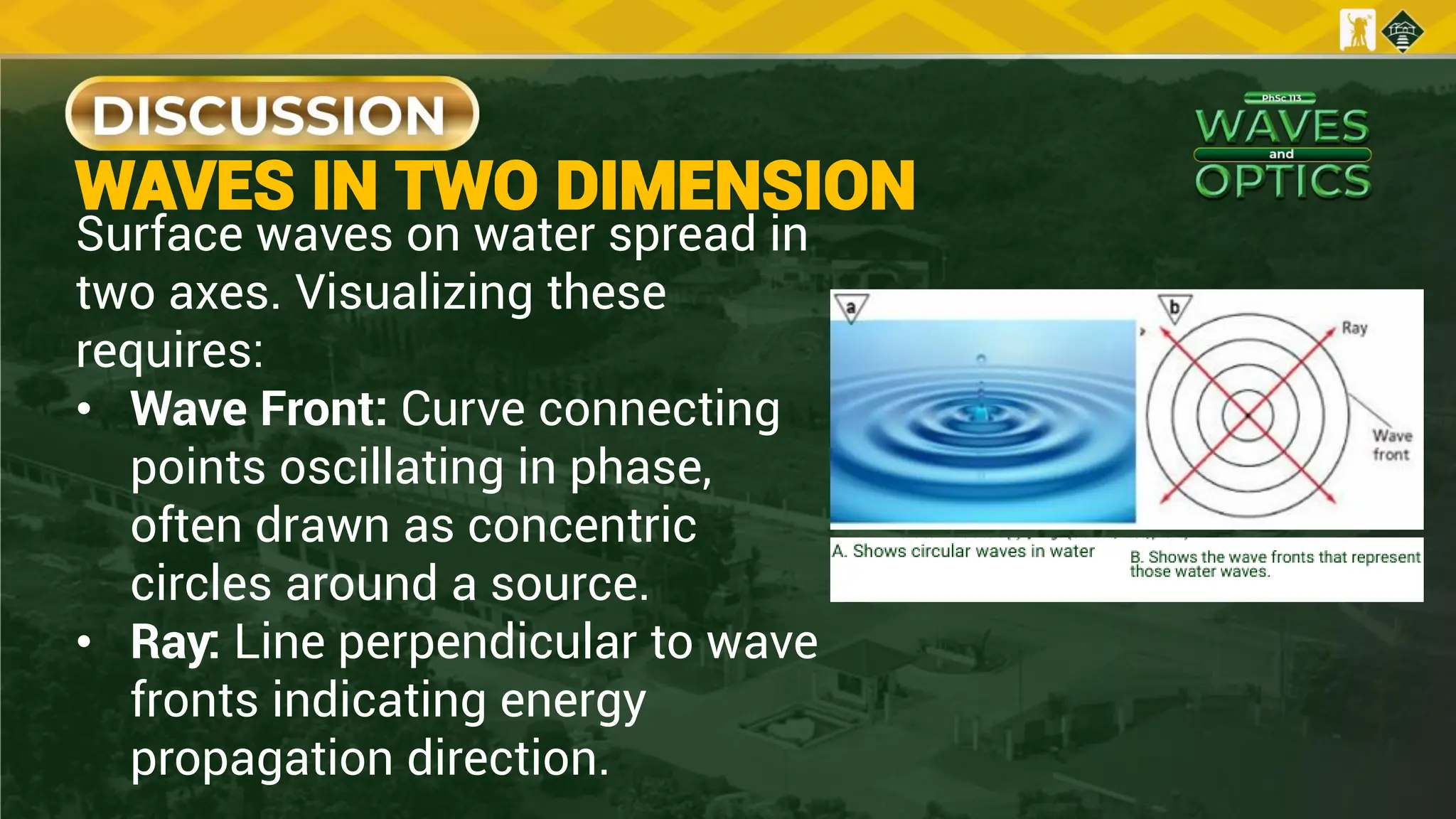
Surface waves on water spread in
two axes. Visualizing these
requires:
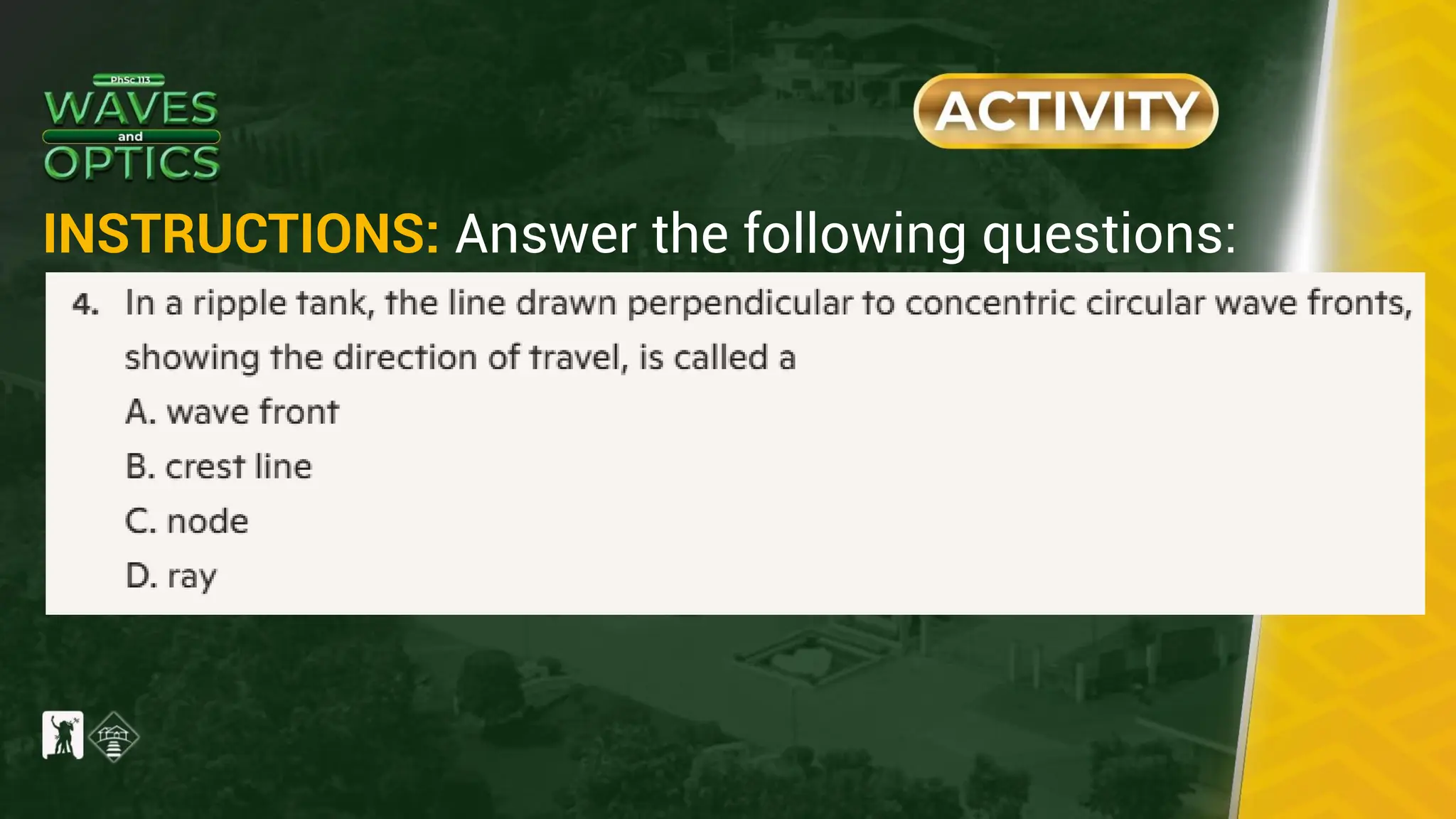
• Wave Front: Curve connecting
points oscillating in phase,
often drawn as concentric
circles around a source.
• Ray: Line perpendicular to wave
fronts indicating energy
propagation direction.
WAVES IN TWO DIMENSION
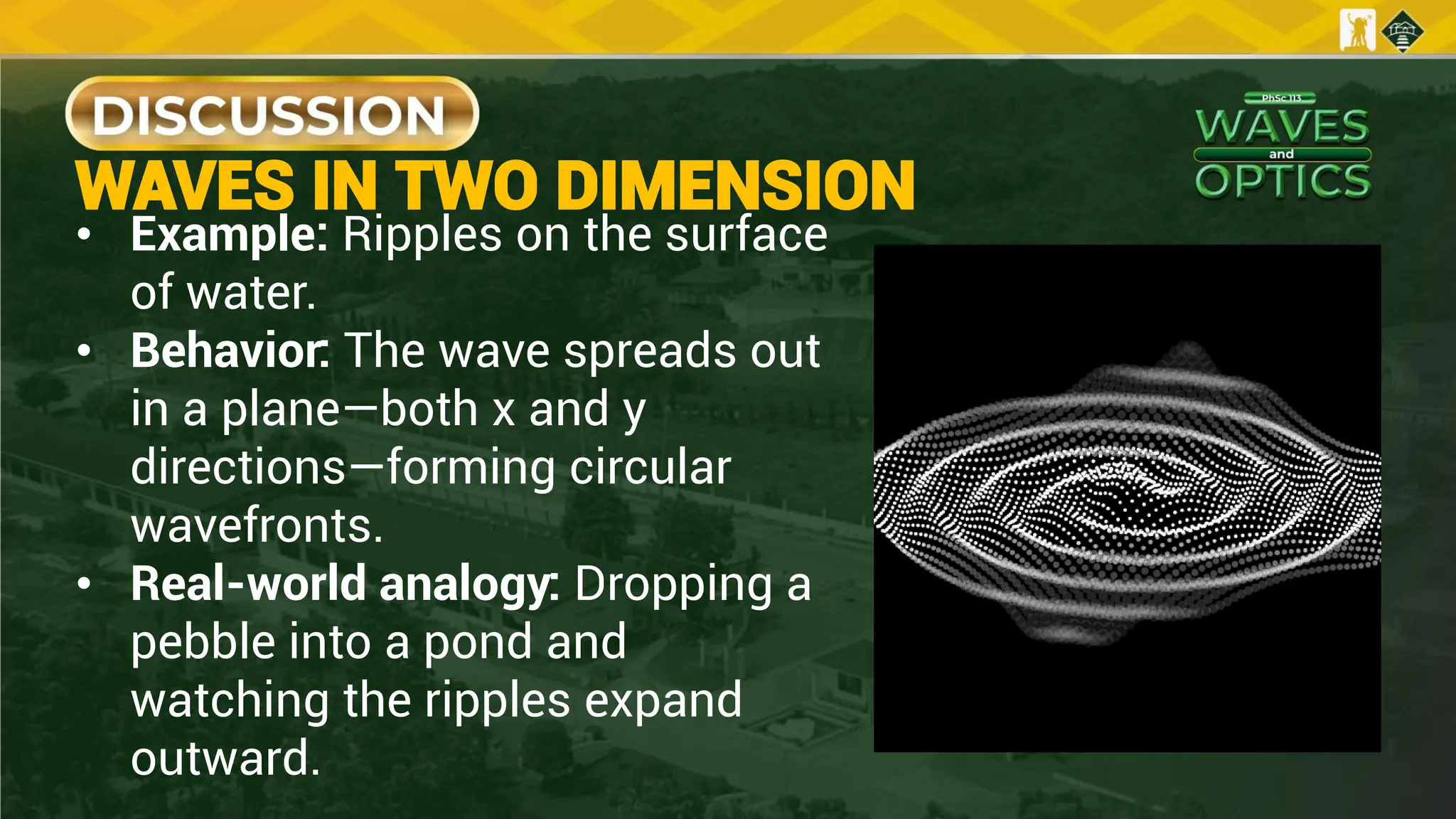
• Example: Ripples on the surface
of water.
• Behavior: The wave spreads out
in a plane—both x and y
directions—forming circular
wavefronts.
• Real-world analogy: Dropping a
pebble into a pond and
watching the ripples expand
outward.
WAVES IN TWO DIMENSION
REFLECTION IN TWO DIMENSION
• The wave pulse moves
toward a rigid barrier that
reflects the wave: the
incident wave moves
forward, and the reflected
wave moves to the right.
• The law of reflection states
that the angle of incidence is
equal to the angle of
reflection.
REFLECTION IN TWO DIMENSION
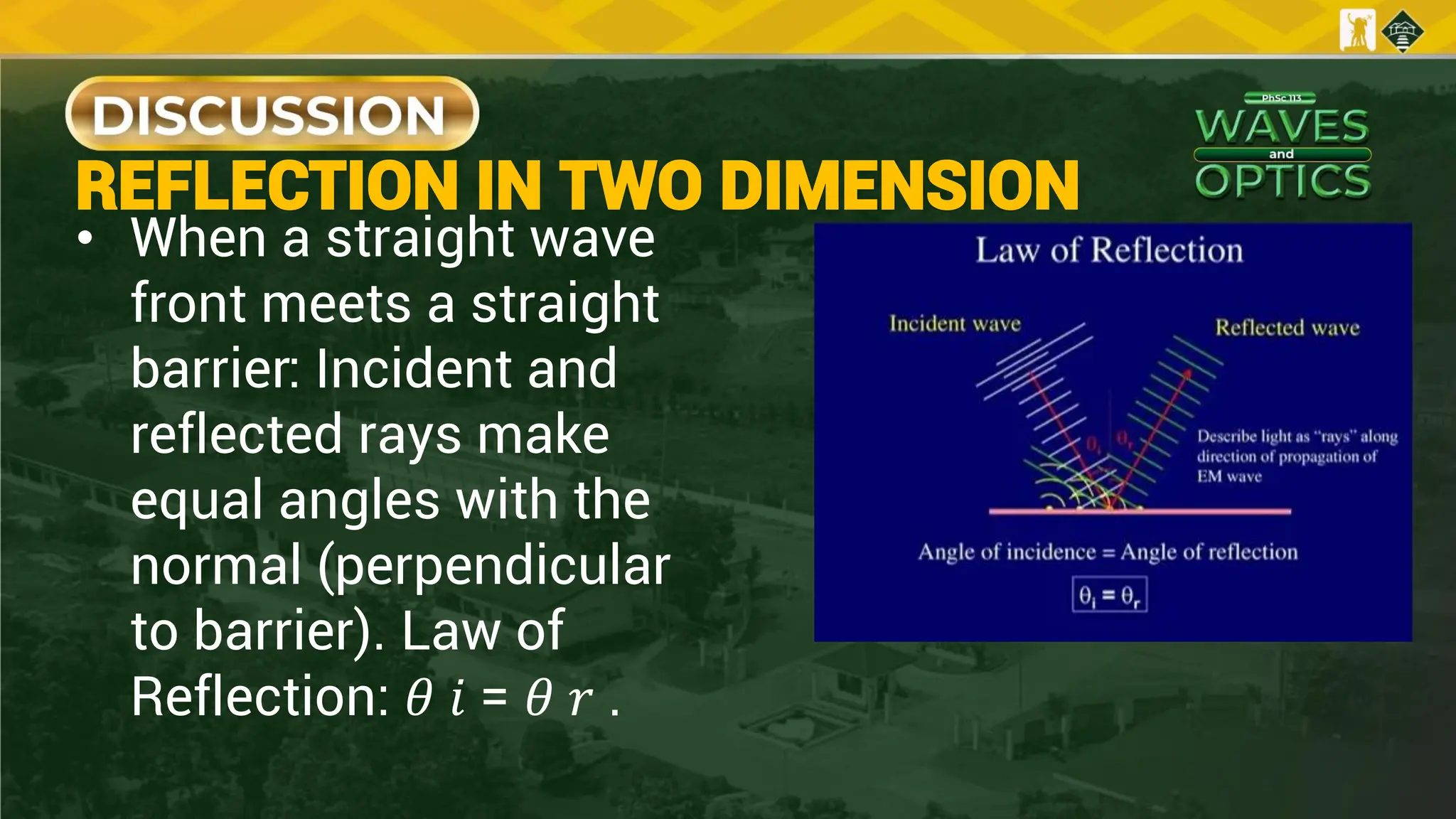
• When a straight wave
front meets a straight
barrier: Incident and
reflected rays make
equal angles with the
normal (perpendicular
to barrier). Law of
Reflection: 𝜃 𝑖 = 𝜃 𝑟 .
REFLECTION IN TWO DIMENSION
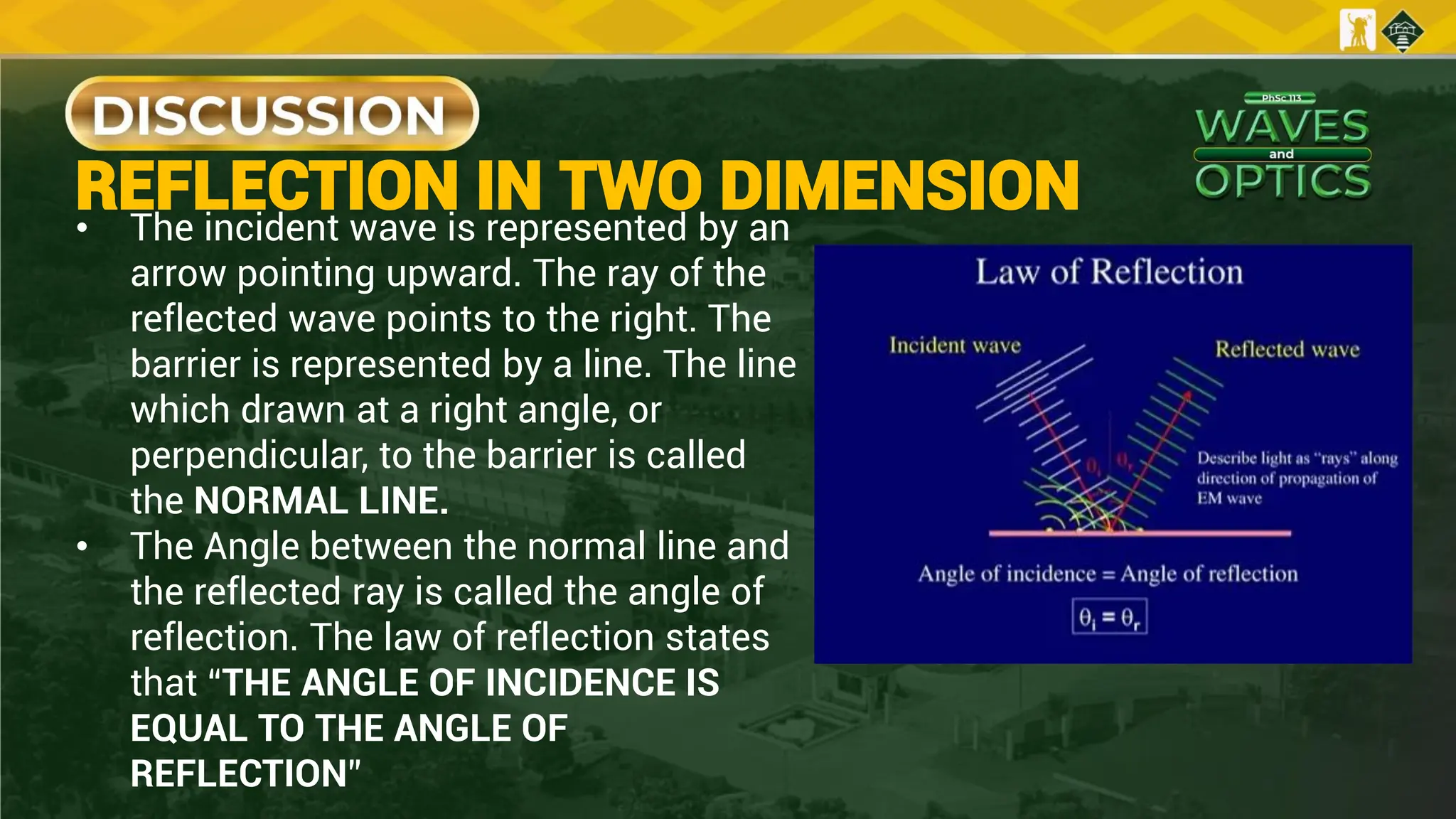
• The incident wave is represented by an
arrow pointing upward. The ray of the
reflected wave points to the right. The
barrier is represented by a line. The line
which drawn at a right angle, or
perpendicular, to the barrier is called
the NORMAL LINE.
• The Angle between the normal line and
the reflected ray is called the angle of
reflection. The law of reflection states
that “THE ANGLE OF INCIDENCE IS
EQUAL TO THE ANGLE OF
REFLECTION”
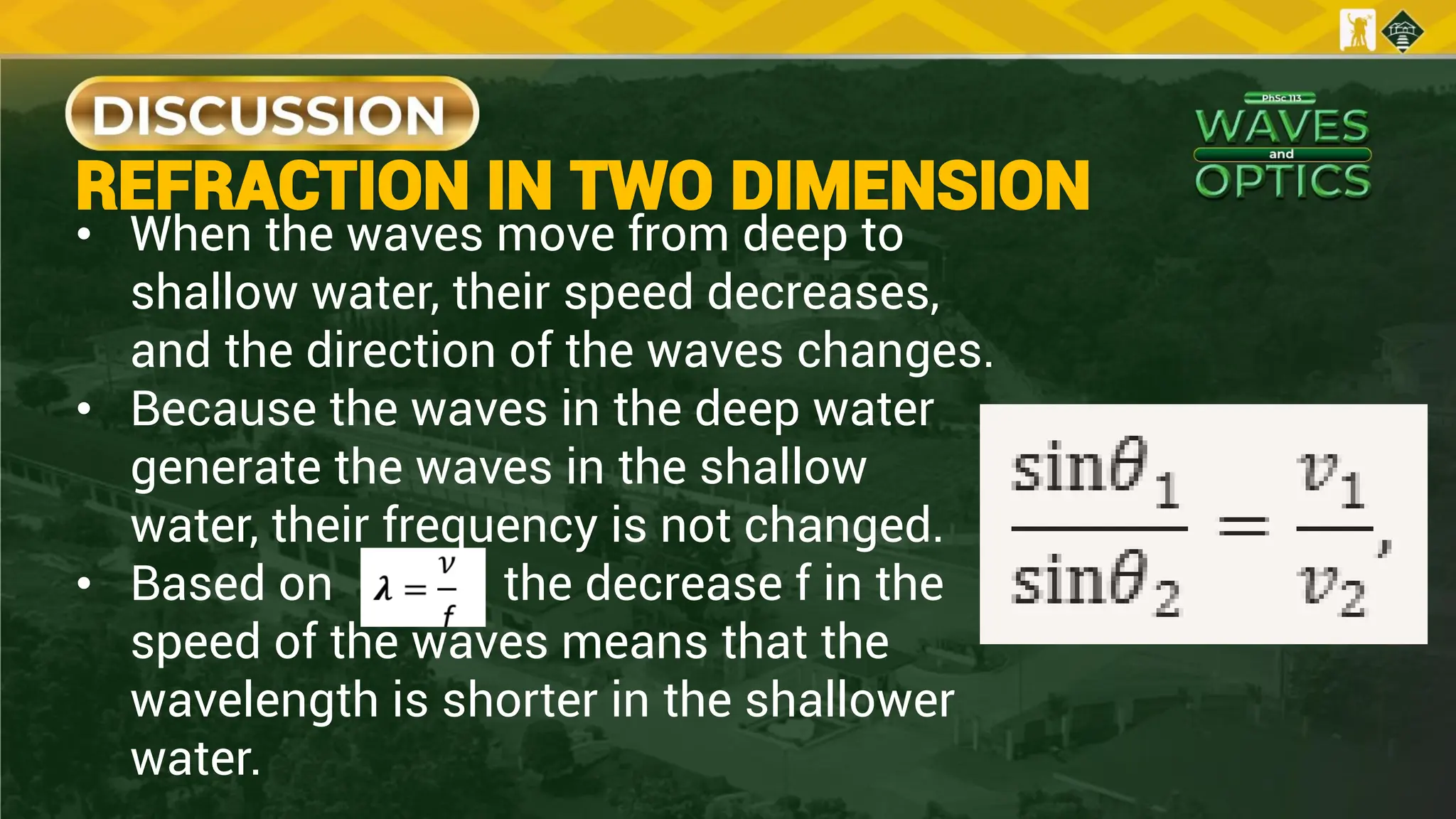
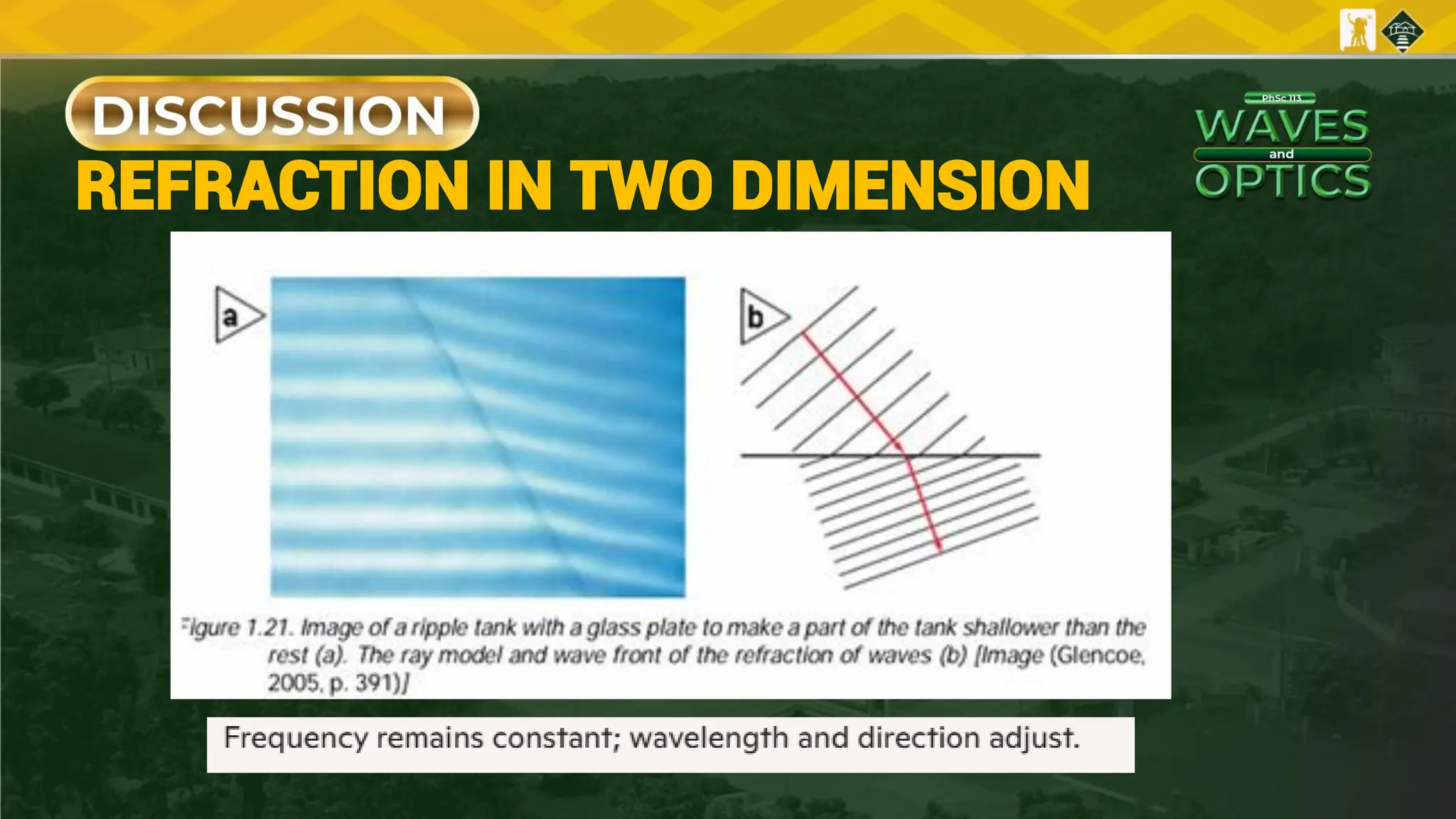
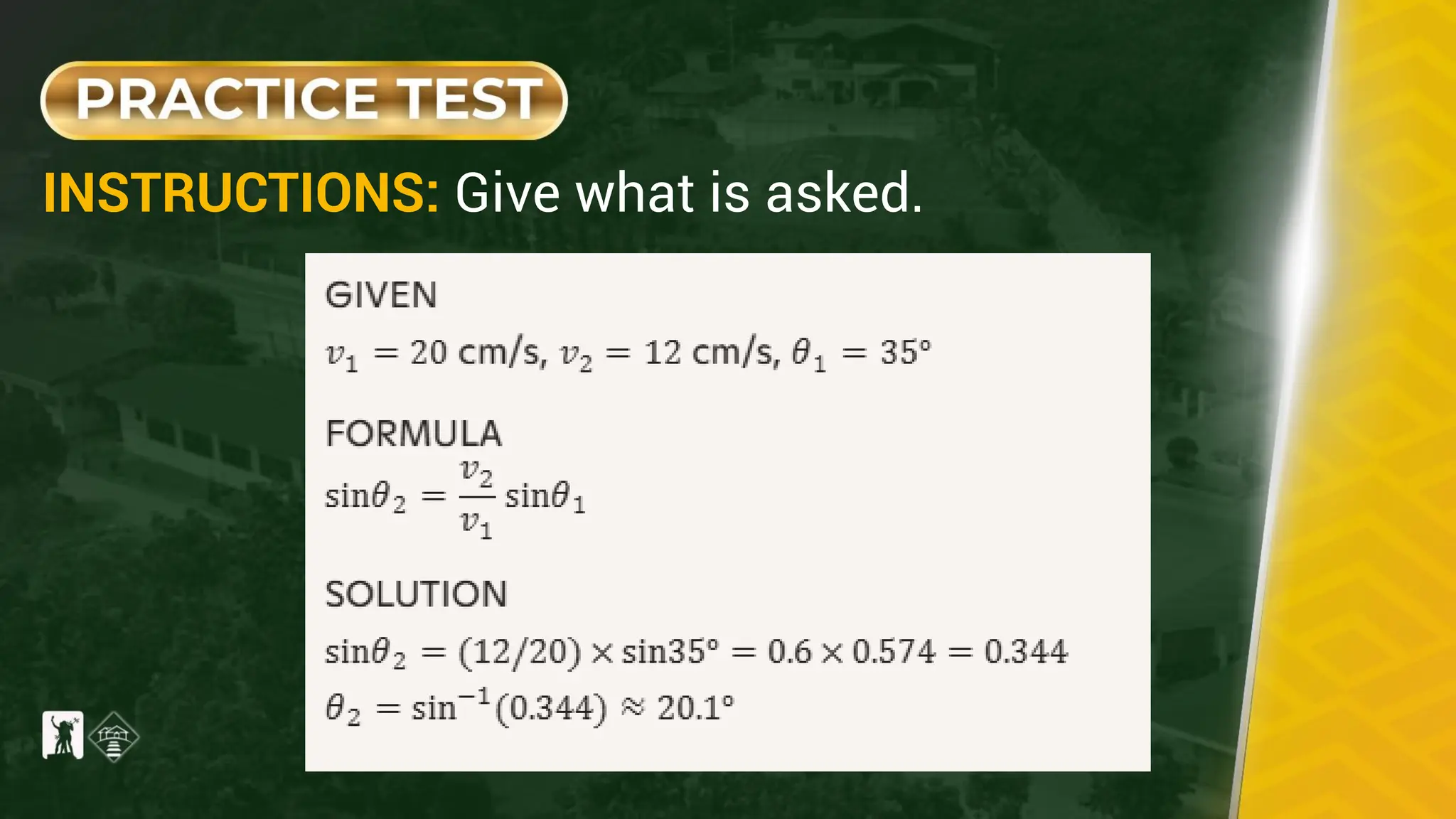
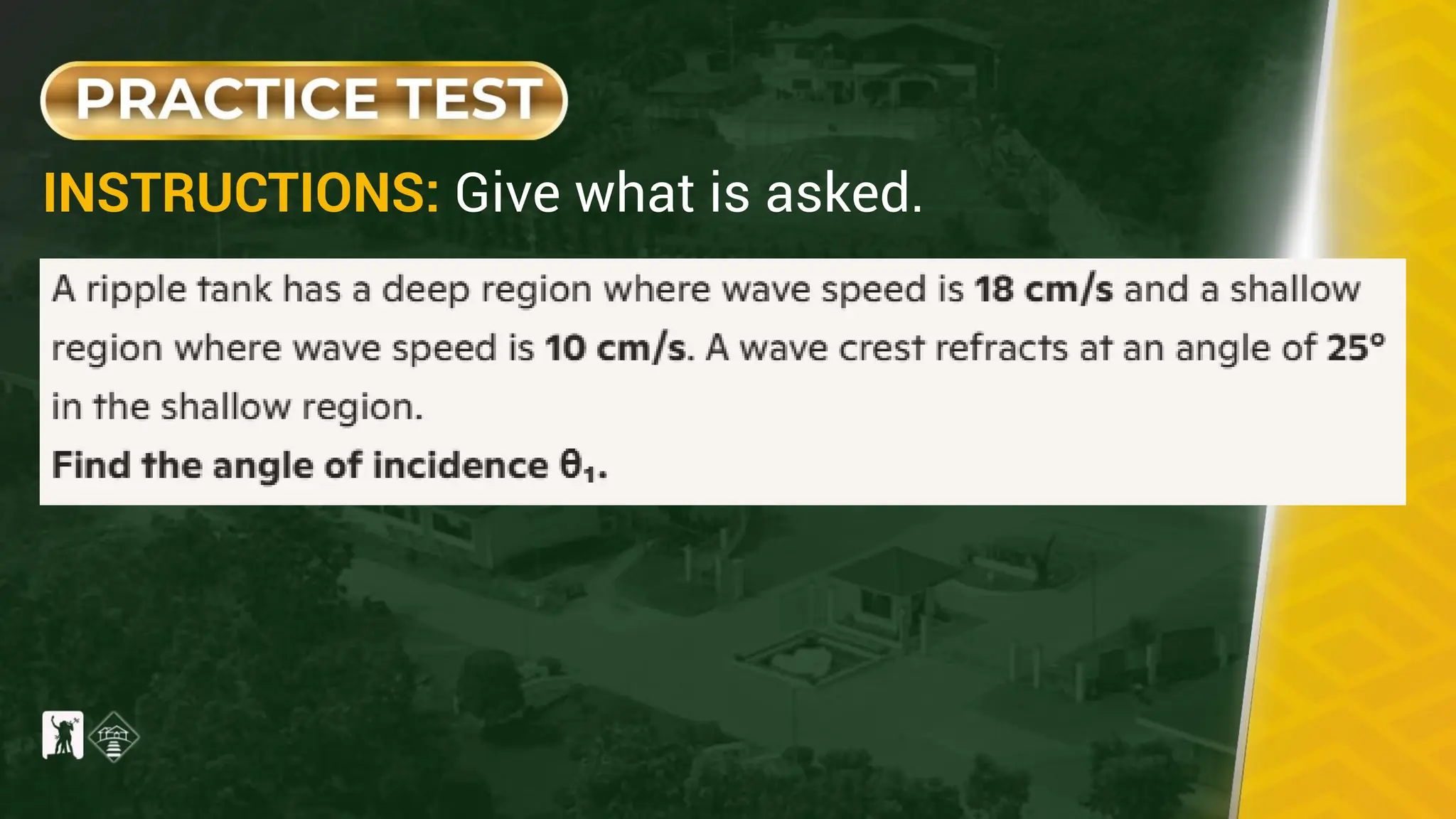
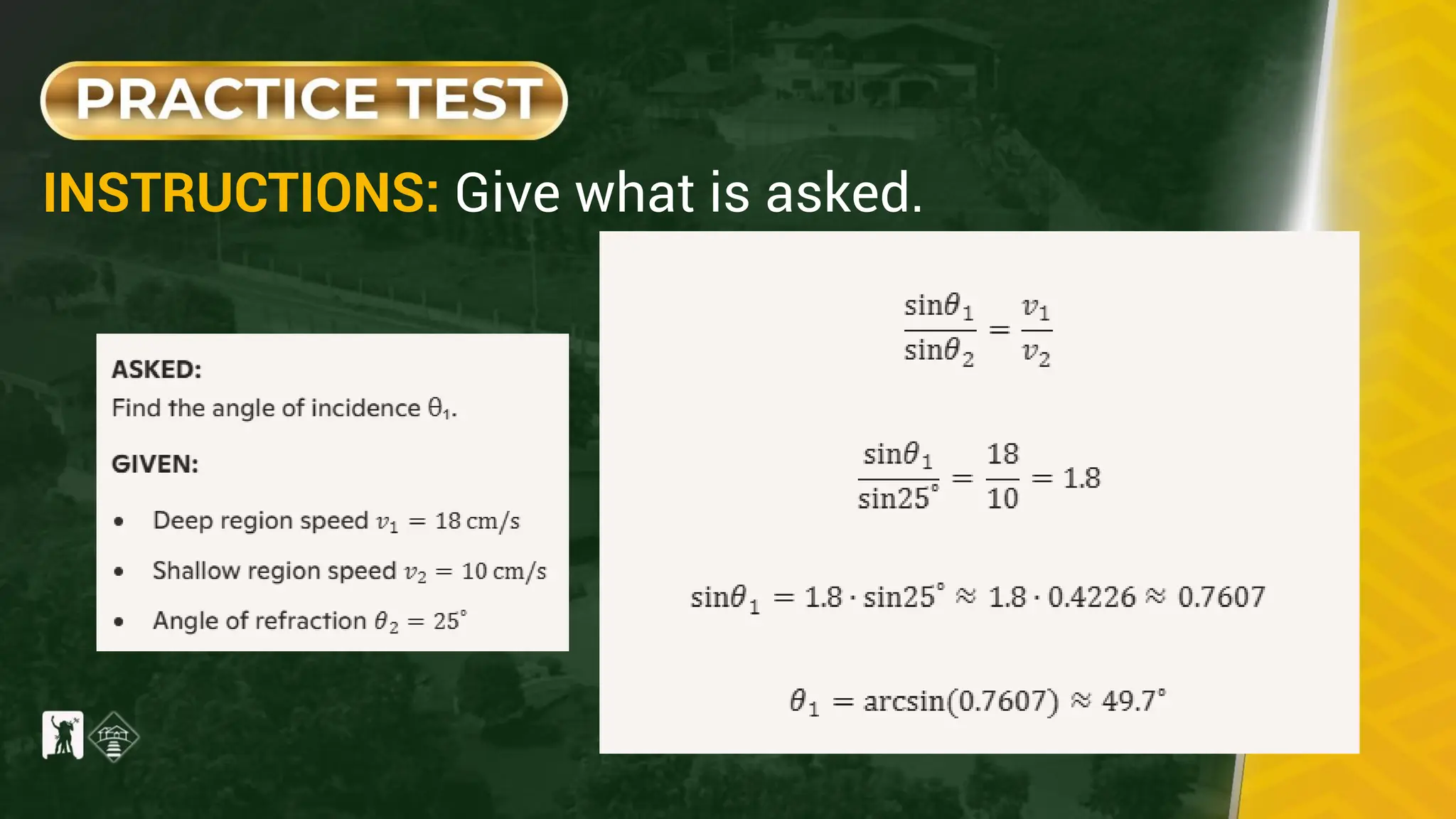
REFRACTION IN TWO DIMENSION
• When the waves move from deep to
shallow water, their speed decreases,
and the direction of the waves changes.
• Because the waves in the deep water
generate the waves in the shallow
water, their frequency is not changed.
• Based on the decrease f in the
speed of the waves means that the
wavelength is shorter in the shallower
water.
REFRACTION IN TWO DIMENSION
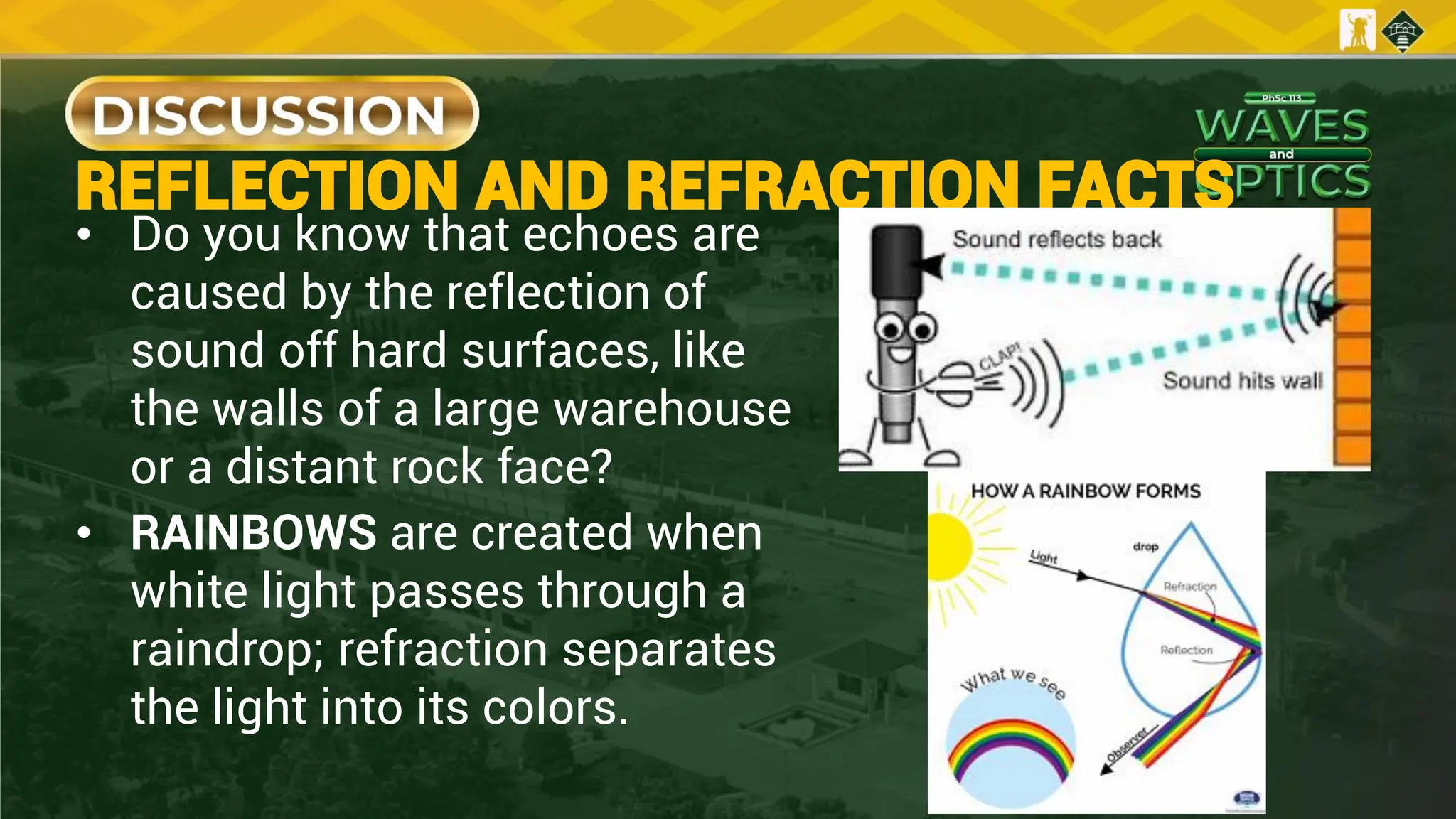
REFLECTION AND REFRACTION FACTS
• Do you know that echoes are
caused by the reflection of
sound off hard surfaces, like
the walls of a large warehouse
or a distant rock face?
• RAINBOWS are created when
white light passes through a
raindrop; refraction separates
the light into its colors.

INSTRUCTIONS: Give what is asked.

Module-1-Lesson-1.3.pdf.Wave behavior and Types

  • 2.
  • 3.
  • 5.
    INSTRUCTIONS: Answer thefollowing questions:
  • 6.
    INSTRUCTIONS: Answer thefollowing questions:
  • 7.
    INSTRUCTIONS: Answer thefollowing questions:
  • 8.
    INSTRUCTIONS: Answer thefollowing questions:
  • 9.
    INSTRUCTIONS: Answer thefollowing questions:
  • 11.
    • Relate awave’s speed to the medium in which the wave travels. • Describe how waves are reflected and refracted at boundaries between media. • Apply the principle of superposition to the phenomenon of interference
  • 12.
    Waves transport energyby oscillating a medium’s particles without moving the medium itself. From the echo of a shout against a canyon wall to the colorful rainbow arching overhead, wave behaviors— speed changes, reflections, refractions, and interference— shape much of what we observe. INTRODUCTION
  • 13.
    In this module,we explore how medium properties govern wave speed, how waves interact at boundaries (fixed, free, or “no‐end”), how overlapping waves combine, and how one‐ and two‐dimensional waves reveal patterns like standing waves and ripple‐tank phenomena. Each section builds deep conceptual understanding alongside practical, classroom‐ready examples and problem solving. INTRODUCTION
  • 14.
    Medium A material—solid, liquid,or gas—whose constituent particles transmit mechanical disturbances by oscillating around equilibrium positions. Examples include air for sound waves, water for surface ripples, and metal strings in instruments. DEFINITION OF TERMS
  • 15.
    Boundary Condition Constraints atan interface or end of a medium, determining wave displacement and phase upon reflection or transmission. Fixed ends enforce zero displacement; free ends allow maximal motion. DEFINITION OF TERMS
  • 16.
    Incident Wave (Pulse) Theportion of a wave train or single disturbance traveling toward a boundary before any reflection or transmission occurs. DEFINITION OF TERMS
  • 17.
    Reflected Wave (Pulse) Theportion of an incident wave that reverses direction upon meeting a boundary, possibly inverted (phase‐shifted by 180°) or upright, depending on boundary mobility. DEFINITION OF TERMS
  • 18.
    Transmitted Wave (Pulse) Thepart of the incident disturbance that continues into the second medium, maintaining original frequency but adopting the new medium’s speed and wavelength. DEFINITION OF TERMS
  • 19.
    Superposition The principle thatwhen two or more waves occupy the same region, the net displacement at a point is the algebraic sum of individual displacements. The principle that overlapping waves combine their displacements algebraically at each point: 𝑦total = 𝑦1 + 𝑦2 + … DEFINITION OF TERMS
  • 20.
    Interference The phenomenon arising fromsuperposition, producing regions of reinforcement (constructive) or cancellation (destructive). DEFINITION OF TERMS
  • 21.
    Diffraction The bending and spreadingof waves around obstacles or through openings, most pronounced when obstacle dimensions are comparable to the wavelength. DEFINITION OF TERMS
  • 22.
    Refraction The change indirection and wavelength of a wave as it crosses obliquely from one medium into another with different propagation speed, governed by Snell’s law. DEFINITION OF TERMS
  • 23.
    Standing Wave (Stationary Wave) Apattern formed by two waves of identical frequency and amplitude traveling in opposite directions, yielding fixed nodes (zero displacement) and antinodes (maximum displacement). DEFINITION OF TERMS
  • 24.
    Node A point ina standing wave where the net displacement is always zero due to perfect destructive interference. DEFINITION OF TERMS
  • 25.
    1.1 Dependence onAir Temperature Sound speed in dry air increases approximately linearly with temperature because warmer air molecules transmit pressure variations more rapidly. An empirical relation valid near atmospheric pressure is: SPEED OF SOUND WAVES
  • 26.
  • 27.
    SPEED OF SOUNDWAVES This arises from the exact thermodynamic formula on the speed of sound in an ideal gas:
  • 28.
  • 29.
    INSTRUCTIONS: Answer thefollowing questions:
  • 30.
    INSTRUCTIONS: Answer thefollowing questions:
  • 31.
    Mechanical impedance—rooted indensity and elasticity—dictates wave speed across materials. Stiffer and less compressible media conduct sound faster. DEPENDENCE ON MEDIUM
  • 32.
    INSTRUCTIONS: Answer thefollowing questions:
  • 33.
    INSTRUCTIONS: Answer thefollowing questions:
  • 34.
    When the incidentpulse reaches a boundary, two things occur: • A portion of the energy carried by the pulse is reflected and returns towards the left end of the rope (reflected pulse). • A portion of the energy carried by the pulse is transmitted to the wall WAVE INTERACTION WITH BOUNDARY
  • 35.
    • Constraint: Endheld immobile (e.g., rope tied to a rigid wall). • Reflection: Pulse inverts (180° phase shift) because displacement at boundary must be zero. • Speed & Wavelength: Remain equal to incident values. FIXED END
  • 36.
    • Reflected waveis inverted with the incident wave • Speed is the same • Wavelength is the same • Reflected wave’s amplitude is lesser FIXED END
  • 37.
    • Constraint: Endcan move freely (e.g., rope over frictionless ring). • Reflection: Pulse remains upright (no phase shift) as boundary displacement maximizes. • Speed & Wavelength: Unchanged from incident. FREE END
  • 38.
    • Reflected waveis in phase with the incident wave • Speed is the same • Wavelength is the same • Reflected wave’s amplitude is lesser FREE END
  • 39.
    FIXED END VS.FREE END
  • 40.
    • Constraint: Mediumextends indefinitely or terminates in energy absorber (e.g., water waves on a sandy beach). • Reflection: None—incident energy either continues or dissipates. • Illustration: Rope end dipped in viscous fluid shows pulse disappearing without echo. NO END
  • 41.
    FIXED, FREE, ANDNO-END CONDITIONS
  • 42.
    • Waves willreact differently with varying linear densities of the strings. WAVES IN VARYING DENSITY
  • 43.
    • The transmittedpulse is traveling slower than the reflected pulse. • The transmitted pulse has a smaller wavelength than the reflected pulse. • The speed and the wavelength of the reflected pulse are the same as the speed and the wavelength of the incident pulse WAVES IN VARYING DENSITY
  • 44.
    • Waves willreact differently with varying linear densities of the strings. WAVES IN VARYING DENSITY
  • 45.
    • The transmittedpulse is traveling faster than the reflected pulse. • The transmitted pulse has a larger wavelength than the reflected pulse. • The speed and the wavelength of the reflected pulse are the same as the speed and the wavelength of the incident pulse WAVES IN VARYING DENSITY
  • 46.
    As a pulsetravels from medium 1 into medium 2: • Incident Pulse approaches the boundary. • Reflected Pulse returns into medium 1 with reduced amplitude. • Transmitted Pulse continues into medium 2 at speed 𝑣2 and wavelength 𝜆2, sharing the incident frequency 𝑓 . INCIDENT, REFLECTED, AND TRANSMITTED PULSES
  • 47.
    INSTRUCTIONS: Answer thefollowing questions:
  • 48.
    INSTRUCTIONS: Answer thefollowing questions:
  • 49.
  • 50.
    What happens whentwo waves meet while they travel through the same medium? SUPERPOSITION AND INTERFERENCE
  • 51.
    INTERFERENCE • It isa phenomenon that occurs when two waves meet while traveling along the same medium
  • 52.
    PRINCIPLE OF SUPERPOSITION •When multiple waves coexist in a medium, they do not collide; rather, their displacements add algebraically at each point:
  • 53.
    PRINCIPLE OF SUPERPOSITION •It states that the disturbance in a medium caused by two or more waves is the algebraic sum of the displacements produced by the individual waves. • Waves can combine to form a new wave • Waves moving in opposite directions can cancel or form a new wave of lesser or greater amplitude. • This principle underpins all interference phenomena.
  • 54.
  • 55.
    CONSTRUCTIVE INTERFERENCE • In‐phasewaves ( 0 ° difference) reinforce, yielding a resultant amplitude 𝐴res = 𝐴1 + 𝐴2 . • Two interfering waves have a displacement in the same direction. • The amplitude of the resulting wave is equal to the sum of the individual amplitudes
  • 56.
    CONSTRUCTIVE INTERFERENCE • In‐phasewaves ( 0 ° difference) reinforce, yielding a resultant amplitude 𝐴res = 𝐴1 + 𝐴2 . • Two interfering waves have a displacement in the same direction. • The amplitude of the resulting wave is equal to the sum of the individual amplitudes • Waves pass each other.
  • 57.
    CONSTRUCTIVE INTERFERENCE Scenario 1:Same Phase, Unequal Amplitudes • Description: Two waves are in phase, meaning their crests and troughs align perfectly. But one wave has a larger amplitude than the other. • Result: The amplitudes add together, so the resultant wave has a larger amplitude than either wave individually. • Type of Interference: Constructive interference—even though the amplitudes are unequal, the waves reinforce each other. • Nickname: You could call this partial constructive interference, but it's still fundamentally constructive.
  • 58.
    DESTRUCTIVE INTERFERENCE • Out‐of‐phasewaves ( 180 ° difference) cancel, potentially producing zero net displacement. • The two interfering waves have a displacement in the opposite direction • When waves overlap, the effect of one of the pulses on the displacement of a given particle of the medium is destroyed or canceled by the effect of the other pulse. • Only a momentary condition-waves pass each other
  • 59.
    DESTRUCTIVE INTERFERENCE • Out‐of‐phasewaves ( 180 ° difference) cancel, potentially producing zero net displacement. • The two interfering waves have a displacement in the opposite direction • When waves overlap, the effect of one of the pulses on the displacement of a given particle of the medium is destroyed or canceled by the effect of the other pulse. • Only a momentary condition-waves pass each other
  • 60.
    DESTRUCTIVE INTERFERENCE Scenario 2:Out of Phase, Unequal Amplitudes • Description: The waves are out of phase (e.g., crest meets trough), but one wave is larger than the other. • Result: The smaller wave partially cancels the larger one, resulting in a wave with reduced amplitude, but not zero. • Type of Interference: Destructive interference—because cancellation occurs, even if it's not complete. • Nickname: This is often called partial destructive interference or incomplete cancellation.
  • 61.
  • 62.
  • 63.
    INSTRUCTIONS: Identify whattype of interference is asked
  • 64.
    INSTRUCTIONS: Identify whattype of interference is asked • G: Partial Constructive (The waves are partially in phase, resulting in a resultant wave with an amplitude greater than the individual waves but less than the maximum possible) • H: Partial Destructive (The waves are partially out of phase, resulting in a resultant wave with a reduced amplitude) • I: Partial Destructive (The waves are partially out of phase, resulting in a resultant wave with a reduced amplitude)
  • 65.
    INSTRUCTIONS: Identify whattype of interference is asked • J: Partial Constructive (The waves are partially in phase, resulting in a resultant wave with an amplitude greater than the individual waves but less than the maximum possible) • K: Partial Destructive (Similar to 'I', the waves are partially out of phase, leading to partial cancellation) • L: Partial Destructive (Similar to 'I', the waves are partially out of phase, leading to partial cancellation)
  • 66.
    INSTRUCTIONS: Identify whattype of interference is asked • M: Partial Constructive (The waves are partially in phase, resulting in a resultant wave with an amplitude greater than the individual waves but less than the maximum possible) • N: Partial Constructive (The waves are partially in phase, resulting in a resultant wave with an amplitude greater than the individual waves but less than the maximum possible) • O: Partial Destructive (Similar to 'I', the waves are partially out of phase, leading to partial cancellation)
  • 67.
    STANDING WAVES (STATIONARYWAVES) • A combination of two waves moving in opposite directions, each having the same amplitude and frequency. • Result of interference • Standing wave pattern - points that appear to be standing still • Only created within the medium at specific frequencies (harmonics) of vibration
  • 68.
    STANDING WAVES (STATIONARYWAVES) A standing wave emerges from two identical waves traveling oppositely. Nodes (zero displacement) form at fixed points; antinodes (maximum displacement) lie midway. Only discrete frequencies (harmonics) satisfy boundary constraints on a string of length 𝐿 fixed at both ends:
  • 69.
  • 70.
  • 71.
    WAVES IN ONEDIMENSION One‐dimensional waves— such as pulses on a rope—confine oscillations along a single axis. Analysis tracks displacement vs. position and time, ideal for illustrating boundary reflections and standing modes.
  • 72.
    REFLECTION IN ONEDIMENSION • When a wave encounters a barrier, like with 1-D waves, it is reflected. • When a straight wave encounters a straight barrier head on, it is reflected back on the original path.
  • 73.
    REFLECTION IN TWODIMENSION • The wave pulse moves toward a rigid barrier that reflects the wave: the incident wave moves forward, and the reflected wave moves to the right. • The law of reflection states that the angle of incidence is equal to the angle of reflection.
  • 74.
    WAVES IN TWODIMENSION Surface waves on water spread in two axes. Visualizing these requires: • Wave Front: Curve connecting points oscillating in phase, often drawn as concentric circles around a source. • Ray: Line perpendicular to wave fronts indicating energy propagation direction.
  • 75.
    WAVES IN TWODIMENSION • Example: Ripples on the surface of water. • Behavior: The wave spreads out in a plane—both x and y directions—forming circular wavefronts. • Real-world analogy: Dropping a pebble into a pond and watching the ripples expand outward.
  • 76.
    WAVES IN TWODIMENSION
  • 77.
    WAVES IN TWODIMENSION
  • 78.
    WAVES IN TWODIMENSION
  • 79.
    REFLECTION IN TWODIMENSION • The wave pulse moves toward a rigid barrier that reflects the wave: the incident wave moves forward, and the reflected wave moves to the right. • The law of reflection states that the angle of incidence is equal to the angle of reflection.
  • 80.
    REFLECTION IN TWODIMENSION • When a straight wave front meets a straight barrier: Incident and reflected rays make equal angles with the normal (perpendicular to barrier). Law of Reflection: 𝜃 𝑖 = 𝜃 𝑟 .
  • 81.
    REFLECTION IN TWODIMENSION • The incident wave is represented by an arrow pointing upward. The ray of the reflected wave points to the right. The barrier is represented by a line. The line which drawn at a right angle, or perpendicular, to the barrier is called the NORMAL LINE. • The Angle between the normal line and the reflected ray is called the angle of reflection. The law of reflection states that “THE ANGLE OF INCIDENCE IS EQUAL TO THE ANGLE OF REFLECTION”
  • 82.
    REFRACTION IN TWODIMENSION • When the waves move from deep to shallow water, their speed decreases, and the direction of the waves changes. • Because the waves in the deep water generate the waves in the shallow water, their frequency is not changed. • Based on the decrease f in the speed of the waves means that the wavelength is shorter in the shallower water.
  • 83.
  • 84.
    REFLECTION AND REFRACTIONFACTS • Do you know that echoes are caused by the reflection of sound off hard surfaces, like the walls of a large warehouse or a distant rock face? • RAINBOWS are created when white light passes through a raindrop; refraction separates the light into its colors.
  • 85.
  • 86.
  • 87.
  • 88.